ARM Architecture
Computer Organization and Assembly Languagesp g z y g g
Yung-Yu Chuang
with slides by Peng-Sheng Chen, Ville Pietikainen
ARM history
• 1983 developed by Acorn computers
T l 6502 i BBC t– To replace 6502 in BBC computers
– 4-man VLSI design team
It i li it f th i i t– Its simplicity comes from the inexperience team
– Match the needs for generalized SoC for reasonable
power performance and die sizepower, performance and die size
– The first commercial RISC implemenation
1990 ARM (Ad d RISC M hi ) d b• 1990 ARM (Advanced RISC Machine), owned by
Acorn, Apple and VLSI
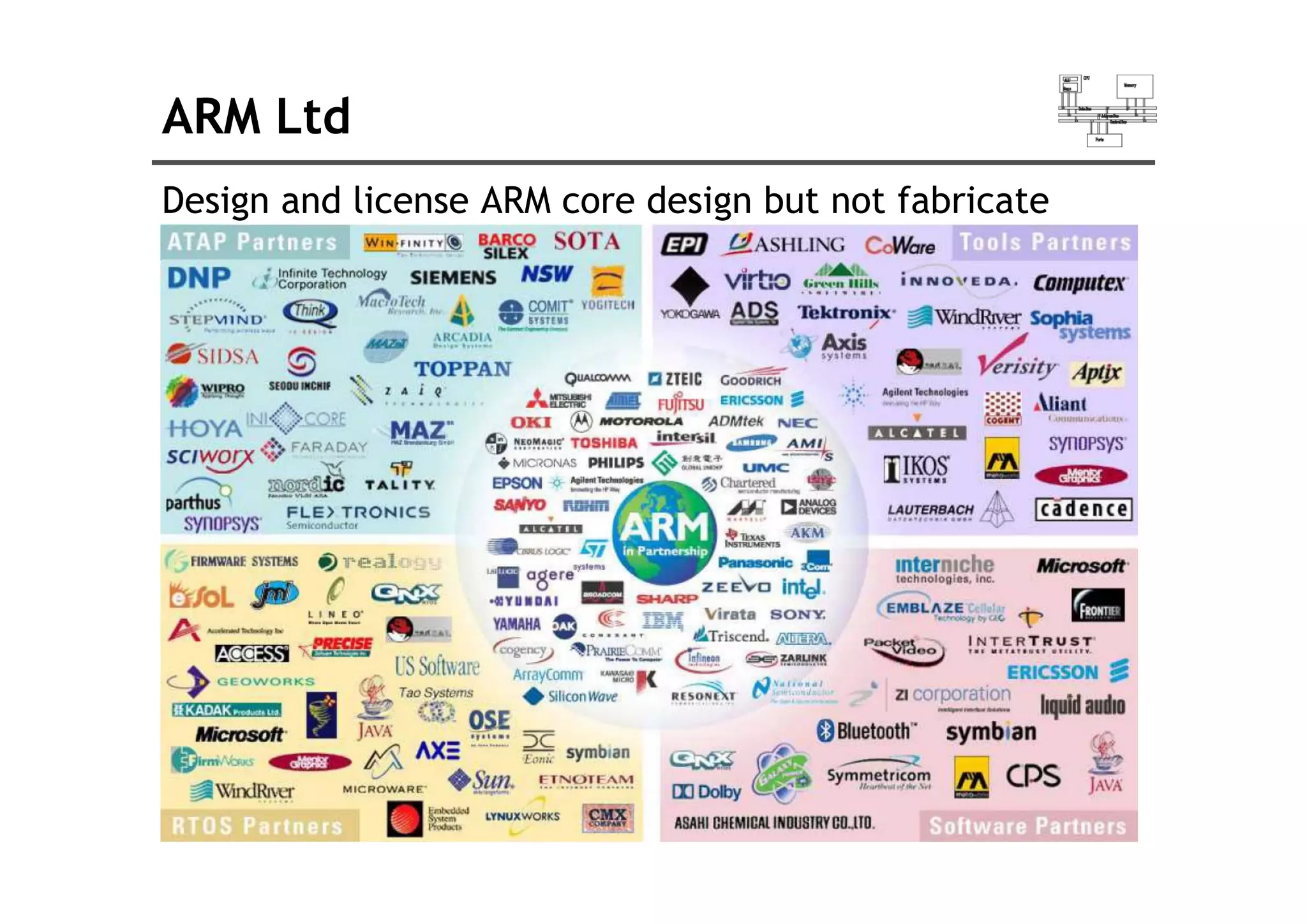
ARM Ltd
Design and license ARM core design but not fabricate
Why ARM?
• One of the most licensed and thus widespread
processor cores in the worldprocessor cores in the world
– Used in PDA, cell phones, multimedia players,
handheld game console digital TV and camerashandheld game console, digital TV and cameras
– ARM7: GBA, iPod
ARM9: NDS PSP Sony Ericsson BenQ– ARM9: NDS, PSP, Sony Ericsson, BenQ
– ARM11: Apple iPhone, Nokia N93, N800
90% of 32 bit embedded RISC processors till 2009– 90% of 32-bit embedded RISC processors till 2009
• Used especially in portable devices due to its
l ti d bllow power consumption and reasonable
performance
ARM powered products
ARM processors
• A simple but powerful design
A h l f il f d i h i i il d i• A whole family of designs sharing similar design
principles and a common instruction set
Naming ARM
• ARMxyzTDMIEJFS
– x: series– x: series
– y: MMU
z: cache– z: cache
– T: Thumb
D: debugger– D: debugger
– M: Multiplier
I: EmbeddedICE (built in debugger hardware)– I: EmbeddedICE (built-in debugger hardware)
– E: Enhanced instruction
J J ll (JVM)– J: Jazelle (JVM)
– F: Floating-point
S S th i ibl i ( d i f EDA– S: Synthesizible version (source code version for EDA
tools)
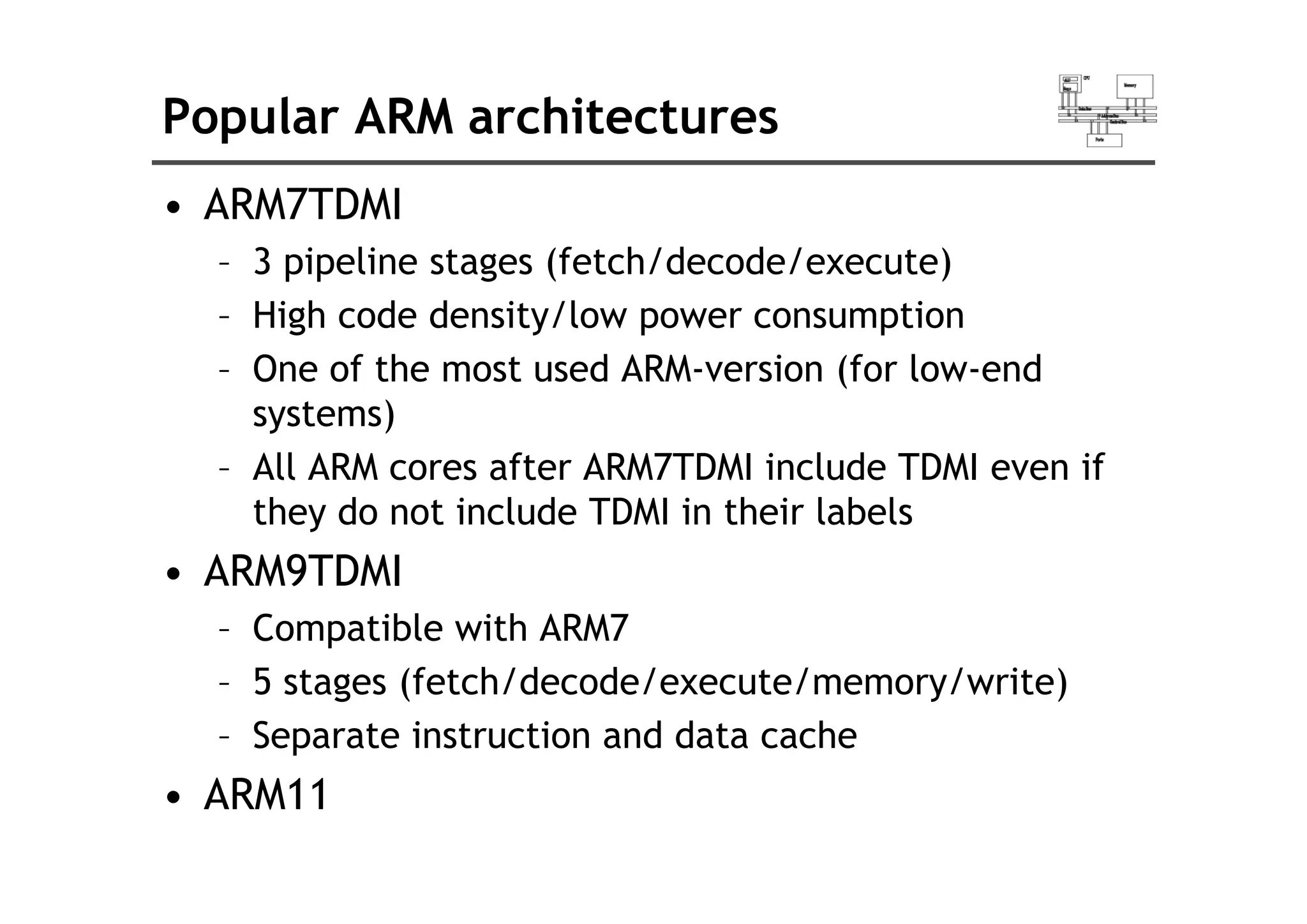
Popular ARM architectures
• ARM7TDMI
3 i li t (f t h/d d / t )– 3 pipeline stages (fetch/decode/execute)
– High code density/low power consumption
O f th t d ARM i (f l d– One of the most used ARM-version (for low-end
systems)
All ARM cores after ARM7TDMI include TDMI even if– All ARM cores after ARM7TDMI include TDMI even if
they do not include TDMI in their labels
ARM9TDMI• ARM9TDMI
– Compatible with ARM7
5 t (f t h/d d / t / / it )– 5 stages (fetch/decode/execute/memory/write)
– Separate instruction and data cache
• ARM11
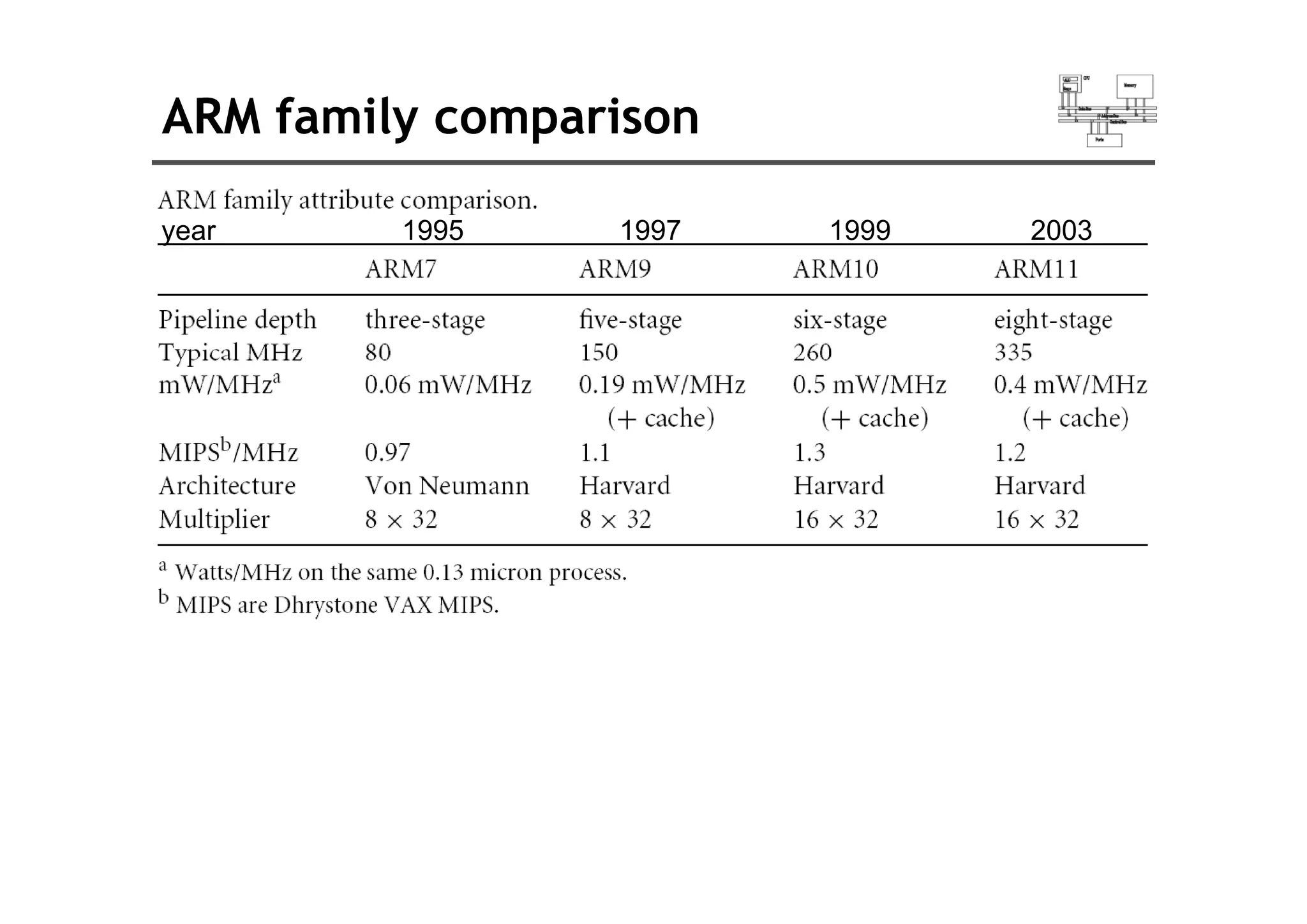
ARM family comparison
year 1995 1997 1999 2003
ARM is a RISC
• RISC: simple but powerful instructions that
execute within a single cycle at high clock speedexecute within a single cycle at high clock speed.
• Four major design rules:
– Instructions: reduced set/single cycle/fixed length
– Pipeline: decode in one stage/no need for microcode
– Registers: a large set of general-purpose registers
– Load/store architecture: data processing instructions
apply to registers only; load/store to transfer data
from memory
R l i i l d i d f l k• Results in simple design and fast clock rate
• The distinction blurs because CISC implements
RISC concepts
ARM design philosophy
• Small processor for lower power consumption
(for embedded system)(for embedded system)
• High code density for limited memory and
h i l i t i tiphysical size restrictions
• The ability to use slow and low-cost memory
• Reduced die size for reducing manufacture cost
and accommodating more peripheralsg p p
ARM features
• Different from pure RISC in several ways:
V i bl l ti f t i i t ti– Variable cycle execution for certain instructions:
multiple-register load/store (faster/higher code
density)density)
– Inline barrel shifter leading to more complex
instructions: improves performance and code densityinstructions: improves performance and code density
– Thumb 16-bit instruction set: 30% code density
improvementp
– Conditional execution: improve performance and
code density by reducing branch
– Enhanced instructions: DSP instructions
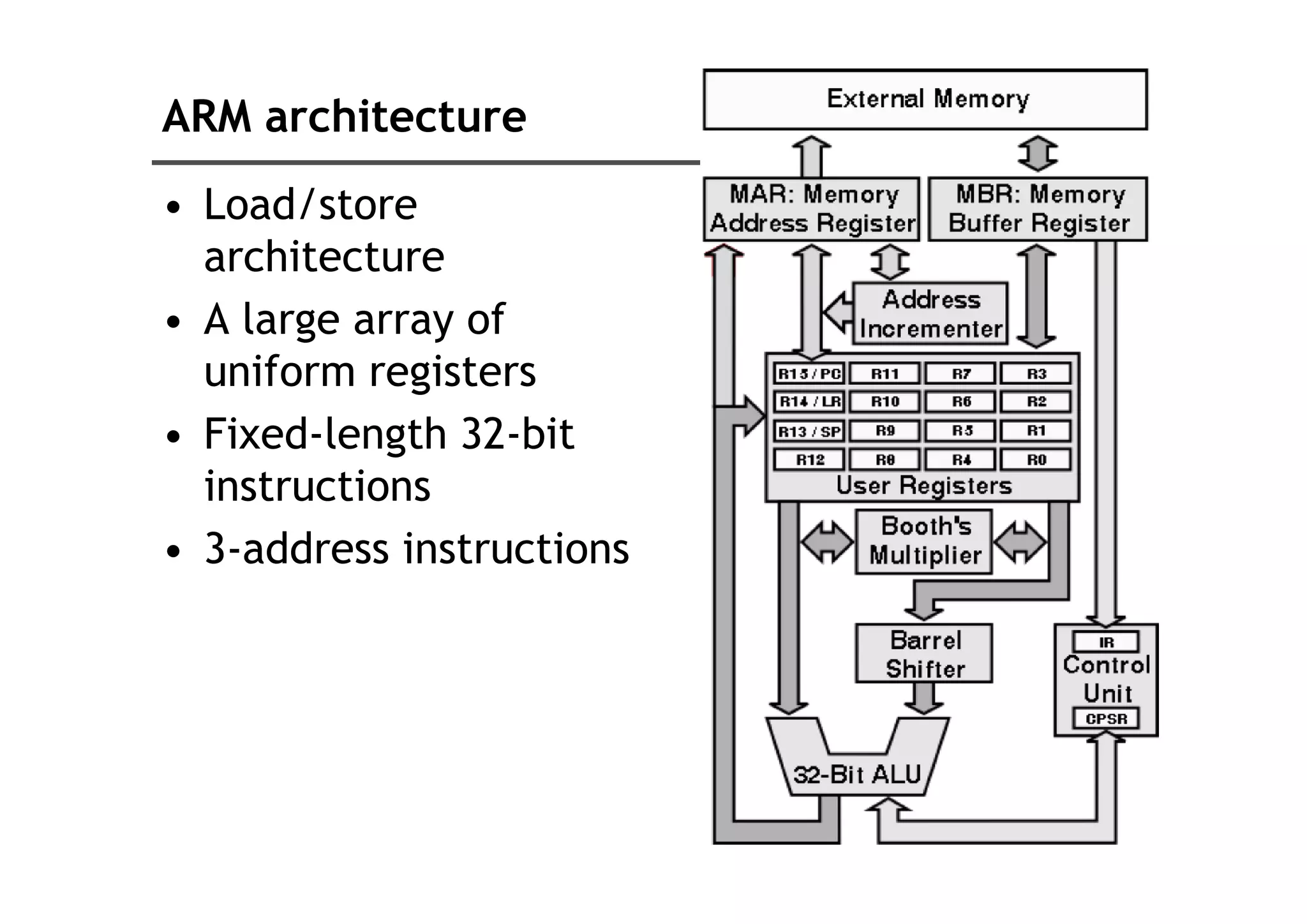
ARM architecture
ARM architecture
• Load/store
architecturearchitecture
• A large array of
if i tuniform registers
• Fixed-length 32-bit
instructions
• 3-address instructions
Registers
• Only 16 registers are visible to a specific mode.
A mode could accessA mode could access
– A particular set of r0-r12
13 ( t k i t )– r13 (sp, stack pointer)
– r14 (lr, link register)
15 ( )– r15 (pc, program counter)
– Current program status register (cpsr)
– The uses of r0-r13 are orthogonal
General-purpose registers
08 716 1524 2331
8-bit Byte8 bit Byte
16-bit Half word
32-bit word
• 6 data types (signed/unsigned)• 6 data types (signed/unsigned)
• All ARM operations are 32-bit. Shorter data
t l t d b d t t ftypes are only supported by data transfer
operations.
Program counter
• Store the address of the instruction to be
executedexecuted
• All instructions are 32-bit wide and word-
li daligned
• Thus, the last two bits of pc are undefined.
Program status register (CPSR)
mode bits
overflow Thumb state
carry/borrow
zero
FIQ disable
IRQ disable
negative
Q
Processor modes
Register organization
Instruction sets
• ARM/Thumb/Jazelle
Pipeline
ARM7
ARM9ARM9
In execution pc always 8 bytes aheadIn execution, pc always 8 bytes ahead
Pipeline
• Execution of a branch or direct modification of
pc causes ARM core to flush its pipelinepc causes ARM core to flush its pipeline
• ARM10 starts to use branch prediction
• An instruction in the execution stage will
complete even though an interrupt has been
raised. Other instructions in the pipeline are
abondond.
Interrupts
Vector table
:
Interrupt
handlershandlers
code
Interrupts
References

ARM Architecture

  • 1.
    ARM Architecture Computer Organizationand Assembly Languagesp g z y g g Yung-Yu Chuang with slides by Peng-Sheng Chen, Ville Pietikainen
  • 2.
    ARM history • 1983developed by Acorn computers T l 6502 i BBC t– To replace 6502 in BBC computers – 4-man VLSI design team It i li it f th i i t– Its simplicity comes from the inexperience team – Match the needs for generalized SoC for reasonable power performance and die sizepower, performance and die size – The first commercial RISC implemenation 1990 ARM (Ad d RISC M hi ) d b• 1990 ARM (Advanced RISC Machine), owned by Acorn, Apple and VLSI
  • 3.
    ARM Ltd Design andlicense ARM core design but not fabricate
  • 4.
    Why ARM? • Oneof the most licensed and thus widespread processor cores in the worldprocessor cores in the world – Used in PDA, cell phones, multimedia players, handheld game console digital TV and camerashandheld game console, digital TV and cameras – ARM7: GBA, iPod ARM9: NDS PSP Sony Ericsson BenQ– ARM9: NDS, PSP, Sony Ericsson, BenQ – ARM11: Apple iPhone, Nokia N93, N800 90% of 32 bit embedded RISC processors till 2009– 90% of 32-bit embedded RISC processors till 2009 • Used especially in portable devices due to its l ti d bllow power consumption and reasonable performance
  • 5.
  • 6.
    ARM processors • Asimple but powerful design A h l f il f d i h i i il d i• A whole family of designs sharing similar design principles and a common instruction set
  • 7.
    Naming ARM • ARMxyzTDMIEJFS –x: series– x: series – y: MMU z: cache– z: cache – T: Thumb D: debugger– D: debugger – M: Multiplier I: EmbeddedICE (built in debugger hardware)– I: EmbeddedICE (built-in debugger hardware) – E: Enhanced instruction J J ll (JVM)– J: Jazelle (JVM) – F: Floating-point S S th i ibl i ( d i f EDA– S: Synthesizible version (source code version for EDA tools)
  • 8.
    Popular ARM architectures •ARM7TDMI 3 i li t (f t h/d d / t )– 3 pipeline stages (fetch/decode/execute) – High code density/low power consumption O f th t d ARM i (f l d– One of the most used ARM-version (for low-end systems) All ARM cores after ARM7TDMI include TDMI even if– All ARM cores after ARM7TDMI include TDMI even if they do not include TDMI in their labels ARM9TDMI• ARM9TDMI – Compatible with ARM7 5 t (f t h/d d / t / / it )– 5 stages (fetch/decode/execute/memory/write) – Separate instruction and data cache • ARM11
  • 9.
    ARM family comparison year1995 1997 1999 2003
  • 10.
    ARM is aRISC • RISC: simple but powerful instructions that execute within a single cycle at high clock speedexecute within a single cycle at high clock speed. • Four major design rules: – Instructions: reduced set/single cycle/fixed length – Pipeline: decode in one stage/no need for microcode – Registers: a large set of general-purpose registers – Load/store architecture: data processing instructions apply to registers only; load/store to transfer data from memory R l i i l d i d f l k• Results in simple design and fast clock rate • The distinction blurs because CISC implements RISC concepts
  • 11.
    ARM design philosophy •Small processor for lower power consumption (for embedded system)(for embedded system) • High code density for limited memory and h i l i t i tiphysical size restrictions • The ability to use slow and low-cost memory • Reduced die size for reducing manufacture cost and accommodating more peripheralsg p p
  • 12.
    ARM features • Differentfrom pure RISC in several ways: V i bl l ti f t i i t ti– Variable cycle execution for certain instructions: multiple-register load/store (faster/higher code density)density) – Inline barrel shifter leading to more complex instructions: improves performance and code densityinstructions: improves performance and code density – Thumb 16-bit instruction set: 30% code density improvementp – Conditional execution: improve performance and code density by reducing branch – Enhanced instructions: DSP instructions
  • 13.
  • 14.
    ARM architecture • Load/store architecturearchitecture •A large array of if i tuniform registers • Fixed-length 32-bit instructions • 3-address instructions
  • 15.
    Registers • Only 16registers are visible to a specific mode. A mode could accessA mode could access – A particular set of r0-r12 13 ( t k i t )– r13 (sp, stack pointer) – r14 (lr, link register) 15 ( )– r15 (pc, program counter) – Current program status register (cpsr) – The uses of r0-r13 are orthogonal
  • 16.
    General-purpose registers 08 7161524 2331 8-bit Byte8 bit Byte 16-bit Half word 32-bit word • 6 data types (signed/unsigned)• 6 data types (signed/unsigned) • All ARM operations are 32-bit. Shorter data t l t d b d t t ftypes are only supported by data transfer operations.
  • 17.
    Program counter • Storethe address of the instruction to be executedexecuted • All instructions are 32-bit wide and word- li daligned • Thus, the last two bits of pc are undefined.
  • 18.
    Program status register(CPSR) mode bits overflow Thumb state carry/borrow zero FIQ disable IRQ disable negative Q
  • 19.
  • 20.
  • 21.
  • 22.
    Pipeline ARM7 ARM9ARM9 In execution pcalways 8 bytes aheadIn execution, pc always 8 bytes ahead
  • 23.
    Pipeline • Execution ofa branch or direct modification of pc causes ARM core to flush its pipelinepc causes ARM core to flush its pipeline • ARM10 starts to use branch prediction • An instruction in the execution stage will complete even though an interrupt has been raised. Other instructions in the pipeline are abondond.
  • 24.
  • 25.
  • 26.