
Department of Orthopaedics
       MH Kirkee
           CME


      DAMAGE CONTROL
       ORTHOPAEDICS

                    Maj Rohit Vikas
                    Resident
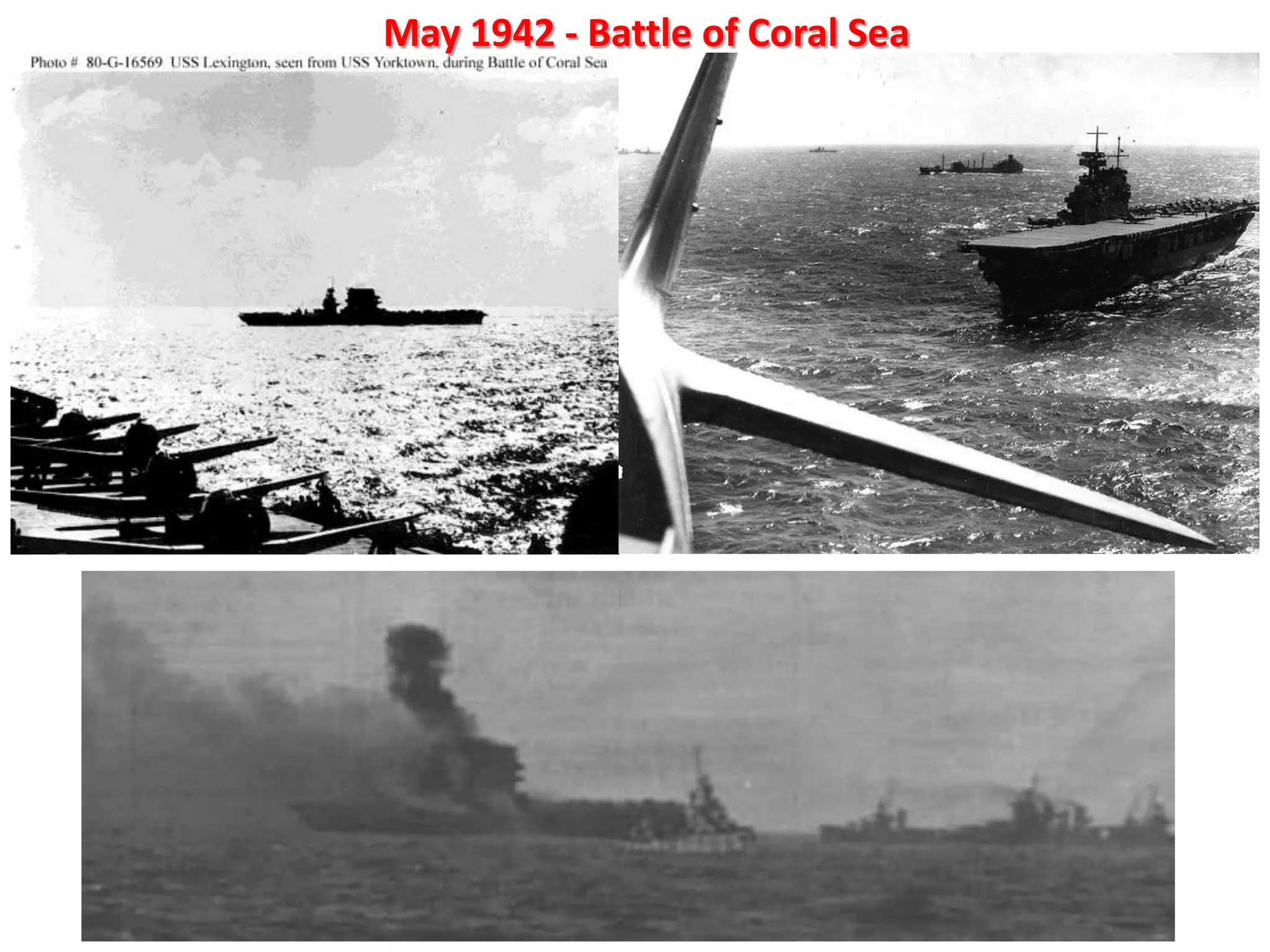
May 1942 - Battle of Coral Sea
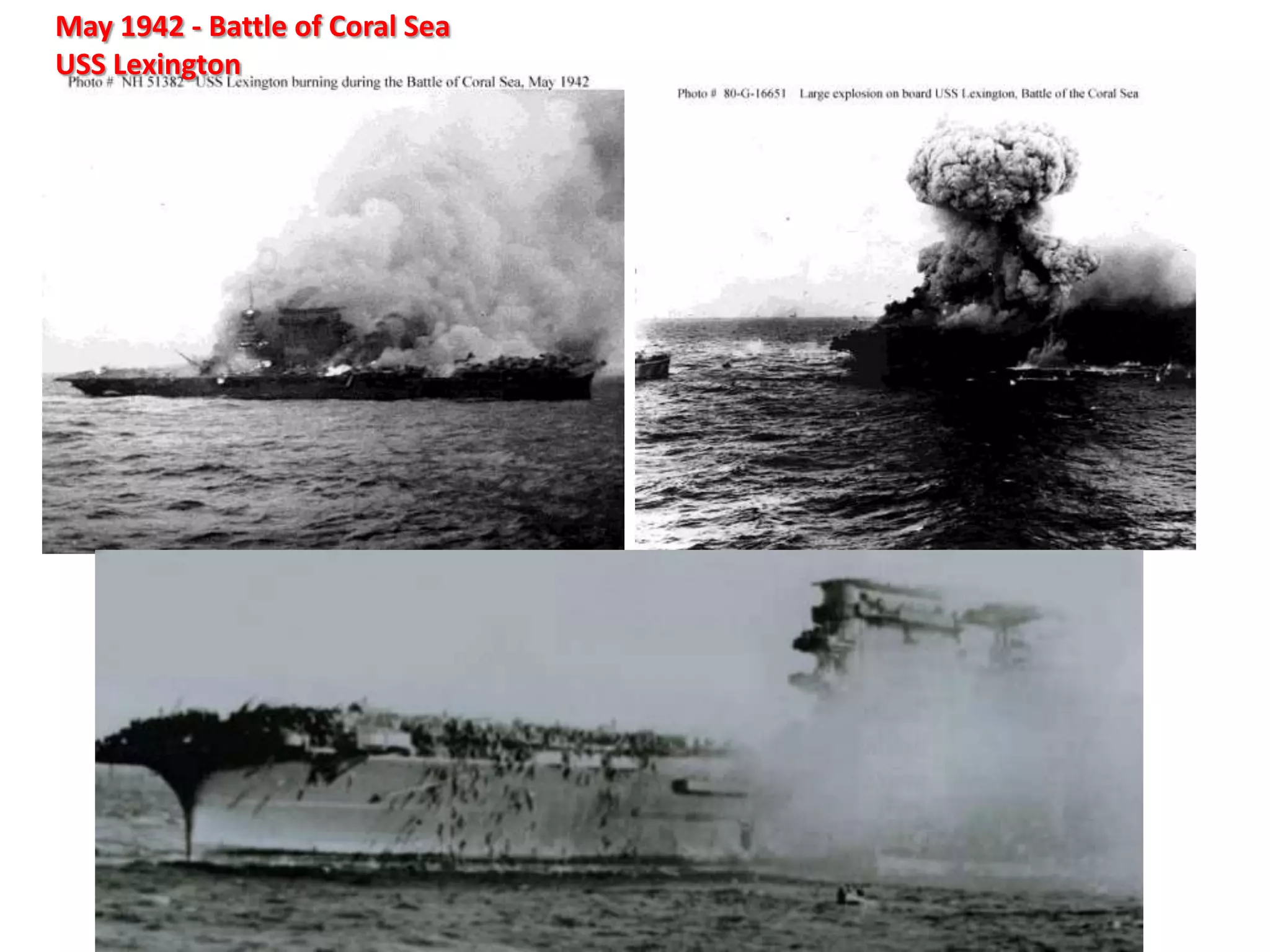
USS Lexington
May 1942 - Battle of Coral Sea
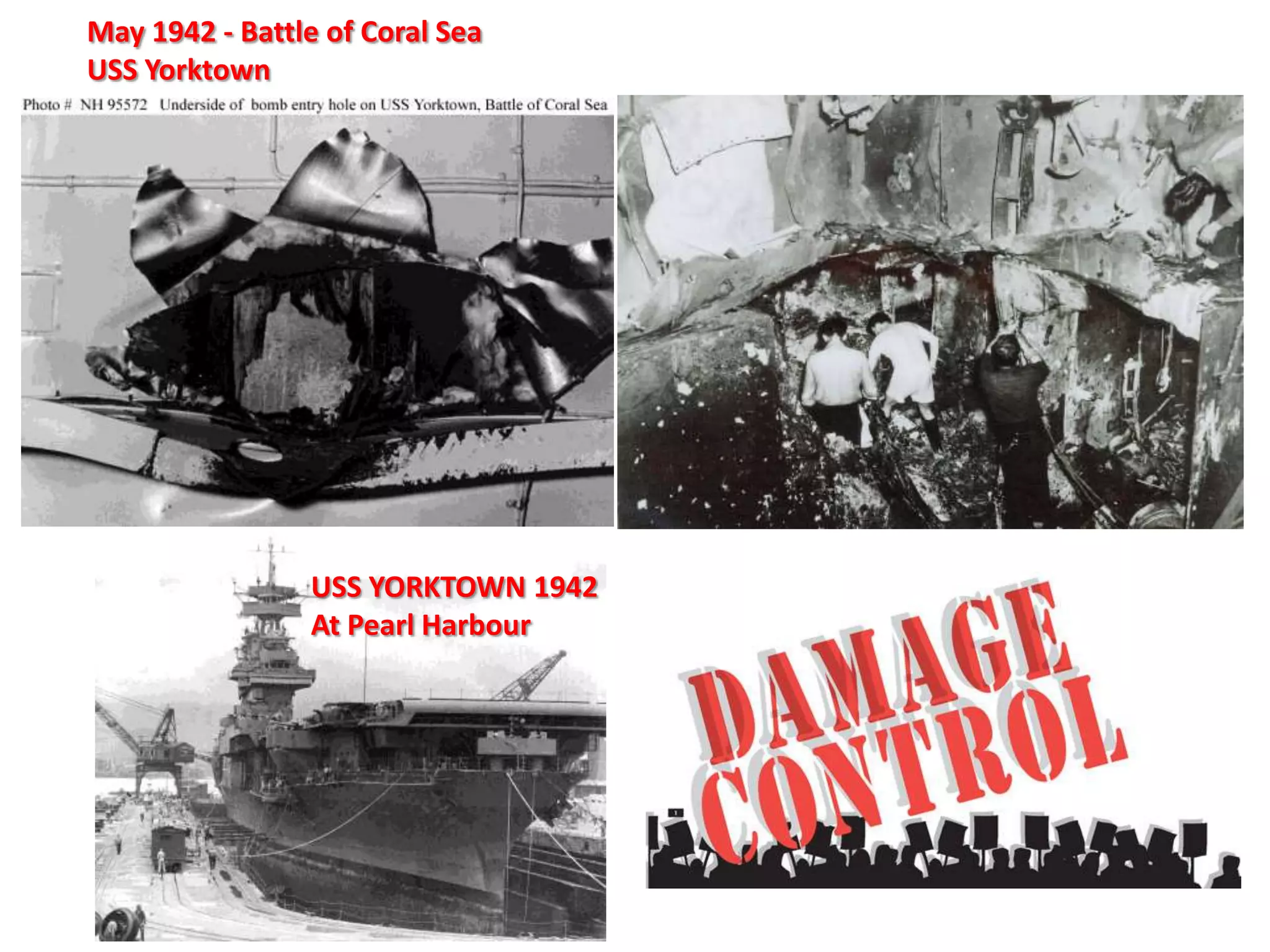
USS Yorktown


                 USS YORKTOWN 1942
                 At Pearl Harbour
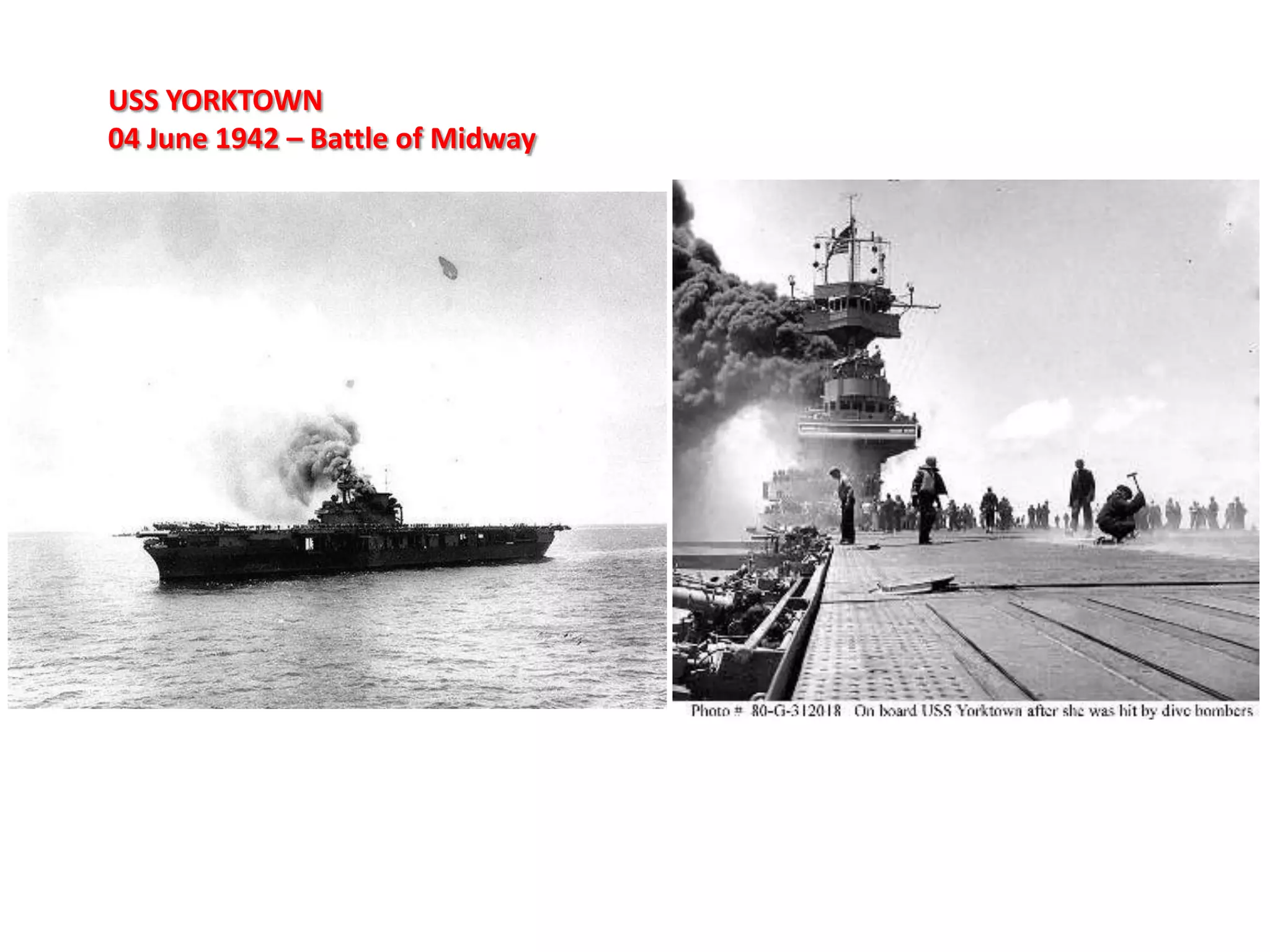
USS YORKTOWN
04 June 1942 – Battle of Midway

LIVE TO FIGHT ANOTHER DAY
USS YORKTOWN
04 June 1942 – Battle of Midway
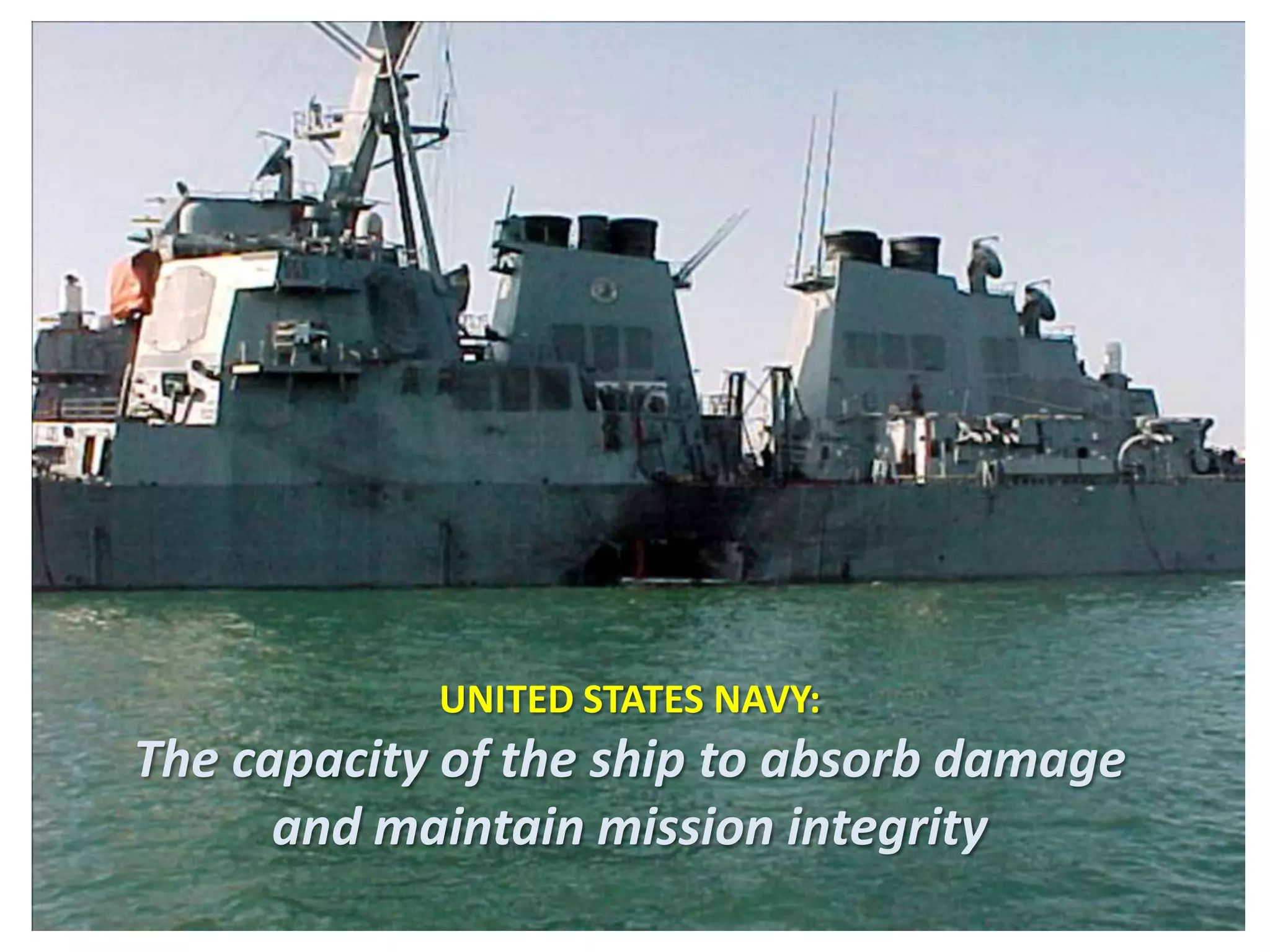
UNITED STATES NAVY:
The capacity of the ship to absorb damage
      and maintain mission integrity
An approach that contains and stabilizes orthopaedic injuries so
      that the patient’s overall physiology can improve.


 DCO should be regarded as a part of the resuscitation process
“Second Hit”
Interleukins 6 and 8.


IL falling
over
5 days
The 24-72 hour period after the initial injury appears to be the most at-risk time


                                              Stabilize fractures and bleeding
      Decrease the chance
                                              prior to the 24-72 hour high-risk
        of a second hit
                                                           period.
Till 1970s - 80s
    Multiply injured patients were too unstable to survive surgical intervention.

   Early definitive fracture stabilization was
   performed only as an exception


   Signs of MODS in the first posttraumatic week was
   diagnosed as the ‘‘fat embolism syndrome’’,
   characterised by hypoxia, cerebral depression
   (somnolence, coma), coagulopathy (petechial
   bleeding) or renal failure (anuria).

   Surgical fracture stabilization were only performed in
   patients, who were in a condition, i.e. without signs
   of fat embolism syndrome.
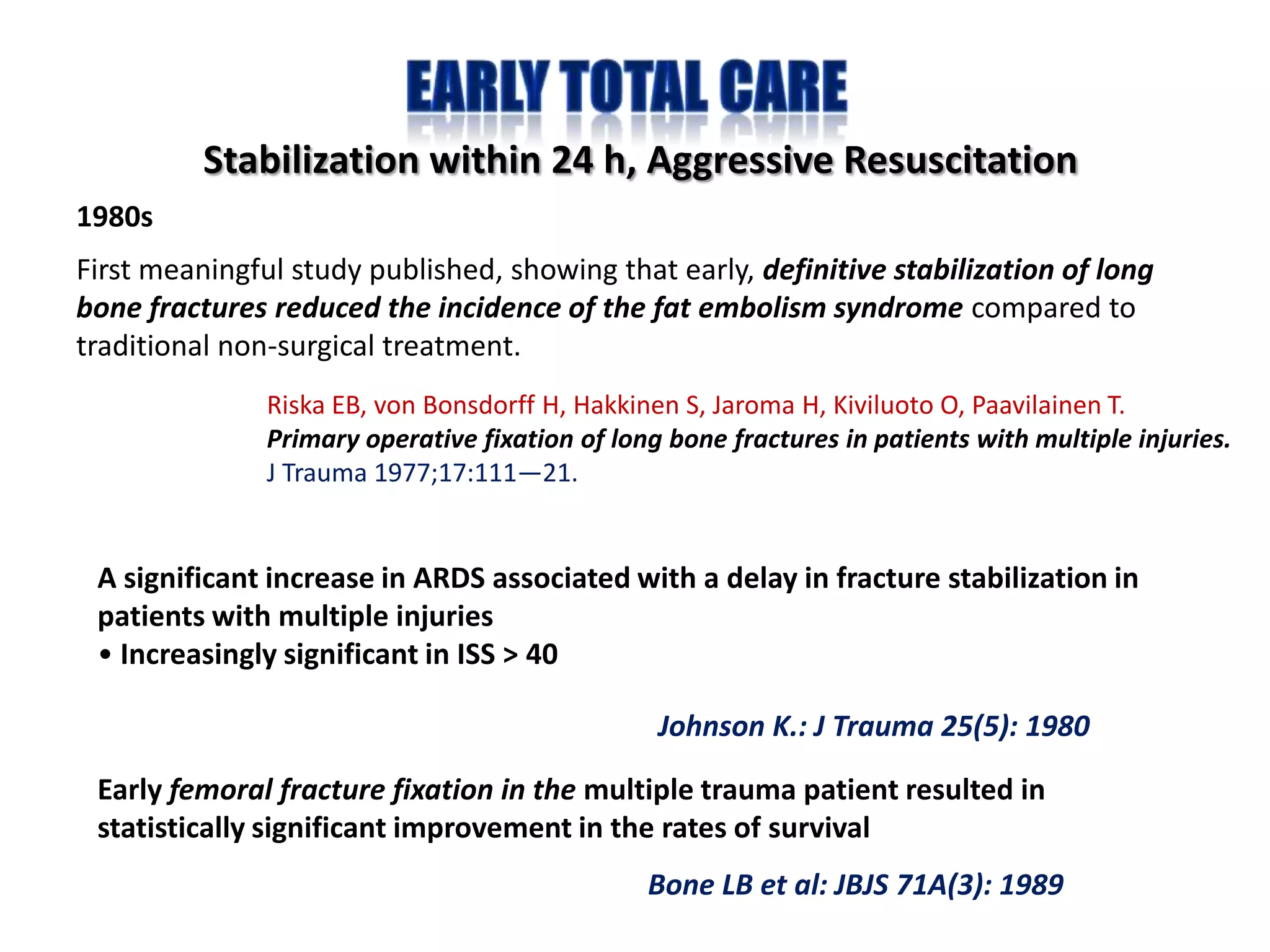
Stabilization within 24 h, Aggressive Resuscitation
1980s
First meaningful study published, showing that early, definitive stabilization of long
bone fractures reduced the incidence of the fat embolism syndrome compared to
traditional non-surgical treatment.
               Riska EB, von Bonsdorff H, Hakkinen S, Jaroma H, Kiviluoto O, Paavilainen T.
               Primary operative fixation of long bone fractures in patients with multiple injuries.
               J Trauma 1977;17:111—21.


 A significant increase in ARDS associated with a delay in fracture stabilization in
 patients with multiple injuries
 • Increasingly significant in ISS > 40

                                                 Johnson K.: J Trauma 25(5): 1980
 Early femoral fracture fixation in the multiple trauma patient resulted in
 statistically significant improvement in the rates of survival
                                                Bone LB et al: JBJS 71A(3): 1989
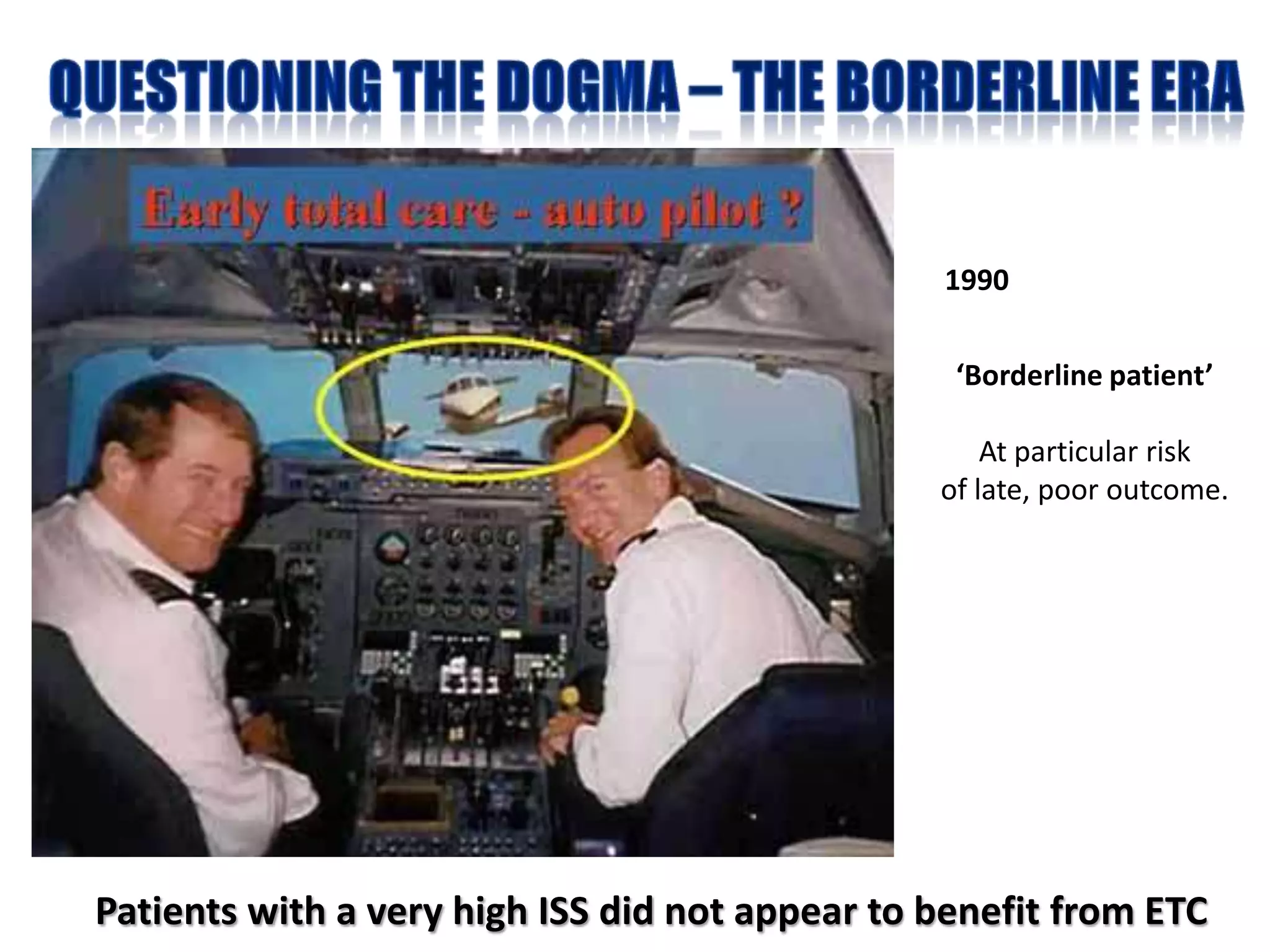
1990


                                                 ‘Borderline patient’

                                                    At particular risk
                                                of late, poor outcome.


Patients with a very high ISS did not appear to benefit from ETC
CLINICAL EXAMPLE


     16 y male, RTA

     • Pulmonary Contusions
     • Stable TBI
     • Bilateral Femoral #
     • Hip Dislocation


     ETC – BL Femoral Nailing
CLINICAL EXAMPLE
96 h post femoral nailing
            Florid ARDS


Outcome at 01 wk
        Autopsy


                             IS IT INEVITABLE?
                            OR PREVENTABLE ?
Life as a trauma surgeon would be easy
if all we had to deal with was the fracture.          COMPLICATING FACTORS


                                                  The fracture always has a patient
                                                            attached to it.

                                               This forces us to consider more than just
                                                               the bones.
Clinical Parameters Used in Hannover, Germany, to Define the “Borderline” Patient for
Whom DCO Is Often Preferred

    Polytrauma + ISS >20 + Thoracic trauma

    Polytrauma + Abdominal/pelvic trauma + Hemorrhagic shock (initial BP <90 mm Hg)

    ISS ≥ 40 in the absence of additional thoracic injury

    X Ray: B/L lung contusion

    Initial mean pulmonary arterial pressure >24 mm Hg

    Increase of >6 mm Hg in pulmonary arterial pressure during IM Nailing
COAGULOPATHIC

HYPOTHERMIA (T < 32)

ACIDOSIS

SHOCK

PRESUMED OR TIME > 6 H

ARTERIAL INJURY AND HAEMODYNAMIC INSTABILITY

EXAGGERATED INFLAMMATORY RESPONSE
RELEASE COMPARTMENTS                    CONTROL HAEMORRHAGE
REDUCE DISLOCATIONS                     FLUID RESUSCITATION
DEBRIDE OPEN WOUNDS                     CXR – ICD IF NECESSARY
STABILIZE LONG BONES/ PELVIS            LATERAL CERVICAL SPINE X RAY
                                        X RAY PELVIS AP
                                        FAST/ DPL
INITIAL EARLY EXTERNAL FIXATION
                                        RE EVALUATE
                                        MONITOR
                                        BP, URINE OUTPUT
                                        ABG
                                        REPEAT FAST
                                        IL-6


STAGED INTRAMEDULLARY FIXATION
MINIMAL INVASIVE PLATE OSTEOSYNTHESIS
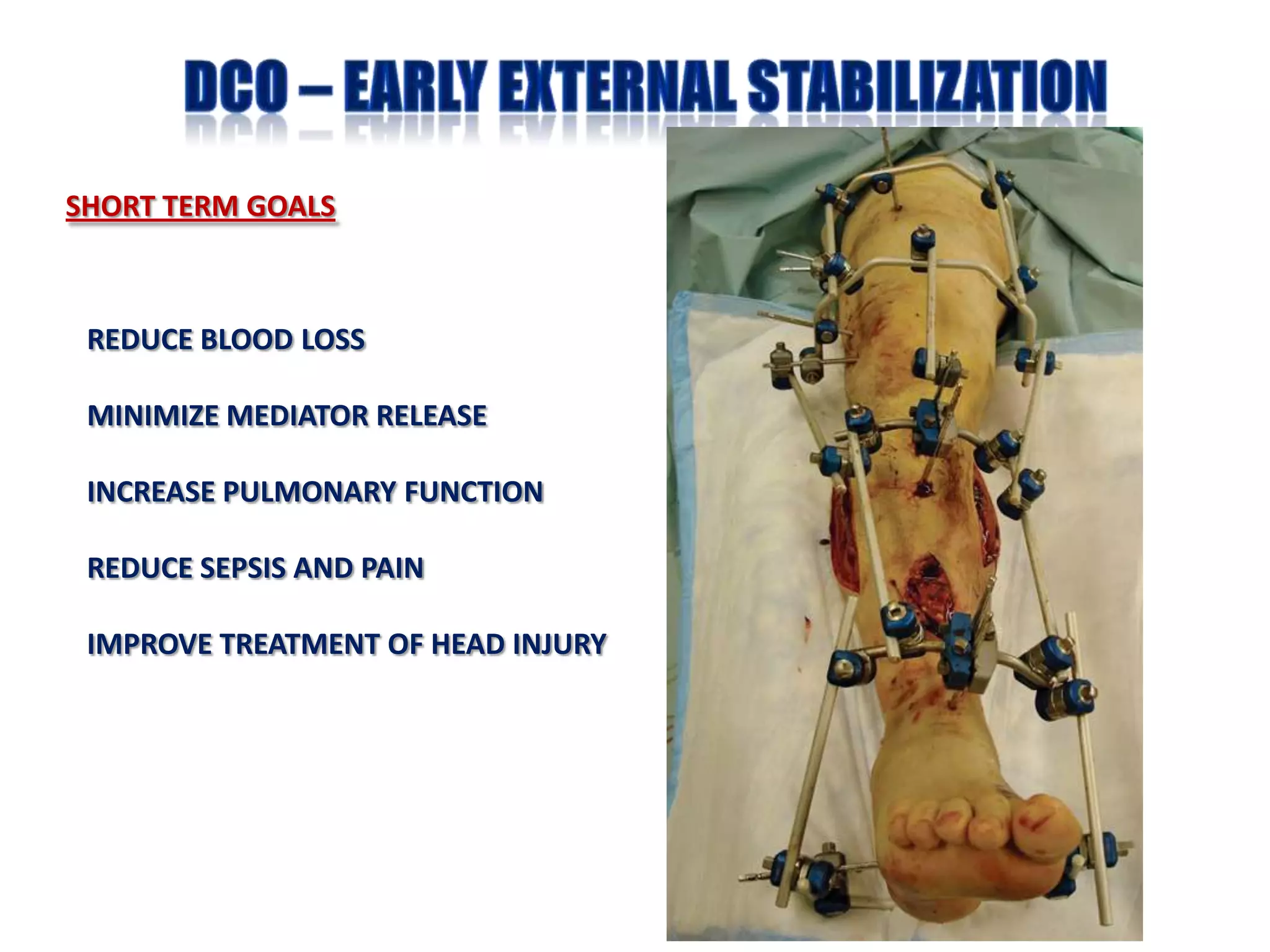
SHORT TERM GOALS


 REDUCE BLOOD LOSS

 MINIMIZE MEDIATOR RELEASE

 INCREASE PULMONARY FUNCTION

 REDUCE SEPSIS AND PAIN

 IMPROVE TREATMENT OF HEAD INJURY
Days 2—4 do not offer optimal conditions for definitive surgery.

Primary procedures of greater than 6 h duration and major surgical procedures at
days 2—4 should be avoided.


Between 5 – 14 days post injury
Multiply injured patient

Physiologically unstable

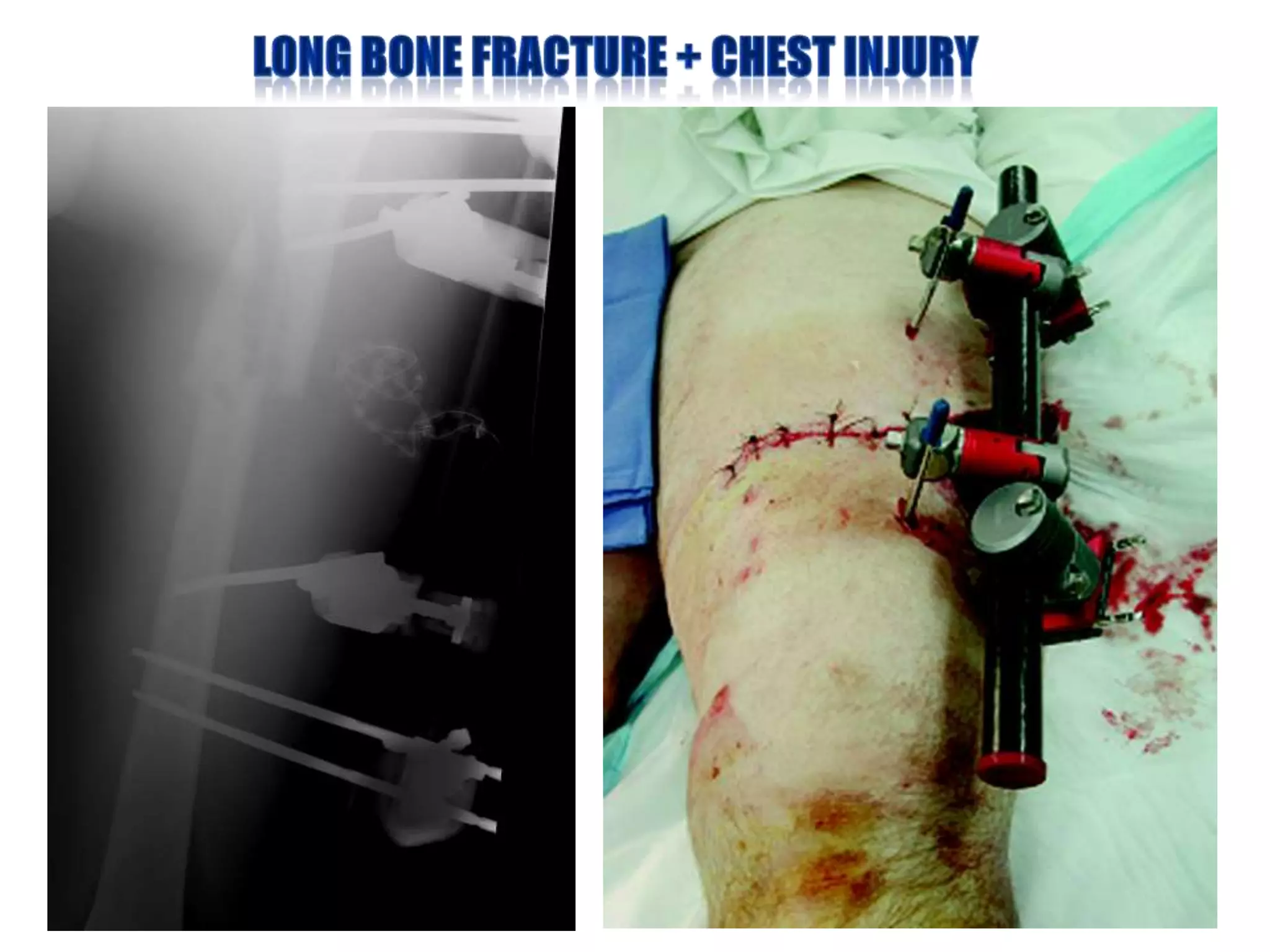
Severe chest injury (pulmonary insufficiency)

Severe TBI (hemorrhage or elevated ICP)

Mass casualty situation
Prolonged operation could cause intraop
hypotension, hypoxia, coagulopathy, increased
blood loss and fluid requirements during and
after the orthopedic operation.
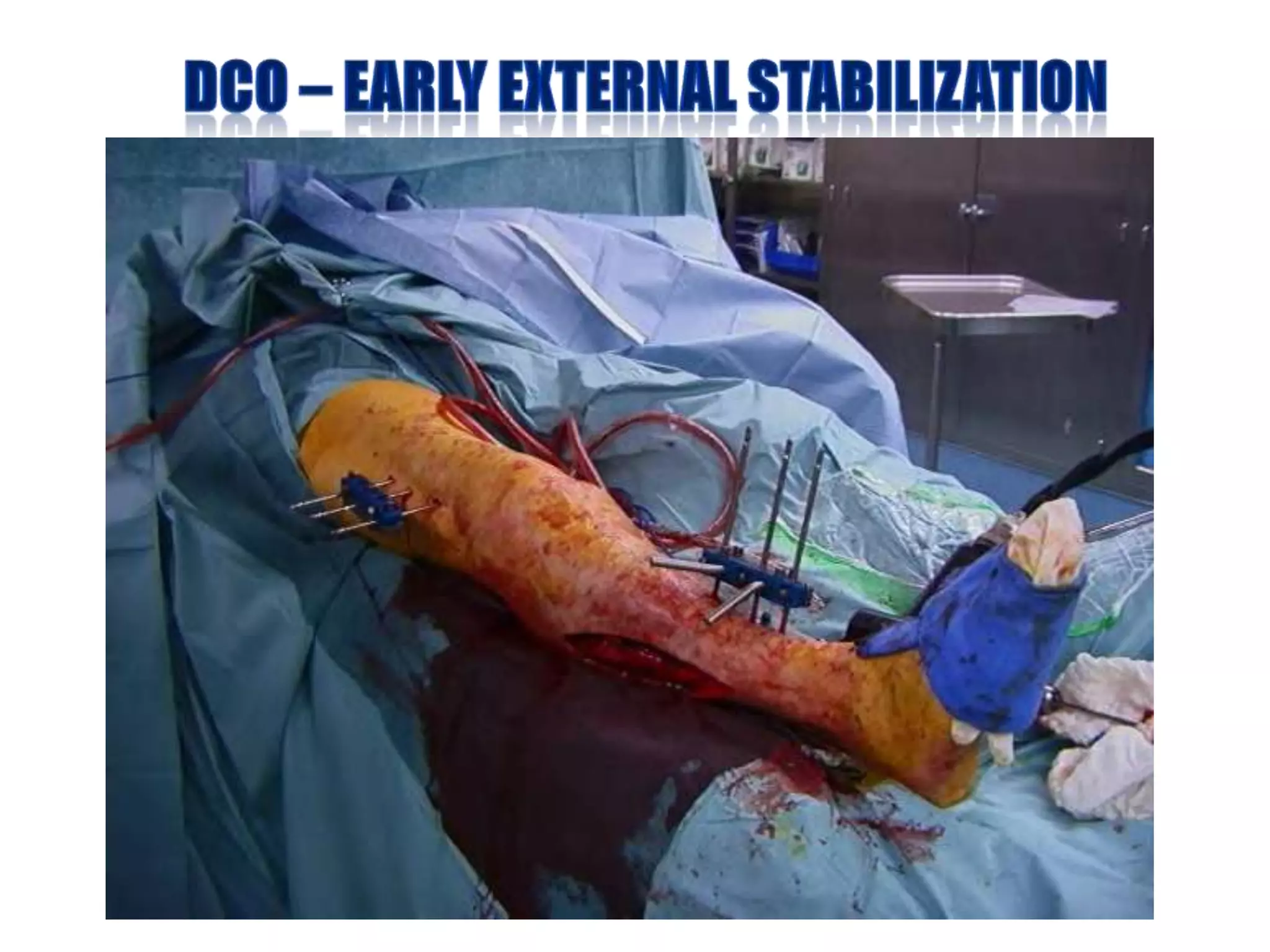
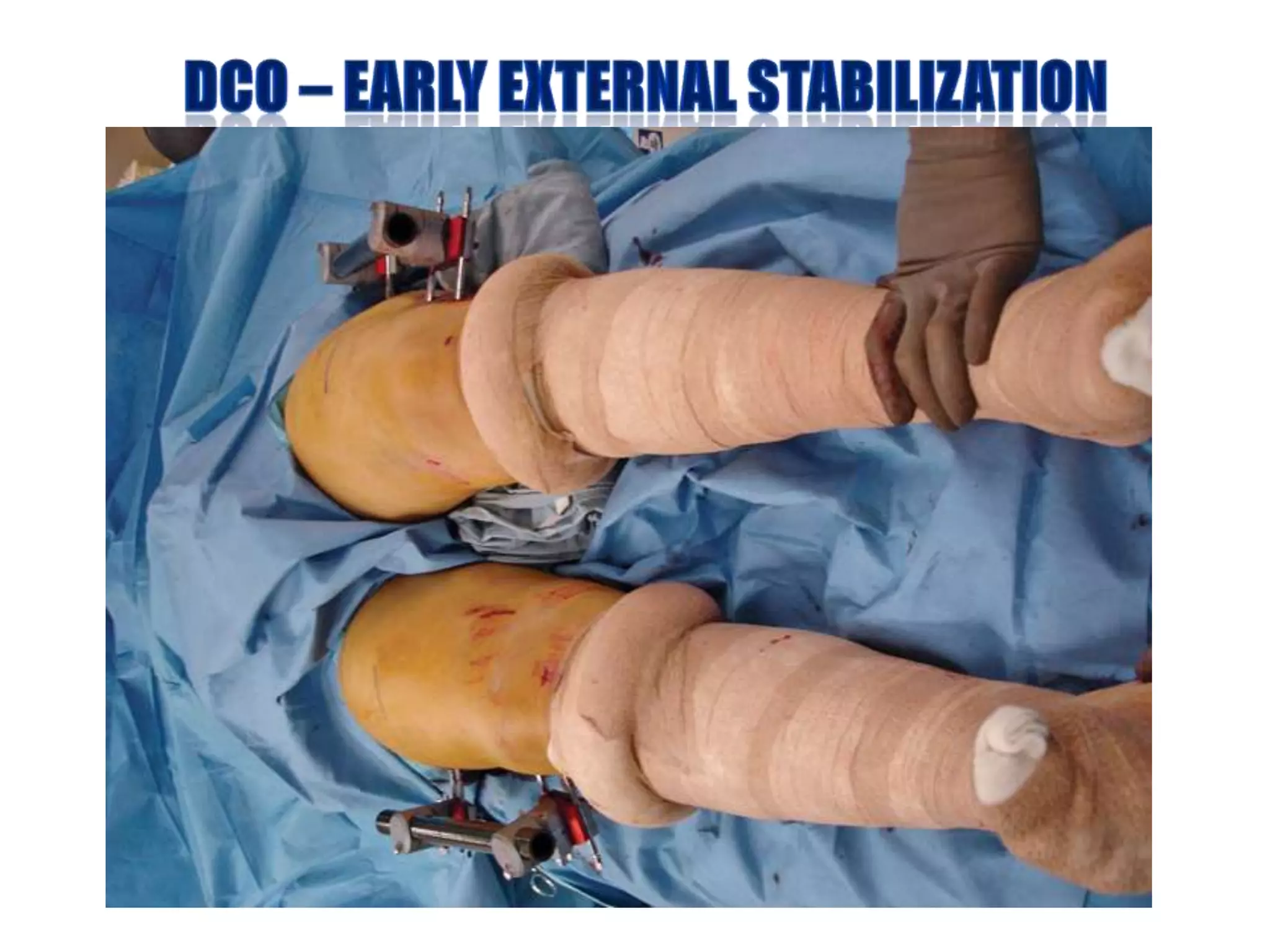
                                                     DCO – EXTERNAL FIXATION
This will be detrimental to cerebral perfusion and
would be an additional insult to the already
injured brain, thus outweighing the benefits of
early fracture stabilization.


Maintenance of CPP >70 mm Hg and ICP <20 mm Hg should be mandatory before,
                    during, and after surgical procedures.
LEAP Study

An increasing trend toward limb salvage
rather than immediate amputation for
complex open lower-extremity injuries.


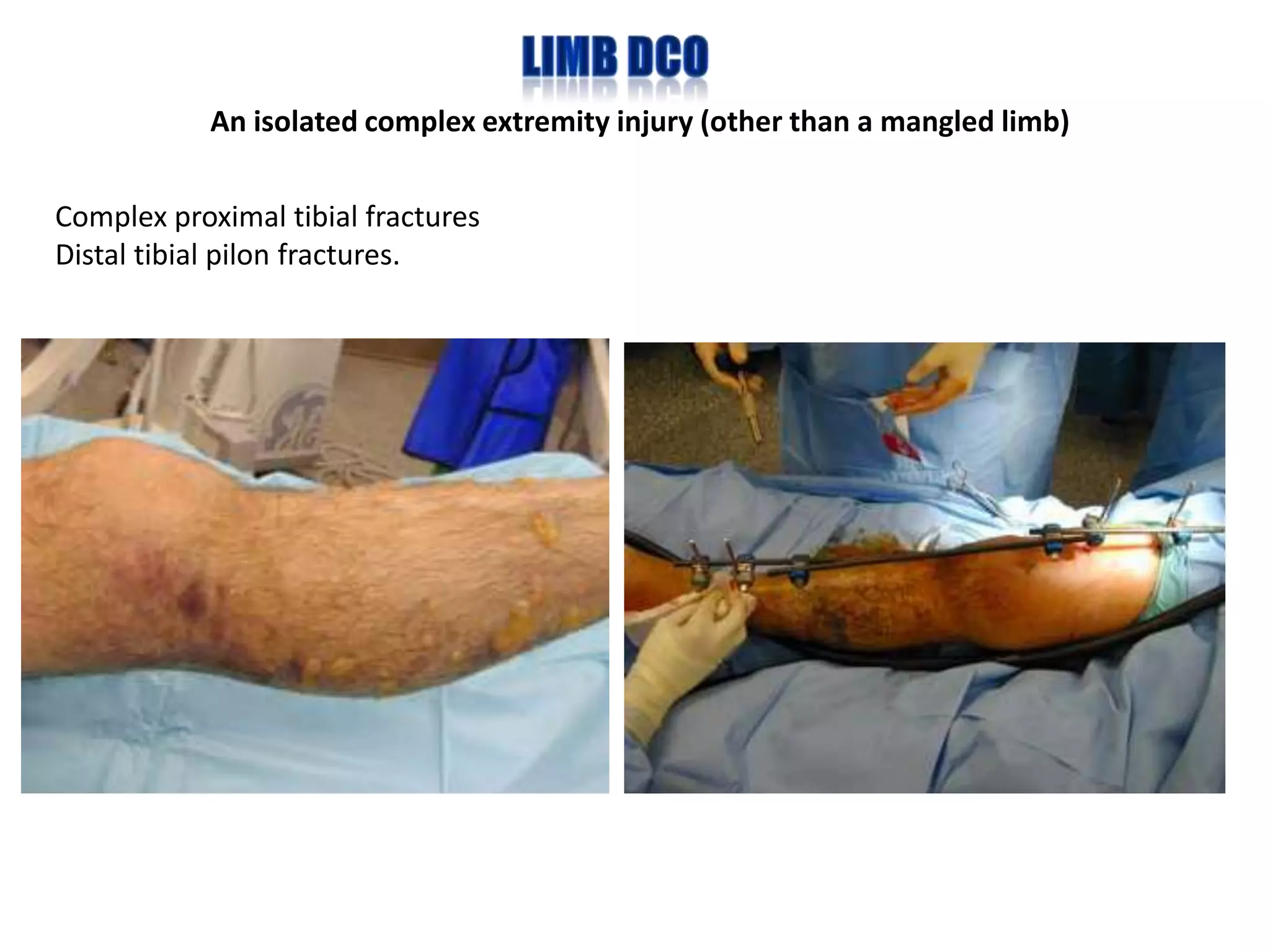
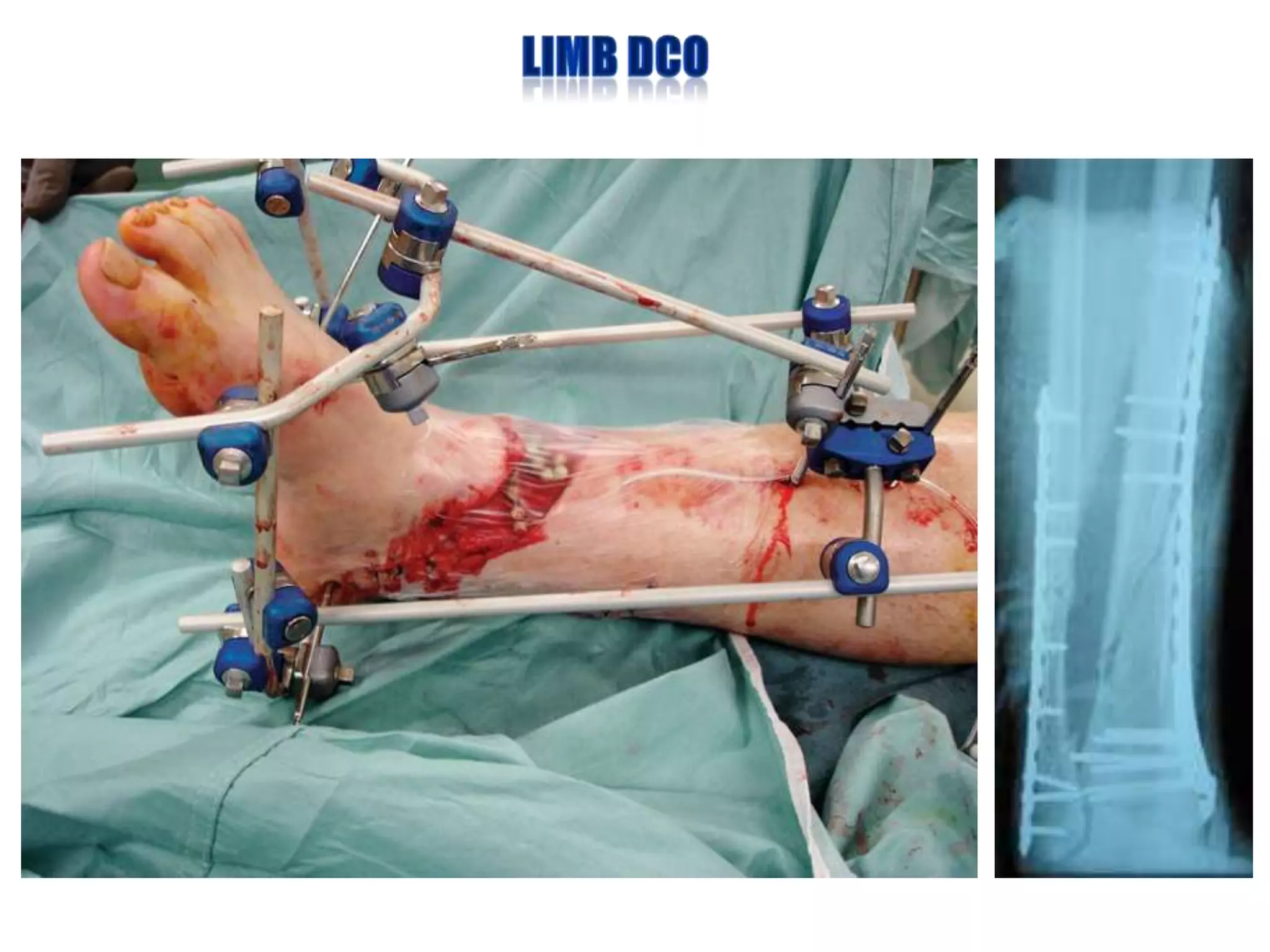
A DCO approach to saving the limb

         Spanning external fixation,
         Antibiotic bead pouches
         Vacuum-assisted wound closure
An isolated complex extremity injury (other than a mangled limb)


Complex proximal tibial fractures
Distal tibial pilon fractures.
CURRENT ISSUES


Early skeletal fixation is appropriate…

• But   what are the limits ?
    • Hemodynamic instability
    • Pulmonary instability
    • Severe head injury
    • Coagulopathy
    • Hypothermia
DCO: Principles in Polytrauma

    Ortho team must be
resuscitators and stabilizers:
         not “fixers”

    Save the Patient First
Damage control orthopaedics

Damage control orthopaedics

  • 1.
    Department of Orthopaedics MH Kirkee CME DAMAGE CONTROL ORTHOPAEDICS Maj Rohit Vikas Resident
  • 2.
    May 1942 -Battle of Coral Sea
  • 3.
    May 1942 -Battle of Coral Sea USS Lexington
  • 4.
    May 1942 -Battle of Coral Sea USS Yorktown USS YORKTOWN 1942 At Pearl Harbour
  • 5.
    USS YORKTOWN 04 June1942 – Battle of Midway LIVE TO FIGHT ANOTHER DAY
  • 6.
    USS YORKTOWN 04 June1942 – Battle of Midway
  • 7.
    UNITED STATES NAVY: Thecapacity of the ship to absorb damage and maintain mission integrity
  • 8.
    An approach thatcontains and stabilizes orthopaedic injuries so that the patient’s overall physiology can improve. DCO should be regarded as a part of the resuscitation process
  • 9.
  • 10.
    Interleukins 6 and8. IL falling over 5 days
  • 11.
    The 24-72 hourperiod after the initial injury appears to be the most at-risk time Stabilize fractures and bleeding Decrease the chance prior to the 24-72 hour high-risk of a second hit period.
  • 12.
    Till 1970s -80s Multiply injured patients were too unstable to survive surgical intervention. Early definitive fracture stabilization was performed only as an exception Signs of MODS in the first posttraumatic week was diagnosed as the ‘‘fat embolism syndrome’’, characterised by hypoxia, cerebral depression (somnolence, coma), coagulopathy (petechial bleeding) or renal failure (anuria). Surgical fracture stabilization were only performed in patients, who were in a condition, i.e. without signs of fat embolism syndrome.
  • 13.
    Stabilization within 24h, Aggressive Resuscitation 1980s First meaningful study published, showing that early, definitive stabilization of long bone fractures reduced the incidence of the fat embolism syndrome compared to traditional non-surgical treatment. Riska EB, von Bonsdorff H, Hakkinen S, Jaroma H, Kiviluoto O, Paavilainen T. Primary operative fixation of long bone fractures in patients with multiple injuries. J Trauma 1977;17:111—21. A significant increase in ARDS associated with a delay in fracture stabilization in patients with multiple injuries • Increasingly significant in ISS > 40 Johnson K.: J Trauma 25(5): 1980 Early femoral fracture fixation in the multiple trauma patient resulted in statistically significant improvement in the rates of survival Bone LB et al: JBJS 71A(3): 1989
  • 14.
    1990 ‘Borderline patient’ At particular risk of late, poor outcome. Patients with a very high ISS did not appear to benefit from ETC
  • 15.
    CLINICAL EXAMPLE 16 y male, RTA • Pulmonary Contusions • Stable TBI • Bilateral Femoral # • Hip Dislocation ETC – BL Femoral Nailing
  • 16.
    CLINICAL EXAMPLE 96 hpost femoral nailing Florid ARDS Outcome at 01 wk Autopsy IS IT INEVITABLE? OR PREVENTABLE ?
  • 17.
    Life as atrauma surgeon would be easy if all we had to deal with was the fracture. COMPLICATING FACTORS The fracture always has a patient attached to it. This forces us to consider more than just the bones.
  • 18.
    Clinical Parameters Usedin Hannover, Germany, to Define the “Borderline” Patient for Whom DCO Is Often Preferred Polytrauma + ISS >20 + Thoracic trauma Polytrauma + Abdominal/pelvic trauma + Hemorrhagic shock (initial BP <90 mm Hg) ISS ≥ 40 in the absence of additional thoracic injury X Ray: B/L lung contusion Initial mean pulmonary arterial pressure >24 mm Hg Increase of >6 mm Hg in pulmonary arterial pressure during IM Nailing
  • 19.
    COAGULOPATHIC HYPOTHERMIA (T <32) ACIDOSIS SHOCK PRESUMED OR TIME > 6 H ARTERIAL INJURY AND HAEMODYNAMIC INSTABILITY EXAGGERATED INFLAMMATORY RESPONSE
  • 21.
    RELEASE COMPARTMENTS CONTROL HAEMORRHAGE REDUCE DISLOCATIONS FLUID RESUSCITATION DEBRIDE OPEN WOUNDS CXR – ICD IF NECESSARY STABILIZE LONG BONES/ PELVIS LATERAL CERVICAL SPINE X RAY X RAY PELVIS AP FAST/ DPL INITIAL EARLY EXTERNAL FIXATION RE EVALUATE MONITOR BP, URINE OUTPUT ABG REPEAT FAST IL-6 STAGED INTRAMEDULLARY FIXATION MINIMAL INVASIVE PLATE OSTEOSYNTHESIS
  • 22.
    SHORT TERM GOALS REDUCE BLOOD LOSS MINIMIZE MEDIATOR RELEASE INCREASE PULMONARY FUNCTION REDUCE SEPSIS AND PAIN IMPROVE TREATMENT OF HEAD INJURY
  • 28.
    Days 2—4 donot offer optimal conditions for definitive surgery. Primary procedures of greater than 6 h duration and major surgical procedures at days 2—4 should be avoided. Between 5 – 14 days post injury
  • 29.
    Multiply injured patient Physiologicallyunstable Severe chest injury (pulmonary insufficiency) Severe TBI (hemorrhage or elevated ICP) Mass casualty situation
  • 33.
    Prolonged operation couldcause intraop hypotension, hypoxia, coagulopathy, increased blood loss and fluid requirements during and after the orthopedic operation. DCO – EXTERNAL FIXATION This will be detrimental to cerebral perfusion and would be an additional insult to the already injured brain, thus outweighing the benefits of early fracture stabilization. Maintenance of CPP >70 mm Hg and ICP <20 mm Hg should be mandatory before, during, and after surgical procedures.
  • 34.
    LEAP Study An increasingtrend toward limb salvage rather than immediate amputation for complex open lower-extremity injuries. A DCO approach to saving the limb Spanning external fixation, Antibiotic bead pouches Vacuum-assisted wound closure
  • 35.
    An isolated complexextremity injury (other than a mangled limb) Complex proximal tibial fractures Distal tibial pilon fractures.
  • 37.
    CURRENT ISSUES Early skeletalfixation is appropriate… • But what are the limits ? • Hemodynamic instability • Pulmonary instability • Severe head injury • Coagulopathy • Hypothermia
  • 38.
    DCO: Principles inPolytrauma Ortho team must be resuscitators and stabilizers: not “fixers” Save the Patient First