Invention
                                 Or
                             Innovation
                                1m38


Architectural Innovation


                         Lecture by:
                 Djadja.Sardjana@gmail.com
              http://www.slideshare.net/djadja

 23/01/2010               IMT-MMBiztel           1
Roadmap of Innovation


                         Lecture by:
                 Djadja.Sardjana@gmail.com
              http://www.slideshare.net/djadja

 23/01/2010               IMT-MMBiztel           2
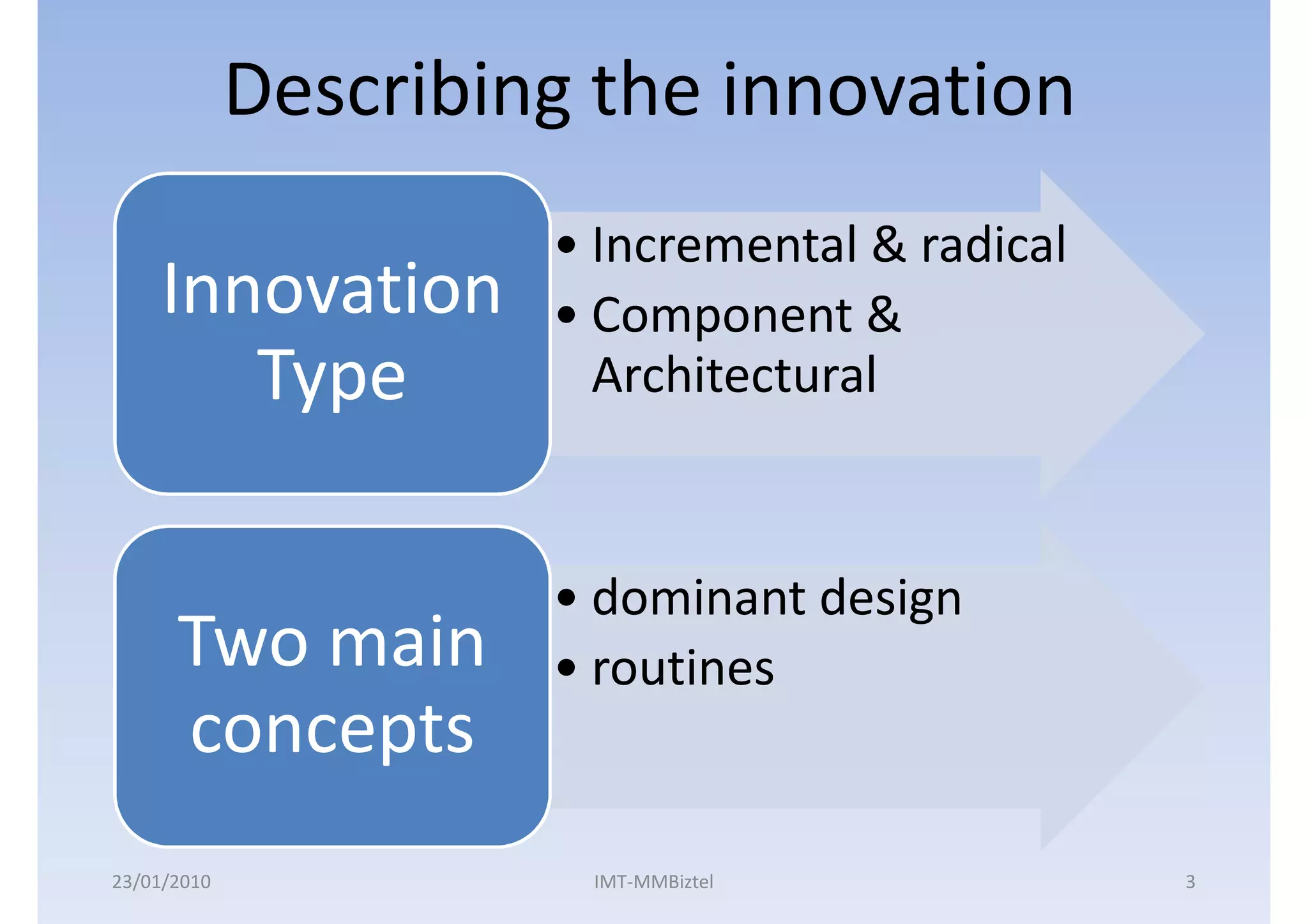
Describing the innovation
                      • Incremental & radical
    Innovation        • Component &
       Type             Architectural


                      • dominant design
      Two main        • routines
      concepts
23/01/2010             IMT-MMBiztel             3
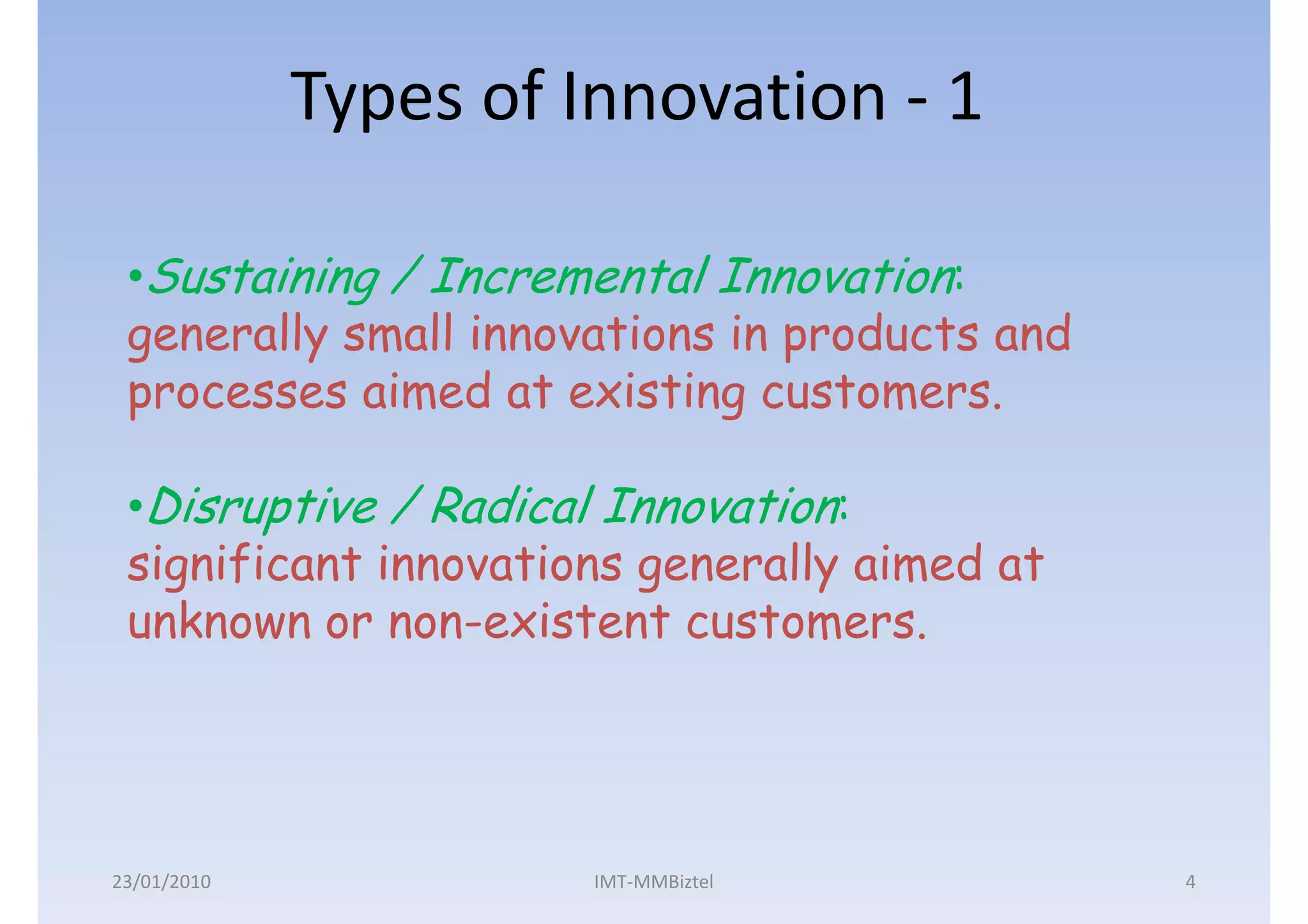
Types of Innovation - 1

 •Sustaining / Incremental Innovation:
 generally small innovations in products and
 processes aimed at existing customers.

 •Disruptive / Radical Innovation:
 significant innovations generally aimed at
 unknown or non-existent customers.


23/01/2010             IMT-MMBiztel            4
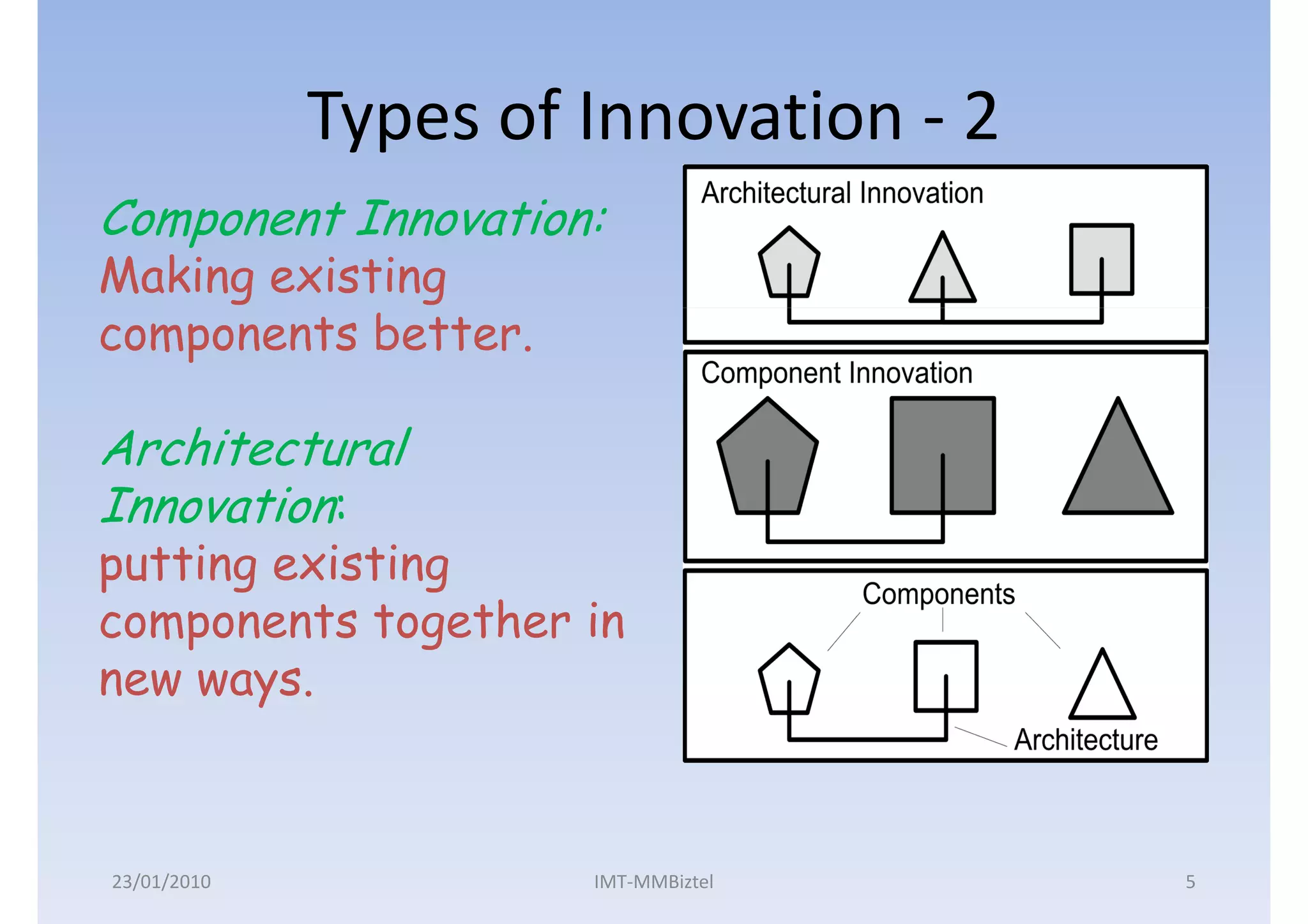
Types of Innovation - 2
Component Innovation:
Making existing
components better.

Architectural
Innovation:
putting existing
components together in
new ways.


23/01/2010            IMT-MMBiztel     5
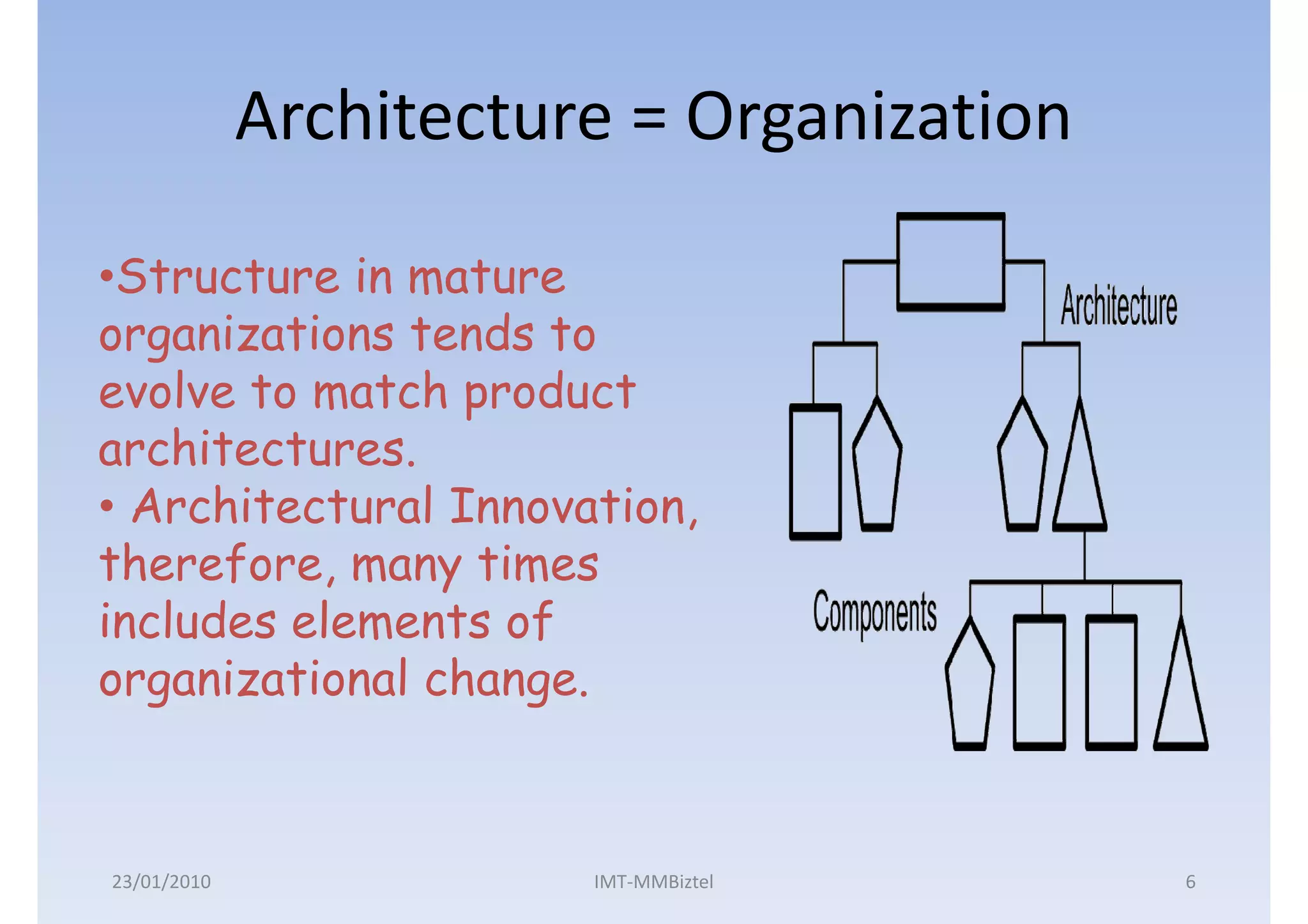
Architecture = Organization

•Structure in mature
organizations tends to
evolve to match product
architectures.
• Architectural Innovation,
therefore, many times
includes elements of
organizational change.


23/01/2010              IMT-MMBiztel       6
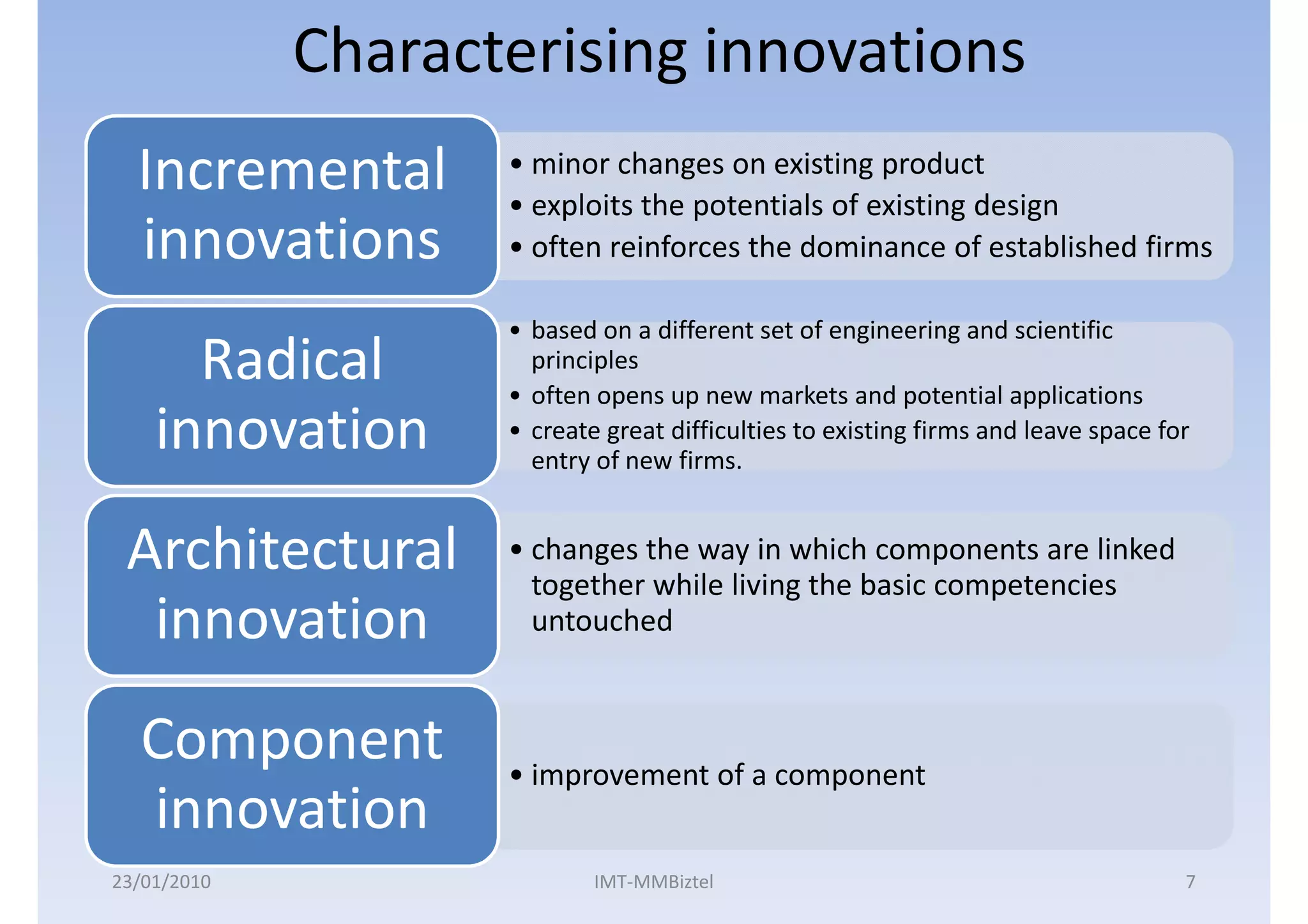
Characterising innovations
  Incremental       • minor changes on existing product
                    • exploits the potentials of existing design
  innovations       • often reinforces the dominance of established firms

                    • based on a different set of engineering and scientific
      Radical         principles
                    • often opens up new markets and potential applications
    innovation      • create great difficulties to existing firms and leave space for
                      entry of new firms.


 Architectural      • changes the way in which components are linked
                      together while living the basic competencies
  innovation          untouched


  Component         • improvement of a component
  innovation
23/01/2010                  IMT-MMBiztel                                            7
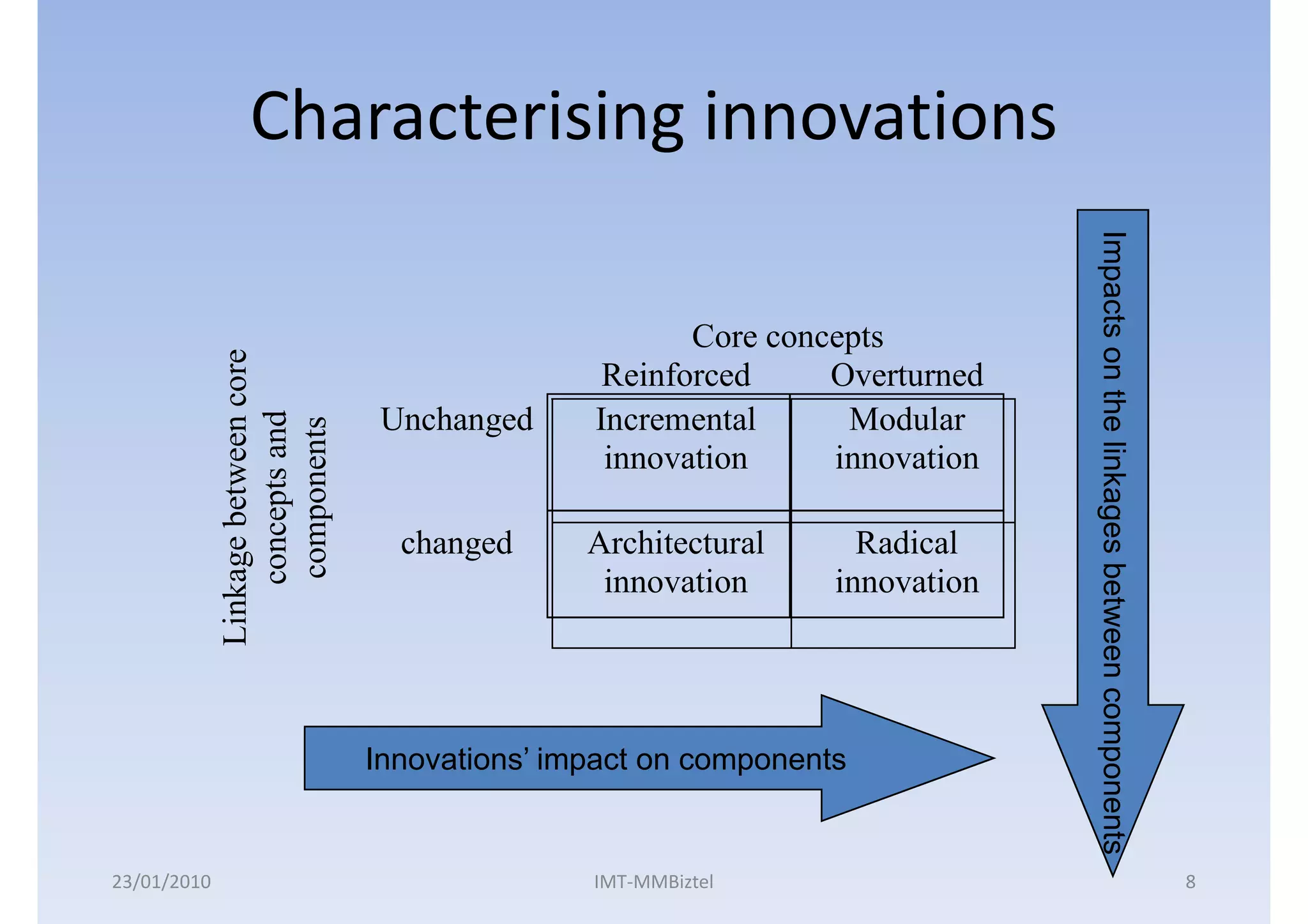
Characterising innovations


                                                                                 Impacts on the linkages between components
                                                                                 Impacts on the linkages between components
                                                                                 Impacts on the linkages between components
                                                          Core concepts
             Linkage between core


                                                    Reinforced     Overturned
                                     Unchanged     Incremental      Modular
                 concepts and
                 components


                                                    innovation     innovation

                                      changed      Architectural      Radical
                                                    innovation      innovation


                                    Innovations’ impact on components


23/01/2010                                         IMT-MMBiztel                                                               8
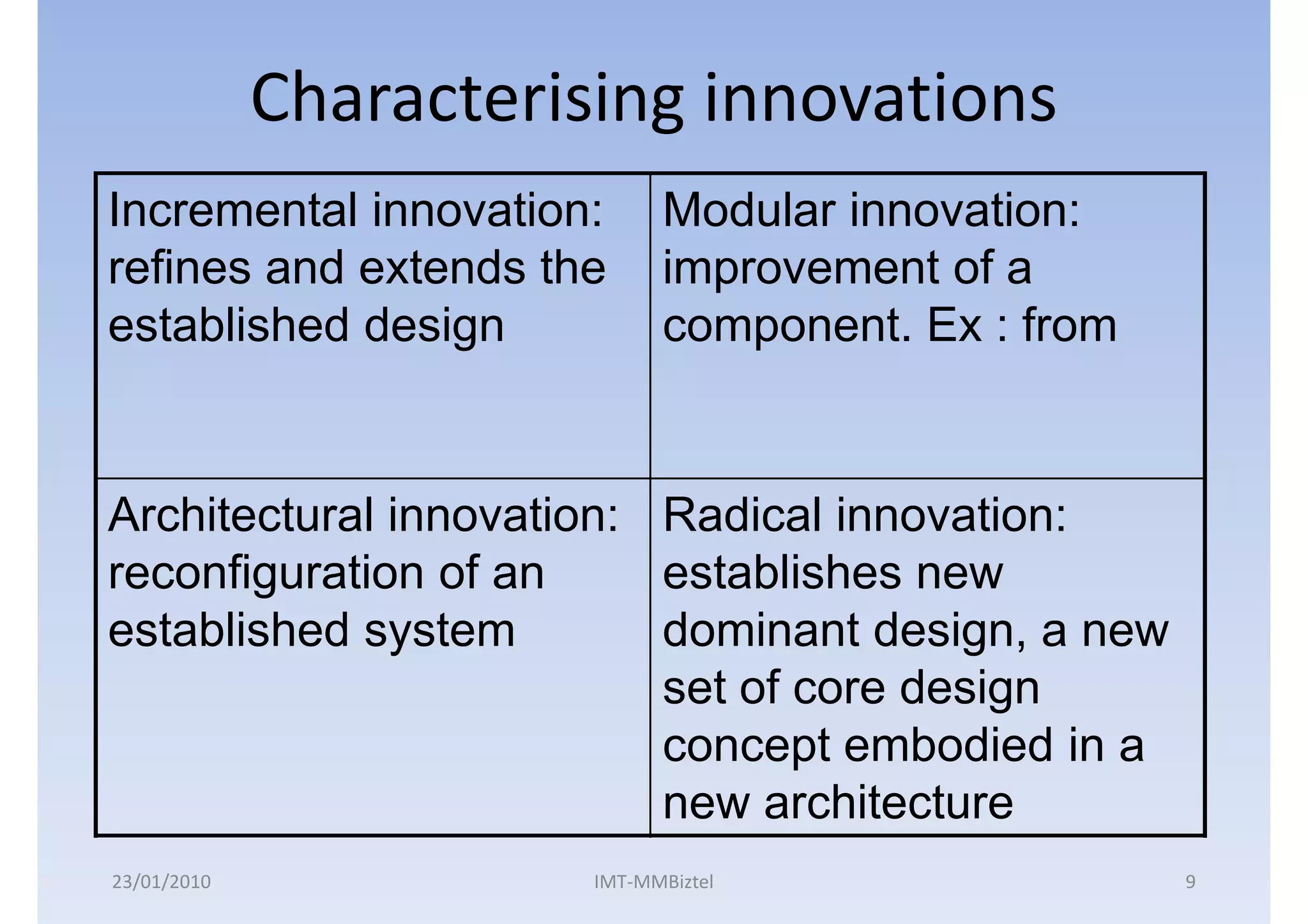
Characterising innovations
Incremental innovation:       Modular innovation:
refines and extends the       improvement of a
established design            component. Ex : from


Architectural innovation: Radical innovation:
reconfiguration of an     establishes new
established system        dominant design, a new
                          set of core design
                          concept embodied in a
                          new architecture
23/01/2010              IMT-MMBiztel                 9
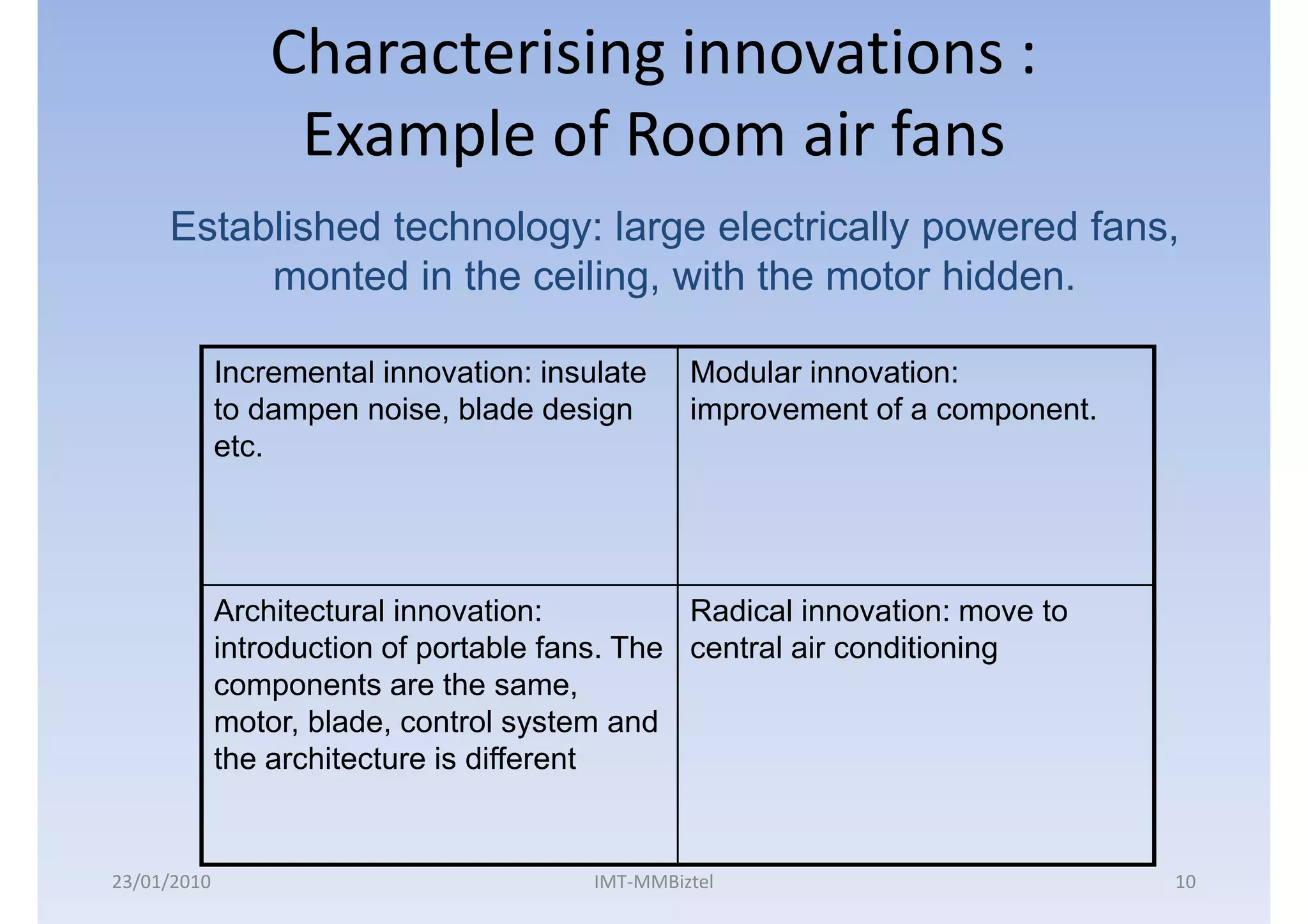
Characterising innovations :
                  Example of Room air fans
     Established technology: large electrically powered fans,
          monted in the ceiling, with the motor hidden.

             Incremental innovation: insulate     Modular innovation:
             to dampen noise, blade design        improvement of a component.
             etc.


             Architectural innovation:          Radical innovation: move to
             introduction of portable fans. The central air conditioning
             components are the same,
             motor, blade, control system and
             the architecture is different


23/01/2010                               IMT-MMBiztel                           10
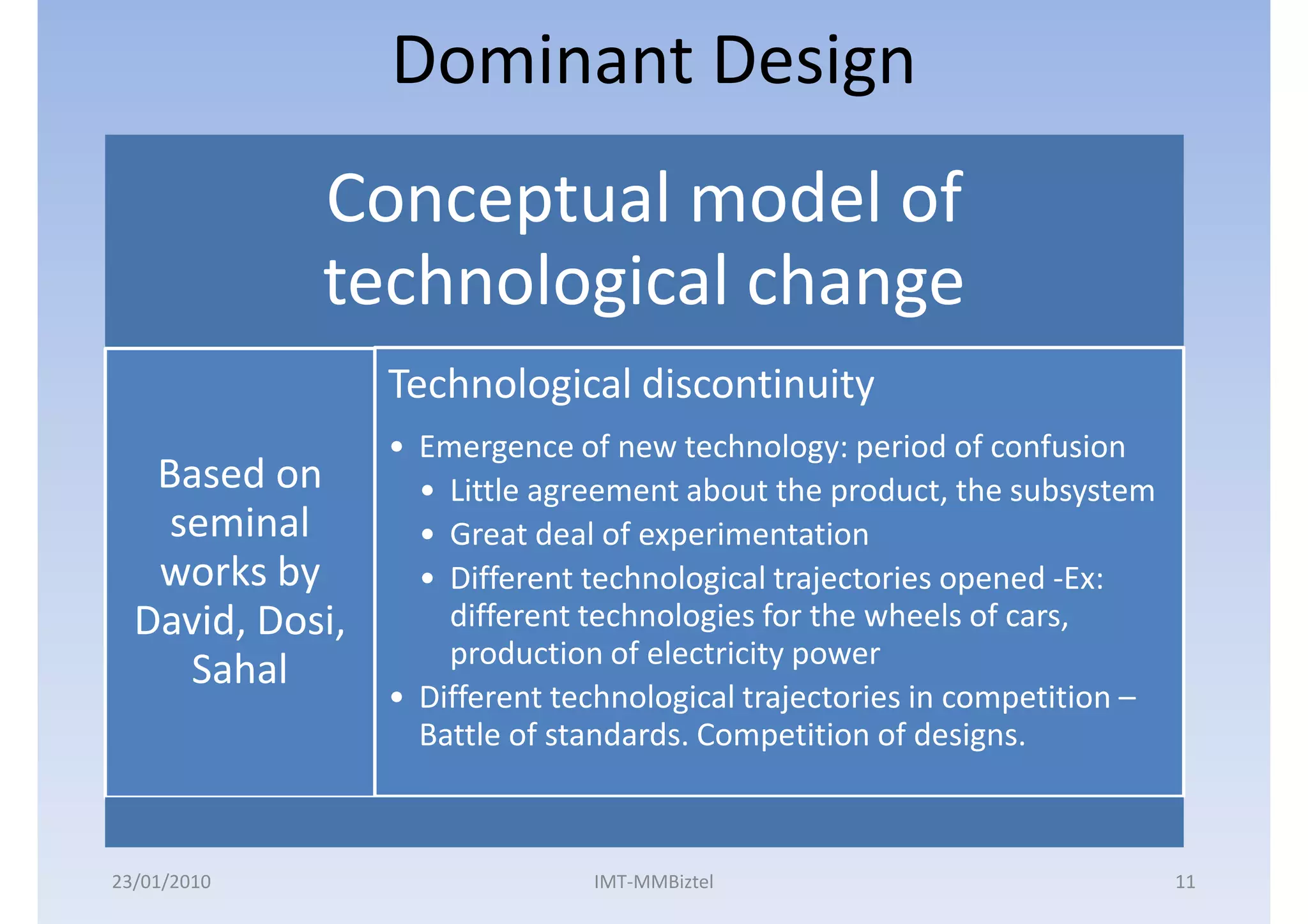
Dominant Design
             Conceptual model of
             technological change
                 Technological discontinuity
                 • Emergence of new technology: period of confusion
   Based on        • Little agreement about the product, the subsystem
    seminal        • Great deal of experimentation
   works by        • Different technological trajectories opened -Ex:
  David, Dosi,       different technologies for the wheels of cars,
                     production of electricity power
     Sahal
                 • Different technological trajectories in competition –
                   Battle of standards. Competition of designs.


23/01/2010                     IMT-MMBiztel                                11
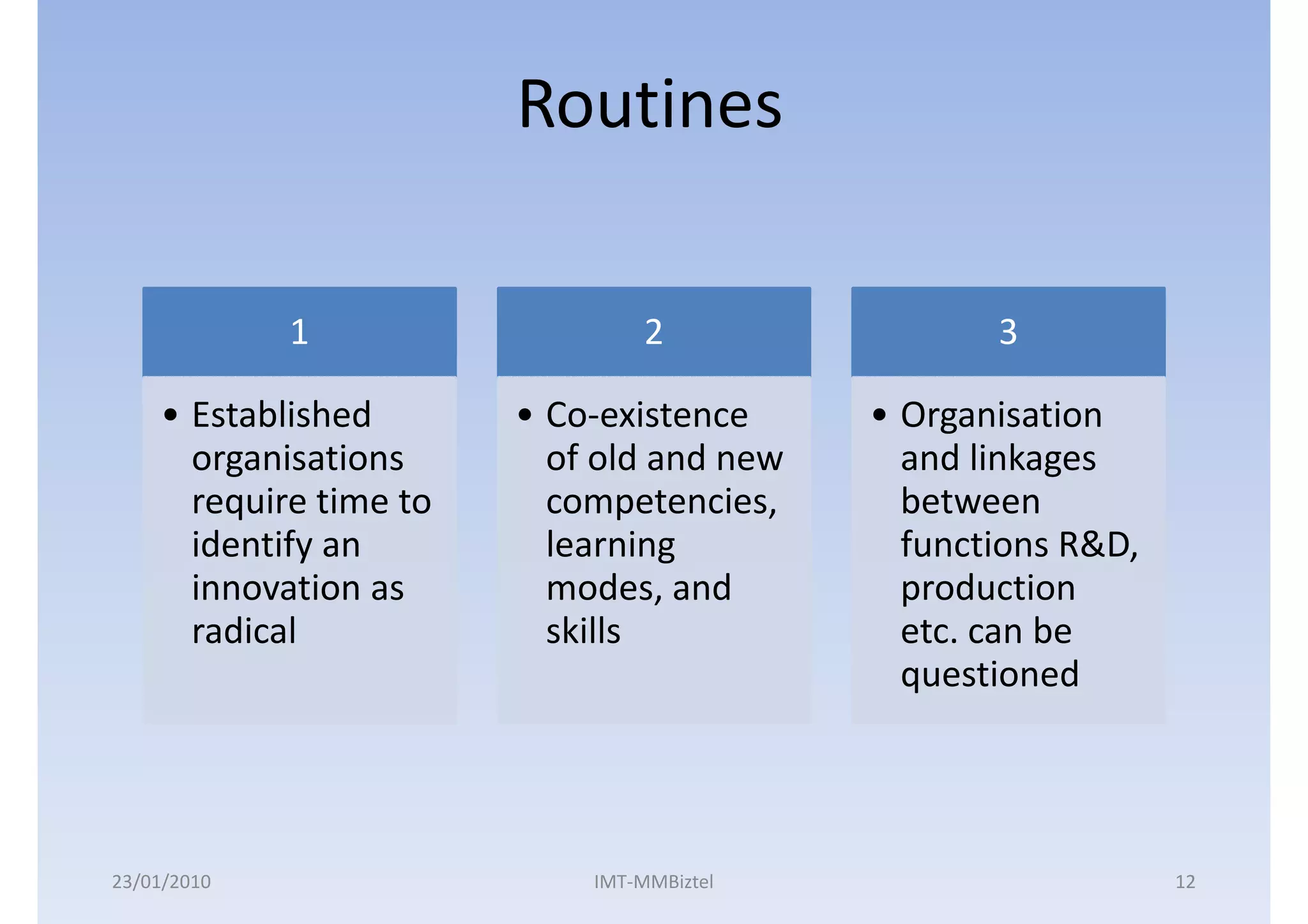
Routines

             1                   2                3

    • Established       • Co-existence     • Organisation
      organisations       of old and new     and linkages
      require time to     competencies,      between
      identify an         learning           functions R&D,
      innovation as       modes, and         production
      radical             skills             etc. can be
                                             questioned


23/01/2010                  IMT-MMBiztel                      12
Innovation Implications


                         Lecture by:
                 Djadja.Sardjana@gmail.com
              http://www.slideshare.net/djadja

 23/01/2010               IMT-MMBiztel           13
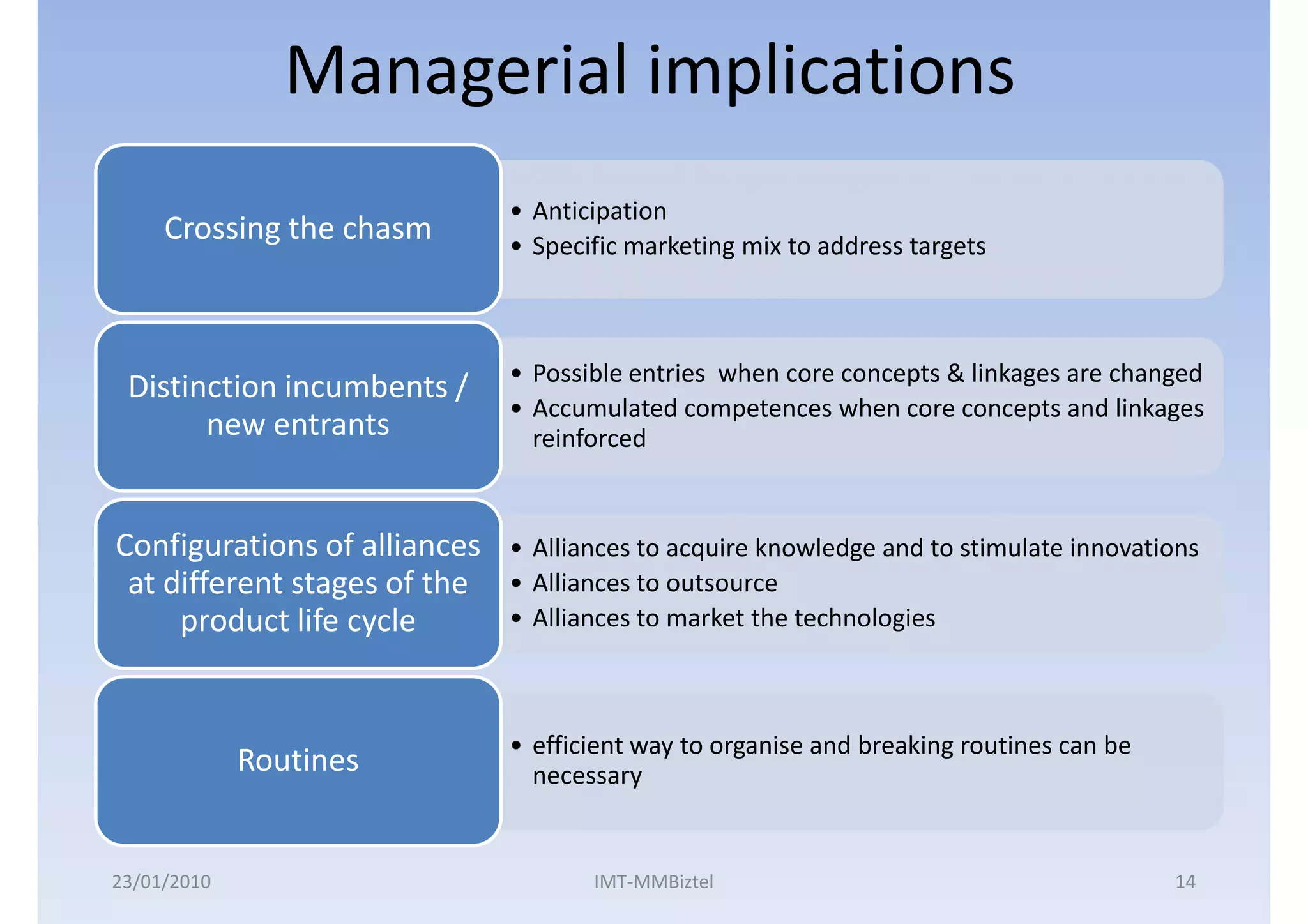
Managerial implications
                              • Anticipation
     Crossing the chasm       • Specific marketing mix to address targets


                              • Possible entries when core concepts & linkages are changed
 Distinction incumbents /
                              • Accumulated competences when core concepts and linkages
       new entrants             reinforced


Configurations of alliances   • Alliances to acquire knowledge and to stimulate innovations
 at different stages of the   • Alliances to outsource
     product life cycle       • Alliances to market the technologies


                              • efficient way to organise and breaking routines can be
             Routines           necessary


23/01/2010                           IMT-MMBiztel                                        14
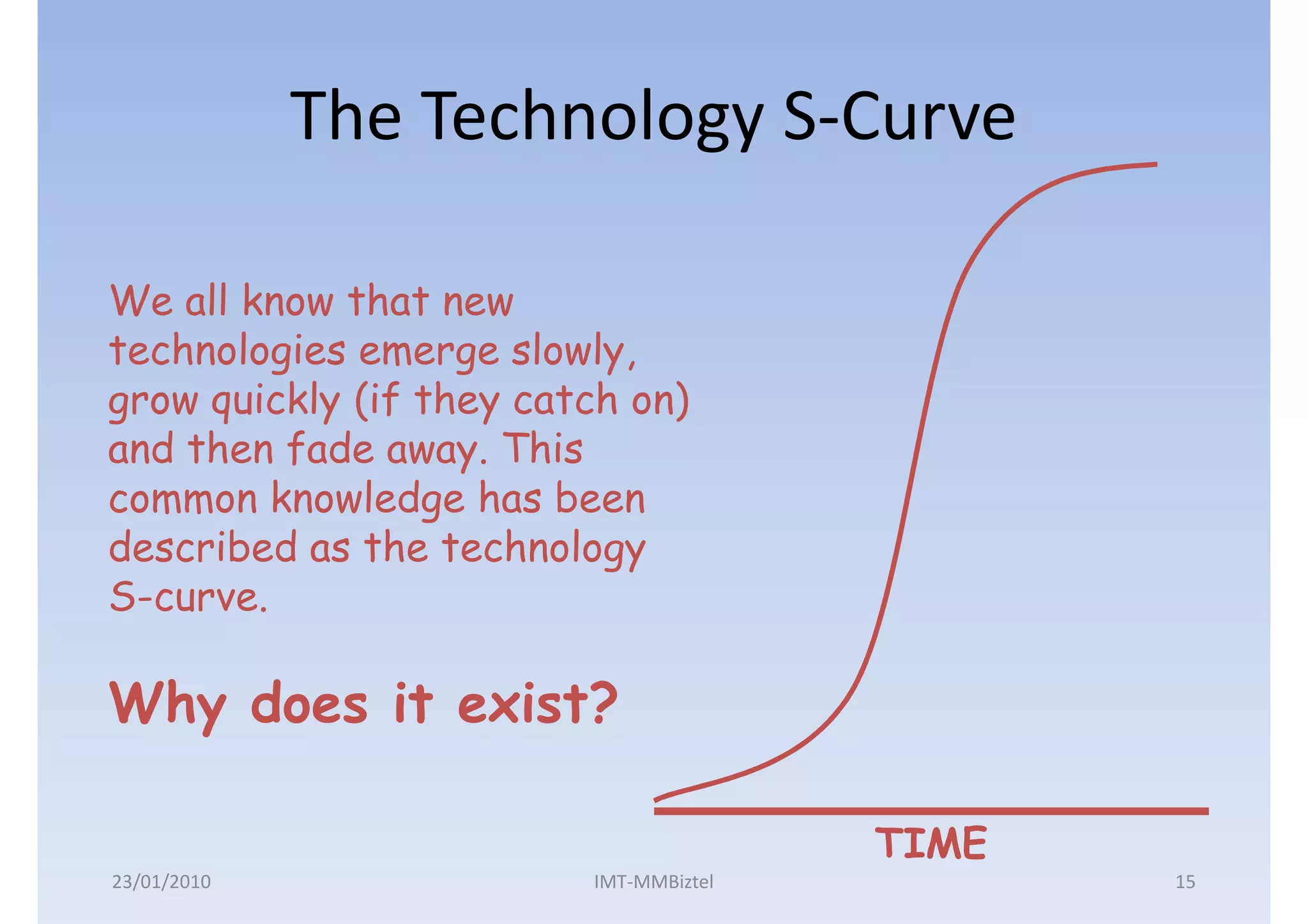
The Technology S-Curve

We all know that new
technologies emerge slowly,
grow quickly (if they catch on)
and then fade away. This
common knowledge has been
described as the technology
S-curve.

Why does it exist?

                                        TIME
23/01/2010               IMT-MMBiztel          15
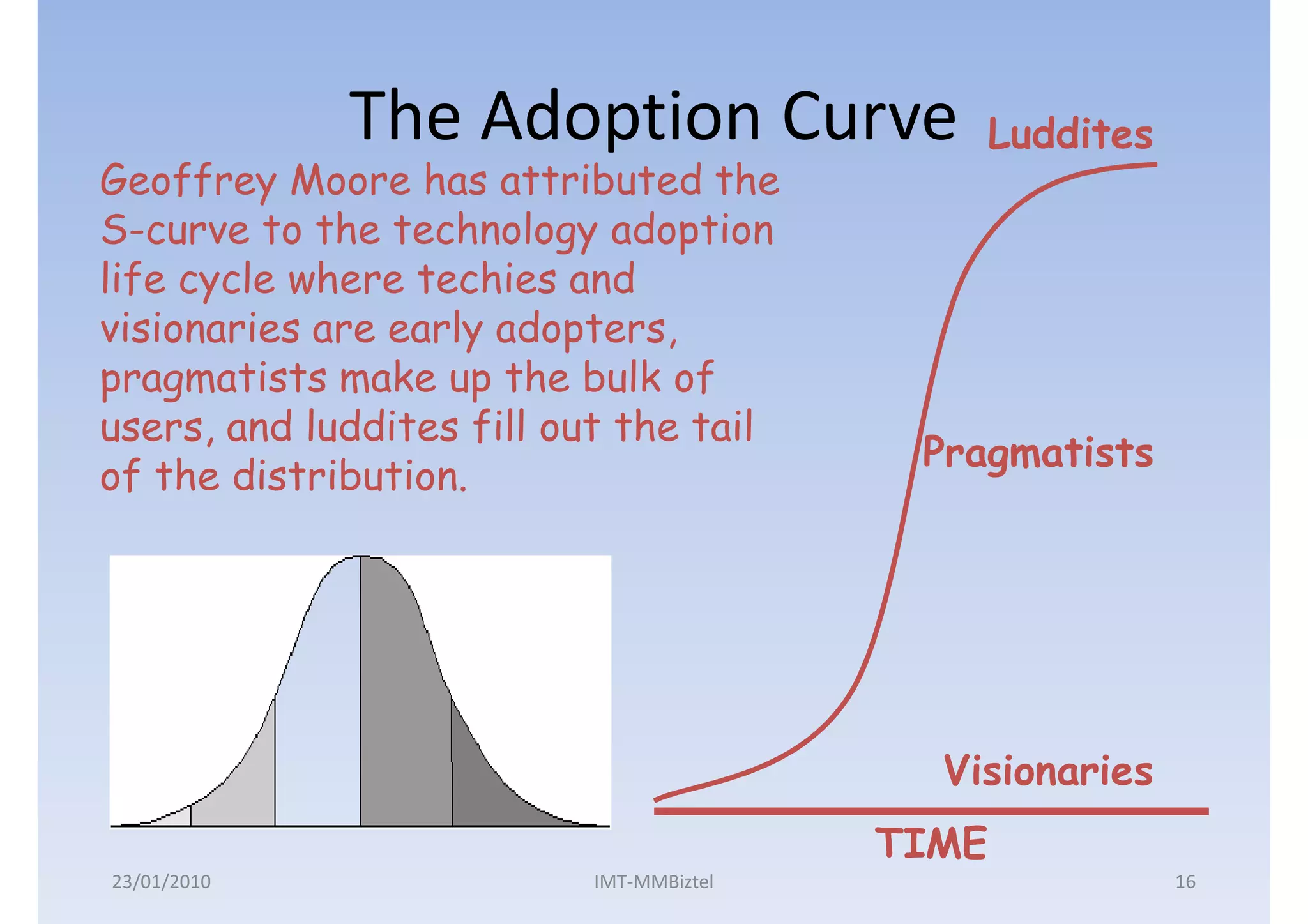
The Adoption Curve                 Luddites
Geoffrey Moore has attributed the
S-curve to the technology adoption
life cycle where techies and
visionaries are early adopters,
pragmatists make up the bulk of
users, and luddites fill out the tail
                                          Pragmatists
of the distribution.


                                           Visionaries
                                         TIME
23/01/2010                IMT-MMBiztel                     16
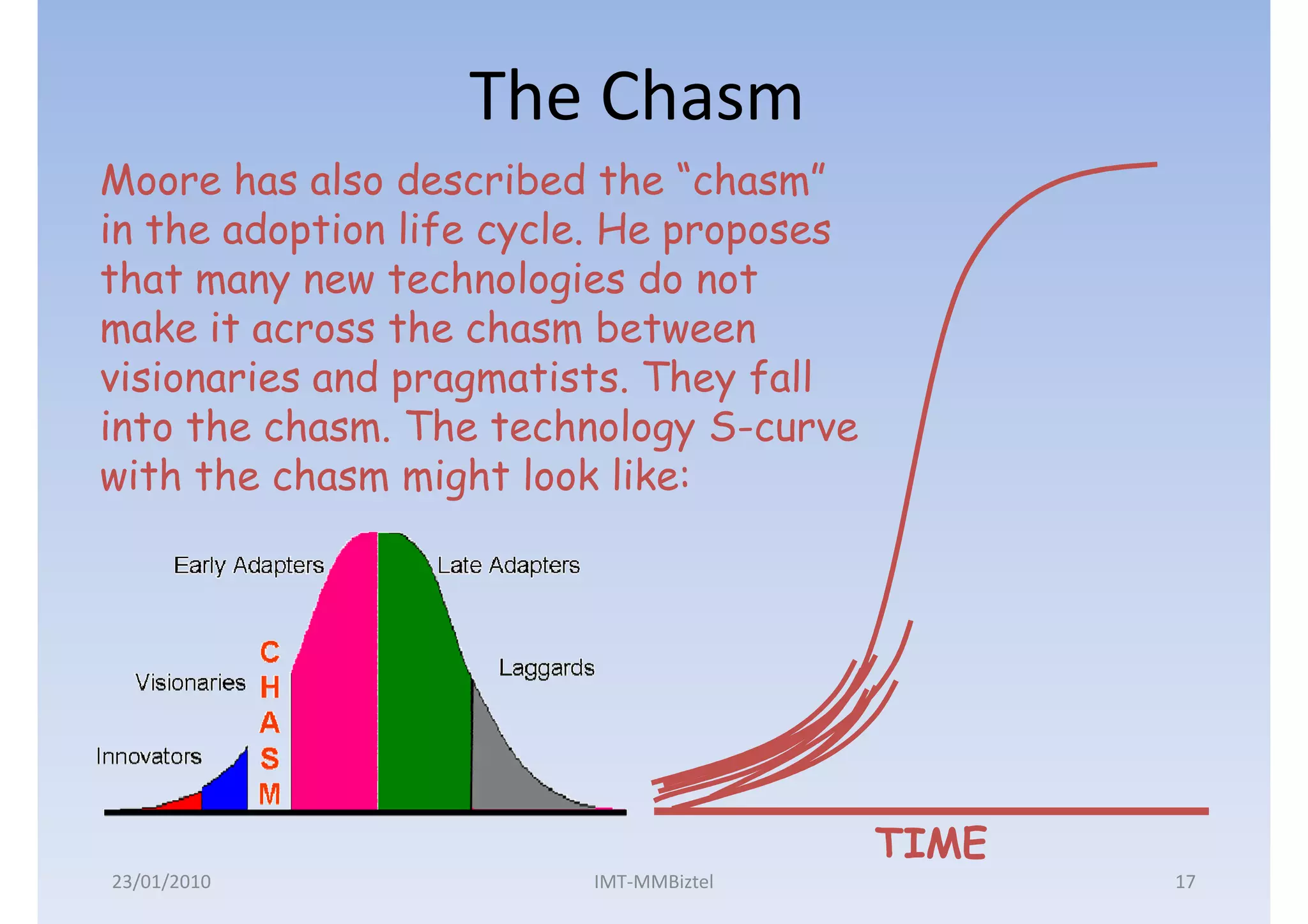
The Chasm
Moore has also described the “chasm”
in the adoption life cycle. He proposes
that many new technologies do not
make it across the chasm between
visionaries and pragmatists. They fall
into the chasm. The technology S-curve
with the chasm might look like:


                                          TIME
23/01/2010               IMT-MMBiztel            17
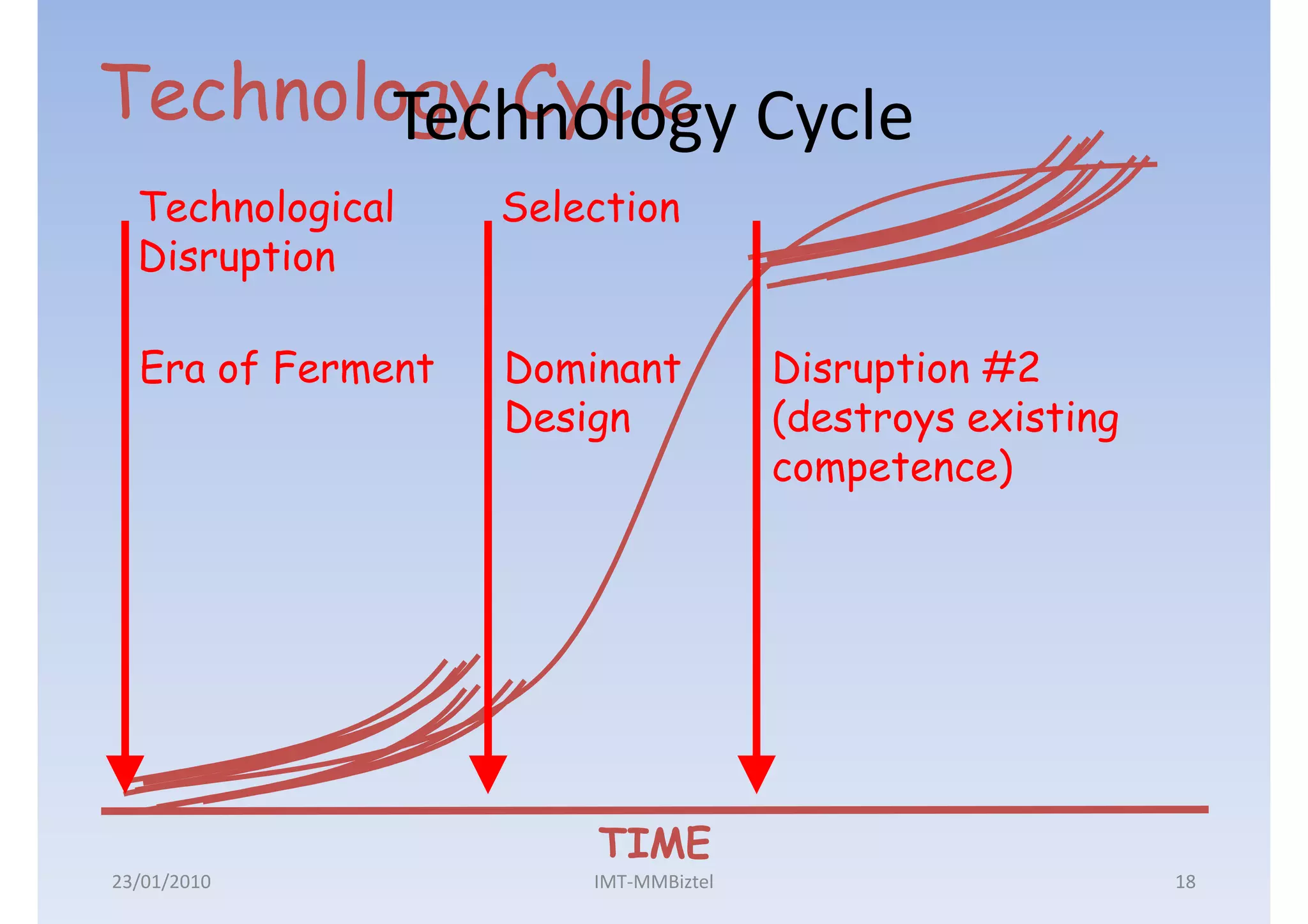
Technology Cycle Cycle
        Technology
  Technological    Selection
  Disruption

  Era of Ferment   Dominant           Disruption #2
                   Design             (destroys existing
                                      competence)


                       TIME
23/01/2010             IMT-MMBiztel                        18
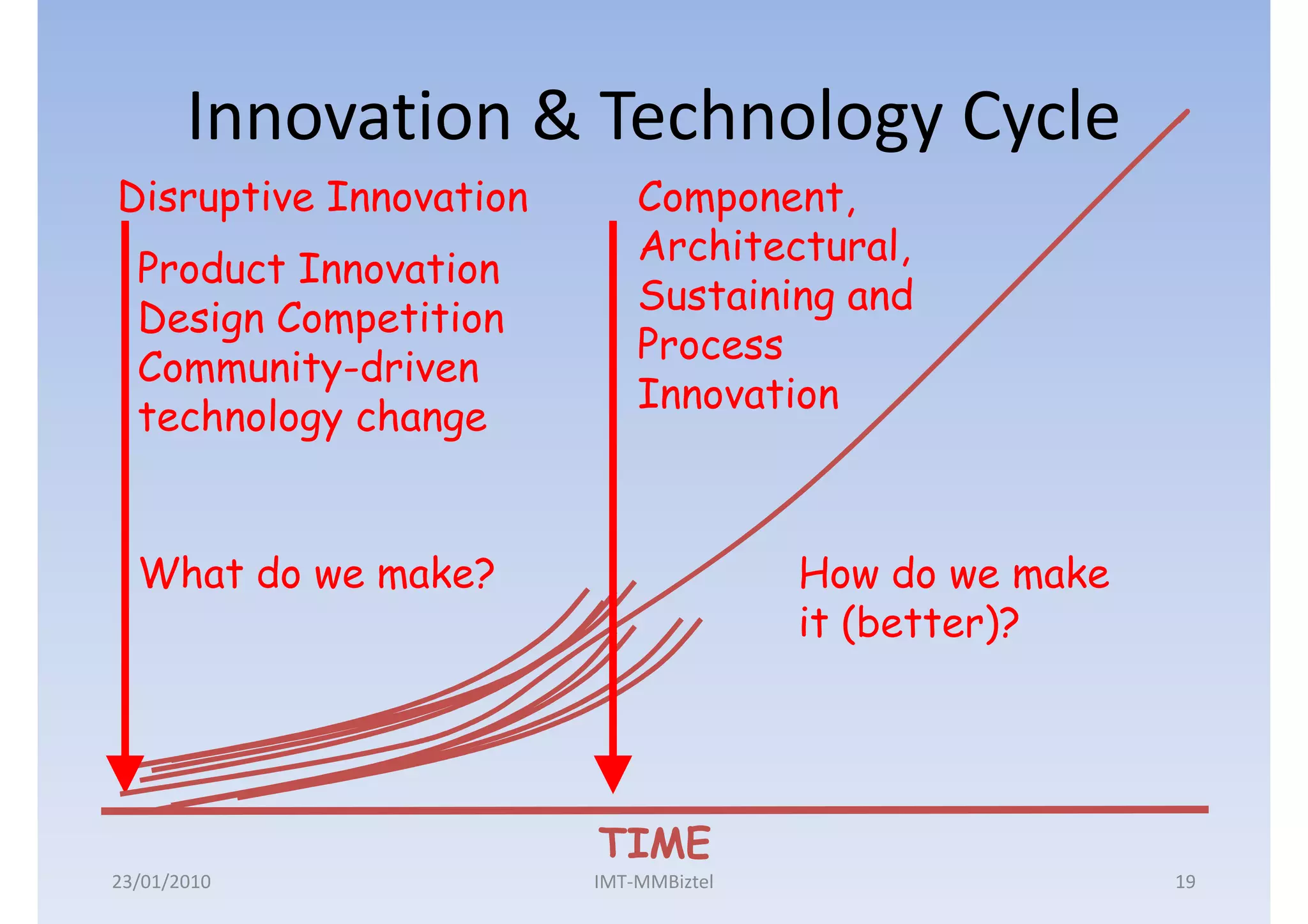
Innovation & Technology Cycle
Disruptive Innovation       Component,
                            Architectural,
  Product Innovation
                            Sustaining and
  Design Competition
                            Process
  Community-driven
                            Innovation
  technology change


  What do we make?                     How do we make
                                       it (better)?


                        TIME
23/01/2010              IMT-MMBiztel                    19
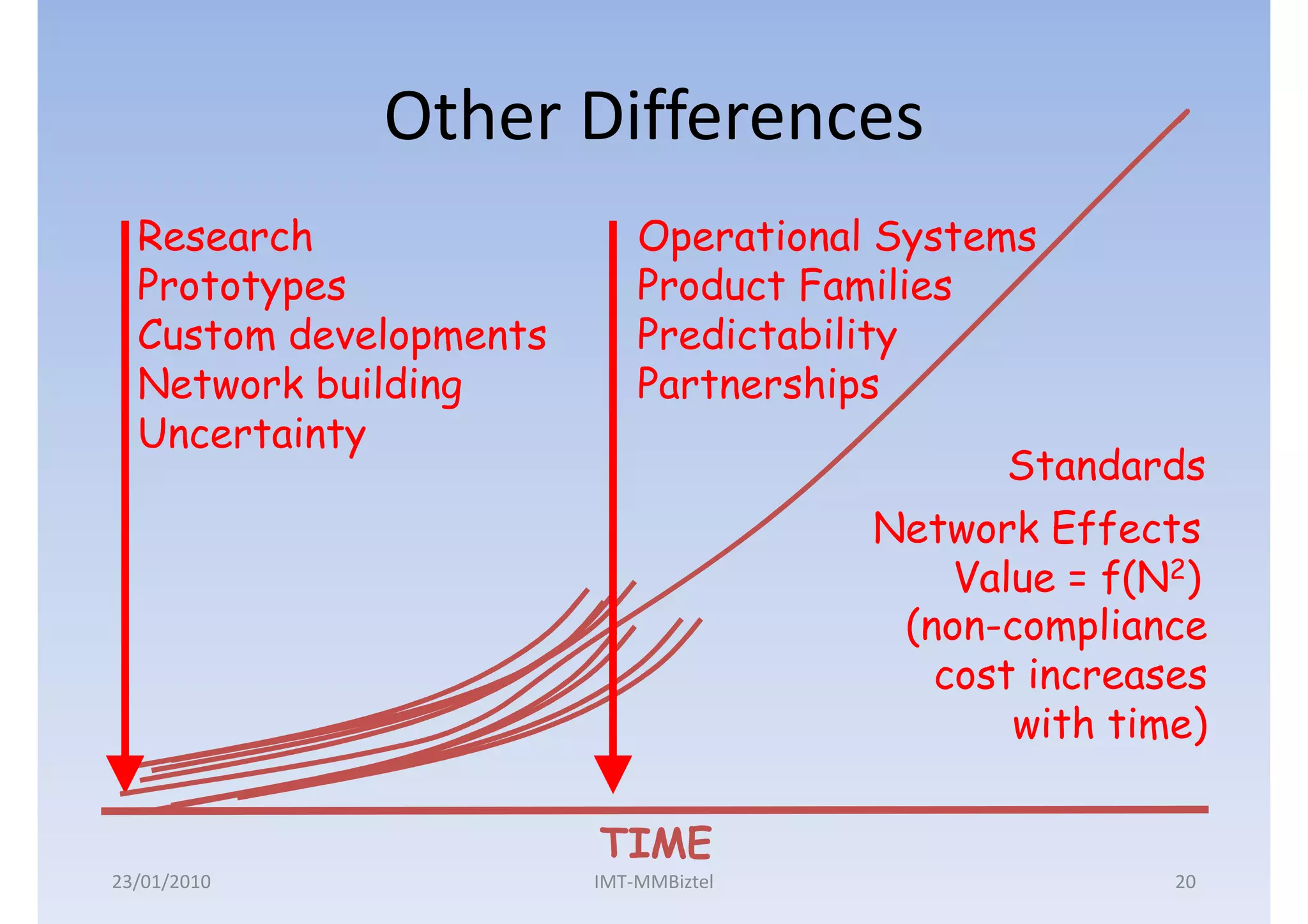
Other Differences
  Research                  Operational Systems
  Prototypes                Product Families
  Custom developments       Predictability
  Network building          Partnerships
  Uncertainty
                                             Standards
                                       Network Effects
                                           Value = f(N2)
                                        (non-compliance
                                          cost increases
                                              with time)

                        TIME
23/01/2010              IMT-MMBiztel                  20
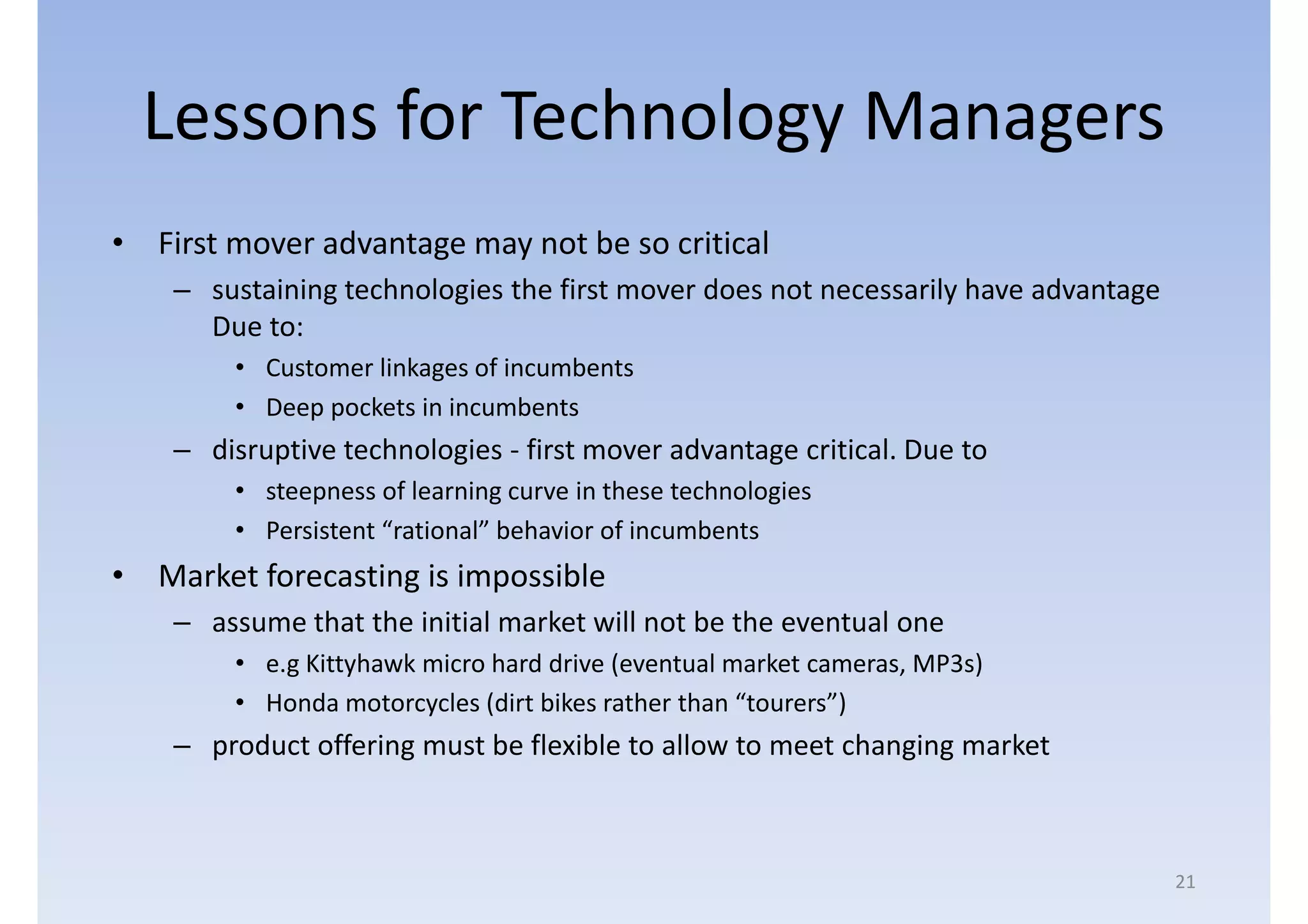
Lessons for Technology Managers
• First mover advantage may not be so critical
    – sustaining technologies the first mover does not necessarily have advantage
      Due to:
        • Customer linkages of incumbents
        • Deep pockets in incumbents
    – disruptive technologies - first mover advantage critical. Due to
        • steepness of learning curve in these technologies
        • Persistent “rational” behavior of incumbents
• Market forecasting is impossible
    – assume that the initial market will not be the eventual one
        • e.g Kittyhawk micro hard drive (eventual market cameras, MP3s)
        • Honda motorcycles (dirt bikes rather than “tourers”)
    – product offering must be flexible to allow to meet changing market


                                                                                    21
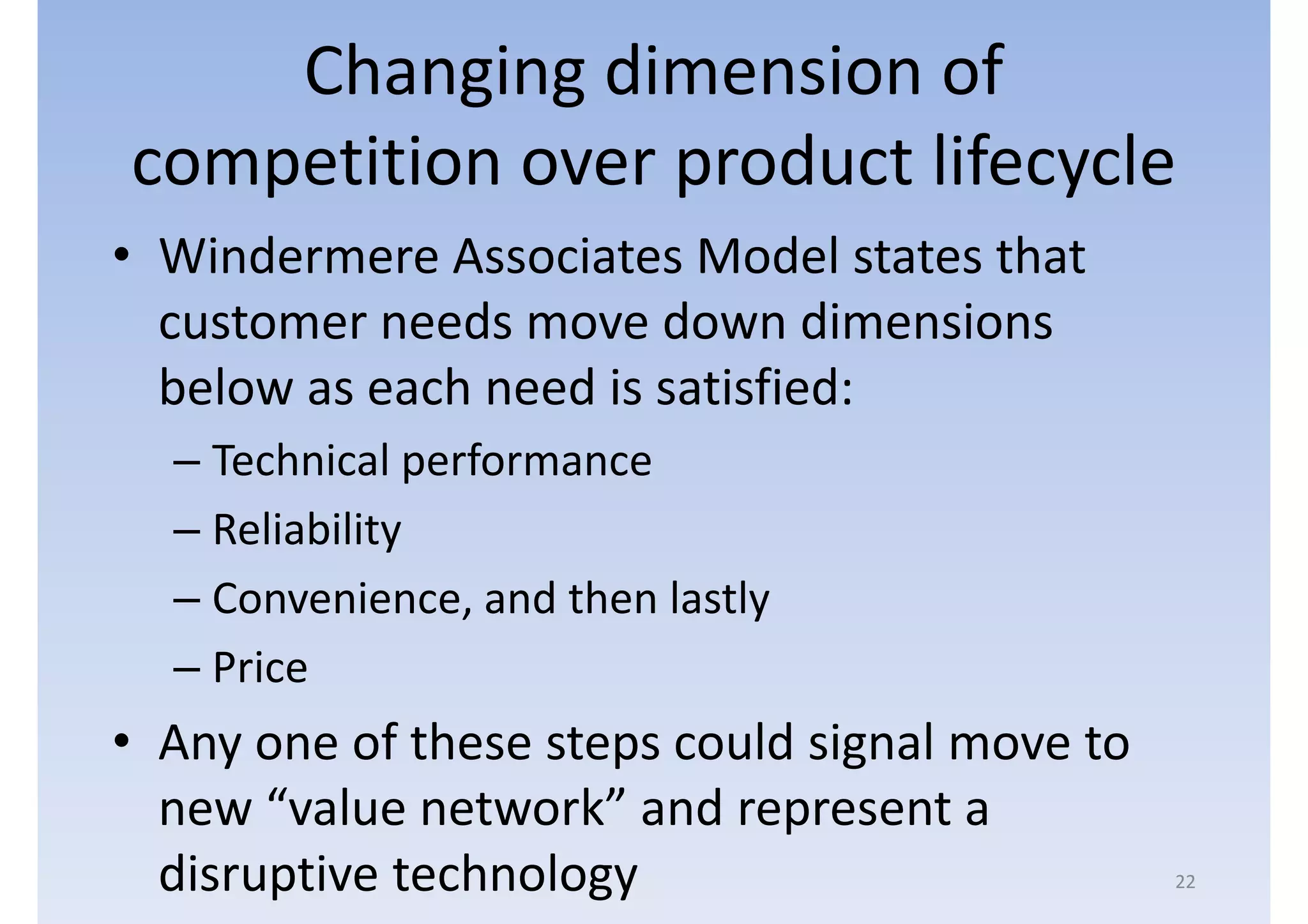
Changing dimension of
competition over product lifecycle
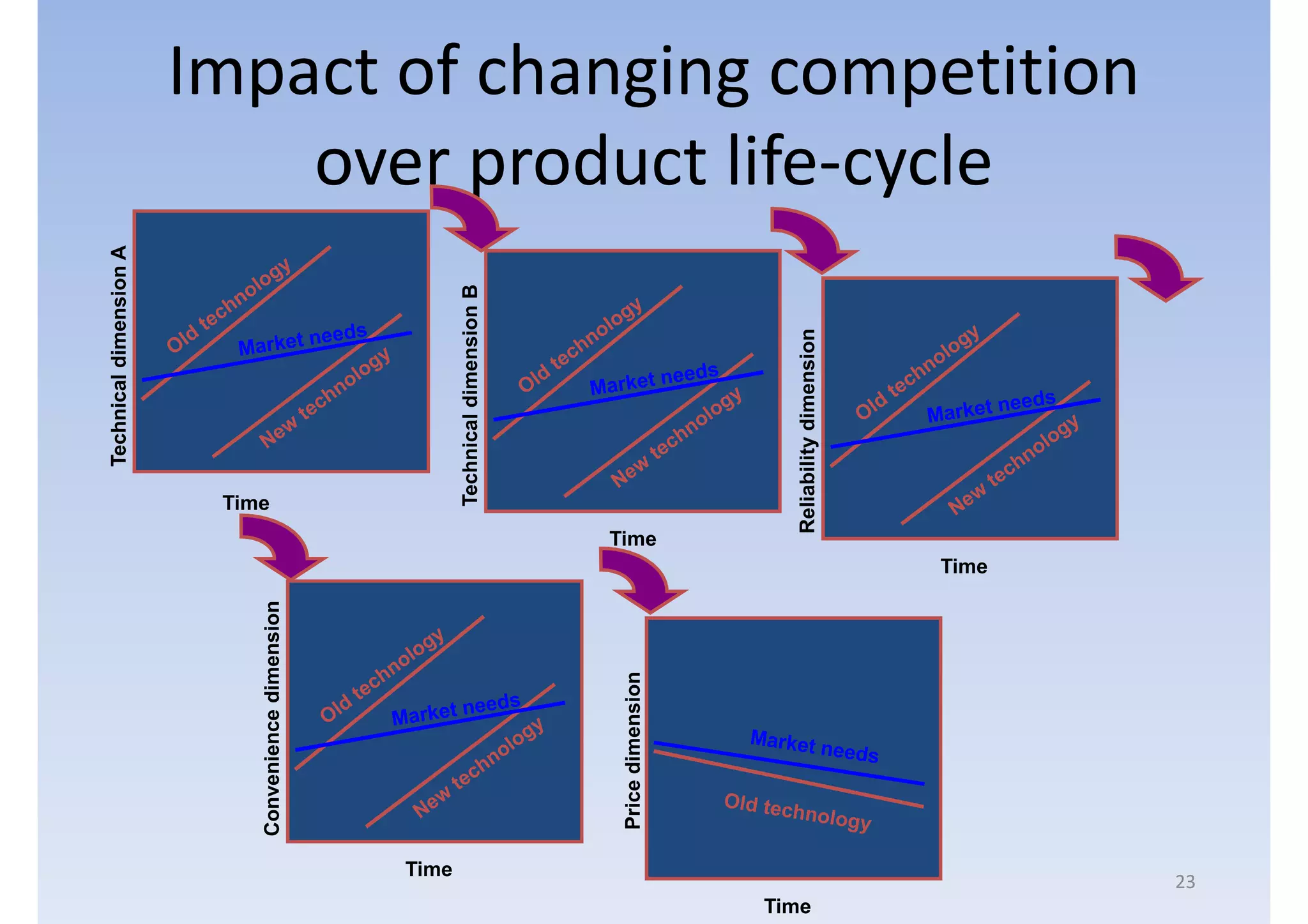
• Windermere Associates Model states that
  customer needs move down dimensions
  below as each need is satisfied:
  – Technical performance
  – Reliability
  – Convenience, and then lastly
  – Price
• Any one of these steps could signal move to
  new “value network” and represent a
  disruptive technology                         22
Technical dimension A


                                                     Time
               Convenience dimension


        Time
                                                      Technical dimension B


               Price dimension
                                              Time


Time
                                                 Reliability dimension
                                       Time
                                                                                        over product life-cycle
                                                                                    Impact of changing competition


       23
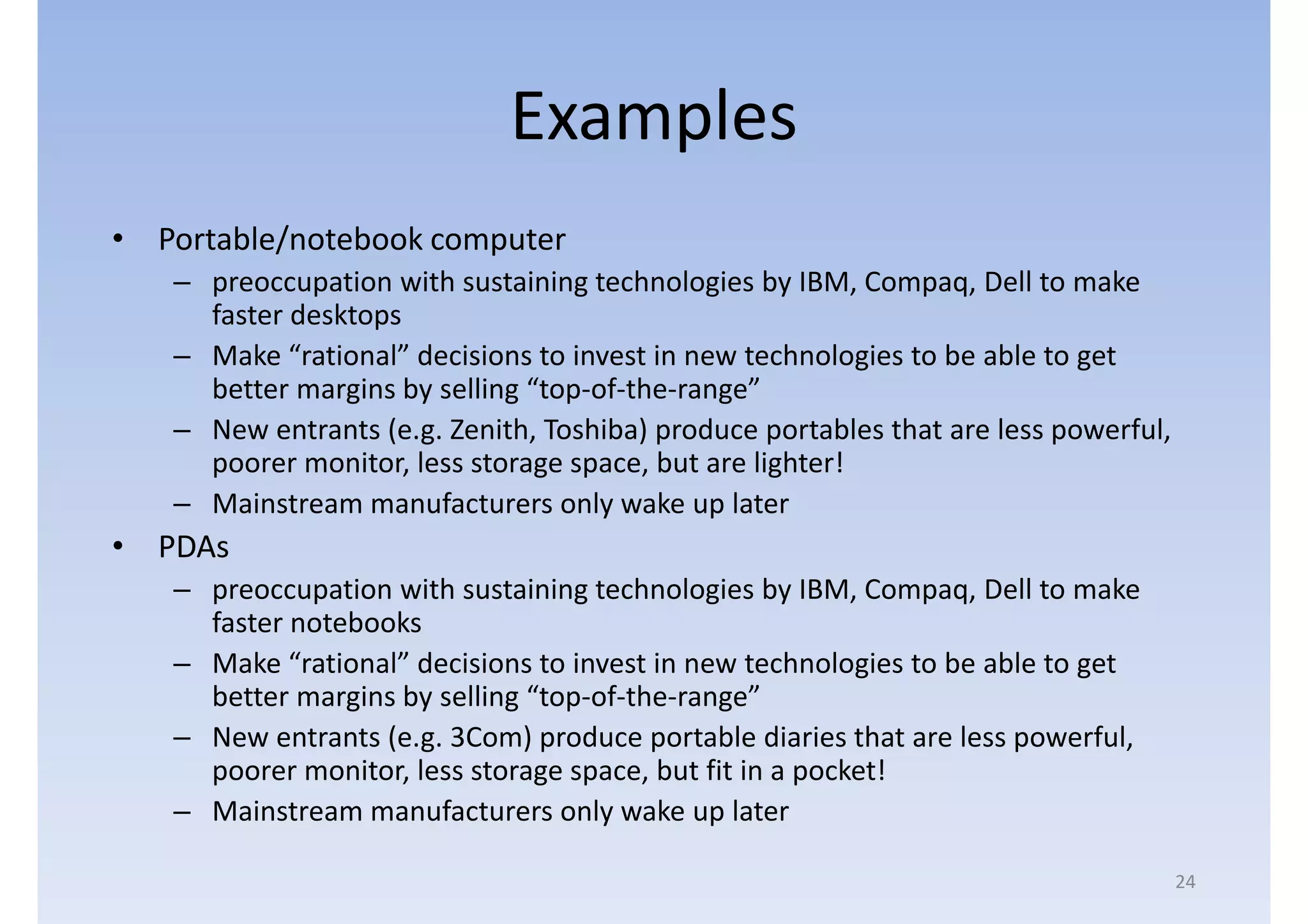
Examples
• Portable/notebook computer
   – preoccupation with sustaining technologies by IBM, Compaq, Dell to make
     faster desktops
   – Make “rational” decisions to invest in new technologies to be able to get
     better margins by selling “top-of-the-range”
   – New entrants (e.g. Zenith, Toshiba) produce portables that are less powerful,
     poorer monitor, less storage space, but are lighter!
   – Mainstream manufacturers only wake up later
• PDAs
   – preoccupation with sustaining technologies by IBM, Compaq, Dell to make
     faster notebooks
   – Make “rational” decisions to invest in new technologies to be able to get
     better margins by selling “top-of-the-range”
   – New entrants (e.g. 3Com) produce portable diaries that are less powerful,
     poorer monitor, less storage space, but fit in a pocket!
   – Mainstream manufacturers only wake up later

                                                                                     24
More Examples
•   “OEM” Software -> Shrink Wrap Software
•   Mainframe -> IBM PC
•   Cessna -> Micro light Aircraft
•   Email -> SMS
•   Professional Printing -> DTP & Inkjet
•   Pathologists -> Home pregnancy testing
•   MSOffice -> MSWorks

                                         25
Trajectories you know


“random access file” – ca. 1953
                                  26
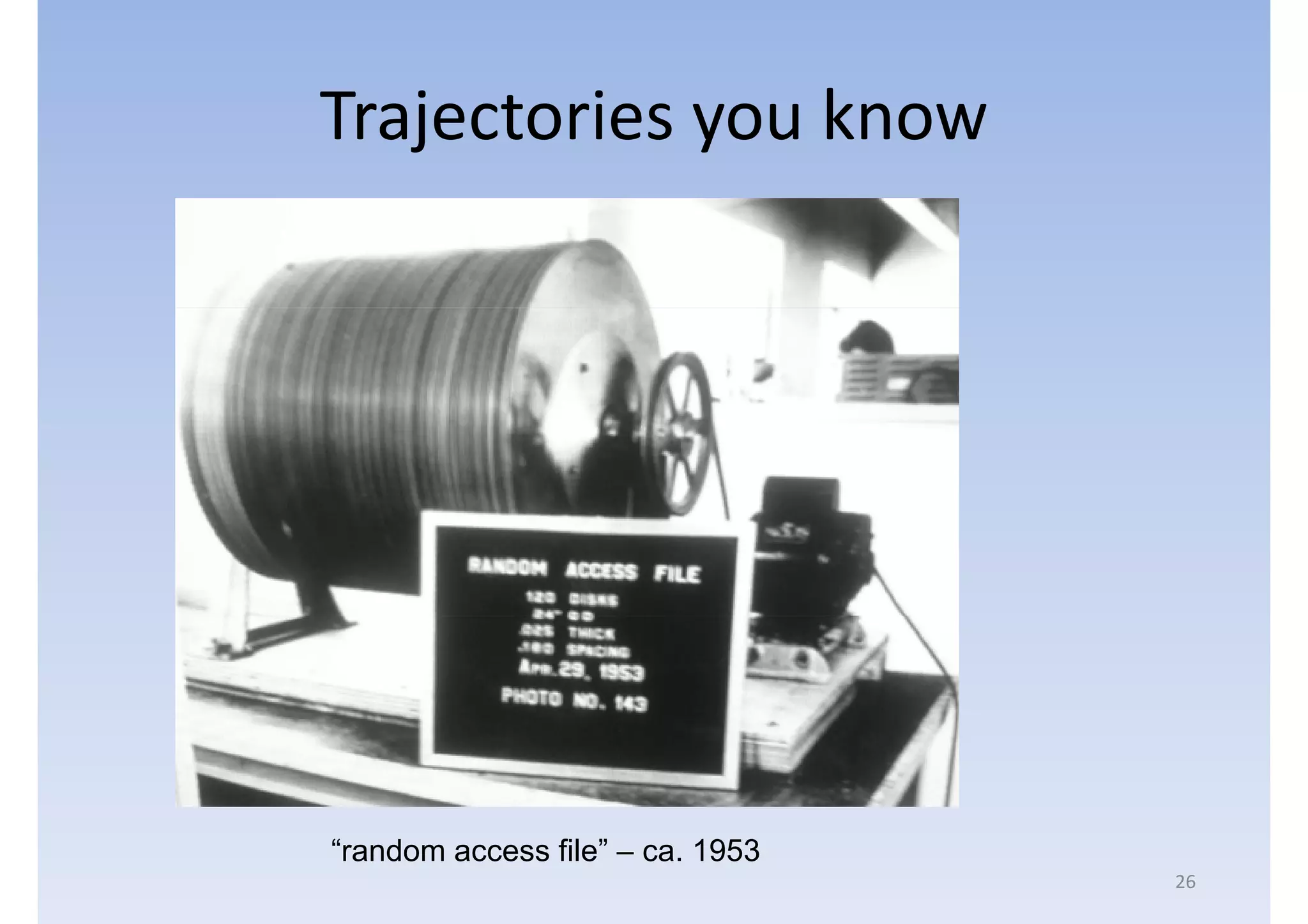
Trajectories you know


“random access file” – ca. 1973
                                  27
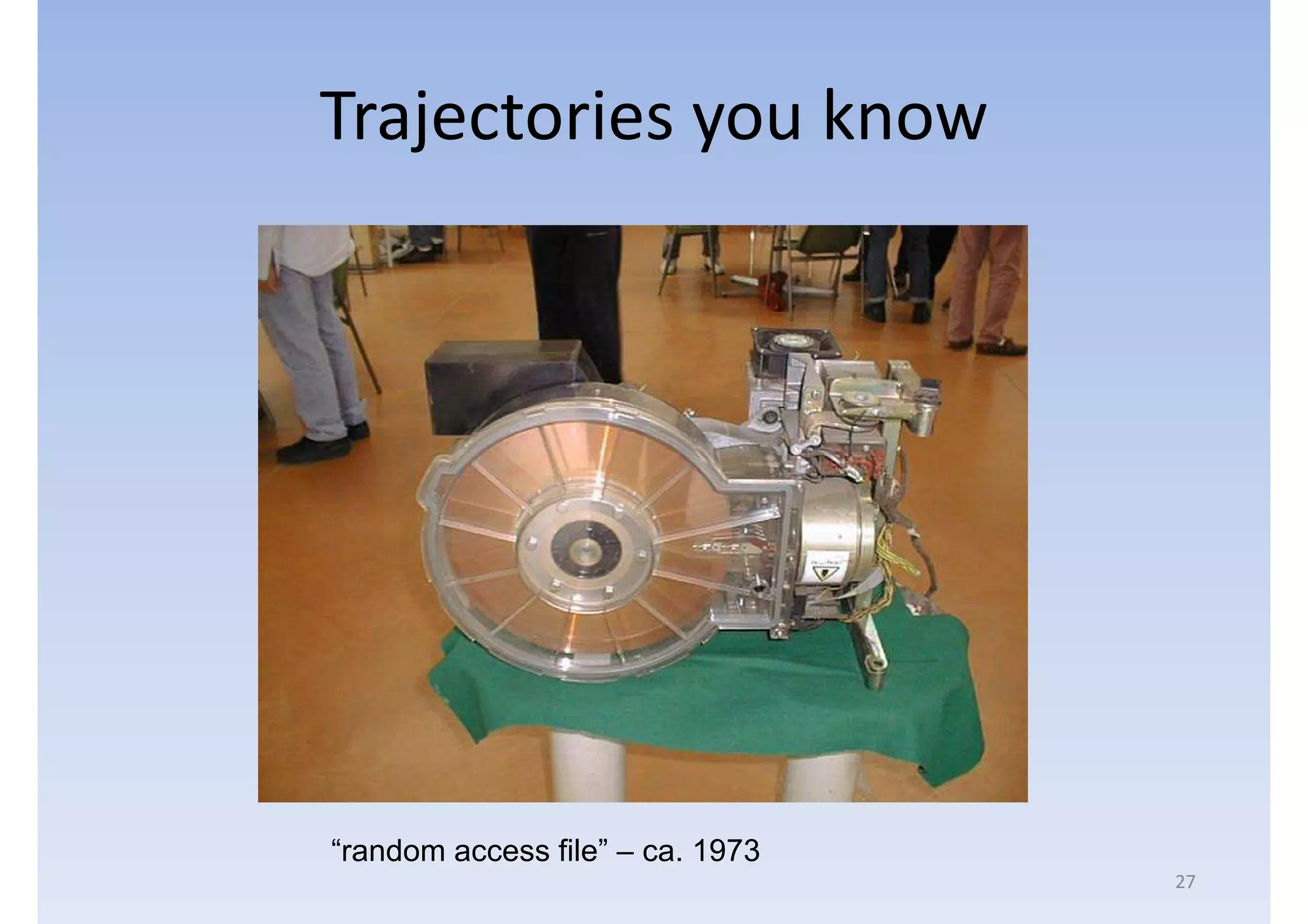
Trajectories you know


   180MB, 3.5” – ca. 1993


                            28
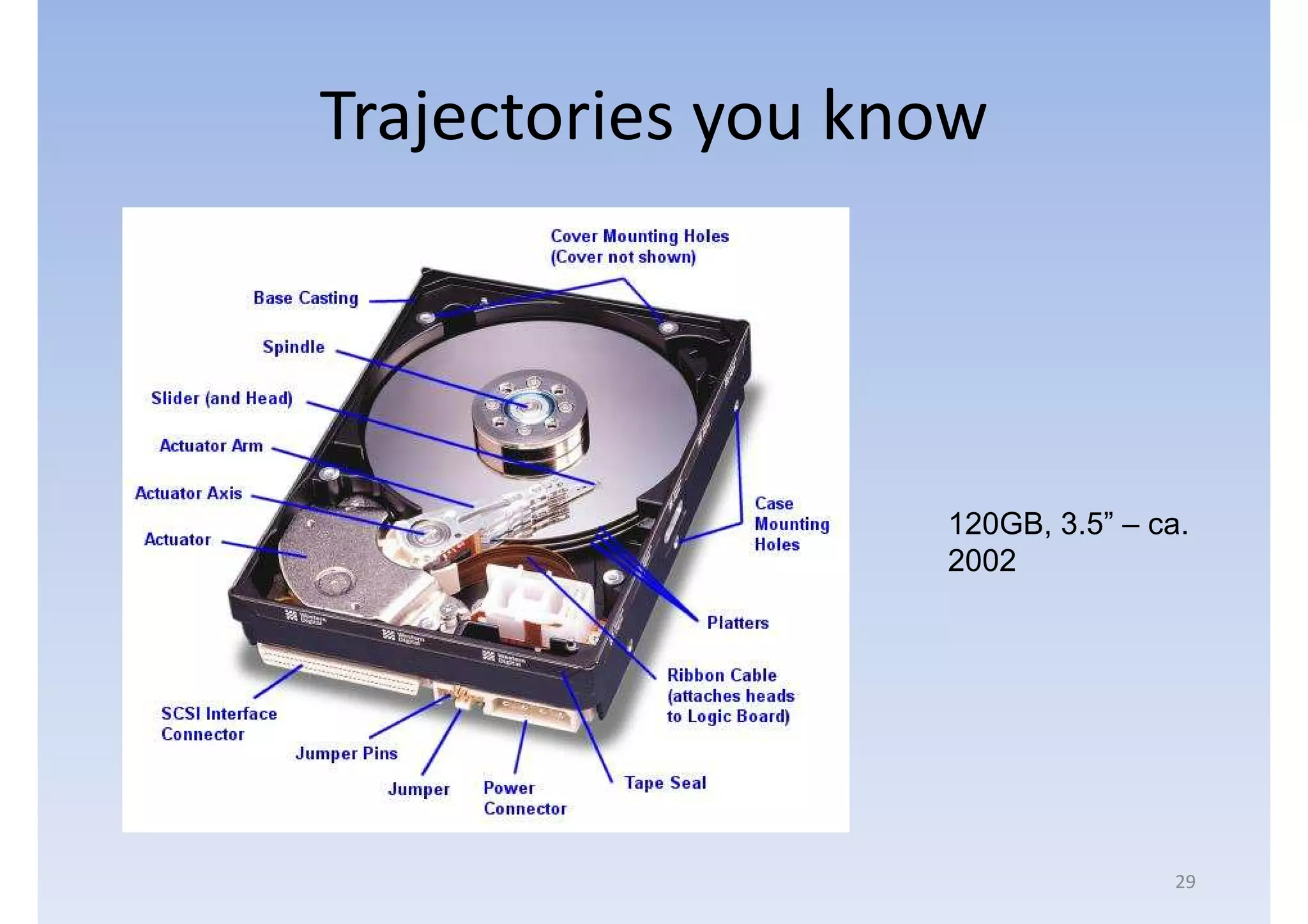
Trajectories you know


                   120GB, 3.5” – ca.
                   2002


                                   29
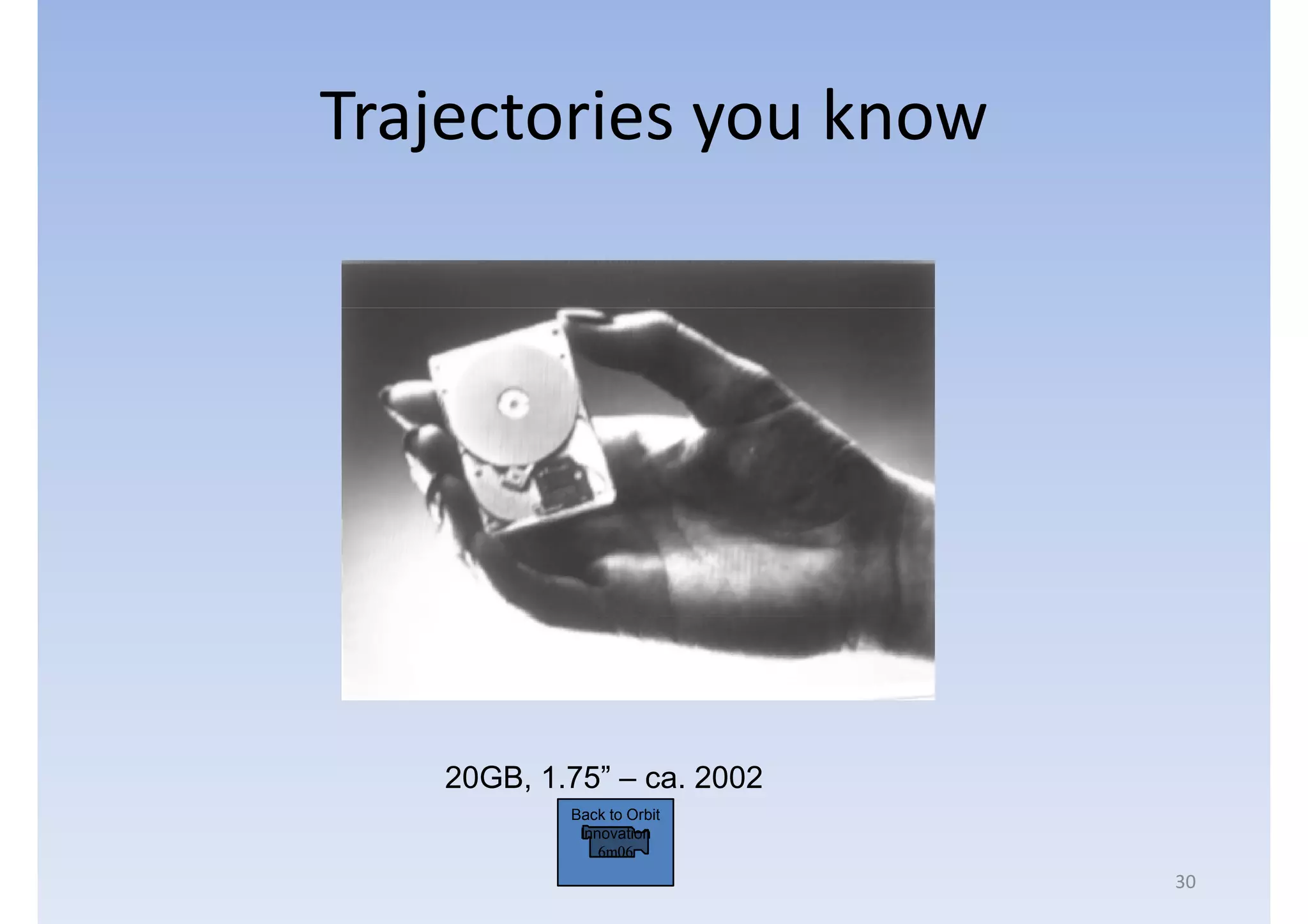
Trajectories you know


   20GB, 1.75” – ca. 2002
           Back to Orbit
            Innovation
               6m06

                            30

Lecture IMTelkom MM-Biztel: Architectural Innovation

  • 1.
    Invention Or Innovation 1m38 Architectural Innovation Lecture by: Djadja.Sardjana@gmail.com http://www.slideshare.net/djadja 23/01/2010 IMT-MMBiztel 1
  • 2.
    Roadmap of Innovation Lecture by: Djadja.Sardjana@gmail.com http://www.slideshare.net/djadja 23/01/2010 IMT-MMBiztel 2
  • 3.
    Describing the innovation • Incremental & radical Innovation • Component & Type Architectural • dominant design Two main • routines concepts 23/01/2010 IMT-MMBiztel 3
  • 4.
    Types of Innovation- 1 •Sustaining / Incremental Innovation: generally small innovations in products and processes aimed at existing customers. •Disruptive / Radical Innovation: significant innovations generally aimed at unknown or non-existent customers. 23/01/2010 IMT-MMBiztel 4
  • 5.
    Types of Innovation- 2 Component Innovation: Making existing components better. Architectural Innovation: putting existing components together in new ways. 23/01/2010 IMT-MMBiztel 5
  • 6.
    Architecture = Organization •Structurein mature organizations tends to evolve to match product architectures. • Architectural Innovation, therefore, many times includes elements of organizational change. 23/01/2010 IMT-MMBiztel 6
  • 7.
    Characterising innovations Incremental • minor changes on existing product • exploits the potentials of existing design innovations • often reinforces the dominance of established firms • based on a different set of engineering and scientific Radical principles • often opens up new markets and potential applications innovation • create great difficulties to existing firms and leave space for entry of new firms. Architectural • changes the way in which components are linked together while living the basic competencies innovation untouched Component • improvement of a component innovation 23/01/2010 IMT-MMBiztel 7
  • 8.
    Characterising innovations Impacts on the linkages between components Impacts on the linkages between components Impacts on the linkages between components Core concepts Linkage between core Reinforced Overturned Unchanged Incremental Modular concepts and components innovation innovation changed Architectural Radical innovation innovation Innovations’ impact on components 23/01/2010 IMT-MMBiztel 8
  • 9.
    Characterising innovations Incremental innovation: Modular innovation: refines and extends the improvement of a established design component. Ex : from Architectural innovation: Radical innovation: reconfiguration of an establishes new established system dominant design, a new set of core design concept embodied in a new architecture 23/01/2010 IMT-MMBiztel 9
  • 10.
    Characterising innovations : Example of Room air fans Established technology: large electrically powered fans, monted in the ceiling, with the motor hidden. Incremental innovation: insulate Modular innovation: to dampen noise, blade design improvement of a component. etc. Architectural innovation: Radical innovation: move to introduction of portable fans. The central air conditioning components are the same, motor, blade, control system and the architecture is different 23/01/2010 IMT-MMBiztel 10
  • 11.
    Dominant Design Conceptual model of technological change Technological discontinuity • Emergence of new technology: period of confusion Based on • Little agreement about the product, the subsystem seminal • Great deal of experimentation works by • Different technological trajectories opened -Ex: David, Dosi, different technologies for the wheels of cars, production of electricity power Sahal • Different technological trajectories in competition – Battle of standards. Competition of designs. 23/01/2010 IMT-MMBiztel 11
  • 12.
    Routines 1 2 3 • Established • Co-existence • Organisation organisations of old and new and linkages require time to competencies, between identify an learning functions R&D, innovation as modes, and production radical skills etc. can be questioned 23/01/2010 IMT-MMBiztel 12
  • 13.
    Innovation Implications Lecture by: Djadja.Sardjana@gmail.com http://www.slideshare.net/djadja 23/01/2010 IMT-MMBiztel 13
  • 14.
    Managerial implications • Anticipation Crossing the chasm • Specific marketing mix to address targets • Possible entries when core concepts & linkages are changed Distinction incumbents / • Accumulated competences when core concepts and linkages new entrants reinforced Configurations of alliances • Alliances to acquire knowledge and to stimulate innovations at different stages of the • Alliances to outsource product life cycle • Alliances to market the technologies • efficient way to organise and breaking routines can be Routines necessary 23/01/2010 IMT-MMBiztel 14
  • 15.
    The Technology S-Curve Weall know that new technologies emerge slowly, grow quickly (if they catch on) and then fade away. This common knowledge has been described as the technology S-curve. Why does it exist? TIME 23/01/2010 IMT-MMBiztel 15
  • 16.
    The Adoption Curve Luddites Geoffrey Moore has attributed the S-curve to the technology adoption life cycle where techies and visionaries are early adopters, pragmatists make up the bulk of users, and luddites fill out the tail Pragmatists of the distribution. Visionaries TIME 23/01/2010 IMT-MMBiztel 16
  • 17.
    The Chasm Moore hasalso described the “chasm” in the adoption life cycle. He proposes that many new technologies do not make it across the chasm between visionaries and pragmatists. They fall into the chasm. The technology S-curve with the chasm might look like: TIME 23/01/2010 IMT-MMBiztel 17
  • 18.
    Technology Cycle Cycle Technology Technological Selection Disruption Era of Ferment Dominant Disruption #2 Design (destroys existing competence) TIME 23/01/2010 IMT-MMBiztel 18
  • 19.
    Innovation & TechnologyCycle Disruptive Innovation Component, Architectural, Product Innovation Sustaining and Design Competition Process Community-driven Innovation technology change What do we make? How do we make it (better)? TIME 23/01/2010 IMT-MMBiztel 19
  • 20.
    Other Differences Research Operational Systems Prototypes Product Families Custom developments Predictability Network building Partnerships Uncertainty Standards Network Effects Value = f(N2) (non-compliance cost increases with time) TIME 23/01/2010 IMT-MMBiztel 20
  • 21.
    Lessons for TechnologyManagers • First mover advantage may not be so critical – sustaining technologies the first mover does not necessarily have advantage Due to: • Customer linkages of incumbents • Deep pockets in incumbents – disruptive technologies - first mover advantage critical. Due to • steepness of learning curve in these technologies • Persistent “rational” behavior of incumbents • Market forecasting is impossible – assume that the initial market will not be the eventual one • e.g Kittyhawk micro hard drive (eventual market cameras, MP3s) • Honda motorcycles (dirt bikes rather than “tourers”) – product offering must be flexible to allow to meet changing market 21
  • 22.
    Changing dimension of competitionover product lifecycle • Windermere Associates Model states that customer needs move down dimensions below as each need is satisfied: – Technical performance – Reliability – Convenience, and then lastly – Price • Any one of these steps could signal move to new “value network” and represent a disruptive technology 22
  • 23.
    Technical dimension A Time Convenience dimension Time Technical dimension B Price dimension Time Time Reliability dimension Time over product life-cycle Impact of changing competition 23
  • 24.
    Examples • Portable/notebook computer – preoccupation with sustaining technologies by IBM, Compaq, Dell to make faster desktops – Make “rational” decisions to invest in new technologies to be able to get better margins by selling “top-of-the-range” – New entrants (e.g. Zenith, Toshiba) produce portables that are less powerful, poorer monitor, less storage space, but are lighter! – Mainstream manufacturers only wake up later • PDAs – preoccupation with sustaining technologies by IBM, Compaq, Dell to make faster notebooks – Make “rational” decisions to invest in new technologies to be able to get better margins by selling “top-of-the-range” – New entrants (e.g. 3Com) produce portable diaries that are less powerful, poorer monitor, less storage space, but fit in a pocket! – Mainstream manufacturers only wake up later 24
  • 25.
    More Examples • “OEM” Software -> Shrink Wrap Software • Mainframe -> IBM PC • Cessna -> Micro light Aircraft • Email -> SMS • Professional Printing -> DTP & Inkjet • Pathologists -> Home pregnancy testing • MSOffice -> MSWorks 25
  • 26.
    Trajectories you know “randomaccess file” – ca. 1953 26
  • 27.
    Trajectories you know “randomaccess file” – ca. 1973 27
  • 28.
    Trajectories you know 180MB, 3.5” – ca. 1993 28
  • 29.
    Trajectories you know 120GB, 3.5” – ca. 2002 29
  • 30.
    Trajectories you know 20GB, 1.75” – ca. 2002 Back to Orbit Innovation 6m06 30