Kayla, Carlota, Andrea, María e Itziar The reproductive  process
Pregnancy and labour
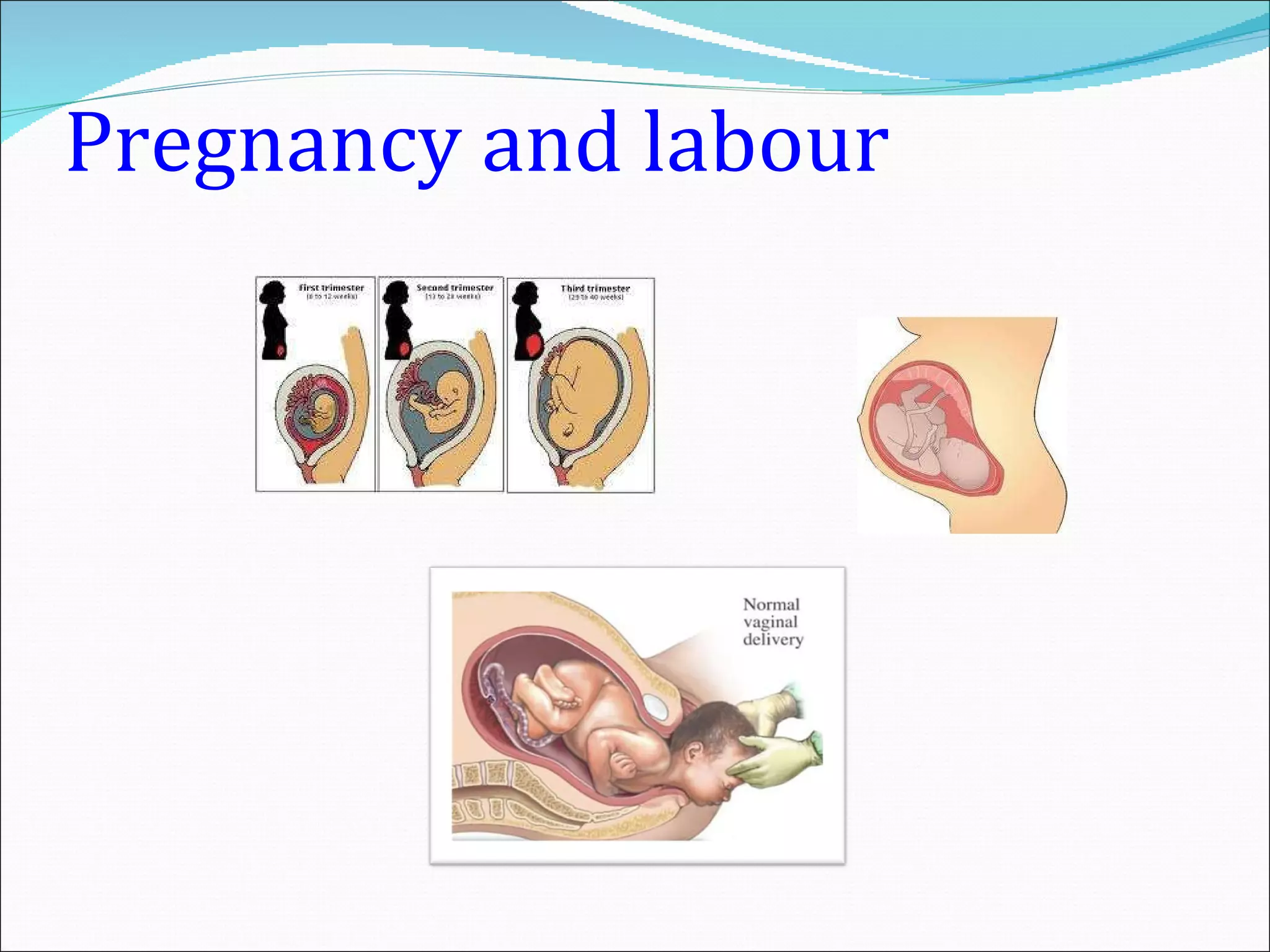
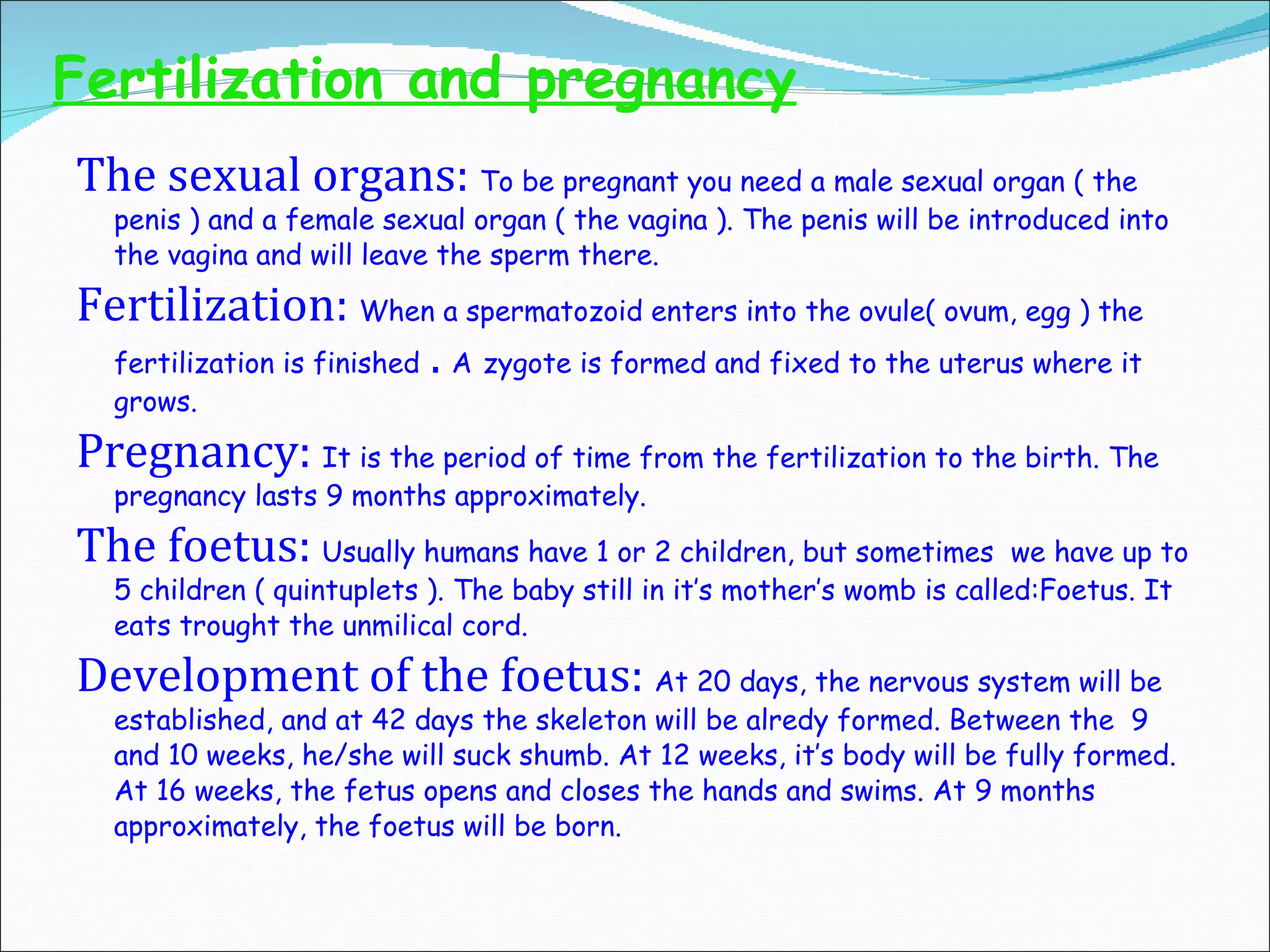
Fertilization and pregnancy The sexual organs:  To be pregnant you need a male sexual organ ( the penis ) and a female sexual organ ( the vagina ). The penis will be introduced into the vagina and will leave the sperm there.  Fertilization:  When a spermatozoid enters into the ovule( ovum, egg ) the fertilization is finished  .  A   zygote is formed and fixed to the uterus where it grows.  P regnancy:  It  is the period of time from the fertilization   to the birth. The pregnancy last s  9 months approximately. The f o etus:  Usually humans  have 1 or 2 children, but  sometimes  we  have up to 5 children ( quintuplets ). The baby still in it’s mother’s womb is called:Foetus. It eats trought the unmilical cord. Developmen t  of the foetus:  At 20 days, the nervous system will be established, and at 42 days the skeleton will be alredy form ed . Between the  9 and 10 weeks, he/she will suck shumb. At 12 weeks, it’s body will be fully formed. At 16 weeks, the fetus opens and closes the hands and swim s . At 9 months approximately, the foetus will be born.
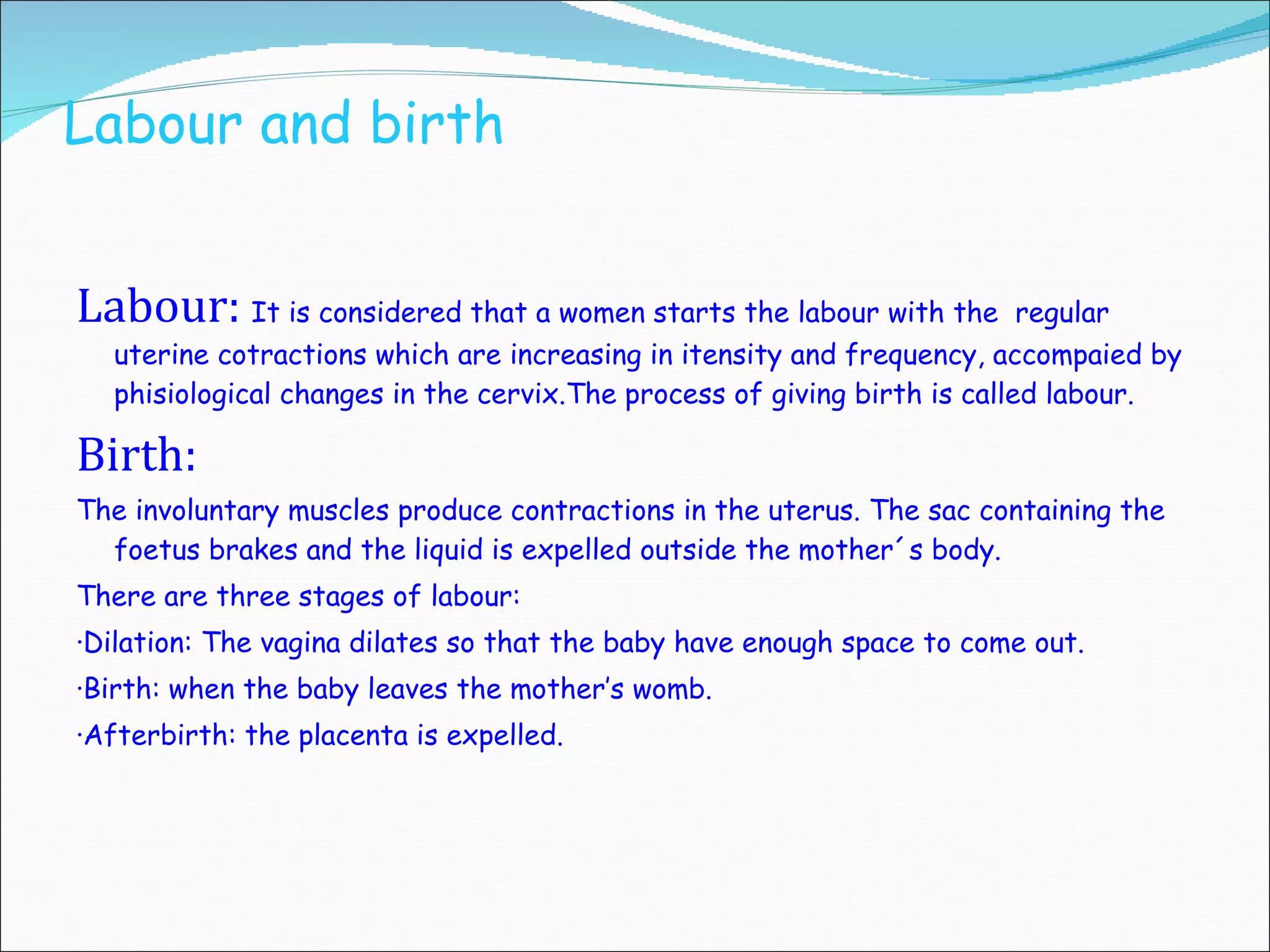
Labour and b irth  Labour:   It is considered that a women starts the labour with the  regular uterine cotractions which are increasing in itensity and frequency, accompaied by phisiological changes in the cervix. T he process of giving birth is called labour. Birth: The involuntary muscles produce contractions in the uterus. The sac containing the foetus brakes and the liquid is expelled  outside the mother´s body . There are three stages of labour: ·Dilation: The vagina dilates so that the baby have enough space to come out. ·Birth: when the baby leaves the mother’s womb. ·Afterbirth: the placenta is expelled.
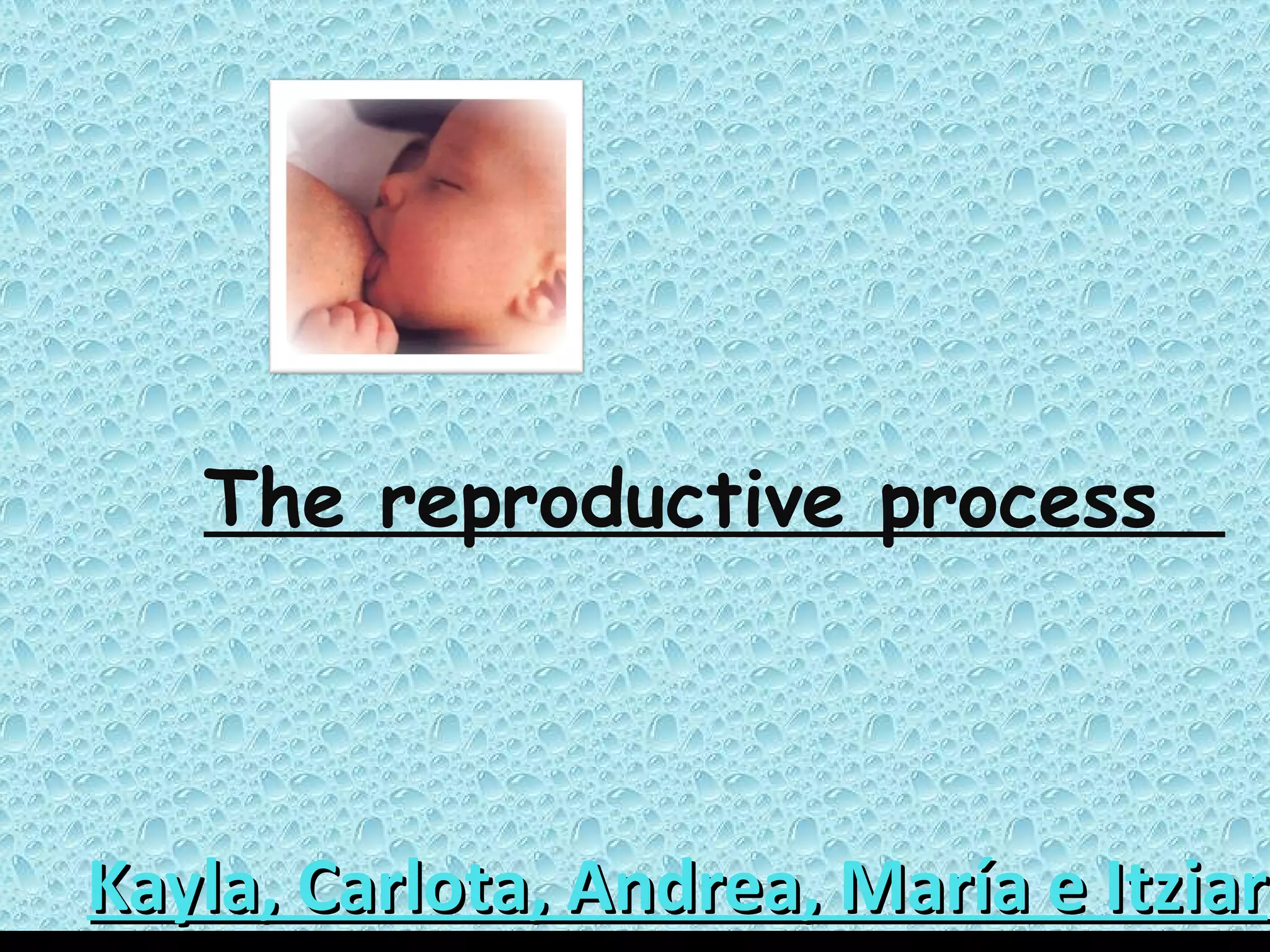
Newborn babies and lactation Newborn babies:   th e umbilicard cord is cut (t he mark  left is the  belly button ) when a baby is born  .  He/she is  about fifty centimetres long and weigh about three kilograms. Babies born berfore term are called premature.  They  are kept in incubators, where they can develop and grow stronger. Lactation:  It  is the period when babies get their nourishment from their mother’s milk.If a mother cannot, produce milk, infant formula is used. The energy needs of the newborn are 60 kilocalories per kg per day, to mantain your weigh, and 100 to 200 for a weight gain.

The reproductive process

  • 1.
    Kayla, Carlota, Andrea,María e Itziar The reproductive process
  • 2.
  • 3.
    Fertilization and pregnancyThe sexual organs: To be pregnant you need a male sexual organ ( the penis ) and a female sexual organ ( the vagina ). The penis will be introduced into the vagina and will leave the sperm there. Fertilization: When a spermatozoid enters into the ovule( ovum, egg ) the fertilization is finished . A zygote is formed and fixed to the uterus where it grows. P regnancy: It is the period of time from the fertilization to the birth. The pregnancy last s 9 months approximately. The f o etus: Usually humans have 1 or 2 children, but sometimes we have up to 5 children ( quintuplets ). The baby still in it’s mother’s womb is called:Foetus. It eats trought the unmilical cord. Developmen t of the foetus: At 20 days, the nervous system will be established, and at 42 days the skeleton will be alredy form ed . Between the 9 and 10 weeks, he/she will suck shumb. At 12 weeks, it’s body will be fully formed. At 16 weeks, the fetus opens and closes the hands and swim s . At 9 months approximately, the foetus will be born.
  • 4.
    Labour and birth Labour: It is considered that a women starts the labour with the regular uterine cotractions which are increasing in itensity and frequency, accompaied by phisiological changes in the cervix. T he process of giving birth is called labour. Birth: The involuntary muscles produce contractions in the uterus. The sac containing the foetus brakes and the liquid is expelled outside the mother´s body . There are three stages of labour: ·Dilation: The vagina dilates so that the baby have enough space to come out. ·Birth: when the baby leaves the mother’s womb. ·Afterbirth: the placenta is expelled.
  • 5.
    Newborn babies andlactation Newborn babies: th e umbilicard cord is cut (t he mark left is the belly button ) when a baby is born . He/she is about fifty centimetres long and weigh about three kilograms. Babies born berfore term are called premature. They are kept in incubators, where they can develop and grow stronger. Lactation: It is the period when babies get their nourishment from their mother’s milk.If a mother cannot, produce milk, infant formula is used. The energy needs of the newborn are 60 kilocalories per kg per day, to mantain your weigh, and 100 to 200 for a weight gain.