Pregnancy Objectives : What happens to an egg after  fertilisation ? How does a baby develop in the  uterus ? What is the role of the  placenta ?
The  fertilised  egg The fertilised egg moves down the  oviduct When it reaches the uterus it is a  ball of cells It buries itself in the  uterus   wall
The  embryo The ball of cells keeps growing and developing into an  embryo No  new eggs are released The uterus keeps its  lining  to protect the embryo
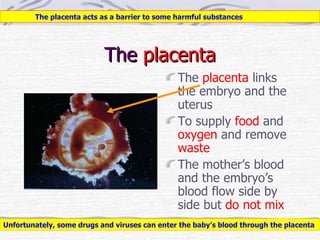
The  placenta The  placenta  links the embryo and the uterus To supply  food  and  oxygen  and remove  waste The mother’s blood and the embryo’s blood flow side by side but  do not mix Unfortunately, some drugs and viruses can enter the baby’s blood through the placenta The placenta acts as a barrier to some harmful substances
The  Foetus After two months the embryo becomes a  foetus It is too big to be attached to the uterus wall It is connected to the placenta by the  umbilical  cord And protected by bag of fluid called the  amnion
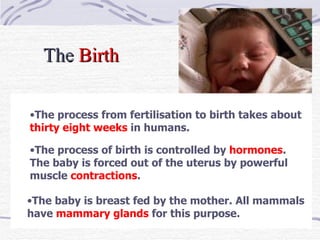
The process from fertilisation to birth takes about  thirty eight weeks  in humans.  The  Birth The process of birth is controlled by  hormones . The baby is forced out of the uterus by powerful muscle  contractions . The baby is breast fed by the mother. All mammals have  mammary glands  for this purpose.
Questions  ? How does the uterus protect the embryo?  answer Where does oxygen and food pass from the mother to the embryo? Name two waste materials that pass from the embryo to the mother placenta uterus cervix amnion Carbon dioxide and oxygen Carbon dioxide and tobacco smoke Carbon dioxide and urea
Answer to question 1 The  thick lining  of the uterus provides food and protection for the developing embryo back
Wrong  back
Wrong back
Correct nice one !! back
Wrong back
Stages of pregnancy Match the diagrams to the words 3 weeks The fertilised egg is dividing rapidly. It has formed a ball of cells. It is too small to be seen without a microscope. 12 weeks The foetus is about 50 mm long. It can kick its legs and move its fingers. Its head is out of proportion with the rest of its body. Most of the organs inside its body are working. 6 weeks The ball of cells now looks like a tadpole. There is a “head end” and a “tail end” and a bulge where the heart is forming.   24 weeks The foetus has grown so much that the mother looks pregnant. She can feel her baby moving inside her. Its heart can be heard beating. 8 weeks You can now see the eyes. The arms and legs have formed with tiny fingers and toes. At this stage the baby is called a foetus.   30 weeks The baby is almost ready to be born. Its head is just about the cervix. When the muscles of the mother’s uterus contract, it will be born head first.
Stages of pregnancy bite size 3 weeks The fertilised egg is dividing rapidly. It has formed a ball of cells. It is too small to be seen without a microscope. 12 weeks The foetus is about 50 mm long. It can kick its legs and move its fingers. Its head is out of proportion with the rest of its body. Most of the organs inside its body are working. 6 weeks The ball of cells now looks like a tadpole. There is a “head end” and a “tail end” and a bulge where the heart is forming.   24 weeks The foetus has grown so much that the mother looks pregnant. She can feel her baby moving inside her. Its heart can be heard beating. 8 weeks You can now see the eyes. The arms and legs have formed with tiny fingers and toes. At this stage the baby is called a foetus.   30 weeks The baby is almost ready to be born. Its head is just about the cervix. When the muscles of the mother’s uterus contract, it will be born head first.
placenta Structure made by an embryo to obtain food and oxygen from its mother _______________ A human embryo after 2 months _____________ The first 2 months of development for a new baby___________ Fluid filled bag that protects the foetus_________ Attaches the embryo to the placenta _______________________ Key words amnion Umbilical cord foetus embryo

Pregnancy

  • 1.
    Pregnancy Objectives :What happens to an egg after fertilisation ? How does a baby develop in the uterus ? What is the role of the placenta ?
  • 2.
    The fertilised egg The fertilised egg moves down the oviduct When it reaches the uterus it is a ball of cells It buries itself in the uterus wall
  • 3.
    The embryoThe ball of cells keeps growing and developing into an embryo No new eggs are released The uterus keeps its lining to protect the embryo
  • 4.
    The placentaThe placenta links the embryo and the uterus To supply food and oxygen and remove waste The mother’s blood and the embryo’s blood flow side by side but do not mix Unfortunately, some drugs and viruses can enter the baby’s blood through the placenta The placenta acts as a barrier to some harmful substances
  • 5.
    The FoetusAfter two months the embryo becomes a foetus It is too big to be attached to the uterus wall It is connected to the placenta by the umbilical cord And protected by bag of fluid called the amnion
  • 6.
    The process fromfertilisation to birth takes about thirty eight weeks in humans. The Birth The process of birth is controlled by hormones . The baby is forced out of the uterus by powerful muscle contractions . The baby is breast fed by the mother. All mammals have mammary glands for this purpose.
  • 7.
    Questions ?How does the uterus protect the embryo? answer Where does oxygen and food pass from the mother to the embryo? Name two waste materials that pass from the embryo to the mother placenta uterus cervix amnion Carbon dioxide and oxygen Carbon dioxide and tobacco smoke Carbon dioxide and urea
  • 8.
    Answer to question1 The thick lining of the uterus provides food and protection for the developing embryo back
  • 9.
  • 10.
  • 11.
  • 12.
  • 13.
    Stages of pregnancyMatch the diagrams to the words 3 weeks The fertilised egg is dividing rapidly. It has formed a ball of cells. It is too small to be seen without a microscope. 12 weeks The foetus is about 50 mm long. It can kick its legs and move its fingers. Its head is out of proportion with the rest of its body. Most of the organs inside its body are working. 6 weeks The ball of cells now looks like a tadpole. There is a “head end” and a “tail end” and a bulge where the heart is forming.   24 weeks The foetus has grown so much that the mother looks pregnant. She can feel her baby moving inside her. Its heart can be heard beating. 8 weeks You can now see the eyes. The arms and legs have formed with tiny fingers and toes. At this stage the baby is called a foetus.   30 weeks The baby is almost ready to be born. Its head is just about the cervix. When the muscles of the mother’s uterus contract, it will be born head first.
  • 14.
    Stages of pregnancybite size 3 weeks The fertilised egg is dividing rapidly. It has formed a ball of cells. It is too small to be seen without a microscope. 12 weeks The foetus is about 50 mm long. It can kick its legs and move its fingers. Its head is out of proportion with the rest of its body. Most of the organs inside its body are working. 6 weeks The ball of cells now looks like a tadpole. There is a “head end” and a “tail end” and a bulge where the heart is forming.   24 weeks The foetus has grown so much that the mother looks pregnant. She can feel her baby moving inside her. Its heart can be heard beating. 8 weeks You can now see the eyes. The arms and legs have formed with tiny fingers and toes. At this stage the baby is called a foetus.   30 weeks The baby is almost ready to be born. Its head is just about the cervix. When the muscles of the mother’s uterus contract, it will be born head first.
  • 15.
    placenta Structure madeby an embryo to obtain food and oxygen from its mother _______________ A human embryo after 2 months _____________ The first 2 months of development for a new baby___________ Fluid filled bag that protects the foetus_________ Attaches the embryo to the placenta _______________________ Key words amnion Umbilical cord foetus embryo
  • 16.
    placenta Structure madeby an embryo to obtain food and oxygen from its mother _______________ A human embryo after 2 months _____________ The first 2 months of development for a new baby___________ Fluid filled bag that protects the foetus_________ Attaches the embryo to the placenta _______________________ Key words amnion Umbilical cord foetus embryo