
REPRODUCTION
Reproductive Parts and Fertilisation
QUESTIONS
   How do you think a baby is formed?

   What do you think are the important things both
    parents will pass on to their child during the
    formation of a baby?
REPRODUCTION IN HUMANS

 Well, before a human can
   reproduction sexually,
 How does sexual the body
 certain organs in
   reproduction
      must develop and
      occur in
           mature.
     humans?
REPRODUCTIVE SYSTEM
   Which part of the human body are involved in
    sexual reproduction?
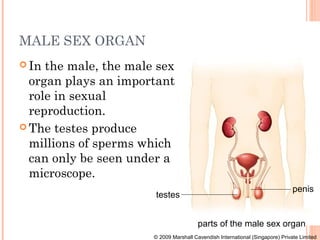
MALE SEX ORGAN
 In the male, the male sex
  organ plays an important
  role in sexual
  reproduction.
 The testes produce
  millions of sperms which
  can only be seen under a
  microscope.
                                                                                penis
                       testes


                                         parts of the male sex organ
                       © 2009 Marshall Cavendish International (Singapore) Private Limited
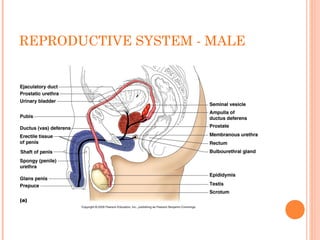
REPRODUCTIVE SYSTEM - MALE
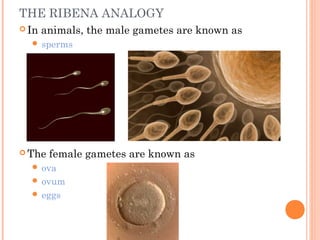
THE RIBENA ANALOGY
 In   animals, the male gametes are known as
   sperms


 The   female gametes are known as
   ova
   ovum
   eggs
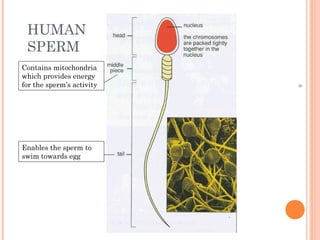
HUMAN
 SPERM
Contains mitochondria
which provides energy
for the sperm’s activity


                           8
Enables the sperm to
swim towards egg
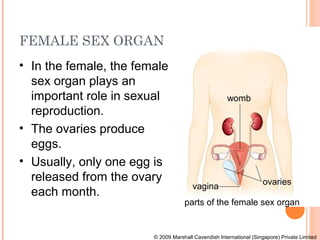
FEMALE SEX ORGAN
• In the female, the female
  sex organ plays an
  important role in sexual                            womb
  reproduction.
• The ovaries produce
  eggs.
• Usually, only one egg is
  released from the ovary                                           ovaries
                                       vagina
  each month.
                                    parts of the female sex organ


                        © 2009 Marshall Cavendish International (Singapore) Private Limited
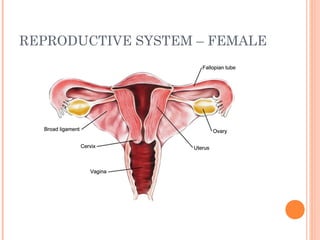
REPRODUCTIVE SYSTEM – FEMALE
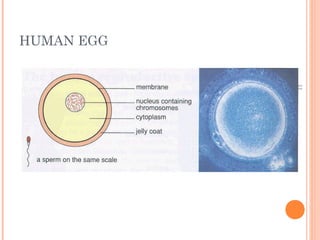
HUMAN EGG


            11
HOW DOES HUMAN LIFE BEGIN?
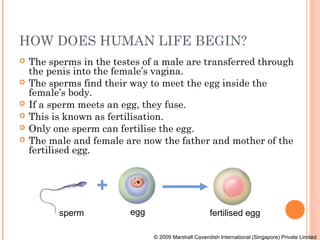
   The sperms in the testes of a male are transferred through
    the penis into the female’s vagina.
   The sperms find their way to meet the egg inside the
    female’s body.
   If a sperm meets an egg, they fuse.
   This is known as fertilisation.
   Only one sperm can fertilise the egg.
   The male and female are now the father and mother of the
    fertilised egg.


                  +
          sperm           egg                          fertilised egg

                                © 2009 Marshall Cavendish International (Singapore) Private Limited
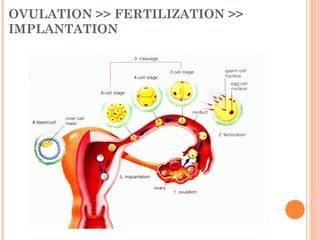
OVULATION >> FERTILIZATION >>
IMPLANTATION
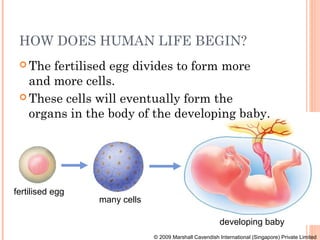
HOW DOES HUMAN LIFE BEGIN?
  The fertilised egg divides to form more
   and more cells.
  These cells will eventually form the
   organs in the body of the developing baby.


fertilised egg
                 many cells

                                                         developing baby
                              © 2009 Marshall Cavendish International (Singapore) Private Limited
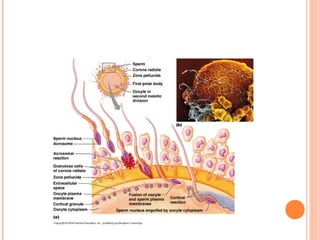
HOW DOES FERTILIZATION OCCUR?
1.   There is mating
2.   Sperms are introduced into the female through
     the vagina.
3.   The sperms swim through the uterus to the
     oviduct towards the egg.
4.   A sperm bumps into the egg.
5.   The sperm penetrates the egg membrane.
6.   The tail drops.
7.   The egg membrane thickens to prevent other
     sperms from entering.
8.   The sperm nucleus fuses with the egg nucleus.
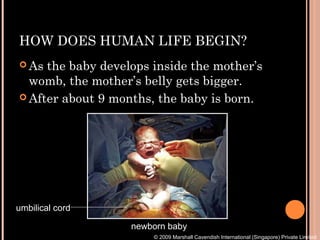
HOW DOES HUMAN LIFE BEGIN?
 As the baby develops inside the mother’s
  womb, the mother’s belly gets bigger.
 After about 9 months, the baby is born.


umbilical cord

                   newborn baby
                       © 2009 Marshall Cavendish International (Singapore) Private Limited
PARENTS AND THEIR YOUNG
 The  fusion of the sperm and egg results in
  a fully developed baby.
 These two reproductive cells contain
  information about the characteristics of
  the father and the mother.
 Through the reproductive cells, the
  characteristics of the parents are passed
  on to their young.
 Thus, the characteristics of plants and
  animals are preserved in future
  generations, hence ensuring that their
  kind continues to exist.

                        © 2009 Marshall Cavendish International (Singapore) Private Limited
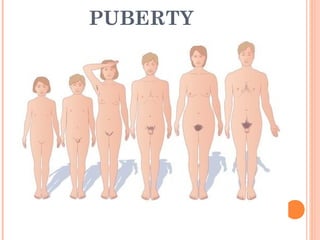
PUBERTY
HOW DOES IT HAPPEN?
 Puberty    - specific changes in the male
     Boys usually reach puberty at an average age
      of 13 years.
     Sex organ starts to produce sperms
     Shoulder and chest become broader
     Voice breaks and deepens
     Moustache and beard start to grow
HOW DOES IT HAPPEN?
   Puberty - Specific changes in the female
       When a baby girl is born, the ovaries already contain
        around 400 000 ova or eggs.
       Girls tend to mature two years earlier than boys
        (average age of 11)
       When she matures, a small fraction of these eggs
        mature (approx. 450) and is released from alternate
        ovaries each month.
       Breasts develop
       Hips widen
       Undergoes the menstrual cycle
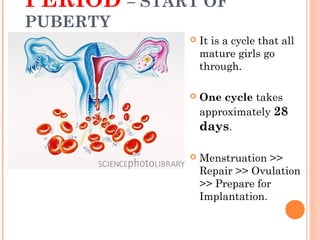
PERIOD – START OF
PUBERTY
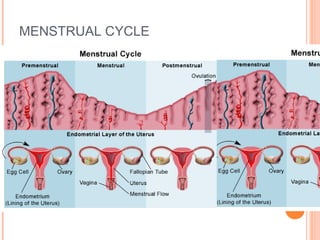
                It is a cycle that all
                 mature girls go
                 through.

                One cycle takes
                 approximately 28
                 days.

                Menstruation >>
                 Repair >> Ovulation
                 >> Prepare for
                 Implantation.
SANITARY PADS
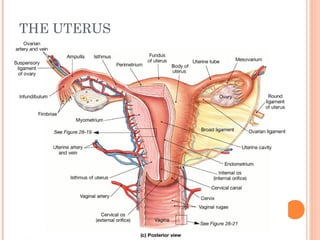
THE UTERUS
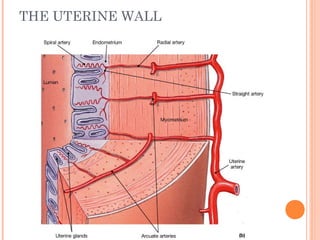
THE UTERINE WALL
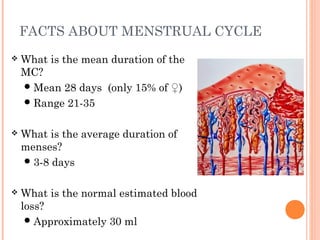
FACTS ABOUT MENSTRUAL CYCLE
   What is the mean duration of the
    MC?
     Mean 28 days (only 15% of ♀)
     Range 21-35


   What is the average duration of
    menses?
     3-8 days


   What is the normal estimated blood
    loss?
      Approximately 30 ml
MENSTRUAL CYCLE
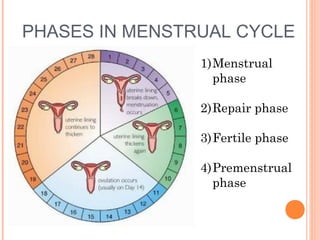
PHASES IN MENSTRUAL CYCLE
                1)Menstrual
                  phase

                2)Repair phase

                3)Fertile phase

                4)Premenstrual
                  phase
MENSTRUAL PROBLEMS
Premenstrual   Syndrome (PMS)


No   Period
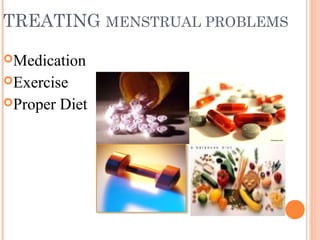
TREATING MENSTRUAL PROBLEMS

Medication
Exercise
Proper   Diet

Form 3 Science Chapter 4 Reproductive System and fertilisation

  • 1.
  • 2.
    QUESTIONS  How do you think a baby is formed?  What do you think are the important things both parents will pass on to their child during the formation of a baby?
  • 3.
    REPRODUCTION IN HUMANS Well, before a human can reproduction sexually, How does sexual the body certain organs in reproduction must develop and occur in mature. humans?
  • 4.
    REPRODUCTIVE SYSTEM  Which part of the human body are involved in sexual reproduction?
  • 5.
    MALE SEX ORGAN In the male, the male sex organ plays an important role in sexual reproduction.  The testes produce millions of sperms which can only be seen under a microscope. penis testes parts of the male sex organ © 2009 Marshall Cavendish International (Singapore) Private Limited
  • 6.
  • 7.
    THE RIBENA ANALOGY In animals, the male gametes are known as  sperms  The female gametes are known as  ova  ovum  eggs
  • 8.
    HUMAN SPERM Contains mitochondria whichprovides energy for the sperm’s activity 8 Enables the sperm to swim towards egg
  • 9.
    FEMALE SEX ORGAN •In the female, the female sex organ plays an important role in sexual womb reproduction. • The ovaries produce eggs. • Usually, only one egg is released from the ovary ovaries vagina each month. parts of the female sex organ © 2009 Marshall Cavendish International (Singapore) Private Limited
  • 10.
  • 11.
  • 12.
    HOW DOES HUMANLIFE BEGIN?  The sperms in the testes of a male are transferred through the penis into the female’s vagina.  The sperms find their way to meet the egg inside the female’s body.  If a sperm meets an egg, they fuse.  This is known as fertilisation.  Only one sperm can fertilise the egg.  The male and female are now the father and mother of the fertilised egg. + sperm egg fertilised egg © 2009 Marshall Cavendish International (Singapore) Private Limited
  • 14.
  • 15.
    HOW DOES HUMANLIFE BEGIN?  The fertilised egg divides to form more and more cells.  These cells will eventually form the organs in the body of the developing baby. fertilised egg many cells developing baby © 2009 Marshall Cavendish International (Singapore) Private Limited
  • 16.
    HOW DOES FERTILIZATIONOCCUR? 1. There is mating 2. Sperms are introduced into the female through the vagina. 3. The sperms swim through the uterus to the oviduct towards the egg. 4. A sperm bumps into the egg. 5. The sperm penetrates the egg membrane. 6. The tail drops. 7. The egg membrane thickens to prevent other sperms from entering. 8. The sperm nucleus fuses with the egg nucleus.
  • 17.
    HOW DOES HUMANLIFE BEGIN?  As the baby develops inside the mother’s womb, the mother’s belly gets bigger.  After about 9 months, the baby is born. umbilical cord newborn baby © 2009 Marshall Cavendish International (Singapore) Private Limited
  • 18.
    PARENTS AND THEIRYOUNG  The fusion of the sperm and egg results in a fully developed baby.  These two reproductive cells contain information about the characteristics of the father and the mother.  Through the reproductive cells, the characteristics of the parents are passed on to their young.  Thus, the characteristics of plants and animals are preserved in future generations, hence ensuring that their kind continues to exist. © 2009 Marshall Cavendish International (Singapore) Private Limited
  • 19.
  • 20.
    HOW DOES ITHAPPEN?  Puberty - specific changes in the male  Boys usually reach puberty at an average age of 13 years.  Sex organ starts to produce sperms  Shoulder and chest become broader  Voice breaks and deepens  Moustache and beard start to grow
  • 21.
    HOW DOES ITHAPPEN?  Puberty - Specific changes in the female  When a baby girl is born, the ovaries already contain around 400 000 ova or eggs.  Girls tend to mature two years earlier than boys (average age of 11)  When she matures, a small fraction of these eggs mature (approx. 450) and is released from alternate ovaries each month.  Breasts develop  Hips widen  Undergoes the menstrual cycle
  • 22.
    PERIOD – STARTOF PUBERTY  It is a cycle that all mature girls go through.  One cycle takes approximately 28 days.  Menstruation >> Repair >> Ovulation >> Prepare for Implantation.
  • 23.
  • 24.
  • 25.
  • 26.
    FACTS ABOUT MENSTRUALCYCLE  What is the mean duration of the MC?  Mean 28 days (only 15% of ♀)  Range 21-35  What is the average duration of menses?  3-8 days  What is the normal estimated blood loss?  Approximately 30 ml
  • 27.
  • 28.
    PHASES IN MENSTRUALCYCLE 1)Menstrual phase 2)Repair phase 3)Fertile phase 4)Premenstrual phase
  • 29.
    MENSTRUAL PROBLEMS Premenstrual Syndrome (PMS) No Period
  • 30.