Chapter 10  Reproductive System By: Norma Gongora
Organs of the Female Reproductive System Ovaries Fallopian Tubes Uterus Vagina Vulva Breasts
 
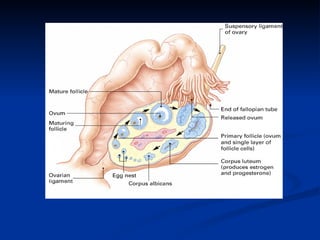
Ovaries There are 2 ovaries, they are located on each side of the uterus in the pelvic cavity. They are almond shaped glands that produce ovum and hormones. Hormones from the anterior pituitary, follicle stimulating hormone and luteinzing hormone, stimulate the ovum and trigger ovulation.  Estrogen and progesterone stimulate the lining of the uterus to be prepared to receive a fertilized ovum.
 
Fallopian Tubes Also called the uterine tubes or oviducts, are 5 ½ inches long. As they get close to  the ovaries, the unattached ends of the two tubes end with finger-like projections called fimbriae. It’s purpose is to propel ovum from ovary to the uterus. Fertilization or conception takes place within the upper half of the fallopian tubes
Uterus It is hollow and pear shaped organ that contains a thick muscular wall, a mucous membrane lining, and rich supply of blood. It lies in the center of the pelvic wall between  the bladder and rectum. It is bent forward which is called anteflexion and held into position by ligaments which anchor it to the perimetrium. There are 3 sections. Fundus-upper, Corpus-body, Cervix-lower or neck.
Vagina It is a muscular tube, lined with mucous membrane that extend from the cervix to the uterus to the outside of the body.  It allows passage for menstrual flow. During intercourse , receives the male penis and semen. Serves as a birth canal.
Vulva General term meaning female external genitalia. The labia majora and labia minora are folds of skin that serve as protection for the genitalia, the vaginal orifice, and the urinary meatus.
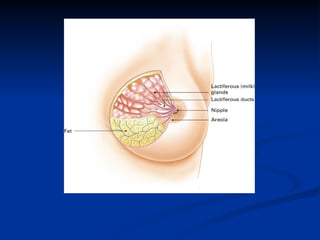
Breasts Also known as mammary glands produce milk, which is a process called lactation.  Milk is produced by the lactiferous glands and is carried to the nipple by the lactiferous ducts. The areola is the pigmented area around the nipple.
 
Pregnancy It is a period of time which the baby grows and develops in its mother’s uterus.  The length of time for a pregnancy, or gestation is 40 weeks.  If the baby is born before 37 weeks it is considered premature. An embryo is from fertilization until 8 weeks. A fetus is developing following the embroyo stage until birth.
Mother to be
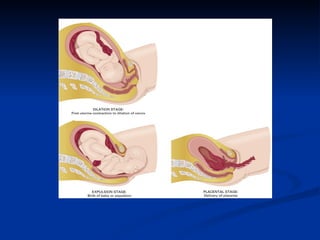
Labor Stage 1 is the dilation stage, in which the uterine muscle contracts strongly to expel the fetus. The cervix dilates, it also becomes thinner, referred to as enfacement. Fetus presses on cervix causing it to expand to 10cm. Stage 2 is the expulsion stage and ends with the birth of the baby. Stage 3 is the placental stage. The uterus begins to contract and then the afterbirth is delivered.
 
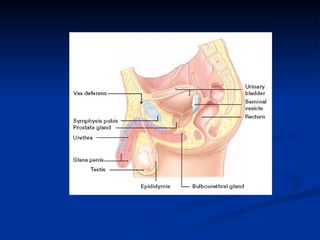
Part II Male Reproductive System Organs of the Male Reproductive System Testes Epididymis Penis Vas Deferens Seminal Vesicles Prostate Gland Bulbourethral Glands
 

Reproductive System Ch 10

  • 1.
    Chapter 10 Reproductive System By: Norma Gongora
  • 2.
    Organs of theFemale Reproductive System Ovaries Fallopian Tubes Uterus Vagina Vulva Breasts
  • 3.
  • 4.
    Ovaries There are2 ovaries, they are located on each side of the uterus in the pelvic cavity. They are almond shaped glands that produce ovum and hormones. Hormones from the anterior pituitary, follicle stimulating hormone and luteinzing hormone, stimulate the ovum and trigger ovulation. Estrogen and progesterone stimulate the lining of the uterus to be prepared to receive a fertilized ovum.
  • 5.
  • 6.
    Fallopian Tubes Alsocalled the uterine tubes or oviducts, are 5 ½ inches long. As they get close to the ovaries, the unattached ends of the two tubes end with finger-like projections called fimbriae. It’s purpose is to propel ovum from ovary to the uterus. Fertilization or conception takes place within the upper half of the fallopian tubes
  • 7.
    Uterus It ishollow and pear shaped organ that contains a thick muscular wall, a mucous membrane lining, and rich supply of blood. It lies in the center of the pelvic wall between the bladder and rectum. It is bent forward which is called anteflexion and held into position by ligaments which anchor it to the perimetrium. There are 3 sections. Fundus-upper, Corpus-body, Cervix-lower or neck.
  • 8.
    Vagina It isa muscular tube, lined with mucous membrane that extend from the cervix to the uterus to the outside of the body. It allows passage for menstrual flow. During intercourse , receives the male penis and semen. Serves as a birth canal.
  • 9.
    Vulva General termmeaning female external genitalia. The labia majora and labia minora are folds of skin that serve as protection for the genitalia, the vaginal orifice, and the urinary meatus.
  • 10.
    Breasts Also knownas mammary glands produce milk, which is a process called lactation. Milk is produced by the lactiferous glands and is carried to the nipple by the lactiferous ducts. The areola is the pigmented area around the nipple.
  • 11.
  • 12.
    Pregnancy It isa period of time which the baby grows and develops in its mother’s uterus. The length of time for a pregnancy, or gestation is 40 weeks. If the baby is born before 37 weeks it is considered premature. An embryo is from fertilization until 8 weeks. A fetus is developing following the embroyo stage until birth.
  • 13.
  • 14.
    Labor Stage 1is the dilation stage, in which the uterine muscle contracts strongly to expel the fetus. The cervix dilates, it also becomes thinner, referred to as enfacement. Fetus presses on cervix causing it to expand to 10cm. Stage 2 is the expulsion stage and ends with the birth of the baby. Stage 3 is the placental stage. The uterus begins to contract and then the afterbirth is delivered.
  • 15.
  • 16.
    Part II MaleReproductive System Organs of the Male Reproductive System Testes Epididymis Penis Vas Deferens Seminal Vesicles Prostate Gland Bulbourethral Glands
  • 17.