MODULE 1:
GADGETS WORK WONDERS (I)
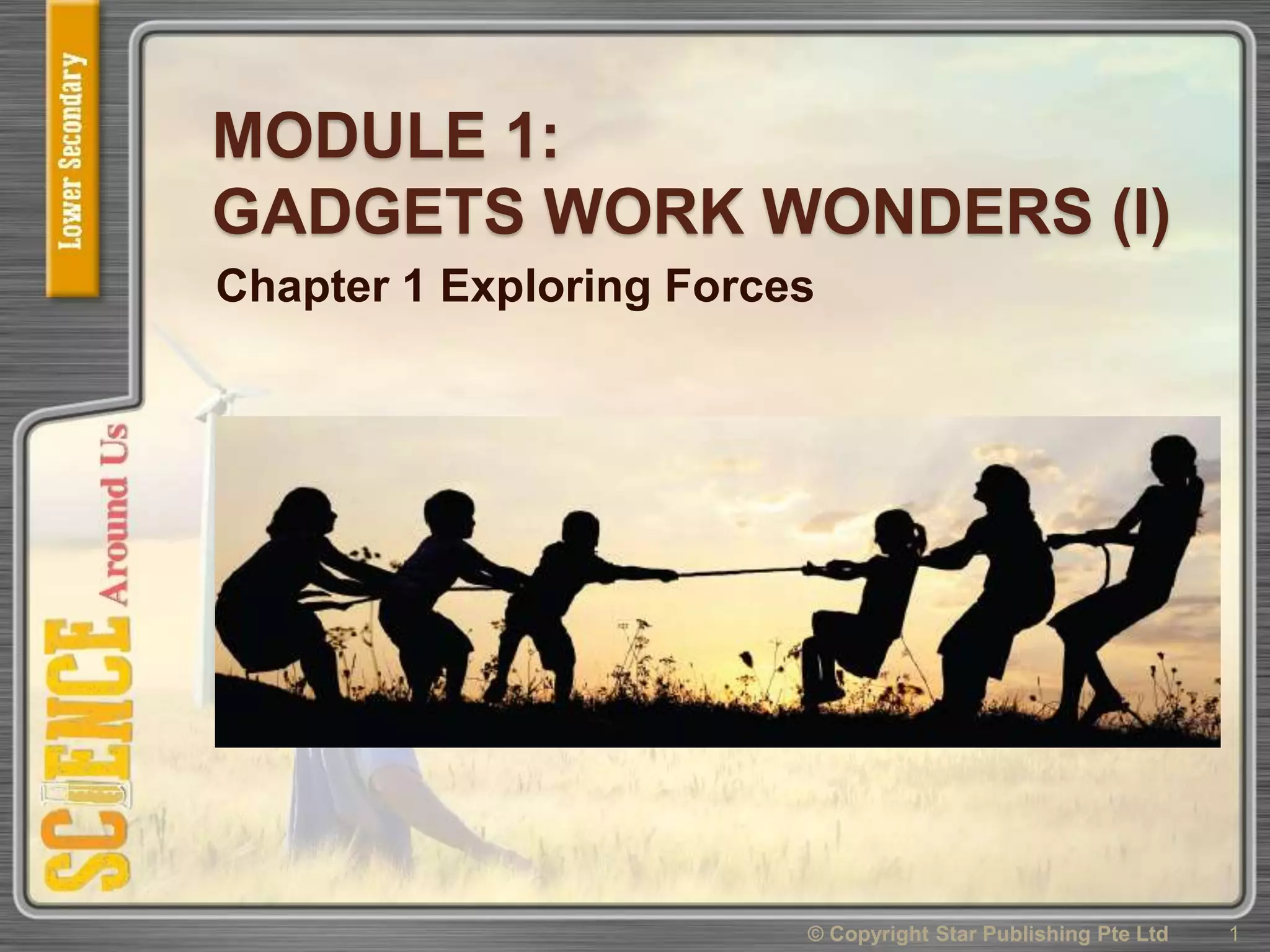
Chapter 1 Exploring Forces
1© Copyright Star Publishing Pte Ltd
Chapter 1 Exploring Forces
1.1 What are the effects of forces?
1.2 How can forces be measured?
1.3 What are the effects of friction?
1.4 How do simple machines work?
2© Copyright Star Publishing Pte Ltd
Objectives
 State that a force can change the shape,
size, state of rest and motion of a body
 Give examples of different forces:
pushing, lifting, stretching, twisting,
pressing, gravitational, frictional and
magnetic forces
 Infer the effects of forces such as
◦ change in state of rest and / or motion of a
body
◦ change in shape and / or size of a body 3© Copyright Star Publishing Pte Ltd
What is a force?
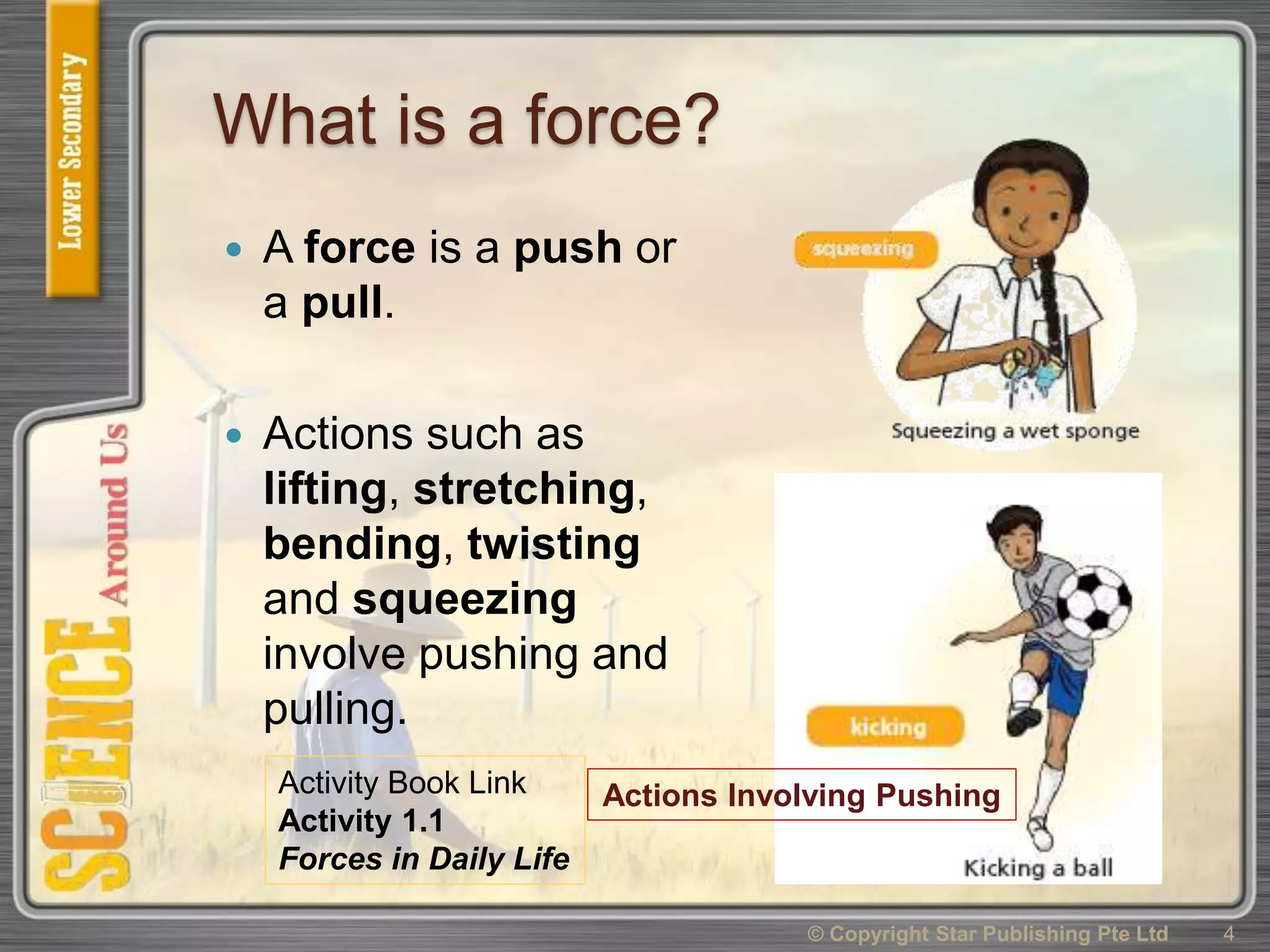
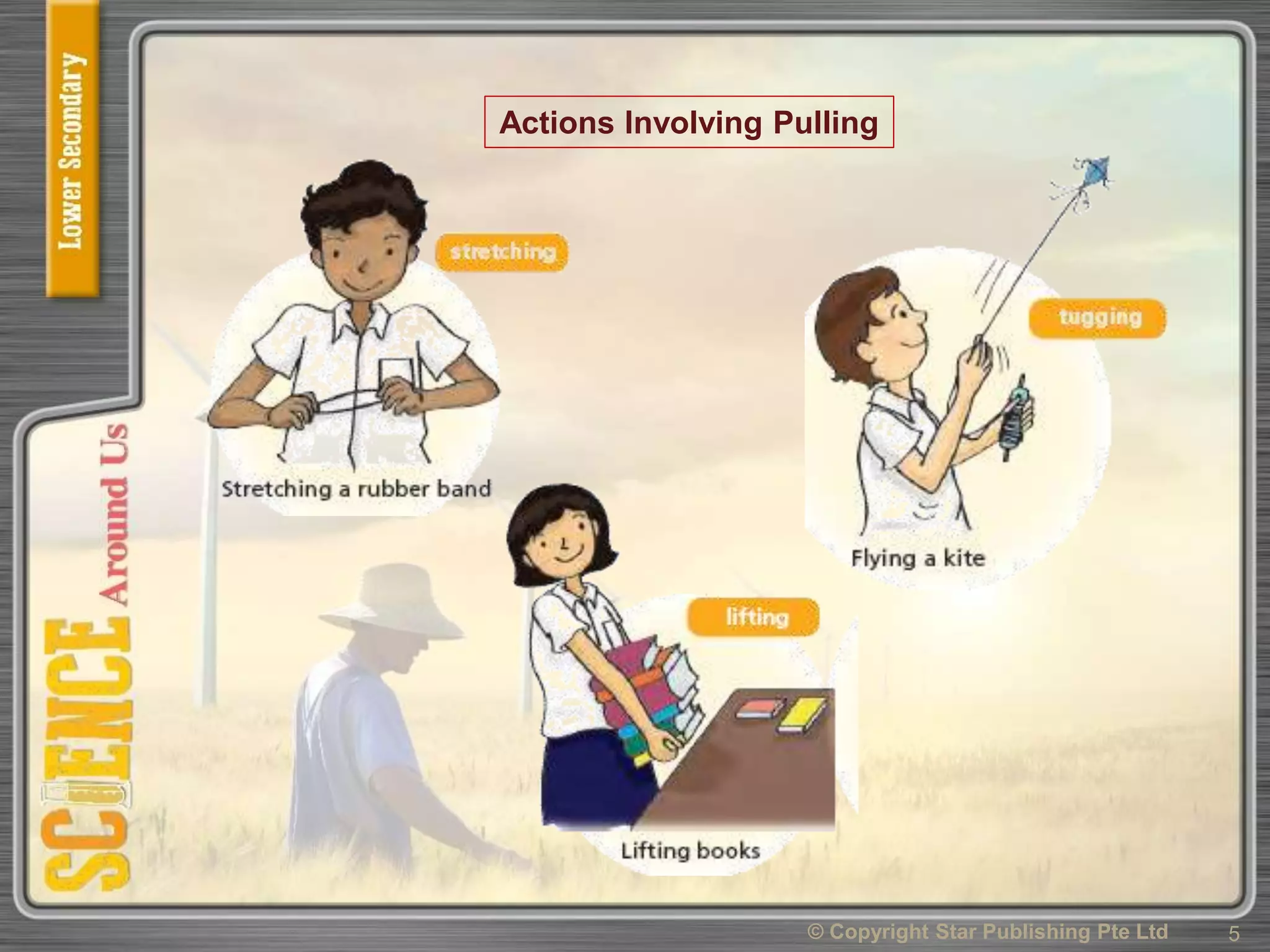
 A force is a push or
a pull.
 Actions such as
lifting, stretching,
bending, twisting
and squeezing
involve pushing and
pulling.
4© Copyright Star Publishing Pte Ltd
Actions Involving PushingActivity Book Link
Activity 1.1
Forces in Daily Life
© Copyright Star Publishing Pte Ltd 5
Actions Involving Pulling
© Copyright Star Publishing Pte Ltd 6
Actions Involving Pushing and Pulling
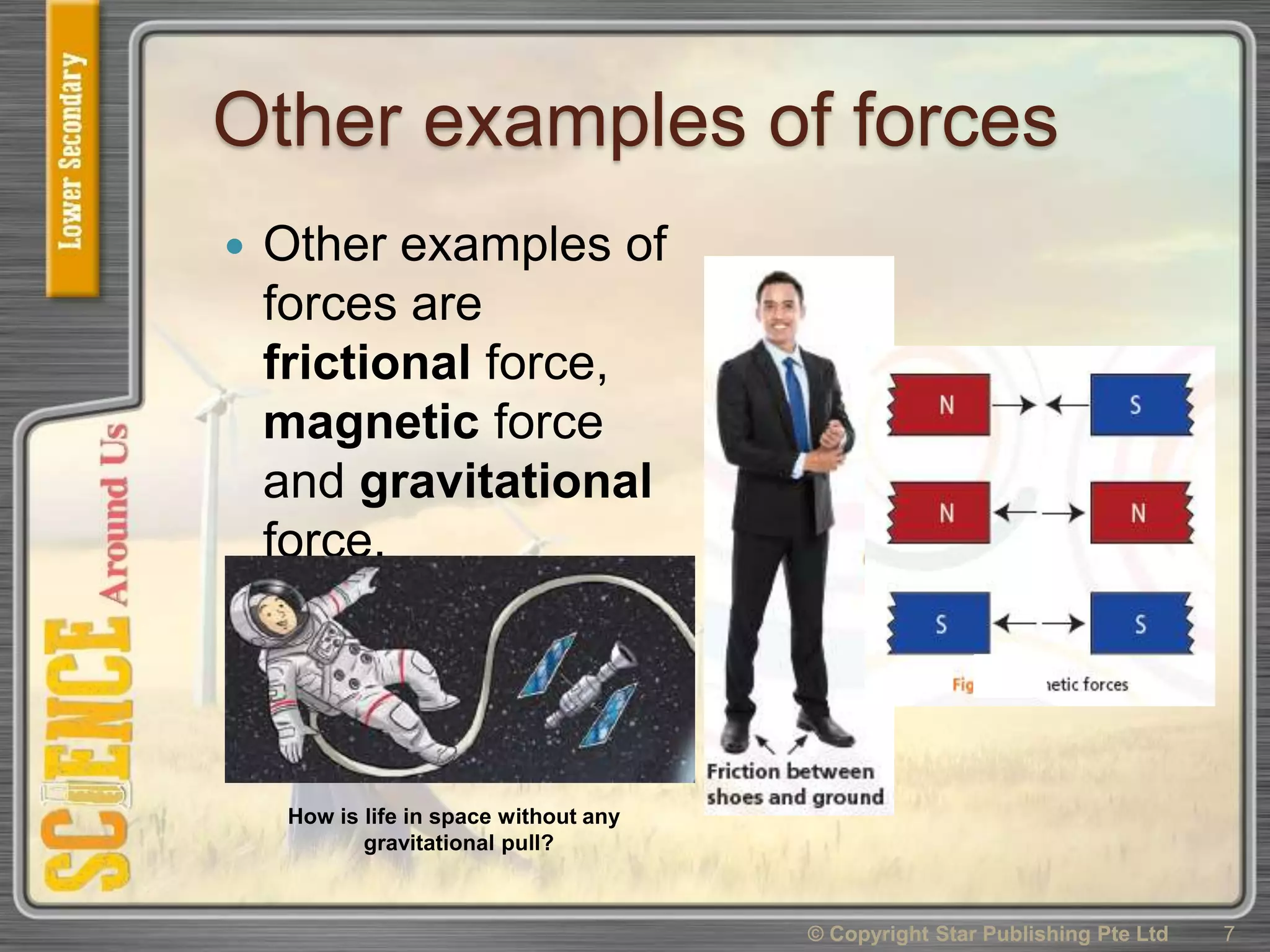
Other examples of forces
 Other examples of
forces are
frictional force,
magnetic force
and gravitational
force.
© Copyright Star Publishing Pte Ltd 7
How is life in space without any
gravitational pull?
What is frictional force?
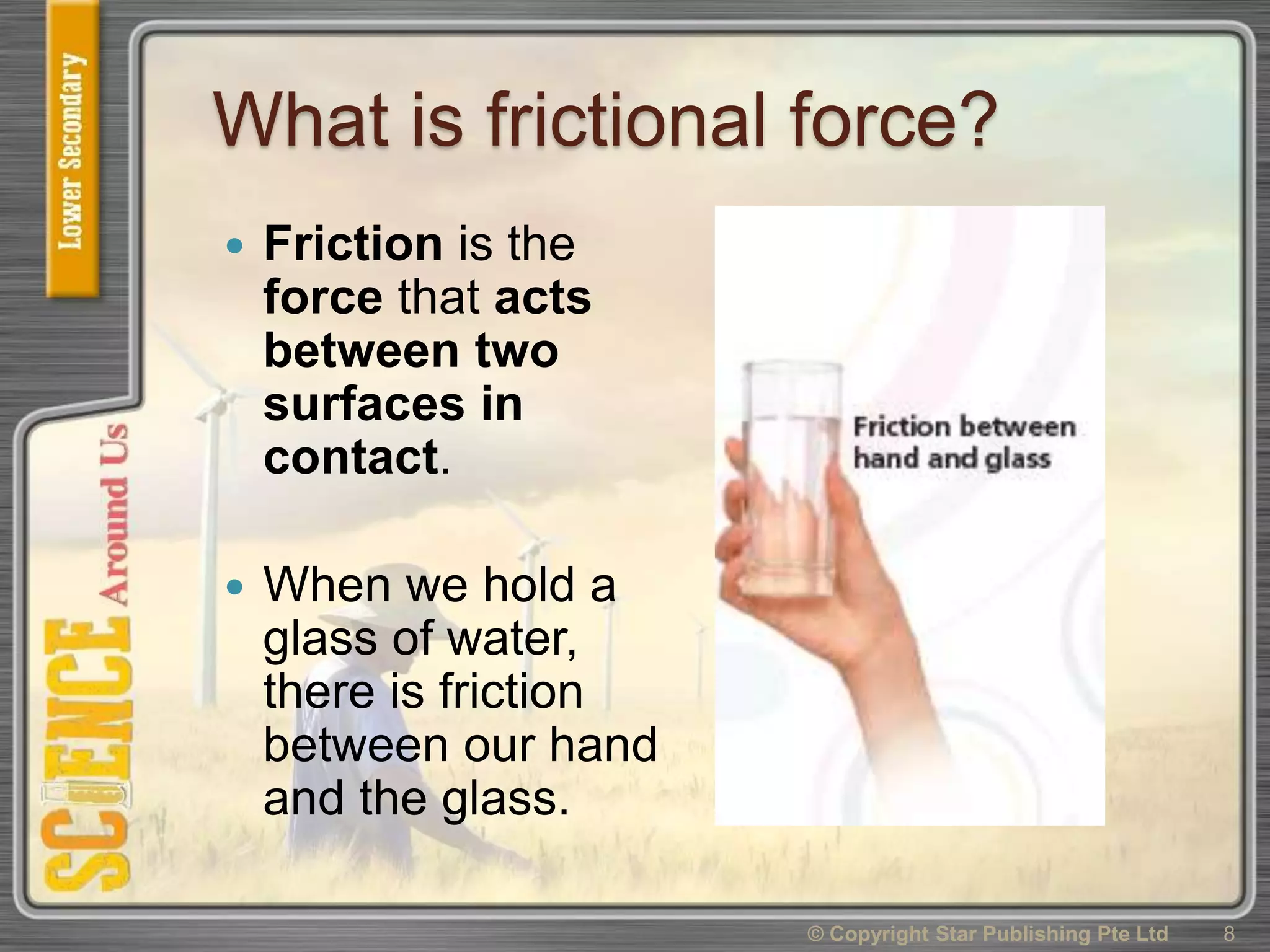
 Friction is the
force that acts
between two
surfaces in
contact.
 When we hold a
glass of water,
there is friction
between our hand
and the glass.
© Copyright Star Publishing Pte Ltd 8
What is magnetic force?
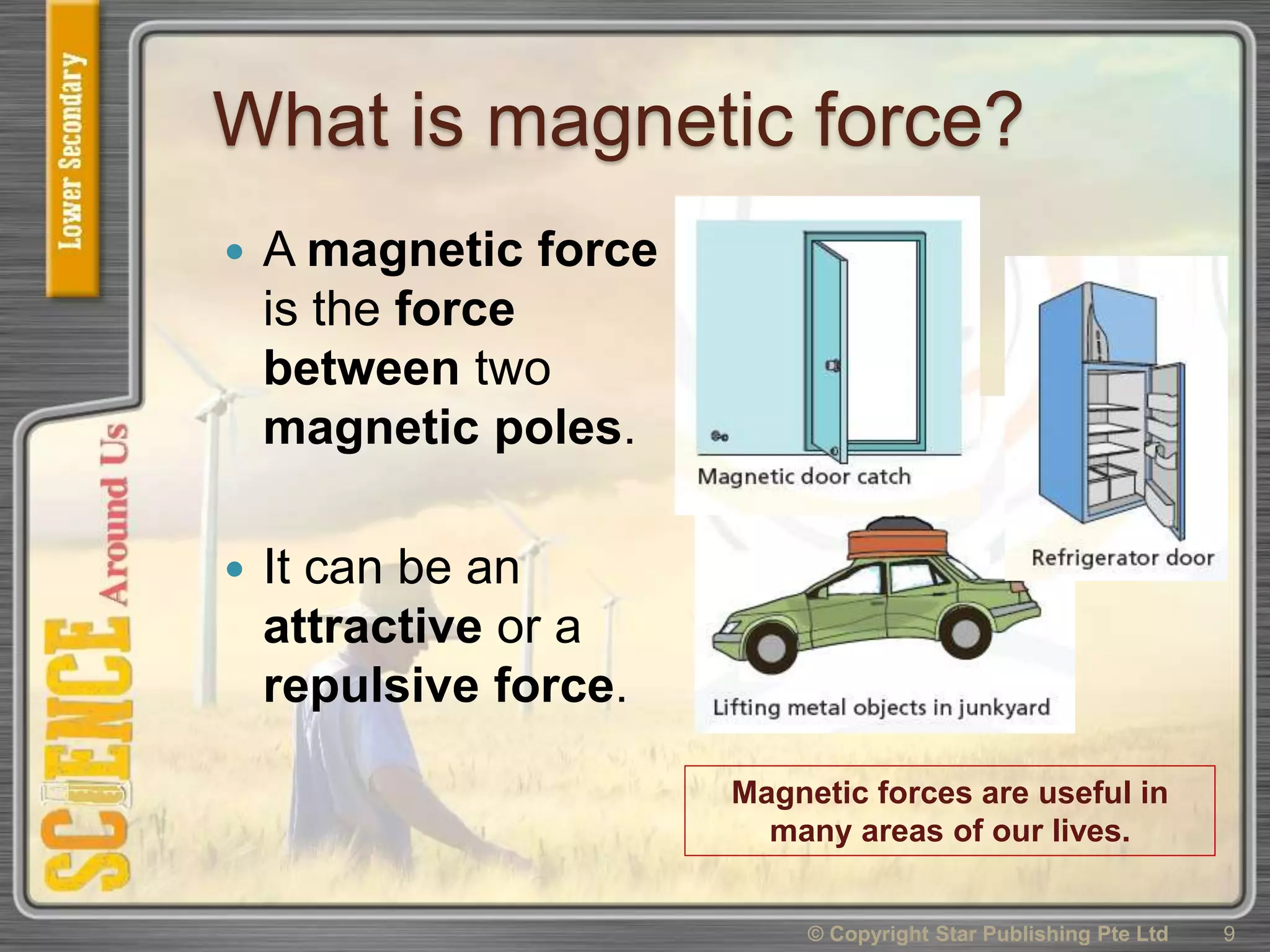
 A magnetic force
is the force
between two
magnetic poles.
 It can be an
attractive or a
repulsive force.
© Copyright Star Publishing Pte Ltd 9
Magnetic forces are useful in
many areas of our lives.
What is gravitational force?
 Gravitational
force is the force
that pulls an
object towards the
earth.
© Copyright Star Publishing Pte Ltd 10
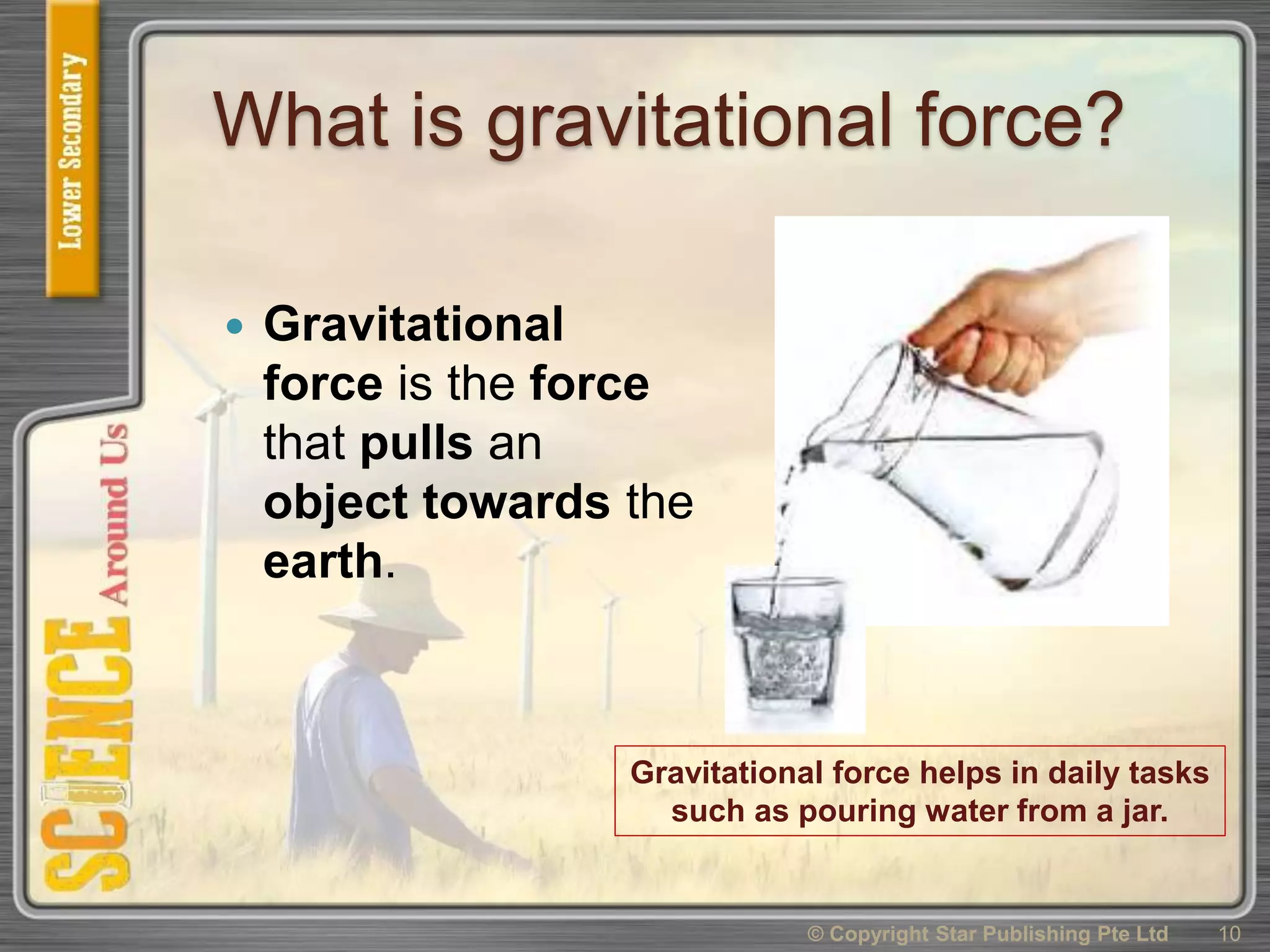
Gravitational force helps in daily tasks
such as pouring water from a jar.
What are the effects of forces?
 A force can
change the shape
and/or size of an
object.
© Copyright Star Publishing Pte Ltd 11
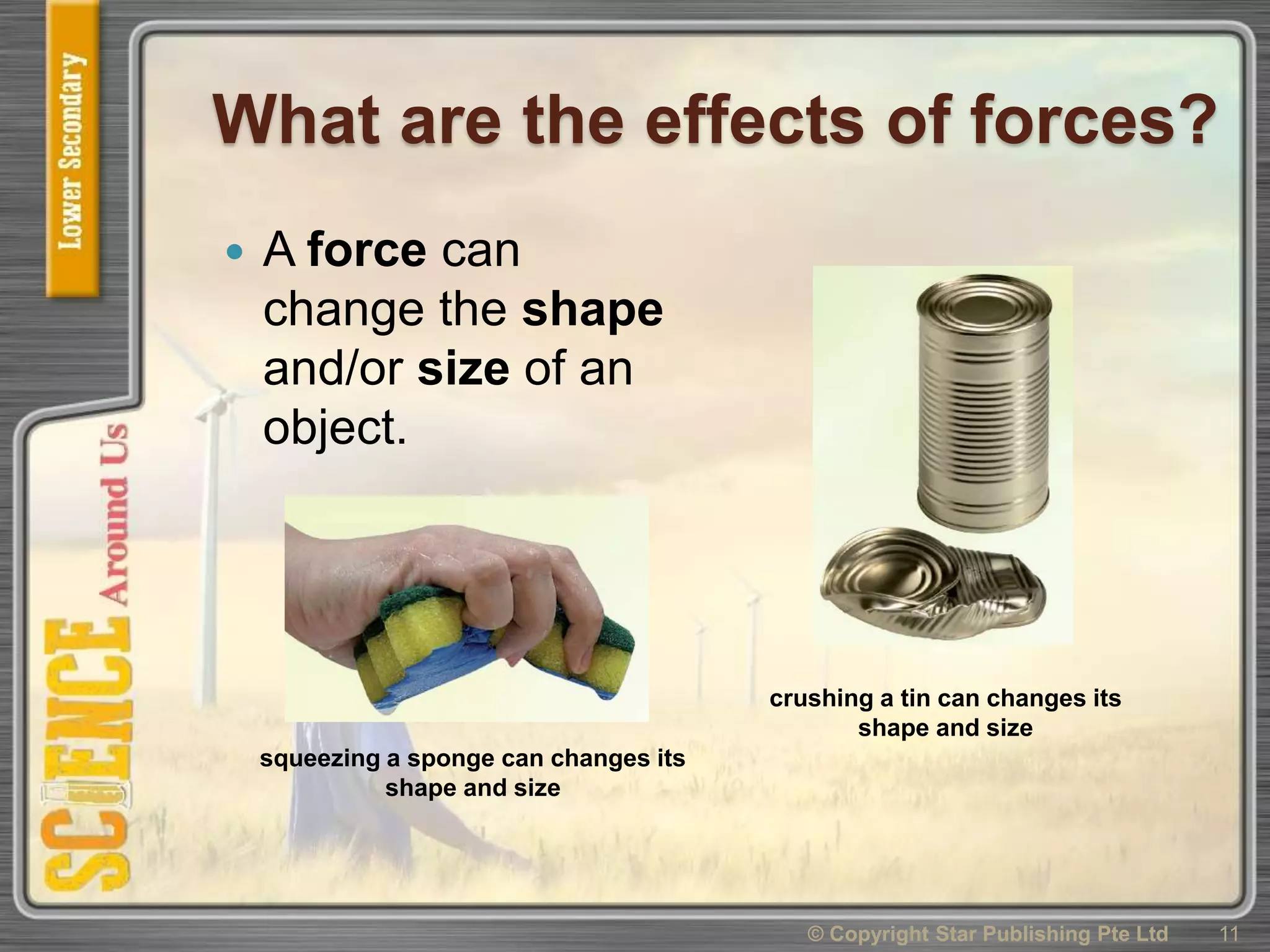
crushing a tin can changes its
shape and size
squeezing a sponge can changes its
shape and size
What are the effects of forces?
 A force can change the motion of an object;
 for example,
(i) move a stationary object,
(ii) stop a moving object,
(iii) change the speed of a moving object,
(iv) change the direction of a moving object.
© Copyright Star Publishing Pte Ltd 12
© Copyright Star Publishing Pte Ltd 13
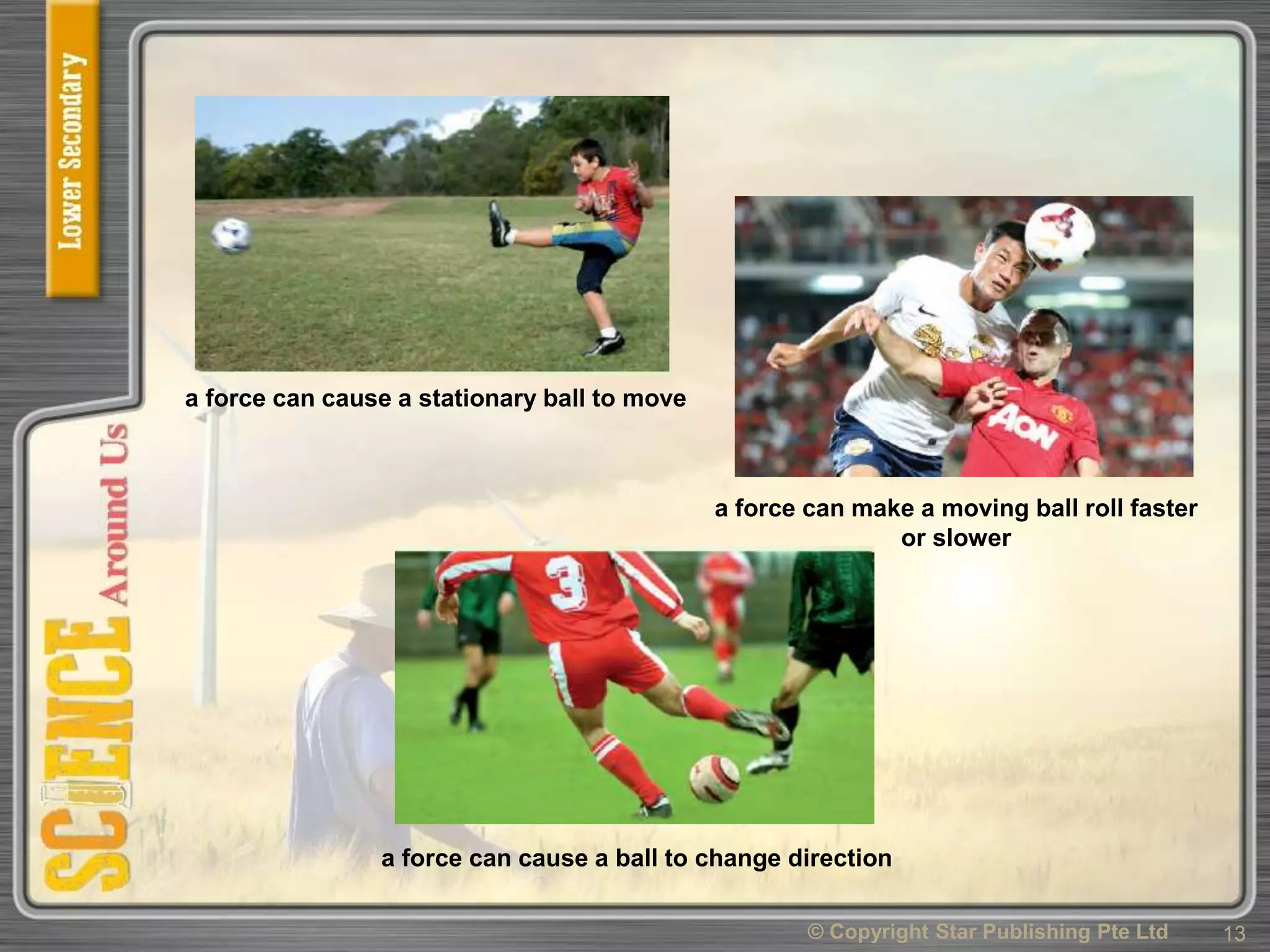
a force can cause a stationary ball to move
a force can make a moving ball roll faster
or slower
a force can cause a ball to change direction
Chapter 1 Exploring Forces
1.1 What are the effects of forces?
1.2 How can forces be measured?
1.3 What are the effects of friction?
1.4 How do simple machines work?
14© Copyright Star Publishing Pte Ltd
Objectives
 Use a spring balance to measure
force
 Use newton as the unit of force
15© Copyright Star Publishing Pte Ltd
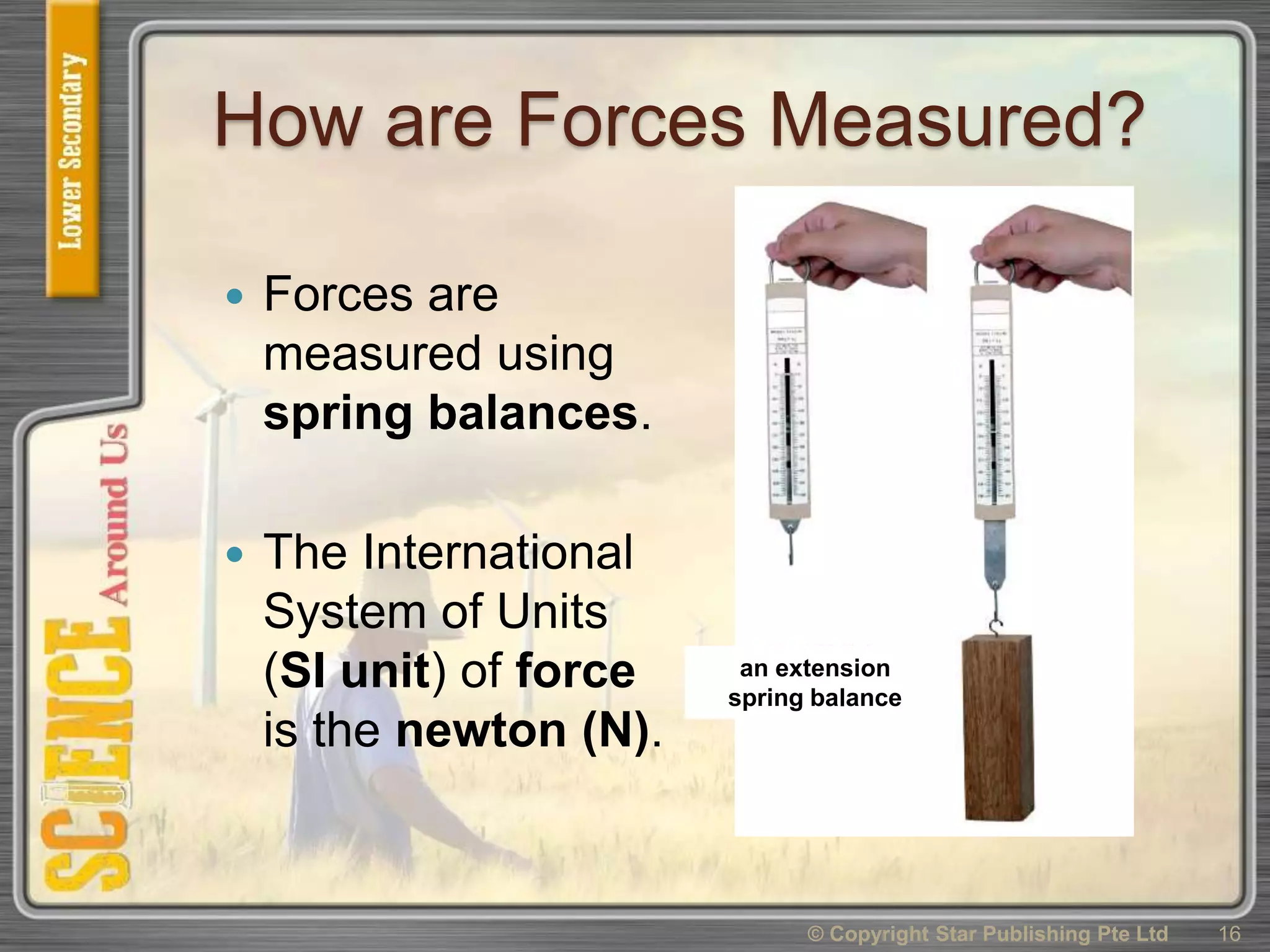
How are Forces Measured?
 Forces are
measured using
spring balances.
 The International
System of Units
(SI unit) of force
is the newton (N).
© Copyright Star Publishing Pte Ltd 16
an extension
spring balance
Spring balances
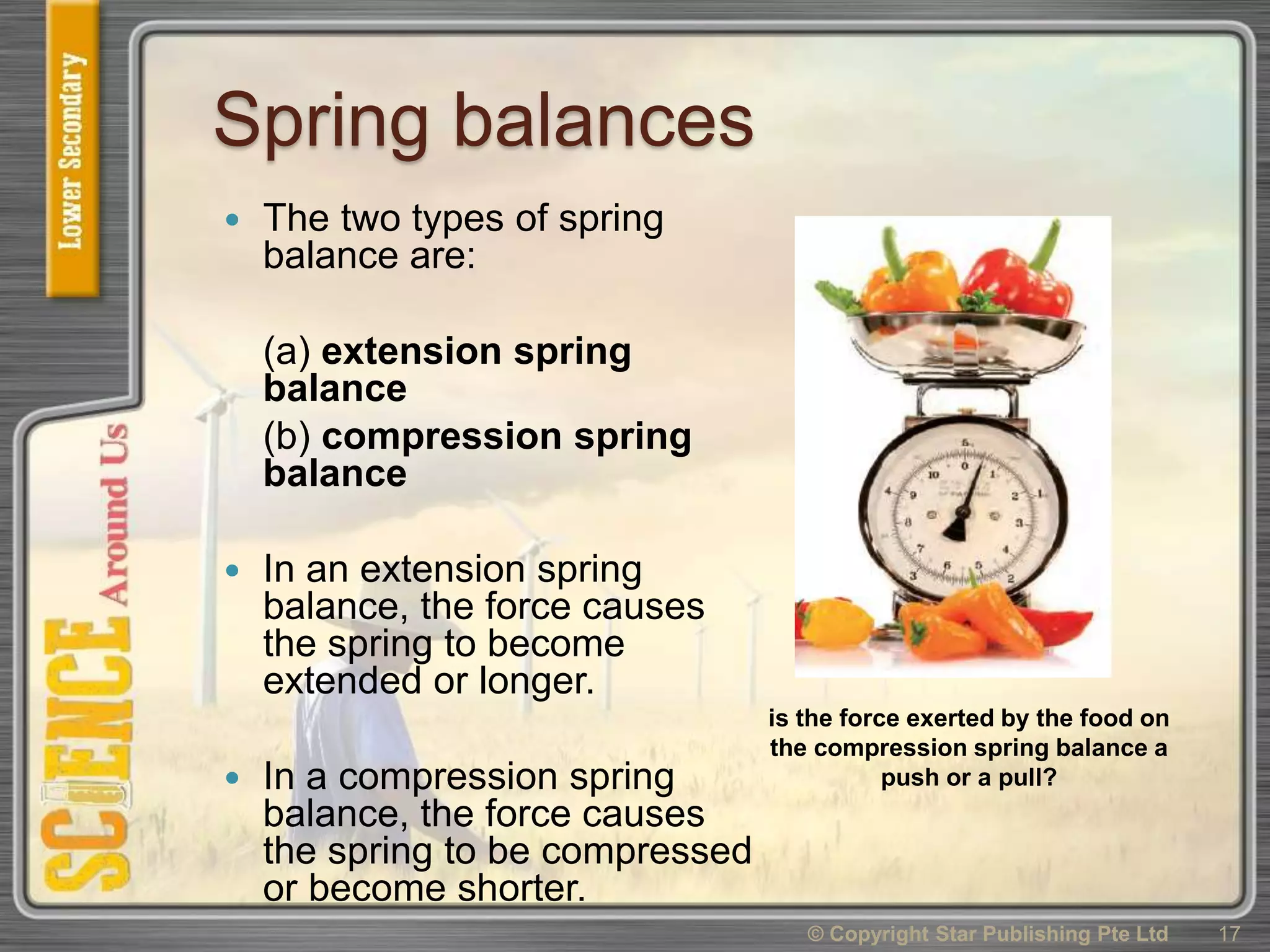
 The two types of spring
balance are:
(a) extension spring
balance
(b) compression spring
balance
 In an extension spring
balance, the force causes
the spring to become
extended or longer.
 In a compression spring
balance, the force causes
the spring to be compressed
or become shorter.
© Copyright Star Publishing Pte Ltd 17
is the force exerted by the food on
the compression spring balance a
push or a pull?
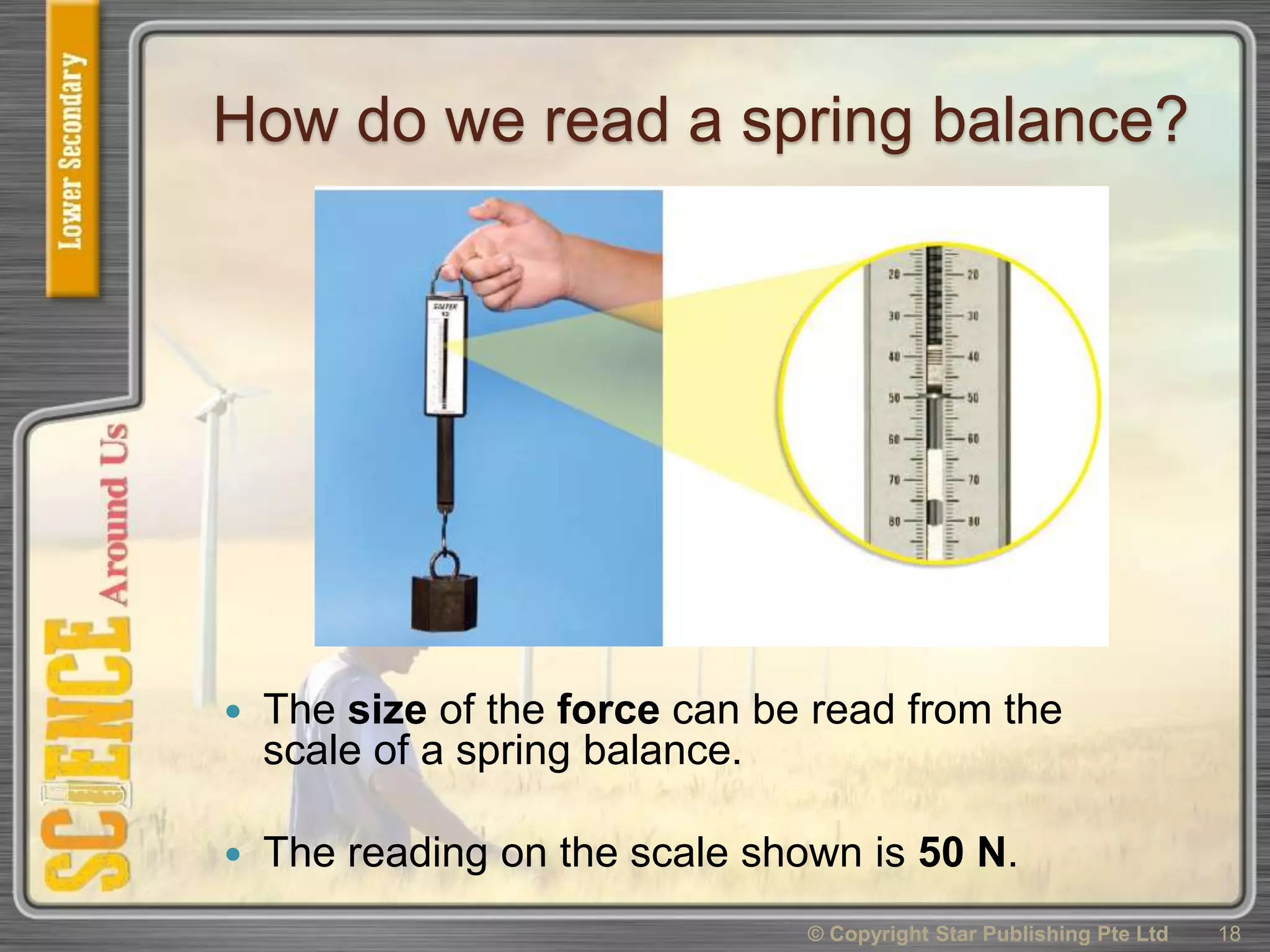
How do we read a spring balance?
 The size of the force can be read from the
scale of a spring balance.
 The reading on the scale shown is 50 N.
© Copyright Star Publishing Pte Ltd 18
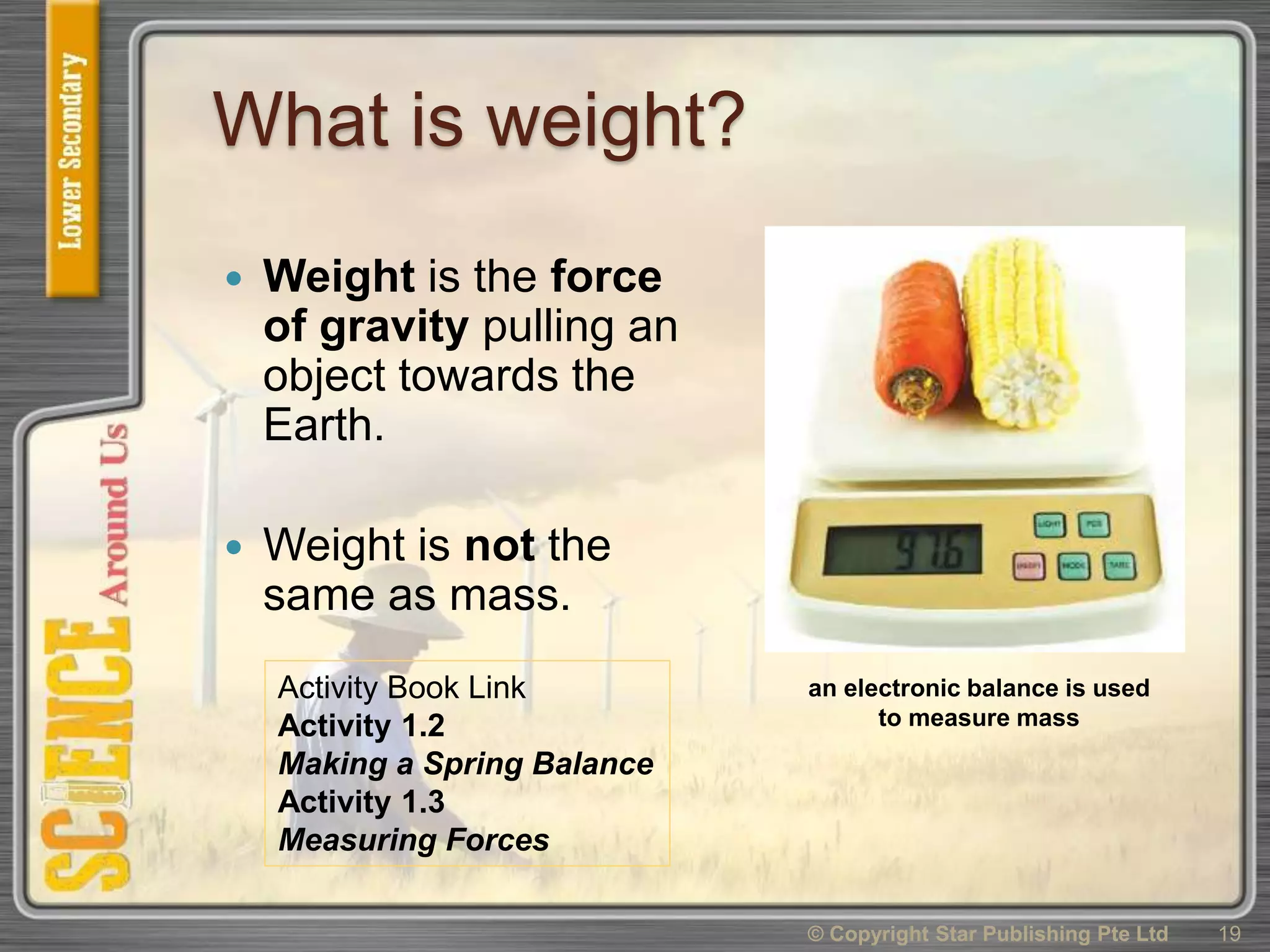
What is weight?
 Weight is the force
of gravity pulling an
object towards the
Earth.
 Weight is not the
same as mass.
© Copyright Star Publishing Pte Ltd 19
an electronic balance is used
to measure mass
Activity Book Link
Activity 1.2
Making a Spring Balance
Activity 1.3
Measuring Forces
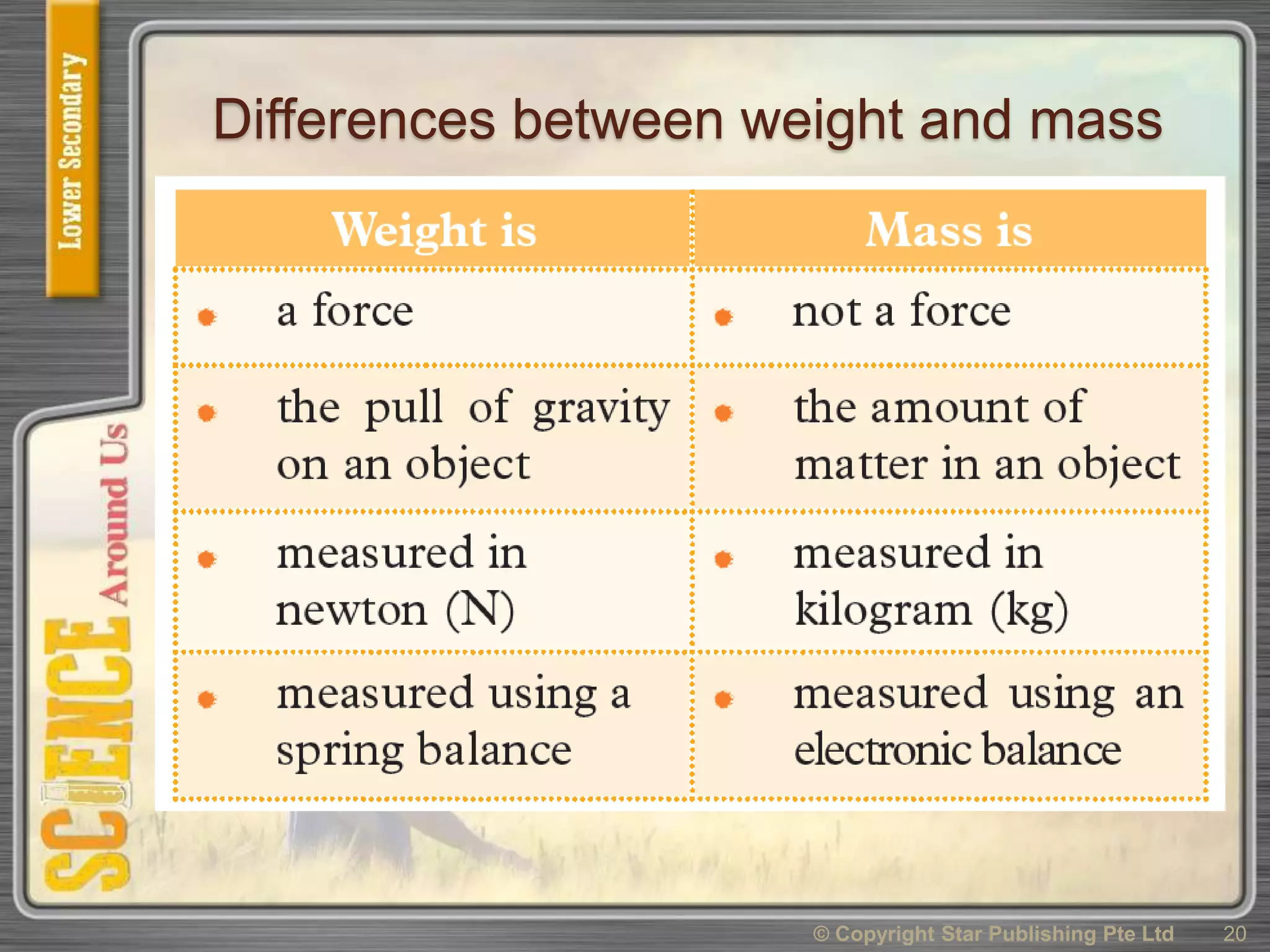
Differences between weight and mass
© Copyright Star Publishing Pte Ltd 20
Chapter 1 Exploring Forces
1.1 What are the effects of forces?
1.2 How can forces be measured?
1.3 What are the effects of friction?
1.4 How do simple machines work?
21© Copyright Star Publishing Pte Ltd
Objectives
 Describe the effects of friction on the
motion of an object
22© Copyright Star Publishing Pte Ltd
What is Frictional Force?
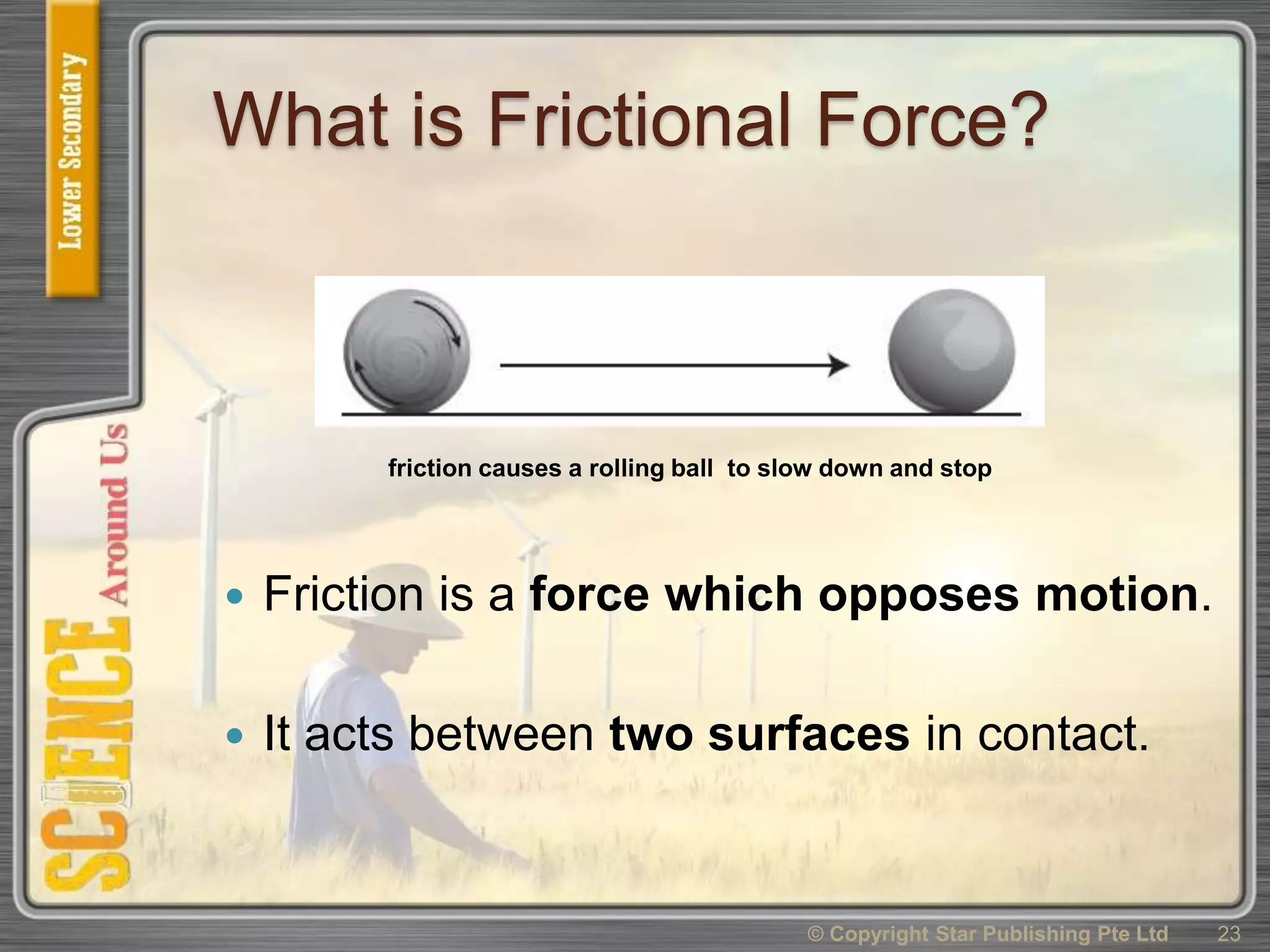
 Friction is a force which opposes motion.
 It acts between two surfaces in contact.
© Copyright Star Publishing Pte Ltd 23
friction causes a rolling ball to slow down and stop
What are the Factors Affecting Friction?
 Friction depends
on:
(a) the
smoothness of the
two surfaces in
contact.
(b) the force
pressing the two
surfaces together.
© Copyright Star Publishing Pte Ltd 24
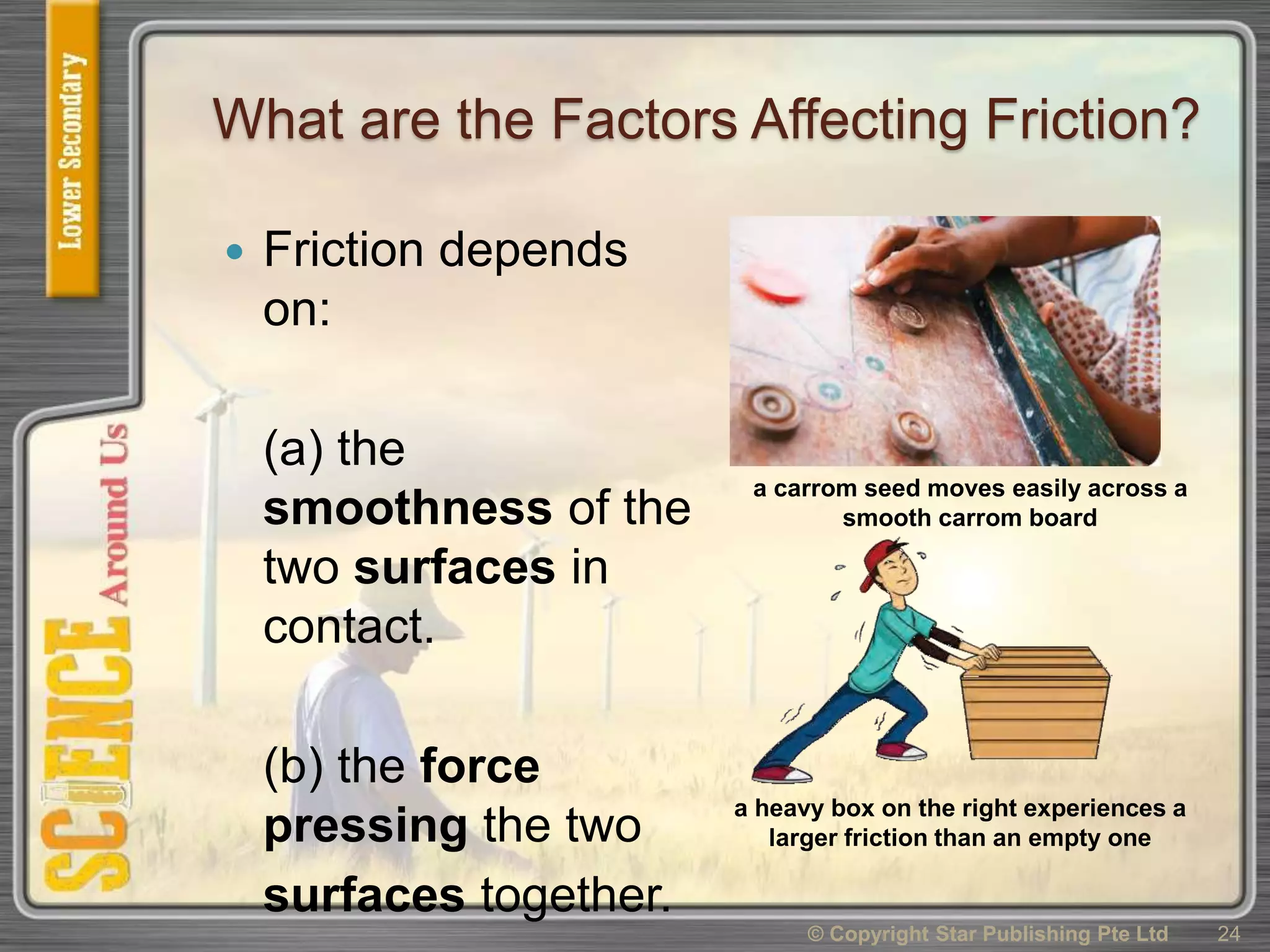
a carrom seed moves easily across a
smooth carrom board
a heavy box on the right experiences a
larger friction than an empty one
Does the Surface Area in Contact Affect
Friction?
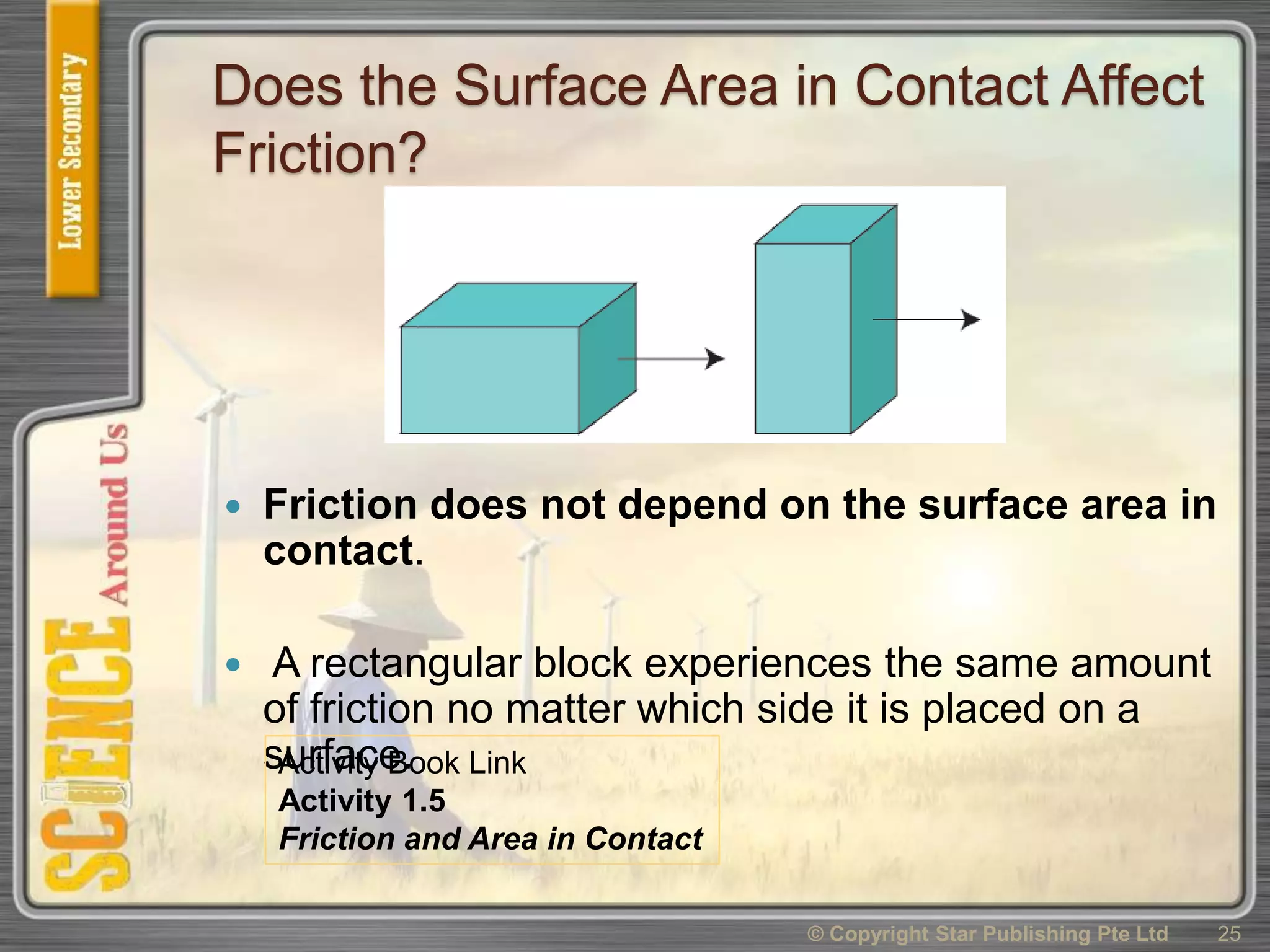
 Friction does not depend on the surface area in
contact.
 A rectangular block experiences the same amount
of friction no matter which side it is placed on a
surface.
© Copyright Star Publishing Pte Ltd 25
Activity Book Link
Activity 1.5
Friction and Area in Contact
Is Friction a Useful Force?
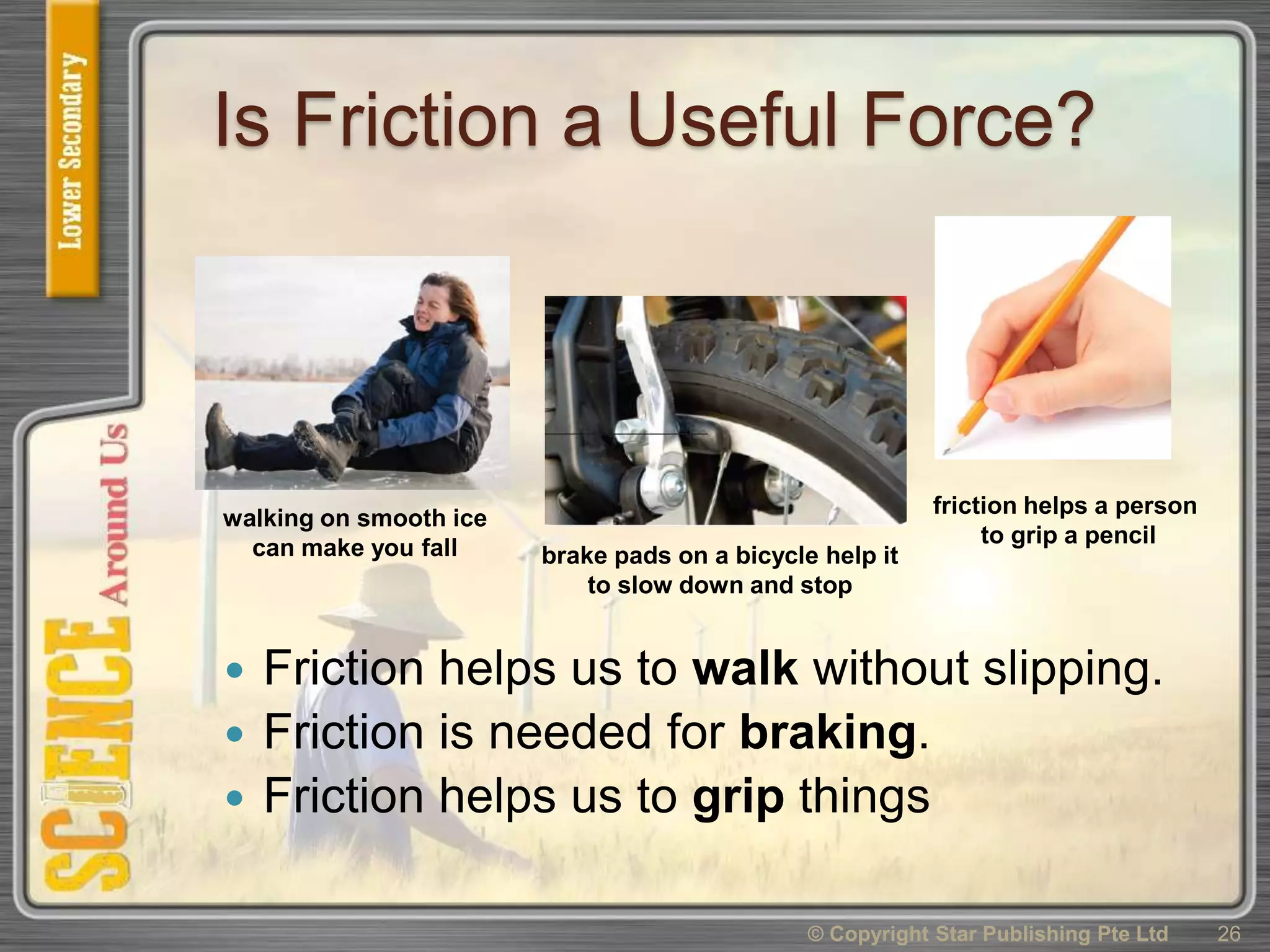
 Friction helps us to walk without slipping.
 Friction is needed for braking.
 Friction helps us to grip things
© Copyright Star Publishing Pte Ltd 26
walking on smooth ice
can make you fall brake pads on a bicycle help it
to slow down and stop
friction helps a person
to grip a pencil
Is Friction a Nuisance?
 Friction can also be a nuisance as it produces
unwanted heat in machines and causes wear
and tear.
 Friction can be reduced by:
(a) Using lubricants
(b) Using ball bearings
© Copyright Star Publishing Pte Ltd 27
lubricants and ball bearings reduce friction between moving parts of machines
Chapter 1 Exploring Forces
1.1 What are the effects of forces?
1.2 How can forces be measured?
1.3 What are the effects of friction?
1.4 How do simple machines work?
28© Copyright Star Publishing Pte Ltd
Objectives
 Identify the different types of simple
machines (levers, inclined planes and
pulleys) and give everyday examples of
their use
 Investigate the effort used when the
following is used to raise a load
▲ Lever
▲ Inclined plane
▲ Pulley
29© Copyright Star Publishing Pte Ltd
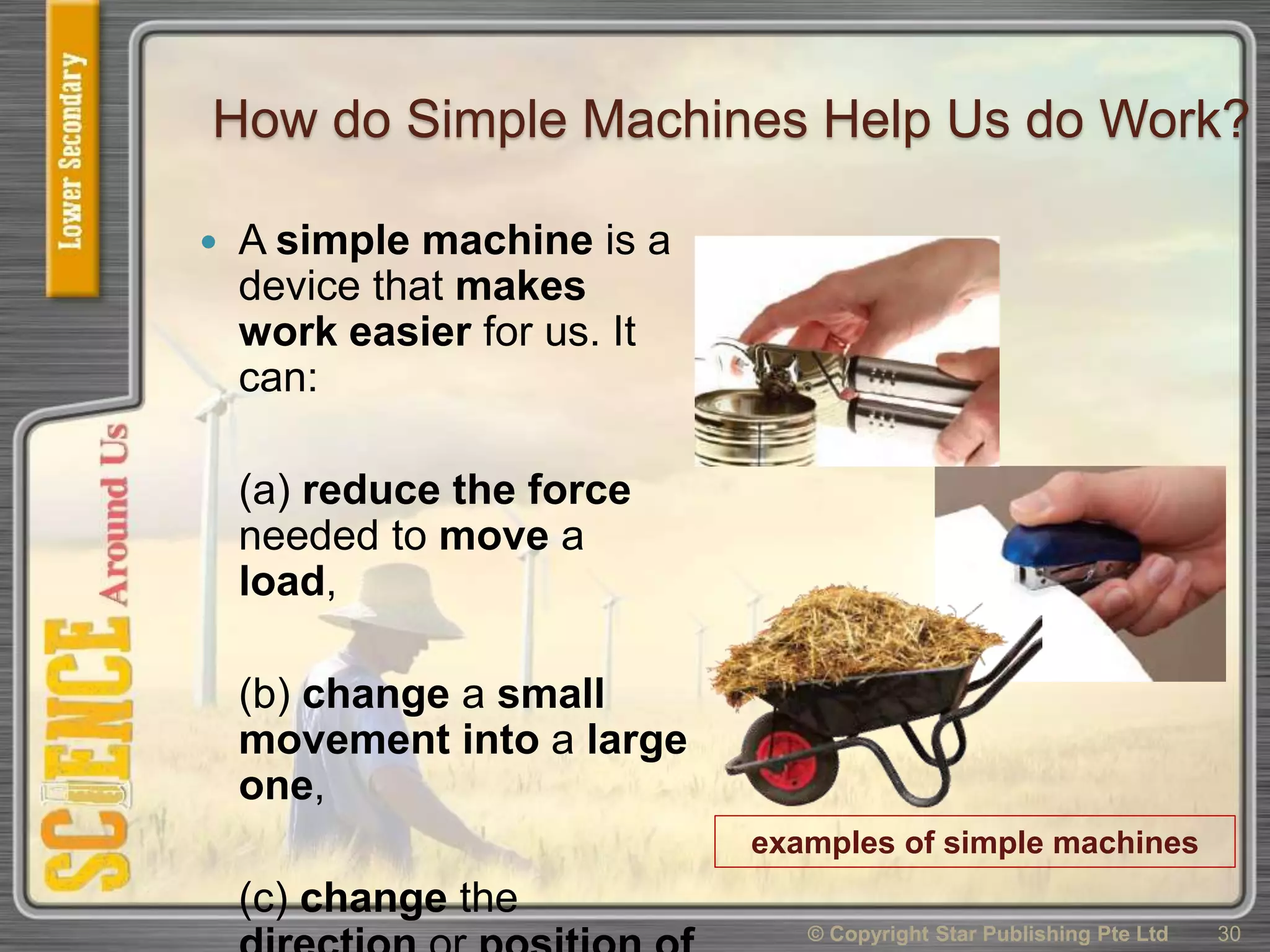
How do Simple Machines Help Us do Work?
 A simple machine is a
device that makes
work easier for us. It
can:
(a) reduce the force
needed to move a
load,
(b) change a small
movement into a large
one,
(c) change the
© Copyright Star Publishing Pte Ltd 30
examples of simple machines
Types of simple machines
 Three common
types of simple
machines are:
(a) levers,
(b) inclined planes,
(c) pulleys.
© Copyright Star Publishing Pte Ltd 31
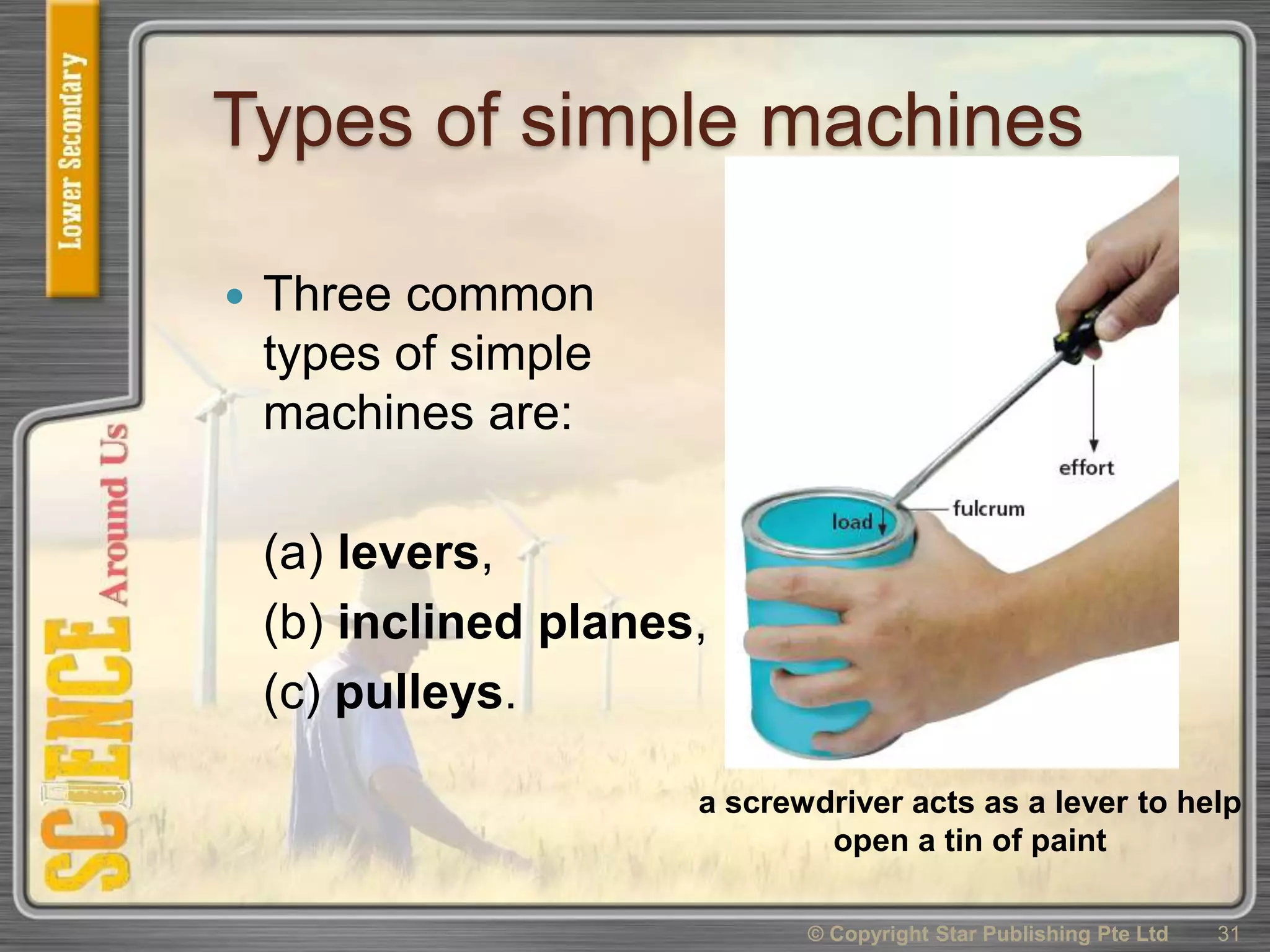
a screwdriver acts as a lever to help
open a tin of paint
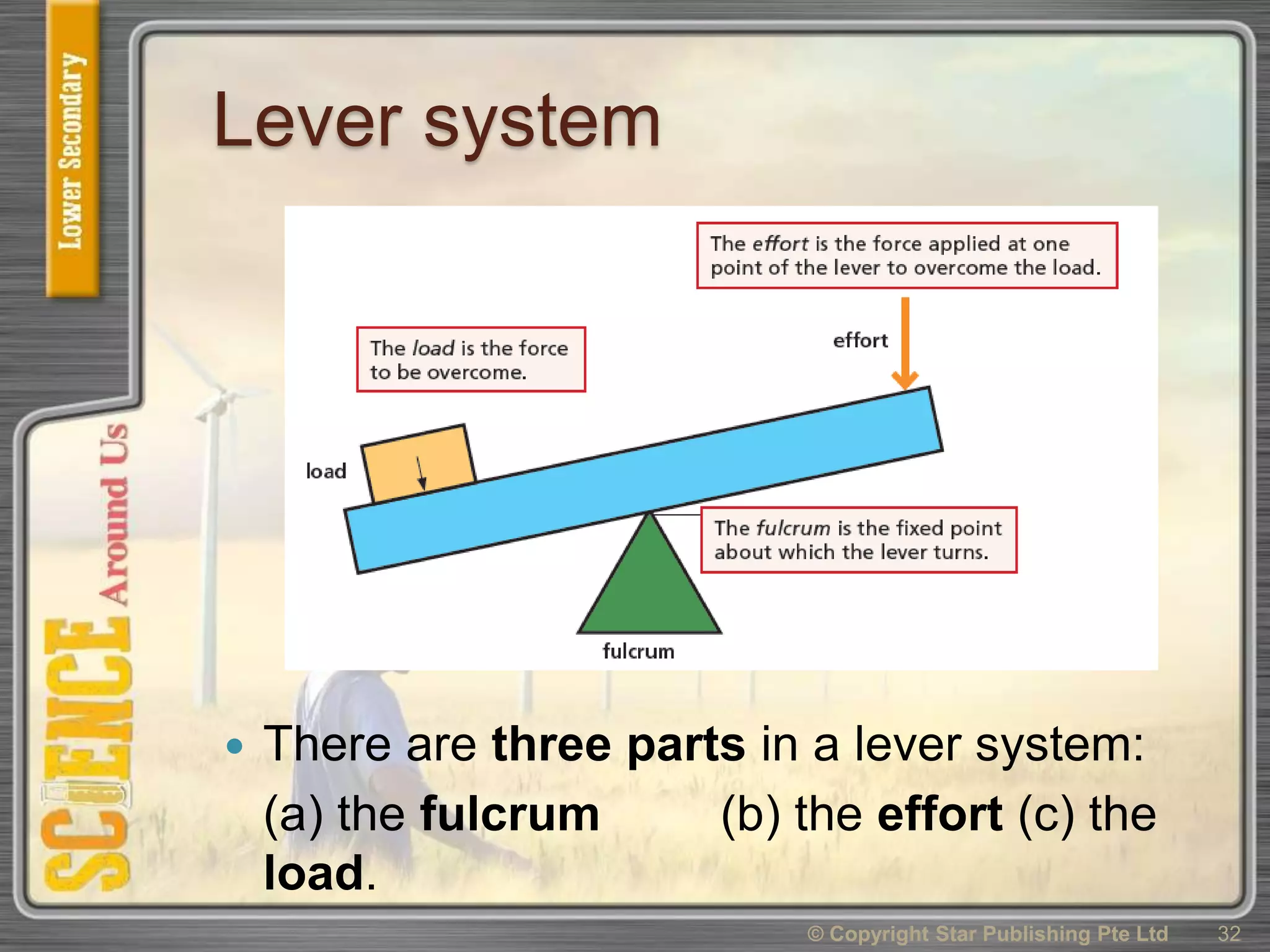
Lever system
 There are three parts in a lever system:
(a) the fulcrum (b) the effort (c) the
load.
© Copyright Star Publishing Pte Ltd 32
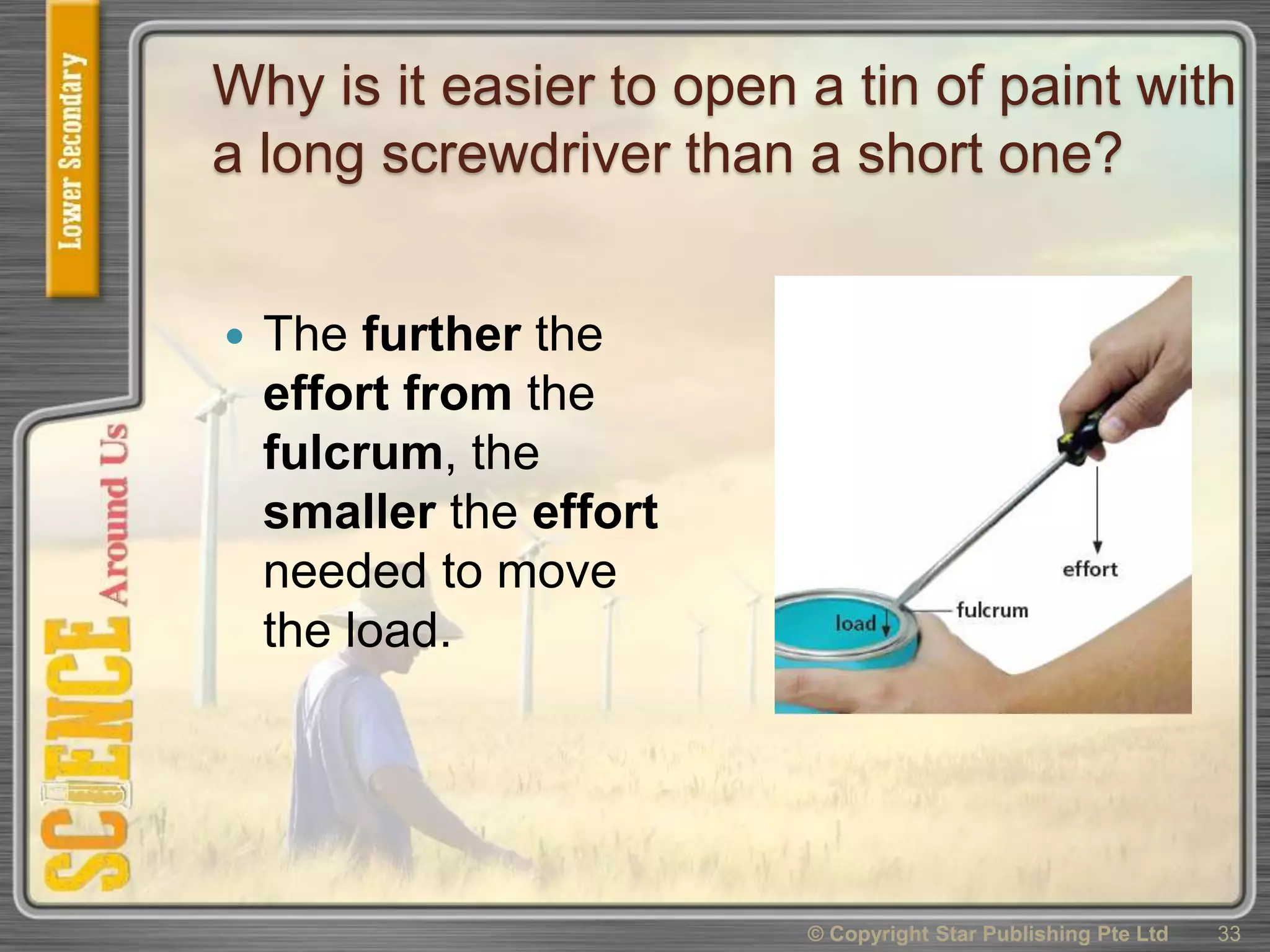
Why is it easier to open a tin of paint with
a long screwdriver than a short one?
 The further the
effort from the
fulcrum, the
smaller the effort
needed to move
the load.
© Copyright Star Publishing Pte Ltd 33
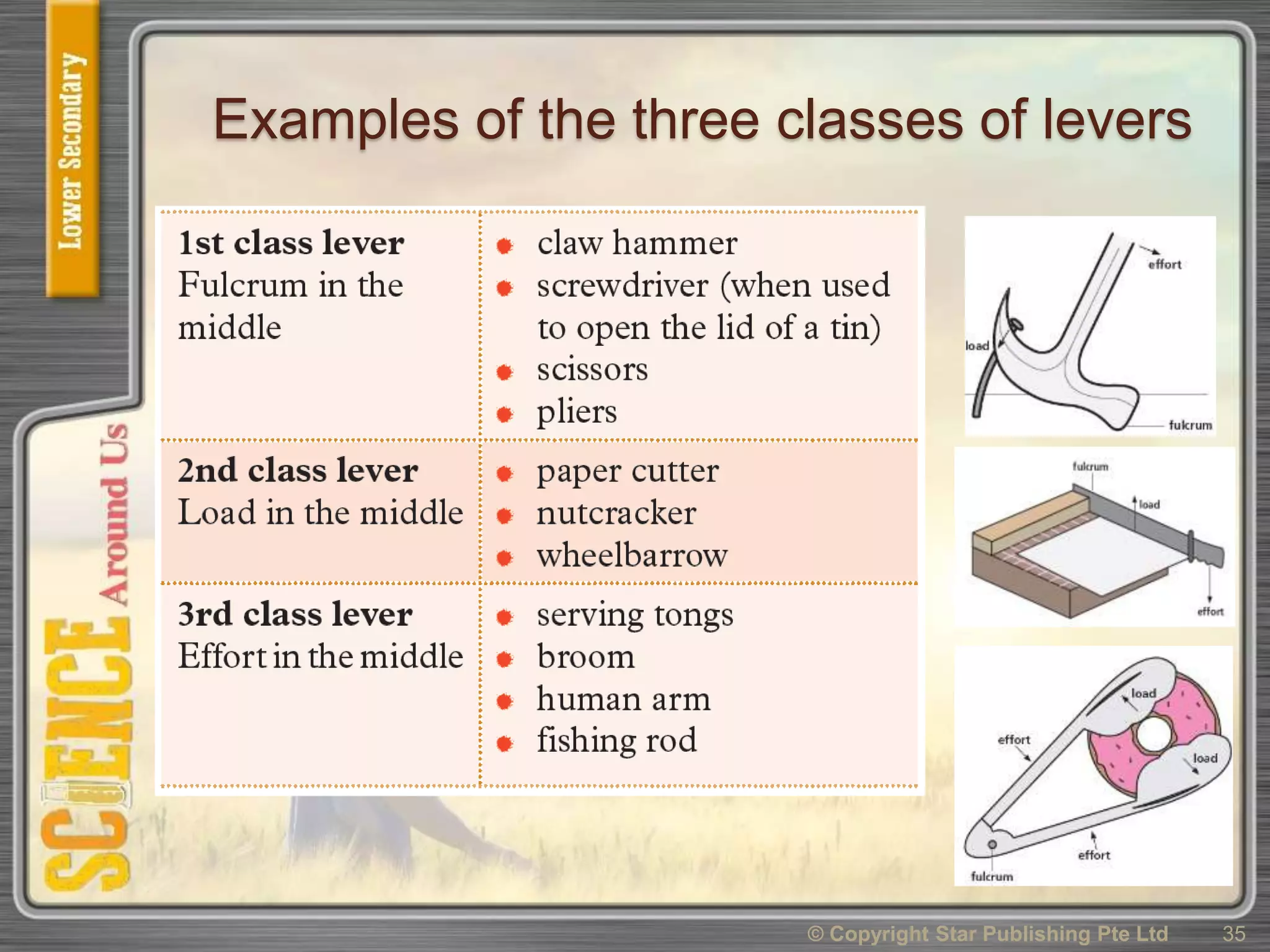
Classes of levers
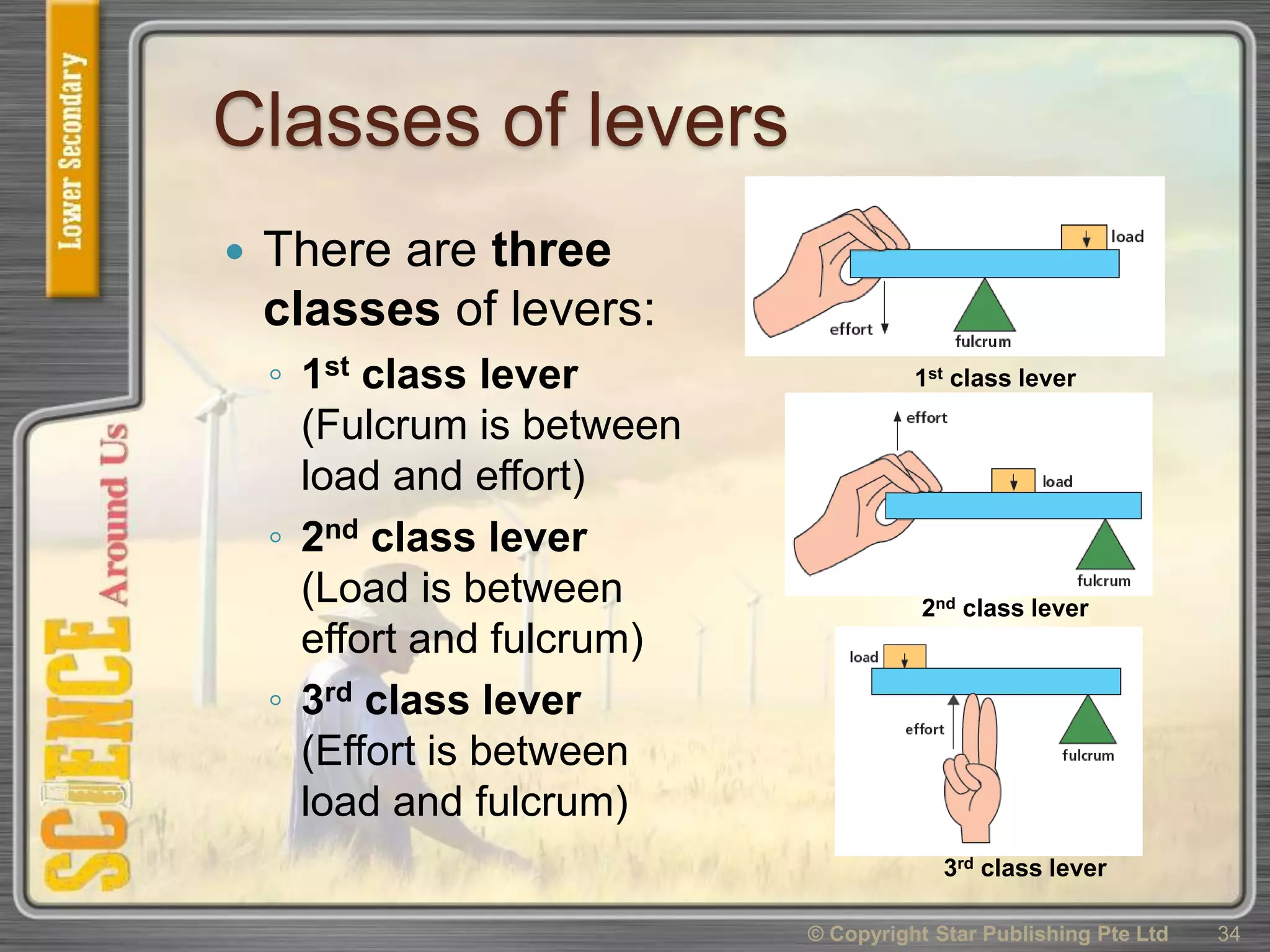
 There are three
classes of levers:
◦ 1st class lever
(Fulcrum is between
load and effort)
◦ 2nd class lever
(Load is between
effort and fulcrum)
◦ 3rd class lever
(Effort is between
load and fulcrum)
© Copyright Star Publishing Pte Ltd 34
1st class lever
2nd class lever
3rd class lever
Examples of the three classes of levers
© Copyright Star Publishing Pte Ltd 35
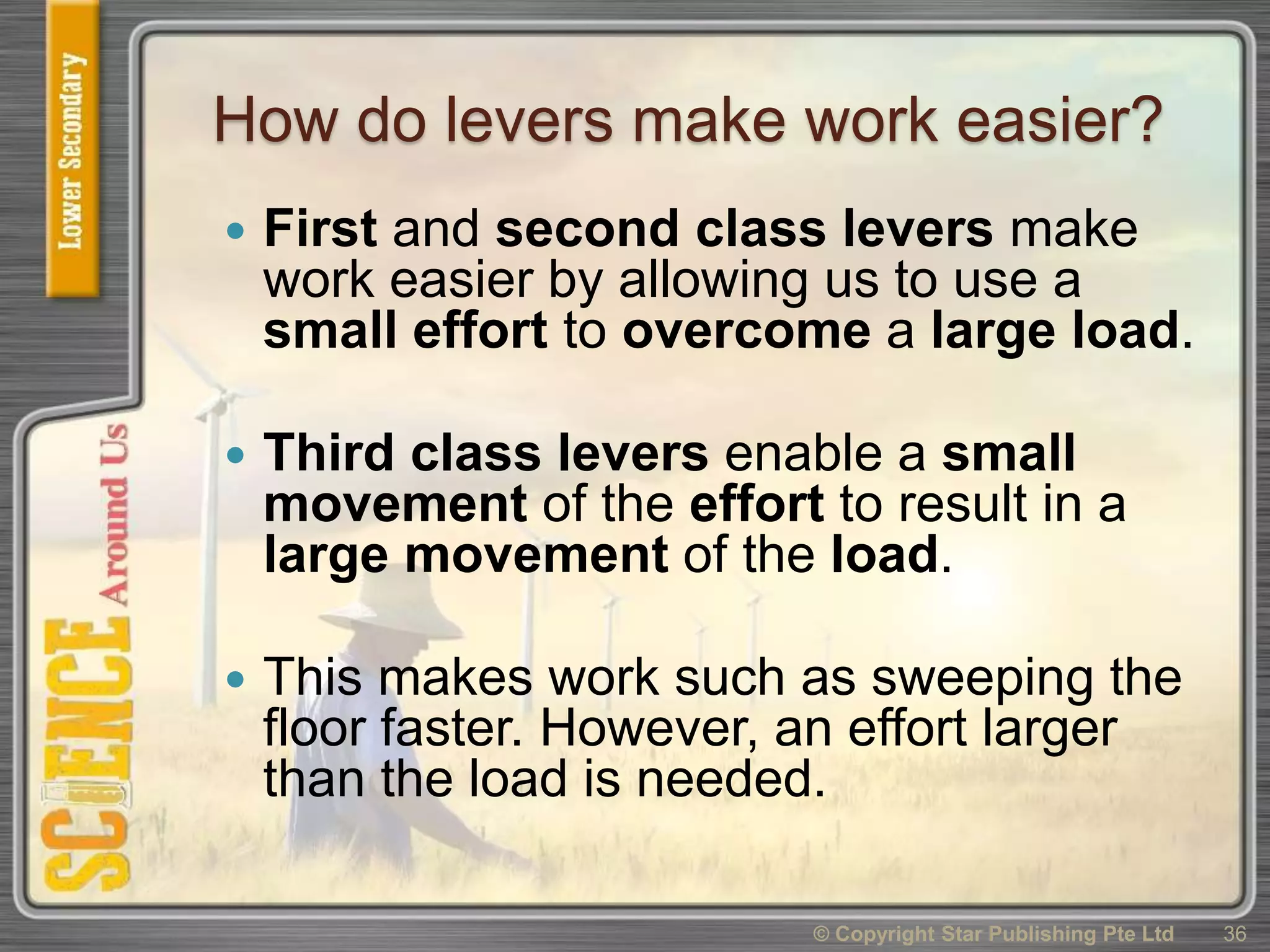
How do levers make work easier?
 First and second class levers make
work easier by allowing us to use a
small effort to overcome a large load.
 Third class levers enable a small
movement of the effort to result in a
large movement of the load.
 This makes work such as sweeping the
floor faster. However, an effort larger
than the load is needed.
© Copyright Star Publishing Pte Ltd 36
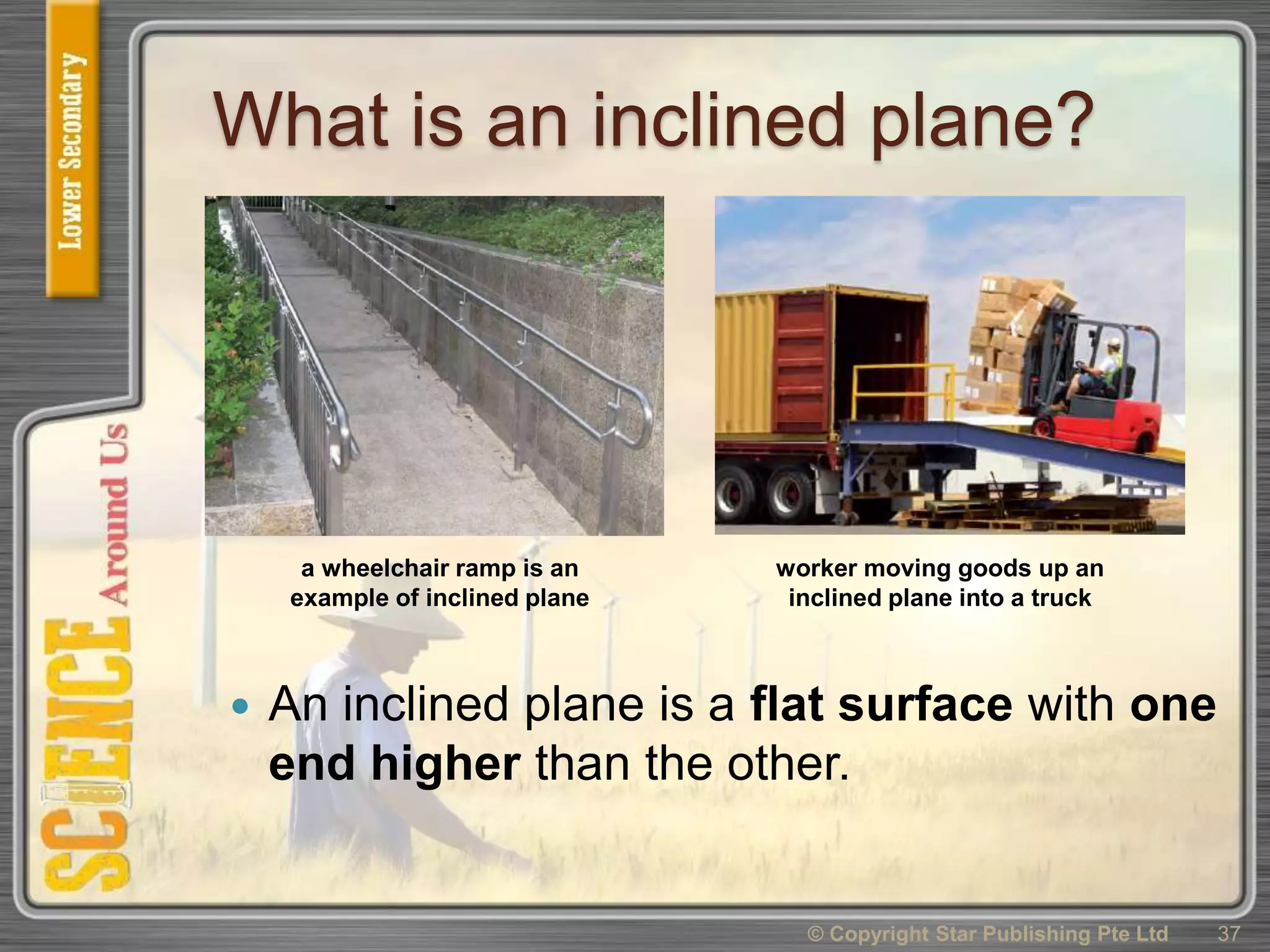
What is an inclined plane?
 An inclined plane is a flat surface with one
end higher than the other.
© Copyright Star Publishing Pte Ltd 37
a wheelchair ramp is an
example of inclined plane
worker moving goods up an
inclined plane into a truck
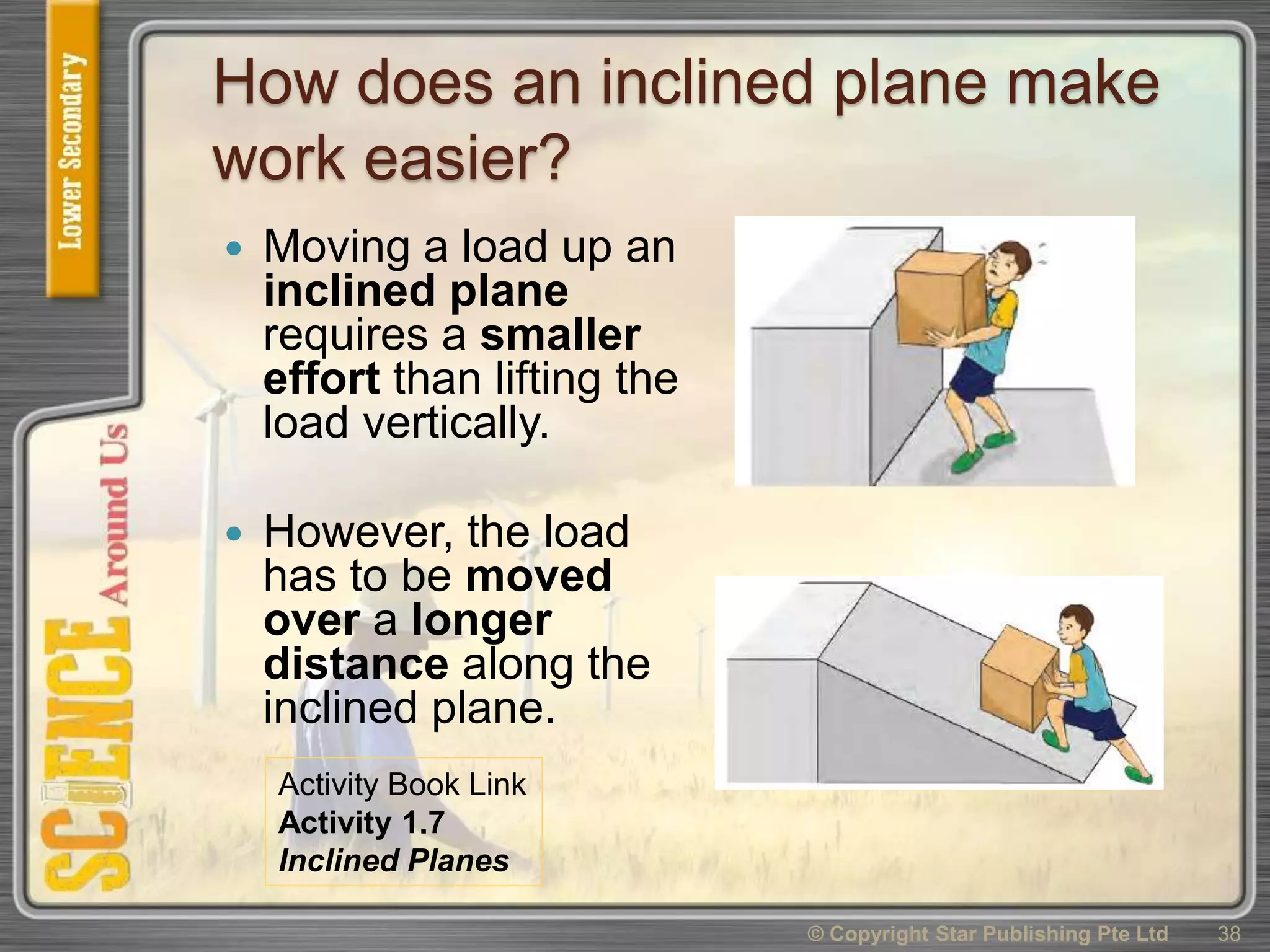
How does an inclined plane make
work easier?
 Moving a load up an
inclined plane
requires a smaller
effort than lifting the
load vertically.
 However, the load
has to be moved
over a longer
distance along the
inclined plane.
© Copyright Star Publishing Pte Ltd 38
Activity Book Link
Activity 1.7
Inclined Planes
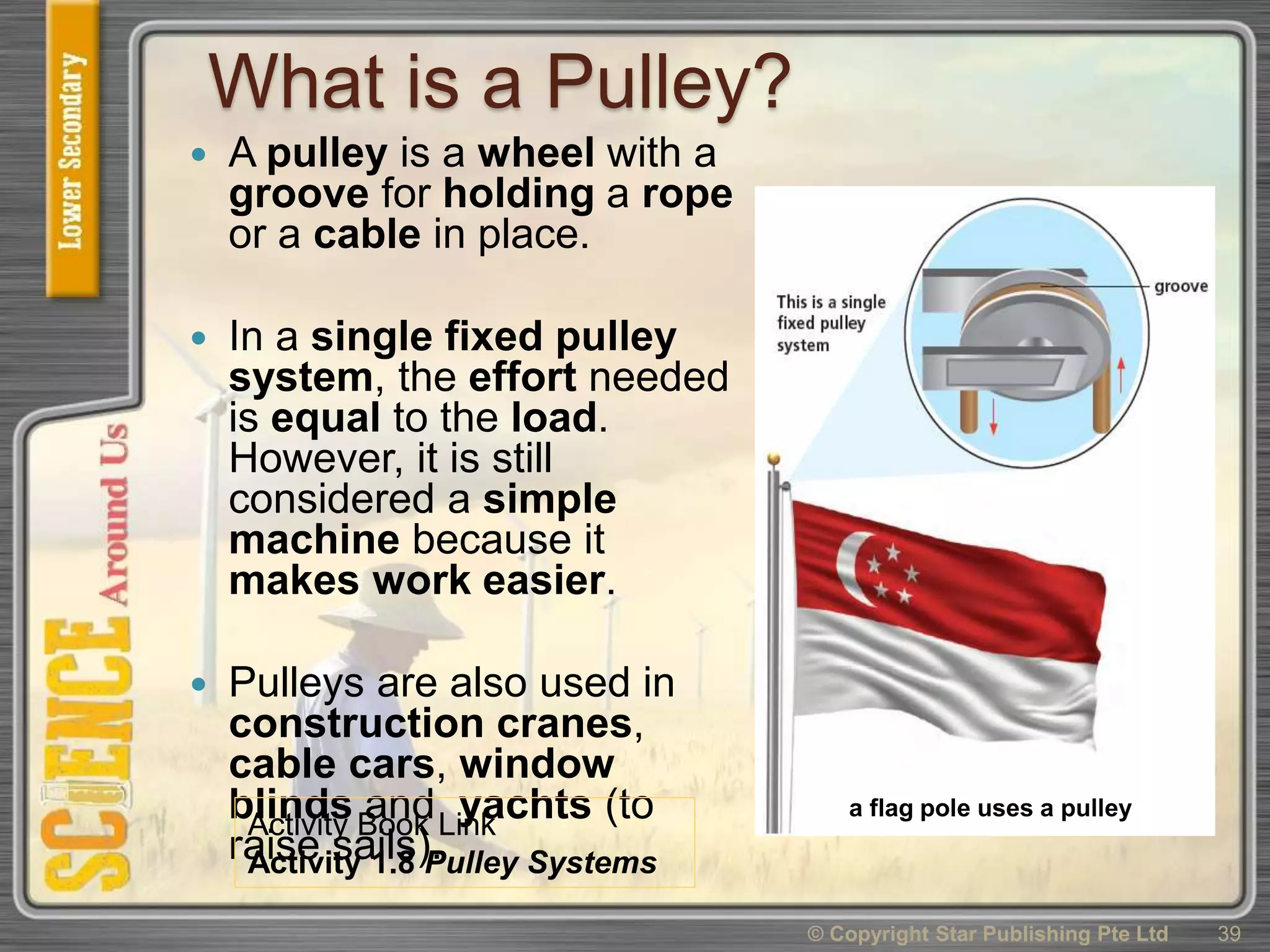
What is a Pulley?
 A pulley is a wheel with a
groove for holding a rope
or a cable in place.
 In a single fixed pulley
system, the effort needed
is equal to the load.
However, it is still
considered a simple
machine because it
makes work easier.
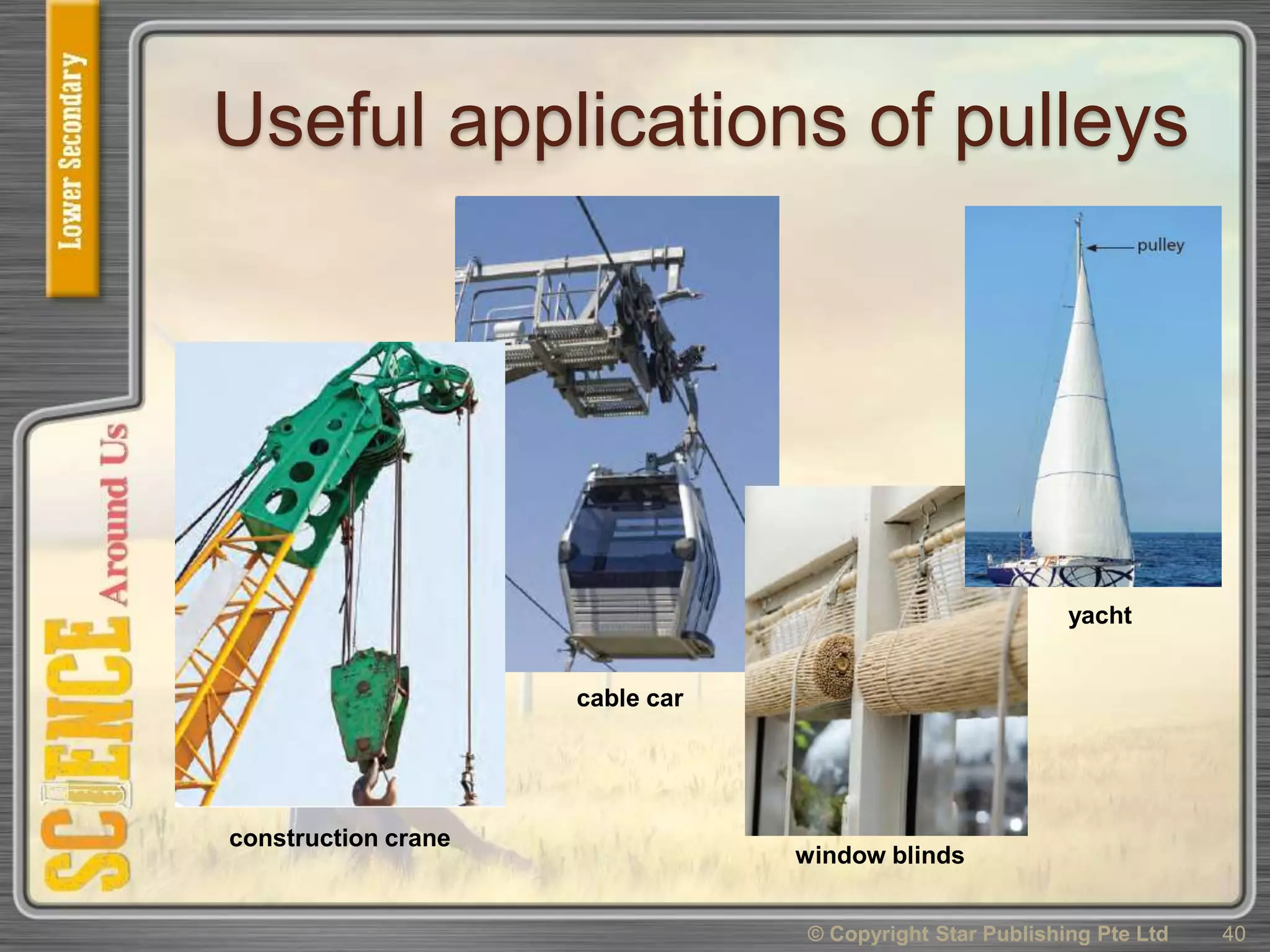
 Pulleys are also used in
construction cranes,
cable cars, window
blinds and yachts (to
raise sails).
© Copyright Star Publishing Pte Ltd 39
a flag pole uses a pulley
Activity Book Link
Activity 1.8 Pulley Systems
Useful applications of pulleys
© Copyright Star Publishing Pte Ltd 40
construction crane
cable car
window blinds
yacht

Lss module 1 chpt 1 investigating forces

  • 1.
    MODULE 1: GADGETS WORKWONDERS (I) Chapter 1 Exploring Forces 1© Copyright Star Publishing Pte Ltd
  • 2.
    Chapter 1 ExploringForces 1.1 What are the effects of forces? 1.2 How can forces be measured? 1.3 What are the effects of friction? 1.4 How do simple machines work? 2© Copyright Star Publishing Pte Ltd
  • 3.
    Objectives  State thata force can change the shape, size, state of rest and motion of a body  Give examples of different forces: pushing, lifting, stretching, twisting, pressing, gravitational, frictional and magnetic forces  Infer the effects of forces such as ◦ change in state of rest and / or motion of a body ◦ change in shape and / or size of a body 3© Copyright Star Publishing Pte Ltd
  • 4.
    What is aforce?  A force is a push or a pull.  Actions such as lifting, stretching, bending, twisting and squeezing involve pushing and pulling. 4© Copyright Star Publishing Pte Ltd Actions Involving PushingActivity Book Link Activity 1.1 Forces in Daily Life
  • 5.
    © Copyright StarPublishing Pte Ltd 5 Actions Involving Pulling
  • 6.
    © Copyright StarPublishing Pte Ltd 6 Actions Involving Pushing and Pulling
  • 7.
    Other examples offorces  Other examples of forces are frictional force, magnetic force and gravitational force. © Copyright Star Publishing Pte Ltd 7 How is life in space without any gravitational pull?
  • 8.
    What is frictionalforce?  Friction is the force that acts between two surfaces in contact.  When we hold a glass of water, there is friction between our hand and the glass. © Copyright Star Publishing Pte Ltd 8
  • 9.
    What is magneticforce?  A magnetic force is the force between two magnetic poles.  It can be an attractive or a repulsive force. © Copyright Star Publishing Pte Ltd 9 Magnetic forces are useful in many areas of our lives.
  • 10.
    What is gravitationalforce?  Gravitational force is the force that pulls an object towards the earth. © Copyright Star Publishing Pte Ltd 10 Gravitational force helps in daily tasks such as pouring water from a jar.
  • 11.
    What are theeffects of forces?  A force can change the shape and/or size of an object. © Copyright Star Publishing Pte Ltd 11 crushing a tin can changes its shape and size squeezing a sponge can changes its shape and size
  • 12.
    What are theeffects of forces?  A force can change the motion of an object;  for example, (i) move a stationary object, (ii) stop a moving object, (iii) change the speed of a moving object, (iv) change the direction of a moving object. © Copyright Star Publishing Pte Ltd 12
  • 13.
    © Copyright StarPublishing Pte Ltd 13 a force can cause a stationary ball to move a force can make a moving ball roll faster or slower a force can cause a ball to change direction
  • 14.
    Chapter 1 ExploringForces 1.1 What are the effects of forces? 1.2 How can forces be measured? 1.3 What are the effects of friction? 1.4 How do simple machines work? 14© Copyright Star Publishing Pte Ltd
  • 15.
    Objectives  Use aspring balance to measure force  Use newton as the unit of force 15© Copyright Star Publishing Pte Ltd
  • 16.
    How are ForcesMeasured?  Forces are measured using spring balances.  The International System of Units (SI unit) of force is the newton (N). © Copyright Star Publishing Pte Ltd 16 an extension spring balance
  • 17.
    Spring balances  Thetwo types of spring balance are: (a) extension spring balance (b) compression spring balance  In an extension spring balance, the force causes the spring to become extended or longer.  In a compression spring balance, the force causes the spring to be compressed or become shorter. © Copyright Star Publishing Pte Ltd 17 is the force exerted by the food on the compression spring balance a push or a pull?
  • 18.
    How do weread a spring balance?  The size of the force can be read from the scale of a spring balance.  The reading on the scale shown is 50 N. © Copyright Star Publishing Pte Ltd 18
  • 19.
    What is weight? Weight is the force of gravity pulling an object towards the Earth.  Weight is not the same as mass. © Copyright Star Publishing Pte Ltd 19 an electronic balance is used to measure mass Activity Book Link Activity 1.2 Making a Spring Balance Activity 1.3 Measuring Forces
  • 20.
    Differences between weightand mass © Copyright Star Publishing Pte Ltd 20
  • 21.
    Chapter 1 ExploringForces 1.1 What are the effects of forces? 1.2 How can forces be measured? 1.3 What are the effects of friction? 1.4 How do simple machines work? 21© Copyright Star Publishing Pte Ltd
  • 22.
    Objectives  Describe theeffects of friction on the motion of an object 22© Copyright Star Publishing Pte Ltd
  • 23.
    What is FrictionalForce?  Friction is a force which opposes motion.  It acts between two surfaces in contact. © Copyright Star Publishing Pte Ltd 23 friction causes a rolling ball to slow down and stop
  • 24.
    What are theFactors Affecting Friction?  Friction depends on: (a) the smoothness of the two surfaces in contact. (b) the force pressing the two surfaces together. © Copyright Star Publishing Pte Ltd 24 a carrom seed moves easily across a smooth carrom board a heavy box on the right experiences a larger friction than an empty one
  • 25.
    Does the SurfaceArea in Contact Affect Friction?  Friction does not depend on the surface area in contact.  A rectangular block experiences the same amount of friction no matter which side it is placed on a surface. © Copyright Star Publishing Pte Ltd 25 Activity Book Link Activity 1.5 Friction and Area in Contact
  • 26.
    Is Friction aUseful Force?  Friction helps us to walk without slipping.  Friction is needed for braking.  Friction helps us to grip things © Copyright Star Publishing Pte Ltd 26 walking on smooth ice can make you fall brake pads on a bicycle help it to slow down and stop friction helps a person to grip a pencil
  • 27.
    Is Friction aNuisance?  Friction can also be a nuisance as it produces unwanted heat in machines and causes wear and tear.  Friction can be reduced by: (a) Using lubricants (b) Using ball bearings © Copyright Star Publishing Pte Ltd 27 lubricants and ball bearings reduce friction between moving parts of machines
  • 28.
    Chapter 1 ExploringForces 1.1 What are the effects of forces? 1.2 How can forces be measured? 1.3 What are the effects of friction? 1.4 How do simple machines work? 28© Copyright Star Publishing Pte Ltd
  • 29.
    Objectives  Identify thedifferent types of simple machines (levers, inclined planes and pulleys) and give everyday examples of their use  Investigate the effort used when the following is used to raise a load ▲ Lever ▲ Inclined plane ▲ Pulley 29© Copyright Star Publishing Pte Ltd
  • 30.
    How do SimpleMachines Help Us do Work?  A simple machine is a device that makes work easier for us. It can: (a) reduce the force needed to move a load, (b) change a small movement into a large one, (c) change the © Copyright Star Publishing Pte Ltd 30 examples of simple machines
  • 31.
    Types of simplemachines  Three common types of simple machines are: (a) levers, (b) inclined planes, (c) pulleys. © Copyright Star Publishing Pte Ltd 31 a screwdriver acts as a lever to help open a tin of paint
  • 32.
    Lever system  Thereare three parts in a lever system: (a) the fulcrum (b) the effort (c) the load. © Copyright Star Publishing Pte Ltd 32
  • 33.
    Why is iteasier to open a tin of paint with a long screwdriver than a short one?  The further the effort from the fulcrum, the smaller the effort needed to move the load. © Copyright Star Publishing Pte Ltd 33
  • 34.
    Classes of levers There are three classes of levers: ◦ 1st class lever (Fulcrum is between load and effort) ◦ 2nd class lever (Load is between effort and fulcrum) ◦ 3rd class lever (Effort is between load and fulcrum) © Copyright Star Publishing Pte Ltd 34 1st class lever 2nd class lever 3rd class lever
  • 35.
    Examples of thethree classes of levers © Copyright Star Publishing Pte Ltd 35
  • 36.
    How do leversmake work easier?  First and second class levers make work easier by allowing us to use a small effort to overcome a large load.  Third class levers enable a small movement of the effort to result in a large movement of the load.  This makes work such as sweeping the floor faster. However, an effort larger than the load is needed. © Copyright Star Publishing Pte Ltd 36
  • 37.
    What is aninclined plane?  An inclined plane is a flat surface with one end higher than the other. © Copyright Star Publishing Pte Ltd 37 a wheelchair ramp is an example of inclined plane worker moving goods up an inclined plane into a truck
  • 38.
    How does aninclined plane make work easier?  Moving a load up an inclined plane requires a smaller effort than lifting the load vertically.  However, the load has to be moved over a longer distance along the inclined plane. © Copyright Star Publishing Pte Ltd 38 Activity Book Link Activity 1.7 Inclined Planes
  • 39.
    What is aPulley?  A pulley is a wheel with a groove for holding a rope or a cable in place.  In a single fixed pulley system, the effort needed is equal to the load. However, it is still considered a simple machine because it makes work easier.  Pulleys are also used in construction cranes, cable cars, window blinds and yachts (to raise sails). © Copyright Star Publishing Pte Ltd 39 a flag pole uses a pulley Activity Book Link Activity 1.8 Pulley Systems
  • 40.
    Useful applications ofpulleys © Copyright Star Publishing Pte Ltd 40 construction crane cable car window blinds yacht