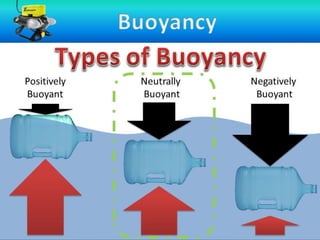
Floating &Floating &
SinkingSinking
The TitanicThe Titanic
What do you know about the Titanic?What do you know about the Titanic?
How did a huge ship (called TheHow did a huge ship (called The
Unsinkable) easily float in water BUTUnsinkable) easily float in water BUT
THEN in a few hours become a sunkenTHEN in a few hours become a sunken
wreck?wreck?
Buoyancy!!Buoyancy!!
What is Buoyancy???What is Buoyancy???
• Ok in teams please research/revise:Ok in teams please research/revise:
1. Buoyant Force1. Buoyant Force 2. Weight2. Weight
3. Density3. Density 4. Net Force4. Net Force
5. Displacement5. Displacement 6. Volume6. Volume
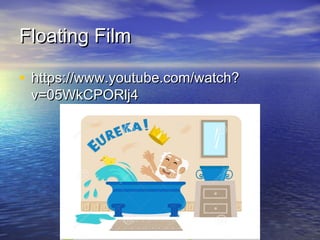
Floating FilmFloating Film
• https://www.youtube.com/watch?https://www.youtube.com/watch?
v=05WkCPORlj4v=05WkCPORlj4
Examples of his PrincipleExamples of his Principle
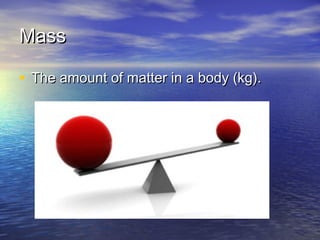
MassMass
• The amount of matter in a body (kg).The amount of matter in a body (kg).
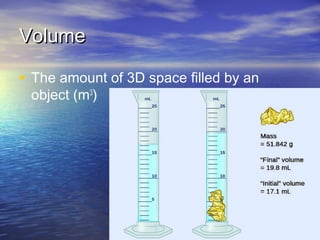
VolumeVolume
• The amount of 3D space filled by an
object (m3
)
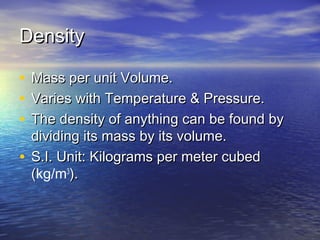
DensityDensity
• Mass per unit Volume.Mass per unit Volume.
• Varies with Temperature & Pressure.Varies with Temperature & Pressure.
• The density of anything can be found byThe density of anything can be found by
dividing its mass by its volume.dividing its mass by its volume.
• S.I. Unit: Kilograms per meter cubedS.I. Unit: Kilograms per meter cubed
((kg/m3
).).
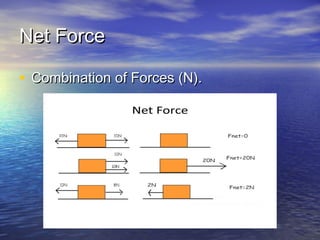
Net ForceNet Force
• Combination of Forces (N).Combination of Forces (N).
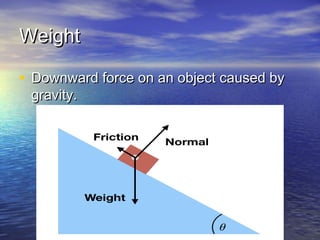
WeightWeight
• Downward force on an object caused byDownward force on an object caused by
gravity.gravity.
Mass vs WeightMass vs Weight
QuestionsQuestions
• What is Archimedes’ Principle?What is Archimedes’ Principle?
• What is Volume?What is Volume?
• Define Mass?Define Mass?
• How is it different to Weight?How is it different to Weight?
• Describe Density?Describe Density?
• What has a higher density, metal orWhat has a higher density, metal or
plastic?plastic?
ExperimentExperiment
• https://www.youtube.com/watch?v=nMlXU97E
BuoyancyBuoyancy
• Force exerted by water.Force exerted by water.
• Acts in the upwards direction.Acts in the upwards direction.
• Acts against the force of Gravity.Acts against the force of Gravity.
• Therefore makes an object feel lighter.Therefore makes an object feel lighter.
BuoyancyBuoyancy
• Fluid pressure is exerted in all directions.Fluid pressure is exerted in all directions.
• Pressure increases with depth.Pressure increases with depth.
• So a greater force is exerted on the bottomSo a greater force is exerted on the bottom
of a submerged object than on the top.of a submerged object than on the top.
• The difference in pressure results in a netThe difference in pressure results in a net
force in the upward direction.force in the upward direction.
• This is the Buoyant Force.This is the Buoyant Force.
Buoyant ForceBuoyant Force
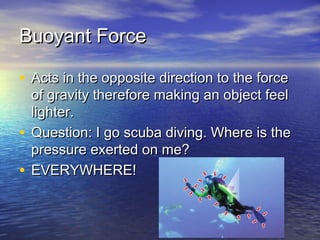
• Acts in the opposite direction to the forceActs in the opposite direction to the force
of gravity therefore making an object feelof gravity therefore making an object feel
lighter.lighter.
• Question: I go scuba diving. Where is theQuestion: I go scuba diving. Where is the
pressure exerted on me?pressure exerted on me?
• EVERYWHERE!EVERYWHERE!
Submersion vs ImmersionSubmersion vs Immersion
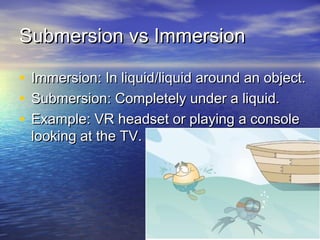
• Immersion: In liquid/liquid around an object.Immersion: In liquid/liquid around an object.
• Submersion: Completely under a liquid.Submersion: Completely under a liquid.
• Example: VR headset or playing a consoleExample: VR headset or playing a console
looking at the TV.looking at the TV.
DisplacementDisplacement
• Occurs when an object is immersed in a
fluid, pushing it out of the way and taking
its place. 
Floating & SinkingFloating & Sinking
• There is always a downwardThere is always a downward
force on a submerged object,force on a submerged object,
the object’s weight.the object’s weight.
• Question: What happens if theQuestion: What happens if the
weight of the object is greaterweight of the object is greater
than the buoyant force?than the buoyant force?
• The net force on a submergedThe net force on a submerged
object will be downward.object will be downward.
• The object will sink.The object will sink.
Sinking and FloatingSinking and Floating
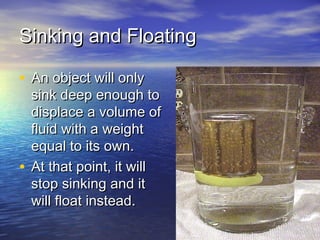
• An object will onlyAn object will only
sink deep enough tosink deep enough to
displace a volume ofdisplace a volume of
fluid with a weightfluid with a weight
equal to its own.equal to its own.
• At that point, it willAt that point, it will
stop sinking and itstop sinking and it
will float instead.will float instead.
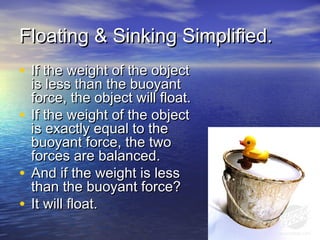
Floating & Sinking Simplified.Floating & Sinking Simplified.
• If the weight of the objectIf the weight of the object
is less than the buoyantis less than the buoyant
force, the object will float.force, the object will float.
• If the weight of the objectIf the weight of the object
is exactly equal to theis exactly equal to the
buoyant force, the twobuoyant force, the two
forces are balanced.forces are balanced.
• And if the weight is lessAnd if the weight is less
than the buoyant force?than the buoyant force?
• It will float.It will float.
Densities of SubstancesDensities of Substances
Changing the density of an object can makeChanging the density of an object can make
it float or sink in a given fluid.it float or sink in a given fluid.
For example: SUBMARINES!For example: SUBMARINES!
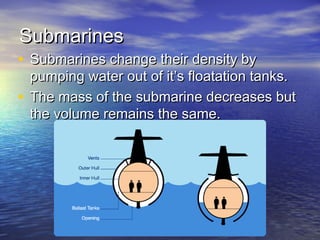
SubmarinesSubmarines
• Submarines change their density bySubmarines change their density by
pumping water out of it’s floatation tanks.pumping water out of it’s floatation tanks.
• The mass of the submarine decreases butThe mass of the submarine decreases but
the volume remains the same.the volume remains the same.
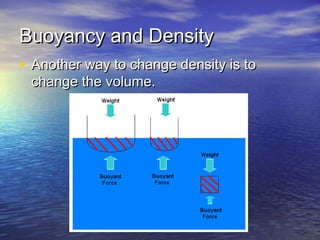
Buoyancy and DensityBuoyancy and Density
• Another way to change density is toAnother way to change density is to
change the volume.change the volume.
Ships TitanicShips Titanic
• The shape of a ship causes it to displaceThe shape of a ship causes it to displace
a greater volume of water than a solida greater volume of water than a solid
piece of steel of the same mass.piece of steel of the same mass.
• The greater the volume of waterThe greater the volume of water
displaced, the greater the buoyant force.displaced, the greater the buoyant force.
• A ship stays afloat as long as the buoyantA ship stays afloat as long as the buoyant
force is greater than its weight.force is greater than its weight.
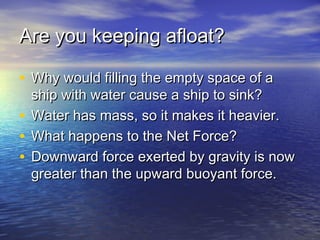
Are you keeping afloat?Are you keeping afloat?
• Why would filling the empty space of aWhy would filling the empty space of a
ship with water cause a ship to sink?ship with water cause a ship to sink?
• Water has mass, so it makes it heavier.Water has mass, so it makes it heavier.
• What happens to the Net Force?What happens to the Net Force?
• Downward force exerted by gravity is nowDownward force exerted by gravity is now
greater than the upward buoyant force.greater than the upward buoyant force.
Is it Sinking in?Is it Sinking in?
• If something is less dense (has lessIf something is less dense (has less
density) than something else whatdensity) than something else what
happens? Does it sink or float?happens? Does it sink or float?
• Float! Less dense, less heavy!Float! Less dense, less heavy!
• What is the buoyant force?What is the buoyant force?
• The upward force a fluid exerts on anThe upward force a fluid exerts on an
object.object.
Book It!Book It!
• Maths page 293Maths page 293
• Test Your Understanding pages 294-297Test Your Understanding pages 294-297
• Work in pairs for four minutes then we’llWork in pairs for four minutes then we’ll
tackle it together.tackle it together.
• If you’re still not understanding, now is theIf you’re still not understanding, now is the
time to ask!time to ask!
RecapRecap
• What two forces work to keep thingsWhat two forces work to keep things
floating?floating?
• Buoyant Force & Gravity.Buoyant Force & Gravity.
• Which direction do they act in?Which direction do they act in?
• Buoyant acts up, gravity acts downward.Buoyant acts up, gravity acts downward.
• How might a floating ship become aHow might a floating ship become a
sinking ship?sinking ship?
• The density/weight would need to change.The density/weight would need to change.
HomeworkHomework
• Worksheets.Worksheets.
• If you have questions, lose your sheet, orIf you have questions, lose your sheet, or
don’t understand… ASK ME!don’t understand… ASK ME!
• Here or at my office!Here or at my office!
• Thank you for today! I know it was crazyThank you for today! I know it was crazy
difficult!difficult!

Floating & Sinking

  • 1.
  • 2.
    The TitanicThe Titanic Whatdo you know about the Titanic?What do you know about the Titanic? How did a huge ship (called TheHow did a huge ship (called The Unsinkable) easily float in water BUTUnsinkable) easily float in water BUT THEN in a few hours become a sunkenTHEN in a few hours become a sunken wreck?wreck? Buoyancy!!Buoyancy!!
  • 3.
    What is Buoyancy???Whatis Buoyancy??? • Ok in teams please research/revise:Ok in teams please research/revise: 1. Buoyant Force1. Buoyant Force 2. Weight2. Weight 3. Density3. Density 4. Net Force4. Net Force 5. Displacement5. Displacement 6. Volume6. Volume
  • 4.
    Floating FilmFloating Film •https://www.youtube.com/watch?https://www.youtube.com/watch? v=05WkCPORlj4v=05WkCPORlj4
  • 5.
    Examples of hisPrincipleExamples of his Principle
  • 6.
    MassMass • The amountof matter in a body (kg).The amount of matter in a body (kg).
  • 7.
    VolumeVolume • The amountof 3D space filled by an object (m3 )
  • 8.
    DensityDensity • Mass perunit Volume.Mass per unit Volume. • Varies with Temperature & Pressure.Varies with Temperature & Pressure. • The density of anything can be found byThe density of anything can be found by dividing its mass by its volume.dividing its mass by its volume. • S.I. Unit: Kilograms per meter cubedS.I. Unit: Kilograms per meter cubed ((kg/m3 ).).
  • 11.
    Net ForceNet Force •Combination of Forces (N).Combination of Forces (N).
  • 12.
    WeightWeight • Downward forceon an object caused byDownward force on an object caused by gravity.gravity.
  • 13.
  • 14.
    QuestionsQuestions • What isArchimedes’ Principle?What is Archimedes’ Principle? • What is Volume?What is Volume? • Define Mass?Define Mass? • How is it different to Weight?How is it different to Weight? • Describe Density?Describe Density? • What has a higher density, metal orWhat has a higher density, metal or plastic?plastic?
  • 15.
  • 16.
    BuoyancyBuoyancy • Force exertedby water.Force exerted by water. • Acts in the upwards direction.Acts in the upwards direction. • Acts against the force of Gravity.Acts against the force of Gravity. • Therefore makes an object feel lighter.Therefore makes an object feel lighter.
  • 17.
    BuoyancyBuoyancy • Fluid pressureis exerted in all directions.Fluid pressure is exerted in all directions. • Pressure increases with depth.Pressure increases with depth. • So a greater force is exerted on the bottomSo a greater force is exerted on the bottom of a submerged object than on the top.of a submerged object than on the top. • The difference in pressure results in a netThe difference in pressure results in a net force in the upward direction.force in the upward direction. • This is the Buoyant Force.This is the Buoyant Force.
  • 18.
    Buoyant ForceBuoyant Force •Acts in the opposite direction to the forceActs in the opposite direction to the force of gravity therefore making an object feelof gravity therefore making an object feel lighter.lighter. • Question: I go scuba diving. Where is theQuestion: I go scuba diving. Where is the pressure exerted on me?pressure exerted on me? • EVERYWHERE!EVERYWHERE!
  • 19.
    Submersion vs ImmersionSubmersionvs Immersion • Immersion: In liquid/liquid around an object.Immersion: In liquid/liquid around an object. • Submersion: Completely under a liquid.Submersion: Completely under a liquid. • Example: VR headset or playing a consoleExample: VR headset or playing a console looking at the TV.looking at the TV.
  • 20.
    DisplacementDisplacement • Occurs whenan object is immersed in a fluid, pushing it out of the way and taking its place. 
  • 21.
    Floating & SinkingFloating& Sinking • There is always a downwardThere is always a downward force on a submerged object,force on a submerged object, the object’s weight.the object’s weight. • Question: What happens if theQuestion: What happens if the weight of the object is greaterweight of the object is greater than the buoyant force?than the buoyant force? • The net force on a submergedThe net force on a submerged object will be downward.object will be downward. • The object will sink.The object will sink.
  • 22.
    Sinking and FloatingSinkingand Floating • An object will onlyAn object will only sink deep enough tosink deep enough to displace a volume ofdisplace a volume of fluid with a weightfluid with a weight equal to its own.equal to its own. • At that point, it willAt that point, it will stop sinking and itstop sinking and it will float instead.will float instead.
  • 23.
    Floating & SinkingSimplified.Floating & Sinking Simplified. • If the weight of the objectIf the weight of the object is less than the buoyantis less than the buoyant force, the object will float.force, the object will float. • If the weight of the objectIf the weight of the object is exactly equal to theis exactly equal to the buoyant force, the twobuoyant force, the two forces are balanced.forces are balanced. • And if the weight is lessAnd if the weight is less than the buoyant force?than the buoyant force? • It will float.It will float.
  • 24.
    Densities of SubstancesDensitiesof Substances Changing the density of an object can makeChanging the density of an object can make it float or sink in a given fluid.it float or sink in a given fluid. For example: SUBMARINES!For example: SUBMARINES!
  • 25.
    SubmarinesSubmarines • Submarines changetheir density bySubmarines change their density by pumping water out of it’s floatation tanks.pumping water out of it’s floatation tanks. • The mass of the submarine decreases butThe mass of the submarine decreases but the volume remains the same.the volume remains the same.
  • 26.
    Buoyancy and DensityBuoyancyand Density • Another way to change density is toAnother way to change density is to change the volume.change the volume.
  • 27.
    Ships TitanicShips Titanic •The shape of a ship causes it to displaceThe shape of a ship causes it to displace a greater volume of water than a solida greater volume of water than a solid piece of steel of the same mass.piece of steel of the same mass. • The greater the volume of waterThe greater the volume of water displaced, the greater the buoyant force.displaced, the greater the buoyant force. • A ship stays afloat as long as the buoyantA ship stays afloat as long as the buoyant force is greater than its weight.force is greater than its weight.
  • 28.
    Are you keepingafloat?Are you keeping afloat? • Why would filling the empty space of aWhy would filling the empty space of a ship with water cause a ship to sink?ship with water cause a ship to sink? • Water has mass, so it makes it heavier.Water has mass, so it makes it heavier. • What happens to the Net Force?What happens to the Net Force? • Downward force exerted by gravity is nowDownward force exerted by gravity is now greater than the upward buoyant force.greater than the upward buoyant force.
  • 29.
    Is it Sinkingin?Is it Sinking in? • If something is less dense (has lessIf something is less dense (has less density) than something else whatdensity) than something else what happens? Does it sink or float?happens? Does it sink or float? • Float! Less dense, less heavy!Float! Less dense, less heavy! • What is the buoyant force?What is the buoyant force? • The upward force a fluid exerts on anThe upward force a fluid exerts on an object.object.
  • 30.
    Book It!Book It! •Maths page 293Maths page 293 • Test Your Understanding pages 294-297Test Your Understanding pages 294-297 • Work in pairs for four minutes then we’llWork in pairs for four minutes then we’ll tackle it together.tackle it together. • If you’re still not understanding, now is theIf you’re still not understanding, now is the time to ask!time to ask!
  • 31.
    RecapRecap • What twoforces work to keep thingsWhat two forces work to keep things floating?floating? • Buoyant Force & Gravity.Buoyant Force & Gravity. • Which direction do they act in?Which direction do they act in? • Buoyant acts up, gravity acts downward.Buoyant acts up, gravity acts downward. • How might a floating ship become aHow might a floating ship become a sinking ship?sinking ship? • The density/weight would need to change.The density/weight would need to change.
  • 32.
    HomeworkHomework • Worksheets.Worksheets. • Ifyou have questions, lose your sheet, orIf you have questions, lose your sheet, or don’t understand… ASK ME!don’t understand… ASK ME! • Here or at my office!Here or at my office! • Thank you for today! I know it was crazyThank you for today! I know it was crazy difficult!difficult!

Editor's Notes

  • #16 Slow it down to 0.75
  • #19 Make sure students understand buoyant force is related to weight NOT mass as weight is also a force. Mass is not. Both have Newtons. Balanced force floats, unbalanced sinks.
  • #23 Write this on board as a type of equation for students to understand
  • #25 Explain given fluid.