Chapter 8: Subprograms 
Principles of Programming Languages
Contents 
•Fundamentals of Subprograms 
•Parameter-Passing Methods 
•Overloaded Subprograms 
•Generic Subprograms 
•Functions 
•User-Defined Overloaded Operators 
•Coroutines
Introduction 
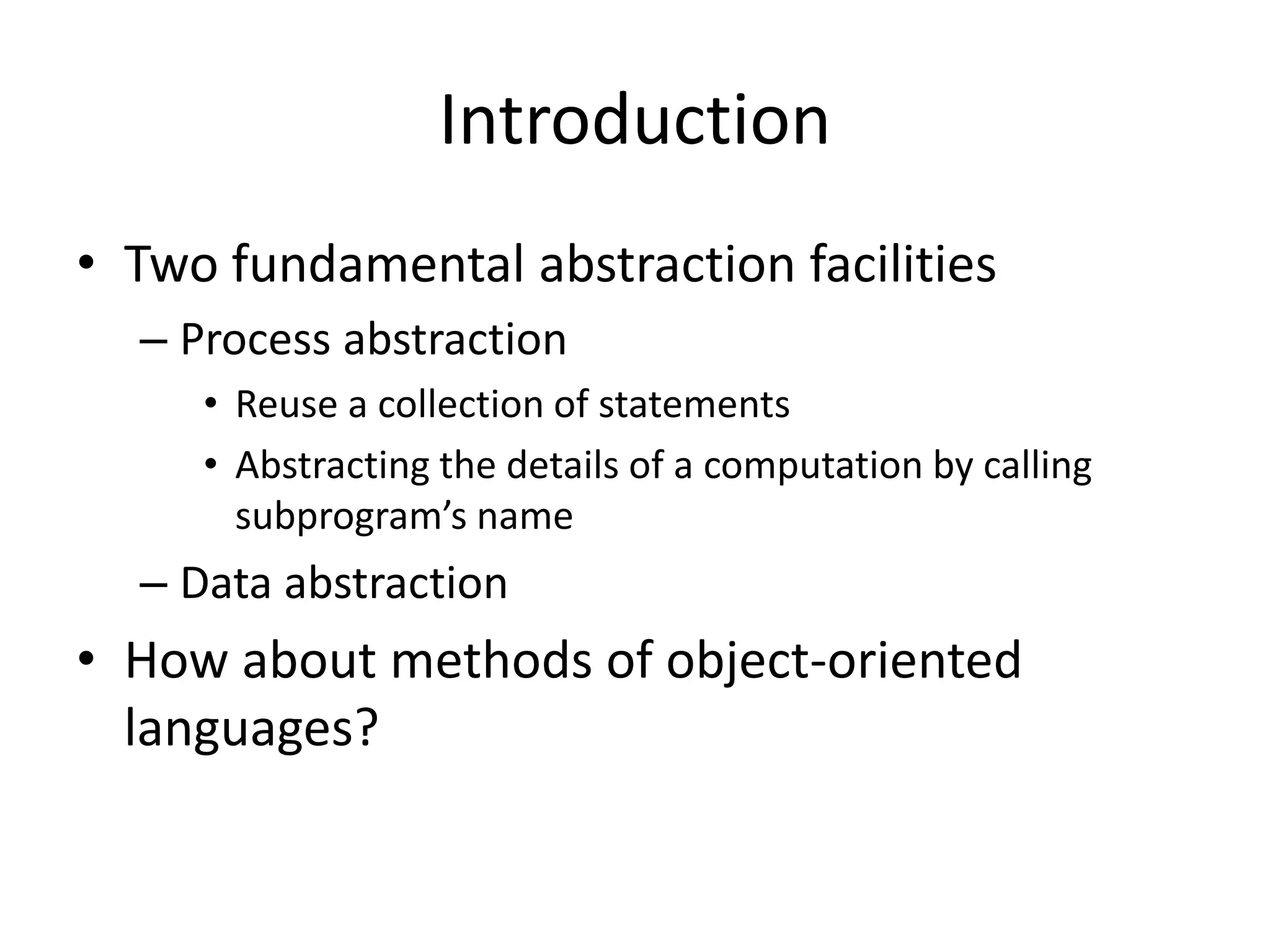
•Two fundamental abstraction facilities 
–Process abstraction 
•Reuse a collection of statements 
•Abstracting the details of a computation by calling subprogram’s name 
–Data abstraction 
•How about methods of object-oriented languages?
General Characteristics 
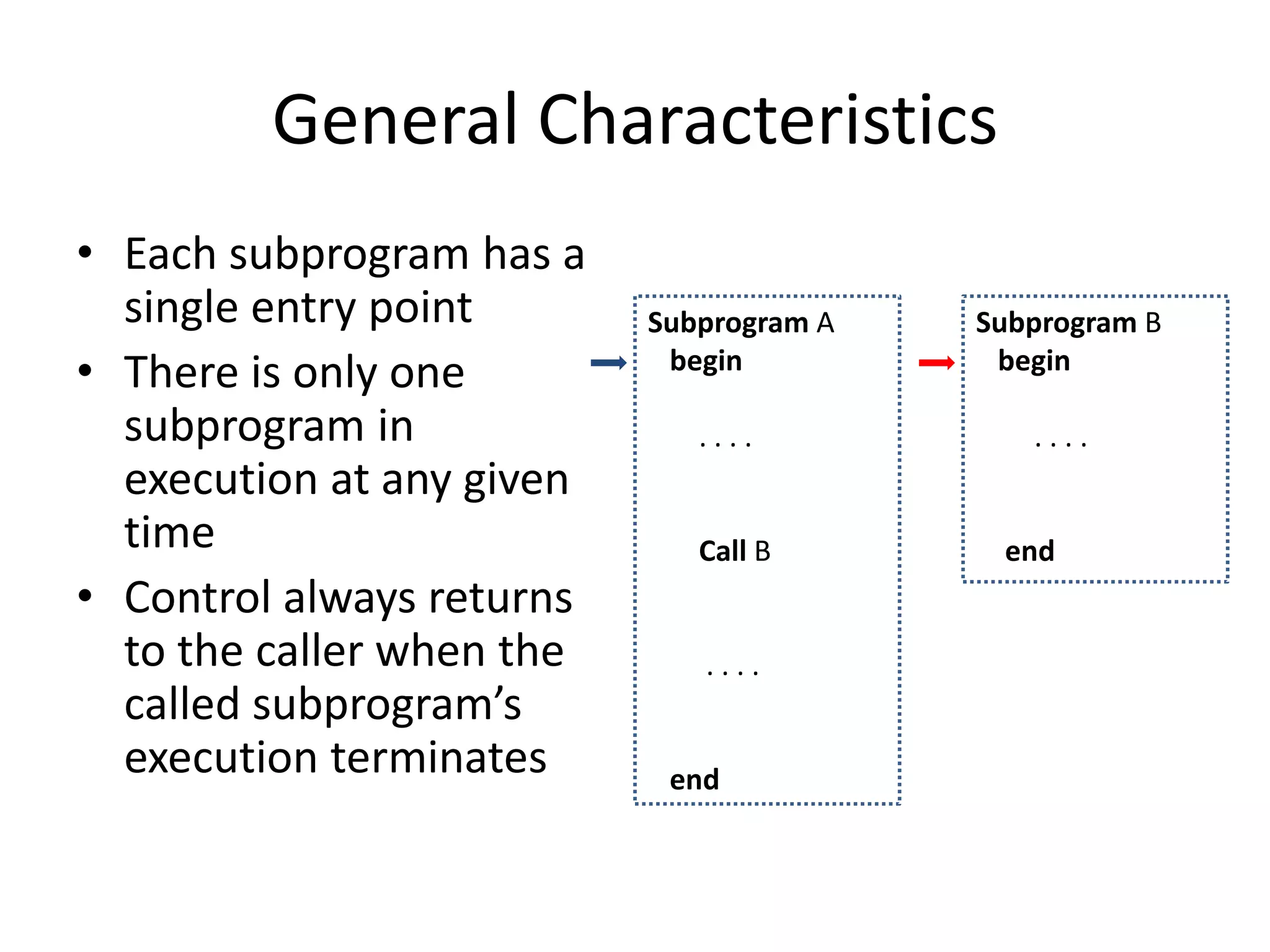
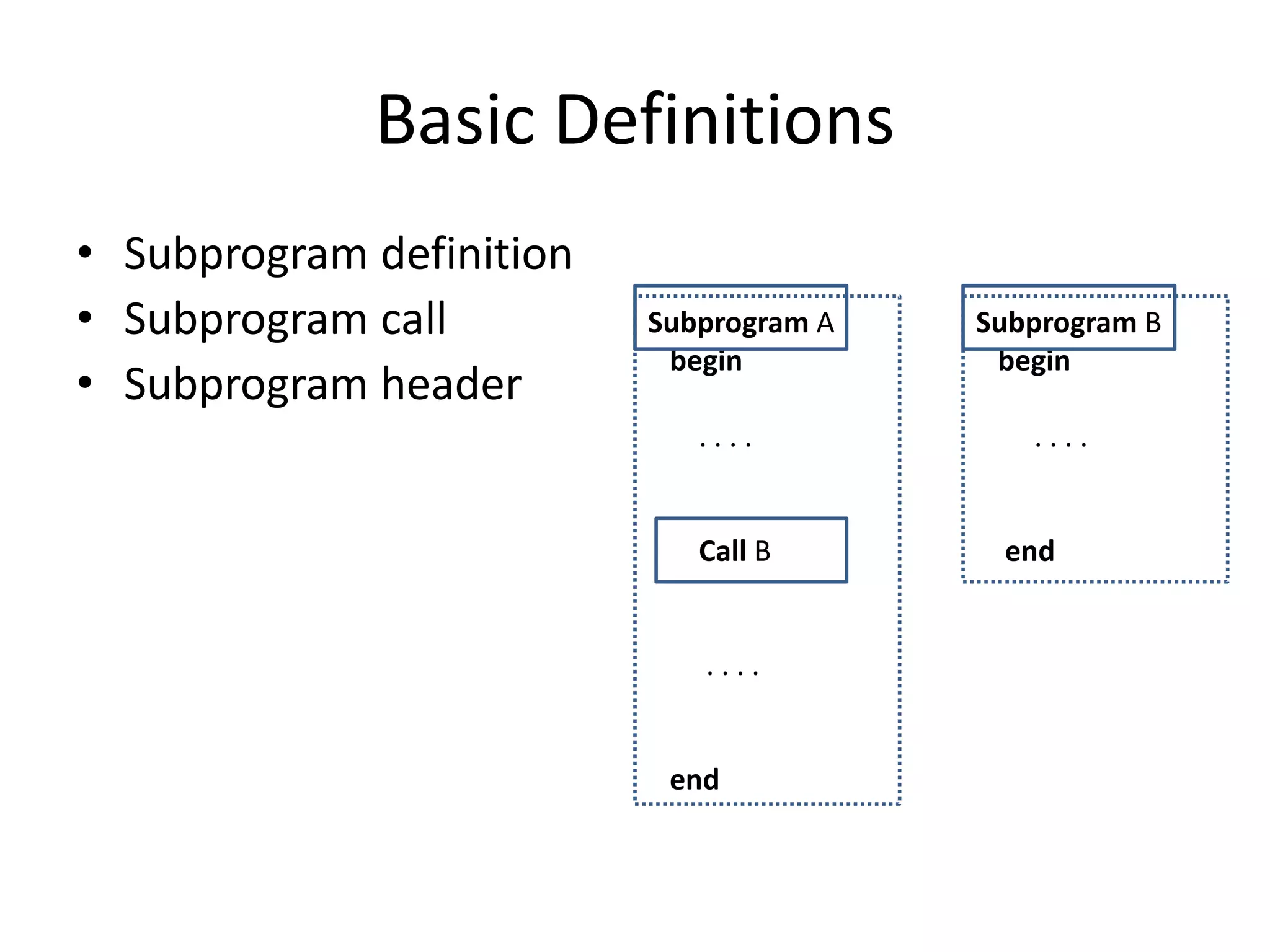
•Each subprogram has a single entry point 
•There is only one subprogram in execution at any given time 
•Control always returns to the caller when the called subprogram’s execution terminates 
Subprogram A 
begin 
. . . . 
Call B 
. . . . 
end 
Subprogram B 
begin 
. . . . 
end
Basic Definitions 
•Subprogram definition 
•Subprogram call 
•Subprogram header 
Subprogram A 
begin 
. . . . 
Call B 
. . . . 
end 
Subprogram B begin . . . . end
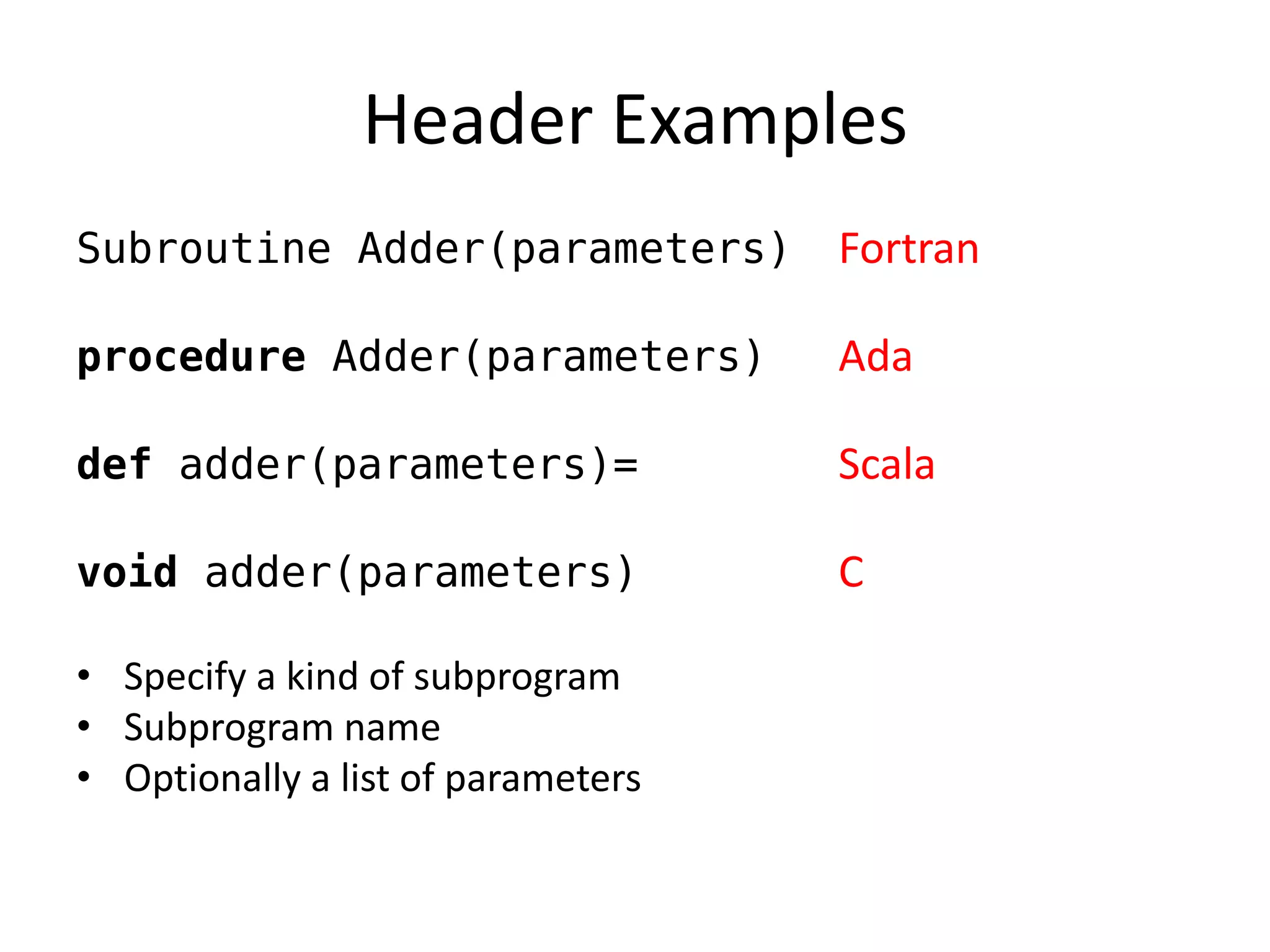
Header Examples 
Subroutine Adder(parameters) Fortran 
procedure Adder(parameters) Ada 
def adder(parameters)= Scala 
void adder(parameters) C 
•Specify a kind of subprogram 
•Subprogram name 
•Optionally a list of parameters
Special Case: C/C++ 
•Parameter profile 
•Protocol 
•A subprogram declaration provides the protocol, but not the body, of the subprogram 
•Function declarations in C and C++ are often called prototypes 
•Reason: not allow forward references to subprogram
•Formal parameters vs. actual parameters 
•Positional (all proglang) 
–The binding of actual parameters to formal parameters is by position: the first actual parameter is bound to the first formal parameter and so forth 
–Safe and effective 
•Keyword (Python, Ada, Fortran 95, Python) 
–The name of the formal parameter to which an actual parameter is to be bound is specified with the actual parameter 
–Parameters can appear in any order 
Parameters
Parameters 
•In certain languages, formal parameters can have default values 
Python: 
def compute_pay(income, exemptions = 1, tax_rate) 
pay = compute_pay(20000.0, tax_rate = 0.15) 
C++: 
float compute_pay(float income, float tax_rate, 
int exemptions = 1) 
•C#: accept a variable number of parameters as long as they are of the same type 
public void Display(params int[] list)
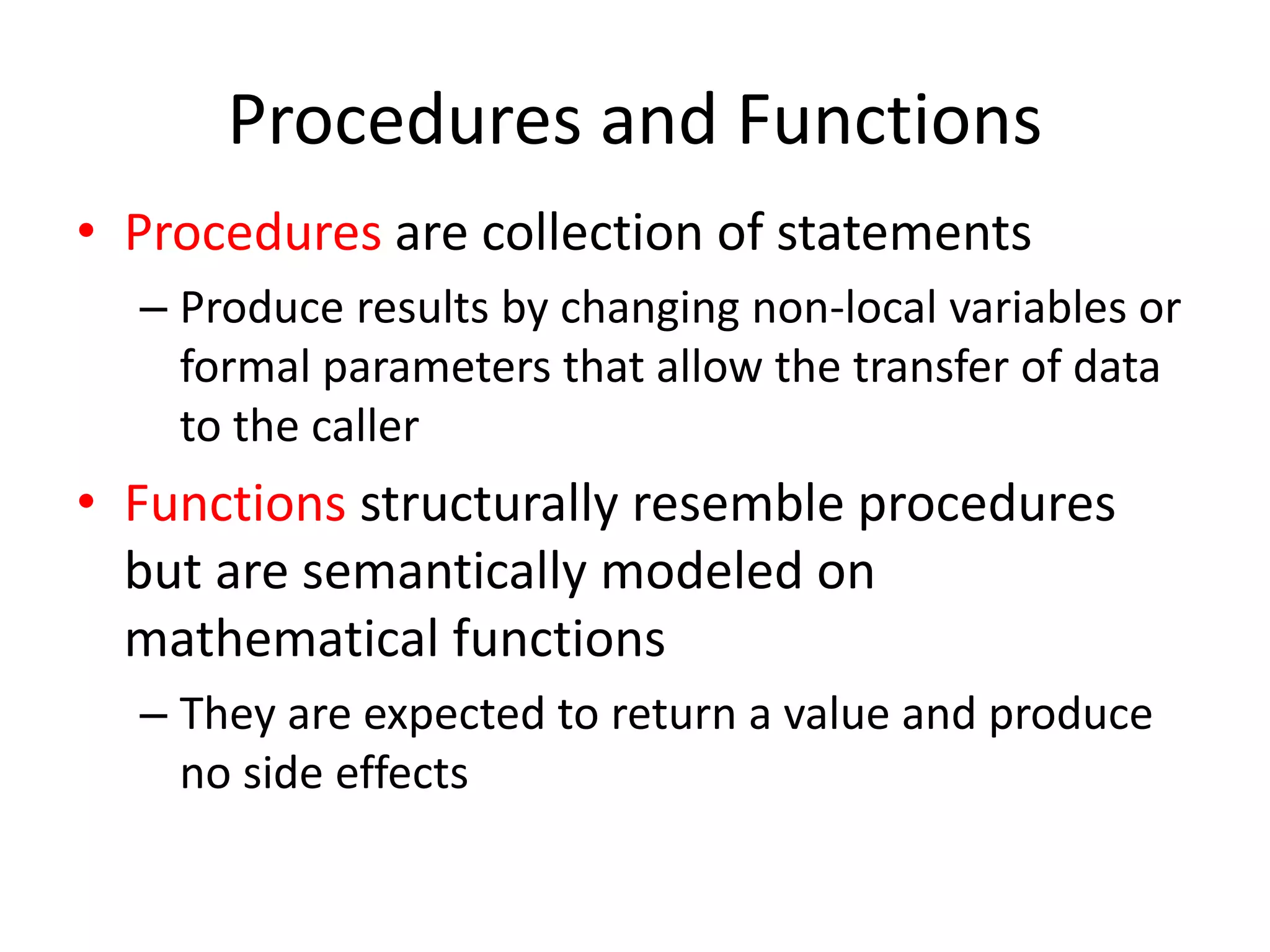
Procedures and Functions 
•Procedures are collection of statements 
–Produce results by changing non-local variables or formal parameters that allow the transfer of data to the caller 
•Functions structurally resemble procedures but are semantically modeled on mathematical functions 
–They are expected to return a value and produce no side effects
Design Issues for Subprograms 
•Are local variables static or dynamic? 
•Can subprogram definitions appear in other subprogram definitions? 
•What parameter-passing methods are used? 
•Are parameter types checked? 
•Can subprograms be overloaded? 
•Can subprogram be generic?
Local Variables 
•Stack-dynamic 
–Where does the name come from? 
–Advantages 
•Support for recursion 
•Storage is shared among some subprograms 
–Disadvantages 
•Cost of allocation/de-allocation, initialization 
•Indirect addressing 
•Subprograms cannot be history sensitive 
–Default in most contemporary languages
Local Variables 
•Local variables can be static 
–Storage? 
–Advantages 
•Slightly more efficient: no indirection, no run-time overhead 
•Allow subprograms to be history-sensitive 
–Disadvantages: 
•Cannot support recursion 
•Storage cannot be shared 
–Supported in C/C++, Fortran 95
Nested Subprograms 
•Originating from Algol 60: Algol 68, Pascal, Ada. Recently, JavaScript, Python, and Ruby 
•Hierarchy of both logic and scopes 
•Usually with static scoping: grant access to nonlocal variables in enclosing subprograms 
•Problems: Chapter 5 
•Examples: many in your Tutorial on Scopes with Ada
Parameter-Passing Methods 
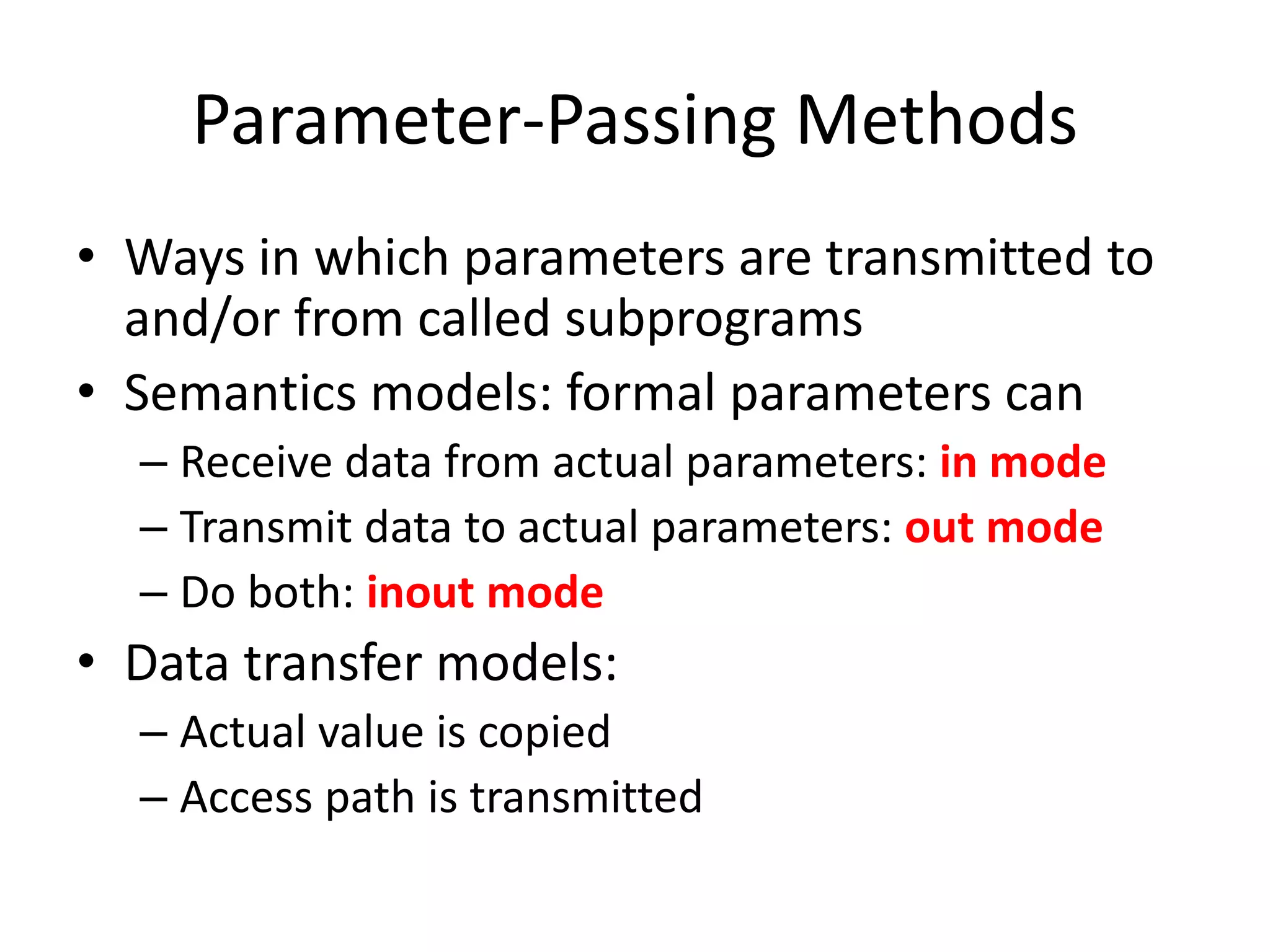
•Ways in which parameters are transmitted to and/or from called subprograms 
•Semantics models: formal parameters can 
–Receive data from actual parameters: in mode 
–Transmit data to actual parameters: out mode 
–Do both: inout mode 
•Data transfer models: 
–Actual value is copied 
–Access path is transmitted
7 
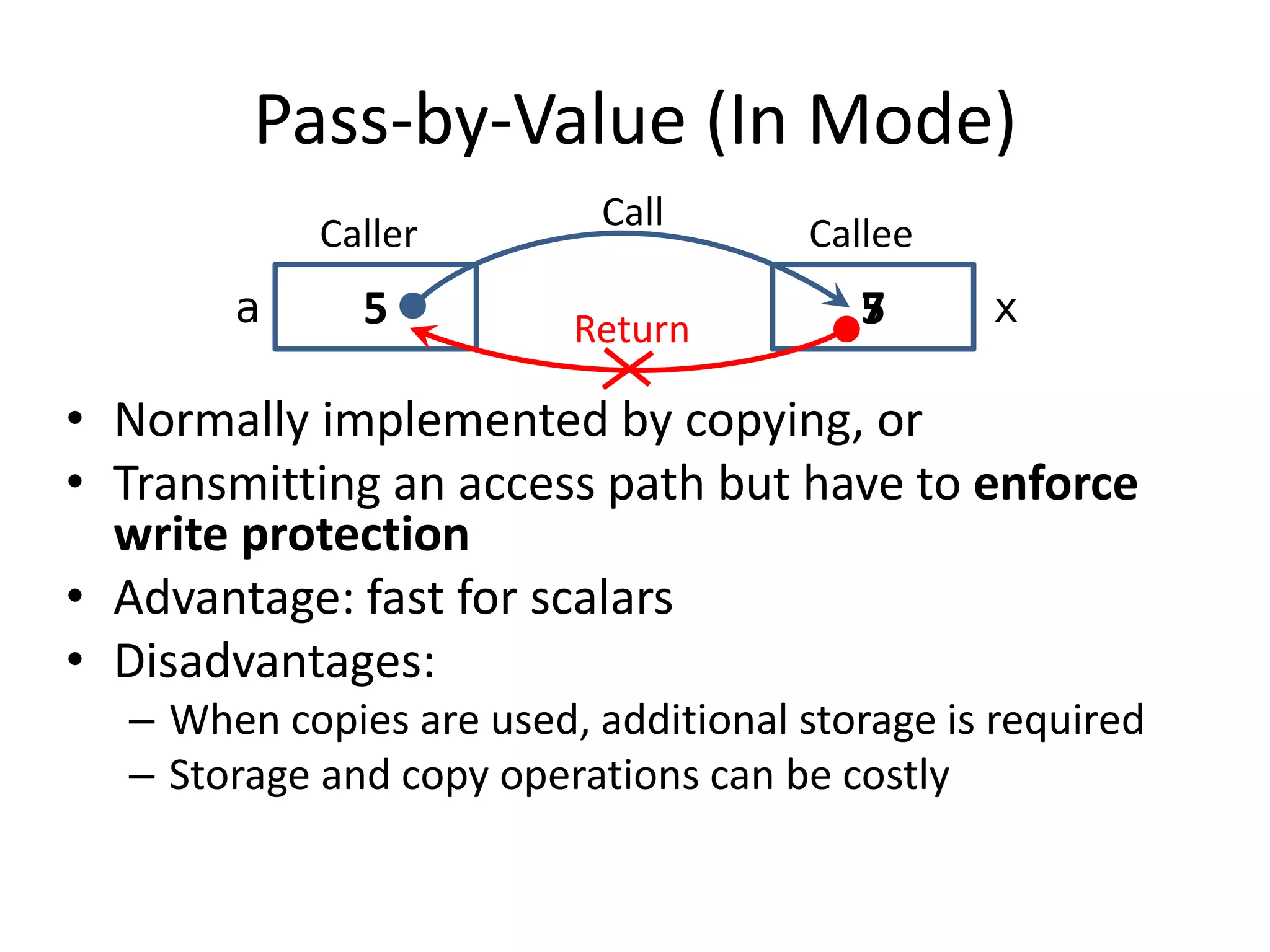
Pass-by-Value (In Mode) 
•Normally implemented by copying, or 
•Transmitting an access path but have to enforce write protection 
•Advantage: fast for scalars 
•Disadvantages: 
–When copies are used, additional storage is required 
–Storage and copy operations can be costly 
5 
5 
Caller 
Callee 
Call 
a 
x 
Return
Pass-by-Result (Out Mode) 
•Potential problem: 
void Fixer(out int x, out int y) { C# 
x = 17; y = 35; 
} 
f.Fixer(out a, out a); 
void DoIt(out int x, out int index) { C# 
x = 17; index = 42; 
} 
sub = 21; 
f.DoIt(out list[sub], out sub) 
5 
7 
Caller 
Callee 
Call 
a 
x 
Return 
7
Pass-by-Value-Result (Inout Mode) 
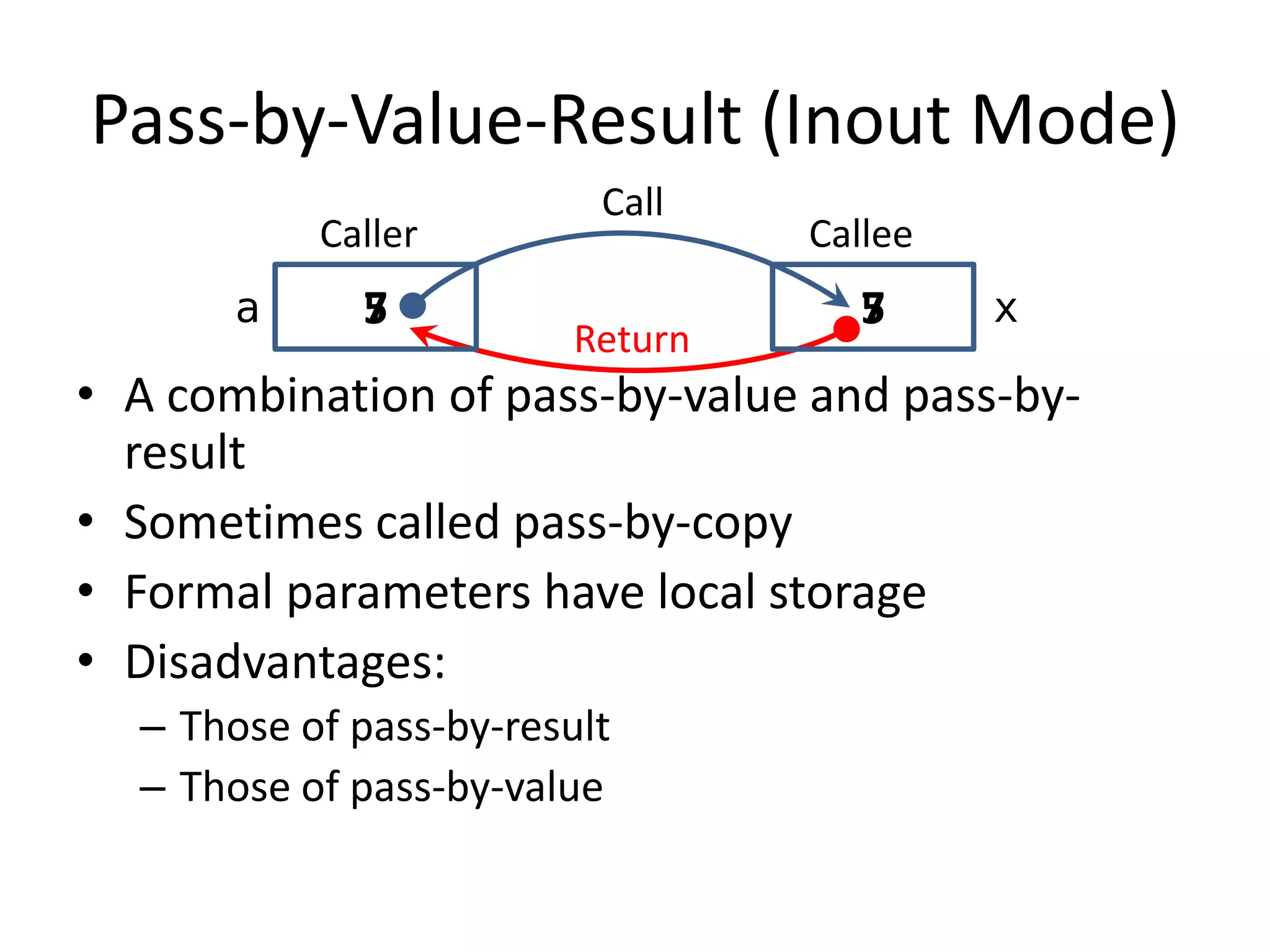
•A combination of pass-by-value and pass-by- result 
•Sometimes called pass-by-copy 
•Formal parameters have local storage 
•Disadvantages: 
–Those of pass-by-result 
–Those of pass-by-value 
5 
7 
Caller 
Callee 
Call 
a 
x 
Return 
7 
5
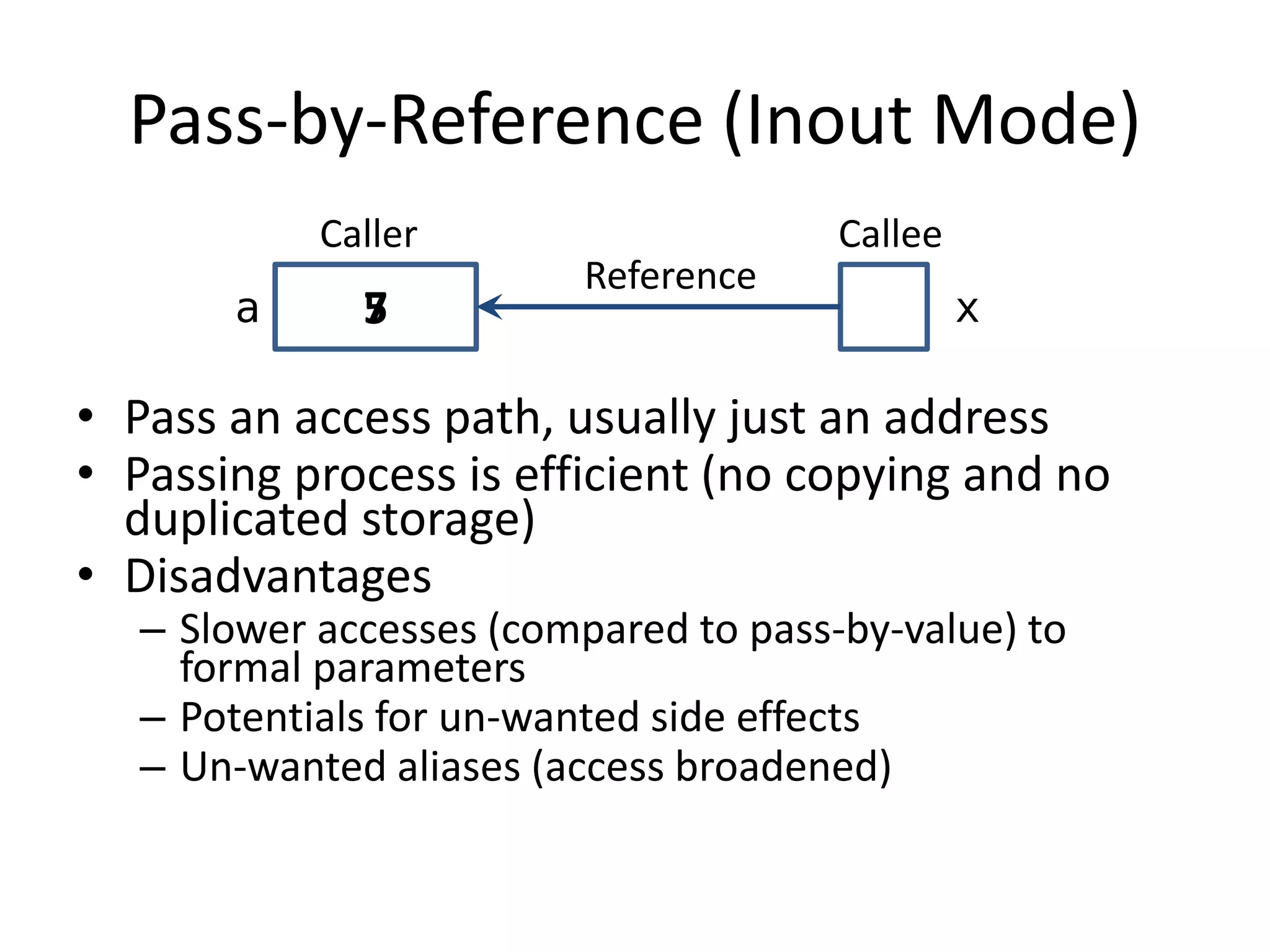
Pass-by-Reference (Inout Mode) 
•Pass an access path, usually just an address 
•Passing process is efficient (no copying and no duplicated storage) 
•Disadvantages 
–Slower accesses (compared to pass-by-value) to formal parameters 
–Potentials for un-wanted side effects 
–Un-wanted aliases (access broadened) 
5 
Caller 
Callee 
a 
x 
7 
Reference
Pass-by-Name (Inout Mode) 
•By textual substitution 
•Actual binding to a value or address takes place at the time of a reference or assignment
type VECT = array [1..3] of integer; 
procedure SUB2 (name I, J: integer); 
begin 
I := I + 1; 
J := J + 1; 
write(I, J) 
end; 
procedure SUB1; 
var A: VECT; 
K: integer; 
begin 
A[1] := 7; A[2] := 8; A[3] := 9; 
K := 2; 
SUB2(K, A[K]); 
for K := 1 to 3 do write(A[K]) 
end; 
K := K + 1; 
A[K] := A[K] + 1; 
write(K,A[K]) 
Pass-by-Name (Inout mode)
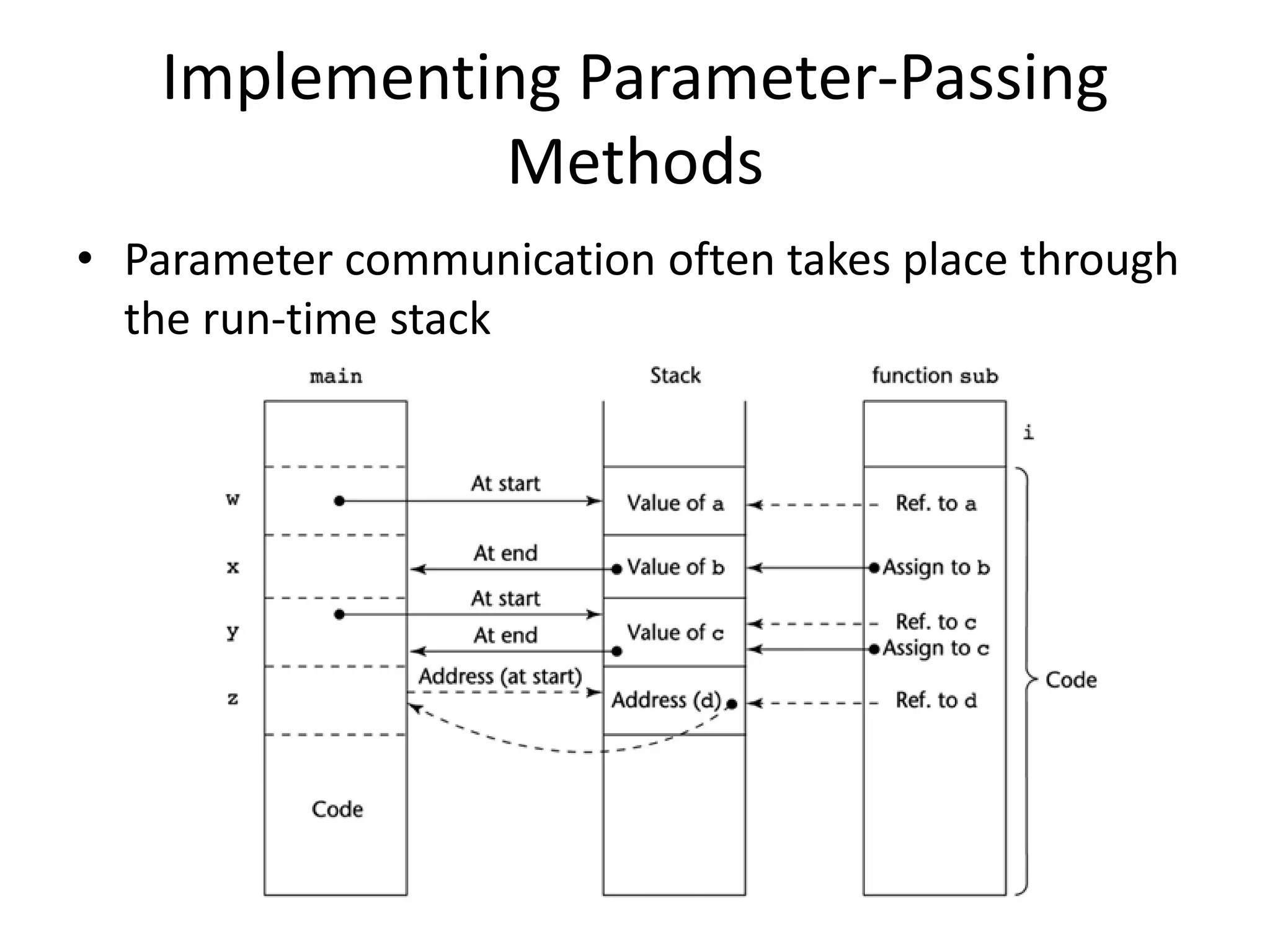
•Parameter communication often takes place through the run-time stack 
Implementing Parameter-Passing Methods
Parameter-Passing Methods in Common Language 
•C 
–Default: pass-by-value 
–Pass-by-reference is achieved by using pointers as parameters 
•C++ 
–Using reference type for pass-by-reference 
–How about constant reference? 
•Java 
–All parameters are passed by value 
–Objects copy its reference
Parameter-Passing Methods in Common Language 
•Ada 
–Three semantics modes of parameter transmission: in, out, in out; in is the default mode 
•C# 
–Default method: pass-by-value 
–Pass-by-reference: ref 
–Out mode: out
Type Checking Parameters 
•Considered very important for reliability 
•Original C: no type checking 
•C++: yes, but can pass by using ellipsis. For example, printf function 
•C#: coercions in pass-by-value, no coercions in pass-by-reference 
•Python, Ruby: formal parameters are typeless, no type checking is needed
Multidimensional Arrays as Parameters 
•If a multidimensional array is passed to a subprogram and the subprogram is separately compiled, the compiler needs to know the declared size of that array to build the storage mapping function 
•C/C++: 
–must declare the matrix size in parameters 
–macro is a good choice 
•Java, C#: every matrix has length function
•Two important considerations 
–Efficiency 
–One-way or two-way data transfer is needed 
•But the above considerations are in conflict 
–Good programming suggest limited access to variables, which means one-way whenever possible 
–But pass-by-reference is more efficient to pass structures of significant size 
Design Considerations
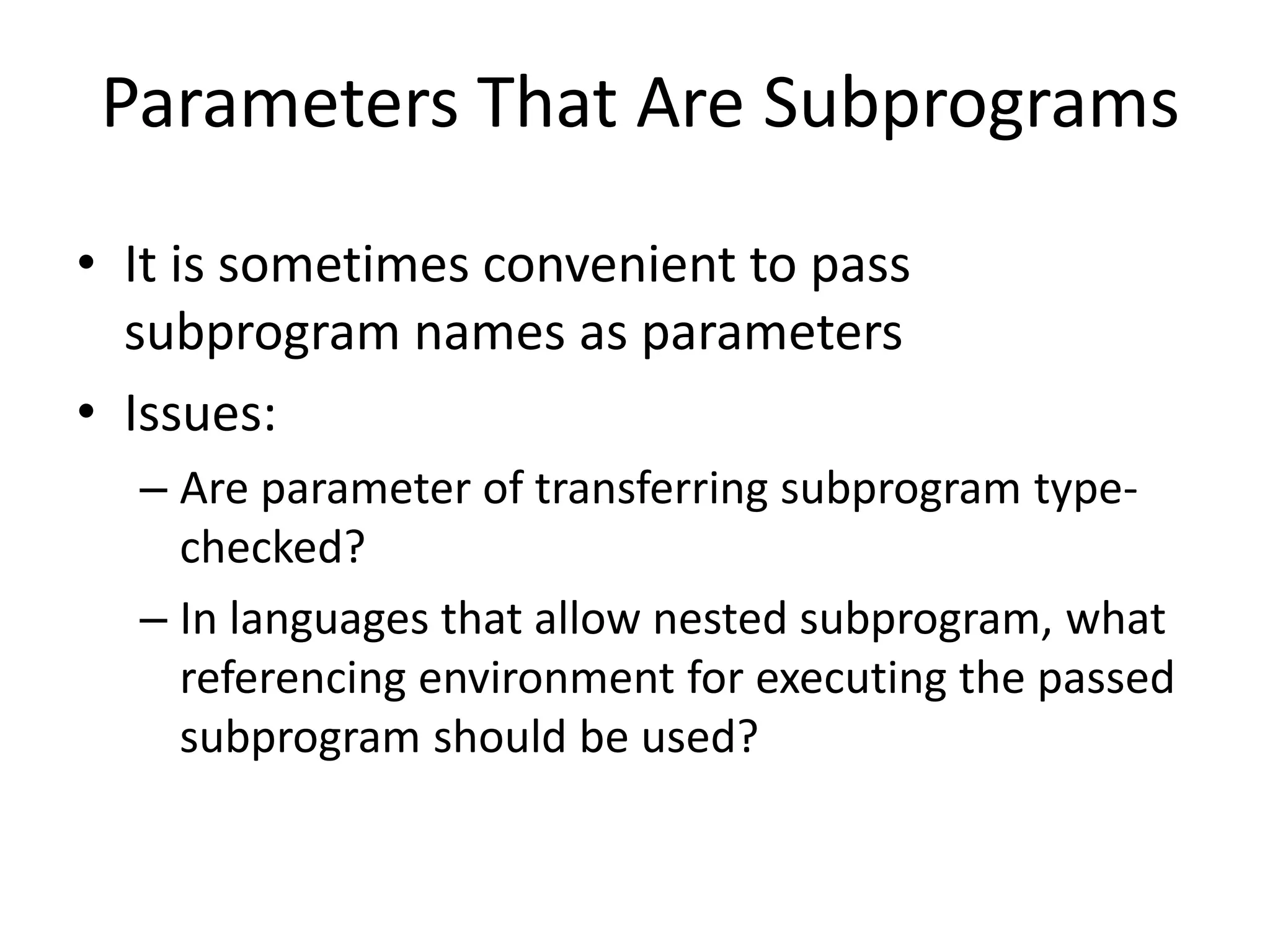
Parameters That Are Subprograms 
•It is sometimes convenient to pass subprogram names as parameters 
•Issues: 
–Are parameter of transferring subprogram type- checked? 
–In languages that allow nested subprogram, what referencing environment for executing the passed subprogram should be used?
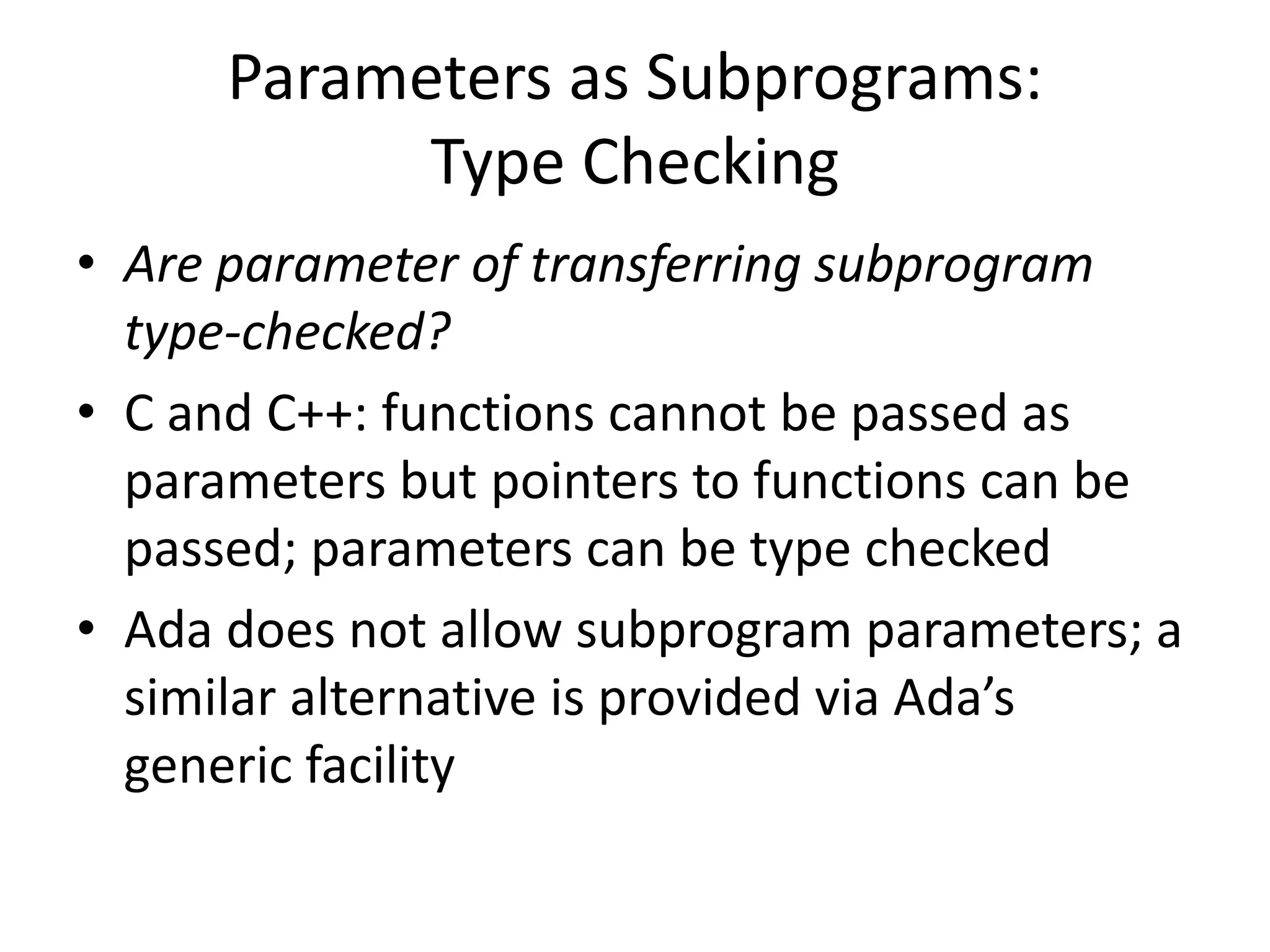
Parameters as Subprograms: Type Checking 
•Are parameter of transferring subprogram type-checked? 
•C and C++: functions cannot be passed as parameters but pointers to functions can be passed; parameters can be type checked 
•Ada does not allow subprogram parameters; a similar alternative is provided via Ada’s generic facility
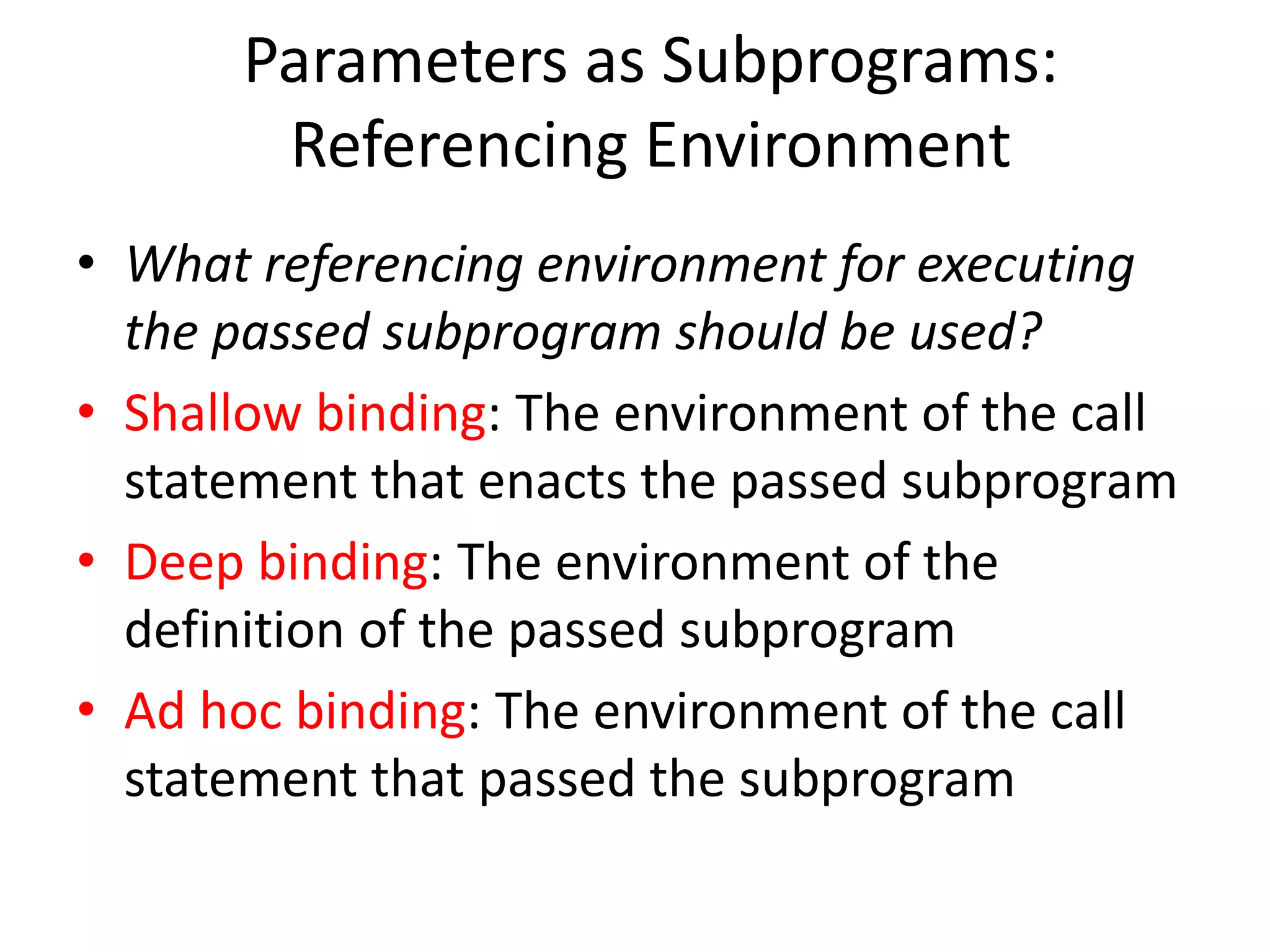
Parameters as Subprograms: Referencing Environment 
•What referencing environment for executing the passed subprogram should be used? 
•Shallow binding: The environment of the call statement that enacts the passed subprogram 
•Deep binding: The environment of the definition of the passed subprogram 
•Ad hoc binding: The environment of the call statement that passed the subprogram
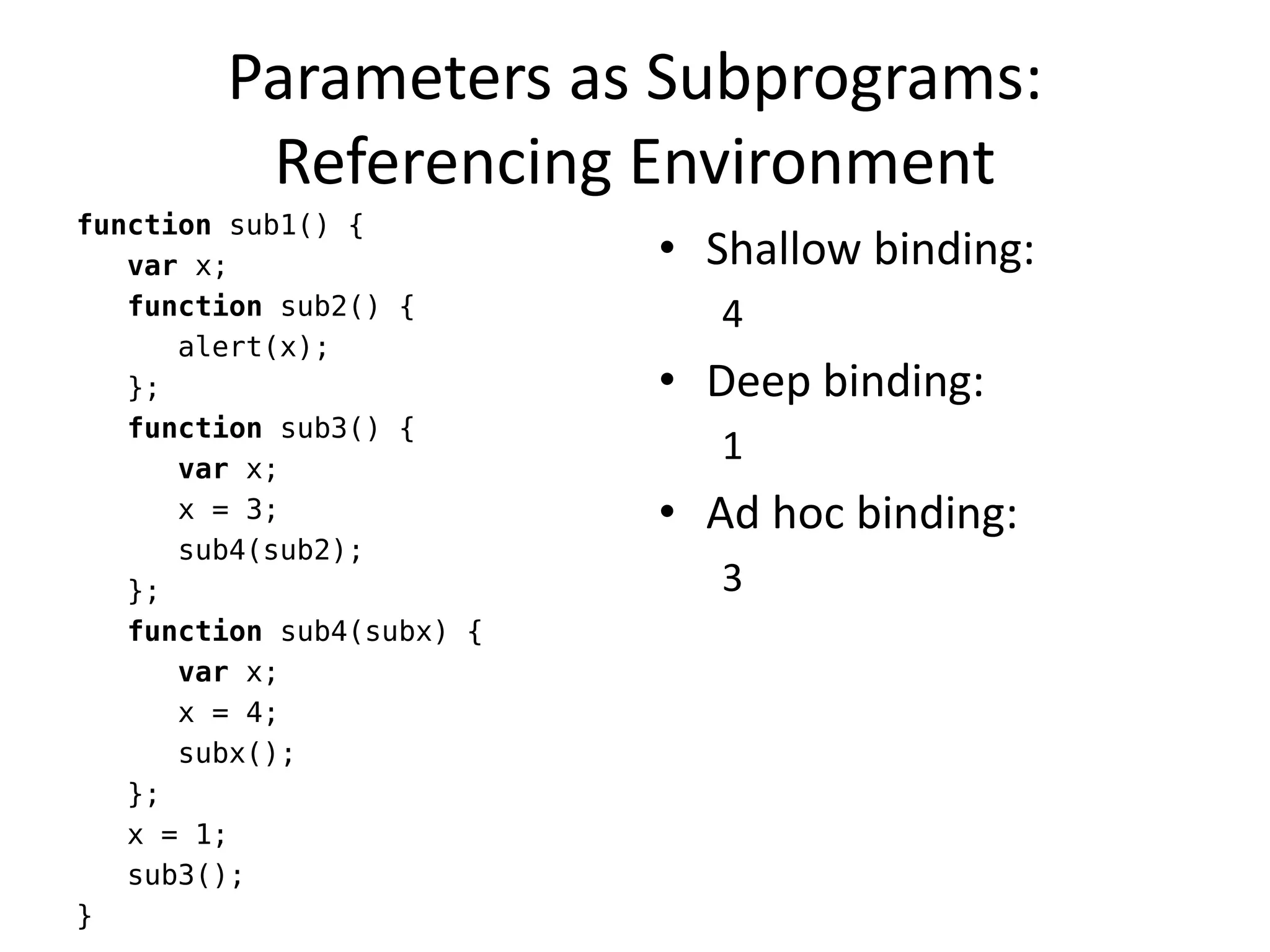
Parameters as Subprograms: Referencing Environment 
function sub1() { 
var x; 
function sub2() { 
alert(x); 
}; 
function sub3() { 
var x; 
x = 3; 
sub4(sub2); 
}; 
function sub4(subx) { 
var x; 
x = 4; 
subx(); 
}; 
x = 1; 
sub3(); 
} 
•Shallow binding: 
4 
•Deep binding: 
1 
•Ad hoc binding: 
3
Overloaded Subprograms 
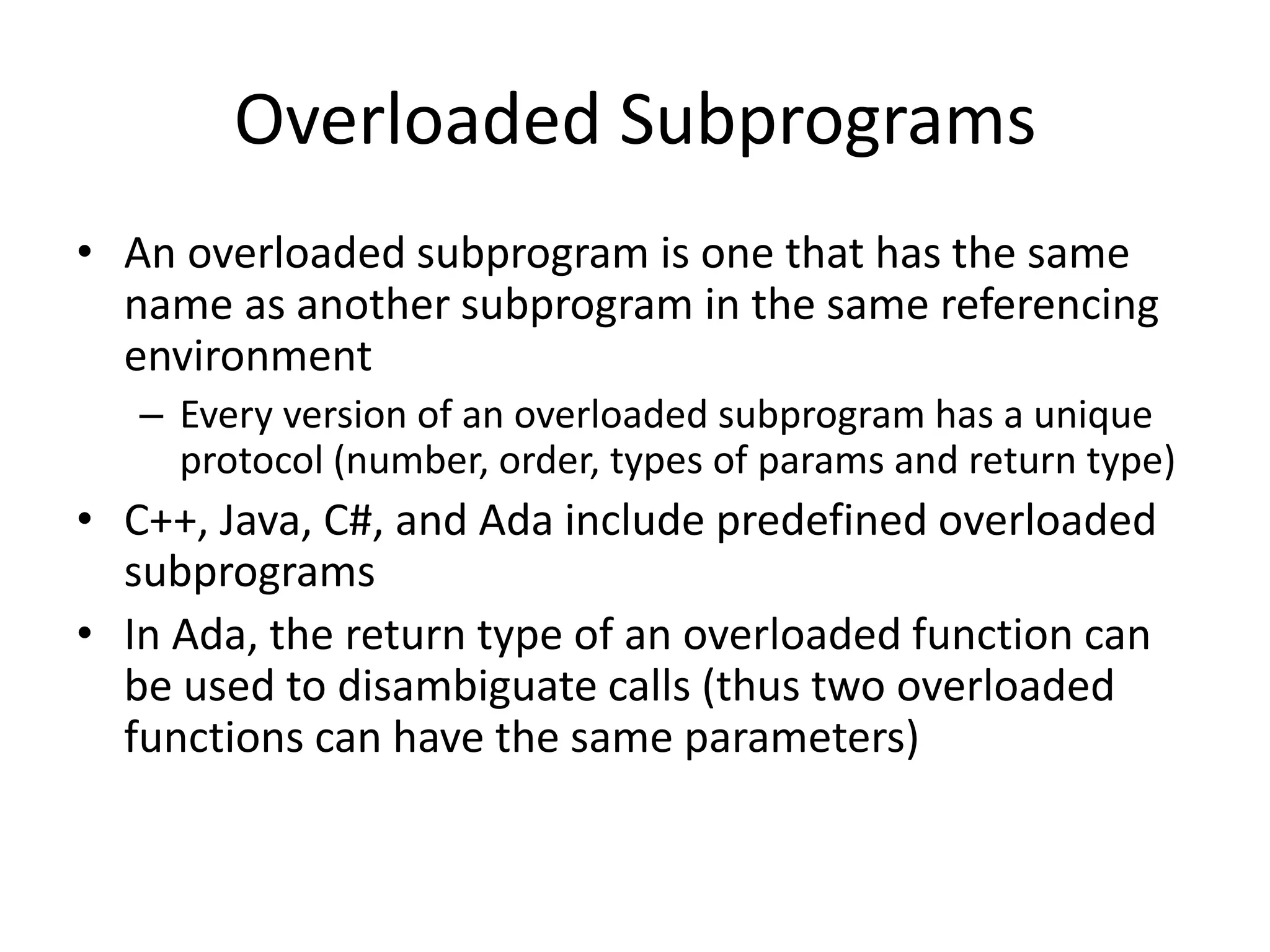
•An overloaded subprogram is one that has the same name as another subprogram in the same referencing environment 
–Every version of an overloaded subprogram has a unique protocol (number, order, types of params and return type) 
•C++, Java, C#, and Ada include predefined overloaded subprograms 
•In Ada, the return type of an overloaded function can be used to disambiguate calls (thus two overloaded functions can have the same parameters)
Generic Subprograms 
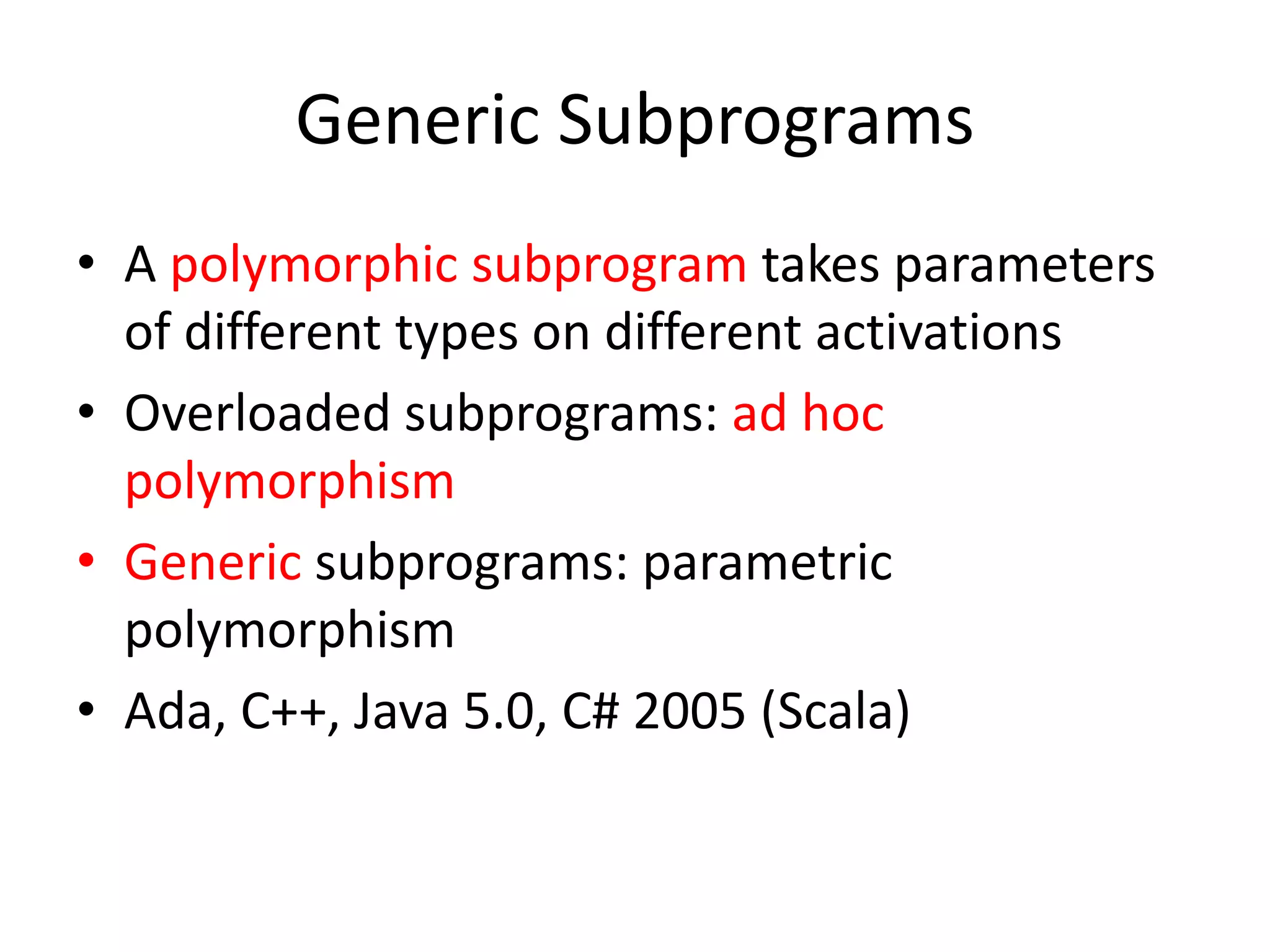
•A polymorphic subprogram takes parameters of different types on different activations 
•Overloaded subprograms: ad hoc polymorphism 
•Generic subprograms: parametric polymorphism 
•Ada, C++, Java 5.0, C# 2005 (Scala)
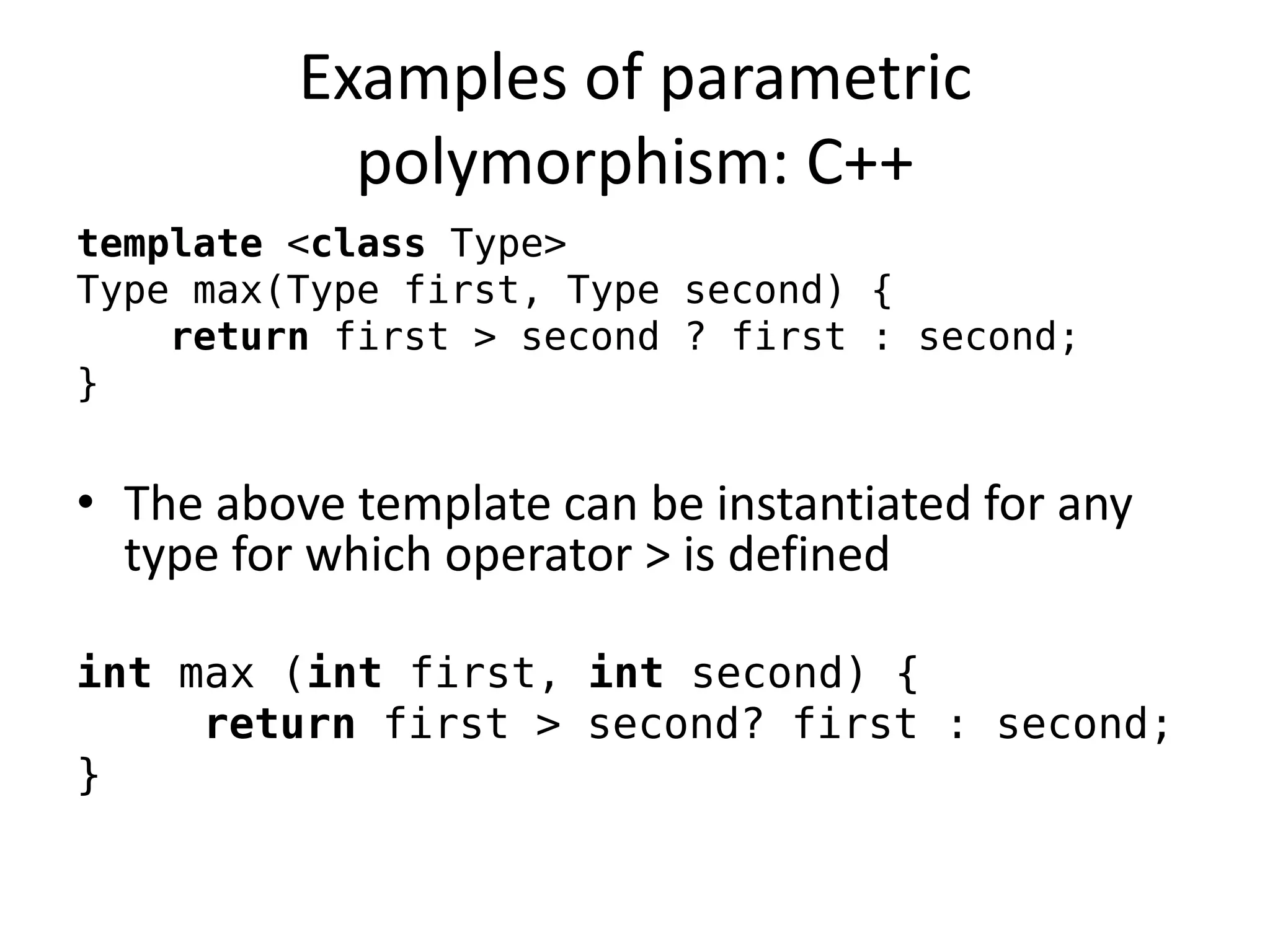
Examples of parametric polymorphism: C++ 
template <class Type> 
Type max(Type first, Type second) { 
return first > second ? first : second; 
} 
•The above template can be instantiated for any type for which operator > is defined 
int max (int first, int second) { 
return first > second? first : second; 
}
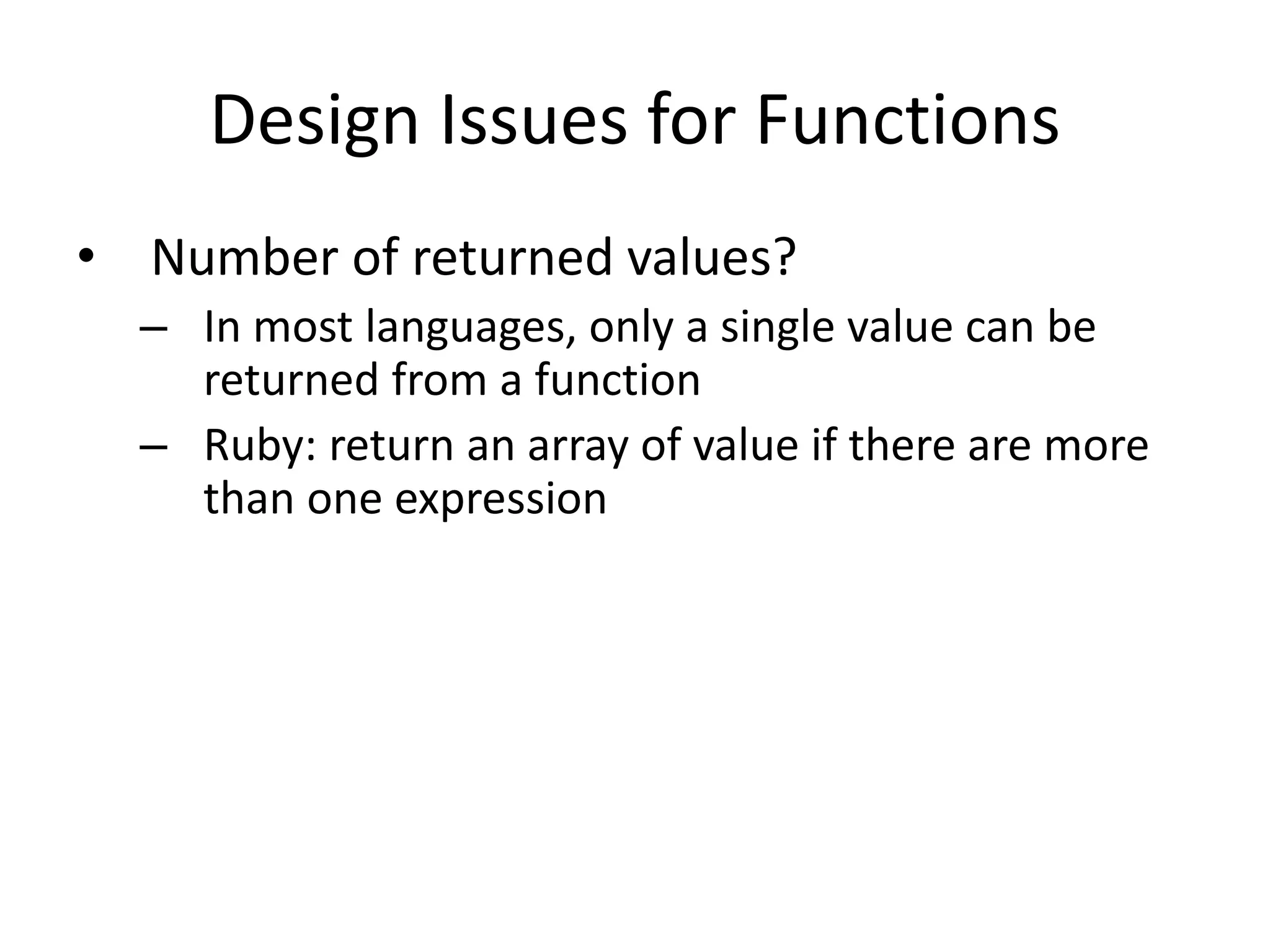
Design Issues for Functions 
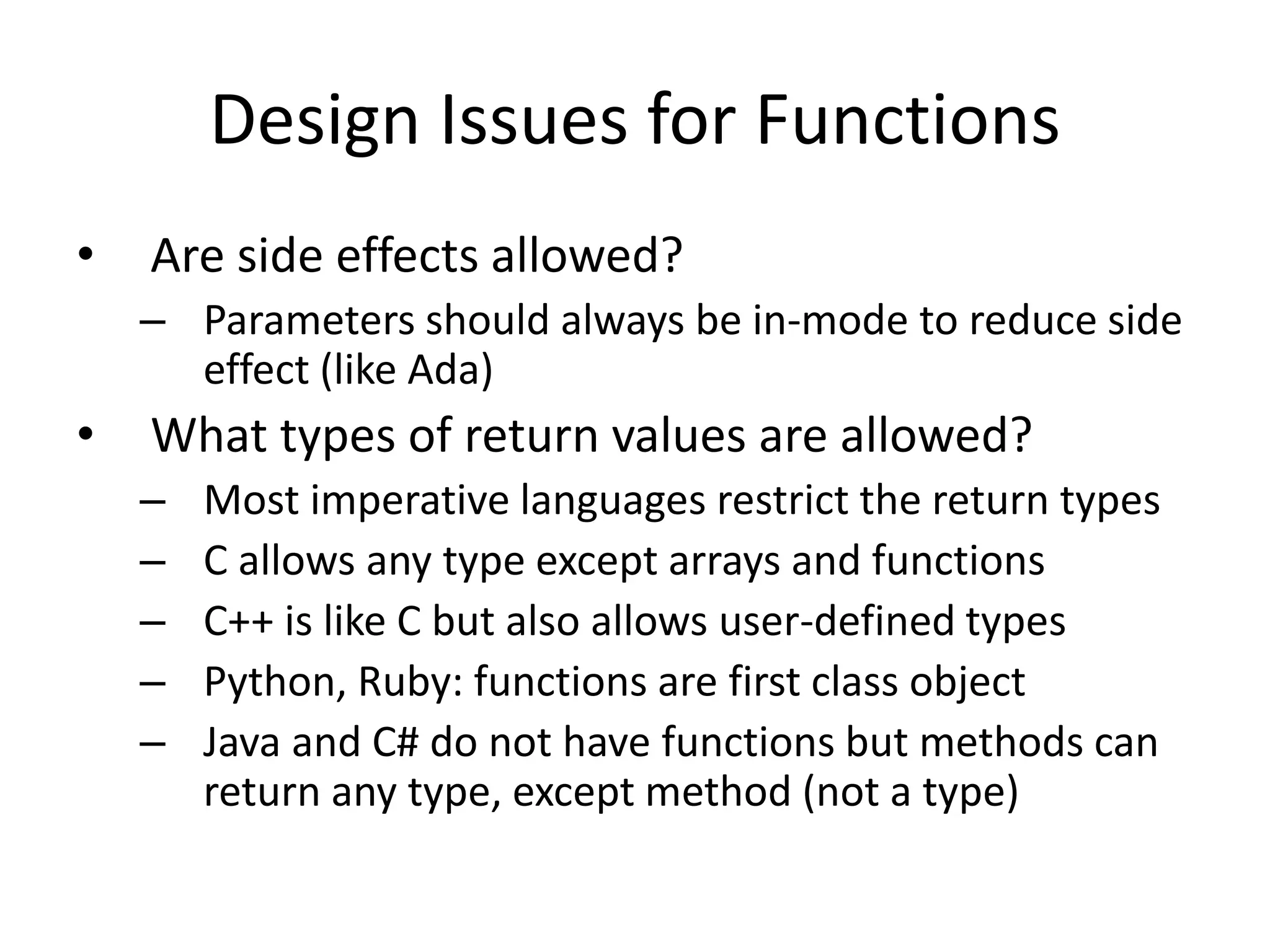
•Are side effects allowed? 
–Parameters should always be in-mode to reduce side effect (like Ada) 
•What types of return values are allowed? 
–Most imperative languages restrict the return types 
–C allows any type except arrays and functions 
–C++ is like C but also allows user-defined types 
–Python, Ruby: functions are first class object 
–Java and C# do not have functions but methods can return any type, except method (not a type)
Design Issues for Functions 
•Number of returned values? 
–In most languages, only a single value can be returned from a function 
–Ruby: return an array of value if there are more than one expression
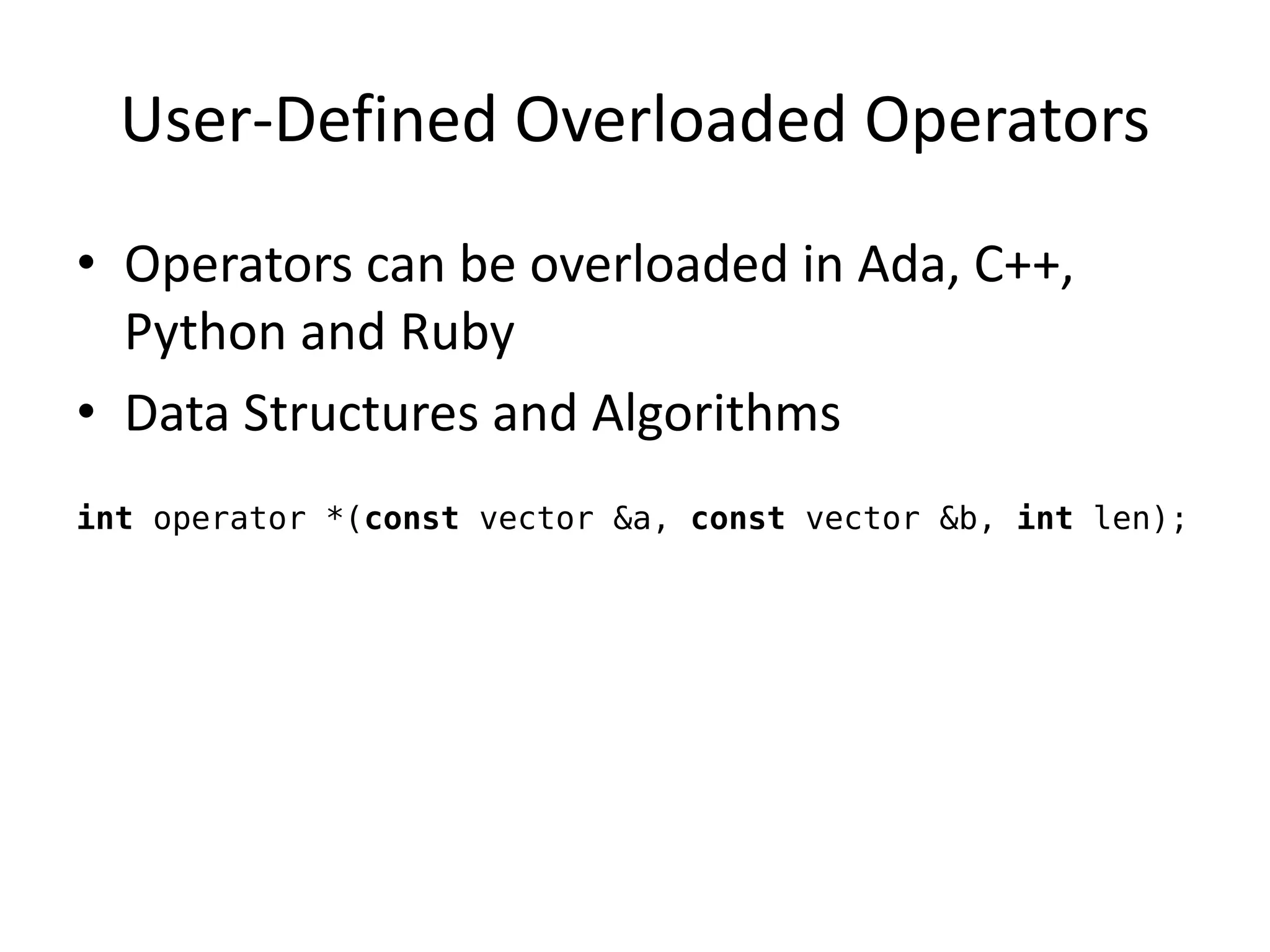
User-Defined Overloaded Operators 
•Operators can be overloaded in Ada, C++, Python and Ruby 
•Data Structures and Algorithms 
int operator *(const vector &a, const vector &b, int len);
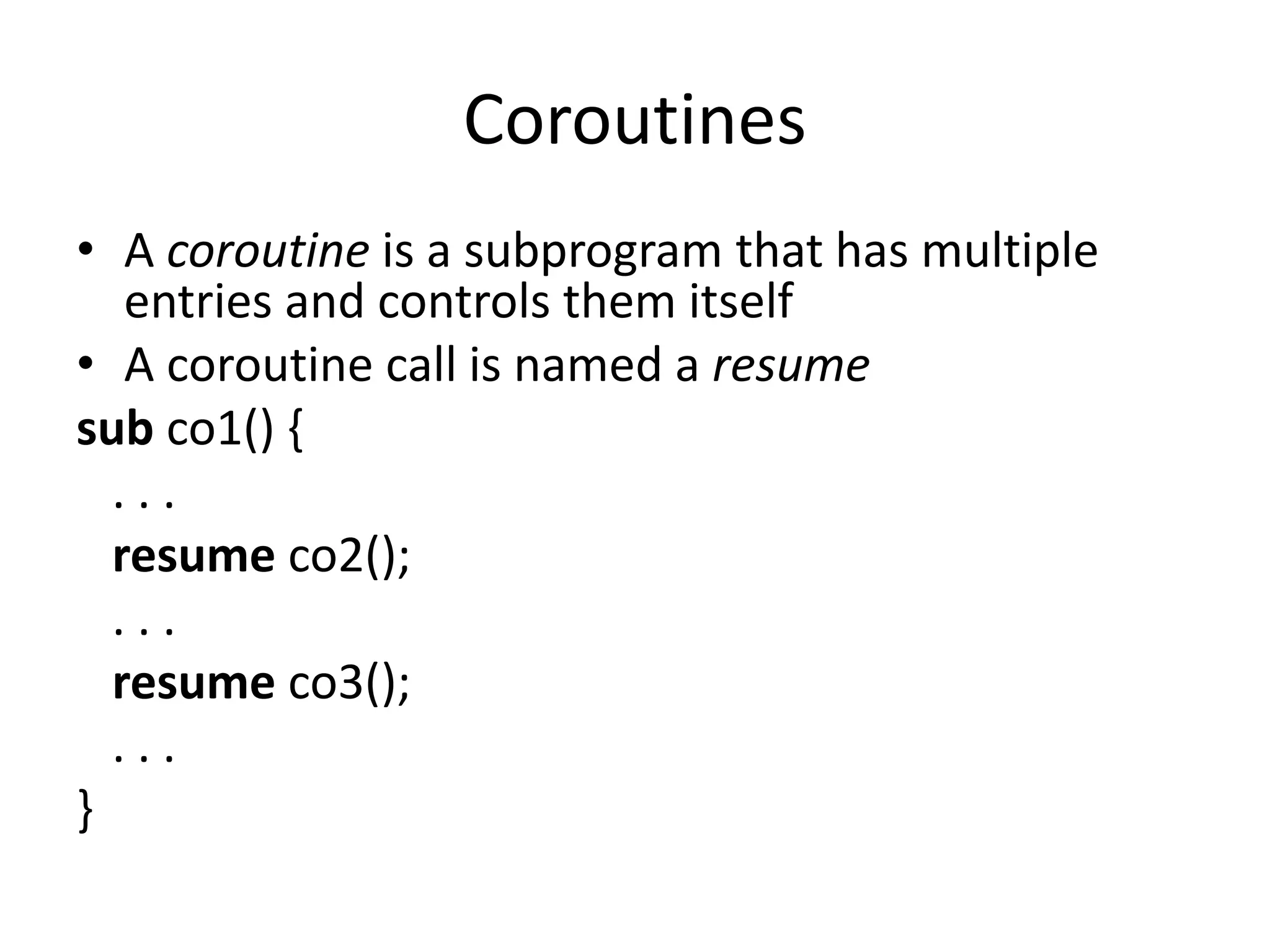
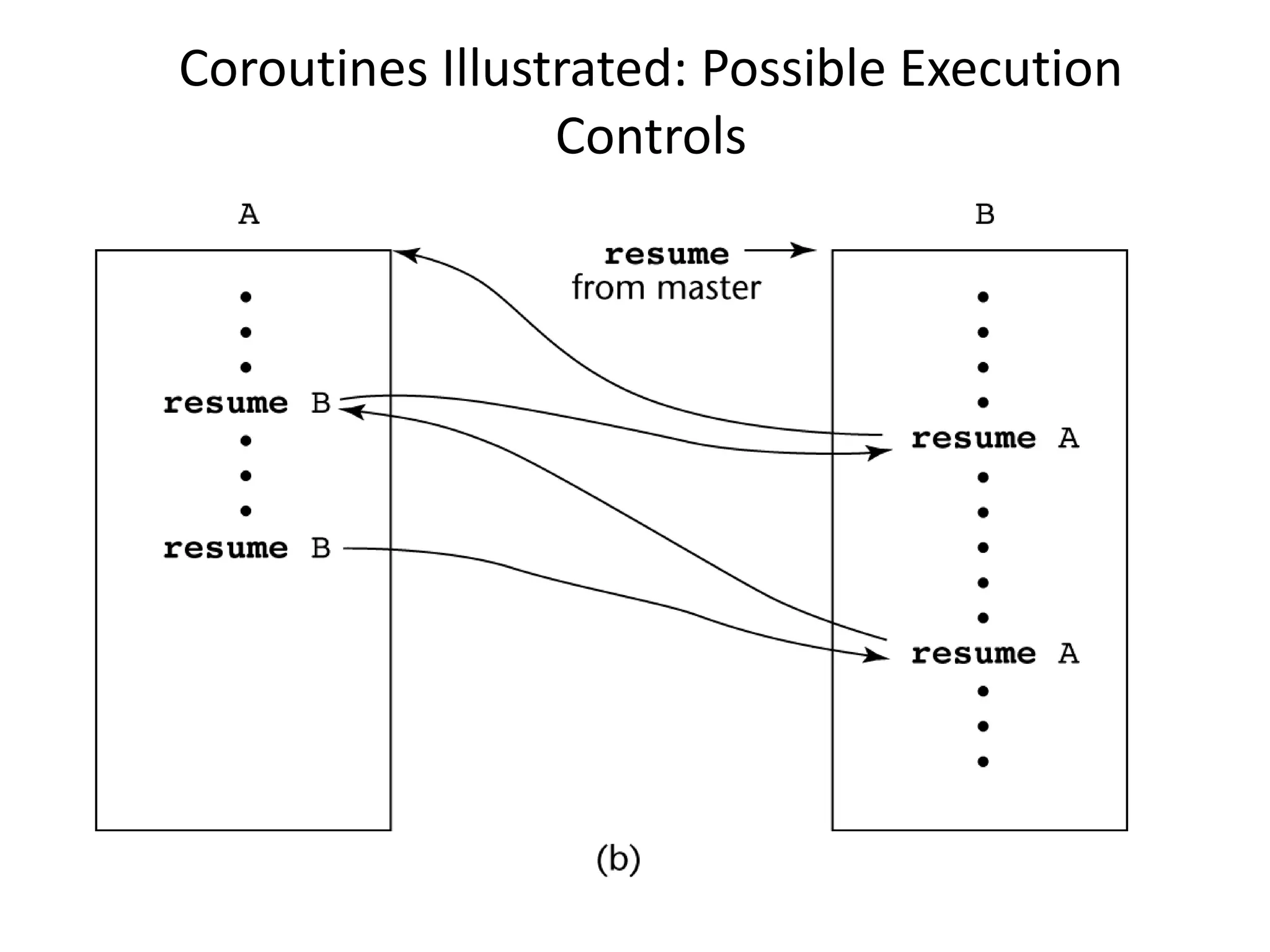
•A coroutine is a subprogram that has multiple entries and controls them itself 
•A coroutine call is named a resume 
sub co1() { 
. . . 
resume co2(); 
. . . 
resume co3(); 
. . . 
} 
Coroutines
1-39 
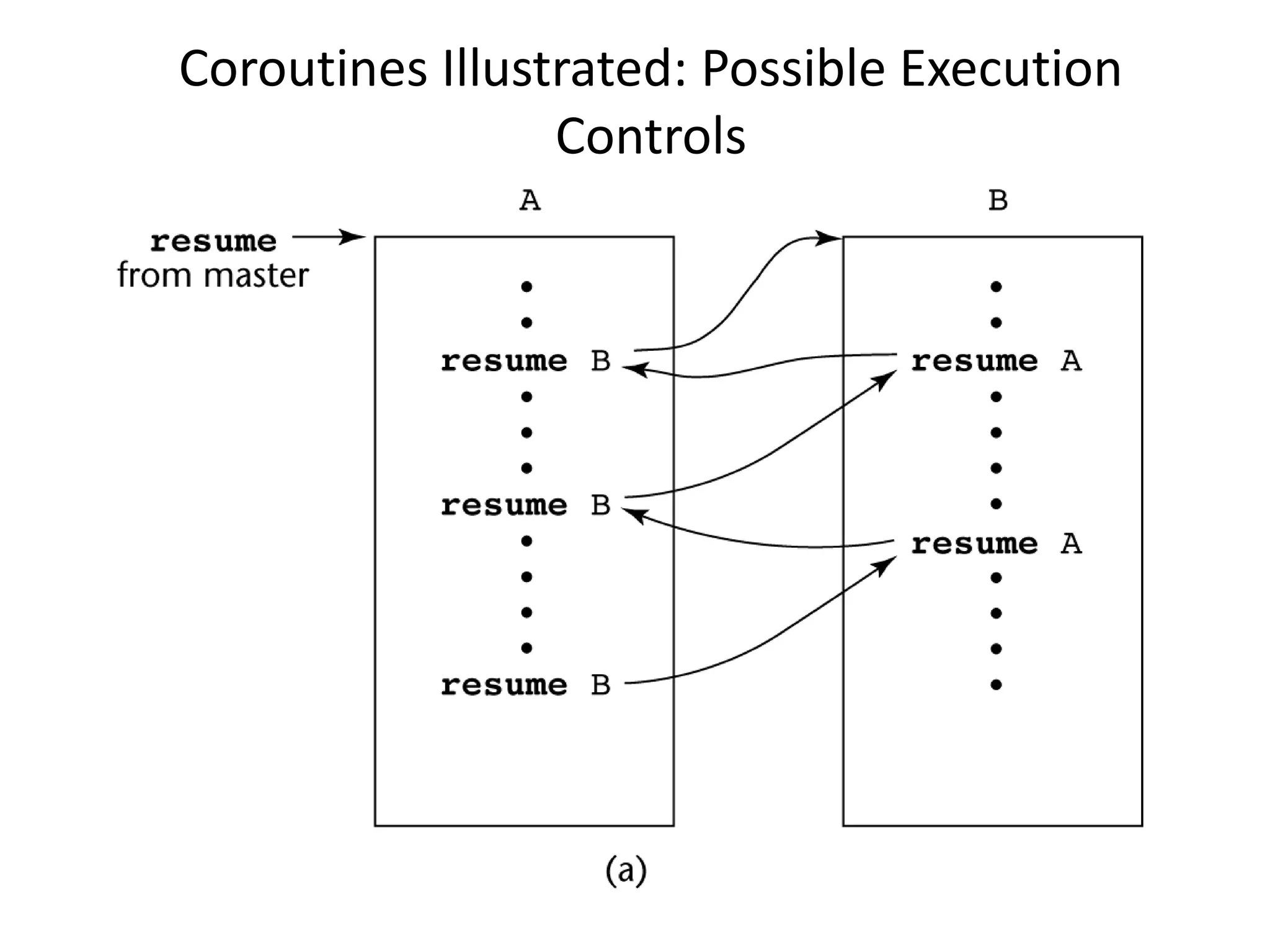
Coroutines Illustrated: Possible Execution Controls
Coroutines 
•Coroutines repeatedly resume each other 
•Coroutines provide quasi-concurrent execution of program units (the coroutines); their execution is interleaved, but not overlapped 
•Coroutines are created by a program unit called the master unit
Coroutines Illustrated 
•Simulation of a card game 
•Four players will have four coroutines, each with collection, or hand, of cards 
•Master program then start by resuming one of the player coroutines 
•After this player played its turn, could resume the next player coroutine and so forth
•A subprogram definition describes the actions represented by the subprogram 
•Subprograms can be either functions or procedures 
•Local variables in subprograms can be stack- dynamic or static 
•Three models of parameter passing: in mode, out mode, and inout mode 
•Some languages allow operator overloading 
•Subprograms can be generic 
•A coroutine is a special subprogram with multiple entries 
Summary

08 subprograms

  • 1.
    Chapter 8: Subprograms Principles of Programming Languages
  • 2.
    Contents •Fundamentals ofSubprograms •Parameter-Passing Methods •Overloaded Subprograms •Generic Subprograms •Functions •User-Defined Overloaded Operators •Coroutines
  • 3.
    Introduction •Two fundamentalabstraction facilities –Process abstraction •Reuse a collection of statements •Abstracting the details of a computation by calling subprogram’s name –Data abstraction •How about methods of object-oriented languages?
  • 4.
    General Characteristics •Eachsubprogram has a single entry point •There is only one subprogram in execution at any given time •Control always returns to the caller when the called subprogram’s execution terminates Subprogram A begin . . . . Call B . . . . end Subprogram B begin . . . . end
  • 5.
    Basic Definitions •Subprogramdefinition •Subprogram call •Subprogram header Subprogram A begin . . . . Call B . . . . end Subprogram B begin . . . . end
  • 6.
    Header Examples SubroutineAdder(parameters) Fortran procedure Adder(parameters) Ada def adder(parameters)= Scala void adder(parameters) C •Specify a kind of subprogram •Subprogram name •Optionally a list of parameters
  • 7.
    Special Case: C/C++ •Parameter profile •Protocol •A subprogram declaration provides the protocol, but not the body, of the subprogram •Function declarations in C and C++ are often called prototypes •Reason: not allow forward references to subprogram
  • 8.
    •Formal parameters vs.actual parameters •Positional (all proglang) –The binding of actual parameters to formal parameters is by position: the first actual parameter is bound to the first formal parameter and so forth –Safe and effective •Keyword (Python, Ada, Fortran 95, Python) –The name of the formal parameter to which an actual parameter is to be bound is specified with the actual parameter –Parameters can appear in any order Parameters
  • 9.
    Parameters •In certainlanguages, formal parameters can have default values Python: def compute_pay(income, exemptions = 1, tax_rate) pay = compute_pay(20000.0, tax_rate = 0.15) C++: float compute_pay(float income, float tax_rate, int exemptions = 1) •C#: accept a variable number of parameters as long as they are of the same type public void Display(params int[] list)
  • 10.
    Procedures and Functions •Procedures are collection of statements –Produce results by changing non-local variables or formal parameters that allow the transfer of data to the caller •Functions structurally resemble procedures but are semantically modeled on mathematical functions –They are expected to return a value and produce no side effects
  • 11.
    Design Issues forSubprograms •Are local variables static or dynamic? •Can subprogram definitions appear in other subprogram definitions? •What parameter-passing methods are used? •Are parameter types checked? •Can subprograms be overloaded? •Can subprogram be generic?
  • 12.
    Local Variables •Stack-dynamic –Where does the name come from? –Advantages •Support for recursion •Storage is shared among some subprograms –Disadvantages •Cost of allocation/de-allocation, initialization •Indirect addressing •Subprograms cannot be history sensitive –Default in most contemporary languages
  • 13.
    Local Variables •Localvariables can be static –Storage? –Advantages •Slightly more efficient: no indirection, no run-time overhead •Allow subprograms to be history-sensitive –Disadvantages: •Cannot support recursion •Storage cannot be shared –Supported in C/C++, Fortran 95
  • 14.
    Nested Subprograms •Originatingfrom Algol 60: Algol 68, Pascal, Ada. Recently, JavaScript, Python, and Ruby •Hierarchy of both logic and scopes •Usually with static scoping: grant access to nonlocal variables in enclosing subprograms •Problems: Chapter 5 •Examples: many in your Tutorial on Scopes with Ada
  • 15.
    Parameter-Passing Methods •Waysin which parameters are transmitted to and/or from called subprograms •Semantics models: formal parameters can –Receive data from actual parameters: in mode –Transmit data to actual parameters: out mode –Do both: inout mode •Data transfer models: –Actual value is copied –Access path is transmitted
  • 16.
    7 Pass-by-Value (InMode) •Normally implemented by copying, or •Transmitting an access path but have to enforce write protection •Advantage: fast for scalars •Disadvantages: –When copies are used, additional storage is required –Storage and copy operations can be costly 5 5 Caller Callee Call a x Return
  • 17.
    Pass-by-Result (Out Mode) •Potential problem: void Fixer(out int x, out int y) { C# x = 17; y = 35; } f.Fixer(out a, out a); void DoIt(out int x, out int index) { C# x = 17; index = 42; } sub = 21; f.DoIt(out list[sub], out sub) 5 7 Caller Callee Call a x Return 7
  • 18.
    Pass-by-Value-Result (Inout Mode) •A combination of pass-by-value and pass-by- result •Sometimes called pass-by-copy •Formal parameters have local storage •Disadvantages: –Those of pass-by-result –Those of pass-by-value 5 7 Caller Callee Call a x Return 7 5
  • 19.
    Pass-by-Reference (Inout Mode) •Pass an access path, usually just an address •Passing process is efficient (no copying and no duplicated storage) •Disadvantages –Slower accesses (compared to pass-by-value) to formal parameters –Potentials for un-wanted side effects –Un-wanted aliases (access broadened) 5 Caller Callee a x 7 Reference
  • 20.
    Pass-by-Name (Inout Mode) •By textual substitution •Actual binding to a value or address takes place at the time of a reference or assignment
  • 21.
    type VECT =array [1..3] of integer; procedure SUB2 (name I, J: integer); begin I := I + 1; J := J + 1; write(I, J) end; procedure SUB1; var A: VECT; K: integer; begin A[1] := 7; A[2] := 8; A[3] := 9; K := 2; SUB2(K, A[K]); for K := 1 to 3 do write(A[K]) end; K := K + 1; A[K] := A[K] + 1; write(K,A[K]) Pass-by-Name (Inout mode)
  • 22.
    •Parameter communication oftentakes place through the run-time stack Implementing Parameter-Passing Methods
  • 23.
    Parameter-Passing Methods inCommon Language •C –Default: pass-by-value –Pass-by-reference is achieved by using pointers as parameters •C++ –Using reference type for pass-by-reference –How about constant reference? •Java –All parameters are passed by value –Objects copy its reference
  • 24.
    Parameter-Passing Methods inCommon Language •Ada –Three semantics modes of parameter transmission: in, out, in out; in is the default mode •C# –Default method: pass-by-value –Pass-by-reference: ref –Out mode: out
  • 25.
    Type Checking Parameters •Considered very important for reliability •Original C: no type checking •C++: yes, but can pass by using ellipsis. For example, printf function •C#: coercions in pass-by-value, no coercions in pass-by-reference •Python, Ruby: formal parameters are typeless, no type checking is needed
  • 26.
    Multidimensional Arrays asParameters •If a multidimensional array is passed to a subprogram and the subprogram is separately compiled, the compiler needs to know the declared size of that array to build the storage mapping function •C/C++: –must declare the matrix size in parameters –macro is a good choice •Java, C#: every matrix has length function
  • 27.
    •Two important considerations –Efficiency –One-way or two-way data transfer is needed •But the above considerations are in conflict –Good programming suggest limited access to variables, which means one-way whenever possible –But pass-by-reference is more efficient to pass structures of significant size Design Considerations
  • 28.
    Parameters That AreSubprograms •It is sometimes convenient to pass subprogram names as parameters •Issues: –Are parameter of transferring subprogram type- checked? –In languages that allow nested subprogram, what referencing environment for executing the passed subprogram should be used?
  • 29.
    Parameters as Subprograms:Type Checking •Are parameter of transferring subprogram type-checked? •C and C++: functions cannot be passed as parameters but pointers to functions can be passed; parameters can be type checked •Ada does not allow subprogram parameters; a similar alternative is provided via Ada’s generic facility
  • 30.
    Parameters as Subprograms:Referencing Environment •What referencing environment for executing the passed subprogram should be used? •Shallow binding: The environment of the call statement that enacts the passed subprogram •Deep binding: The environment of the definition of the passed subprogram •Ad hoc binding: The environment of the call statement that passed the subprogram
  • 31.
    Parameters as Subprograms:Referencing Environment function sub1() { var x; function sub2() { alert(x); }; function sub3() { var x; x = 3; sub4(sub2); }; function sub4(subx) { var x; x = 4; subx(); }; x = 1; sub3(); } •Shallow binding: 4 •Deep binding: 1 •Ad hoc binding: 3
  • 32.
    Overloaded Subprograms •Anoverloaded subprogram is one that has the same name as another subprogram in the same referencing environment –Every version of an overloaded subprogram has a unique protocol (number, order, types of params and return type) •C++, Java, C#, and Ada include predefined overloaded subprograms •In Ada, the return type of an overloaded function can be used to disambiguate calls (thus two overloaded functions can have the same parameters)
  • 33.
    Generic Subprograms •Apolymorphic subprogram takes parameters of different types on different activations •Overloaded subprograms: ad hoc polymorphism •Generic subprograms: parametric polymorphism •Ada, C++, Java 5.0, C# 2005 (Scala)
  • 34.
    Examples of parametricpolymorphism: C++ template <class Type> Type max(Type first, Type second) { return first > second ? first : second; } •The above template can be instantiated for any type for which operator > is defined int max (int first, int second) { return first > second? first : second; }
  • 35.
    Design Issues forFunctions •Are side effects allowed? –Parameters should always be in-mode to reduce side effect (like Ada) •What types of return values are allowed? –Most imperative languages restrict the return types –C allows any type except arrays and functions –C++ is like C but also allows user-defined types –Python, Ruby: functions are first class object –Java and C# do not have functions but methods can return any type, except method (not a type)
  • 36.
    Design Issues forFunctions •Number of returned values? –In most languages, only a single value can be returned from a function –Ruby: return an array of value if there are more than one expression
  • 37.
    User-Defined Overloaded Operators •Operators can be overloaded in Ada, C++, Python and Ruby •Data Structures and Algorithms int operator *(const vector &a, const vector &b, int len);
  • 38.
    •A coroutine isa subprogram that has multiple entries and controls them itself •A coroutine call is named a resume sub co1() { . . . resume co2(); . . . resume co3(); . . . } Coroutines
  • 39.
    1-39 Coroutines Illustrated:Possible Execution Controls
  • 40.
  • 41.
    Coroutines •Coroutines repeatedlyresume each other •Coroutines provide quasi-concurrent execution of program units (the coroutines); their execution is interleaved, but not overlapped •Coroutines are created by a program unit called the master unit
  • 42.
    Coroutines Illustrated •Simulationof a card game •Four players will have four coroutines, each with collection, or hand, of cards •Master program then start by resuming one of the player coroutines •After this player played its turn, could resume the next player coroutine and so forth
  • 43.
    •A subprogram definitiondescribes the actions represented by the subprogram •Subprograms can be either functions or procedures •Local variables in subprograms can be stack- dynamic or static •Three models of parameter passing: in mode, out mode, and inout mode •Some languages allow operator overloading •Subprograms can be generic •A coroutine is a special subprogram with multiple entries Summary