My Information 
• Lecturer: Trần Vĩnh Tân 
• Email: tan@cse.hcmut.edu.vn 
• Website: http://www.cse.hcmut.edu.vn/~tan 
• Office hour: Tuesday 09:00 – 11:00 (subject to 
change) 
• Sakai: http://elearning.cse.hcmut.edu.vn
References 
• Concepts of Programming Languages, 8/e, 
Robert W. Sebesta, Addison Wesley, 2008. 
• “Programming Languages – Principles and 
Practices” – Kenneth C. Louden, Thomson 
Brooks/ Cole, 2003. 
• “Ngôn ngữ lập trình – Các nguyên lý và mô 
hình” – Cao Hoàng Trụ, 2004.
Assessment 
• Tutorials/Labs/On-class Exercises: 10% 
• Assignments: 30%, using Scala 
(http://www.scala-ide.org/) 
• Midterm: 20% 
• Final: 40% 
• Notice: Fail (zero mark) five tuts/labs will be 
banned from final exam
Introduction 
Principles of Programming Languages
Outline 
• Reasons for Studying Concepts of Programming 
Languages 
• Programming Domains 
• Language Evaluation Criteria 
• Influences on Language Design 
• Language Categories 
• Language Design Trade-Offs 
• Implementation Methods 
• Programming Environments 
• Historical Languages
Benefits of Studying 
• Increased capacity to express idea 
• Improved background for choosing appropriate 
languages 
• Increased ability to learn new languages 
• Better understanding of the significance of 
implementation 
• Better use of languages that are already known 
• Overall advancement of computing
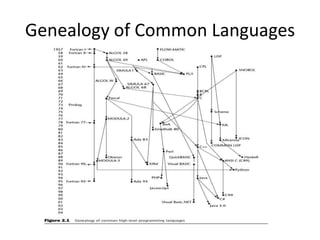
Genealogy of Common Languages
Programming Domains 
• Scientific Applications 
– Fortran, ALGOL 60 
• Business Applications 
– COBOL 
• Artificial Intelligence 
– LISP, Prolog, also C 
• Systems Programming 
– PL/S, BLISS, Extended ALGOL, and C 
• Web Software 
– XHTML; JavaScript, PHP
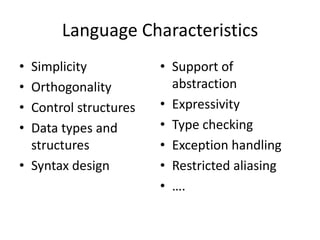
Language Characteristics 
• Simplicity 
• Orthogonality 
• Control structures 
• Data types and 
structures 
• Syntax design 
• Support of 
abstraction 
• Expressivity 
• Type checking 
• Exception handling 
• Restricted aliasing 
• ….
Language Evaluation 
• Readability 
• Writability 
• Reliability 
• Cost
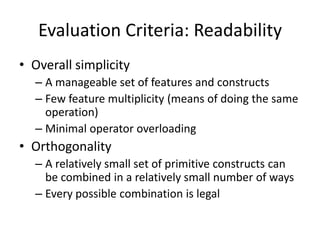
Evaluation Criteria: Readability 
• Overall simplicity 
– A manageable set of features and constructs 
– Few feature multiplicity (means of doing the same 
operation) 
– Minimal operator overloading 
• Orthogonality 
– A relatively small set of primitive constructs can 
be combined in a relatively small number of ways 
– Every possible combination is legal
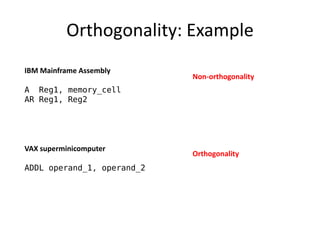
Orthogonality: Example 
IBM Mainframe Assembly 
A Reg1, memory_cell 
AR Reg1, Reg2 
VAX superminicomputer 
ADDL operand_1, operand_2 
Non-orthogonality 
Orthogonality
Evaluation Criteria: Readability 
• Control statements 
– The presence of well-known control structures (e.g., 
while statement) 
• Data types and structures 
– The presence of adequate facilities for defining data 
structures 
• Syntax considerations 
– Identifier forms: flexible composition 
– Special words and methods of forming compound 
statements 
– Form and meaning: self-descriptive constructs, meaningful 
keywords
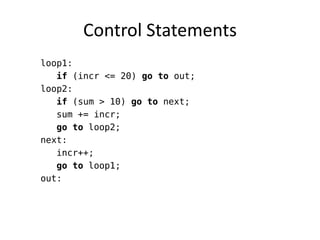
Control Statements 
loop1: 
if (incr <= 20) go to out; 
loop2: 
if (sum > 10) go to next; 
sum += incr; 
go to loop2; 
next: 
incr++; 
go to loop1; 
out:
Evaluation Criteria: Readability 
• Control statements 
– The presence of well-known control structures (e.g., while 
statement) 
• Data types and structures 
– The presence of adequate facilities for defining data 
structures 
• Syntax considerations 
– Identifier forms: flexible composition 
– Special words and methods of forming compound 
statements 
– Form and meaning: self-descriptive constructs, meaningful 
keywords
Evaluation Criteria: Writability 
• Simplicity and orthogonality 
– Few constructs, a small number of primitives, a small 
set of rules for combining them 
• Support for abstraction 
– The ability to define and use complex structures or 
operations in ways that allow details to be ignored 
• Expressivity 
– A set of relatively convenient ways of specifying 
operations 
– Example: the inclusion of for statement in many 
modern languages
Evaluation Criteria: Reliability 
• Type checking 
– Testing for type errors 
• Exception handling 
– Intercept run-time errors and take corrective measures 
• Aliasing 
– Presence of two or more distinct referencing methods for 
the same memory location 
• Readability and writability 
– A language that does not support “natural” ways of 
expressing an algorithm will necessarily use “unnatural” 
approaches, and hence reduced reliability
Evaluation Criteria: Cost 
• Training programmers to use language 
• Writing programs (closeness to particular 
applications) 
• Compiling programs 
• Executing programs 
• Language implementation system: availability of 
free compilers 
• Reliability: poor reliability leads to high costs 
• Maintaining programs
Evaluation Criteria: Others 
• Portability 
– The ease with which programs can be moved from 
one implementation to another 
• Generality 
– The applicability to a wide range of applications 
• Well-definedness 
– The completeness and precision of the language’s 
official definition
Influences on Language Design 
• Computer Architecture 
• Programming Methodologies
Computer Architecture Influence 
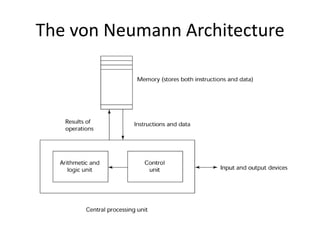
• Well-known computer architecture: Von Neumann 
• Imperative languages, most dominant, because of von 
Neumann computers 
– Data and programs stored in memory 
– Memory is separate from CPU 
– Instructions and data are piped from memory to CPU 
– Basis for imperative languages 
• Variables model memory cells 
• Assignment statements model piping 
• Iteration is efficient
The von Neumann Architecture
Programming Methodologies Influences 
• 1950s and early 1960s: Simple applications; worry about 
machine efficiency 
• Late 1960s: People efficiency became important; readability, 
better control structures 
– structured programming 
– top-down design and step-wise refinement 
• Late 1970s: Process-oriented to data-oriented 
– data abstraction 
• Middle 1980s: Object-oriented programming 
– Data abstraction + inheritance + polymorphism
Language Categories 
• Imperative 
– Central features are variables, assignment statements, and iteration 
– Examples: C, Pascal 
• Functional 
– Main means of making computations is by applying functions to given 
parameters 
– Examples: LISP, Scheme 
• Logic 
– Rule-based (rules are specified in no particular order) 
– Example: Prolog 
• Object-oriented 
– Data abstraction, inheritance, late binding 
– Examples: Java, C++ 
• Markup 
– New; not a programming per se, but used to specify the layout of information 
in Web documents 
– Examples: XHTML, XML
Language Design Trade-Offs 
• Reliability vs. cost of execution 
– Conflicting criteria 
– Example: Java demands all references to array elements be checked 
for proper indexing but that leads to increased execution costs 
• Readability vs. writability 
– Another conflicting criteria 
– Example: APL provides many powerful operators (and a large number 
of new symbols), allowing complex computations to be written in a 
compact program but at the cost of poor readability 
• Writability (flexibility) vs. reliability 
– Another conflicting criteria 
– Example: C++ pointers are powerful and very flexible but not reliably 
used
Implementation Methods 
• Compilation 
– Programs are translated into machine language 
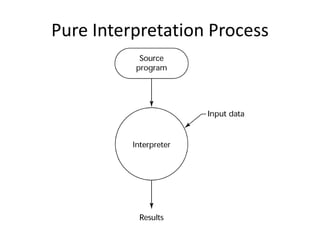
• Pure Interpretation 
– Programs are interpreted by another program 
known as an interpreter 
• Hybrid Implementation Systems 
– A compromise between compilers and pure 
interpreters
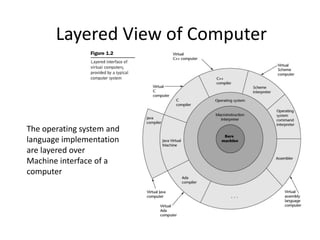
Layered View of Computer 
The operating system and 
language implementation 
are layered over 
Machine interface of a 
computer
Compilation 
• Translate high-level program (source language) into machine 
code (machine language) 
• Slow translation, fast execution 
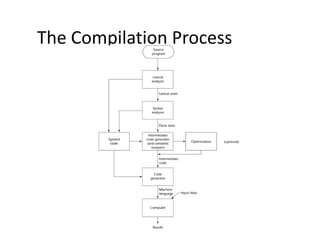
• Compilation process has several phases: 
– lexical analysis: converts characters in the source program into lexical 
units 
– syntax analysis: transforms lexical units into parse trees which 
represent the syntactic structure of program 
– Semantics analysis: generate intermediate code 
– code generation: machine code is generated
The Compilation Process
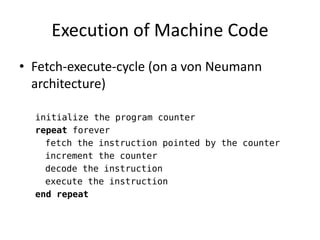
Execution of Machine Code 
• Fetch-execute-cycle (on a von Neumann 
architecture) 
initialize the program counter 
repeat forever 
fetch the instruction pointed by the counter 
increment the counter 
decode the instruction 
execute the instruction 
end repeat
Von Neumann Bottleneck 
• Connection speed between a computer’s 
memory and its processor determines the speed 
of a computer 
• Program instructions often can be executed a lot 
faster than the above connection speed; the 
connection speed thus results in a bottleneck 
• Known as von Neumann bottleneck; it is the 
primary limiting factor in the speed of computers
Pure Interpretation 
• No translation 
• Easier implementation of programs (run-time 
errors can easily and immediately displayed) 
• Slower execution (10 to 100 times slower 
than compiled programs) 
• Often requires more space 
• Becoming rare on high-level languages 
• Significant comeback with some Web 
scripting languages (e.g., JavaScript)
Pure Interpretation Process
Hybrid Implementation Systems 
• A compromise between compilers and pure 
interpreters 
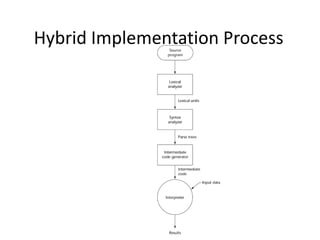
• A high-level language program is translated to an 
intermediate language that allows easy 
interpretation 
• Faster than pure interpretation 
• Examples 
– Perl programs are partially compiled to detect errors before 
interpretation 
– Initial implementations of Java were hybrid; the intermediate form, byte 
code, provides portability to any machine that has a byte code interpreter 
and a run-time system (together, these are called Java Virtual Machine)
Hybrid Implementation Process
Just-in-Time Implementation Systems 
• Initially translate programs to an intermediate 
language 
• Then compile intermediate language into 
machine code 
• Machine code version is kept for subsequent 
calls 
• JIT systems are widely used for Java programs 
• .NET languages are implemented with a JIT 
system
Preprocessors 
• Preprocessor macros (instructions) are 
commonly used to specify that code from 
another file is to be included 
• A preprocessor processes a program 
immediately before the program is compiled 
to expand embedded preprocessor macros 
• A well-known example: C preprocessor 
– expands #include, #define, and similar 
macros
Programming Environments 
• The collection of tools used in software development 
• UNIX 
– An older operating system and tool collection 
– Nowadays often used through a GUI (e.g., CDE, KDE, or GNOME) that 
run on top of UNIX 
• Eclipse, NetBeans, JBuilder 
– An integrated development environment for Java 
• Microsoft Visual Studio.NET 
– A large, complex visual environment 
– Used to program in C#, Visual BASIC.NET, Jscript, J#, or C++
FORTRAN 
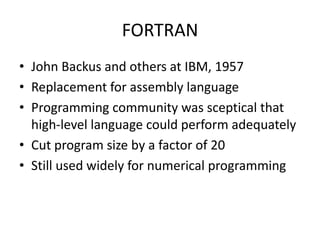
• John Backus and others at IBM, 1957 
• Replacement for assembly language 
• Programming community was sceptical that 
high-level language could perform adequately 
• Cut program size by a factor of 20 
• Still used widely for numerical programming
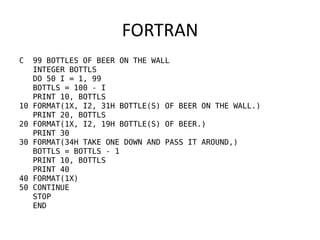
FORTRAN 
C 99 BOTTLES OF BEER ON THE WALL 
INTEGER BOTTLS 
DO 50 I = 1, 99 
BOTTLS = 100 - I 
PRINT 10, BOTTLS 
10 FORMAT(1X, I2, 31H BOTTLE(S) OF BEER ON THE WALL.) 
PRINT 20, BOTTLS 
20 FORMAT(1X, I2, 19H BOTTLE(S) OF BEER.) 
PRINT 30 
30 FORMAT(34H TAKE ONE DOWN AND PASS IT AROUND,) 
BOTTLS = BOTTLS - 1 
PRINT 10, BOTTLS 
PRINT 40 
40 FORMAT(1X) 
50 CONTINUE 
STOP 
END
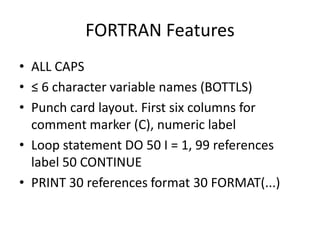
FORTRAN Features 
• ALL CAPS 
• ≤ 6 character variable names (BOTTLS) 
• Punch card layout. First six columns for 
comment marker (C), numeric label 
• Loop statement DO 50 I = 1, 99 references 
label 50 CONTINUE 
• PRINT 30 references format 30 FORMAT(...)
LISP 
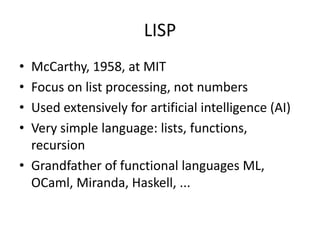
• McCarthy, 1958, at MIT 
• Focus on list processing, not numbers 
• Used extensively for artificial intelligence (AI) 
• Very simple language: lists, functions, 
recursion 
• Grandfather of functional languages ML, 
OCaml, Miranda, Haskell, ...
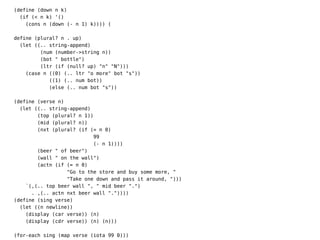
(define (down n k) 
(if (< n k) '() 
(cons n (down (- n 1) k)))) ( 
define (plural? n . up) 
(let ((.. string-append) 
(num (number->string n)) 
(bot " bottle") 
(ltr (if (null? up) "n" "N"))) 
(case n ((0) (.. ltr "o more" bot "s")) 
((1) (.. num bot)) 
(else (.. num bot "s")) 
(define (verse n) 
(let ((.. string-append) 
(top (plural? n 1)) 
(mid (plural? n)) 
(nxt (plural? (if (= n 0) 
99 
(- n 1)))) 
(beer " of beer") 
(wall " on the wall") 
(actn (if (= n 0) 
"Go to the store and buy some more, " 
"Take one down and pass it around, "))) 
`(,(.. top beer wall ", " mid beer ".") 
. ,(.. actn nxt beer wall ".")))) 
(define (sing verse) 
(let ((n newline)) 
(display (car verse)) (n) 
(display (cdr verse)) (n) (n))) 
(for-each sing (map verse (iota 99 0)))
LISP Features 
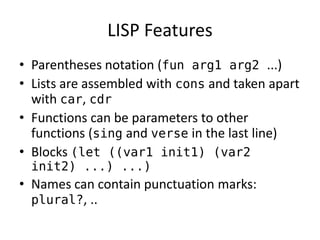
• Parentheses notation (fun arg1 arg2 ...) 
• Lists are assembled with cons and taken apart 
with car, cdr 
• Functions can be parameters to other 
functions (sing and verse in the last line) 
• Blocks (let ((var1 init1) (var2 
init2) ...) ...) 
• Names can contain punctuation marks: 
plural?, ..
ALGOL 60 
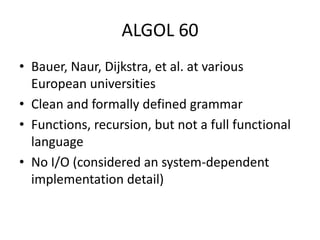
• Bauer, Naur, Dijkstra, et al. at various 
European universities 
• Clean and formally defined grammar 
• Functions, recursion, but not a full functional 
language 
• No I/O (considered an system-dependent 
implementation detail)
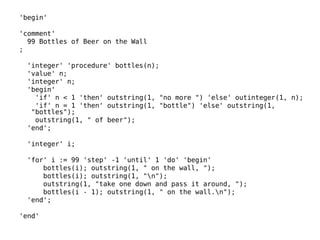
'begin' 
'comment' 
99 Bottles of Beer on the Wall 
; 
'integer' 'procedure' bottles(n); 
'value' n; 
'integer' n; 
'begin' 
'if' n < 1 'then' outstring(1, "no more ") 'else' outinteger(1, n); 
'if' n = 1 'then' outstring(1, "bottle") 'else' outstring(1, 
"bottles"); 
outstring(1, " of beer"); 
'end'; 
'integer' i; 
'for' i := 99 'step' -1 'until' 1 'do' 'begin' 
bottles(i); outstring(1, " on the wall, "); 
bottles(i); outstring(1, "n"); 
outstring(1, "take one down and pass it around, "); 
bottles(i - 1); outstring(1, " on the wall.n"); 
'end'; 
'end'
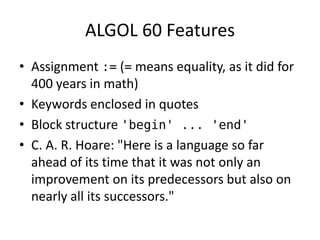
ALGOL 60 Features 
• Assignment := (= means equality, as it did for 
400 years in math) 
• Keywords enclosed in quotes 
• Block structure 'begin' ... 'end' 
• C. A. R. Hoare: "Here is a language so far 
ahead of its time that it was not only an 
improvement on its predecessors but also on 
nearly all its successors."
C 
• Kernighan and Ritchie, AT&T Bell Labs, 1969- 
73 
• Derived from a language called B 
• Co-evolved with Unix operating system 
• Small language (reaction to the complex PL/1) 
• Pointers, registers, inline assembly
C 
#define MAXBEER (99) 
void chug(register int beers) { 
char howmany[8], *s; 
s = beers != 1 ? "s" : ""; 
printf("%d bottle%s of beer on the wall,n", beers, s); 
printf("%d bottle%s of beeeeer . . . ,n", beers, s); 
printf("Take one down, pass it around,n"); 
if(--beers) sprintf(howmany, "%d", beers); else strcpy(howmany, 
"No more"); 
s = beers != 1 ? "s" : ""; 
printf("%s bottle%s of beer on the wall.n", howmany, s); 
} 
main() { 
int beers; 
for(beers = MAXBEER; beers; chug(beers--)) 
puts(""); 
puts("nTime to buy more beer!n"); 
}
C Features 
• Blocks with braces { ... } 
• Pointers 
• Expressions with side effects: if (--beers) 
• Expressions in for (expr1; expr2; 
expr3) need not be related 
• Rich library (for the time): printf, strcpy 
• No automatic resource management
C++ 
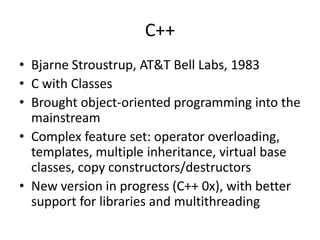
• Bjarne Stroustrup, AT&T Bell Labs, 1983 
• C with Classes 
• Brought object-oriented programming into the 
mainstream 
• Complex feature set: operator overloading, 
templates, multiple inheritance, virtual base 
classes, copy constructors/destructors 
• New version in progress (C++ 0x), with better 
support for libraries and multithreading
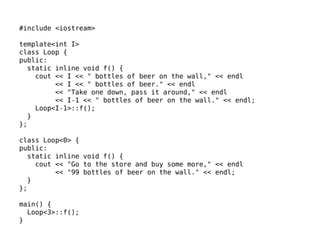
#include <iostream> 
template<int I> 
class Loop { 
public: 
static inline void f() { 
cout << I << " bottles of beer on the wall," << endl 
<< I << " bottles of beer." << endl 
<< "Take one down, pass it around," << endl 
<< I-1 << " bottles of beer on the wall." << endl; 
Loop<I-1>::f(); 
} 
}; 
class Loop<0> { 
public: 
static inline void f() { 
cout << "Go to the store and buy some more," << endl 
<< "99 bottles of beer on the wall." << endl; 
} 
}; 
main() { 
Loop<3>::f(); 
}
C++ 
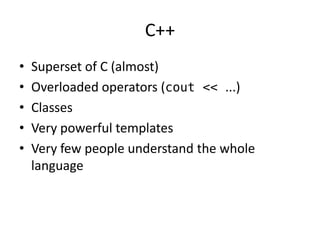
• Superset of C (almost) 
• Overloaded operators (cout << ...) 
• Classes 
• Very powerful templates 
• Very few people understand the whole 
language
Java 
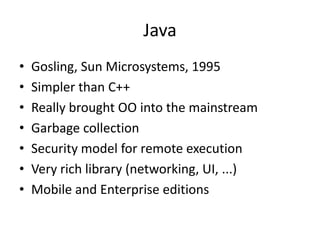
• Gosling, Sun Microsystems, 1995 
• Simpler than C++ 
• Really brought OO into the mainstream 
• Garbage collection 
• Security model for remote execution 
• Very rich library (networking, UI, ...) 
• Mobile and Enterprise editions
class Verse { 
private final int count; 
Verse(int verse) { 
count = 100-verse; 
} 
public String toString() { 
String c = 
"{0,choice,0#no more bottles|1#1 bottle|1<{0} bottles} of 
beer"; 
return java.text.MessageFormat.format( 
c.replace("n","N")+" on the wall, "+c+".n"+ 
"{0,choice,0#Go to the store and buy some more"+ 
"|0<Take one down and pass it around}, 
"+c.replace("{0","{1")+ 
" on the wall.n", count, (count+99)%100); 
} 
public static void main(String[] args) { 
for (int i = 1; i <= 100; i++) 
System.out.println(new Verse(i)); 
} 
}
Java Features 
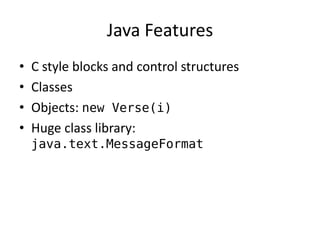
• C style blocks and control structures 
• Classes 
• Objects: new Verse(i) 
• Huge class library: 
java.text.MessageFormat
Summary 
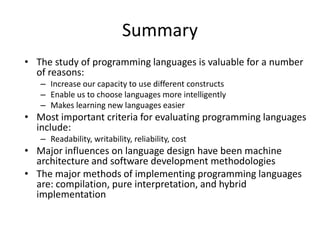
• The study of programming languages is valuable for a number 
of reasons: 
– Increase our capacity to use different constructs 
– Enable us to choose languages more intelligently 
– Makes learning new languages easier 
• Most important criteria for evaluating programming languages 
include: 
– Readability, writability, reliability, cost 
• Major influences on language design have been machine 
architecture and software development methodologies 
• The major methods of implementing programming languages 
are: compilation, pure interpretation, and hybrid 
implementation

Introduction

  • 1.
    My Information •Lecturer: Trần Vĩnh Tân • Email: tan@cse.hcmut.edu.vn • Website: http://www.cse.hcmut.edu.vn/~tan • Office hour: Tuesday 09:00 – 11:00 (subject to change) • Sakai: http://elearning.cse.hcmut.edu.vn
  • 2.
    References • Conceptsof Programming Languages, 8/e, Robert W. Sebesta, Addison Wesley, 2008. • “Programming Languages – Principles and Practices” – Kenneth C. Louden, Thomson Brooks/ Cole, 2003. • “Ngôn ngữ lập trình – Các nguyên lý và mô hình” – Cao Hoàng Trụ, 2004.
  • 3.
    Assessment • Tutorials/Labs/On-classExercises: 10% • Assignments: 30%, using Scala (http://www.scala-ide.org/) • Midterm: 20% • Final: 40% • Notice: Fail (zero mark) five tuts/labs will be banned from final exam
  • 4.
    Introduction Principles ofProgramming Languages
  • 5.
    Outline • Reasonsfor Studying Concepts of Programming Languages • Programming Domains • Language Evaluation Criteria • Influences on Language Design • Language Categories • Language Design Trade-Offs • Implementation Methods • Programming Environments • Historical Languages
  • 6.
    Benefits of Studying • Increased capacity to express idea • Improved background for choosing appropriate languages • Increased ability to learn new languages • Better understanding of the significance of implementation • Better use of languages that are already known • Overall advancement of computing
  • 7.
  • 8.
    Programming Domains •Scientific Applications – Fortran, ALGOL 60 • Business Applications – COBOL • Artificial Intelligence – LISP, Prolog, also C • Systems Programming – PL/S, BLISS, Extended ALGOL, and C • Web Software – XHTML; JavaScript, PHP
  • 9.
    Language Characteristics •Simplicity • Orthogonality • Control structures • Data types and structures • Syntax design • Support of abstraction • Expressivity • Type checking • Exception handling • Restricted aliasing • ….
  • 10.
    Language Evaluation •Readability • Writability • Reliability • Cost
  • 11.
    Evaluation Criteria: Readability • Overall simplicity – A manageable set of features and constructs – Few feature multiplicity (means of doing the same operation) – Minimal operator overloading • Orthogonality – A relatively small set of primitive constructs can be combined in a relatively small number of ways – Every possible combination is legal
  • 12.
    Orthogonality: Example IBMMainframe Assembly A Reg1, memory_cell AR Reg1, Reg2 VAX superminicomputer ADDL operand_1, operand_2 Non-orthogonality Orthogonality
  • 13.
    Evaluation Criteria: Readability • Control statements – The presence of well-known control structures (e.g., while statement) • Data types and structures – The presence of adequate facilities for defining data structures • Syntax considerations – Identifier forms: flexible composition – Special words and methods of forming compound statements – Form and meaning: self-descriptive constructs, meaningful keywords
  • 14.
    Control Statements loop1: if (incr <= 20) go to out; loop2: if (sum > 10) go to next; sum += incr; go to loop2; next: incr++; go to loop1; out:
  • 15.
    Evaluation Criteria: Readability • Control statements – The presence of well-known control structures (e.g., while statement) • Data types and structures – The presence of adequate facilities for defining data structures • Syntax considerations – Identifier forms: flexible composition – Special words and methods of forming compound statements – Form and meaning: self-descriptive constructs, meaningful keywords
  • 16.
    Evaluation Criteria: Writability • Simplicity and orthogonality – Few constructs, a small number of primitives, a small set of rules for combining them • Support for abstraction – The ability to define and use complex structures or operations in ways that allow details to be ignored • Expressivity – A set of relatively convenient ways of specifying operations – Example: the inclusion of for statement in many modern languages
  • 17.
    Evaluation Criteria: Reliability • Type checking – Testing for type errors • Exception handling – Intercept run-time errors and take corrective measures • Aliasing – Presence of two or more distinct referencing methods for the same memory location • Readability and writability – A language that does not support “natural” ways of expressing an algorithm will necessarily use “unnatural” approaches, and hence reduced reliability
  • 18.
    Evaluation Criteria: Cost • Training programmers to use language • Writing programs (closeness to particular applications) • Compiling programs • Executing programs • Language implementation system: availability of free compilers • Reliability: poor reliability leads to high costs • Maintaining programs
  • 19.
    Evaluation Criteria: Others • Portability – The ease with which programs can be moved from one implementation to another • Generality – The applicability to a wide range of applications • Well-definedness – The completeness and precision of the language’s official definition
  • 20.
    Influences on LanguageDesign • Computer Architecture • Programming Methodologies
  • 21.
    Computer Architecture Influence • Well-known computer architecture: Von Neumann • Imperative languages, most dominant, because of von Neumann computers – Data and programs stored in memory – Memory is separate from CPU – Instructions and data are piped from memory to CPU – Basis for imperative languages • Variables model memory cells • Assignment statements model piping • Iteration is efficient
  • 22.
    The von NeumannArchitecture
  • 23.
    Programming Methodologies Influences • 1950s and early 1960s: Simple applications; worry about machine efficiency • Late 1960s: People efficiency became important; readability, better control structures – structured programming – top-down design and step-wise refinement • Late 1970s: Process-oriented to data-oriented – data abstraction • Middle 1980s: Object-oriented programming – Data abstraction + inheritance + polymorphism
  • 24.
    Language Categories •Imperative – Central features are variables, assignment statements, and iteration – Examples: C, Pascal • Functional – Main means of making computations is by applying functions to given parameters – Examples: LISP, Scheme • Logic – Rule-based (rules are specified in no particular order) – Example: Prolog • Object-oriented – Data abstraction, inheritance, late binding – Examples: Java, C++ • Markup – New; not a programming per se, but used to specify the layout of information in Web documents – Examples: XHTML, XML
  • 25.
    Language Design Trade-Offs • Reliability vs. cost of execution – Conflicting criteria – Example: Java demands all references to array elements be checked for proper indexing but that leads to increased execution costs • Readability vs. writability – Another conflicting criteria – Example: APL provides many powerful operators (and a large number of new symbols), allowing complex computations to be written in a compact program but at the cost of poor readability • Writability (flexibility) vs. reliability – Another conflicting criteria – Example: C++ pointers are powerful and very flexible but not reliably used
  • 26.
    Implementation Methods •Compilation – Programs are translated into machine language • Pure Interpretation – Programs are interpreted by another program known as an interpreter • Hybrid Implementation Systems – A compromise between compilers and pure interpreters
  • 27.
    Layered View ofComputer The operating system and language implementation are layered over Machine interface of a computer
  • 28.
    Compilation • Translatehigh-level program (source language) into machine code (machine language) • Slow translation, fast execution • Compilation process has several phases: – lexical analysis: converts characters in the source program into lexical units – syntax analysis: transforms lexical units into parse trees which represent the syntactic structure of program – Semantics analysis: generate intermediate code – code generation: machine code is generated
  • 29.
  • 30.
    Execution of MachineCode • Fetch-execute-cycle (on a von Neumann architecture) initialize the program counter repeat forever fetch the instruction pointed by the counter increment the counter decode the instruction execute the instruction end repeat
  • 31.
    Von Neumann Bottleneck • Connection speed between a computer’s memory and its processor determines the speed of a computer • Program instructions often can be executed a lot faster than the above connection speed; the connection speed thus results in a bottleneck • Known as von Neumann bottleneck; it is the primary limiting factor in the speed of computers
  • 32.
    Pure Interpretation •No translation • Easier implementation of programs (run-time errors can easily and immediately displayed) • Slower execution (10 to 100 times slower than compiled programs) • Often requires more space • Becoming rare on high-level languages • Significant comeback with some Web scripting languages (e.g., JavaScript)
  • 33.
  • 34.
    Hybrid Implementation Systems • A compromise between compilers and pure interpreters • A high-level language program is translated to an intermediate language that allows easy interpretation • Faster than pure interpretation • Examples – Perl programs are partially compiled to detect errors before interpretation – Initial implementations of Java were hybrid; the intermediate form, byte code, provides portability to any machine that has a byte code interpreter and a run-time system (together, these are called Java Virtual Machine)
  • 35.
  • 36.
    Just-in-Time Implementation Systems • Initially translate programs to an intermediate language • Then compile intermediate language into machine code • Machine code version is kept for subsequent calls • JIT systems are widely used for Java programs • .NET languages are implemented with a JIT system
  • 37.
    Preprocessors • Preprocessormacros (instructions) are commonly used to specify that code from another file is to be included • A preprocessor processes a program immediately before the program is compiled to expand embedded preprocessor macros • A well-known example: C preprocessor – expands #include, #define, and similar macros
  • 38.
    Programming Environments •The collection of tools used in software development • UNIX – An older operating system and tool collection – Nowadays often used through a GUI (e.g., CDE, KDE, or GNOME) that run on top of UNIX • Eclipse, NetBeans, JBuilder – An integrated development environment for Java • Microsoft Visual Studio.NET – A large, complex visual environment – Used to program in C#, Visual BASIC.NET, Jscript, J#, or C++
  • 39.
    FORTRAN • JohnBackus and others at IBM, 1957 • Replacement for assembly language • Programming community was sceptical that high-level language could perform adequately • Cut program size by a factor of 20 • Still used widely for numerical programming
  • 40.
    FORTRAN C 99BOTTLES OF BEER ON THE WALL INTEGER BOTTLS DO 50 I = 1, 99 BOTTLS = 100 - I PRINT 10, BOTTLS 10 FORMAT(1X, I2, 31H BOTTLE(S) OF BEER ON THE WALL.) PRINT 20, BOTTLS 20 FORMAT(1X, I2, 19H BOTTLE(S) OF BEER.) PRINT 30 30 FORMAT(34H TAKE ONE DOWN AND PASS IT AROUND,) BOTTLS = BOTTLS - 1 PRINT 10, BOTTLS PRINT 40 40 FORMAT(1X) 50 CONTINUE STOP END
  • 41.
    FORTRAN Features •ALL CAPS • ≤ 6 character variable names (BOTTLS) • Punch card layout. First six columns for comment marker (C), numeric label • Loop statement DO 50 I = 1, 99 references label 50 CONTINUE • PRINT 30 references format 30 FORMAT(...)
  • 42.
    LISP • McCarthy,1958, at MIT • Focus on list processing, not numbers • Used extensively for artificial intelligence (AI) • Very simple language: lists, functions, recursion • Grandfather of functional languages ML, OCaml, Miranda, Haskell, ...
  • 43.
    (define (down nk) (if (< n k) '() (cons n (down (- n 1) k)))) ( define (plural? n . up) (let ((.. string-append) (num (number->string n)) (bot " bottle") (ltr (if (null? up) "n" "N"))) (case n ((0) (.. ltr "o more" bot "s")) ((1) (.. num bot)) (else (.. num bot "s")) (define (verse n) (let ((.. string-append) (top (plural? n 1)) (mid (plural? n)) (nxt (plural? (if (= n 0) 99 (- n 1)))) (beer " of beer") (wall " on the wall") (actn (if (= n 0) "Go to the store and buy some more, " "Take one down and pass it around, "))) `(,(.. top beer wall ", " mid beer ".") . ,(.. actn nxt beer wall ".")))) (define (sing verse) (let ((n newline)) (display (car verse)) (n) (display (cdr verse)) (n) (n))) (for-each sing (map verse (iota 99 0)))
  • 44.
    LISP Features •Parentheses notation (fun arg1 arg2 ...) • Lists are assembled with cons and taken apart with car, cdr • Functions can be parameters to other functions (sing and verse in the last line) • Blocks (let ((var1 init1) (var2 init2) ...) ...) • Names can contain punctuation marks: plural?, ..
  • 45.
    ALGOL 60 •Bauer, Naur, Dijkstra, et al. at various European universities • Clean and formally defined grammar • Functions, recursion, but not a full functional language • No I/O (considered an system-dependent implementation detail)
  • 46.
    'begin' 'comment' 99Bottles of Beer on the Wall ; 'integer' 'procedure' bottles(n); 'value' n; 'integer' n; 'begin' 'if' n < 1 'then' outstring(1, "no more ") 'else' outinteger(1, n); 'if' n = 1 'then' outstring(1, "bottle") 'else' outstring(1, "bottles"); outstring(1, " of beer"); 'end'; 'integer' i; 'for' i := 99 'step' -1 'until' 1 'do' 'begin' bottles(i); outstring(1, " on the wall, "); bottles(i); outstring(1, "n"); outstring(1, "take one down and pass it around, "); bottles(i - 1); outstring(1, " on the wall.n"); 'end'; 'end'
  • 47.
    ALGOL 60 Features • Assignment := (= means equality, as it did for 400 years in math) • Keywords enclosed in quotes • Block structure 'begin' ... 'end' • C. A. R. Hoare: "Here is a language so far ahead of its time that it was not only an improvement on its predecessors but also on nearly all its successors."
  • 48.
    C • Kernighanand Ritchie, AT&T Bell Labs, 1969- 73 • Derived from a language called B • Co-evolved with Unix operating system • Small language (reaction to the complex PL/1) • Pointers, registers, inline assembly
  • 49.
    C #define MAXBEER(99) void chug(register int beers) { char howmany[8], *s; s = beers != 1 ? "s" : ""; printf("%d bottle%s of beer on the wall,n", beers, s); printf("%d bottle%s of beeeeer . . . ,n", beers, s); printf("Take one down, pass it around,n"); if(--beers) sprintf(howmany, "%d", beers); else strcpy(howmany, "No more"); s = beers != 1 ? "s" : ""; printf("%s bottle%s of beer on the wall.n", howmany, s); } main() { int beers; for(beers = MAXBEER; beers; chug(beers--)) puts(""); puts("nTime to buy more beer!n"); }
  • 50.
    C Features •Blocks with braces { ... } • Pointers • Expressions with side effects: if (--beers) • Expressions in for (expr1; expr2; expr3) need not be related • Rich library (for the time): printf, strcpy • No automatic resource management
  • 51.
    C++ • BjarneStroustrup, AT&T Bell Labs, 1983 • C with Classes • Brought object-oriented programming into the mainstream • Complex feature set: operator overloading, templates, multiple inheritance, virtual base classes, copy constructors/destructors • New version in progress (C++ 0x), with better support for libraries and multithreading
  • 52.
    #include <iostream> template<intI> class Loop { public: static inline void f() { cout << I << " bottles of beer on the wall," << endl << I << " bottles of beer." << endl << "Take one down, pass it around," << endl << I-1 << " bottles of beer on the wall." << endl; Loop<I-1>::f(); } }; class Loop<0> { public: static inline void f() { cout << "Go to the store and buy some more," << endl << "99 bottles of beer on the wall." << endl; } }; main() { Loop<3>::f(); }
  • 53.
    C++ • Supersetof C (almost) • Overloaded operators (cout << ...) • Classes • Very powerful templates • Very few people understand the whole language
  • 54.
    Java • Gosling,Sun Microsystems, 1995 • Simpler than C++ • Really brought OO into the mainstream • Garbage collection • Security model for remote execution • Very rich library (networking, UI, ...) • Mobile and Enterprise editions
  • 55.
    class Verse { private final int count; Verse(int verse) { count = 100-verse; } public String toString() { String c = "{0,choice,0#no more bottles|1#1 bottle|1<{0} bottles} of beer"; return java.text.MessageFormat.format( c.replace("n","N")+" on the wall, "+c+".n"+ "{0,choice,0#Go to the store and buy some more"+ "|0<Take one down and pass it around}, "+c.replace("{0","{1")+ " on the wall.n", count, (count+99)%100); } public static void main(String[] args) { for (int i = 1; i <= 100; i++) System.out.println(new Verse(i)); } }
  • 56.
    Java Features •C style blocks and control structures • Classes • Objects: new Verse(i) • Huge class library: java.text.MessageFormat
  • 57.
    Summary • Thestudy of programming languages is valuable for a number of reasons: – Increase our capacity to use different constructs – Enable us to choose languages more intelligently – Makes learning new languages easier • Most important criteria for evaluating programming languages include: – Readability, writability, reliability, cost • Major influences on language design have been machine architecture and software development methodologies • The major methods of implementing programming languages are: compilation, pure interpretation, and hybrid implementation