CSCI 360
Survey Of Programming
Languages

8 – Subprograms

Spring, 2008
Doug L Hoffman, PhD


                        1
CSCI 360 – Survey Of Programming Languages

Chapter 9 Topics

   Introduction
   Fundamentals of Subprograms
   Design Issues for Subprograms
   Local Referencing Environments
   Parameter-Passing Methods
   Parameters That Are Subprogram Names
   Overloaded Subprograms
   Generic Subprograms
   Design Issues for Functions
   User-Defined Overloaded Operators
   Coroutines


                                             Page 2
CSCI 360 – Survey Of Programming Languages

Introduction

 Two fundamental abstraction facilities
   – Process abstraction
       Emphasized from early days
   – Data abstraction
       Emphasized in the1980s


                                             Page 3
CSCI 360 – Survey Of Programming Languages


                   Fundamentals of Subprograms


                                                 4
CSCI 360 – Survey Of Programming Languages

Fundamentals of Subprograms

 Each subprogram has a single entry point
 The calling program is suspended during execution
  of the called subprogram
 Control always returns to the caller when the called
  subprogram’s execution terminates


                                                         Page 5
CSCI 360 – Survey Of Programming Languages

Basic Definitions

 A subprogram definition describes the interface to and the
  actions of the subprogram abstraction
 A subprogram call is an explicit request that the subprogram
  be executed
 A subprogram header is the first part of the definition,
  including the name, the kind of subprogram, and the formal
  parameters
 The parameter profile (aka signature) of a subprogram is
  the number, order, and types of its parameters
 The protocol is a subprogram’s parameter profile and, if it is
  a function, its return type

                                                                   Page 6
CSCI 360 – Survey Of Programming Languages

Basic Definitions (continued)

 Function declarations in C and C++ are often called
  prototypes
 A subprogram declaration provides the protocol, but not the
  body, of the subprogram
 A formal parameter is a dummy variable listed in the
  subprogram header and used in the subprogram
 An actual parameter represents a value or address used in
  the subprogram call statement


                                                                Page 7
CSCI 360 – Survey Of Programming Languages

Actual/Formal Parameter Correspondence
  Positional
     – The binding of actual parameters to formal parameters
       is by position: the first actual parameter is bound to the
       first formal parameter and so forth
     – Safe and effective
  Keyword
     – The name of the formal parameter to which an actual
       parameter is to be bound is specified with the actual
       parameter
     – Parameters can appear in any order


                                                                    Page 8
CSCI 360 – Survey Of Programming Languages

Formal Parameter Default Values

 In certain languages (e.g., C++, Ada), formal
  parameters can have default values (if not actual
  parameter is passed)
   – In C++, default parameters must appear last because
     parameters are positionally associated
 C# methods can accept a variable number of
  parameters as long as they are of the same type


                                                           Page 9
CSCI 360 – Survey Of Programming Languages


Procedures and Functions

 There are two categories of subprograms
   – Procedures are collection of statements that define
     parameterized computations
   – Functions structurally resemble procedures but are
     semantically modeled on mathematical functions
        They are expected to produce no side effects
        In practice, program functions have side effects


                                                            Page 10
CSCI 360 – Survey Of Programming Languages

Design Issues for Subprograms

 What parameter passing methods are provided?
 Are parameter types checked?
 Are local variables static or dynamic?
 Can subprogram definitions appear in other
  subprogram definitions?
 Can subprograms be overloaded?
 Can subprogram be generic?


                                                 Page 11
CSCI 360 – Survey Of Programming Languages

Local Referencing Environments
 Local variables can be stack-dynamic (bound to storage)
   – Advantages
        Support for recursion
        Storage for locals is shared among some subprograms
   – Disadvantages
        Allocation/de-allocation, initialization time
        Indirect addressing
        Subprograms cannot be history sensitive

 Local variables can be static
   – More efficient (no indirection)
   – No run-time overhead
   – Cannot support recursion (FORTRAN)


                                                               Page 12
CSCI 360 – Survey Of Programming Languages


                   Parameter Passing


                                             13
CSCI 360 – Survey Of Programming Languages

Parameter Passing Methods

 Ways in which parameters are transmitted to
  and/or from called subprograms
   – Pass-by-value
   – Pass-by-result
   – Pass-by-value-result
   – Pass-by-reference
   – Pass-by-name


                                                Page 14
CSCI 360 – Survey Of Programming Languages

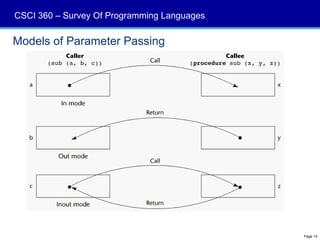
Models of Parameter Passing


                                             Page 15
CSCI 360 – Survey Of Programming Languages

Pass-by-Value (In Mode)
 The value of the actual parameter is used to
  initialize the corresponding formal parameter
   – Normally implemented by copying
   – Can be implemented by transmitting an access path
     but not recommended (enforcing write protection is not
     easy)
   – When copies are used, additional storage is required
   – Storage and copy operations can be costly


                                                              Page 16
CSCI 360 – Survey Of Programming Languages

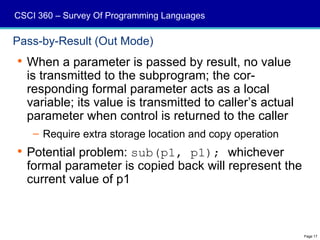
Pass-by-Result (Out Mode)
 When a parameter is passed by result, no value
  is transmitted to the subprogram; the cor-
  responding formal parameter acts as a local
  variable; its value is transmitted to caller’s actual
  parameter when control is returned to the caller
    – Require extra storage location and copy operation
 Potential problem: sub(p1, p1); whichever
  formal parameter is copied back will represent the
  current value of p1


                                                          Page 17
CSCI 360 – Survey Of Programming Languages

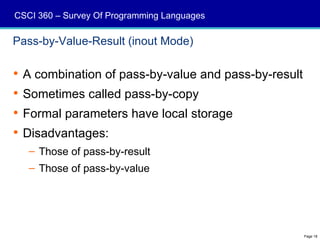
Pass-by-Value-Result (inout Mode)

 A combination of pass-by-value and pass-by-result
 Sometimes called pass-by-copy
 Formal parameters have local storage
 Disadvantages:
   – Those of pass-by-result
   – Those of pass-by-value


                                                      Page 18
CSCI 360 – Survey Of Programming Languages

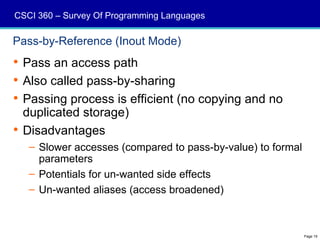
Pass-by-Reference (Inout Mode)
 Pass an access path
 Also called pass-by-sharing
 Passing process is efficient (no copying and no
  duplicated storage)
 Disadvantages
   – Slower accesses (compared to pass-by-value) to formal
     parameters
   – Potentials for un-wanted side effects
   – Un-wanted aliases (access broadened)


                                                             Page 19
CSCI 360 – Survey Of Programming Languages

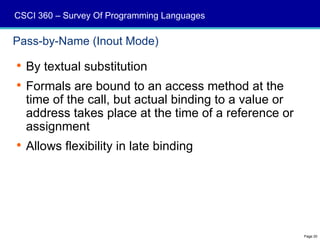
Pass-by-Name (Inout Mode)

 By textual substitution
 Formals are bound to an access method at the
  time of the call, but actual binding to a value or
  address takes place at the time of a reference or
  assignment
 Allows flexibility in late binding


                                                       Page 20
CSCI 360 – Survey Of Programming Languages

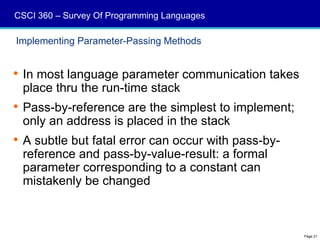
Implementing Parameter-Passing Methods


 In most language parameter communication takes
  place thru the run-time stack
 Pass-by-reference are the simplest to implement;
  only an address is placed in the stack
 A subtle but fatal error can occur with pass-by-
  reference and pass-by-value-result: a formal
  parameter corresponding to a constant can
  mistakenly be changed


                                                     Page 21
CSCI 360 – Survey Of Programming Languages

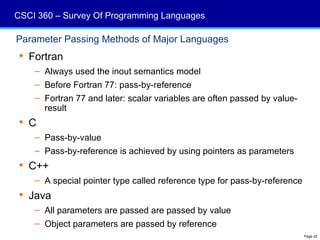
Parameter Passing Methods of Major Languages
 Fortran
    – Always used the inout semantics model
    – Before Fortran 77: pass-by-reference
    – Fortran 77 and later: scalar variables are often passed by value-
      result
 C
    – Pass-by-value
    – Pass-by-reference is achieved by using pointers as parameters
 C++
    – A special pointer type called reference type for pass-by-reference
 Java
    – All parameters are passed are passed by value
    – Object parameters are passed by reference
                                                                           Page 22
CSCI 360 – Survey Of Programming Languages

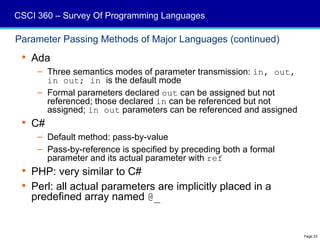
Parameter Passing Methods of Major Languages (continued)
  Ada
     – Three semantics modes of parameter transmission: in, out,
       in out; in is the default mode
     – Formal parameters declared out can be assigned but not
       referenced; those declared in can be referenced but not
       assigned; in out parameters can be referenced and assigned
  C#
     – Default method: pass-by-value
     – Pass-by-reference is specified by preceding both a formal
       parameter and its actual parameter with ref
  PHP: very similar to C#
  Perl: all actual parameters are implicitly placed in a
   predefined array named @_


                                                                    Page 23
CSCI 360 – Survey Of Programming Languages

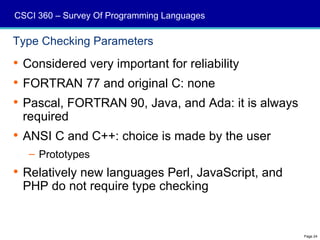
Type Checking Parameters
 Considered very important for reliability
 FORTRAN 77 and original C: none
 Pascal, FORTRAN 90, Java, and Ada: it is always
  required
 ANSI C and C++: choice is made by the user
   – Prototypes
 Relatively new languages Perl, JavaScript, and
  PHP do not require type checking


                                                    Page 24
CSCI 360 – Survey Of Programming Languages

Multidimensional Arrays as Parameters


 If a multidimensional array is passed to a
  subprogram and the subprogram is separately
  compiled, the compiler needs to know the
  declared size of that array to build the storage
  mapping function


                                                     Page 25
CSCI 360 – Survey Of Programming Languages

Multidimensional Arrays as Parameters: C and C++

 Programmer is required to include the declared
  sizes of all but the first subscript in the actual
  parameter
 Disallows writing flexible subprograms
 Solution: pass a pointer to the array and the sizes
  of the dimensions as other parameters; the user
  must include the storage mapping function in
  terms of the size parameters


                                                        Page 26
CSCI 360 – Survey Of Programming Languages

Multidimensional Arrays as Parameters: Pascal and Ada

 Pascal
    – Not a problem; declared size is part of the
      array’s type
 Ada
    – Constrained arrays - like Pascal
    – Unconstrained arrays - declared size is part of
      the object declaration


                                                        Page 27
CSCI 360 – Survey Of Programming Languages


Multidimensional Arrays as Parameters: Fortran


 Formal parameter that are arrays have a
  declaration after the header
    – For single-dimension arrays, the subscript is
      irrelevant
    – For multi-dimensional arrays, the subscripts
      allow the storage-mapping function


                                                      Page 28
CSCI 360 – Survey Of Programming Languages

Multidimensional Arrays as Parameters: Java and C#


 Similar to Ada
 Arrays are objects; they are all single-dimensioned,
  but the elements can be arrays
 Each array inherits a named constant (length in
  Java, Length in C#) that is set to the length of the
  array when the array object is created


                                                         Page 29
CSCI 360 – Survey Of Programming Languages

Design Considerations for Parameter Passing


 Two important considerations
   – Efficiency
   – One-way or two-way data transfer
 But the above considerations are in conflict
   – Good programming suggest limited access to variables,
     which means one-way whenever possible
   – But pass-by-reference is more efficient to pass
     structures of significant size


                                                             Page 30
CSCI 360 – Survey Of Programming Languages


Parameters that are Subprogram Names
 It is sometimes convenient to pass
  subprogram names as parameters
 Issues:
   1. Are parameter types checked?
   2. What is the correct referencing environment
      for a subprogram that was sent as a
      parameter?


                                                    Page 31
CSCI 360 – Survey Of Programming Languages

Subprogram Names as Parameters: Parameter Type Checking

   C and C++: functions cannot be passed as
    parameters but pointers to functions can be
    passed; parameters can be type checked
   FORTRAN 95 type checks
   Later versions of Pascal and
   Ada does not allow subprogram parameters; a
    similar alternative is provided via Ada’s generic
    facility


                                                          Page 32
CSCI 360 – Survey Of Programming Languages

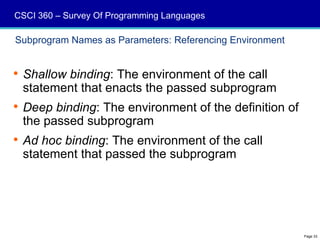
Subprogram Names as Parameters: Referencing Environment


 Shallow binding: The environment of the call
  statement that enacts the passed subprogram
 Deep binding: The environment of the definition of
  the passed subprogram
 Ad hoc binding: The environment of the call
  statement that passed the subprogram


                                                          Page 33
CSCI 360 – Survey Of Programming Languages

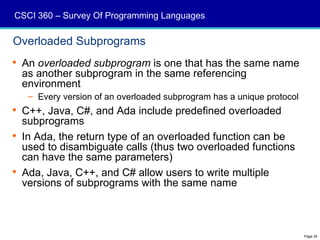
Overloaded Subprograms
 An overloaded subprogram is one that has the same name
  as another subprogram in the same referencing
  environment
   – Every version of an overloaded subprogram has a unique protocol
 C++, Java, C#, and Ada include predefined overloaded
  subprograms
 In Ada, the return type of an overloaded function can be
  used to disambiguate calls (thus two overloaded functions
  can have the same parameters)
 Ada, Java, C++, and C# allow users to write multiple
  versions of subprograms with the same name


                                                                       Page 34
CSCI 360 – Survey Of Programming Languages

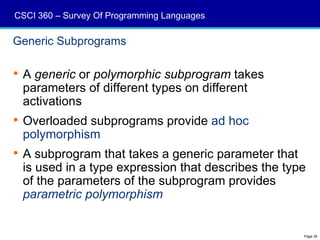
Generic Subprograms

 A generic or polymorphic subprogram takes
  parameters of different types on different
  activations
 Overloaded subprograms provide ad hoc
  polymorphism
 A subprogram that takes a generic parameter that
  is used in a type expression that describes the type
  of the parameters of the subprogram provides
  parametric polymorphism


                                                     Page 35
CSCI 360 – Survey Of Programming Languages


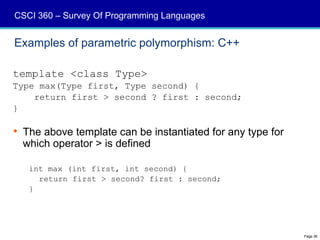
Examples of parametric polymorphism: C++

template <class Type>
Type max(Type first, Type second) {
    return first > second ? first : second;
}

 The above template can be instantiated for any type for
  which operator > is defined

   int max (int first, int second) {
     return first > second? first : second;
   }


                                                            Page 36
CSCI 360 – Survey Of Programming Languages


                   Functions and Co-routines


                                               37
CSCI 360 – Survey Of Programming Languages

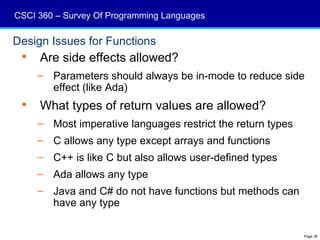
Design Issues for Functions
    Are side effects allowed?
     – Parameters should always be in-mode to reduce side
       effect (like Ada)
    What types of return values are allowed?
     – Most imperative languages restrict the return types
     – C allows any type except arrays and functions
     – C++ is like C but also allows user-defined types
     – Ada allows any type
     – Java and C# do not have functions but methods can
       have any type

                                                             Page 38
CSCI 360 – Survey Of Programming Languages


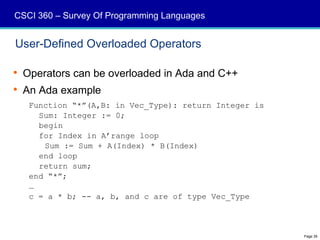
User-Defined Overloaded Operators

 Operators can be overloaded in Ada and C++
 An Ada example
   Function “*”(A,B: in Vec_Type): return Integer is
     Sum: Integer := 0;
     begin
     for Index in A’range loop
      Sum := Sum + A(Index) * B(Index)
     end loop
     return sum;
   end “*”;
   …
   c = a * b; -- a, b, and c are of type Vec_Type


                                                       Page 39
CSCI 360 – Survey Of Programming Languages

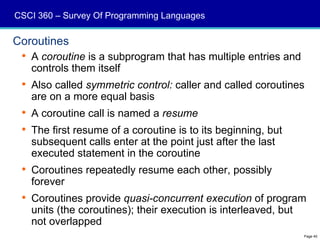
Coroutines
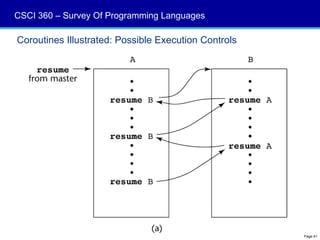
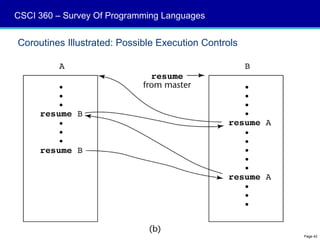
  A coroutine is a subprogram that has multiple entries and
   controls them itself
  Also called symmetric control: caller and called coroutines
   are on a more equal basis
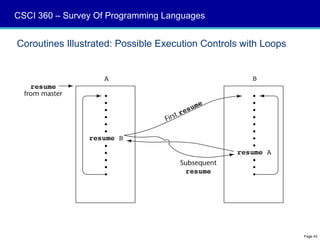
  A coroutine call is named a resume
  The first resume of a coroutine is to its beginning, but
   subsequent calls enter at the point just after the last
   executed statement in the coroutine
  Coroutines repeatedly resume each other, possibly
   forever
  Coroutines provide quasi-concurrent execution of program
   units (the coroutines); their execution is interleaved, but
   not overlapped
                                                               Page 40
CSCI 360 – Survey Of Programming Languages

Coroutines Illustrated: Possible Execution Controls


                                                      Page 41
CSCI 360 – Survey Of Programming Languages


Coroutines Illustrated: Possible Execution Controls


                                                      Page 42
CSCI 360 – Survey Of Programming Languages


Coroutines Illustrated: Possible Execution Controls with Loops


                                                                 Page 43
CSCI 360 – Survey Of Programming Languages


                   Summary


                                             44
CSCI 360 – Survey Of Programming Languages

Summary

 A subprogram definition describes the actions represented
  by the subprogram
 Subprograms can be either functions or procedures
 Local variables in subprograms can be stack-dynamic or
  static
 Three models of parameter passing: in mode, out mode,
  and inout mode
 Some languages allow operator overloading
 Subprograms can be generic
 A coroutine is a special subprogram with multiple entries

                                                              Page 45
CSCI 360 – Survey Of Programming Languages

Next Time…


                  Implementing
                   Subprograms


                                             Page 46

Csci360 08-subprograms

  • 1.
    CSCI 360 Survey OfProgramming Languages 8 – Subprograms Spring, 2008 Doug L Hoffman, PhD 1
  • 2.
    CSCI 360 –Survey Of Programming Languages Chapter 9 Topics  Introduction  Fundamentals of Subprograms  Design Issues for Subprograms  Local Referencing Environments  Parameter-Passing Methods  Parameters That Are Subprogram Names  Overloaded Subprograms  Generic Subprograms  Design Issues for Functions  User-Defined Overloaded Operators  Coroutines Page 2
  • 3.
    CSCI 360 –Survey Of Programming Languages Introduction  Two fundamental abstraction facilities – Process abstraction  Emphasized from early days – Data abstraction  Emphasized in the1980s Page 3
  • 4.
    CSCI 360 –Survey Of Programming Languages Fundamentals of Subprograms 4
  • 5.
    CSCI 360 –Survey Of Programming Languages Fundamentals of Subprograms  Each subprogram has a single entry point  The calling program is suspended during execution of the called subprogram  Control always returns to the caller when the called subprogram’s execution terminates Page 5
  • 6.
    CSCI 360 –Survey Of Programming Languages Basic Definitions  A subprogram definition describes the interface to and the actions of the subprogram abstraction  A subprogram call is an explicit request that the subprogram be executed  A subprogram header is the first part of the definition, including the name, the kind of subprogram, and the formal parameters  The parameter profile (aka signature) of a subprogram is the number, order, and types of its parameters  The protocol is a subprogram’s parameter profile and, if it is a function, its return type Page 6
  • 7.
    CSCI 360 –Survey Of Programming Languages Basic Definitions (continued)  Function declarations in C and C++ are often called prototypes  A subprogram declaration provides the protocol, but not the body, of the subprogram  A formal parameter is a dummy variable listed in the subprogram header and used in the subprogram  An actual parameter represents a value or address used in the subprogram call statement Page 7
  • 8.
    CSCI 360 –Survey Of Programming Languages Actual/Formal Parameter Correspondence  Positional – The binding of actual parameters to formal parameters is by position: the first actual parameter is bound to the first formal parameter and so forth – Safe and effective  Keyword – The name of the formal parameter to which an actual parameter is to be bound is specified with the actual parameter – Parameters can appear in any order Page 8
  • 9.
    CSCI 360 –Survey Of Programming Languages Formal Parameter Default Values  In certain languages (e.g., C++, Ada), formal parameters can have default values (if not actual parameter is passed) – In C++, default parameters must appear last because parameters are positionally associated  C# methods can accept a variable number of parameters as long as they are of the same type Page 9
  • 10.
    CSCI 360 –Survey Of Programming Languages Procedures and Functions  There are two categories of subprograms – Procedures are collection of statements that define parameterized computations – Functions structurally resemble procedures but are semantically modeled on mathematical functions  They are expected to produce no side effects  In practice, program functions have side effects Page 10
  • 11.
    CSCI 360 –Survey Of Programming Languages Design Issues for Subprograms  What parameter passing methods are provided?  Are parameter types checked?  Are local variables static or dynamic?  Can subprogram definitions appear in other subprogram definitions?  Can subprograms be overloaded?  Can subprogram be generic? Page 11
  • 12.
    CSCI 360 –Survey Of Programming Languages Local Referencing Environments  Local variables can be stack-dynamic (bound to storage) – Advantages  Support for recursion  Storage for locals is shared among some subprograms – Disadvantages  Allocation/de-allocation, initialization time  Indirect addressing  Subprograms cannot be history sensitive  Local variables can be static – More efficient (no indirection) – No run-time overhead – Cannot support recursion (FORTRAN) Page 12
  • 13.
    CSCI 360 –Survey Of Programming Languages Parameter Passing 13
  • 14.
    CSCI 360 –Survey Of Programming Languages Parameter Passing Methods  Ways in which parameters are transmitted to and/or from called subprograms – Pass-by-value – Pass-by-result – Pass-by-value-result – Pass-by-reference – Pass-by-name Page 14
  • 15.
    CSCI 360 –Survey Of Programming Languages Models of Parameter Passing Page 15
  • 16.
    CSCI 360 –Survey Of Programming Languages Pass-by-Value (In Mode)  The value of the actual parameter is used to initialize the corresponding formal parameter – Normally implemented by copying – Can be implemented by transmitting an access path but not recommended (enforcing write protection is not easy) – When copies are used, additional storage is required – Storage and copy operations can be costly Page 16
  • 17.
    CSCI 360 –Survey Of Programming Languages Pass-by-Result (Out Mode)  When a parameter is passed by result, no value is transmitted to the subprogram; the cor- responding formal parameter acts as a local variable; its value is transmitted to caller’s actual parameter when control is returned to the caller – Require extra storage location and copy operation  Potential problem: sub(p1, p1); whichever formal parameter is copied back will represent the current value of p1 Page 17
  • 18.
    CSCI 360 –Survey Of Programming Languages Pass-by-Value-Result (inout Mode)  A combination of pass-by-value and pass-by-result  Sometimes called pass-by-copy  Formal parameters have local storage  Disadvantages: – Those of pass-by-result – Those of pass-by-value Page 18
  • 19.
    CSCI 360 –Survey Of Programming Languages Pass-by-Reference (Inout Mode)  Pass an access path  Also called pass-by-sharing  Passing process is efficient (no copying and no duplicated storage)  Disadvantages – Slower accesses (compared to pass-by-value) to formal parameters – Potentials for un-wanted side effects – Un-wanted aliases (access broadened) Page 19
  • 20.
    CSCI 360 –Survey Of Programming Languages Pass-by-Name (Inout Mode)  By textual substitution  Formals are bound to an access method at the time of the call, but actual binding to a value or address takes place at the time of a reference or assignment  Allows flexibility in late binding Page 20
  • 21.
    CSCI 360 –Survey Of Programming Languages Implementing Parameter-Passing Methods  In most language parameter communication takes place thru the run-time stack  Pass-by-reference are the simplest to implement; only an address is placed in the stack  A subtle but fatal error can occur with pass-by- reference and pass-by-value-result: a formal parameter corresponding to a constant can mistakenly be changed Page 21
  • 22.
    CSCI 360 –Survey Of Programming Languages Parameter Passing Methods of Major Languages  Fortran – Always used the inout semantics model – Before Fortran 77: pass-by-reference – Fortran 77 and later: scalar variables are often passed by value- result  C – Pass-by-value – Pass-by-reference is achieved by using pointers as parameters  C++ – A special pointer type called reference type for pass-by-reference  Java – All parameters are passed are passed by value – Object parameters are passed by reference Page 22
  • 23.
    CSCI 360 –Survey Of Programming Languages Parameter Passing Methods of Major Languages (continued)  Ada – Three semantics modes of parameter transmission: in, out, in out; in is the default mode – Formal parameters declared out can be assigned but not referenced; those declared in can be referenced but not assigned; in out parameters can be referenced and assigned  C# – Default method: pass-by-value – Pass-by-reference is specified by preceding both a formal parameter and its actual parameter with ref  PHP: very similar to C#  Perl: all actual parameters are implicitly placed in a predefined array named @_ Page 23
  • 24.
    CSCI 360 –Survey Of Programming Languages Type Checking Parameters  Considered very important for reliability  FORTRAN 77 and original C: none  Pascal, FORTRAN 90, Java, and Ada: it is always required  ANSI C and C++: choice is made by the user – Prototypes  Relatively new languages Perl, JavaScript, and PHP do not require type checking Page 24
  • 25.
    CSCI 360 –Survey Of Programming Languages Multidimensional Arrays as Parameters  If a multidimensional array is passed to a subprogram and the subprogram is separately compiled, the compiler needs to know the declared size of that array to build the storage mapping function Page 25
  • 26.
    CSCI 360 –Survey Of Programming Languages Multidimensional Arrays as Parameters: C and C++  Programmer is required to include the declared sizes of all but the first subscript in the actual parameter  Disallows writing flexible subprograms  Solution: pass a pointer to the array and the sizes of the dimensions as other parameters; the user must include the storage mapping function in terms of the size parameters Page 26
  • 27.
    CSCI 360 –Survey Of Programming Languages Multidimensional Arrays as Parameters: Pascal and Ada  Pascal – Not a problem; declared size is part of the array’s type  Ada – Constrained arrays - like Pascal – Unconstrained arrays - declared size is part of the object declaration Page 27
  • 28.
    CSCI 360 –Survey Of Programming Languages Multidimensional Arrays as Parameters: Fortran  Formal parameter that are arrays have a declaration after the header – For single-dimension arrays, the subscript is irrelevant – For multi-dimensional arrays, the subscripts allow the storage-mapping function Page 28
  • 29.
    CSCI 360 –Survey Of Programming Languages Multidimensional Arrays as Parameters: Java and C#  Similar to Ada  Arrays are objects; they are all single-dimensioned, but the elements can be arrays  Each array inherits a named constant (length in Java, Length in C#) that is set to the length of the array when the array object is created Page 29
  • 30.
    CSCI 360 –Survey Of Programming Languages Design Considerations for Parameter Passing  Two important considerations – Efficiency – One-way or two-way data transfer  But the above considerations are in conflict – Good programming suggest limited access to variables, which means one-way whenever possible – But pass-by-reference is more efficient to pass structures of significant size Page 30
  • 31.
    CSCI 360 –Survey Of Programming Languages Parameters that are Subprogram Names  It is sometimes convenient to pass subprogram names as parameters  Issues: 1. Are parameter types checked? 2. What is the correct referencing environment for a subprogram that was sent as a parameter? Page 31
  • 32.
    CSCI 360 –Survey Of Programming Languages Subprogram Names as Parameters: Parameter Type Checking  C and C++: functions cannot be passed as parameters but pointers to functions can be passed; parameters can be type checked  FORTRAN 95 type checks  Later versions of Pascal and  Ada does not allow subprogram parameters; a similar alternative is provided via Ada’s generic facility Page 32
  • 33.
    CSCI 360 –Survey Of Programming Languages Subprogram Names as Parameters: Referencing Environment  Shallow binding: The environment of the call statement that enacts the passed subprogram  Deep binding: The environment of the definition of the passed subprogram  Ad hoc binding: The environment of the call statement that passed the subprogram Page 33
  • 34.
    CSCI 360 –Survey Of Programming Languages Overloaded Subprograms  An overloaded subprogram is one that has the same name as another subprogram in the same referencing environment – Every version of an overloaded subprogram has a unique protocol  C++, Java, C#, and Ada include predefined overloaded subprograms  In Ada, the return type of an overloaded function can be used to disambiguate calls (thus two overloaded functions can have the same parameters)  Ada, Java, C++, and C# allow users to write multiple versions of subprograms with the same name Page 34
  • 35.
    CSCI 360 –Survey Of Programming Languages Generic Subprograms  A generic or polymorphic subprogram takes parameters of different types on different activations  Overloaded subprograms provide ad hoc polymorphism  A subprogram that takes a generic parameter that is used in a type expression that describes the type of the parameters of the subprogram provides parametric polymorphism Page 35
  • 36.
    CSCI 360 –Survey Of Programming Languages Examples of parametric polymorphism: C++ template <class Type> Type max(Type first, Type second) { return first > second ? first : second; }  The above template can be instantiated for any type for which operator > is defined int max (int first, int second) { return first > second? first : second; } Page 36
  • 37.
    CSCI 360 –Survey Of Programming Languages Functions and Co-routines 37
  • 38.
    CSCI 360 –Survey Of Programming Languages Design Issues for Functions  Are side effects allowed? – Parameters should always be in-mode to reduce side effect (like Ada)  What types of return values are allowed? – Most imperative languages restrict the return types – C allows any type except arrays and functions – C++ is like C but also allows user-defined types – Ada allows any type – Java and C# do not have functions but methods can have any type Page 38
  • 39.
    CSCI 360 –Survey Of Programming Languages User-Defined Overloaded Operators  Operators can be overloaded in Ada and C++  An Ada example Function “*”(A,B: in Vec_Type): return Integer is Sum: Integer := 0; begin for Index in A’range loop Sum := Sum + A(Index) * B(Index) end loop return sum; end “*”; … c = a * b; -- a, b, and c are of type Vec_Type Page 39
  • 40.
    CSCI 360 –Survey Of Programming Languages Coroutines  A coroutine is a subprogram that has multiple entries and controls them itself  Also called symmetric control: caller and called coroutines are on a more equal basis  A coroutine call is named a resume  The first resume of a coroutine is to its beginning, but subsequent calls enter at the point just after the last executed statement in the coroutine  Coroutines repeatedly resume each other, possibly forever  Coroutines provide quasi-concurrent execution of program units (the coroutines); their execution is interleaved, but not overlapped Page 40
  • 41.
    CSCI 360 –Survey Of Programming Languages Coroutines Illustrated: Possible Execution Controls Page 41
  • 42.
    CSCI 360 –Survey Of Programming Languages Coroutines Illustrated: Possible Execution Controls Page 42
  • 43.
    CSCI 360 –Survey Of Programming Languages Coroutines Illustrated: Possible Execution Controls with Loops Page 43
  • 44.
    CSCI 360 –Survey Of Programming Languages Summary 44
  • 45.
    CSCI 360 –Survey Of Programming Languages Summary  A subprogram definition describes the actions represented by the subprogram  Subprograms can be either functions or procedures  Local variables in subprograms can be stack-dynamic or static  Three models of parameter passing: in mode, out mode, and inout mode  Some languages allow operator overloading  Subprograms can be generic  A coroutine is a special subprogram with multiple entries Page 45
  • 46.
    CSCI 360 –Survey Of Programming Languages Next Time… Implementing Subprograms Page 46