Monolithic and
Procedural Programming
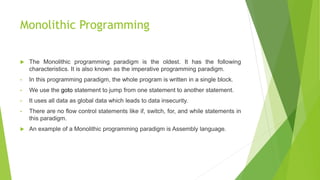
Monolithic Programming
 The Monolithic programming paradigm is the oldest. It has the following
characteristics. It is also known as the imperative programming paradigm.
• In this programming paradigm, the whole program is written in a single block.
• We use the goto statement to jump from one statement to another statement.
• It uses all data as global data which leads to data insecurity.
• There are no flow control statements like if, switch, for, and while statements in
this paradigm.
 An example of a Monolithic programming paradigm is Assembly language.
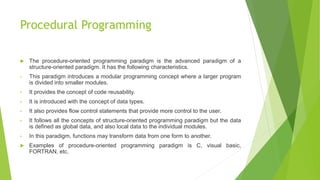
Procedural Programming
 The procedure-oriented programming paradigm is the advanced paradigm of a
structure-oriented paradigm. It has the following characteristics.
• This paradigm introduces a modular programming concept where a larger program
is divided into smaller modules.
• It provides the concept of code reusability.
• It is introduced with the concept of data types.
• It also provides flow control statements that provide more control to the user.
• It follows all the concepts of structure-oriented programming paradigm but the data
is defined as global data, and also local data to the individual modules.
• In this paradigm, functions may transform data from one form to another.
 Examples of procedure-oriented programming paradigm is C, visual basic,
FORTRAN, etc.
Key Features of Procedural
Programming
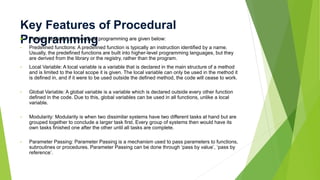
 The key features of procedural programming are given below:
• Predefined functions: A predefined function is typically an instruction identified by a name.
Usually, the predefined functions are built into higher-level programming languages, but they
are derived from the library or the registry, rather than the program.
• Local Variable: A local variable is a variable that is declared in the main structure of a method
and is limited to the local scope it is given. The local variable can only be used in the method it
is defined in, and if it were to be used outside the defined method, the code will cease to work.
• Global Variable: A global variable is a variable which is declared outside every other function
defined in the code. Due to this, global variables can be used in all functions, unlike a local
variable.
• Modularity: Modularity is when two dissimilar systems have two different tasks at hand but are
grouped together to conclude a larger task first. Every group of systems then would have its
own tasks finished one after the other until all tasks are complete.
• Parameter Passing: Parameter Passing is a mechanism used to pass parameters to functions,
subroutines or procedures. Parameter Passing can be done through ‘pass by value’, ‘pass by
reference’.
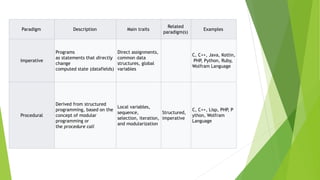
Paradigm Description Main traits
Related
paradigm(s)
Examples
Imperative
Programs
as statements that directly
change
computed state (datafields)
Direct assignments,
common data
structures, global
variables
C, C++, Java, Kotlin,
PHP, Python, Ruby,
Wolfram Language
Procedural
Derived from structured
programming, based on the
concept of modular
programming or
the procedure call
Local variables,
sequence,
selection, iteration,
and modularization
Structured,
imperative
C, C++, Lisp, PHP, P
ython, Wolfram
Language
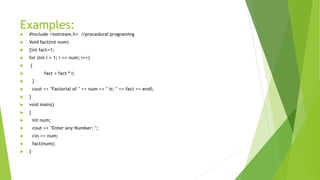
Examples:
 #include <iostream.h> //procedural programing
 Void fact(int num)
 {int fact=1;
 for (int i = 1; i <= num; i++)
 {
 fact = fact * i;
 }
 cout << "Factorial of " << num << " is: " << fact << endl;
 }
 void main()
 {
 int num;
 cout << "Enter any Number: ";
 cin >> num;
 fact(num);
 }
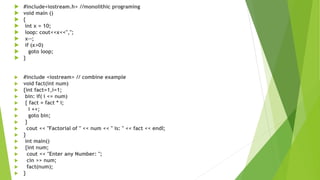
 #include<iostream.h> //monolithic programing
 void main ()
 {
 int x = 10;
 loop: cout<<x<<",";
 x--;
 if (x>0)
 goto loop;
 }
 #include <iostream> // combine example
 void fact(int num)
 {int fact=1,i=1;
 bin: if( i <= num)
 { fact = fact * i;
 i ++;
 goto bin;
 }
 cout << "Factorial of " << num << " is: " << fact << endl;
 }
 int main()
 {int num;
 cout << "Enter any Number: ";
 cin >> num;
 fact(num);
 }

Monolithic and Procedural Programming

  • 1.
  • 2.
    Monolithic Programming  TheMonolithic programming paradigm is the oldest. It has the following characteristics. It is also known as the imperative programming paradigm. • In this programming paradigm, the whole program is written in a single block. • We use the goto statement to jump from one statement to another statement. • It uses all data as global data which leads to data insecurity. • There are no flow control statements like if, switch, for, and while statements in this paradigm.  An example of a Monolithic programming paradigm is Assembly language.
  • 3.
    Procedural Programming  Theprocedure-oriented programming paradigm is the advanced paradigm of a structure-oriented paradigm. It has the following characteristics. • This paradigm introduces a modular programming concept where a larger program is divided into smaller modules. • It provides the concept of code reusability. • It is introduced with the concept of data types. • It also provides flow control statements that provide more control to the user. • It follows all the concepts of structure-oriented programming paradigm but the data is defined as global data, and also local data to the individual modules. • In this paradigm, functions may transform data from one form to another.  Examples of procedure-oriented programming paradigm is C, visual basic, FORTRAN, etc.
  • 4.
    Key Features ofProcedural Programming  The key features of procedural programming are given below: • Predefined functions: A predefined function is typically an instruction identified by a name. Usually, the predefined functions are built into higher-level programming languages, but they are derived from the library or the registry, rather than the program. • Local Variable: A local variable is a variable that is declared in the main structure of a method and is limited to the local scope it is given. The local variable can only be used in the method it is defined in, and if it were to be used outside the defined method, the code will cease to work. • Global Variable: A global variable is a variable which is declared outside every other function defined in the code. Due to this, global variables can be used in all functions, unlike a local variable. • Modularity: Modularity is when two dissimilar systems have two different tasks at hand but are grouped together to conclude a larger task first. Every group of systems then would have its own tasks finished one after the other until all tasks are complete. • Parameter Passing: Parameter Passing is a mechanism used to pass parameters to functions, subroutines or procedures. Parameter Passing can be done through ‘pass by value’, ‘pass by reference’.
  • 5.
    Paradigm Description Maintraits Related paradigm(s) Examples Imperative Programs as statements that directly change computed state (datafields) Direct assignments, common data structures, global variables C, C++, Java, Kotlin, PHP, Python, Ruby, Wolfram Language Procedural Derived from structured programming, based on the concept of modular programming or the procedure call Local variables, sequence, selection, iteration, and modularization Structured, imperative C, C++, Lisp, PHP, P ython, Wolfram Language
  • 6.
    Examples:  #include <iostream.h>//procedural programing  Void fact(int num)  {int fact=1;  for (int i = 1; i <= num; i++)  {  fact = fact * i;  }  cout << "Factorial of " << num << " is: " << fact << endl;  }  void main()  {  int num;  cout << "Enter any Number: ";  cin >> num;  fact(num);  }
  • 7.
     #include<iostream.h> //monolithicprograming  void main ()  {  int x = 10;  loop: cout<<x<<",";  x--;  if (x>0)  goto loop;  }  #include <iostream> // combine example  void fact(int num)  {int fact=1,i=1;  bin: if( i <= num)  { fact = fact * i;  i ++;  goto bin;  }  cout << "Factorial of " << num << " is: " << fact << endl;  }  int main()  {int num;  cout << "Enter any Number: ";  cin >> num;  fact(num);  }