ICS 313 - Fundamentals of Programming Languages 1
9. Subprograms
9.2 Fundamentals of Subprograms
General characteristics of subprograms
A subprogram has a single entry point
The caller is suspended during execution of the called subprogram
Control always returns to the caller when the called subprogram’s
execution terminates
Basic definitions
A subprogram definition is a description of the actions of the subprogram
abstraction
A subprogram call is an explicit request that the subprogram be executed
A subprogram header is the first line of the definition, including the name,
the kind of subprogram, and the formal parameters
The parameter profile of a subprogram is the number, order, and types of
its parameters
The protocol of a subprogram is its parameter profile plus, if it is a function,
its return type
A subprogram declaration provides the protocol, but not the body, of the
subprogram
ICS 313 - Fundamentals of Programming Languages 2
9.2 Fundamentals of Subprograms (continued)
A formal parameter is a dummy variable listed in the subprogram header and used in the
subprogram
An actual parameter represents a value or address used in the subprogram call statement
Actual/Formal Parameter Correspondence
Positional
Keyword
e.g. SORT(LIST => A, LENGTH => N);
Advantage: order is irrelevant
Disadvantage: user must know the formal parameter’s names
Default Values:
e.g.
procedure SORT(LIST : LIST_TYPE; LENGTH : INTEGER := 100);
...
SORT(LIST => A);
Procedures provide user-defined statements
Functions provide user-defined operators
9.3 Design Issues for Subprograms
What parameter passing methods are provided?
Are parameter types checked?
Are local variables static or dynamic?
What is the referencing environment of a passed subprogram?
Are parameter types in passed subprograms checked?
Can subprogram definitions be nested?
Can subprograms be overloaded?
Are subprograms allowed to be generic?
Is separate or independent compilation supported?
ICS 313 - Fundamentals of Programming Languages 3
9.4 Local referencing environments
If local variables are stack-dynamic:
Advantages
Support for recursion
Storage for locals is shared among some subprograms
Disadvantages
Allocation/deallocation time
Indirect addressing
Subprograms cannot be history sensitive
Static locals are the opposite
Language Examples
FORTRAN 77 and 90 - most are static, but the implementor can
choose either
(User can force static with SAVE)
C - both (variables declared to be static are)
(default is stack dynamic)
Pascal, Java, and Ada - dynamic only
9.5 Parameter Passing Methods
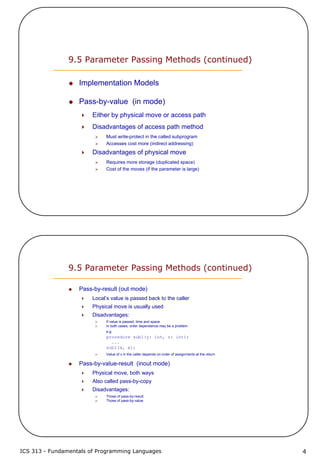
We discuss these at several different levels
Semantic Models: in mode, out mode, inout mode
Conceptual Models of Transfer
Physically move a value
Move an access path
ICS 313 - Fundamentals of Programming Languages 4
9.5 Parameter Passing Methods (continued)
Implementation Models
Pass-by-value (in mode)
Either by physical move or access path
Disadvantages of access path method
Must write-protect in the called subprogram
Accesses cost more (indirect addressing)
Disadvantages of physical move
Requires more storage (duplicated space)
Cost of the moves (if the parameter is large)
9.5 Parameter Passing Methods (continued)
Pass-by-result (out mode)
Local’s value is passed back to the caller
Physical move is usually used
Disadvantages:
If value is passed, time and space
In both cases, order dependence may be a problem
e.g.
procedure sub1(y: int, z: int);
...
sub1(x, x);
Value of x in the caller depends on order of assignments at the return
Pass-by-value-result (inout mode)
Physical move, both ways
Also called pass-by-copy
Disadvantages:
Those of pass-by-result
Those of pass-by-value
ICS 313 - Fundamentals of Programming Languages 5
9.5 Parameter Passing Methods (continued)
Pass-by-reference (inout mode)
Pass an access path
Also called pass-by-sharing
Advantage: passing process is efficient (no copying and no duplicated
storage)
Disadvantages
Slower accesses
Allows aliasing
Actual parameter collisions
e.g. procedure sub1(a: int, b: int);
...
sub1(x, x);
Array element collisions
e.g.
sub1(a[i], a[j]); /* if i = j */
Also, sub2(a, a[i]); (a different one)
Collision between formals and globals
– Root cause of all of these is: The called subprogram is provided wider access to
nonlocals than is necessary
– Pass-by-value-result does not allow these aliases (but has other problems!)
9.5 Parameter Passing Methods (continued)
Pass-by-name (multiple mode)
By textual substitution
Formals are bound to an access method at the time of the call,
but actual binding to a value or address takes place at the time
of a reference or assignment
Purpose: flexibility of late binding
Resulting semantics:
If actual is a scalar variable, it is pass-by-reference
If actual is a constant expression, it is pass-by-value
If actual is an array element, it is like nothing else
e.g.
procedure sub1(x: int; y: int);
begin
x := 1;
y := 2;
x := 2;
y := 3;
end;
sub1(i, a[i]);
ICS 313 - Fundamentals of Programming Languages 6
9.5 Parameter Passing Methods (continued)
If actual is an expression with a reference to a variable that is also
accessible in the program, it is also like nothing else
e.g. (assume k is a global variable)
procedure sub1(x: int; y: int; z: int);
begin
k := 1;
y := x;
k := 5;
z := x;
end;
sub1(k+1, j, i);
Disadvantages of pass by name
Very inefficient references
Too tricky; hard to read and understand
9.5 Parameter Passing Methods (continued)
Language Examples
FORTRAN
Before 77, pass-by-reference
77 - scalar variables are often passed by value-result
ALGOL 60
Pass-by-name is default; pass-by-value is optional
ALGOL W
Pass-by-value-result
C
Pass-by-value
Pascal and Modula-2
Default is pass-by-value; pass-by-reference is optional
C++
Like C, but also allows reference type parameters, which provide the efficiency of
pass-by-reference with in-mode semantics
ICS 313 - Fundamentals of Programming Languages 7
9.5 Parameter Passing Methods (continued)
Ada
All three semantic modes are available
If out, it cannot be referenced
If in, it cannot be assigned
Java
Like C++, except only references
Type checking parameters
(Now considered very important for reliability)
FORTRAN 77 and original C: none
Pascal, FORTRAN 90, Java, and Ada: it is always
required
ANSI C and C++: choice is made by the user
9.5 Parameter Passing Methods (continued)
Implementing Parameter Passing
ALGOL 60 and most of its descendants use the run-time stack
Value - copy it to the stack; references are indirect to the stack
Result - same
Reference - regardless of form, put the address in the stack
Name - run-time resident code segments or subprograms evaluate the
address of the parameter; called for each reference to the formal; these are
called thunks
Very expensive, compared to reference or value-result
ICS 313 - Fundamentals of Programming Languages 8
9.5 Parameter Passing Methods (continued)
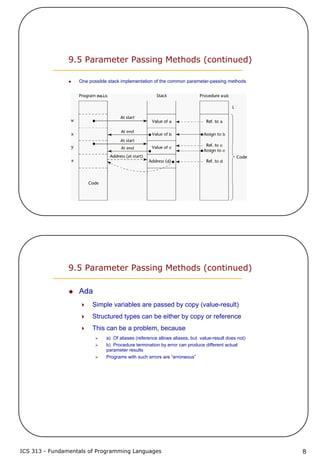
One possible stack implementation of the common parameter-passing methods
9.5 Parameter Passing Methods (continued)
Ada
Simple variables are passed by copy (value-result)
Structured types can be either by copy or reference
This can be a problem, because
a) Of aliases (reference allows aliases, but value-result does not)
b) Procedure termination by error can produce different actual
parameter results
Programs with such errors are “erroneous”
ICS 313 - Fundamentals of Programming Languages 9
9.5 Parameter Passing Methods (continued)
Multidimensional Arrays as Parameters
If a multidimensional array is passed to a subprogram and the
subprogram is separately compiled, the compiler needs to know the
declared size of that array to build the storage mapping function
C and C++
Programmer is required to include the declared sizes of all but the first subscript in
the actual parameter
This disallows writing flexible subprograms
Solution: pass a pointer to the array and the sizes of the dimensions as other
parameters; the user must include the storage mapping function, which is in terms
of the size parameters (See example, p. 371)
Pascal
Not a problem (declared size is part of the array’s type)
Ada
Constrained arrays - like Pascal
Unconstrained arrays - declared size is part of the object declaration
(See example p. 371)
(Java is similar)
9.5 Parameter Passing Methods (continued)
Pre-90 FORTRAN
Formal parameter declarations for arrays can include passed parameters
e.g.
SUBPROGRAM SUB(MATRIX, ROWS, COLS, RESULT)
INTEGER ROWS, COLS
REAL MATRIX (ROWS, COLS), RESULT
...
END
Design Considerations for Parameter Passing
1. Efficiency
2. One-way or two-way
These two are in conflict with one another!
Good programming => limited access to variables, which means one-way
whenever possible
Efficiency => pass by reference is fastest way to pass structures of
significant size
Also, functions should not allow reference parameters
ICS 313 - Fundamentals of Programming Languages 10
9.6 Parameters that are Subprogram Names
Issues
Are parameter types checked?
Early Pascal and FORTRAN 77 do not
Later versions of Pascal and FORTRAN 90 do
Ada does not allow subprogram parameters
Java does not allow method names to be passed as parameters
C and C++ - pass pointers to functions; parameters can be type checked
What is the correct referencing environment for a
subprogram that was sent as a parameter?
Possibilities:
a. It is that of the subprogram that enacted it - Shallow binding
b. It is that of the subprogram that declared it - Deep binding
c. It is that of the subprogram that passed it - Ad hoc binding
(Has never been used)
9.6 Parameters that are Subprogram Names
For static-scoped languages, deep binding is most natural
For dynamic-scoped languages, shallow binding is most natural
Example:
sub1
sub2
sub3
call sub4(sub2)
sub4(subx)
call subx
call sub3
What is the referencing environment of sub2 when it is called in sub4?
Shallow binding => sub2, sub4, sub3, sub1
Deep binding => sub2, sub1
ICS 313 - Fundamentals of Programming Languages 11
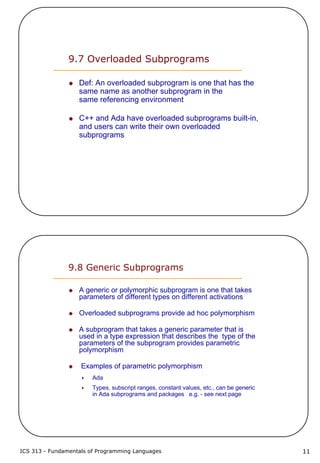
9.7 Overloaded Subprograms
Def: An overloaded subprogram is one that has the
same name as another subprogram in the
same referencing environment
C++ and Ada have overloaded subprograms built-in,
and users can write their own overloaded
subprograms
9.8 Generic Subprograms
A generic or polymorphic subprogram is one that takes
parameters of different types on different activations
Overloaded subprograms provide ad hoc polymorphism
A subprogram that takes a generic parameter that is
used in a type expression that describes the type of the
parameters of the subprogram provides parametric
polymorphism
Examples of parametric polymorphism
Ada
Types, subscript ranges, constant values, etc., can be generic
in Ada subprograms and packages e.g. - see next page
ICS 313 - Fundamentals of Programming Languages 12
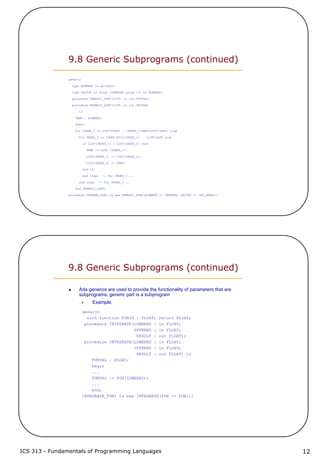
9.8 Generic Subprograms (continued)
generic
type ELEMENT is private;
type VECTOR is array (INTEGER range <>) of ELEMENT;
procedure GENERIC_SORT(LIST: in out VECTOR);
procedure GENERIC_SORT(LIST: in out VECTOR)
is
TEMP : ELEMENT;
begin
for INDEX_1 in LIST'FIRST .. INDEX_1'PRED(LIST'LAST) loop
for INDEX_2 in INDEX'SUCC(INDEX_1) .. LIST'LAST loop
if LIST(INDEX_1) > LIST(INDEX_2) then
TEMP := LIST (INDEX_1);
LIST(INDEX_1) := LIST(INDEX_2);
LIST(INDEX_2) := TEMP;
end if;
end loop; -- for INDEX_1 ...
end loop; -- for INDEX_2 ...
end GENERIC_SORT;
procedure INTEGER_SORT is new GENERIC_SORT(ELEMENT => INTEGER; VECTOR => INT_ARRAY);
9.8 Generic Subprograms (continued)
Ada generics are used to provide the functionality of parameters that are
subprograms; generic part is a subprogram
Example:
generic
with function FUN(X : FLOAT) return FLOAT;
procedure INTEGRATE(LOWERBD : in FLOAT;
UPPERBD : in FLOAT;
RESULT : out FLOAT);
procedure INTEGRATE(LOWERBD : in FLOAT;
UPPERBD : in FLOAT;
RESULT : out FLOAT) is
FUNVAL : FLOAT;
begin
...
FUNVAL := FUN(LOWERBD);
...
end;
INTEGRATE_FUN1 is new INTEGRATE(FUN => FUN1);
ICS 313 - Fundamentals of Programming Languages 13
9.8 Generic Subprograms (continued)
C++
Templated functions
e.g.
template <class Type>
Type max(Type first, Type second) {
return first > second ? first : second;
}
C++ template functions are instantiated implicitly when the function
is named in a call or when its address is taken with the & operator
9.8 Generic Subprograms (continued)
Another example:
template <class Type>
void generic_sort(Type list[], int len) {
int top, bottom;
Type temp;
for (top = 0; top < len - 2; top++)
for (bottom = top + 1; bottom < len - 1; bottom++) {
if (list[top] > list[bottom]) {
temp = list [top];
list[top] = list[bottom];
list[bottom] = temp;
} //** end of for (bottom = ...
} //** end of generic_sort
Example use:
float flt_list[100];
...
generic_sort(flt_list, 100); // Implicit
// instantiation
ICS 313 - Fundamentals of Programming Languages 14
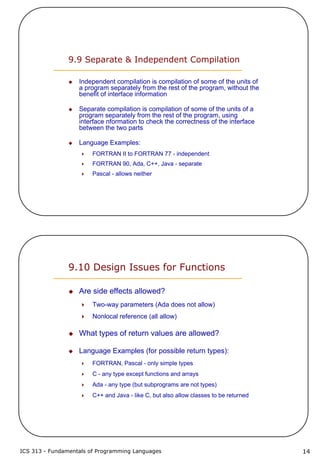
9.9 Separate & Independent Compilation
Independent compilation is compilation of some of the units of
a program separately from the rest of the program, without the
benefit of interface information
Separate compilation is compilation of some of the units of a
program separately from the rest of the program, using
interface nformation to check the correctness of the interface
between the two parts
Language Examples:
FORTRAN II to FORTRAN 77 - independent
FORTRAN 90, Ada, C++, Java - separate
Pascal - allows neither
9.10 Design Issues for Functions
Are side effects allowed?
Two-way parameters (Ada does not allow)
Nonlocal reference (all allow)
What types of return values are allowed?
Language Examples (for possible return types):
FORTRAN, Pascal - only simple types
C - any type except functions and arrays
Ada - any type (but subprograms are not types)
C++ and Java - like C, but also allow classes to be returned
ICS 313 - Fundamentals of Programming Languages 15
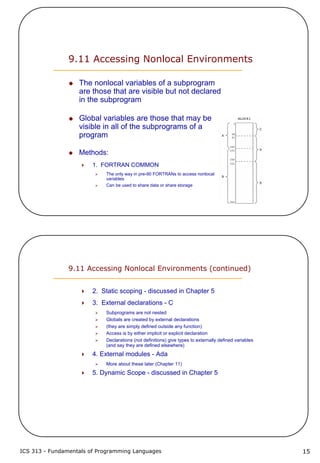
9.11 Accessing Nonlocal Environments
The nonlocal variables of a subprogram
are those that are visible but not declared
in the subprogram
Global variables are those that may be
visible in all of the subprograms of a
program
Methods:
1. FORTRAN COMMON
The only way in pre-90 FORTRANs to access nonlocal
variables
Can be used to share data or share storage
9.11 Accessing Nonlocal Environments (continued)
2. Static scoping - discussed in Chapter 5
3. External declarations - C
Subprograms are not nested
Globals are created by external declarations
(they are simply defined outside any function)
Access is by either implicit or explicit declaration
Declarations (not definitions) give types to externally defined variables
(and say they are defined elsewhere)
4. External modules - Ada
More about these later (Chapter 11)
5. Dynamic Scope - discussed in Chapter 5
ICS 313 - Fundamentals of Programming Languages 16
9.12 User-Defined Overloaded Operators
Nearly all programming languages have overloaded operators
Users can further overload operators in C++ and Ada (Not carried over into
Java)
Example (Ada) (assume VECTOR_TYPE has been defined to be an array type
with INTEGER elements):
function "*"(A, B : in VECTOR_TYPE)
return INTEGER is
SUM : INTEGER := 0;
begin
for INDEX in A'range loop
SUM := SUM + A(INDEX) * B(INDEX);
end loop;
return SUM;
end "*";
Are user-defined overloaded operators good or bad?
9.13 Coroutines
A coroutine is a subprogram that has multiple entries and controls
them itself
Also called symmetric control
A coroutine call is named a resume
The first resume of a coroutine is to its beginning, but subsequent
calls enter at the point just after the last executed statement in the
coroutine
Typically, coroutines repeatedly resume each other, possibly forever
Coroutines provide quasi-concurrent execution of program units
(the coroutines)
Their execution is interleaved, but not overlapped
ICS 313 - Fundamentals of Programming Languages 17
9.13 Coroutines (continued)
Examples

9 subprograms

  • 1.
    ICS 313 -Fundamentals of Programming Languages 1 9. Subprograms 9.2 Fundamentals of Subprograms General characteristics of subprograms A subprogram has a single entry point The caller is suspended during execution of the called subprogram Control always returns to the caller when the called subprogram’s execution terminates Basic definitions A subprogram definition is a description of the actions of the subprogram abstraction A subprogram call is an explicit request that the subprogram be executed A subprogram header is the first line of the definition, including the name, the kind of subprogram, and the formal parameters The parameter profile of a subprogram is the number, order, and types of its parameters The protocol of a subprogram is its parameter profile plus, if it is a function, its return type A subprogram declaration provides the protocol, but not the body, of the subprogram
  • 2.
    ICS 313 -Fundamentals of Programming Languages 2 9.2 Fundamentals of Subprograms (continued) A formal parameter is a dummy variable listed in the subprogram header and used in the subprogram An actual parameter represents a value or address used in the subprogram call statement Actual/Formal Parameter Correspondence Positional Keyword e.g. SORT(LIST => A, LENGTH => N); Advantage: order is irrelevant Disadvantage: user must know the formal parameter’s names Default Values: e.g. procedure SORT(LIST : LIST_TYPE; LENGTH : INTEGER := 100); ... SORT(LIST => A); Procedures provide user-defined statements Functions provide user-defined operators 9.3 Design Issues for Subprograms What parameter passing methods are provided? Are parameter types checked? Are local variables static or dynamic? What is the referencing environment of a passed subprogram? Are parameter types in passed subprograms checked? Can subprogram definitions be nested? Can subprograms be overloaded? Are subprograms allowed to be generic? Is separate or independent compilation supported?
  • 3.
    ICS 313 -Fundamentals of Programming Languages 3 9.4 Local referencing environments If local variables are stack-dynamic: Advantages Support for recursion Storage for locals is shared among some subprograms Disadvantages Allocation/deallocation time Indirect addressing Subprograms cannot be history sensitive Static locals are the opposite Language Examples FORTRAN 77 and 90 - most are static, but the implementor can choose either (User can force static with SAVE) C - both (variables declared to be static are) (default is stack dynamic) Pascal, Java, and Ada - dynamic only 9.5 Parameter Passing Methods We discuss these at several different levels Semantic Models: in mode, out mode, inout mode Conceptual Models of Transfer Physically move a value Move an access path
  • 4.
    ICS 313 -Fundamentals of Programming Languages 4 9.5 Parameter Passing Methods (continued) Implementation Models Pass-by-value (in mode) Either by physical move or access path Disadvantages of access path method Must write-protect in the called subprogram Accesses cost more (indirect addressing) Disadvantages of physical move Requires more storage (duplicated space) Cost of the moves (if the parameter is large) 9.5 Parameter Passing Methods (continued) Pass-by-result (out mode) Local’s value is passed back to the caller Physical move is usually used Disadvantages: If value is passed, time and space In both cases, order dependence may be a problem e.g. procedure sub1(y: int, z: int); ... sub1(x, x); Value of x in the caller depends on order of assignments at the return Pass-by-value-result (inout mode) Physical move, both ways Also called pass-by-copy Disadvantages: Those of pass-by-result Those of pass-by-value
  • 5.
    ICS 313 -Fundamentals of Programming Languages 5 9.5 Parameter Passing Methods (continued) Pass-by-reference (inout mode) Pass an access path Also called pass-by-sharing Advantage: passing process is efficient (no copying and no duplicated storage) Disadvantages Slower accesses Allows aliasing Actual parameter collisions e.g. procedure sub1(a: int, b: int); ... sub1(x, x); Array element collisions e.g. sub1(a[i], a[j]); /* if i = j */ Also, sub2(a, a[i]); (a different one) Collision between formals and globals – Root cause of all of these is: The called subprogram is provided wider access to nonlocals than is necessary – Pass-by-value-result does not allow these aliases (but has other problems!) 9.5 Parameter Passing Methods (continued) Pass-by-name (multiple mode) By textual substitution Formals are bound to an access method at the time of the call, but actual binding to a value or address takes place at the time of a reference or assignment Purpose: flexibility of late binding Resulting semantics: If actual is a scalar variable, it is pass-by-reference If actual is a constant expression, it is pass-by-value If actual is an array element, it is like nothing else e.g. procedure sub1(x: int; y: int); begin x := 1; y := 2; x := 2; y := 3; end; sub1(i, a[i]);
  • 6.
    ICS 313 -Fundamentals of Programming Languages 6 9.5 Parameter Passing Methods (continued) If actual is an expression with a reference to a variable that is also accessible in the program, it is also like nothing else e.g. (assume k is a global variable) procedure sub1(x: int; y: int; z: int); begin k := 1; y := x; k := 5; z := x; end; sub1(k+1, j, i); Disadvantages of pass by name Very inefficient references Too tricky; hard to read and understand 9.5 Parameter Passing Methods (continued) Language Examples FORTRAN Before 77, pass-by-reference 77 - scalar variables are often passed by value-result ALGOL 60 Pass-by-name is default; pass-by-value is optional ALGOL W Pass-by-value-result C Pass-by-value Pascal and Modula-2 Default is pass-by-value; pass-by-reference is optional C++ Like C, but also allows reference type parameters, which provide the efficiency of pass-by-reference with in-mode semantics
  • 7.
    ICS 313 -Fundamentals of Programming Languages 7 9.5 Parameter Passing Methods (continued) Ada All three semantic modes are available If out, it cannot be referenced If in, it cannot be assigned Java Like C++, except only references Type checking parameters (Now considered very important for reliability) FORTRAN 77 and original C: none Pascal, FORTRAN 90, Java, and Ada: it is always required ANSI C and C++: choice is made by the user 9.5 Parameter Passing Methods (continued) Implementing Parameter Passing ALGOL 60 and most of its descendants use the run-time stack Value - copy it to the stack; references are indirect to the stack Result - same Reference - regardless of form, put the address in the stack Name - run-time resident code segments or subprograms evaluate the address of the parameter; called for each reference to the formal; these are called thunks Very expensive, compared to reference or value-result
  • 8.
    ICS 313 -Fundamentals of Programming Languages 8 9.5 Parameter Passing Methods (continued) One possible stack implementation of the common parameter-passing methods 9.5 Parameter Passing Methods (continued) Ada Simple variables are passed by copy (value-result) Structured types can be either by copy or reference This can be a problem, because a) Of aliases (reference allows aliases, but value-result does not) b) Procedure termination by error can produce different actual parameter results Programs with such errors are “erroneous”
  • 9.
    ICS 313 -Fundamentals of Programming Languages 9 9.5 Parameter Passing Methods (continued) Multidimensional Arrays as Parameters If a multidimensional array is passed to a subprogram and the subprogram is separately compiled, the compiler needs to know the declared size of that array to build the storage mapping function C and C++ Programmer is required to include the declared sizes of all but the first subscript in the actual parameter This disallows writing flexible subprograms Solution: pass a pointer to the array and the sizes of the dimensions as other parameters; the user must include the storage mapping function, which is in terms of the size parameters (See example, p. 371) Pascal Not a problem (declared size is part of the array’s type) Ada Constrained arrays - like Pascal Unconstrained arrays - declared size is part of the object declaration (See example p. 371) (Java is similar) 9.5 Parameter Passing Methods (continued) Pre-90 FORTRAN Formal parameter declarations for arrays can include passed parameters e.g. SUBPROGRAM SUB(MATRIX, ROWS, COLS, RESULT) INTEGER ROWS, COLS REAL MATRIX (ROWS, COLS), RESULT ... END Design Considerations for Parameter Passing 1. Efficiency 2. One-way or two-way These two are in conflict with one another! Good programming => limited access to variables, which means one-way whenever possible Efficiency => pass by reference is fastest way to pass structures of significant size Also, functions should not allow reference parameters
  • 10.
    ICS 313 -Fundamentals of Programming Languages 10 9.6 Parameters that are Subprogram Names Issues Are parameter types checked? Early Pascal and FORTRAN 77 do not Later versions of Pascal and FORTRAN 90 do Ada does not allow subprogram parameters Java does not allow method names to be passed as parameters C and C++ - pass pointers to functions; parameters can be type checked What is the correct referencing environment for a subprogram that was sent as a parameter? Possibilities: a. It is that of the subprogram that enacted it - Shallow binding b. It is that of the subprogram that declared it - Deep binding c. It is that of the subprogram that passed it - Ad hoc binding (Has never been used) 9.6 Parameters that are Subprogram Names For static-scoped languages, deep binding is most natural For dynamic-scoped languages, shallow binding is most natural Example: sub1 sub2 sub3 call sub4(sub2) sub4(subx) call subx call sub3 What is the referencing environment of sub2 when it is called in sub4? Shallow binding => sub2, sub4, sub3, sub1 Deep binding => sub2, sub1
  • 11.
    ICS 313 -Fundamentals of Programming Languages 11 9.7 Overloaded Subprograms Def: An overloaded subprogram is one that has the same name as another subprogram in the same referencing environment C++ and Ada have overloaded subprograms built-in, and users can write their own overloaded subprograms 9.8 Generic Subprograms A generic or polymorphic subprogram is one that takes parameters of different types on different activations Overloaded subprograms provide ad hoc polymorphism A subprogram that takes a generic parameter that is used in a type expression that describes the type of the parameters of the subprogram provides parametric polymorphism Examples of parametric polymorphism Ada Types, subscript ranges, constant values, etc., can be generic in Ada subprograms and packages e.g. - see next page
  • 12.
    ICS 313 -Fundamentals of Programming Languages 12 9.8 Generic Subprograms (continued) generic type ELEMENT is private; type VECTOR is array (INTEGER range <>) of ELEMENT; procedure GENERIC_SORT(LIST: in out VECTOR); procedure GENERIC_SORT(LIST: in out VECTOR) is TEMP : ELEMENT; begin for INDEX_1 in LIST'FIRST .. INDEX_1'PRED(LIST'LAST) loop for INDEX_2 in INDEX'SUCC(INDEX_1) .. LIST'LAST loop if LIST(INDEX_1) > LIST(INDEX_2) then TEMP := LIST (INDEX_1); LIST(INDEX_1) := LIST(INDEX_2); LIST(INDEX_2) := TEMP; end if; end loop; -- for INDEX_1 ... end loop; -- for INDEX_2 ... end GENERIC_SORT; procedure INTEGER_SORT is new GENERIC_SORT(ELEMENT => INTEGER; VECTOR => INT_ARRAY); 9.8 Generic Subprograms (continued) Ada generics are used to provide the functionality of parameters that are subprograms; generic part is a subprogram Example: generic with function FUN(X : FLOAT) return FLOAT; procedure INTEGRATE(LOWERBD : in FLOAT; UPPERBD : in FLOAT; RESULT : out FLOAT); procedure INTEGRATE(LOWERBD : in FLOAT; UPPERBD : in FLOAT; RESULT : out FLOAT) is FUNVAL : FLOAT; begin ... FUNVAL := FUN(LOWERBD); ... end; INTEGRATE_FUN1 is new INTEGRATE(FUN => FUN1);
  • 13.
    ICS 313 -Fundamentals of Programming Languages 13 9.8 Generic Subprograms (continued) C++ Templated functions e.g. template <class Type> Type max(Type first, Type second) { return first > second ? first : second; } C++ template functions are instantiated implicitly when the function is named in a call or when its address is taken with the & operator 9.8 Generic Subprograms (continued) Another example: template <class Type> void generic_sort(Type list[], int len) { int top, bottom; Type temp; for (top = 0; top < len - 2; top++) for (bottom = top + 1; bottom < len - 1; bottom++) { if (list[top] > list[bottom]) { temp = list [top]; list[top] = list[bottom]; list[bottom] = temp; } //** end of for (bottom = ... } //** end of generic_sort Example use: float flt_list[100]; ... generic_sort(flt_list, 100); // Implicit // instantiation
  • 14.
    ICS 313 -Fundamentals of Programming Languages 14 9.9 Separate & Independent Compilation Independent compilation is compilation of some of the units of a program separately from the rest of the program, without the benefit of interface information Separate compilation is compilation of some of the units of a program separately from the rest of the program, using interface nformation to check the correctness of the interface between the two parts Language Examples: FORTRAN II to FORTRAN 77 - independent FORTRAN 90, Ada, C++, Java - separate Pascal - allows neither 9.10 Design Issues for Functions Are side effects allowed? Two-way parameters (Ada does not allow) Nonlocal reference (all allow) What types of return values are allowed? Language Examples (for possible return types): FORTRAN, Pascal - only simple types C - any type except functions and arrays Ada - any type (but subprograms are not types) C++ and Java - like C, but also allow classes to be returned
  • 15.
    ICS 313 -Fundamentals of Programming Languages 15 9.11 Accessing Nonlocal Environments The nonlocal variables of a subprogram are those that are visible but not declared in the subprogram Global variables are those that may be visible in all of the subprograms of a program Methods: 1. FORTRAN COMMON The only way in pre-90 FORTRANs to access nonlocal variables Can be used to share data or share storage 9.11 Accessing Nonlocal Environments (continued) 2. Static scoping - discussed in Chapter 5 3. External declarations - C Subprograms are not nested Globals are created by external declarations (they are simply defined outside any function) Access is by either implicit or explicit declaration Declarations (not definitions) give types to externally defined variables (and say they are defined elsewhere) 4. External modules - Ada More about these later (Chapter 11) 5. Dynamic Scope - discussed in Chapter 5
  • 16.
    ICS 313 -Fundamentals of Programming Languages 16 9.12 User-Defined Overloaded Operators Nearly all programming languages have overloaded operators Users can further overload operators in C++ and Ada (Not carried over into Java) Example (Ada) (assume VECTOR_TYPE has been defined to be an array type with INTEGER elements): function "*"(A, B : in VECTOR_TYPE) return INTEGER is SUM : INTEGER := 0; begin for INDEX in A'range loop SUM := SUM + A(INDEX) * B(INDEX); end loop; return SUM; end "*"; Are user-defined overloaded operators good or bad? 9.13 Coroutines A coroutine is a subprogram that has multiple entries and controls them itself Also called symmetric control A coroutine call is named a resume The first resume of a coroutine is to its beginning, but subsequent calls enter at the point just after the last executed statement in the coroutine Typically, coroutines repeatedly resume each other, possibly forever Coroutines provide quasi-concurrent execution of program units (the coroutines) Their execution is interleaved, but not overlapped
  • 17.
    ICS 313 -Fundamentals of Programming Languages 17 9.13 Coroutines (continued) Examples