Programming Languages Principles and Practices 3rd Edition Louden Test Bank
Programming Languages Principles and Practices 3rd Edition Louden Test Bank
Programming Languages Principles and Practices 3rd Edition Louden Test Bank
Programming Languages Principles and Practices 3rd Edition Louden Test Bank
Programming Languages Principles and Practices 3rd Edition Louden Test Bank
1.
Programming Languages Principlesand Practices
3rd Edition Louden Test Bank download
https://testbankdeal.com/product/programming-languages-
principles-and-practices-3rd-edition-louden-test-bank/
Visit testbankdeal.com today to download the complete set of
test bank or solution manual
2.
We believe theseproducts will be a great fit for you. Click
the link to download now, or visit testbankdeal.com
to discover even more!
Programming Languages Principles and Practices 3rd Edition
Louden Solutions Manual
https://testbankdeal.com/product/programming-languages-principles-and-
practices-3rd-edition-louden-solutions-manual/
Concepts of Programming Languages 10th Edition Sebesta
Solutions Manual
https://testbankdeal.com/product/concepts-of-programming-
languages-10th-edition-sebesta-solutions-manual/
Foundation Design Principles and Practices 3rd Edition
Coduto Solutions Manual
https://testbankdeal.com/product/foundation-design-principles-and-
practices-3rd-edition-coduto-solutions-manual/
World Regions in Global Context People Places and
Environments 5th Edition Marston Test Bank
https://testbankdeal.com/product/world-regions-in-global-context-
people-places-and-environments-5th-edition-marston-test-bank/
3.
Medical Terminology forHealth Professions 6th Edition
Ehrlich Test Bank
https://testbankdeal.com/product/medical-terminology-for-health-
professions-6th-edition-ehrlich-test-bank/
Bank Management 8th Edition Koch Solutions Manual
https://testbankdeal.com/product/bank-management-8th-edition-koch-
solutions-manual/
Pharmacology Connections to Nursing Practice 3rd Edition
Adams Solutions Manual
https://testbankdeal.com/product/pharmacology-connections-to-nursing-
practice-3rd-edition-adams-solutions-manual/
Clinical Nursing Skills and Techniques 7th Edition Perry
Test Bank
https://testbankdeal.com/product/clinical-nursing-skills-and-
techniques-7th-edition-perry-test-bank/
Accounting Information Systems A Practitioner Emphasis 7th
Edition Heagy Test Bank
https://testbankdeal.com/product/accounting-information-systems-a-
practitioner-emphasis-7th-edition-heagy-test-bank/
4.
Business Communication BuildingCritical Skills Canadian
6th Edition Braun Solutions Manual
https://testbankdeal.com/product/business-communication-building-
critical-skills-canadian-6th-edition-braun-solutions-manual/
5.
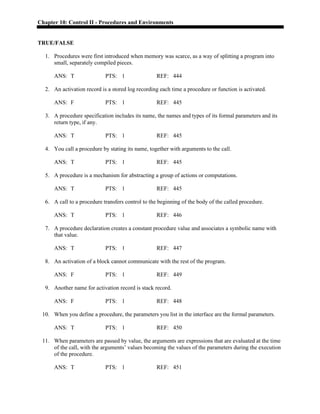
Chapter 10: ControlII - Procedures and Environments
TRUE/FALSE
1. Procedures were first introduced when memory was scarce, as a way of splitting a program into
small, separately compiled pieces.
ANS: T PTS: 1 REF: 444
2. An activation record is a stored log recording each time a procedure or function is activated.
ANS: F PTS: 1 REF: 445
3. A procedure specification includes its name, the names and types of its formal parameters and its
return type, if any.
ANS: T PTS: 1 REF: 445
4. You call a procedure by stating its name, together with arguments to the call.
ANS: T PTS: 1 REF: 445
5. A procedure is a mechanism for abstracting a group of actions or computations.
ANS: T PTS: 1 REF: 445
6. A call to a procedure transfers control to the beginning of the body of the called procedure.
ANS: T PTS: 1 REF: 446
7. A procedure declaration creates a constant procedure value and associates a symbolic name with
that value.
ANS: T PTS: 1 REF: 447
8. An activation of a block cannot communicate with the rest of the program.
ANS: F PTS: 1 REF: 449
9. Another name for activation record is stack record.
ANS: F PTS: 1 REF: 448
10. When you define a procedure, the parameters you list in the interface are the formal parameters.
ANS: T PTS: 1 REF: 450
11. When parameters are passed by value, the arguments are expressions that are evaluated at the time
of the call, with the arguments’ values becoming the values of the parameters during the execution
of the procedure.
ANS: T PTS: 1 REF: 451
6.
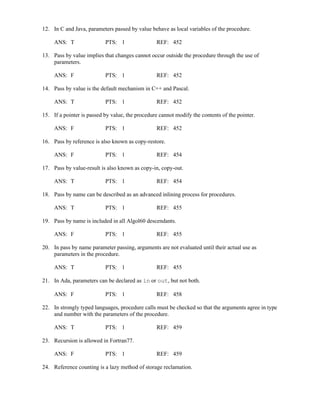
12. In Cand Java, parameters passed by value behave as local variables of the procedure.
ANS: T PTS: 1 REF: 452
13. Pass by value implies that changes cannot occur outside the procedure through the use of
parameters.
ANS: F PTS: 1 REF: 452
14. Pass by value is the default mechanism in C++ and Pascal.
ANS: T PTS: 1 REF: 452
15. If a pointer is passed by value, the procedure cannot modify the contents of the pointer.
ANS: F PTS: 1 REF: 452
16. Pass by reference is also known as copy-restore.
ANS: F PTS: 1 REF: 454
17. Pass by value-result is also known as copy-in, copy-out.
ANS: T PTS: 1 REF: 454
18. Pass by name can be described as an advanced inlining process for procedures.
ANS: T PTS: 1 REF: 455
19. Pass by name is included in all Algol60 descendants.
ANS: F PTS: 1 REF: 455
20. In pass by name parameter passing, arguments are not evaluated until their actual use as
parameters in the procedure.
ANS: T PTS: 1 REF: 455
21. In Ada, parameters can be declared as in or out, but not both.
ANS: F PTS: 1 REF: 458
22. In strongly typed languages, procedure calls must be checked so that the arguments agree in type
and number with the parameters of the procedure.
ANS: T PTS: 1 REF: 459
23. Recursion is allowed in Fortran77.
ANS: F PTS: 1 REF: 459
24. Reference counting is a lazy method of storage reclamation.
7.
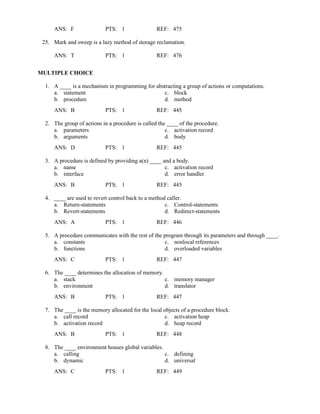
ANS: F PTS:1 REF: 475
25. Mark and sweep is a lazy method of storage reclamation.
ANS: T PTS: 1 REF: 476
MULTIPLE CHOICE
1. A ____ is a mechanism in programming for abstracting a group of actions or computations.
a. statement c. block
b. procedure d. method
ANS: B PTS: 1 REF: 445
2. The group of actions in a procedure is called the ____ of the procedure.
a. parameters c. activation record
b. arguments d. body
ANS: D PTS: 1 REF: 445
3. A procedure is defined by providing a(n) ____ and a body.
a. name c. activation record
b. interface d. error handler
ANS: B PTS: 1 REF: 445
4. ____ are used to revert control back to a method caller.
a. Return-statements c. Control-statements
b. Revert-statements d. Redirect-statements
ANS: A PTS: 1 REF: 446
5. A procedure communicates with the rest of the program through its parameters and through ____.
a. constants c. nonlocal references
b. functions d. overloaded variables
ANS: C PTS: 1 REF: 447
6. The ____ determines the allocation of memory.
a. stack c. memory manager
b. environment d. translator
ANS: B PTS: 1 REF: 447
7. The ____ is the memory allocated for the local objects of a procedure block.
a. call record c. activation heap
b. activation record d. heap record
ANS: B PTS: 1 REF: 448
8. The ____ environment houses global variables.
a. calling c. defining
b. dynamic d. universal
ANS: C PTS: 1 REF: 449
8.
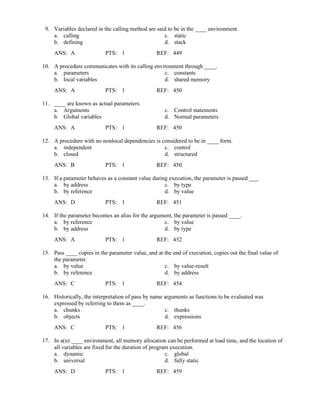
9. Variables declaredin the calling method are said to be in the ____ environment.
a. calling c. static
b. defining d. stack
ANS: A PTS: 1 REF: 449
10. A procedure communicates with its calling environment through ____.
a. parameters c. constants
b. local variables d. shared memory
ANS: A PTS: 1 REF: 450
11. ____ are known as actual parameters.
a. Arguments c. Control statements
b. Global variables d. Normal parameters
ANS: A PTS: 1 REF: 450
12. A procedure with no nonlocal dependencies is considered to be in ____ form.
a. independent c. control
b. closed d. structured
ANS: B PTS: 1 REF: 450
13. If a parameter behaves as a constant value during execution, the parameter is passed ___.
a. by address c. by type
b. by reference d. by value
ANS: D PTS: 1 REF: 451
14. If the parameter becomes an alias for the argument, the parameter is passed ____.
a. by reference c. by value
b. by address d. by type
ANS: A PTS: 1 REF: 452
15. Pass ____ copies in the parameter value, and at the end of execution, copies out the final value of
the parameter.
a. by value c. by value-result
b. by reference d. by address
ANS: C PTS: 1 REF: 454
16. Historically, the interpretation of pass by name arguments as functions to be evaluated was
expressed by referring to them as ____.
a. chunks c. thunks
b. objects d. expressions
ANS: C PTS: 1 REF: 456
17. In a(n) ____ environment, all memory allocation can be performed at load time, and the location of
all variables are fixed for the duration of program execution.
a. dynamic c. global
b. universal d. fully static
ANS: D PTS: 1 REF: 459
9.
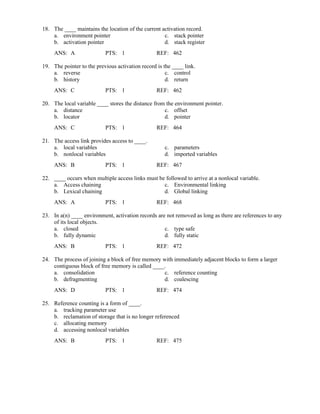
18. The ____maintains the location of the current activation record.
a. environment pointer c. stack pointer
b. activation pointer d. stack register
ANS: A PTS: 1 REF: 462
19. The pointer to the previous activation record is the ____ link.
a. reverse c. control
b. history d. return
ANS: C PTS: 1 REF: 462
20. The local variable ____ stores the distance from the environment pointer.
a. distance c. offset
b. locator d. pointer
ANS: C PTS: 1 REF: 464
21. The access link provides access to ____.
a. local variables c. parameters
b. nonlocal variables d. imported variables
ANS: B PTS: 1 REF: 467
22. ____ occurs when multiple access links must be followed to arrive at a nonlocal variable.
a. Access chaining c. Environmental linking
b. Lexical chaining d. Global linking
ANS: A PTS: 1 REF: 468
23. In a(n) ____ environment, activation records are not removed as long as there are references to any
of its local objects.
a. closed c. type safe
b. fully dynamic d. fully static
ANS: B PTS: 1 REF: 472
24. The process of joining a block of free memory with immediately adjacent blocks to form a larger
contiguous block of free memory is called ____.
a. consolidation c. reference counting
b. defragmenting d. coalescing
ANS: D PTS: 1 REF: 474
25. Reference counting is a form of ____.
a. tracking parameter use
b. reclamation of storage that is no longer referenced
c. allocating memory
d. accessing nonlocal variables
ANS: B PTS: 1 REF: 475
“I couldn’t dothat!” exclaimed Mrs. Vissian, shaking her head.
“No, I’m sure it won’t be so. No woman who respects herself could
submit to that.”
“But, my dear——”
“But what?”
“Ah, I really forgot what I was going to say; something about Mrs.
Clarendon. Never mind.”
Returning to London by the first of June, Ada brought all her high
spirits with her. With Rhoda and Hilda she was an affectionate sister,
and outdid them both in mirthfulness. Rhoda had got over her long
depression; she was in the habit of looking forward with a very
carefully-concealed expectation to the not infrequent visits of a
certain friend of her father’s, a gentleman of something less than
forty, who was a widower, with one little boy of his own. This
youngster occasionally accompanied his father, and received much
affectionate attention from Rhoda; Hilda looked askance at the
exhibition of his graces. The house in Chelsea had certainly a
brighter air than of old.
On the evening of the day after her return, Ada went to walk by
herself along the river. Hilda wished to accompany her, and was
surprised by her friends request to be alone.
“Oh, you are thinking out another story,” Hilda exclaimed.
“Yes, I am; a very interesting one.”
Her face was very bright, but grave. She walked till the sun had
set, watching the changing clouds and the gold on the river. On her
way home, she paused a moment before each of the historic houses
close at hand, and stood to look at the face of Thomas Carlyle, who
had just been set up in effigy on the Embankment. At ten o’clock,
when the sisters went up to bed, Ada knocked in her usual way at
the door of Mr. Meres’ study.
Mr. Meres was reading; he welcomed her with a smile.
12.
“Have you gotDrummond’s poems?” she began by asking.
“Drummond of Hawthornden? Alas, no!”
“No matter. Mr. Vissian happened to mention him to me with some
fervour.”
She was silent for a little, seemingly thinking of another matter.
Then she said:
“Mr. Meres, I shall be one-and-twenty a fortnight to-day.”
“I know it, Ada.”
He watched her under his brows; she was smiling, with tremor of
the lips.
“I went down to look at my property,” were her next words.
Mr. Meres made no answer.
“You will never, I fear, be able to congratulate me.”
He shifted on his chair, but still said nothing.
“And if you do not, who will?” pursued the girl. “I am afraid I shall
be very friendless. Do you think it will be worth while to have a
London house as well as Knights-well?”
“You will scarcely need one,” said the other, tapping his knee with
a paper-knife, and speaking in rather a gruff voice.
“Some people in my position,” Ada went on, “would half wish that
such wealth had never come to trouble them. They might be
tempted to say they would have nothing to do with it.”
Mr. Meres raised his face.
“And so give much trouble,” he remarked, in a tone of suppressed
agitation. “A state of things would follow equivalent to intestacy. Ten
to one there would be law-suits. The property would be broken up.”
“Yes, I have thought of that,” Ada assented, looking up at the
Madonna over the fireplace. “Still there would be a resource for such
13.
a person’s foolishness.There would be nothing to prevent him or her
from giving it all away when once possessed of it.”
“Nothing in the world,” said Mr. Meres, scarcely above a whisper.
“Mr. Meres, will you help me to get that legally performed?”
He half rose, his hands trembling on the arms of his chair.
“Ada, you mean that?”
“Yes, I mean it.”
He caught her head between his hands, and kissed her several
times on the forehead.
“That’s my brave girl!” was all he could say. Then he sat down
again in the utmost perturbation. He was completely unnerved, and
had to press his hands upon his brows to try and recover calm.
Ada kept her eyes upon Raphael’s Madonna. She could not see
quite clearly, but the divine face was glowed around with halo, and
seemed to smile.
“I cannot be quite independent, you know,” she said at length.
“For the present I must ask Mrs. Clarendon to give me just what I
need to live upon—that, and no more. I shall be glad to do that. I
had rather have it from her as a gift than keep a sum for myself.”
“When did you first think of this?” Mr. Meres asked, when he could
command his voice.
“I cannot tell you. I think the seed was in my mind long ago, and
it has grown slowly.”
She spoke with much simplicity, and with natural earnestness.
“I never rejoiced in my future,” she continued, “unless, perhaps, in
a few moments of misery. I never in earnest realised the possession
of it. How could I? This wealth was not mine; a mere will could give
me no right in it. I have often, in thinking over it, been brought to a
kind of amazement at the unquestioning homage paid to arbitrary
law. You know that mood in which simple, every-day matters are
14.
seen in theirmiraculous light. My whole self revolted against such
laws. It seemed a kind of conjuring with human lives—something
basely ludicrous. And the surrender costs me nothing; I assure you it
costs me nothing! To say there was merit in it would be ridiculous. I
simply could not accept what is offered me. Oh, how light I feel!”
Meres looked at her admiringly.
“And to consent to be the instrument of a dead mans malice!” Her
scorn was passionate. “Isn’t it enough to think of that? What did he
care for me, a wretched, parentless child, put out to nurse with
working-people! It was baser cruelty to me than to Mrs. Clarendon.
Oh, how did she consent to be rich on those terms?”
“Ada, you must try and think tenderly of her,” said Meres, with the
softness which always marked his voice when he spoke of Isabel. “I
have told you of her early poverty. She was a beautiful girl, and
without the education which might have given her high aims; the
pleasant things of the world tempted her, and frivolous society did its
best to ruin her. It did not touch her heart; that has always been
pure, and generous, and womanly. Try never to think of her failings.”
“I wish I were not a woman!” Ada exclaimed. “It is that which
makes me judge her hardly. Men—all men—see her so differently.”
“Ada Warren!” he grasped the arm of his chair convulsively,
speaking in sudden forgetfulness of everything but his passion, “if by
my death I could save her from the most trifling pain I would gladly
die this hour!”
She gazed at him with a daughters tenderness, and sighed:
“I shall never hear such words as those.”
“My child, your reward is in the future. Fate has given you nobility
alike of heart and brain, and, if you live, you will lack no happiness
that time has in its bestowal. Go, now, Ada, and leave me to myself.
This hour has made me feel old. My quiet life does not fit me for
these scenes. I am horribly shaken.”
15.
She rose, andbent her head that again he might kiss her on the
brows.
“You shall be my father,” she said, her voice faltering. “May I call
you father from now?”
He turned from her, pressing her hand, and she left him.
16.
K
CHAPTER XVI.
ingcote’s abodewas in one of the principal streets of Norwich.
The shop was narrow but ran back some distance, and above
it were two storeys for dwelling; to reach the house door you
went up a yard, beneath an archway, the side entrance to a
respectable public-house being opposite. The name of Gabriel had
been left undisturbed along the top of the shopfront; above it, in
fresh gilt letters, was the name of the present tradesman; a small
“late” connected the two.
In the rear of the shop, a small dark room, with windows of which
the lower half was in ground glass, served during the day-time as
counting-house; after business hours it became the private sitting-
room of Mr. Billimore. It was to Mr. Billimore that Gabriel referred,
when he spoke in terms of confidence of the assistant who had so
long been his father’s right-hand man. He was middle-aged, rather
above six feet in stature, and entirely bald; not a hair remained upon
his head. He had, however, a thin moustache, reddish mixed with
gray, and a goat-beard beneath his chin; the chin itself, for some
strange reason, he carefully shaved. His cheeks were marked with
healthful ruddiness, and he had eyes which twinkled with a pleasant
and kindly humour. When he met a customer, he stood with bowed
head, performing the action of hand-washing; when discussing a
matter with his employer, he invariably took his handkerchief from
the breast-pocket of his coat, and polished his head with it, as if the
act implied a seemly combination of self-respect and deference.
Never was a worthier assistant, never a more capable. His
knowledge of the outsides of books was considerable; his
acquaintance with them as literature was such as might be gained
by a complete perusal each Sunday morning of The Athenoum. In
the pleasantest manner possible, he set to work from the first day to
instruct Kingcote in the details of shopkeeping; without a smile of
17.
presumption he answeredquestions which Kingcote himself put with
a half-ashamed laugh; his seriousness and honesty were beyond
suspicion.
Mr. Billimore had a bedroom at the top of the house; breakfast,
mid-day dinner, and tea, he took with the family; his supper,
consisting of bread and cheese and a pint of beer, was, in
accordance with immemorial usage, laid for him in the counting-
house at nine o’clock. Kingcote wondered much what his assistant
did with himself during his free hours, for no acquaintance ever
came to see him, and his excursions were limited to a walk before
breakfast on Sunday morning, and another after supper on the same
day. If Kingcote went by chance through the counting-house after
the shop was closed, he found Mr. Billimore sitting with a glass of
beer at his elbow, a churchwarden pipe between his lips, either
musing or reading some periodical. The pipe and glass were
invariable; the assistant had the habit at Sunday dinner of pouring
out his second tumbler of ale just before the meal ended, and
carrying it with him into his own quarters, that the afternoon
tobacco might not be unmoistened. That he suffered no ennui was
demonstrable, for it was no uncommon thing to hear him laughing
by himself, a remarkable laugh, half a crow and half a scream. When
Kingcote heard the sound for the first time, he had apprehensions
that Mr. Billimore was unwell; discovering the truth, he was annoyed
by the thought that it was himself and his inaptitude that occasioned
the assistant’s mirth. This, however, he was soon convinced was
equally a mistake, and he and Mary derived not a little amusement
from these grotesque outbursts of solitary mirth; occasionally they
could hear them even when seated in their drawing-room, which
was immediately above the shop. It only remained to suppose that
Mr. Billimore was a philosopher of the school of Democritus, a
conclusion not perhaps wide of the mark.
By the end of his first three months, King-cote was acquiescent in
his life, even contented with it. The customers who had been in the
habit of using the shop still came, for Mr. Billimore’s continued
presence was reassuring, and the little that was seen of the new
18.
proprietor was notrepellent; there was every likelihood that the
business would still be what it had been. It was a week or two
before Kingcote broke himself to the habit of remaining at the
counter when a purchaser entered, but even this grew to be very
simple, and quite in the order of things. With the bookselling proper
was joined a stationery business, and perhaps on the whole it was a
little harder to sell a newspaper or a quire of note, or a bottle of
gum, than to take an order for a volume or part with one from the
shelves; still, no mortal is above satisfaction in receiving cash
payment, part whereof is calculable profit, and the very till soon
began to be more than endurable in our friend’s eyes.
The trial was when acquaintances of old time presented
themselves to claim recognition. There were not more than half-a-
dozen who did so, and two or three of these were not, in the end,
unwelcome. They were worthy people of the middle-class provincial
sort, full of natural curiosity, but also not lacking kindliness. Their
curiosity Kingcote satisfied only in broad terms, and perhaps the
fixed melancholy of his face prevented the grosser kind of
inquisitiveness. He let it be known that his sister kept house for him,
and that she was a widow, but it was some time before any one
called to see Mary. The circumstances of her marriage were
remembered, and created prejudice; there had not been wanting
those who, at the time, hinted at worse things than a mere
elopement, and now such points were rediscussed with the relish of
a provincial appetite which has only limited diet. Still, even Mary was
in the end accepted. The first lady who called upon her no doubt
suppressed a hesitation for the sake of getting a glimpse of the
domestic interior; one or two others justified themselves by the
precedent. There followed invitations to heavy tea, and it was made
known to Kingcote that he would be welcome here or there at
supper. For his sisters sake he obliged himself to go wherever he
was sought. He might not enjoy the conversation at these houses,
but in future he must have that or none, and to keep up pretences
would savour of the ludicrous. He was a shopkeeper, and likely to
remain one to the end of his days. Nor did he in truth repine.
19.
He rested. Fromhis illness there had remained a good deal of
physical weakness; it was more apparent now than it had been
during the late months of the past year. He had no longer a desire to
take walks, and indeed seldom left the house for such a purpose;
when at leisure, he sat with a book, and it was a trouble to stir from
his chair. His appearance was that of a man ten years beyond his
own age; always grave, he had only to sit in silence for a quarter of
an hour to fall into a dreamy state of absent-mindedness; as often
as not he turned the pages of his book without knowledge of what
he seemed to be reading. This was not the same thing as
unhappiness; his mood was emphatically one of contentment. He
interested himself in the details of his business, and was in nothing
neglectful. Only it was all done without active pleasure; his life
remained joyless.
“What are those lines you are repeating, Bernard?” his sister
asked him one evening, when he had turned from the finished
supper, to take up a magazine.
“Did I say them aloud?” he asked. Then he quoted:
For not to desire or admire, if a man could learn it, were
more
Than to walk all day like the Sultan of old in a garden of
spice.
“I am not far from that end,” he added then went on with his
reading.
There was truth in what he said, and he would not have
exchanged his state for one more active, even though it had been an
activity that promised happiness. For in happiness he had no faith. It
did exist on earth—in the form of sleep; all other bliss he held to be
illusion. Heights to which he had once looked up with envious eyes,
20.
he did notnow contemplate; if a glimpse of them arrested him, he
hurriedly turned away, pained by a sudden sense of unrest. The
thought of exertion was intolerable. His reading was no longer study,
but mere pastime in idle pages; books which demanded thought or
suggested a high and energetic ideal, he put aside. This habit of
mind, at first involuntary, he was beginning to take consciously for
his direction; it preserved to him an even calm, which was now the
most desirable of things.
“Do not tell me of your work,” he wrote to Gabriel in London. “It
will seem unfriendly that I should not wish to Hear of it, but your
progress and achievements I take for granted; they are the essence
of the distinction between your world and my own. When you say
you have done this, and are planning that, it disturbs me, I know not
how; I neither act nor plan, and hope never again to do either.
Formerly, when I should gladly have heard these details, you kept
them from me; pray do so now. The change in yourself which this
new habit implies, I believe I understand. There is a joyful tone in all
you write, formerly never to be found. You are less severe, more
human. Naturally so; success is before you, and the anxious toil of
your years of poverty is at an end. I, too, have ceased to fear
poverty—thanks to you—but I dread the more anything that can give
a shock to my placid materialism. I dread awakenings of sympathy, I
dread discontent, I dread the ideal.”
Whereto Clement Gabriel took occasion to reply:
“My friend, you are in a bad way. Fortunately you are young; there
is hope for you in the years that bring the philosophic mind. Allow
me to suggest that your present mind contains as little of the
philosophic as it well could. I will not for the present trouble you
about my doings. We will talk over them when you have recovered
your interest in the things which alone are worth living for.”
So the days moved on. Towards the end of the first week in June,
Kingcote exhibited a slight return of restlessness; he complained,
when Mary questioned him, that he could not sleep; it was nothing,
it would pass. It did not, however, pass immediately. For ten days
21.
the trouble ofmind or body rather grew than diminished; the old
dislike of society showed itself, and at length he seemed to be
shrinking from his daily occupations. Mr. Billimore, who was
observant, noticed that he displayed much anxiety to take the letters
from the postman, when the latter came into the shop each
morning, and that an examination of the batch seemed always to
occasion him some disappointment. But the trouble did in the end
prove transitory. A day or two of headache, which kept him to his
room, led back to the ordinary routine of life. Business received
attention in the usual way, and his impassive countenance was
restored....
A week later, there came to the shop a messenger from a hotel,
with a note addressed to Mr. Kingcote. He was at that moment in the
house; knowing he would appear speedily, Mr. Billimore laid the note
on his master’s desk in the counting-house. Within a few minutes
Kingcote entered, and took up the envelope carelessly. He dropped it
again as if it had burnt him.
Mr. Billimore was advancing to explain by whom the note had
been left. Kingcote’s face struck him as so singular, that he retired
into the shop without having spoken.
Had he still power to feel this? That terrible sinking at the heart
which had once been so common an experience had again come
upon him. He had to sit down; his limbs would not support him. His
face was hot, his mouth all at once parched; his hands shook as if
they never could regain their steadiness.
When he opened the envelope, he found two lines:
“If you could come to see me here before five o’clock, I should be
glad. I have a private room; ask for me by name.
“Isabel Clarendon.”
It was now two in the afternoon. Kingcote, after consulting his
watch, went upstairs to his bedroom. There he paced up and down
for half-an-hour. On recovering from the shock of agitation which
was incompatible with thought of any kind, his first sentiment was
22.
one of anger.He had thought that the time for this was gone by; the
assurance of it had been a new beginning of calm. What right had
she to disturb him? As she was in the town, she doubtless knew
what his position was; probably she had heard that from Mr. Vissian
long ago. What inspiration save of woman’s cruelty could have led to
this summons? He had forgotten her; she had gone from his life;
was he never to be secure from a renewal of that intolerable
anguish, anguish even physical, which she had it in her power to
inflict upon him?
Nay, she had worse power than that. From the long-sealed
chambers of his heart came a low cry as of reawakening life, life
which would fain be free again. The sweat stood on his forehead as
he crushed down the tenderness, the passion which he had thought
dead. The sight of her handwriting, after so long, had given back to
him the dreadful power of seeing herself, her features, her beautiful
form. He flung himself by the bedside, and smothered his face; the
striving of the old spirit drew groans from him.
What, what was he to her, or she to him? What conceivable
circumstances could render possible the realisation of that mad
dream, of which he had well-nigh died? It was imbecility to flatter
himself with the fancy that she loved him; but, if he could believe it,
if she proved it to him——. Had all his suffering been mere frantic
jealousy? Had he misunderstood? Had time proved to her that his
love was worth more than the pleasures the world could give her?
Had it grown within her soul, whilst he had sunk to brutish
indifference?
At first it had seemed possible to refuse to see her; would it not
be fair reprisal for all that he had borne at her hands? Would it not
gratify his pride to coldly tell her that he saw no good end to be
gained by a personal interview? It needed another than himself to
act upon such a thought. Already he was preparing to go and see
her. He threw water upon his face to cool its burning. The fear now
had become lest his delay in answering her summons should have
led her to conclude that he would not answer it. With haste which
23.
only heightened hisnervousness, he completed his preparations,
and went downstairs. Fortunately he met no one; he could take his
hat and leave by the house-door unobserved.
The walk to the hotel was short. On reaching the entrance he had
to turn aside and go a little further on, that he might be able to use
his voice and present any appearance but that of a man under stress
of violent emotion. Between the door of the hotel and the private
room to which he was conducted, he knew nothing but the pain
which came from the throbbing at his temples and the rush of blood
in his ears.
She stood at the farther end of the room, a dark object to him.
She wore a summer travelling dress, but of that he could take no
note; her face alone came out of the confused mist, and he saw that
it was pale and agitated. There was no joy in it; that he knew at
once. None of the old sweetness dwelt in her eyes and about her
lips. She was austere, fear-stricken.
“You have kept me long,” were her first words, and as she spoke
them her hand pressed upon her bosom. “I thought you would come
at once.”
The sound of her speaking had the effect of a cold hand upon his
forehead. He saw with clear vision; the throbbing at his temples
allayed itself.
“Why are you here?” he asked. “Why have you sent for me?”
With perfect consciousness he made his tone as gentle as he
could. His words did not seem to himself spontaneous; these were
prompted to him from within, and she repeated them as if playing a
part.
Isabel came nearer, and held to him the photograph he had
returned her. Since sending the note, she had stood there with it in
her hand; it was bent.
“Will you take it back again?” she asked. He saw her throat swell;
she seemed to swallow something before she spoke.
24.
He did notmove to take it.
“You wish,” he replied, “to be a shopkeeper’s wife?”
With no smile he said it; yet it cost him an effort. Again it was the
repetition of prompted words.
“I thought you had perhaps heard,” Isabel said, letting her hand
fall again, and speaking quickly, still with that swelling of the throat.
“Ada refuses to take what is hers by law. She has given it back to
me.”
Kingcote’s eyes held themselves fixed upon her face. The silence
seemed to be long; he was conscious of prolonging it purposely. He
saw her put her hand upon the table and lean heavily on it.
“Will you answer me?” she uttered in an agitated whisper.
“Surely it is needless to answer in words,” he said at length. “Why
have you come to offer me that which you know I cannot accept?”
The evil spirit stirred in his breast, and, with scarcely a pause, he
continued vehemently:
“Why did you not spare both of us this? Do you think so basely of
me? Cannot I read in your face that you believed it to be your duty
to make this offer to me, at whatever cost to yourself? You are
conscious that your unkindness drove me to part from you in frenzy,
and what has happened seemed to impose a necessity of restoring
to me a piece of good fortune which I had thrown away. And you
have feared lest I should take you at your word! If you had ever
loved me you would know me better.”
Her head bowed itself before his violence; he could scarcely catch
the words when she said:
“I did love you.”
“For a day—for an hour; I believe it. You gave me your love in
recklessness. It was a fatal gift.”
“I think you should not reproach me,” she said, in the same faint
voice. “I gave you the one love of my life. I would have married you
25.
then. It wouldhave been truer kindness to take me—to have given
me something to live for. My love would not have failed you.”
For an instant he could have implored what fate had written
unattainable. He knew the unreality of the vision that tempted him,
and could not have uttered the words his tongue half-formed. But
the mood showed itself in gentler speech.
“I have no right to speak so harshly. The last words we shall ever
say to each other must not be unkind. If I did not still love you it
would be easier to speak smooth things.”
Her tears were falling.
“If you still love me,” she said brokenly, “it is your right to take
me, whatever seems to hinder.” She held forth her hands, but
without looking up. “Your voice is the highest leading that I know.
Oh, are you not strong enough? Can you not bend me to your will?”
A sob stayed her, but there came another cry:
“If I were young!”
Kingcote quivered, then fell to his knees, holding the hands she
had outstretched.
“Say good-bye to me in the kind voice I once knew!” He spoke in
hoarse, choked accents. “Say it kindly, that it may be a sacred
memory whilst I live, and a hope in death!”
She did utter the word, but in such a passion of weeping that it
fell upon his ears like a moan. Then he kissed both her hands, and
broke away....
“The tragedy,” Kingcote had once said, “is not where two who love
each other die for the sake of their love; but where love itself dies,
blown upon by the cold breath of the world, and those who loved
live on with hearts made sepulchres.”...
Here is a letter which came to Kingcote from Mr. Vissian some six
months later:
26.
“Methinks, my friend,I have grounds of complaint against you.
Though I have submitted to your judgment three conjectural
emendations which, in my poor thinking, do not lack propriety, you
fail even to acknowledge the receipt of them. I trust this does not
signify any incapacity to write; for you are of those whom I would
rather challenge for unkindness than pity for mischance. I should—
taking the more probable view of the case—scarcely have written
again thus soon, but that I have sundry items of news to
communicate, one of which concerns me nearly. Learn, then, that at
the end of the year I surrender my present living, on the ground that
another and a better has been offered me. When I say ‘better,’ I
mean in the worldly sense; that, I fear, my usual way of speaking
will have made you too ready to take for granted. I shall in future be
nearer to you by a matter of fifty miles, my new parish being that of
S—————.
“There will be a necessity for keeping a curate, as the work is
much more considerable than what has here been my share. It is in
no spirit of levity that I express my hope of being able to adapt my
energies to the larger sphere. It is possible that I have occasionally
been remiss, owing to the manifold temptations of pursuits which
my graver judgment often condemns as incompatible with my
duties.
“I should hardly have consented to leave Winstoke were it not for
an event which has weakened the tie which bound me to the spot. I
refer to the final departure from Knightswell of that gracious lady
whom I have so long regarded with affectionate reverence, and
whom my wife truly loves. Mrs. Clarendon is Mrs. Clarendon no
longer; she has just married a wealthy and, I doubt not, worthy
gentleman, her cousin Mr. Asquith, who takes her to live in another
part of England. Knightswell is to be sold. The marriage was
celebrated privately in London. I am glad I was not asked to
officiate; it would have been painful to me. The old name has come
to mean so much in my ears; I should but grudgingly have aided in
its casting off.
27.
“Now here benews. Moreover, I have it in charge from Mrs.
Vissian to say unto you, that, as a final test of your good will to us,
we invite you to visit us in our new home not later than the end of
January. That you can come, I am convinced, and in very truth we
want to see you.
“I must not forget to add that I have just received from Miss
Warren a weekly paper containing a poem by herself, and, it seems
to me, one of striking merit. After the unprecedented act of
generosity which this young lady has performed, I am disposed to
regard everything she writes as the outcome of a very noble nature,
and to study it in a serious spirit. I am very anxious to know her
better, personally, for I have always grievously misjudged her. I do
not think she will refuse to come and spend a few days with us in
the spring. Would it not be agreeable to you to renew your
acquaintance with her at some time?”
THE END.
28.
*** END OFTHE PROJECT GUTENBERG EBOOK ISABEL
CLARENDON, VOL. 2 (OF 2) ***
Updated editions will replace the previous one—the old editions will
be renamed.
Creating the works from print editions not protected by U.S.
copyright law means that no one owns a United States copyright in
these works, so the Foundation (and you!) can copy and distribute it
in the United States without permission and without paying
copyright royalties. Special rules, set forth in the General Terms of
Use part of this license, apply to copying and distributing Project
Gutenberg™ electronic works to protect the PROJECT GUTENBERG™
concept and trademark. Project Gutenberg is a registered trademark,
and may not be used if you charge for an eBook, except by following
the terms of the trademark license, including paying royalties for use
of the Project Gutenberg trademark. If you do not charge anything
for copies of this eBook, complying with the trademark license is
very easy. You may use this eBook for nearly any purpose such as
creation of derivative works, reports, performances and research.
Project Gutenberg eBooks may be modified and printed and given
away—you may do practically ANYTHING in the United States with
eBooks not protected by U.S. copyright law. Redistribution is subject
to the trademark license, especially commercial redistribution.
START: FULL LICENSE
PLEASE READ THISBEFORE YOU DISTRIBUTE OR USE THIS WORK
To protect the Project Gutenberg™ mission of promoting the free
distribution of electronic works, by using or distributing this work (or
any other work associated in any way with the phrase “Project
Gutenberg”), you agree to comply with all the terms of the Full
Project Gutenberg™ License available with this file or online at
www.gutenberg.org/license.
Section 1. General Terms of Use and
Redistributing Project Gutenberg™
electronic works
1.A. By reading or using any part of this Project Gutenberg™
electronic work, you indicate that you have read, understand, agree
to and accept all the terms of this license and intellectual property
(trademark/copyright) agreement. If you do not agree to abide by all
the terms of this agreement, you must cease using and return or
destroy all copies of Project Gutenberg™ electronic works in your
possession. If you paid a fee for obtaining a copy of or access to a
Project Gutenberg™ electronic work and you do not agree to be
bound by the terms of this agreement, you may obtain a refund
from the person or entity to whom you paid the fee as set forth in
paragraph 1.E.8.
1.B. “Project Gutenberg” is a registered trademark. It may only be
used on or associated in any way with an electronic work by people
who agree to be bound by the terms of this agreement. There are a
few things that you can do with most Project Gutenberg™ electronic
works even without complying with the full terms of this agreement.
See paragraph 1.C below. There are a lot of things you can do with
Project Gutenberg™ electronic works if you follow the terms of this
agreement and help preserve free future access to Project
Gutenberg™ electronic works. See paragraph 1.E below.
31.
1.C. The ProjectGutenberg Literary Archive Foundation (“the
Foundation” or PGLAF), owns a compilation copyright in the
collection of Project Gutenberg™ electronic works. Nearly all the
individual works in the collection are in the public domain in the
United States. If an individual work is unprotected by copyright law
in the United States and you are located in the United States, we do
not claim a right to prevent you from copying, distributing,
performing, displaying or creating derivative works based on the
work as long as all references to Project Gutenberg are removed. Of
course, we hope that you will support the Project Gutenberg™
mission of promoting free access to electronic works by freely
sharing Project Gutenberg™ works in compliance with the terms of
this agreement for keeping the Project Gutenberg™ name associated
with the work. You can easily comply with the terms of this
agreement by keeping this work in the same format with its attached
full Project Gutenberg™ License when you share it without charge
with others.
1.D. The copyright laws of the place where you are located also
govern what you can do with this work. Copyright laws in most
countries are in a constant state of change. If you are outside the
United States, check the laws of your country in addition to the
terms of this agreement before downloading, copying, displaying,
performing, distributing or creating derivative works based on this
work or any other Project Gutenberg™ work. The Foundation makes
no representations concerning the copyright status of any work in
any country other than the United States.
1.E. Unless you have removed all references to Project Gutenberg:
1.E.1. The following sentence, with active links to, or other
immediate access to, the full Project Gutenberg™ License must
appear prominently whenever any copy of a Project Gutenberg™
work (any work on which the phrase “Project Gutenberg” appears,
or with which the phrase “Project Gutenberg” is associated) is
accessed, displayed, performed, viewed, copied or distributed:
32.
This eBook isfor the use of anyone anywhere in the
United States and most other parts of the world at no
cost and with almost no restrictions whatsoever. You
may copy it, give it away or re-use it under the terms
of the Project Gutenberg License included with this
eBook or online at www.gutenberg.org. If you are not
located in the United States, you will have to check the
laws of the country where you are located before using
this eBook.
1.E.2. If an individual Project Gutenberg™ electronic work is derived
from texts not protected by U.S. copyright law (does not contain a
notice indicating that it is posted with permission of the copyright
holder), the work can be copied and distributed to anyone in the
United States without paying any fees or charges. If you are
redistributing or providing access to a work with the phrase “Project
Gutenberg” associated with or appearing on the work, you must
comply either with the requirements of paragraphs 1.E.1 through
1.E.7 or obtain permission for the use of the work and the Project
Gutenberg™ trademark as set forth in paragraphs 1.E.8 or 1.E.9.
1.E.3. If an individual Project Gutenberg™ electronic work is posted
with the permission of the copyright holder, your use and distribution
must comply with both paragraphs 1.E.1 through 1.E.7 and any
additional terms imposed by the copyright holder. Additional terms
will be linked to the Project Gutenberg™ License for all works posted
with the permission of the copyright holder found at the beginning
of this work.
1.E.4. Do not unlink or detach or remove the full Project
Gutenberg™ License terms from this work, or any files containing a
part of this work or any other work associated with Project
Gutenberg™.
1.E.5. Do not copy, display, perform, distribute or redistribute this
electronic work, or any part of this electronic work, without
33.
prominently displaying thesentence set forth in paragraph 1.E.1
with active links or immediate access to the full terms of the Project
Gutenberg™ License.
1.E.6. You may convert to and distribute this work in any binary,
compressed, marked up, nonproprietary or proprietary form,
including any word processing or hypertext form. However, if you
provide access to or distribute copies of a Project Gutenberg™ work
in a format other than “Plain Vanilla ASCII” or other format used in
the official version posted on the official Project Gutenberg™ website
(www.gutenberg.org), you must, at no additional cost, fee or
expense to the user, provide a copy, a means of exporting a copy, or
a means of obtaining a copy upon request, of the work in its original
“Plain Vanilla ASCII” or other form. Any alternate format must
include the full Project Gutenberg™ License as specified in
paragraph 1.E.1.
1.E.7. Do not charge a fee for access to, viewing, displaying,
performing, copying or distributing any Project Gutenberg™ works
unless you comply with paragraph 1.E.8 or 1.E.9.
1.E.8. You may charge a reasonable fee for copies of or providing
access to or distributing Project Gutenberg™ electronic works
provided that:
• You pay a royalty fee of 20% of the gross profits you derive
from the use of Project Gutenberg™ works calculated using the
method you already use to calculate your applicable taxes. The
fee is owed to the owner of the Project Gutenberg™ trademark,
but he has agreed to donate royalties under this paragraph to
the Project Gutenberg Literary Archive Foundation. Royalty
payments must be paid within 60 days following each date on
which you prepare (or are legally required to prepare) your
periodic tax returns. Royalty payments should be clearly marked
as such and sent to the Project Gutenberg Literary Archive
Foundation at the address specified in Section 4, “Information
34.
about donations tothe Project Gutenberg Literary Archive
Foundation.”
• You provide a full refund of any money paid by a user who
notifies you in writing (or by e-mail) within 30 days of receipt
that s/he does not agree to the terms of the full Project
Gutenberg™ License. You must require such a user to return or
destroy all copies of the works possessed in a physical medium
and discontinue all use of and all access to other copies of
Project Gutenberg™ works.
• You provide, in accordance with paragraph 1.F.3, a full refund of
any money paid for a work or a replacement copy, if a defect in
the electronic work is discovered and reported to you within 90
days of receipt of the work.
• You comply with all other terms of this agreement for free
distribution of Project Gutenberg™ works.
1.E.9. If you wish to charge a fee or distribute a Project Gutenberg™
electronic work or group of works on different terms than are set
forth in this agreement, you must obtain permission in writing from
the Project Gutenberg Literary Archive Foundation, the manager of
the Project Gutenberg™ trademark. Contact the Foundation as set
forth in Section 3 below.
1.F.
1.F.1. Project Gutenberg volunteers and employees expend
considerable effort to identify, do copyright research on, transcribe
and proofread works not protected by U.S. copyright law in creating
the Project Gutenberg™ collection. Despite these efforts, Project
Gutenberg™ electronic works, and the medium on which they may
be stored, may contain “Defects,” such as, but not limited to,
incomplete, inaccurate or corrupt data, transcription errors, a
copyright or other intellectual property infringement, a defective or
35.
Welcome to ourwebsite – the perfect destination for book lovers and
knowledge seekers. We believe that every book holds a new world,
offering opportunities for learning, discovery, and personal growth.
That’s why we are dedicated to bringing you a diverse collection of
books, ranging from classic literature and specialized publications to
self-development guides and children's books.
More than just a book-buying platform, we strive to be a bridge
connecting you with timeless cultural and intellectual values. With an
elegant, user-friendly interface and a smart search system, you can
quickly find the books that best suit your interests. Additionally,
our special promotions and home delivery services help you save time
and fully enjoy the joy of reading.
Join us on a journey of knowledge exploration, passion nurturing, and
personal growth every day!
testbankdeal.com