
Andreas Kaschig, Ronald Maier, Alexander Sandow, MariangelaLazoi, Sally-Anne Barnes, Jenny Bimrose, Claire Bradley, Alan Brown, Christine Kunzmann, Athanasios Mazarakis, Andreas SchmidtKnowledge Maturing Activities and Practices Fostering Organisational Learning: Results of an Empirical StudyECTEL 2010September 30, 2010 Barcelonahttp://mature-ip.eu
OutlineBackgroundKnowledgematuringElicitationofknowledgematuringactivitiesGoals ofthestudyResultsGeneral overviewImportance, support, andsuccessClusteringNarrativesConclusions
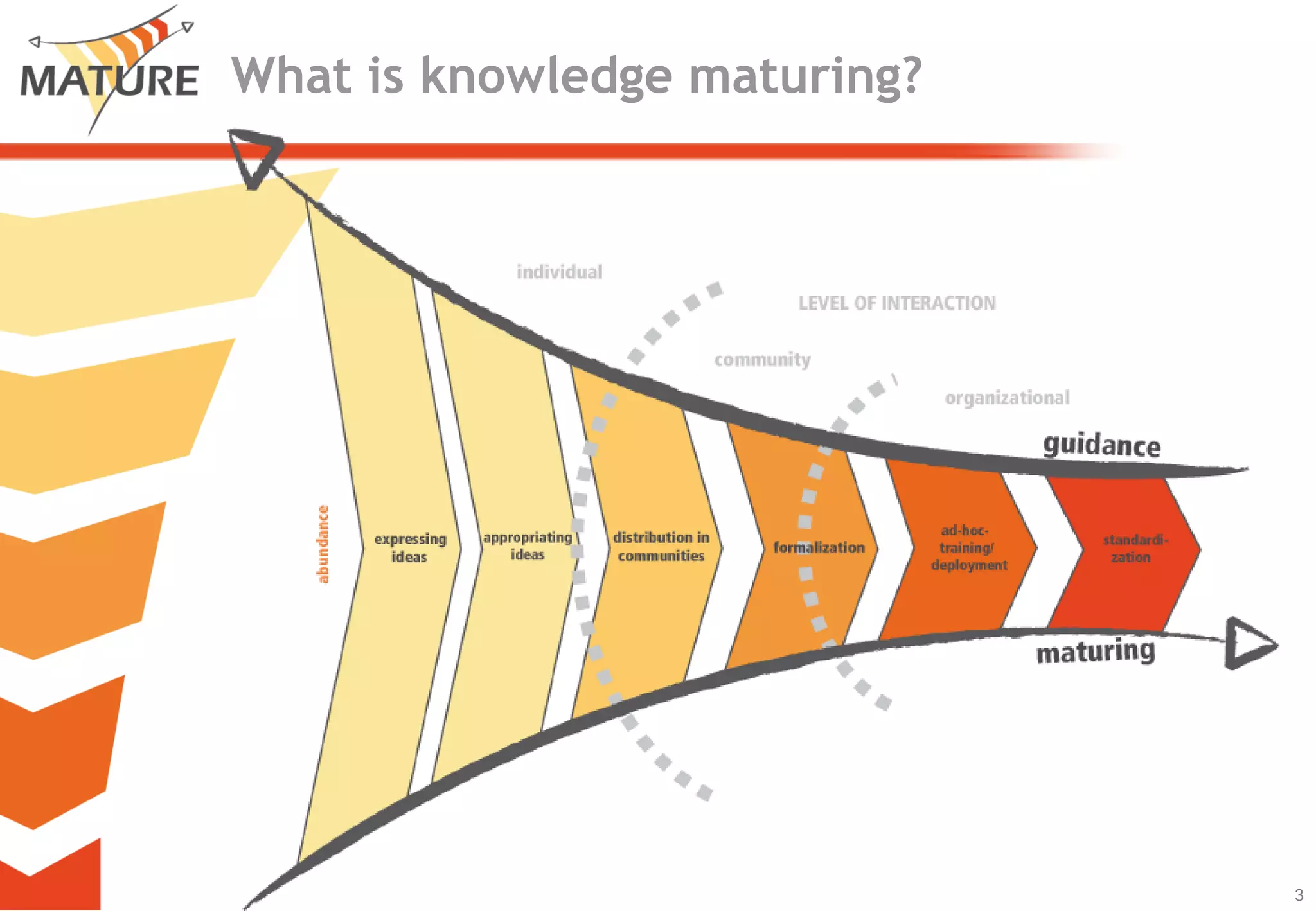
Whatisknowledgematuring?
BackgroundKnowledgeMaturingActivitiesactivities of individuals or groups that contribute to the development of knowledge within the organisation.Basis:Prior work on knowledgeactivitiesEthnographicallyinformedstudies in thefirstyearof MATUREUsecasedefinitionprocessof MATUREFirst validation in a small-scalestudywithintheassociatepartnernetworkof MATURE
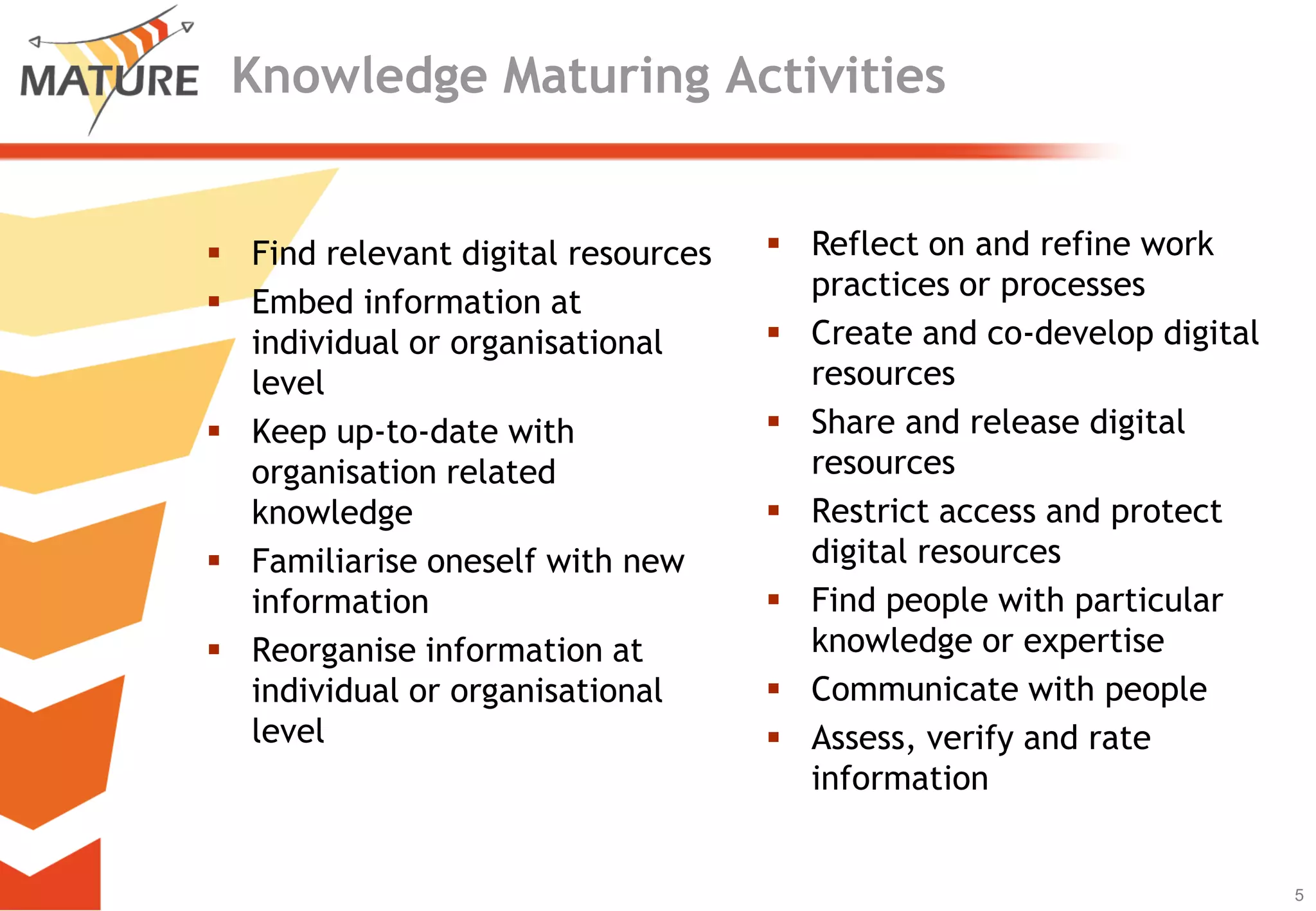
KnowledgeMaturingActivitiesReflect on and refine work practices or processes
Create and co-develop digital resources
Share and release digital resources
Restrict access and protect digital resources
Find people with particular knowledgeorexpertise
Communicatewithpeople
Assess, verify and rate informationFind relevant digital resourcesEmbed information at individual or organisational levelKeep up-to-datewithorganisationrelatedknowledgeFamiliariseoneselfwithnewinformationReorganise information at individual or organisational level
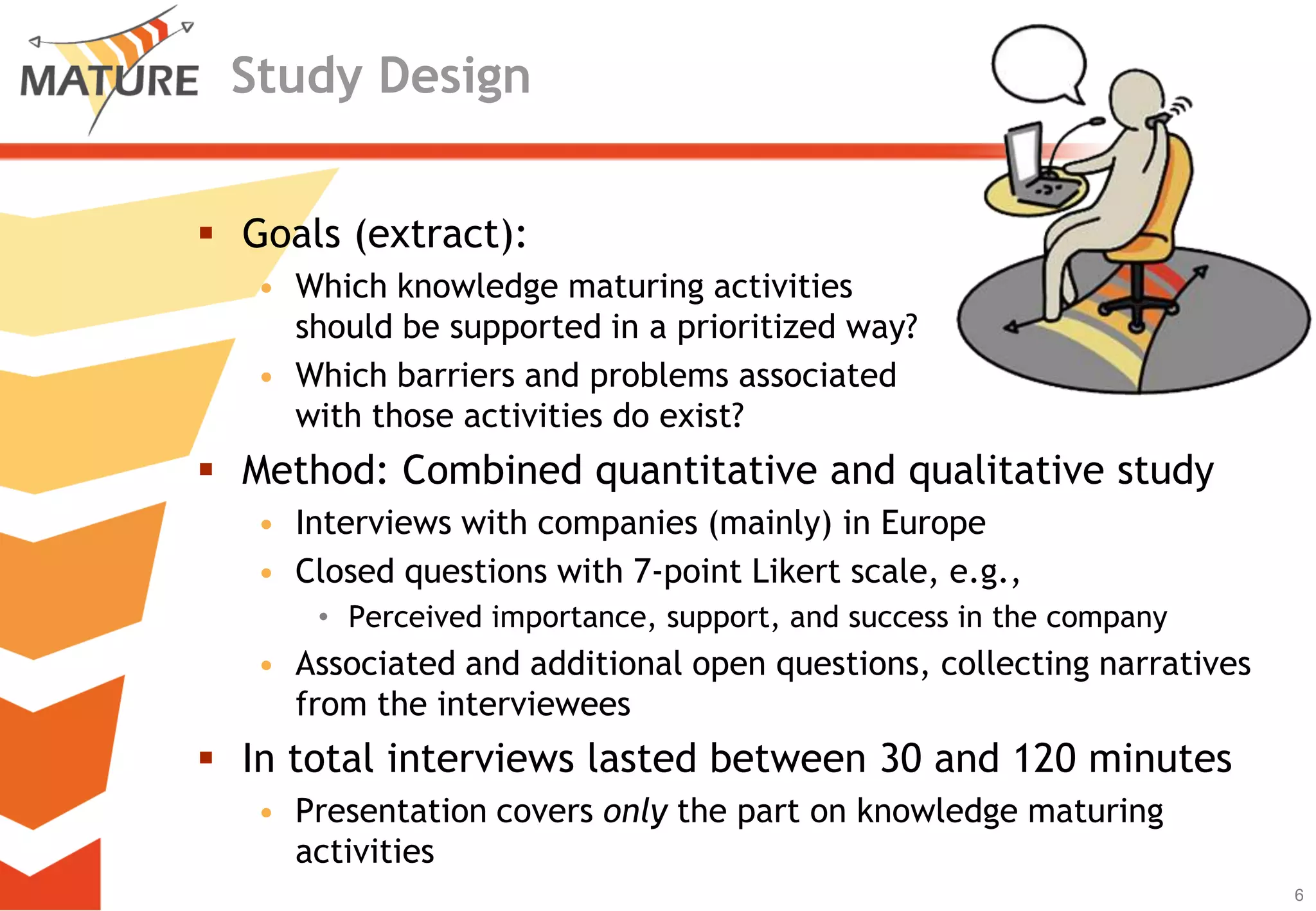
Study DesignGoals (extract): Whichknowledgematuringactivitiesshouldbesupported in a prioritizedway?Whichbarriersandproblemsassociatedwiththoseactivities do exist?Method: Combined quantitative and qualitative studyInterviews withcompanies (mainly) in EuropeClosedquestionswith 7-point Likertscale, e.g.,Perceivedimportance, support, andsuccess in thecompanyAssociated and additional open questions, collecting narratives fromtheintervieweesIn total interviewslastedbetween 30 and 120 minutesPresentationcoversonlythepart on knowledgematuringactivities
Resultsofthe Study
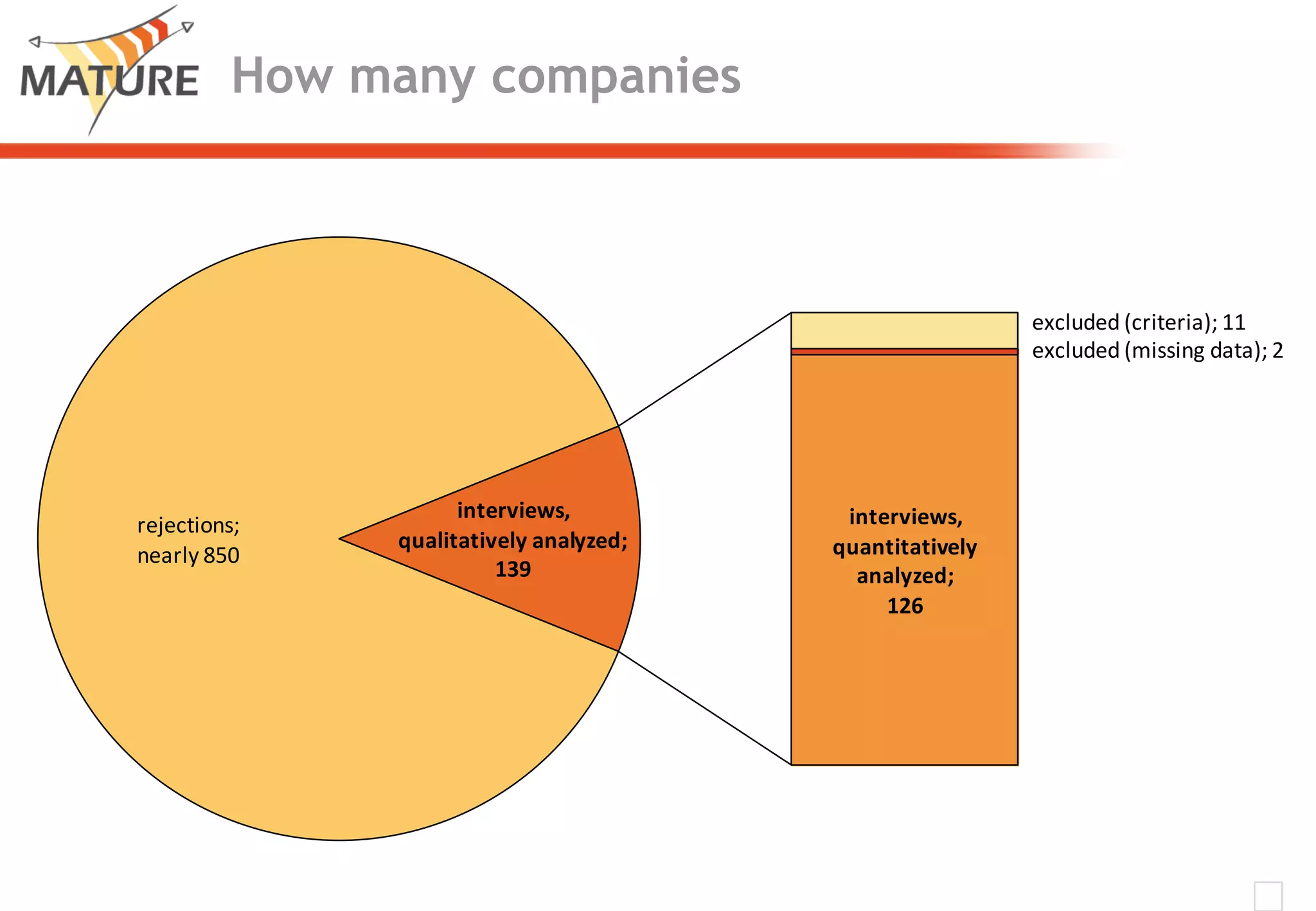
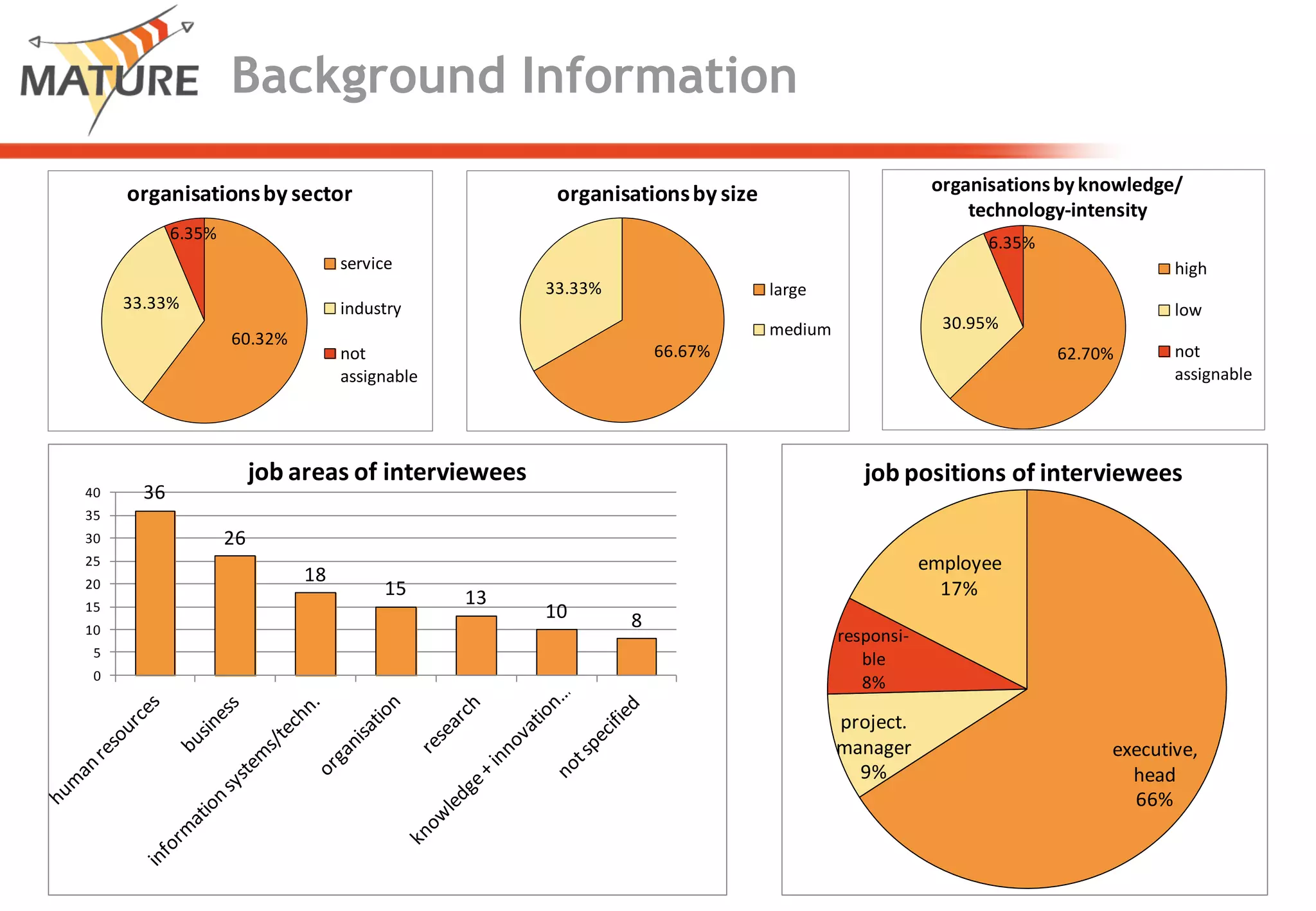
How many companies
Background Information
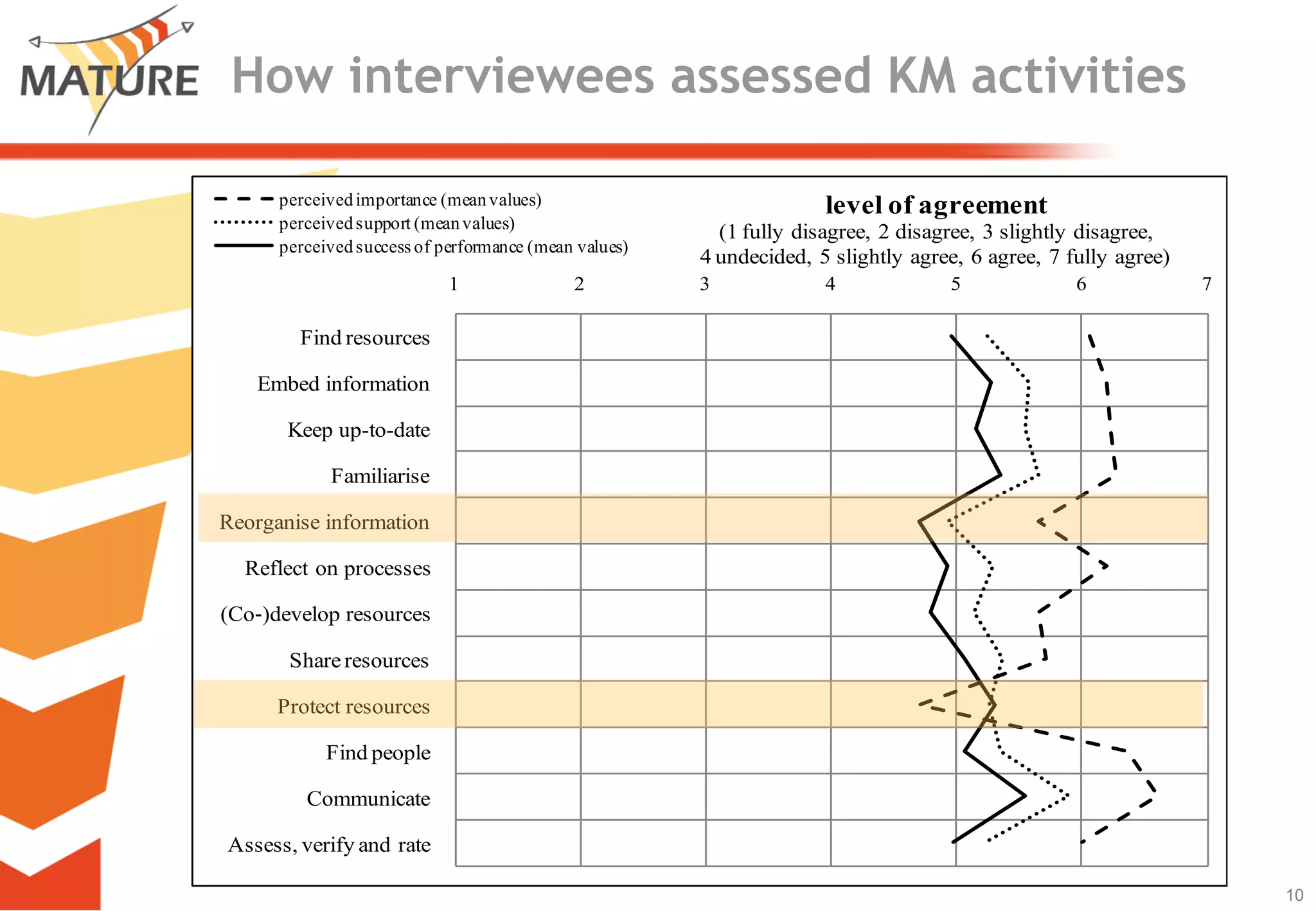
How interviewees assessed KM activities
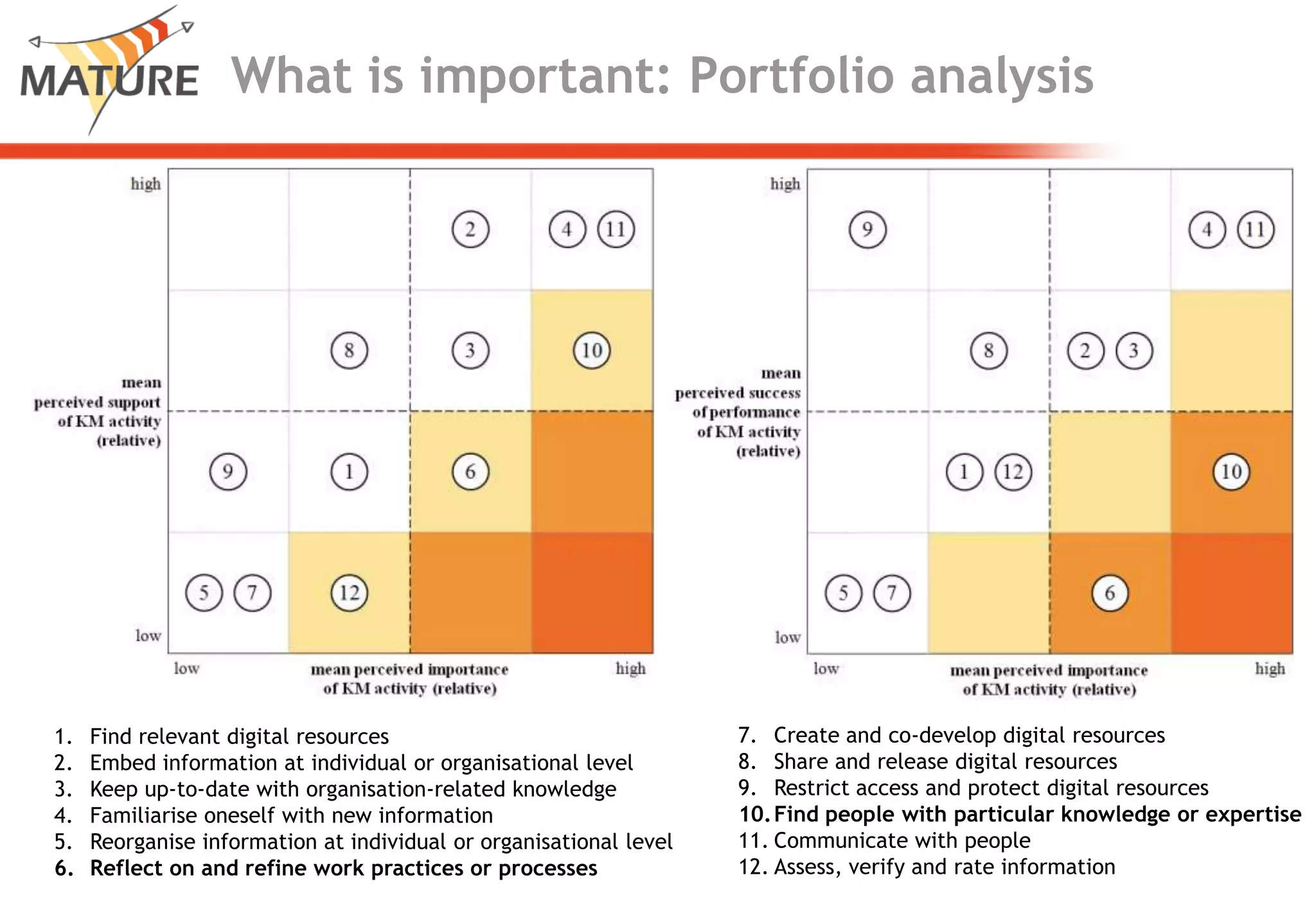
What is important: Portfolio analysis7.	Create and co-develop digital resources8.	Share and release digital resources9.	Restrict access and protect digital resources10.	Find people with particular knowledge or expertise11.	Communicate with people12.	Assess, verify and rate information1.	Find relevant digital resources2.	Embed information at individual or organisational level3.	Keep up-to-date with organisation-related knowledge4.	Familiarise oneself with new information5.	Reorganise information at individual or organisational level6.	Reflect on and refine work practices or processes
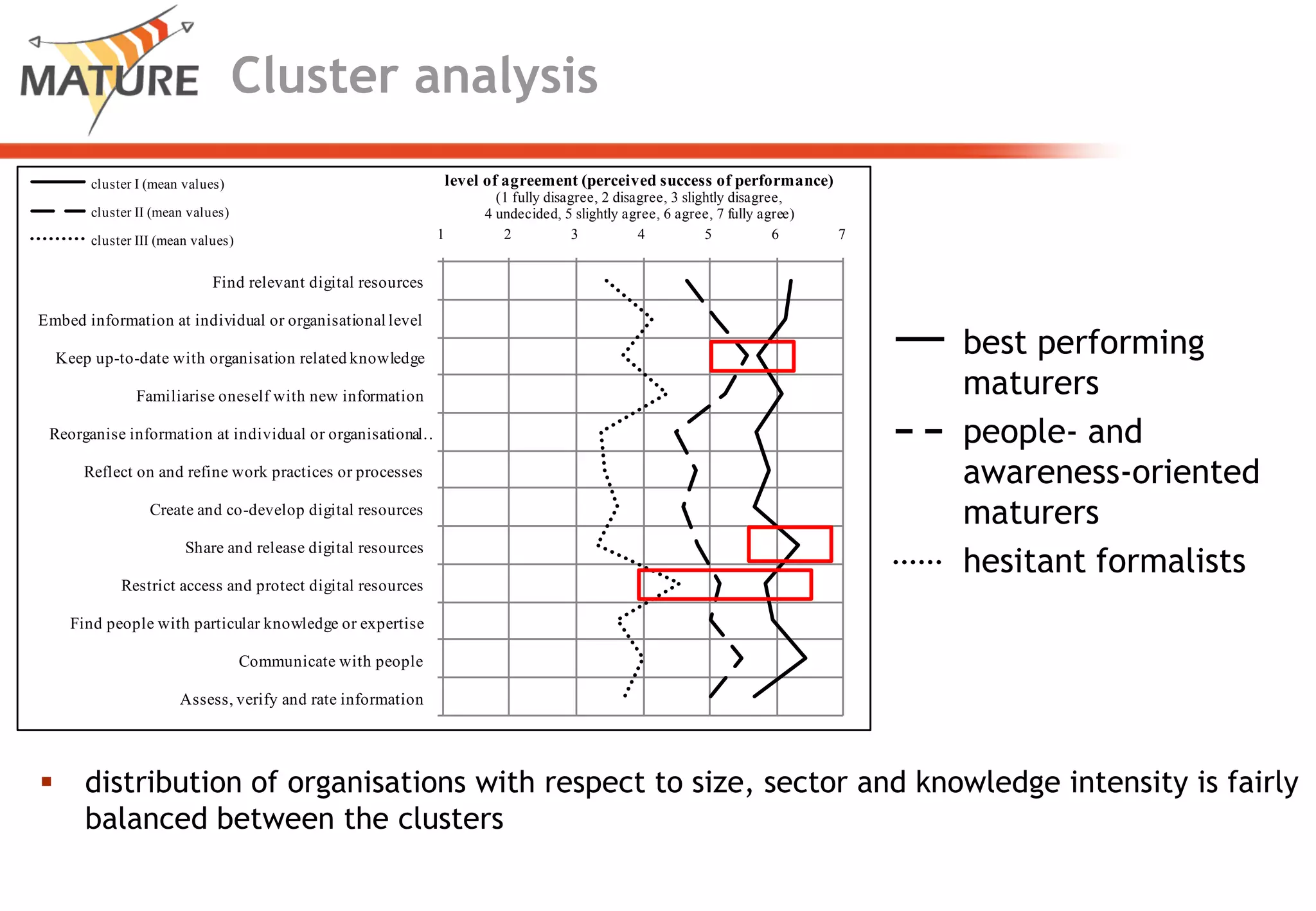
Cluster analysisbest performing maturerspeople- and awareness-oriented maturershesitant formalistsdistribution of organisations with respect to size, sector and knowledge intensity is fairly balanced between the clusters Restrictaccessandprotectmost controversial KM activitytwo types of answers can be distinguished: statements whether and why the organisation restricts access and statements about personal opinion whether restricting access is beneficial to knowledge maturing.
Restrict & protectaccess: organizationalSome have very few restrictions (related to an open organisational culture), whilst others are giving high priority to restricting access:legal requirementschannel the knowledge through the correct users and to avoid dissipating itprotecting their own competitive advantageImportant is the nature of their competetive advantage:people, marketing, process knowledge
Restrict & protectaccess: individualTrust as a prerequisite. “There are individuals who will share only in a limited way if they can trust that not everyone can see it.” “So if you restrict access, it is also good for knowledge exchange, not for those who don't have access, but for those who have access. Otherwise you wouldn't share anything if you couldn't restrict it to certain persons”. Information channelling/avoidance of overload. “Knowledge is not something that has to be always distributed. With this activity the knowledge is channelled to therightusers.”

Knowledge Maturing Activities and Practices Fostering Organisational Learning: Results of an Empirical Study

  • 1.
    Andreas Kaschig, RonaldMaier, Alexander Sandow, MariangelaLazoi, Sally-Anne Barnes, Jenny Bimrose, Claire Bradley, Alan Brown, Christine Kunzmann, Athanasios Mazarakis, Andreas SchmidtKnowledge Maturing Activities and Practices Fostering Organisational Learning: Results of an Empirical StudyECTEL 2010September 30, 2010 Barcelonahttp://mature-ip.eu
  • 2.
  • 3.
  • 4.
    BackgroundKnowledgeMaturingActivitiesactivities of individualsor groups that contribute to the development of knowledge within the organisation.Basis:Prior work on knowledgeactivitiesEthnographicallyinformedstudies in thefirstyearof MATUREUsecasedefinitionprocessof MATUREFirst validation in a small-scalestudywithintheassociatepartnernetworkof MATURE
  • 5.
    KnowledgeMaturingActivitiesReflect on andrefine work practices or processes
  • 6.
    Create and co-developdigital resources
  • 7.
    Share and releasedigital resources
  • 8.
    Restrict access andprotect digital resources
  • 9.
    Find people withparticular knowledgeorexpertise
  • 10.
  • 11.
    Assess, verify andrate informationFind relevant digital resourcesEmbed information at individual or organisational levelKeep up-to-datewithorganisationrelatedknowledgeFamiliariseoneselfwithnewinformationReorganise information at individual or organisational level
  • 12.
    Study DesignGoals (extract):Whichknowledgematuringactivitiesshouldbesupported in a prioritizedway?Whichbarriersandproblemsassociatedwiththoseactivities do exist?Method: Combined quantitative and qualitative studyInterviews withcompanies (mainly) in EuropeClosedquestionswith 7-point Likertscale, e.g.,Perceivedimportance, support, andsuccess in thecompanyAssociated and additional open questions, collecting narratives fromtheintervieweesIn total interviewslastedbetween 30 and 120 minutesPresentationcoversonlythepart on knowledgematuringactivities
  • 13.
  • 14.
  • 15.
  • 16.
  • 17.
    What is important:Portfolio analysis7. Create and co-develop digital resources8. Share and release digital resources9. Restrict access and protect digital resources10. Find people with particular knowledge or expertise11. Communicate with people12. Assess, verify and rate information1. Find relevant digital resources2. Embed information at individual or organisational level3. Keep up-to-date with organisation-related knowledge4. Familiarise oneself with new information5. Reorganise information at individual or organisational level6. Reflect on and refine work practices or processes
  • 18.
    Cluster analysisbest performingmaturerspeople- and awareness-oriented maturershesitant formalistsdistribution of organisations with respect to size, sector and knowledge intensity is fairly balanced between the clusters Restrictaccessandprotectmost controversial KM activitytwo types of answers can be distinguished: statements whether and why the organisation restricts access and statements about personal opinion whether restricting access is beneficial to knowledge maturing.
  • 19.
    Restrict & protectaccess:organizationalSome have very few restrictions (related to an open organisational culture), whilst others are giving high priority to restricting access:legal requirementschannel the knowledge through the correct users and to avoid dissipating itprotecting their own competitive advantageImportant is the nature of their competetive advantage:people, marketing, process knowledge
  • 20.
    Restrict & protectaccess:individualTrust as a prerequisite. “There are individuals who will share only in a limited way if they can trust that not everyone can see it.” “So if you restrict access, it is also good for knowledge exchange, not for those who don't have access, but for those who have access. Otherwise you wouldn't share anything if you couldn't restrict it to certain persons”. Information channelling/avoidance of overload. “Knowledge is not something that has to be always distributed. With this activity the knowledge is channelled to therightusers.”
  • 21.
    Restrict & protectaccess:individual (II)Obstructing people’s access to knowledge which they view as a prerequisite for knowledge maturing to happen. “nonsense”“The access rights are pretty strict, my drive cannot be seen by my colleagues, I find that unbelievable.”“We are destroying knowledge in this area”
  • 22.
    Further narratives collectedE.g.,medical engineering companyMarket leader due to its production process knowledgeNeed toprotectitscompetetiveadvantageAnonymizationofcustomers, accessprotectionBut: still foster an open innovationclimateCreatingawarenessofprotectionandinnovationneedsDifficulttoimplementprocessinnovationsLong cycles due tocertificationHigh budgetfor an experimentationteam
  • 23.
  • 24.
    ConclusionsMost importantfor ProfessionalTEL tofocus on:Reflect on andrefineworkpracticesFind people with particular knowledge orexpertiseSuccess in sharingofresourcesandcommunicationismaindifferentiatingfactorof „bestperformers“ clusterA differentiatedperspectiveisneeded onRestrict & protectaccessNosignificant national culturaldifferencesslightdifferenceswithrespectto professional cultureconsiderableimpactoforganizationalculture
  • 25.
    Outlook & ContactOpenforassociatepartners!MATURE IP – http://mature-ip.euIdentifyingandovercomingbarrierstoknowledgematuring in organizationsSummaryofrepresentativestudy: http://mature-ip.eu/results/representative-studyAndreas SchmidtDepartment Manager Scientific CoordinatorMATUREFZI Research Center for Information Technologiesandreas.schmidt@fzi.dehttp://andreas.schmidt.name