ODIN –
ORCID and DataCite Interoperability Network
Association of Librarians and Information
Professionals in the Social Sciences
July 2013
John Kaye – British Library
Funded by The European Union Seventh Framework
Programme
www.odin-project.eu
Summary
• Identifiers
• ODIN Overview
• Humanities and Social Sciences
• High Energy Physics
• Next Steps
Identifers
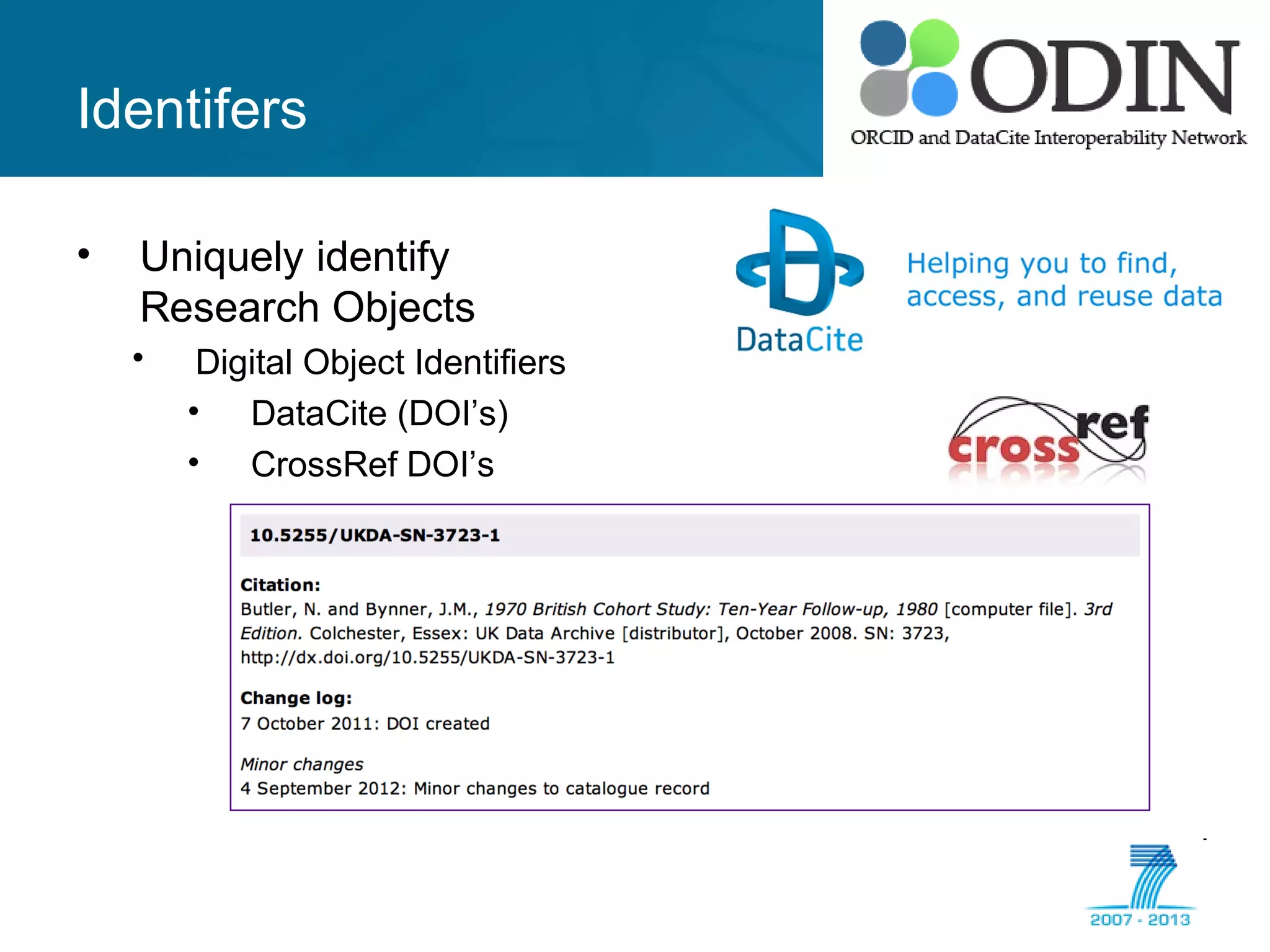
• Uniquely identify
Research Objects
• Digital Object Identifiers
• DataCite (DOI’s)
• CrossRef DOI’s
Identifers
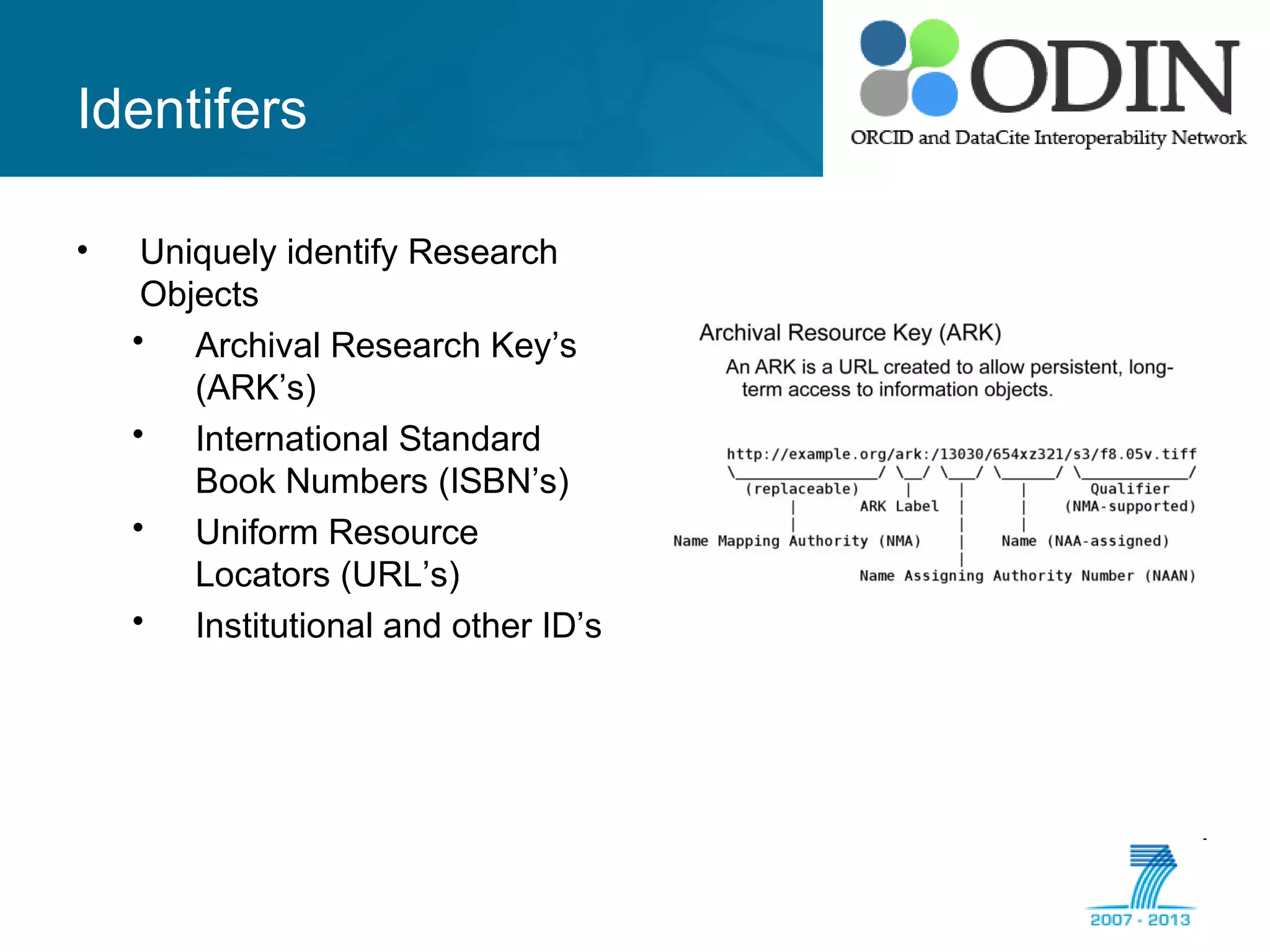
• Uniquely identify Research
Objects
• Archival Research Key’s
(ARK’s)
• International Standard
Book Numbers (ISBN’s)
• Uniform Resource
Locators (URL’s)
• Institutional and other ID’s
People Identifers
• Uniquely identify
people
• Open Researcher
and Contributor ID
(ORCID)
• International
Standard Name
Identifier (ISNI)
• Country Based
ID’s
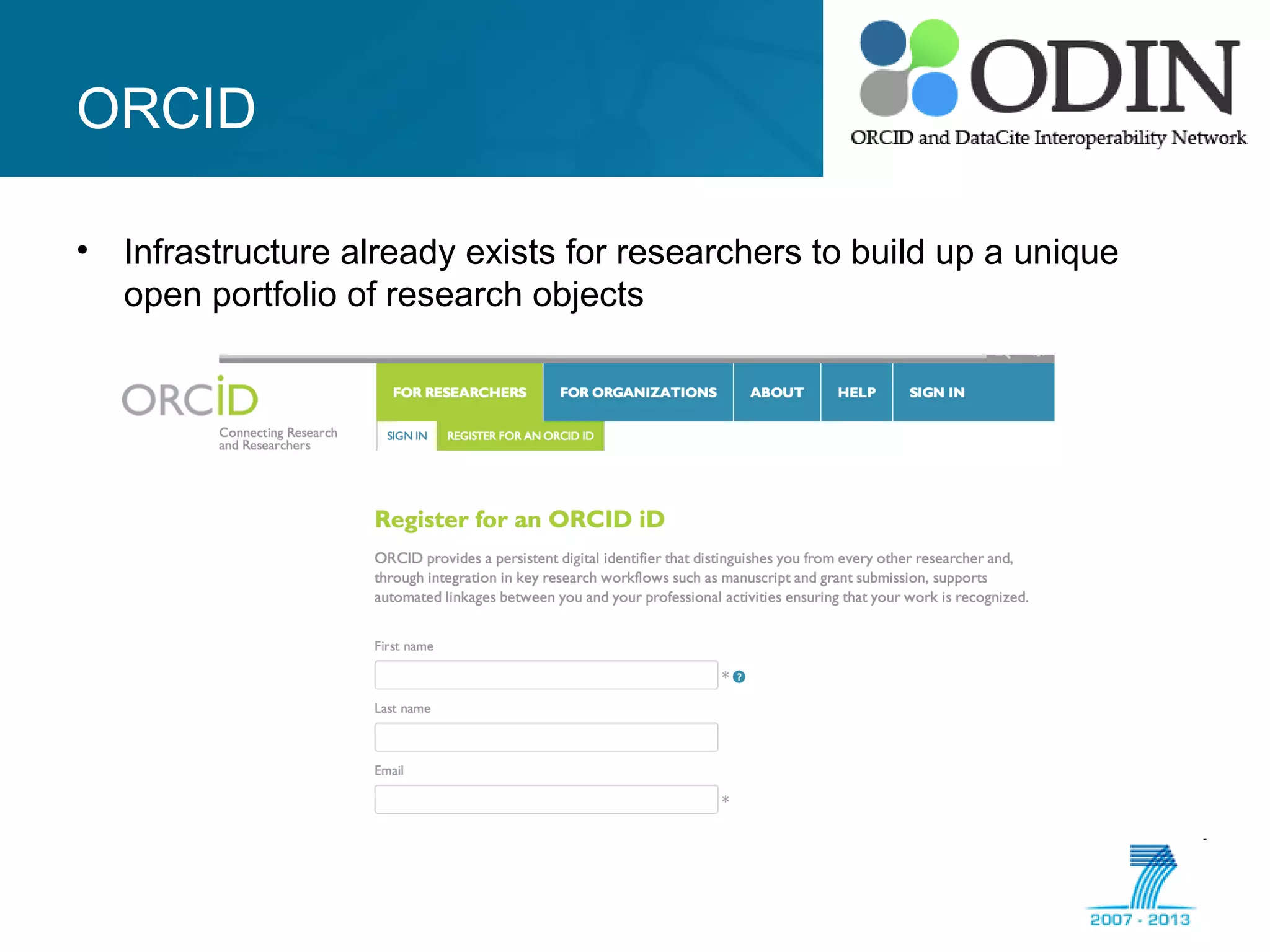
ORCID
• Infrastructure already exists for researchers to build up a unique
open portfolio of research objects
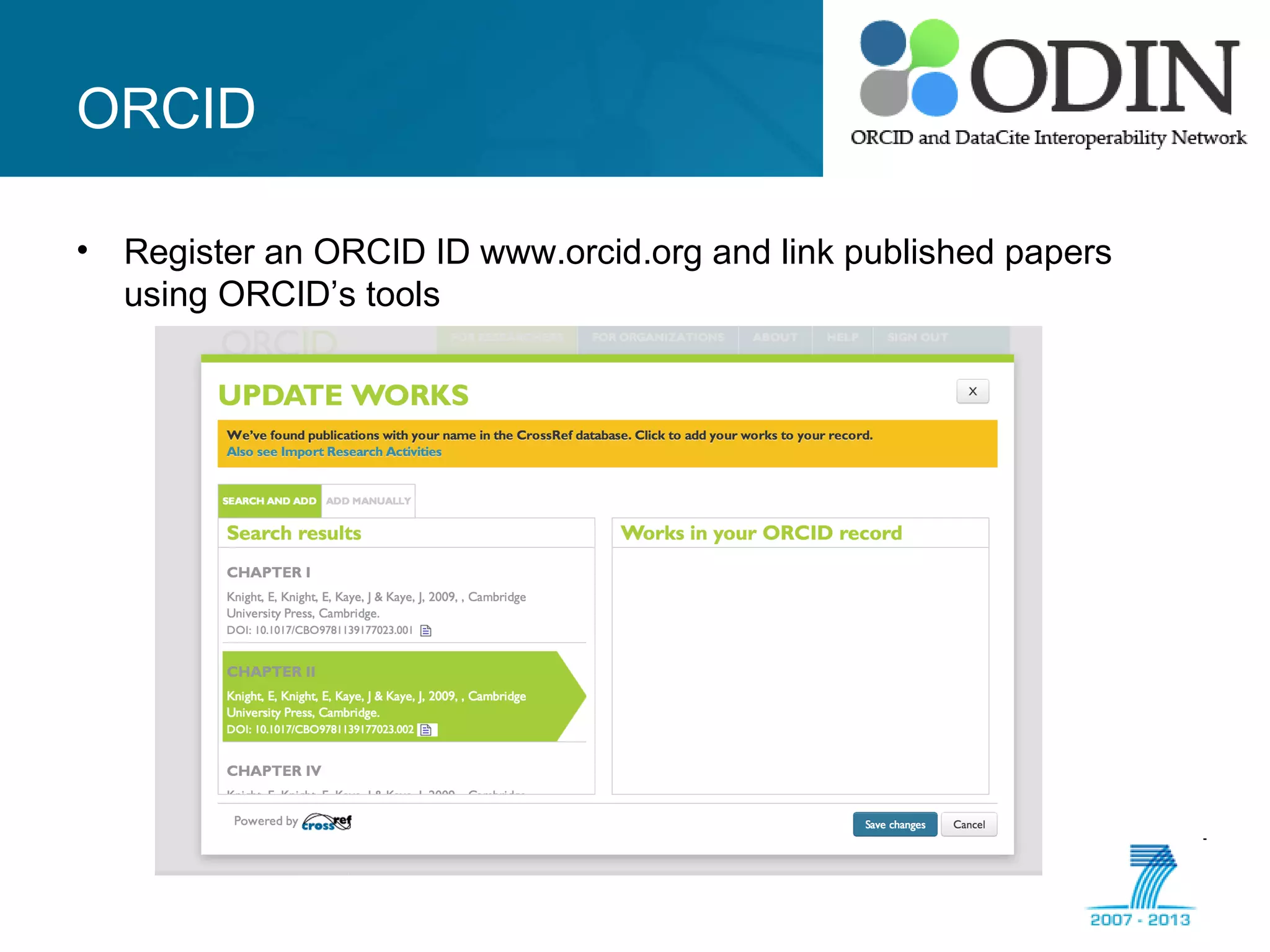
ORCID
• Register an ORCID ID www.orcid.org and link published papers
using ORCID’s tools
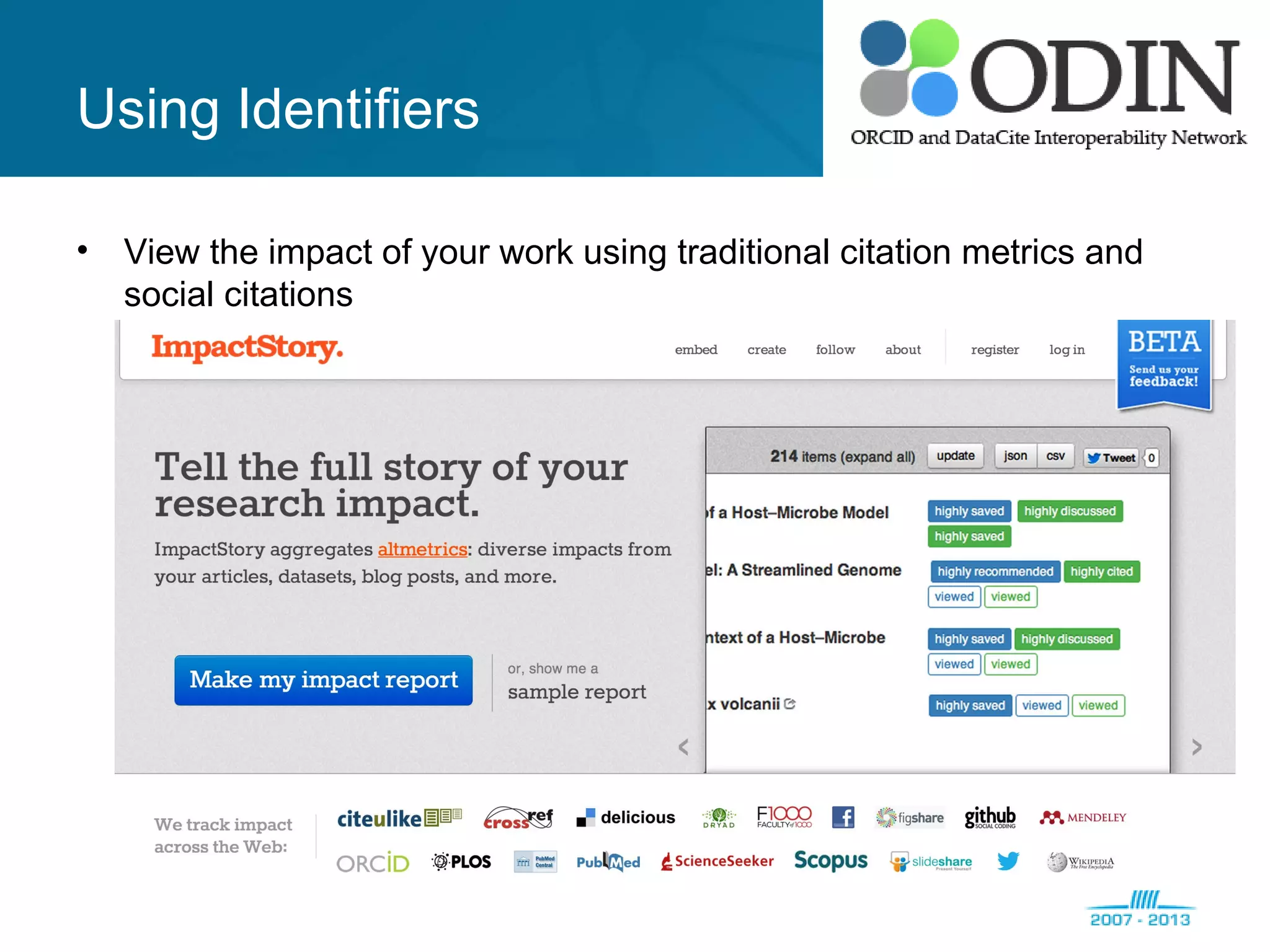
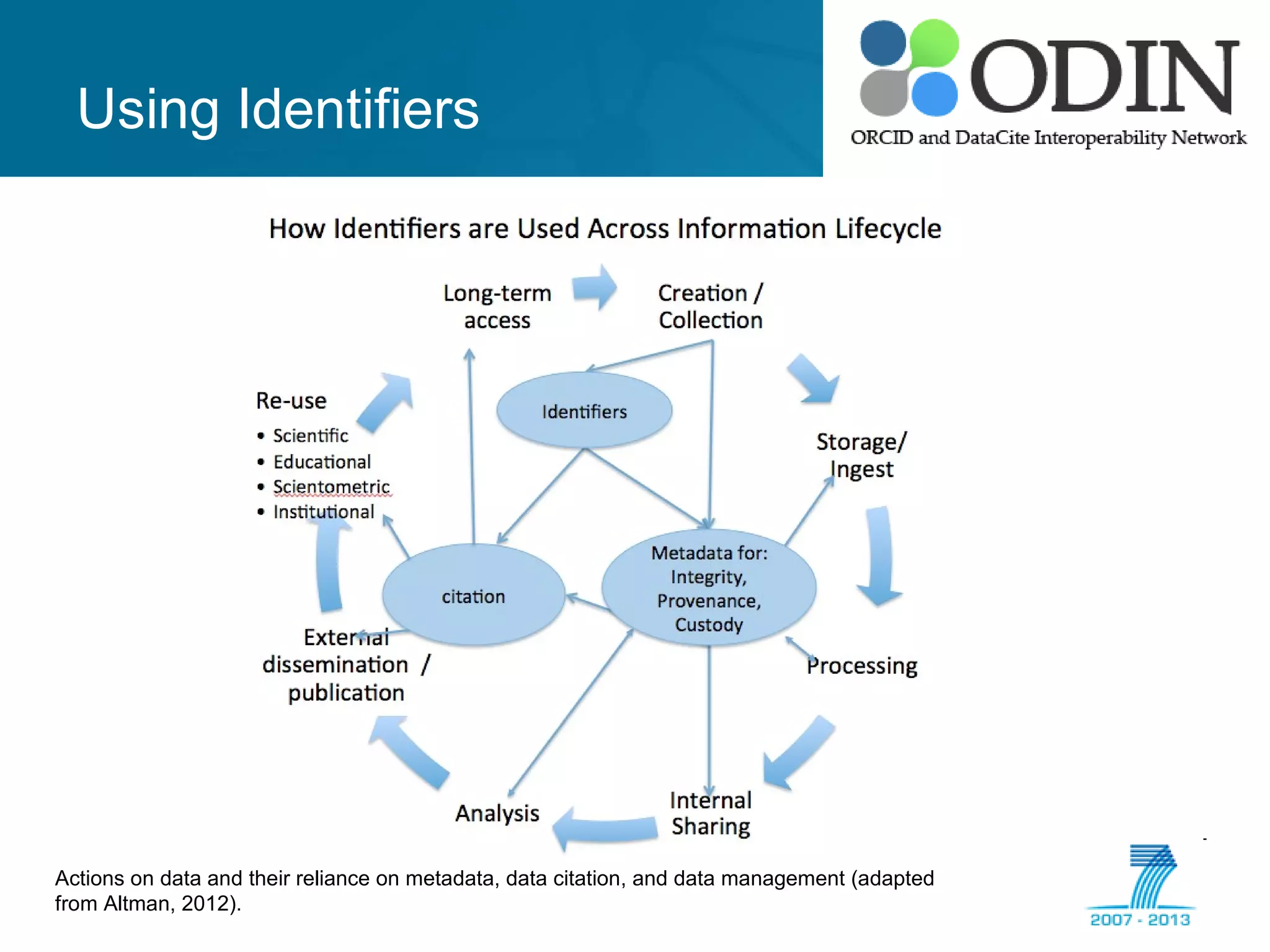
Using Identifiers
• View the impact of your work using traditional citation metrics and
social citations
Using Identifiers
Actions on data and their reliance on metadata, data citation, and data management (adapted
from Altman, 2012).
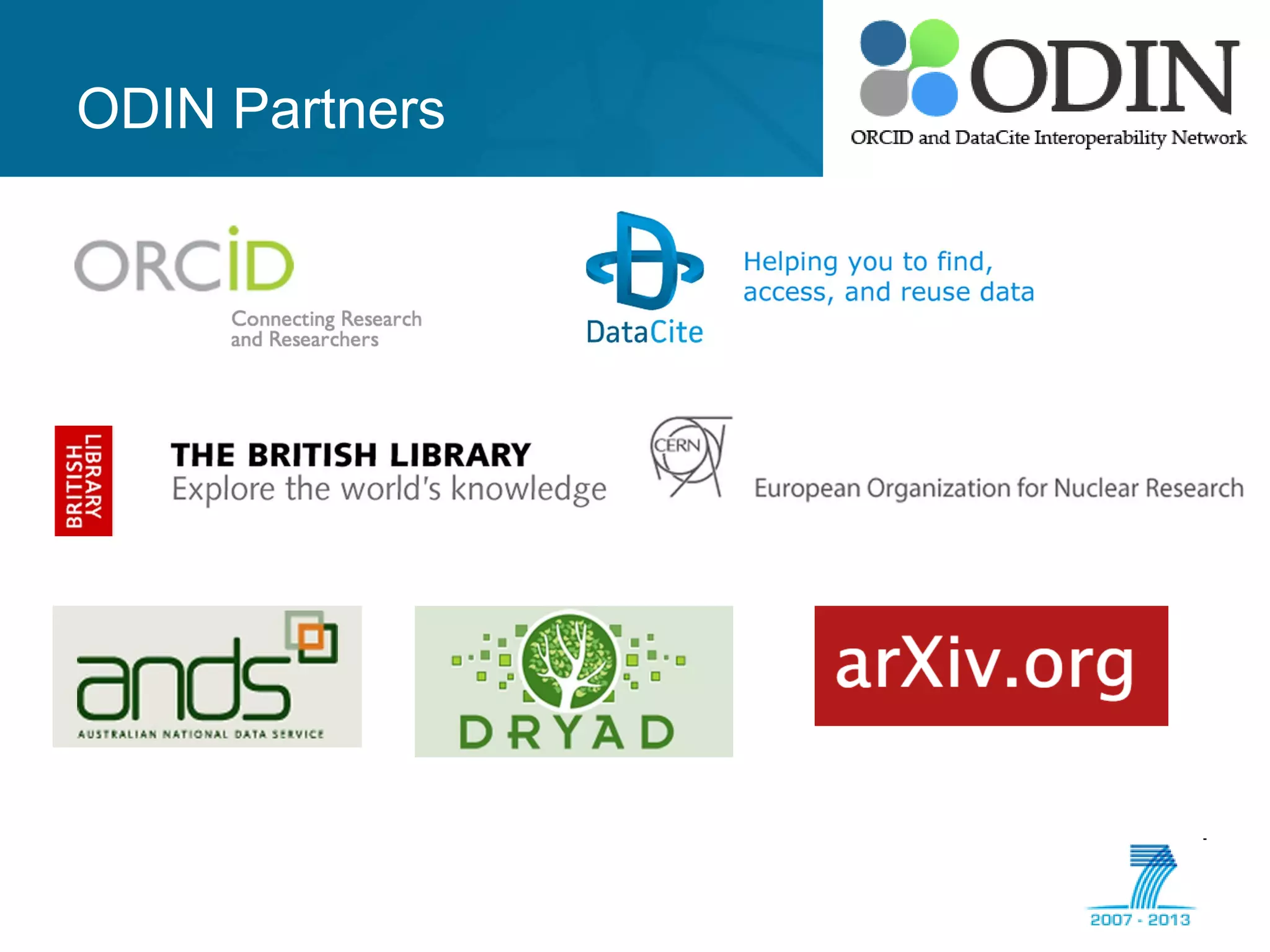
ODIN Partners
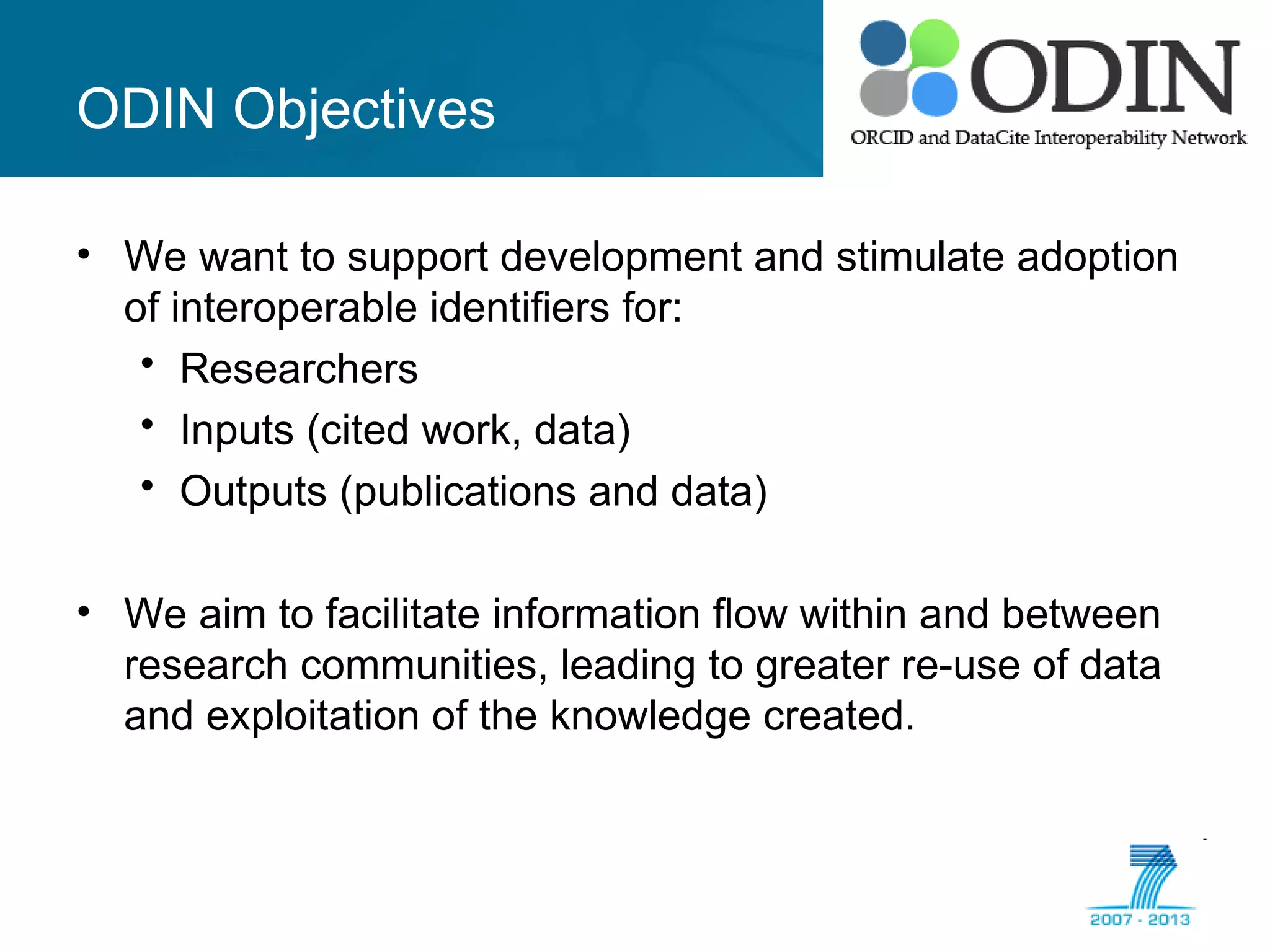
ODIN Objectives
• We want to support development and stimulate adoption
of interoperable identifiers for:
• Researchers
• Inputs (cited work, data)
• Outputs (publications and data)
• We aim to facilitate information flow within and between
research communities, leading to greater re-use of data
and exploitation of the knowledge created.
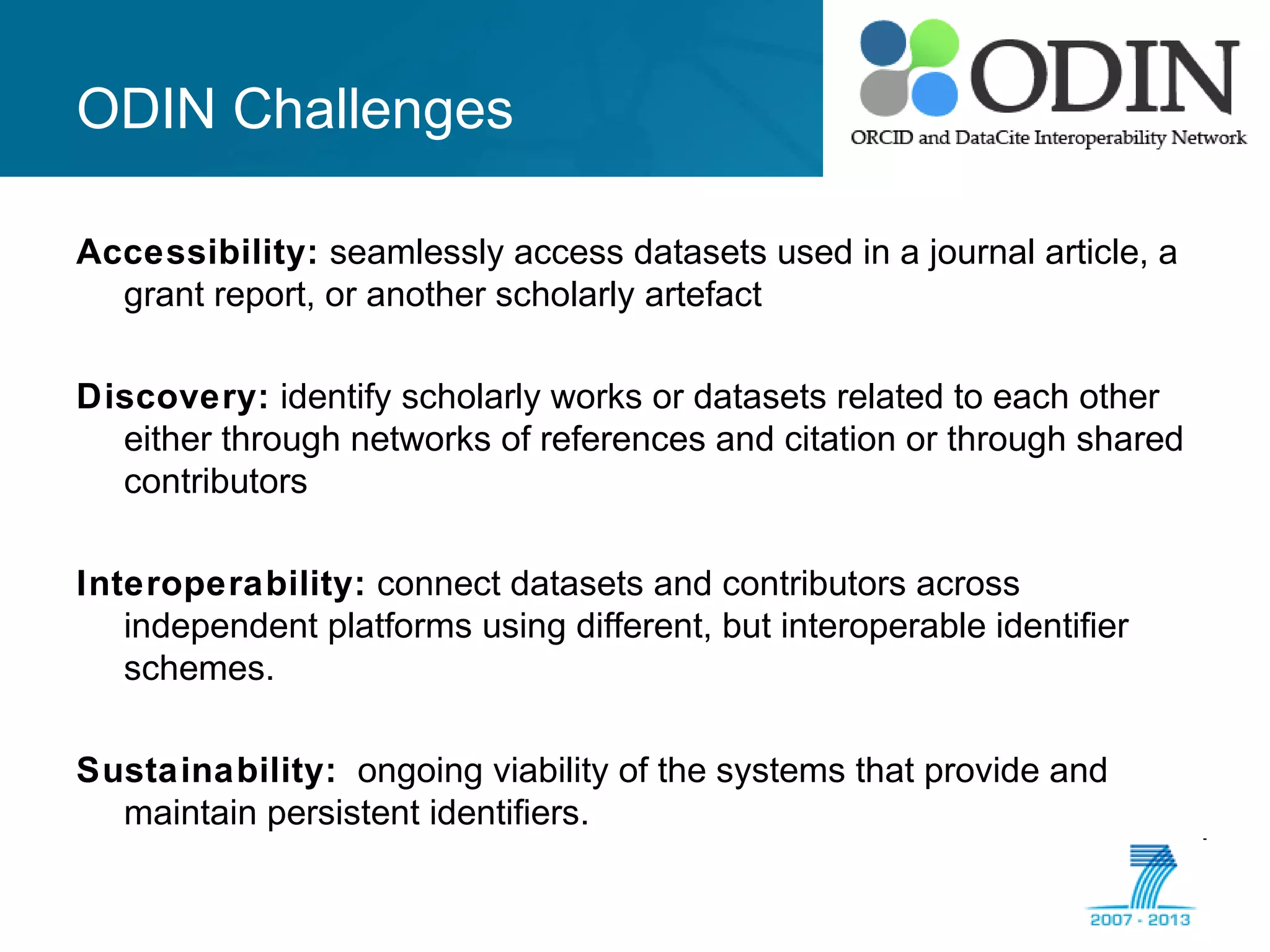
ODIN Challenges
Accessibility: seamlessly access datasets used in a journal article, a
grant report, or another scholarly artefact
Discovery: identify scholarly works or datasets related to each other
either through networks of references and citation or through shared
contributors
Interoperability: connect datasets and contributors across
independent platforms using different, but interoperable identifier
schemes.
Sustainability: ongoing viability of the systems that provide and
maintain persistent identifiers.
ODIN Work Streams
• Proofs of Concept in Humanities and
Social Science and High Energy Physics
• Interoperability
• Strategy
• Internationalisation
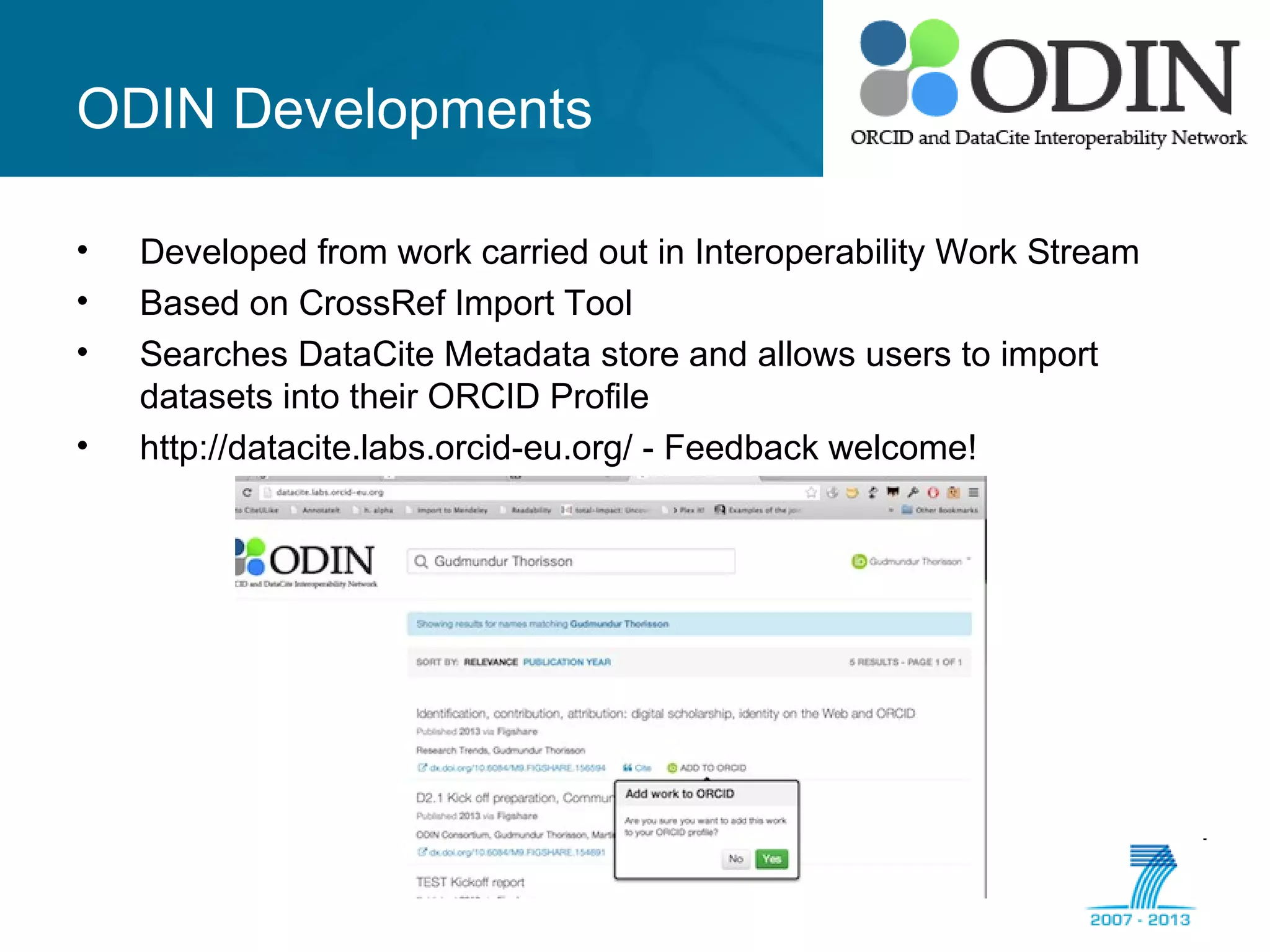
ODIN Developments
• Developed from work carried out in Interoperability Work Stream
• Based on CrossRef Import Tool
• Searches DataCite Metadata store and allows users to import
datasets into their ORCID Profile
• http://datacite.labs.orcid-eu.org/ - Feedback welcome!
Humanities and
Social Sciences (HSS)
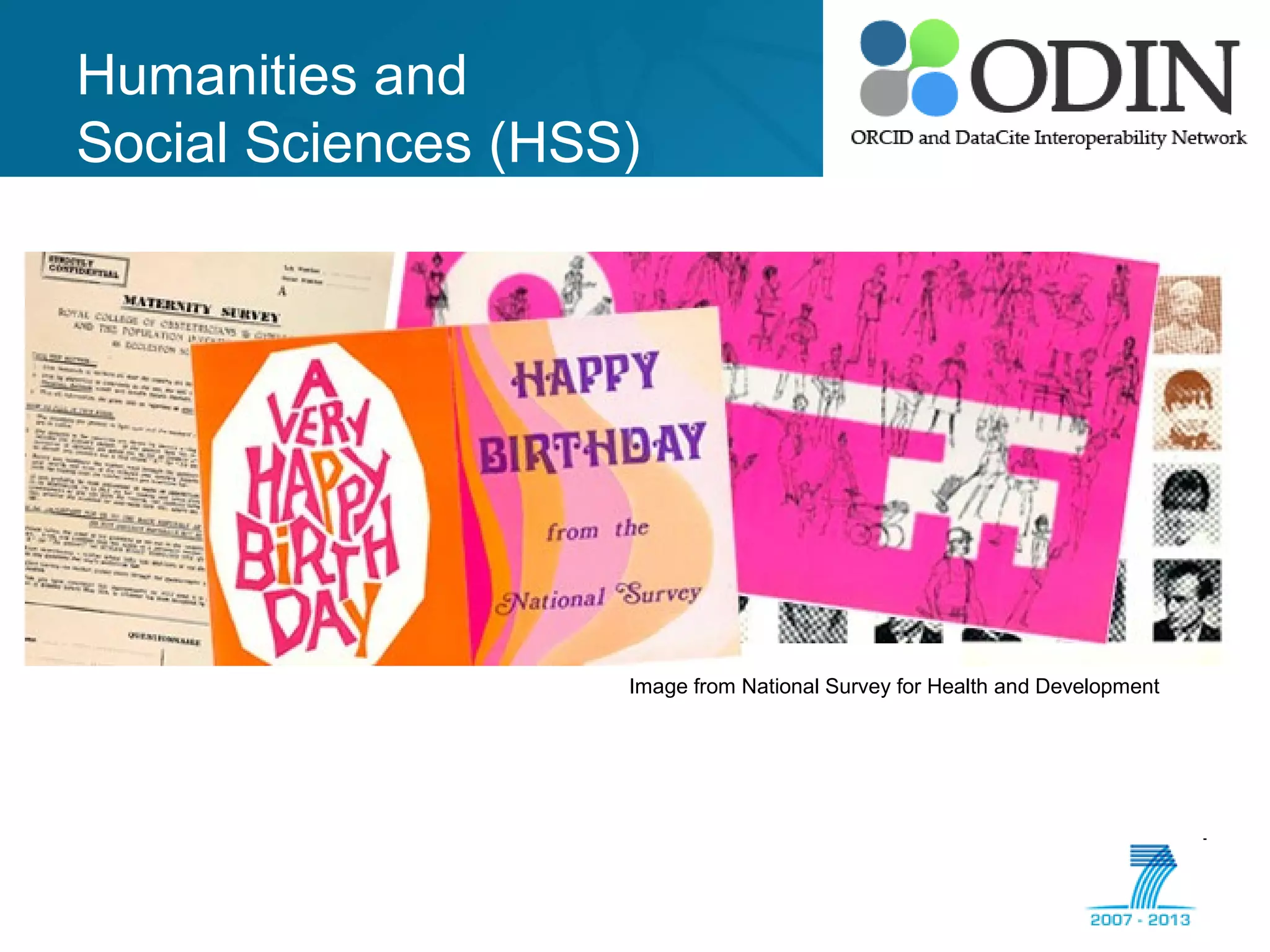
Image from National Survey for Health and Development
HSS: Birth Cohort Studies
• Why Birth Cohort Studies?
• Investment
• Established/Long history
• Tradition of data curation
• Multiple Data Providers
• High Re-use
• Derived Data
• Multi-disciplinary
• BL Involvement in CLOSER (Cohort and Longitudinal
Studies Enhancement Resource)
HSS: Objectives
• 1st
Year: Preliminary conceptual models for connecting
data creators, curators, contributors and data sets will be
described
• 2nd
Year: Concrete workflows will be designed and
developed
• The development of such workflows will be done in
strong collaboration with the relevant stakeholders in
the community
HSS: Approach
• Technical work – http://odin-discover.eu/
• Conversations and Interviews:
• Cohort Study Teams
• UK Data Service
• International Data Providers
• Visit from Australian Data Archive
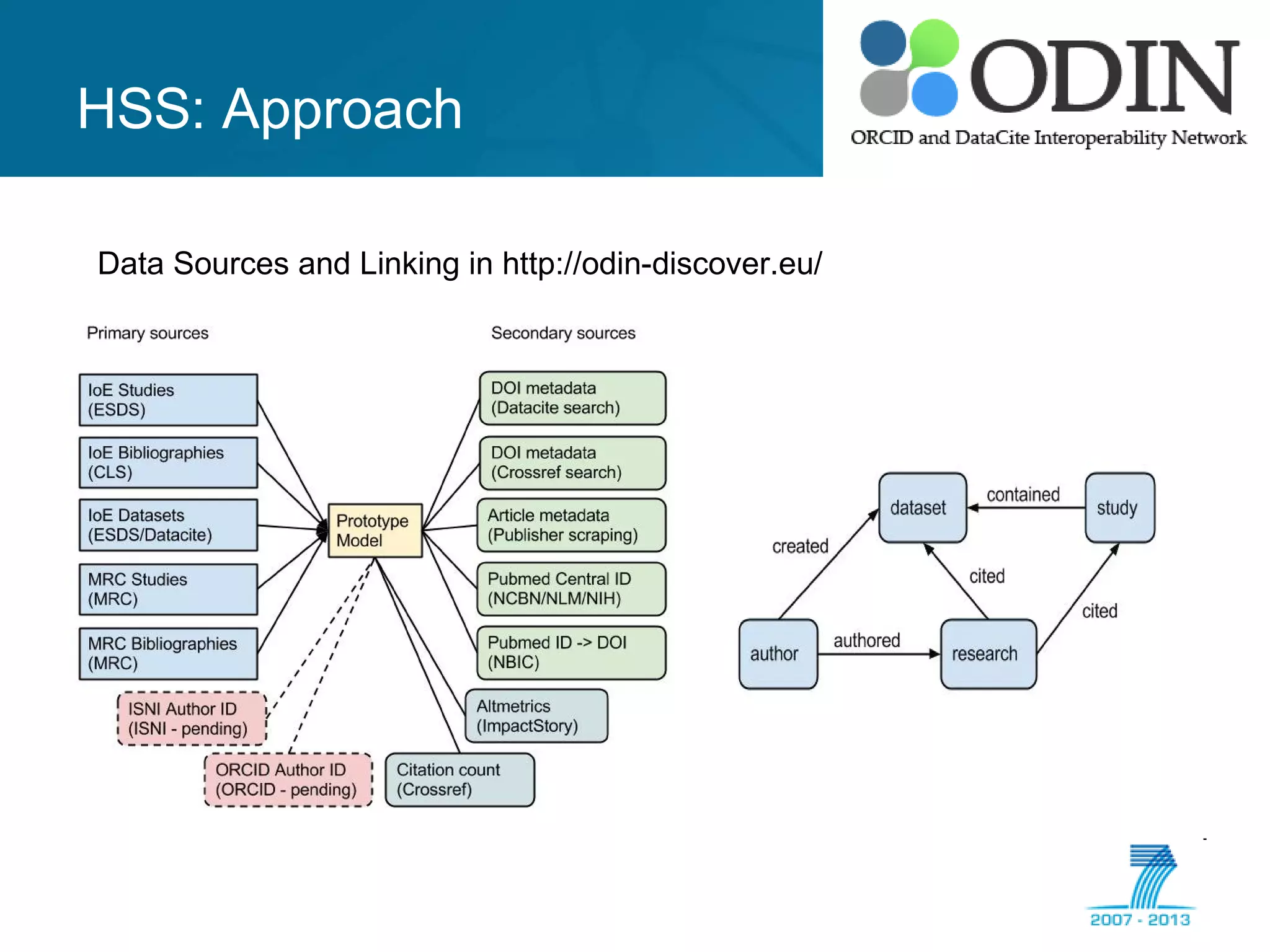
HSS: Approach
Data Sources and Linking in http://odin-discover.eu/
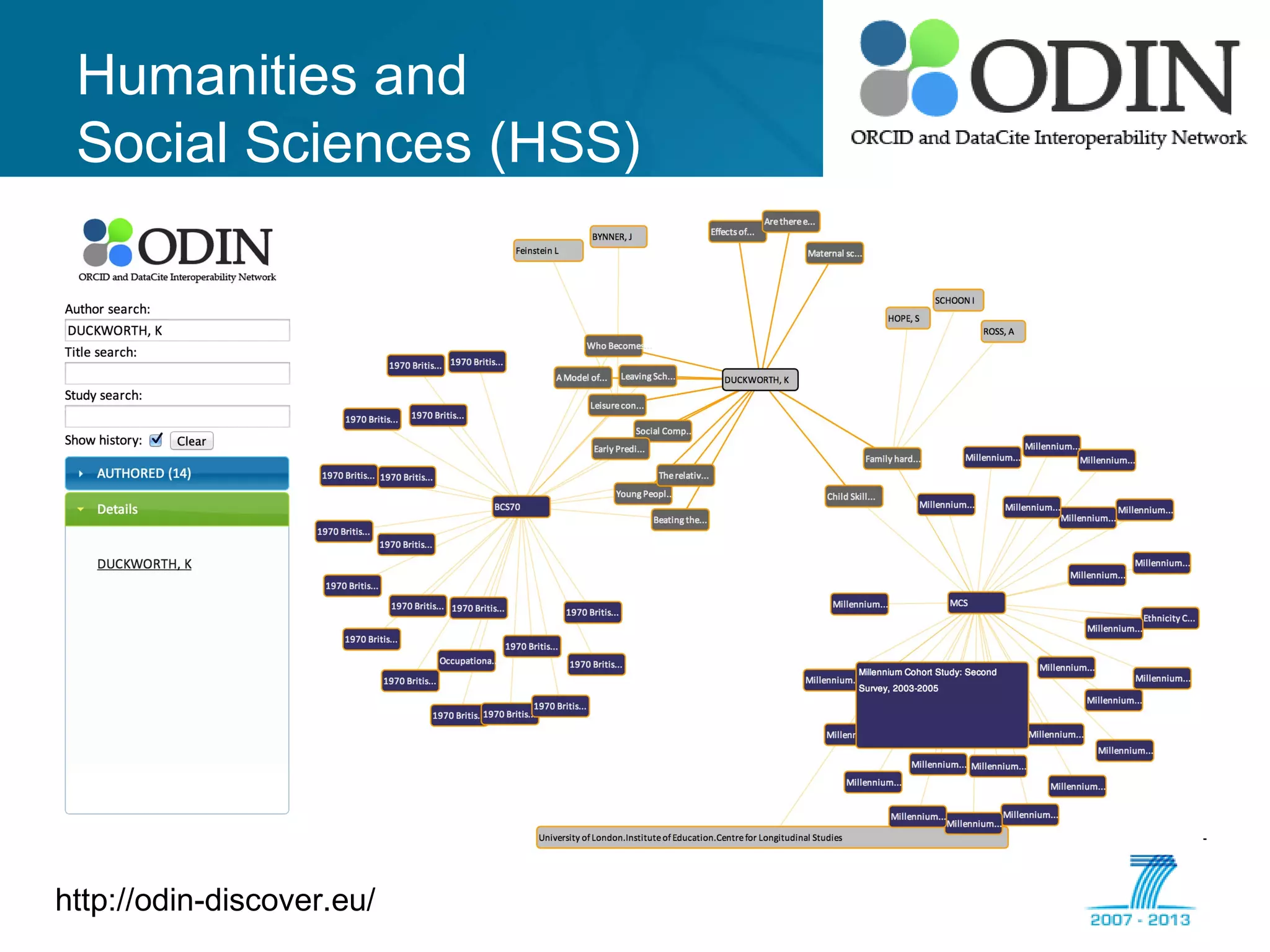
Humanities and
Social Sciences (HSS)
http://odin-discover.eu/
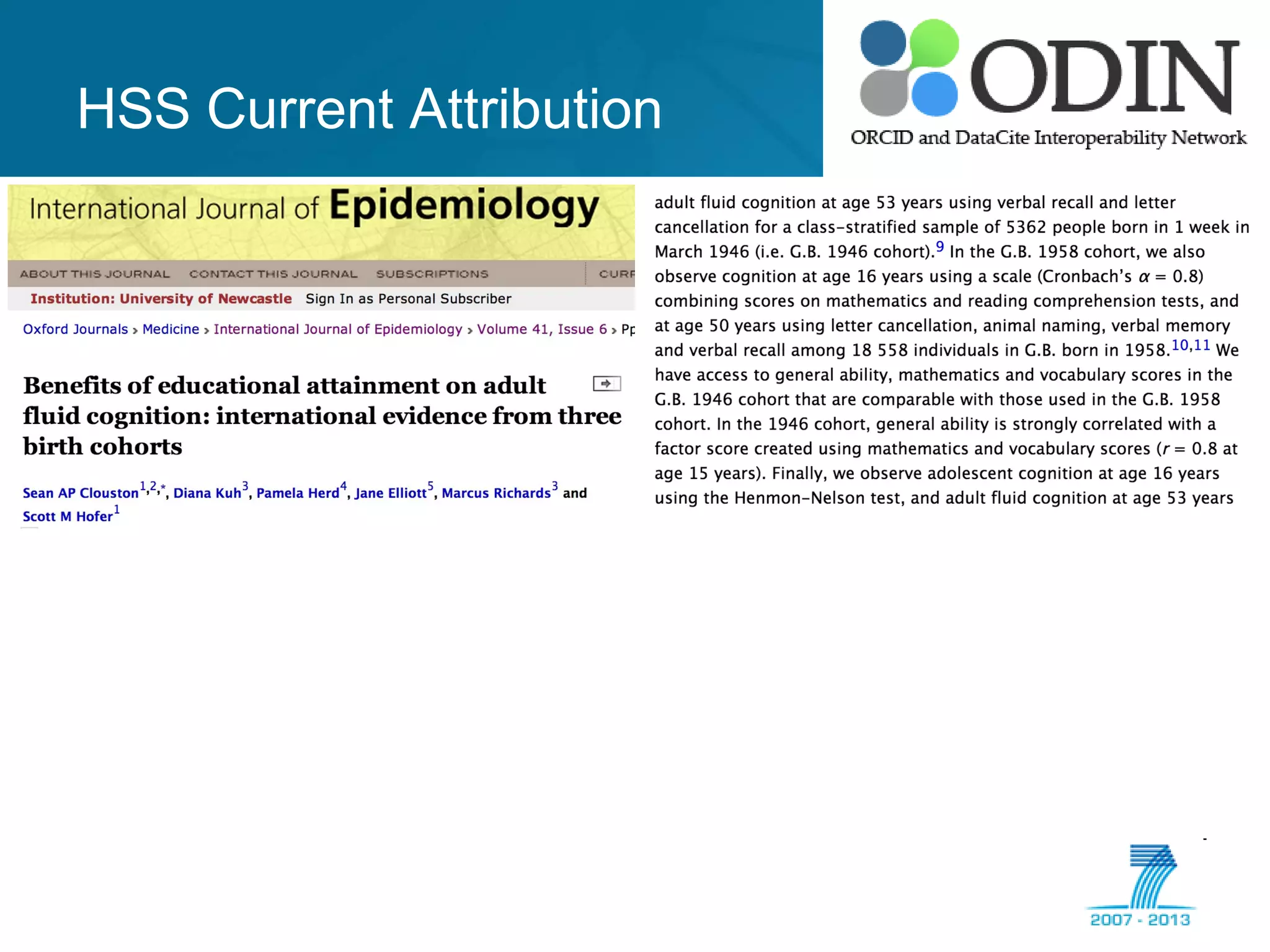
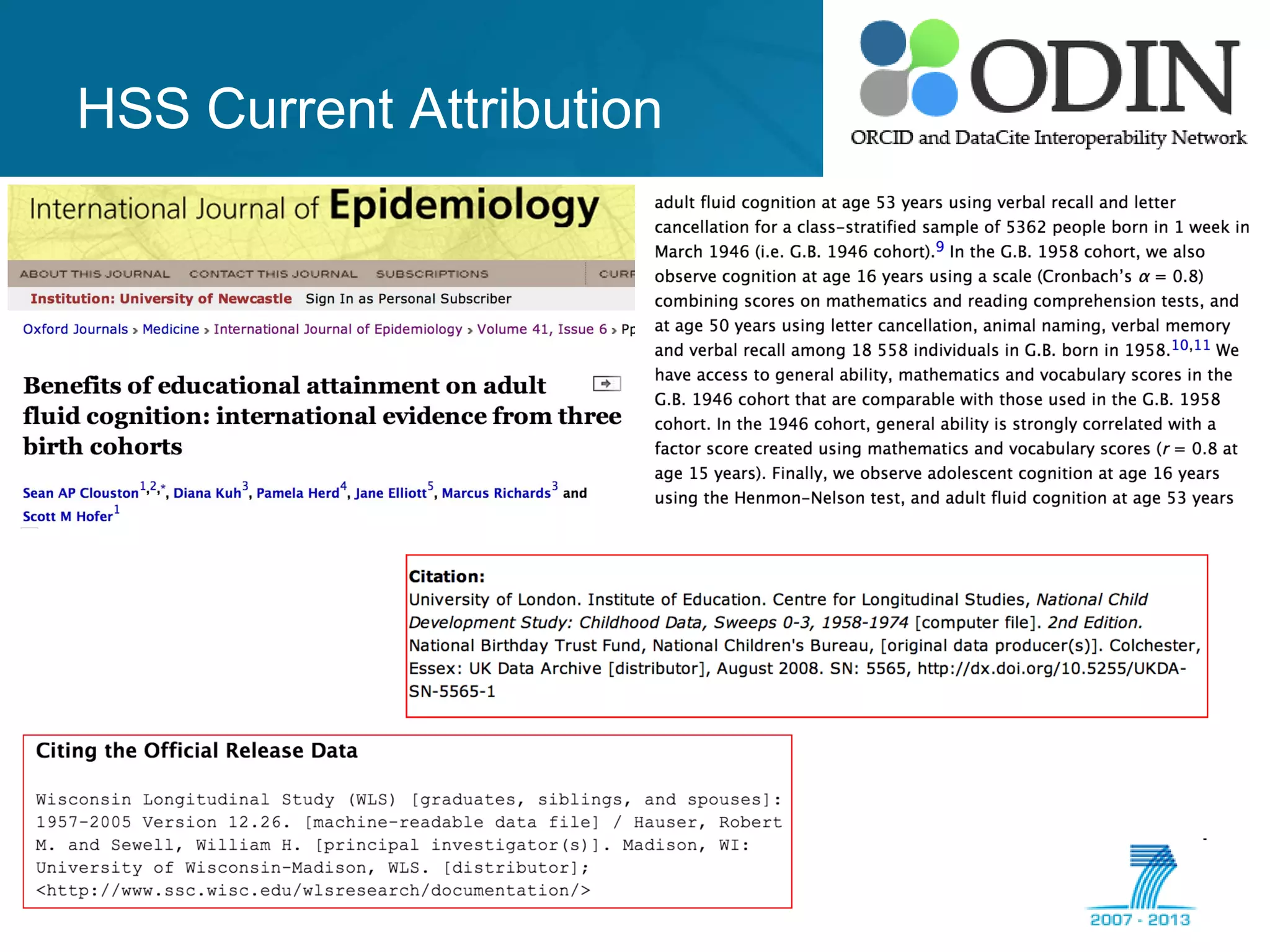
HSS Current Attribution
Workflows
• Consult with Data Centres and providers to see where identifiers fit
in their workflows
• Assigning roles and names
• Assigning identifiers to new datasets
• Assigning identifiers to exsiting datasets
• How to integrate identifiers into DDI
• Push more metadata into DataCite
• Provide feedback to datacentres
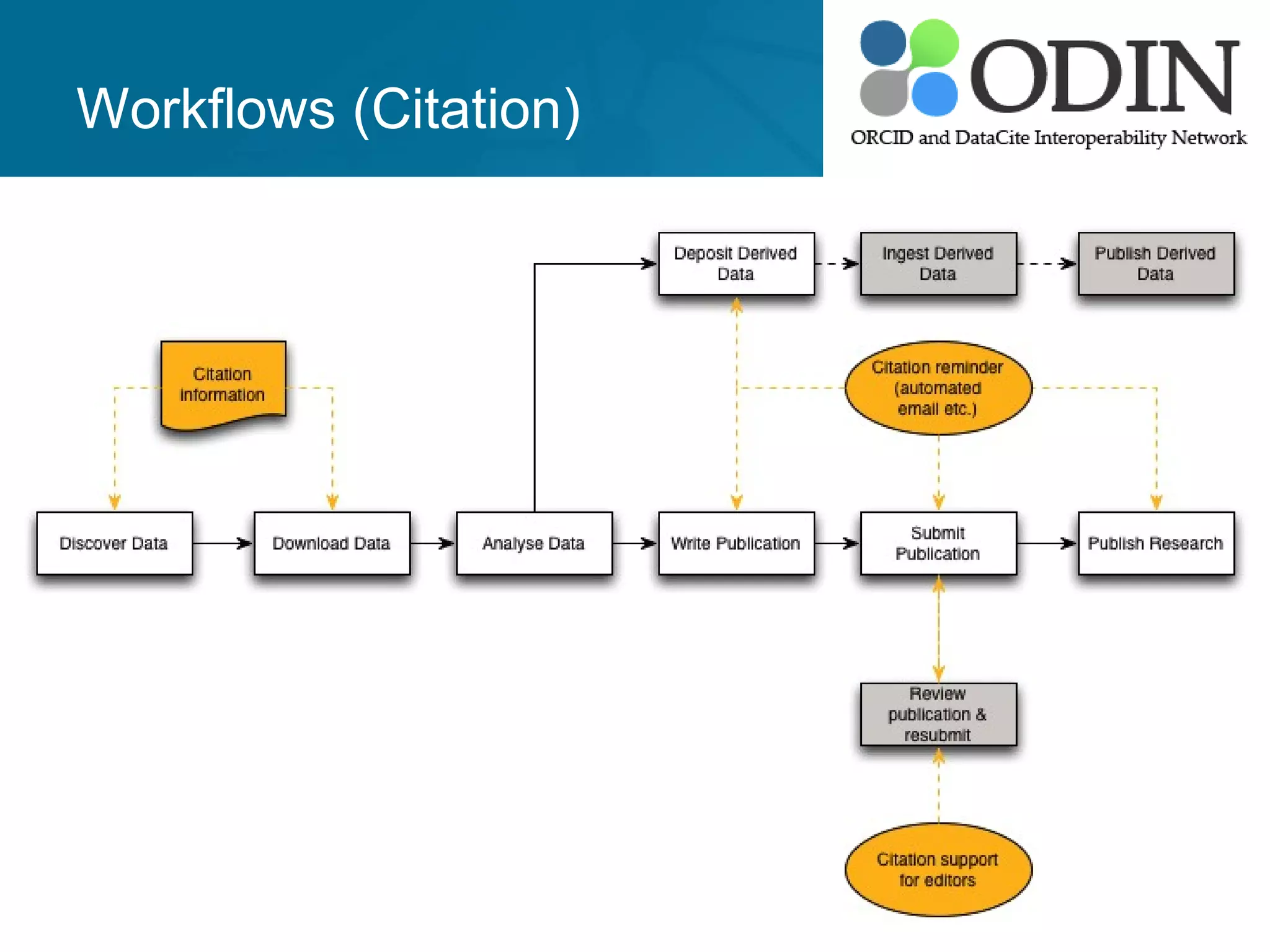
• ‘Nudge’ researchers to cite data properly
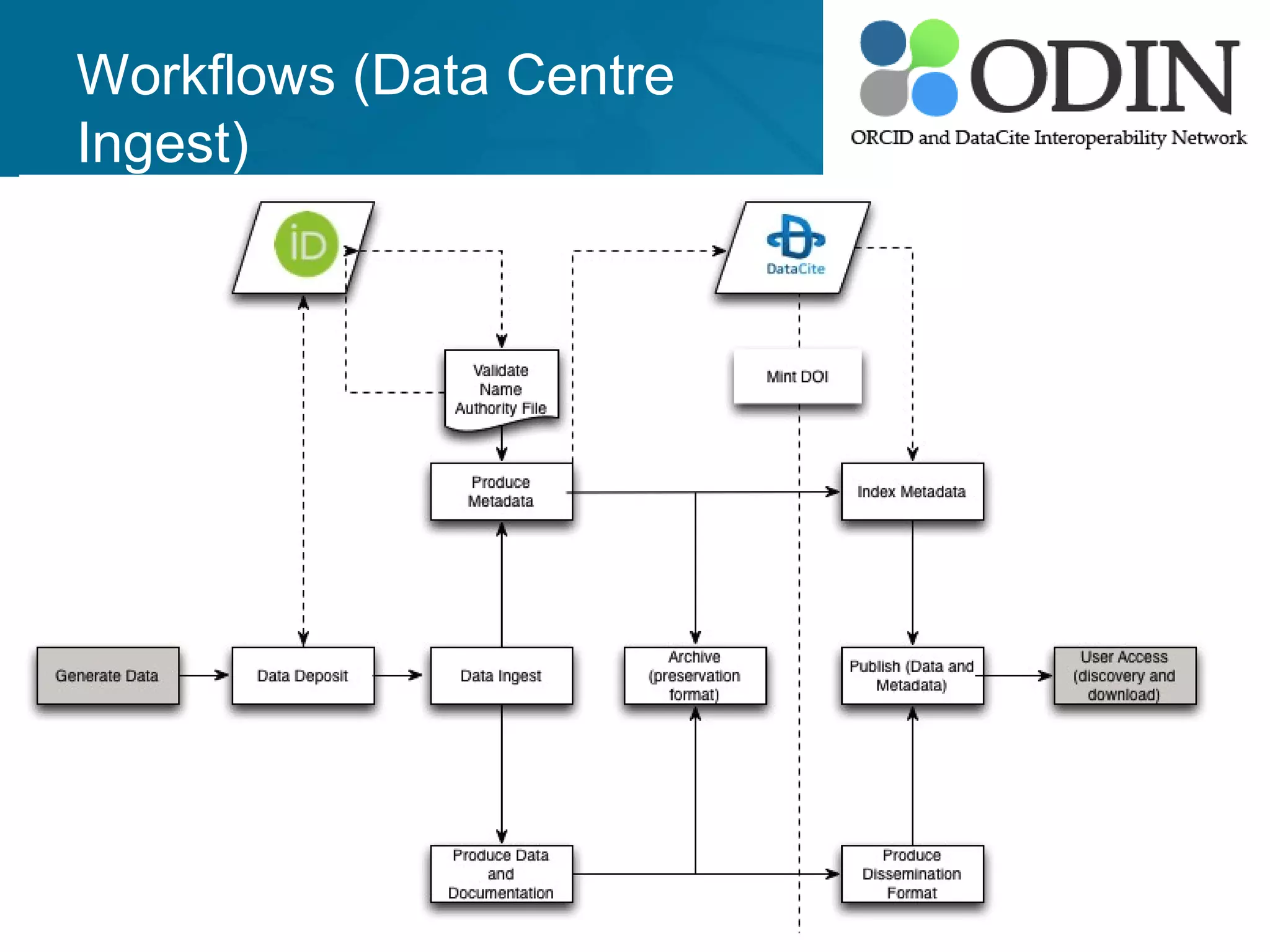
Workflows (Data Centre
Ingest)
Workflows (Citation)
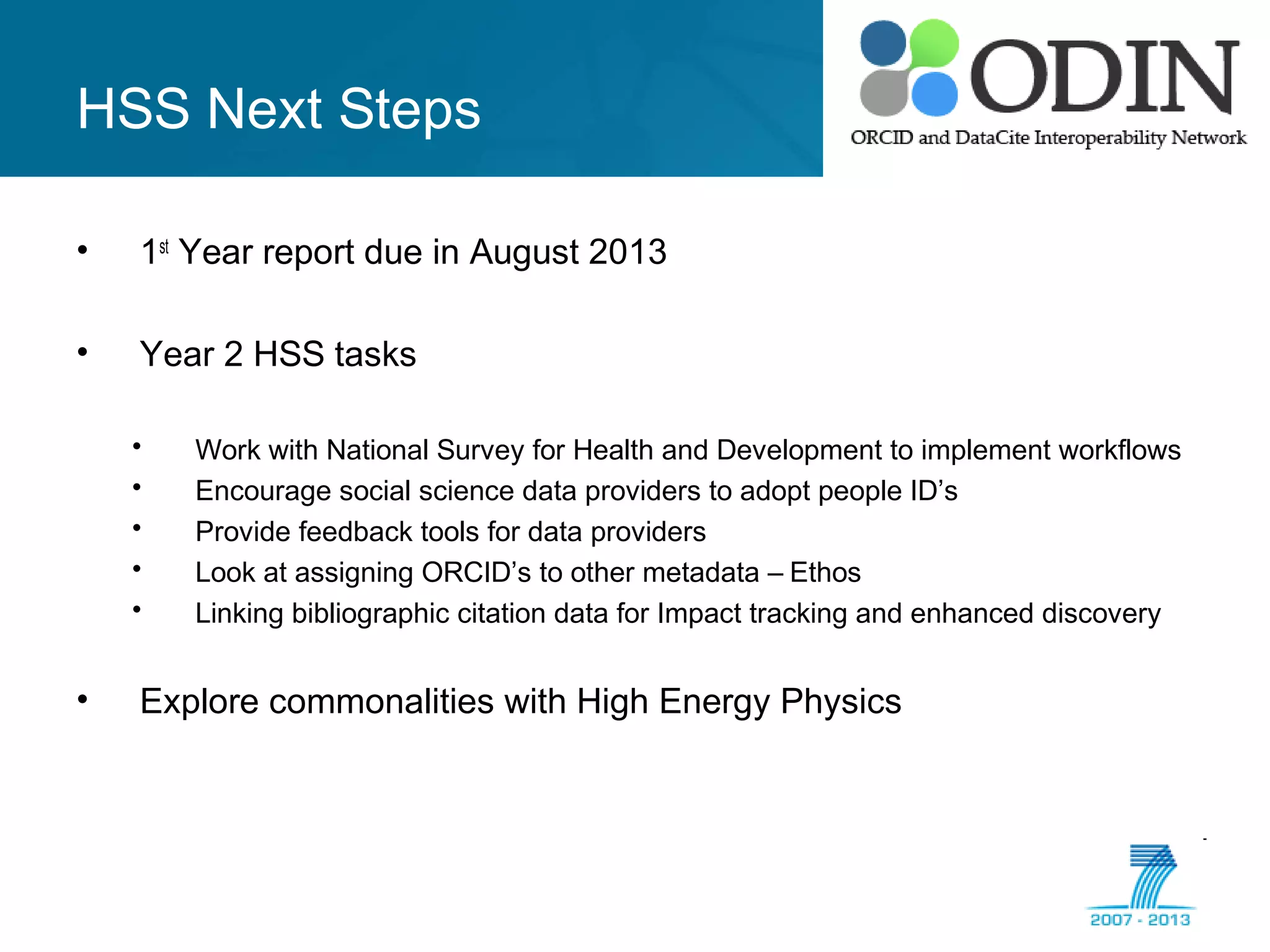
HSS Next Steps
• 1st
Year report due in August 2013
• Year 2 HSS tasks
• Work with National Survey for Health and Development to implement workflows
• Encourage social science data providers to adopt people ID’s
• Provide feedback tools for data providers
• Look at assigning ORCID’s to other metadata – Ethos
• Linking bibliographic citation data for Impact tracking and enhanced discovery
• Explore commonalities with High Energy Physics
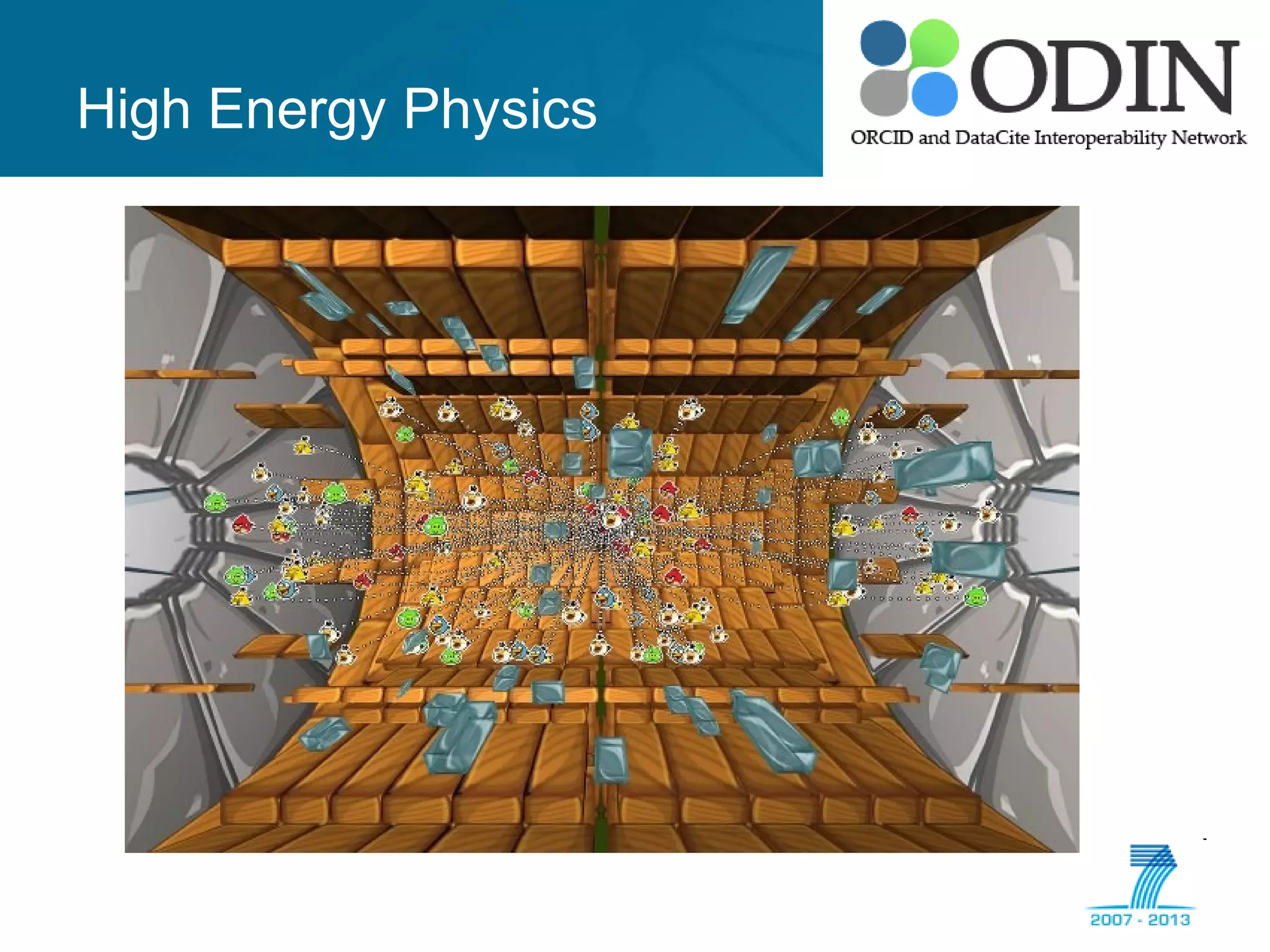
High Energy Physics
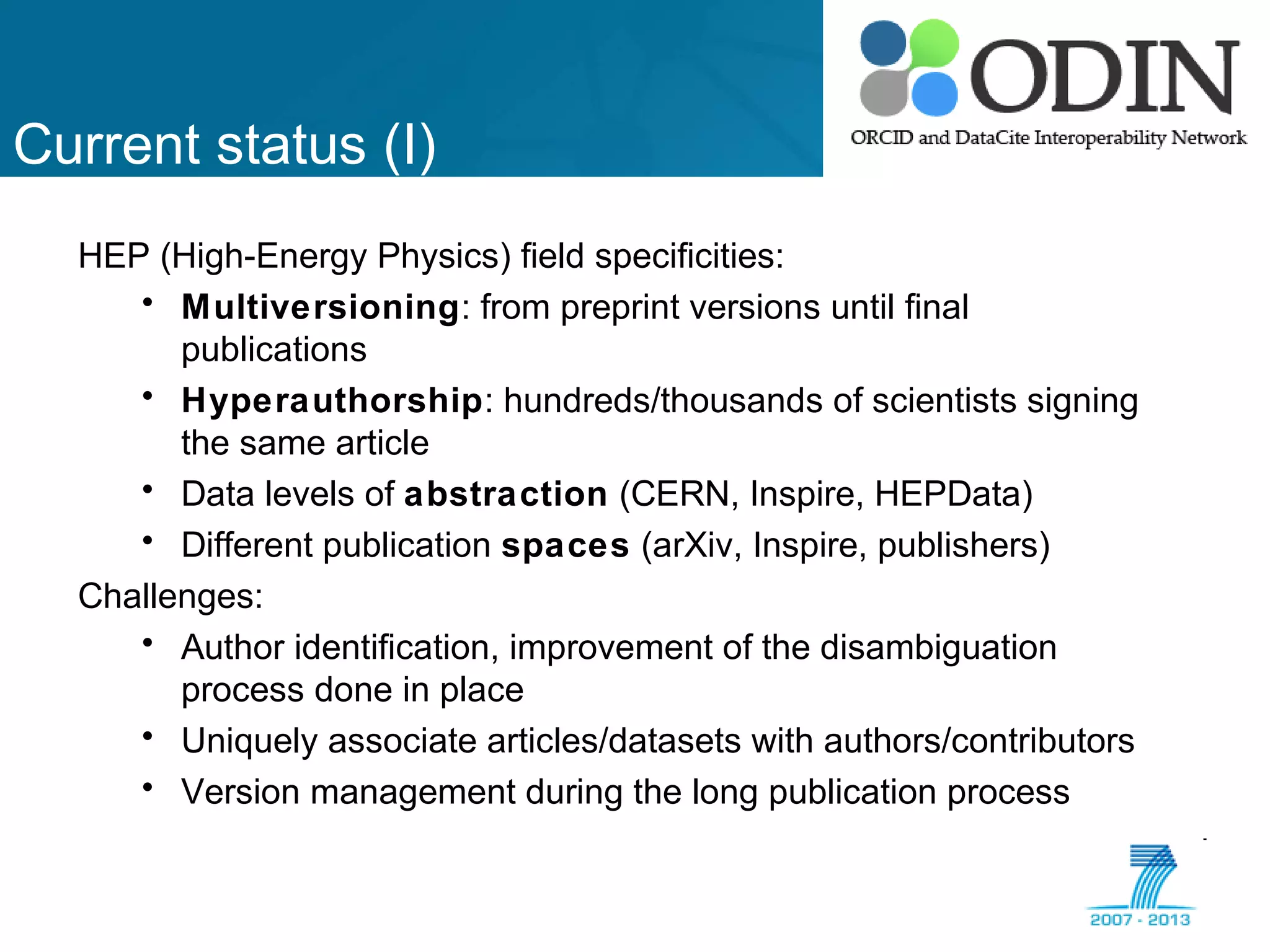
Current status (I)
HEP (High-Energy Physics) field specificities:
• Multiversioning: from preprint versions until final
publications
• Hyperauthorship: hundreds/thousands of scientists signing
the same article
• Data levels of abstraction (CERN, Inspire, HEPData)
• Different publication spaces (arXiv, Inspire, publishers)
Challenges:
• Author identification, improvement of the disambiguation
process done in place
• Uniquely associate articles/datasets with authors/contributors
• Version management during the long publication process
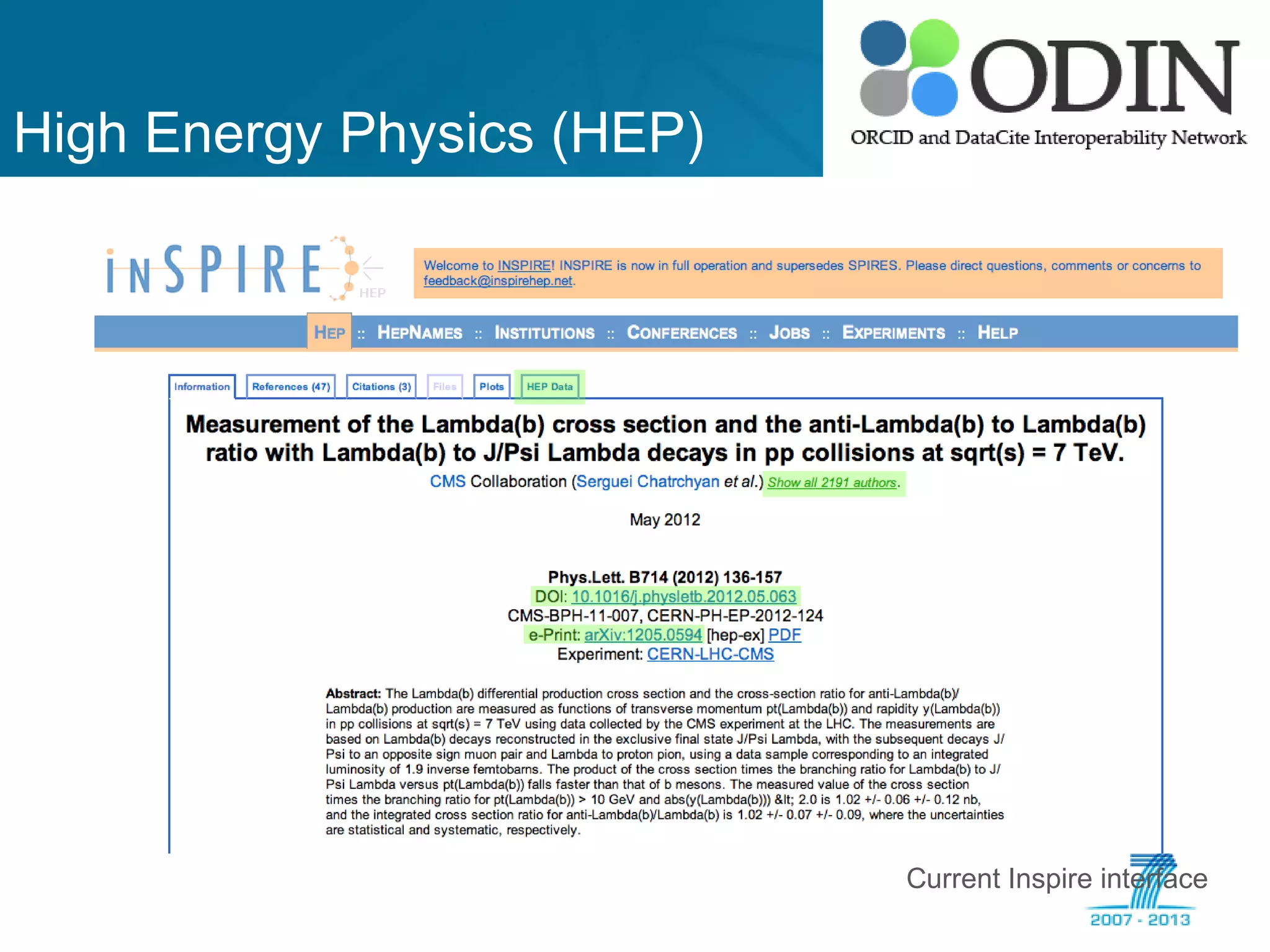
High Energy Physics (HEP)
Current Inspire interface
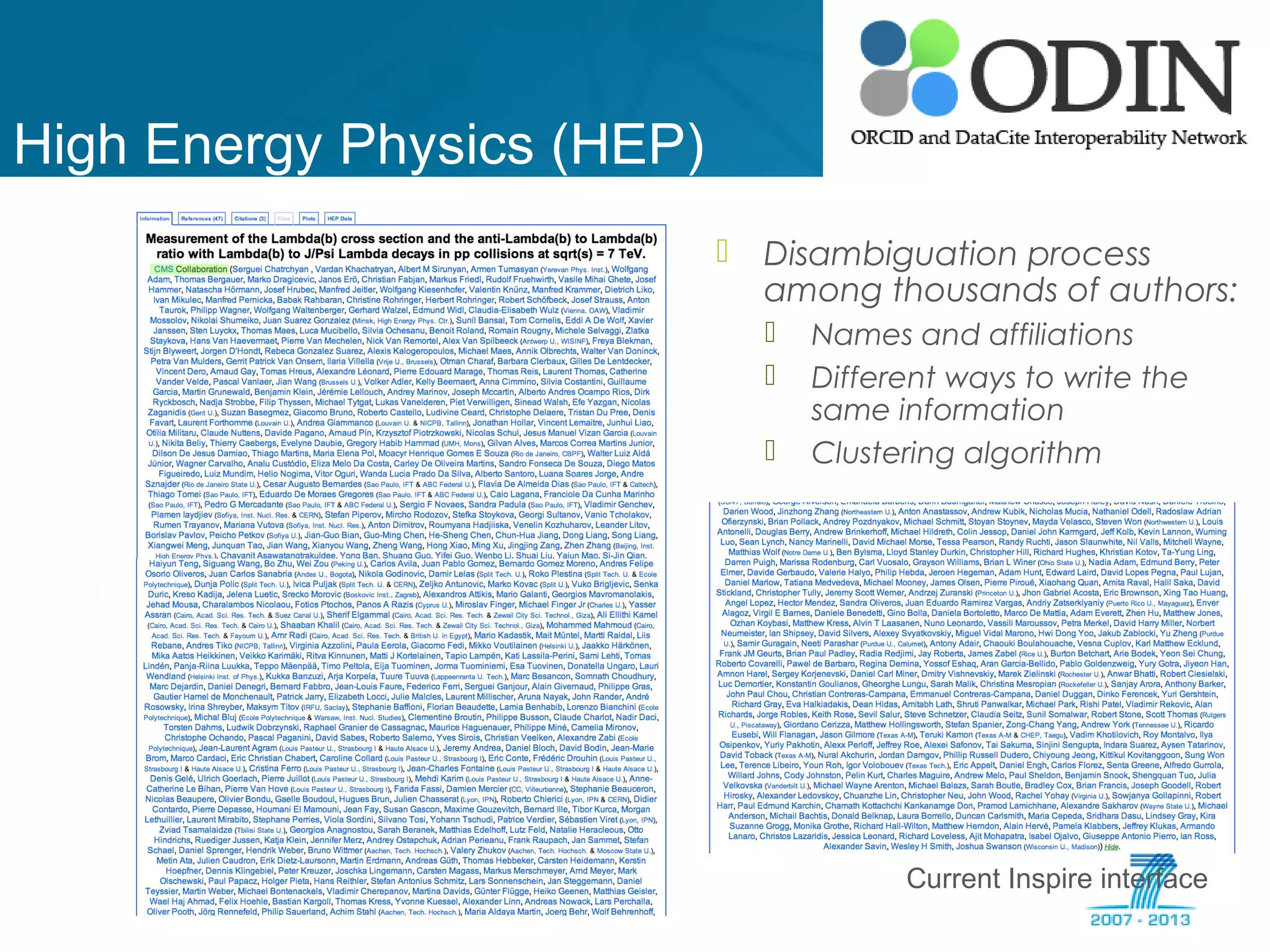
High Energy Physics (HEP)
Current Inspire interface
 Disambiguation process
among thousands of authors:
 Names and affiliations
 Different ways to write the
same information
 Clustering algorithm
ODIN Next Steps
• Reports available in Summer 2013
• 1st Year Event and Codesprint @ CERN 15th
- 17th
October 2013
• http://datacite.labs.orcid-eu.org/ - Feedback welcome!
• Input into and Social Science Proof of Concept,
workflows etc. please contact us!
Thank you!
John Kaye – Lead Curator Digital Social Sciences
The British Library
96 Euston Road
London NW1 2DB
john.kaye@bl.uk
Twitter: @johnkayebl
Telephone: 020 7412 7450
Project Website http://odin-project.eu/
BL Social Sciences Blog http://britishlibrary.typepad.co.uk/socialscience/

Identifiers for Researchers and Data: Increasing Attribution and Discovery– John Kaye

  • 1.
    ODIN – ORCID andDataCite Interoperability Network Association of Librarians and Information Professionals in the Social Sciences July 2013 John Kaye – British Library Funded by The European Union Seventh Framework Programme www.odin-project.eu
  • 2.
    Summary • Identifiers • ODINOverview • Humanities and Social Sciences • High Energy Physics • Next Steps
  • 3.
    Identifers • Uniquely identify ResearchObjects • Digital Object Identifiers • DataCite (DOI’s) • CrossRef DOI’s
  • 4.
    Identifers • Uniquely identifyResearch Objects • Archival Research Key’s (ARK’s) • International Standard Book Numbers (ISBN’s) • Uniform Resource Locators (URL’s) • Institutional and other ID’s
  • 5.
    People Identifers • Uniquelyidentify people • Open Researcher and Contributor ID (ORCID) • International Standard Name Identifier (ISNI) • Country Based ID’s
  • 6.
    ORCID • Infrastructure alreadyexists for researchers to build up a unique open portfolio of research objects
  • 7.
    ORCID • Register anORCID ID www.orcid.org and link published papers using ORCID’s tools
  • 8.
    Using Identifiers • Viewthe impact of your work using traditional citation metrics and social citations
  • 9.
    Using Identifiers Actions ondata and their reliance on metadata, data citation, and data management (adapted from Altman, 2012).
  • 10.
  • 11.
    ODIN Objectives • Wewant to support development and stimulate adoption of interoperable identifiers for: • Researchers • Inputs (cited work, data) • Outputs (publications and data) • We aim to facilitate information flow within and between research communities, leading to greater re-use of data and exploitation of the knowledge created.
  • 12.
    ODIN Challenges Accessibility: seamlesslyaccess datasets used in a journal article, a grant report, or another scholarly artefact Discovery: identify scholarly works or datasets related to each other either through networks of references and citation or through shared contributors Interoperability: connect datasets and contributors across independent platforms using different, but interoperable identifier schemes. Sustainability: ongoing viability of the systems that provide and maintain persistent identifiers.
  • 13.
    ODIN Work Streams •Proofs of Concept in Humanities and Social Science and High Energy Physics • Interoperability • Strategy • Internationalisation
  • 14.
    ODIN Developments • Developedfrom work carried out in Interoperability Work Stream • Based on CrossRef Import Tool • Searches DataCite Metadata store and allows users to import datasets into their ORCID Profile • http://datacite.labs.orcid-eu.org/ - Feedback welcome!
  • 15.
    Humanities and Social Sciences(HSS) Image from National Survey for Health and Development
  • 16.
    HSS: Birth CohortStudies • Why Birth Cohort Studies? • Investment • Established/Long history • Tradition of data curation • Multiple Data Providers • High Re-use • Derived Data • Multi-disciplinary • BL Involvement in CLOSER (Cohort and Longitudinal Studies Enhancement Resource)
  • 17.
    HSS: Objectives • 1st Year:Preliminary conceptual models for connecting data creators, curators, contributors and data sets will be described • 2nd Year: Concrete workflows will be designed and developed • The development of such workflows will be done in strong collaboration with the relevant stakeholders in the community
  • 18.
    HSS: Approach • Technicalwork – http://odin-discover.eu/ • Conversations and Interviews: • Cohort Study Teams • UK Data Service • International Data Providers • Visit from Australian Data Archive
  • 19.
    HSS: Approach Data Sourcesand Linking in http://odin-discover.eu/
  • 20.
    Humanities and Social Sciences(HSS) http://odin-discover.eu/
  • 21.
  • 22.
  • 23.
    Workflows • Consult withData Centres and providers to see where identifiers fit in their workflows • Assigning roles and names • Assigning identifiers to new datasets • Assigning identifiers to exsiting datasets • How to integrate identifiers into DDI • Push more metadata into DataCite • Provide feedback to datacentres • ‘Nudge’ researchers to cite data properly
  • 24.
  • 25.
  • 26.
    HSS Next Steps •1st Year report due in August 2013 • Year 2 HSS tasks • Work with National Survey for Health and Development to implement workflows • Encourage social science data providers to adopt people ID’s • Provide feedback tools for data providers • Look at assigning ORCID’s to other metadata – Ethos • Linking bibliographic citation data for Impact tracking and enhanced discovery • Explore commonalities with High Energy Physics
  • 27.
  • 28.
    Current status (I) HEP(High-Energy Physics) field specificities: • Multiversioning: from preprint versions until final publications • Hyperauthorship: hundreds/thousands of scientists signing the same article • Data levels of abstraction (CERN, Inspire, HEPData) • Different publication spaces (arXiv, Inspire, publishers) Challenges: • Author identification, improvement of the disambiguation process done in place • Uniquely associate articles/datasets with authors/contributors • Version management during the long publication process
  • 29.
    High Energy Physics(HEP) Current Inspire interface
  • 30.
    High Energy Physics(HEP) Current Inspire interface  Disambiguation process among thousands of authors:  Names and affiliations  Different ways to write the same information  Clustering algorithm
  • 31.
    ODIN Next Steps •Reports available in Summer 2013 • 1st Year Event and Codesprint @ CERN 15th - 17th October 2013 • http://datacite.labs.orcid-eu.org/ - Feedback welcome! • Input into and Social Science Proof of Concept, workflows etc. please contact us!
  • 32.
    Thank you! John Kaye– Lead Curator Digital Social Sciences The British Library 96 Euston Road London NW1 2DB john.kaye@bl.uk Twitter: @johnkayebl Telephone: 020 7412 7450 Project Website http://odin-project.eu/ BL Social Sciences Blog http://britishlibrary.typepad.co.uk/socialscience/