Data sharing &
publication at
Elsevier
Hylke Koers,
Head of Content Innovation
July 2016
| 2| 2| 2
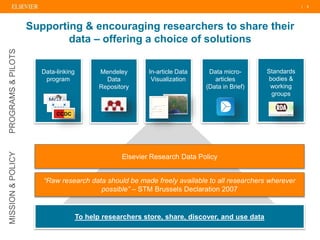
Supporting & encouraging researchers to share their
data – offering a choice of solutions
Elsevier Research Data Policy
To help researchers store, share, discover, and use data
“Raw research data should be made freely available to all researchers wherever
possible” – STM Brussels Declaration 2007
Data-linking
program
Data micro-
articles
(Data in Brief)
Standards
bodies &
working
groups
MISSION&POLICYPROGRAMS&PILOTS
In-article Data
Visualization
Mendeley
Data
Repository
| 3| 3| 3
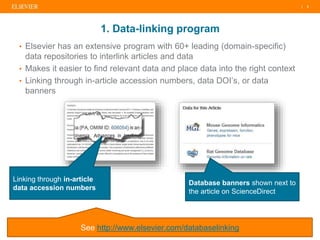
Linking through in-article
data accession numbers
Database banners shown next to
the article on ScienceDirect
See http://www.elsevier.com/databaselinking
• Elsevier has an extensive program with 60+ leading (domain-specific)
data repositories to interlink articles and data
• Makes it easier to find relevant data and place data into the right context
• Linking through in-article accession numbers, data DOI’s, or data
banners
1. Data-linking program
| 4| 4| 4
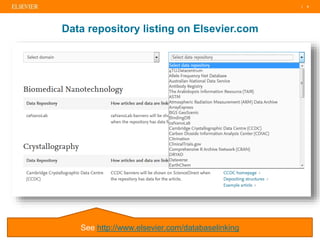
See http://www.elsevier.com/databaselinking
Data repository listing on Elsevier.com
| 5| 5| 5
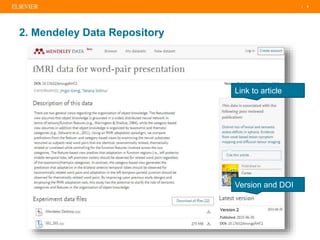
2. Mendeley Data Repository
Link to article
Version and DOI
| 6| 6| 6
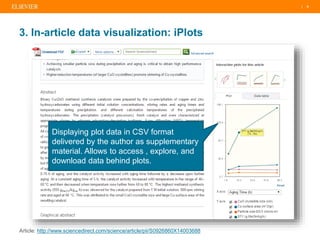
3. In-article data visualization: iPlots
Article: http://www.sciencedirect.com/science/article/pii/S0926860X14003688
Displaying plot data in CSV format
delivered by the author as supplementary
material. Allows to access , explore, and
download data behind plots.
| 7| 7| 7
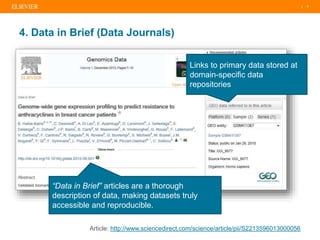
4. Data in Brief (Data Journals)
“Data in Brief” articles are a thorough
description of data, making datasets truly
accessible and reproducible.
Links to primary data stored at
domain-specific data
repositories
Article: http://www.sciencedirect.com/science/article/pii/S2213596013000056
| 8| 8| 8
5. Research Data Working Groups and Industry
Standards
• Joint Declaration of Data Citation Principles: best-
practices to cite data in articles for better linking and credit
• Research Data Alliance & ICSU World Data System:
Tackling a broad range of interconnected issues around Data
Publication (workflows, bibliometrics, cost recovery, services)
| 9| 9| 9
Standards
bodies &
working
groups
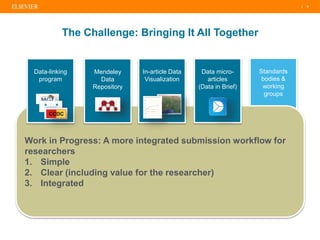
Work in Progress: A more integrated submission workflow for
researchers
1. Simple
2. Clear (including value for the researcher)
3. Integrated
The Challenge: Bringing It All Together
Data-linking
program
Data micro-
articles
(Data in Brief)
In-article Data
Visualization
Mendeley
Data
Repository
| 10| 10| 10
Annex
| 11| 11| 11
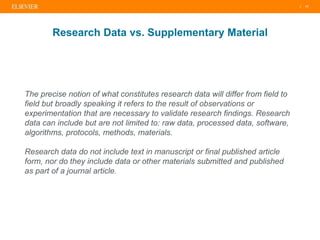
Research Data vs. Supplementary Material
The precise notion of what constitutes research data will differ from field to
field but broadly speaking it refers to the result of observations or
experimentation that are necessary to validate research findings. Research
data can include but are not limited to: raw data, processed data, software,
algorithms, protocols, methods, materials.
Research data do not include text in manuscript or final published article
form, nor do they include data or other materials submitted and published
as part of a journal article.

THOR Workshop - Data Publishing Elsevier

  • 1.
    Data sharing & publicationat Elsevier Hylke Koers, Head of Content Innovation July 2016
  • 2.
    | 2| 2|2 Supporting & encouraging researchers to share their data – offering a choice of solutions Elsevier Research Data Policy To help researchers store, share, discover, and use data “Raw research data should be made freely available to all researchers wherever possible” – STM Brussels Declaration 2007 Data-linking program Data micro- articles (Data in Brief) Standards bodies & working groups MISSION&POLICYPROGRAMS&PILOTS In-article Data Visualization Mendeley Data Repository
  • 3.
    | 3| 3|3 Linking through in-article data accession numbers Database banners shown next to the article on ScienceDirect See http://www.elsevier.com/databaselinking • Elsevier has an extensive program with 60+ leading (domain-specific) data repositories to interlink articles and data • Makes it easier to find relevant data and place data into the right context • Linking through in-article accession numbers, data DOI’s, or data banners 1. Data-linking program
  • 4.
    | 4| 4|4 See http://www.elsevier.com/databaselinking Data repository listing on Elsevier.com
  • 5.
    | 5| 5|5 2. Mendeley Data Repository Link to article Version and DOI
  • 6.
    | 6| 6|6 3. In-article data visualization: iPlots Article: http://www.sciencedirect.com/science/article/pii/S0926860X14003688 Displaying plot data in CSV format delivered by the author as supplementary material. Allows to access , explore, and download data behind plots.
  • 7.
    | 7| 7|7 4. Data in Brief (Data Journals) “Data in Brief” articles are a thorough description of data, making datasets truly accessible and reproducible. Links to primary data stored at domain-specific data repositories Article: http://www.sciencedirect.com/science/article/pii/S2213596013000056
  • 8.
    | 8| 8|8 5. Research Data Working Groups and Industry Standards • Joint Declaration of Data Citation Principles: best- practices to cite data in articles for better linking and credit • Research Data Alliance & ICSU World Data System: Tackling a broad range of interconnected issues around Data Publication (workflows, bibliometrics, cost recovery, services)
  • 9.
    | 9| 9|9 Standards bodies & working groups Work in Progress: A more integrated submission workflow for researchers 1. Simple 2. Clear (including value for the researcher) 3. Integrated The Challenge: Bringing It All Together Data-linking program Data micro- articles (Data in Brief) In-article Data Visualization Mendeley Data Repository
  • 10.
    | 10| 10|10 Annex
  • 11.
    | 11| 11|11 Research Data vs. Supplementary Material The precise notion of what constitutes research data will differ from field to field but broadly speaking it refers to the result of observations or experimentation that are necessary to validate research findings. Research data can include but are not limited to: raw data, processed data, software, algorithms, protocols, methods, materials. Research data do not include text in manuscript or final published article form, nor do they include data or other materials submitted and published as part of a journal article.