What do 21st century readers
expect from the British Library?
Ian Cooke
Head of Contemporary British Publications
ALISS AGM 2015
Senate House, University of London 1st July 2015
www.bl.uk 2
Why do we conduct Reading Room
surveys?
• To find our who our Readers are and what they are doing
• Information is used in planning: services; content
management
• To understand the impact of changes in Library activities
and policy on our Readers
• To understand how changing research environment affects
our Readers
• Most effective way of contacting our Readers
• We are interested in behaviour on the day of visit
www.bl.uk 3
Methodology and Numbers
• In Jan/Feb 2015, 600 interviews
were undertaken with
readers over a 3-week period.
• Interviews undertaken during opening
hours, including Saturdays and evenings
• Survey by questionnaire with coded
responses, and some open questions.
• Comparison of some responses against
2009 data (380 interviews overall; 134
Social Sciences)
Reading Room Number
Social Science 232
Science 2 200
Science 3 168
Total 600
Source: IRN Research.
2015
www.bl.uk 4
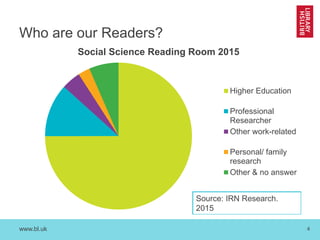
Who are our Readers?
Social Science Reading Room 2015
Higher Education
Professional
Researcher
Other work-related
Personal/ family
research
Other & no answer
Source: IRN Research.
2015
www.bl.uk 5
2015 & 2009 compared
Social Science Reading
Room 2009
Higher
Education
Professional
Researcher
Other work-
related
Personal/
family
research
Other & no
answerSource: IRN Research.
2009 & 2015
Social Science Reading
Room 2015
Higher
Education
Professional
Researcher
Other work-
related
Personal/
family
research
Other & no
answer
www.bl.uk 6
Higher Education readers
Social Science Reading Room 2015
Undergraduate
Taught PG
Research PG
Lecturer/ Reader/
Professor
Research Fellow/
Manager
Other academic
Social Science Reading Room 2009
Undergraduate
Source: IRN Research.
2009 & 2015
www.bl.uk 7
Why use the Reading Room today?
What is the main purpose of your use of the
Reading Room today?
Preparing a publication
Work for a research
degree
Work for a taught course
A space to study
Professional
development/ my work
Personal interest
Source: IRN Research.
2015
www.bl.uk 8
Location of Readers
Current residence
• 83% London
• 89% London & South East
Home institution
• 30% London University
• 43% University in London
Next highest responses: Cambridge 4%; Oxford 3%; Kent 2%
(based on 174 replies)
Source: IRN Research.
2015
www.bl.uk 9
Key:
30 mins
60 mins
120 mins
Visitor postcode
British Library
60mins:
16%
30 mins:
65%
120 mins:
8%
Visitor Mapping (Academic Researchers) - 89% of academics come
from within a 2 hour drivetime, 65% within 30 minutes
source: bdrc, Annual Visitor Research April 2014- March 2015
www.bl.uk 10
Visitor Mapping (Academic Researchers)
source: bdrc Annual Visitor Research April 2014- March 2015
www.bl.uk 11
Subjects studied
0
5
10
15
20
25
30
Main subject studied
Number of responses per
subject (or group of subjects for
humanities and STM).
Interviewees were each asked
to select one option only as
their ‘main subject’.
Source: IRN Research. 2015
www.bl.uk 12
Reading rooms used
Reading Room Number %
Social Science 232 100
Science 2 23 9.9
Science 3 11 4.7
Business & IP 11 4.7
Humanities 1 35 15.1
Humanities 2 17 7.3
Rare Books & Music 13 5.6
Maps 3 1.3
Manuscripts 6 2.6
Newsroom 7 3
Asian & African Studies 5 2.2
Source: IRN Research.
2015
www.bl.uk 13
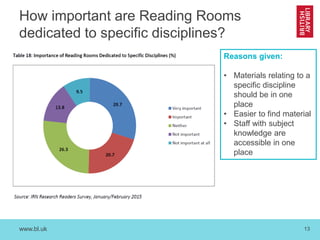
How important are Reading Rooms
dedicated to specific disciplines?
Reasons given:
• Materials relating to a
specific discipline
should be in one
place
• Easier to find material
• Staff with subject
knowledge are
accessible in one
place
www.bl.uk 14
How do Readers use the Reading Room?
• 81% using collections or databases on day of visit
• 7% say they never use collections or databases
• 2011 Focus groups: some researchers do report using
British Library as place of study only, BUT tend not to use
Reading Rooms
Source: IRN Research.
2011 & 2015
www.bl.uk 15
77
15
34
8
2 2 2 4 1
53
7 7
<1 1 <1 0
8
Academic
Research
Q6c. Which of the following did you actually do at the British Library today? Base: Academic (n=357)
Academic researcher activity - Academic researchers predominantly study in
dedicated study areas. Around 1 in 10 academic researchers conduct a cultural activity.
Source: bdrc Annual Visitor Research, April 2014- March 2015
Average dwell time:
4hrs 1 min
STUDY
SECONDAR
Y SPEND CULTURE CIRCULATING
86% 38% 9% 59%Net
www.bl.uk 16
Personal
Research
Q6c. Which of the following did you actually do at the British Library today? Base: Personal Research (n=124)
Personal researchers activity - Personal researcher activity is similar to
academic researchers - shorter average dwell time. Source: bdrc Annual Visitor
Research, April 2014- March 2015
64
20
30
13
1 2 2 1 3
55
9
1 1 1 0 0
12
Average dwell time:
3hrs 15 mins
STUDY
SECONDAR
Y SPEND CULTURE CIRCULATING
80% 35% 8% 59%Net
www.bl.uk 17
How do Readers use the Reading Room?
• Frequent visitors:
54% at least once per week;
76% stay at least 3 hours; 48% stay 5- 6 hours
• Planning ahead:
59% use website in advance; 50% use catalogue in
advance
BUT numbers ordering in advance has declined:
27% in 2015 vs >50% in 2009
• 2011 Focus Groups: A “British Library” way of working –
using the Library requires planning and a different sort of
discipline to using other libraries.
Source: IRN Research.
2009, 2011 & 2015
www.bl.uk 18
Certain activities in decline
Activity 2015 2009
Using printed indexes 10% 24%
Browsing shelves 22% 40%
Using open-shelf
material*
56% 67%
Consulting Library staff 53% 61%
* But, higher proportions are using more items from the shelves:
15% using 7+ items in 2015 (5% in 2009)
Source: IRN Research.
2009 & 2015
www.bl.uk 19
What are Readers using?
Material type 2015 use on
day
2015 ‘use
regularly’
2009 2007
Printed books 54% 44% 63%* 68%*
E-books 14% 6% n/a n/a
Printed
journals
25% 28% 18% 22%
E-journals 25% 31% 24% 17%
Databases 10% 18% 12% 13%
General
internet
12% 12% 7% 9%
Remote resources used:
9% Ethos; 7% remote access databases; 5% MBS Portal
* No option given for ‘e-books’ in 2009 and 2007
Source: IRN Research. 2009 & 2015; Ipsos MORI. 2007
www.bl.uk 20
Why do Readers use the British Library?
Reasons for choosing the British Library
Over half of
interviewees – 53% -
mentioned the good
working environment
as a reason for using
the library. This falls to
just 43% of Social
Science readers.
Breadth of coverage
appears to be much
less important to
Science readers than
Social Science readers .
Source: IRN Research. 2015
www.bl.uk 21
Where else do Readers go?
2015 2009
University/ school/ college
library
55% 30%
Other ‘home’ library 10% 1%
Internet 40% 22%
Public library 11% 6%
Specialist/ membership
library
12% 1%
Source: IRN Research.
2009 & 2015
www.bl.uk 22
Most popular improvement would be remote access to
electronic content.
Improvements Readers Would Like to See %
Able to use electronic content from my home or office 43%
Able to use my own laptop/device to access electronic
content in reading rooms
35%
Access BL services using one username and password 22%
Able to discover digital content available online from
other organisations alongside BL content
18%
Able to use electronic content in public café and other
public areas of the British Library building
15%
More tools to manipulate and analyse datasets 9%
Able to add reviews/comments to records on BL
catalogues
5%
Other 13%
None of the above 19%
Source: IRN Research. 2015
www.bl.uk 23
How do Readers compare with BL use generally?
Source: bdrc Annual Visitor Research April 2014- March 2015
370,982
visits
347,796
visits
115,932
visits
81,152
visits
Primary stated purpose for visiting The British Library
243,457
visits
320,021
visitors
189,033
visitors
84,359
visitors
25,605
visitors42,417
visitors
No. of visits No. of unique visitors
Visit Intention groups Culture (n=359) Personal Escape (n=278); Academic (n=357);
Personal (n=124); Work (n=76)
Q2a. How would you best describe the primary purpose of your visit here today?
www.bl.uk 24
70
48
22
16
16
12
8
Consulted books, journals and
other items ordered
Searched the online
catalogues
Accessed electronic material
Didn't access BL material
Asked for help from
information specialists
Accessed material on open
shelves
Used copying and printing
services
41
1911
9
9
7
7
5
1
Humanities
How do Social Science and Science Researchers compare with users of other
Reading Rooms?
Source: bdrc Annual Visitor Research March 2014- April 2015
%
Base: All who used the reading room (n=394)
.
Rare books
& music
Social
sciences
African &
Asian studies
Science
Manuscripts
Newsroom
Business &
IP Centre
Maps
www.bl.uk 25
So what?
• HE research remains largest user group, but later-career researchers,
and researchers outside HE, are getting harder to reach
• Distance is a barrier to use. How does the Library support researchers
outside London and South East?
• For those who do use the Library, it occupies a significant role in
research: many are using the Library 0.5- 1 days per week or more
• Access to content (books and journals) is most important for Social
Sciences, but working environment also significant
• Subject specialism is important to a significant proportion
www.bl.uk 26
Sources used
IRN Research. 2015. British Library Social Science and
Science Readers Survey 2015.
IRN Research. 2011. British Library Social Science and
Science Focus Groups.
IRN Research. 2009. British Library Social Science and
Science Readers Survey.
Ipsos MORI. 2007. British Library Social Sciences and STM
Reading Rooms survey February to March 2007.
bdrc continental. 2015. Annual Visitor Research Presentation.

July2015cooke.

  • 1.
    What do 21stcentury readers expect from the British Library? Ian Cooke Head of Contemporary British Publications ALISS AGM 2015 Senate House, University of London 1st July 2015
  • 2.
    www.bl.uk 2 Why dowe conduct Reading Room surveys? • To find our who our Readers are and what they are doing • Information is used in planning: services; content management • To understand the impact of changes in Library activities and policy on our Readers • To understand how changing research environment affects our Readers • Most effective way of contacting our Readers • We are interested in behaviour on the day of visit
  • 3.
    www.bl.uk 3 Methodology andNumbers • In Jan/Feb 2015, 600 interviews were undertaken with readers over a 3-week period. • Interviews undertaken during opening hours, including Saturdays and evenings • Survey by questionnaire with coded responses, and some open questions. • Comparison of some responses against 2009 data (380 interviews overall; 134 Social Sciences) Reading Room Number Social Science 232 Science 2 200 Science 3 168 Total 600 Source: IRN Research. 2015
  • 4.
    www.bl.uk 4 Who areour Readers? Social Science Reading Room 2015 Higher Education Professional Researcher Other work-related Personal/ family research Other & no answer Source: IRN Research. 2015
  • 5.
    www.bl.uk 5 2015 &2009 compared Social Science Reading Room 2009 Higher Education Professional Researcher Other work- related Personal/ family research Other & no answerSource: IRN Research. 2009 & 2015 Social Science Reading Room 2015 Higher Education Professional Researcher Other work- related Personal/ family research Other & no answer
  • 6.
    www.bl.uk 6 Higher Educationreaders Social Science Reading Room 2015 Undergraduate Taught PG Research PG Lecturer/ Reader/ Professor Research Fellow/ Manager Other academic Social Science Reading Room 2009 Undergraduate Source: IRN Research. 2009 & 2015
  • 7.
    www.bl.uk 7 Why usethe Reading Room today? What is the main purpose of your use of the Reading Room today? Preparing a publication Work for a research degree Work for a taught course A space to study Professional development/ my work Personal interest Source: IRN Research. 2015
  • 8.
    www.bl.uk 8 Location ofReaders Current residence • 83% London • 89% London & South East Home institution • 30% London University • 43% University in London Next highest responses: Cambridge 4%; Oxford 3%; Kent 2% (based on 174 replies) Source: IRN Research. 2015
  • 9.
    www.bl.uk 9 Key: 30 mins 60mins 120 mins Visitor postcode British Library 60mins: 16% 30 mins: 65% 120 mins: 8% Visitor Mapping (Academic Researchers) - 89% of academics come from within a 2 hour drivetime, 65% within 30 minutes source: bdrc, Annual Visitor Research April 2014- March 2015
  • 10.
    www.bl.uk 10 Visitor Mapping(Academic Researchers) source: bdrc Annual Visitor Research April 2014- March 2015
  • 11.
    www.bl.uk 11 Subjects studied 0 5 10 15 20 25 30 Mainsubject studied Main subject studied Number of responses per subject (or group of subjects for humanities and STM). Interviewees were each asked to select one option only as their ‘main subject’. Source: IRN Research. 2015
  • 12.
    www.bl.uk 12 Reading roomsused Reading Room Number % Social Science 232 100 Science 2 23 9.9 Science 3 11 4.7 Business & IP 11 4.7 Humanities 1 35 15.1 Humanities 2 17 7.3 Rare Books & Music 13 5.6 Maps 3 1.3 Manuscripts 6 2.6 Newsroom 7 3 Asian & African Studies 5 2.2 Source: IRN Research. 2015
  • 13.
    www.bl.uk 13 How importantare Reading Rooms dedicated to specific disciplines? Reasons given: • Materials relating to a specific discipline should be in one place • Easier to find material • Staff with subject knowledge are accessible in one place
  • 14.
    www.bl.uk 14 How doReaders use the Reading Room? • 81% using collections or databases on day of visit • 7% say they never use collections or databases • 2011 Focus groups: some researchers do report using British Library as place of study only, BUT tend not to use Reading Rooms Source: IRN Research. 2011 & 2015
  • 15.
    www.bl.uk 15 77 15 34 8 2 22 4 1 53 7 7 <1 1 <1 0 8 Academic Research Q6c. Which of the following did you actually do at the British Library today? Base: Academic (n=357) Academic researcher activity - Academic researchers predominantly study in dedicated study areas. Around 1 in 10 academic researchers conduct a cultural activity. Source: bdrc Annual Visitor Research, April 2014- March 2015 Average dwell time: 4hrs 1 min STUDY SECONDAR Y SPEND CULTURE CIRCULATING 86% 38% 9% 59%Net
  • 16.
    www.bl.uk 16 Personal Research Q6c. Whichof the following did you actually do at the British Library today? Base: Personal Research (n=124) Personal researchers activity - Personal researcher activity is similar to academic researchers - shorter average dwell time. Source: bdrc Annual Visitor Research, April 2014- March 2015 64 20 30 13 1 2 2 1 3 55 9 1 1 1 0 0 12 Average dwell time: 3hrs 15 mins STUDY SECONDAR Y SPEND CULTURE CIRCULATING 80% 35% 8% 59%Net
  • 17.
    www.bl.uk 17 How doReaders use the Reading Room? • Frequent visitors: 54% at least once per week; 76% stay at least 3 hours; 48% stay 5- 6 hours • Planning ahead: 59% use website in advance; 50% use catalogue in advance BUT numbers ordering in advance has declined: 27% in 2015 vs >50% in 2009 • 2011 Focus Groups: A “British Library” way of working – using the Library requires planning and a different sort of discipline to using other libraries. Source: IRN Research. 2009, 2011 & 2015
  • 18.
    www.bl.uk 18 Certain activitiesin decline Activity 2015 2009 Using printed indexes 10% 24% Browsing shelves 22% 40% Using open-shelf material* 56% 67% Consulting Library staff 53% 61% * But, higher proportions are using more items from the shelves: 15% using 7+ items in 2015 (5% in 2009) Source: IRN Research. 2009 & 2015
  • 19.
    www.bl.uk 19 What areReaders using? Material type 2015 use on day 2015 ‘use regularly’ 2009 2007 Printed books 54% 44% 63%* 68%* E-books 14% 6% n/a n/a Printed journals 25% 28% 18% 22% E-journals 25% 31% 24% 17% Databases 10% 18% 12% 13% General internet 12% 12% 7% 9% Remote resources used: 9% Ethos; 7% remote access databases; 5% MBS Portal * No option given for ‘e-books’ in 2009 and 2007 Source: IRN Research. 2009 & 2015; Ipsos MORI. 2007
  • 20.
    www.bl.uk 20 Why doReaders use the British Library? Reasons for choosing the British Library Over half of interviewees – 53% - mentioned the good working environment as a reason for using the library. This falls to just 43% of Social Science readers. Breadth of coverage appears to be much less important to Science readers than Social Science readers . Source: IRN Research. 2015
  • 21.
    www.bl.uk 21 Where elsedo Readers go? 2015 2009 University/ school/ college library 55% 30% Other ‘home’ library 10% 1% Internet 40% 22% Public library 11% 6% Specialist/ membership library 12% 1% Source: IRN Research. 2009 & 2015
  • 22.
    www.bl.uk 22 Most popularimprovement would be remote access to electronic content. Improvements Readers Would Like to See % Able to use electronic content from my home or office 43% Able to use my own laptop/device to access electronic content in reading rooms 35% Access BL services using one username and password 22% Able to discover digital content available online from other organisations alongside BL content 18% Able to use electronic content in public café and other public areas of the British Library building 15% More tools to manipulate and analyse datasets 9% Able to add reviews/comments to records on BL catalogues 5% Other 13% None of the above 19% Source: IRN Research. 2015
  • 23.
    www.bl.uk 23 How doReaders compare with BL use generally? Source: bdrc Annual Visitor Research April 2014- March 2015 370,982 visits 347,796 visits 115,932 visits 81,152 visits Primary stated purpose for visiting The British Library 243,457 visits 320,021 visitors 189,033 visitors 84,359 visitors 25,605 visitors42,417 visitors No. of visits No. of unique visitors Visit Intention groups Culture (n=359) Personal Escape (n=278); Academic (n=357); Personal (n=124); Work (n=76) Q2a. How would you best describe the primary purpose of your visit here today?
  • 24.
    www.bl.uk 24 70 48 22 16 16 12 8 Consulted books,journals and other items ordered Searched the online catalogues Accessed electronic material Didn't access BL material Asked for help from information specialists Accessed material on open shelves Used copying and printing services 41 1911 9 9 7 7 5 1 Humanities How do Social Science and Science Researchers compare with users of other Reading Rooms? Source: bdrc Annual Visitor Research March 2014- April 2015 % Base: All who used the reading room (n=394) . Rare books & music Social sciences African & Asian studies Science Manuscripts Newsroom Business & IP Centre Maps
  • 25.
    www.bl.uk 25 So what? •HE research remains largest user group, but later-career researchers, and researchers outside HE, are getting harder to reach • Distance is a barrier to use. How does the Library support researchers outside London and South East? • For those who do use the Library, it occupies a significant role in research: many are using the Library 0.5- 1 days per week or more • Access to content (books and journals) is most important for Social Sciences, but working environment also significant • Subject specialism is important to a significant proportion
  • 26.
    www.bl.uk 26 Sources used IRNResearch. 2015. British Library Social Science and Science Readers Survey 2015. IRN Research. 2011. British Library Social Science and Science Focus Groups. IRN Research. 2009. British Library Social Science and Science Readers Survey. Ipsos MORI. 2007. British Library Social Sciences and STM Reading Rooms survey February to March 2007. bdrc continental. 2015. Annual Visitor Research Presentation.