1
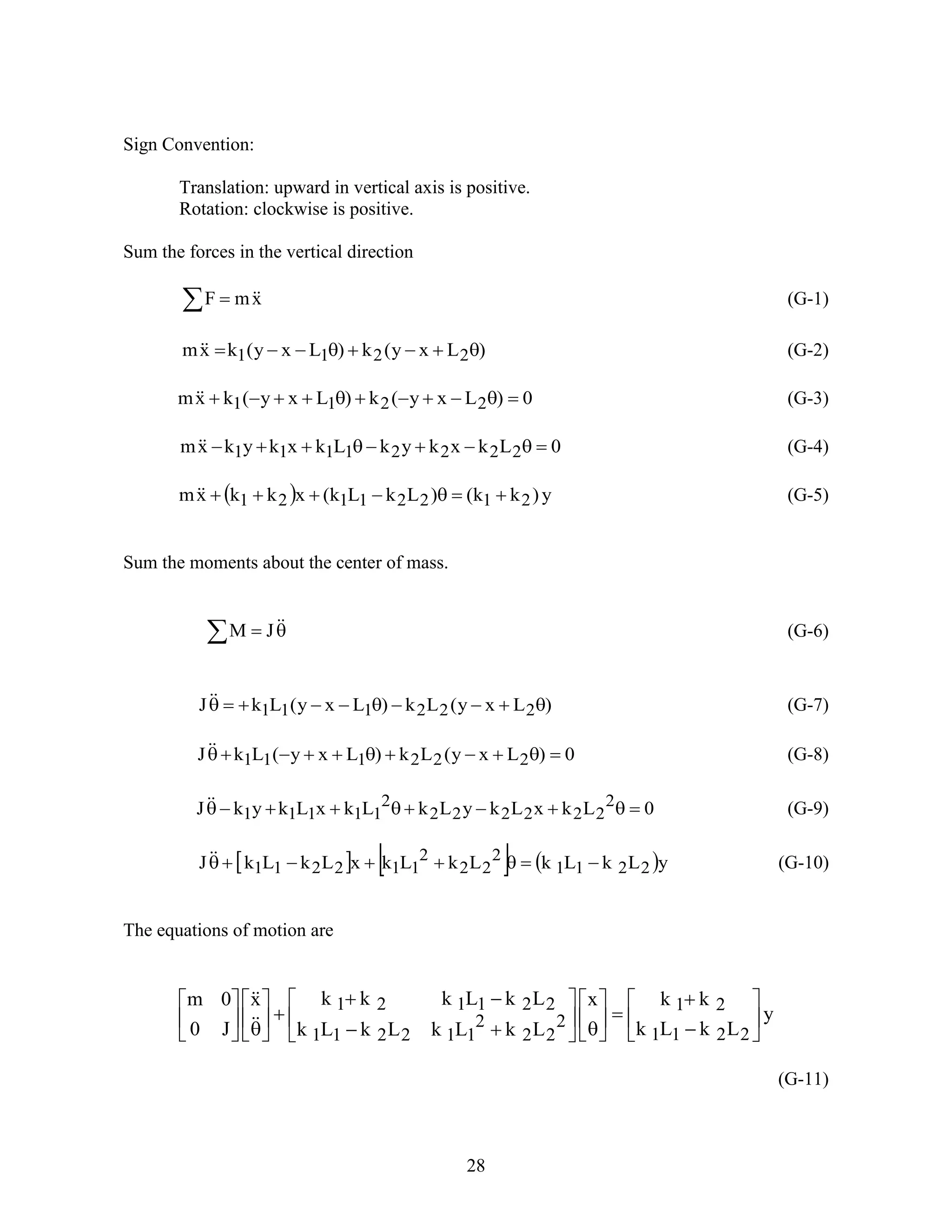
EFFECTIVE MODAL MASS & MODAL PARTICIPATION FACTORS
Revision H
By Tom Irvine
Email: tom@vibrationdata.com
March 28, 2013
_______________________________________________________________________
Introduction
The effective modal mass provides a method for judging the “significance” of a vibration
mode.
Modes with relatively high effective masses can be readily excited by base excitation.
On the other hand, modes with low effective masses cannot be readily excited in this
manner.
Consider a modal transient or frequency response function analysis via the finite element
method. Also consider that the system is a multi-degree-of-freedom system. For brevity,
only a limited number of modes should be included in the analysis.
How many modes should be included in the analysis? Perhaps the number should be
enough so that the total effective modal mass of the model is at least 90% of the actual
mass.
Definitions
The equation definitions in this section are taken from Reference 1.
Consider a discrete dynamic system governed by the following equation
FxKxM  (1)
where
M is the mass matrix
K is the stiffness matrix
x is the acceleration vector
x is the displacement vector
F is the forcing function or base excitation function
2
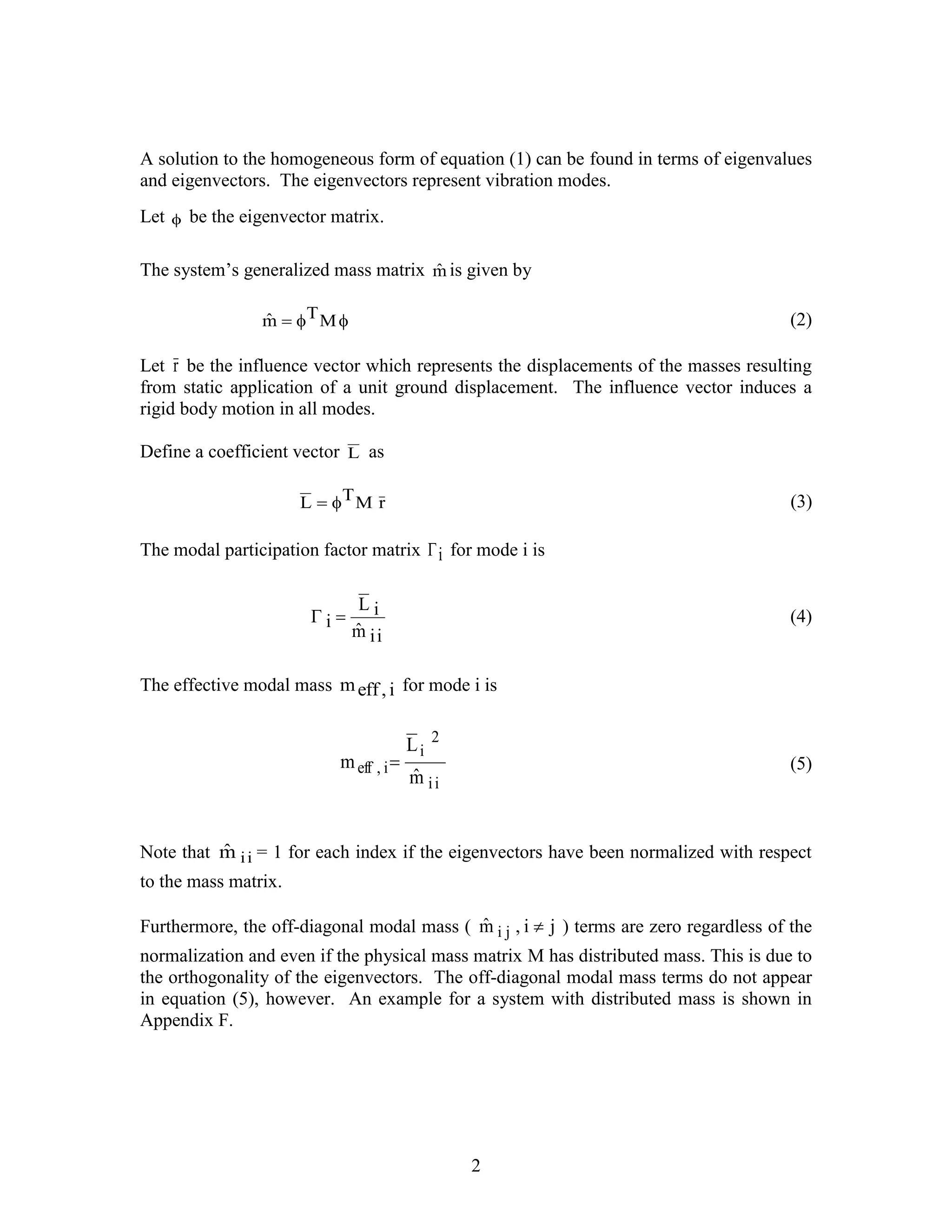
A solution to the homogeneous form of equation (1) can be found in terms of eigenvalues
and eigenvectors. The eigenvectors represent vibration modes.
Let  be the eigenvector matrix.
The system’s generalized mass matrix mˆ is given by
 MTmˆ (2)
Let r be the influence vector which represents the displacements of the masses resulting
from static application of a unit ground displacement. The influence vector induces a
rigid body motion in all modes.
Define a coefficient vector L as
rMTL  (3)
The modal participation factor matrix i for mode i is
iimˆ
iL
i  (4)
The effective modal mass i,effm for mode i is
ii
2
i
i,eff
mˆ
L
m  (5)
Note that iimˆ = 1 for each index if the eigenvectors have been normalized with respect
to the mass matrix.
Furthermore, the off-diagonal modal mass ( ji,mˆ ji  ) terms are zero regardless of the
normalization and even if the physical mass matrix M has distributed mass. This is due to
the orthogonality of the eigenvectors. The off-diagonal modal mass terms do not appear
in equation (5), however. An example for a system with distributed mass is shown in
Appendix F.
3
Example
Consider the two-degree-of-freedom system shown in Figure 1, with the parameters
shown in Table 1.
Figure 1.
The homogeneous equation of motion is
































0
0
2x
1x
3k2k3k
3k3k1k
2x
1x
2m0
01m


(6)
The mass matrix is
kg
10
02
M 





 (7)
Table 1. Parameters
Variable Value
1m 2.0 kg
2m 1.0 kg
1k 1000 N/m
2k 2000 N/m
3k 3000 N/m
m1
k1
m2
k2
k3
x1
x2
y
4
The stiffness matrix is
m/N
50003000
30004000
K 







 (8)
The eigenvalues and eigenvectors can be found using the method in Reference 2.
The eigenvalues are the roots of the following equation.
0M2Kdet 



  (9)
The eigenvalues are
 2sec/rad9.9012
1  (10)
sec/rad03.301  (11)
Hz78.41f  (12)
 2sec/rad60982
2  (13)
sec/rad09.782  (14)
Hz4.122f  (15)
The eigenvector matrix is





 

8881.04597.0
3251.06280.0
(16)
5
The eigenvectors were previously normalized so that the generalized mass is the identity
matrix.
 MTmˆ (17)





 














8881.04597.0
3251.06280.0
10
02
8881.03251.0
4597.06280.0
mˆ (18)





 








8881.04597.0
6502.02560.1
8881.03251.0
4597.06280.0
mˆ (19)







10
01
mˆ (20)
Again, r is the influence vector which represents the displacements of the masses
resulting from static application of a unit ground displacement. For this example, each
mass simply has the same static displacement as the ground displacement.







1
1
r (21)
The coefficient vector L is
rMTL  (22)




















1
1
10
02
8881.03251.0
4597.06280.0
L (23)
6














1
2
8881.03251.0
4597.06280.0
L (24)
kg
2379.0
7157.1
L 






 (25)
The modal participation factor i for mode i is
iimˆ
iL
i  (26)
The modal participation vector is thus








2379.0
7157.1
(27)
The coefficient vector L and the modal participation vector  are identical in this
example because the generalized mass matrix is the identity matrix.
The effective modal mass i,effm for mode i is
iimˆ
2
iL
i,effm  (28)
For mode 1,
 
kg1
2kg7157.1
1,effm  (29)
kg944.21,effm  (30)
7
For mode 2,
 
kg1
2kg2379.0
2,effm

 (31)
kg056.02,effm  (32)
Note that
kg056.0kg944.22,effm1,effm  (33)
kg32,effm1,effm  (34)
Thus, the sum of the effective masses equals the total system mass.
Also, note that the first mode has a much higher effective mass than the second mode.
Thus, the first mode can be readily excited by base excitation. On the other hand, the
second mode is negligible in this sense.
From another viewpoint, the center of gravity of the first mode experiences a significant
translation when the first mode is excited.
On the other hand, the center of gravity of the second mode remains nearly stationary
when the second mode is excited.
Each degree-of-freedom in the previous example was a translation in the X-axis. This
characteristic simplified the effective modal mass calculation.
In general, a system will have at least one translation degree-of-freedom in each of three
orthogonal axes. Likewise, it will have at least one rotational degree-of-freedom about
each of three orthogonal axes. The effective modal mass calculation for a general system
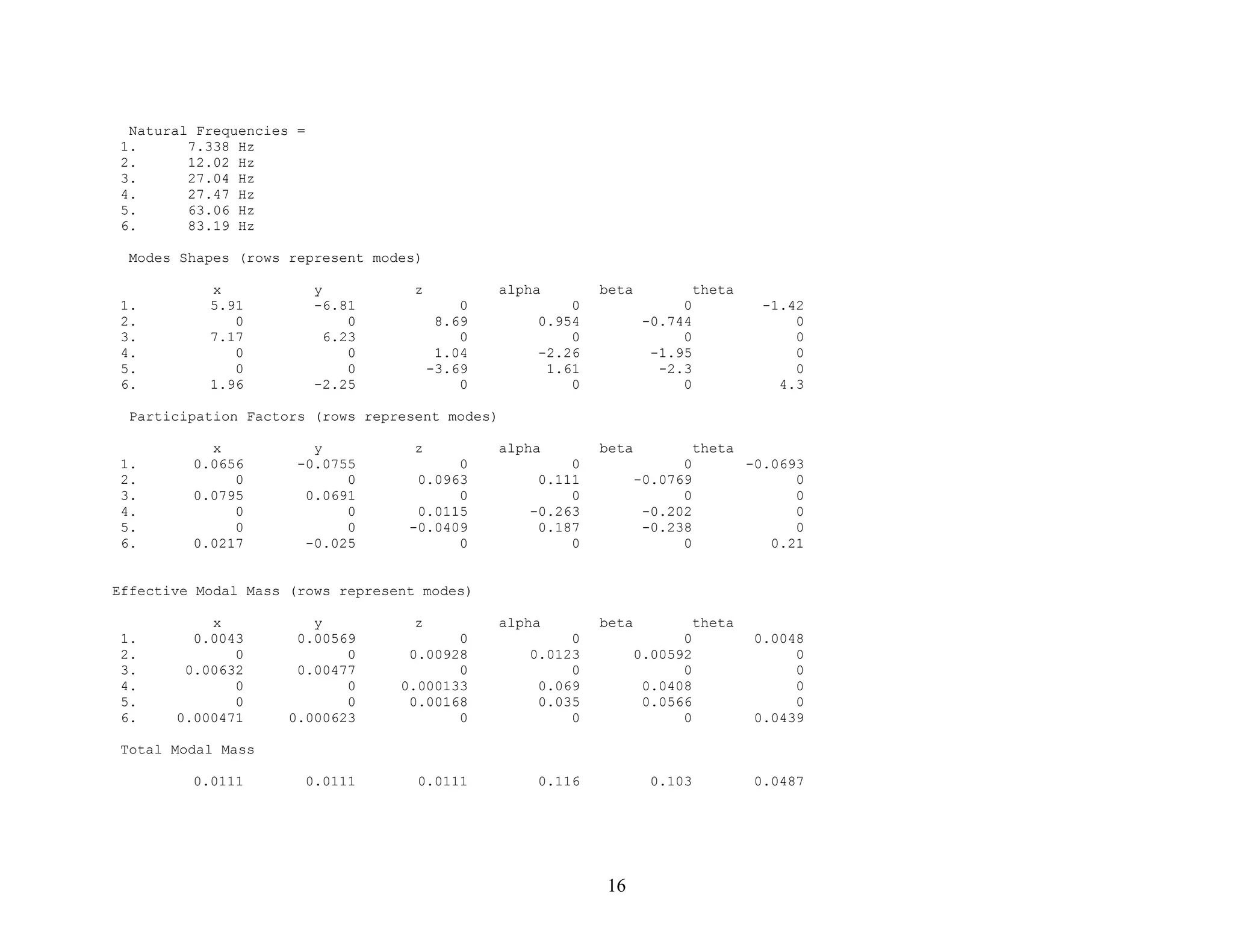
is shown by the example in Appendix A. The example is from a real-world problem.
8
Aside
An alternate definition of the participation factor is given in Appendix B.
References
1. M. Papadrakakis, N. Lagaros, V. Plevris; Optimum Design of Structures under
Seismic Loading, European Congress on Computational Methods in Applied
Sciences and Engineering, Barcelona, 2000.
2. T. Irvine, The Generalized Coordinate Method For Discrete Systems,
Vibrationdata, 2000.
3. W. Thomson, Theory of Vibration with Applications 2nd Edition, Prentice Hall,
New Jersey, 1981.
4. T. Irvine, Bending Frequencies of Beams, Rods, and Pipes, Rev M, Vibrationdata,
2010.
5. T. Irvine, Rod Response to Longitudinal Base Excitation, Steady-State and
Transient, Rev B, Vibrationdata, 2009.
6. T. Irvine, Longitudinal Vibration of a Rod via the Finite Element Method, Revision B,
Vibrationdata, 2008.
9
APPENDIX A
Equation of Motion, Isolated Avionics Component
Figure A-1. Isolated Avionics Component Model
The mass and inertia are represented at a point with the circle symbol. Each isolator is
modeled by three orthogonal DOF springs. The springs are mounted at each corner. The
springs are shown with an offset from the corners for clarity. The triangles indicate fixed
constraints. “0” indicates the origin.
ky4kx4
kz4
ky2
kx2
ky3kx3
ky1
kx1
kz1
kz3
kz2
m, J
0
x
z
y
10
Figure A-2. Isolated Avionics Component Model with Dimensions
All dimensions are positive as long as the C.G. is “inside the box.” At least one
dimension will be negative otherwise.
x
z
y
0b
c1
c2
a1 a2
C. G.
11
The mass and stiffness matrices are shown in upper triangular form due to symmetry.
(A-1)
K =
 
   
 
    
 




























 




 




 



2
2a2
1ayk22bxk4
b2c1cxk22
2a2
1azk22
2cxk4
2c1c2a1aykb2a1azk22
2c2
1cyk22bzk4
02a1azk2bzk4zk4
2a1ayk202c1cyk20yk4
bxk42c1cxk2000xk4
(A-2)





















zJ
0yJ
00xJ
000m
0000m
00000m
M
12
The equation of motion is




































































0
0
0
0
0
0
z
y
x
K
z
y
x
M






(A-3)
The variables , β and  represent rotations about the X, Y, and Z axes, respectively.
Example
A mass is mounted to a surface with four isolators. The system has the following properties.
M = 4.28 lbm
Jx = 44.9 lbm in^2
Jy = 39.9 lbm in^2
Jz = 18.8 lbm in^2
kx = 80 lbf/in
ky = 80 lbf/in
kz = 80 lbf/in
a1 = 6.18 in
a2 = -2.68 in
b = 3.85 in
c1 = 3. in
c2 = 3. in
13
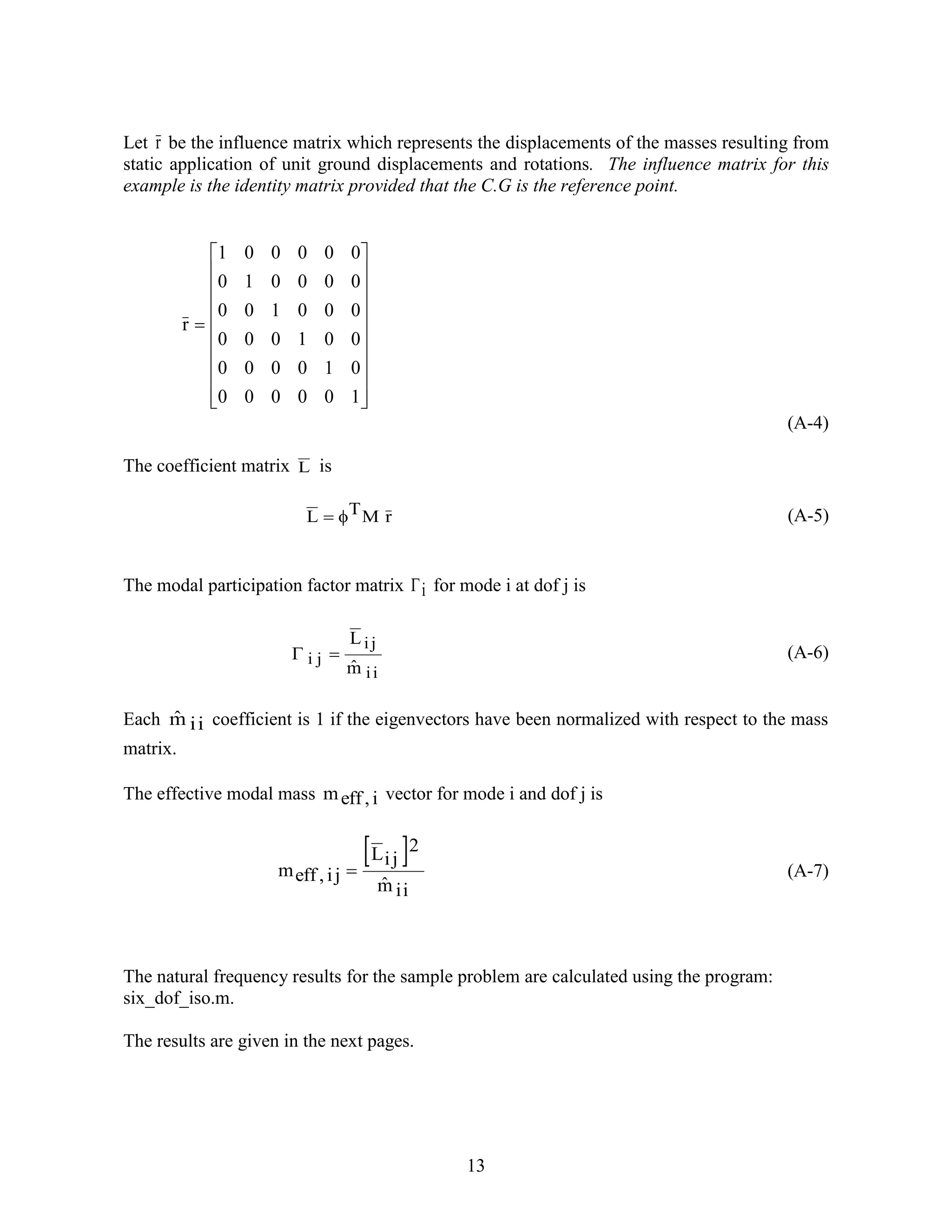
Let r be the influence matrix which represents the displacements of the masses resulting from
static application of unit ground displacements and rotations. The influence matrix for this
example is the identity matrix provided that the C.G is the reference point.





















100000
010000
001000
000100
000010
000001
r
(A-4)
The coefficient matrix L is
rMTL  (A-5)
The modal participation factor matrix i for mode i at dof j is
ii
ji
ji
mˆ
L
 (A-6)
Each iimˆ coefficient is 1 if the eigenvectors have been normalized with respect to the mass
matrix.
The effective modal mass i,effm vector for mode i and dof j is
 
iimˆ
2
jiL
ji,effm  (A-7)
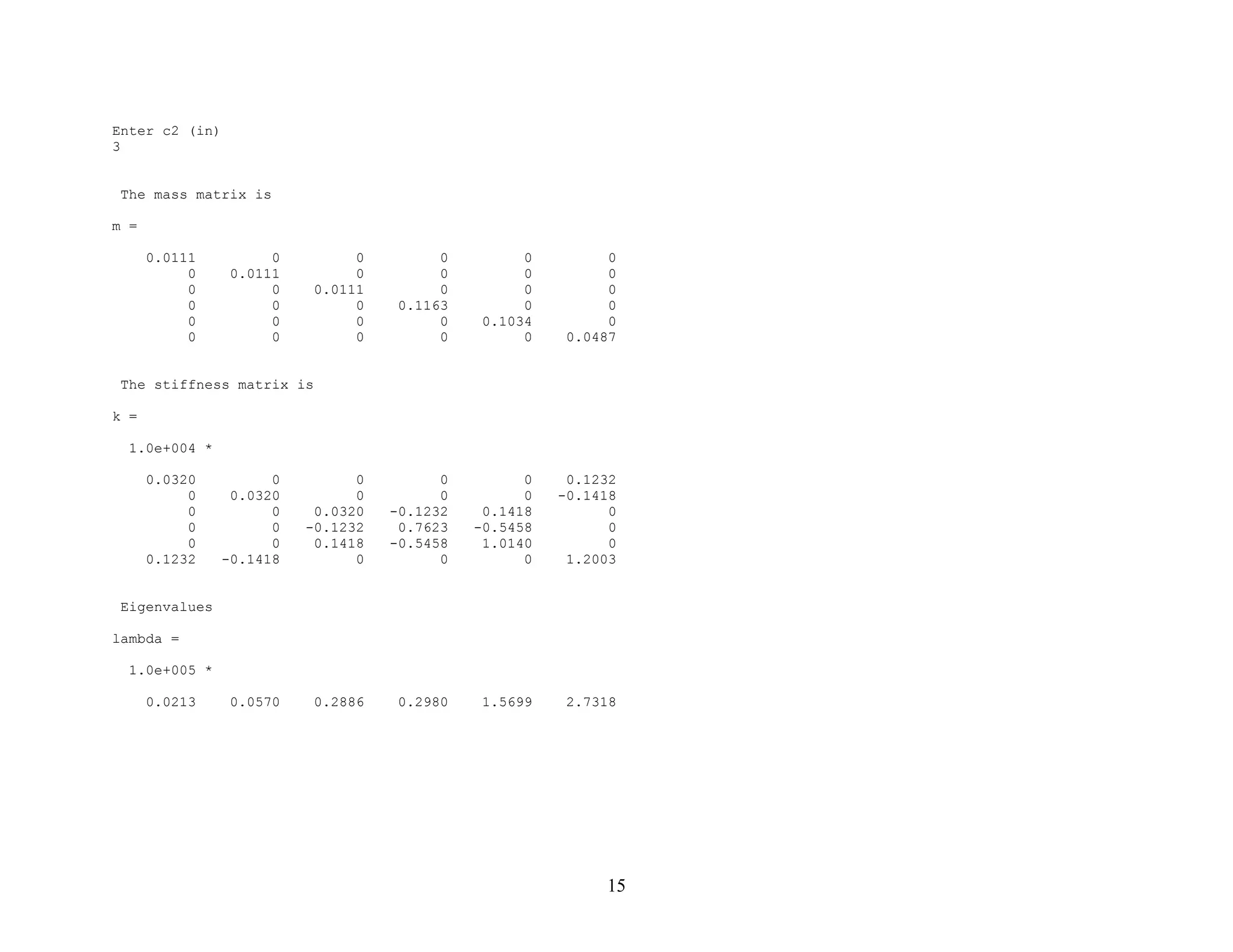
The natural frequency results for the sample problem are calculated using the program:
six_dof_iso.m.
The results are given in the next pages.
14
six_dof_iso.m ver 1.2 March 31, 2005
by Tom Irvine Email: tomirvine@aol.com
This program finds the eigenvalues and eigenvectors for a
six-degree-of-freedom system.
Refer to six_dof_isolated.pdf for a diagram.
The equation of motion is: M (d^2x/dt^2) + K x = 0
Enter m (lbm)
4.28
Enter Jx (lbm in^2)
44.9
Enter Jy (lbm in^2)
39.9
Enter Jz (lbm in^2)
18.8
Note that the stiffness values are for individual springs
Enter kx (lbf/in)
80
Enter ky (lbf/in)
80
Enter kz (lbf/in)
80
Enter a1 (in)
6.18
Enter a2 (in)
-2.68
Enter b (in)
3.85
Enter c1 (in)
3
15
Enter c2 (in)
3
The mass matrix is
m =
0.0111 0 0 0 0 0
0 0.0111 0 0 0 0
0 0 0.0111 0 0 0
0 0 0 0.1163 0 0
0 0 0 0 0.1034 0
0 0 0 0 0 0.0487
The stiffness matrix is
k =
1.0e+004 *
0.0320 0 0 0 0 0.1232
0 0.0320 0 0 0 -0.1418
0 0 0.0320 -0.1232 0.1418 0
0 0 -0.1232 0.7623 -0.5458 0
0 0 0.1418 -0.5458 1.0140 0
0.1232 -0.1418 0 0 0 1.2003
Eigenvalues
lambda =
1.0e+005 *
0.0213 0.0570 0.2886 0.2980 1.5699 2.7318
16
Natural Frequencies =
1. 7.338 Hz
2. 12.02 Hz
3. 27.04 Hz
4. 27.47 Hz
5. 63.06 Hz
6. 83.19 Hz
Modes Shapes (rows represent modes)
x y z alpha beta theta
1. 5.91 -6.81 0 0 0 -1.42
2. 0 0 8.69 0.954 -0.744 0
3. 7.17 6.23 0 0 0 0
4. 0 0 1.04 -2.26 -1.95 0
5. 0 0 -3.69 1.61 -2.3 0
6. 1.96 -2.25 0 0 0 4.3
Participation Factors (rows represent modes)
x y z alpha beta theta
1. 0.0656 -0.0755 0 0 0 -0.0693
2. 0 0 0.0963 0.111 -0.0769 0
3. 0.0795 0.0691 0 0 0 0
4. 0 0 0.0115 -0.263 -0.202 0
5. 0 0 -0.0409 0.187 -0.238 0
6. 0.0217 -0.025 0 0 0 0.21
Effective Modal Mass (rows represent modes)
x y z alpha beta theta
1. 0.0043 0.00569 0 0 0 0.0048
2. 0 0 0.00928 0.0123 0.00592 0
3. 0.00632 0.00477 0 0 0 0
4. 0 0 0.000133 0.069 0.0408 0
5. 0 0 0.00168 0.035 0.0566 0
6. 0.000471 0.000623 0 0 0 0.0439
Total Modal Mass
0.0111 0.0111 0.0111 0.116 0.103 0.0487
17
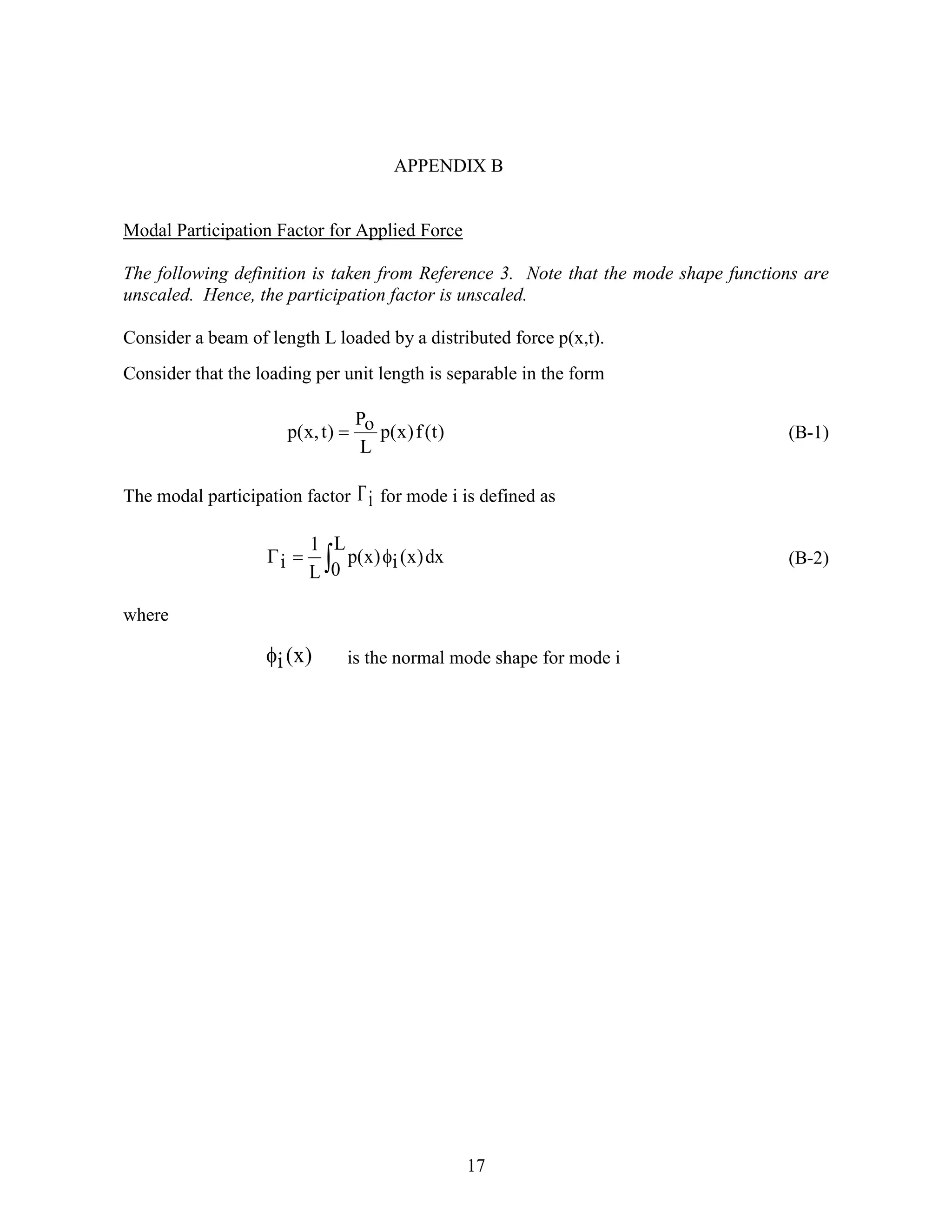
APPENDIX B
Modal Participation Factor for Applied Force
The following definition is taken from Reference 3. Note that the mode shape functions are
unscaled. Hence, the participation factor is unscaled.
Consider a beam of length L loaded by a distributed force p(x,t).
Consider that the loading per unit length is separable in the form
)t(f)x(p
L
oP
)t,x(p  (B-1)
The modal participation factor i for mode i is defined as
 
L
0
dx)x(i)x(p
L
1
i (B-2)
where
)x(i is the normal mode shape for mode i
18
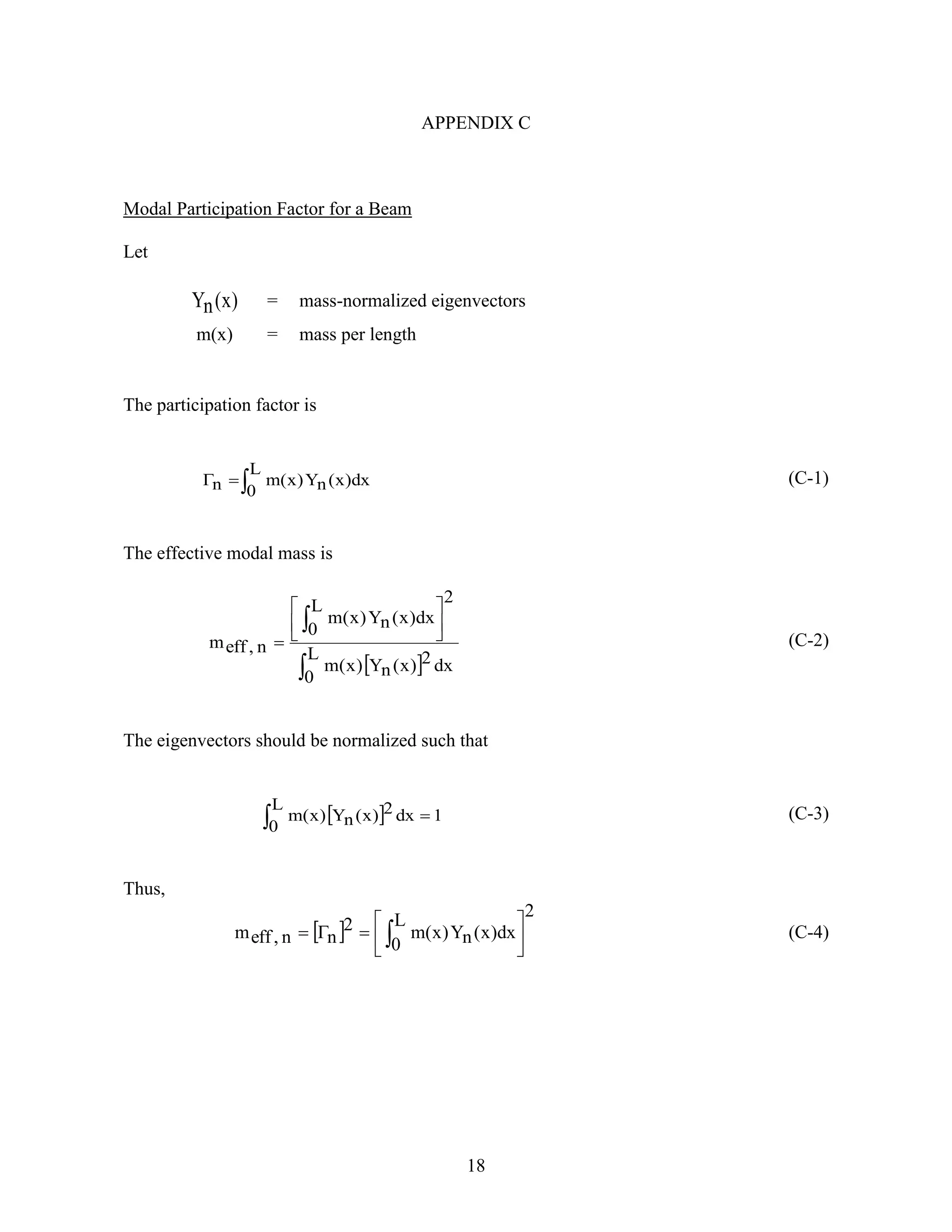
APPENDIX C
Modal Participation Factor for a Beam
Let
)x(nY = mass-normalized eigenvectors
m(x) = mass per length
The participation factor is

L
0
dx)x(nY)x(mn (C-1)
The effective modal mass is
 
 






L
0
dx2)x(nY)x(m
2
L
0
dx)x(nY)x(m
n,effm (C-2)
The eigenvectors should be normalized such that
  1
L
0
dx2)x(nY)x(m  (C-3)
Thus,
 
2
L
0
dx)x(nY)x(m2
nn,effm 





  (C-4)
19
APPENDIX D
Effective Modal Mass Values for Bernoulli-Euler Beams
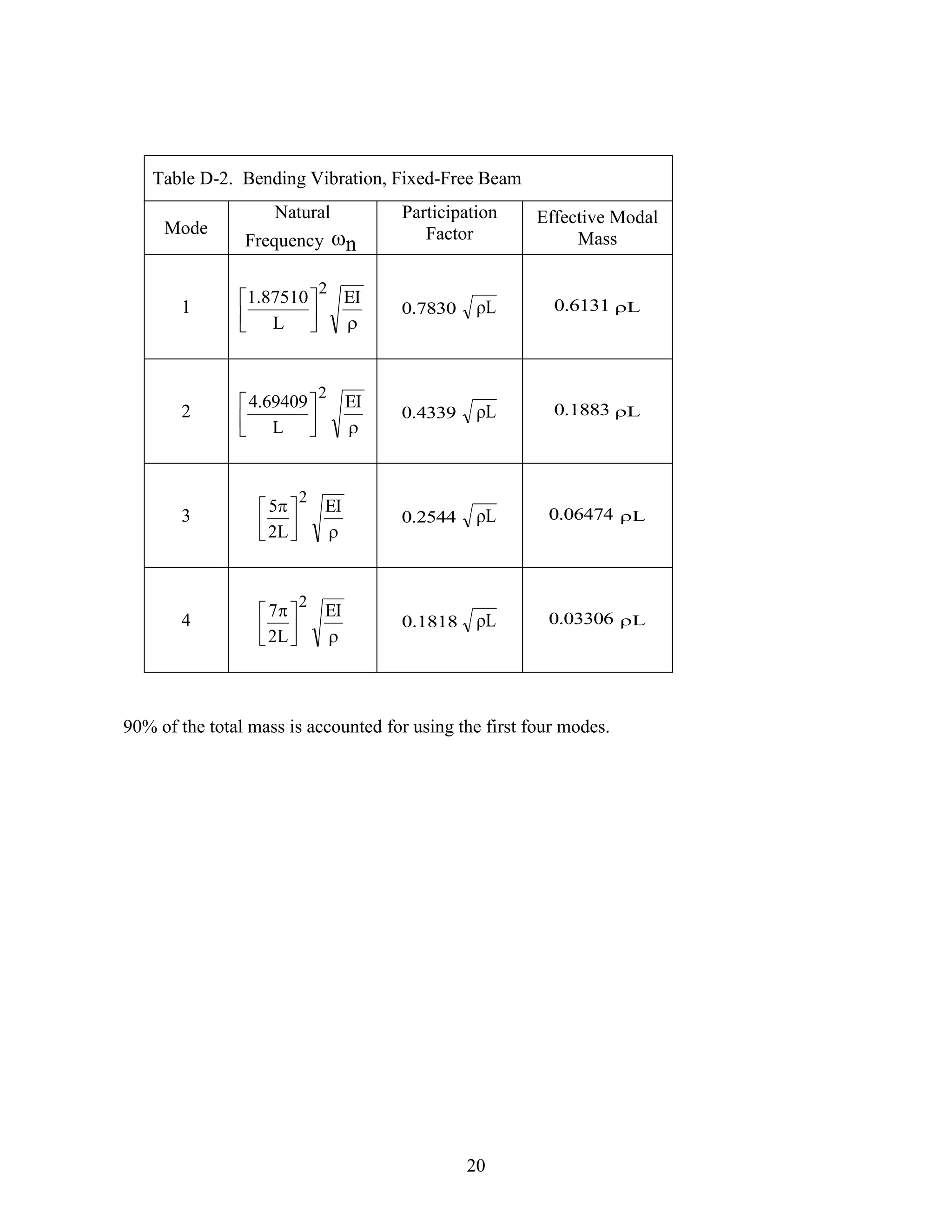
The results are calculated using formulas from Reference 4. The variables are
E = is the modulus of elasticity
I = is the area moment of inertia
L = is the length
 = is (mass/length)
Table D-1. Bending Vibration, Beam Simply-Supported at Both Ends
Mode
Natural
Frequency n
Participation
Factor Effective Modal Mass
1

 EI
L2
2
L2
2


L
2
8


2

 EI
L
4
2
2
0 0
3

 EI
L
9
2
2
L2
3
2


L
29
8


4

 EI
L
16
2
2
0 0
5

 EI
L
25
2
2
L2
5
2


L
225
8


6

 EI
L
36
2
2
0 0
7

 EI
L
49
2
2
L2
7
2


L
249
8


95% of the total mass is accounted for using the first seven modes.
20
Table D-2. Bending Vibration, Fixed-Free Beam
Mode
Natural
Frequency n
Participation
Factor
Effective Modal
Mass
1





 EI
L
87510.1
2
7830.0 L 6131.0 L
2





 EI
L
69409.4
2
4339.0 L 0.1883 L
3





  EI
L2
5
2
2544.0 L 0.06474 L
4





  EI
L2
7
2
1818.0 L 0.03306 L
90% of the total mass is accounted for using the first four modes.
21
APPENDIX E
Rod, Longitudinal Vibration, Classical Solution
The results are taken from Reference 5.
Table E-1. Longitudinal Vibration of a Rod, Fixed-Free
Mode Natural Frequency n
Participation
Factor
Effective Modal
Mass
1 0.5  c / L L2
2


L
8
2


2 1.5  c / L L2
3
2


L
9
8
2


3 2.5  c / L L2
5
2


L
25
8
2


The longitudinal wave speed c is


E
c (E-1)
93% of the total mass is accounted for by using the first three modes.
22
APPENDIX F
This example shows a system with distributed or consistent mass matrix.
Rod, Longitudinal Vibration, Finite Element Method
Consider an aluminum rod with 1 inch diameter and 48 inch length. The rod has fixed-free
boundary conditions.
A finite element model of the rod is shown in Figure F-1. It consists of four elements and five
nodes. Each element has an equal length.
Figure F-1.
The boundary conditions are
U(0) = 0 (Fixed end) (F-1)
0
Lxdx
dU


(Free end) (F-2)
The natural frequencies and modes are determined using the finite element method in
Reference 6.
N1 N2 N3
E1 E2
N4
E3
N5
E4
23
The resulting eigenvalue problem for the constrained system has the following mass and
stiffness matrices as calculated via Matlab script: rod_FEA.m.
Mass =
0.0016 0.0004 0 0
0.0004 0.0016 0.0004 0
0 0.0004 0.0016 0.0004
0 0 0.0004 0.0008
Stiffness =
1.0e+006 *
1.3090 -0.6545 0 0
-0.6545 1.3090 -0.6545 0
0 -0.6545 1.3090 -0.6545
0 0 -0.6545 0.6545
The natural frequencies are
n fn(Hz)
1 1029.9
2 3248.8
3 5901.6
4 8534.3
The mass-normalized eigenvectors in column format are
5.5471 14.8349 18.0062 -9.1435
10.2496 11.3542 -13.7813 16.8950
13.3918 -6.1448 -7.4584 -22.0744
14.4952 -16.0572 19.4897 23.8931
24
Let r be the influence vector which represents the displacements of the masses resulting from
static application of a unit ground displacement.
The influence vector for the sample problem is
r =
1
1
1
1
The coefficient vector L is
rMTL  (F-3)
where
T = transposed eigenvector matrix
M = mass matrix
The coefficient vector for the sample problem is
L =
0.0867
0.0233
0.0086
-0.0021
The modal participation factor matrix i for mode i is
ii
i
i
mˆ
L
 (F-4)
Note that iimˆ = 1 for each index since the eigenvectors have been previously normalized
with respect to the mass matrix.
25
Thus, for the sample problem,
ii L (F-5)
The effective modal mass i,effm for mode i is
ii
2
i
i,eff
mˆ
L
m  (F-6)
Again, the eigenvectors are mass normalized.
Thus
2
ii,eff Lm  (F-7)
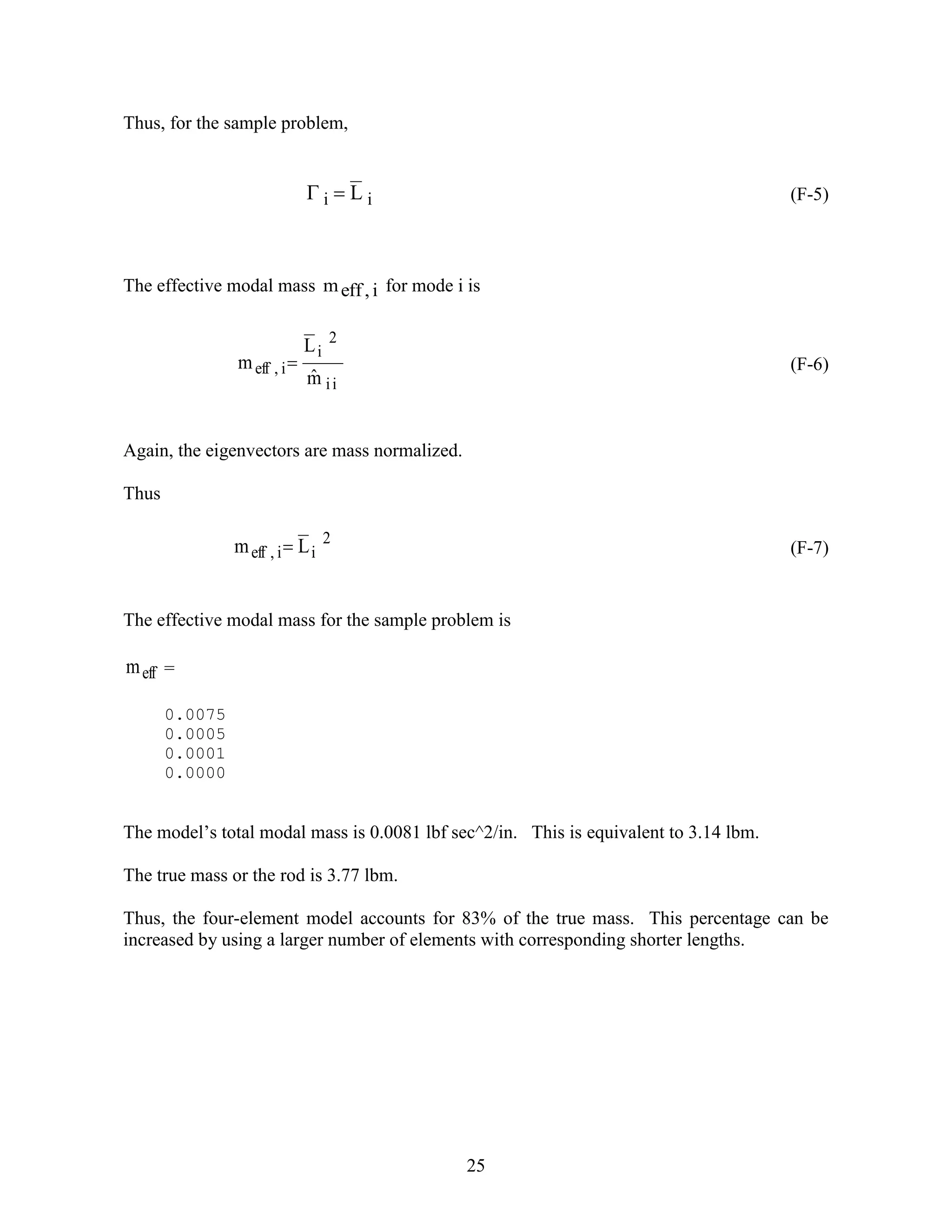
The effective modal mass for the sample problem is
effm =
0.0075
0.0005
0.0001
0.0000
The model’s total modal mass is 0.0081 lbf sec^2/in. This is equivalent to 3.14 lbm.
The true mass or the rod is 3.77 lbm.
Thus, the four-element model accounts for 83% of the true mass. This percentage can be
increased by using a larger number of elements with corresponding shorter lengths.
26
APPENDIX G
Two-degree-of-freedom System, Static Coupling
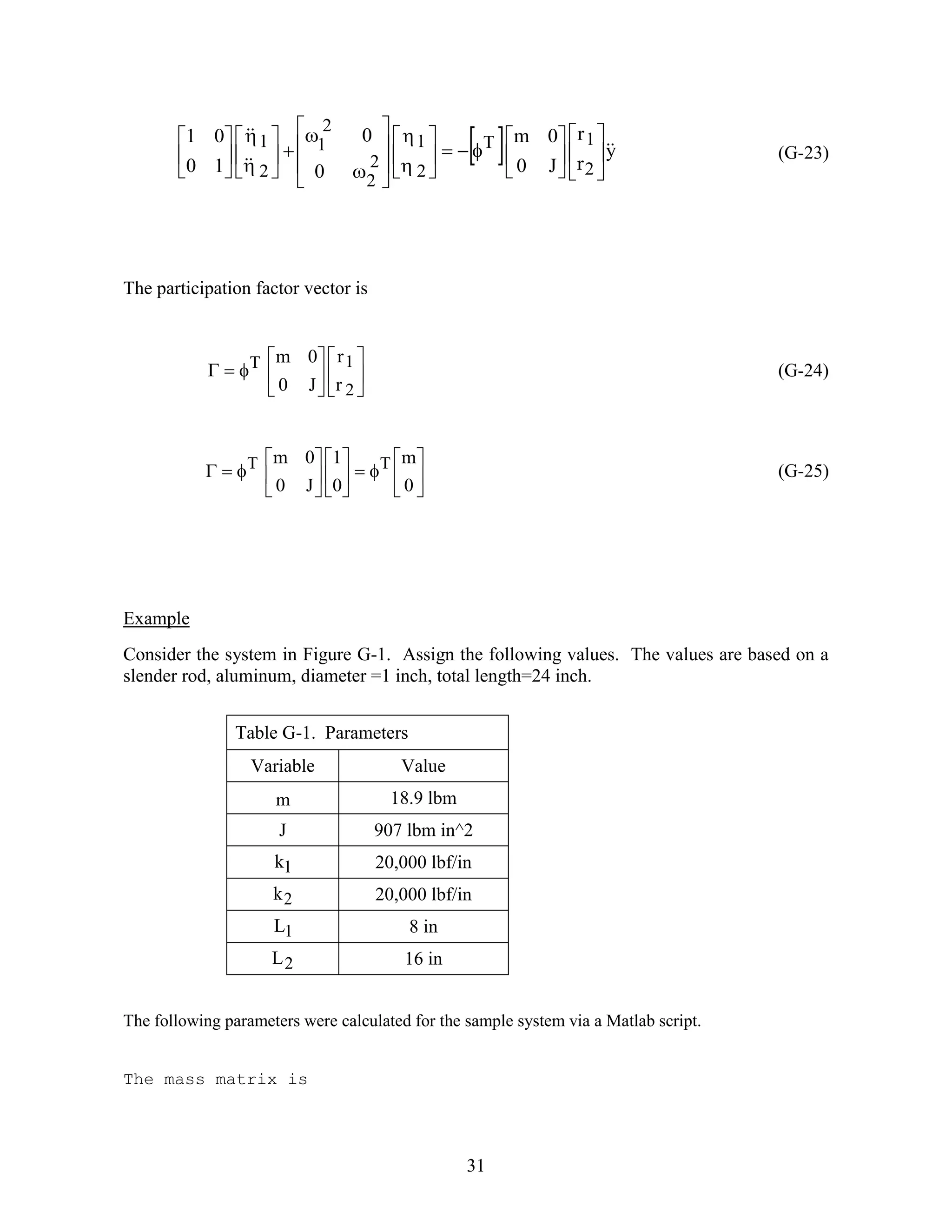
Figure G-1.
Figure G-2.
The free-body diagram is given in Figure G-2.
k 1 k 2
L1
y
L2
x

k 1 ( y - x - L1 )
)
k 2 ( y - x + L2 )
)
27
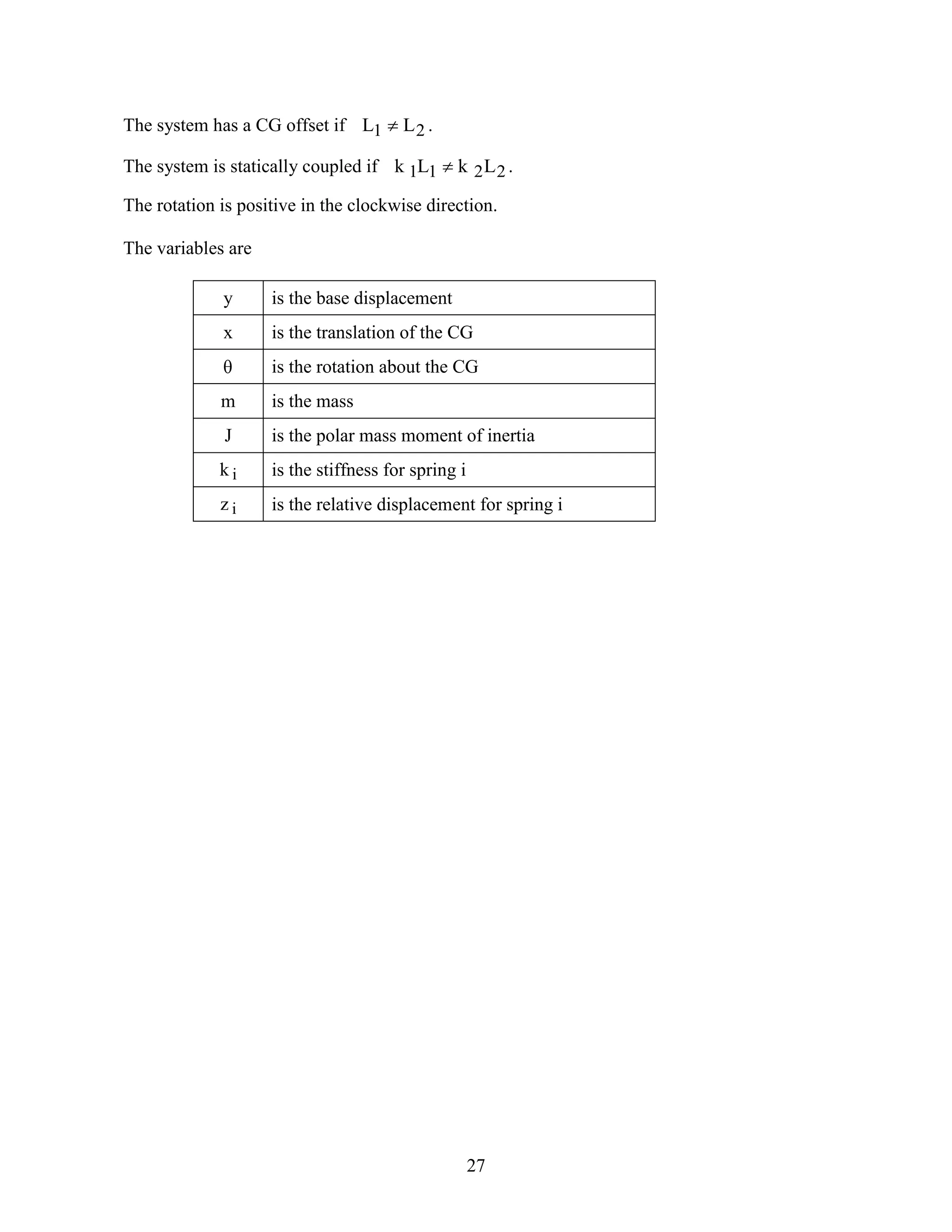
The system has a CG offset if 21 LL  .
The system is statically coupled if 2211 LkLk  .
The rotation is positive in the clockwise direction.
The variables are
y is the base displacement
x is the translation of the CG
 is the rotation about the CG
m is the mass
J is the polar mass moment of inertia
k i is the stiffness for spring i
z i is the relative displacement for spring i
28
Sign Convention:
Translation: upward in vertical axis is positive.
Rotation: clockwise is positive.
Sum the forces in the vertical direction
  xmF  (G-1)
)Lxy(k)Lxy(kxm 2211  (G-2)
0)Lxy(k)Lxy(kxm 2211  (G-3)
0LkxkykLkxkykxm 22221111  (G-4)
  y)kk()LkLk(xkkxm 21221121  (G-5)
Sum the moments about the center of mass.
  JM (G-6)
)Lxy(Lk)Lxy(LkJ 222111  (G-7)
0)Lxy(Lk)Lxy(LkJ 222111  (G-8)
0LkxLkyLkLkxLkykJ 2
222222
2
11111  (G-9)
     yLkLkLkLkxLkLkJ 2211
2
22
2
112211  (G-10)
The equations of motion are
y
LkLk
kkx
LkLkLkLk
LkLkkkx
J0
0m
2211
21
2
22
2
112211
221121





































(G-11)
29
The pseudo-static problem is
y
LkLk
kkx
LkLkLkLk
LkLkkk
2211
21
2
22
2
112211
221121























(G-12)
Solve for the influence vector r by applying a unit displacement.






















2211
21
2
1
2
22
2
112211
221121
LkLk
kk
r
r
LkLkLkLk
LkLkkk
(G-13)












0
1
r
r
2
1
(G-14)
Define a relative displacement z.
z = x – y (G-15)
x = z + y (G-16)
 y
LkLk
kk
0
y
LkLkLkLk
LkLkkkz
LkLkLkLk
LkLkkk
0
ymz
J0
0m
2211
21
2
22
2
112211
221121
2
22
2
112211
221121
























































 


(G-17)

































0
ymz
LkLkLkLk
LkLkkkz
J0
0m
2
22
2
112211
221121 


30
(G-18)
The equation is more formally
y
r
r
J0
0mz
LkLkLkLk
LkLkkkz
J0
0m
2
1
2
22
2
112211
221121










































(G-19)
Solve for the eigenvalues and mass-normalized eigenvectors matrix  using the
homogeneous problem form of equation (G-9).
Define modal coordinates
  













 2
1z
(G-20)
    y
r
r
J0
0m
LkLkLkLk
LkLkkk
J0
0m
2
1
2
1
2
22
2
112211
221121
2
1 












































(G-21)
Then premultiply by the transpose of the eigenvector matrix T .
       
  y
r
r
J0
0m
LkLkLkLk
LkLkkk
J0
0m
2
1T
2
1
2
22
2
112211
221121T
2
1T















































(G-22)
31
  y
r
r
J0
0m
0
0
10
01
2
1T
2
1
2
2
2
1
2
1 














































(G-23)
The participation factor vector is













2
1T
r
r
J0
0m
(G-24)



















0
m
0
1
J0
0m TT (G-25)
Example
Consider the system in Figure G-1. Assign the following values. The values are based on a
slender rod, aluminum, diameter =1 inch, total length=24 inch.
Table G-1. Parameters
Variable Value
m 18.9 lbm
J 907 lbm in^2
1k 20,000 lbf/in
2k 20,000 lbf/in
1L 8 in
2L 16 in
The following parameters were calculated for the sample system via a Matlab script.
The mass matrix is
32
m =
0.0490 0
0 2.3497
The stiffness matrix is
k =
40000 160000
160000 6400000
Natural Frequencies =
133.8 Hz
267.9 Hz
Modes Shapes (column format) =
-4.4 1.029
0.1486 0.6352
Participation Factors =
0.2156
0.0504
Effective Modal Mass
0.0465
0.0025
The total modal mass is 0.0490 lbf sec^2/in, equivalent to18.9 lbm.
33
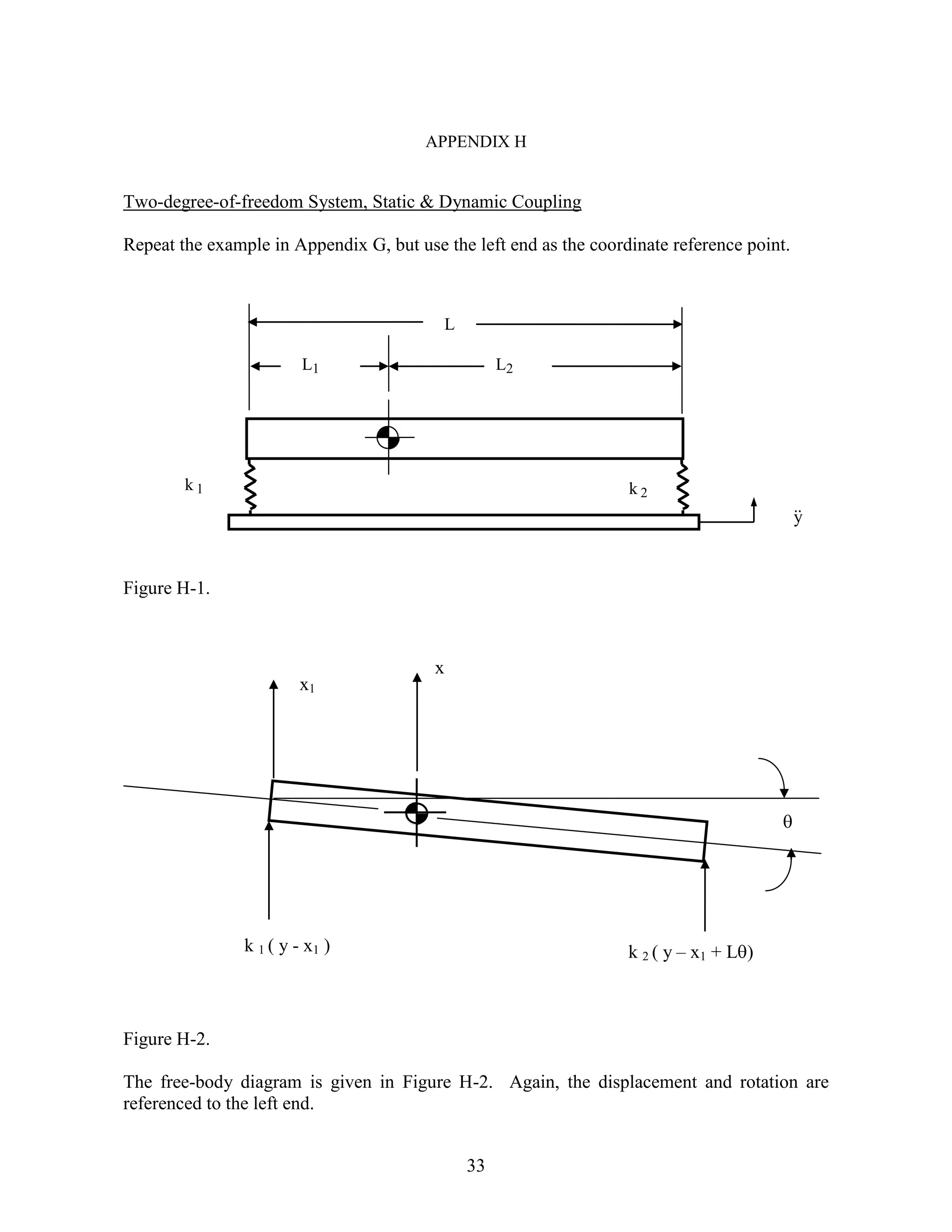
APPENDIX H
Two-degree-of-freedom System, Static & Dynamic Coupling
Repeat the example in Appendix G, but use the left end as the coordinate reference point.
Figure H-1.
Figure H-2.
The free-body diagram is given in Figure H-2. Again, the displacement and rotation are
referenced to the left end.
k 1 k 2
L1
y
L2
L
x1

k 1 ( y - x1 ) k 2 ( y – x1 + L)
x
34
Sign Convention:
Translation: upward in vertical axis is positive.
Rotation: clockwise is positive.
Sum the forces in the vertical direction
  xmF  (H-1)
)Lxy(k)xy(kxm 1211  (H-2)
0)Lxy(k)xy(kxm 1211  (H-3)
0Lkxkykxkykxm 2122111  (H-4)
  y)kk(Lkxkkxm 212121  (H-
5)
 11 Lxx (H-6)
    y)kk(LkxkkLxm 21212111   (H-7)
  y)kk(LkxkkLmxm 21212111   (H-8)
Sum the moments about the left end.
  
11 JM (H-9)
 11121 x-xmL)L+x-y(LkJ   (H-10)
  0)L+x-y(Lkx-xmLJ 12111   (H-11)
  0LkLxk-Lykx-xmLJ 2
2122111   (H-12)
  LykLkLxk-x-xmLJ 2
2
212111   (H-13)
35
 11 Lxx (H-14)
  LykLkLxk-x-LxmLJ 2
2
21211111   (H-15)
LykLkLxk-xmLJ 2
2
212111   (H-16)
The equations of motion are
y
Lk
kkx
LkLk
Lkkkx
JmL
mLm
2
211
2
22
2211
11
1







































(H-17)
Note that
2
11 mLJJ  (H-18)
y
Lk
kkx
LkLk
Lkkkx
mLJmL
mLm
2
211
2
22
2211
2
11
1









































(H-
19)
The pseudo-static problem is
y
Lk
kkx
LkLk
Lkkk
2
211
2
22
221























(H-20)
Solve for the influence vector r by applying a unit displacement.






















Lk
kk
r
r
LkLk
Lkkk
2
21
2
1
2
22
221
(H-21)
36












0
1
r
r
2
1
(H-22)
The influence coefficient vector is the same as that in Appendix G.
The natural frequencies are obtained via a Matlab script. The results are:
Natural Frequencies
No. f(Hz)
1. 133.79
2. 267.93
Modes Shapes (column format)
ModeShapes =
5.5889 4.0527
0.1486 0.6352
Participation Factors =
0.2155
-0.05039
Effective Modal Mass =
0.04642
0.002539
The total modal mass is 0.0490 lbf sec^2/in, equivalent to18.9 lbm.

Modal mass

  • 1.
    1 EFFECTIVE MODAL MASS& MODAL PARTICIPATION FACTORS Revision H By Tom Irvine Email: tom@vibrationdata.com March 28, 2013 _______________________________________________________________________ Introduction The effective modal mass provides a method for judging the “significance” of a vibration mode. Modes with relatively high effective masses can be readily excited by base excitation. On the other hand, modes with low effective masses cannot be readily excited in this manner. Consider a modal transient or frequency response function analysis via the finite element method. Also consider that the system is a multi-degree-of-freedom system. For brevity, only a limited number of modes should be included in the analysis. How many modes should be included in the analysis? Perhaps the number should be enough so that the total effective modal mass of the model is at least 90% of the actual mass. Definitions The equation definitions in this section are taken from Reference 1. Consider a discrete dynamic system governed by the following equation FxKxM  (1) where M is the mass matrix K is the stiffness matrix x is the acceleration vector x is the displacement vector F is the forcing function or base excitation function
  • 2.
    2 A solution tothe homogeneous form of equation (1) can be found in terms of eigenvalues and eigenvectors. The eigenvectors represent vibration modes. Let  be the eigenvector matrix. The system’s generalized mass matrix mˆ is given by  MTmˆ (2) Let r be the influence vector which represents the displacements of the masses resulting from static application of a unit ground displacement. The influence vector induces a rigid body motion in all modes. Define a coefficient vector L as rMTL  (3) The modal participation factor matrix i for mode i is iimˆ iL i  (4) The effective modal mass i,effm for mode i is ii 2 i i,eff mˆ L m  (5) Note that iimˆ = 1 for each index if the eigenvectors have been normalized with respect to the mass matrix. Furthermore, the off-diagonal modal mass ( ji,mˆ ji  ) terms are zero regardless of the normalization and even if the physical mass matrix M has distributed mass. This is due to the orthogonality of the eigenvectors. The off-diagonal modal mass terms do not appear in equation (5), however. An example for a system with distributed mass is shown in Appendix F.
  • 3.
    3 Example Consider the two-degree-of-freedomsystem shown in Figure 1, with the parameters shown in Table 1. Figure 1. The homogeneous equation of motion is                                 0 0 2x 1x 3k2k3k 3k3k1k 2x 1x 2m0 01m   (6) The mass matrix is kg 10 02 M        (7) Table 1. Parameters Variable Value 1m 2.0 kg 2m 1.0 kg 1k 1000 N/m 2k 2000 N/m 3k 3000 N/m m1 k1 m2 k2 k3 x1 x2 y
  • 4.
    4 The stiffness matrixis m/N 50003000 30004000 K          (8) The eigenvalues and eigenvectors can be found using the method in Reference 2. The eigenvalues are the roots of the following equation. 0M2Kdet       (9) The eigenvalues are  2sec/rad9.9012 1  (10) sec/rad03.301  (11) Hz78.41f  (12)  2sec/rad60982 2  (13) sec/rad09.782  (14) Hz4.122f  (15) The eigenvector matrix is         8881.04597.0 3251.06280.0 (16)
  • 5.
    5 The eigenvectors werepreviously normalized so that the generalized mass is the identity matrix.  MTmˆ (17)                      8881.04597.0 3251.06280.0 10 02 8881.03251.0 4597.06280.0 mˆ (18)                8881.04597.0 6502.02560.1 8881.03251.0 4597.06280.0 mˆ (19)        10 01 mˆ (20) Again, r is the influence vector which represents the displacements of the masses resulting from static application of a unit ground displacement. For this example, each mass simply has the same static displacement as the ground displacement.        1 1 r (21) The coefficient vector L is rMTL  (22)                     1 1 10 02 8881.03251.0 4597.06280.0 L (23)
  • 6.
    6               1 2 8881.03251.0 4597.06280.0 L (24) kg 2379.0 7157.1 L        (25) The modal participation factor i for mode i is iimˆ iL i  (26) The modal participation vector is thus         2379.0 7157.1 (27) The coefficient vector L and the modal participation vector  are identical in this example because the generalized mass matrix is the identity matrix. The effective modal mass i,effm for mode i is iimˆ 2 iL i,effm  (28) For mode 1,   kg1 2kg7157.1 1,effm  (29) kg944.21,effm  (30)
  • 7.
    7 For mode 2,  kg1 2kg2379.0 2,effm   (31) kg056.02,effm  (32) Note that kg056.0kg944.22,effm1,effm  (33) kg32,effm1,effm  (34) Thus, the sum of the effective masses equals the total system mass. Also, note that the first mode has a much higher effective mass than the second mode. Thus, the first mode can be readily excited by base excitation. On the other hand, the second mode is negligible in this sense. From another viewpoint, the center of gravity of the first mode experiences a significant translation when the first mode is excited. On the other hand, the center of gravity of the second mode remains nearly stationary when the second mode is excited. Each degree-of-freedom in the previous example was a translation in the X-axis. This characteristic simplified the effective modal mass calculation. In general, a system will have at least one translation degree-of-freedom in each of three orthogonal axes. Likewise, it will have at least one rotational degree-of-freedom about each of three orthogonal axes. The effective modal mass calculation for a general system is shown by the example in Appendix A. The example is from a real-world problem.
  • 8.
    8 Aside An alternate definitionof the participation factor is given in Appendix B. References 1. M. Papadrakakis, N. Lagaros, V. Plevris; Optimum Design of Structures under Seismic Loading, European Congress on Computational Methods in Applied Sciences and Engineering, Barcelona, 2000. 2. T. Irvine, The Generalized Coordinate Method For Discrete Systems, Vibrationdata, 2000. 3. W. Thomson, Theory of Vibration with Applications 2nd Edition, Prentice Hall, New Jersey, 1981. 4. T. Irvine, Bending Frequencies of Beams, Rods, and Pipes, Rev M, Vibrationdata, 2010. 5. T. Irvine, Rod Response to Longitudinal Base Excitation, Steady-State and Transient, Rev B, Vibrationdata, 2009. 6. T. Irvine, Longitudinal Vibration of a Rod via the Finite Element Method, Revision B, Vibrationdata, 2008.
  • 9.
    9 APPENDIX A Equation ofMotion, Isolated Avionics Component Figure A-1. Isolated Avionics Component Model The mass and inertia are represented at a point with the circle symbol. Each isolator is modeled by three orthogonal DOF springs. The springs are mounted at each corner. The springs are shown with an offset from the corners for clarity. The triangles indicate fixed constraints. “0” indicates the origin. ky4kx4 kz4 ky2 kx2 ky3kx3 ky1 kx1 kz1 kz3 kz2 m, J 0 x z y
  • 10.
    10 Figure A-2. IsolatedAvionics Component Model with Dimensions All dimensions are positive as long as the C.G. is “inside the box.” At least one dimension will be negative otherwise. x z y 0b c1 c2 a1 a2 C. G.
  • 11.
    11 The mass andstiffness matrices are shown in upper triangular form due to symmetry. (A-1) K =                                                             2 2a2 1ayk22bxk4 b2c1cxk22 2a2 1azk22 2cxk4 2c1c2a1aykb2a1azk22 2c2 1cyk22bzk4 02a1azk2bzk4zk4 2a1ayk202c1cyk20yk4 bxk42c1cxk2000xk4 (A-2)                      zJ 0yJ 00xJ 000m 0000m 00000m M
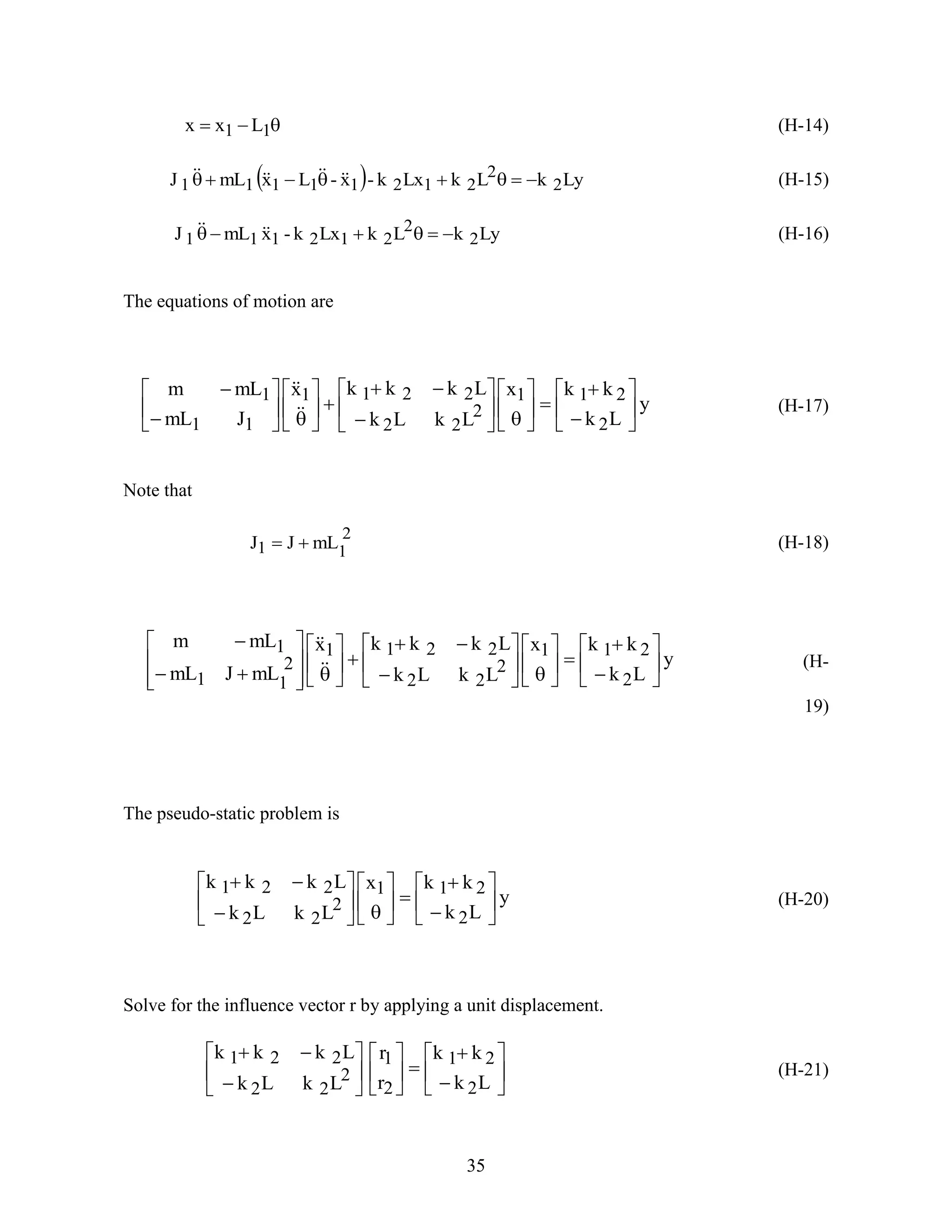
  • 12.
    12 The equation ofmotion is                                                                     0 0 0 0 0 0 z y x K z y x M       (A-3) The variables , β and  represent rotations about the X, Y, and Z axes, respectively. Example A mass is mounted to a surface with four isolators. The system has the following properties. M = 4.28 lbm Jx = 44.9 lbm in^2 Jy = 39.9 lbm in^2 Jz = 18.8 lbm in^2 kx = 80 lbf/in ky = 80 lbf/in kz = 80 lbf/in a1 = 6.18 in a2 = -2.68 in b = 3.85 in c1 = 3. in c2 = 3. in
  • 13.
    13 Let r bethe influence matrix which represents the displacements of the masses resulting from static application of unit ground displacements and rotations. The influence matrix for this example is the identity matrix provided that the C.G is the reference point.                      100000 010000 001000 000100 000010 000001 r (A-4) The coefficient matrix L is rMTL  (A-5) The modal participation factor matrix i for mode i at dof j is ii ji ji mˆ L  (A-6) Each iimˆ coefficient is 1 if the eigenvectors have been normalized with respect to the mass matrix. The effective modal mass i,effm vector for mode i and dof j is   iimˆ 2 jiL ji,effm  (A-7) The natural frequency results for the sample problem are calculated using the program: six_dof_iso.m. The results are given in the next pages.
  • 14.
    14 six_dof_iso.m ver 1.2March 31, 2005 by Tom Irvine Email: tomirvine@aol.com This program finds the eigenvalues and eigenvectors for a six-degree-of-freedom system. Refer to six_dof_isolated.pdf for a diagram. The equation of motion is: M (d^2x/dt^2) + K x = 0 Enter m (lbm) 4.28 Enter Jx (lbm in^2) 44.9 Enter Jy (lbm in^2) 39.9 Enter Jz (lbm in^2) 18.8 Note that the stiffness values are for individual springs Enter kx (lbf/in) 80 Enter ky (lbf/in) 80 Enter kz (lbf/in) 80 Enter a1 (in) 6.18 Enter a2 (in) -2.68 Enter b (in) 3.85 Enter c1 (in) 3
  • 15.
    15 Enter c2 (in) 3 Themass matrix is m = 0.0111 0 0 0 0 0 0 0.0111 0 0 0 0 0 0 0.0111 0 0 0 0 0 0 0.1163 0 0 0 0 0 0 0.1034 0 0 0 0 0 0 0.0487 The stiffness matrix is k = 1.0e+004 * 0.0320 0 0 0 0 0.1232 0 0.0320 0 0 0 -0.1418 0 0 0.0320 -0.1232 0.1418 0 0 0 -0.1232 0.7623 -0.5458 0 0 0 0.1418 -0.5458 1.0140 0 0.1232 -0.1418 0 0 0 1.2003 Eigenvalues lambda = 1.0e+005 * 0.0213 0.0570 0.2886 0.2980 1.5699 2.7318
  • 16.
    16 Natural Frequencies = 1.7.338 Hz 2. 12.02 Hz 3. 27.04 Hz 4. 27.47 Hz 5. 63.06 Hz 6. 83.19 Hz Modes Shapes (rows represent modes) x y z alpha beta theta 1. 5.91 -6.81 0 0 0 -1.42 2. 0 0 8.69 0.954 -0.744 0 3. 7.17 6.23 0 0 0 0 4. 0 0 1.04 -2.26 -1.95 0 5. 0 0 -3.69 1.61 -2.3 0 6. 1.96 -2.25 0 0 0 4.3 Participation Factors (rows represent modes) x y z alpha beta theta 1. 0.0656 -0.0755 0 0 0 -0.0693 2. 0 0 0.0963 0.111 -0.0769 0 3. 0.0795 0.0691 0 0 0 0 4. 0 0 0.0115 -0.263 -0.202 0 5. 0 0 -0.0409 0.187 -0.238 0 6. 0.0217 -0.025 0 0 0 0.21 Effective Modal Mass (rows represent modes) x y z alpha beta theta 1. 0.0043 0.00569 0 0 0 0.0048 2. 0 0 0.00928 0.0123 0.00592 0 3. 0.00632 0.00477 0 0 0 0 4. 0 0 0.000133 0.069 0.0408 0 5. 0 0 0.00168 0.035 0.0566 0 6. 0.000471 0.000623 0 0 0 0.0439 Total Modal Mass 0.0111 0.0111 0.0111 0.116 0.103 0.0487
  • 17.
    17 APPENDIX B Modal ParticipationFactor for Applied Force The following definition is taken from Reference 3. Note that the mode shape functions are unscaled. Hence, the participation factor is unscaled. Consider a beam of length L loaded by a distributed force p(x,t). Consider that the loading per unit length is separable in the form )t(f)x(p L oP )t,x(p  (B-1) The modal participation factor i for mode i is defined as   L 0 dx)x(i)x(p L 1 i (B-2) where )x(i is the normal mode shape for mode i
  • 18.
    18 APPENDIX C Modal ParticipationFactor for a Beam Let )x(nY = mass-normalized eigenvectors m(x) = mass per length The participation factor is  L 0 dx)x(nY)x(mn (C-1) The effective modal mass is           L 0 dx2)x(nY)x(m 2 L 0 dx)x(nY)x(m n,effm (C-2) The eigenvectors should be normalized such that   1 L 0 dx2)x(nY)x(m  (C-3) Thus,   2 L 0 dx)x(nY)x(m2 nn,effm         (C-4)
  • 19.
    19 APPENDIX D Effective ModalMass Values for Bernoulli-Euler Beams The results are calculated using formulas from Reference 4. The variables are E = is the modulus of elasticity I = is the area moment of inertia L = is the length  = is (mass/length) Table D-1. Bending Vibration, Beam Simply-Supported at Both Ends Mode Natural Frequency n Participation Factor Effective Modal Mass 1   EI L2 2 L2 2   L 2 8   2   EI L 4 2 2 0 0 3   EI L 9 2 2 L2 3 2   L 29 8   4   EI L 16 2 2 0 0 5   EI L 25 2 2 L2 5 2   L 225 8   6   EI L 36 2 2 0 0 7   EI L 49 2 2 L2 7 2   L 249 8   95% of the total mass is accounted for using the first seven modes.
  • 20.
    20 Table D-2. BendingVibration, Fixed-Free Beam Mode Natural Frequency n Participation Factor Effective Modal Mass 1       EI L 87510.1 2 7830.0 L 6131.0 L 2       EI L 69409.4 2 4339.0 L 0.1883 L 3        EI L2 5 2 2544.0 L 0.06474 L 4        EI L2 7 2 1818.0 L 0.03306 L 90% of the total mass is accounted for using the first four modes.
  • 21.
    21 APPENDIX E Rod, LongitudinalVibration, Classical Solution The results are taken from Reference 5. Table E-1. Longitudinal Vibration of a Rod, Fixed-Free Mode Natural Frequency n Participation Factor Effective Modal Mass 1 0.5  c / L L2 2   L 8 2   2 1.5  c / L L2 3 2   L 9 8 2   3 2.5  c / L L2 5 2   L 25 8 2   The longitudinal wave speed c is   E c (E-1) 93% of the total mass is accounted for by using the first three modes.
  • 22.
    22 APPENDIX F This exampleshows a system with distributed or consistent mass matrix. Rod, Longitudinal Vibration, Finite Element Method Consider an aluminum rod with 1 inch diameter and 48 inch length. The rod has fixed-free boundary conditions. A finite element model of the rod is shown in Figure F-1. It consists of four elements and five nodes. Each element has an equal length. Figure F-1. The boundary conditions are U(0) = 0 (Fixed end) (F-1) 0 Lxdx dU   (Free end) (F-2) The natural frequencies and modes are determined using the finite element method in Reference 6. N1 N2 N3 E1 E2 N4 E3 N5 E4
  • 23.
    23 The resulting eigenvalueproblem for the constrained system has the following mass and stiffness matrices as calculated via Matlab script: rod_FEA.m. Mass = 0.0016 0.0004 0 0 0.0004 0.0016 0.0004 0 0 0.0004 0.0016 0.0004 0 0 0.0004 0.0008 Stiffness = 1.0e+006 * 1.3090 -0.6545 0 0 -0.6545 1.3090 -0.6545 0 0 -0.6545 1.3090 -0.6545 0 0 -0.6545 0.6545 The natural frequencies are n fn(Hz) 1 1029.9 2 3248.8 3 5901.6 4 8534.3 The mass-normalized eigenvectors in column format are 5.5471 14.8349 18.0062 -9.1435 10.2496 11.3542 -13.7813 16.8950 13.3918 -6.1448 -7.4584 -22.0744 14.4952 -16.0572 19.4897 23.8931
  • 24.
    24 Let r bethe influence vector which represents the displacements of the masses resulting from static application of a unit ground displacement. The influence vector for the sample problem is r = 1 1 1 1 The coefficient vector L is rMTL  (F-3) where T = transposed eigenvector matrix M = mass matrix The coefficient vector for the sample problem is L = 0.0867 0.0233 0.0086 -0.0021 The modal participation factor matrix i for mode i is ii i i mˆ L  (F-4) Note that iimˆ = 1 for each index since the eigenvectors have been previously normalized with respect to the mass matrix.
  • 25.
    25 Thus, for thesample problem, ii L (F-5) The effective modal mass i,effm for mode i is ii 2 i i,eff mˆ L m  (F-6) Again, the eigenvectors are mass normalized. Thus 2 ii,eff Lm  (F-7) The effective modal mass for the sample problem is effm = 0.0075 0.0005 0.0001 0.0000 The model’s total modal mass is 0.0081 lbf sec^2/in. This is equivalent to 3.14 lbm. The true mass or the rod is 3.77 lbm. Thus, the four-element model accounts for 83% of the true mass. This percentage can be increased by using a larger number of elements with corresponding shorter lengths.
  • 26.
    26 APPENDIX G Two-degree-of-freedom System,Static Coupling Figure G-1. Figure G-2. The free-body diagram is given in Figure G-2. k 1 k 2 L1 y L2 x  k 1 ( y - x - L1 ) ) k 2 ( y - x + L2 ) )
  • 27.
    27 The system hasa CG offset if 21 LL  . The system is statically coupled if 2211 LkLk  . The rotation is positive in the clockwise direction. The variables are y is the base displacement x is the translation of the CG  is the rotation about the CG m is the mass J is the polar mass moment of inertia k i is the stiffness for spring i z i is the relative displacement for spring i
  • 28.
    28 Sign Convention: Translation: upwardin vertical axis is positive. Rotation: clockwise is positive. Sum the forces in the vertical direction   xmF  (G-1) )Lxy(k)Lxy(kxm 2211  (G-2) 0)Lxy(k)Lxy(kxm 2211  (G-3) 0LkxkykLkxkykxm 22221111  (G-4)   y)kk()LkLk(xkkxm 21221121  (G-5) Sum the moments about the center of mass.   JM (G-6) )Lxy(Lk)Lxy(LkJ 222111  (G-7) 0)Lxy(Lk)Lxy(LkJ 222111  (G-8) 0LkxLkyLkLkxLkykJ 2 222222 2 11111  (G-9)      yLkLkLkLkxLkLkJ 2211 2 22 2 112211  (G-10) The equations of motion are y LkLk kkx LkLkLkLk LkLkkkx J0 0m 2211 21 2 22 2 112211 221121                                      (G-11)
  • 29.
    29 The pseudo-static problemis y LkLk kkx LkLkLkLk LkLkkk 2211 21 2 22 2 112211 221121                        (G-12) Solve for the influence vector r by applying a unit displacement.                       2211 21 2 1 2 22 2 112211 221121 LkLk kk r r LkLkLkLk LkLkkk (G-13)             0 1 r r 2 1 (G-14) Define a relative displacement z. z = x – y (G-15) x = z + y (G-16)  y LkLk kk 0 y LkLkLkLk LkLkkkz LkLkLkLk LkLkkk 0 ymz J0 0m 2211 21 2 22 2 112211 221121 2 22 2 112211 221121                                                             (G-17)                                  0 ymz LkLkLkLk LkLkkkz J0 0m 2 22 2 112211 221121   
  • 30.
    30 (G-18) The equation ismore formally y r r J0 0mz LkLkLkLk LkLkkkz J0 0m 2 1 2 22 2 112211 221121                                           (G-19) Solve for the eigenvalues and mass-normalized eigenvectors matrix  using the homogeneous problem form of equation (G-9). Define modal coordinates                  2 1z (G-20)     y r r J0 0m LkLkLkLk LkLkkk J0 0m 2 1 2 1 2 22 2 112211 221121 2 1                                              (G-21) Then premultiply by the transpose of the eigenvector matrix T .           y r r J0 0m LkLkLkLk LkLkkk J0 0m 2 1T 2 1 2 22 2 112211 221121T 2 1T                                                (G-22)
  • 31.
    31   y r r J0 0m 0 0 10 01 2 1T 2 1 2 2 2 1 2 1                                               (G-23) The participation factor vector is              2 1T r r J0 0m (G-24)                    0 m 0 1 J0 0m TT (G-25) Example Consider the system in Figure G-1. Assign the following values. The values are based on a slender rod, aluminum, diameter =1 inch, total length=24 inch. Table G-1. Parameters Variable Value m 18.9 lbm J 907 lbm in^2 1k 20,000 lbf/in 2k 20,000 lbf/in 1L 8 in 2L 16 in The following parameters were calculated for the sample system via a Matlab script. The mass matrix is
  • 32.
    32 m = 0.0490 0 02.3497 The stiffness matrix is k = 40000 160000 160000 6400000 Natural Frequencies = 133.8 Hz 267.9 Hz Modes Shapes (column format) = -4.4 1.029 0.1486 0.6352 Participation Factors = 0.2156 0.0504 Effective Modal Mass 0.0465 0.0025 The total modal mass is 0.0490 lbf sec^2/in, equivalent to18.9 lbm.
  • 33.
    33 APPENDIX H Two-degree-of-freedom System,Static & Dynamic Coupling Repeat the example in Appendix G, but use the left end as the coordinate reference point. Figure H-1. Figure H-2. The free-body diagram is given in Figure H-2. Again, the displacement and rotation are referenced to the left end. k 1 k 2 L1 y L2 L x1  k 1 ( y - x1 ) k 2 ( y – x1 + L) x
  • 34.
    34 Sign Convention: Translation: upwardin vertical axis is positive. Rotation: clockwise is positive. Sum the forces in the vertical direction   xmF  (H-1) )Lxy(k)xy(kxm 1211  (H-2) 0)Lxy(k)xy(kxm 1211  (H-3) 0Lkxkykxkykxm 2122111  (H-4)   y)kk(Lkxkkxm 212121  (H- 5)  11 Lxx (H-6)     y)kk(LkxkkLxm 21212111   (H-7)   y)kk(LkxkkLmxm 21212111   (H-8) Sum the moments about the left end.    11 JM (H-9)  11121 x-xmL)L+x-y(LkJ   (H-10)   0)L+x-y(Lkx-xmLJ 12111   (H-11)   0LkLxk-Lykx-xmLJ 2 2122111   (H-12)   LykLkLxk-x-xmLJ 2 2 212111   (H-13)
  • 35.
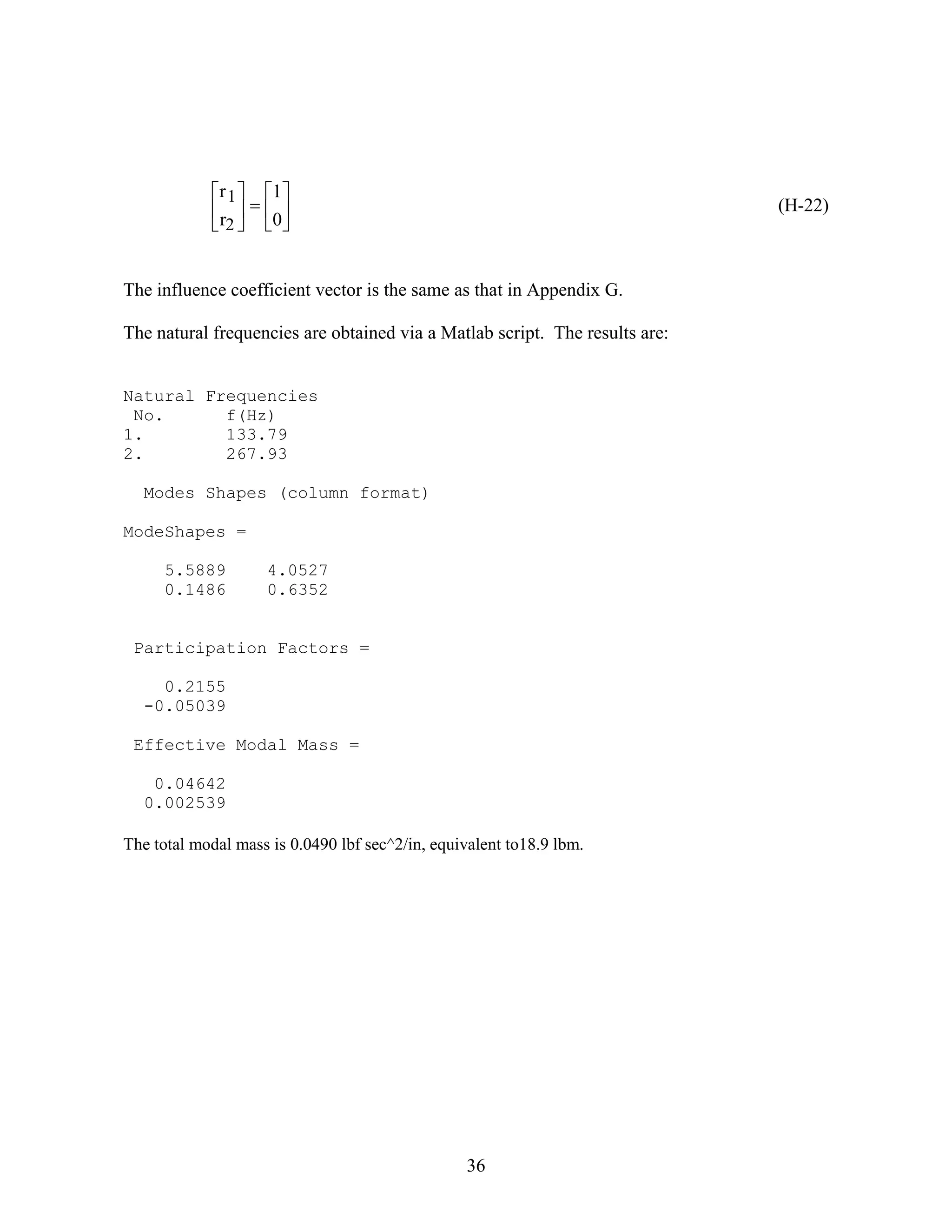
    35  11 Lxx(H-14)   LykLkLxk-x-LxmLJ 2 2 21211111   (H-15) LykLkLxk-xmLJ 2 2 212111   (H-16) The equations of motion are y Lk kkx LkLk Lkkkx JmL mLm 2 211 2 22 2211 11 1                                        (H-17) Note that 2 11 mLJJ  (H-18) y Lk kkx LkLk Lkkkx mLJmL mLm 2 211 2 22 2211 2 11 1                                          (H- 19) The pseudo-static problem is y Lk kkx LkLk Lkkk 2 211 2 22 221                        (H-20) Solve for the influence vector r by applying a unit displacement.                       Lk kk r r LkLk Lkkk 2 21 2 1 2 22 221 (H-21)
  • 36.
    36             0 1 r r 2 1 (H-22) The influence coefficientvector is the same as that in Appendix G. The natural frequencies are obtained via a Matlab script. The results are: Natural Frequencies No. f(Hz) 1. 133.79 2. 267.93 Modes Shapes (column format) ModeShapes = 5.5889 4.0527 0.1486 0.6352 Participation Factors = 0.2155 -0.05039 Effective Modal Mass = 0.04642 0.002539 The total modal mass is 0.0490 lbf sec^2/in, equivalent to18.9 lbm.