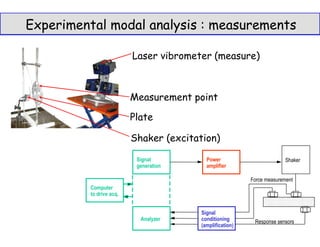
Shaker (excitation)
Plate
Laser vibrometer (measure)
Measurement point
Experimental modal analysis : measurements
Computer
to drive acq.
Signal
generation
Power
amplifier
Shaker
Force measurement
Response sensors
Signal
conditioning
(amplification)
Analyzer
Bode plot : visualization of transfer function
Modal analysis : transfers
In
U
Out
Y
System H
{Y(w)}=[H(w)]{U(w)}
ONE input
ONE output
MANY resonances
Transfers estimated
from time response
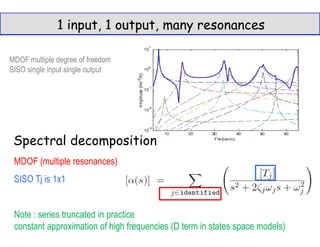
1 input, 1 output, many resonances
Spectral decomposition
MDOF (multiple resonances)
SISO Tj is 1x1
Note : series truncated in practice
constant approximation of high frequencies (D term in states space models)
MDOF multiple degree of freedom
SISO single input single output
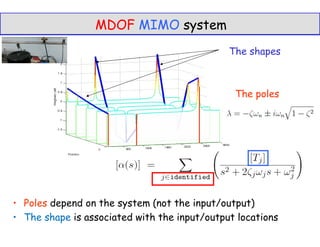
MDOF MIMO system
• Poles depend on the system (not the input/output)
• The shape is associated with the input/output locations
The shapes
The poles
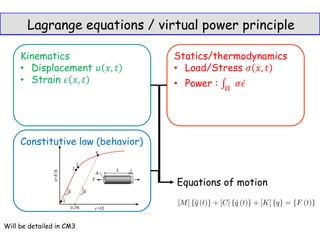
Lagrange equations / virtual power principle
Kinematics
• Displacement
• Strain
Statics/thermodynamics
• Load/Stress
• Power :
Constitutive law (behavior)
Equations of motion
Will be detailed in CM3
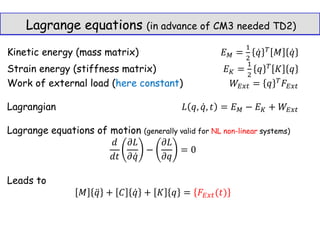
Kinetic energy (mass matrix)
Strain energy (stiffness matrix)
Work of external load (here constant)
Lagrangian
Lagrange equations of motion (generally valid for NL non-linear systems)
Leads to
Lagrange equations (in advance of CM3 needed TD2)
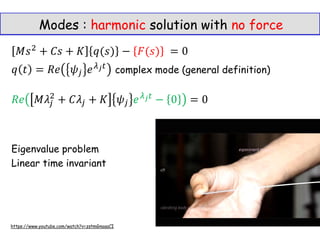
Modes : harmonic solution with no force
complex mode (general definition)
Eigenvalue problem
Linear time invariant
https://www.youtube.com/watch?v=zstmGnaaaCI
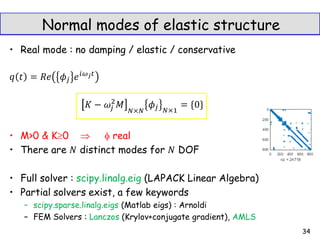
• Real mode : no damping / elastic / conservative
• M>0 & K0  f real
• There are distinct modes for DOF
• Full solver : scipy.linalg.eig (LAPACK Linear Algebra)
• Partial solvers exist, a few keywords
– scipy.sparse.linalg.eigs (Matlab eigs) : Arnoldi
– FEM Solvers : Lanczos (Krylov+conjugate gradient), AMLS
Normal modes of elastic structure
34
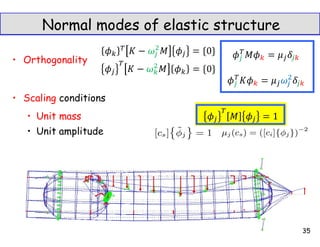
Normal modes of elastic structure
• Orthogonality
• Scaling conditions
• Unit mass
• Unit amplitude
35
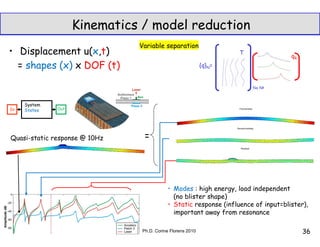
Kinematics / model reduction
• Displacement u(x,t)
= shapes (x) x DOF (t) {q}N=
qR
Nx NR
T
Ph.D. Corine Florens 2010
In Out
System
States
Quasi-static response @ 10Hz =
• Modes : high energy, load independent
(no blister shape)
• Static response (influence of input=blister),
important away from resonance
36
Variable separation
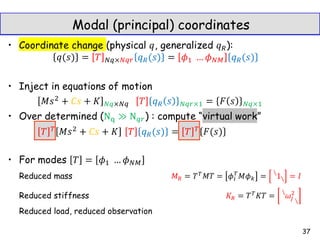
Modal (principal) coordinates
• Coordinate change (physical , generalized ):
• Inject in equations of motion
• Over determined ( ) : compute “virtual work”
• For modes
Reduced mass


Reduced stiffness


Reduced load, reduced observation
37
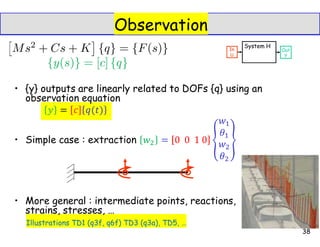
Observation
• {y} outputs are linearly related to DOFs {q} using an
observation equation
• Simple case : extraction
• More general : intermediate points, reactions,
strains, stresses, …
Illustrations TD1 (q3f, q6f) TD3 (q3a), TD5, …
38
Command
• Loads decomposed as spatially unit loads and inputs
{F(t)} = [b] {u(t)}
Abaqus : *CLOAD + *AMPLITUDE, …
NASTRAN : FORCE-MOMENT + RLOAD
ANSYS, CODE Aster, …
Illustrations TD1, 3, 5, …
39
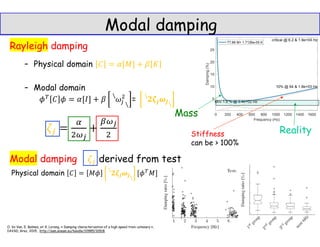
Rayleigh damping
– Physical domain
– Modal domain


= 𝒋 𝒋


Modal damping derived from test
40
Modal damping
O. Vo Van, E. Balmes, et X. Lorang, « Damping characterization of a high speed train catenary »,
IAVSD, Graz, 2015, http://sam.ensam.eu/handle/10985/10918.
Reality
Mass
Stiffness
can be > 100%
Physical domain 𝒋 𝒋
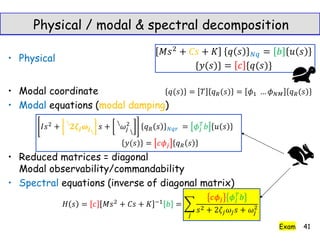
• Physical
• Modal coordinate
• Modal equations (modal damping)
𝒋 𝒋


• Reduced matrices = diagonal
Modal observability/commandability
• Spectral equations (inverse of diagonal matrix)
41
Physical / modal & spectral decomposition
Exam
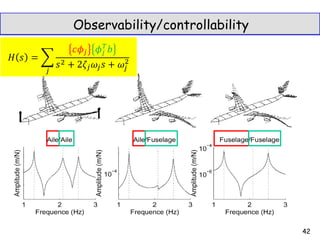
Observability/controllability
42
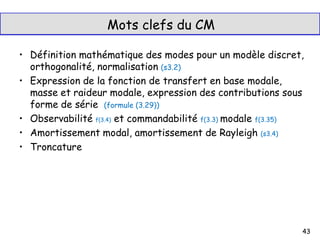
Mots clefs du CM
• Définition mathématique des modes pour un modèle discret,
orthogonalité, normalisation (s3.2)
• Expression de la fonction de transfert en base modale,
masse et raideur modale, expression des contributions sous
forme de série (formule (3.29))
• Observabilité f(3.4) et commandabilité f(3.3) modale f(3.35)
• Amortissement modal, amortissement de Rayleigh (s3.4)
• Troncature
43

CM2_Mode.pdf

  • 1.
    Shaker (excitation) Plate Laser vibrometer(measure) Measurement point Experimental modal analysis : measurements Computer to drive acq. Signal generation Power amplifier Shaker Force measurement Response sensors Signal conditioning (amplification) Analyzer
  • 2.
    Bode plot :visualization of transfer function Modal analysis : transfers In U Out Y System H {Y(w)}=[H(w)]{U(w)} ONE input ONE output MANY resonances Transfers estimated from time response
  • 3.
    1 input, 1output, many resonances Spectral decomposition MDOF (multiple resonances) SISO Tj is 1x1 Note : series truncated in practice constant approximation of high frequencies (D term in states space models) MDOF multiple degree of freedom SISO single input single output
  • 4.
    MDOF MIMO system •Poles depend on the system (not the input/output) • The shape is associated with the input/output locations The shapes The poles
  • 5.
    Lagrange equations /virtual power principle Kinematics • Displacement • Strain Statics/thermodynamics • Load/Stress • Power : Constitutive law (behavior) Equations of motion Will be detailed in CM3
  • 6.
    Kinetic energy (massmatrix) Strain energy (stiffness matrix) Work of external load (here constant) Lagrangian Lagrange equations of motion (generally valid for NL non-linear systems) Leads to Lagrange equations (in advance of CM3 needed TD2)
  • 7.
    Modes : harmonicsolution with no force complex mode (general definition) Eigenvalue problem Linear time invariant https://www.youtube.com/watch?v=zstmGnaaaCI
  • 8.
    • Real mode: no damping / elastic / conservative • M>0 & K0  f real • There are distinct modes for DOF • Full solver : scipy.linalg.eig (LAPACK Linear Algebra) • Partial solvers exist, a few keywords – scipy.sparse.linalg.eigs (Matlab eigs) : Arnoldi – FEM Solvers : Lanczos (Krylov+conjugate gradient), AMLS Normal modes of elastic structure 34
  • 9.
    Normal modes ofelastic structure • Orthogonality • Scaling conditions • Unit mass • Unit amplitude 35
  • 10.
    Kinematics / modelreduction • Displacement u(x,t) = shapes (x) x DOF (t) {q}N= qR Nx NR T Ph.D. Corine Florens 2010 In Out System States Quasi-static response @ 10Hz = • Modes : high energy, load independent (no blister shape) • Static response (influence of input=blister), important away from resonance 36 Variable separation
  • 11.
    Modal (principal) coordinates •Coordinate change (physical , generalized ): • Inject in equations of motion • Over determined ( ) : compute “virtual work” • For modes Reduced mass Reduced stiffness Reduced load, reduced observation 37
  • 12.
    Observation • {y} outputsare linearly related to DOFs {q} using an observation equation • Simple case : extraction • More general : intermediate points, reactions, strains, stresses, … Illustrations TD1 (q3f, q6f) TD3 (q3a), TD5, … 38
  • 13.
    Command • Loads decomposedas spatially unit loads and inputs {F(t)} = [b] {u(t)} Abaqus : *CLOAD + *AMPLITUDE, … NASTRAN : FORCE-MOMENT + RLOAD ANSYS, CODE Aster, … Illustrations TD1, 3, 5, … 39
  • 14.
    Rayleigh damping – Physicaldomain – Modal domain = 𝒋 𝒋 Modal damping derived from test 40 Modal damping O. Vo Van, E. Balmes, et X. Lorang, « Damping characterization of a high speed train catenary », IAVSD, Graz, 2015, http://sam.ensam.eu/handle/10985/10918. Reality Mass Stiffness can be > 100% Physical domain 𝒋 𝒋
  • 15.
    • Physical • Modalcoordinate • Modal equations (modal damping) 𝒋 𝒋 • Reduced matrices = diagonal Modal observability/commandability • Spectral equations (inverse of diagonal matrix) 41 Physical / modal & spectral decomposition Exam
  • 16.
  • 17.
    Mots clefs duCM • Définition mathématique des modes pour un modèle discret, orthogonalité, normalisation (s3.2) • Expression de la fonction de transfert en base modale, masse et raideur modale, expression des contributions sous forme de série (formule (3.29)) • Observabilité f(3.4) et commandabilité f(3.3) modale f(3.35) • Amortissement modal, amortissement de Rayleigh (s3.4) • Troncature 43