PSYCHOLOGICAL ASSESSMENT AND TESTS
AASHISH PARIHAR
NURSING TUTOR
COLLEGE OF NURSING, AIIMS
JODHPUR
PSYCHOLOGICAL ASSESSMENT AND TESTS
Content-
 Types, development, Characteristics, Principles, Uses
 Interpretations and Role of nurse in psychological assessment i.e.
VIQ, PIQ.
PSYCHOLOGICAL ASSESSMENT AND TESTS
DEVELOPMENT OF PSYCHOLOGICAL TEST
 Analysis of the situation in which the tested skills are to be used.
 Tentative selection of the test items
 Development of a standardized method of administration and scoring
 Administration of all test items to a large representative group of individual
 Final selection of items
 Evaluation of the final test
PSYCHOLOGICAL ASSESSMENT AND TESTS
TYPES OF TESTS
There are two broad categories to classify the psychological tests-
 On the basis of test construction and administration-
1. Individual and group tests
2. Speed and power tests
3. Computer-assisted tests
4. Paper and pencil and performance tests
 On the basis of test of knowledge, skills and abilities-
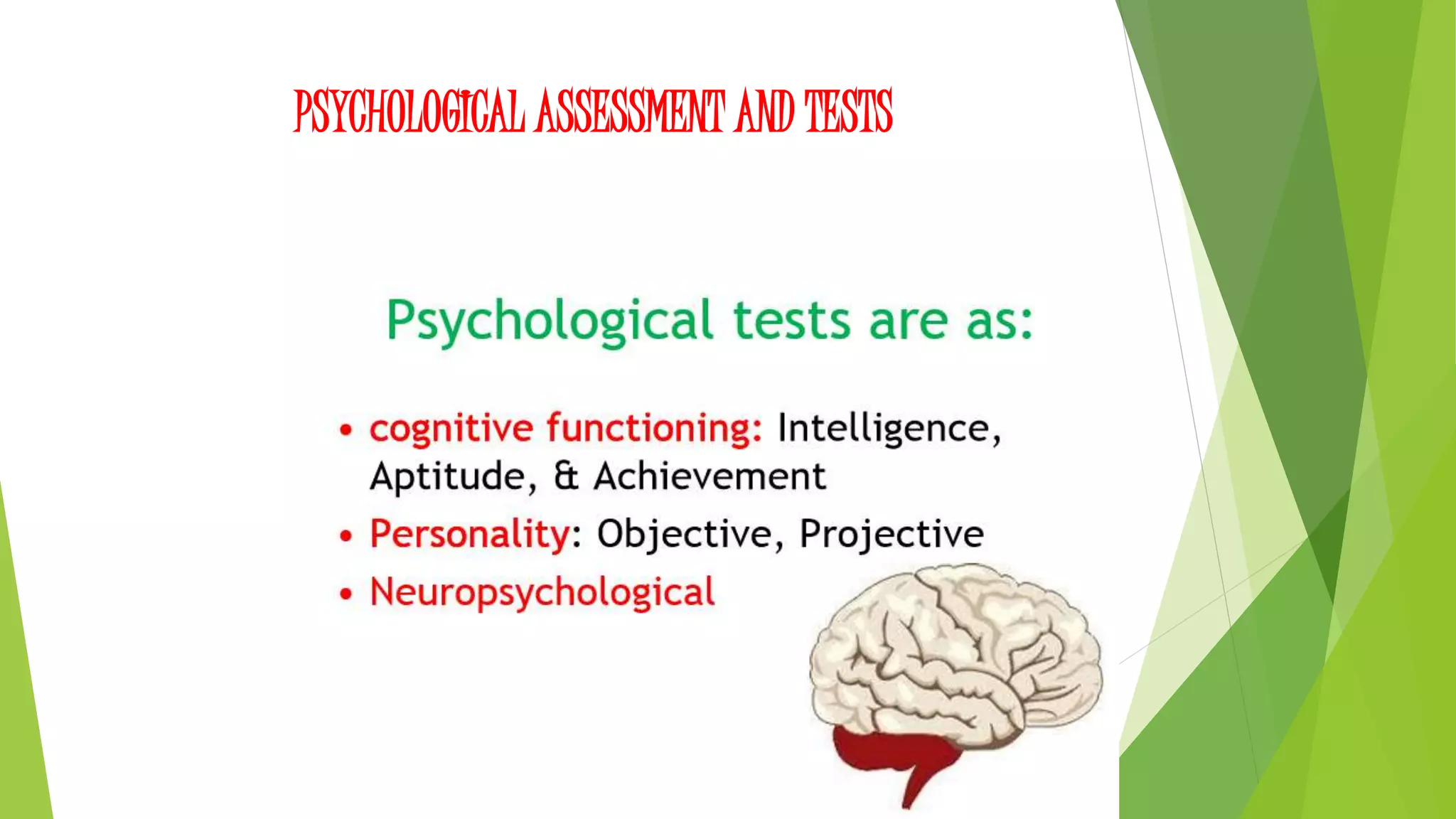
1. Achievement tests
2. Aptitude tests
3. Intelligence tests and cognitive ability tests
4. Interest tests
5. Neuropsychological tests
6. Occupational tests
7. Personality tests
8. Specific clinical tests
Achievement & ability tests
1. STANFORD-BINET INTELLIGENCE SCALES:-
Devised in 1916 by Stanford psychologist Lewis
Terman.
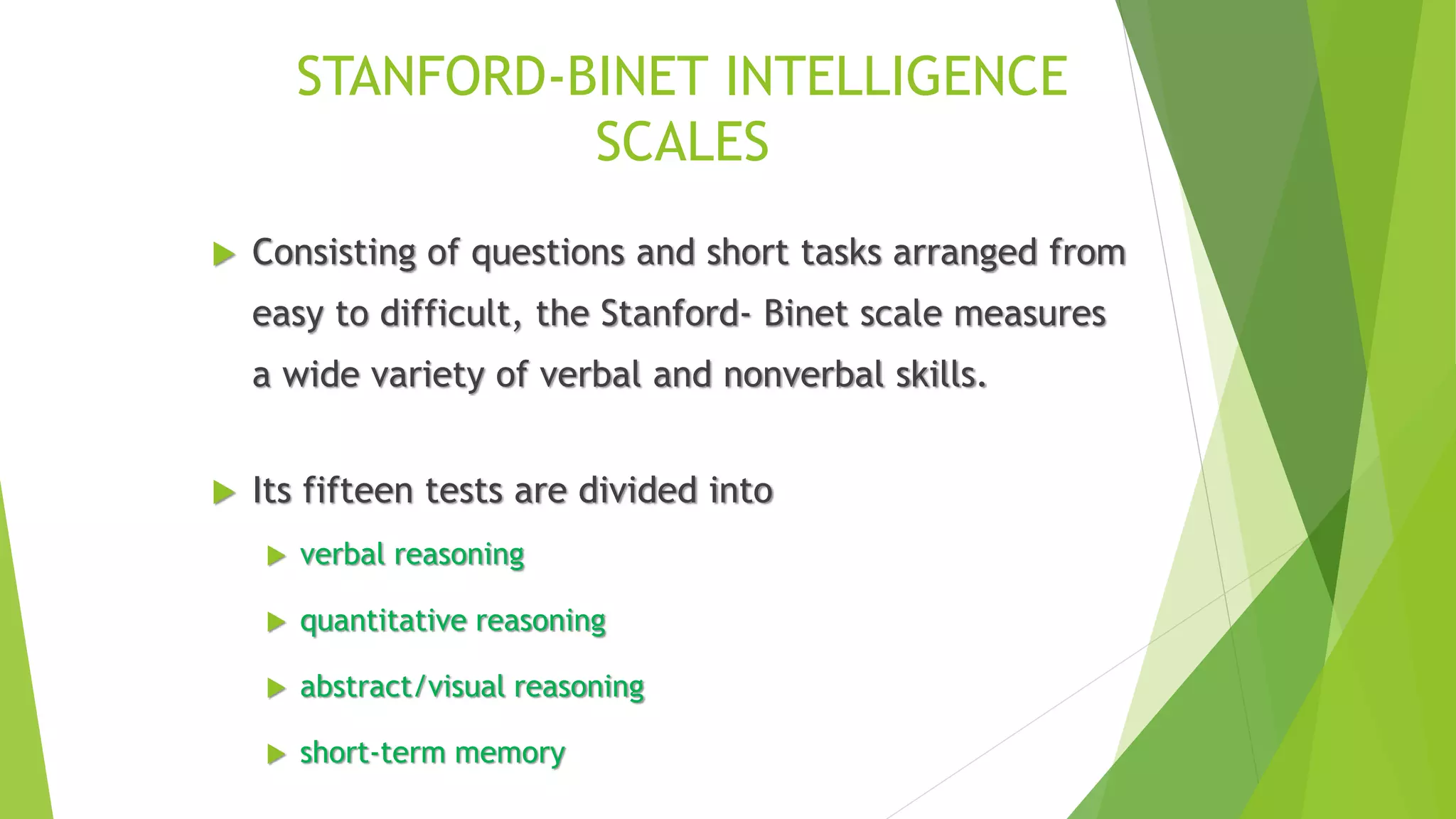
STANFORD-BINET INTELLIGENCE
SCALES
 Consisting of questions and short tasks arranged from
easy to difficult, the Stanford- Binet scale measures
a wide variety of verbal and nonverbal skills.
 Its fifteen tests are divided into
 verbal reasoning
 quantitative reasoning
 abstract/visual reasoning
 short-term memory
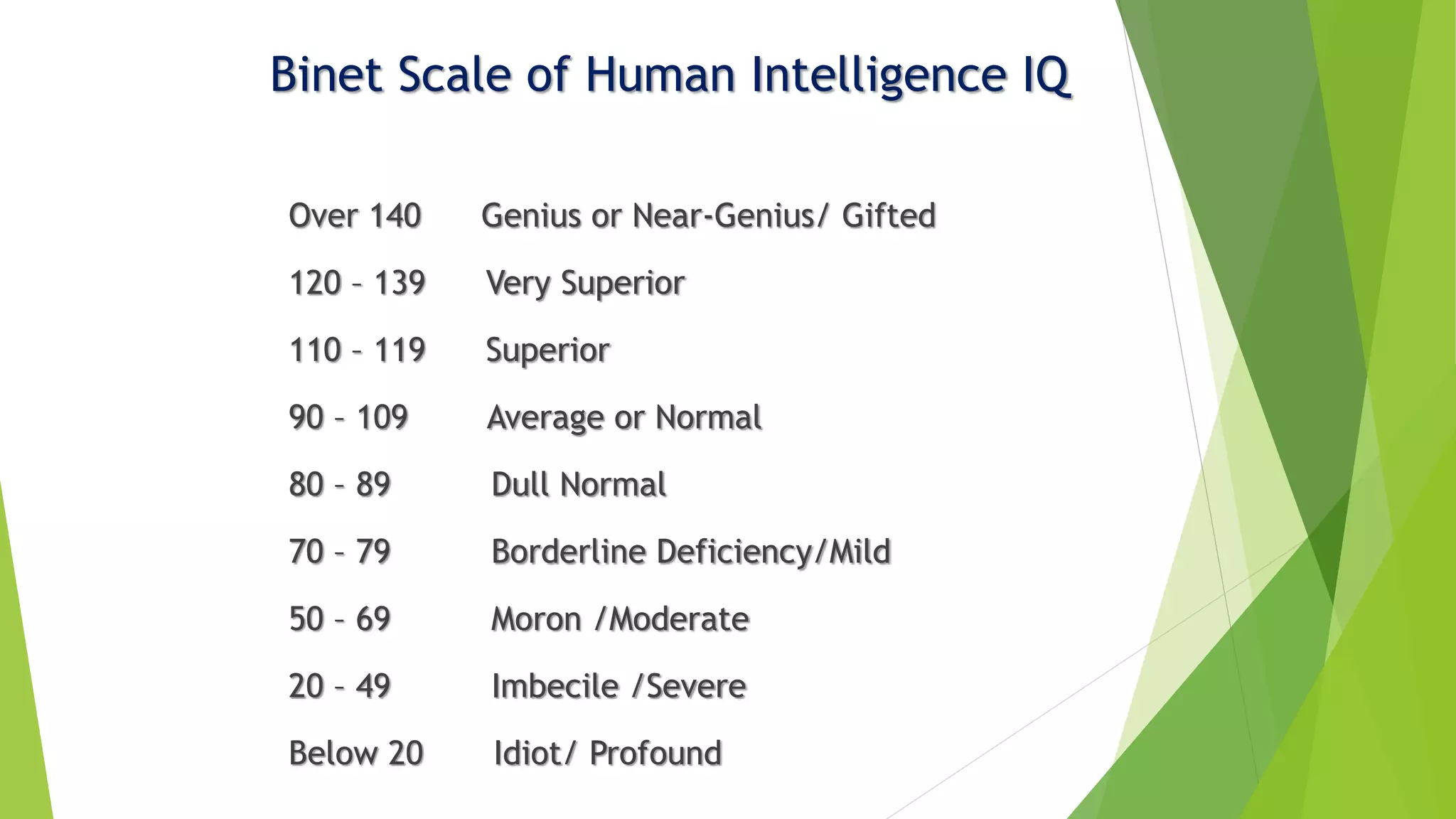
Binet Scale of Human Intelligence IQ
Over 140 Genius or Near-Genius/ Gifted
120 – 139 Very Superior
110 – 119 Superior
90 – 109 Average or Normal
80 – 89 Dull Normal
70 – 79 Borderline Deficiency/Mild
50 – 69 Moron /Moderate
20 – 49 Imbecile /Severe
Below 20 Idiot/ Profound
WECHSLER INTELLIGENCE SCALES:-
David "Wex" Wechsler (January 12, 1896 –
May 2, 1981)
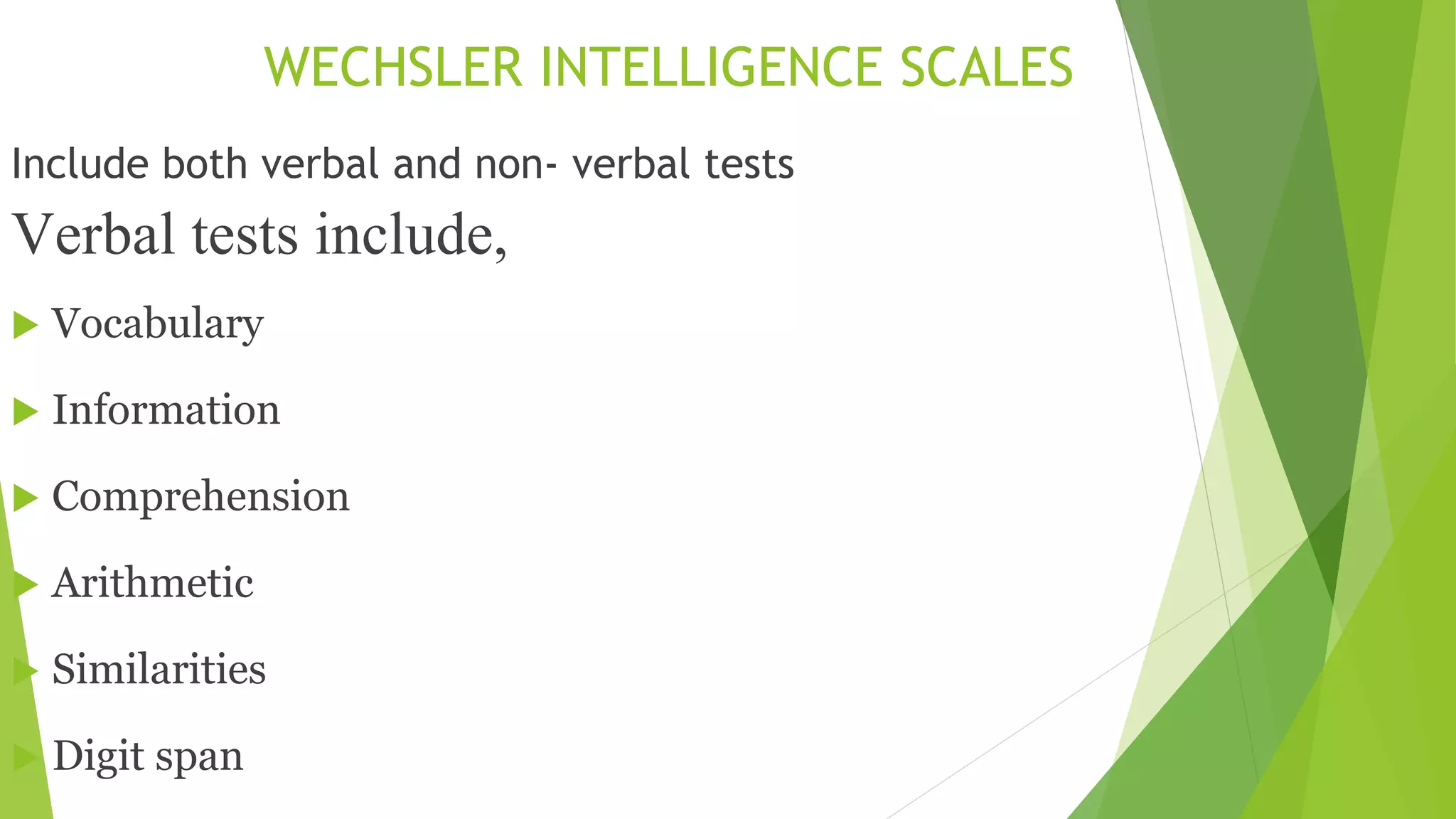
WECHSLER INTELLIGENCE SCALES
Include both verbal and non- verbal tests
Verbal tests include,
 Vocabulary
 Information
 Comprehension
 Arithmetic
 Similarities
 Digit span
WECHSLER INTELLIGENCE SCALES
Performance tests include,
Digit symbols
Picture completion
Block design
Picture arrangement
Object assembly(jigsaw)
Verbal Intelligence test
 Information : A persons level of general
knowledge
 Comprehension : How well you can
understand questions and grasp
concepts.
 Arithmetic : A persons mathematical
abilities.
 Similarities : Measures abstract thought.
 Digit Span : Measures attention span.
 Vocabulary : How many word meanings
you know.
Performance Intelligence Test
 Digit Symbol : Mental flexibility with
random symbols.
 Picture Completion : Ability to notice
differences between two similar pictures.
 Block Design : Mentally construct printed
designs in your head.
 Picture Arrangement : Arrange pictures in a
logical order.
 Object Assembly : Place the correct part in
relationship to a whole.
WECHSLER INTELLIGENCE SCALES
TYPES
 The Wechsler Preschool and Primary
Scales of Intelligence (WPPSI)
 The Wechsler Intelligence Scale for
Children (WISC)
 Wechsler Adult Intelligence Scale
(WAIS)
WAIS-R Testing kit
 Testing Booklet
 Story Cards
 Puzzle Pieces
 Block Design
WAIS-R Block Design
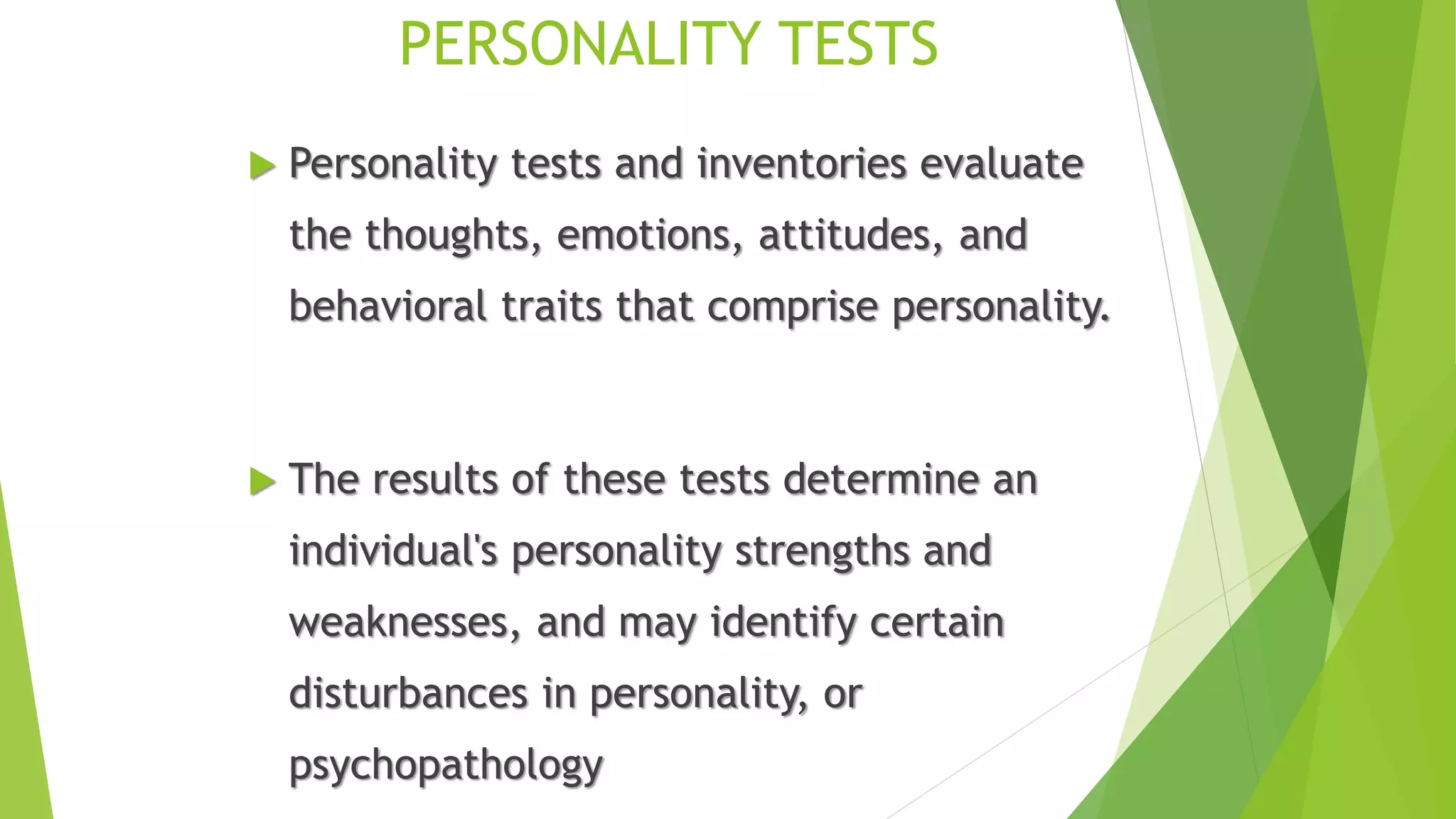
PERSONALITY TESTS
 Personality tests and inventories evaluate
the thoughts, emotions, attitudes, and
behavioral traits that comprise personality.
 The results of these tests determine an
individual's personality strengths and
weaknesses, and may identify certain
disturbances in personality, or
psychopathology
1. PERSONALITY INVENTORY
 Minnesota Multiphasic Personality Inventory
 Millon Clinical Multiaxial Inventory (MCMI )
 The California Psychological Inventory (CPI)
 Sixteen Personality Factor Questionnaire (or
16PF)
 The Eyesenck Personality Inventory
2. PROJECTIVE TECHNIQUES
 Rorschach inkblot test:-
 Thematic Apperception Test (TAT)
 Sentence completion test
 Create drawings (Draw a person test) or
complete a story.
3. NEUROPSYCHOLOGICAL ASSESSMENT
4. RATING SCALES
Minnesota Multiphasic Personality
Inventory
 Developed in the late 1930’s by psychologist Starke
R. Hathaway and psychiatrist J.C. McKinley at the
University of Minnesota.
 The most widely researched and clinically
used of all personality tests
 Developed to identify emotional disorders
 This is one of the most frequently used
personality tests in mental health.
Minnesota Multiphasic Personality
Inventory
 The test is used by trained professionals to assist
in identifying personality structure and
psychopathology.
 consists of 567 statements that the test taker has
to mark as “true,” “false,” or “cannot say.”
 Answers are scored according to how they
correspond with those given by persons with
various psychological disorders, including
depression, hysteria, paranoia, psychopathic
deviancy, and schizophrenia.
Minnesota Multiphasic Personality
Inventory
 The MMPI is copyrighted by the University of
Minnesota.
 It is appropriate for use with adults 18 and
over.
 The current MMPI-2 has 567 items, all
true-or-false format, and usually takes
between 1 and 2 hours to complete
depending on reading level.
Minnesota Multiphasic Personality
Inventory
 The MMPI-2 is most commonly used by
mental health professionals to assess and
diagnose mental illness.
 The MMPI-2 has been utilized in other fields
outside of clinical psychology. The test is often
used in legal cases, including criminal defense
and custody disputes.
Millon Clinical Multiaxial Inventory
(MCMI )
 It has been designed for adults (18
years and older) who have a minimum
of an eighth-grade reading level.
 The MCMI is one of the few self-report
tests that focus on personality
disorders along with symptoms that
are associated with these disorders.
Millon Clinical Multiaxial Inventory (MCMI )
 The current version, the MCMI-III, is composed of
175 items that are scored to produce 28 scales
divided into following categories
 Modifying Indices,
 Clinical Personality Patterns,
 Severe Personality Pathology
 Clinical Syndromes
 Severe Syndromes
The California Psychological Inventory
(CPI)
It assesses
 Traits (including dominance, responsibility, self-
acceptance)
 Socialization
 Traits relevant to academic achievement.
 Personality Research Form (PRF)
 The Neuroticism Extroversion Openness Personality Inventory,
Revised (NEO-PIR)
Sixteen Personality Factor Questionnaire
(or 16PF)
 Over several decades of research by Raymond B. Cattell
and his colleagues.
 Big Five secondary traits, which have
become popularized by other authors in recent years.
THE EYESENCK PERSONALITY
INVENTORY
 Short questionnaire which can be completed in 10 to 20
minutes.
 It assesses two dimensions of personality: Introversion versus
Extroversion, and Neuroticism versus Emotional stability.
 The EPI includes a subset of questions that comprises a Social
Desirability Scale (Lie Scale):
PROJECTIVE TECHNIQUES
 Projective techniques involve asking subjects to interpret
or fill in visual stimuli, complete sentences, or report what
associations particular words bring to mind.
 Because of the leeway provided by the tests, subjects
project their own personalities onto the stimulus, often
revealing personal conflicts, motivations, coping styles,
and other characteristics.
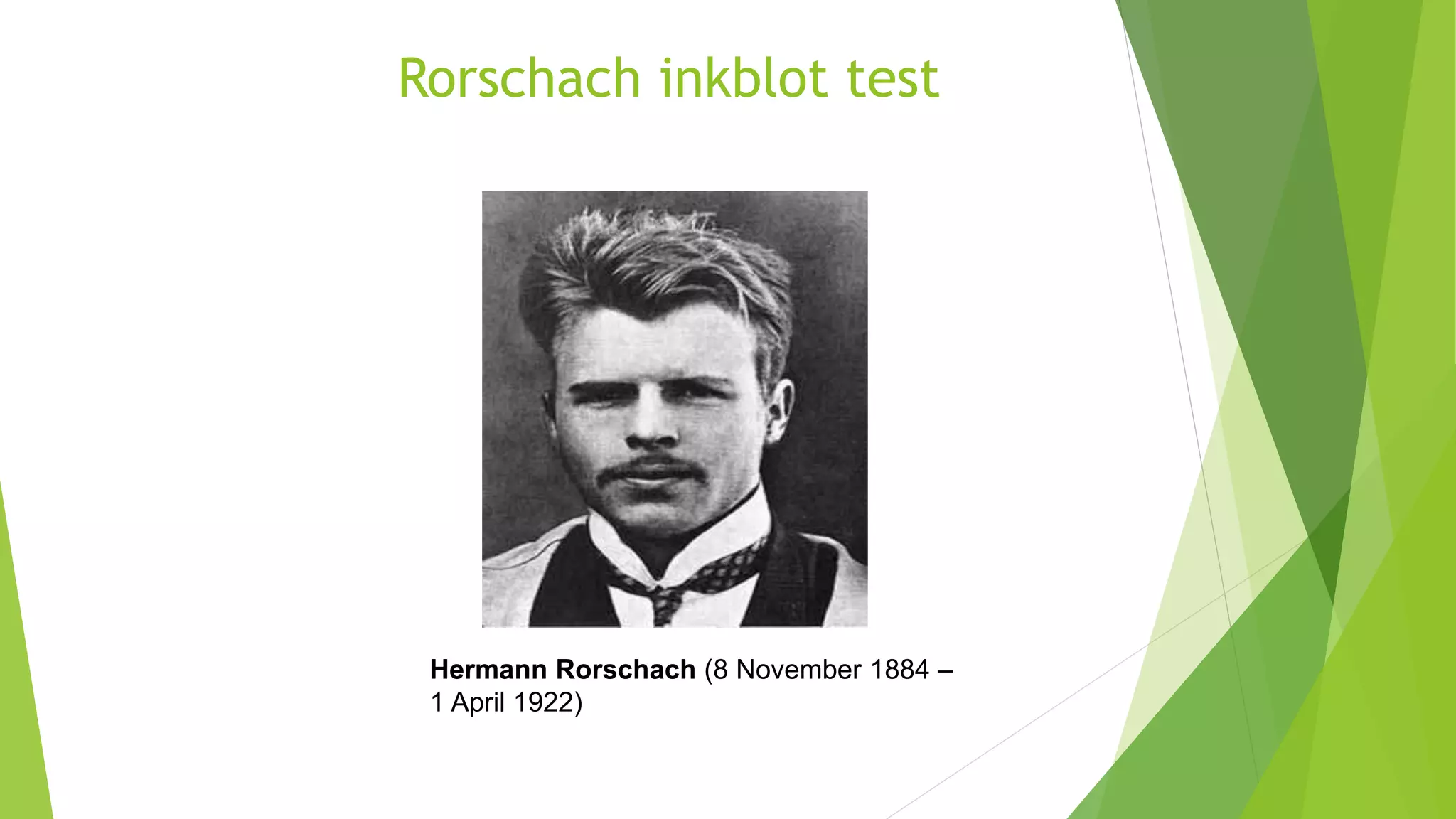
Rorschach inkblot test
Hermann Rorschach (8 November 1884 –
1 April 1922)
Rorschach inkblot test
 Created in the 1920s by Swiss psychologist
Hermann Rorschach (1884-1922).
 It consists of a series of 10 cards, each
containing a complicated inkblot. Some are
in black and white, some in color.
 Subjects are asked to describe what they
see in each card.
Rorschach inkblot test
Test scores are based on several parameters:
1) what part of the blot a person focuses on
2) what particular details determine the response;
3) the content of the responses (what objects, persons,
or situations they involve);
4) the frequency with which a particular response has
been given by previous test takers
Rorschach test
Thematic Apperception Test (TAT)
 Introduced at Harvard University in 1935 by Henry
Murray.
 Test takers look at a series of up to 20 pictures of
people in a variety of recognizable settings and
construct a story about what is happening in each
one. They are asked to describe not only what is
happening at the moment shown in the picture but
also what events led up to the present situation and
what the characters are thinking and feeling.
Thematic Apperception Test (TAT)
 Its adherents assert that the TAT taps a subject's
unconscious to reveal repressed aspects of personality,
motives and needs for achievement, power and intimacy,
and problem-solving abilities.
Thematic Apperception Test (TAT)
 The subject is asked to tell as dramatic a story as they
can for each picture presented, including the following:
? what has led up to the event shown
? what is happening at the moment
? what the characters are feeling and thinking
? what the outcome of the story was
TAT PROCEDURE
Some TAT cards
Thematic Apperception Test (TAT)
 There are 31 picture cards in the standard form of
the TAT .
 Some of the cards show male figures, some
female, some both male and female figures, some
of ambiguous gender, some adults, some
children, and some show no human figures at all.
 One card is completely blank
Thematic Apperception Test (TAT)
USES OF TAT
 Individual assessments for employment in fields
requiring a high degree such as law enforcement,
military leadership positions.
 For diagnosis in order to match psychotherapy best
suited to patients personalities.
 Forensic purposes in evaluating the motivations and
general attitudes of persons accused of violent
crimes.
 Research into specific aspects of human personality,
most often needs for achievement, fears of failure,
hostility.
sentence completion test
 Specifically for children or adolescents.
 Subjects are asked to complete sentences with such
open-ended beginnings as “I wish . . .” or “My mother .
. .”
 Same sentence beginnings are shown to different test
takers.
 There are no norms for comparing their answers to those
of previous subjects.
CREATE DRAWINGS
 (Draw a person test)
 complete a story.
NEUROPSYCHOLOGICAL ASSESSMENT
 Luria- Nebraska battery
 Halsted- Reitan battery
 Michigan neuropsychological battery
 Shipley Institute of Living Scale
 NIMHANS neuropsychological battery.
NEUROPSYCHOLOGICAL ASSESSMENT
Assessment of the neurological deficit
 Predicts the possible organic psychopathology
 Identification of intact neurological functioning
 help in the process of neuro-rehabilitation (Cognitive
retraining)
 Evaluation and comparison of various treatment
options and its perceived efficacy
 Progressive evaluation and formulation of differential
diagnosis
 Developmental progression of the milestones
 Tackling the mental developmental delay, and taking
necessary actions on time
RATING SCALES
 Rating scales are instruments used to assess the
magnitude or severity of a psychological construct
or disorder.
 Rating scales aid in research and clinical practice
such data are important for evaluation, decision
making, documentation and/or analysis.
Common rating scales in psychiatry:-
 For the assessment of general mental health:
1. Golberg general health questionnaire(GHQ)
2. Subjective wellbeing inventory (SWBI)
 For the assessment of anxiety :-
1. Hamilton anxiety rating scale (HARC),
2. Covi anxiety scale
Common rating scales in psychiatry:-
 For the assessment of depression :-
1. Hamilton depression rating scale (HDRS),
2. Beck depression Inventory(BDI)
 For the assessment of mania :-
1. Young’s mania rating scale,
2. Bech- Rafaelson mania scale
Common rating scales in psychiatry:-
 For the assessment of schizophrenia :-
1. Brief psychiatric rating scale,
2. Scale for assessment of positive symptoms and
scale for assessment of negative symptoms.
PSYCHOLOGICAL TESTS USED IN
INDIAN SCENARIO
 The Bayley Scales of Infant Development has been standardized on Indian children
 The Pandey's Cognitive Development test for the pre-school child is a standardized test,
1. Conceptual skills
2. Information
3. Comprehension
4. Visual Perception
5. Memory
6. Object vocabulary
USES OF PSYCHOLOGICAL TESTS
 It is easier to get information from test then by clinical interview.
 They assist in clinical diagnosis example: Rorschach inkblot test
 Information from tests are more scientifically consistent then clinical interview
 They assist in the formulation of psychopathology and identification of areas of
stress and conflict. Example: Thematic appreciation test
 They help to determine the nature of deficit present. Example: cognitive
neuropsychological assessments
USES OF PSYCHOLOGICAL TESTS
 They help in assessing severity of psychopathology and response to treatment.
Example: Hamilton rating scale for depression, brief psychiatric rating scale
 They help in assessing general characteristics of the individual. Example:
assessment of intelligence, assessment of personality
 These tests are also used for forensic evaluations regarding litigation, family
court issues or criminal charges
 These tests assesses the level of functioning or disability, help direct treatment
and assess treatment outcome.
LIMITATIONS OF PSYCHOLOGICAL
TESTING PROGRAMS
 Uncritical use
 Faking
 Attitudes toward testing
 Effects of negative attitudes
 Ethical issues
 Test users
 Test security
 Test interpretation
 Test publication
 Privacy issues
NURSE’S ROLE IN PSYCHOLOGICAL
TESTS
 Should have knowledge about all the psychological tests.
 Clarify the patient’s and relatives’ doubts regarding the psychological tests they have to
undergo.
 Nurses should have good rapport with the patients and family members.
 The nurse should reassure the patient about the safety of the tests and the confidentiality of the
observations of the psychologist.
 The nurse observes the patient’s behavior and the changes, which occur once the therapy is
commenced.
 The nurse observes, informs and records these changes in patient’s chart.
NURSE’S ROLE IN PSYCHOLOGICAL TESTS
 A nurse who is knowledgeable and skilled is an empowered nurse who
is able to function at par with other team members and thus further
build up the nursing images in the public eye.
 The nurse can also interrupt the findings of various tests and then plan
the nursing care accordingly.

Psychological assessment and test

  • 1.
    PSYCHOLOGICAL ASSESSMENT ANDTESTS AASHISH PARIHAR NURSING TUTOR COLLEGE OF NURSING, AIIMS JODHPUR
  • 2.
    PSYCHOLOGICAL ASSESSMENT ANDTESTS Content-  Types, development, Characteristics, Principles, Uses  Interpretations and Role of nurse in psychological assessment i.e. VIQ, PIQ.
  • 3.
  • 4.
  • 5.
  • 6.
    PSYCHOLOGICAL ASSESSMENT ANDTESTS DEVELOPMENT OF PSYCHOLOGICAL TEST  Analysis of the situation in which the tested skills are to be used.  Tentative selection of the test items  Development of a standardized method of administration and scoring  Administration of all test items to a large representative group of individual  Final selection of items  Evaluation of the final test
  • 7.
    PSYCHOLOGICAL ASSESSMENT ANDTESTS TYPES OF TESTS There are two broad categories to classify the psychological tests-  On the basis of test construction and administration- 1. Individual and group tests 2. Speed and power tests 3. Computer-assisted tests 4. Paper and pencil and performance tests  On the basis of test of knowledge, skills and abilities- 1. Achievement tests 2. Aptitude tests 3. Intelligence tests and cognitive ability tests 4. Interest tests 5. Neuropsychological tests 6. Occupational tests 7. Personality tests 8. Specific clinical tests
  • 8.
    Achievement & abilitytests 1. STANFORD-BINET INTELLIGENCE SCALES:- Devised in 1916 by Stanford psychologist Lewis Terman.
  • 9.
    STANFORD-BINET INTELLIGENCE SCALES  Consistingof questions and short tasks arranged from easy to difficult, the Stanford- Binet scale measures a wide variety of verbal and nonverbal skills.  Its fifteen tests are divided into  verbal reasoning  quantitative reasoning  abstract/visual reasoning  short-term memory
  • 10.
    Binet Scale ofHuman Intelligence IQ Over 140 Genius or Near-Genius/ Gifted 120 – 139 Very Superior 110 – 119 Superior 90 – 109 Average or Normal 80 – 89 Dull Normal 70 – 79 Borderline Deficiency/Mild 50 – 69 Moron /Moderate 20 – 49 Imbecile /Severe Below 20 Idiot/ Profound
  • 11.
    WECHSLER INTELLIGENCE SCALES:- David"Wex" Wechsler (January 12, 1896 – May 2, 1981)
  • 12.
    WECHSLER INTELLIGENCE SCALES Includeboth verbal and non- verbal tests Verbal tests include,  Vocabulary  Information  Comprehension  Arithmetic  Similarities  Digit span
  • 13.
    WECHSLER INTELLIGENCE SCALES Performancetests include, Digit symbols Picture completion Block design Picture arrangement Object assembly(jigsaw)
  • 14.
    Verbal Intelligence test Information : A persons level of general knowledge  Comprehension : How well you can understand questions and grasp concepts.  Arithmetic : A persons mathematical abilities.  Similarities : Measures abstract thought.  Digit Span : Measures attention span.  Vocabulary : How many word meanings you know.
  • 15.
    Performance Intelligence Test Digit Symbol : Mental flexibility with random symbols.  Picture Completion : Ability to notice differences between two similar pictures.  Block Design : Mentally construct printed designs in your head.  Picture Arrangement : Arrange pictures in a logical order.  Object Assembly : Place the correct part in relationship to a whole.
  • 16.
    WECHSLER INTELLIGENCE SCALES TYPES The Wechsler Preschool and Primary Scales of Intelligence (WPPSI)  The Wechsler Intelligence Scale for Children (WISC)  Wechsler Adult Intelligence Scale (WAIS)
  • 17.
    WAIS-R Testing kit Testing Booklet  Story Cards  Puzzle Pieces  Block Design
  • 18.
  • 19.
    PERSONALITY TESTS  Personalitytests and inventories evaluate the thoughts, emotions, attitudes, and behavioral traits that comprise personality.  The results of these tests determine an individual's personality strengths and weaknesses, and may identify certain disturbances in personality, or psychopathology
  • 20.
    1. PERSONALITY INVENTORY Minnesota Multiphasic Personality Inventory  Millon Clinical Multiaxial Inventory (MCMI )  The California Psychological Inventory (CPI)  Sixteen Personality Factor Questionnaire (or 16PF)  The Eyesenck Personality Inventory
  • 21.
    2. PROJECTIVE TECHNIQUES Rorschach inkblot test:-  Thematic Apperception Test (TAT)  Sentence completion test  Create drawings (Draw a person test) or complete a story. 3. NEUROPSYCHOLOGICAL ASSESSMENT 4. RATING SCALES
  • 22.
    Minnesota Multiphasic Personality Inventory Developed in the late 1930’s by psychologist Starke R. Hathaway and psychiatrist J.C. McKinley at the University of Minnesota.  The most widely researched and clinically used of all personality tests  Developed to identify emotional disorders  This is one of the most frequently used personality tests in mental health.
  • 23.
    Minnesota Multiphasic Personality Inventory The test is used by trained professionals to assist in identifying personality structure and psychopathology.  consists of 567 statements that the test taker has to mark as “true,” “false,” or “cannot say.”  Answers are scored according to how they correspond with those given by persons with various psychological disorders, including depression, hysteria, paranoia, psychopathic deviancy, and schizophrenia.
  • 24.
    Minnesota Multiphasic Personality Inventory The MMPI is copyrighted by the University of Minnesota.  It is appropriate for use with adults 18 and over.  The current MMPI-2 has 567 items, all true-or-false format, and usually takes between 1 and 2 hours to complete depending on reading level.
  • 25.
    Minnesota Multiphasic Personality Inventory The MMPI-2 is most commonly used by mental health professionals to assess and diagnose mental illness.  The MMPI-2 has been utilized in other fields outside of clinical psychology. The test is often used in legal cases, including criminal defense and custody disputes.
  • 26.
    Millon Clinical MultiaxialInventory (MCMI )  It has been designed for adults (18 years and older) who have a minimum of an eighth-grade reading level.  The MCMI is one of the few self-report tests that focus on personality disorders along with symptoms that are associated with these disorders.
  • 27.
    Millon Clinical MultiaxialInventory (MCMI )  The current version, the MCMI-III, is composed of 175 items that are scored to produce 28 scales divided into following categories  Modifying Indices,  Clinical Personality Patterns,  Severe Personality Pathology  Clinical Syndromes  Severe Syndromes
  • 28.
    The California PsychologicalInventory (CPI) It assesses  Traits (including dominance, responsibility, self- acceptance)  Socialization  Traits relevant to academic achievement.  Personality Research Form (PRF)  The Neuroticism Extroversion Openness Personality Inventory, Revised (NEO-PIR)
  • 29.
    Sixteen Personality FactorQuestionnaire (or 16PF)  Over several decades of research by Raymond B. Cattell and his colleagues.  Big Five secondary traits, which have become popularized by other authors in recent years.
  • 30.
    THE EYESENCK PERSONALITY INVENTORY Short questionnaire which can be completed in 10 to 20 minutes.  It assesses two dimensions of personality: Introversion versus Extroversion, and Neuroticism versus Emotional stability.  The EPI includes a subset of questions that comprises a Social Desirability Scale (Lie Scale):
  • 31.
    PROJECTIVE TECHNIQUES  Projectivetechniques involve asking subjects to interpret or fill in visual stimuli, complete sentences, or report what associations particular words bring to mind.  Because of the leeway provided by the tests, subjects project their own personalities onto the stimulus, often revealing personal conflicts, motivations, coping styles, and other characteristics.
  • 32.
    Rorschach inkblot test HermannRorschach (8 November 1884 – 1 April 1922)
  • 33.
    Rorschach inkblot test Created in the 1920s by Swiss psychologist Hermann Rorschach (1884-1922).  It consists of a series of 10 cards, each containing a complicated inkblot. Some are in black and white, some in color.  Subjects are asked to describe what they see in each card.
  • 34.
    Rorschach inkblot test Testscores are based on several parameters: 1) what part of the blot a person focuses on 2) what particular details determine the response; 3) the content of the responses (what objects, persons, or situations they involve); 4) the frequency with which a particular response has been given by previous test takers
  • 35.
  • 36.
    Thematic Apperception Test(TAT)  Introduced at Harvard University in 1935 by Henry Murray.  Test takers look at a series of up to 20 pictures of people in a variety of recognizable settings and construct a story about what is happening in each one. They are asked to describe not only what is happening at the moment shown in the picture but also what events led up to the present situation and what the characters are thinking and feeling.
  • 37.
    Thematic Apperception Test(TAT)  Its adherents assert that the TAT taps a subject's unconscious to reveal repressed aspects of personality, motives and needs for achievement, power and intimacy, and problem-solving abilities.
  • 38.
    Thematic Apperception Test(TAT)  The subject is asked to tell as dramatic a story as they can for each picture presented, including the following: ? what has led up to the event shown ? what is happening at the moment ? what the characters are feeling and thinking ? what the outcome of the story was
  • 39.
  • 40.
  • 41.
    Thematic Apperception Test(TAT)  There are 31 picture cards in the standard form of the TAT .  Some of the cards show male figures, some female, some both male and female figures, some of ambiguous gender, some adults, some children, and some show no human figures at all.  One card is completely blank
  • 42.
    Thematic Apperception Test(TAT) USES OF TAT  Individual assessments for employment in fields requiring a high degree such as law enforcement, military leadership positions.  For diagnosis in order to match psychotherapy best suited to patients personalities.  Forensic purposes in evaluating the motivations and general attitudes of persons accused of violent crimes.  Research into specific aspects of human personality, most often needs for achievement, fears of failure, hostility.
  • 43.
    sentence completion test Specifically for children or adolescents.  Subjects are asked to complete sentences with such open-ended beginnings as “I wish . . .” or “My mother . . .”  Same sentence beginnings are shown to different test takers.  There are no norms for comparing their answers to those of previous subjects.
  • 44.
    CREATE DRAWINGS  (Drawa person test)  complete a story.
  • 45.
    NEUROPSYCHOLOGICAL ASSESSMENT  Luria-Nebraska battery  Halsted- Reitan battery  Michigan neuropsychological battery  Shipley Institute of Living Scale  NIMHANS neuropsychological battery.
  • 46.
    NEUROPSYCHOLOGICAL ASSESSMENT Assessment ofthe neurological deficit  Predicts the possible organic psychopathology  Identification of intact neurological functioning  help in the process of neuro-rehabilitation (Cognitive retraining)  Evaluation and comparison of various treatment options and its perceived efficacy  Progressive evaluation and formulation of differential diagnosis  Developmental progression of the milestones  Tackling the mental developmental delay, and taking necessary actions on time
  • 47.
    RATING SCALES  Ratingscales are instruments used to assess the magnitude or severity of a psychological construct or disorder.  Rating scales aid in research and clinical practice such data are important for evaluation, decision making, documentation and/or analysis.
  • 48.
    Common rating scalesin psychiatry:-  For the assessment of general mental health: 1. Golberg general health questionnaire(GHQ) 2. Subjective wellbeing inventory (SWBI)  For the assessment of anxiety :- 1. Hamilton anxiety rating scale (HARC), 2. Covi anxiety scale
  • 49.
    Common rating scalesin psychiatry:-  For the assessment of depression :- 1. Hamilton depression rating scale (HDRS), 2. Beck depression Inventory(BDI)  For the assessment of mania :- 1. Young’s mania rating scale, 2. Bech- Rafaelson mania scale
  • 50.
    Common rating scalesin psychiatry:-  For the assessment of schizophrenia :- 1. Brief psychiatric rating scale, 2. Scale for assessment of positive symptoms and scale for assessment of negative symptoms.
  • 51.
    PSYCHOLOGICAL TESTS USEDIN INDIAN SCENARIO  The Bayley Scales of Infant Development has been standardized on Indian children  The Pandey's Cognitive Development test for the pre-school child is a standardized test, 1. Conceptual skills 2. Information 3. Comprehension 4. Visual Perception 5. Memory 6. Object vocabulary
  • 52.
    USES OF PSYCHOLOGICALTESTS  It is easier to get information from test then by clinical interview.  They assist in clinical diagnosis example: Rorschach inkblot test  Information from tests are more scientifically consistent then clinical interview  They assist in the formulation of psychopathology and identification of areas of stress and conflict. Example: Thematic appreciation test  They help to determine the nature of deficit present. Example: cognitive neuropsychological assessments
  • 53.
    USES OF PSYCHOLOGICALTESTS  They help in assessing severity of psychopathology and response to treatment. Example: Hamilton rating scale for depression, brief psychiatric rating scale  They help in assessing general characteristics of the individual. Example: assessment of intelligence, assessment of personality  These tests are also used for forensic evaluations regarding litigation, family court issues or criminal charges  These tests assesses the level of functioning or disability, help direct treatment and assess treatment outcome.
  • 54.
    LIMITATIONS OF PSYCHOLOGICAL TESTINGPROGRAMS  Uncritical use  Faking  Attitudes toward testing  Effects of negative attitudes  Ethical issues  Test users  Test security  Test interpretation  Test publication  Privacy issues
  • 55.
    NURSE’S ROLE INPSYCHOLOGICAL TESTS  Should have knowledge about all the psychological tests.  Clarify the patient’s and relatives’ doubts regarding the psychological tests they have to undergo.  Nurses should have good rapport with the patients and family members.  The nurse should reassure the patient about the safety of the tests and the confidentiality of the observations of the psychologist.  The nurse observes the patient’s behavior and the changes, which occur once the therapy is commenced.  The nurse observes, informs and records these changes in patient’s chart.
  • 56.
    NURSE’S ROLE INPSYCHOLOGICAL TESTS  A nurse who is knowledgeable and skilled is an empowered nurse who is able to function at par with other team members and thus further build up the nursing images in the public eye.  The nurse can also interrupt the findings of various tests and then plan the nursing care accordingly.