Institute of Computer Science 
Department of Distributed Systems 
Prof. Dr.-Ing. P. Tran-Gia 
SDN Interfaces and 
Performance Analysis of SDN components 
Steffen Gebert, David Hock, Michael Jarschel, Thomas Zinner, 
Phuoc Tran-Gia 
www3.informatik.uni-wuerzburg.de
Agenda 
SDN Interfaces and Performance Analysis of SDN Components 2 
Steffen Gebert 
u „A Compass for SDN“ 
§ Interfaces 
§ Features 
§ Use cases 
u Performance of the SDN architecture 
§ Data Plane Performance 
§ Control Plane Performance 
§ Analytical Model 
u Network Functions Virtualization 
§ Placement in a Mobile Network 
§ Performance Evaluation a virtualized network function
IEEE Communications Magazine, June 2014 
M. Jarschel, T. Zinner, T. Hossfeld, P. Tran-Gia, W. Kellerer 
A COMPASS FOR SDN 
SDN Interfaces and Performance Analysis of SDN Components 3 
Steffen Gebert
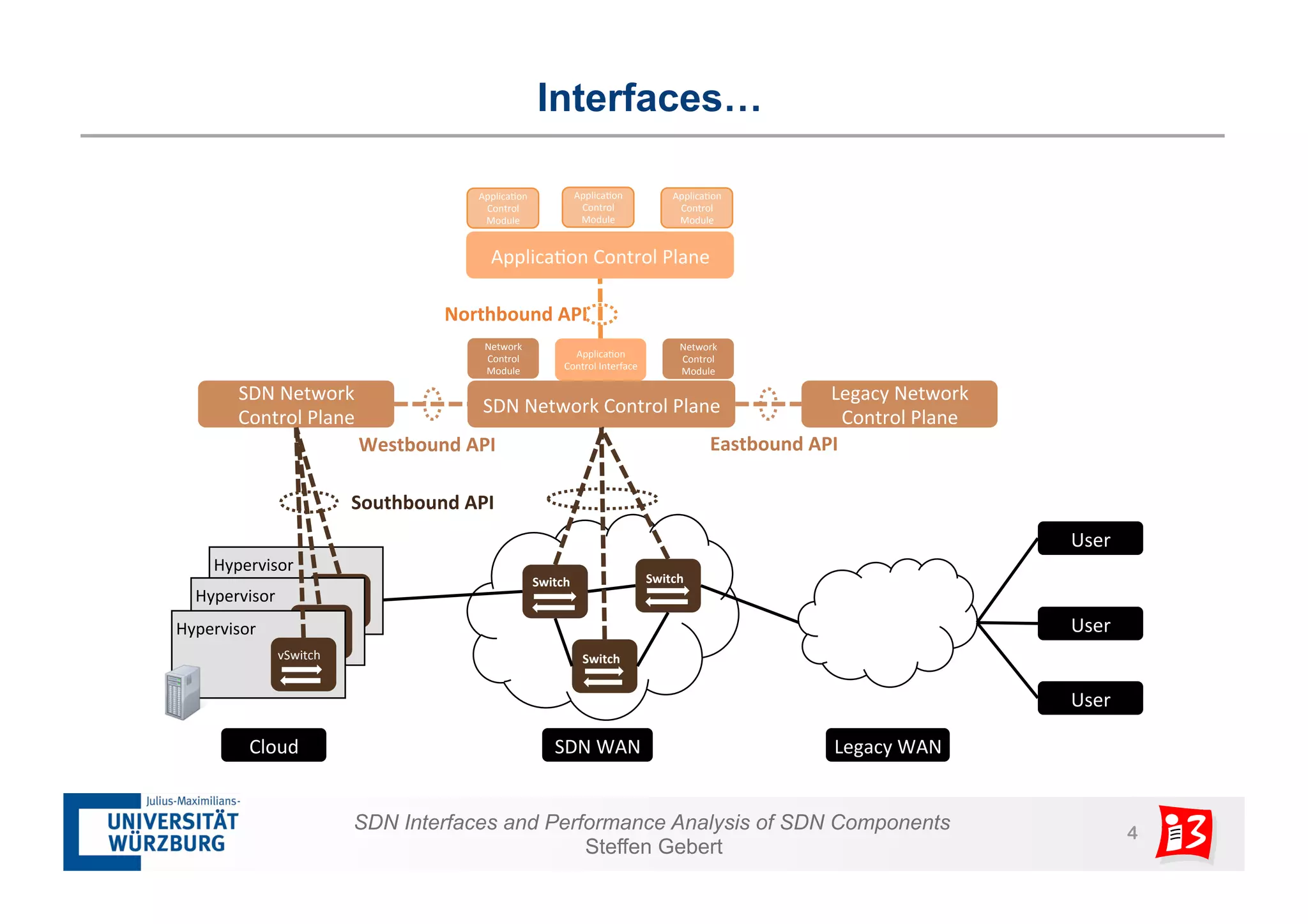
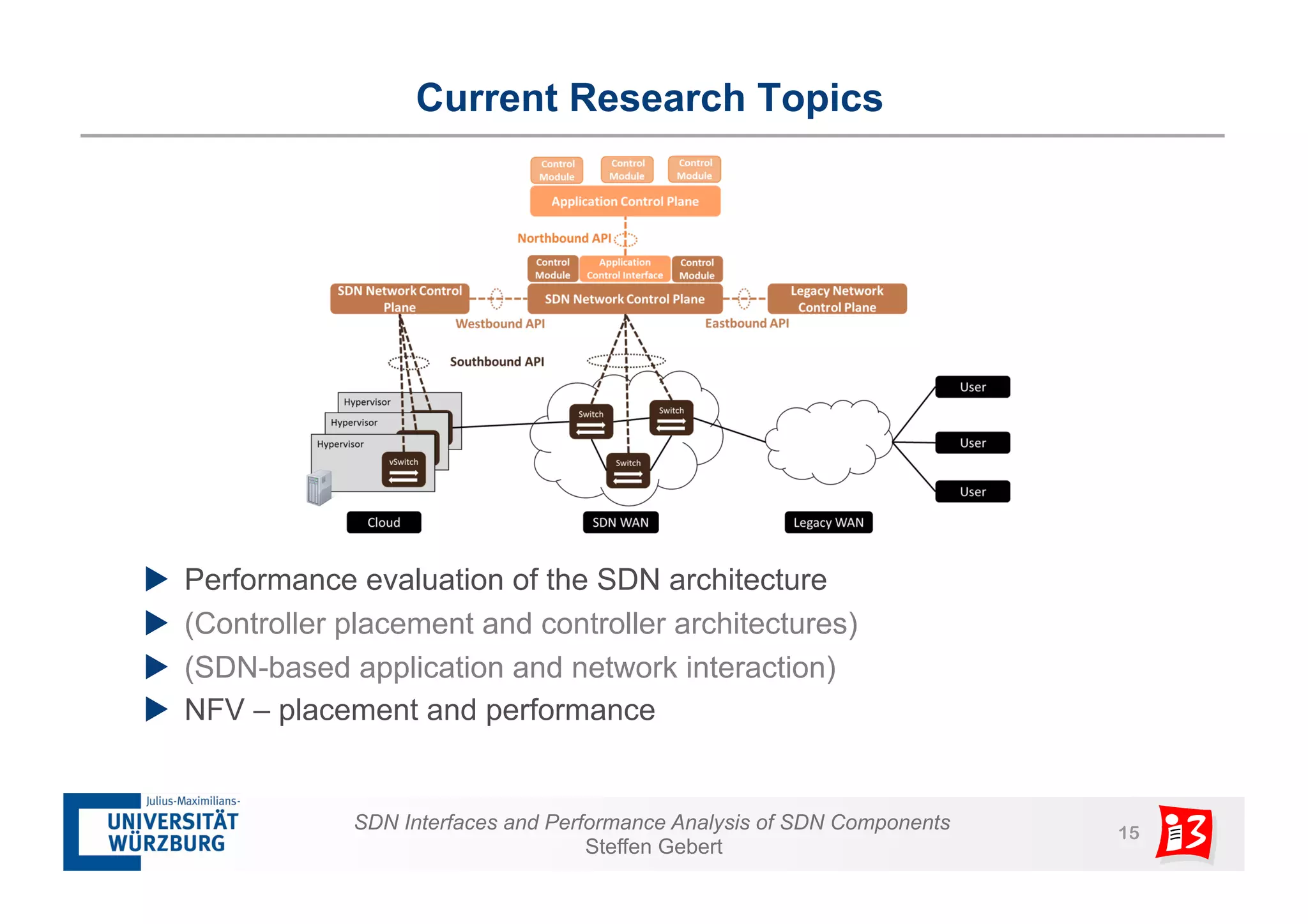
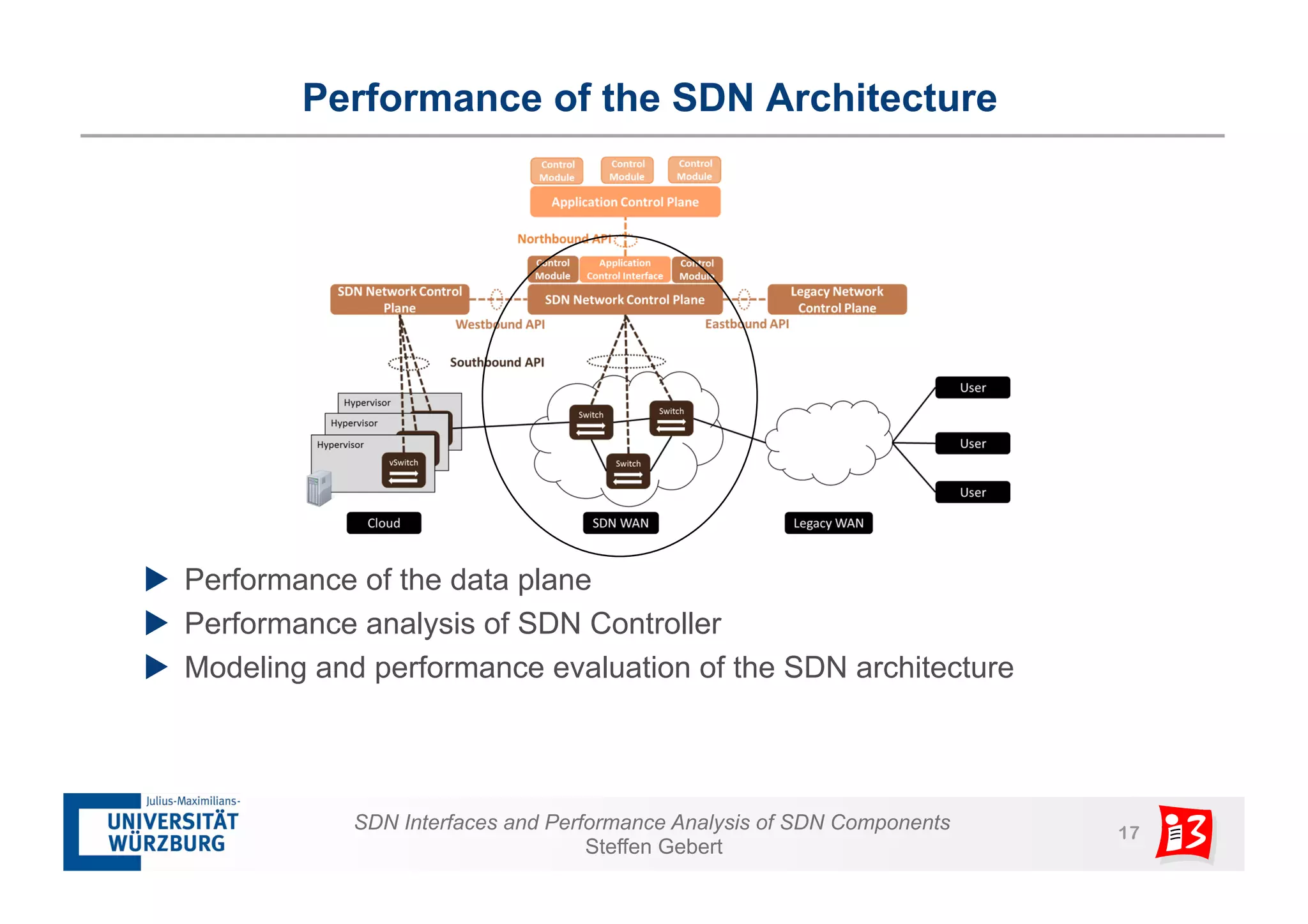
Interfaces… 
Applica8on 
Control 
Plane 
Northbound 
API 
SDN 
Network 
Control 
Plane 
Switch 
Switch 
SDN 
WAN 
SDN 
Network 
Control 
Plane 
SDN Interfaces and Performance Analysis of SDN Components 4 
Steffen Gebert 
Switch 
Network 
Control 
Module 
Southbound 
API 
Network 
Control 
Module 
Applica8on 
Control 
Interface 
Applica8on 
Control 
Module 
Applica8on 
Control 
Module 
Applica8on 
Control 
Module 
Westbound 
API 
Hypervisor 
vSwitc 
h 
Hypervisor 
vSwitc 
h 
Hypervisor 
vSwitch 
Cloud 
Eastbound 
API 
User 
Legacy 
Network 
Control 
Plane 
Legacy 
WAN 
User 
User
….Features… 
SDN Interfaces and Performance Analysis of SDN Components 5 
Steffen Gebert 
u Programmability 
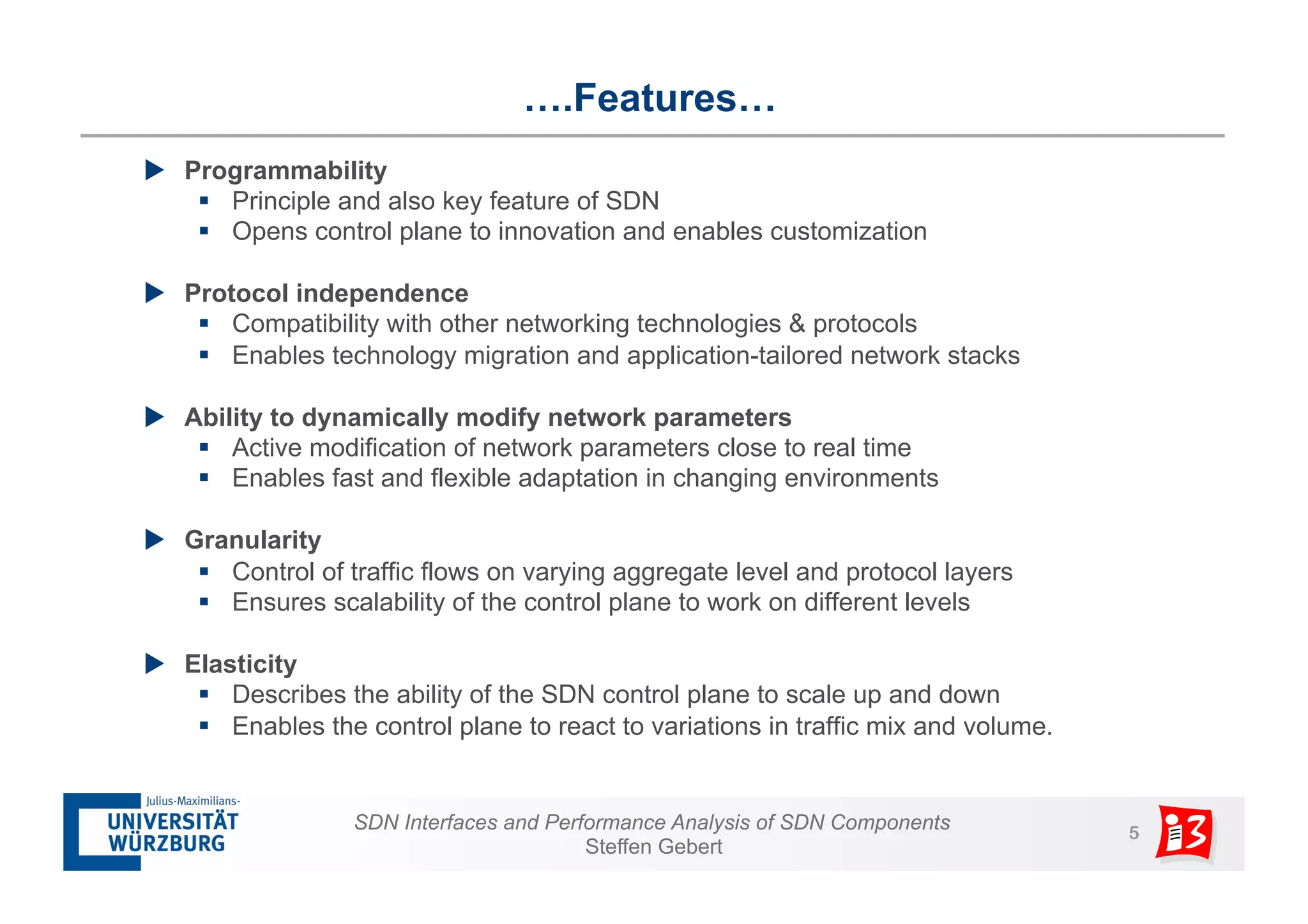
§ Principle and also key feature of SDN 
§ Opens control plane to innovation and enables customization 
u Protocol independence 
§ Compatibility with other networking technologies & protocols 
§ Enables technology migration and application-tailored network stacks 
u Ability to dynamically modify network parameters 
§ Active modification of network parameters close to real time 
§ Enables fast and flexible adaptation in changing environments 
u Granularity 
§ Control of traffic flows on varying aggregate level and protocol layers 
§ Ensures scalability of the control plane to work on different levels 
u Elasticity 
§ Describes the ability of the SDN control plane to scale up and down 
§ Enables the control plane to react to variations in traffic mix and volume.
…and Use Cases 
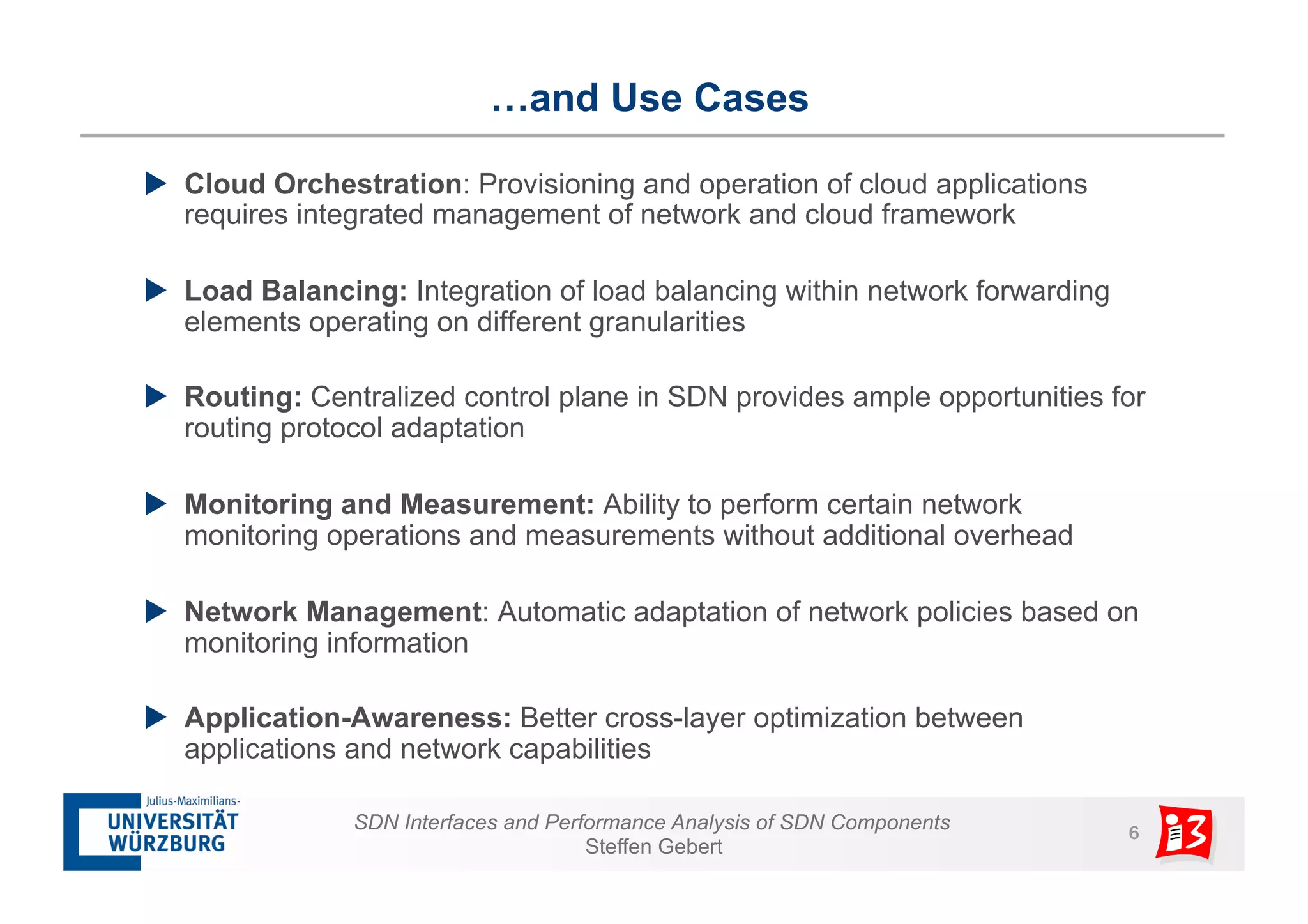
u Cloud Orchestration: Provisioning and operation of cloud applications 
requires integrated management of network and cloud framework 
u Load Balancing: Integration of load balancing within network forwarding 
elements operating on different granularities 
u Routing: Centralized control plane in SDN provides ample opportunities for 
SDN Interfaces and Performance Analysis of SDN Components 6 
Steffen Gebert 
routing protocol adaptation 
u Monitoring and Measurement: Ability to perform certain network 
monitoring operations and measurements without additional overhead 
u Network Management: Automatic adaptation of network policies based on 
monitoring information 
u Application-Awareness: Better cross-layer optimization between 
applications and network capabilities
Use-Cases and Interfaces 
SDN Interfaces and Performance Analysis of SDN Components 7 
Steffen Gebert 
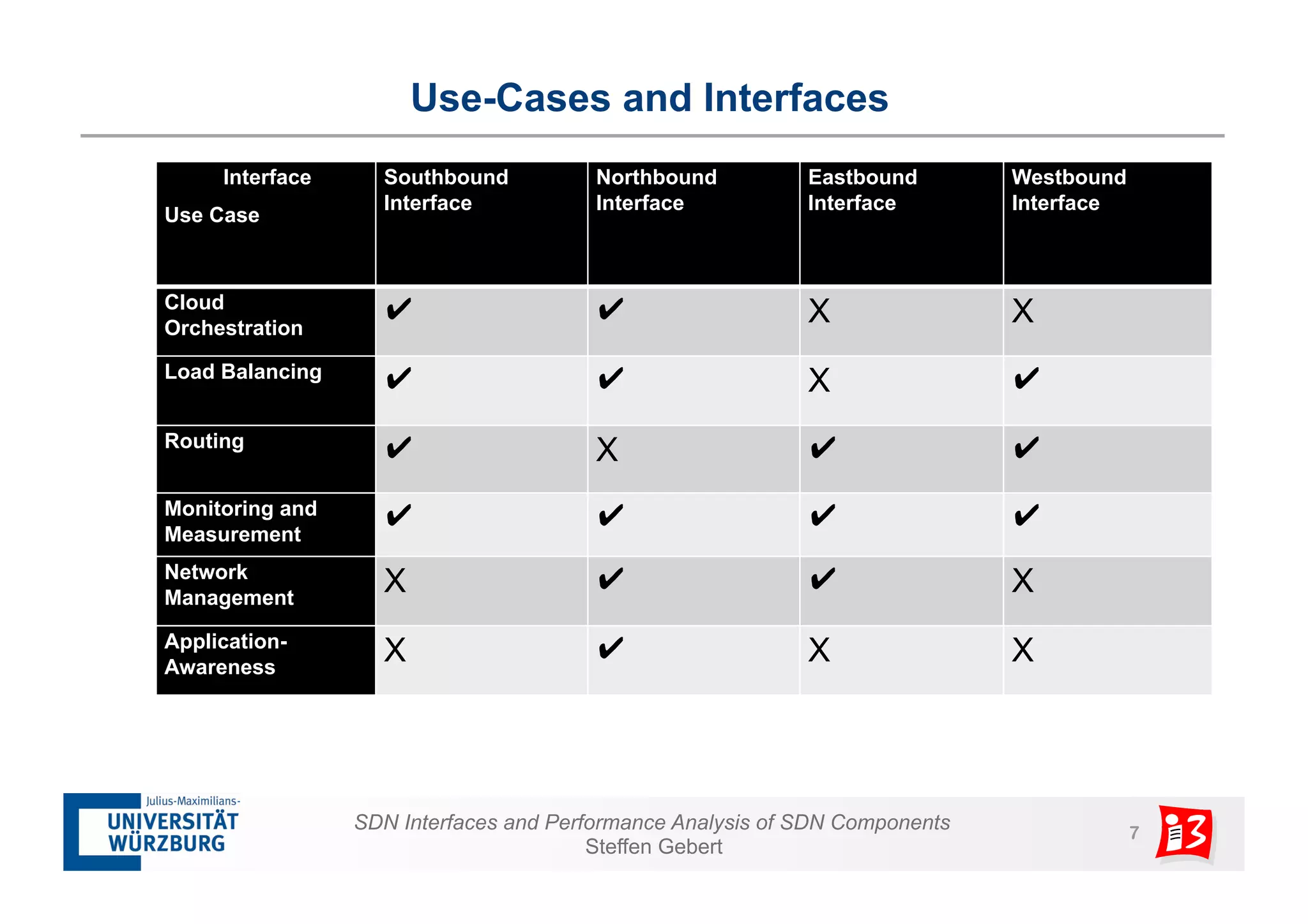
Interface 
Use Case 
Southbound 
Interface 
Northbound 
Interface 
Eastbound 
Interface 
Westbound 
Interface 
Cloud 
Orchestration 
✔ 
✔ 
X 
X 
Load Balancing 
✔ 
✔ 
X 
✔ 
Routing 
✔ 
X 
✔ 
✔ 
Monitoring and 
Measurement 
✔ 
✔ 
✔ 
✔ 
Network 
Management 
X 
✔ 
✔ 
X 
Application- 
Awareness 
X 
✔ 
X 
X
EXAMPLE: CLOUD 
ORCHESTRATION 
SDN Interfaces and Performance Analysis of SDN Components 8 
Steffen Gebert
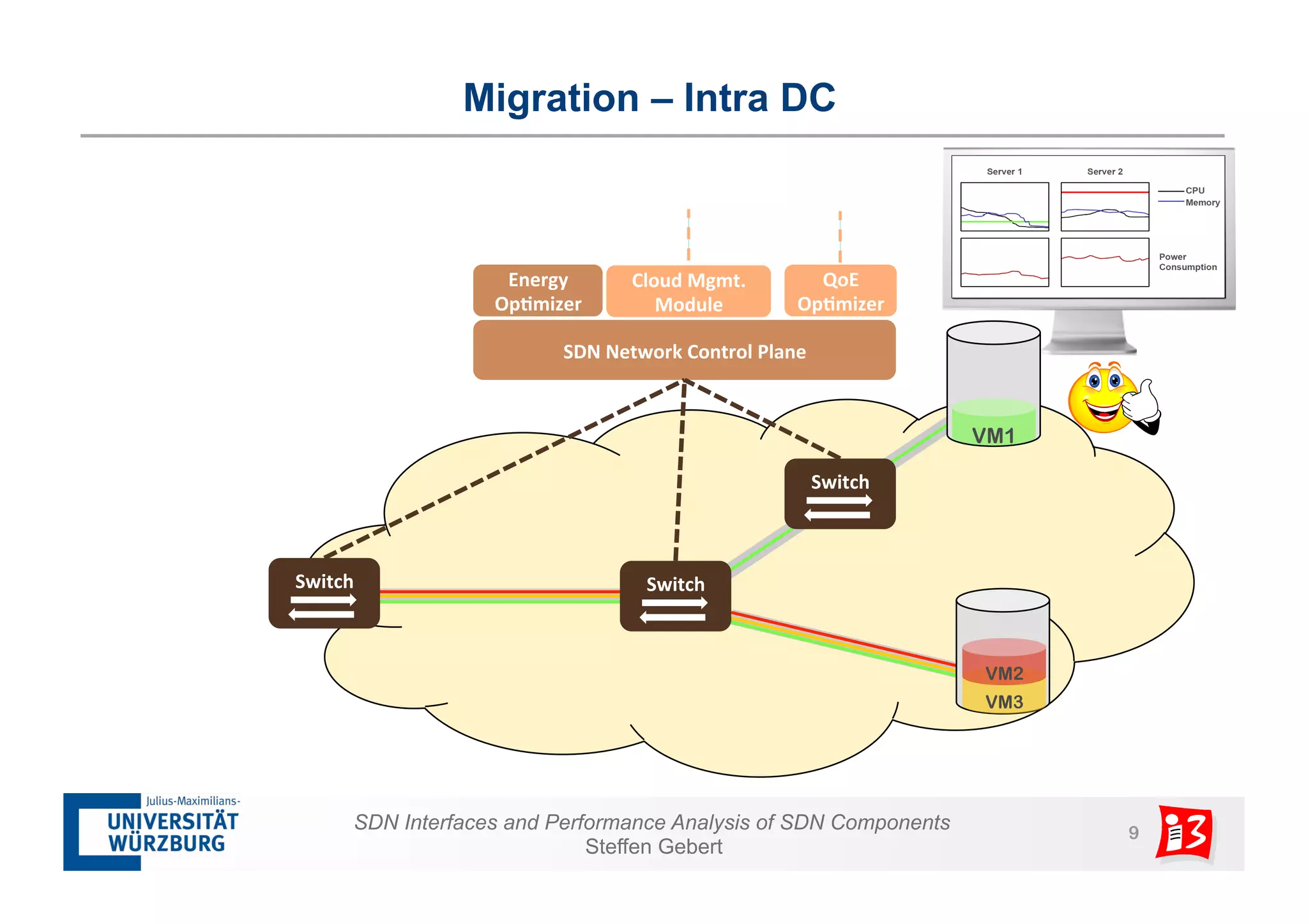
Migration – Intra DC 
SDN 
Network 
Control 
Plane 
VM1 
VM2 
SDN Interfaces and Performance Analysis of SDN Components 9 
Steffen Gebert 
Energy 
Op?mizer 
QoE 
Op?mizer 
Switch 
VM3 
Switch 
Switch 
Cloud 
Mgmt. 
Module
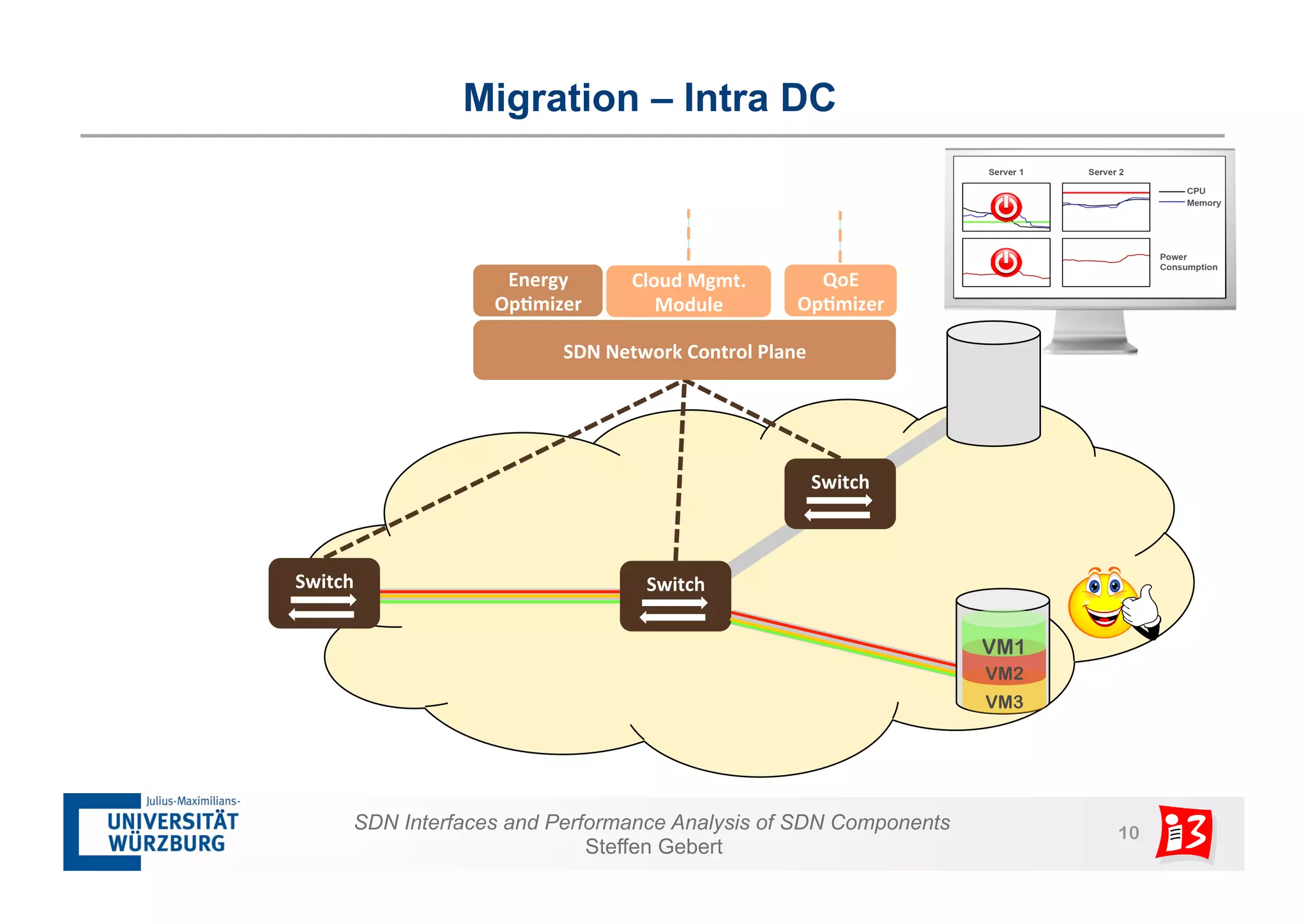
Migration – Intra DC 
Cloud 
Mgmt. 
Module 
Switch 
VM1 
VM2 
Energy 
Op?mizer 
QoE 
Op?mizer 
SDN Interfaces and Performance Analysis of SDN Components 10 
Steffen Gebert 
VM3 
Switch 
Switch 
SDN 
Network 
Control 
Plane
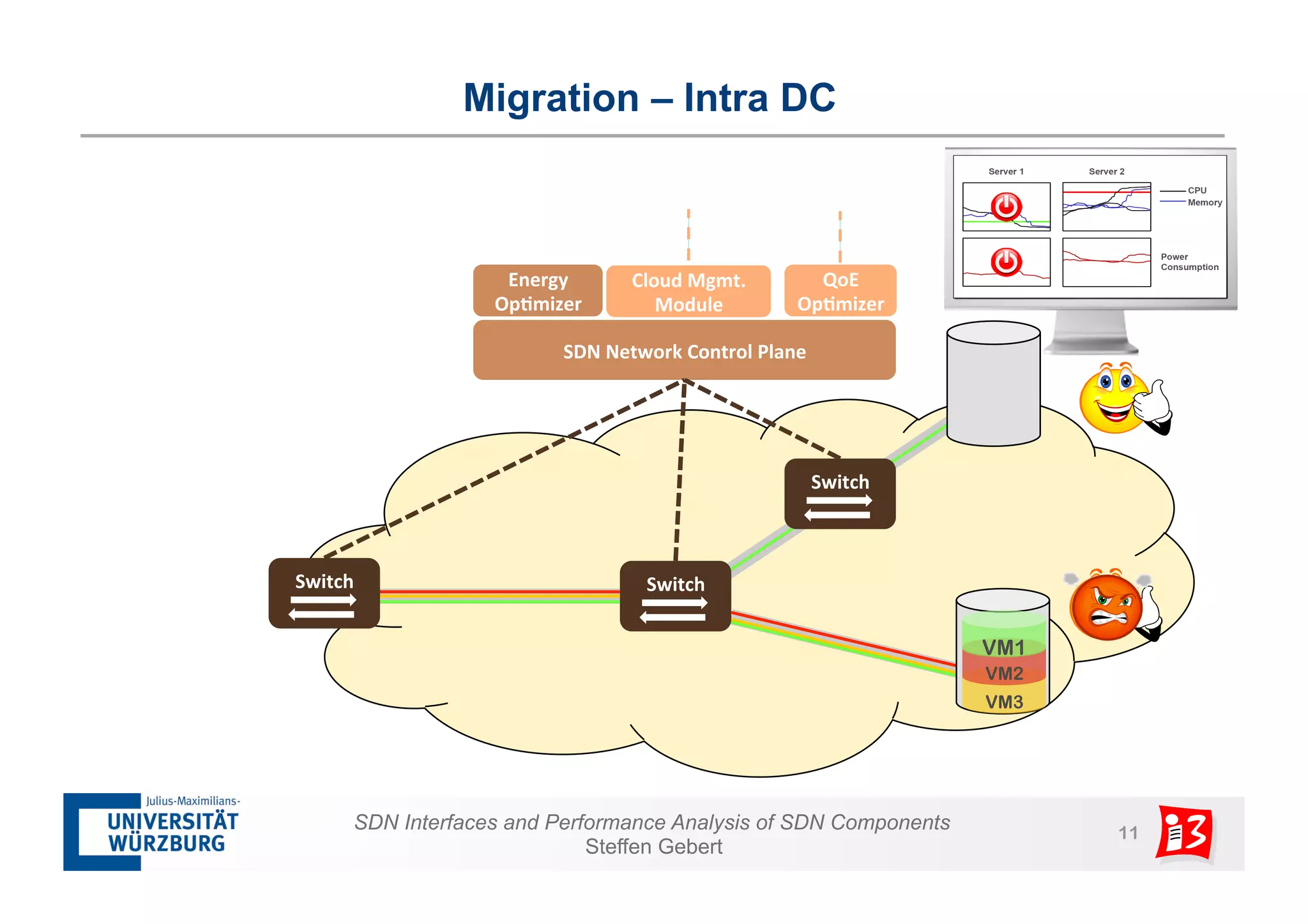
Migration – Intra DC 
Cloud 
Mgmt. 
Module 
Switch 
VM1 
VM2 
Energy 
Op?mizer 
QoE 
Op?mizer 
SDN Interfaces and Performance Analysis of SDN Components 11 
Steffen Gebert 
VM3 
Switch 
Switch 
SDN 
Network 
Control 
Plane
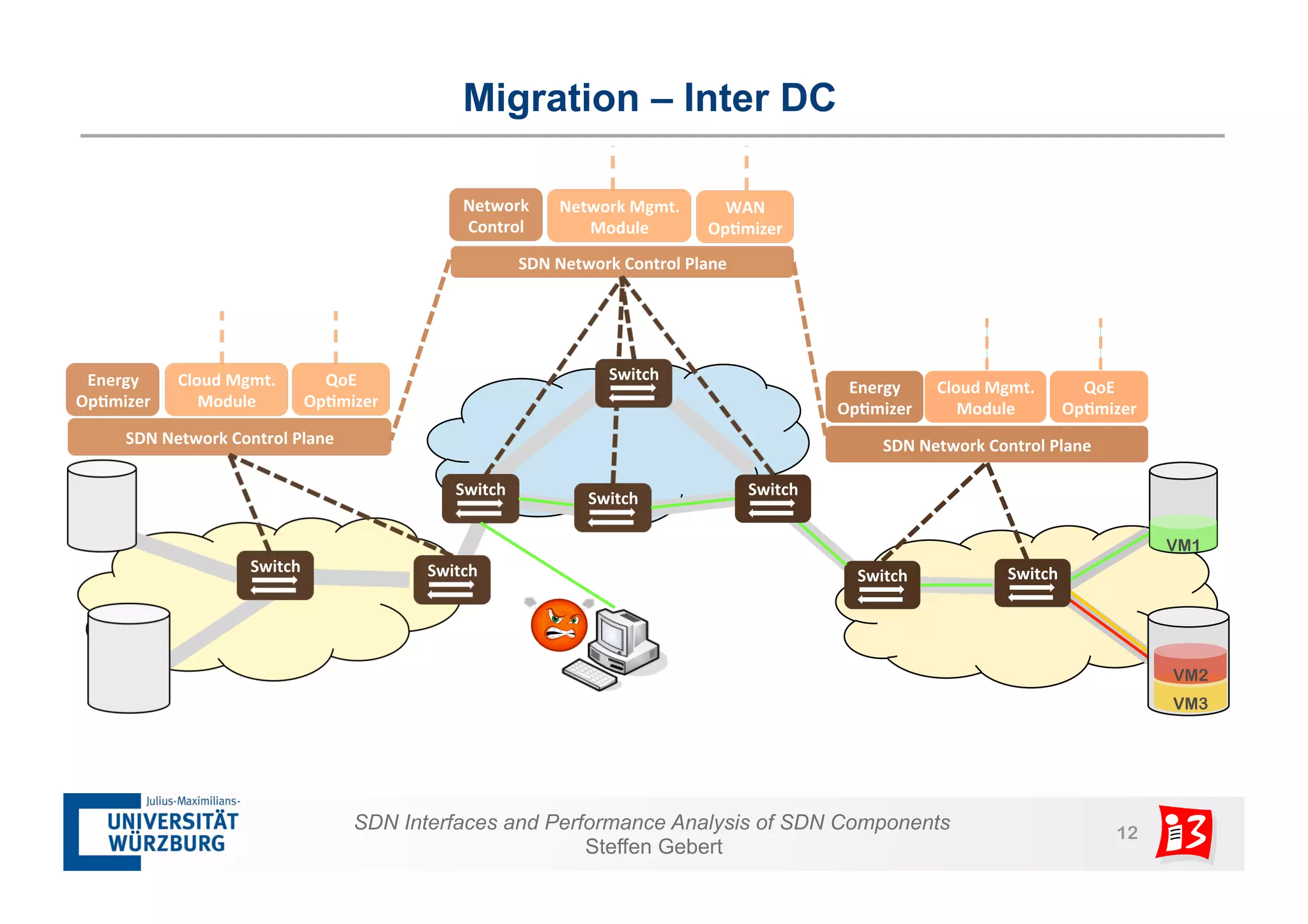
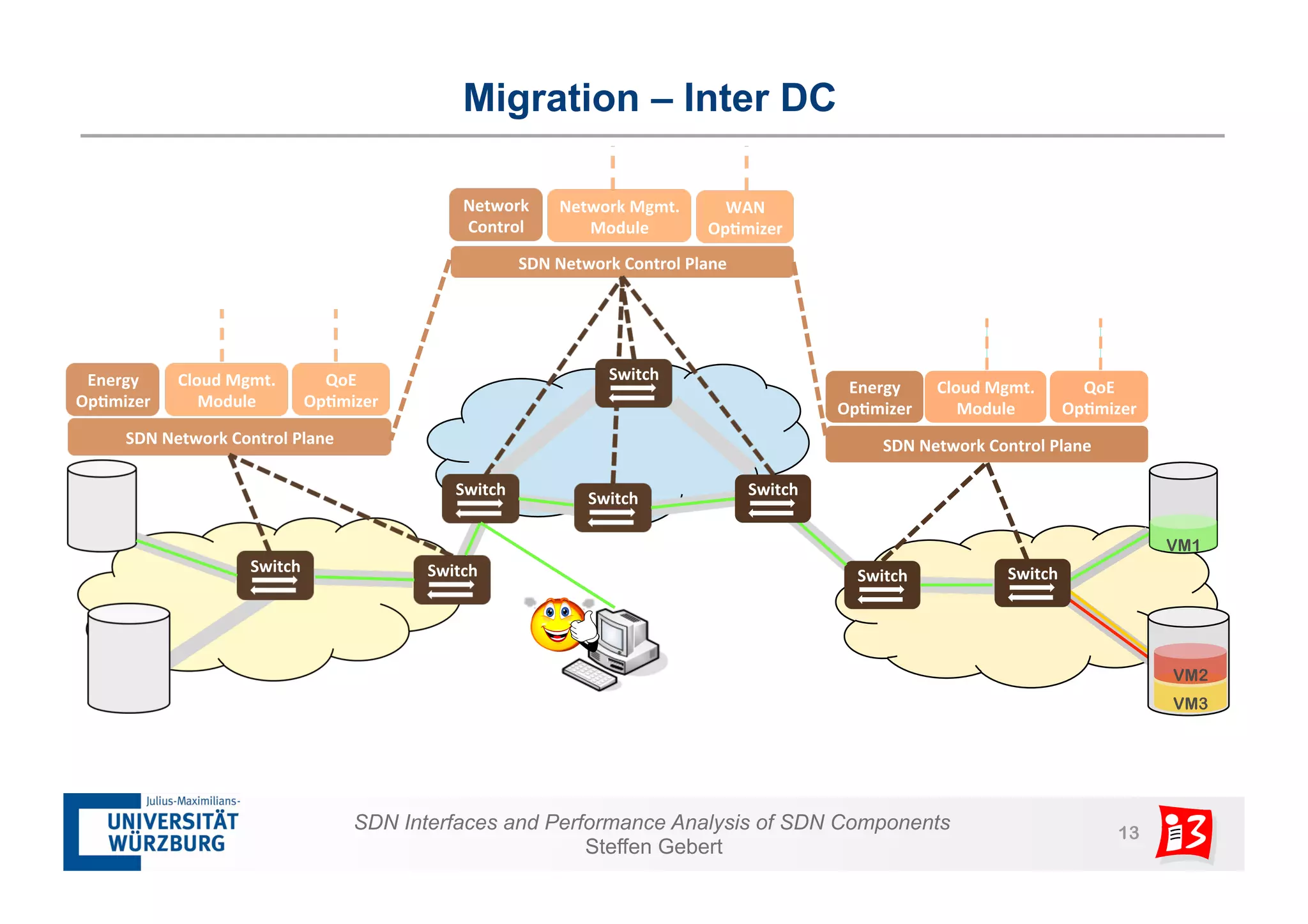
Migration – Inter DC 
Energy 
Op?mizer 
QoE 
Op?mizer 
QoE 
Op?mizer 
Network 
Control 
WAN 
Op?mizer 
Network 
Mgmt. 
Module 
Switch 
SDN Interfaces and Performance Analysis of SDN Components 12 
Steffen Gebert 
SDN 
Network 
Control 
Plane 
VM1 
VM2 
VM3 
Cloud 
Mgmt. 
Module 
Switch 
Switch 
Energy 
Op?mizer 
Cloud 
Mgmt. 
Module 
SDN 
Network 
Control 
Plane 
Switch 
Switch 
SDN 
Network 
Control 
Plane 
Switch 
Switch 
Switch
Migration – Inter DC 
Energy 
Op?mizer 
QoE 
Op?mizer 
QoE 
Op?mizer 
Network 
Control 
WAN 
Op?mizer 
Network 
Mgmt. 
Module 
Switch 
SDN Interfaces and Performance Analysis of SDN Components 13 
Steffen Gebert 
SDN 
Network 
Control 
Plane 
VM2 
VM3 
Cloud 
Mgmt. 
Module 
Switch 
Switch 
Energy 
Op?mizer 
Cloud 
Mgmt. 
Module 
SDN 
Network 
Control 
Plane 
Switch 
Switch 
SDN 
Network 
Control 
Plane 
Switch 
Switch 
Switch 
VM1
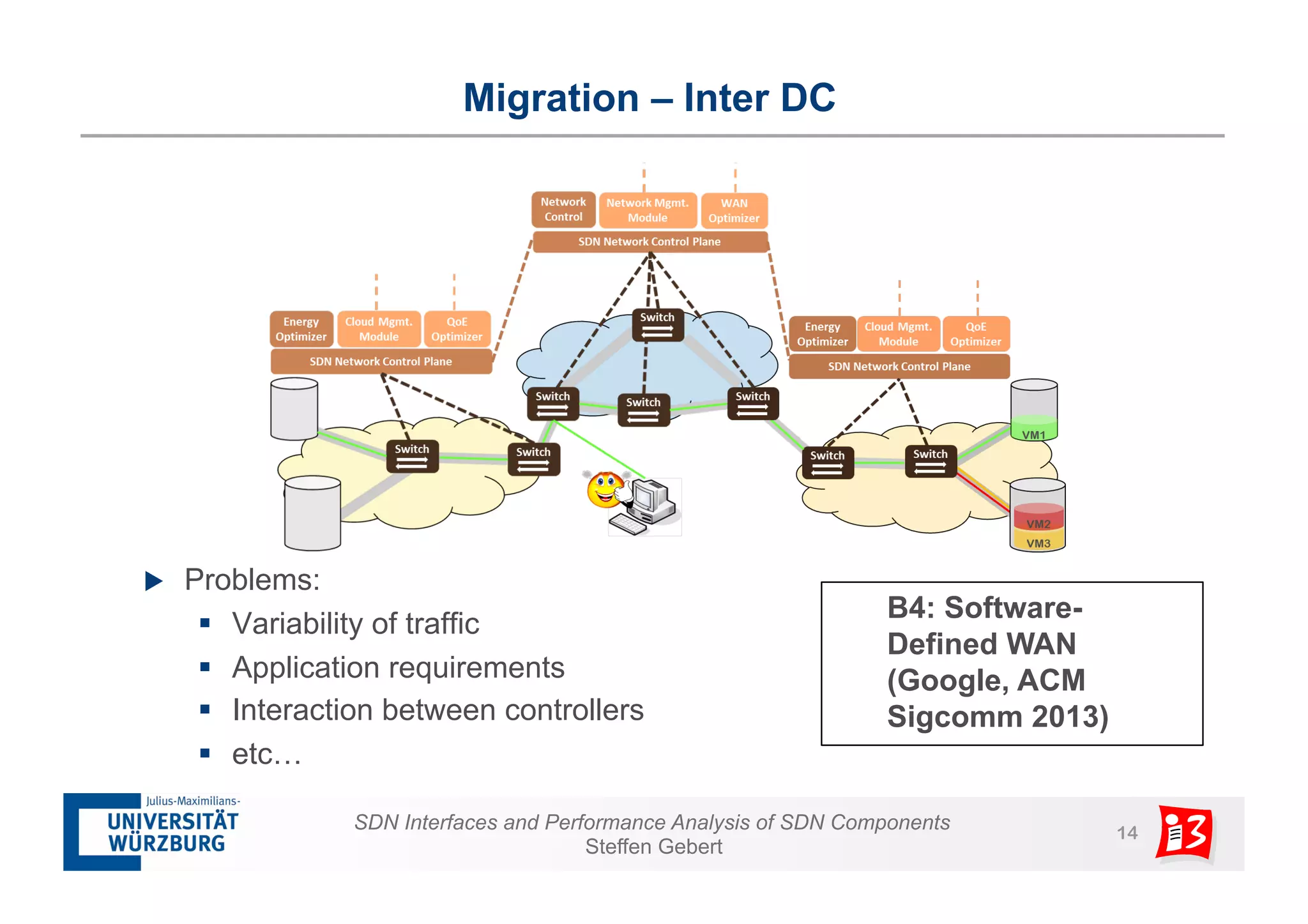
Migration – Inter DC 
SDN Interfaces and Performance Analysis of SDN Components 14 
Steffen Gebert 
u Problems: 
§ Variability of traffic 
§ Application requirements 
§ Interaction between controllers 
§ etc… 
B4: Software- 
Defined WAN 
(Google, ACM 
Sigcomm 2013)
Current Research Topics 
u Performance evaluation of the SDN architecture 
u (Controller placement and controller architectures) 
u (SDN-based application and network interaction) 
u NFV – placement and performance 
SDN Interfaces and Performance Analysis of SDN Components 15 
Steffen Gebert
PERFORMANCE OF THE SDN 
ARCHITECTURE 
SDN Interfaces and Performance Analysis of SDN Components 16 
Steffen Gebert
Performance of the SDN Architecture 
u Performance of the data plane 
u Performance analysis of SDN Controller 
u Modeling and performance evaluation of the SDN architecture 
SDN Interfaces and Performance Analysis of SDN Components 17 
Steffen Gebert
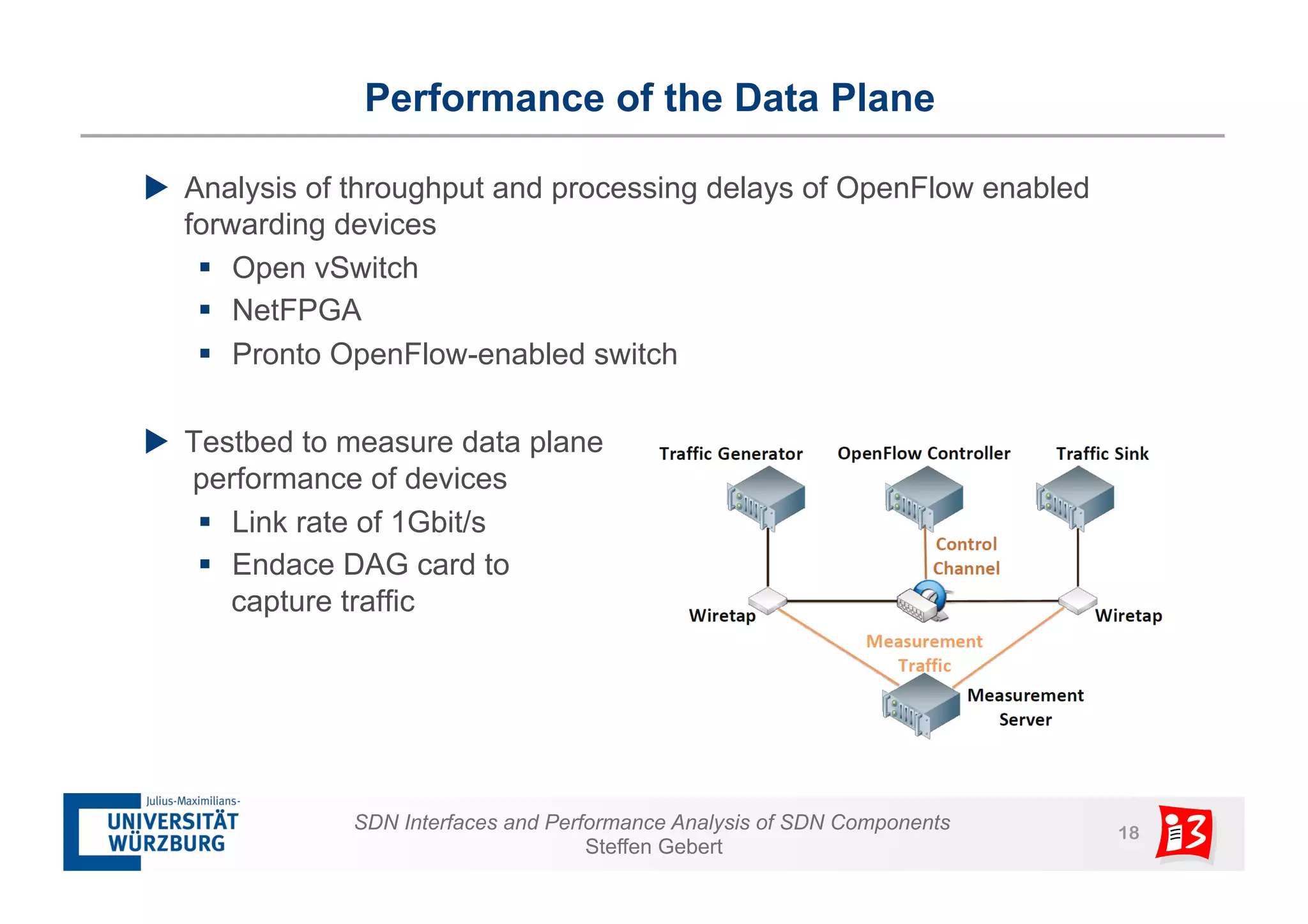
Performance of the Data Plane 
u Analysis of throughput and processing delays of OpenFlow enabled 
forwarding devices 
§ Open vSwitch 
§ NetFPGA 
§ Pronto OpenFlow-enabled switch 
u Testbed to measure data plane 
SDN Interfaces and Performance Analysis of SDN Components 18 
Steffen Gebert 
performance of devices 
§ Link rate of 1Gbit/s 
§ Endace DAG card to 
capture traffic
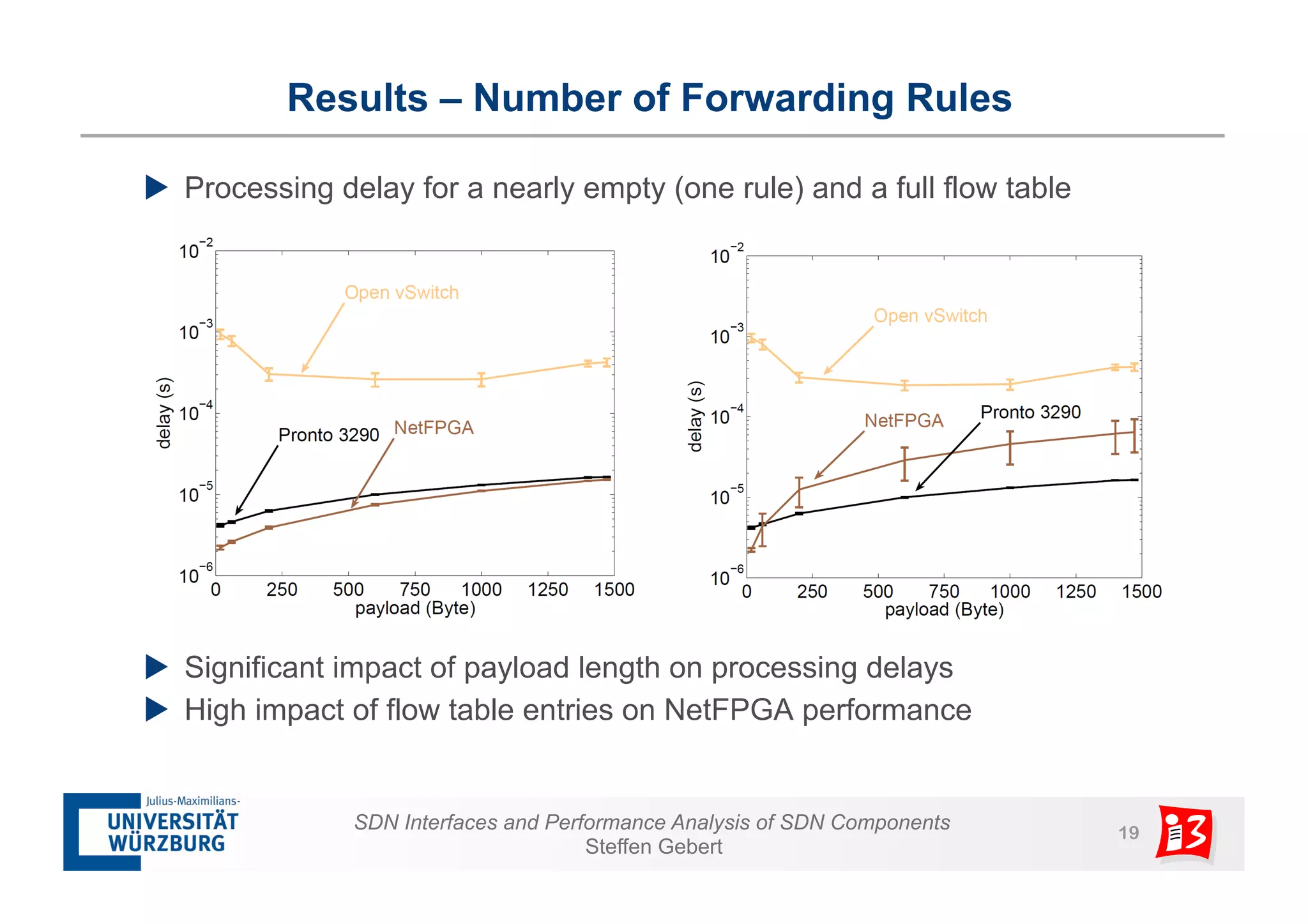
Results – Number of Forwarding Rules 
u Processing delay for a nearly empty (one rule) and a full flow table 
u Significant impact of payload length on processing delays 
u High impact of flow table entries on NetFPGA performance 
SDN Interfaces and Performance Analysis of SDN Components 19 
Steffen Gebert
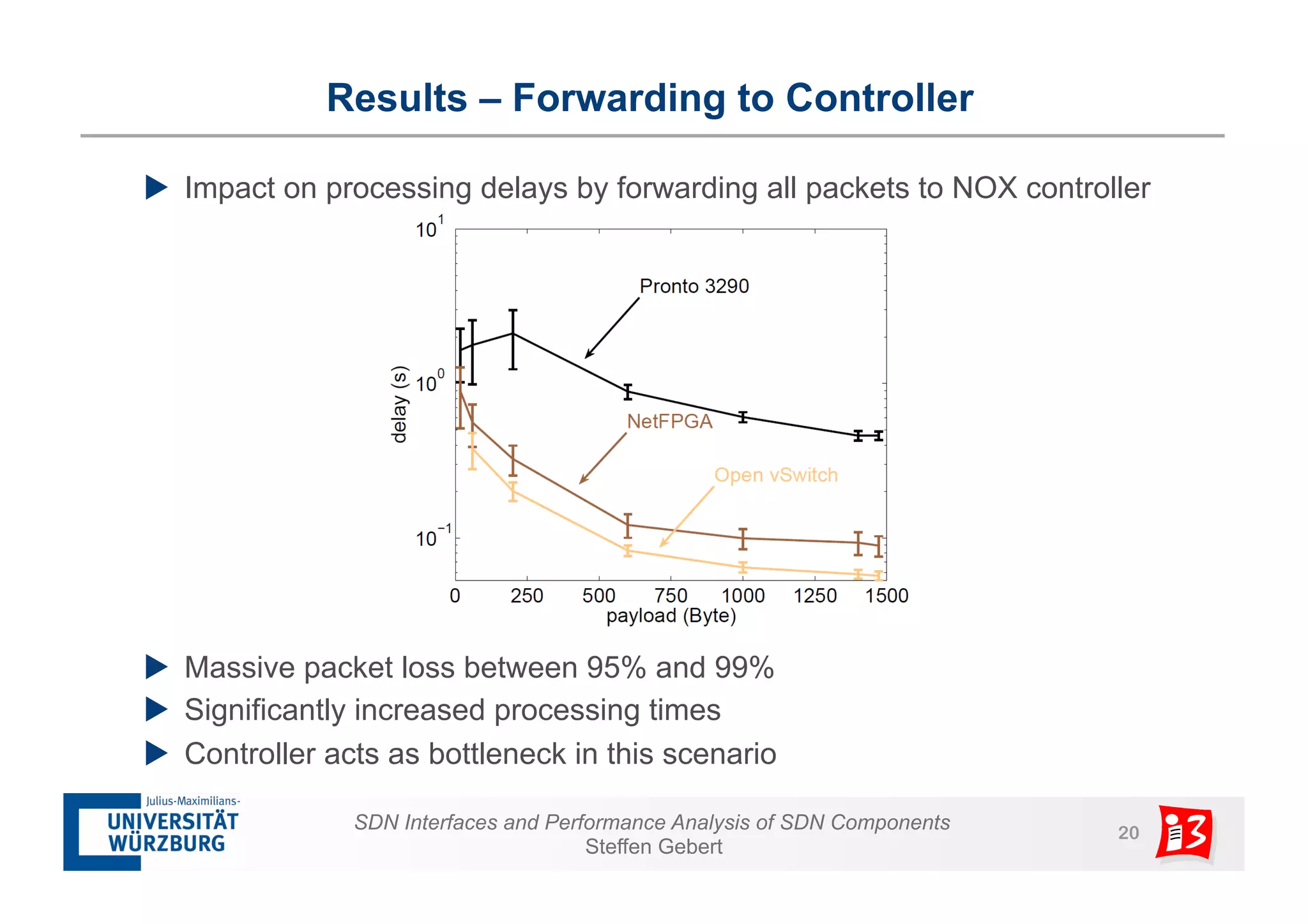
Results – Forwarding to Controller 
u Impact on processing delays by forwarding all packets to NOX controller 
u Massive packet loss between 95% and 99% 
u Significantly increased processing times 
u Controller acts as bottleneck in this scenario 
SDN Interfaces and Performance Analysis of SDN Components 20 
Steffen Gebert
Performance Analysis of SDN Controllers 
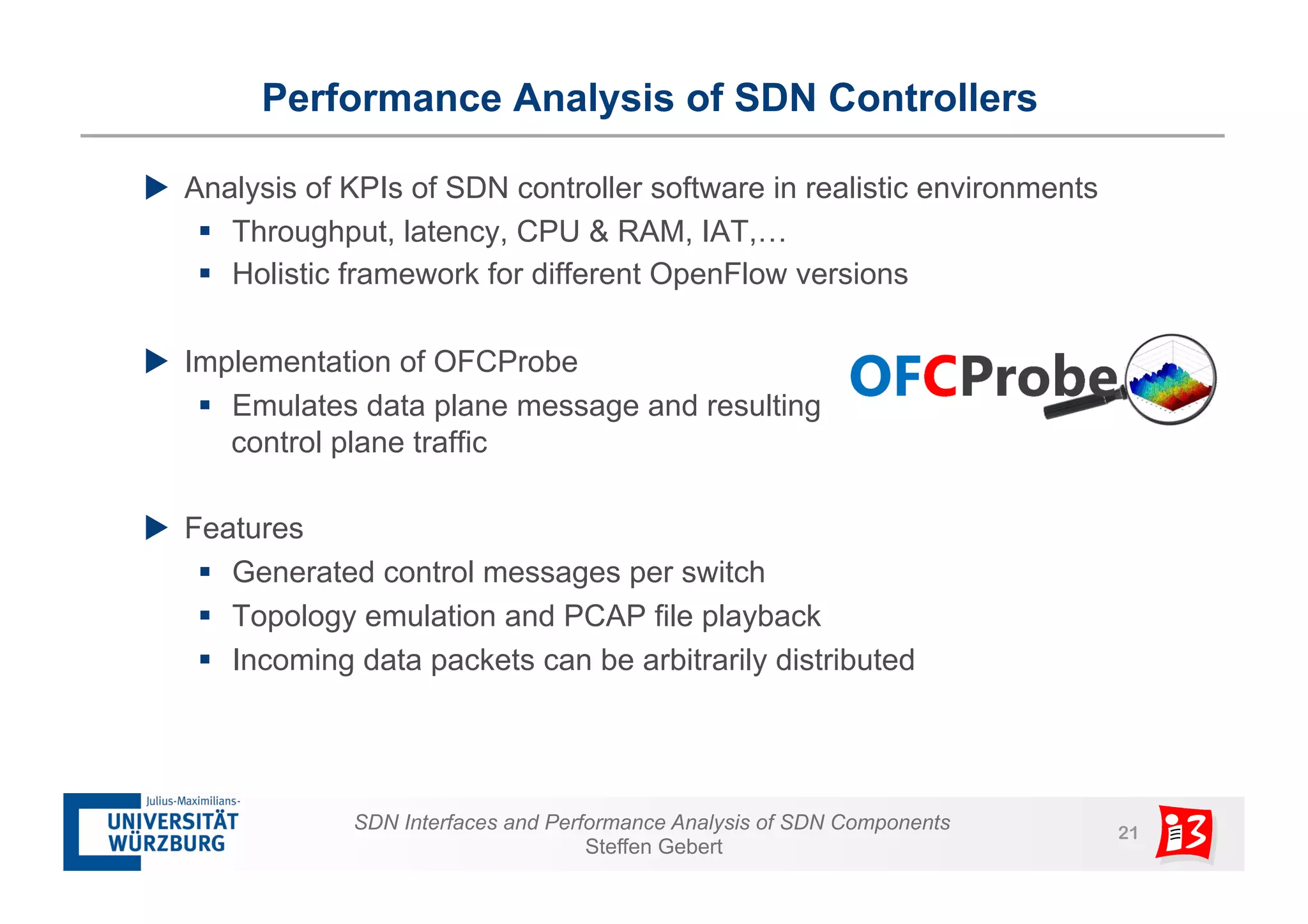
u Analysis of KPIs of SDN controller software in realistic environments 
§ Throughput, latency, CPU & RAM, IAT,… 
§ Holistic framework for different OpenFlow versions 
SDN Interfaces and Performance Analysis of SDN Components 21 
Steffen Gebert 
u Implementation of OFCProbe 
§ Emulates data plane message and resulting 
control plane traffic 
u Features 
§ Generated control messages per switch 
§ Topology emulation and PCAP file playback 
§ Incoming data packets can be arbitrarily distributed
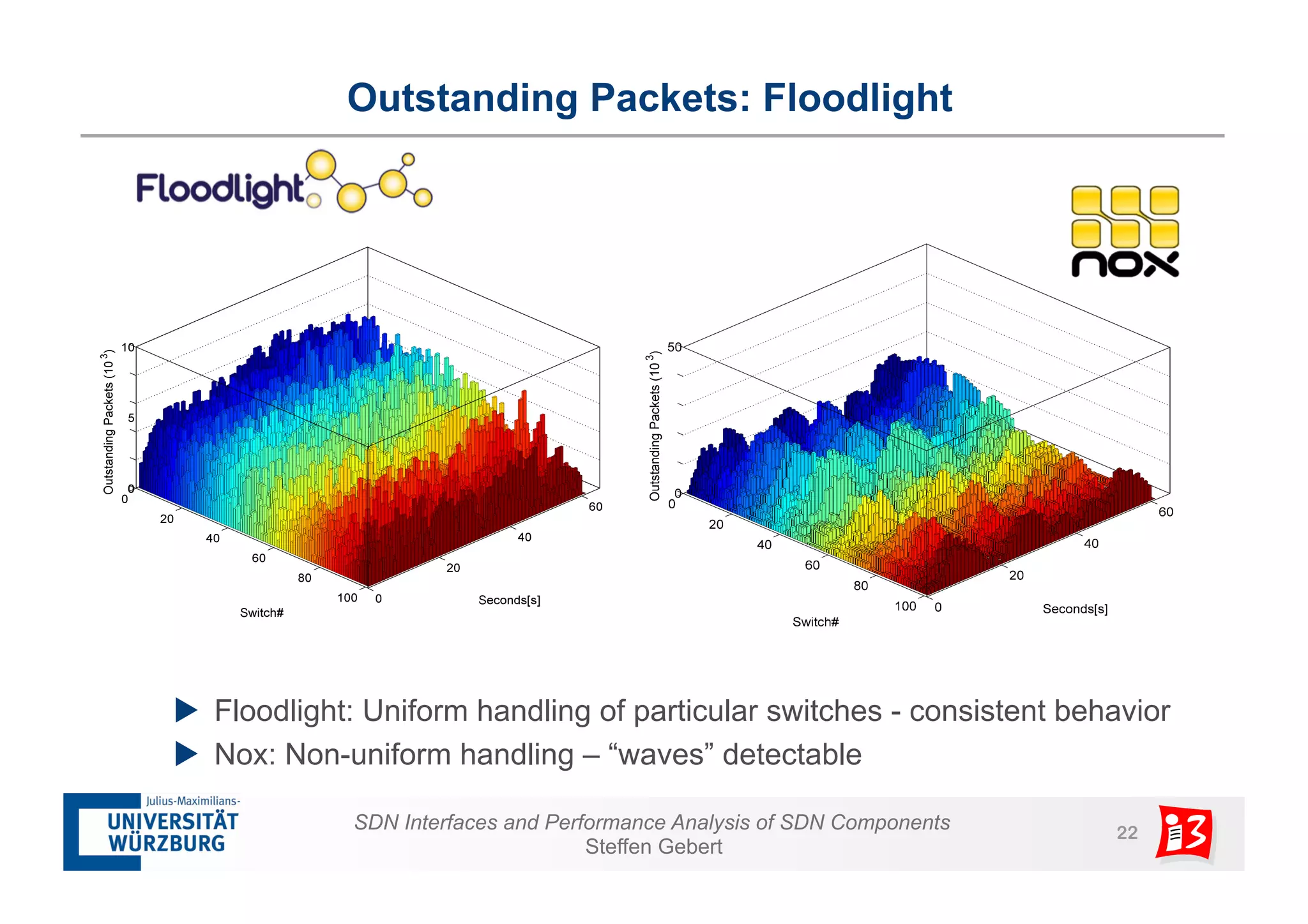
Outstanding Packets: Floodlight 
u Floodlight: Uniform handling of particular switches - consistent behavior 
u Nox: Non-uniform handling – “waves” detectable 
SDN Interfaces and Performance Analysis of SDN Components 22 
Steffen Gebert
Performance Evaluation of SDN 
u Investigation of the performance of the SDN architecture for changing 
parameters 
§ Modeling of control and data plane 
§ System scalability and limitations of the concept 
u Evaluations using analytical modeling and simulations 
§ Input parameters based on measurements with real hardware 
§ Verification of analytical results with simulations 
SDN Interfaces and Performance Analysis of SDN Components 23 
Steffen Gebert 
u Simulation of OpenFlow 
§ OpenFlow implementation for OMNeT++: OFOmnet 
§ Code available at https://github.com/lsinfo3/ofomnet
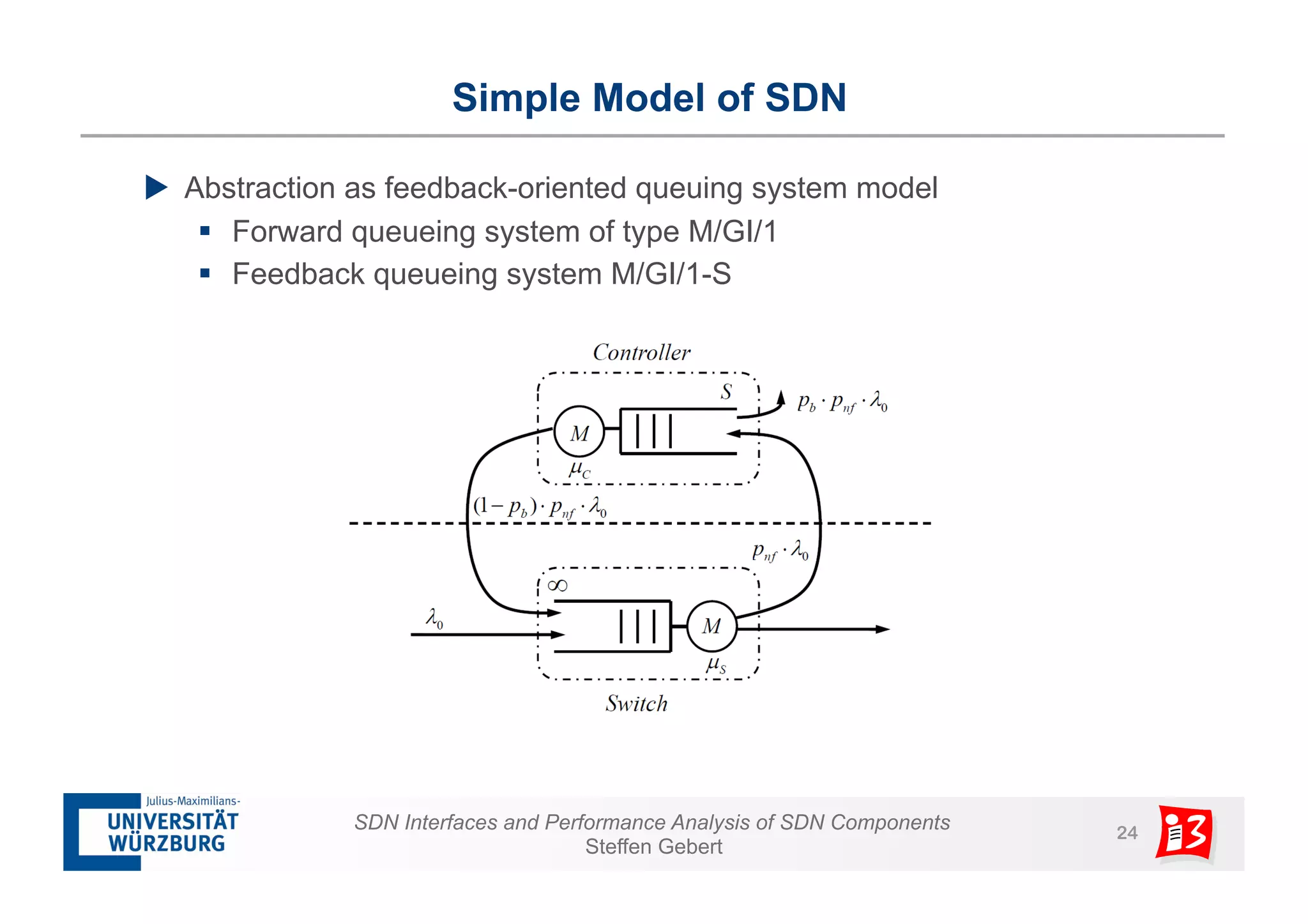
Simple Model of SDN 
u Abstraction as feedback-oriented queuing system model 
§ Forward queueing system of type M/GI/1 
§ Feedback queueing system M/GI/1-S 
SDN Interfaces and Performance Analysis of SDN Components 24 
Steffen Gebert
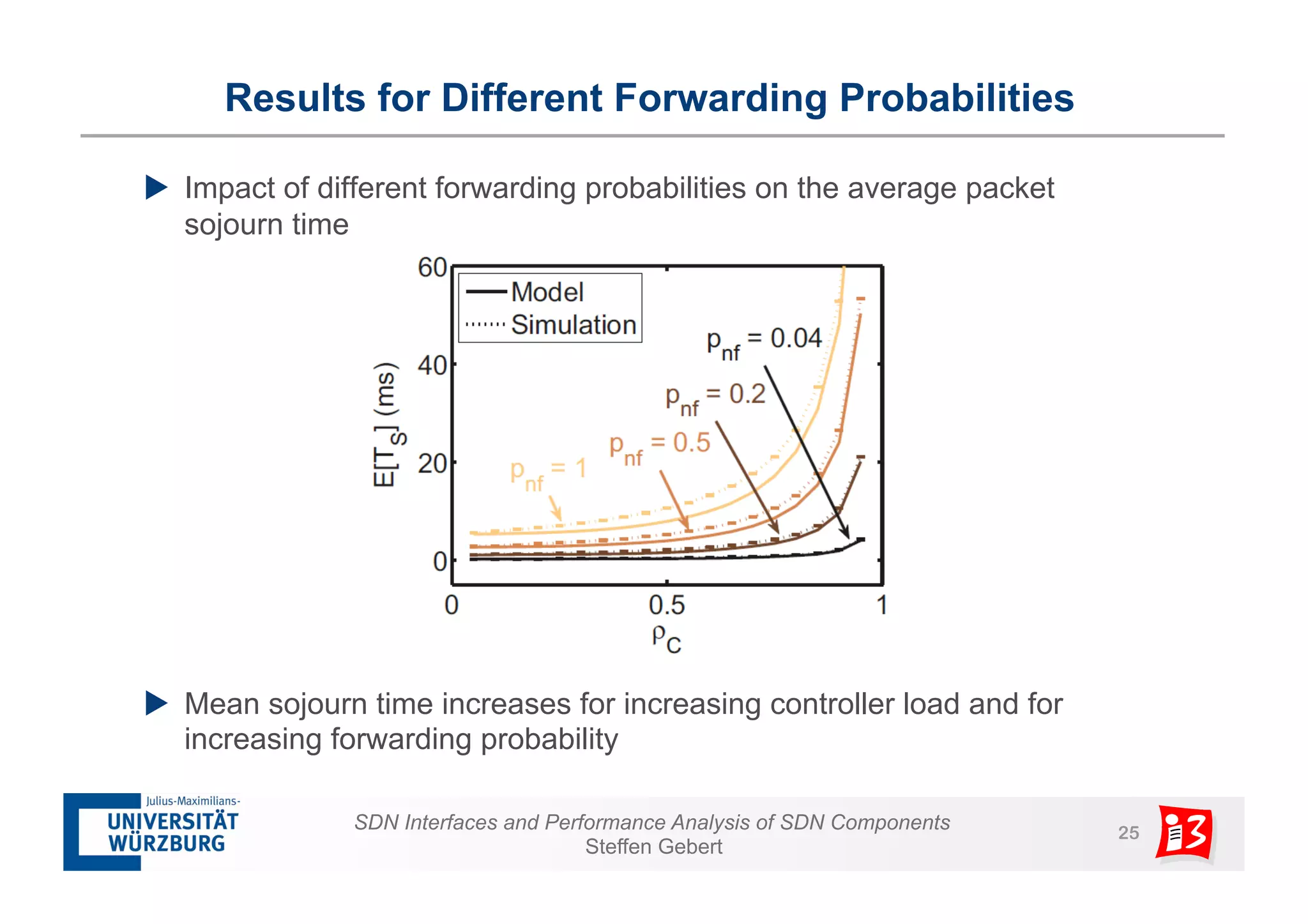
Results for Different Forwarding Probabilities 
u Impact of different forwarding probabilities on the average packet 
SDN Interfaces and Performance Analysis of SDN Components 25 
Steffen Gebert 
sojourn time 
u Mean sojourn time increases for increasing controller load and for 
increasing forwarding probability
SDN Performance: Summary 
u Performance analysis of SDN architecture and SDN control plane 
§ Controller analysis using OFCProbe 
§ Performance evaluation of the architecture using models 
u Main results of the current investigations 
§ Diverse behavior of software control planes, e.g., Floodlight 
outperforms NOX in terms of throughput and fairness 
§ Scalability mainly depends on control plane 
SDN Interfaces and Performance Analysis of SDN Components 26 
Steffen Gebert 
u Other issues: 
§ Investigation of different topologies and software controllers 
§ Integration and investigation of OpenFlow 1.3 
§ Impact of messages via Northbound interface 
§ Extension of the analytical models
NFV – PLACEMENT AND 
PERFORMANCE 
SDN Interfaces and Performance Analysis of SDN Components 27 
Steffen Gebert
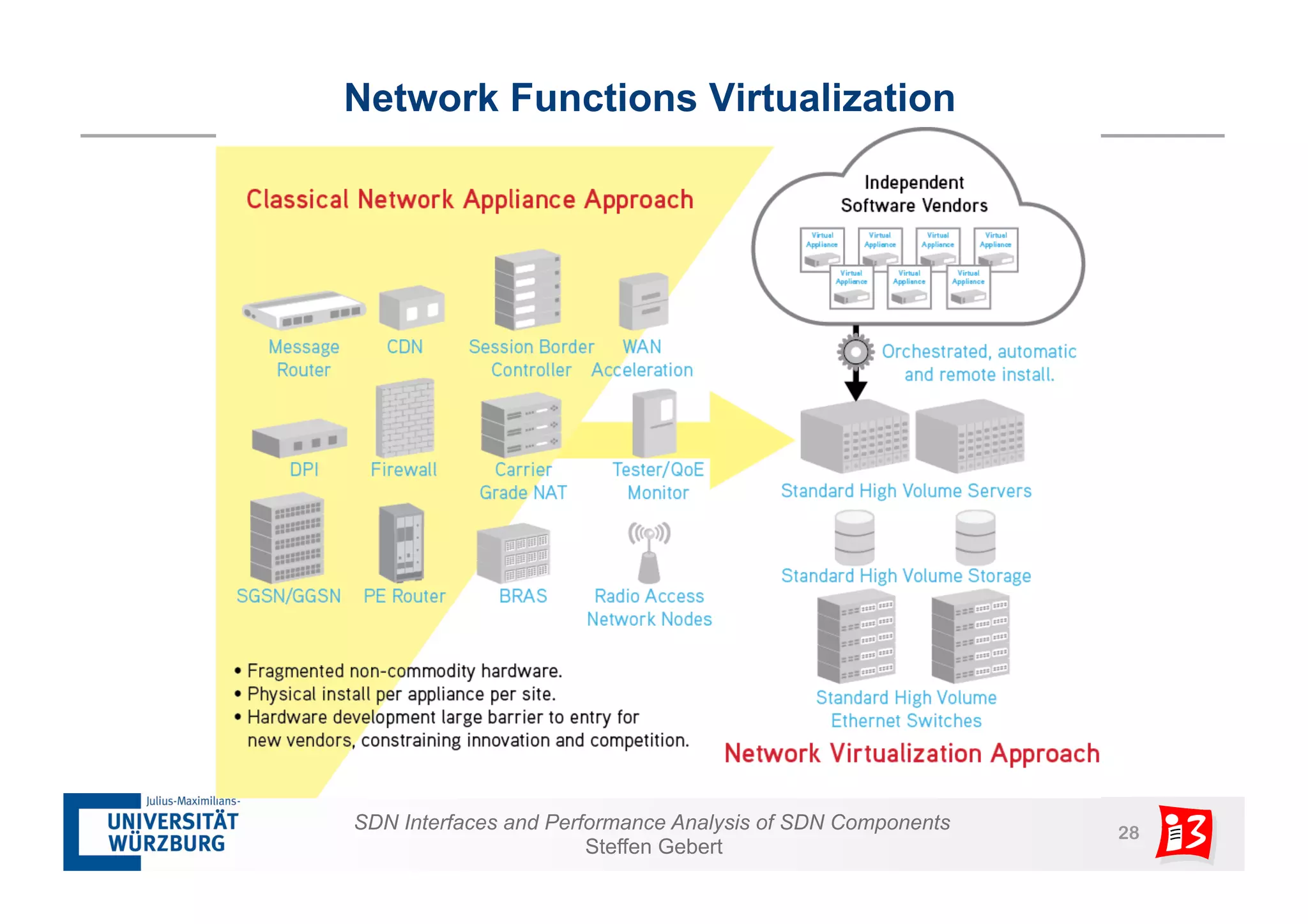
Network Functions Virtualization 
SDN Interfaces and Performance Analysis of SDN Components 28 
Steffen Gebert
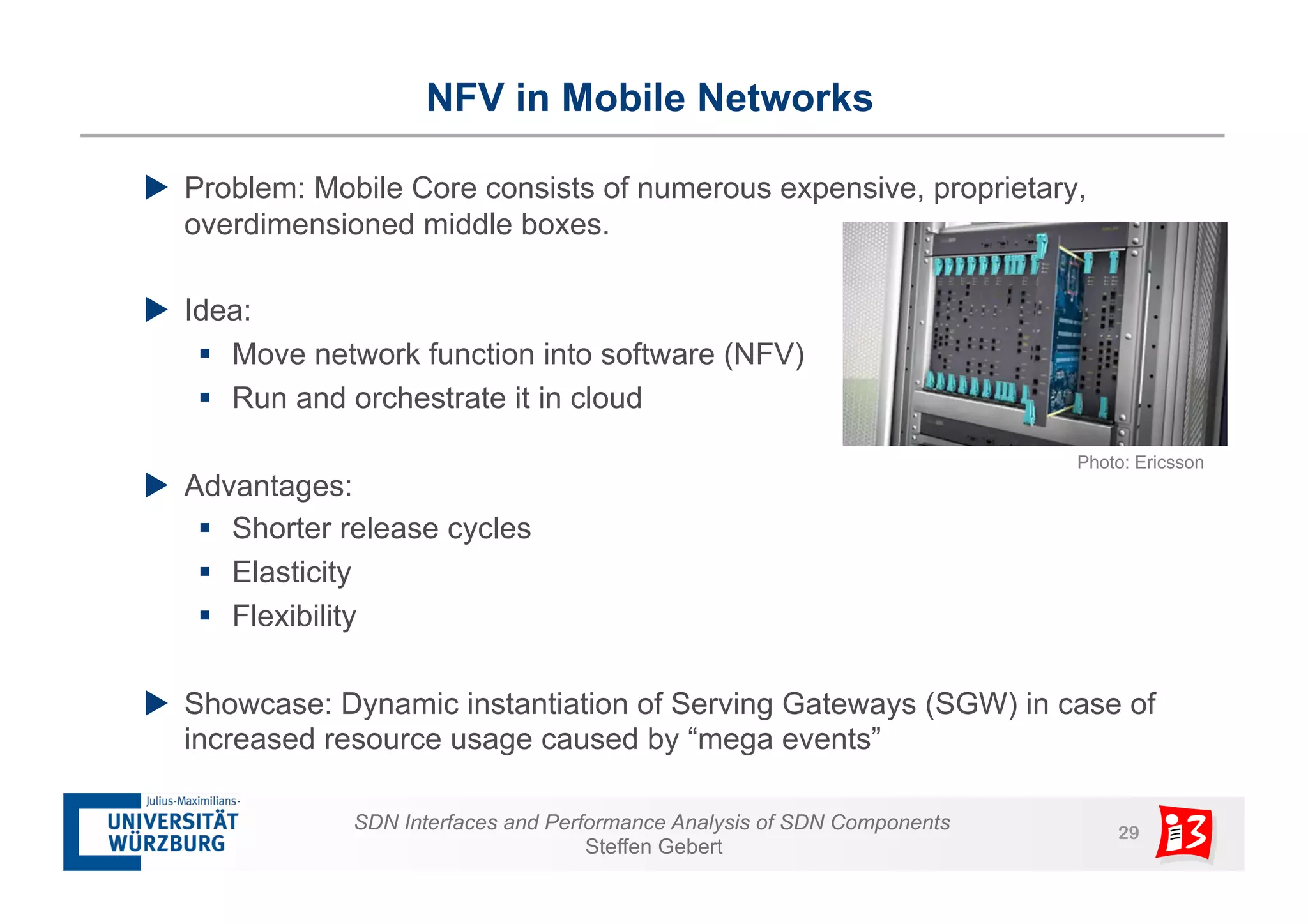
NFV in Mobile Networks 
u Problem: Mobile Core consists of numerous expensive, proprietary, 
overdimensioned middle boxes. 
SDN Interfaces and Performance Analysis of SDN Components 29 
Steffen Gebert 
u Idea: 
§ Move network function into software (NFV) 
§ Run and orchestrate it in cloud 
u Advantages: 
§ Shorter release cycles 
§ Elasticity 
§ Flexibility 
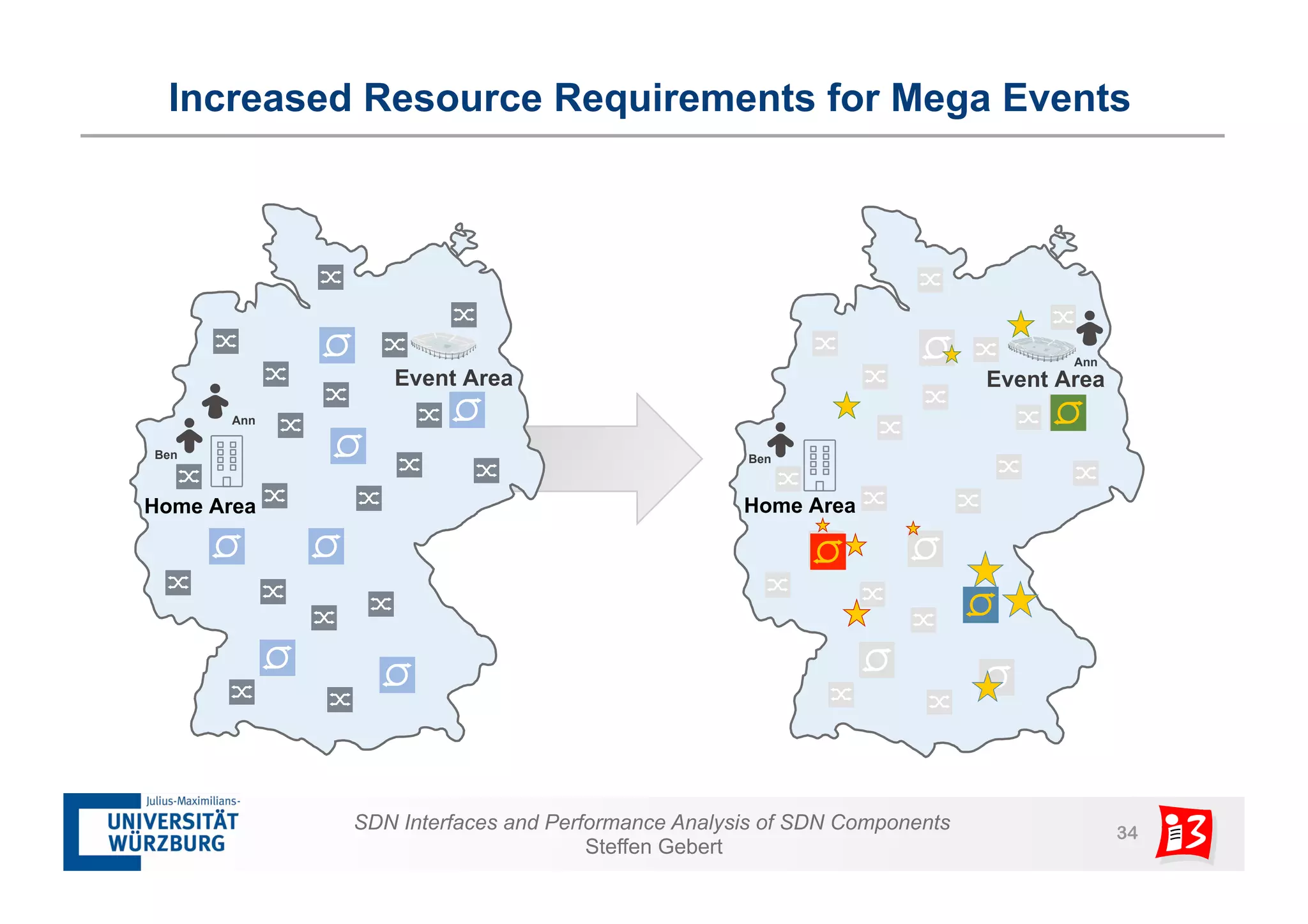
u Showcase: Dynamic instantiation of Serving Gateways (SGW) in case of 
increased resource usage caused by “mega events” 
Photo: Ericsson
SDN Legacy SDN 
Legacy SDN 
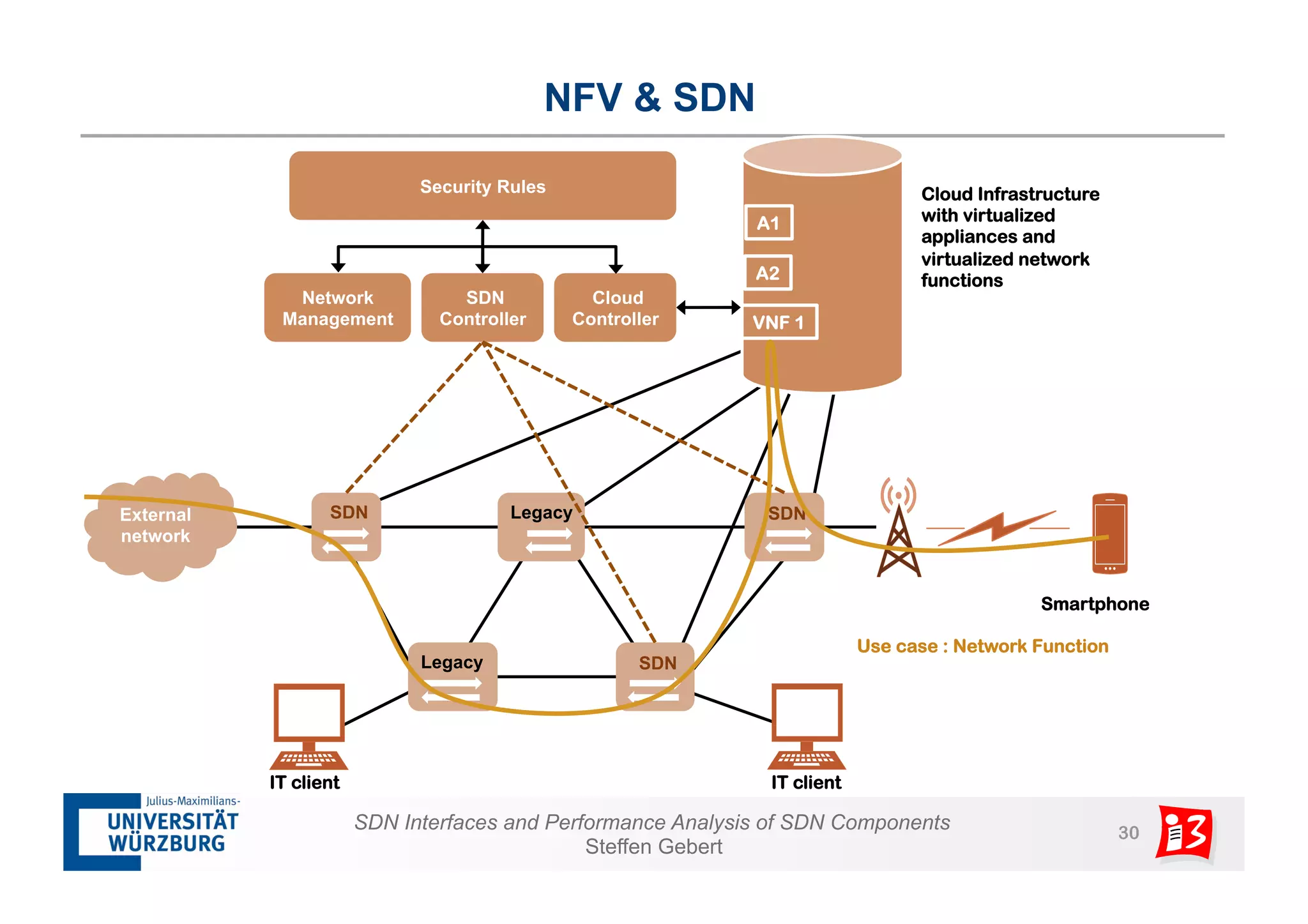
Cloud Infrastructure 
with virtualized 
appliances and 
virtualized network 
functions 
SDN Interfaces and Performance Analysis of SDN Components 30 
Steffen Gebert 
SDN 
Controller 
Network 
Management 
Security Rules 
External 
network 
A1 
A2 
VNF 1 
IT client IT client 
Use case : Network Function 
Cloud 
Controller 
Smartphone 
Cloud NFV & SDN
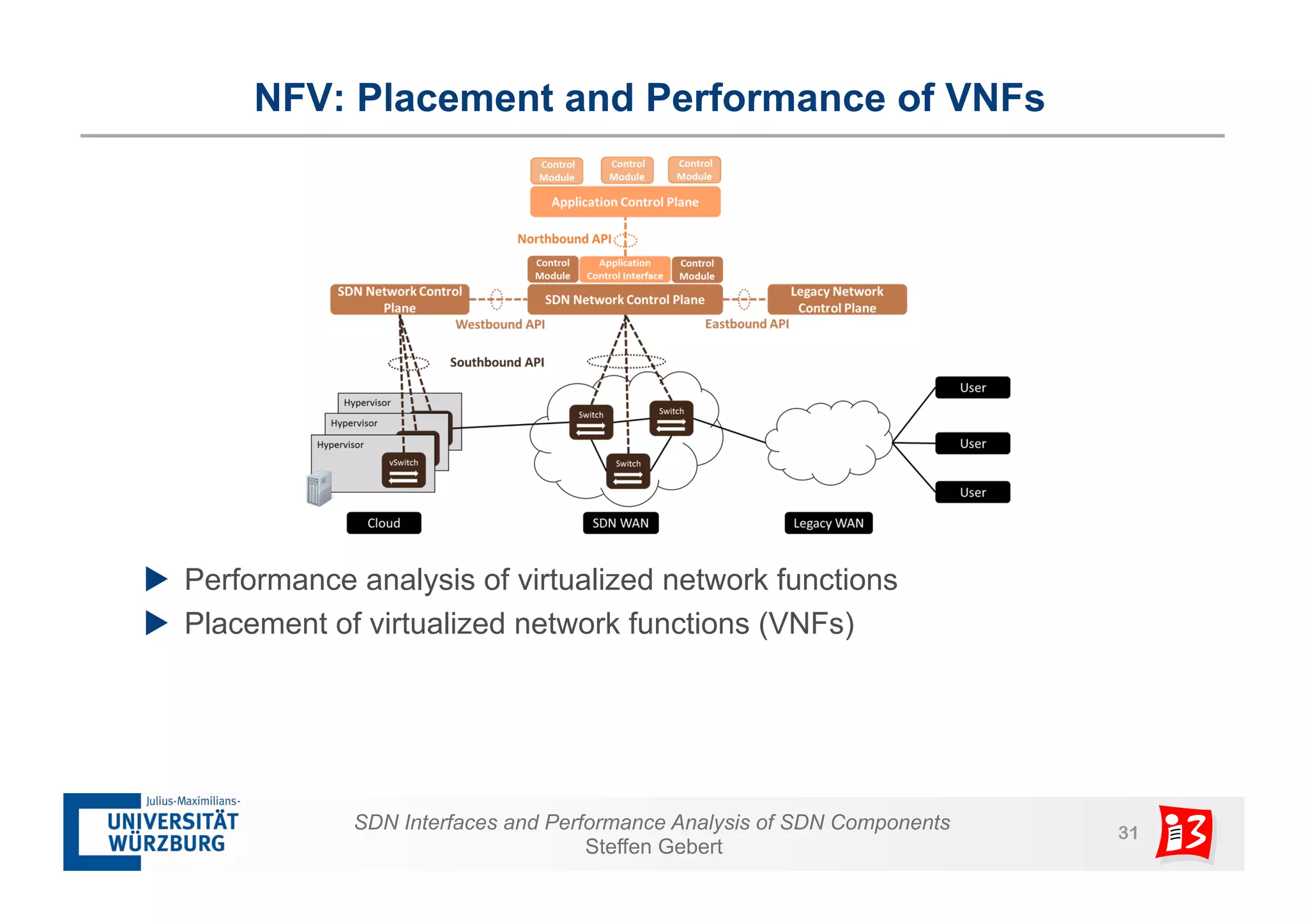
NFV: Placement and Performance of VNFs 
u Performance analysis of virtualized network functions 
u Placement of virtualized network functions (VNFs) 
SDN Interfaces and Performance Analysis of SDN Components 31 
Steffen Gebert
SDNA – Software Defined NFV Application 
MEGA EVENT USE CASE 
SDN Interfaces and Performance Analysis of SDN Components 32 
Steffen Gebert
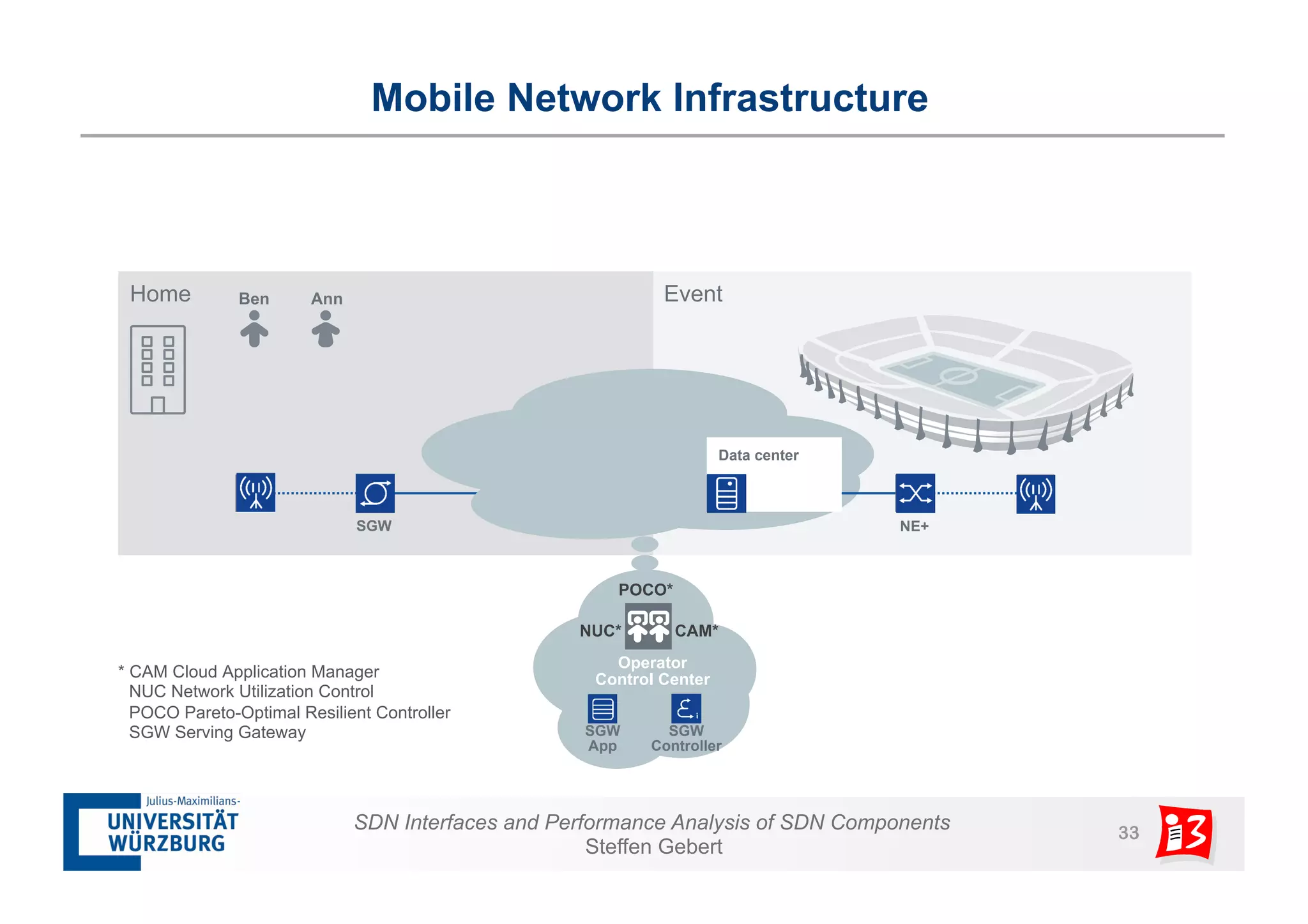
Mobile Network Infrastructure 
Home Ben Event 
NUC* CAM* 
SDN Interfaces and Performance Analysis of SDN Components 33 
Steffen Gebert 
NE+ 
Operator 
Control Center 
Ann 
* CAM Cloud Application Manager 
NUC Network Utilization Control 
POCO Pareto-Optimal Resilient Controller 
SGW Serving Gateway 
POCO* 
SGW 
Data center 
SGW 
Controller 
SGW 
App
Increased Resource Requirements for Mega Events 
Ann 
SDN Interfaces and Performance Analysis of SDN Components 34 
Steffen Gebert 
Event Area 
Ann 
Ben 
Home Area 
Ben 
Home Area 
Event Area
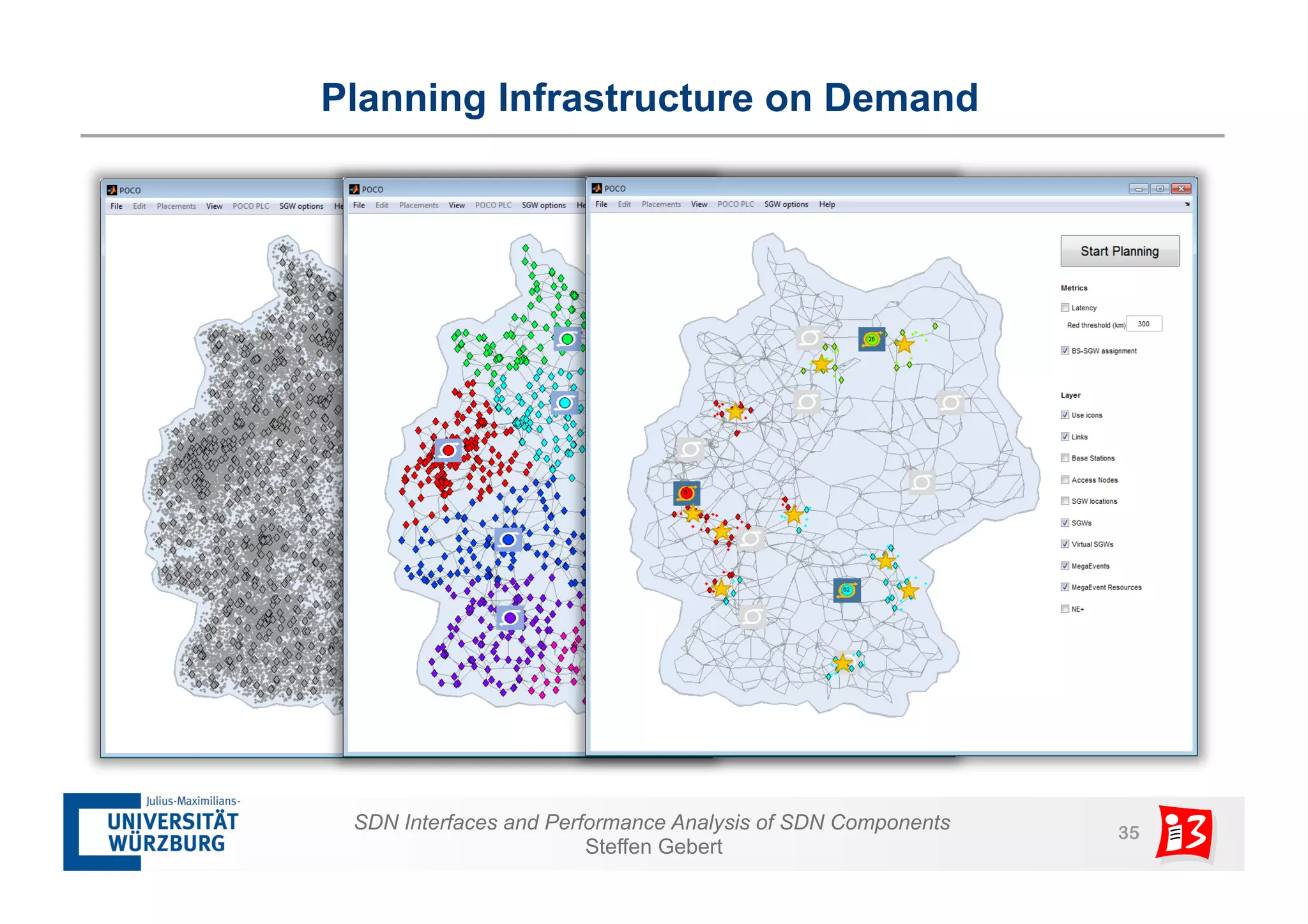
Planning Infrastructure on Demand 
SDN Interfaces and Performance Analysis of SDN Components 35 
Steffen Gebert
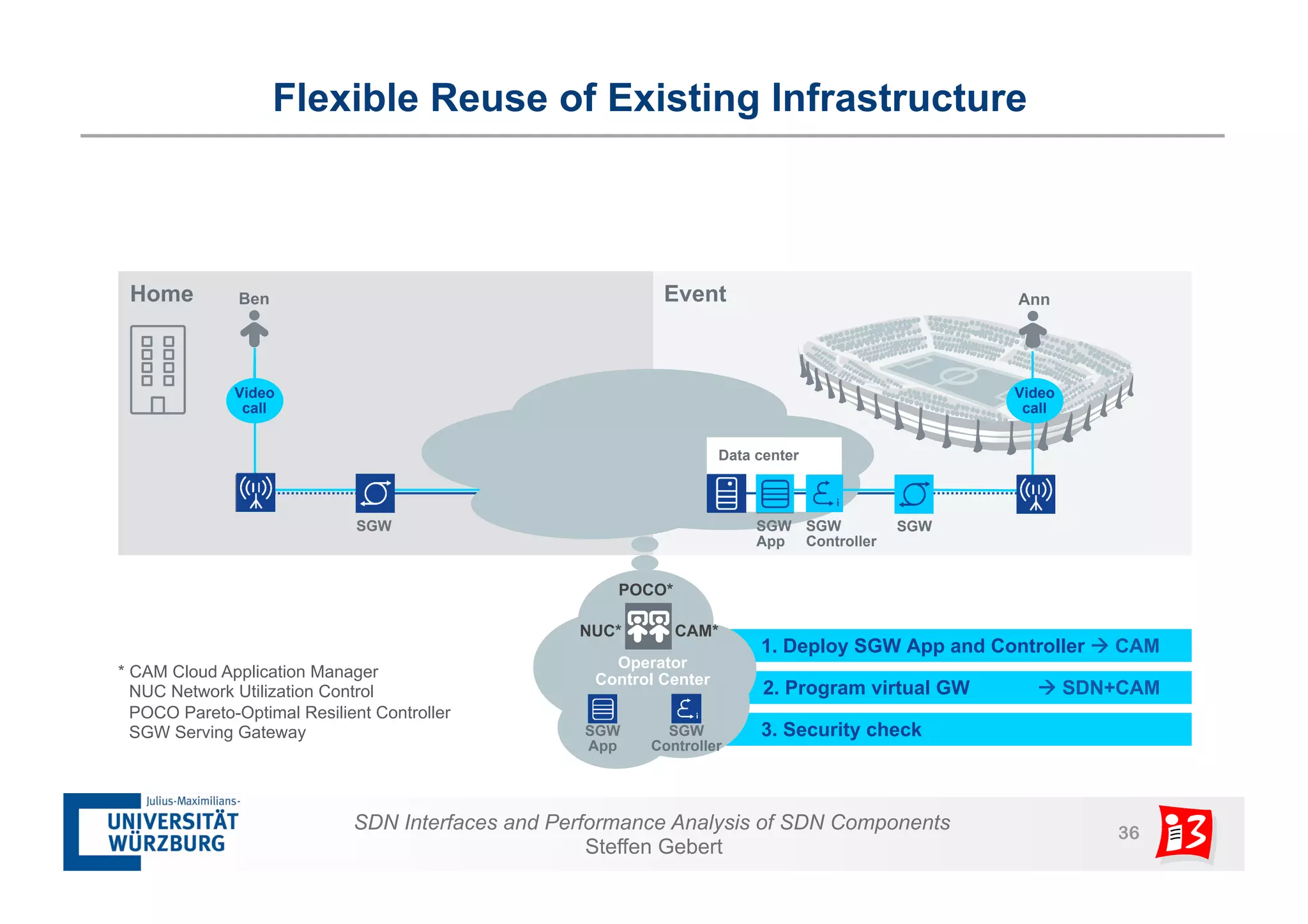
Flexible Reuse of Existing Infrastructure 
1. Deploy SGW App and Controller à CAM 
2. Program virtual GW à SDN+CAM 
NUC* CAM* 
SDN Interfaces and Performance Analysis of SDN Components 36 
Steffen Gebert 
3. Security check 
Home Ben Event 
SGW 
Operator 
Control Center 
* CAM Cloud Application Manager 
NUC Network Utilization Control 
POCO Pareto-Optimal Resilient Controller 
SGW Serving Gateway 
POCO* 
SGW 
SGW 
Controller 
SGW 
App 
Ann 
Video 
call 
Data center 
SGW 
Controller 
SGW 
App 
Video 
call
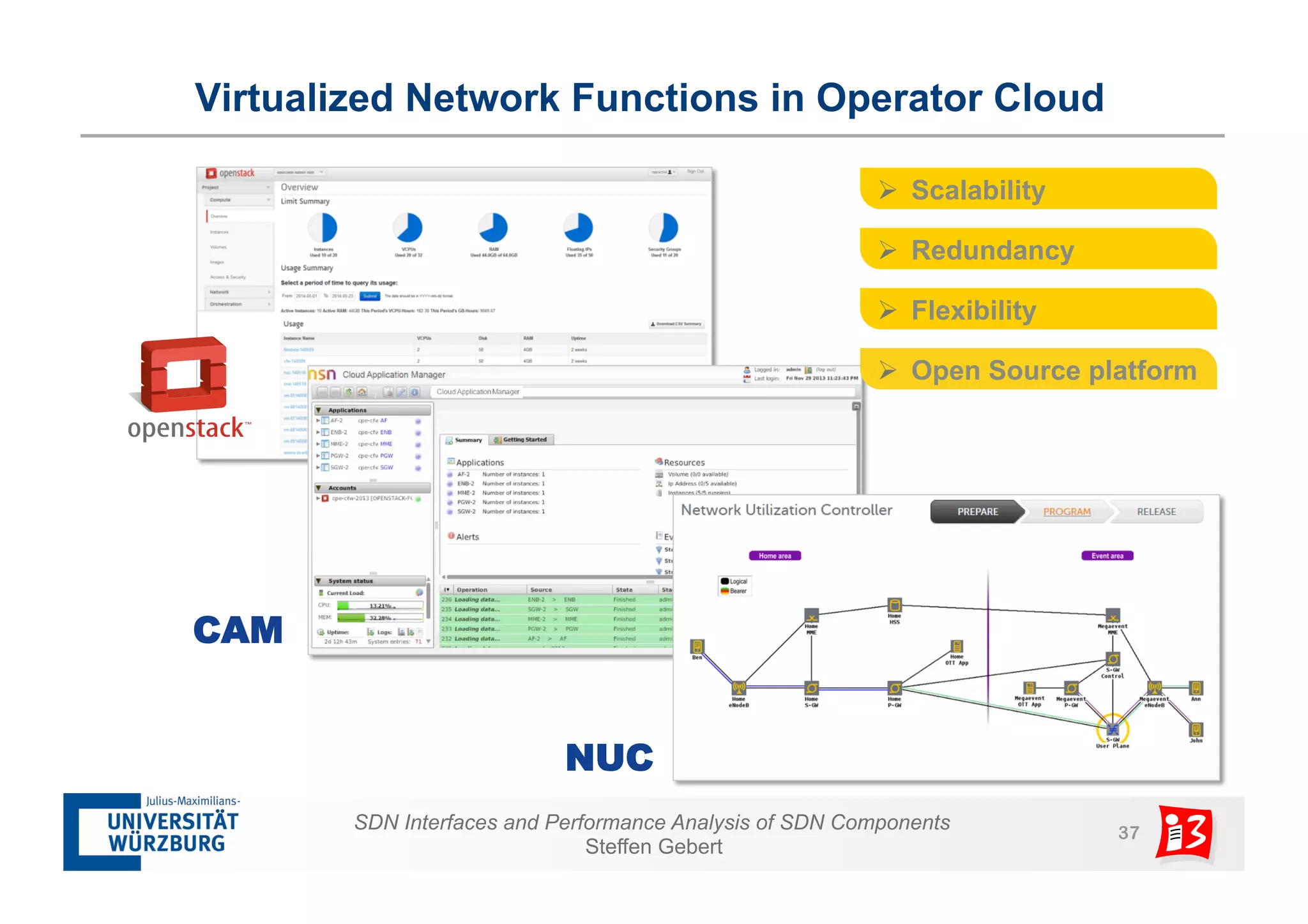
Virtualized Network Functions in Operator Cloud 
SDN Interfaces and Performance Analysis of SDN Components 37 
Steffen Gebert 
Ø Scalability 
Ø Redundancy 
Ø Flexibility 
Ø Open Source platform 
CAM 
NUC
PERFORMANCE OF 
VIRTUALIZED NETWORK 
FUNCTIONS 
SDN Interfaces and Performance Analysis of SDN Components 38 
Steffen Gebert
Performance of Virtualized Network Functions 
u Impact of softwarization on performance of network functions 
§ Impact on typical KPIs, i.e., delay, throughput 
§ Influence of dynamic function placement 
u Categorization and Modeling of VNFs 
§ By resource demands: CPU-intense, network-intense, etc. 
§ By ability to scale out: scale out delay, state-sync, etc. 
§ Identification and investigation of characteristic VNFs 
§ Analysis of the influence of the virtualization platform 
SDN Interfaces and Performance Analysis of SDN Components 39 
Steffen Gebert
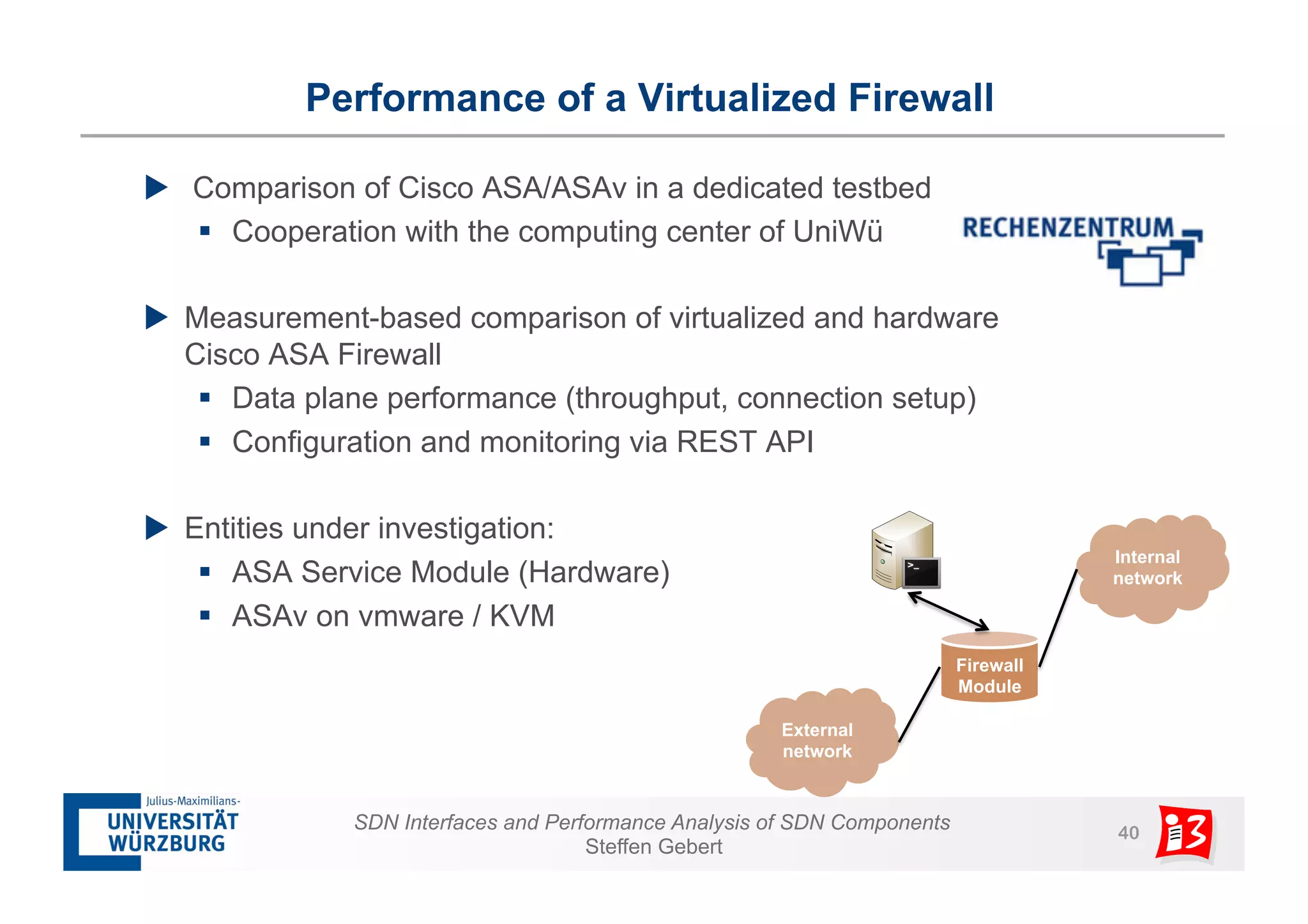
Performance of a Virtualized Firewall 
u Comparison of Cisco ASA/ASAv in a dedicated testbed 
§ Cooperation with the computing center of UniWü 
u Measurement-based comparison of virtualized and hardware 
Cisco ASA Firewall 
§ Data plane performance (throughput, connection setup) 
§ Configuration and monitoring via REST API 
SDN Interfaces and Performance Analysis of SDN Components 40 
Steffen Gebert 
u Entities under investigation: 
§ ASA Service Module (Hardware) 
§ ASAv on vmware / KVM 
External 
network 
Internal 
network 
Firewall 
Module
Summary 
u SDN interfaces are key to integration and better user experience 
§ Interaction with legacy infrastructure and cloud controller 
§ Tailored handling of traffic flows or aggregates 
§ Application-aware networking ensures optimal user experience 
u SDN control plane is performance-critical for the whole network 
§ Measurement and simulation tools provided 
§ Suggestion of (simple) analytical model 
§ Optimal controller placement and hierarchy under investigation 
u Network Functions Virtualisation (NFV) as logical step, supported by SDN 
§ Open issues regarding performance of pure software implementations, 
interfaces, placement, operations, monitoring, ... 
§ Benefit: Flexibility of the network as we know it from software 
§ Mobile network operators are planning rollout of virtualized EPC 
SDN Interfaces and Performance Analysis of SDN Components 41 
Steffen Gebert

SDN interfaces and performance analysis of SDN components

  • 1.
    Institute of ComputerScience Department of Distributed Systems Prof. Dr.-Ing. P. Tran-Gia SDN Interfaces and Performance Analysis of SDN components Steffen Gebert, David Hock, Michael Jarschel, Thomas Zinner, Phuoc Tran-Gia www3.informatik.uni-wuerzburg.de
  • 2.
    Agenda SDN Interfacesand Performance Analysis of SDN Components 2 Steffen Gebert u „A Compass for SDN“ § Interfaces § Features § Use cases u Performance of the SDN architecture § Data Plane Performance § Control Plane Performance § Analytical Model u Network Functions Virtualization § Placement in a Mobile Network § Performance Evaluation a virtualized network function
  • 3.
    IEEE Communications Magazine,June 2014 M. Jarschel, T. Zinner, T. Hossfeld, P. Tran-Gia, W. Kellerer A COMPASS FOR SDN SDN Interfaces and Performance Analysis of SDN Components 3 Steffen Gebert
  • 4.
    Interfaces… Applica8on Control Plane Northbound API SDN Network Control Plane Switch Switch SDN WAN SDN Network Control Plane SDN Interfaces and Performance Analysis of SDN Components 4 Steffen Gebert Switch Network Control Module Southbound API Network Control Module Applica8on Control Interface Applica8on Control Module Applica8on Control Module Applica8on Control Module Westbound API Hypervisor vSwitc h Hypervisor vSwitc h Hypervisor vSwitch Cloud Eastbound API User Legacy Network Control Plane Legacy WAN User User
  • 5.
    ….Features… SDN Interfacesand Performance Analysis of SDN Components 5 Steffen Gebert u Programmability § Principle and also key feature of SDN § Opens control plane to innovation and enables customization u Protocol independence § Compatibility with other networking technologies & protocols § Enables technology migration and application-tailored network stacks u Ability to dynamically modify network parameters § Active modification of network parameters close to real time § Enables fast and flexible adaptation in changing environments u Granularity § Control of traffic flows on varying aggregate level and protocol layers § Ensures scalability of the control plane to work on different levels u Elasticity § Describes the ability of the SDN control plane to scale up and down § Enables the control plane to react to variations in traffic mix and volume.
  • 6.
    …and Use Cases u Cloud Orchestration: Provisioning and operation of cloud applications requires integrated management of network and cloud framework u Load Balancing: Integration of load balancing within network forwarding elements operating on different granularities u Routing: Centralized control plane in SDN provides ample opportunities for SDN Interfaces and Performance Analysis of SDN Components 6 Steffen Gebert routing protocol adaptation u Monitoring and Measurement: Ability to perform certain network monitoring operations and measurements without additional overhead u Network Management: Automatic adaptation of network policies based on monitoring information u Application-Awareness: Better cross-layer optimization between applications and network capabilities
  • 7.
    Use-Cases and Interfaces SDN Interfaces and Performance Analysis of SDN Components 7 Steffen Gebert Interface Use Case Southbound Interface Northbound Interface Eastbound Interface Westbound Interface Cloud Orchestration ✔ ✔ X X Load Balancing ✔ ✔ X ✔ Routing ✔ X ✔ ✔ Monitoring and Measurement ✔ ✔ ✔ ✔ Network Management X ✔ ✔ X Application- Awareness X ✔ X X
  • 8.
    EXAMPLE: CLOUD ORCHESTRATION SDN Interfaces and Performance Analysis of SDN Components 8 Steffen Gebert
  • 9.
    Migration – IntraDC SDN Network Control Plane VM1 VM2 SDN Interfaces and Performance Analysis of SDN Components 9 Steffen Gebert Energy Op?mizer QoE Op?mizer Switch VM3 Switch Switch Cloud Mgmt. Module
  • 10.
    Migration – IntraDC Cloud Mgmt. Module Switch VM1 VM2 Energy Op?mizer QoE Op?mizer SDN Interfaces and Performance Analysis of SDN Components 10 Steffen Gebert VM3 Switch Switch SDN Network Control Plane
  • 11.
    Migration – IntraDC Cloud Mgmt. Module Switch VM1 VM2 Energy Op?mizer QoE Op?mizer SDN Interfaces and Performance Analysis of SDN Components 11 Steffen Gebert VM3 Switch Switch SDN Network Control Plane
  • 12.
    Migration – InterDC Energy Op?mizer QoE Op?mizer QoE Op?mizer Network Control WAN Op?mizer Network Mgmt. Module Switch SDN Interfaces and Performance Analysis of SDN Components 12 Steffen Gebert SDN Network Control Plane VM1 VM2 VM3 Cloud Mgmt. Module Switch Switch Energy Op?mizer Cloud Mgmt. Module SDN Network Control Plane Switch Switch SDN Network Control Plane Switch Switch Switch
  • 13.
    Migration – InterDC Energy Op?mizer QoE Op?mizer QoE Op?mizer Network Control WAN Op?mizer Network Mgmt. Module Switch SDN Interfaces and Performance Analysis of SDN Components 13 Steffen Gebert SDN Network Control Plane VM2 VM3 Cloud Mgmt. Module Switch Switch Energy Op?mizer Cloud Mgmt. Module SDN Network Control Plane Switch Switch SDN Network Control Plane Switch Switch Switch VM1
  • 14.
    Migration – InterDC SDN Interfaces and Performance Analysis of SDN Components 14 Steffen Gebert u Problems: § Variability of traffic § Application requirements § Interaction between controllers § etc… B4: Software- Defined WAN (Google, ACM Sigcomm 2013)
  • 15.
    Current Research Topics u Performance evaluation of the SDN architecture u (Controller placement and controller architectures) u (SDN-based application and network interaction) u NFV – placement and performance SDN Interfaces and Performance Analysis of SDN Components 15 Steffen Gebert
  • 16.
    PERFORMANCE OF THESDN ARCHITECTURE SDN Interfaces and Performance Analysis of SDN Components 16 Steffen Gebert
  • 17.
    Performance of theSDN Architecture u Performance of the data plane u Performance analysis of SDN Controller u Modeling and performance evaluation of the SDN architecture SDN Interfaces and Performance Analysis of SDN Components 17 Steffen Gebert
  • 18.
    Performance of theData Plane u Analysis of throughput and processing delays of OpenFlow enabled forwarding devices § Open vSwitch § NetFPGA § Pronto OpenFlow-enabled switch u Testbed to measure data plane SDN Interfaces and Performance Analysis of SDN Components 18 Steffen Gebert performance of devices § Link rate of 1Gbit/s § Endace DAG card to capture traffic
  • 19.
    Results – Numberof Forwarding Rules u Processing delay for a nearly empty (one rule) and a full flow table u Significant impact of payload length on processing delays u High impact of flow table entries on NetFPGA performance SDN Interfaces and Performance Analysis of SDN Components 19 Steffen Gebert
  • 20.
    Results – Forwardingto Controller u Impact on processing delays by forwarding all packets to NOX controller u Massive packet loss between 95% and 99% u Significantly increased processing times u Controller acts as bottleneck in this scenario SDN Interfaces and Performance Analysis of SDN Components 20 Steffen Gebert
  • 21.
    Performance Analysis ofSDN Controllers u Analysis of KPIs of SDN controller software in realistic environments § Throughput, latency, CPU & RAM, IAT,… § Holistic framework for different OpenFlow versions SDN Interfaces and Performance Analysis of SDN Components 21 Steffen Gebert u Implementation of OFCProbe § Emulates data plane message and resulting control plane traffic u Features § Generated control messages per switch § Topology emulation and PCAP file playback § Incoming data packets can be arbitrarily distributed
  • 22.
    Outstanding Packets: Floodlight u Floodlight: Uniform handling of particular switches - consistent behavior u Nox: Non-uniform handling – “waves” detectable SDN Interfaces and Performance Analysis of SDN Components 22 Steffen Gebert
  • 23.
    Performance Evaluation ofSDN u Investigation of the performance of the SDN architecture for changing parameters § Modeling of control and data plane § System scalability and limitations of the concept u Evaluations using analytical modeling and simulations § Input parameters based on measurements with real hardware § Verification of analytical results with simulations SDN Interfaces and Performance Analysis of SDN Components 23 Steffen Gebert u Simulation of OpenFlow § OpenFlow implementation for OMNeT++: OFOmnet § Code available at https://github.com/lsinfo3/ofomnet
  • 24.
    Simple Model ofSDN u Abstraction as feedback-oriented queuing system model § Forward queueing system of type M/GI/1 § Feedback queueing system M/GI/1-S SDN Interfaces and Performance Analysis of SDN Components 24 Steffen Gebert
  • 25.
    Results for DifferentForwarding Probabilities u Impact of different forwarding probabilities on the average packet SDN Interfaces and Performance Analysis of SDN Components 25 Steffen Gebert sojourn time u Mean sojourn time increases for increasing controller load and for increasing forwarding probability
  • 26.
    SDN Performance: Summary u Performance analysis of SDN architecture and SDN control plane § Controller analysis using OFCProbe § Performance evaluation of the architecture using models u Main results of the current investigations § Diverse behavior of software control planes, e.g., Floodlight outperforms NOX in terms of throughput and fairness § Scalability mainly depends on control plane SDN Interfaces and Performance Analysis of SDN Components 26 Steffen Gebert u Other issues: § Investigation of different topologies and software controllers § Integration and investigation of OpenFlow 1.3 § Impact of messages via Northbound interface § Extension of the analytical models
  • 27.
    NFV – PLACEMENTAND PERFORMANCE SDN Interfaces and Performance Analysis of SDN Components 27 Steffen Gebert
  • 28.
    Network Functions Virtualization SDN Interfaces and Performance Analysis of SDN Components 28 Steffen Gebert
  • 29.
    NFV in MobileNetworks u Problem: Mobile Core consists of numerous expensive, proprietary, overdimensioned middle boxes. SDN Interfaces and Performance Analysis of SDN Components 29 Steffen Gebert u Idea: § Move network function into software (NFV) § Run and orchestrate it in cloud u Advantages: § Shorter release cycles § Elasticity § Flexibility u Showcase: Dynamic instantiation of Serving Gateways (SGW) in case of increased resource usage caused by “mega events” Photo: Ericsson
  • 30.
    SDN Legacy SDN Legacy SDN Cloud Infrastructure with virtualized appliances and virtualized network functions SDN Interfaces and Performance Analysis of SDN Components 30 Steffen Gebert SDN Controller Network Management Security Rules External network A1 A2 VNF 1 IT client IT client Use case : Network Function Cloud Controller Smartphone Cloud NFV & SDN
  • 31.
    NFV: Placement andPerformance of VNFs u Performance analysis of virtualized network functions u Placement of virtualized network functions (VNFs) SDN Interfaces and Performance Analysis of SDN Components 31 Steffen Gebert
  • 32.
    SDNA – SoftwareDefined NFV Application MEGA EVENT USE CASE SDN Interfaces and Performance Analysis of SDN Components 32 Steffen Gebert
  • 33.
    Mobile Network Infrastructure Home Ben Event NUC* CAM* SDN Interfaces and Performance Analysis of SDN Components 33 Steffen Gebert NE+ Operator Control Center Ann * CAM Cloud Application Manager NUC Network Utilization Control POCO Pareto-Optimal Resilient Controller SGW Serving Gateway POCO* SGW Data center SGW Controller SGW App
  • 34.
    Increased Resource Requirementsfor Mega Events Ann SDN Interfaces and Performance Analysis of SDN Components 34 Steffen Gebert Event Area Ann Ben Home Area Ben Home Area Event Area
  • 35.
    Planning Infrastructure onDemand SDN Interfaces and Performance Analysis of SDN Components 35 Steffen Gebert
  • 36.
    Flexible Reuse ofExisting Infrastructure 1. Deploy SGW App and Controller à CAM 2. Program virtual GW à SDN+CAM NUC* CAM* SDN Interfaces and Performance Analysis of SDN Components 36 Steffen Gebert 3. Security check Home Ben Event SGW Operator Control Center * CAM Cloud Application Manager NUC Network Utilization Control POCO Pareto-Optimal Resilient Controller SGW Serving Gateway POCO* SGW SGW Controller SGW App Ann Video call Data center SGW Controller SGW App Video call
  • 37.
    Virtualized Network Functionsin Operator Cloud SDN Interfaces and Performance Analysis of SDN Components 37 Steffen Gebert Ø Scalability Ø Redundancy Ø Flexibility Ø Open Source platform CAM NUC
  • 38.
    PERFORMANCE OF VIRTUALIZEDNETWORK FUNCTIONS SDN Interfaces and Performance Analysis of SDN Components 38 Steffen Gebert
  • 39.
    Performance of VirtualizedNetwork Functions u Impact of softwarization on performance of network functions § Impact on typical KPIs, i.e., delay, throughput § Influence of dynamic function placement u Categorization and Modeling of VNFs § By resource demands: CPU-intense, network-intense, etc. § By ability to scale out: scale out delay, state-sync, etc. § Identification and investigation of characteristic VNFs § Analysis of the influence of the virtualization platform SDN Interfaces and Performance Analysis of SDN Components 39 Steffen Gebert
  • 40.
    Performance of aVirtualized Firewall u Comparison of Cisco ASA/ASAv in a dedicated testbed § Cooperation with the computing center of UniWü u Measurement-based comparison of virtualized and hardware Cisco ASA Firewall § Data plane performance (throughput, connection setup) § Configuration and monitoring via REST API SDN Interfaces and Performance Analysis of SDN Components 40 Steffen Gebert u Entities under investigation: § ASA Service Module (Hardware) § ASAv on vmware / KVM External network Internal network Firewall Module
  • 41.
    Summary u SDNinterfaces are key to integration and better user experience § Interaction with legacy infrastructure and cloud controller § Tailored handling of traffic flows or aggregates § Application-aware networking ensures optimal user experience u SDN control plane is performance-critical for the whole network § Measurement and simulation tools provided § Suggestion of (simple) analytical model § Optimal controller placement and hierarchy under investigation u Network Functions Virtualisation (NFV) as logical step, supported by SDN § Open issues regarding performance of pure software implementations, interfaces, placement, operations, monitoring, ... § Benefit: Flexibility of the network as we know it from software § Mobile network operators are planning rollout of virtualized EPC SDN Interfaces and Performance Analysis of SDN Components 41 Steffen Gebert