1) The document discusses security challenges in software defined networks (SDNs) including threats to the application plane, control plane, and data plane due to the separation of the control and data planes in SDNs.
2) It describes various security approaches and platforms that can secure each plane and provide network-wide security in SDNs.
3) The paper analyzes SDN security according to several dimensions and highlights both present and future security challenges in SDNs to guide further research on secure SDN architectures.
![IEEE COMMUNICATION SURVEYS & TUTORIALS, VOL. 17, NO. 4, FOURTH QUARTER 2015 2317
Security in Software Defined Networks: A Survey
Ijaz Ahmad, Suneth Namal, Mika Ylianttila, Senior Member, IEEE, and Andrei Gurtov, Senior Member, IEEE
Abstract—Software defined networking (SDN) decouples the
network control and data planes. The network intelligence and
state are logically centralized and the underlying network infras-
tructure is abstracted from applications. SDN enhances network
security by means of global visibility of the network state where
a conflict can be easily resolved from the logically centralized
control plane. Hence, the SDN architecture empowers networks to
actively monitor traffic and diagnose threats to facilitates network
forensics, security policy alteration, and security service insertion.
The separation of the control and data planes, however, opens
security challenges, such as man-in-the middle attacks, denial of
service (DoS) attacks, and saturation attacks. In this paper, we
analyze security threats to application, control, and data planes of
SDN. The security platforms that secure each of the planes are de-
scribed followed by various security approaches for network-wide
security in SDN. SDN security is analyzed according to security
dimensions of the ITU-T recommendation, as well as, by the costs
of security solutions. In a nutshell, this paper highlights the present
and future security challenges in SDN and future directions for
secure SDN.
Index Terms—SDN, OpenFlow, network security, SDN security,
application plane, control plane, data plane.
I. INTRODUCTION
SOFTWARE defined networking (SDN) has become one of
the most important network architectures for simplifying
network management and enabling innovation in communica-
tion networks. SDN decouples the network control from the
data forwarding plane. The control plane is logically centralized
and the forwarding plane is rendered simple to act on decisions
from the control plane [1]. In SDN, new control functions can
be implemented by writing software-based logic in the control
plane which deploys the decision logic in the forwarding plane
through standard interfaces. A network operating system (NOS)
in the control plane maps the entire network to different services
and applications that are implemented on top of the control
plane.
OpenFlow [2] is the most accepted and widely used imple-
mentation architecture of SDN. In OpenFlow, network policies
and services are implemented as OpenFlow applications which
interact with the control plane through the north-bound API
(application programming interface) of the control plane. The
control plane functionalities are implemented in an OpenFlow
Manuscript received January 7, 2015; revised July 5, 2015; accepted
August 15, 2015. Date of publication August 27, 2015; date of current version
November 18, 2015.
I. Ahmad, S. Namal, and M. Ylianttila are with the Department of Com-
munications Engineering, University of Oulu, 90014 Oulu, Finland (e-mail:
iahmad@ee.oulu.fi; namal@ee.oulu.fi; mika.ylianttila@oulu.fi)
A. Gurtov is with Helsinki Institute for Information Technology (HIIT)
and Department of Computer Science, Aalto University, 00076 Aalto, Finland
(e-mail: gurtov@hiit.fi).
Digital Object Identifier 10.1109/COMST.2015.2474118
controller which interacts with the data plane through the
OpenFlow protocol (south-bound API). OpenFlow-based SDN
applications are developed that use the underlying network
infrastructure and deploy various functions at run-time. Hence,
control of the network traffic is transferred from the infrastruc-
ture to the administrator. As a result, network operators will
gain high levels of network control, automation and optimiza-
tion with the help of SDN applications.
SDN enhances network security with the centralized control
of network behavior, global visibility of the network state and
run-time manipulation of traffic forwarding rules. The central-
ized nature of networking in SDN enables enforcing network-
wide security policies and mitigates the risks of policy collision.
A network security application (e.g., security monitoring appli-
cation) can request flow samples through the controller from
the datapath. After security analysis, the security application
can redirect the data path elements to either block the traffic,
reroute to security middle boxes or restrict the traffic within
a particular network jurisdiction. Moreover, updating security
policies in SDN requires updating the security applications or
adding security modules to the controller platform, rather than
changing the hardware or updating its firmware.
On the contrary, conventional networks comprise large sets
of vendor-specific manually configurable devices spread across
networks. These devices are hardwired with specific algorithms
used to route, control and monitor data flow based on function-
specific logic in each device. Hence, it is difficult to seam-
lessly combine them into a single domain along with all the
proprietary protocols, applications, and interfaces. The result
is that legacy network architectures lack global visibility of the
network state and have difficulties in deploying and maintaining
coherent network-wide policies. This complexity and weak-
nesses in integration make it worse for maintaining stable and
robust network security. For example, changing or updating se-
curity policies in these systems in the wake of changes in traffic
behavior or intrusions is practically unmanageable and costly.
Network security in legacy network architectures is con-
sidered as an add-on which relies on manually configurable
perimeter-based solutions. To implement a high-level network
security policy, network operators must configure each device
using vendor-specific low-level commands. However, manual
configurations of network security technologies such as fire-
walls, intrusion detection/prevention systems (IDS/IPS) and
IPSec technologies on extended sets of devices are prone to
configuration errors, intra- and inter- domain policy conflicts
that result in serious security breaches and threats [3]. A quanti-
tative study on firewall configuration errors [4] shows that
corporate firewalls enforce rule sets that violate well-known se-
curity guidelines and result in security breaches due to manual
low-level configurations in each of the devices.
1553-877X © 2015 IEEE. Personal use is permitted, but republication/redistribution requires IEEE permission.
See http://www.ieee.org/publications_standards/publications/rights/index.html for more information.](https://image.slidesharecdn.com/securitysdn-170204174709/85/Security-sdn-1-320.jpg)
![IEEE COMMUNICATION SURVEYS & TUTORIALS, VOL. 17, NO. 4, FOURTH QUARTER 2015 2317
Security in Software Defined Networks: A Survey
Ijaz Ahmad, Suneth Namal, Mika Ylianttila, Senior Member, IEEE, and Andrei Gurtov, Senior Member, IEEE
Abstract—Software defined networking (SDN) decouples the
network control and data planes. The network intelligence and
state are logically centralized and the underlying network infras-
tructure is abstracted from applications. SDN enhances network
security by means of global visibility of the network state where
a conflict can be easily resolved from the logically centralized
control plane. Hence, the SDN architecture empowers networks to
actively monitor traffic and diagnose threats to facilitates network
forensics, security policy alteration, and security service insertion.
The separation of the control and data planes, however, opens
security challenges, such as man-in-the middle attacks, denial of
service (DoS) attacks, and saturation attacks. In this paper, we
analyze security threats to application, control, and data planes of
SDN. The security platforms that secure each of the planes are de-
scribed followed by various security approaches for network-wide
security in SDN. SDN security is analyzed according to security
dimensions of the ITU-T recommendation, as well as, by the costs
of security solutions. In a nutshell, this paper highlights the present
and future security challenges in SDN and future directions for
secure SDN.
Index Terms—SDN, OpenFlow, network security, SDN security,
application plane, control plane, data plane.
I. INTRODUCTION
SOFTWARE defined networking (SDN) has become one of
the most important network architectures for simplifying
network management and enabling innovation in communica-
tion networks. SDN decouples the network control from the
data forwarding plane. The control plane is logically centralized
and the forwarding plane is rendered simple to act on decisions
from the control plane [1]. In SDN, new control functions can
be implemented by writing software-based logic in the control
plane which deploys the decision logic in the forwarding plane
through standard interfaces. A network operating system (NOS)
in the control plane maps the entire network to different services
and applications that are implemented on top of the control
plane.
OpenFlow [2] is the most accepted and widely used imple-
mentation architecture of SDN. In OpenFlow, network policies
and services are implemented as OpenFlow applications which
interact with the control plane through the north-bound API
(application programming interface) of the control plane. The
control plane functionalities are implemented in an OpenFlow
Manuscript received January 7, 2015; revised July 5, 2015; accepted
August 15, 2015. Date of publication August 27, 2015; date of current version
November 18, 2015.
I. Ahmad, S. Namal, and M. Ylianttila are with the Department of Com-
munications Engineering, University of Oulu, 90014 Oulu, Finland (e-mail:
iahmad@ee.oulu.fi; namal@ee.oulu.fi; mika.ylianttila@oulu.fi)
A. Gurtov is with Helsinki Institute for Information Technology (HIIT)
and Department of Computer Science, Aalto University, 00076 Aalto, Finland
(e-mail: gurtov@hiit.fi).
Digital Object Identifier 10.1109/COMST.2015.2474118
controller which interacts with the data plane through the
OpenFlow protocol (south-bound API). OpenFlow-based SDN
applications are developed that use the underlying network
infrastructure and deploy various functions at run-time. Hence,
control of the network traffic is transferred from the infrastruc-
ture to the administrator. As a result, network operators will
gain high levels of network control, automation and optimiza-
tion with the help of SDN applications.
SDN enhances network security with the centralized control
of network behavior, global visibility of the network state and
run-time manipulation of traffic forwarding rules. The central-
ized nature of networking in SDN enables enforcing network-
wide security policies and mitigates the risks of policy collision.
A network security application (e.g., security monitoring appli-
cation) can request flow samples through the controller from
the datapath. After security analysis, the security application
can redirect the data path elements to either block the traffic,
reroute to security middle boxes or restrict the traffic within
a particular network jurisdiction. Moreover, updating security
policies in SDN requires updating the security applications or
adding security modules to the controller platform, rather than
changing the hardware or updating its firmware.
On the contrary, conventional networks comprise large sets
of vendor-specific manually configurable devices spread across
networks. These devices are hardwired with specific algorithms
used to route, control and monitor data flow based on function-
specific logic in each device. Hence, it is difficult to seam-
lessly combine them into a single domain along with all the
proprietary protocols, applications, and interfaces. The result
is that legacy network architectures lack global visibility of the
network state and have difficulties in deploying and maintaining
coherent network-wide policies. This complexity and weak-
nesses in integration make it worse for maintaining stable and
robust network security. For example, changing or updating se-
curity policies in these systems in the wake of changes in traffic
behavior or intrusions is practically unmanageable and costly.
Network security in legacy network architectures is con-
sidered as an add-on which relies on manually configurable
perimeter-based solutions. To implement a high-level network
security policy, network operators must configure each device
using vendor-specific low-level commands. However, manual
configurations of network security technologies such as fire-
walls, intrusion detection/prevention systems (IDS/IPS) and
IPSec technologies on extended sets of devices are prone to
configuration errors, intra- and inter- domain policy conflicts
that result in serious security breaches and threats [3]. A quanti-
tative study on firewall configuration errors [4] shows that
corporate firewalls enforce rule sets that violate well-known se-
curity guidelines and result in security breaches due to manual
low-level configurations in each of the devices.
1553-877X © 2015 IEEE. Personal use is permitted, but republication/redistribution requires IEEE permission.
See http://www.ieee.org/publications_standards/publications/rights/index.html for more information.](https://image.slidesharecdn.com/securitysdn-170204174709/75/Security-sdn-1-2048.jpg)
![2318 IEEE COMMUNICATION SURVEYS & TUTORIALS, VOL. 17, NO. 4, FOURTH QUARTER 2015
Fig. 1. The three planes/layers in the SDN architecture.
By logically centralizing the network control plane and in-
troducing programmability, SDN enables security automation
and run-time deployment of security procedures and policies.
Network security systems leveraging from SDN can respond
to network anomalies and spurious traffic conditions at run-
time. To elaborate the functionality of the SDN architecture,
the three main functional layers or SDN planes are presented in
Fig. 1 and are constituted of:
• Application Plane: It contains SDN applications for var-
ious functionalities, such as network management, policy
implementation, and security services.
• Control Plane: It is a logically centralized control frame-
work that runs the NOS, maintains global view of the
network, and provides hardware abstractions to SDN
applications.
• Data Plane: It is the combination of forwarding elements
used to forward traffic flows based on instructions from
the control plane.
Network security techniques can be implemented as applica-
tions in the SDN application plane. These applications would ac-
quire the network state or resource information from thenetwork
control plane through the north-boundinterface (App-Ctrl API).
Similarly, security applications can collect samples of packets
through the control plane. After security analysis, security
applications/systems can redirect the traffic according to higher
level security policies via the control plane using the south-
bound API (Ctrl-Infra-API). Unlike traditional networks, data
handling rules in SDN are implemented as software modules
rather than embedding them in the hardware, thus, allowing
run-time implementation of security policies and procedures.
However, SDN has its own challenges and limitations in
terms of security, scalability, and supportability. Security has
been on the forefront of these challenges. Since a centralized
controller is responsible for managing the entire network,
security compromise of the controller can render the whole net-
work compromised. Furthermore, security lapses in controller-
datapath communication can lead to illegitimate access and
usage of network resources. On one hand, SDN enables ap-
plications to interact with the control plane to access network
resources, deploy new functionalities and manipulate the be-
havior of the network. On the other hand, securing the network
from malicious applications or abnormal behavior of applica-
tions is a serious security challenge in SDN. Network security
is crucial for the success of a networking technology and com-
munication networks must provide end-to-end communication
security.
In this paper, we are describing security challenges in SDNs
with proposed security solutions, and security platforms. An
analysis of network security in SDN is presented in [5].
Scott et al. [5] provide a brief overview of security challenges
in SDN and describe some of the existing frameworks for
enhancing security in SDN. It is stated in [5] that even though
security as an advantage of SDN has been recognized, still there
are fewer SDN security solutions. However, [5] is limited in
scope and does not cover the recent advances in SDN security.
In this paper, we aim at providing a comprehensive and up-to-
date overview of security in SDN by presenting security chal-
lenges and solutions related to individual SDN planes i.e., the
application plane, control plane, and data plane. We also de-
scribe network-wide security solutions and security develop-
ment platforms in SDN, categorize security solutions according
to the ITU-T security recommendations, and briefly present
costs of various security architectures.
This paper is organized as follows. Section II describes se-
curity in past programmable networking proposals followed by
the concepts of SDN in Section III. Security challenges existing
in each of the three planes (i.e., Application, Control, and Data
planes) of SDN are presented in Section IV. Security proposals,
platforms and solutions for each of the three planes in SDN
are discussed in Section V. Network-wide security platforms
for SDN are presented in Section VI. SDN-based virtual and
cloud networks’ security is described in Section VII. SDN se-
curity frameworks and platforms are categorized and discussed
according to the ITU-T recommendations in Section VIII.
Future research directions for security in SDN are outlined in
Section IX and the paper is concluded in Section X.
II. SECURITY IN PROGRAMMABLE NETWORKS: THE PAST
Security has been a daunting task in communication net-
works due to the underlying network complexities, proprietary
and perimeter-based security solutions that are difficult to man-
age, and the weak notions of identity in IP networks. Similarly,
the Internet architecture that defines procedures for usage of the
underlying infrastructure [6], inherits the problems arising from
the infrastructure, is ripe with security challenges and is stag-
nant to innovation. Therefore, many proposals have been put
forward for (re)architecting the Internet to curtail its inherent
limitations, and to minimize its complexities and security vul-
nerabilities. In this section, we discuss those proposals which
either had an impact on network security or network security
has been its important objective besides other objectives.
A. Active Networking
Active networking was proposed to enable programmability
of nodes (e.g., routers and switches) through user injected](https://image.slidesharecdn.com/securitysdn-170204174709/85/Security-sdn-2-320.jpg)
![AHMAD et al.: SECURITY IN SOFTWARE DEFINED NETWORKS: A SURVEY 2319
programs [7]. In active networks, nodes perform customized
computation on the payload that passes through them. Hence,
the nodes can be tailored to function according to user or
application requirements. The benefits of active networking are
i) deployability of adaptive protocols, ii) capability to imple-
ment fine-grained application-specific functionalities in desired
nodes within the network, and iii) user driven customiza-
tion of the infrastructure to enable fast deployment of new
services [8].
A major challenge for active networks was to secure active
nodes from malicious user-injected programs. As a result,
active security [9] and other security approaches [10] were pro-
posed to ensure a node’s security through authentication and au-
thorization mechanisms. However, complexity in management
and security of active nodes remained challenging tasks in
active networks.
B. The 4D Approach
Greenberg et al. [11] associate the fragile nature of com-
munication networks to the complex nature of control and
management planes in traditional networks. It is illustrated that
the lack of coordination between routing and security mecha-
nisms result in a fragile network and security lapses.
Henceforth, a clean-slate approach is proposed called the
“4D approach,” named after the four planes of decision, dis-
semination, discovery, and data. The 4D architecture com-
pletely re-factors the functionalities of a network and separate
the network control from the forwarding substrate. The authors
propose that a network architecture should be based on three
key principles i.e., i) network-level objectives, ii) network-wide
views, and iii) direct control [11].
In the 4D architecture, network security objectives are
considered as network-level goals and network security is con-
sidered as an integral part of the network management. The
separation logic was proposed to enable new, simpler, more
robust, more reliable, and more secure control and management
protocols from a centralized decision plane. The similarity in
principle objectives (e.g., Data-Control plane separation) 4D
and SDN shows that the SDN architecture is the recent version
of the 4D architecture. Similarly, OpenFlow has sprung from
the ideas of the 4D project as stated in [12].
C. SANE
Secure Architecture for the Networked Enterprise (SANE)
[13] is a clean-slate protection architecture for enterprise net-
works. The design goals of SANE include an architecture that
supports simple but powerful natural policies, independence
from topology and network equipment, link layer security, pro-
tection of topology and services information from unauthorized
access, and centralized definition and execution of all the
policies [13]. The SANE architecture has a Domain Controller
(DC) that performs three main functions. First, the DC authenti-
cates users, hosts, and switches, and maintains a symmetric key
with each for secure communication. Second, it advertises and
controls access to available services. Third, the DC controls all
the connectivity in a SANE network.
The idea of SANE emerged to solve the complexity of secu-
rity systems (security boxes) used in enterprises. Traditionally,
configuration of these boxes is complex, often dependent on
network topology and based on addresses or physical ports that
make network management difficult and result in fragile net-
work security. SANE allows simple high-level policies which
are expressed centrally and are enforced by a single fine-grained
mechanism within the network. The complexity challenges
are solved with the help of centralized decision making and
reducing the number of trusted and configured components with
simple and minimally-trusted forwarding elements. The SANE
architecture has been extended to Ethane [14] that is based on the
principle of incremental deployment in enterprise networks [15].
D. Ethane
Although, the main theme of the Ethane project [14] was to
centralize the control logic of a network, it decouples the archi-
tecture from the infrastructure in a way that the forwarding
switches are acting on behest of the centralized controller.
The Ethane architecture comprises a centralized controller with
global view of the network, simple and dumb Ethane switches
with a simple flow table, and a secure channel to the controller.
Besides proper policy management in the network, security has
been considered as an integral part of the network management
and hence identity-based access control has been considered
for the architecture. Ethane follows the work of the SANE [13]
architecture and has a resemblance to SANE. However, unlike
SANE, in Ethane security is considered as a subset of network
management, and due to its backwards-compatibility, it can be
deployed incrementally.
Ethane is built around three main principles. First, the net-
work is governed by policies which are declared over high-level
names. Second, policies determine paths that packets follow.
This makes it easy to control traffic and deploy new security
services. For example, a policy might require that certain traffic
should be forwarded to intrusion detection systems, security
middle boxes, and firewalls etc. The third and most interesting
principle is the strong binding between packets and their origin.
The addresses used today are dynamic and change frequently.
Hence, it is extremely difficult to reliably relate traffic to their
source. In Ethane, policies declared over high-level names (e.g.,
users and hosts) and secure binding between packet headers
and the physical entities that sent them enable tracking users
and machines even if they move. This is a strong and distinct
security feature of Ethane that must be incorporated in SDN
architectures. Ethane is considered to be the predecessor of the
current OpenFlow variant of SDN which can be seen in the
architectural resemblance of both technologies.
III. SOFTWARE DEFINED NETWORKING
CONCEPTS AND IMPLEMENTATION
SDN decouples the network control and forwarding func-
tions. The control logic is separated from individual forwarding
devices, such as routers and switches, and implemented in a
logically centralized controller. Hence, the data plane becomes
a set of simple forwarding devices which are managed by the](https://image.slidesharecdn.com/securitysdn-170204174709/85/Security-sdn-3-320.jpg)
![2320 IEEE COMMUNICATION SURVEYS & TUTORIALS, VOL. 17, NO. 4, FOURTH QUARTER 2015
Fig. 2. SDN reference architecture with network constituents.
controller. The separation of control and data planes enables the
network control to be programmable and the underlying infras-
tructure to be abstracted for applications and network services.
In other words, SDN dis-aggregates traditional vertically inte-
grated networking stacks to improve network feature velocity or
to customize network operation for specialized environments.
In SDN, the controller is going to be talking and pushing
instructions in real-time down to the network elements. Having
the software layer above controlling the hardware underneath,
applications can be built on top of the software layer to utilize
and control heterogeneous network resources [16]. The aim of
SDN is to allow network engineers and administrators to re-
spond quickly to the changing business requirements. Network
administrators can shape traffic from the central controller with-
out having to touch the physical switches using the software to
prioritize, redirect or block traffic either globally or in varying
degrees down to individual packet levels [17].
The SDN reference architecture and the interaction between
the SDN planes/layers is presented in Fig. 2. As shown in Fig. 2,
a network administrator can set security policies for the network
through the application plane and redirect network traffic to
different security systems or middle-boxes using the control
plane. Furthermore, the granularity of the security procedures
can be extended to individual flows with the help of the SDN
controller. Since OpenFlow [2] is considered to be the de-facto
standard of SDN, most of the security systems and proposals
are based on OpenFlow. Therefore, we describe the three planes
of SDN in accordance with the OpenFlow architecture below.
A. OpenFlow: Enabler of SDN
The three tier approach of SDN has been implemented in
the form of OpenFlow; a novel approach for networking with
vendor-agnostic interface, e.g., the OpenFlow protocol between
the control and data planes. OpenFlow [2] is a popular SDN
technology describing how a logically centralized software con-
troller and a network forwarding device should communicate,
thus, making it possible to implement and deploy SDN tech-
nology in current networks. The OpenFlow controller provides
a clear unified view of the network; making it easier to spot
network vulnerabilities and intrusions, and implement security
policies [18]. Security applications can be implemented on top
of the control plane to deploy network security functions.
B. Application Plane
SDN enables applications to interact with and manipulate the
behavior of network devices through the control layer. Applica-
tions benefit from the visibility of network resources in the
controller and, therefore, can request the network states, and ac-
cessibility of network resources in specific ways. There is a re-
quirement to couple applications with the underlying physical
or virtual resources e.g., for topology and link discovery, fire-
wall services, domain name services, network address transla-
tion services and deploying virtual private networks. Therefore,
network operators and service providers desire to control, mani-
pulate, manage and set policies by using applications for various
network control, configurations and manipulation options [19].
In SDN, the control plane provides an abstract view and re-
source information of the entire network elements to SDN ap-
plications. In OpenFlow, the controller abstracts the network
complexity, gathers network information through the south-
bound API and maintains a logical map of the entire network.
Thenetworkinformationcanbeprovidedtoapplicationsthrough
the north-bound API of the controller. Hence, OpenFlow is a
natural choice to implement network functions in the form of
OpenFlow applications. Therefore, a variety of network secu-
rity services are implemented on top of the OpenFlow controller
as security applications which are described in latter sections.
C. Control Plane
In SDN, the control plane is taken out from individual net-
work nodes and implemented in a separate logically centralized
plane. The entity that implements the control plane functionali-
ties is referred to as the SDN controller [20]. The SDN con-
troller is responsible for managing and controlling the whole
network through the NOS from a central ventage point with](https://image.slidesharecdn.com/securitysdn-170204174709/85/Security-sdn-4-320.jpg)
![AHMAD et al.: SECURITY IN SOFTWARE DEFINED NETWORKS: A SURVEY 2321
a global view of all the network resources. The NOS collects
network information using APIs to observe and control a
network conceptually much like a computer operating system.
The operating system for networks provides a uniform and
centralized programmatic interface to the entire network such
that applications implemented on top of the operating system
perform the actual management tasks [21].
Being an integral part of SDN, the controller is responsi-
ble for flow settings in data-path elements (e.g., OpenFlow
switches) such that all the flow processing in the data-path is
based on instructions from the controller. In the OpenFlow SDN
architecture, the OpenFlow protocol provides an open and stan-
dard approach for the controller to communicate with switches
[2]. When a packet of a new flow arrives in the switch, the
switch checks its flow table for flow rules corresponding to that
particular packet. If a matching entry for the flow exists, instruc-
tions for that specific flow are executed, otherwise the flows are
forwarded to the controller. The controller then sets the flow
rules in the switch flow tables to either forward the flow packets
to a particular port or drop packets coming from that particular
source.
The initial design of OpenFlow considered a single OpenFlow
controller for simplicity. Recent OpenFlow architectures sup-
port multiple controllers which can be distributed in the net-
work to achieve higher scalability and availability.
D. Data Plane
SDNs’ separation of control and data planes refers to making
the forwarding devices simple and remotely controllable via
open interfaces. Forwarding devices such as routers, switches,
virtual switches and access points can be (re)configured and
(re)programmed for different purposes including traffic isola-
tion and virtualization via a remote procedure call from the
controller using a secure communication channel. The most
suitable example of SDN forwarding devices is the OpenFlow
switch. OpenFlow switches are simple and, thus, future-proof
since forwarding policies are imposed by the controller soft-
ware rather than by the switch hardware or firmware. Any
router or Ethernet switch having flow tables can be programmed
to be an OpenFlow switch using the OpenFlow protocol. When
programmed to an OpenFlow switch, the flow tables of the
switch or router are used to maintain flow entries with an
associated set of actions for each flow [2].
The OpenFlow switch can have an extensible set of function-
alities but the minimum requirements are that it must contain;
i) a flow table with actions associated with each flow for
processing the flows accordingly; ii) a secure channel to the
controller to allow communication of instructions and packets;
and iii) an OpenFlow protocol providing an open and standard
mechanism for the controller to communicate with the switch.
An OpenFlow switch must be capable of forwarding the packets
according to the flow rules installed in the flow tables. There can
be dedicated OpenFlow switches or general purpose Ethernet
switches or routers enabled with OpenFlow. The prior does
not support normal Layer 2 and Layer 3 processing, whereas
the latter have OpenFlow protocol and interfaces added as new
features [2].
E. Standardization Activities and Industry Acceptance
SDN has received overwhelming attention from the industry
and academia. This necessitated fast standardization leading
to initiating activities in Standard Development Organizations
(SDOs), industry and community consortia. These standardiza-
tion bodies deliver results that are considered as the de facto
standards which mostly come in the form of open source im-
plementations [22]. The Open Networking Foundation (ONF)
has been perceived as the leader for SDN standardization that
promotes the adoption of SDN through the development of the
OpenFlow protocol as an open standard for controller-data path
communication.
ONF is structured in many technical working groups (WGs)
for architecture and framework, extensibility, configuration and
management, forwarding abstractions, testing and interoper-
ability. The Internet Engineering Task Force (IETF) has created
the SDN Research Group (SDNRG) that focuses on research
aspects for the evolution of the Internet. IETF has published In-
ternet Drafts on security requirements in SDN [23], security of
OpenFlow switch [24], and SDN and NFV security architecture
[25]. The International Telecommunication Union’s Telecom-
munication sector (ITU-T) has started Study Groups (SGs) to
develop recommendations for SDN, and a Joint Coordination
Activity on SDN (JCA-SDN) to coordinate the standardization
work. We have presented SDN security according to the ITU-T
security recommendations [26] in Section VIII.
The networking industry has opted for SDN as a new
paradigm and a revolution in networking technologies. In
March 2011 Deutsche Telekom, Facebook, Google, Microsoft,
Verizon and Yahoo! formed the Open Networking Foundation
(ONF) to promote SDN technologies [18]. Adopting the SDN
technology,GooglehasdeployedOpenFlowin oneoftheirback-
bone networks [27], Cisco has developed SDN-based Cisco
Application Centric Infrastructure [28], VMware has developed
network virtualization and a security platform, i.e., NSX [29]
for a software-defined data center, and many other companies
are already manufacturing SDN products as listed in [30]. Ac-
cording to the SDN and Network Function Virtualization
(NFV) community, i.e., the SDNCentral [31], the SDN market
is expected to surpass $35 Billion by 2018. One can deduce
from these facts that the future of networking lies in SDN.
IV. SECURITY CHALLENGES IN SDN
Separation of the planes and aggregating the control plane
functionality to a centralized system (e.g., OpenFlow con-
troller) can be fundamental to future networks; however, it also
opens new security challenges. For example, communication
channels between isolated planes can be targeted to masquerade
one plane for attacking the other. The control plane is more
attractive to security attacks, and especially to DoS and DDoS
attacks, because of its visible nature. The SDN controller can
become a single point of failure and render the whole network
down in case of a security compromise. Network resource vis-
ibility is of paramount importance in SDN, but these resources
must not be visible to all or unconcerned applications.
The list of security challenges in SDN is expected to grow
with the gradual deployment of SDN technologies. In order to](https://image.slidesharecdn.com/securitysdn-170204174709/85/Security-sdn-5-320.jpg)
![2322 IEEE COMMUNICATION SURVEYS & TUTORIALS, VOL. 17, NO. 4, FOURTH QUARTER 2015
TABLE I
MAJOR SECURITY THREATS IN THE SDN PLANES
take full advantage of SDN, these challenges must be high-
lighted so that proper security measures can be taken proac-
tively. Therefore, security challenges and threats existing in
SDN are discussed in this section. From a basic point of view,
security vulnerabilities in SDNs are concentrated around the
main areas of i) applications, ii) control plane, and iii) data
plane. Hence, security challenges existing in the three planes(or
SDN layers) are described below. The major and most common
security challenges are presented in Table I.
A. Application Plane Security Challenges
SDN has two principle properties which make the foundation
of networking innovation on one hand, and the basis of security
challenges on the other. First, the ability to control a network by
software, and second, centralization of network intelligence in
network controllers [32]. Since most of the network functions
can be implemented as SDN applications, malicious applica-
tions if not stopped early enough, can spread havoc across a
network. Therefore, we describe security challenges related to
SDN applications in this section.
Since there are no standards or open specifications to facili-
tate open APIs for applications to control network services and
functions through the control plane [19], applications can pose
serious security threats to network resources, services and func-
tions. Although OpenFlow enables deploying flow-based secu-
rity detection algorithms in the form of security applications,
there are no compelling OpenFlow security applications [33].
Besides that, there are no agreed-upon compelling develop-
ment environments, and network programming models or pa-
radigms. The variety and multitude of vendor and third-party
applications developed in different independent development
environments using different programming models and para-
digms could create interoperability limitations and security pol-
icy collision. Some of the threatening security challenges posed
by SDN applications are described below.
1) Authentication and Authorization: Authenticating appli-
cations in the current fast trends of software engineering and
emerging feats of hacks will be a major issue in the SDN
domains. In OpenFlow, applications running on the controller
implement a majority of the functionalities of the control plane
and are typically developed by other parties than the controller
vendors. These applications inherit the privileges of access to
network resources, and network behavior manipulation mostly
without proper security mechanisms for protecting network
resources from malicious activities [34]. Hence, authentication
of the increasing number of applications in programmable net-
works with centralized control architecture is a major security
challenge.
Kreutz et al. [32] presented threat vectors to describe security
vulnerabilities in SDN. It is described that there are no com-
pelling mechanisms to establish a trust relationship between the
controller and applications in SDNs. Hence, a malicious appli-
cation can potentially create havoc in the network since the
SDN controllers provide abstractions that are translated to
configuration commands for the underlying infrastructure by
applications. Similarly, if an application server that stores the
details of users is compromised, credentials of legitimate users
can be used to inject authorized, but, forged flows into the net-
work. Moreover, various techniques exist to certify network
devices in a network, but there are no mechanisms to certify
network applications. Since network functionality in SDN is
implemented in applications, a centralized system to certify
SDN applications is required but it is not available yet.
2) Access Control and Accountability: Since applications
implement most of the network services in SDN, proper access
control and accountability mechanisms are needed to ensure
the security of a network. To understand the possible security
threats related to access control and accountability in SDN,
consider the following example applications.
Hartman et al. [35] identify three classes of applications that
can affect network security in SDN. First, network sensitive
applications that require particular network characteristics such
as path characteristics, cost of traffic flows, etc. Second, appli-
cations that provide services for the network such as access
control or firewall, and content inspection or intrusion detec-
tion services. Thirdly, packaged network services that combine
applications from the first and second classes, or applications](https://image.slidesharecdn.com/securitysdn-170204174709/85/Security-sdn-6-320.jpg)
![AHMAD et al.: SECURITY IN SOFTWARE DEFINED NETWORKS: A SURVEY 2323
requesting instantiation of another application as a virtual
element in the network. Hence, a malicious application can
bypass access control by using an instance of the second class
application.
Besides that, access control and accountability of nested ap-
plications (e.g., an application using an instance of another ap-
plication) will be a real challenge in SDN. An example of such
applications is mentioned in [20] stating that applications in
SDNs can be either SDN-aware or unaware of SDNs. SDN-
aware applications are capable of locating and directly com-
municating with the SDN controllers while the unaware SDN
applications communicate indirectly with application data-
grams in specific formats [20]. In the latter case, a legitimate,
but compromised SDN application can become a gateway for
unauthorized access to the network control plane. Similarly,
maintaining accountability for usage of network resources by
nested applications is another challenge.
B. Control Plane Security Challenges
In SDN, the control plane (e.g., OpenFlow controller) is a
centralized decision-making entity. Hence, the controller can
be highly targeted for compromising the network or carrying
out malicious activities in the network due to its pivotal role.
The main security challenges and threats existing in the control
plane are described below.
1) Threats From Applications: Applications implemented
on top of the control plane can pose serious security threats to
the control plane. Generally, the controller security is a chal-
lenge from the perspectives of controller capability to authenti-
cate applications, and authorize resources used by applications
with proper isolation, auditing, and tracking [35]. Added to that,
there is a need of separating different applications according to
their security implications before access to network information
and resources is provided. The separation of applications is
highly important to distinctly authenticate and authorize third-
party and operator applications having established auditing for
each application.
Different applications having different functional require-
ments from the underlying controller and data path must qualify
different security requirements. Some applications, e.g., load-
balancing application might need network statistics such as
bytes or packets counter values from the switch to perform load
balancing. Other applications, e.g., intrusion detection applica-
tion might need to inspect packet header fields. Besides that,
vendor and third-party applications must have different privil-
eges to access network information and resources. For example,
participatory networking in SDN is presented in [36] to enable
end-users and their applications to take part in network config-
uration. These kinds of user-applications must be scrutinized
properly before access to the network is provided having com-
paratively less privileges than vendor applications. Therefore, a
customized security enforcement mechanism for various types
of applications is required in the north-bound API of the con-
troller. Such customized security procedures based on the type
or categories of applications have not been demonstrated yet.
2) Threats Due to Scalability: In OpenFlow, most of the
complexity is pushed towards a controller where forwarding
decisions are taken in a logically centralized manner [37].
If the controllers are required to install flow rules for each
new flow in the data path, the controller can easily become a
bottleneck. The authors in [38] analyzed that todays controller
implementations are not capable to handle the huge number of
new flows when using OpenFlow in high-speed networks with
10 Gbps links. It is described in [39] that the lack of scalability
enables targeted attacks to cause control plane saturation that
has more detrimental results in SDNs than traditional networks.
Hence, controller scalability makes it a favorite choice for DoS
and distributed DoS attacks.
Another challenge for the currently available controller im-
plementations is specifying the number of forwarding devices
to be managed by a single controller to cope with the delay con-
straints. If the number of flows on the controller increase, there
is a high probability that the sojourn time will increase which
is deeply dependent on the processing power of the controller.
This limitation of controllers’ capabilities can lead to single
point of failure. To avoid the challenges of a controller being
a single point of failure, the use of multiple controllers is sug-
gested. However, it is demonstrated in [40] that simply utilizing
multiple controllers in SDNs cannot protect the network from
single point of failure. The reason is that the load of controllers
carrying the load of the failed controller can exceed their ca-
pacity and hence will result in a worse situation, e.g., cascading
failures of controllers [40].
3) DoS Attacks: DoS and distributed DoS attacks are the
most threatening security challenges for the SDN controller.
DoS attack is an attempt to make a (network) resource unavail-
able to legitimate users. A DoS attack on SDN is demonstrated
in [41] that exploits the control-data planes separation logic of
SDN. A network scanning tool is developed that can identify
an SDN network with the help of flow response times. Since
for each new flow, the data path queries the controller, there is a
difference in flow response times for new and existing flows.
The scanner gathers the time values with the help of header field
change scanning, which scans networks as changing network
header fields. Having found the network to be SDN, specifically
crafted flow requests are transmitted to the target network
which are forwarded by the datapath to the controller. Increas-
ing the number of flows in the datapath will make the switches
bombard flow setup requests on the controller and hence even-
tually cause it to break.
A DoS attack on the SDN controller is also demonstrated in
[42] where an attacker continuously sends IP packets with ran-
dom headers to put the controller in non-responsive state. The
authors [42] use a secondary controller for improved resilience,
however, a DoS or DDoS detection mechanism is still required
since the secondary controller can also be susceptible to DoS or
DDoS attacks. Hence, the use of multiple controllers is not the
answer to DDoS attacks since, it can lead to cascading failure
of multiple controllers as demonstrated in [40].
4) Challenges in Distributed Control Plane: To manage a
huge number and variety of devices that cannot be managed
by a single SDN controller, multiple controllers have to be de-
ployed which divide the network into different sub-domains.
But, if the network is divided into multiple software-
defined sub-networks, information aggregation and maintaining](https://image.slidesharecdn.com/securitysdn-170204174709/85/Security-sdn-7-320.jpg)
![2324 IEEE COMMUNICATION SURVEYS & TUTORIALS, VOL. 17, NO. 4, FOURTH QUARTER 2015
Fig. 3. OpenFlow switch architecture.
different privacy rules in each sub-network will be a challenge.
This can be described with the example of the Application-
Layer Traffic Optimization (ALTO) [43] application imple-
mented in the SDN application plane. The ALTO application
needs network level information such as topology and link
information from the controller to optimize traffic for a spe-
cific application. In [19], the authors discuss a model where
managed service providers (MSPs) provide network services
to applications. In this case, an application traversing multiple
network domains may pose serious security threats related to
authorization, authentication and privacy by acquiring network
resource information of third party networks without having
proper service-level agreements (SLAs) in place.
5) Other Challenges: Since the controller is responsible for
network-wide policy enforcement, the controller-switch seman-
tic gap, distribution of access control supporting aggregated
flows, multi-tenant controllers, and multiple controllers in a sin-
gle domain can create configuration conflicts [44]. In multiple
OpenFlow infrastructures, inconsistency in the controller con-
figurations will result in potential inter-federated conflicts [44].
For example, if the state of the network changes, all the con-
trollers might not receive the network information at the same
time. Hence, some stateful applications such as firewalls might
behave incorrectly due to the controller non-visibility into
past events.
C. Data Plane Security Challenges
In OpenFlow networks, the OpenFlow controller installs flow
rules in the OpenFlow switch’s flow tables. These flow rules
can be installed before a new host sends packets (proactive rule
installation) or upon the first packet from a new host (reactive
rule installation). As shown in Fig. 3, a switch has a limited
number of flow tables where flow rules are installed according
to the controller’s view of the network. Since, the decision mak-
ing capability has been taken out of switches, the first and fore-
most security challenge is recognizing genuine flow rules and
differentiating them from false or malicious rules. The second
challenge is based on the number of flow entries a switch can
maintain. In OpenFlow, a switch has to buffer flows until the
controller issues flow rules. This makes the data plane prone
to saturation attacks, since it has limited resources to buffer
unsolicited (TCP/UDP) flows.
In SDN, the security of the control plane has direct impli-
cations on the data plane as described in [39]. It means that if
a controller is compromised, the whole network comprising a
variety of data plane nodes will be compromised. In split archi-
tectures such as SDN, if a switch does not receive forwarding
instructions from the control plane, either because of control
plane failure or control plane disconnection, the data plane be-
comes practically offline [45]. Hence, the switch-controller link
can be a favorable choice for attacking the network. The control
and data planes separation can enable an attacker to manipulate
flows stealthily through the manipulation of OpenFlow rules,
resulting in various active network attacks, such as man-in-the-
middle attack, and black-hole attacks.
The original OpenFlow specification defines Transport Layer
Security (TLS) [46] and Datagram Transport Layer Security
(DTLS) [47] for the controller-switch communication. How-
ever, the latter versions of OpenFlow (e.g., OpenFlow v1.3.0)
makes the use of TLS optional. Moreover, it is described in [48]
that TLS has a higher technical barrier for operators due to its
complexity of configuration. The configuration steps include
generating a site-wide certificate, generating controller and
switch certificates, signing the certificates with the site-wide
private key, and installing correct keys and certificates on all
of the devices. Therefore, many vendors have skipped support
for TLS in their OpenFlow switches.
Complexity in configuration and optional use of TLS can
make the control channel vulnerable to various types of attacks.
Benton et al. [48] describe how man-in-the-middle attacks are
more lethal in OpenFlow networks than traditional networks
due to constant connectivity and lack of authentication in the
plain-text OpenFlow TCP control channel. As a result, an
attacker can immediately seize full control of any down-stream
switches and execute fine-grained eavesdropping attacks [48].
Added to that, it is demonstrated in [49] that the use of TLS
does not provide any TCP-level protection and as such, can be
prone to TCP-level attacks.
Furthermore, SDN can allow the network traffic to be routed
through a centralized firewall to secure the data-plane. How-
ever, monitoring messages between a switch and a controller
can take long enough time that the switch resources are ex-
hausted by false flows leading to flooding or a DoS attack
compromise. Dimitri et al. presented in [50] that it is hard to
achieve carrier grade requirement of restoration within 50ms in
large OpenFlow networks. Delays in setting up the flow rules
can introduce difficulties in authorization and authentication,
and inspection of traffic contents and flow rules by security
applications.
V. SECURITY SOLUTIONS OF SDN PLANES
In SDN, the control plane is logically centralized to make
centralized decisions based on the global view of the network.
As a result, logically the SDN architecture supports highly reac-
tive security monitoring, analysis and response systems to facil-
itate network forensics, security policy alteration and security](https://image.slidesharecdn.com/securitysdn-170204174709/85/Security-sdn-8-320.jpg)
![AHMAD et al.: SECURITY IN SOFTWARE DEFINED NETWORKS: A SURVEY 2325
TABLE II
SECURITY PLATFORMS FOR THE SDN PLANES OR LAYERS
service insertion [51]. For network forensics SDN facilitates
quick and adaptive threat identification through a cycle of
harvesting intelligence from the network to analyze, update the
policy and reprogram the network accordingly. SDNs facilitate
dynamic security policy alteration to define a security policy,
push it to the network elements and reduce the chances of mis-
configuration and policy conflicts across the network in run
time. Because of the global network visibility, security services
such as firewalls and intrusion detection systems (IDS) can be
easily deployed on specified traffic according to defined secu-
rity policies.
In this section, security measures, proposals and platforms
for securing application, control and data planes are discussed.
Security solutions that explicitly strengthen the security of each
plane are presented in Table II. The organization of solutions
with respect to SDN planes in Table II shows its highest impact
in terms of security on that particular plane.
A. Application Plane Security Solutions
In SDN, the controller acts as an intermediate layer between
the network hardware and applications and hides the network
complexity from applications. Hence, the centralized control
architecture enabled by SDN makes it easy to deploy new appli-
cations that would retrieve network statistics and packet char-
acteristics through the controller to implement new security
services. Therefore, various network programming languages,
such as Frentic [68], Procera [69], and NetCore [70] are pro-
posed that simplify the development of applications in SDN.
Furthermore, FRESCO [52] is proposed to enable development
of OpenFlow security applications.
The FRESCO scripting language enables developers to im-
plement new security applications which can be deployed on
any OpenFlow controller or switch implementation. Similarly,
various security frameworks are proposed to check whether
SDN applications comply with network security policies or not.
These proposals and frameworks are described below.
1) AccessandPermissionControl: Applicationsneedtowork
in its functional boundaries and have controlled access to net-
work resources. PermOF [34] is a fine-grained permission sys-
tem used to provide controlled access of OpenFlow controller
TABLE III
PERMISION SET OF THE PERMOF [34]
and data path to OpenFlow applications. The design is based
on a set of permissions and isolation mechanisms to enforce the
permission control. The permission set is categorized into read,
notification, write, and system permissions. The permission set
is further divided into sub-categories as shown in Table III.
The read permission is used to manage the availability of sen-
sitive information to an application. The notification permission
is used to manage whether an app should be notified of certain
events in real time. The write permissions manage the ability of
applications to modify states in the controller or switches, and
the system permissions manage an application’s access to local
resources provided by an OS. The isolation framework main-
tains the controller superiority over applications, isolates con-
trol flow and data flow, and enables the controller to mediate
all the applications’ activities with the outside world. However,
there is no experimental evaluation of the proposed framework.
2) Compliance With Network Security: In SDN, applications
must have a consistent view of the network and be aware of the
changing network conditions. A method for verifying and de-
bugging SDN applications to stay aware and consistent with the
changing network conditions is presented in [53]. Assertion-
based debugging and verification language is developed to](https://image.slidesharecdn.com/securitysdn-170204174709/85/Security-sdn-9-320.jpg)
![2326 IEEE COMMUNICATION SURVEYS & TUTORIALS, VOL. 17, NO. 4, FOURTH QUARTER 2015
enable application developers to verify dynamic properties
of controller application via high-level program statements.
Assertion-based methods help to catch bugs in programs before
they are deployed. Since, VeriFlow [66] provides mechanisms
to inspect flow rules in run-time, the proposed verification pro-
cedure of [53] uses the VeriFlow verification algorithm with an
incremental data structure to efficiently verify properties with
dynamically changing verification conditions.
Flover [54], a model checking system for OpenFlow verifies
that the aggregate of flow policies does not violate the network’s
security policies. Flover is implemented as an OpenFlow appli-
cation running on the controller to check that new flow rules
created by the controller are consistent with a set of specified
properties. There are other proposals such as [55], where the
authors propose an automatic testing procedure for identifying
bugs in OpenFlow programs. The ndb framework [71] provides
a debugging tool for network programmers to find the root
cause of bugs in a network. The OFRewind [72] can record
and replay selected traffic to trace network anomalies. ndb and
OFRewind frameworks can be used to trace those applications
that induce security threats in a network.
3) Remarks: The platforms and proposals discussed above
help in developing security applications and providing security
to the control plane from malicious applications. It is important
to mention that there is very little effort to strengthen the secu-
rity of applications’ data and the applications themselves. Be-
sides that, there are no mechanisms for differentiating between
third-party or user applications and operator or network service
applications. Moreover, access control and accountability pro-
cedures for nested applications have not been demonstrated yet.
B. Control Plane Security Solutions
The control plane security solutions are categorized into pro-
posals and approaches for securing the control plane from
I) malicious or faulty applications, II) circumventing SDN secu-
rity by targeting the scalability of the control plane, III) Dos or
DDoS attacks, and IV) ensuring the control plane security and
availability through reliable controller placement.
1) Applications: Sinceapplicationsaccessnetwork resources
and information through the control plane, it is very important
to secure the control plane from malicious or faulty applica-
tions. Moreover, the control plane must ensure access to legit-
imate applications according to their functional requirements
but within the security constraints.
Security-enhanced (SE) Floodlight controller [56], an ex-
tended version of the original floodlight controller [73], is
an attempt towards an ideal secure SDN control layer. The
SE-Floodlight controller provides mechanisms for privilege
separation by adding a secure programmable north-bound API
to the controller to operate as a mediator between applications
and data plane. It introduces a run-time OpenFlow application
verification module for validating the integrity of class modules
that produce flow rules. For role-based conflict resolution,
SE-Floodlight assigns authorization roles to OpenFlow appli-
cations to resolve rule conflicts by comparing the authoritative
roles of producers of conflicting rules. Similarly, it can restrict
PACKET_OUT messages produced by various applications and
hence secure flow rule mediation. The SE-Floodlight controller
also introduces a new OpenFlow audit subsystem that can
track all security-related events occurring within the OpenFlow
control layer.
2) Controller Scalability: In the OpenFlow standard of SDN,
a controller installs separate rules for each client connection,
also called “microflow,” leading to installation of a huge num-
ber of flows in the switches and a heavy load on the controller.
Therefore, various approaches are suggested to either minimize
the load on a controller, distribute control plane functionalities,
or maximize the processing power and memory of controllers.
Besides that, OpenFlow supports the use of wildcards so that
the controller directs an aggregate of client requests to server
replicas. The wildcard mechanisms exploit the switch support
for wildcard rules to achieve higher scalability besides main-
taining a balanced load on the controller. These techniques use
algorithms that compute concise wildcard rules that achieve
target distribution of the traffic and automatically adjust to
changes in load balancing policies without disturbing existing
connections.
A comparative analysis of various reactive and proactive
OpenFlow controller paradigms for scalability is presented in
[57]. Reactive controllers receive the first packet of flow from
the switch to populate the flow table in the switch for that parti-
cular flow, whereas proactive controllers set flow rules before
the flows arrive at the switch based on some pre-defined for-
warding rules. The paper [57] demonstrates that proactive con-
trollers are more scalable than its counterpart. However, a pure
proactive controller would need to know all the traffic flows in
advance which is not practically possible. Therefore, the author
suggests a hybrid controller architecture in which the con-
trollers act reactively to configure routes and have some intelli-
gence to act proactively to understand the traffic behavior and
define a path in advance.
There are efforts to increase the processing power of the
controllers and share responsibilities among a set of controllers.
McNettle [74] is an extensible SDN controller with multiple
CPU cores developed to scale and support control algorithms.
It requires global visibility of state changes occurring at flow
arrival rates. Programmers can extend McNettle with a high-
level functional programming language. Compared to NOX,
McNettle is more scalable as it can scale up to 46 cores while
NOX can scale up to 10 cores besides being more efficient
performance-wise. In [12] and [74] parallelism through multi-
core processors is proposed to increase the processing perfor-
mance of the controllers for higher scalability and availability.
The distributed SDN control plane (DISCO) is presented in
[58], [59] to provide control plane functionalities to distributed,
heterogeneous, and overlay networks. DISCO is implemented
on top of the Floodlight [73] OpenFlow controller and uses
Advanced Messaging Queuing Protocol (AMPQ) [75]. It is
composed of two parts i.e., intra-domain and inter-domain. The
intra-domain modules enable network monitoring and manage
flow prioritization for the controller to compute paths of priority
flows. These modules help in dynamically reacting to network
issues by redirecting and/or stopping network traffic according
to the criticality of flows. The inter-domain part manages com-
munication among controllers and is composed of a messenger](https://image.slidesharecdn.com/securitysdn-170204174709/85/Security-sdn-10-320.jpg)
![AHMAD et al.: SECURITY IN SOFTWARE DEFINED NETWORKS: A SURVEY 2327
and agents. The messenger module discovers neighboring con-
trollers and provides a control channel between those neigh-
boring domains. The agents use the channels provided by the
messenger to exchange network-wide information with other
controllers.
HyperFlow [63] is a physically distributed and logically
centralized event-based scalable control platform. HyperFlow
allows network operators to deploy multiple controllers, being
capable of local decision making, in order to maximize control-
ler scalability and minimize flow-setup time. Heller et al. [60]
provide a trade-off between availability, state distribution and
suggest to place controllers to minimize latency as a starting
point, and then use load balancing algorithms to balance the
load among the controllers. Load balancing techniques de-
scribed in [76], [77] can be used to increase the scalability of
the SDN control plane.
3) DoS Mitigation: DoS or DDoS attacks can be miti-
gated by analyzing flow behavior and flow statistics stored in
OpenFlow switches. Since the switch statistics can be easily
fetched in the OpenFlow controller, the process of statistics
collection in OpenFlow is comparatively cost effective due to
low overhead. A lightweight DDoS flooding attack detection
using Self-Organizing Maps (SOM) [78] is presented in [64].
SOM is an artificial neural network used to transform a given
n-dimensional pattern of data into a 1- or 2 dimensional map.
The transformation process carries out topological ordering,
where patterns of data with similar statistical features are gath-
ered for further processing. In [64], the mechanism of SOM is
used to find hidden relations among flows entering the network.
The DDoS detection method in [64] uses three modules i.e.,
flow collector, feature extractor, and classifier. The flow col-
lector module gathers flow entries from all the Flow Tables of
OpenFlow switches during predetermined intervals. The fea-
ture extractor module extracts features that are important for
DDoS attacks, gathers them in 6-tuples, and passes them to the
classifier. The extracted features include, average of packets per
flow, average of Bytes per flow, average of duration per flow,
percentage of pair-flows, growth of single-flows, and growth of
different ports. The classifier analyzes whether a given 6-tuple
corresponds to an attack or normal traffic using SOM. SOM is
trained with a sufficiently large set of 6-tuple samples collected
either during an attack or normal traffic to create a topological
map where different regions present each type of traffic. Hence-
forth, whenever the trained SOM is stimulated with a 6-tuple
extracted from collected flow entries from OpenFlow switches,
it will be able to classify a traffic either as normal traffic or an
attack.
4) Reliable Controller Placement: The controller placement
problem is presented in [60], where it is shown that the number
of controllers and topological locations of controllers are two
key challenges for network scalability and resilience in SDN.
Therefore, optimal placement of the controller has garnered
much attention of the research community and a number of al-
gorithms for optimal placement have been examined and tested.
The Simulated Annealing (SA) algorithm, a generic probabilis-
tic algorithm, has been favored as the most optimal algorithm
for controller placement in [61], [62], and [79]. For improving
network resilience through efficient controller placement, a
minimum-cut based graph partitioning algorithm is proposed
in [45].
The controller placement problem with its NP hardness is
described in [61] in order to maximize the reliability of SDN
control operations while meeting the response-time require-
ments. The authors suggest that state synchronization and con-
trol coordination between controllers is necessary and can be
achieved with techniques such as controller’s hierarchy. For op-
timal placement, the expected percentage of control path loss is
used as a reliability metric, where the control path loss is con-
sidered as the number of broken control paths due to network
failures. The proposed mechanisms in [61] optimize the net-
work by minimizing the expected percentage of control path
loss. Several algorithms with their benefits for controller place-
ment are examined using real topologies, and tradeoffs between
reliability and latencies are presented.
Dynamic Controller Provisioning Problem (DCPP) has been
addressed in [79]. The authors propose a framework for dynam-
ically deploying multiple controllers in WAN in which both the
number and locations of controllers are adjusted according to
network dynamics. DCPP has been formulated as an Integer
Linear Program (IGP) that uses traffic patterns to minimize the
costs of switch state collection, inter-controller synchronization
and switch-to-controller reassignment. Moreover, the controller
deployment strategy described in [79] provides a fair trade-off
between flow-setup time and communicationoverheadin SDNs.
Pareto-based Optimal Controller-placement (POCO) frame-
work is presented in [80] to enhance resilience in SDN. The au-
thors suggest that a single controller might be enough to satisfy
latency constraints, however, many more controllers (at least
20% of all nodes need to be controllers) are necessary to meet
the requirements of network resilience. The proposed frame-
work in [80] optimizes networks with respect to inter-controller
latency, load balancing between controllers, and trade-off con-
siderations between latency and failure resilience.
5) Control-Data Plane Intelligence Tradeoff: Intelligence
tradeoff between the controller and switches can be used to
increase the controller availability. Devolved OpenFlow or De-
voFlow [81] is one such approach that modifies the OpenFlow
model in order to minimize control-data planes interaction. The
architecture devolves some control back to the switches while
maintaining central control of the controller. The authors sug-
gest that central visibility of all the flows might not be necessary
but rather costly in terms of scalability. Hence, DevoFlow is
designed such that it uses wild-carded OpenFlow rules, and the
switches can take local routing decisions where per-flow vetting
by the controller might not be necessary. Most of the micro-
flows in DevoFlow are handled in the data plane, however,
operators can manage or scrutinize any flow that matter to them
for management purposes.
In OpenFlow, a controller obtains the network topology in-
formation using the Link Layer Discovery Protocol (LLDP) to
get the connection status of OpenFlow switches including the
switch and the port connection information [82]. For fault man-
agement, the controller can use LLDP to monitor links in the
network. In this case, the controller is required to be involved in
all the LLDP monitoring messages which can result in scala-
bility limitation. To overcome this limitation, an architecture is](https://image.slidesharecdn.com/securitysdn-170204174709/85/Security-sdn-11-320.jpg)
![2328 IEEE COMMUNICATION SURVEYS & TUTORIALS, VOL. 17, NO. 4, FOURTH QUARTER 2015
proposed in [83] in order to offload the link monitoring capabil-
ity of Operation Administration and Maintenance (OAM) from
the controller to the switch. The platform [83] proposes a gen-
eral message generator and processing function in the switches,
and extension in OpenFlow 1.1 protocol to support the moni-
toring function.
The Network Core Programming Language (NetCore) [70]
is a high-level, declarative language for expressing packet-
forwarding policies in SDNs. NetCore proposes novel com-
pilation algorithms and a run-time system to conciliate the
delay incurred by involving a controller in all packet processing
decisions. NetCore divides packet-processing responsibilities
among controllers and switches with the help of compilation
algorithms coupled with the run-time system.
C. Data Plane Security Solutions
As a starting point, the data plane must be secured from
malicious applications which can install, change or modify flow
rules in the data path. Hence, fine-grained security enforcement
mechanisms such as authentication and authorization are used
for applications which can change the flow rules. FortNox [65]
is one such platform that enables the NOX OpenFlow controller
to check flow rule contradictions in real-time and authorize
OpenFlow applications before they can change the flow rules.
FortNOX provides role-based authorization through digital
signatures and security constraint enforcement through a soft-
ware extension in the NOX OpenFlow controller. Using a live
rule conflict detection engine, FortNOX mediates all OpenFlow
rule insertion requests with the help of a rule conflict analysis
algorithm i.e., “alias set rule reduction.” Once a flow rule is in-
serted by a security application, FortNOX restricts other appli-
cations to insert contradicting flow rules in the same OpenFlow
network.
FlowChecker [44] is a configuration verification tool used to
identify inconsistenciesin OpenFlowruleswithinasingleswitch
or multiple inter-federated datapath elements. FlowChecker can
be used as an OpenFlow application or a master controller
to validate, analyze, and enforce OpenFlow end-to-end con-
figurations at run-time. VeriFlow [66] is a network debugging
tool used to find faulty rules inserted by SDN applications and
prevent them from causing anomalous network behavior.
Since controller connectivity is vital for the functionality of
a switch, redundant connections or fast link recovery mecha-
nisms must be in place for communication between the two.
The OpenFlow protocol itself helps in recovery of the switch
by using connection detection techniques to check connection
to the controller, such as sending activity probe messages peri-
odically to the controller. OpenFlow protocol also provides the
flexibility to configure a secondary connection with a backup
controller to use if the first controller fails. In [42] controller
replication is proposed to maintain the switch operation even
if the main controller fails. In this case, a switch periodically
sends probe messages to the controller. If the controller does
not reply in a specific time interval, the switch assumes that the
controller is down. Then, the OpenFlow switch tries to connect
with the secondary controller by performing a handshake and
establishing a connection immediately [42].
Proper network planning and segmentation can also help to
strengthen the resilience of OpenFlow switches and maximize
their connectivity with controllers. An OpenFlow switch which
is always connected to the controller will be less prone to satu-
ration attacks, due to the fact that it will not be required to store
unsolicited flows for longer duration. It is demonstrated in [45]
that the length of the path between a switch and a controller is
directly proportional to connectivity loss. Therefore, it is sug-
gested in [45] that, besides the optimal number of switches
under a controller, the length of paths between controllers and
switches must be optimally short. This will not only improve
the system’s performance in terms of delay constraints, but
enable fast restoration, improve content availability to security
applications, and enable fast security analysis.
VI. NETWORK-WIDE SECURITY IN SDN
Network programmability brought about by SDN has en-
abled the deployment of network security services, altering se-
curity policy and performing network forensics at run time. An
interesting capability of SDN is that the route a packet takes can
be easily determined, since flow management and flow forward-
ing decisions are taken by the centralized control plane. Hence,
due to centralized control architecture and global visibility of
the network state, mechanisms such as packet traceback [71]
can be used to easily trace malicious users or hosts and effi-
ciently stop/counter malicious activities. Therefore, security
service insertion in SDN is cost effective, easy and more de-
terministic unlike traditional networks where security services
must be distributed at different entry points without knowing
the paths that packets follow.
The benefits of centralized control for secure cloud comput-
ing is presented in [85] while the ease of deploying new security
services is demonstrated in [86] showing the implementation of
MPLS Virtual Private Networks (MPLS VPNS) in OpenFlow
networks. The use of SDN for improving anomaly detection
systems in small and home networks is demonstrated in [87].
OpenSafe [88] using ALARMS (A Language for Arbitrary
Route Management for Security) to manage the routing of traf-
fic through network monitoring devices is an example of econo-
mical deployment of security monitoring systems in SDN.
Software-defIned Middlebox PoLicy Enforcement (SIMPLE)
[89] is another example of deploying security middle-boxes
without modification in middle-boxes or SDN architectures. A
multi-tier security architecture for future mobile networks lever-
aging the SDN centralized network control is presented in [90].
In the previous section (Section V) we described security
solutions that secure a particular SDN plane or layer. In this sec-
tion, we describe various security approaches such as flow sam-
pling, contents inspection, security middle boxes, etc. that can
secure the whole network through merging the capabilities of
the application, control and data planes. Table IV presents var-
ious security solutions that secure various parts of the network,
e.g., SDN plane (SDN Layer) and_or interface(s). Below, we
start from describing the security system development plat-
forms in SDN, the basis of enabling security such as flow sam-
pling, content inspection, etc. and complete the section with
secure networking architectures in SDN.](https://image.slidesharecdn.com/securitysdn-170204174709/85/Security-sdn-12-320.jpg)
![AHMAD et al.: SECURITY IN SOFTWARE DEFINED NETWORKS: A SURVEY 2329
TABLE IV
SDN SECURITY PLATFORMS
A. Security Systems Development
In SDN, network security is as good as the security policy.
Security policies can be converged to security practices with the
help of software applications or security modules in the control
plane. Hence, security in SDN can be termed “software-defined
security” and Scott et al. [5] termed SDN “Security-Defined
Networking.” Many of the security platforms mentioned in
Table IV are OpenFlow applications, or SDN control platforms
modified for security. In this section we discuss various mech-
anisms that are used to develop security systems for SDNs.
FRESCO [52] is a framework developed in-between the
OpenFlow application layer and the OpenFlow controller that
empowers developing security applications by accessing net-
work flows, switch-wide statistics, and inserting new flow con-
straint rules to protect against detected threats. This framework
simplifies the development of security applications by export-
ing an intermediate scripting API that enables secure access to
network information. To strengthen a network defense system,
FRESCO provides various built-in security modules for imple-
menting essential security functions, such as firewalls, scan
detectors, attack deflectors, IDS detection logic, and APIs to
enable legacy applications to trigger these modules. Security
applications developed in FRESCO can be deployed on any
OpenFlow controller or switch implementations. It also enables
OpenFlow and legacy security applications to co-work coher-
ently for threats detection and mitigation.
Language-based security, showing how to program SDNs
in a secure and reliable manner is presented in [91]. The au-
thors propose a new programming model that supports network
slicing in order to isolate traffic of one program from another
or segregate one type of traffic from another within a pro-
gram. Compared to traditional slicing approaches, this model
provides principles for formal modular reasoning and enables
programmers to maintain end-to-end desirable security proper-
ties within a slice. Similarly, the correctness of the compiler
can be tested with a translation validation framework that
automatically verifies the compiled programs that are devel-
oped for SDNs.
In [91], the authors discuss language-based security for cre-
ating secure network slices in SDN. A programming model is
proposed that supports network slicing to isolate one type of
traffic from another in order to maintain security and reliability
in SDN. Similar to modules and abstract data types in program-
ming languages, the proposed programming model enables net-
work programmers to seal off portions of their SDN programs
from outside interference. Therefore, a high-level abstraction
with a well-defined semantics model that uses compilers to pro-
vide important security properties is proposed in [91].
A language for verifying and debugging SDN applications is
presented in [53]. It is an assertion-based language that enables
application developers to verify dynamic properties of con-
troller applications using high level program statements. The
Flow-based Security Language (FSL) [92] is a security policy
implementation language that enables deployment of automatic
Access Controll Lists (ACL), firewalls, and traffic isolation me-
chanisms. FSL extends the security notion beyond traffic block-
ing to traffic redirection, usage rate limitation, and security
policy confederation.
A mechanism to define and detect interactions among var-
ious flow rules in an OpenFlow switch is presented in [93].
The authors proposed an algorithm for detecting interactions
between OpenFlow switch rules and demonstrated its useful-
ness for developing OpenFlow applications.The tool demon-
strated in [93] can be used to test flow rules-generating
applications in order to avoid conflicting OpenFlow rules in the
datapath.
B. Flow Sampling
In SDN, flow forwarding rules are installed in the flow tables
of forwarding elements based on higher-level decisions in the
controller. A flow of packets can be (re)directed to any desti-
nation (port) based on the flow rules in flow tables of a switch.](https://image.slidesharecdn.com/securitysdn-170204174709/85/Security-sdn-13-320.jpg)
![2330 IEEE COMMUNICATION SURVEYS & TUTORIALS, VOL. 17, NO. 4, FOURTH QUARTER 2015
Flow sampling mechanisms comprise algorithms that select
samples (e.g., packets or packet headers fields) of flows and
send them to a desired destination. These samples can be used
to check the contents of a flow, frequency of packets with par-
ticular characteristics, and inter-arrival times of various packets.
In SDN, flow sampling is rather easy due to the centralized
control on the packet forwarding behavior of various distributed
forwarding elements.
To increase the visibility of packet contents at the controller,
[94] propose per-flow sampling of active flows in the datapath.
The controller defines the sampling rate at various granularity
to retrieve samples of packets. In small networks where middle
boxes would be costly, flow samples can be used by applications
implemented in the controller, whereas in large networks the
flow samples can be provided to middle boxes near switches
to analyze various flows for security. The sampling parameters
(e.g., number of samples per flow, etc.) can be set by the con-
troller and performed in the data plane either stochastically
(with a predetermined probability) or deterministically (based
on some patterns).
The FleXam [95] framework proposes a sampling extension
in OpenFlow switches to provide access to packet level infor-
mation at the controller. FleXam enables the controller to define
which packets or parts of packets (samples) should be sent to
the controller, or security middle boxes or even forwarded to ap-
plications for security analysis, such as intrusion detection. In
FleXam [95], a sampling action i.e., OFPAT_SAMPLING, sim-
ilar to OFPAT_OUTPUT which sends the sampled packets to
the controller, is assigned to each flow. These actions are based
on six parameters, i.e., scheme, p, m, k, &, and destination. The
scheme parameter defines the sampling scheme that is used to
identify the parts of sampled packets that could be sent to a host.
The m, k, and & parameters are used for deterministic sampl-
ing, and the p parameter is used for stochastic sampling. The
destination parameter identifies the host where the selected
samples will be sent, such as controllers, middle boxes, IDS,
or other applications.
C. Content Inspection
Recent increase in volumes of traffic makes it difficult to in-
spect contents of each packet in contrast to high-speed require-
ments. SDN enables flow-level security measures that empower
network security systems, since a flow of data is analyzed and
selected packets are used for content inspection. Flow-based
content inspection procedures enable cost effective deep packet
inspection (DPI) in IDSs and IPS.
Intrusion detection and prevention systems (ID/PS) supervise
the running status of networks according to security policies,
finds attacks and threats, and deploy countermeasures in order
to secure the network from future possible threats. In traditional
networks, network nodes are independent and loosely coupled
having no communication between their control planes. Hence,
ID/PS in each network domain deal with their own challenges
alone, and each node is configured independently. Similarly,
each network branch has to be secured with its own ID/PS
deployed at at each ingress and egress. These features make
the current ID/PS systems complex, prone to errors, and costly.
SDN enables real-time deployment of novel ID/PS leverag-
ing from the centralized control and visibility of the entire data
plane. The SDN variant, i.e., OpenFlow, enables per-flow statis-
tics collection enabling the controller to poll a switch for indi-
vidual or aggregated flow statistics from the entire data plane.
The controller can retrieve packet contents from the switch in
order to provide packet contents to novel security systems im-
plemented either as OpenFlow applications or security middle
boxes. Similarly, traffic from a particular host or application
can be re-directed to a security middle box at run time through
changing the flow rules in a switch.
In [96], a fuzzy logic-based information security manage-
ment system for SDN is proposed. The system [96] performs
assessment of the security level of information, information se-
curity risk management, and intrusion detection and prevention.
Implemented as OpenFlow application for the Beacon con-
troller [97], the system consists of three modules, i.e., a statistic
collection and processing module, and a decision-making mod-
ule. Similarly, Learning Intrusion Detection System (L-IDS)
using OpenFlow is presented in [98]. The authors claim that
the proposed (L-IDS) [98] scheme provides rapid response and
network reconfiguration in real time to secure embedded mobile
devices.
An IPS based on SDN is presented in [99] which supports
unified scheduling of security applications in a network and
load balancing among the IPSs. In the proposed scheme, IPSs
are registered with the OpenFlow controller that can check
its availability, and redirect flows to various IPSs. SnortFlow
[100] is a Snort-based [101] IDPS that enables cloud systems
to detect intrusions and deploy countermeasures with the help
of OpenFlow in run-time. SnortFlow combines the strengths of
Snort [101], [102] for pattern matching, content analysis, and
OpenFlow for network reconfiguration.
Frameworks which are based on flow sampling, such as
[95] and [94], enable proactive security services deployment in
SDN, and are simple enough to work at line rate. The four
main features of these frameworks are easy switch implementa-
tion, low switch overhead, access to packet contents, and con-
trollable network overhead. These frameworks enable anomaly
detection with low network overhead and can be easily im-
plemented in SDN due to the centralized control architecture
in SDN. A Flow-based Intrusion Detection System (FIDS) in
OpenFlow based on the NetServ programmable node archi-
tecture [103] is presented in [84]. Besides autonomic network
management, the platform [84] demonstrates that FIDS can be
used to protect a SIP application server against DoS attacks.
Deep Packet Inspection (DPI) techniques are used to examine
application headers and payloads of packets in a network. DPI
enables filtering network packets to examine their data part
in order to find protocol non-compliance, viruses, intrusions,
spams or other defined attributes. A cost-based virtualized Deep
Packet Inspection mechanism is proposed in [104] that main-
tains an optimal tradeoff between minimum number of DPI en-
gines and minimum network load. The proposed platform uses
genetic algorithms to deploy DPI engines in order to optimize
the cost of deployment, minimize its number and the global
network load, and maximize the average number of flows for
analysis.](https://image.slidesharecdn.com/securitysdn-170204174709/85/Security-sdn-14-320.jpg)
![AHMAD et al.: SECURITY IN SOFTWARE DEFINED NETWORKS: A SURVEY 2331
D. Traffic Monitoring
Network traffic monitoring supports user application identi-
fication, anomaly detection, and network forensic analysis be-
sides other fundamental network management tasks. Network
traffic monitoring is a daunting task in traditional networks due
to complexities in routing traffic to devices or tools for traffic
analysis [88]. Since ISPs often do not have access to end-user
devices, they prefer network layer measurements that use infra-
structure elements, such as routers and switches to obtain statis-
tics. Hence, the measurement granularity is often limited to
port-based counters. This approach lacks the capability to differ
between different applications and traffic flows, thus making
network forensics difficult and complex [105].
SDN enables network traffic monitoring through program-
mability of the forwarding plane and novel control protocols
between forwarding elements and the control plane. For exam-
ple, the OpenFlow controller can retrieve switch statistics (e.g.,
OFPT_STATES_REQUEST and OFPT_STATES_REPLY), or
extract sample packets from flows and provide them to monitor-
ing applications for security analysis. The OpenFlow controller
can also redirect network traffic to security middle boxes at run-
time by updating the switch flow tables. Moreover, tools such as
ndb [71] that performs packet back-trace, and OFRewind [72]
that records and replays traffic, can be used to find the route of
traffic origination to trace causes of traffic anomalies.
OpenSAFE (Open Security Auditing and Flow Examination)
[88] is an OpenFlow-based network monitoring framework that
enables network traffic monitoring and packet filtering at line-
rate. The OpenSAFE framework enables arbitrary direction of
traffic to security systems and monitoring devices by introducing
a language called ALARMS (A Language for Arbitrary Route
Management for Security). OpenSAFE uses multiple parallel
filters and route traffic to those filters with the help of ALARMs
that creates flow paths and installs them on the switches.
The design of a multi-level security network switch system
for OpenFlow is proposed in [106]. The system enables network
traffic monitoring with the help of a packet filter that can
check a packet’s content, packet header fields and other packet
attributes to restrict covert channels. Covert channels are de-
signed in such a way that their very existence can be hidden,
which can be used for malicious activities. Developed for Open-
Flow networks, the system in [106] can implement multi-level
security policies and restrict covert channels through traffic
monitoring strategies.
PayLess, a network monitoring framework is presented in
[107]. PayLess proposes a frequency adaptive statistics collec-
tion scheduling algorithm for network monitoring that provides
real-time network information with minimal overhead. The
flexible RESTful API of PayLess enables adaptive flow statis-
tics collection for network monitoring at various aggregation
levels. PayLess itself is a collection of pluggable components
and can integrate custom-belt components with the help of well-
defined interfaces.
The OpenNetMon [105] framework is proposed to monitor
per-flow metrics, such as throughput, delay and packet loss,
however, it can be used to provide flow statistics to security ap-
plications such as IDS and IPS etc. A traffic monitoring system
for OpenFlow switches is demonstrated in [108] which can mo-
nitor all hosts and traffic that pass through the switches. The
switch monitoring system provides warning functions to main-
tain traffic bounds on switch ports. The traffic monitoring mech-
anisms demonstrated in [108] can be used to detect flooding
attacks and traffic anomalies in OpenFlow networks.
E. Access Control
Traditionally, access control mechanisms are enforced by
firewalls which are deployed on network boundaries to exam-
ine all incoming and outgoing packets to defend a network
against attacks and unauthorized access. However, conventional
firewalls consider insiders to be trusted partners which is not
a true assumption, since in-zone users could (for any reason)
launch attacks or circumvent the security mechanisms. More-
over, dynamic changes in network policies, traffic conditions
and complex configurations make the deployment of firewalls
even harder.
SDN, however, makes the implementation of access control
mechanisms rather easy to develop and deploy in the form of
SDN applications. An OpenFlow firewall application imple-
mented as a FloodLight module is available on the FloodLight
community repository [109]. It enforces Access Control List
(ACL) rules on OpenFlow-enabled switches by monitoring
packet-in behavior. ACL rules comprise sets of conditions that
allow or deny a traffic flow at its ingress switch. The firewall
operates in a reactive manner, such that each new flow is com-
pared against ACL rules and corresponding actions are taken.
FLOWGUARD [111] is an OpenFlow-based firewall frame-
work that enables effective network-wide access control in
SDN. FLOWGUARD [111] detects firewall policy violations
and tracks the path of a flow to identify the source and destina-
tion of each flow in the network. This tracking capability helps
in identification of flows having mutated packet header fields. A
packet filtering application called oftables is presented in [111].
Besides providing basic firewall functions, oftables creates
several perimeter networks to avoid insider attacks. A Firewall
application that runs on the SDN controller as an application
without the need of dedicated hardware is presented in [112].
The firewall proposed in [112] performs packet inspection and
updates packet handling rules at run time. This firewall has a
simple interface and a user can manage the flow rules from
outside the controller.
F. Network Resilience
Network resilience strategies enable networks to maintain
acceptable levels of network operation in the presence of chal-
lenges, such as malicious attacks, security breaches, mis-
configurations, operational overload, or equipment failures
[113]. Regarding network security resilience, security breaches
must not limit the availability of network resources and infor-
mation to legitimate users. Network resilience mechanisms are
based on flexible configuration, and cooperation of interact-
ing devices across the network that provide services such as
flow monitoring, anomaly detection and traffic shaping, etc.
A resilience strategy is described in [113] and defined as;](https://image.slidesharecdn.com/securitysdn-170204174709/85/Security-sdn-15-320.jpg)
![2332 IEEE COMMUNICATION SURVEYS & TUTORIALS, VOL. 17, NO. 4, FOURTH QUARTER 2015
D2R2 + DR: Defend, Detect, Remediate, Recover, and Diag-
nose and Refine. This strategy puts forward the idea of a real-
time control loop to enable dynamic adaptation of networks in
response to faults and security challenges.
Two features of the SDN architecture can realize deployment
of the above-mentioned control loops at run-time to enhance
network resilience. First, SDN provides flexible architecture for
quick and easy configuration of devices. Second, SDN provides
control of the networked devices to a centralized controller that
enhance cooperation between a variety of heterogeneous ser-
vices and devices. The latter can also help in improving network
resilience by orchestrating a variety of security services or ap-
plications deployed for specific services or network segments.
SDN-enabled network resilience management is presented in
[114]. The framework is based on policy-controlled manage-
ment patterns that can be described as a high-level descrip-
tion of the overall policy-based configuration and interactions
between a set of resilience mechanisms. These mechanisms
include mechanisms for detection of attacks and anomalies,
and methods for the remediation of these challenges. The
framework proposed in [114] is implemented as an OpenFlow
application that translates high-level management patterns to
low-level device configurations. Those configurations are trans-
lated to packet forwarding rules and using the OpenFlow
protocol, those configurations are deployed in the OpenFlow
switches as forwarding rules in its flow tables. One benefit of
such architectures is that it can provide abstractions for orches-
trating individual resilience services (OpenFlow applications).
The potential of using SDN/OpenFlow for disaster resilience
in WAN is presented in [115]. Two important issues are eval-
uated, first, communication between networking devices and
controllers, and second, recovery process after link failure. It
is demonstrated that, if a link between a switch and a controller
fails, link migration does not affect the throughput performance
in the proposed framework. Besides that, the recovery process
is very fast. Similarly, optimal disaster recovery in backbone
networks with the help of SDN is presented [116]. The authors
in [116] claim that SDN supports faster path recovery for multi-
path TCP (MPTCP) than legacy IP networks, since MPTCP can
not reestablish the paths itself.
Similarly, using the centralized intelligence brought about
by SDN, a mechanism for (software) component organization
through SDN is proposed in [42] to enhance network resilience.
The proposed framework [42] uses controller replicas to main-
tain network operation even if some parts of the network
(including the controller) are compromised.
G. Security Middle-Boxes
Network traffic is routed to security middle-boxes in order to
perform various network security functions. In traditional net-
works, middle-boxes have a number of challenges pertaining to
middle-box placement, scalability and security policy altera-
tion. Joseph et al. [117] attribute these challenges to complex
manual configurations, the need of on-path deployment of
middle-boxes in existing networks, and inflexibility in current
networks. SDN makes the deployment of middle-boxes simple
and elegant through network programmability and centralized
network control. In [118], it is presented that there is no need
of deploying function-specific middle-boxes in SDN, rather,
integrate its processing into the network itself. Authors of [119]
describehowSDNsimplifiesthemanagementofcomplexanddi-
verse middle-boxes in software-defined middle-box networking.
Anwer et al. proposed a control plane, Slick, for network
middle-boxes in [120]. The decoupling concepts of SDN are
used to separate the processing between in-network middle-
boxes and a controller that coordinates those devices. The Slick
control plane for middle-boxes supports heterogeneous devices,
their dynamic reconfigurations, and automatic traffic steering
and function placement with migration capabilities. Similar to
OpenFlow, Slick provides a control plane protocol to install
or remove code from middle-boxes, a Slick controller that
determines where to install elements (middle-boxes), and a
programming model that simplifies policy implementation as
applications and encourage code reuse.
The SIMPLE [89] framework provides an SDN-based policy
enforcement layer to manage middle-box deployments and
middle-box-specific traffic steering. The policy layer translates
high-level middle-box policies into efficient and load-balanced
data plane configurations that steer traffic through a sequence of
middle-boxes. One of the main contributions of this framework
is that it requires no modification neither in the SDN archi-
tecture (e.g., OpenFlow protocol and OpenFlow switches), nor
in middle-box functionalities. The FlowTags [121] architecture
uses packet tags that hold the middle-box context. The SDN
controller configures switches and middle boxes to use these
tags in order to enforce network-wide policies.
Optimal Security Traversal with Middle-box Addition
(OSTMA) in OpenFlow networks is presented in [122]. Secu-
rity traversal services route data flows to security devices or
middle-boxes which can introduce delay. In [122] the security
traversal path is modeled as a constrained shortest path problem
(CSP) to provide deterministic delay guarantee and maintain
minimum transmission costs. A middle-box monitoring module
is developed for the OpenFlow controller and a security traver-
sal engine is implemented in the OpenFlow controller. Based
on the network condition information in the controller, the best
security traversal path (minimum cost path among the alterna-
tives) is configured in the data plane. Hence, [122] provides
mechanisms for efficient use of middle-boxes in terms of secu-
rity and cost penalty.
These proposals and approaches can be used to introduce
security middle-boxes in SDN. However, the centralized con-
trol, programmability of network elements, and openness to
application development in SDN might curtail the need of
security-specific middle-boxes (at least in small and medium
enterprise networks). The sampling approaches described in the
previous section enable applications to use samples of packets
at any time and perform security analysis. These applications
can stop malicious traffic by installing or modifying forwarding
rules in switches through the SDN controller. Furthermore, the
placement and integration of security middle-boxes in SDN
needs thorough analysis for two reasons. First, it might increase
delay in network operation due to contacting the controller for
suspicious traffic. Second, the increased number of queries in
the controller might have a controller performance penalty.](https://image.slidesharecdn.com/securitysdn-170204174709/85/Security-sdn-16-320.jpg)
![AHMAD et al.: SECURITY IN SOFTWARE DEFINED NETWORKS: A SURVEY 2333
Fig. 4. The active security platform.
H. Security-Defined Networking
Besides, function-specific security systems in SDN such
as firewalls, security middle-boxes and intrusion detection/
prevention systems, there are unified security architectures that
combine the functions of each of the above security systems
for network-wide security. Using the centralized control plane
and programmable network devices, various network security
architectures are proposed to provide robust network-wide
security. Below, we describe various SDN-based networking
architectures in which network security is an inherent feature
of the architecture.
Active security [123] provides a centralized programming
interface to control detection of attacks, data collection for anal-
ysis of attacks, configuration revision, and reaction to attacks. It
couples passive components for monitoring the state of the net-
work with highly dynamic components for enforcing policy or
manipulating traffic, and a programming environment for exer-
cising granular control over each of these. The Floodlight [73]
OpenFlow controller is modified for Active security [123] so
that it can interact with end-host systems and security middle-
boxes, and work as an active security controller. The controller
has interfaces to network equipment, end-hosts, and security
systems allowing for programmatic control over an event-
driven feedback loop of the entire cycle of configuration, detec-
tion, investigation, and response. The active security platform
architecture is shown in Fig. 4.
The core capabilities of active security are based upon five
security measures and components. First, protection through
configuration of the infrastructure using protection mechanisms
which provide security against common attack scenarios to
build a context-aware security system at the next level. Second,
detection through interfaces to different sensors or sources that
perform some detection and monitoring such as IDS to notify
the reactive security system. Third, adjusting the network dy-
namically by using the SDN controller to better defend or
monitor the network in future. Fourth, collection of attack
statistics to perform forensics evidence gathering (e.g., memory
gathering) in order to understand the attack and attribute it to an
individual or organization. Fifth, reconnaissance and counter-
attack by closely monitoring the attack using mechanisms such
as honeypots, and responding by launching a counter-attack
such as denial of service to consume the attacker’s resources
and limit his ability to continue attacks.
OrchSec [124] is an orchestrator-based architecture for en-
hancing network security using network monitoring and SDN
control functions. The authors of OrchSec [124] have proposed
decoupling of the control and monitoring functionalities in SDN.
In OrchSec, the controllers are responsible only for issuing con-
trol messages (e.g., flow rules), whereas network monitors are
responsible for doing monitoring functions. Similarly, applica-
tions are not implemented inside the controllers but rather de-
veloped as Northbound applications to provide independence
to applications from the underlying controller architectures.
OrchSec provides monitoring functionalities at different gran-
ularity (e.g., varying sampling rates, changing responsibilities
between controllers and monitors) based on network-wide se-
curity requirements.
LiveSec [125] is an OpenFlow-based agile architecture for
network security management in production networks. The
LiveSec framework can visualize a network environment to
enable event replay besides interactive policy enforcement and
application-aware monitoring. The LiveSec architecture com-
prises a LiveSec controller, Access Switching switches
(OpenFlow switches), and legacy switches. The legacy switches
perform layer-2 switching and are connected to the Access-
Switching layer as shown in Fig. 5. Various security service el-
ements can be attached to OVSs, for example in the VM service
elements. When a user attempts to access the network from
outside through the Internet gateway, the traffic can be directed
to security service elements after the first flow enters the](https://image.slidesharecdn.com/securitysdn-170204174709/85/Security-sdn-17-320.jpg)
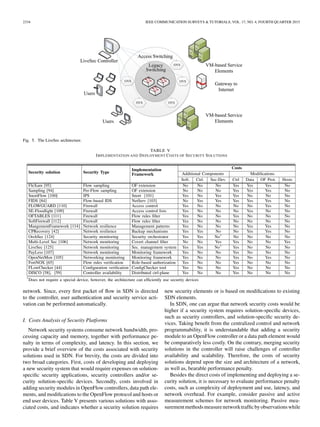
![AHMAD et al.: SECURITY IN SOFTWARE DEFINED NETWORKS: A SURVEY 2335
active measurement methods inject additional packets into the
network to monitor their behavior. Thus, passive measurements
require synchronization between observation beacons that com-
plicate the monitoring process, whereas active measurements
induce additional traffic load that affects the network and influ-
ences the accuracy of the measurements themselves [105]. In
doing so, passive measurements increase delay, whereas active
measurements increase the overhead by adding extra packets.
To illustrate the performance penalty, consider the inspection
time of the SE-Floodlight [109] controller and FlowGuard [111]
built on top of the Floodlight controller. The SE-Floodlight
controller has a security module operating as a firewall, whereas
FlowGuard is an application built on top of the Floodlight
controller. The inspection time of 90% packets is approximately
40 μs in SE-Floodlight, whereas the inspection time for the
same percentage of packets in FlowGuard is 79 μs. In a nut-
shell, this means that an isolated application consumes more
time on packet inspection than a built-in module in the con-
troller. Thus, there is always a performance trade-off that must
be evaluated for each network setup.
Compared to traditional networks, SDN minimizes the costs
of network security from many perspectives. First of all, SDN
enables software-based solutions that diminishes the necessity
of security-specific devices. Therefore, the Capital Expenditure
(CAPEX) could be minimized. Moreover, SDN brings forward
programmability in networking which eliminates the need of
per-box manual configurations and that minimizes Operational
Expenditures(OPEX). Therefore, in a broader view when com-
pared to traditional networks, SDN minimizes both CAPEX
and OPEX on network security.
VII. SDN-BASED VIRTUAL AND
CLOUD NETWORKS SECURITY
Virtualization is used to decouple a system’s service model
from its physical realization and has been used in networking
e.g., for creating virtual links (tunnels) and broadcast domains
(VLANs). Through virtualization, logical instances of physical
hardware can be used for different tasks where the physical
and logical instances are mapped through a network hypervisor
[126]. Cloud computing uses remote servers over the Internet
to maintain data, services, and applications by allowing opera-
tors and subscribers to use them without maintaining their own
infrastructure for computing and storage. Cloud networks bring
technologically distinct systems onto a single virtualized do-
main on top of which services could be deployed to achieve a
high degree of service availability and flexibility. The impor-
tance of virtual and cloud networks leveraging SDN for future
mobile networks with its challenges and benefits is presented in
[127], [128].
However, there are daunting security challenges in virtual
and cloud networks. These challenges are explained below with
the state of the art in SDN-based security solutions.
A. Virtual Networks Security
Virtualization enables multiple tenants or network users to
share the same physical network resources that can create
security vulnerabilities. A literature study on security impli-
cations of virtualization [129] shows that virtualization has a
positive effect on availability but has threatening security chal-
lenges related to confidentiality, integrity, authenticity and non-
repudiation.Virtual machines can be created,deleted and moved
around a network easily, hence, tracking a malicious virtual ma-
chine would be much more complex. Similarly, if a hypervisor
is hijacked the whole system can be compromised [130].
SDN provides a layered design that hides the complex hard-
ware from SDN applications implemented on top of the control
plane. SDN offers standard interfaces between control plane ap-
plications and forwarding elements, and is thus considered to be
a natural platform for network virtualization. Network hypervi-
sor, a program that provides an abstraction layer for the network
hardware, enables network engineers to create virtual networks
thatarecompletely decoupled fromthenetworkhardware.Flow-
Visor [131] is one example of hypervisors that uses OpenFlow
and sits between software controllers and hardware switches to
filter events to the controller and mask messages to switches.
FlowVisor [131] enables network administrators to identify
and differentiate network slices with the help of packet header
fields. From the security perspective, FlowVisor can be used
to isolate different types of traffic and provide an interference-
free environment to maintain privacy and confidentiality in
communication networks. Isolation is enforced even under
adversarial conditions so that one slice is not able to exhaust the
resources of another [131]. For example, network hardware has
low-power embedded processors and finite memory that can be
prone to resource exhaustion or saturation attacks. FlowVisor
tracks the processing plane and explicitly lists flow entries in a
switch so that a slice does not exceed preset limits.
A Network Intrusion detection and Countermeasure sElec-
tion (NICE) framework for virtual network systems is proposed
in [132]. The NICE framework is a multiphase distributed
vulnerability detection, measurement, and countermeasure se-
lection system that can be used to detect and mitigate collabora-
tive attacks in a cloud virtual networking environment. The
NICE platform is built on graph-based analytical models and re-
configurable virtual network-based countermeasures to prevent
vulnerable virtual machines from being compromised in cloud
networks. The NICE framework leverages OpenFlow network
programming APIs to build the monitoring and control plane
system over distributed programmable virtual switches.
B. Cloud Networks Security
Cloud computing systems comprise various resources which
are shared among users with the help of hypervisors. From a
security point of view, it is possible that a user spread malicious
traffic to tear down the performance of the whole system, con-
sume more resources or stealthily access the resources of other
users. Similarly, in multi-tenant cloud networks in which ten-
ants run their own control logic, interactions can cause conflicts
in network configurations. However, given the unified view of
all the resources to a centralized control plane system of SDN,
these challenges can be efficiently solved. The rise of SDN
will change the dynamics around securing the data centers by
offering opportunities to research for enhanced security [133].](https://image.slidesharecdn.com/securitysdn-170204174709/85/Security-sdn-19-320.jpg)
![2336 IEEE COMMUNICATION SURVEYS & TUTORIALS, VOL. 17, NO. 4, FOURTH QUARTER 2015
Fig. 6. SnortFlow system architecture.
Presenting SDN security considerations in data centers, a
use case of Automated Malware Quarantine (AMQ) in SDN is
presented in [133]. AMQ detects potential network threats and
isolates unsecure network devices to stop them from negatively
affecting the network. AMQ uses software patches to resolve
threats and automatically allows quarantined devices to join the
network. However, today’s AMQ solutions consist of propri-
etary devices which have limited awareness of other devices
and are designed for static traffic flows. Therefore, AMQ pre-
sented in [133] is implemented as an OpenFlow application that
leverages from the centralized control plane for network aware-
ness and adjustment to dynamic traffic flows.
The AMQ implementation using SDN [133] consists of two
primary security Network Services Modules (NSM), i.e., the
Bot Hunter NSM and the Threat Responder NSM. The Bot
Hunter NSM monitors the network in real time and detects
Malware-infected hosts. The Threat Responder NSM initiates
the quarantine procedure with the help of the controller to iso-
late the threat from the network. This AMQ system can apply
security policies to individual switch ports transparently and
dynamically. The automatic configuration enabled by SDN
reduces the response time to security threats, puts an end to
manual configurations to deploy a policy, eliminates the need
of hardware in small and medium enterprise networks, and
minimizes CAPEX and OPEX [133].
CloudWatcher[134]is an SDN monitoringapplication imple-
mented on top ofthecontrolplanetoprovidemonitoring services
to large and dynamic clouds. CloudWatcher controls network
flows to guarantee their inspection through security devices and
provides a simple policy scripting language to use the services.
CloudWatcher leverages SDN to dynamically control network
flows and change routing paths of flows so that intended flows
pass through security devices. It consists of three main compo-
nents, i.e., the device and policy manager that manages the in-
formation of security devices, the routing rule generator, and the
flow rule enforcer to enforcethegenerated flowrules in switches.
SnortFlow [100] is a Snort-based IPS which enables the
cloud system to detect intrusions and deploy countermeasures
by reconfiguring the cloud networking system at run-time. Be-
sides OpenFlow controller and switches, SnortFlow consists of
Cloud Cluster that hosts cloud resources and the SnortFlow
agent, and SnortFLow Server that evaluates the network secu-
rity statusand generatesactionsforthecontroller.TheSnortFlow
server has a SnortFlow daemon that collects alert data from the
Snort agent, an alert interpreter that parses and targets suspected
traffic, and a rules generator that generates rules for reconfigur-
ing the network. These rules are stored in a database for future
operations as shown in the system architecture in Fig. 6.
VIII. SDN SECURITY ACCORDING TO
ITU-T RECOMMENDATIONS
To address all the aspects of network security, network secu-
rity dimensions are proposed by ITU-T in its security recom-
mendation [26]. The security dimensions consist of a set of
security measures to protect against all major security threats.
In this section, SDN security platforms and mechanisms are
discussed according to the ITU-T proposed security dimensions
presented in Fig. 7. The security solutions are arranged in
Table VI against each of the security dimension. Critical re-
marks in Table VI against each dimension present the lack of
stable security solutions for that dimension. Similarly, “Open
Challenge” shows that there are no compelling solutions ad-
dressing that security type directly. SDN security solutions are
described below for each of the security dimensions.
A. Access Control
The access control security measures ensure that only author-
ized personnel or devices access the network resources. Unau-
thorized access to the controller or an application server that
stores user credentials can spread havoc across the network.
Unauthorized access to OpenFlow switches can lead to security
issues, such as cloning or deviating traffic (for theft purposes),
sending forged flow requests to controllers (DoS attack), and
injecting malicious flow rules in switches. PermOF [34] secures
the network resources from malicious applications by imple-
menting a customized permission system and run-time isolation
of OpenFlow applications.
Flow Security Language (FSL) [92] enables dynamic access
control policy deployment in SDN using network flows. FSL
improves deployment of multiple policies and mitigates the
risks of policy conflicts. Resonance [67] is a system developed
to enforce dynamic access control policies based on real-
time alerts and flow-level information. Resonance provides
mechanisms to directly implement dynamic network security](https://image.slidesharecdn.com/securitysdn-170204174709/85/Security-sdn-20-320.jpg)
![AHMAD et al.: SECURITY IN SOFTWARE DEFINED NETWORKS: A SURVEY 2337
Fig. 7. Applying ITU-T security dimensions to SDNs.
TABLE VI
SDN SECURITY SOLUTIONS ACCORDING TO ITU-T SECURITY RECOMMENDATIONS
policies on the device level while leaving little responsibilities
to higher layers. It also implements network-layer security
policies and provides a monitoring control interface which is
required to control traffic according to predefined policies.
B. Authentication
Authentication security mechanisms ensure the identities of
the communicating parties and that a user or device is not
attempting a masquerade or unauthorized replay of previous
communications. In SDN, the application server needs to au-
thenticate devices and users before providing information such
as user identities or credentials. Applications must also be au-
thenticated before access is provided to the controller interface
or network resources. The data plane also needs mechanisms to
authenticate the controllers to avoid false rule insertions. If
multiple controllers are used, the switches should be capable of
authenticating them and maintaining the necessary controller
redundancy. The latest OpenFlow switch specification i.e.,
OpenFlow v.1.3 specifies mechanisms for access to multiple
controllers.
FortNOX [65] is a software extension to NOX that provides
role-based authorization and security constraint enforcement
for the NOX OpenFlow controller. This approach prevents an
adversary attempting to strategically insert flow rules that
would otherwise circumvent flow constraints imposed by the
OpenFlow security applications. The role-based source authen-
tication in FortNOX recognizes three authorization roles among
which right to add, modify, and remove flow rules are distri-
buted. The human administrator role gets the highest priority to
insert flow rules, and attributes of the highest priority flow rules
are sent to the switch. Similarly, security applications and then
non-security-related applications get the priorities. Moreover,
different authentication schemes [141] can be chosen according](https://image.slidesharecdn.com/securitysdn-170204174709/85/Security-sdn-21-320.jpg)
![2338 IEEE COMMUNICATION SURVEYS & TUTORIALS, VOL. 17, NO. 4, FOURTH QUARTER 2015
to the network architecture and system capabilities, and de-
ployed and relegated through the centralized control plane.
C. Non-Repudiation
To ensure that a particular action has been performed by a
specific user or device is non-repudiation. Proper identities are
used to ensure that an authentic user or device can access par-
ticular services and resources. The controller must keep track
of identities of applications making changes to or accessing the
network resources for different functionalities. The controller
also needs to associate proper identities with the forwarding
devices to mitigate the risks of false and malicious requests. The
switches need to keep proper identities for the legitimacy of the
controllers. Encryption and identity management mechanisms
can be used to prevent non-repudiation vulnerabilities.
In [135], the use of the locator/identifier separation protocol
(LISP) [142] is proposed for maintaining accountability in
OpenFlow networks. The permanent identifier in LISP, which
does not change with changes in location, is used for user
identification. Similarly, OpenFlow-Host Identity Protocol or
OFHIP proposed in [136] introduces a cryptographic name-
space to ensure user identity. Source address validation of all
incoming packets presented in VAVE [137] can ensure the
identities of sources and users and prevent security lapses.
D. Data Confidentiality
Data confidentiality security mechanisms protect the data
from unauthorized access. Encryption, access control mecha-
nisms and file permissions are used to ensure data confidential-
ity. In order to prevent attacks by impersonating a switch or a
controller, OpenFlow has an optional security feature to use
TLS where identification certificates are properly checked in
either direction and allows encrypting the control channel in
order to prevent it from eavesdropping. In [138], a moving tar-
get defense (MTD) technique called OpenFlow Random Host
Mutation (OF-RHM) is proposed which mutates IP addresses
of end-hosts to avoid scanning attacks. The mechanism for en-
forcing slice isolation-based confidentiality is demonstrated in
[91]. Focusing on the packet processing functionality, the traffic
of multiple slices is isolated through algorithms specifically
designed for compiling slices to avoid interference.
FRESCO [52] and FortNOX [65] provides mechanisms to
ensure data confidentiality by flow rules legitimacy. The use of
Identity Based Cryptography (IBC) considering the controller
as the trusted third party for secret generation is demonstrated in
[139]. The proposed mechanism ensures data confidentiality in
a hybrid SDN environment. Host Identity Protocol (HIP) [143]
provides cryptographic identities and enhance data confiden-
tiality through authentication mechanisms involving consistent
host identifiers (HI) or host identity tags (HIT). The possible
use of HIP in OpenFlow architecture for increasing data confi-
dentiality besides mobility is demonstrated in OFHIP [136].
E. Communication Security
Communication security is necessary to ensure that the data
flows between the authorized end-points and is not diverted
or intercepted in between. OpenFlow defines Transport Layer
Security (TLS) [46] and Datagram Transport Layer Security
(DTLS) [47] to secure communication between controllers and
switches. The TLS protocol provides privacy and data integrity
between two communicating parties. TLS is composed of two
layers i.e., the TLS Record Protocol and the TLS Handshake
Protocol. The TLS Record Protocol provides connection se-
curity ensuring connection privacy and connection reliability.
The TLS Handshake Protocol enables a server and a client to
authenticate each other, and negotiate encryption algorithms
and cryptographic keys [46]. The DTLS protocol is used to
secure data between communicating applications. It runs in the
application space and is designed for UDP traffic [47].
Multiple channels (associations) between switches and con-
trollers are suggested since a single channel might result in
service outages due to connection failures. The latest OpenFlow
specifications support multiple in-band or out-of-band connec-
tionsbetweenswitchesandcontrollers.Hence,thisoptionshould
be used to improve network resilience in case of link failures. A
fast link restoration mechanism has been proposed and demon-
strated in [144]. The authors suggest backup entries with differ-
ent priorities in the OpenFlow switches. These backup paths
are computed by the controller after computing the working
paths. Hence, upon link failure, the traffic is locally switched on
a backup path without involving the controller. Similarly, flow
entry migration techniques such as the ones proposed in [145]
can reinstate a flow within 36ms that fulfills the carrier grade
recovery requirement of 50ms. Moreover, HIP [146] based
scheme proposed for SDN-based mobile networks in [147] can
secure the control channel between the control and data planes.
F. Data Integrity
Data integrity security ensures the correctness or accuracy of
data in transmission and protects it from unauthorized modifica-
tion, deletion, creation and replication. Naturally, SDN ensures
data integrity through verifiable flow rules, data origination and
destinationvisibility,virtualizationtechniques,andper-flowsec-
urity analysis. FortNOX [65] provides role-based authentica-
tion for determining the security authorization of OpenFlow
applications. It extends NOX to support digital signatures and
use an alias-set rule reduction algorithm to avoid flow-rule con-
tradictions to ensure that the data is forwarded to the legitimate
user or device.
VeriFlow [66] puts forward a proactive mechanisms to in-
spect the flow rules dynamically and in run time to maintain the
integrity of the flow rules. OFHIP [136] employes IPSec encap-
sulated security payload (ESP) in transport mode for protection
against DoS attacks, data origin authenticity, connectionless
integrity and anti-replay protection. Traffic isolation-based in-
tegrity is proposed in [91]. However, no specific security plat-
forms are devised to ensure data integrity, or that has data
integrity as one of its main security goal.
G. Availability
Availability ensures that there is no denial of authorized
access to network resources and applications. Events impacting](https://image.slidesharecdn.com/securitysdn-170204174709/85/Security-sdn-22-320.jpg)
![AHMAD et al.: SECURITY IN SOFTWARE DEFINED NETWORKS: A SURVEY 2339
the network, such as system failures or disasters, scalability
and security compromise, must not limit access to authorized
users and devices. Hence, availability has multiple dimensions,
and due to the centralized control plane, there are many re-
search proposals to increase the scalability and security of
the SDN controller. The platforms for controller scalability
are discussed in Section V-B. There are some proposals that
increase controller availability by minimizing controllers’ re-
sponsibility such as DevoFLow [148] and DIFANE [149].
Devolved OpenFlow or DevoFLow [148] enable scalable flow
management by aggressive use of wild-carded OpenFlow rules.
DIFANE [149] proposes to relegate the controller to simpler
tasks of generating rules but not involved in real-time handling
of data-packets.
High availability also needs fast restoration from failures. A
fast restoration mechanism for an OpenFlow network is dis-
cussed in [150] where a flow can be migrated to another path
within a very short interval on the directions from the controller.
Similarly, HotSwap [151] is a system for upgrading or replacing
a controller without service disruption and minimal overhead.
Centralized architectures also increase the administrator’s re-
sponsibilities where the administrator can become a bottleneck
due to lack of knowledge or availability etc. Mechanisms for
devolution of the administrator’s responsibilities is proposed in
ident++ [140], where the end-users and applications can set
their traffic rules and security mechanisms. The source address
validation of all incoming packets presented in VAVE [137] for
the OpenFlow architecture is another approach to stop un-
wanted traffic and mitigate the risks of controller and switch
resource exhaustion.
In OpenFlow, it is necessary to ensure the availability of the
switch flow tables for new incoming requests. Sizes of flow
tables might be limited which can cause the switch to drop legit-
imate flow requests. Another challenge that requires attention is
ensuring availability of the application plane. Services offered
by operators might reside in a cloud network which must be
available to users. This challenge will be more visible when
commercial networks are converged into SDNs.
H. Privacy
Privacy mechanisms ensure protection of information which
might be derived from observing the network activities. Trans-
port Layer Security (TLS) is specified for the OpenFlow com-
munication which is a common approach for enabling secure
communication in client/server applications on the Internet.
TLS is mostly used to prevent eavesdropping, tempering or
message forgery. Generally, its primary goal is to enable pri-
vacy and data integrity between the communication parties
through the use of symmetric cryptography for data encryp-
tion. The protocol is composed of two layers; TLS Record
Protocol and TLS Handshake Protocol. The Record Protocol
guarantees connection privacy and reliability by means of data
encryption supported by TLS handshake protocol, and MAC
to ensure integrity. The TLS Handshake part is responsible for
authenticating the communicating parties with each other, and
to negotiate the encryption algorithm and cryptographic keys
before transmitting the first packet of an application.
Besides the use of TLS and DTLS as specified in the Open-
Flow specification, virtual networks or network slicing can be
used to provide isolation-based information privacy. Individual
slices are separated by a networking hypervisor such as the
FlowVisor [131]. The Open vSwitch platform provides isola-
tion in multi-tenant environments and during mobility across
multiple subnets [152]. The VAVE [137] platform enables infor-
mation privacy and prevents data from being spoofed or forged
through the OpenFlow interface attached to legacy devices.
The ident++ [140] approach can increase user privacy by al-
lowing users to enforce their own security procedures. Simi-
larly, the OF-RHM mechanism [138] increases user privacy by
changing end-hosts’ IP addresses randomly and frequently. A
framework called Enterprise-Centric Offloading System
(ECOS) [153] leverages SDN to provide secure offloading of
mobile applications in enterprise networks. The ECOS frame-
work offers varying levels of trust and privacy to corporate
mobile users to access their systems.
IX. FUTURE DIRECTIONS
SDN enhances network security due to global visibility of the
network state, centralized intelligence and network program-
mability. As such, a common distribution layer gathering in-
formation about security requirements of different services,
resources and hosts, and disseminating the security establishing
commands to the network elements to enforce security policies
can result in robust and scalable security enforcement. How-
ever, the same key attributes of SDN i.e., centralized intelli-
gence and programmable network elements, make security in
SDN a more challenging task. Hence, many potential SDN
security solutions and platforms are proposed that are described
in previous sections.
To our understanding, there are still some gray areas which
need to be understood and properly addressed before SDNs
are commercially deployed. Henceforth, we point out some
research challenges and future directions below.
A. Programming and Development Models
SDN enables developers to develop novel networking ar-
chitectures, protocols, applications, and test or use them in
operational networks. This capability will bring innovation in
networking but can also introduce security challenges with the
myriad of possible new applications running in a network. The
independence and loose interconnection of various develop-
ment environments and arbitrary control platforms that will
deploy the functionalities of independent applications on pos-
sibly the same forwarding elements can create severe security
challenges. This threat can be visualized with the help of Fig. 8.
As can be seen in Fig. 8, if an application is developed in an
environment that uses the control plane that is developed in a
different environment,the resulting functionality taken from the
same data plane might induce security vulnerabilities besides
other challenges, such as security policy collision and difficulty
in integration. Implementation is a key factor that induces se-
curity vulnerabilities in Internet applications [154]. Therefore,
proper programming models and paradigms, and development](https://image.slidesharecdn.com/securitysdn-170204174709/85/Security-sdn-23-320.jpg)
![2340 IEEE COMMUNICATION SURVEYS & TUTORIALS, VOL. 17, NO. 4, FOURTH QUARTER 2015
Fig. 8. Current trends of development in SDN.
environments must be standardized to minimize the chances of
conflicting modules that create security vulnerabilities. Con-
flicting modules in distributed systems can create security
vulnerabilities, such as exposing sensitive network information
or APIs, and creating contradictory flow rules.
B. Class-Based Application Security
In SDN, most of the networking functionalities will be imple-
mented in software as applications on top of the control plane.
Consider that some applications might need network statistics
for load balancing, some applications might need samples of
packets, and so on. Each of these applications has its own distinct
functional requirements and each of these applications should
be provided differentiated access. Similarly, some applications
might need their traffic to follow a path with particular charac-
teristics, e.g., avoid some links, stay within a certain jurisdiction
and use a path within the cost constraints, as described in [35].
In SDN, security applications seek network statistics, sam-
ples of packets and access network resources through the con-
trol plane. A monitoring application that works on fine-grained
tracking of packet behaviors in the data plane require direct
view of the network. However, the control plane provides net-
works statistics to applications based on its own view which
might be incoherent with the actual network view. Hence, some
applications need direct access to network statistics and re-
sources. On the other hand, in the current trends of apps. devel-
opment, providing direct access to a variety of applications
might create security challenges.
Therefore, it is necessary to categorize applications into
classes or groups and enforce security procedures based on
high-level security policies defined for each of the class. This
will require first to Categorize applications into Classes accord-
ing to their functions and their requirements from the underly-
ing network resources. Secondly, security policies need to be
defined for each class that will invoke security procedures upon
an application’s request for access to network resources (e.g.,
flow tables in OpenFlow switches) or network information (e.g.,
network statistics). Having defined such classes of applications,
specific security procedures based on high-level security poli-
cies can be enforced on an aggregated sum of applications.
Three classes of applications significantly impacting the net-
work security in SDNs discussed in the IETF draft [35] could
be listed as “Network Sensitive Applications,” “Services for the
Networks” and “Packaged Network Services.” Authenticating
and authorizing each application in the same way will make the
control plane a bottleneck due to large numbers of incoming
requests for access to network resources or with attempts to de-
rive network statistics. The categorization of applications would
enable lenient per application-class based security enforcement,
and involve minimal controller overhead to authenticate and
authorize applications based on security policies compiled for
various classes of applications.
C. Scalability and Security
Scalability is one of the major challenges faced by the logic-
ally centralized SDN architecture. In SDNs, as the network size
and diameter grows, the amount of control traffic destined to-
wards the centralized controller increases and as a result the
flow setup time grows [63]. Moreover, it is known that the capa-
bility and operation set of an OpenFlow controller is most likely
limited. Hence, the lack of scalability in SDN can enable tar-
geted attacks by inundating communication between the con-
troller and the switch to cause control plane saturation [39].
Besides saturation of the control plane, it is demonstrated in
[41] that a network can be compromised by exhausting re-
sources of OpenFlow-enabled switches.
Availability is a security dimension that strongly correlates
scalability with security. Most of the security threats in SDN
target to compromise availability of the control plane. Thus,
multiple controllers are suggested, but, simply adding multiple
controllers might result in cascading failures of controllers as
demonstrated in [40]. Therefore, it it is necessary to correlate](https://image.slidesharecdn.com/securitysdn-170204174709/85/Security-sdn-24-320.jpg)
![AHMAD et al.: SECURITY IN SOFTWARE DEFINED NETWORKS: A SURVEY 2341
security and scalability in SDN to design secure SDN architec-
tures that ensure high availability of the control plane. For the
data plane, load balancing and connection migration techniques
could be used to equally share the load among OpenFlow
switches. This will not only help in maintaining the required
QoS, but minimize the intensity of flooding and data plane satu-
ration attacks.
D. Control-Data Planes Intelligence Tradeoff
In SDN, a single controller or a group of controllers provid-
ing control plane services for wider sets of forwarding devices
will result in node-to-node or node-to-controller latency in
exchanging the network information, and hence open up avail-
ability challenges for the logically centralized SDN architec-
tures [51]. Increasing the number of active OpenFlow switches
managed by a single controller increases the controller response
time for setting the flow rules, since it involves an increased
number of flow setup requests [155]. Therefore, intelligence
tradeoff between the control and data planes could be one so-
lution to minimize switch dependency on the controller.
Intelligence tradeoff will be beneficial in solving two main
challenges in SDNs. First, enhance scalability of the OpenFlow
architecture and minimize delays through local decision mak-
ing capabilities. Second, enhance availability and enable fast
restoration. From the network security point of view, sharing
intelligence will enable the network to be less prone to single
point of failures, as well as less prone to DoS attacks. However,
intelligence tradeoff as an attempt to enhance network security
has not been demonstrated yet.
E. Synchronization of Network Security and Network Traffic
Network security is an integral part of the network manage-
ment where stable and robust security policy deployment re-
quiresglobalanalysisofpolicyconfigurationofallthenetworked
elements to avoid conflicts and inconsistency in the security
procedures and hence diminish the chances of serious security
breaches and network vulnerabilities [3]. Network security and
network traffic challenges are part of the network management
where synchronization is needed for cooperative policy deploy-
ment. Cooperative policy deployment is needed to keep the net-
work traffic alive even if there is a security breach or the other
way around, it keeps the network security intact with changes
in the network topology, node mobility and changes in traffic
behavior or volumes.
Even though such cooperative policies and procedures have
been suggested in various projects, such as 4D [11], Ethane
[14], etc. it has never been realized into practice. The main rea-
son behind this lack of cooperation among security and traffic
management, as we see today, is the loosely coupled control
planes of forwarding devices, independent security architec-
tures and policies, and security independent routing. Hence,
Greenberg et al. [11] state that traditional IP networks have
the characteristics of instability and complexity where a small
misconfiguration of a routing protocol can have a severe global
impact of cascading meltdown.
In SDNs, since a logically centralized controller is respon-
sible for controlling and managing the whole network, security
lapses compromising the controller, nonetheless, will affect set-
ting up flow rules in the data plane. For example, in OpenFlow
networks a DoS attack on the centralized controller would at
least increase delay in setting up flow rules in the OpenFlow
switches. Similar to other networks, in SDNs traffic flow fea-
tures can be used to detect distributed DoS attacks [64]. How-
ever,the global network visibility in the centralized SDN control
plane and programmability of the forwarding plane can enable
deploying cooperative and interdependent policies. Therefore,
interdependent security and traffic forwarding policies, that
converge to secure traffic forwarding mechanisms, are needed
to take full advantage of SDN technologies.
F. Network Security Automation
The increasing complexity, dynamism, heterogeneity, and re-
quirements of reliability and scalability is making management
and monitoringof communicationnetworksmuch more difficult
and prone to errors. However, the challenges of sensing contex-
tual changes in the network, adapting to the contextual changes
and control loop for the system to learn and update itself for
future actions in traditional networks has staggered deployment
of automation techniques [156]. In the context of network secu-
rity, Hamed et al. conclude in [3] that manual configuration of
network security technologies, such as firewall and IPSec tech-
nologies on extended sets of devices are prone to configuration
errors, intra- and inter- policy conflicts resulting in serious
security vulnerabilities and threats. A study on firewall config-
uration errors [4] shows that configuration complexity is one of
the main reasons for security breaches in enterprise networks.
SDN abstracts away the low level configuration from network
devicesand enable designing languages and network controllers
which are capable of automatically reacting to the changing net-
work state [157]. ONF (Open Networking Foundation) claims
in [158] that SDNs offer flexible network automation and man-
agement framework, which makes it possible to develop tools to
automate management tasks (that are done manually) to reduce
operational overhead, decrease network instability introduced
by operator error and support emerging self-services provision-
ing models. There are automation frameworks for QoS [159],
automated policy implementation through Procera [69], and
responsive automatic control platform OMNI [160], etc. How-
ever, no viable SDN security automation mechanisms have
been demonstrated yet.
Centralizing the network control also increases responsibil-
ities on network administrators where the lack of the admin-
istrator’s knowledge and availability can become a bottleneck
for a network. Therefore, automated security mechanisms that
require minimal administrator intervention to protect the net-
work and activate automatic recovery mechanisms are needed
for SDNs.
G. Identity Location Split
One of the pressing problems pertaining to Internet security
is the lack of ensuring proper identities. Jennifer Rexford, a](https://image.slidesharecdn.com/securitysdn-170204174709/85/Security-sdn-25-320.jpg)
![2342 IEEE COMMUNICATION SURVEYS & TUTORIALS, VOL. 17, NO. 4, FOURTH QUARTER 2015
proponent of clean slate Internet architecture, relates security
problems that are deeply rooted in the current Internet architec-
ture to the Internet’s weak notions of identity [161]. The same
legacy remains in SDN where there is no significant work on
improving user identity systems in SDN. OpenFlow does pro-
vide mechanisms for identifying flows or packets based on
packet header fields, but there are no mechanisms that can
ensure and bind identities to the users.
The IP address embodies information about the attachment
point of the host and works as an identity of the host. This
causes semantic collision leading to limited flexibility in the
Internet architecture [162]. Using IP addresses in OpenFlow,
change of address due to mobility would disrupt flow process-
ing and will require fast and regular updates to flow tables that
will cause additional overhead. Therefore, the use of novel tech-
nologies such as HIP [143] should be investigated for SDN, to
not only provide permanent identities (e.g., Host Identity Tags
(HITs) or Host Identifiers (HIs)), but baseline end-to-end secu-
rity aided by the associated set of security protocols.
X. CONCLUSION
SDN enhances network security through global visibility of
the network state. In SDN, a common distribution layer gathers
information about security requirements of different services,
resources and hosts, and disseminates security establishing
commands to network elements to enforce security policies. On
one hand, centralizing the network control plane and enabling
network programmability can result in robust and scalable secu-
rity enforcement, on the other hand, it introduces new security
challenges. Therefore, we have presented security weaknesses
and strengths of SDN in this paper. In doing so, we have high-
lighted security vulnerabilities in application, control, and data
planes of SDN, and then presented security solutions for these
planes. We also summarized security techniques that can
strengthen the network-wide security in SDNs. Then we pre-
sented security solutions according to the security recommen-
dations of ITU-T and briefly described the costs associated with
security solutions.
To our understanding, the most vulnerable component in the
SDN architecture is the centralized controller. As a result, con-
troller vulnerability has already been discussed and researched
from different perspectives including controllers’ safety from
applications, controller’s scalability and availability, resilience
and placement, and security from DoS and DDoS attacks. The
security of the OpenFlow switch flow rules have gained more
attention of the research community, since they define the actual
communication. Although security applications are developed
and implemented, the security of the application plane itself is a
security challenge. Moreover, communication security between
controllers and switches in OpenFlow is threatened due to the
optional use of TLS and DTLS.
It is highly possible that new security threats will emerge with
the gradual deployment of SDN technologies. Similarly, the
threat space will most likely grow, since security threats existing
in traditional networks will propagate along with SDN-specific
security challenges. However, SDN aims at bringing innova-
tion in communication networks and thus, automatic security
mechanisms will be developed to enable fast anomaly detection
and quick response for protection. The existing literature on
network security in SDN endorses the fact that SDN will enable
rapid deployment of cost-effective security services.
ACKNOWLEDGMENT
This work was accomplished in the platform of the CELTIC
SIGMONA (SDN Concepts In Generalized Mobile Network
Architectures) project. The authors would like to thank the
project partners for their thoughtful discussions.
REFERENCES
[1] B. Raghavan et al., “Software-defined internet architecture: decoupling
architecture from infrastructure,” in Proc. 11th ACM Workshop Hot
Topics Netw., 2012, pp. 43–48.
[2] N. McKeown et al., “OpenFlow: Enabling innovation in campus net-
works,” ACM SIGCOMM Comput. Commun. Rev., vol. 38, no. 2,
pp. 69–74, Apr. 2008.
[3] H. Hamed and E. Al-Shaer, “Taxonomy of conflicts in network security
policies,” IEEE Commun. Mag., vol. 44, no. 3, pp. 134–141, Mar. 2006.
[4] A. Wool, “A quantitative study of firewall configuration errors,”
Computer, vol. 37, no. 6, pp. 62–67, Jun. 2004.
[5] S. Scott-Hayward, G. O’Callaghan, and S. Sezer, “SDN security: A
survey,” in Proc. IEEE SDN4FNS, 2013, pp. 1–7.
[6] D. Clark, R. Braden, K. Sollins, J. Wroclawski, and D. Katabi, “New
Arch: Future generation Internet architecture,” Def. Tech. Inf. Center
(DTIC), Fort Velvoir, VA, USA, Tech. Rep. AFRL-IF-RS-TR-2004-235,
2004.
[7] D. L. Tennenhouse, J. M. Smith, W. D. Sincoskie, D. J. Wetherall, and
G. J. Minden, “A survey of active network research,” IEEE Commun.
Mag., vol. 35, no. 1, pp. 80–86, Jan. 1997.
[8] D. L. Tennenhouse and D. J. Wetherall, “Towards an active network
architecture,” in Proc. DARPA Active NEtw. Conf. Expo., 2002, pp. 2–15.
[9] Z. Liu, R. Campbell, and M. Mickunas, “Active security support for
active networks,” IEEE Trans. Syst., Man, Cybern., Part C, Appl. Rev.,
vol. 33, no. 4, pp. 432–445, Nov. 2003.
[10] S. Murphy, E. Lewis, R. Puga, R. Watson, and R. Yee, “Strong security
for active networks,” in Proc. IEEE Open Archit. Netw. Programm.,
2001, pp. 63–70.
[11] A. Greenberg et al., “A clean slate 4D approach to network control and
management,” ACM SIGCOMM Comput. Commun. Rev., vol. 35, no. 5,
pp. 41–54, Oct. 2005.
[12] Z. Cai, A. L. Cox, and T. E. N. Maestro, “Maestro: A system for scalable
OpenFlow control,” RiceUniv., Houston, TX, USA, Tech. Rep. TR10-08,
2010.
[13] M. Casado et al., “SANE: A protection architecture for enterprise net-
works,” in Proc. Usenix Security, 2006, pp. 137–151.
[14] M. Casado et al., “Ethane: Taking control of the enterprise,” ACM
SIGCOMM Comput. Commun. Rev., vol. 37, no. 4, pp. 1–12, Oct. 2007.
[15] Y. Jarraya, T. Madi, and M. Debbabi, “A survey and a layered taxonomy
of software-defined networking,” IEEE Commun. Surveys Tuts., vol. 16,
no. 4, pp. 1955–1980, 4th Quart. 2014.
[16] S. Namal, I. Ahmad, S. Saud, M. Jokinen, and A. Gurtov, “Imple-
mentation of OpenFlow based cognitive radio network architecture:
SDN&R,” in Wireless Networks. New York, NY, USA: Springer, 2015,
pp. 1–15.
[17] M. Liyanage, A. Gurtov, and M. Ylianttila, Software Defined Mobile
Networks (SDMN): Beyond LTE Network Architecture. Hoboken, NJ,
USA: Wiley, 2015.
[18] S. J. Vaughan-Nichols, “OpenFlow: The next generation of the
network?” Computer, vol. 44, no. 8, pp. 13–15, Aug. 2011.
[19] T. Nadeau, “Software driven networks problem statement,” Network
Working Group Internet-Draft, Sep. 30, 2011. [Online]. Available:
https://tools.ietf.org/html/draft-nadeau-sdn-problem-statement-00
[20] H. Xie, T. Tsou, D. Lopez, H. Yin, and V. Gurbani, “Use cases for
ALTO with software defined networks,” Working Draft, IETF Sec-
retariat, Internet-Draft, 2012. [Online]. Available: https://tools.ietf.org/
html/draft-xie-alto-sdn-use-cases-01
[21] N. Gude et al., “NOX: towards an operating system for networks,”
ACM SIGCOMM Comput. Commun. Rev., vol. 38, no. 3, pp. 105–110,
Jul. 2008.](https://image.slidesharecdn.com/securitysdn-170204174709/85/Security-sdn-26-320.jpg)
![AHMAD et al.: SECURITY IN SOFTWARE DEFINED NETWORKS: A SURVEY 2343
[22] D. Kreutz et al., “Software-defined networking: A comprehensive
survey,” Proc. IEEE, vol. 103, no. 1, pp. 14–76, Jan. 2014.
[23] J. Jeong, H. Kim, and J. Park, “Requirements for security services based
on software-defined networking,” Internet Eng. Task Force, Fremont,
CA, USA, Oct. 2014. [Online]. Available: https://tools.ietf.org/html/
draft-jeong-l2nsf-sdn-security-services-00
[24] M. Wasserman and S. Hartman, “Security analysis of the open network-
ing foundation (ONF) OpenFlow switch specification. Internet engineer-
ing task force,” Internet Eng. Task Force, Fremont, CA, USA, Apr. 2013.
[Online]. Available: https://tools.ietf.org/html/draft-mrw-sdnsec-
openflow-analysis-02
[25] D. V. Bernardo, “Software-defined networking and network function
virtualization security architecture,” Internet Eng. Task Force, Fremont,
CA, USA. [Online]. Available: https://tools.ietf.org/html/draft-
bernardo-sec-arch-sdnnvf-architecture-00
[26] “Security architecture for systems providing end-to-end communica-
tions,” ITU Telecommun. Standardization Sector, Geneva, Switzerland,
2003.
[27] A. Lara, A. Kolasani, and B. Ramamurthy, “Network innovation using
OpenFlow: A survey,” IEEE Commun. Surveys Tuts., vol. 16, no. 1,
pp. 493–512, 1st Quart. 2013.
[28] “SDN: Empowering the network,” CISCO, San Jose, CA, USA,
Nov. 2012. [Online]. Available: http://www.cisco.com/c/en/us/solutions/
data-center-virtualization/application-centric-infrastructure/index.html
[29] “VMware NSX virtualization and security platform,” VMware,
Palo Alto, CA, USA. [Online]. Available: https://www.vmware.com/
products/nsx/
[30] “SDN product directory,” Open Netw. Found., Palo Alto, CA, USA.
[Online]. Available: https://www.opennetworking.org/sdn-resources/
onf-products-listing
[31] “SDN market size forecast,” SDNCentral, Sunnyvale, CA, USA,
Nov. 2013. [Online]. Available: https://www.sdncentral.com
[32] D. Kreutz, F. Ramos, and P. Verissimo, “Towards secure and dependable
software-defined networks,” in Proc. 2nd ACM SIGCOMM Work. Hot
Topics Softw. Defined Netw., 2013, pp. 55–60.
[33] S. Shin, P. Porras, V. Yegneswaran, and G. Gu, “A framework for inte-
grating security services into software-defined networks,” in Proc. ONS,
2013, pp. 1–2.
[34] X. Wen, Y. Chen, C. Hu, C. Shi, and Y. Wang, “Towards a se-
cure controller platform for OpenFlow applications,” in Proc. 2nd
ACM SIGCOMM Workshop Hot Topics Softw. Defined Netw., 2013,
pp. 171–172.
[35] S. Hartman, M. Wasserman and D. Zhang, “Software driven net-
works problem statement,” Network Working Group Internet-Draft,
Oct. 15, 2013. [Online]. Available: https://tools.ietf.org/html/draft-
hartman-sdnsec-requirements-00
[36] A. D. Ferguson, A. Guha, J. Place, R. Fonseca, and S. Krishnamurthi,
“Participatory networking,” in Proc. Hot-ICE, 2012, pp. 327–338.
[37] J. Naous, D. Erickson, G. A. Covington, G. Appenzeller, and
N. McKeown, “Implementing an OpenFlow switch on the NetFPGA
platform,” in Proc. 4th ACM/IEEE Symp. Archit. Netw. Commun. Syst.,
2008, pp. 1–9.
[38] M. Jarschel et al., “Modeling and performance evaluation of an
OpenFlow architecture,” in Proc. 23rd ITCP, 2011, pp. 1–7.
[39] S. Shin, V. Yegneswaran, P. Porras, and G. Gu, “Avant-guard: Scalable
and vigilant switch flow management in software-defined networks,” in
Proc. CCS, 2013, pp. 413–424.
[40] G. Yao, J. Bi, and L. Guo, “On the cascading failures of multi-controllers
in software defined networks,” in Proc. 21st IEEE ICNP, Oct. 2013,
pp. 1–2.
[41] S. Shin and G. Gu, “Attacking software-defined networks: a first feasi-
bility study,” in Proc. 2nd ACM SIGCOMM Workshop Hot Topics Softw.
Defined Netw., 2013, pp. 165–166.
[42] P. Fonseca, R. Bennesby, E. Mota, and A. Passito, “A replication com-
ponent for resilient OpenFlow-based networking,” in Proc. IEEE NOMS,
Apr. 2012, pp. 933–939.
[43] J. Seedorf and E. Burger, “Application-layer traffic optimization (ALTO)
problem statement,” Internet Eng. Task Force (IETF), Fremont, CA,
USA, 2009.
[44] E. Al-Shaer and S. Al-Haj, “FlowChecker: Configuration analysis and
verification of federated openflow infrastructures,” in Proc. 3rd ACM
Workshop SafeConfig, 2010, pp. 37–44.
[45] Y. Zhang, N. Beheshti, and M. Tatipamula, “On resilience of split-
architecture networks,” in Proc. IEEE GLOBECOM, Dec. 2011, pp. 1–6.
[46] T. Dierks, “The Transport Layer Security (TLS) protocol version 1.2,”
2008. [Online]. Available: http://tools.ietf.org/html/rfc5246
[47] E. Rescorla and N. Modadugu, “Datagram Transport Layer Security
Version 1.2,” 2012. [Online]. Available: http://tools.ietf.org/html/rfc6347
[48] K. Benton, L. J. Camp, and C. Small, “OpenFlow vulnerability as-
sessment,” in Proc. 2nd ACM SIGCOMM Workshop HotSDN, 2013,
pp. 151–152.
[49] M. Liyanage and A. Gurtov, “Secured VPN models for LTE backhaul
networks,” in Proc. IEEE VTC Fall, 2012, pp. 1–5.
[50] D. Staessens, S. Sharma, D. Colle, M. Pickavet, and P. Demeester,
“Software defined networking: Meeting carrier grade requirements,” in
Proc. 18th IEEE Workshop LANMAN, Oct. 2011, pp. 1–6.
[51] S. Sezer et al., “Are we ready for SDN? Implementation challenges
for software-defined networks,” IEEE Commun. Mag., vol. 51, no. 7,
pp. 36–43, Jul. 2013.
[52] S. Shin et al., “FRESCO: Modular composable security services for
software-defined networks,” in Proc. Netw. Distrib. Security Symp.,
Feb. 2013, pp. 1–16. [Online]. Available: http://www.csl.sri.com/users/
vinod/papers/fresco.pdf
[53] R. Beckett et al., “An assertion language for debugging SDN appli-
cations,” in Proc3rd ACM Workshop Hot Topics Softw. Defined Netw.,
2014, pp. 91–96.
[54] S. Son, S. Shin, V. Yegneswaran, P. Porras, and G. Gu, “Model checking
invariant security properties in openflow,” in Proc. IEEE ICC, 2013,
pp. 1974–1979.
[55] M. Canini, D. Kostic, J. Rexford, and D. Venzano, “Automating the
testing of OpenFlow applications,” in Proc. 1st Int. WRiPE, 2011,
pp. 1–6.
[56] “Security-enhanced floodlight,” SDx Central, Sunnyvale, CA, USA.
[Online]. Available: http://www.sdncentral.com/education/toward-
secure-sdn-control-layer/2013/10/
[57] M. Fernandez, “Comparing openflow controller paradigms scalability:
reactive and proactive,” in Proc. IEEE 27th Int. Conf. AINA, Mar. 2013,
pp. 1009–1016.
[58] K. Phemius, M. Bouet, and J. Leguay, “DISCO: Distributed multi-
domain SDN controllers,” in Proc. IEEE NOMS, May 2014, pp. 1–4.
[59] K. Phemius, M. Bouet, and J. Leguay, “DISCO: Distributed SDN
controllers in a multi-domain environment,” in Proc. IEEE NOMS,
May 2014, pp. 1–2.
[60] B. Heller, R. Sherwood, and N. McKeown, “The controller placement
problem,” in Proc. 1st ACM Workshop HotSDN, 2012, pp. 7–12.
[61] Y. Hu, W. Wang, X. Gong, X. Que, and S. Cheng, “On reliability-
optimized controller placement for software-defined networks,”
Commun., China, vol. 11, no. 2, pp. 38–54, Feb. 2014.
[62] Y. Hu, W. Wendong, X. Gong, X. Que, and C. Shiduan, “Reliability-
aware controller placement for software-defined networks,” in Proc.
IFIP/IEEE Int. Symp. IM, May 2013, pp. 672–675.
[63] A. Tootoonchian and Y. Ganjali, “HyperFlow: A distributed control
plane for OpenFlow,” in Proc. Internet Netw. Manag. Conf. Res. Enter-
prise Netw. USENIX Assoc., 2010, p. 3.
[64] R. Braga, E. Mota, and A. Passito, “Lightweight DDoS flooding
attack detection using NOX/OpenFlow,” in Proc. IEEE 35th Conf. LCN,
Oct. 2010, pp. 408–415.
[65] P. Porras et al., “A security enforcement kernel for OpenFlow networks,”
in Proc. 1st Workshop HotSDN, 2012, pp. 121–126.
[66] A. Khurshid, W. Zhou, M. Caesar, and P. B. Godfrey, “Veriflow:
Verifying network-wide invariants in real time,” SIGCOMM Comput.
Commun. Rev., vol. 42, no. 4, pp. 467–472, Sep. 2012.
[67] A. K. Nayak, A. Reimers, N. Feamster, and R. Clark, “Resonance:
dynamic access control for enterprise networks,” in Proc 1st ACM Work-
shop Res. Enterprise Netw., 2009, pp. 11–18.
[68] N. Foster et al., “Frenetic: A network programming language,”
SIGPLAN Notices, vol. 46, no. 9, pp. 279–291, Sep. 2011.
[69] A. Voellmy, H. Kim, and N. Feamster, “Procera: A language for
high-level reactive network control,” in Proc. 1st Workshop HotSDN,
New York, NY, USA, 2012, pp. 43–48.
[70] C. Monsanto, N. Foster, R. Harrison, and D. Walker, “A compiler
and run-time system for network programming languages,” SIGPLAN
Notices, vol. 47, no. 1, pp. 217–230, Jan. 2012.
[71] N. Handigol, B. Heller, V. Jeyakumar, D. Mazières, and N. McKeown,
“Where is the debugger for my software-defined network?” in Proc. 1st
Workshop Hot Topics Softw. Defined Netw., 2012, pp. 55–60.
[72] A. Wundsam, D. Levin, S. Seetharaman, A. Feldmann, “OFRewind:
Enabling record and replay troubleshooting for networks.” in Proc.
USENIX Annu. Tech. Conf., 2011, p. 29.
[73] B. Switch, “Developing floodlight modules. Floodlight OpenFlow
controller,” 2012. [Online]. Available: http://www.projectfloodlight.org/
floodlight/](https://image.slidesharecdn.com/securitysdn-170204174709/85/Security-sdn-27-320.jpg)
![2344 IEEE COMMUNICATION SURVEYS & TUTORIALS, VOL. 17, NO. 4, FOURTH QUARTER 2015
[74] A. Voellmy and J. Wang, “Scalable software defined network con-
trollers,” in Proc. ACM SIGCOMM Conf. Appl., Technol., Archit.,
Protocols Comput. Commun., 2012, pp. 289–290.
[75] “Advanced Message Queuing Protocol.” [Online]. Available: http://
www.amqp.org
[76] I. Ahmad, S. N. Karunarathna, M. Ylianttila, and A. Gurtov, “Load bal-
ancing in software defined mobile networks,” in Software Defined Mo-
bile Networks (SDMN): Beyond LTE Network Architecture. Hoboken,
NJ, USA: Wiley, 2015, pp. 225–245.
[77] S. Namal, I. Ahmad, A. Gurtov, and M. Ylianttila, “SDN based inter-
technology load balancing leveraged by flow admission control,” in
Proc. IEEE SDN4FNS, Nov. 2013, pp. 1–5.
[78] T. Kohonen, “The self-organizing map,” Proc. IEEE, vol. 78, no. 9,
pp. 1464–1480, Sep. 1990.
[79] M. Bari et al., “Dynamic controller provisioning in software defined
networks,” in Proc. Int. CNSM, Oct. 2013, pp. 18–25.
[80] D. Hock et al., “Pareto-optimal resilient controller placement in
SDN-based core networks,” in Proc. 25th ITC, Sep. 2013,
pp. 1–9.
[81] J. C. Mogul et al., “DevoFlow: Cost-effective flow management for
high performance enterprise networks,” in Proc. 9th ACM SIGCOMM
Workshop Hotnets-IX, 2010, pp. 1–6.
[82] J. Ge, H. Shen, E. Yuepeng, Y. Wu, and J. You, “An OpenFlow-based dy-
namic path adjustment algorithm for multicast spanning trees,” in Proc.
12th Int. Conf. IEEE TrustCom, 2013, pp. 1478–1483.
[83] J. Kempf et al., “Scalable fault management for OpenFlow,” in Proc.
IEEE ICC, Jun. 2012, pp. 6606–6610.
[84] E. Maccherani et al., “Extending the NetServ autonomic manage-
ment capabilities using OpenFlow,” in Proc. IEEE NOMS, Apr. 2012,
pp. 582–585.
[85] F. Hao, T. Lakshman, S. Mukherjee, and H. Song, “Secure cloud com-
puting with a virtualized network infrastructure,” in Proc. 2nd USENIX
Conf. Hot Topics Cloud Comput., 2010, p. 16.
[86] A. R. Sharafat, S. Das, G. Parulkar, and N. McKeown, “MPLS-TE
and MPLS-VPN with OpenFlow,” ACM SIGCOMM Comput. Commun.
Rev., vol. 41, no. 4, pp. 452–453, Aug. 2011.
[87] S. A. Mehdi, J. Khalid, and S. A. Khayam, “Revisiting traffic anomaly
detection using software defined networking,” in Recent Advances in
Intrusion Detection, R. Sommer, D. Balzarotti, and G. Maier, Eds.
Berlin, Germany: Springer-Verlag, 2011, pp. 161–180.
[88] J. R. Ballard, I. Rae, and A. Akella, “Extensible and scalable network
monitoring using OpenSafe,” in Proc. INM/WREN, 2010, p. 8.
[89] Z. A. Qazi et al., “SIMPLE-fying middlebox policy enforcement using
SDN,” SIGCOMM Comput. Commun. Rev., vol. 43, no. 4, pp. 27–38,
Oct. 2013.
[90] M. Liyanage et al., “Security for future software defined mobile
networks,” in Proc. 9th Int. Conf. NGMAST, 2015, pp. 1–9.
[91] S. Gutz, A. Story, C. Schlesinger, and N. Foster, “Splendid isolation: A
slice abstraction for software-defined networks,” in Proc. 1st Workshop
HotSDN, 2012, pp. 79–84.
[92] T. Hinrichs, N. Gude, M. Casado, J. Mitchell, and S. Shenker, “Express-
ing and enforcing flow-based network security policies,” Univ. Chicago,
Chicago, IL, USA, Tech. Rep., 2009, pp. 1–20. [Online]. Available:
http://www.cs.uic.edu/~hinrichs/papers/hinrichs2008design.pdf
[93] R. Bifulco and F. Schneider, “OpenFlow rules interactions: Def-
inition and detection,” in Proc. IEEE SDN4FNS, Nov. 2013,
pp. 1–6.
[94] S. Shirali-Shahreza and Y. Ganjali, “Empowering software defined
network controller with packet-level information,” in Proc. IEEE ICC,
Jun. 2013, pp. 1335–1339.
[95] S. Shirali-Shahreza and Y. Ganjali, “Efficient implementation of security
applications in openflow controller with flexam,” in Proc. IEEE 21st
Annu. Symp. HOTI, Aug. 2013, pp. 49–54.
[96] S. Dotcenko, A. Vladyko, and I. Letenko, “A fuzzy logic-based informa-
tion security management for software-defined networks,” in Proc. IEEE
ICACT, Feb. 2014, pp. 167–171.
[97] D. Erickson, “The Beacon Openflow Controller,” in Proc. 2nd ACM
SIGCOMM Workshop Hot Topics Softw. Defined Netw., Hong Kong,
China, 2011, pp. 13–18. [Online]. Available: http://doi.acm.org/10.1145/
2491185.2491189
[98] R. Skowyra, S. Bahargam, and A. Bestavros, “Software-Defined IDS for
securing embedded mobile devices,” in Proc. IEEE HPEC, Sep. 2013,
pp. 1–7.
[99] L. Zhang, G. Shou, Y. Hu, and Z. Guo, “Deployment of intrusion
prevention system based on software defined networking,” in Proc. IEEE
ICCT, Nov. 2013, pp. 26–31.
[100] T. Xing, D. Huang, L. Xu, C.-J. Chung, and P. Khatkar, “SnortFlow:
A openflow-based intrusion prevention system in cloud environment,”
in Proc. 2nd GREE, Mar. 2013, pp. 89–92.
[101] H. Li and D. Liu, “Research on intelligent intrusion prevention sys-
tem based on Snort,” in Proc. Int. Conf. CMCE, Aug., vol. 1 2010,
pp. 251–253.
[102] M. Roesch, “Snort: Lightweight intrusion detection for networks.” in
Proc. LISA, 1999, vol. 99, pp. 229–238.
[103] M. Femminella, R. Francescangeli, G. Reali, J. W. Lee, and
H. Schulzrinne, “An enabling platform for autonomic management
of the future internet,” IEEE Netw., vol. 25, no. 6, pp. 24–32,
Nov. 2011.
[104] M. Bouet, J. Leguay, and V. Conan, “Cost-based placement of vir-
tualized deep packet inspection functions in SDN,” in Proc. IEEE
MILCOM, Nov. 2013, pp. 992–997.
[105] N. L. van Adrichem, C. Doerr, and F. A. Kuipers, “OpenNetMon:
Network monitoring in OpenFlow software-defined networks,” in Proc.
IEEE NOMS, May 2014, pp. 1–8.
[106] X. Liu, H. Xue, X. Feng, and Y. Dai, “Design of the multi-level security
network switch system which restricts covert channel,” in Proc. IEEE
3rd ICCSN, May 2011, pp. 233–237.
[107] S. R. Chowdhury, M. Bari, R. Ahmed, and R. Boutaba, “PayLess: A low
cost network monitoring framework for software defined networks,” in
Proc. IEEE NOMS, May 2014, pp. 1–9.
[108] C.-T. Yang et al., “Implementation of a virtual switch monitor system
using openflow on cloud,” in Proc. Int. Conf. IMIS Ubiquitous Comput.,
Jul. 2013, pp. 283–290.
[109] “OpenFlow Firewall: A Floodlight Module. ” [Online]. Available: http://
www.openflowhub.org/display/floodlightcontroller
[110] H. Hu, W. Han, G.-J. Ahn, and Z. Zhao, “FLOWGUARD: building
robust firewalls for software-defined networks,” in Proc. 3rd Workshop
Topics Softw. Defined Netw., 2014, pp. 97–102.
[111] M. Koerner and O. Kao, “Oftables: A distributed packet filter,” in Proc.
6th Int. Conf. COMSNETS, Jan. 2014, pp. 1–4.
[112] M. Suh, S. H. Park, B. Lee, and S. Yang, “Building firewall over the
software-defined network controller,” in Proc. 16th ICACT, Feb. 2014,
pp. 744–748.
[113] J. P. Sterbenz et al., “Resilience and survivability in communication
networks: Strategies, principles, and survey of disciplines,” Comput.
Netw., vol. 54, no. 8, pp. 1245–1265, 2010.
[114] P. Smith, A. Schaeffer-Filho, D. Hutchison, and A. Mauthe, “Manage-
ment patterns: SDN-enabled network resilience management,” in Proc.
IEEE NOMS, May 2014, pp. 1–9.
[115] K. Nguyen, Q. T. Minh, and S. Yamada, “A software-defined networking
approach for disaster-resilient WANs,” in Proc. 22nd ICCCN, Jul. 2013,
pp. 1–5.
[116] K. Nguyen, Q. T. Minh, and S. Yamada, “Towards optimal disaster
recovery in backbone networks,” in Proc. IEEE 37th Annu. COMPSAC,
2013, pp. 826–827.
[117] D. A. Joseph, A. Tavakoli, and I. Stoica, “A policy-aware switching layer
for data centers,” in Proc. ACM SIGCOMM, New York, NY, USA, 2008,
pp. 51–62.
[118] J. Lee, J. Tourrilhes, P. Sharma, and S. Banerjee, “No more middlebox:
Integrate processing into network,” SIGCOMM Comput. Commun. Rev.,
vol. 40, no. 4, pp. 459–460, Aug. 2010.
[119] A. Gember, P. Prabhu, Z. Ghadiyali, and A. Akella, “Toward Software-
defined Middlebox Networking,” in Proc. 11th ACM Workshop
HotNets-XI, 2012, pp. 7–12.
[120] B. Anwer, T. Benson, N. Feamster, D. Levin, and J. Rexford, “A slick
control plane for network middleboxes,” in Proc. 2nd ACM SIGCOMM
Workshop HotSDN, 2013, pp. 147–148.
[121] S. K. Fayazbakhsh, V. Sekar, M. Yu, and J. C. Mogul, “FlowTags:
Enforcing network-wide policies in the presence of dynamic middle-
box actions,” in Proc. 2nd ACM SIGCOMM Workshop HotSDN, 2013,
pp. 19–24.
[122] Y.-J. Chen, F.-Y. Lin, L.-C. Wang, and B.-S. Lin, “A dynamic secu-
rity traversal mechanism for providing deterministic delay guarantee in
SDN,” in Proc. IEEE Int. Symp. WoWMoM, Jun. 2014, pp. 1–6.
[123] R. Hand, M. Ton, and E. Keller, “Active security,” in Proc. 12th ACM
Workshop HotNets-XII, 2013, pp. 17:1–17:7.
[124] A. Zaalouk, R. Khondoker, R. Marx, and K. Bayarou, “OrchSec: An
orchestrator-based architecture for enhancing network-security using
network monitoring and SDN control functions,” in Proc. IEEE NOMS,
May 2014, pp. 1–9.
[125] K. Wang, Y. Qi, B. Yang, Y. Xue, and J. Li, “LiveSec: Towards effec-
tive security management in large-scale production networks,” in Proc.
ICDCSW, Jun. 2012, pp. 451–460.](https://image.slidesharecdn.com/securitysdn-170204174709/85/Security-sdn-28-320.jpg)
![AHMAD et al.: SECURITY IN SOFTWARE DEFINED NETWORKS: A SURVEY 2345
[126] M. Casado, T. Koponen, R. Ramanathan, and S. Shenker, “Virtualizing
the network forwarding plane,” in Proc. Workshop Programm. Routers
Extensible Serv. Tomorrow, 2010, p. 8.
[127] J. Costa-Requena et al., “SDN and NFV integration in generalized mo-
bile network architecture,” in Proc. EuCNC, Jun. 2015, pp. 154–158.
[128] I. Ahmad, S. Namal, M. Ylianttila, and A. Gurtov, “Towards software de-
fined cognitive networking,” in Proc. Int. Conf. NTMS, 2015, pp. 1–5.
[129] A. van Cleeff, W. Pieters, and R. Wieringa, “Security implications of
virtualization: A literature study,” in Proc. Int. Conf. CSE, Aug. 2009,
vol. 3, pp. 353–358.
[130] S. Vaughan-Nichols, “Virtualization sparks security concerns,”
Computer, vol. 41, no. 8, pp. 13–15, Aug. 2008.
[131] R. Sherwood et al., “Flowvisor: A network virtualization layer,”
OpenFlow Switch Consortium, Tech. Rep. OPENFLOW-TR-2009-1,
Stanford Univ., Stanford, CA, USA, 2009.
[132] C.-J. Chung, P. Khatkar, T. Xing, J. Lee, and D. Huang, “NICE:
Network intrusion detection and countermeasure selection in virtual net-
work systems,” IEEE Trans. Dependable Secure Comput., vol. 10, no. 4,
pp. 198–211, Jul. 2013.
[133] “SDN security considerations in the data center. Open networking foun-
dation,” Open Netw. Found., Palo Alto, CA, USA. [Online]. Available:
https://www.opennetworking.org/sdn-resources/sdn-library
[134] S. Shin and G. Gu, “CloudWatcher: Network security monitoring using
OpenFlow in dynamic cloud networks (or: How to provide security mon-
itoring as a service in clouds?),” in Proc. 20th IEEE ICNP, Oct. 2012,
pp. 1–6.
[135] C. YuHunag, T. MinChi, C. YaoTing, C. YuChieh, and C. YanRen, “A
novel design for future on-demand service and security,” in Proc. 12th
IEEE ICCT, 2010, pp. 385–388.
[136] S. Namal, I. Ahmad, A. Gurtov, and M. Ylianttila, “Enabling secure
mobility with OpenFlow,” in Proc. IEEE SDN4FNS, 2013, pp. 1–5.
[137] G. Yao, J. Bi, and P. Xiao, “Source address validation solution
with OpenFlow/NOX architecture,” in Proc. 19th IEEE ICNP, 2011,
pp. 7–12.
[138] J. H. Jafarian, E. Al-Shaer, and Q. Duan, “OpenFlow random host
mutation: transparent moving target defense using software defined net-
working,” in Proc. 1st Workshop Hot Topics Softw. Defined Netw., 2012,
pp. 127–132.
[139] M. A. S. Santos et al., “Software-defined networking based capacity
sharing in hybrid networks,” in Proc. IEEE ICNP, 2013, pp. 1–6.
[140] J. Naous, R. Stutsman, D. Mazieres, N. McKeown, and N. Zeldovich,
“Delegating network security with more information,” in Proc. 1st ACM
Workshop Res. Enterprise Netw., 2009, pp. 19–26.
[141] Z. Faigl, J. Pellikka, L. Bokor, and A. Gurtov, “Performance evaluation
of current and emerging authentication schemes for future 3GPP network
architectures,” Comput. Netw., vol. 60, pp. 60–74, 2014.
[142] D. Farinacci, D. Lewis, D. Meyer, and V. Fuller, “The loca-
tor/ID separation protocol (LISP),” CISCO, San Jose, CA, USA,
2013.
[143] A. Gurtov, Host Identity Protocol (HIP): Towards the Secure Mobile
Internet. Hoboken, NJ, USA: Wiley, 2008.
[144] A. Sgambelluri, A. Giorgetti, F. Cugini, F. Paolucci, and P. Castoldi,
“Effective flow protection in OpenFlow rings,” in Proc. OFC/NFOEC,
Mar. 2013, pp. 1–3.
[145] J. Li, J. Hyun, J.-H. Yoo, S. Baik, and J.-K. Hong, “Scalable failover
method for data center networks using OpenFlow,” in Proc. IEEE
NOMS, May 2014, pp. 1–6.
[146] P. Nikander, A. Gurtov, and T. Henderson, “Host Identity Protocol
(HIP): Connectivity, mobility, multi-homing, security, and privacy over
IPv4 and IPv6 networks,” IEEE Commun. Surveys Tuts., vol. 12, no. 2,
pp. 186–204, 2nd Quart. 2010.
[147] M. Liyanage, M. Ylianttila, and A. Gurtov, “Securing the control channel
of software-defined mobile networks,” in Proc. IEEE 15th Int. Symp.
WoWMoM, Jun. 2014, pp. 1–6.
[148] A. R. Curtis et al., “DevoFlow: Scaling flow management for high-
performance networks,” ACM SIGCOMM Comput. Commun. Rev.,
vol. 41, no. 4, pp. 254–265, Aug. 2011.
[149] M. Yu, J. Rexford, M. J. Freedman, and J. Wang, “Scalable flow-based
networking with DIFANE,” ACM SIGCOMM Comput. Commun. Rev.,
vol. 41, no. 4, pp. 351–362, Oct. 2011.
[150] S. Sharma, D. Staessens, D. Colle, M. Pickavet, and P. Demeester,
“Enabling fast failure recovery in OpenFlow networks,” in Proc. 8th Int.
Workshop DRCN, 2011, pp. 164–171.
[151] L. Vanbever, J. Reich, T. Benson, N. Foster, and J. Rexford,
“HotSwap: Correct and efficient controller upgrades for software-
defined networks,” in Proc. 2nd ACM SIGCOMM HotSDN, 2013,
pp. 133–138.
[152] B. Pfaff, J. Pettit, K. Amidon, M. Casado, T. Koponen, and S. Shenker,
“Extending networking into the virtualization layer,” in Proc. Hotnets,
2009, pp. 1–6.
[153] A. Gember, C. Dragga, and A. Akella, “ECOS: Leveraging software-
defined networks to support mobile application offloading,” in Proc. 8th
ACM/IEEE Symp. ANCS, 2012, pp. 199–210.
[154] A. Keromytis, “Voice-over-IP security: Research and practice,” IEEE
Security Privacy, vol. 8, no. 2, pp. 76–78, Mar. 2010.
[155] A. Tootoonchian, S. Gorbunov, Y. Ganjali, M. Casado, and R. Sherwood,
“On controller performance in software-defined networks,” in Proc.
USENIX Workshop Hot-ICE, 2012, p. 10.
[156] B. Jennings et al., “Towards autonomic management of communica-
tions networks,” IEEE Commun. Mag., vol. 45, no. 10, pp. 112–121,
Oct. 2007.
[157] H. Kim and N. Feamster, “Improving network management with
software defined networking,” IEEE Commun. Mag., vol. 51, no. 2,
pp. 114–119, Feb. 2013.
[158] “Software-defined networking: The new norm for networks,” Open
Netw. Found., Palo Alto, CA, USA. [Online] Available: https://www.
opennetworking.org/sdn-resources/sdn-library/whitepapers/benefits-of-
OFB-SDN
[159] W. Kim et al., “Automated and scalable QoS control for network conver-
gence,” in Proc. INM/WREN, 2010, vol. 10, pp. 1–1.
[160] D. M. Mattos et al., “OMNI: OpenFlow management infrastructure,” in
Proc. IEEE Int. Conf. NOF, 2011, pp. 52–56.
[161] J. Rexford and C. Dovrolis, “Future internet architecture: clean-slate
versus evolutionary research,” Commun. ACM, vol. 53, no. 9, pp. 36–40,
Sep. 2010.
[162] T. Li, “Design goals for scalable internet routing,” ip.com, Fairport, NY,
USA, 2011.
Ijaz Ahmad received the M.Sc. (Technology) degree
in wireless communications engineering with major
in telecommunication engineering from University
of Oulu, Finland, in 2012. He is pursuing the doctoral
degree with the Department of Communications En-
gineering, University of Oulu, and a Research Sci-
entist with the Centre for Wireless Communications
(CWC), Oulu, Finland. His research interest includes
SDN, SDN security, software defined mobile net-
works, OpenFlow, and network load balancing.
Suneth Namal received the B.Sc. degree in com-
puter engineering from the University of Peradeniya,
Peradeniya, Sri Lanka, in 2007. He completed the
M.E. degree in information and communication tech-
nologies from the Asian Institute of Technology,
Bangkok, Thailand, in 2010 and M.Sc. degree in
communication network and services from Telecom
Sud-Paris, Paris, France, in 2010. He is pursuing
the doctoral degree with the Department of Com-
munication Engineering, University of Oulu, Oulu,
Finland. His research interest includes software de-
fined networks (SDN), OpenFlow, network security, mobile femtocells, fast ini-
tial authentication, load balancing and mobility management, Wi-Fi protocols.
Currently, he is a Senior Lecturer at the Department of Computer Engineering,
University of Peradeniya, Sri Lanka.](https://image.slidesharecdn.com/securitysdn-170204174709/85/Security-sdn-29-320.jpg)



![[이동식 원격 데이터센터 컨퍼런스] 이동식 원격 데이터센터의 군 활용-국방대 권태욱 교수](https://cdn.slidesharecdn.com/ss_thumbnails/1-161219002152-thumbnail.jpg?width=640&height=640&fit=bounds)


