





Cleaning Up the Dirt of the Nineties
How New Protocols are
Modernizing the Web
Steffen Gebert
(with help from Thomas Zinner and Benedikt Pfaff)
Photos:
Thanks to our Sponsors
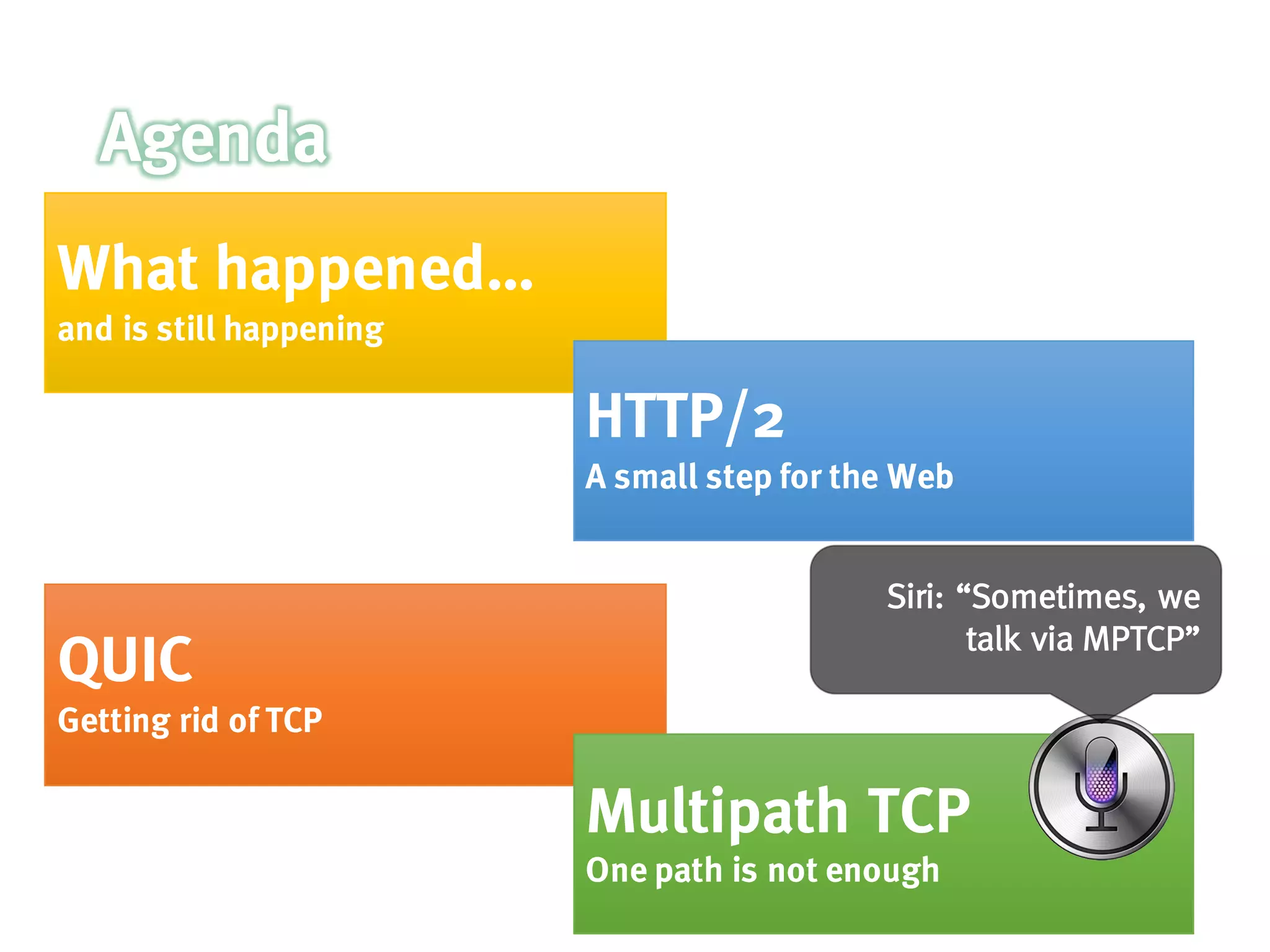
Agenda
What happened…
and is still happening
HTTP/2
A small step for the Web
QUIC
Getting rid of TCP
Multipath TCP
One path is not enough
Siri: “Sometimes, we
talk via MPTCP”
About Me
PhD Student Comm. Networks
since 2011
Contributor
2008 – 2010
Core Team
2010 - 2013
Server Admin Team
since 2011
Visiting Researcher
10/2011 – 01/2012
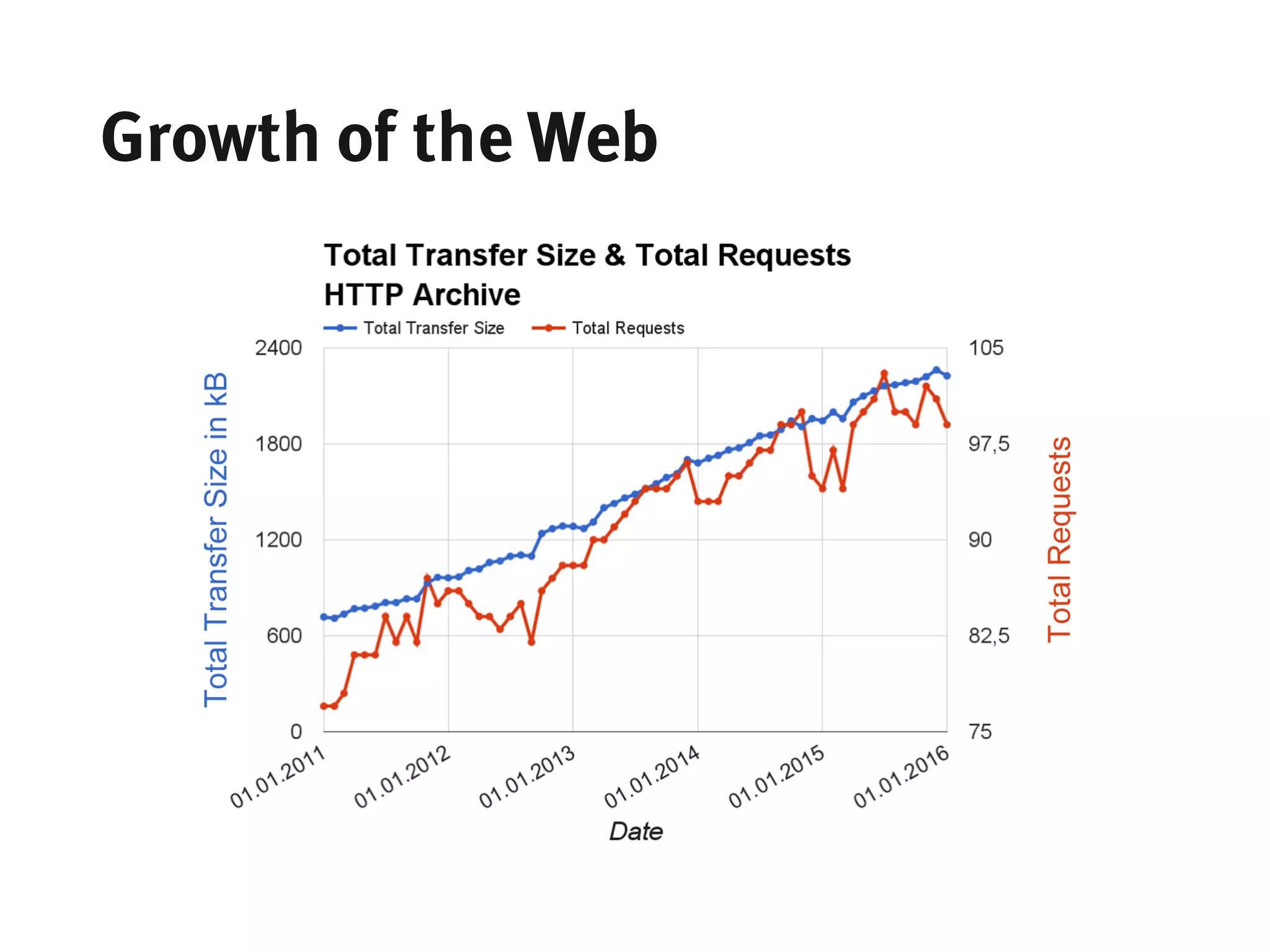
Growth of the Web
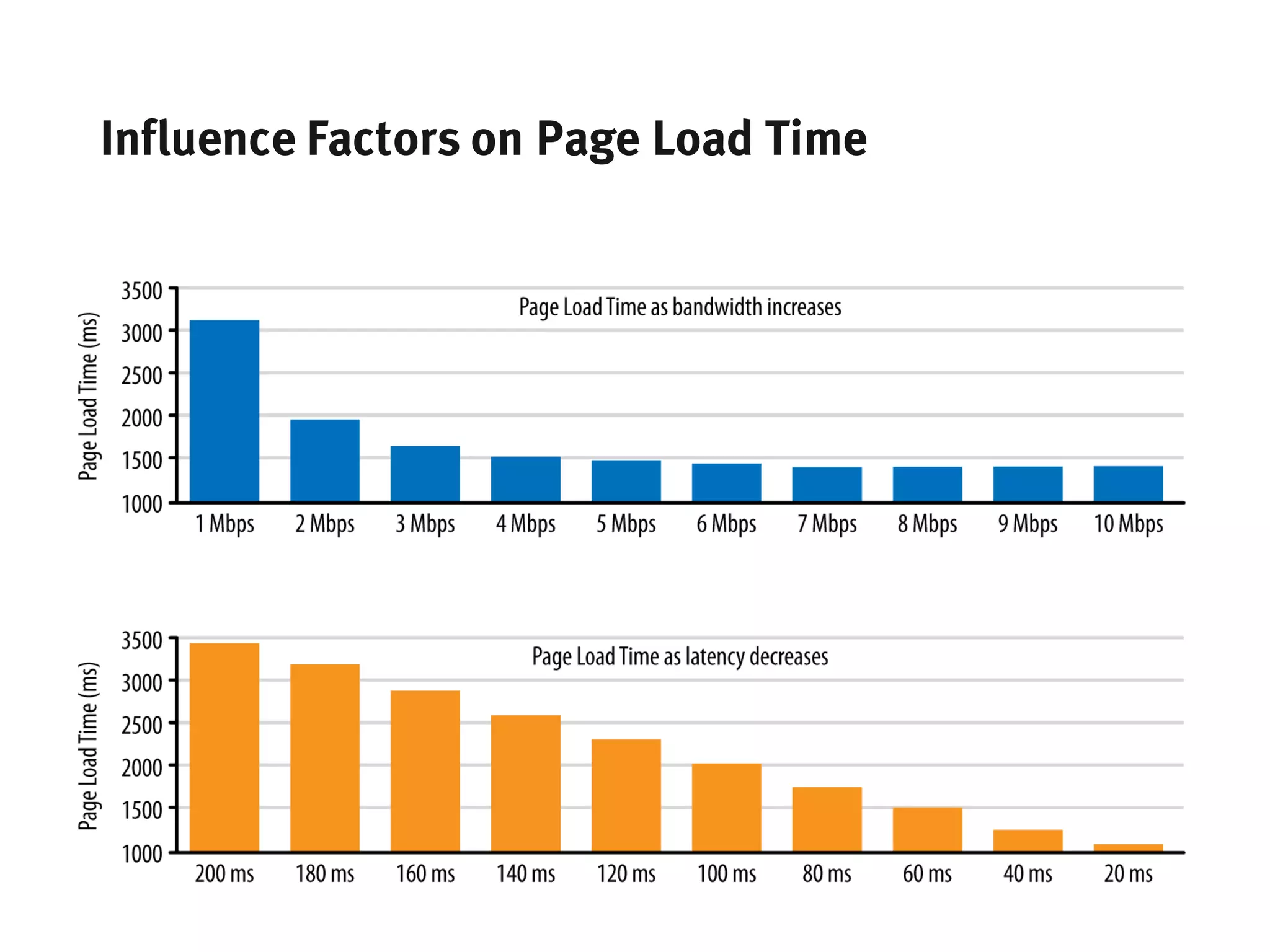
Influence Factors on Page Load Time
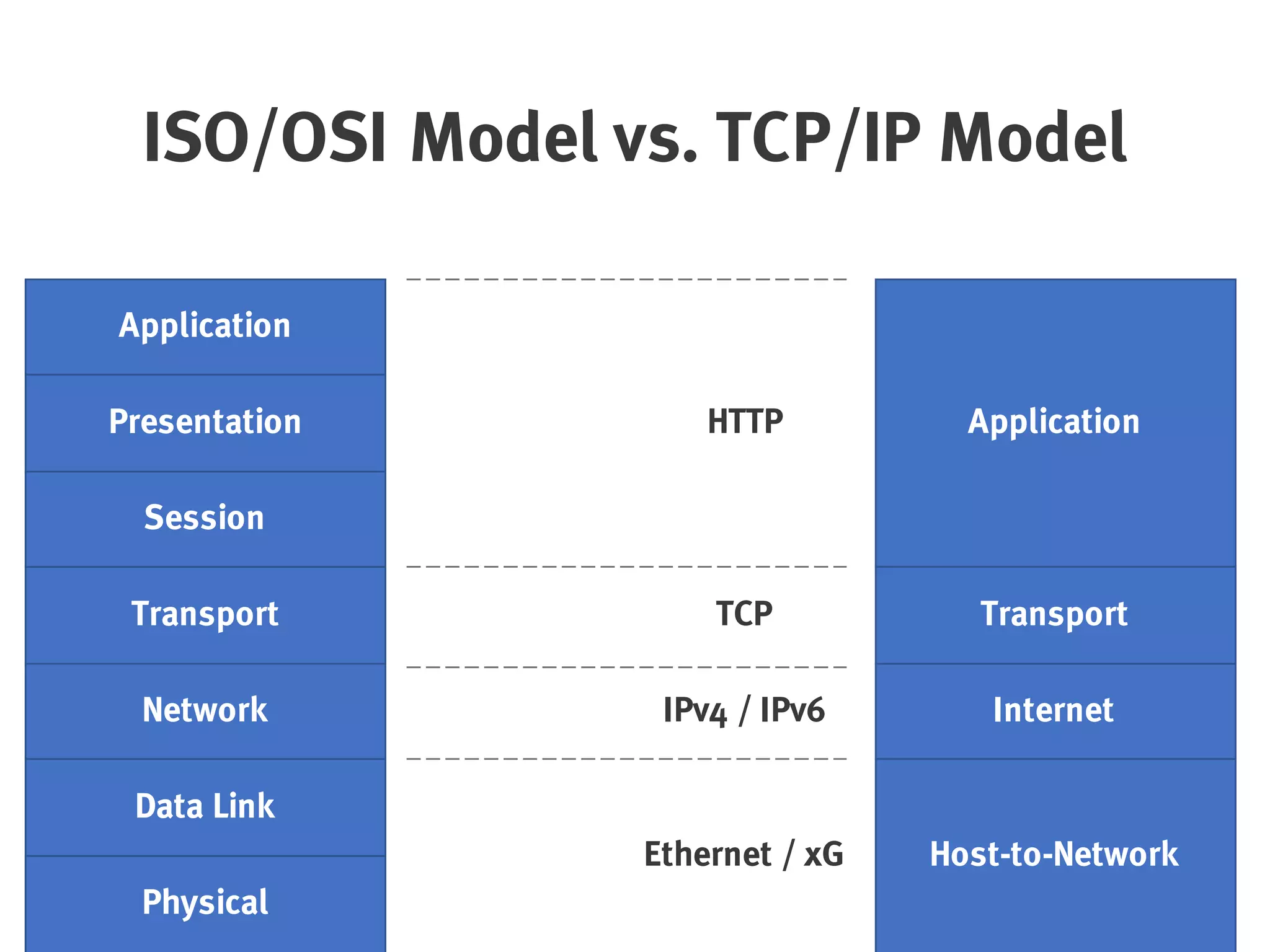
ISO/OSI Model vs. TCP/IP Model
Physical
Data Link
Network
Transport
Session
Presentation
Application
Host-to-Network
Internet
Transport
Application
Ethernet / xG
IPv4 / IPv6
TCP
HTTP
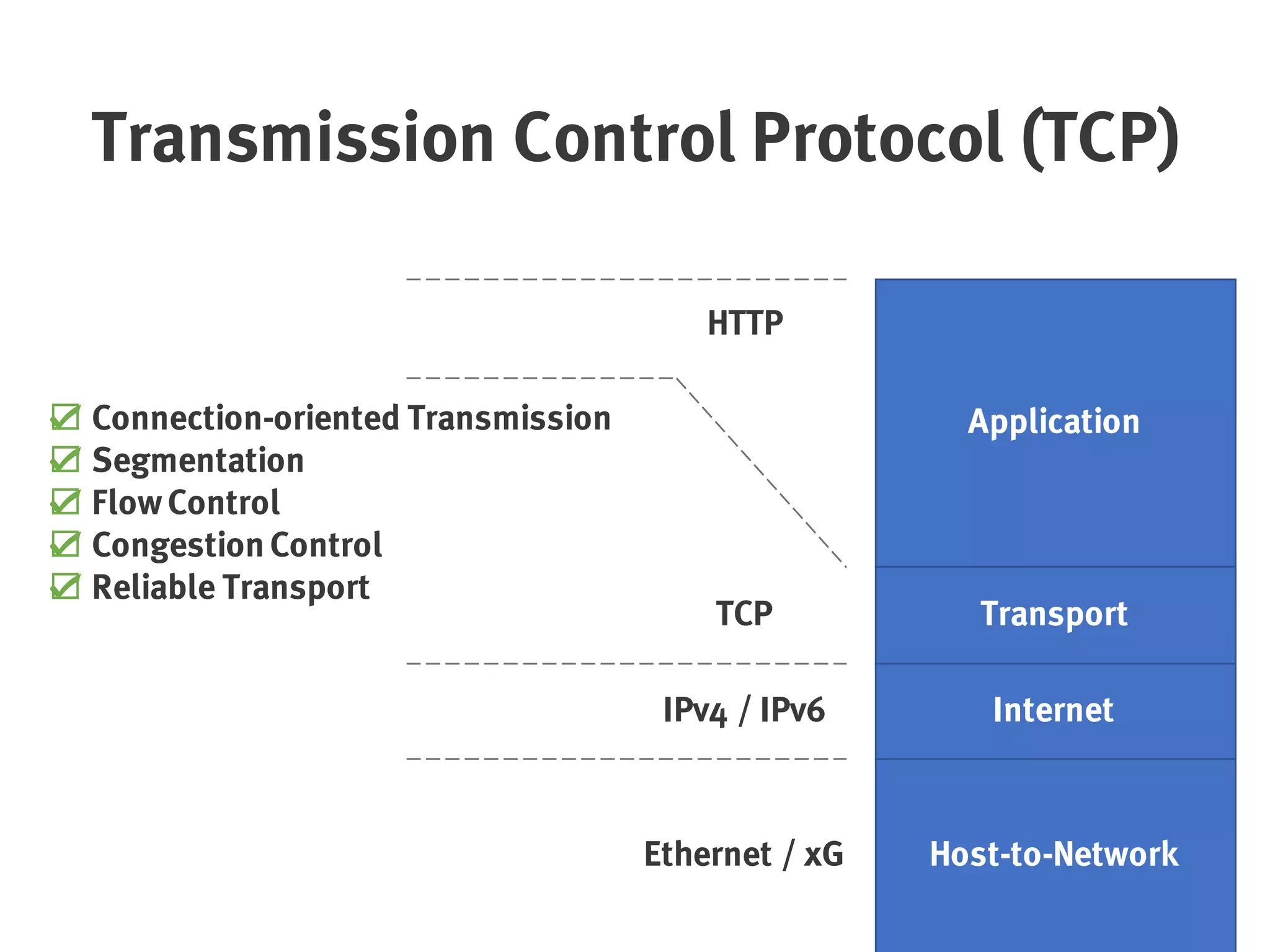
Transmission Control Protocol (TCP)
Host-to-Network
Internet
Transport
Application
Ethernet / xG
IPv4 / IPv6
TCP
HTTP
☑ Connection-oriented Transmission
☑ Segmentation
☑ Flow Control
☑ Congestion Control
☑ Reliable Transport
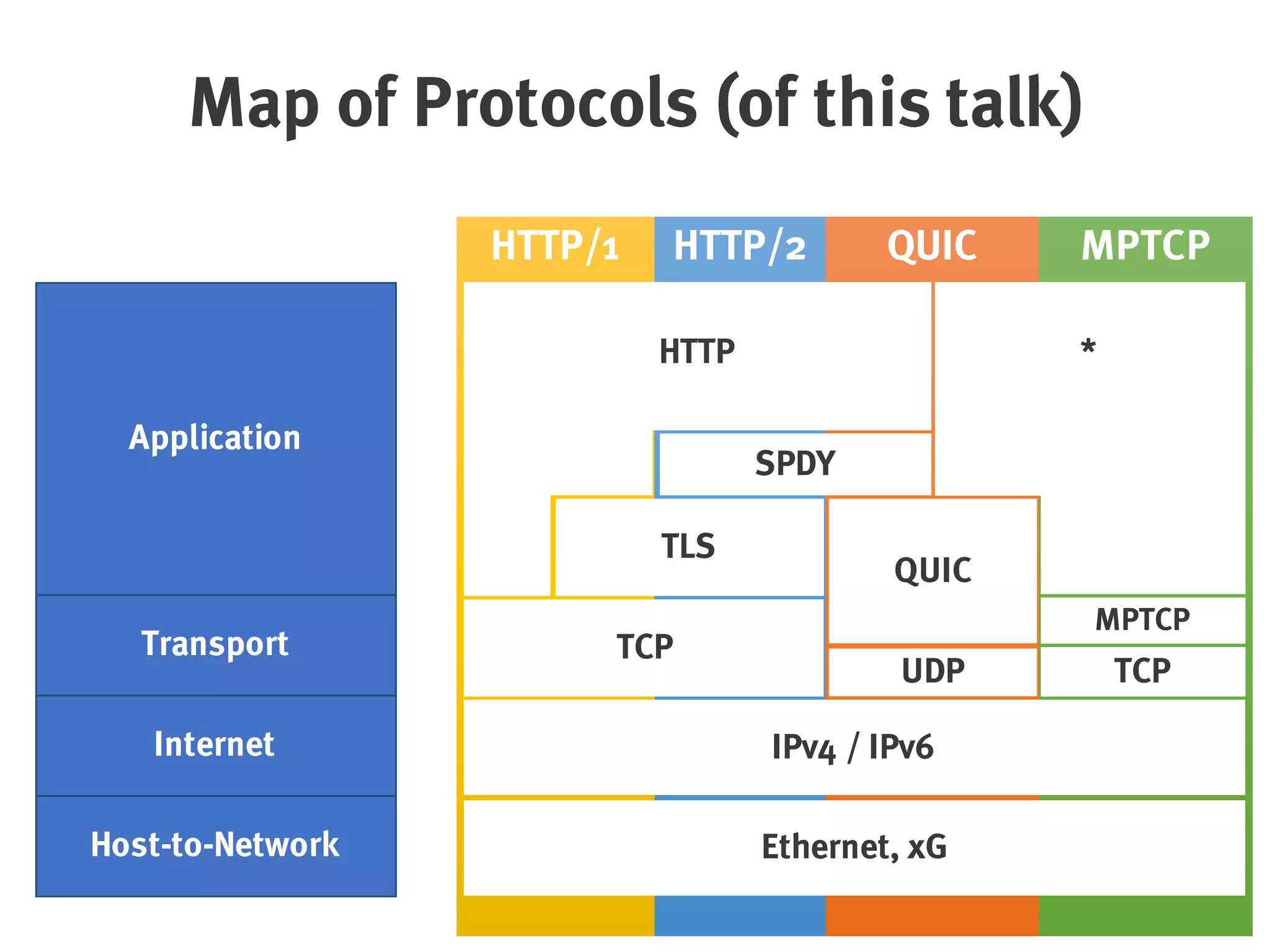
HTTP/2 QUIC MPTCPHTTP/1
*HTTP
Map of Protocols (of this talk)
Host-to-Network
Internet
Transport
Application
IPv4 / IPv6
Ethernet, xG
TCP
TLS
UDP TCP
MPTCP
QUIC
SPDY
Beginnings of HTTP:
Simplicity
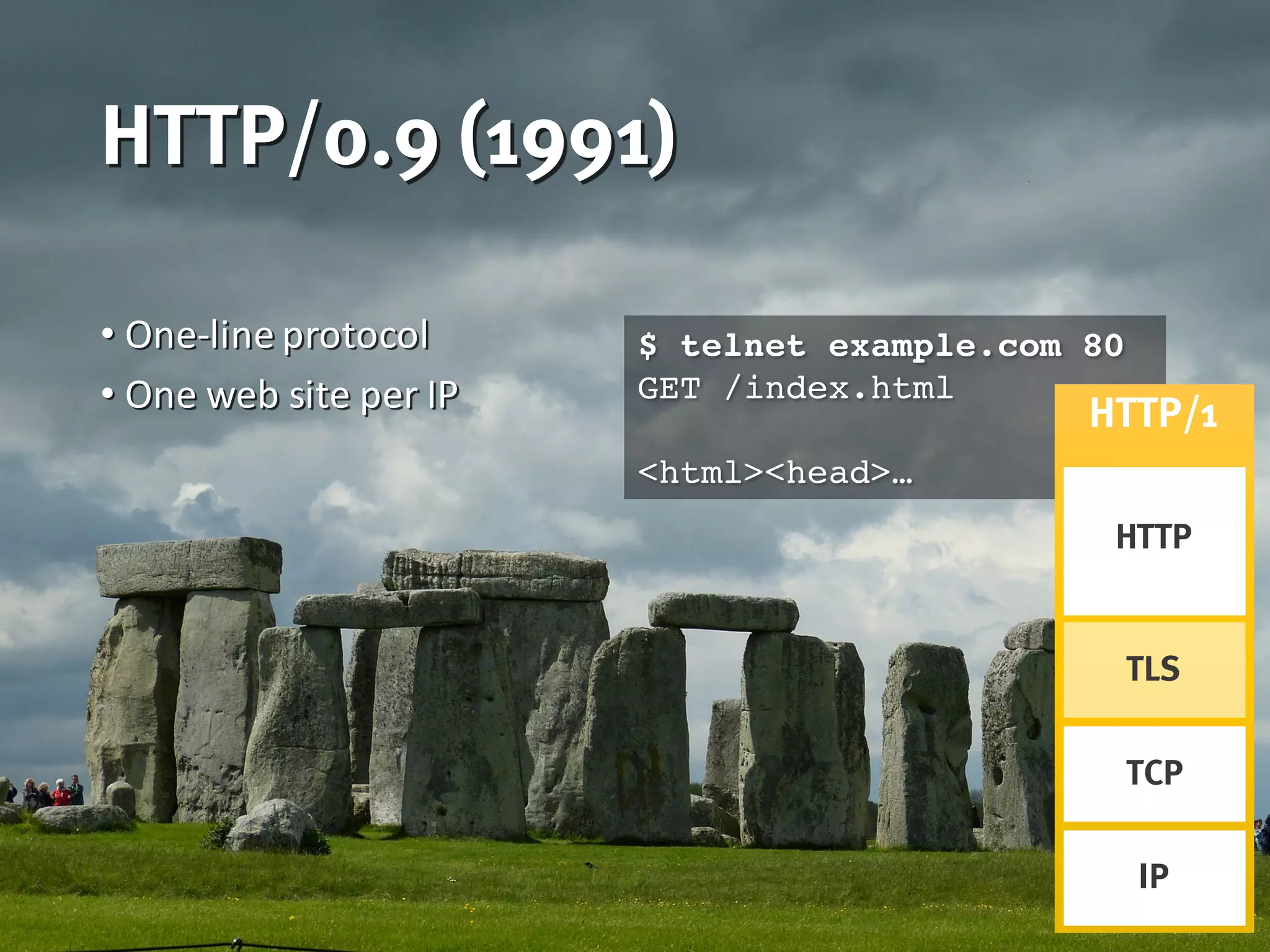
HTTP/0.9 (1991)
• One-line	protocol
• One	web	site	per	IP
$ telnet example.com 80
GET /index.html
<html><head>…
HTTP/1
HTTP
IP
TCP
TLS
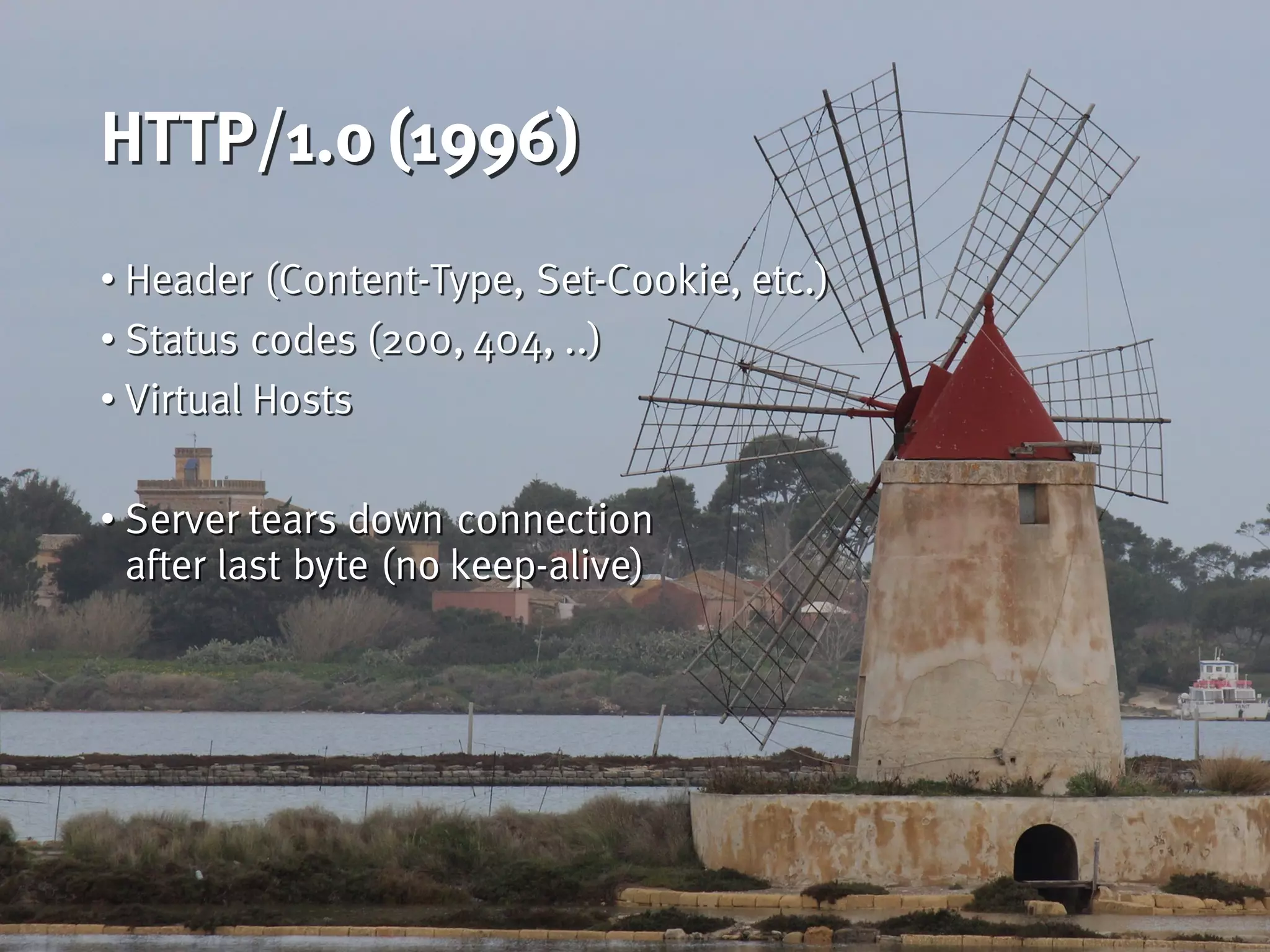
HTTP/1.0 (1996)
• Header (Content-Type, Set-Cookie, etc.)
• Status codes (200, 404, ..)
• Virtual Hosts
• Server tears down connection
after last byte (no keep-alive)
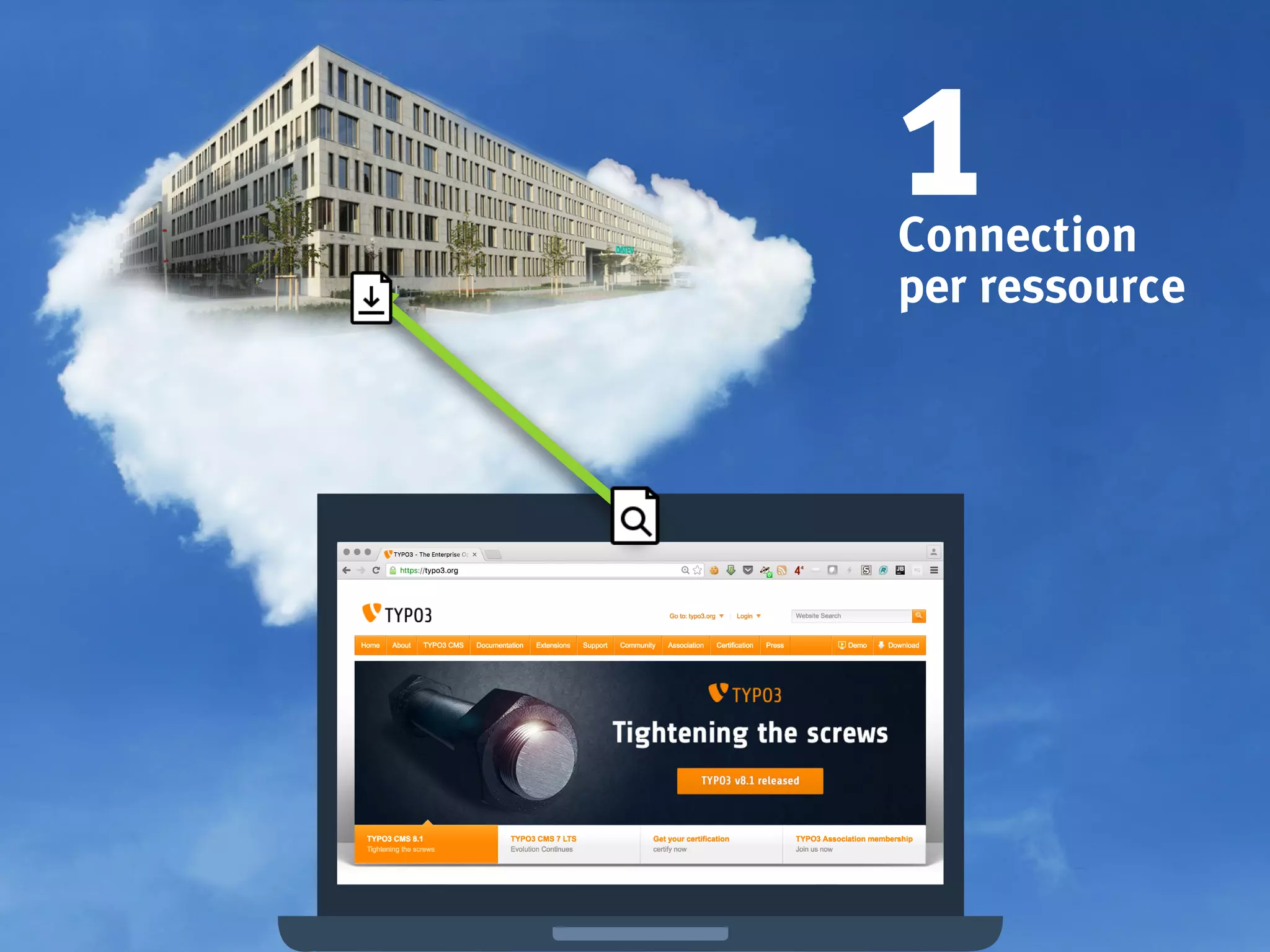
1Connection
per ressource
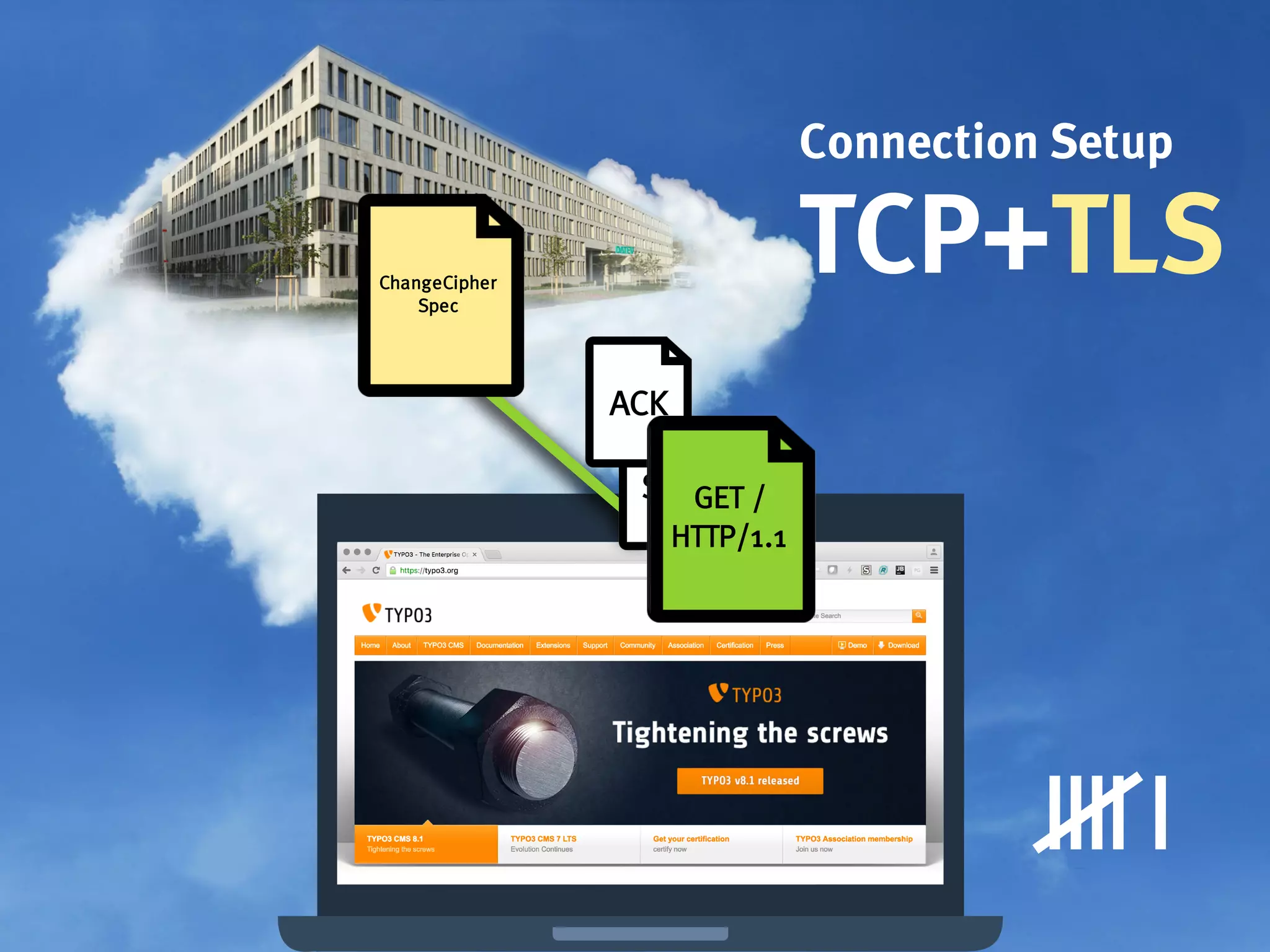
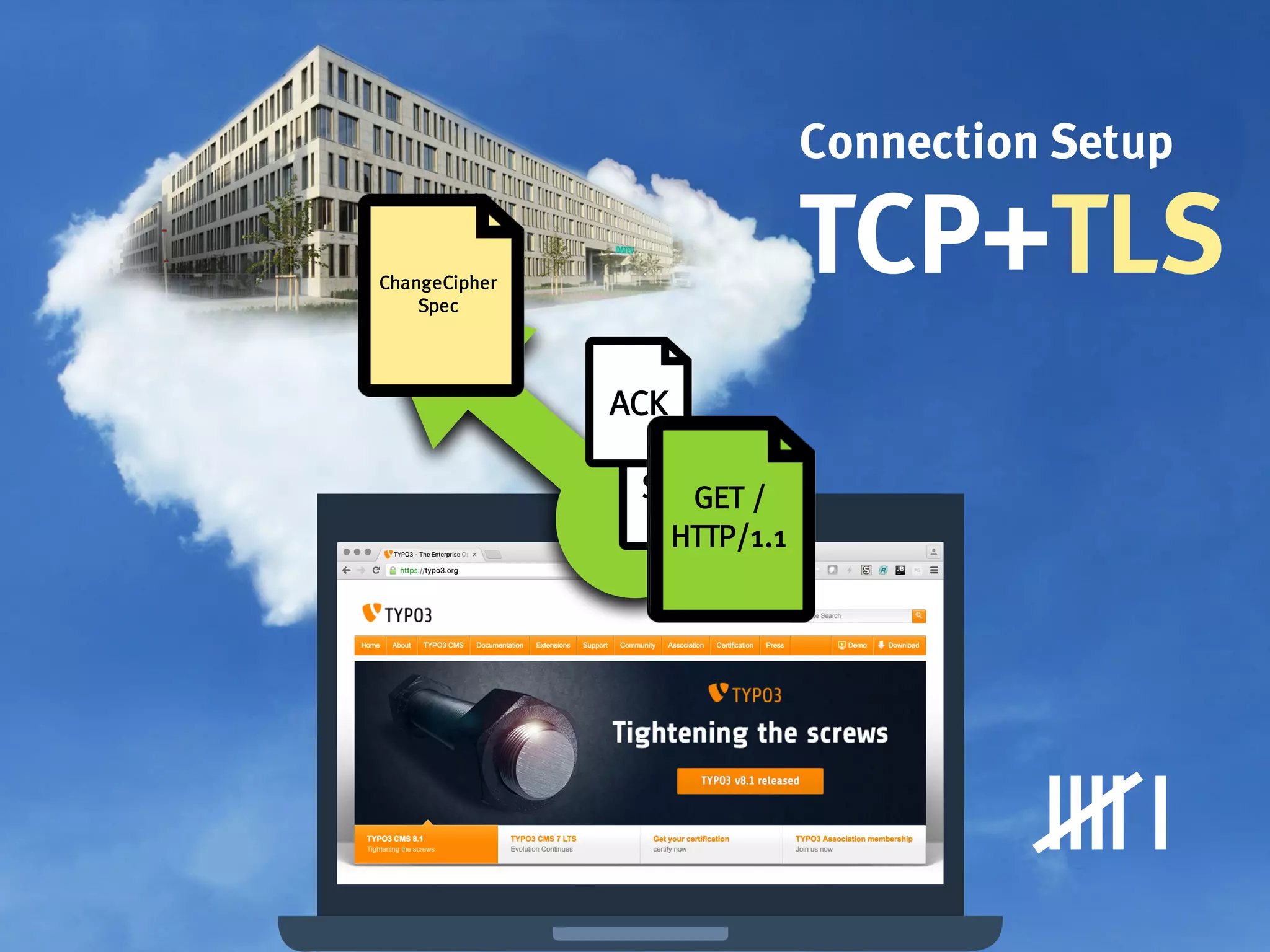
Connection Setup
TCP+TLS
SYN
SYN
ACK
ServerHello
Certificate
ChangeCipher
Spec
ACK
ClientHello
ClientKey
Exchange
ChangeCipher
Spec
GET /
HTTP/1.1
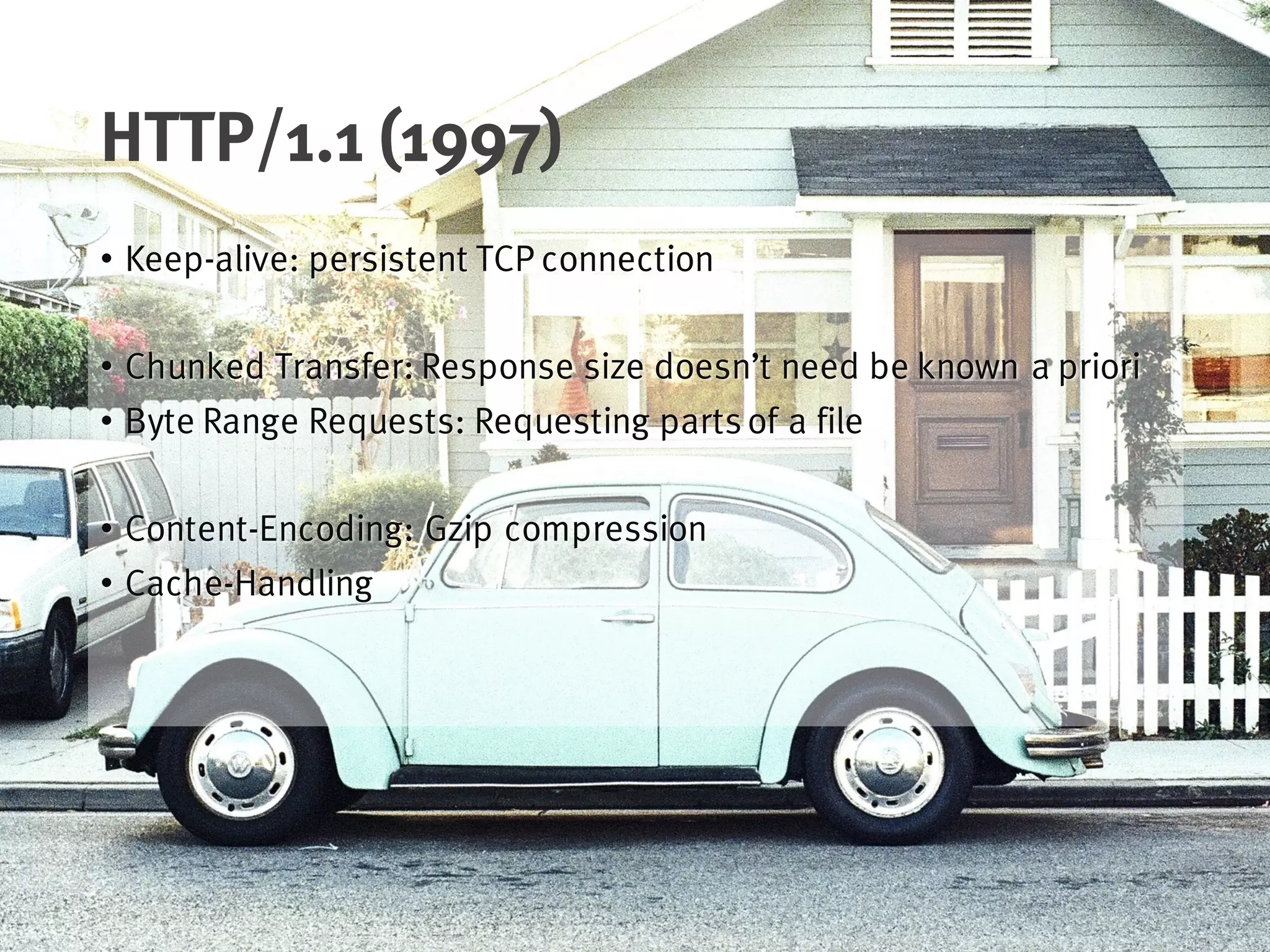
HTTP/1.1 (1997)
• Keep-alive: persistent TCP connection
• Chunked Transfer: Response size doesn’t need be known a priori
• Byte Range Requests: Requesting partsof a file
• Content-Encoding: Gzip compression
• Cache-Handling
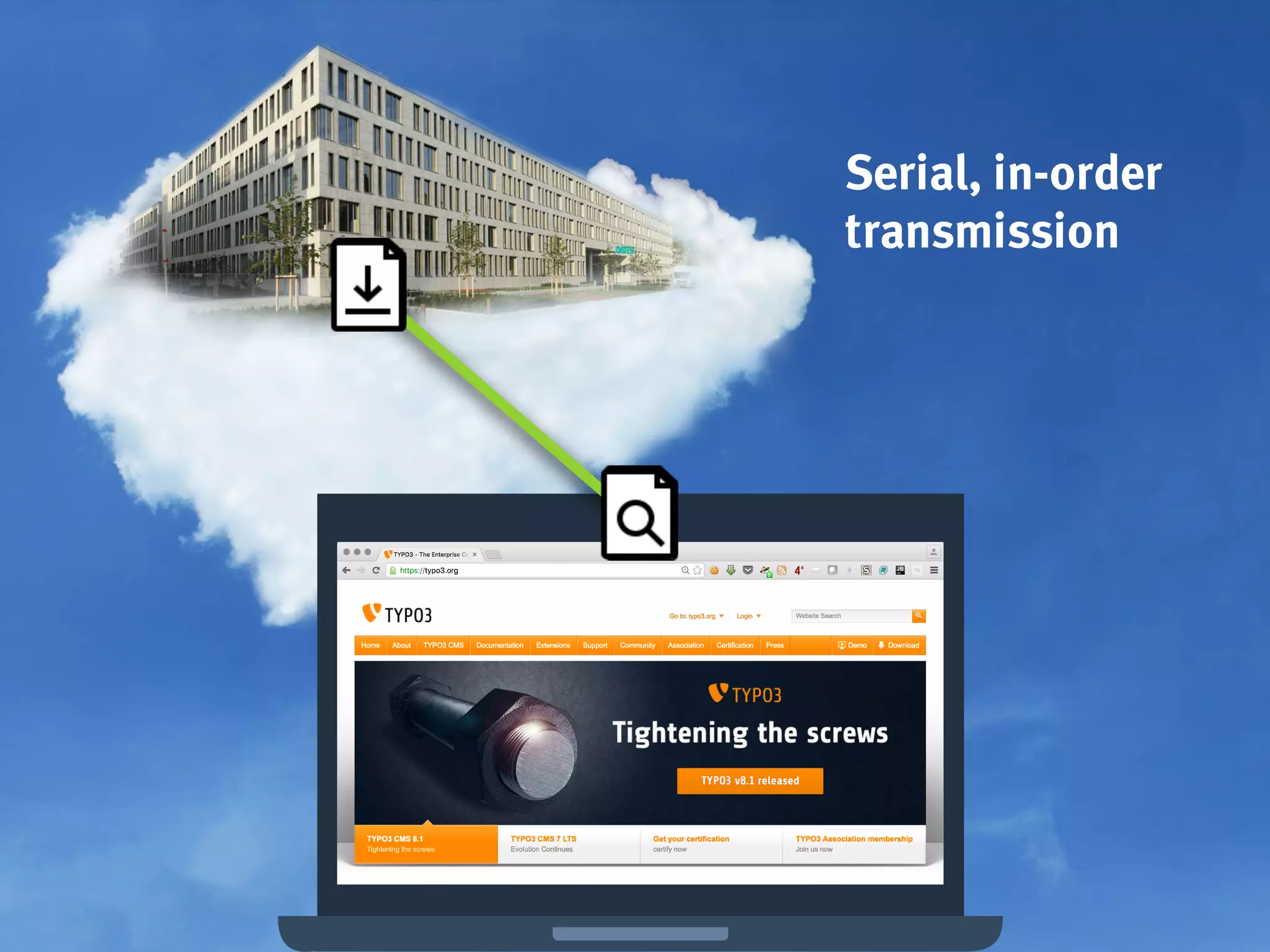
Serial, in-order
transmission
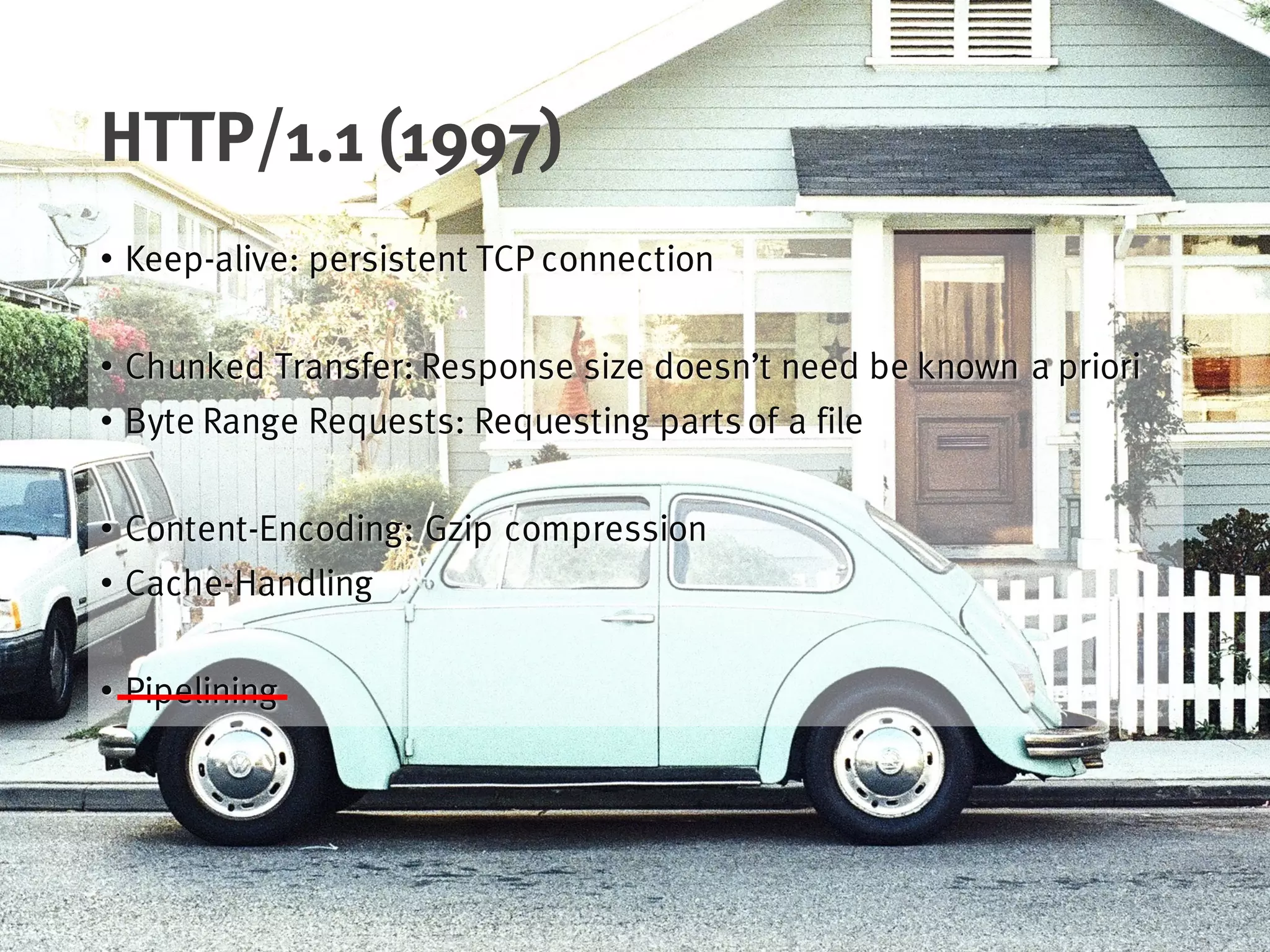
HTTP/1.1 (1997)
• Keep-alive: persistent TCP connection
• Chunked Transfer: Response size doesn’t need be known a priori
• Byte Range Requests: Requesting partsof a file
• Content-Encoding: Gzip compression
• Cache-Handling
• Pipelining
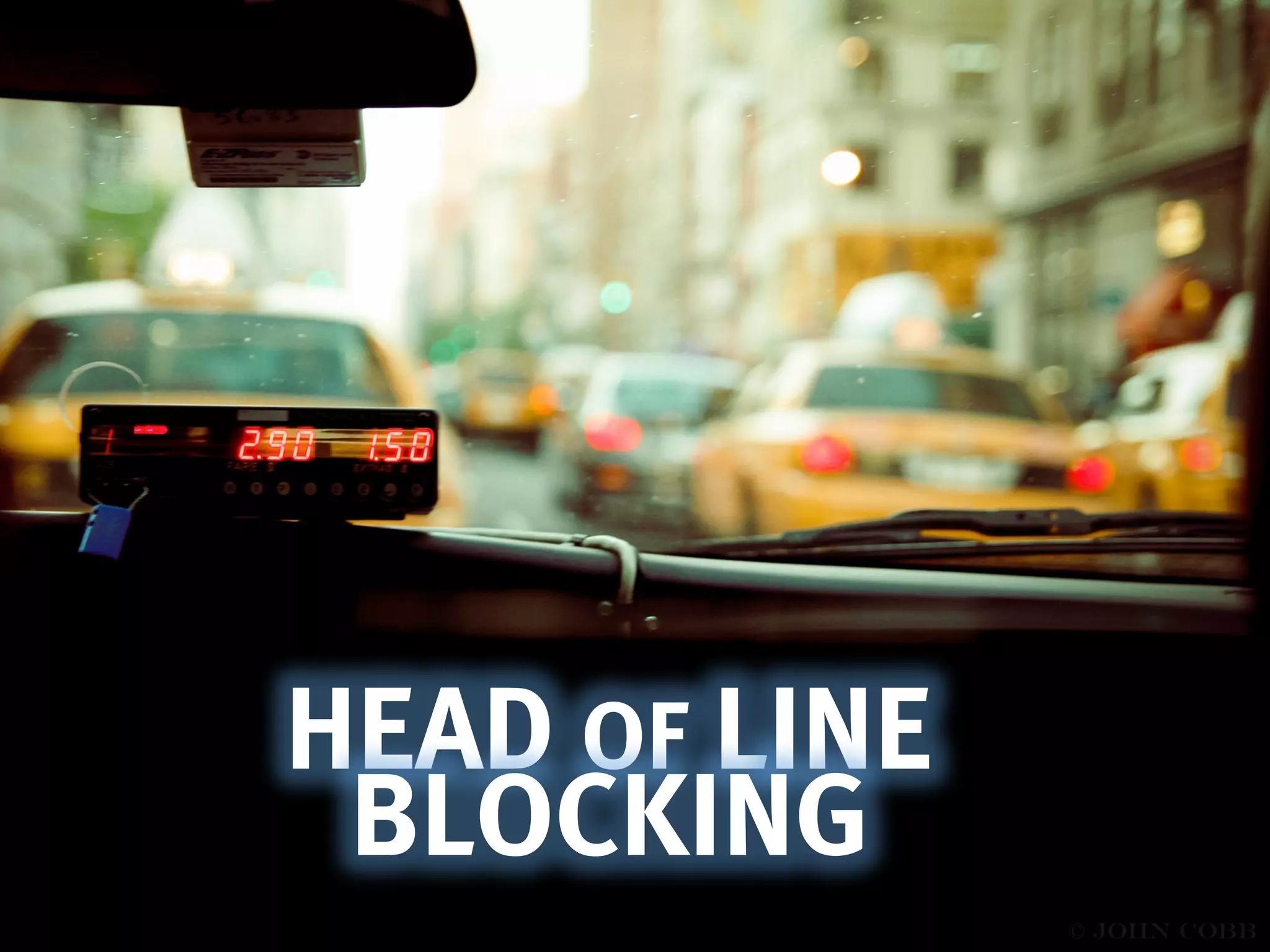
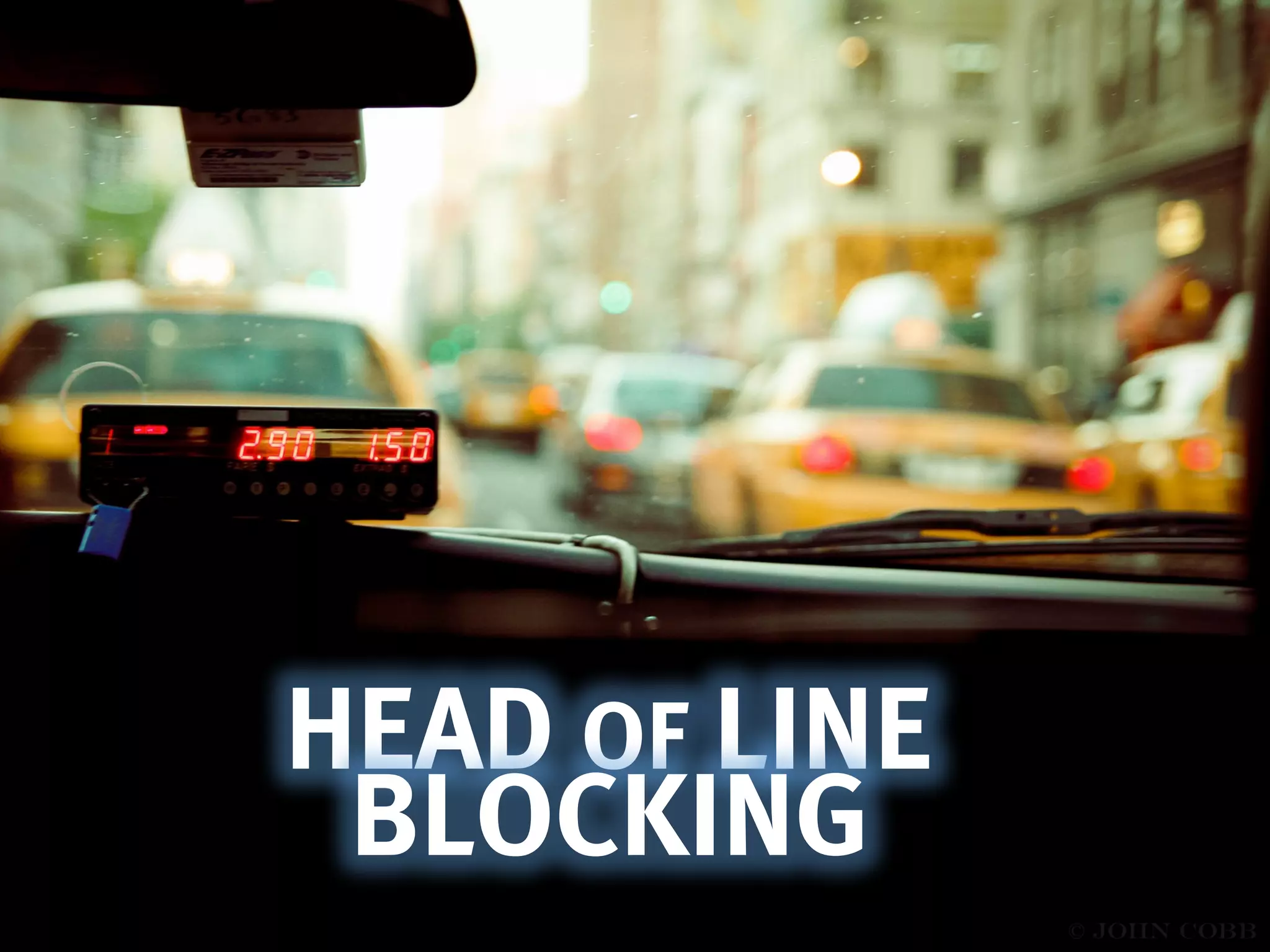
HEAD OF LINE
BLOCKING
Up to 6 conns.
per origin
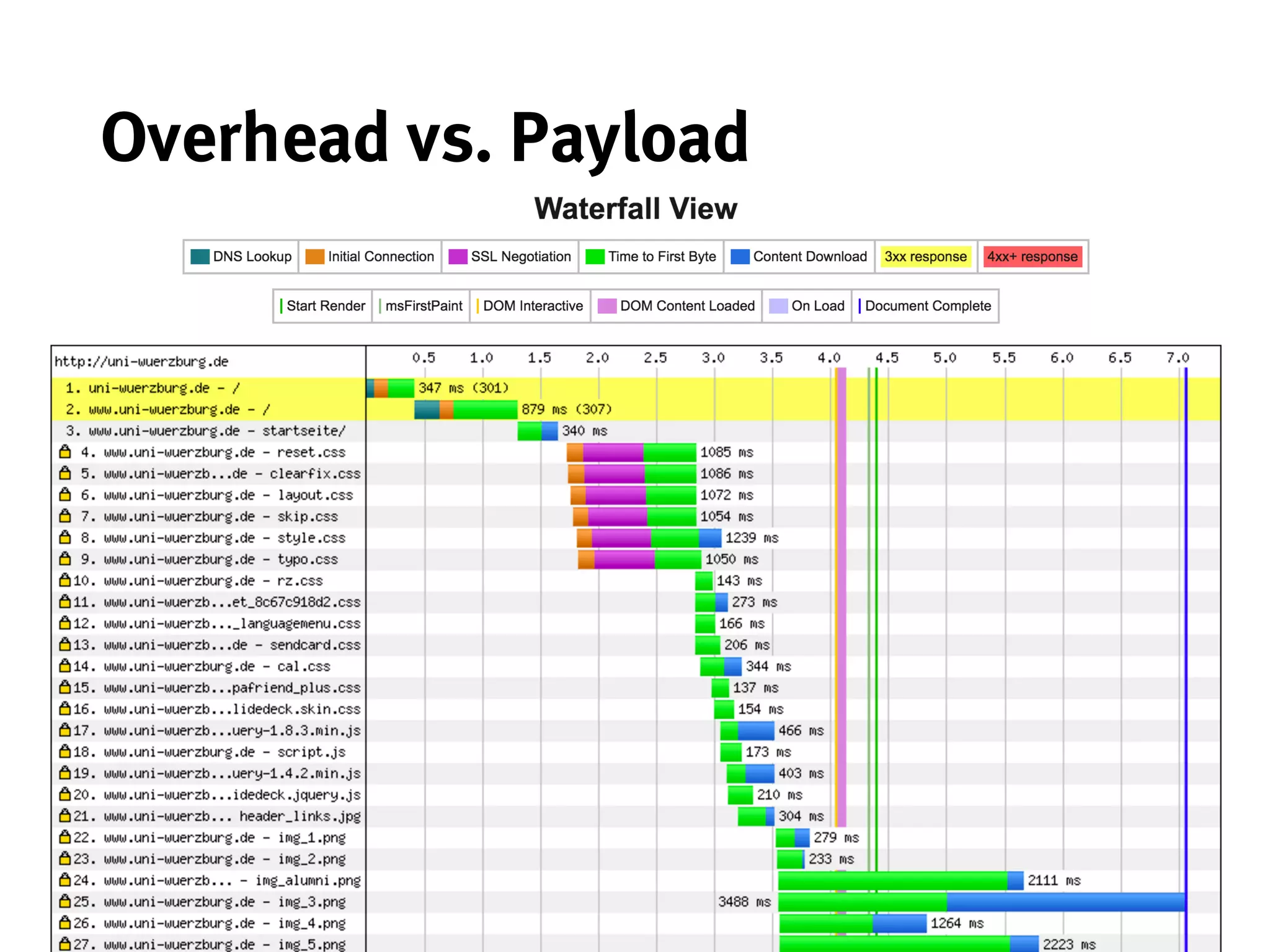
Overhead vs. Payload
More connections?
Domain Sharding
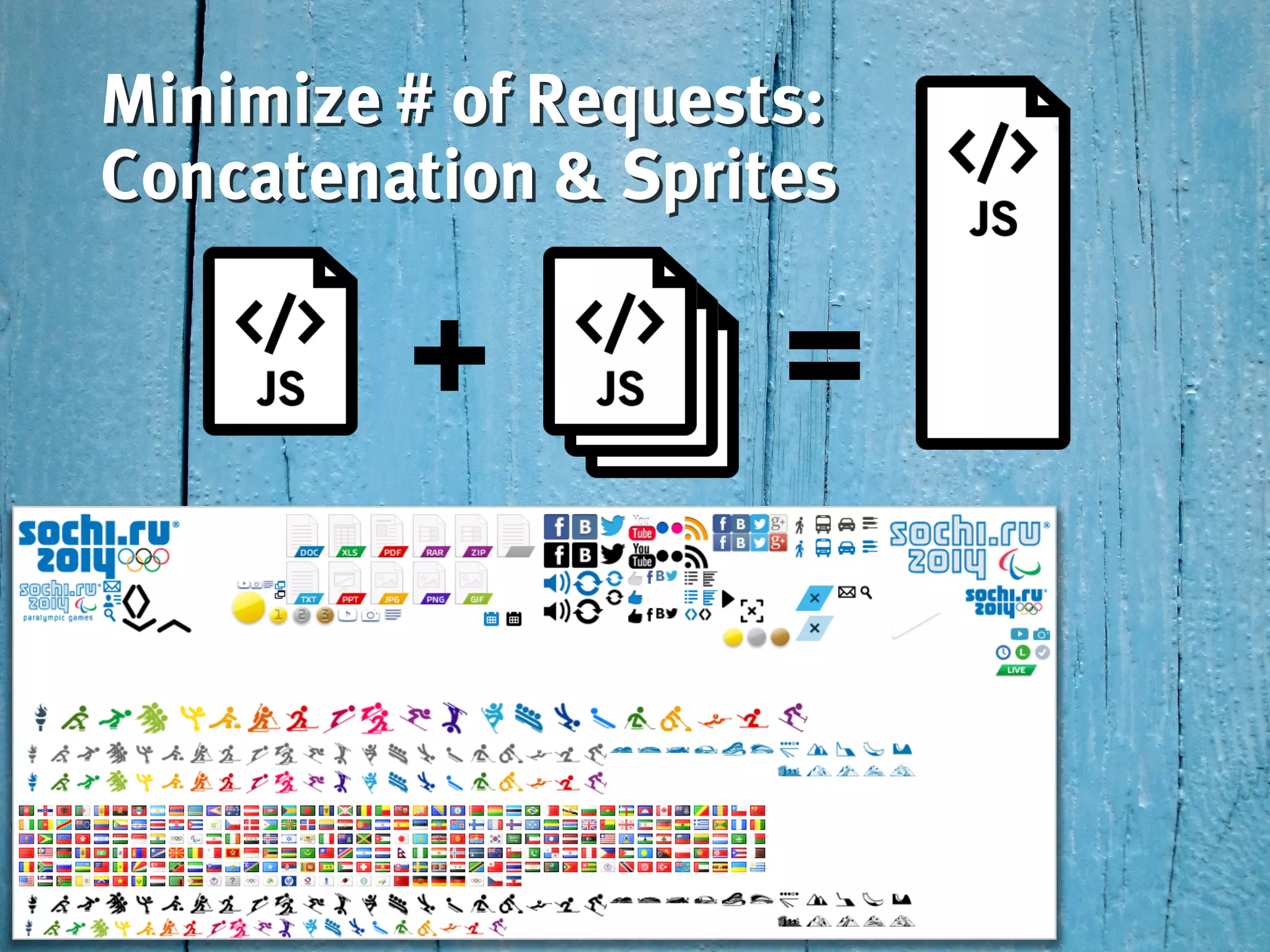
Minimize # of Requests:
Concatenation & Sprites
+ =
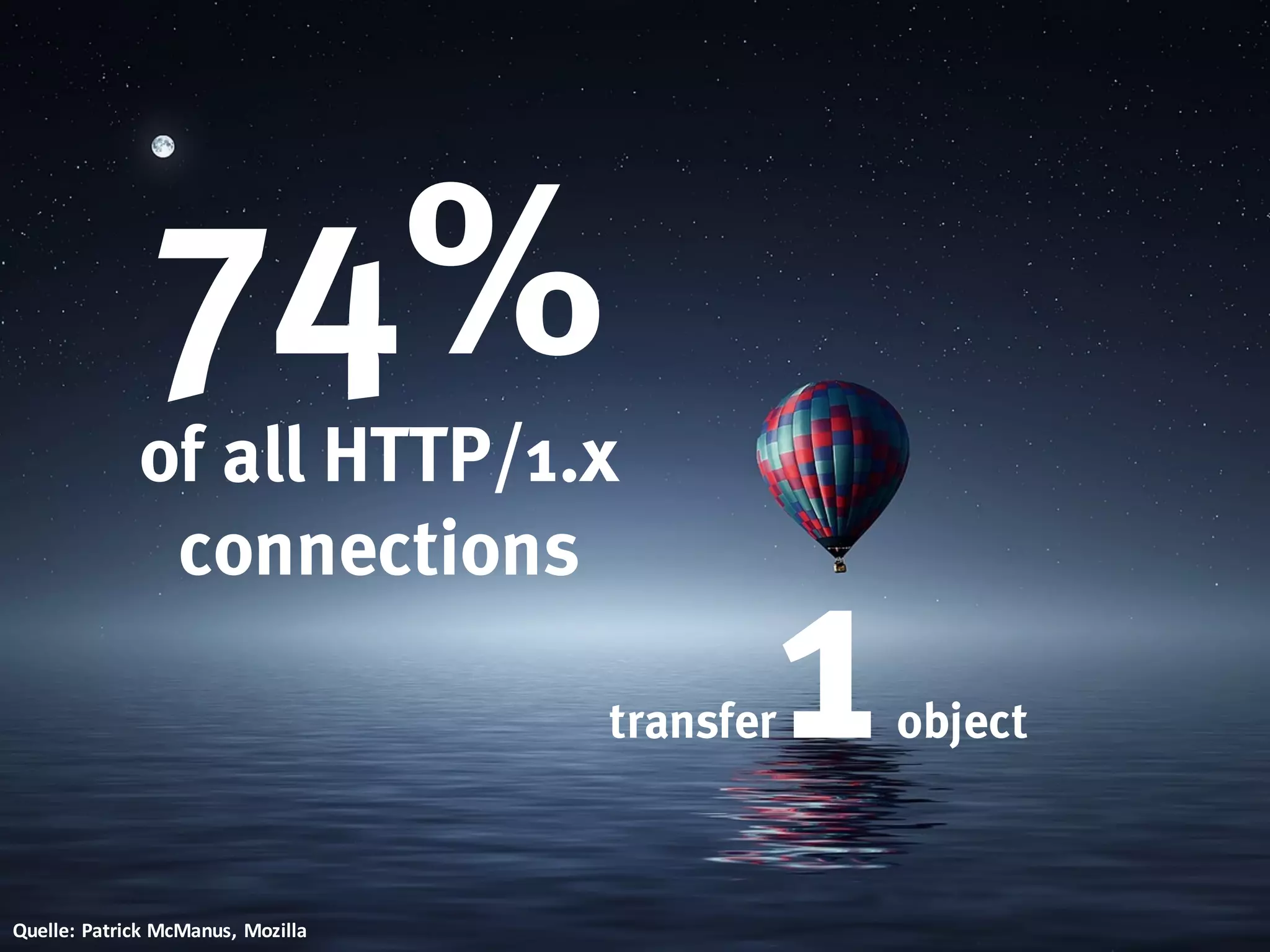
Quelle:	Patrick	McManus,	Mozilla
74%
of all HTTP/1.x
connections
transfer1object
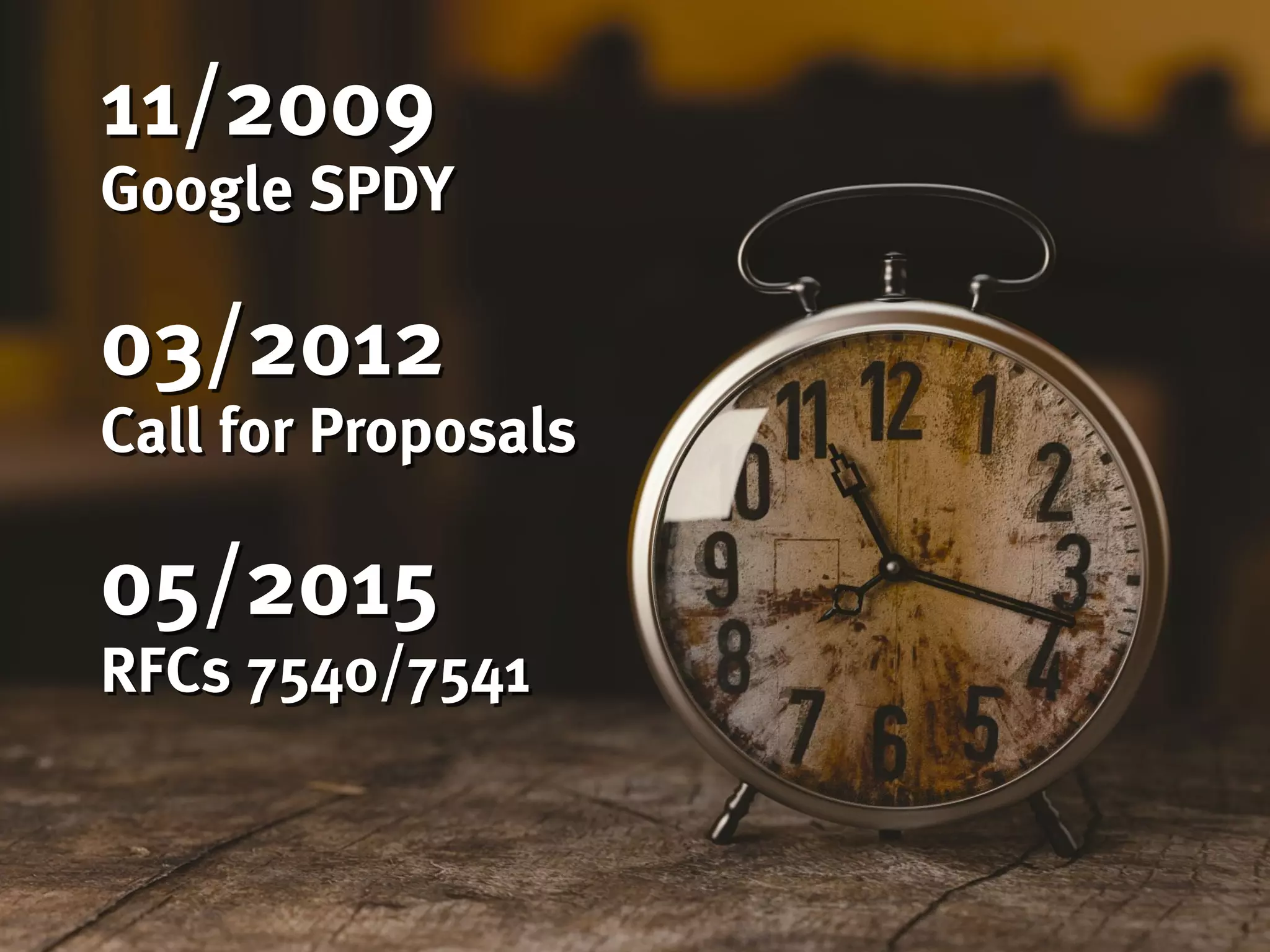
HTTP/2
11/2009
Google SPDY
03/2012
Call for Proposals
05/2015
RFCs 7540/7541
SPEED
what else?!
Clean Up
all the hacks
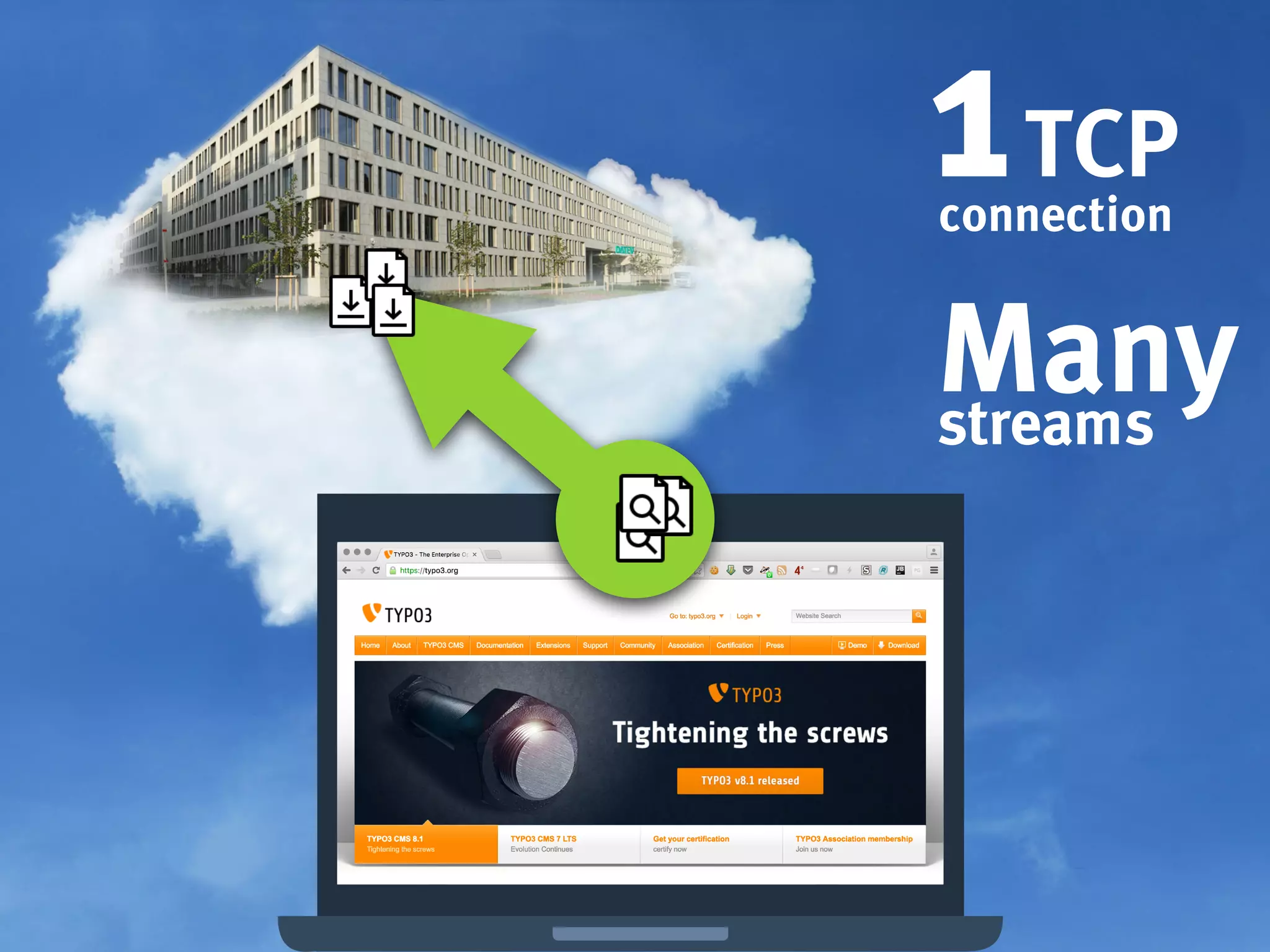
1TCP
connection
Manystreams
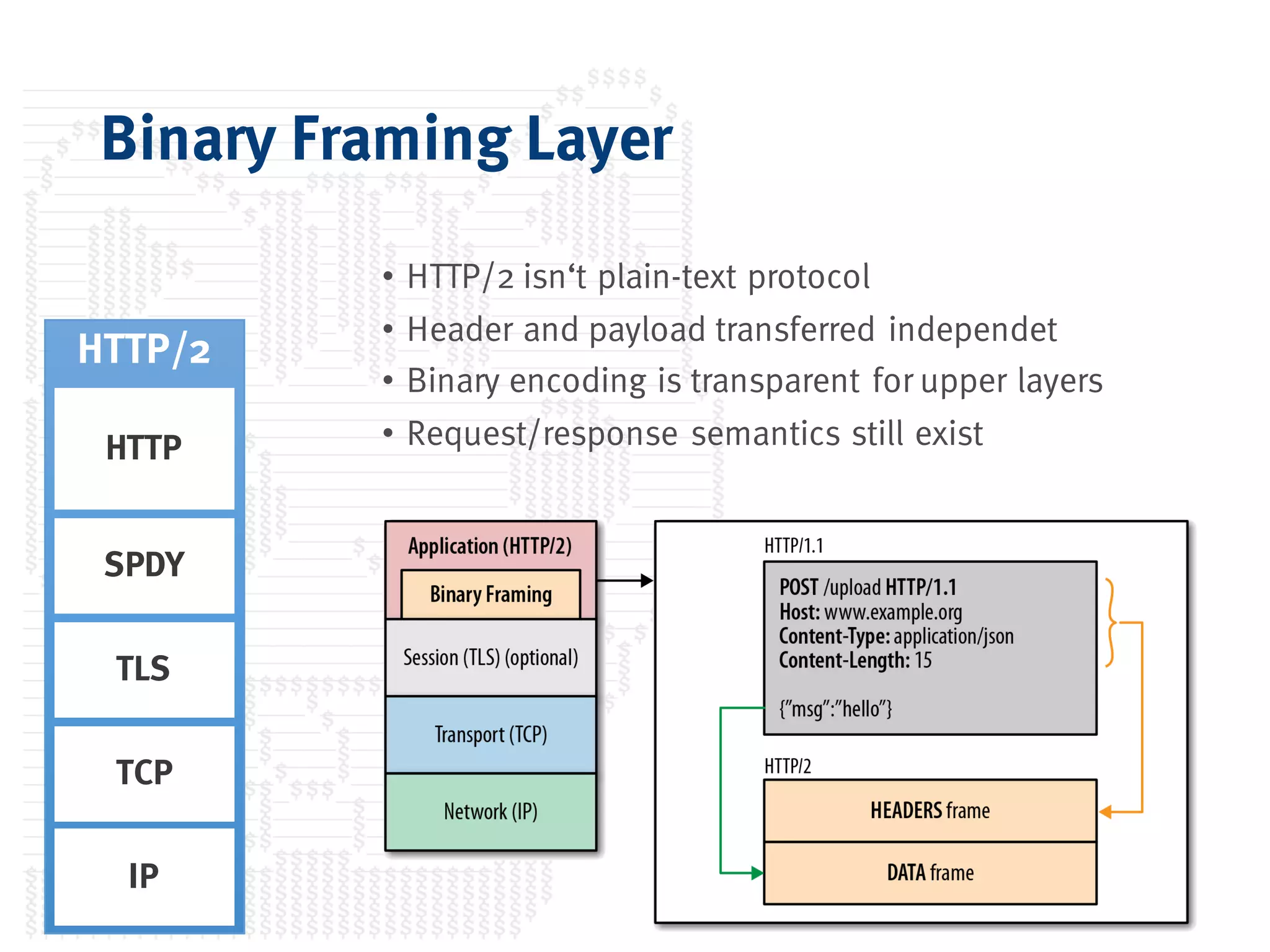
Binary Framing Layer
• HTTP/2 isn‘t plain-text protocol
• Header and payload transferred independet
• Binary encoding is transparent for upper layers
• Request/response semantics still exist
39
HTTP/2
TLS
IP
TCP
SPDY
HTTP
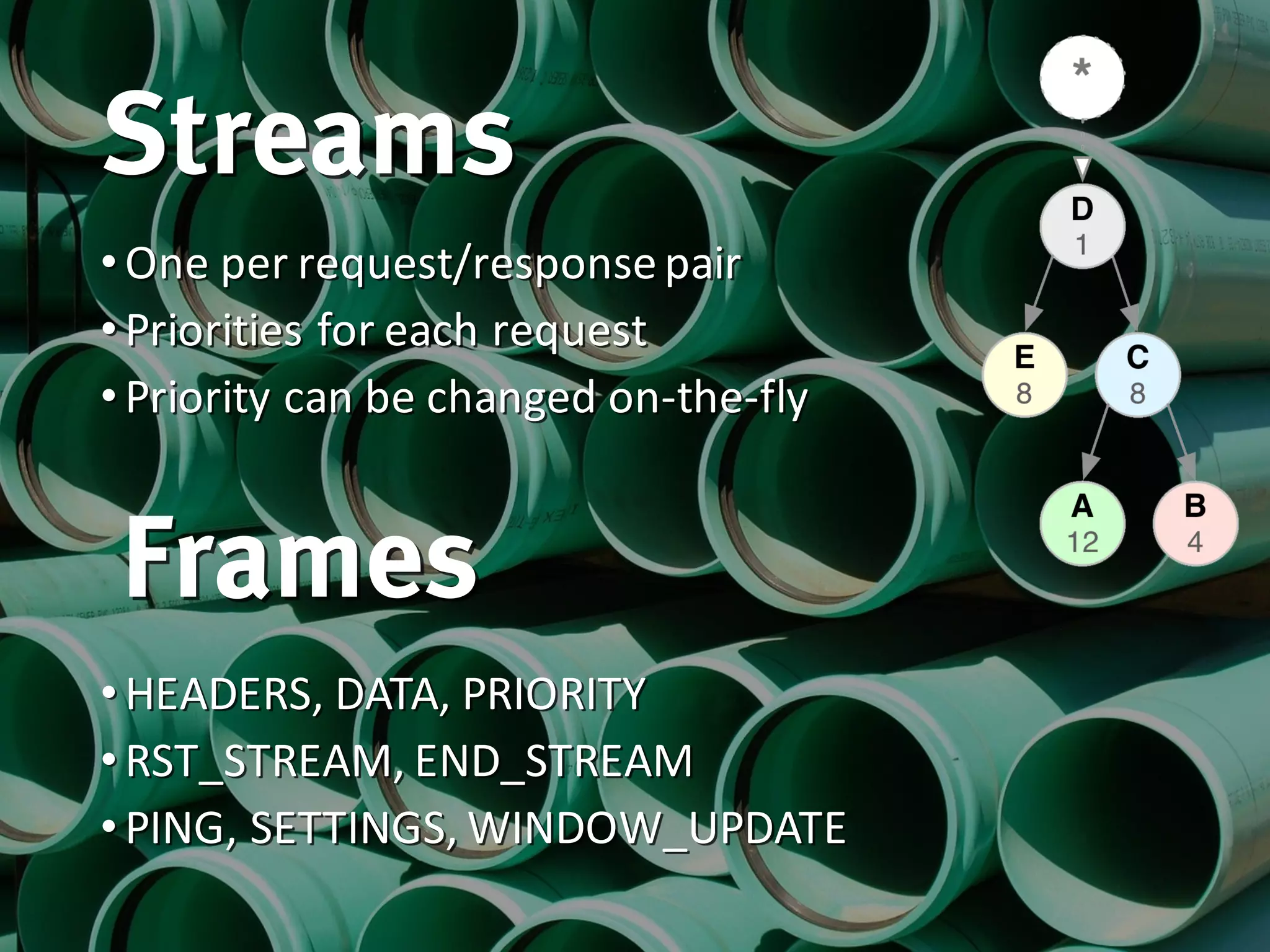
Streams
•One	per	request/response	pair
•Priorities	for	each	request
•Priority	can	be	changed	on-the-fly
Frames
•HEADERS,	DATA,	PRIORITY
•RST_STREAM,	END_STREAM	
•PING,	SETTINGS,	WINDOW_UPDATE
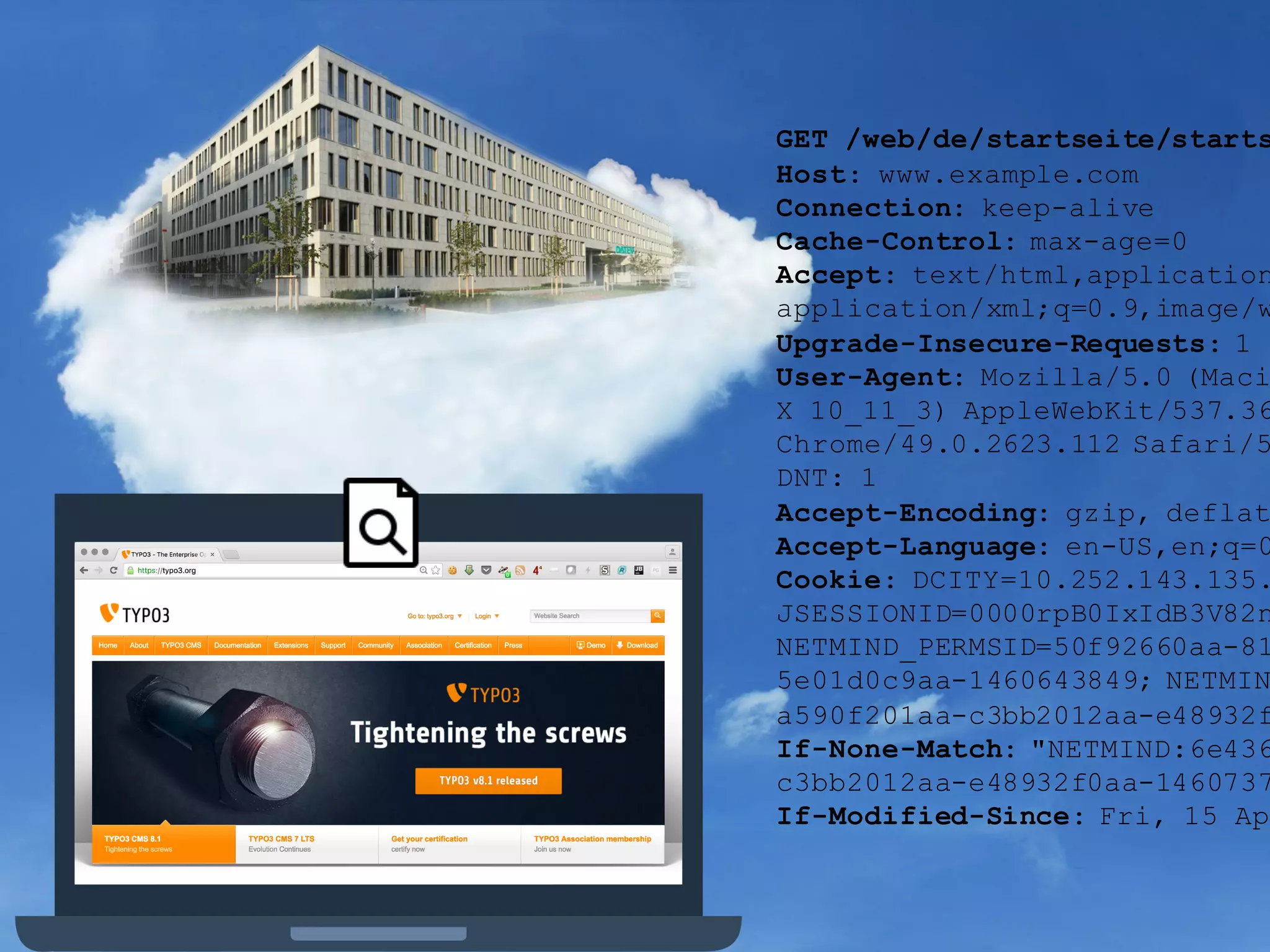
GET /web/de/startseite/starts
Host: www.example.com
Connection: keep-alive
Cache-Control: max-age=0
Accept: text/html,application
application/xml;q=0.9,image/w
Upgrade-Insecure-Requests: 1
User-Agent: Mozilla/5.0 (Maci
X 10_11_3) AppleWebKit/537.36
Chrome/49.0.2623.112 Safari/5
DNT: 1
Accept-Encoding: gzip, deflat
Accept-Language: en-US,en;q=0
Cookie: DCITY=10.252.143.135.
JSESSIONID=0000rpB0IxIdB3V82n
NETMIND_PERMSID=50f92660aa-81
5e01d0c9aa-1460643849; NETMIN
a590f201aa-c3bb2012aa-e48932f
If-None-Match: "NETMIND:6e436
c3bb2012aa-e48932f0aa-1460737
If-Modified-Since: Fri, 15 Ap
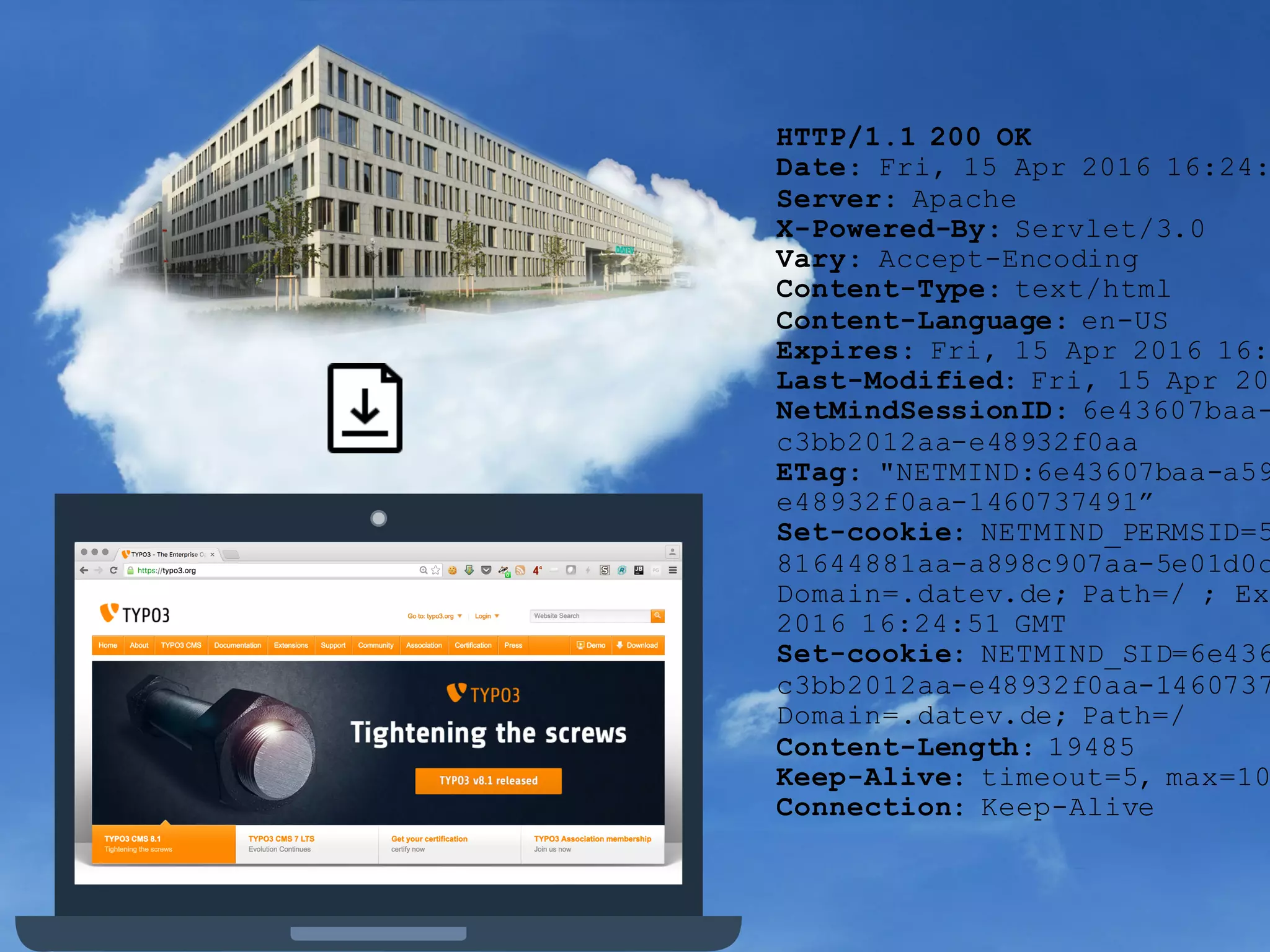
HTTP/1.1 200 OK
Date: Fri, 15 Apr 2016 16:24:
Server: Apache
X-Powered-By: Servlet/3.0
Vary: Accept-Encoding
Content-Type: text/html
Content-Language: en-US
Expires: Fri, 15 Apr 2016 16:
Last-Modified: Fri, 15 Apr 20
NetMindSessionID: 6e43607baa-
c3bb2012aa-e48932f0aa
ETag: "NETMIND:6e43607baa-a59
e48932f0aa-1460737491”
Set-cookie: NETMIND_PERMSID=5
81644881aa-a898c907aa-5e01d0c
Domain=.datev.de; Path=/ ; Ex
2016 16:24:51 GMT
Set-cookie: NETMIND_SID=6e436
c3bb2012aa-e48932f0aa-1460737
Domain=.datev.de; Path=/
Content-Length: 19485
Keep-Alive: timeout=5, max=10
Connection: Keep-Alive
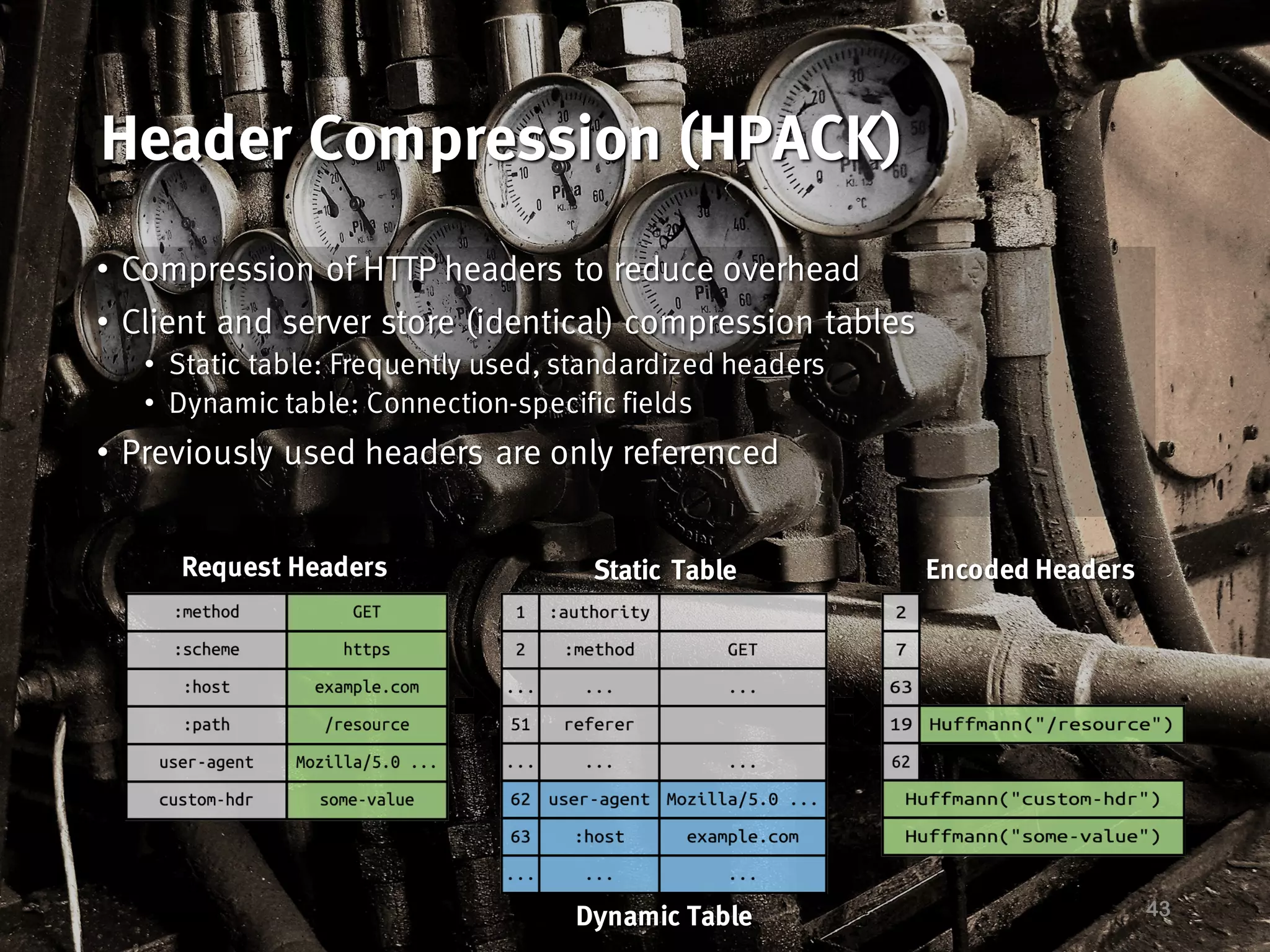
Header Compression (HPACK)
43
• Compression of HTTP headers to reduce overhead
• Client and server store (identical) compression tables
• Static table: Frequently used, standardized headers
• Dynamic table: Connection-specific fields
• Previously used headers are only referenced
Request Headers Static Table Encoded Headers
Dynamic Table
Let’s go!
•HTTP/2 is fully
backwards
compatible
•No changes
needed in web
application
Server Push
• Server	can answer one request with additional	responses
• Server	can manage	the client‘s cache
• Push	resources,	invalidate resource,	increase TTL
• Requires server-side knowledgeof web	application
• No overlap with Server-Sent Events	/	WebSockets
• State	not	known to the web	application(aka	JavaScript)
45
Link: “</css/site.css>;rel=preload“
Link: "</images/logo.jpg>;rel=preload“
QUIC
Getting rid of TCP using
Quick UDP Internet Connections
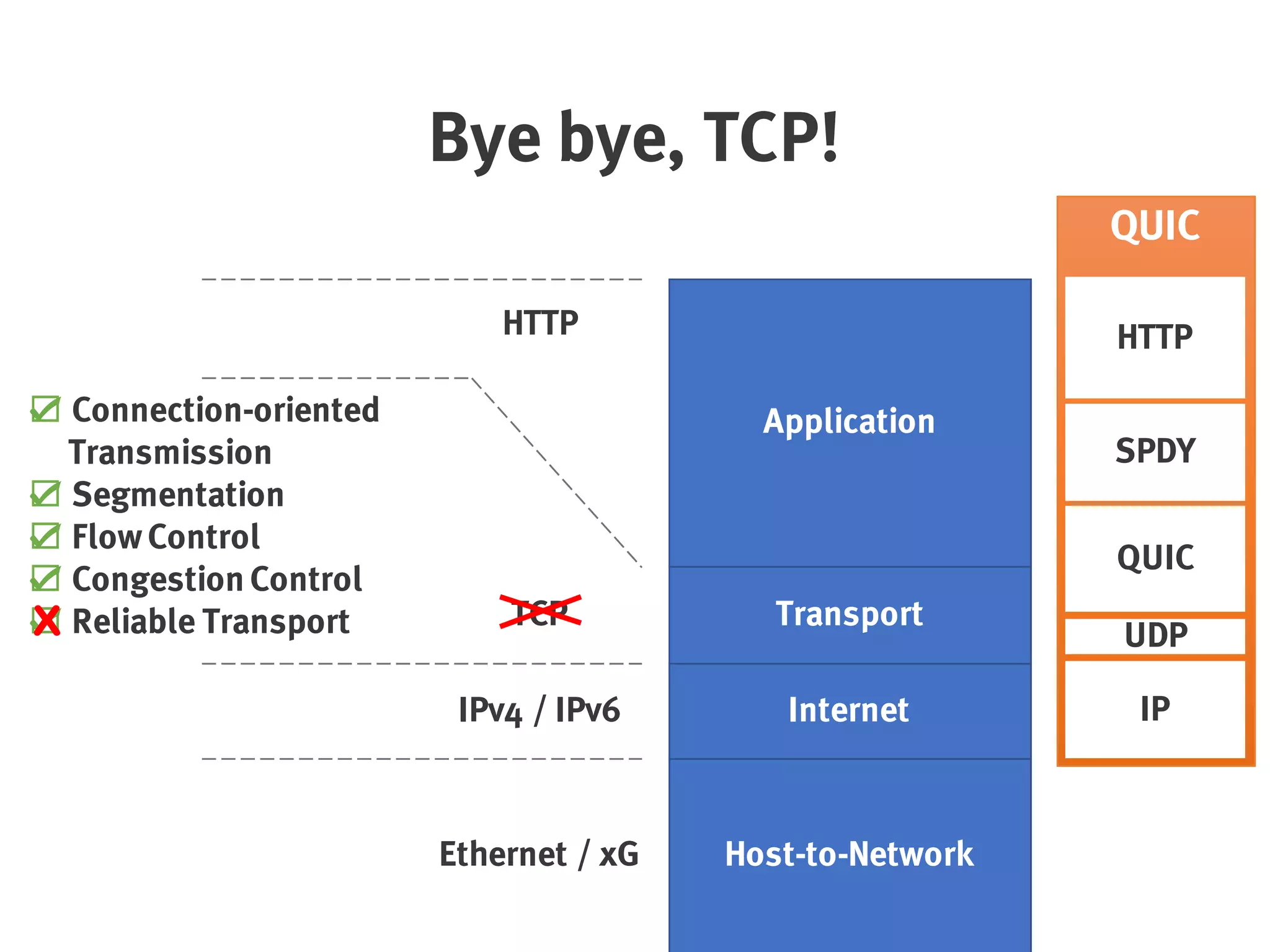
Bye bye, TCP!
Host-to-Network
Internet
Transport
Application
Ethernet / xG
IPv4 / IPv6
TCP
HTTP
☑ Connection-oriented
Transmission
☑ Segmentation
☑ Flow Control
☑ Congestion Control
☑ Reliable Transportx
QUIC
QUIC
IP
UDP
SPDY
HTTP
HEAD OF LINE
BLOCKING
Slow Connection Setup?
Connection Setup
TCP+TLS
SYN
SYN
ACK
ServerHello
Certificate
ChangeCipher
Spec
ACK
ClientHello
ClientKey
Exchange
ChangeCipher
Spec
GET /
HTTP/1.1
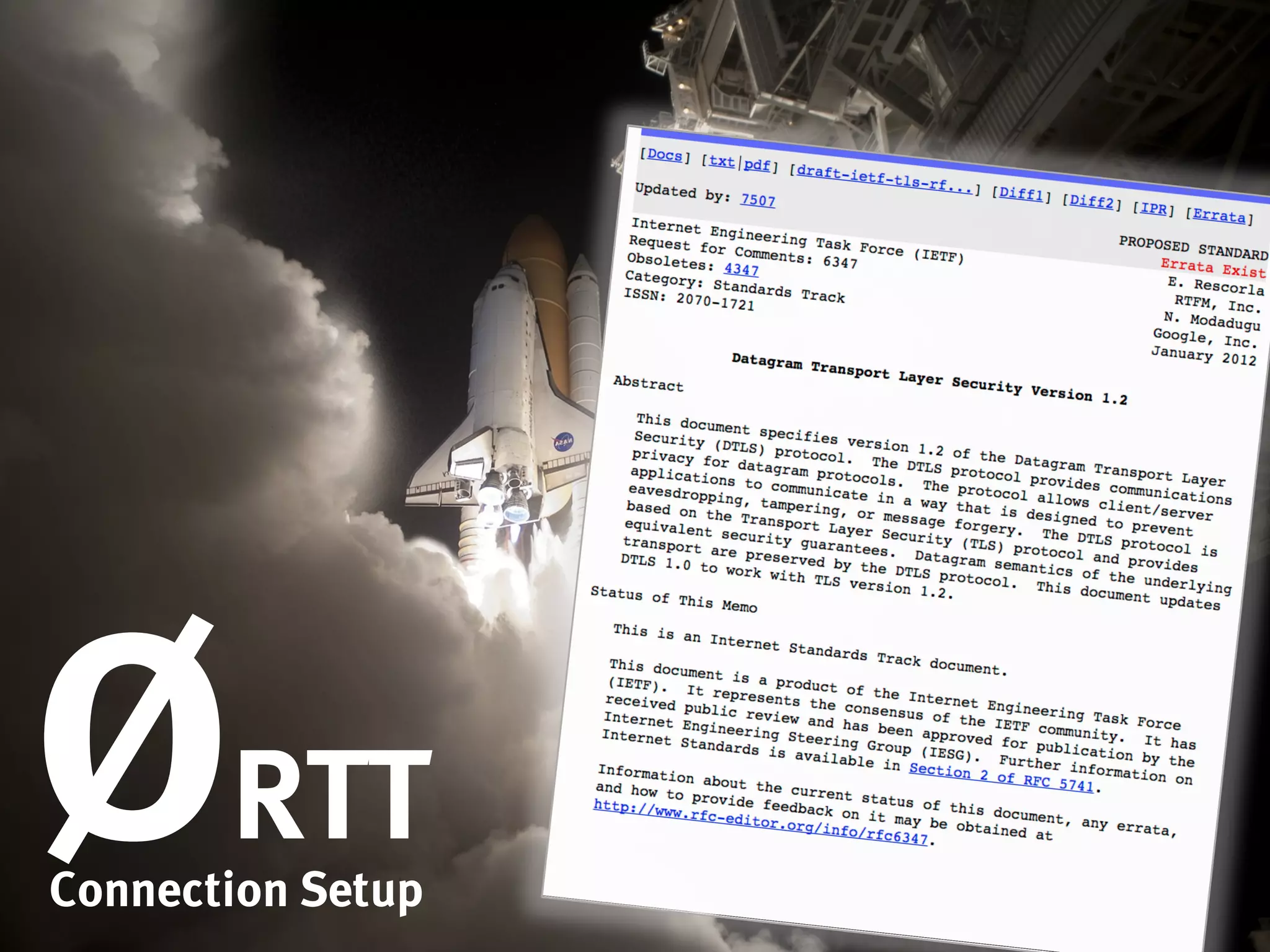
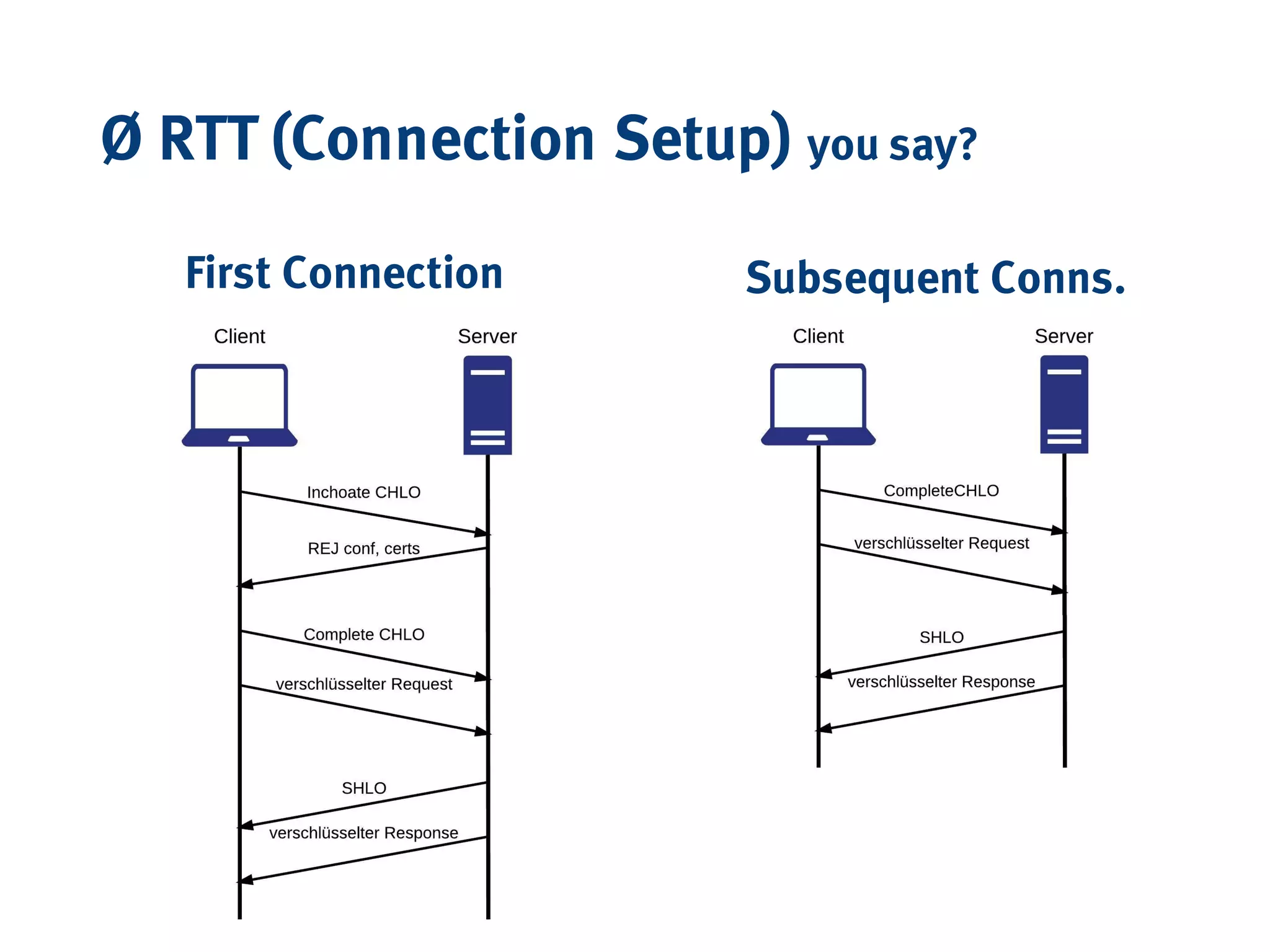
ØRTT
Connection Setup
Ø RTT (Connection Setup) you say?
First Connection Subsequent Conns.
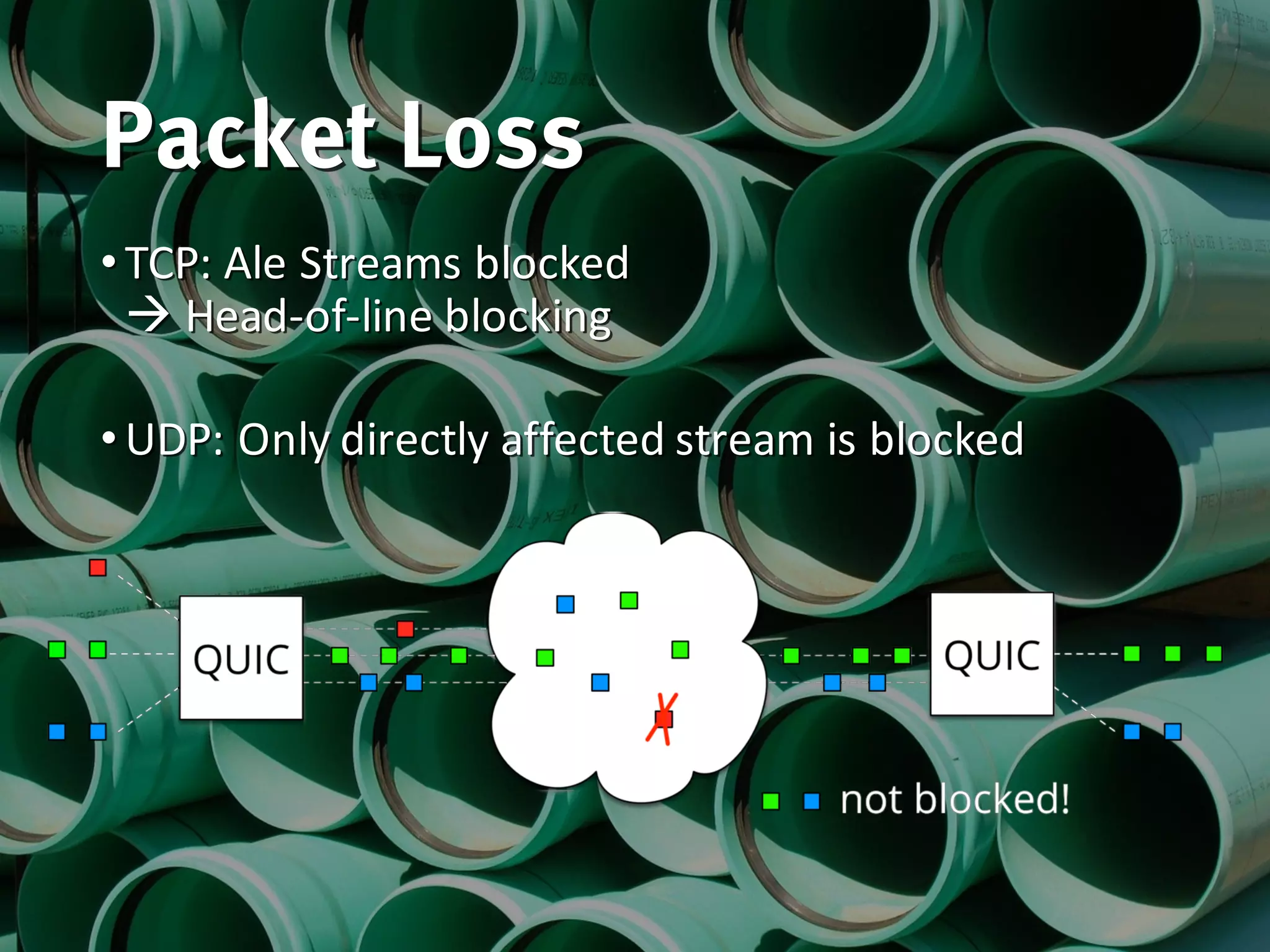
Packet Loss
•TCP:	Ale	Streams	blocked
à Head-of-line	blocking
•UDP:	Only	directly	affected	stream	is	blocked
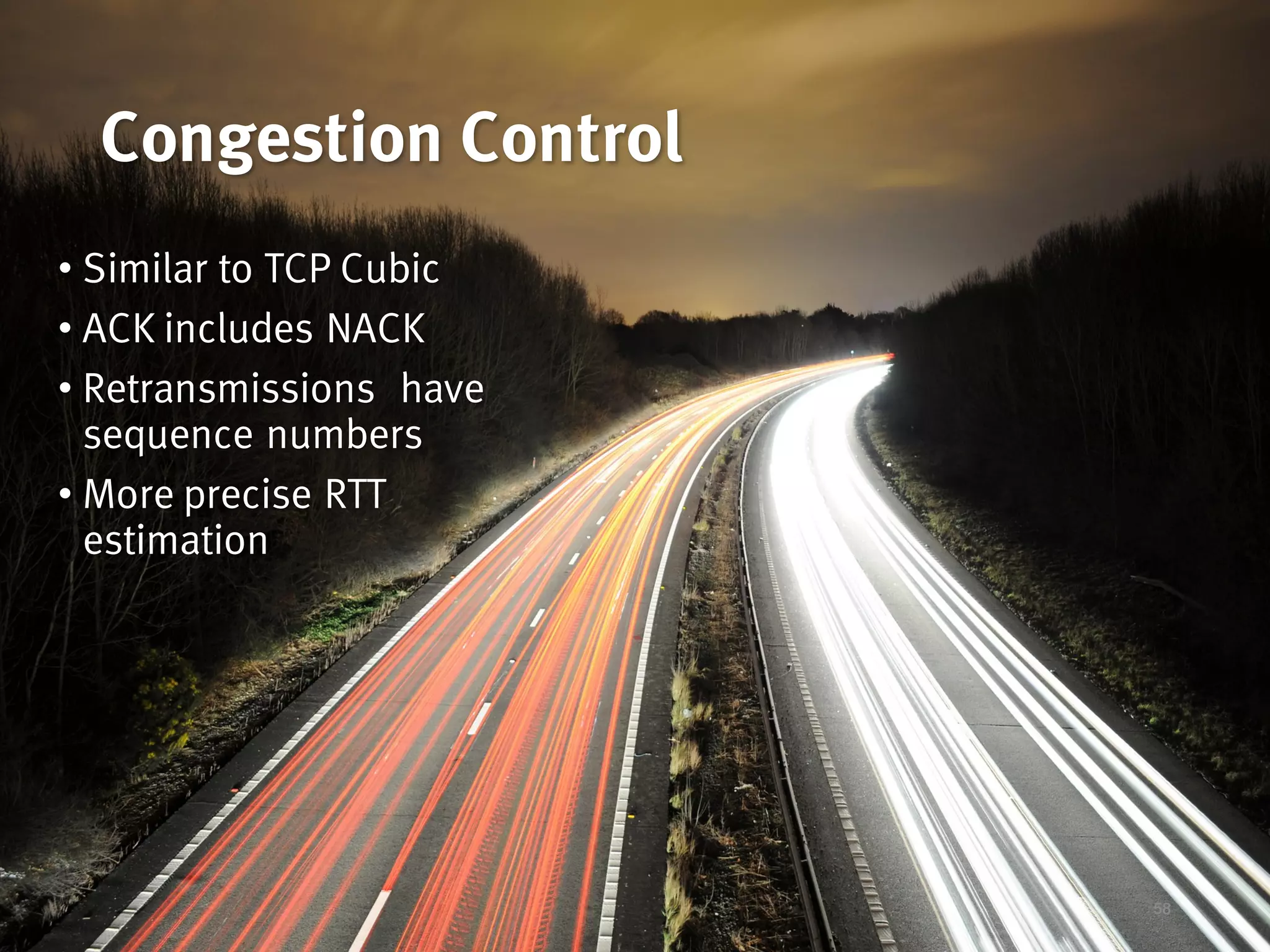
Congestion Control
58
• Similar to TCP Cubic
• ACK includes NACK
• Retransmissions have
sequence numbers
• More precise RTT
estimation
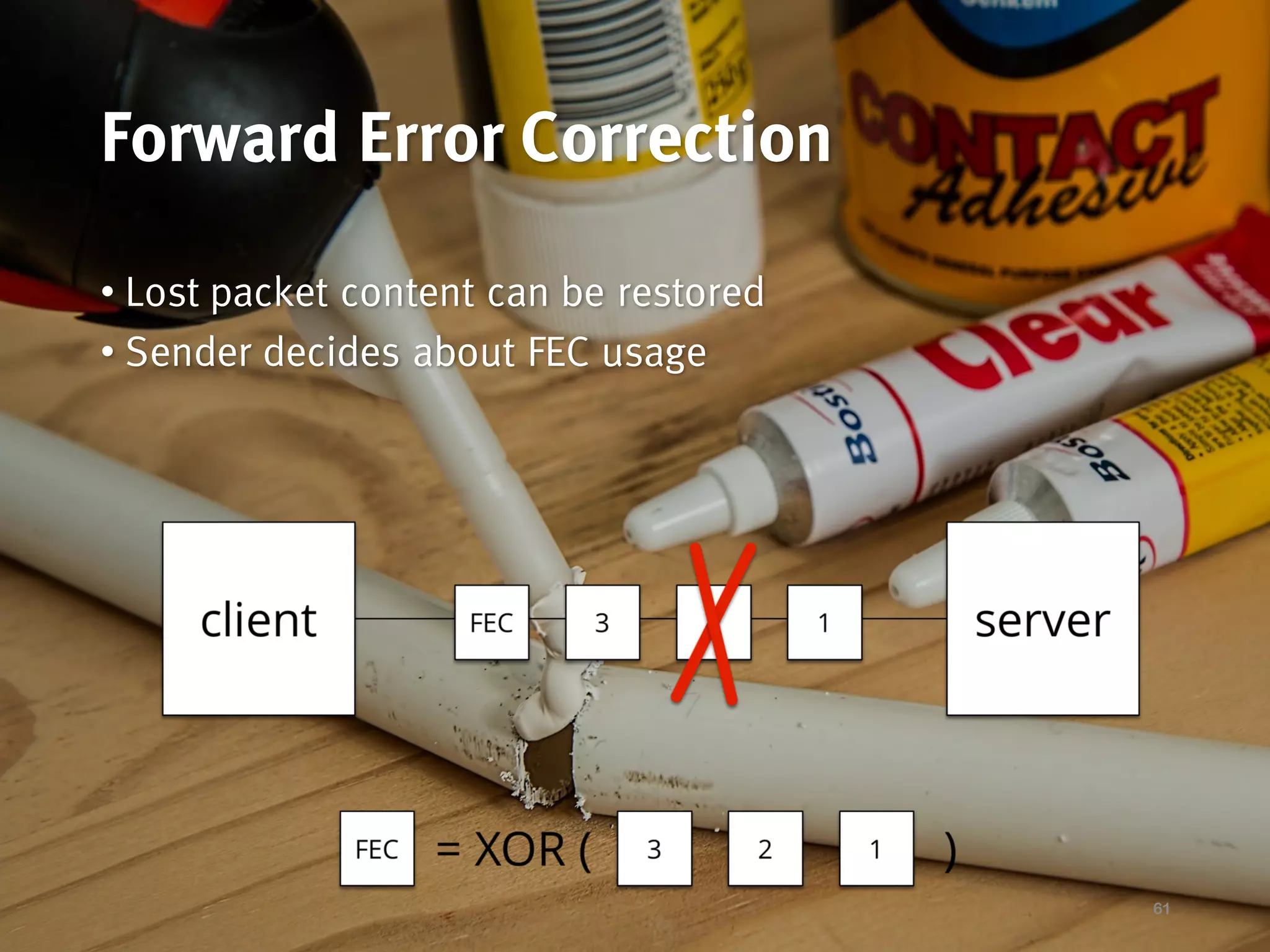
Forward Error Correction
61
• Lost packet content can be restored
• Sender decides about FEC usage
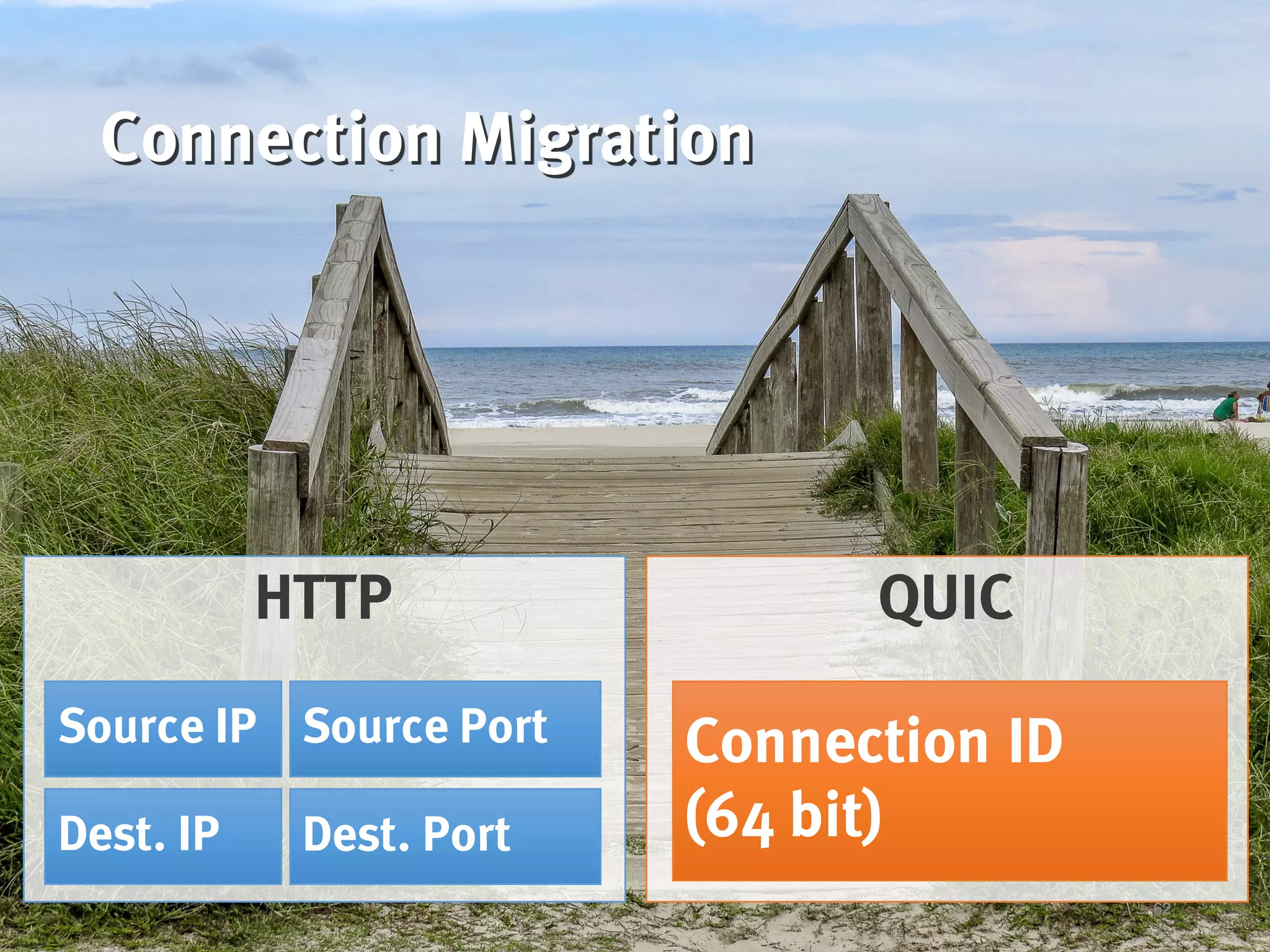
Connection Migration
62
QUIC
Connection ID
(64 bit)
HTTP
Source IP Source Port
Dest. IP Dest. Port
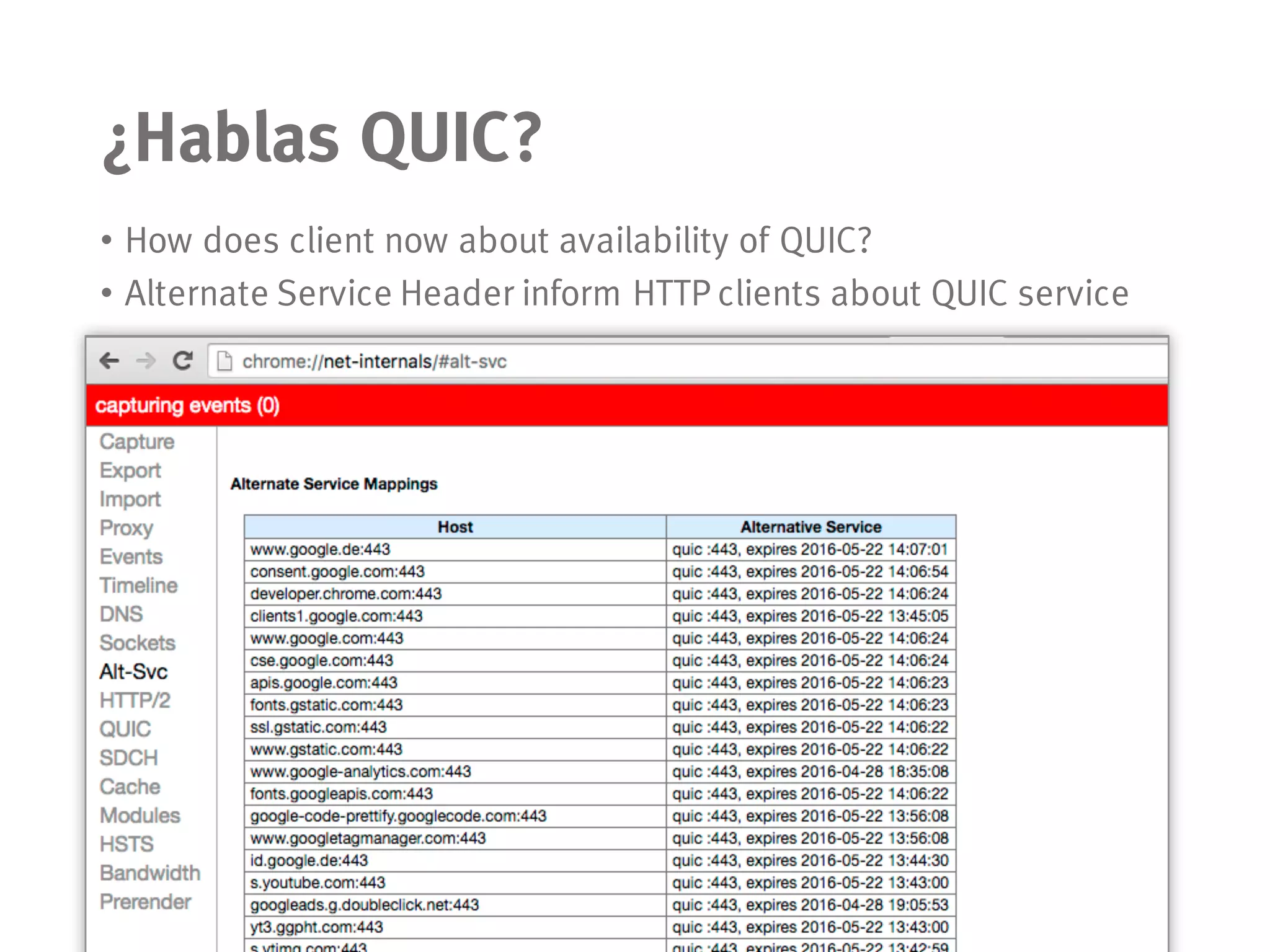
¿Hablas QUIC?
• How does client now about availability of QUIC?
• Alternate Service Header inform HTTP clients about QUIC service
QUIC Status
• Currently, only Google knows
• Currently, only Google uses it
• Open Source QUIC server (Chromium) outdated
• No reliable information about efficiency
MULTIPATH TCP
All paths lead to Rome
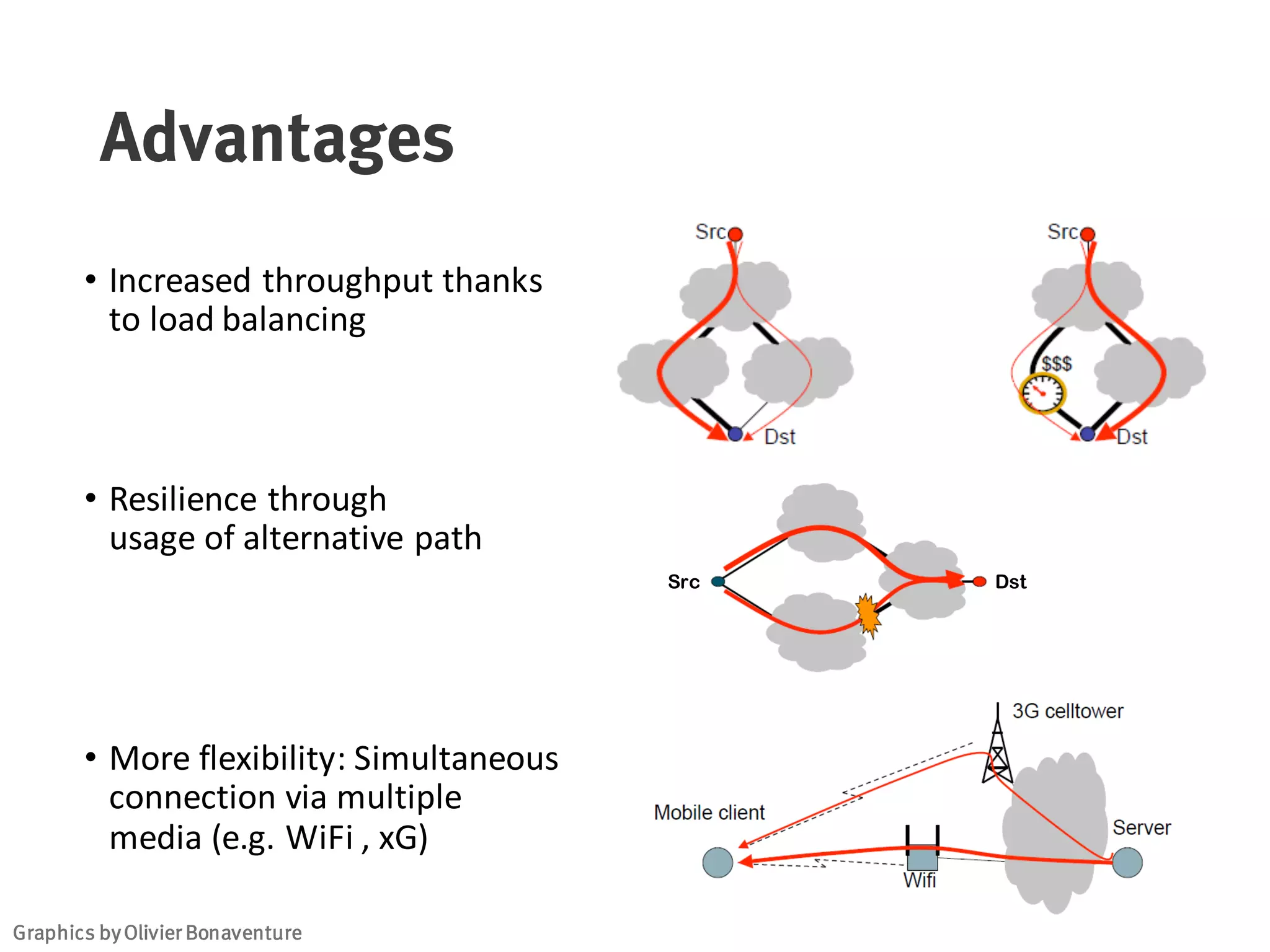
Advantages
• Increased throughput thanks
to load balancing
• Resilience through
usage of alternative	path
• More	flexibility:	Simultaneous
connection via	multiple
media (e.g.	WiFi	,	xG)
Src Dst
Graphics byOlivier Bonaventure
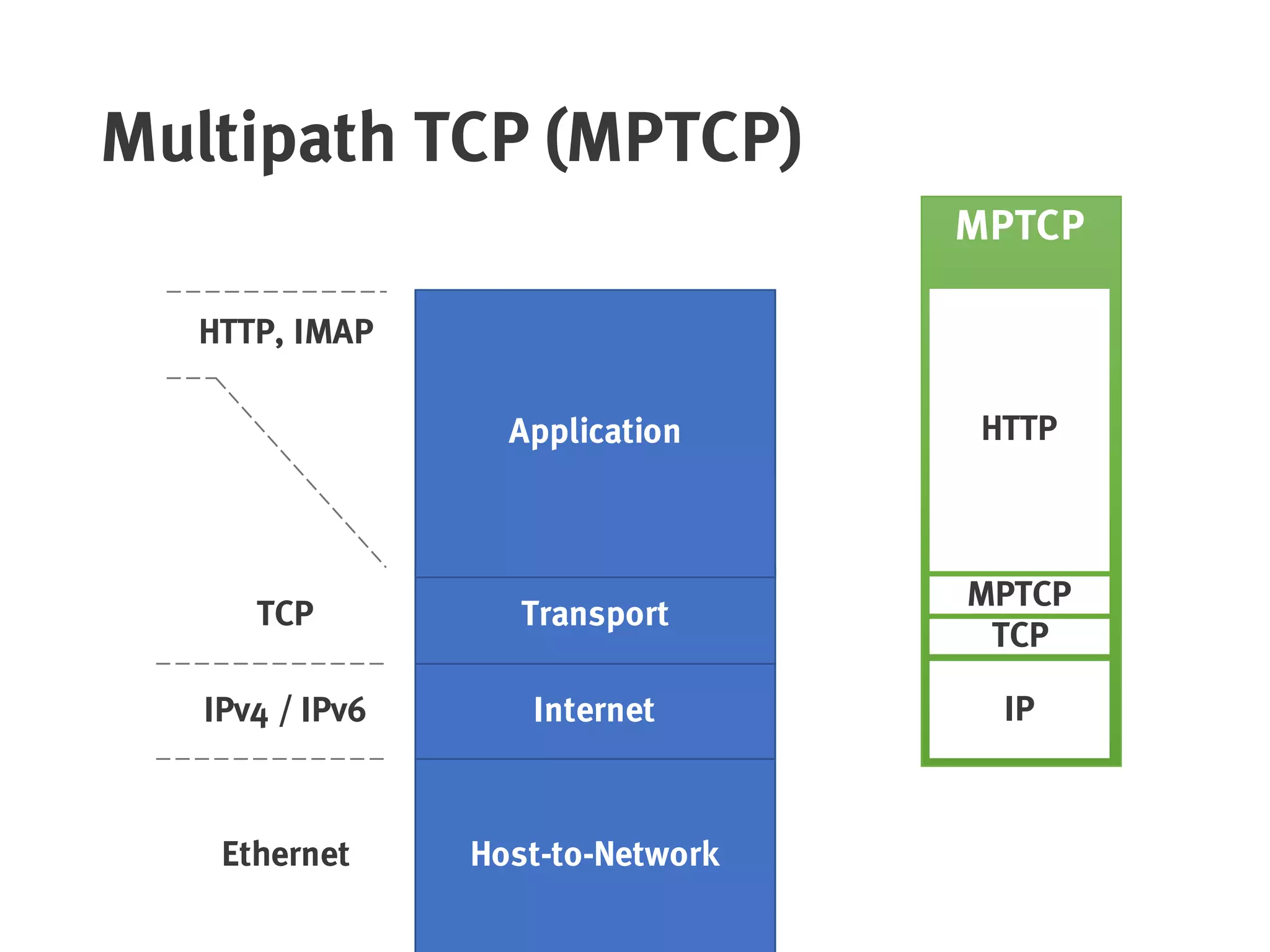
Multipath TCP (MPTCP)
Host-to-Network
Internet
Transport
Application
Ethernet
IPv4 / IPv6
TCP
HTTP, IMAP
MPTCP
IP
TCP
MPTCP
HTTP
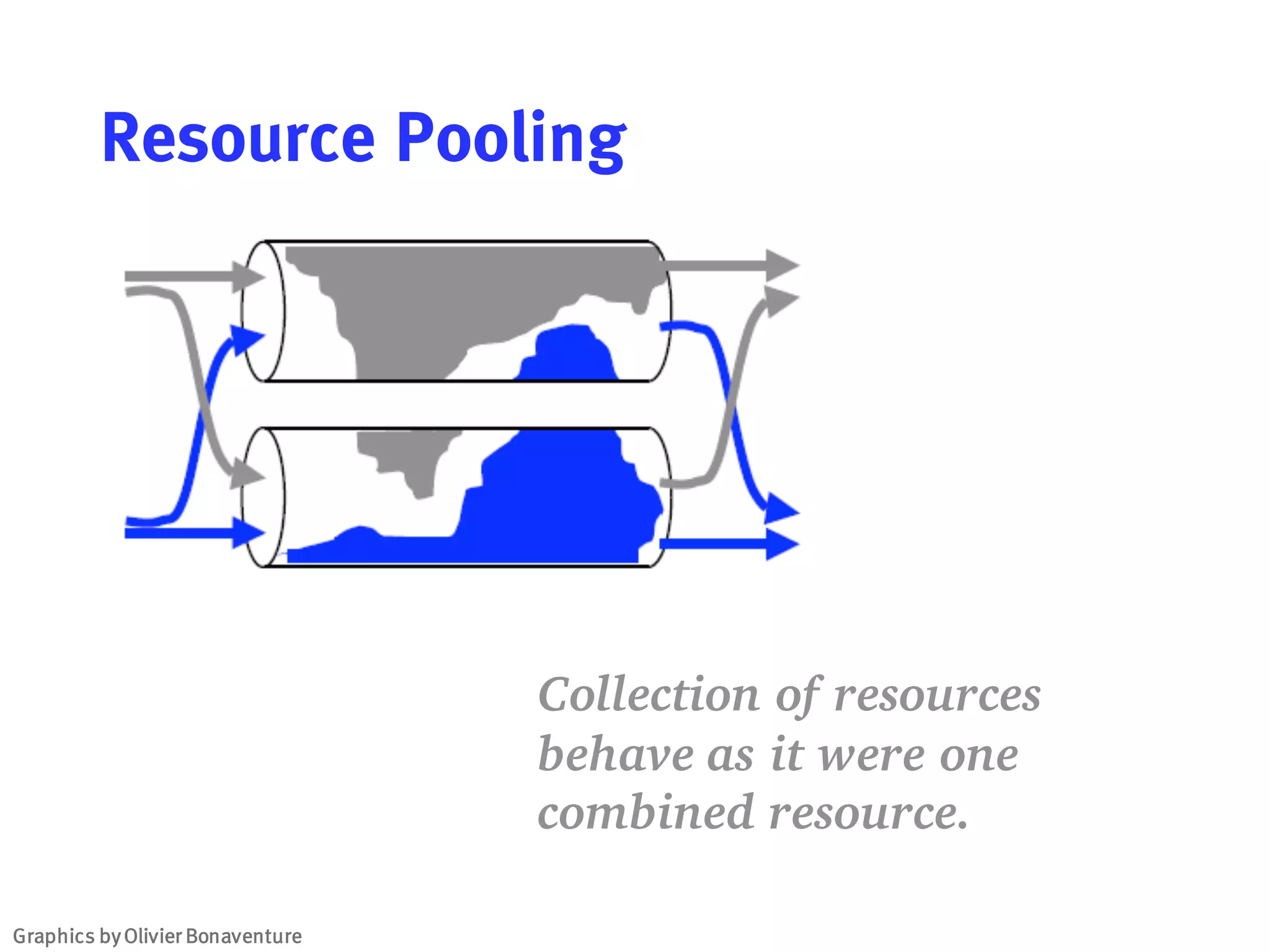
Resource Pooling
Collection of resources
behave as it were one
combined resource.
Graphics byOlivier Bonaventure
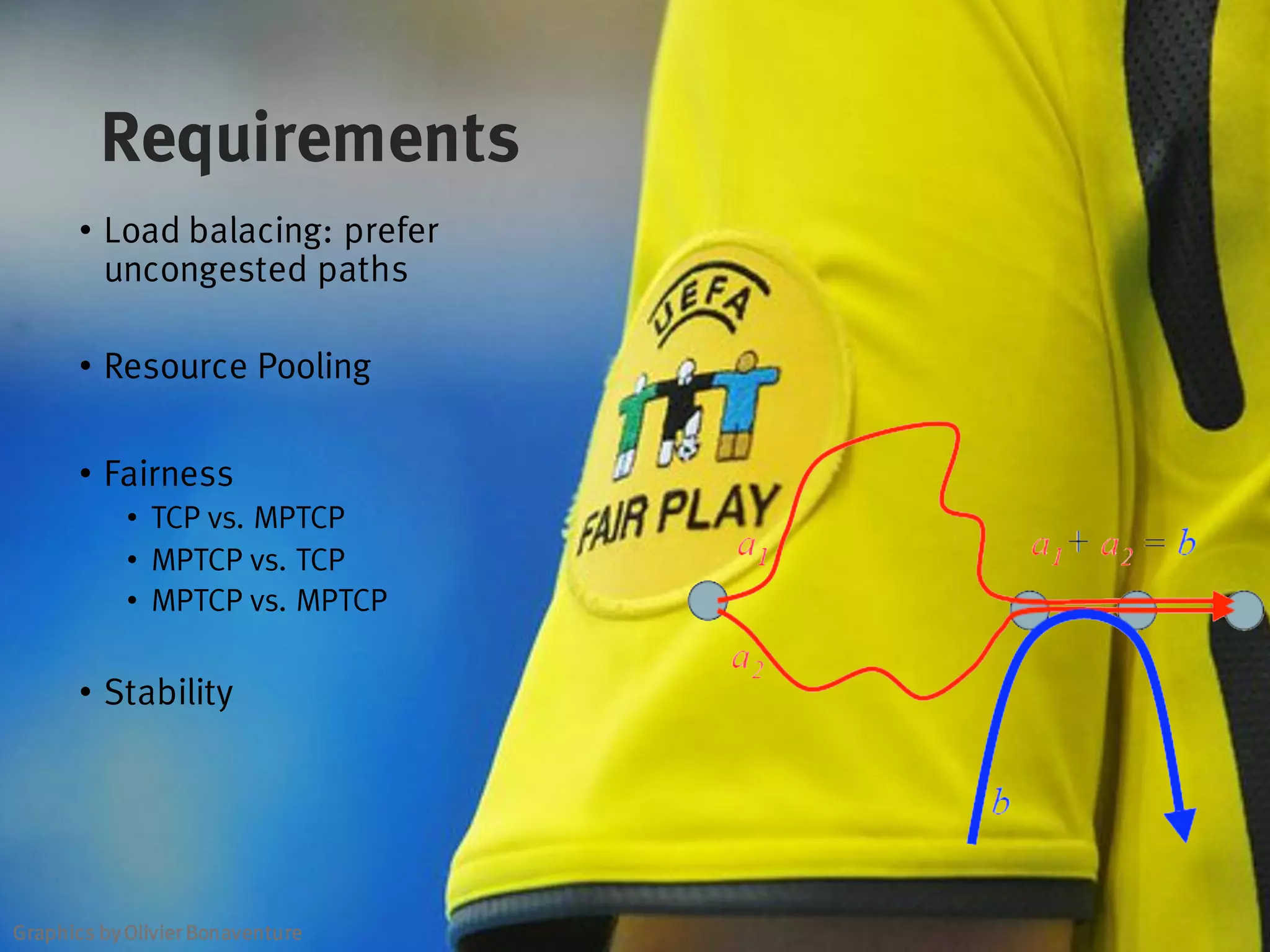
Requirements
• Load balacing: prefer
uncongested paths
• Resource Pooling
• Fairness
• TCP vs. MPTCP
• MPTCP vs. TCP
• MPTCP vs. MPTCP
• Stability
Graphics byOlivier Bonaventure
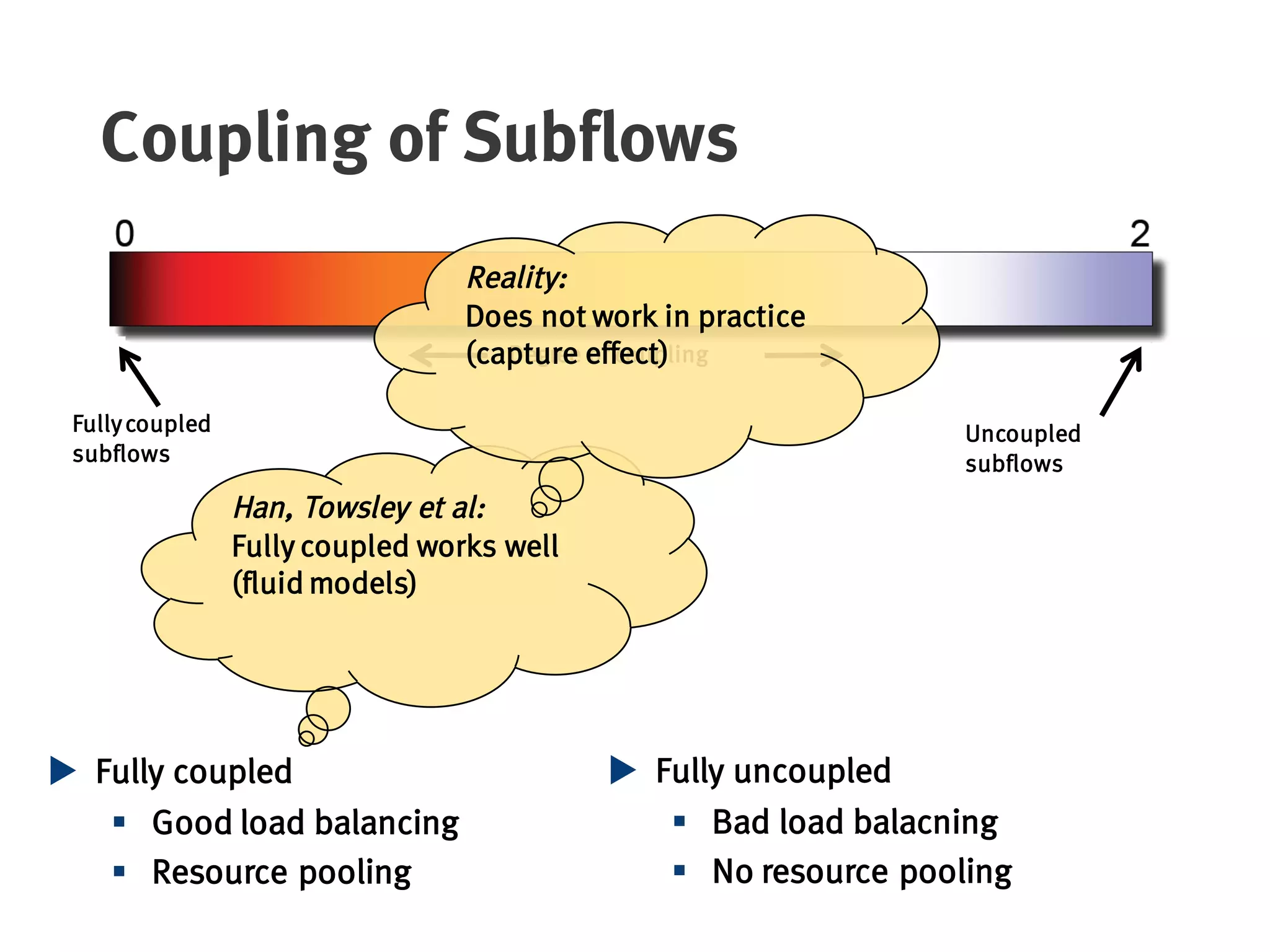
Coupling of Subflows
u Fully uncoupled
§ Bad load balacning
§ No resource pooling
u Fully coupled
§ Good load balancing
§ Resource pooling
Han, Towsley et al:
Fully coupled works well
(fluid models)
Fullycoupled
subflows
Uncoupled
subflows
Degree of coupling
Reality:
Does not work in practice
(capture effect)
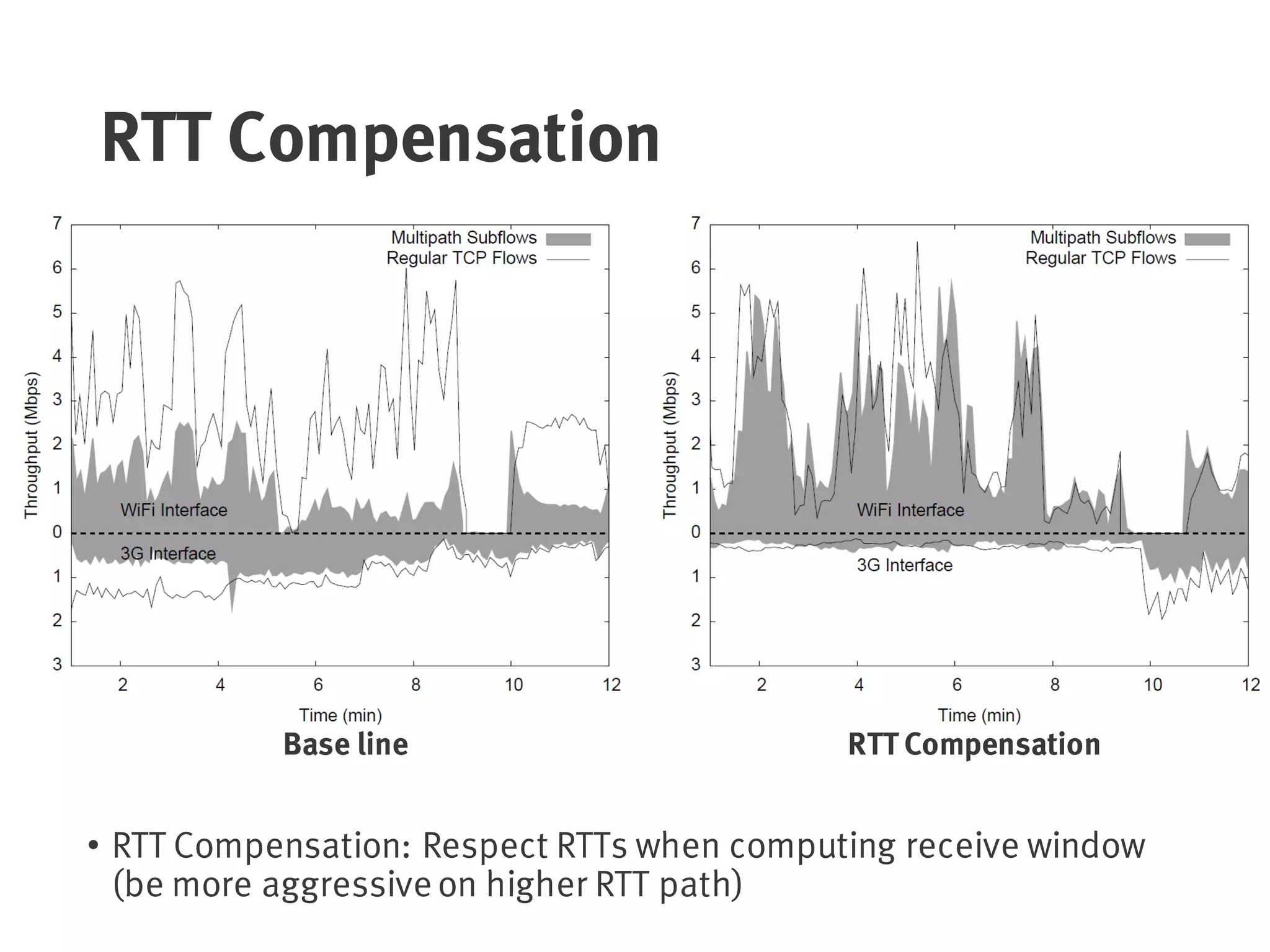
RTT Compensation
• RTT Compensation: Respect RTTs when computing receive window
(be more aggressive on higher RTT path)
RTT CompensationBase line
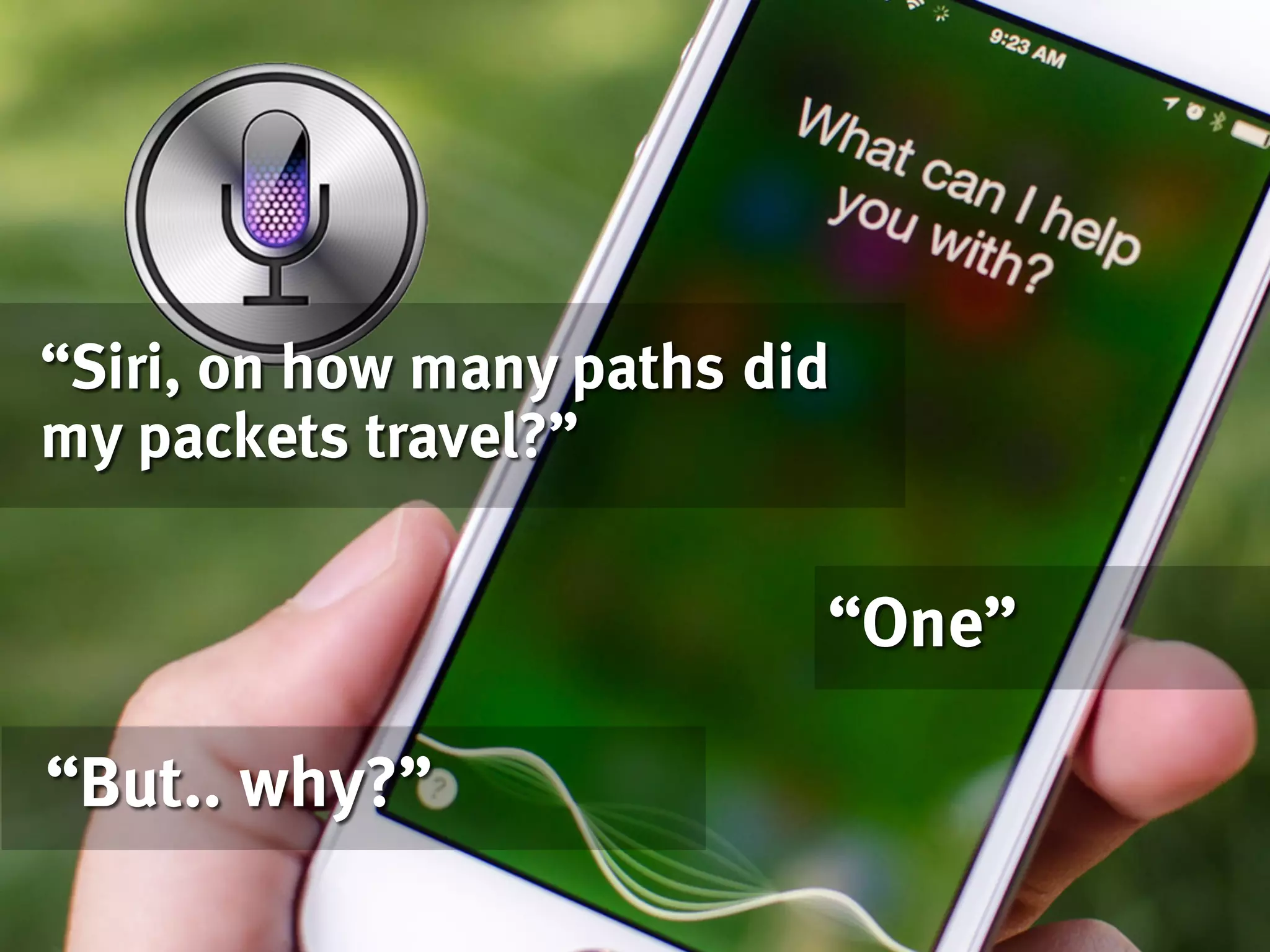
“One”
“But.. why?”
“Siri, on how many paths did
my packets travel?”
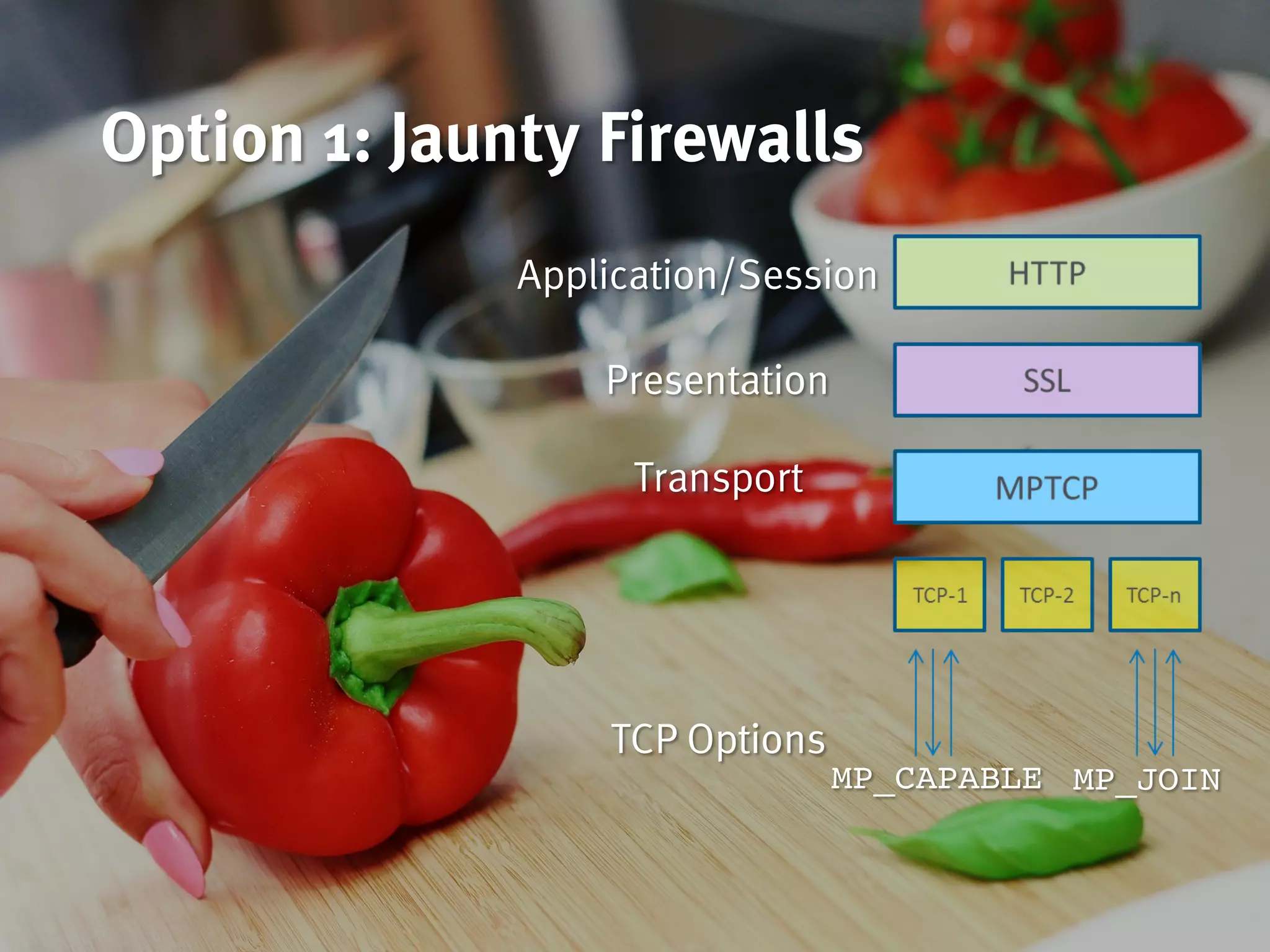
Option 1: Jaunty Firewalls
Application/Session
Presentation
Transport
TCP Options
MP_CAPABLE MP_JOIN
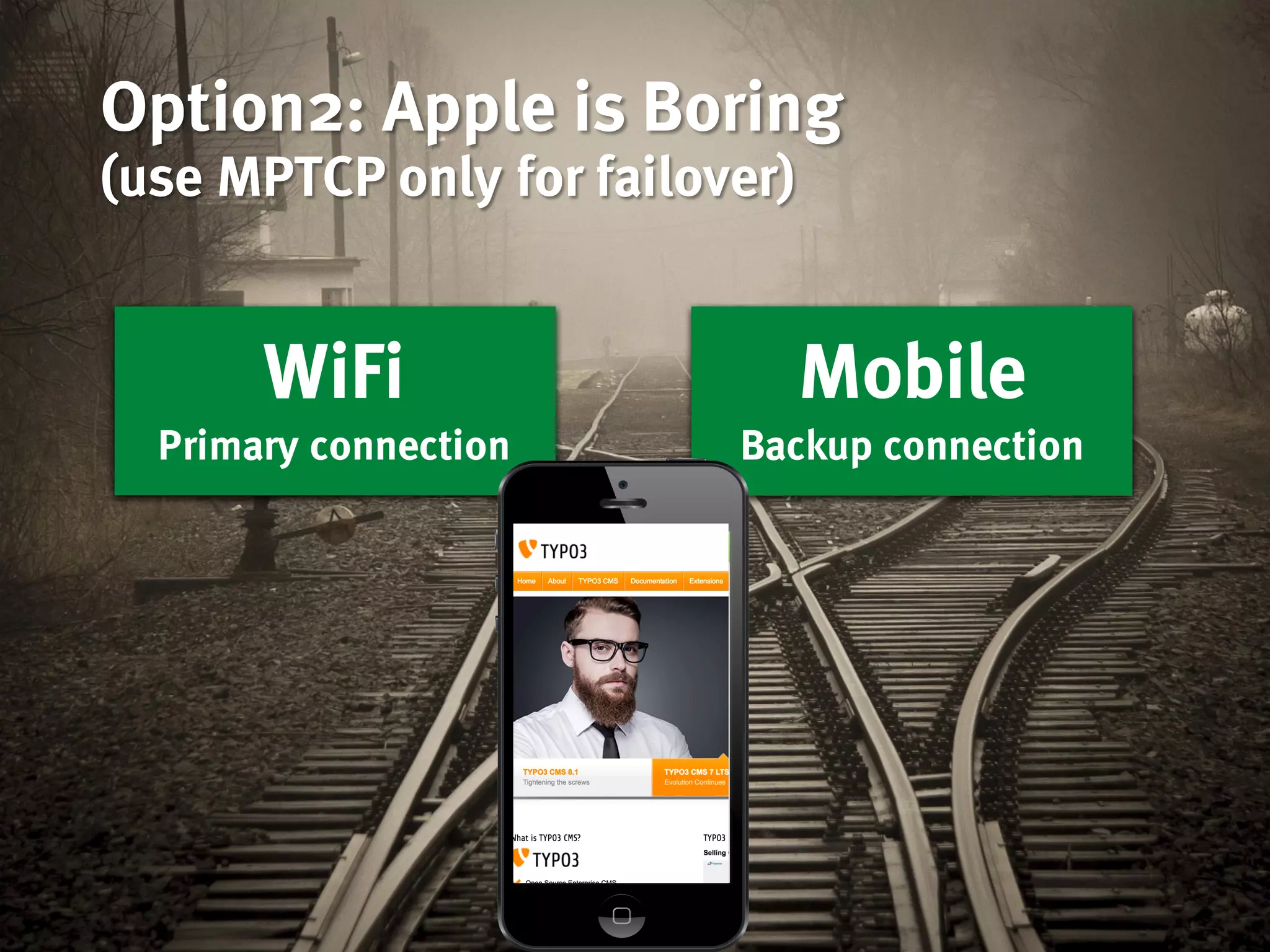
Option2: Apple is Boring
(use MPTCP only for failover)
Mobile
Backup connection
Mobile
Backup connection
WiFi
Primary connection
WiFi
Primary connection
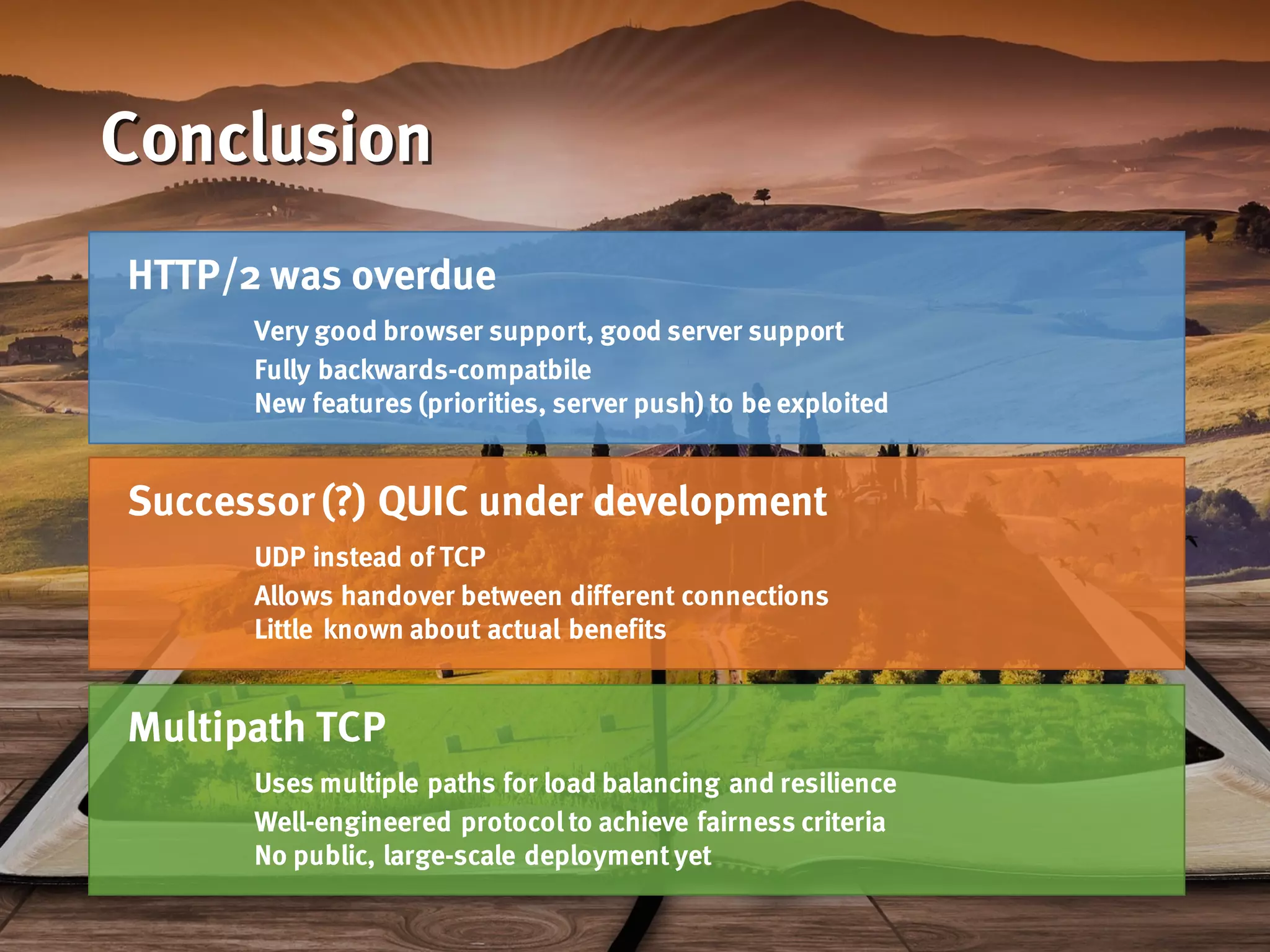
Conclusion
HTTP/2 was overdue
Very good browser support, good server support
Fully backwards-compatbile
New features (priorities, server push) to be exploited
Successor (?) QUIC under development
UDP instead of TCP
Allows handover between different connections
Little known about actual benefits
Multipath TCP
Uses multiple paths for load balancing and resilience
Well-engineered protocol to achieve fairness criteria
No public, large-scale deployment yet

Cleaning Up the Dirt of the Nineties - How New Protocols are Modernizing the Web