Network
Programming Languages
Author: Flavio Vit
Course: UNICAMP –MO611
Teleprocessamento e Redes
Professor: Nelson da Fonseca
June 18, 2014
Agenda
• Introduction
• Flog
• Nettle
• FatTire
• Comparisons
Introduction
• Flog: Logic Programming for Software-Defined
Networks
• Nettle: Taking the Sting Out of Programming
Network Routers
• FatTire: Fault Tolerating Regular Expressions
Networks Management
In the past …
• Networks managed through a set of complex,
low-level, and heterogeneous interfaces
• Firewalls + network address translators + load
balancers + routers + switches == Configured
separately
• Thousands of lines low-level code in different
domain-specific languages
• Complex routing mechanisms (error-prone tasks)
Software Defined Networks
Recently …
• SDN – Software Defined Networks
• Logically centralized Controller:
– Managing distributed switches
– General purpose machines
– Working on routing decisions
– Instruct the switches to install the necessary
packet-forwarding rules.
Flog - An SDN Logic Programming
Language
• SDN packet-forwarding rule
 Predicate + Action + Priority
• Example:
 Predicate: match packets based on the IP header
(MAC, IP, etc.)
 Action: Drop, forward or flood the packet to ports
 Priority: rules are executed according with priorities
Flog
• Combines two programing languages:
– FML:
• set of high-level built-in policy operators (SDN abstractions)
• allow/deny certain flows
• provide quality of service
• Programing model Not flexible
– Frenetic:
• declarative query language - SQL-like syntax
• functional stream-processing language
• language for describing packet forwarding
Flog
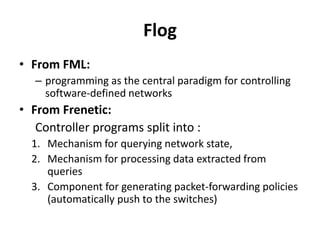
• From FML:
– Programming for controlling software-defined
networks
• From Frenetic:
Controller programs split into :
1. Mechanism for querying network state
2. Mechanism for processing data extracted from
queries
3. Component for generating packet-forwarding policies
(automatically push to the switches)
Flog
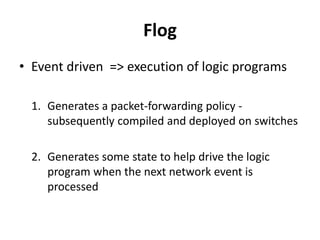
• Event driven => execution of logic programs
1. Generates a packet-forwarding policy
compiled and deployed on switches
2. Generates states : drive the logic program when
the next network event is processed
Flog
• Network Events:
– Switches online / offline
– Ports on switches active / inactive
– Statistics gathered by switches
– Packets arrive at the controller and require
handling
Flog
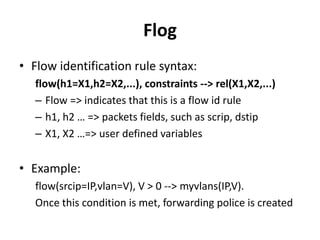
• Flow rule syntax example:
flow(srcip=IP,vlan=V), V > 0 --> myvlans(IP,V)
• When vlan tag is greater than 0, generate a
network event every time a packet with a new
srcip - vlan tag pair is detected
• When this event generated, the rest of the
logic program will be executed.
• The initial data for the logic program will
include the tuple myvlans(IP,V)
Flog
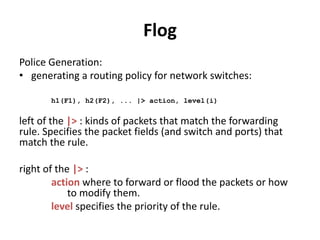
Police Generation:
• generating a routing policy for network switches:
h1(F1), h2(F2), ... |> action, level(i)
left of the |> : kinds of packets that match the forwarding
rule. Specifies the packet fields (and switch and ports) that
match the rule.
right of the |> :
action where to forward or flood the packets or how
to modify them.
level specifies the priority of the rule.
Flog
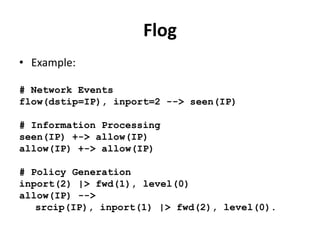
• Example:
# Network Events
flow(dstip=IP), inport=2 --> seen(IP)
# Information Processing
seen(IP) +-> allow(IP)
allow(IP) +-> allow(IP)
# Policy Generation
inport(2) |> fwd(1), level(0)
allow(IP) -->
srcip(IP), inport(1) |> fwd(2), level(0).
Nettle - Taking the Sting Out of
Programming Network Routers
• Networks of OpenFlow switches controlled using
a high-level, declarative and expressive language
• Based on the principles of functional reactive
programming (FRP)
• Embedded in Haskell => general-purpose purely
functional programming language.
• Domain Specific Language
Nettle
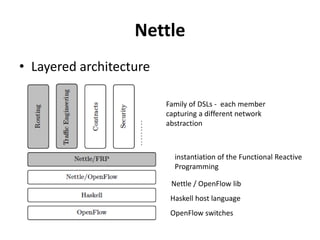
• Layered architecture
Family of DSLs - each member
capturing a different network
abstraction
Haskell host language
OpenFlow switches
Nettle / OpenFlow lib
instantiation of the Functional Reactive
Programming
Nettle
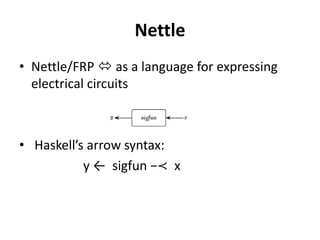
• Nettle/FRP  as a language for expressing
electrical circuits
• Haskell’s arrow syntax:
y ← sigfun −≺ x
Nettle
• Focus on the stream of control messages
among OpenFlow switches
• Nettle => powerful collection of
– Signal functions
– Event operators
Nettle
OpenFlow switches maintains flow table with
flow entries:
match IPs, header fields
• Forwarding actions to specific ports, flooding,
dropping packets
are updated
• Expirations settings expires a flow entry after
prescribed time
Nettle
• Nettle Controller transforms:
stream of messages from switches
stream of commands for switches
Nettle
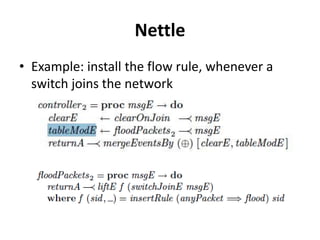
• Example: install the flow rule, whenever a
switch joins the network
FatTire: Fault Tolerating Regular
Expressions
• Programs for fault tolerant Networks
• Based on regular expressions
• Main features:
Expressive: easy to describe forwarding and fault
tolerant policies
Efficient: based on fast failover from OpenFlow
Correct: reasoning about the behavior of the
system during failure recovery
FatTire
• Central feature: Regular expressions for sets
of legal paths through the network
• FatTire programs are translated to OpenFlow
switch configurations
• Automatic response to link failures with no
controller intervention
FatTire
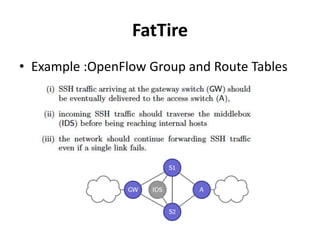
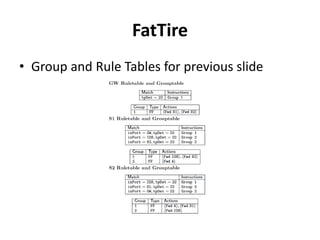
• Example :OpenFlow Group and Route Tables
FatTire
• Group and Rule Tables for previous slide
FatTire
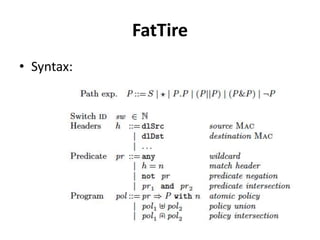
• Syntax:
FatTire
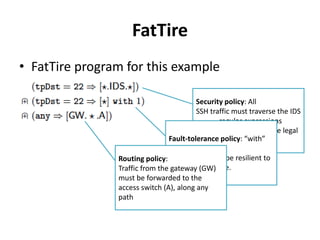
• FatTire program for this example
Security policy: All
SSH traffic must traverse the IDS
- regular expressions
over switches to describe legal
paths
Fault-tolerance policy: “with”
annotation
Forwarding must be resilient to
a single link failure.
Routing policy:
Traffic from the gateway (GW)
must be forwarded to the
access switch (A), along any
path
Comparisons
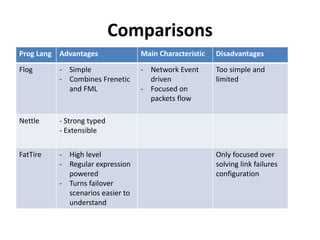
Prog Lang Main Characteristic Advantages Disadvantages
Flog - Network Event
driven
- Focused on packets
flow
- Simple
- Combines Frenetic
and FML
Too simple and
limited to flow
control
FatTire Targets fast failover
mechanisms provided
by OpenFlow standard
- High level
- Regular expression
powered
- Turns failover
scenarios easier to
understand
Only focused over
solving link failures
configuration
Nettle - allow fine-grained
control over switch
behavior
- event-based
programming model
- Strong typed
- Extensible
Good question!!!
I buy it!
References
1. Naga Praveen Katta, Jennifer Rexford, and David Walker. Logic
Programming for Software-Defined Networks
1. Mark Reitblatt, Marco Canini, Arjun Guha, and Nate Foster.
Fattire: Declarative fault tolerance for software defined
networks
1. Andreas Voellmy and Paul Hudak. Nettle: Taking the Sting Out
of Programming Network Routers

SDN Networks Programming Languages

  • 1.
    Network Programming Languages Author: FlavioVit Course: UNICAMP –MO611 Teleprocessamento e Redes Professor: Nelson da Fonseca June 18, 2014
  • 2.
    Agenda • Introduction • Flog •Nettle • FatTire • Comparisons
  • 3.
    Introduction • Flog: LogicProgramming for Software-Defined Networks • Nettle: Taking the Sting Out of Programming Network Routers • FatTire: Fault Tolerating Regular Expressions
  • 4.
    Networks Management In thepast … • Networks managed through a set of complex, low-level, and heterogeneous interfaces • Firewalls + network address translators + load balancers + routers + switches == Configured separately • Thousands of lines low-level code in different domain-specific languages • Complex routing mechanisms (error-prone tasks)
  • 5.
    Software Defined Networks Recently… • SDN – Software Defined Networks • Logically centralized Controller: – Managing distributed switches – General purpose machines – Working on routing decisions – Instruct the switches to install the necessary packet-forwarding rules.
  • 6.
    Flog - AnSDN Logic Programming Language • SDN packet-forwarding rule  Predicate + Action + Priority • Example:  Predicate: match packets based on the IP header (MAC, IP, etc.)  Action: Drop, forward or flood the packet to ports  Priority: rules are executed according with priorities
  • 7.
    Flog • Combines twoprograming languages: – FML: • set of high-level built-in policy operators (SDN abstractions) • allow/deny certain flows • provide quality of service • Programing model Not flexible – Frenetic: • declarative query language - SQL-like syntax • functional stream-processing language • language for describing packet forwarding
  • 8.
    Flog • From FML: –Programming for controlling software-defined networks • From Frenetic: Controller programs split into : 1. Mechanism for querying network state 2. Mechanism for processing data extracted from queries 3. Component for generating packet-forwarding policies (automatically push to the switches)
  • 9.
    Flog • Event driven=> execution of logic programs 1. Generates a packet-forwarding policy compiled and deployed on switches 2. Generates states : drive the logic program when the next network event is processed
  • 10.
    Flog • Network Events: –Switches online / offline – Ports on switches active / inactive – Statistics gathered by switches – Packets arrive at the controller and require handling
  • 11.
    Flog • Flow rulesyntax example: flow(srcip=IP,vlan=V), V > 0 --> myvlans(IP,V) • When vlan tag is greater than 0, generate a network event every time a packet with a new srcip - vlan tag pair is detected • When this event generated, the rest of the logic program will be executed. • The initial data for the logic program will include the tuple myvlans(IP,V)
  • 12.
    Flog Police Generation: • generatinga routing policy for network switches: h1(F1), h2(F2), ... |> action, level(i) left of the |> : kinds of packets that match the forwarding rule. Specifies the packet fields (and switch and ports) that match the rule. right of the |> : action where to forward or flood the packets or how to modify them. level specifies the priority of the rule.
  • 13.
    Flog • Example: # NetworkEvents flow(dstip=IP), inport=2 --> seen(IP) # Information Processing seen(IP) +-> allow(IP) allow(IP) +-> allow(IP) # Policy Generation inport(2) |> fwd(1), level(0) allow(IP) --> srcip(IP), inport(1) |> fwd(2), level(0).
  • 14.
    Nettle - Takingthe Sting Out of Programming Network Routers • Networks of OpenFlow switches controlled using a high-level, declarative and expressive language • Based on the principles of functional reactive programming (FRP) • Embedded in Haskell => general-purpose purely functional programming language. • Domain Specific Language
  • 15.
    Nettle • Layered architecture Familyof DSLs - each member capturing a different network abstraction Haskell host language OpenFlow switches Nettle / OpenFlow lib instantiation of the Functional Reactive Programming
  • 16.
    Nettle • Nettle/FRP as a language for expressing electrical circuits • Haskell’s arrow syntax: y ← sigfun −≺ x
  • 17.
    Nettle • Focus onthe stream of control messages among OpenFlow switches • Nettle => powerful collection of – Signal functions – Event operators
  • 18.
    Nettle OpenFlow switches maintainsflow table with flow entries: match IPs, header fields • Forwarding actions to specific ports, flooding, dropping packets are updated • Expirations settings expires a flow entry after prescribed time
  • 19.
    Nettle • Nettle Controllertransforms: stream of messages from switches stream of commands for switches
  • 20.
    Nettle • Example: installthe flow rule, whenever a switch joins the network
  • 21.
    FatTire: Fault ToleratingRegular Expressions • Programs for fault tolerant Networks • Based on regular expressions • Main features: Expressive: easy to describe forwarding and fault tolerant policies Efficient: based on fast failover from OpenFlow Correct: reasoning about the behavior of the system during failure recovery
  • 22.
    FatTire • Central feature:Regular expressions for sets of legal paths through the network • FatTire programs are translated to OpenFlow switch configurations • Automatic response to link failures with no controller intervention
  • 23.
    FatTire • Example :OpenFlowGroup and Route Tables
  • 24.
    FatTire • Group andRule Tables for previous slide
  • 25.
  • 26.
    FatTire • FatTire programfor this example Security policy: All SSH traffic must traverse the IDS - regular expressions over switches to describe legal paths Fault-tolerance policy: “with” annotation Forwarding must be resilient to a single link failure. Routing policy: Traffic from the gateway (GW) must be forwarded to the access switch (A), along any path
  • 27.
    Comparisons Prog Lang MainCharacteristic Advantages Disadvantages Flog - Network Event driven - Focused on packets flow - Simple - Combines Frenetic and FML Too simple and limited to flow control FatTire Targets fast failover mechanisms provided by OpenFlow standard - High level - Regular expression powered - Turns failover scenarios easier to understand Only focused over solving link failures configuration Nettle - allow fine-grained control over switch behavior - event-based programming model - Strong typed - Extensible Good question!!! I buy it!
  • 28.
    References 1. Naga PraveenKatta, Jennifer Rexford, and David Walker. Logic Programming for Software-Defined Networks 1. Mark Reitblatt, Marco Canini, Arjun Guha, and Nate Foster. Fattire: Declarative fault tolerance for software defined networks 1. Andreas Voellmy and Paul Hudak. Nettle: Taking the Sting Out of Programming Network Routers