Population
Population GrowthThe worlds population is growing rapidlyThe population of the world is growing at an exponential rate- its growing faster and faster.There are two things that affect the population size of the world:Birth rate- the number of live babies born per thousand of the population per year.Death rate-the number of deaths per thousand of the  population per year.When the birth rate is higher than the death rate, more people are being born than are dying, so the population growsThis is called Natural increaseWhen the death rate is higher than the birth rate it is called the natural decrease.
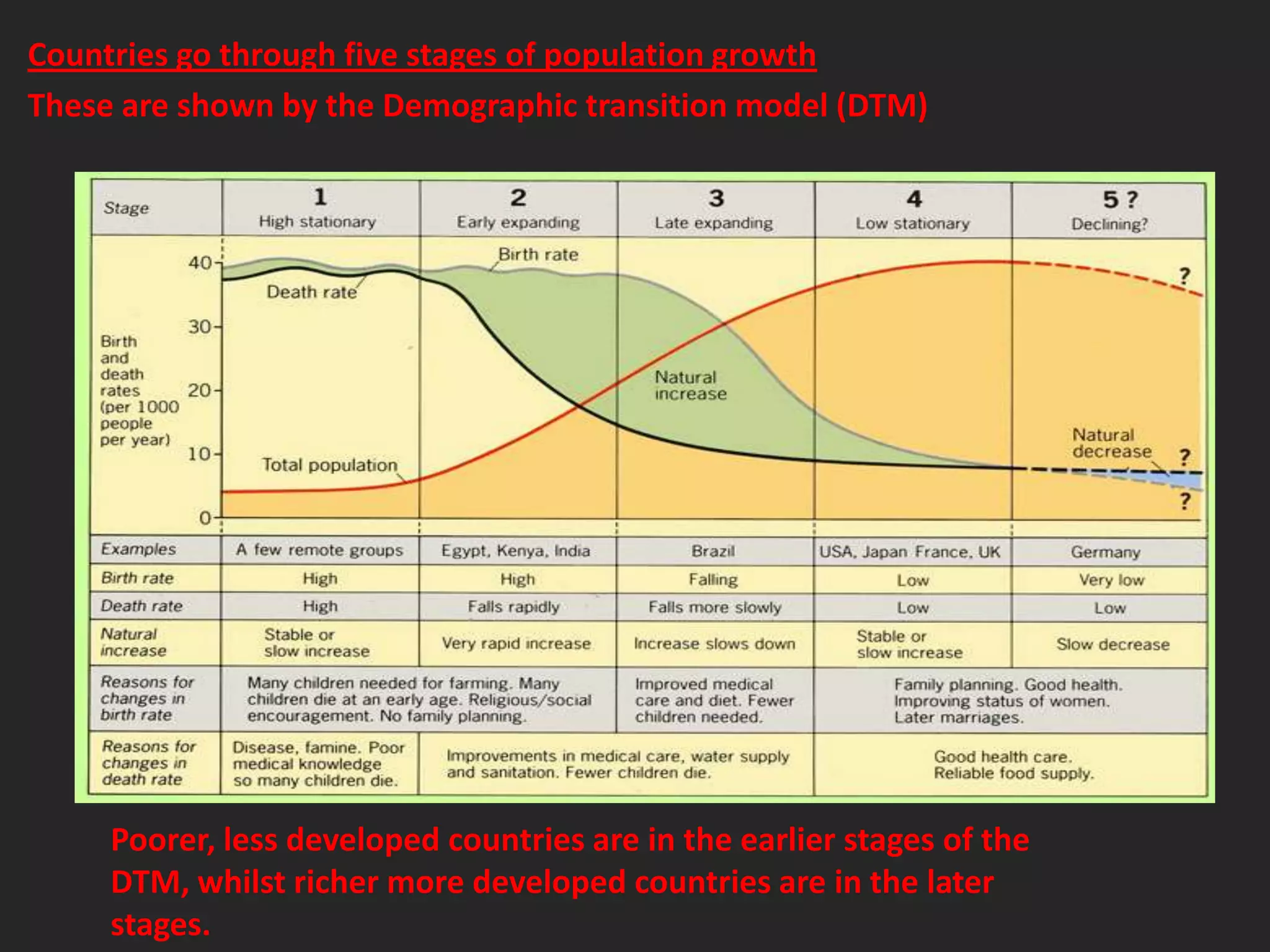
Countries go through five stages of population growthThese are shown by the Demographic transition model (DTM)Poorer, less developed countries are in the earlier stages of the DTM, whilst richer more developed countries are in the later stages.
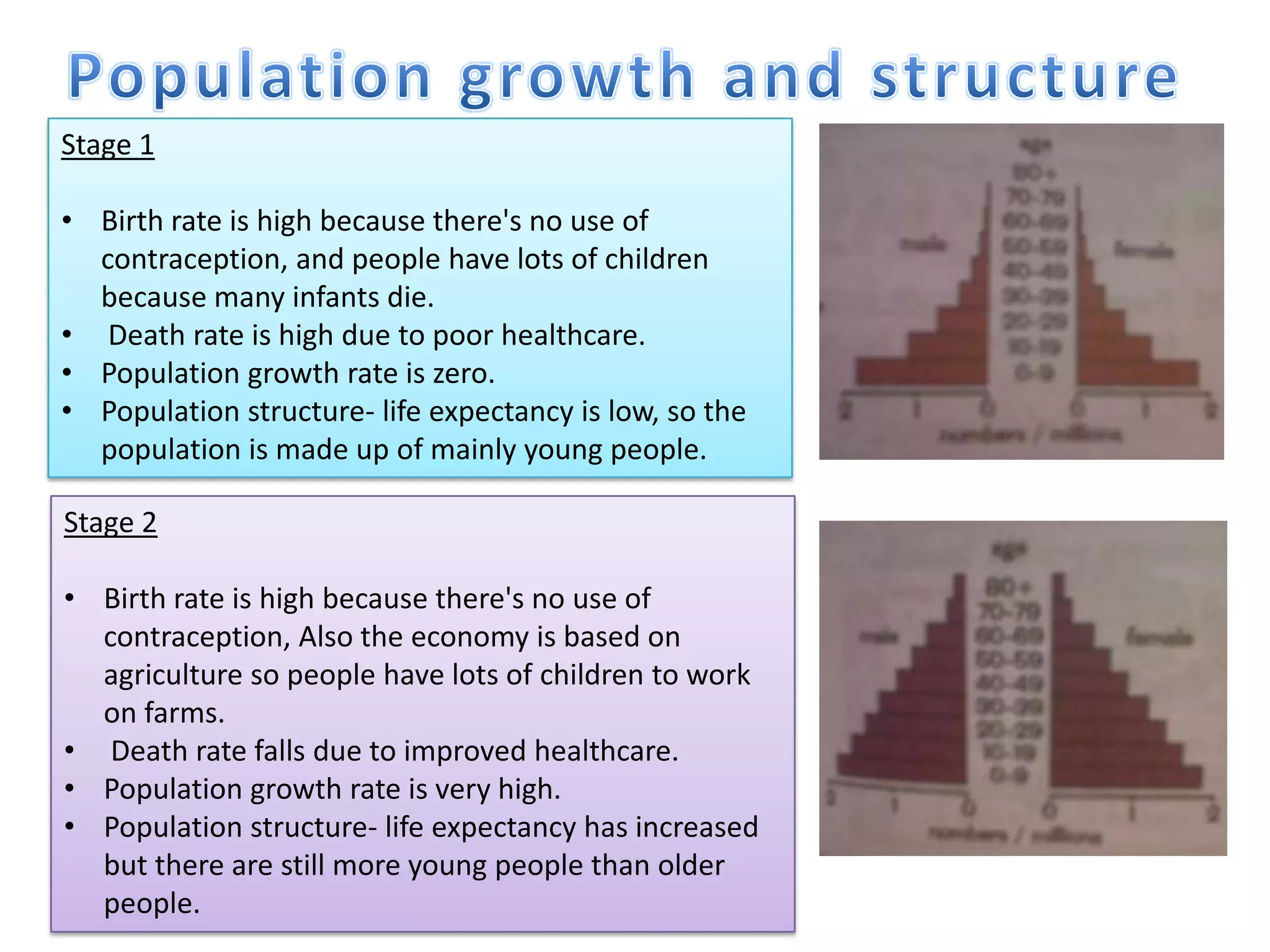
Population growth and structureStage 1Birth rate is high because there's no use of contraception, and people have lots of children because many infants die.
 Death rate is high due to poor healthcare.
Population growth rate is zero.
Population structure- life expectancy is low, so the population is made up of mainly young people.Stage 2Birth rate is high because there's no use of contraception, Also the economy is based on agriculture so people have lots of children to work on farms.
 Death rate falls due to improved healthcare.
Population growth rate is very high.
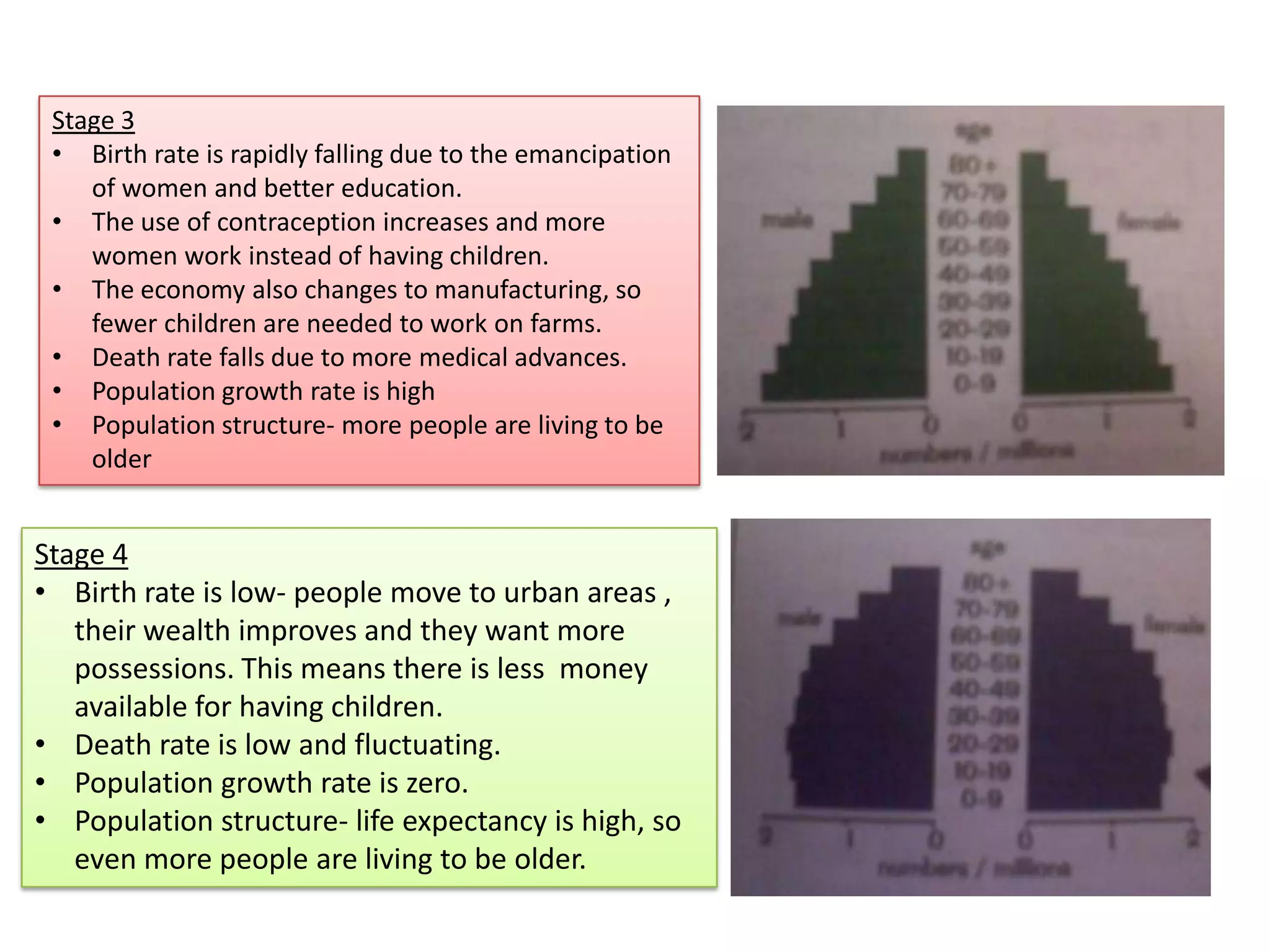
Population structure- life expectancy has increased but there are still more young people than older people.Stage 3Birth rate is rapidly falling due to the emancipation of women and better education.
The use of contraception increases and more women work instead of having children.
The economy also changes to manufacturing, so fewer children are needed to work on farms.
Death rate falls due to more medical advances.
Population growth rate is high
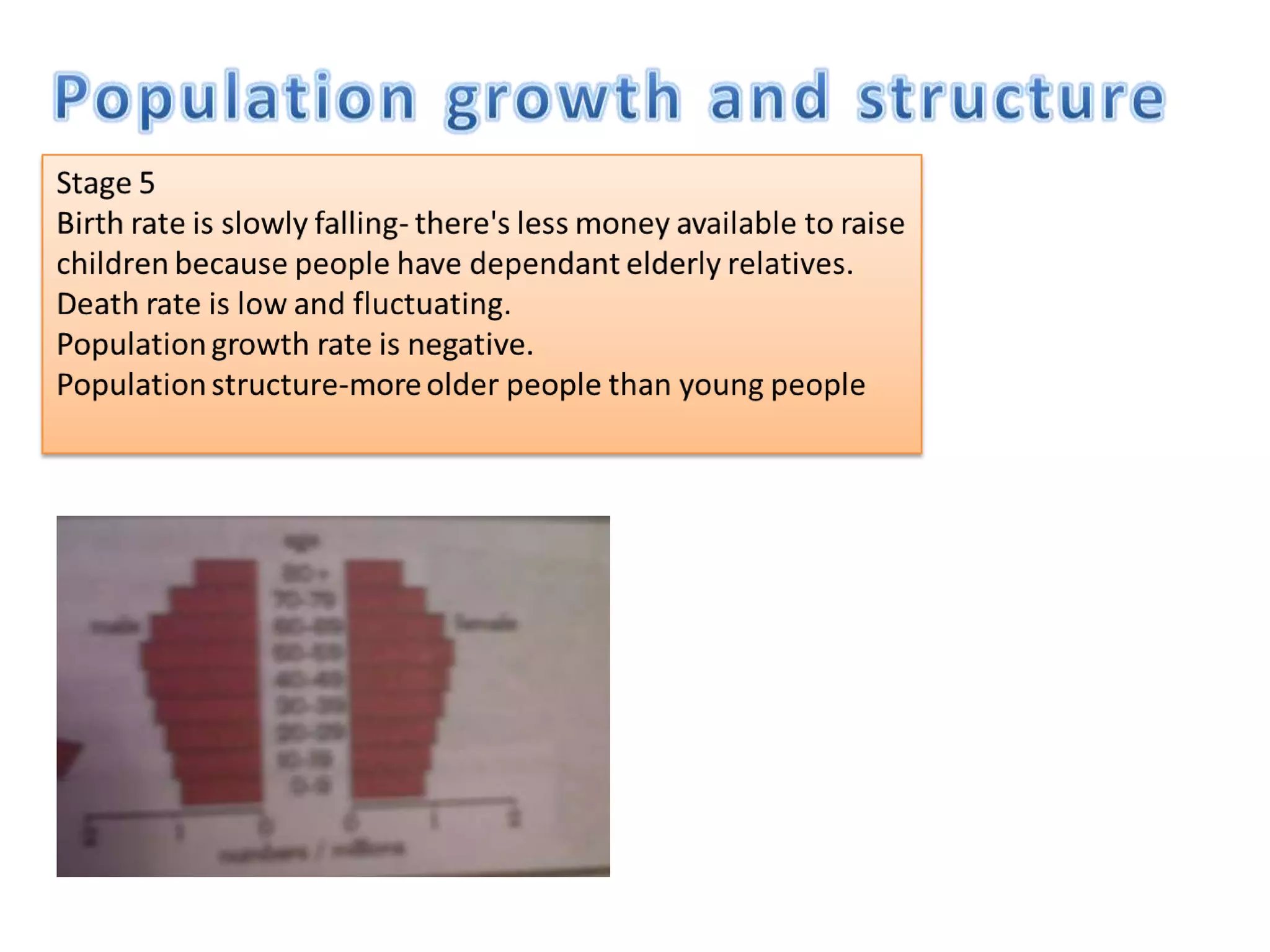
Population structure- more people are living to be olderStage 4Birth rate is low- people move to urban areas , their wealth improves and they want more possessions. This means there is less  money available for having children.
Death rate is low and fluctuating.
Population growth rate is zero.
Population structure- life expectancy is high, so even more people are living to be older.
Managing rapid population growthRapid population growth has social, economic and political impacts.PoliticalMost of the population is made up of young people so the government focuses on policies that are important to young people e.g. education and provision of things such as childcare.
There are fewer older people so the government doesn’t have to focus on policies that are important to older people e.g. pensions.
The government has to make policies to bring population growth under control so the social and economic impacts of rapid population growth don’t get any worse.SocialServices like healthcare and education cant cope with the rapid increase in population , so not everyone has access to them.
Children have to work to help support their large families , so they miss out on education.
There aren't enough houses for everyone, so people are forced to live in  makeshift houses in overcrowded settlements. This leads to health problems because the houses aren't always connected to sewers or they don’t have access to clean water.
There are food shortages if the country cant grow or import enough food for the population.EconomicThere aren't enough jobs for the number of people in the country so unemployment increases.

Population ppt

  • 1.
  • 2.
    Population GrowthThe worldspopulation is growing rapidlyThe population of the world is growing at an exponential rate- its growing faster and faster.There are two things that affect the population size of the world:Birth rate- the number of live babies born per thousand of the population per year.Death rate-the number of deaths per thousand of the population per year.When the birth rate is higher than the death rate, more people are being born than are dying, so the population growsThis is called Natural increaseWhen the death rate is higher than the birth rate it is called the natural decrease.
  • 3.
    Countries go throughfive stages of population growthThese are shown by the Demographic transition model (DTM)Poorer, less developed countries are in the earlier stages of the DTM, whilst richer more developed countries are in the later stages.
  • 4.
    Population growth andstructureStage 1Birth rate is high because there's no use of contraception, and people have lots of children because many infants die.
  • 5.
    Death rateis high due to poor healthcare.
  • 6.
  • 7.
    Population structure- lifeexpectancy is low, so the population is made up of mainly young people.Stage 2Birth rate is high because there's no use of contraception, Also the economy is based on agriculture so people have lots of children to work on farms.
  • 8.
    Death ratefalls due to improved healthcare.
  • 9.
  • 10.
    Population structure- lifeexpectancy has increased but there are still more young people than older people.Stage 3Birth rate is rapidly falling due to the emancipation of women and better education.
  • 11.
    The use ofcontraception increases and more women work instead of having children.
  • 12.
    The economy alsochanges to manufacturing, so fewer children are needed to work on farms.
  • 13.
    Death rate fallsdue to more medical advances.
  • 14.
  • 15.
    Population structure- morepeople are living to be olderStage 4Birth rate is low- people move to urban areas , their wealth improves and they want more possessions. This means there is less money available for having children.
  • 16.
    Death rate islow and fluctuating.
  • 17.
  • 18.
    Population structure- lifeexpectancy is high, so even more people are living to be older.
  • 19.
    Managing rapid populationgrowthRapid population growth has social, economic and political impacts.PoliticalMost of the population is made up of young people so the government focuses on policies that are important to young people e.g. education and provision of things such as childcare.
  • 20.
    There are fewerolder people so the government doesn’t have to focus on policies that are important to older people e.g. pensions.
  • 21.
    The government hasto make policies to bring population growth under control so the social and economic impacts of rapid population growth don’t get any worse.SocialServices like healthcare and education cant cope with the rapid increase in population , so not everyone has access to them.
  • 22.
    Children have towork to help support their large families , so they miss out on education.
  • 23.
    There aren't enoughhouses for everyone, so people are forced to live in makeshift houses in overcrowded settlements. This leads to health problems because the houses aren't always connected to sewers or they don’t have access to clean water.
  • 24.
    There are foodshortages if the country cant grow or import enough food for the population.EconomicThere aren't enough jobs for the number of people in the country so unemployment increases.
  • 25.
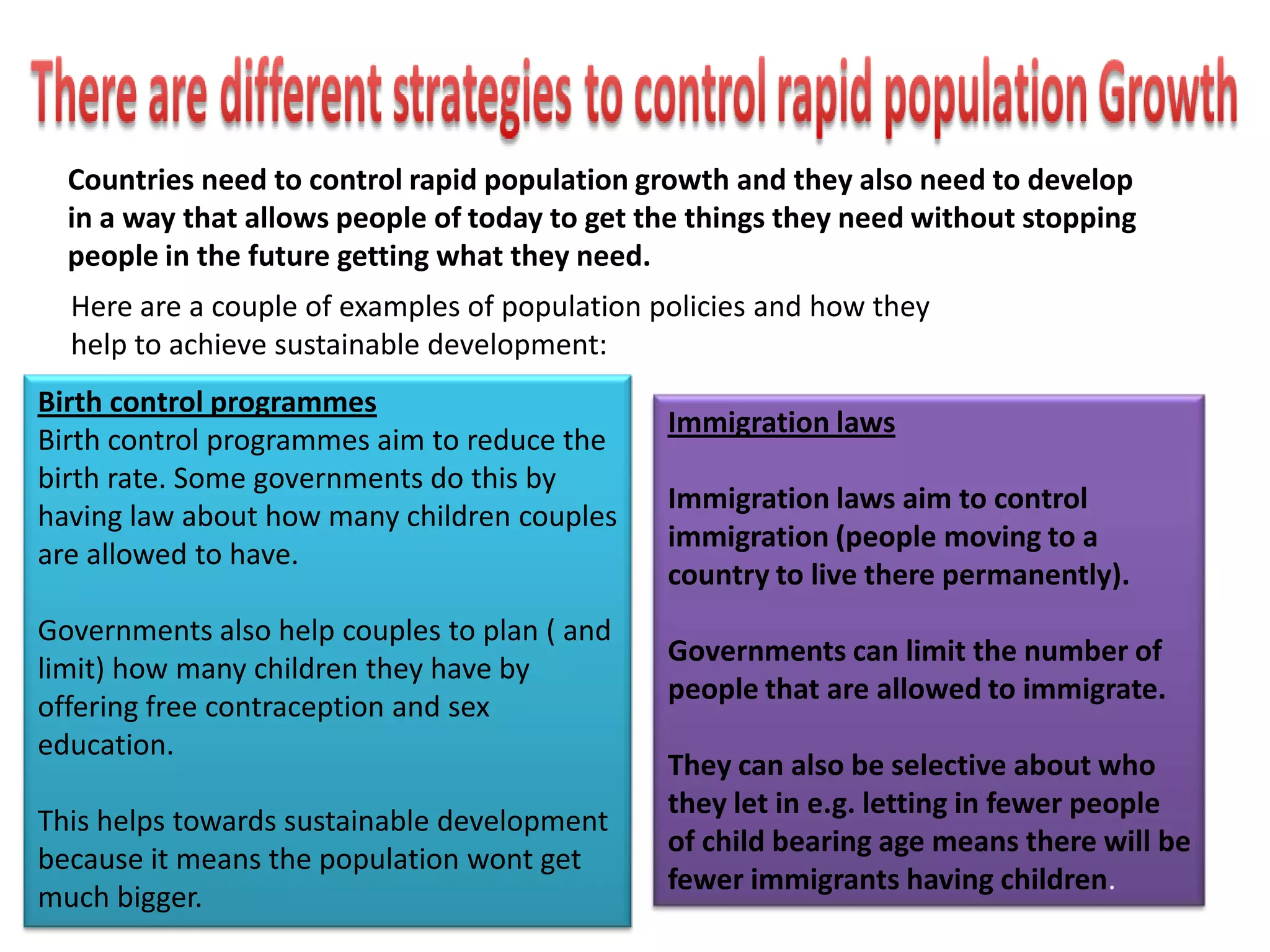
    There is increasedpoverty because more people are born into families that are already poor.Countries need to control rapid population growth and they also need to develop in a way that allows people of today to get the things they need without stopping people in the future getting what they need.Here are a couple of examples of population policies and how they help to achieve sustainable development:Birth control programmesBirth control programmes aim to reduce the birth rate. Some governments do this by having law about how many children couples are allowed to have. Governments also help couples to plan ( and limit) how many children they have by offering free contraception and sex education.This helps towards sustainable development because it means the population wont get much bigger. Immigration lawsImmigration laws aim to control immigration (people moving to a country to live there permanently).Governments can limit the number of people that are allowed to immigrate.They can also be selective about who they let in e.g. letting in fewer people of child bearing age means there will be fewer immigrants having children.
  • 26.
    Managing population growth-case studiesChina has the largest population of any country in the world- over 1.3 billion.Different policies have been used to control rapid population growth- the most important is the one child policy introduced in 1979.Couples that have only have one child are given benefits like longer maternity leave, better housing and free education for the child. Couples that have more than one child don’t get any benefits and are fined part of their income.Over the years the policy has changed so there are some exceptions:In some rural areas couples are allowed to have more than one child if the first was a girl or has a physical disability – this Is because children are still needed to work on farms in rural areas.
  • 27.
    If one ofthe parents has a disability or if both the parents are only children then couples are allowed to have a second child so there are enough people to look after the parents. EffectivenessThe policy has prevented up to 400 million births.
  • 28.
    The fertility rate has dropped from 5.7 in 1970 to around 1.8 today.Some people think that it wasn’t just the one child policy that slowed population growth. They say older policies about leaving longer gaps between children were also effective and that Chinese people want fewer children anyway as they have become more wealthy.Chinas one child policy helps towards sustainable development- The population hasn’t grown as fast and got as big as it would have so fewer resources have been used.
  • 29.
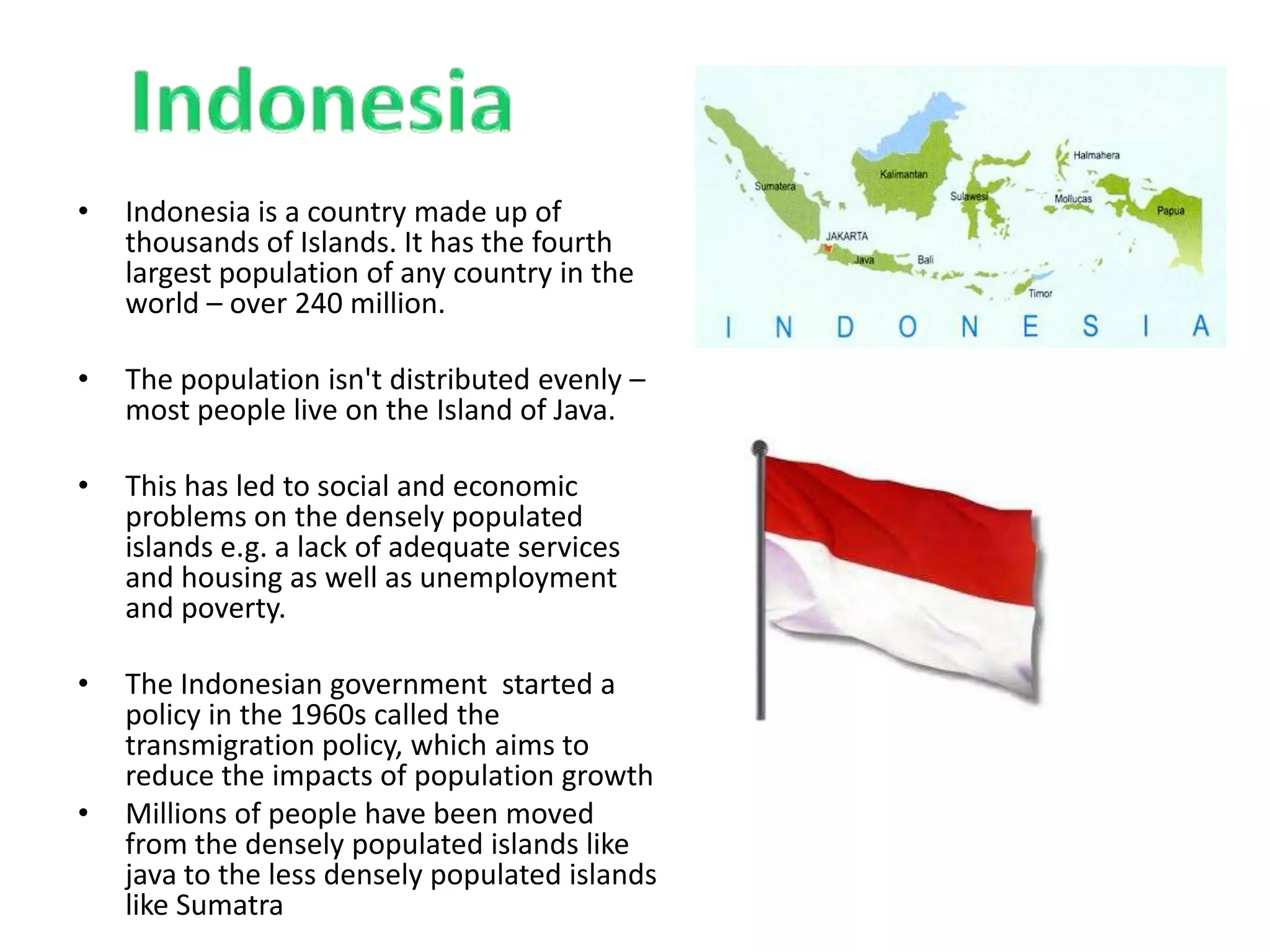
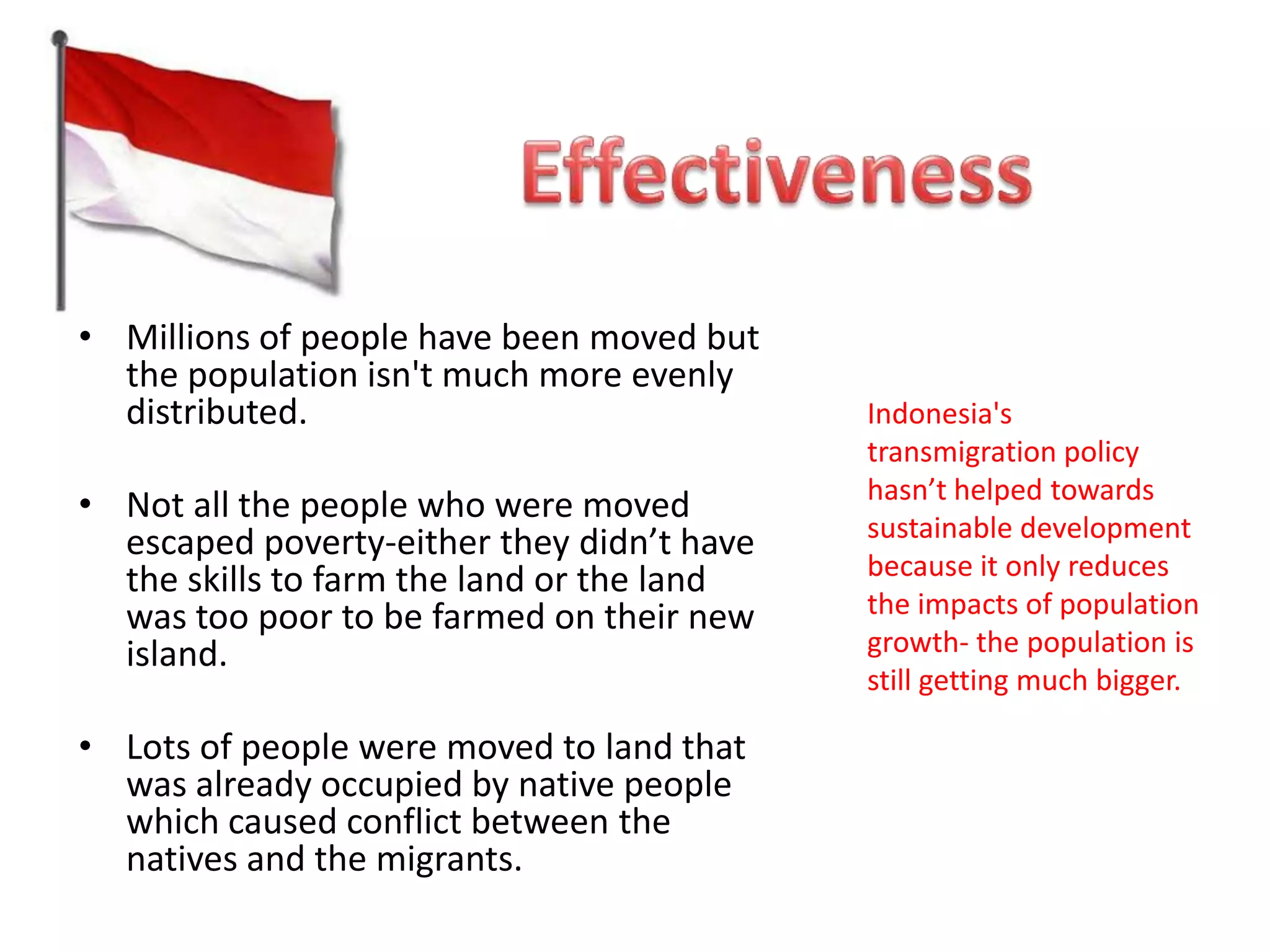
    IndonesiaIndonesia is acountry made up of thousands of Islands. It has the fourth largest population of any country in the world – over 240 million.The population isn't distributed evenly – most people live on the Island of Java.This has led to social and economic problems on the densely populated islands e.g. a lack of adequate services and housing as well as unemployment and poverty.The Indonesian government started a policy in the 1960s called the transmigration policy, which aims to reduce the impacts of population growthMillions of people have been moved from the densely populated islands like java to the less densely populated islands like Sumatra
  • 30.
    EffectivenessMillions of peoplehave been moved but the population isn't much more evenly distributed.Not all the people who were moved escaped poverty-either they didn’t have the skills to farm the land or the land was too poor to be farmed on their new island.Lots of people were moved to land that was already occupied by native people which caused conflict between the natives and the migrants.Indonesia's transmigration policy hasn’t helped towards sustainable development because it only reduces the impacts of population growth- the population is still getting much bigger.
  • 31.
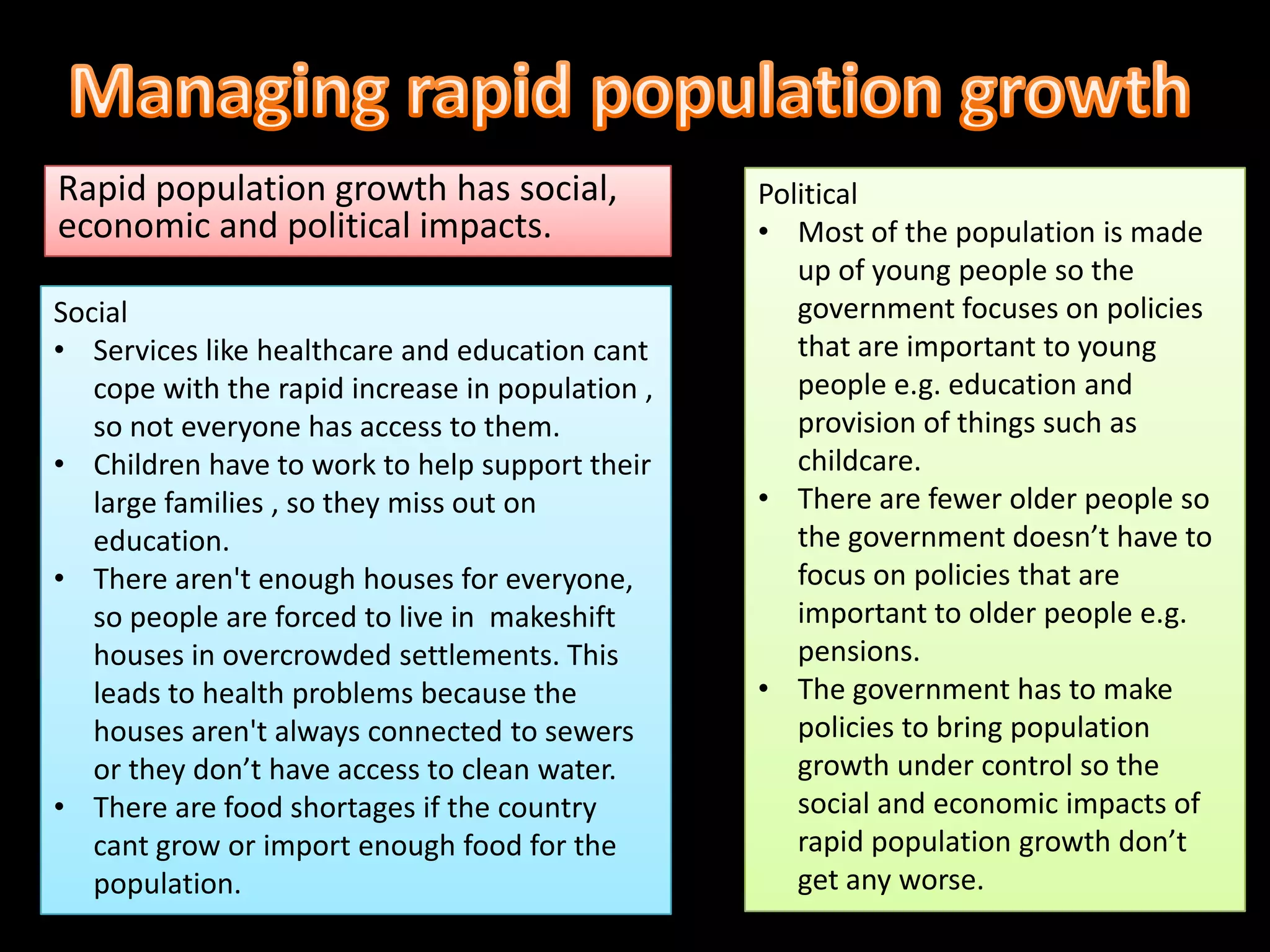
    Managing ageing populationsThepopulation structure of an ageing population has more older people than younger people because few people are being born and people are living to be older.Countries with a an ageing population are usually the richer countries in stage 5 of the DTM.Older people (over 65) are supported by the working population (aged 16-64)- they're dependant on them . So in a country with an ageing population there is a higher proportion of people who are dependant.
  • 32.
    This has economicand social impacts:SocialEconomicHealthcare services are stretched more because older people need more medical care.
  • 33.
    People will needto spend more time working as unpaid carers for older family members. This means that the working population have less leisure time and are more stressed and worried.
  • 34.
    People may havefewer children because they cant afford lots of children when they have dependant older relatives. This leads to a drop in birth rate.
  • 35.
    The more oldpeople there are the lower the pension will be .People will have to retire later because they cant afford to get by on a state pension.
  • 36.
    The working populationpay taxes, some of which the government use to pay the state pensions of older people and to pay for services like healthcare and retirement homes.
  • 37.
    Taxes would needto go up because there are more pensions to pay for and older people need more healthcare.The economy would grow more slowly- less money is being spent on things that help the economy e.g. education and business.
  • 38.
    There are differentstrategies to cope with an ageing populationEncouraging larger families e.g. in Italy women are offered cash rewards to have more children. This increases the number of young people- when they start work there will a larger working population to pay taxes and support the ageing population
  • 39.
    Encouraging the immigration of young people from other countries. This increases the working population.Theses strategies don’t help towards sustainable development because they increase the population size.
  • 40.
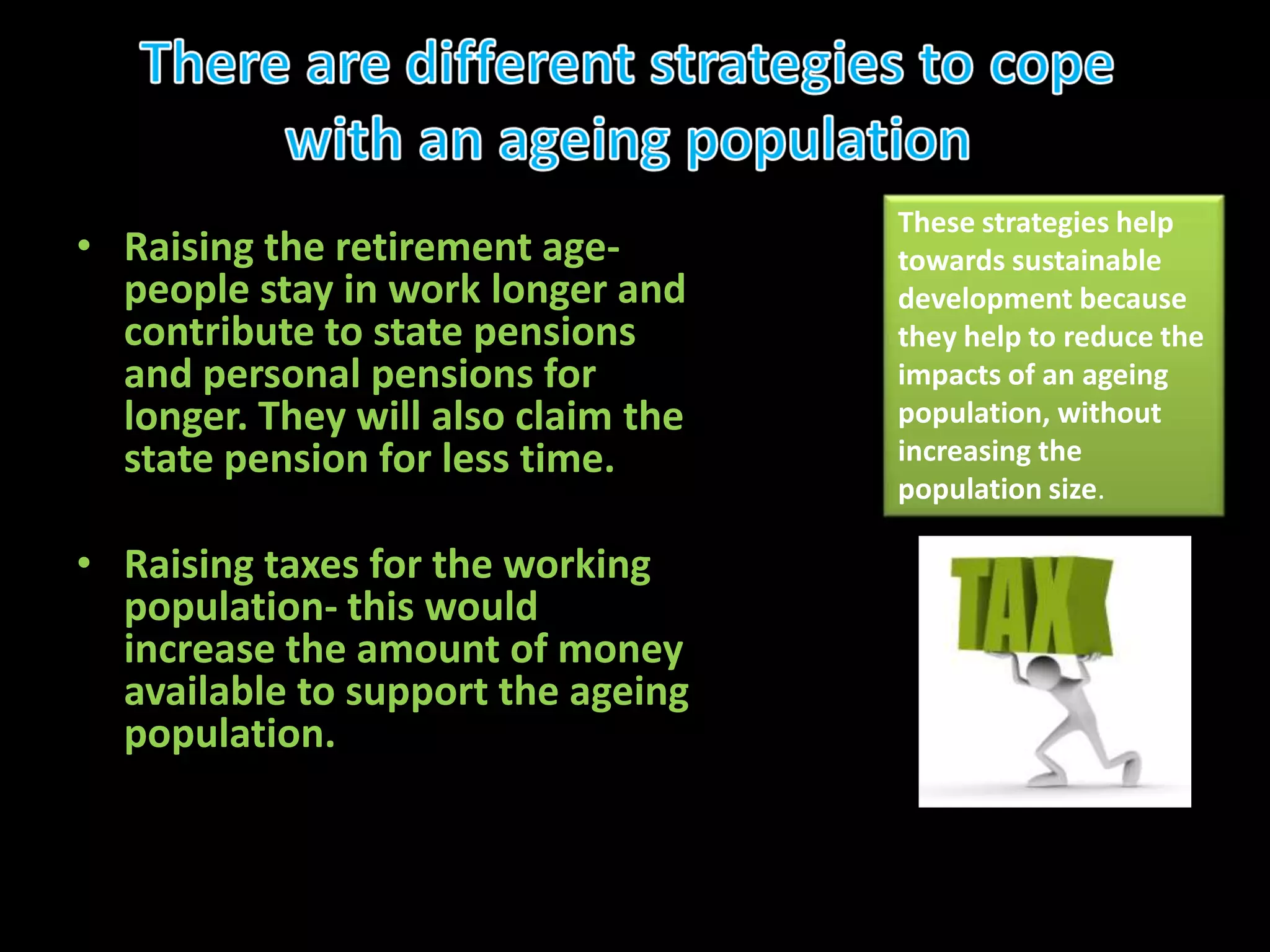
    These strategies helptowards sustainable development because they help to reduce the impacts of an ageing population, without increasing the population size.Raising the retirement age- people stay in work longer and contribute to state pensions and personal pensions for longer. They will also claim the state pension for less time.Raising taxes for the working population- this would increase the amount of money available to support the ageing population.
  • 41.
    Ageing populations- casestudyThe Uks population is ageingThe ageing population is caused by Increasing Life expectancy and dropping birth ratePeople are living longer due to medical advances and improved living standards
  • 42.
    Between 1980 and2006 life expectancy rose 2.6 years for women and 6.4 years for men.
  • 43.
    Lots of babieswere born in the 1940s and 1960s . Those born in the 1940s are retiring now creating a pensioner boom.
  • 44.
    Since the 1970sthe number of babies being born has fallen . With fewer young people in the population the proportion of older people.The Uks Ageing population causes a few problems:More elderly people are living in poverty- the working population isn't large enough to pay for a decent pension, and many people don’t have other savings.Even though the state pension is low the government is struggling to pay it. The taxes paid by people in work aren't enough to cover the cost of pensions and as the population ages the situation gets worse.The health service is under pressure because older people need more medical care than younger people.
  • 45.
    The UK governmenthas strategies to cope with an ageing populationRaise the retirement age-people will have to work for longer so there will be more people paying tax and fewer people claiming pensions.Encourage immigration of young people to the UK- This increases the number of people paying taxes which helps pay for the state pension and services.Encourage women to have childrenEncourage people to take out private pensions- With private pensions people wont be so dependant on the state pension.Its too early to tell if government Strategies are working.
  • 46.
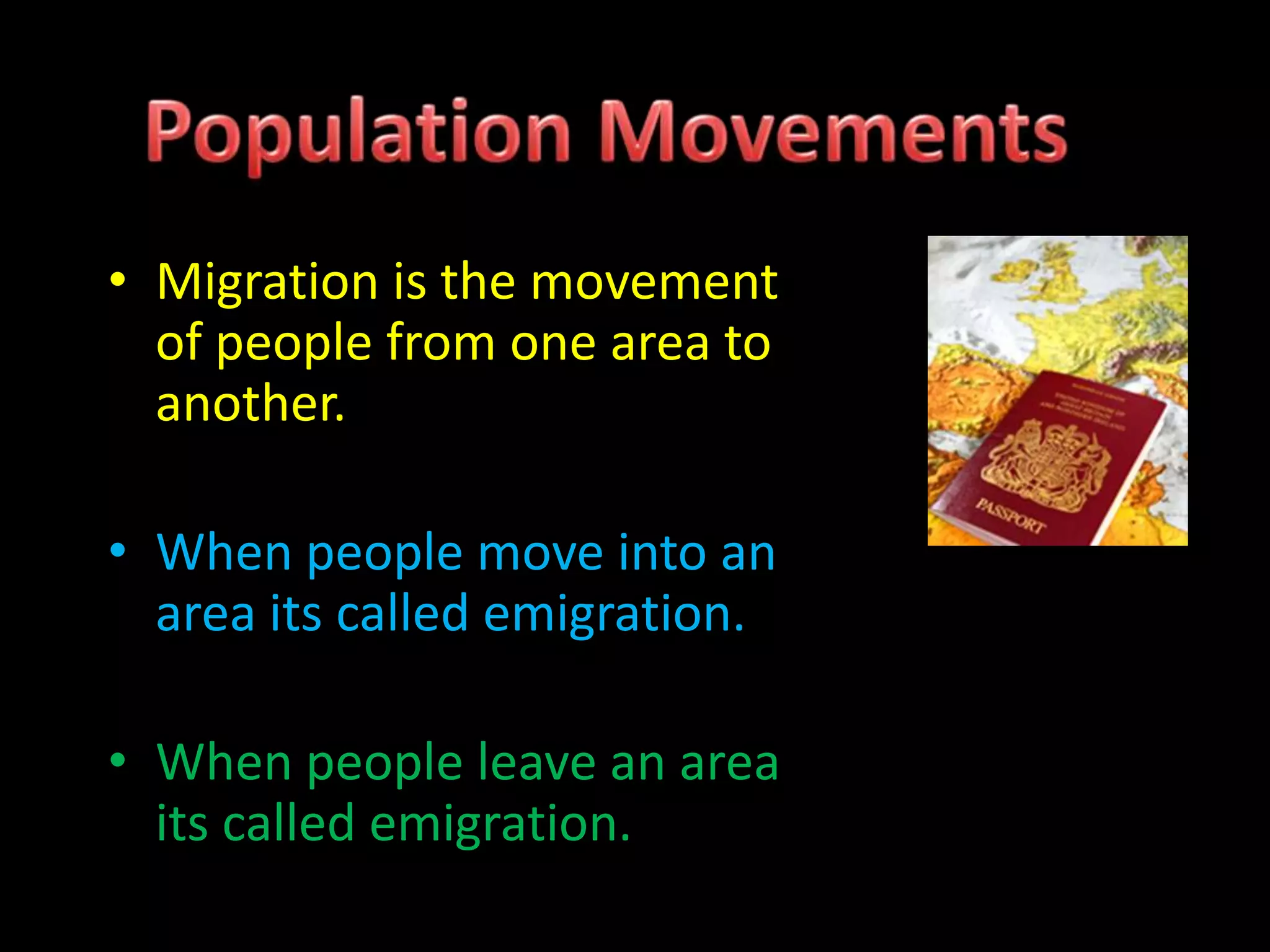
    Population MovementsMigrationis the movement of people from one area to another.When people move into an area its called emigration.When people leave an area its called emigration.
  • 47.
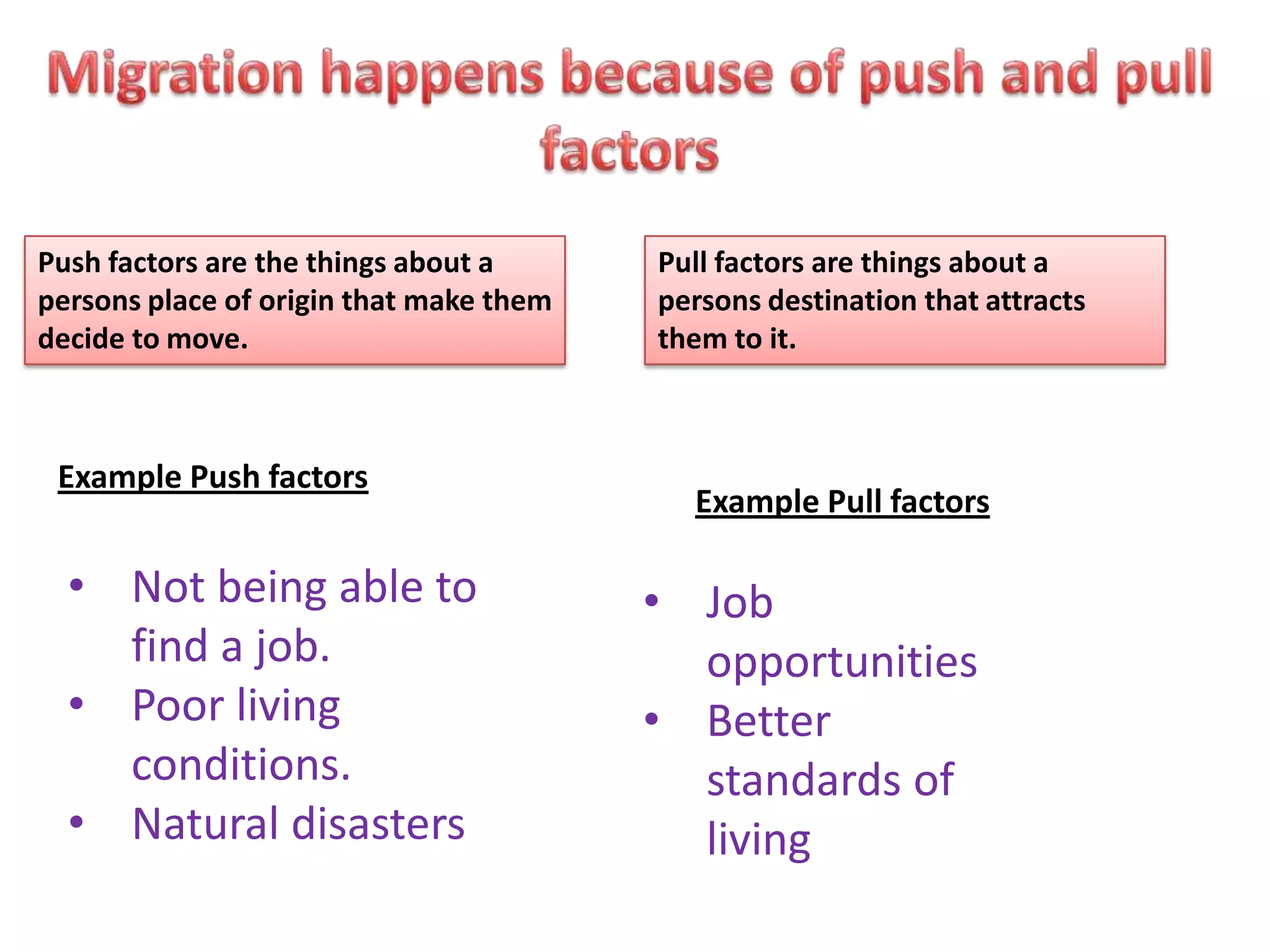
    Migration happens becauseof push and pull factorsPush factors are the things about a persons place of origin that make them decide to move.Pull factors are things about a persons destination that attracts them to it.Example Push factorsExample Pull factorsNot being able to find a job.
  • 48.
  • 49.
  • 50.
  • 51.
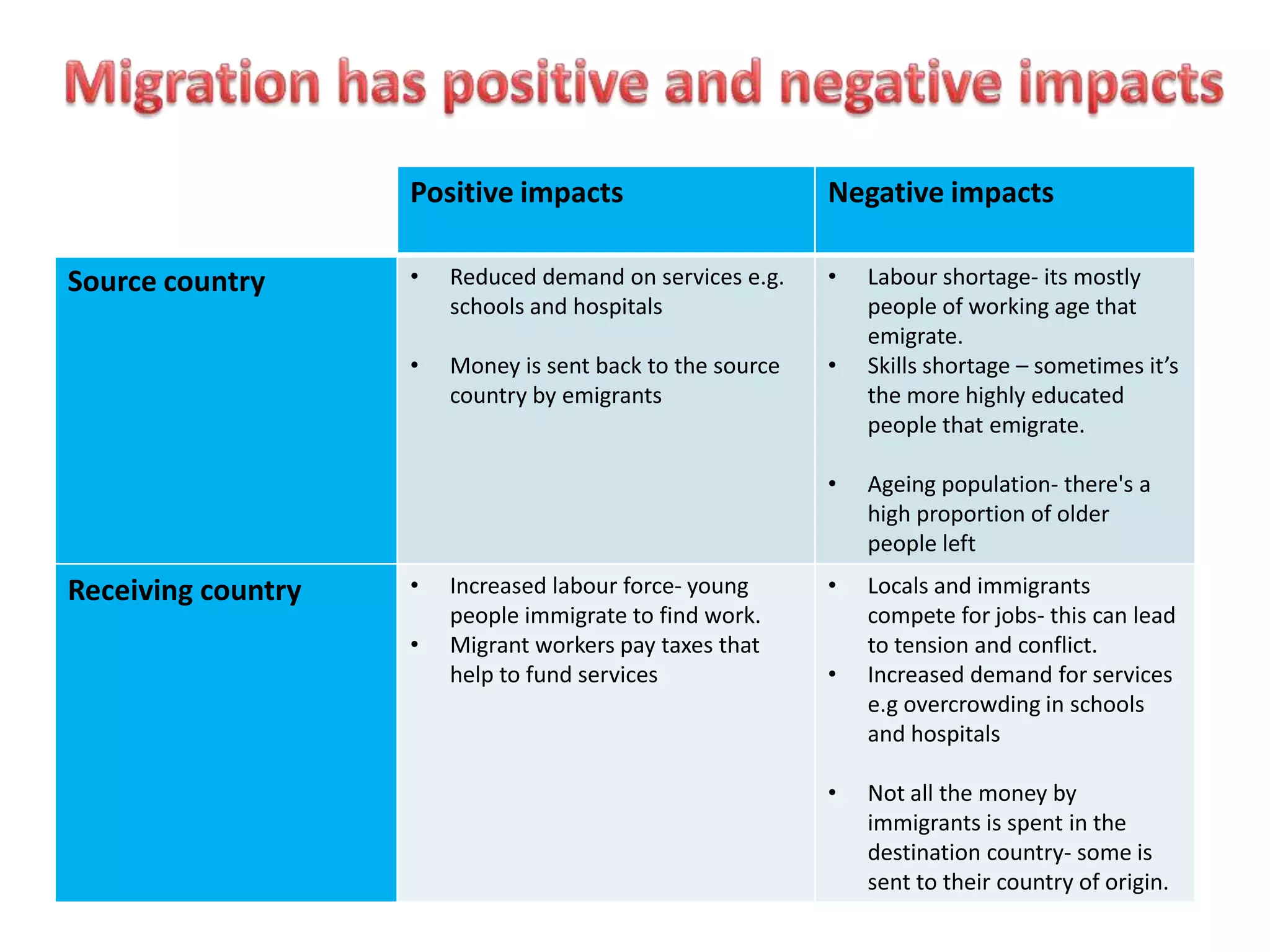
    Better standards oflivingMigration has positive and negative impacts
  • 52.
    Need to knowcase studies:Economic Migrants within the EU:Poland to UK2. Refugees Migrate to the EUNorth Africa to EU (Spain) See green bible for references…..