INTRODUCTION
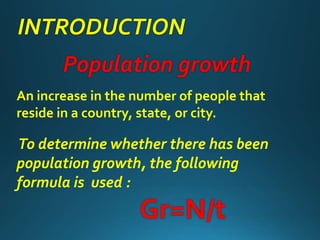
Population growth
An increase in the number of people that
reside in a country, state, or city.
To determine whether there has been
population growth, the following
formula is used :
Gr=N/t
WORLDPOPULATIONEVENTS
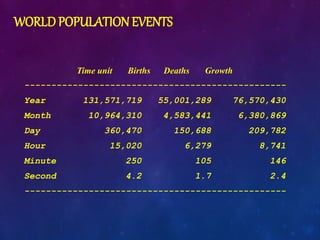
Time unit Births Deaths Growth
-------------------------------------------------
Year 131,571,719 55,001,289 76,570,430
Month 10,964,310 4,583,441 6,380,869
Day 360,470 150,688 209,782
Hour 15,020 6,279 8,741
Minute 250 105 146
Second 4.2 1.7 2.4
-------------------------------------------------
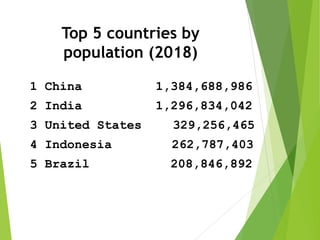
Top 5 countries by
population (2018)
1 China 1,384,688,986
2 India 1,296,834,042
3 United States 329,256,465
4 Indonesia 262,787,403
5 Brazil 208,846,892
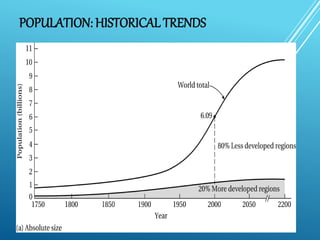
POPULATION: HISTORICAL TRENDS
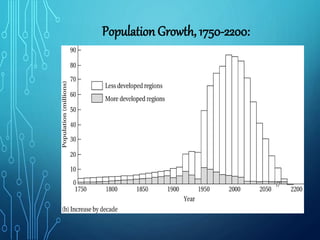
Population Growth, 1750-2200:
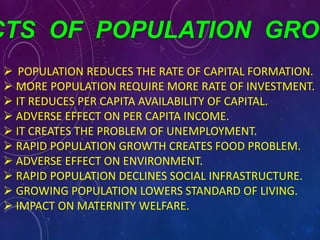
CTS OF POPULATION GROW
 POPULATION REDUCES THE RATE OF CAPITAL FORMATION.
 MORE POPULATION REQUIRE MORE RATE OF INVESTMENT.
 IT REDUCES PER CAPITA AVAILABILITY OF CAPITAL.
 ADVERSE EFFECT ON PER CAPITA INCOME.
 IT CREATES THE PROBLEM OF UNEMPLOYMENT.
 RAPID POPULATION GROWTH CREATES FOOD PROBLEM.
 ADVERSE EFFECT ON ENVIRONMENT.
 RAPID POPULATION DECLINES SOCIAL INFRASTRUCTURE.
 GROWING POPULATION LOWERS STANDARD OF LIVING.
 IMPACT ON MATERNITY WELFARE.
CASE STUDY ON THE EFFECTS
1) REDUCTION IN RATE OF CAPITAL FORMATION :
In underdeveloped countries, the composition of population
is determined to increase capital formation. Due to higher birth rate
and low life expectation in these countries, the percentage of
dependents is very high. These population are of non-productive age
groups which simply consumes and does not produce anything.
2) REQUIREMENT OF MORE INVESTMENT:
In economically backward countries, investment requirements
are beyond it’s investing capacity. A rapid growing population
increase the requirements of demographic investment which at same
time reduce the capacity of the people to save it.
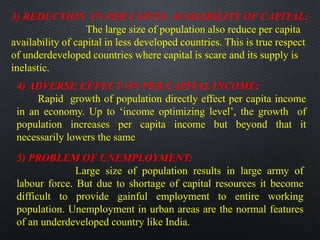
3) REDUCTION IN PER CAPITA AVAILIBILITY OF CAPITAL:
The large size of population also reduce per capita
availability of capital in less developed countries. This is true respect
of underdeveloped countries where capital is scare and its supply is
inelastic.
4) ADVERSE EFFECT ON PER CAPITAL INCOME:
Rapid growth of population directly effect per capita income
in an economy. Up to ‘income optimizing level’, the growth of
population increases per capita income but beyond that it
necessarily lowers the same
5) PROBLEM OF UNEMPLOYMENT:
Large size of population results in large army of
labour force. But due to shortage of capital resources it become
difficult to provide gainful employment to entire working
population. Unemployment in urban areas are the normal features
of an underdeveloped country like India.
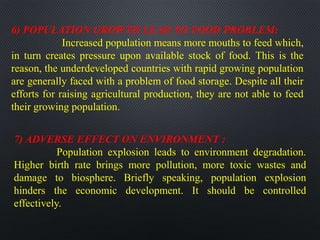
6) POPULATION GROWTH LEAD TO FOOD PROBLEM:
Increased population means more mouths to feed which,
in turn creates pressure upon available stock of food. This is the
reason, the underdeveloped countries with rapid growing population
are generally faced with a problem of food storage. Despite all their
efforts for raising agricultural production, they are not able to feed
their growing population.
7) ADVERSE EFFECT ON ENVIRONMENT :
Population explosion leads to environment degradation.
Higher birth rate brings more pollution, more toxic wastes and
damage to biosphere. Briefly speaking, population explosion
hinders the economic development. It should be controlled
effectively.
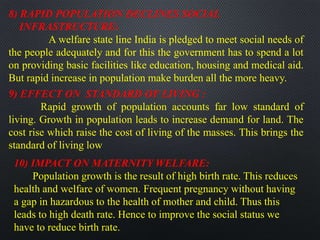
8) RAPID POPULATION DECLINES SOCIAL
INFRASTRUCTURE:
A welfare state line India is pledged to meet social needs of
the people adequately and for this the government has to spend a lot
on providing basic facilities like education, housing and medical aid.
But rapid increase in population make burden all the more heavy.
9) EFFECT ON STANDARD OF LIVING :
Rapid growth of population accounts far low standard of
living. Growth in population leads to increase demand for land. The
cost rise which raise the cost of living of the masses. This brings the
standard of living low
10) IMPACT ON MATERNITY WELFARE:
Population growth is the result of high birth rate. This reduces
health and welfare of women. Frequent pregnancy without having
a gap in hazardous to the health of mother and child. Thus this
leads to high death rate. Hence to improve the social status we
have to reduce birth rate.
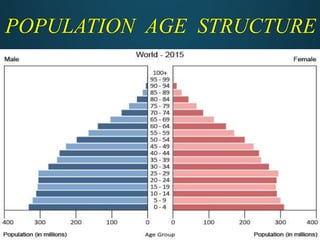
POPULATION AGE STRUCTURE
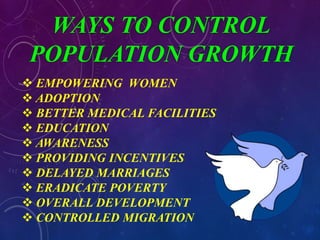
WAYS TO CONTROL
POPULATION GROWTH
 EMPOWERING WOMEN
 ADOPTION
 BETTER MEDICAL FACILITIES
 EDUCATION
 AWARENESS
 PROVIDING INCENTIVES
 DELAYED MARRIAGES
 ERADICATE POVERTY
 OVERALL DEVELOPMENT
 CONTROLLED MIGRATION
THANK YOUTHE END
CREDITS
DIRECTED BY ASIF MANDAL
WRITTEN BY GOOGLE
PRODUCED BY DELL LATITUDE E6410
EXECUTIVE PRODUCER APPLE
LEAD CAST POPULATION GROWTH
SUPPORTING CAST EFFECTS AND WAYS
PHOTOGRAPHY CHROME
PRODUCTION DESIGNER ASIF MANDAL
EDITOR INTEL CORE i7
ASSOCIATE PRODUCERS JIO AND TEAM
COSTUME DESIGNER MICROSOFT THEMES
CASTING DIRECTOR DALIA DAS
PRODUCTION MANAGER OPPOA37F
CHOREOGRAPHER ASIF MANDAL
SUPERVISOR DALIA DAS
SET DECORATOR POWER POINT
PRODUCTION COMPANY ASIF
FOLLOW ME @MANDALASIF
EMAIL: asif9404051606@gmail.com
PPT BY-
ASIF MANDAL

analysis of population growth

  • 2.
    INTRODUCTION Population growth An increasein the number of people that reside in a country, state, or city. To determine whether there has been population growth, the following formula is used : Gr=N/t
  • 3.
    WORLDPOPULATIONEVENTS Time unit BirthsDeaths Growth ------------------------------------------------- Year 131,571,719 55,001,289 76,570,430 Month 10,964,310 4,583,441 6,380,869 Day 360,470 150,688 209,782 Hour 15,020 6,279 8,741 Minute 250 105 146 Second 4.2 1.7 2.4 -------------------------------------------------
  • 4.
    Top 5 countriesby population (2018) 1 China 1,384,688,986 2 India 1,296,834,042 3 United States 329,256,465 4 Indonesia 262,787,403 5 Brazil 208,846,892
  • 5.
  • 6.
  • 7.
    CTS OF POPULATIONGROW  POPULATION REDUCES THE RATE OF CAPITAL FORMATION.  MORE POPULATION REQUIRE MORE RATE OF INVESTMENT.  IT REDUCES PER CAPITA AVAILABILITY OF CAPITAL.  ADVERSE EFFECT ON PER CAPITA INCOME.  IT CREATES THE PROBLEM OF UNEMPLOYMENT.  RAPID POPULATION GROWTH CREATES FOOD PROBLEM.  ADVERSE EFFECT ON ENVIRONMENT.  RAPID POPULATION DECLINES SOCIAL INFRASTRUCTURE.  GROWING POPULATION LOWERS STANDARD OF LIVING.  IMPACT ON MATERNITY WELFARE.
  • 8.
    CASE STUDY ONTHE EFFECTS 1) REDUCTION IN RATE OF CAPITAL FORMATION : In underdeveloped countries, the composition of population is determined to increase capital formation. Due to higher birth rate and low life expectation in these countries, the percentage of dependents is very high. These population are of non-productive age groups which simply consumes and does not produce anything. 2) REQUIREMENT OF MORE INVESTMENT: In economically backward countries, investment requirements are beyond it’s investing capacity. A rapid growing population increase the requirements of demographic investment which at same time reduce the capacity of the people to save it.
  • 9.
    3) REDUCTION INPER CAPITA AVAILIBILITY OF CAPITAL: The large size of population also reduce per capita availability of capital in less developed countries. This is true respect of underdeveloped countries where capital is scare and its supply is inelastic. 4) ADVERSE EFFECT ON PER CAPITAL INCOME: Rapid growth of population directly effect per capita income in an economy. Up to ‘income optimizing level’, the growth of population increases per capita income but beyond that it necessarily lowers the same 5) PROBLEM OF UNEMPLOYMENT: Large size of population results in large army of labour force. But due to shortage of capital resources it become difficult to provide gainful employment to entire working population. Unemployment in urban areas are the normal features of an underdeveloped country like India.
  • 10.
    6) POPULATION GROWTHLEAD TO FOOD PROBLEM: Increased population means more mouths to feed which, in turn creates pressure upon available stock of food. This is the reason, the underdeveloped countries with rapid growing population are generally faced with a problem of food storage. Despite all their efforts for raising agricultural production, they are not able to feed their growing population. 7) ADVERSE EFFECT ON ENVIRONMENT : Population explosion leads to environment degradation. Higher birth rate brings more pollution, more toxic wastes and damage to biosphere. Briefly speaking, population explosion hinders the economic development. It should be controlled effectively.
  • 11.
    8) RAPID POPULATIONDECLINES SOCIAL INFRASTRUCTURE: A welfare state line India is pledged to meet social needs of the people adequately and for this the government has to spend a lot on providing basic facilities like education, housing and medical aid. But rapid increase in population make burden all the more heavy. 9) EFFECT ON STANDARD OF LIVING : Rapid growth of population accounts far low standard of living. Growth in population leads to increase demand for land. The cost rise which raise the cost of living of the masses. This brings the standard of living low 10) IMPACT ON MATERNITY WELFARE: Population growth is the result of high birth rate. This reduces health and welfare of women. Frequent pregnancy without having a gap in hazardous to the health of mother and child. Thus this leads to high death rate. Hence to improve the social status we have to reduce birth rate.
  • 12.
  • 13.
    WAYS TO CONTROL POPULATIONGROWTH  EMPOWERING WOMEN  ADOPTION  BETTER MEDICAL FACILITIES  EDUCATION  AWARENESS  PROVIDING INCENTIVES  DELAYED MARRIAGES  ERADICATE POVERTY  OVERALL DEVELOPMENT  CONTROLLED MIGRATION
  • 14.
  • 15.
    CREDITS DIRECTED BY ASIFMANDAL WRITTEN BY GOOGLE PRODUCED BY DELL LATITUDE E6410 EXECUTIVE PRODUCER APPLE LEAD CAST POPULATION GROWTH SUPPORTING CAST EFFECTS AND WAYS PHOTOGRAPHY CHROME PRODUCTION DESIGNER ASIF MANDAL EDITOR INTEL CORE i7 ASSOCIATE PRODUCERS JIO AND TEAM COSTUME DESIGNER MICROSOFT THEMES CASTING DIRECTOR DALIA DAS PRODUCTION MANAGER OPPOA37F CHOREOGRAPHER ASIF MANDAL SUPERVISOR DALIA DAS SET DECORATOR POWER POINT PRODUCTION COMPANY ASIF FOLLOW ME @MANDALASIF EMAIL: asif9404051606@gmail.com PPT BY- ASIF MANDAL