MIPI DisCo
and ACPI:
Streamlining MIPI
Component Integration
Rob Gough
MIPI Software WG Chair
Platform Software
Architect (Intel)
Agenda
•  MIPI Software Working Group Charter
•  ACPI Overview
•  MIPI DisCo implementation of ACPI
•  MIPI SoundWire example
•  Open Property Database
•  Benefits of using DisCo-defined property sets
•  Streamlining the Platform Integration Process
•  Call to Action
2
MIPI Software Working Group Charter
•  Develop uniform hardware description mechanism for components/
devices
•  Define an extensible framework, flexibly applicable to all MIPI
interfaces
•  Ensure compatibility with existing mechanisms defined by MIPI
interfaces
•  Minimize cost for platform silicon (gate count, resource efficiency)
and OS (code footprint, responsiveness)
•  Provide consistent capabilities, w/o constraints/restrictions on
implementation
•  Enable OS consistency for capabilities and controls through
reference implementation
3
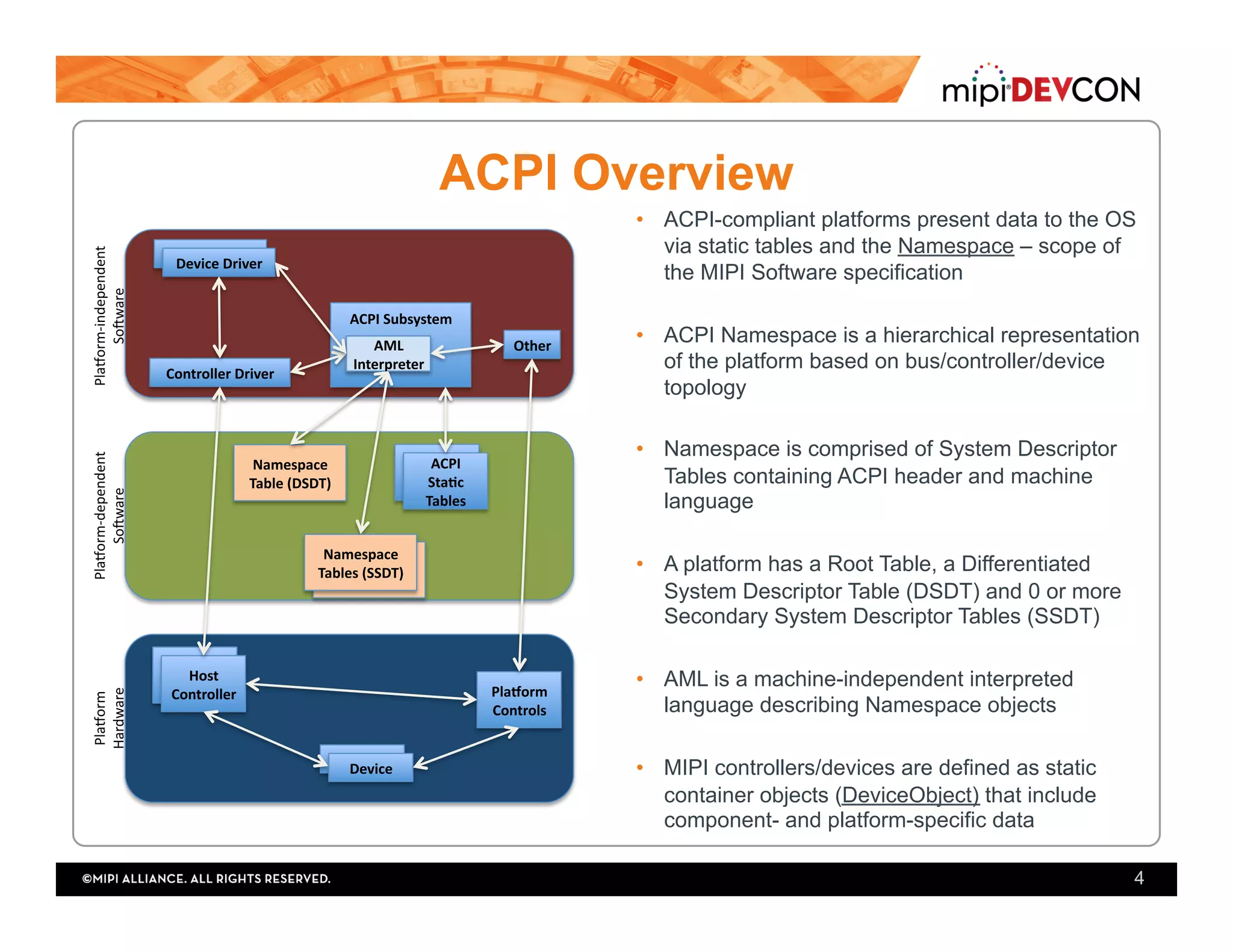
ACPI Overview
•  ACPI-compliant platforms present data to the OS
via static tables and the Namespace – scope of
the MIPI Software specification
•  ACPI Namespace is a hierarchical representation
of the platform based on bus/controller/device
topology
•  Namespace is comprised of System Descriptor
Tables containing ACPI header and machine
language
•  A platform has a Root Table, a Differentiated
System Descriptor Table (DSDT) and 0 or more
Secondary System Descriptor Tables (SSDT)
•  AML is a machine-independent interpreted
language describing Namespace objects
•  MIPI controllers/devices are defined as static
container objects (DeviceObject) that include
component- and platform-specific data
4
Device	Driver	
Device	Driver	
ACPI	Subsystem	
Controller	Driver	
AML	
Interpreter	
Other	
Device	
Driver	
ACPI	
Sta<c	
Tables	
Device	
Device	
Driver	
Host	
Controller	 Pla?orm	
Controls	
Namespace	
Table	(DSDT)	
Namespace	
Tables	(SSDT)	
Namespace	
Tables	(SSDT)	
Pla$orm	
Hardware	
Pla$orm-dependent	
So2ware	
Pla$orm-independent	
So2ware
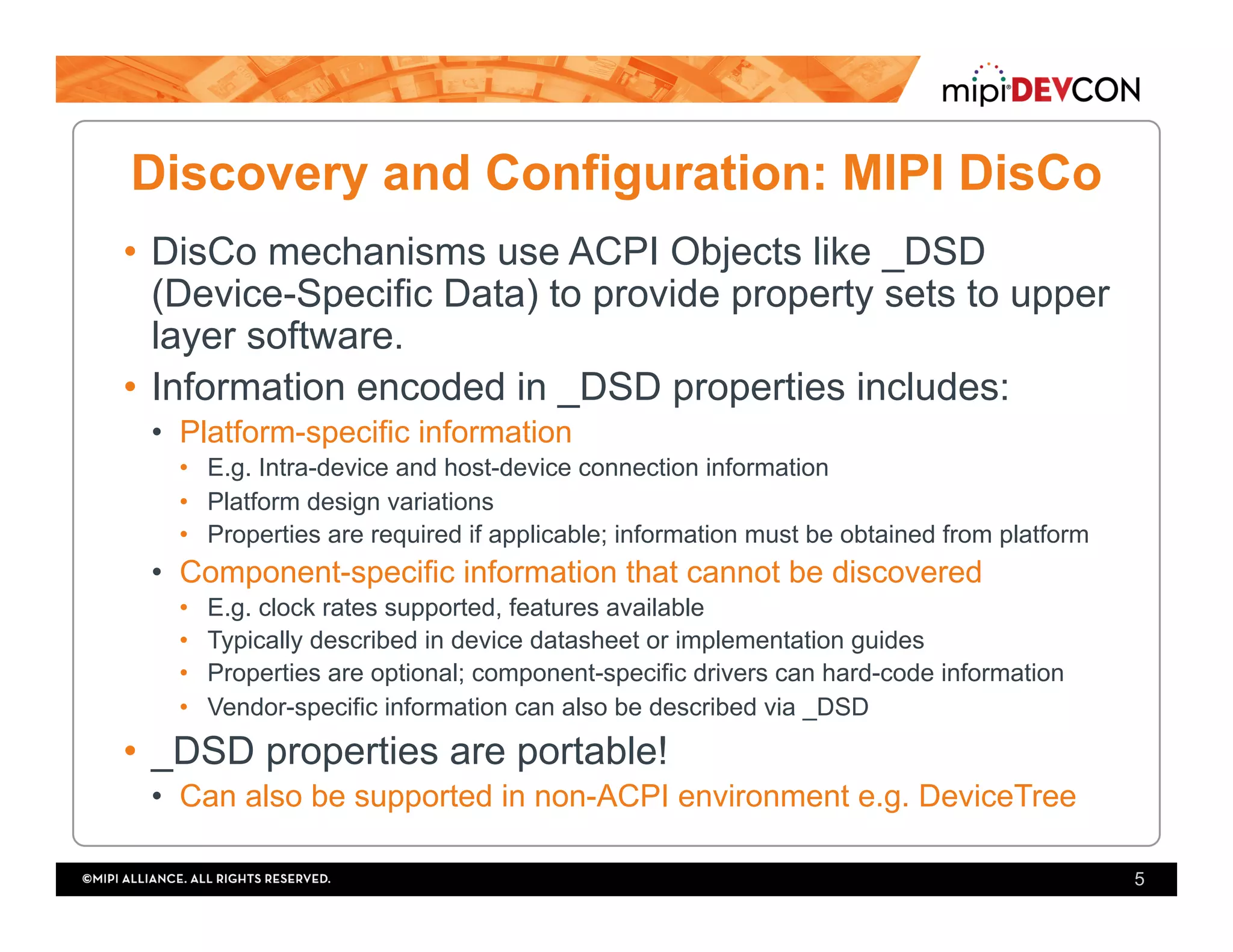
Discovery and Configuration: MIPI DisCo
•  DisCo mechanisms use ACPI Objects like _DSD
(Device-Specific Data) to provide property sets to upper
layer software.
•  Information encoded in _DSD properties includes:
•  Platform-specific information
•  E.g. Intra-device and host-device connection information
•  Platform design variations
•  Properties are required if applicable; information must be obtained from platform
•  Component-specific information that cannot be discovered
•  E.g. clock rates supported, features available
•  Typically described in device datasheet or implementation guides
•  Properties are optional; component-specific drivers can hard-code information
•  Vendor-specific information can also be described via _DSD
•  _DSD properties are portable!
•  Can also be supported in non-ACPI environment e.g. DeviceTree
5
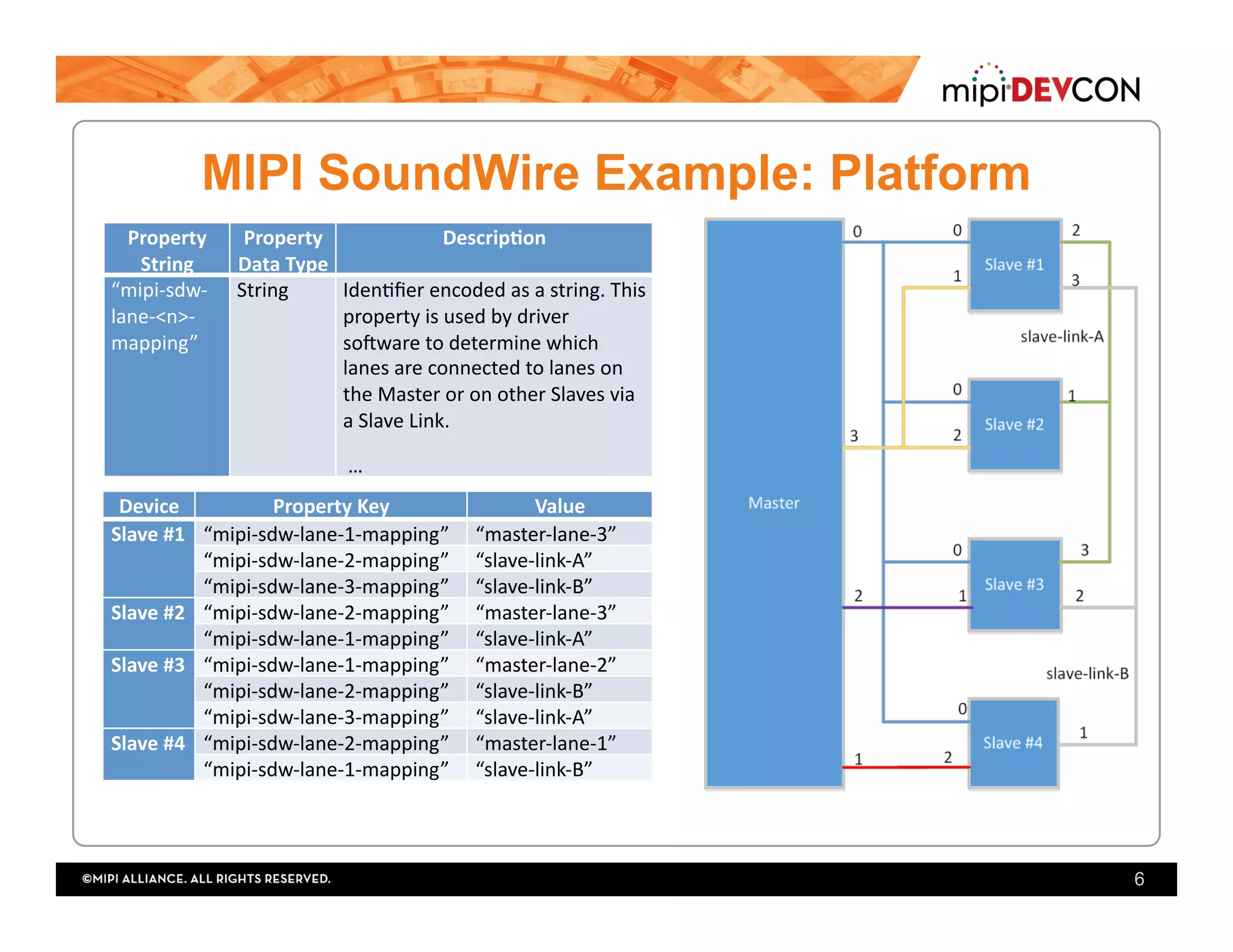
MIPI SoundWire Example: Platform
Property	
String
Property	
Data	Type
Descrip<on
“mipi-sdw-
lane-<n>-
mapping”
String Iden;fier	encoded	as	a	string.	This	
property	is	used	by	driver	
so2ware	to	determine	which	
lanes	are	connected	to	lanes	on	
the	Master	or	on	other	Slaves	via	
a	Slave	Link.		
	…
6
Device Property	Key Value
Slave	#1 “mipi-sdw-lane-1-mapping” “master-lane-3”
“mipi-sdw-lane-2-mapping” “slave-link-A”
“mipi-sdw-lane-3-mapping” “slave-link-B”
Slave	#2 “mipi-sdw-lane-2-mapping” “master-lane-3”
“mipi-sdw-lane-1-mapping” “slave-link-A”
Slave	#3 “mipi-sdw-lane-1-mapping” “master-lane-2”
“mipi-sdw-lane-2-mapping” “slave-link-B”
“mipi-sdw-lane-3-mapping” “slave-link-A”
Slave	#4 “mipi-sdw-lane-2-mapping” “master-lane-1”
“mipi-sdw-lane-1-mapping” “slave-link-B”
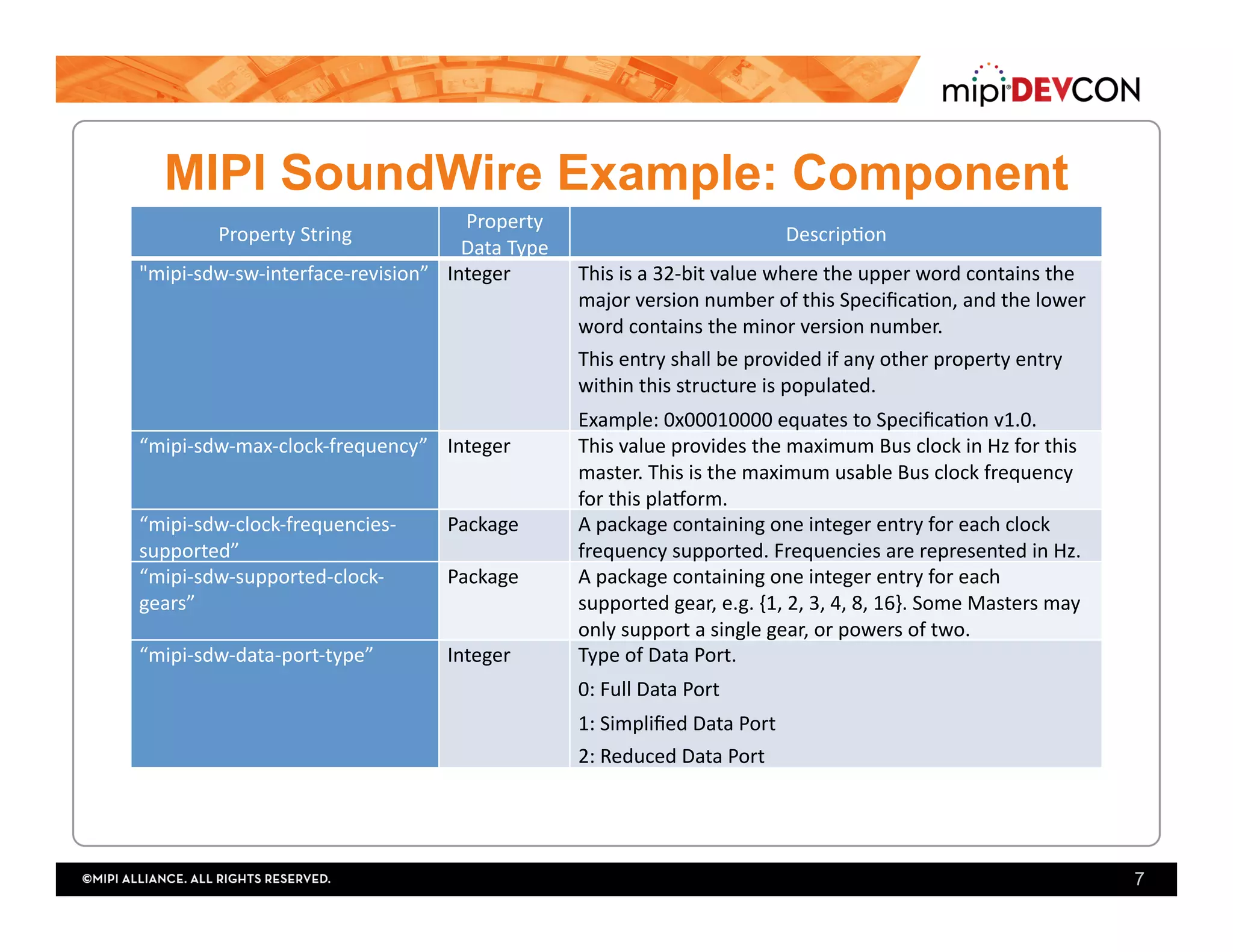
MIPI SoundWire Example: Component
Property	String	
Property	
Data	Type	
Descrip;on	
"mipi-sdw-sw-interface-revision”	 Integer	 This	is	a	32-bit	value	where	the	upper	word	contains	the	
major	version	number	of	this	Specifica;on,	and	the	lower	
word	contains	the	minor	version	number.		
This	entry	shall	be	provided	if	any	other	property	entry	
within	this	structure	is	populated.		
Example:	0x00010000	equates	to	Specifica;on	v1.0.	
“mipi-sdw-max-clock-frequency”	 Integer	 This	value	provides	the	maximum	Bus	clock	in	Hz	for	this	
master.	This	is	the	maximum	usable	Bus	clock	frequency	
for	this	pla$orm.	
“mipi-sdw-clock-frequencies-
supported”	
Package	 A	package	containing	one	integer	entry	for	each	clock	
frequency	supported.	Frequencies	are	represented	in	Hz.	
“mipi-sdw-supported-clock-
gears”	
Package	 A	package	containing	one	integer	entry	for	each	
supported	gear,	e.g.	{1,	2,	3,	4,	8,	16}.	Some	Masters	may	
only	support	a	single	gear,	or	powers	of	two.	
“mipi-sdw-data-port-type”	 Integer	 Type	of	Data	Port.	
0:	Full	Data	Port	
1:	Simplified	Data	Port	
2:	Reduced	Data	Port		
7
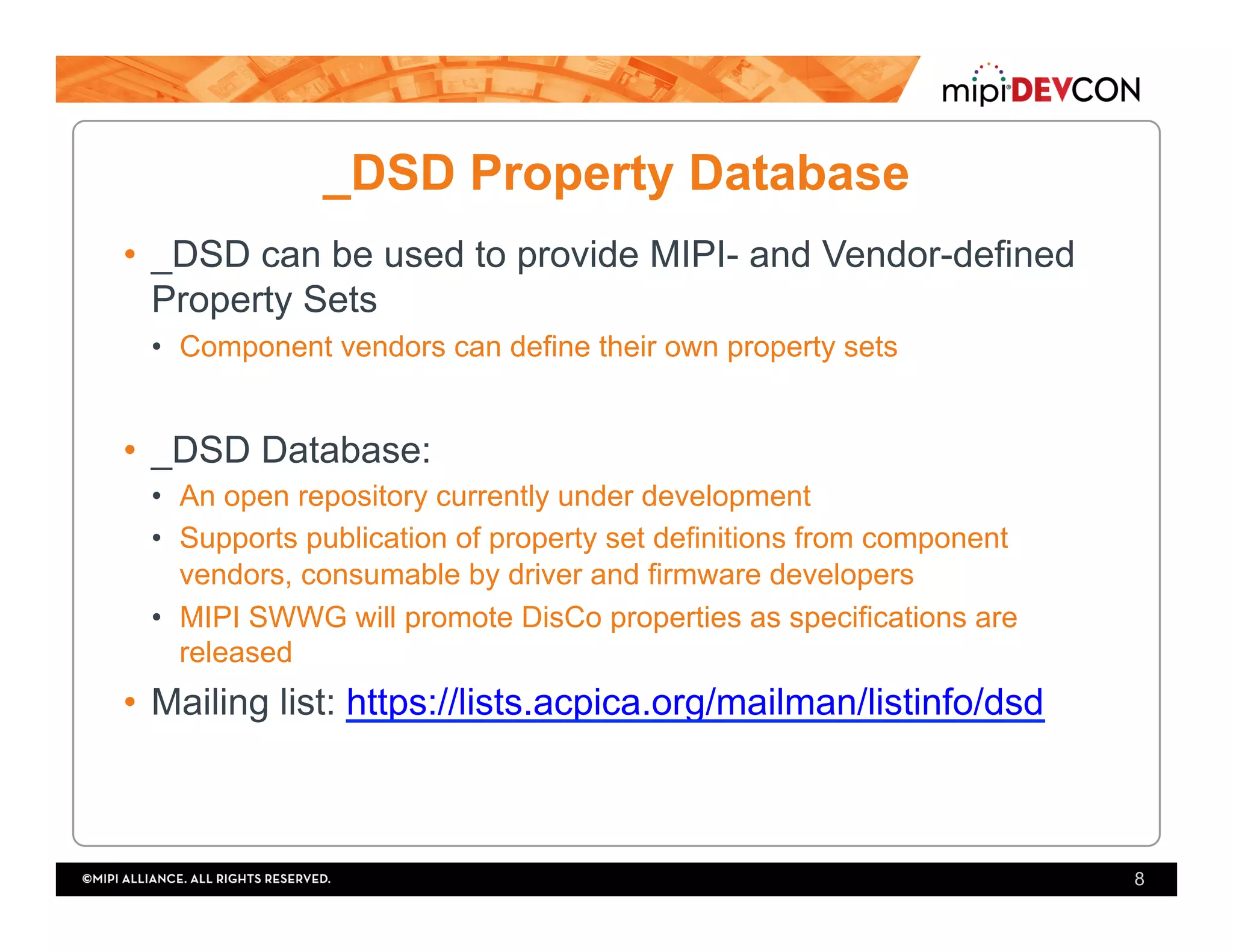
_DSD Property Database
•  _DSD can be used to provide MIPI- and Vendor-defined
Property Sets
•  Component vendors can define their own property sets
•  _DSD Database:
•  An open repository currently under development
•  Supports publication of property set definitions from component
vendors, consumable by driver and firmware developers
•  MIPI SWWG will promote DisCo properties as specifications are
released
•  Mailing list: https://lists.acpica.org/mailman/listinfo/dsd
8
MIPI DisCo Benefits
•  Driver
•  Pre-DisCo, drivers are developed on a single platform, and then re-
built or ported to new platforms
•  A driver for a given component on platform A must be modified to work on
platform B
•  Many versions of drivers exist (must be supported) for the same component
•  DisCo-compliant drivers for a MIPI component can be written once,
consuming ACPI-provided properties for device and platform
configuration.
•  No more forking drivers per-platform
•  Firmware
•  Information is OS-agnostic
•  Simple presentation of DisCo properties
•  Drop-in property sets from component vendors
9
Platform Component Integration
•  Component vendor provides component-specific DisCo
property sets
•  Datasheet and/or electronic format
•  Platform designer imports vendor-provided properties
•  Platform designer adds platform implementation-
specific properties as needed
•  Existing OS drivers work as-is
•  Drivers for new components developed based on DisCo
specifications can be re-used
10
Call To Action
•  Component Vendors:
•  Utilize _DSD properties for components defined in MIPI DisCo
Specifications
•  Describe vendor-specific properties through the _DSD database
•  Consider applicability- candidate for a future DisCo spec? Engage SWWG
•  Publish existing vendor-defined DeviceTree property sets to the _DSD database
•  Provide component-specific _DSD packages to customers
•  System Integrators:
•  Utilize _DSD properties for platform configurations defined in MIPI
DisCo Specifications
•  Integrate component-specific packages from component vendors
•  All:
•  Participate in DisCo Spec development, property set definition
11
MIPI DisCo Development Process
•  MIPI Software WG members work with other WGs to
jointly define property sets for MIPI component types
(e.g. SoundWire)
•  SWWG develops specification, ongoing reviews with
other MIPI Working Groups.
•  Other WG ratifies content; SWWG owns content and
publishes, with board approval.
•  Software WG specs are made available to non-MIPI
members via public MIPI.org website presence (WIP)
14
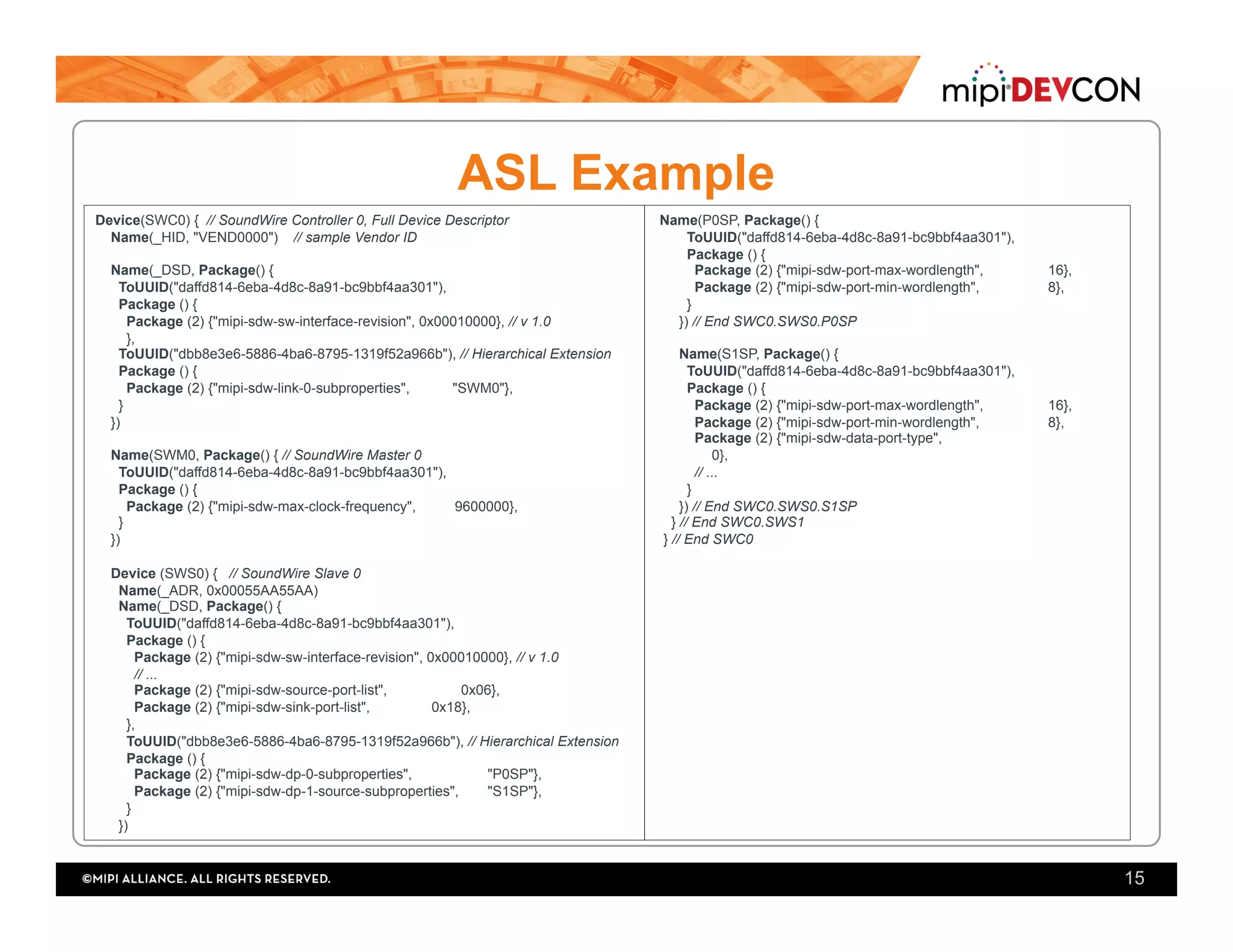
ASL Example
Device(SWC0) { // SoundWire Controller 0, Full Device Descriptor
Name(_HID, "VEND0000") // sample Vendor ID
Name(_DSD, Package() {
ToUUID("daffd814-6eba-4d8c-8a91-bc9bbf4aa301"),
Package () {
Package (2) {"mipi-sdw-sw-interface-revision", 0x00010000}, // v 1.0
},
ToUUID("dbb8e3e6-5886-4ba6-8795-1319f52a966b"), // Hierarchical Extension
Package () {
Package (2) {"mipi-sdw-link-0-subproperties", "SWM0"},
}
})
Name(SWM0, Package() { // SoundWire Master 0
ToUUID("daffd814-6eba-4d8c-8a91-bc9bbf4aa301"),
Package () {
Package (2) {"mipi-sdw-max-clock-frequency", 9600000},
}
})
Device (SWS0) { // SoundWire Slave 0
Name(_ADR, 0x00055AA55AA)
Name(_DSD, Package() {
ToUUID("daffd814-6eba-4d8c-8a91-bc9bbf4aa301"),
Package () {
Package (2) {"mipi-sdw-sw-interface-revision", 0x00010000}, // v 1.0
// ...
Package (2) {"mipi-sdw-source-port-list", 0x06},
Package (2) {"mipi-sdw-sink-port-list", 0x18},
},
ToUUID("dbb8e3e6-5886-4ba6-8795-1319f52a966b"), // Hierarchical Extension
Package () {
Package (2) {"mipi-sdw-dp-0-subproperties", "P0SP"},
Package (2) {"mipi-sdw-dp-1-source-subproperties", "S1SP"},
}
})
Name(P0SP, Package() {
ToUUID("daffd814-6eba-4d8c-8a91-bc9bbf4aa301"),
Package () {
Package (2) {"mipi-sdw-port-max-wordlength", 16},
Package (2) {"mipi-sdw-port-min-wordlength", 8},
}
}) // End SWC0.SWS0.P0SP
Name(S1SP, Package() {
ToUUID("daffd814-6eba-4d8c-8a91-bc9bbf4aa301"),
Package () {
Package (2) {"mipi-sdw-port-max-wordlength", 16},
Package (2) {"mipi-sdw-port-min-wordlength", 8},
Package (2) {"mipi-sdw-data-port-type",
0},
// ...
}
}) // End SWC0.SWS0.S1SP
} // End SWC0.SWS1
} // End SWC0
15

MIPI DevCon 2016: MIPI DisCo and ACPI - Streamlining MIPI Component Integration

  • 1.
    MIPI DisCo and ACPI: StreamliningMIPI Component Integration Rob Gough MIPI Software WG Chair Platform Software Architect (Intel)
  • 2.
    Agenda •  MIPI SoftwareWorking Group Charter •  ACPI Overview •  MIPI DisCo implementation of ACPI •  MIPI SoundWire example •  Open Property Database •  Benefits of using DisCo-defined property sets •  Streamlining the Platform Integration Process •  Call to Action 2
  • 3.
    MIPI Software WorkingGroup Charter •  Develop uniform hardware description mechanism for components/ devices •  Define an extensible framework, flexibly applicable to all MIPI interfaces •  Ensure compatibility with existing mechanisms defined by MIPI interfaces •  Minimize cost for platform silicon (gate count, resource efficiency) and OS (code footprint, responsiveness) •  Provide consistent capabilities, w/o constraints/restrictions on implementation •  Enable OS consistency for capabilities and controls through reference implementation 3
  • 4.
    ACPI Overview •  ACPI-compliantplatforms present data to the OS via static tables and the Namespace – scope of the MIPI Software specification •  ACPI Namespace is a hierarchical representation of the platform based on bus/controller/device topology •  Namespace is comprised of System Descriptor Tables containing ACPI header and machine language •  A platform has a Root Table, a Differentiated System Descriptor Table (DSDT) and 0 or more Secondary System Descriptor Tables (SSDT) •  AML is a machine-independent interpreted language describing Namespace objects •  MIPI controllers/devices are defined as static container objects (DeviceObject) that include component- and platform-specific data 4 Device Driver Device Driver ACPI Subsystem Controller Driver AML Interpreter Other Device Driver ACPI Sta<c Tables Device Device Driver Host Controller Pla?orm Controls Namespace Table (DSDT) Namespace Tables (SSDT) Namespace Tables (SSDT) Pla$orm Hardware Pla$orm-dependent So2ware Pla$orm-independent So2ware
  • 5.
    Discovery and Configuration:MIPI DisCo •  DisCo mechanisms use ACPI Objects like _DSD (Device-Specific Data) to provide property sets to upper layer software. •  Information encoded in _DSD properties includes: •  Platform-specific information •  E.g. Intra-device and host-device connection information •  Platform design variations •  Properties are required if applicable; information must be obtained from platform •  Component-specific information that cannot be discovered •  E.g. clock rates supported, features available •  Typically described in device datasheet or implementation guides •  Properties are optional; component-specific drivers can hard-code information •  Vendor-specific information can also be described via _DSD •  _DSD properties are portable! •  Can also be supported in non-ACPI environment e.g. DeviceTree 5
  • 6.
    MIPI SoundWire Example:Platform Property String Property Data Type Descrip<on “mipi-sdw- lane-<n>- mapping” String Iden;fier encoded as a string. This property is used by driver so2ware to determine which lanes are connected to lanes on the Master or on other Slaves via a Slave Link. … 6 Device Property Key Value Slave #1 “mipi-sdw-lane-1-mapping” “master-lane-3” “mipi-sdw-lane-2-mapping” “slave-link-A” “mipi-sdw-lane-3-mapping” “slave-link-B” Slave #2 “mipi-sdw-lane-2-mapping” “master-lane-3” “mipi-sdw-lane-1-mapping” “slave-link-A” Slave #3 “mipi-sdw-lane-1-mapping” “master-lane-2” “mipi-sdw-lane-2-mapping” “slave-link-B” “mipi-sdw-lane-3-mapping” “slave-link-A” Slave #4 “mipi-sdw-lane-2-mapping” “master-lane-1” “mipi-sdw-lane-1-mapping” “slave-link-B”
  • 7.
    MIPI SoundWire Example:Component Property String Property Data Type Descrip;on "mipi-sdw-sw-interface-revision” Integer This is a 32-bit value where the upper word contains the major version number of this Specifica;on, and the lower word contains the minor version number. This entry shall be provided if any other property entry within this structure is populated. Example: 0x00010000 equates to Specifica;on v1.0. “mipi-sdw-max-clock-frequency” Integer This value provides the maximum Bus clock in Hz for this master. This is the maximum usable Bus clock frequency for this pla$orm. “mipi-sdw-clock-frequencies- supported” Package A package containing one integer entry for each clock frequency supported. Frequencies are represented in Hz. “mipi-sdw-supported-clock- gears” Package A package containing one integer entry for each supported gear, e.g. {1, 2, 3, 4, 8, 16}. Some Masters may only support a single gear, or powers of two. “mipi-sdw-data-port-type” Integer Type of Data Port. 0: Full Data Port 1: Simplified Data Port 2: Reduced Data Port 7
  • 8.
    _DSD Property Database • _DSD can be used to provide MIPI- and Vendor-defined Property Sets •  Component vendors can define their own property sets •  _DSD Database: •  An open repository currently under development •  Supports publication of property set definitions from component vendors, consumable by driver and firmware developers •  MIPI SWWG will promote DisCo properties as specifications are released •  Mailing list: https://lists.acpica.org/mailman/listinfo/dsd 8
  • 9.
    MIPI DisCo Benefits • Driver •  Pre-DisCo, drivers are developed on a single platform, and then re- built or ported to new platforms •  A driver for a given component on platform A must be modified to work on platform B •  Many versions of drivers exist (must be supported) for the same component •  DisCo-compliant drivers for a MIPI component can be written once, consuming ACPI-provided properties for device and platform configuration. •  No more forking drivers per-platform •  Firmware •  Information is OS-agnostic •  Simple presentation of DisCo properties •  Drop-in property sets from component vendors 9
  • 10.
    Platform Component Integration • Component vendor provides component-specific DisCo property sets •  Datasheet and/or electronic format •  Platform designer imports vendor-provided properties •  Platform designer adds platform implementation- specific properties as needed •  Existing OS drivers work as-is •  Drivers for new components developed based on DisCo specifications can be re-used 10
  • 11.
    Call To Action • Component Vendors: •  Utilize _DSD properties for components defined in MIPI DisCo Specifications •  Describe vendor-specific properties through the _DSD database •  Consider applicability- candidate for a future DisCo spec? Engage SWWG •  Publish existing vendor-defined DeviceTree property sets to the _DSD database •  Provide component-specific _DSD packages to customers •  System Integrators: •  Utilize _DSD properties for platform configurations defined in MIPI DisCo Specifications •  Integrate component-specific packages from component vendors •  All: •  Participate in DisCo Spec development, property set definition 11
  • 12.
    MIPI DisCo DevelopmentProcess •  MIPI Software WG members work with other WGs to jointly define property sets for MIPI component types (e.g. SoundWire) •  SWWG develops specification, ongoing reviews with other MIPI Working Groups. •  Other WG ratifies content; SWWG owns content and publishes, with board approval. •  Software WG specs are made available to non-MIPI members via public MIPI.org website presence (WIP) 14
  • 13.
    ASL Example Device(SWC0) {// SoundWire Controller 0, Full Device Descriptor Name(_HID, "VEND0000") // sample Vendor ID Name(_DSD, Package() { ToUUID("daffd814-6eba-4d8c-8a91-bc9bbf4aa301"), Package () { Package (2) {"mipi-sdw-sw-interface-revision", 0x00010000}, // v 1.0 }, ToUUID("dbb8e3e6-5886-4ba6-8795-1319f52a966b"), // Hierarchical Extension Package () { Package (2) {"mipi-sdw-link-0-subproperties", "SWM0"}, } }) Name(SWM0, Package() { // SoundWire Master 0 ToUUID("daffd814-6eba-4d8c-8a91-bc9bbf4aa301"), Package () { Package (2) {"mipi-sdw-max-clock-frequency", 9600000}, } }) Device (SWS0) { // SoundWire Slave 0 Name(_ADR, 0x00055AA55AA) Name(_DSD, Package() { ToUUID("daffd814-6eba-4d8c-8a91-bc9bbf4aa301"), Package () { Package (2) {"mipi-sdw-sw-interface-revision", 0x00010000}, // v 1.0 // ... Package (2) {"mipi-sdw-source-port-list", 0x06}, Package (2) {"mipi-sdw-sink-port-list", 0x18}, }, ToUUID("dbb8e3e6-5886-4ba6-8795-1319f52a966b"), // Hierarchical Extension Package () { Package (2) {"mipi-sdw-dp-0-subproperties", "P0SP"}, Package (2) {"mipi-sdw-dp-1-source-subproperties", "S1SP"}, } }) Name(P0SP, Package() { ToUUID("daffd814-6eba-4d8c-8a91-bc9bbf4aa301"), Package () { Package (2) {"mipi-sdw-port-max-wordlength", 16}, Package (2) {"mipi-sdw-port-min-wordlength", 8}, } }) // End SWC0.SWS0.P0SP Name(S1SP, Package() { ToUUID("daffd814-6eba-4d8c-8a91-bc9bbf4aa301"), Package () { Package (2) {"mipi-sdw-port-max-wordlength", 16}, Package (2) {"mipi-sdw-port-min-wordlength", 8}, Package (2) {"mipi-sdw-data-port-type", 0}, // ... } }) // End SWC0.SWS0.S1SP } // End SWC0.SWS1 } // End SWC0 15