1
Computer Architecture
Chapter 1: Fundamentals of
Computer Design
2
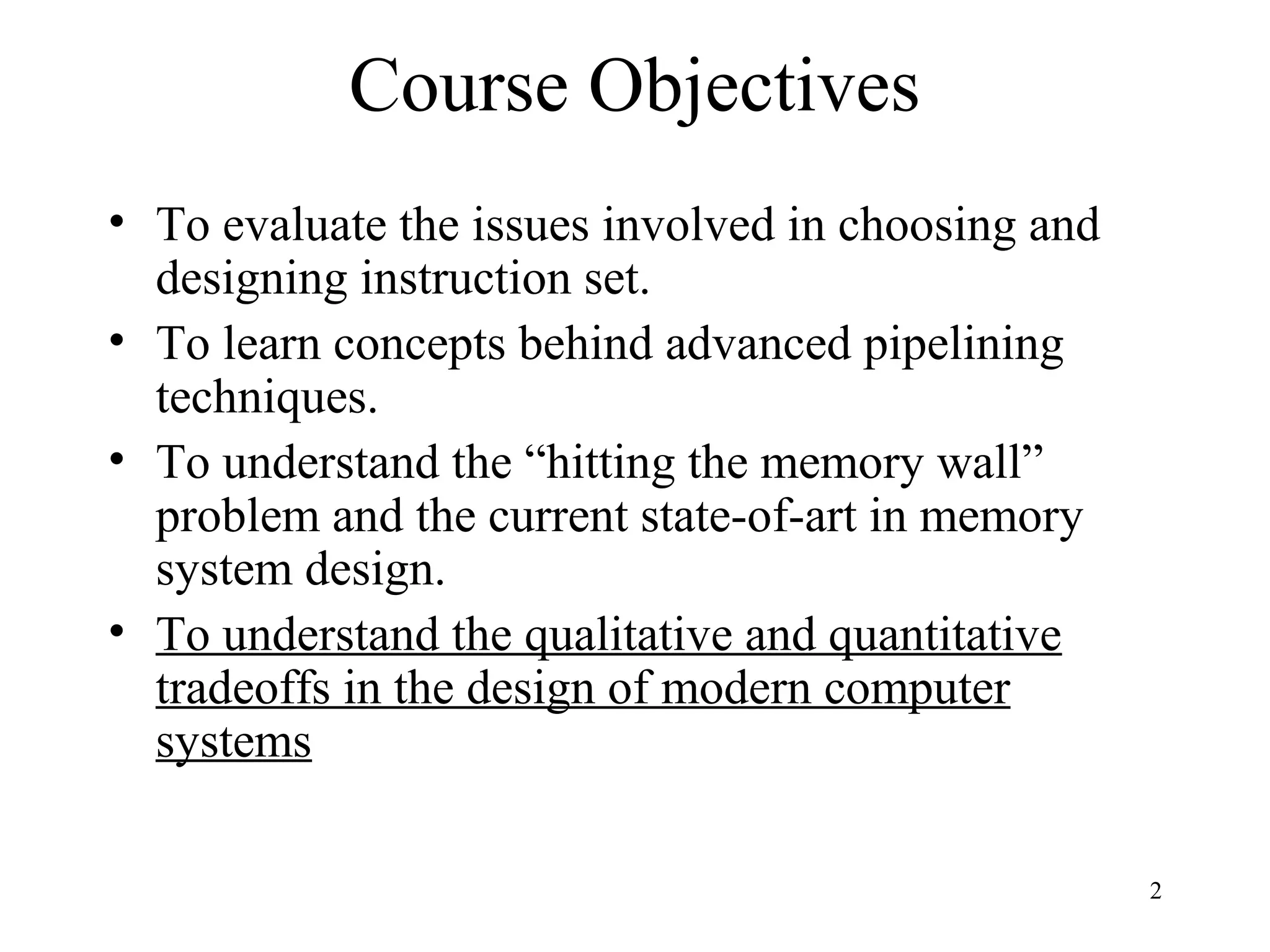
Course Objectives
• To evaluate the issues involved in choosing and
designing instruction set.
• To learn concepts behind advanced pipelining
techniques.
• To understand the “hitting the memory wall”
problem and the current state-of-art in memory
system design.
• To understand the qualitative and quantitative
tradeoffs in the design of modern computer
systems
3
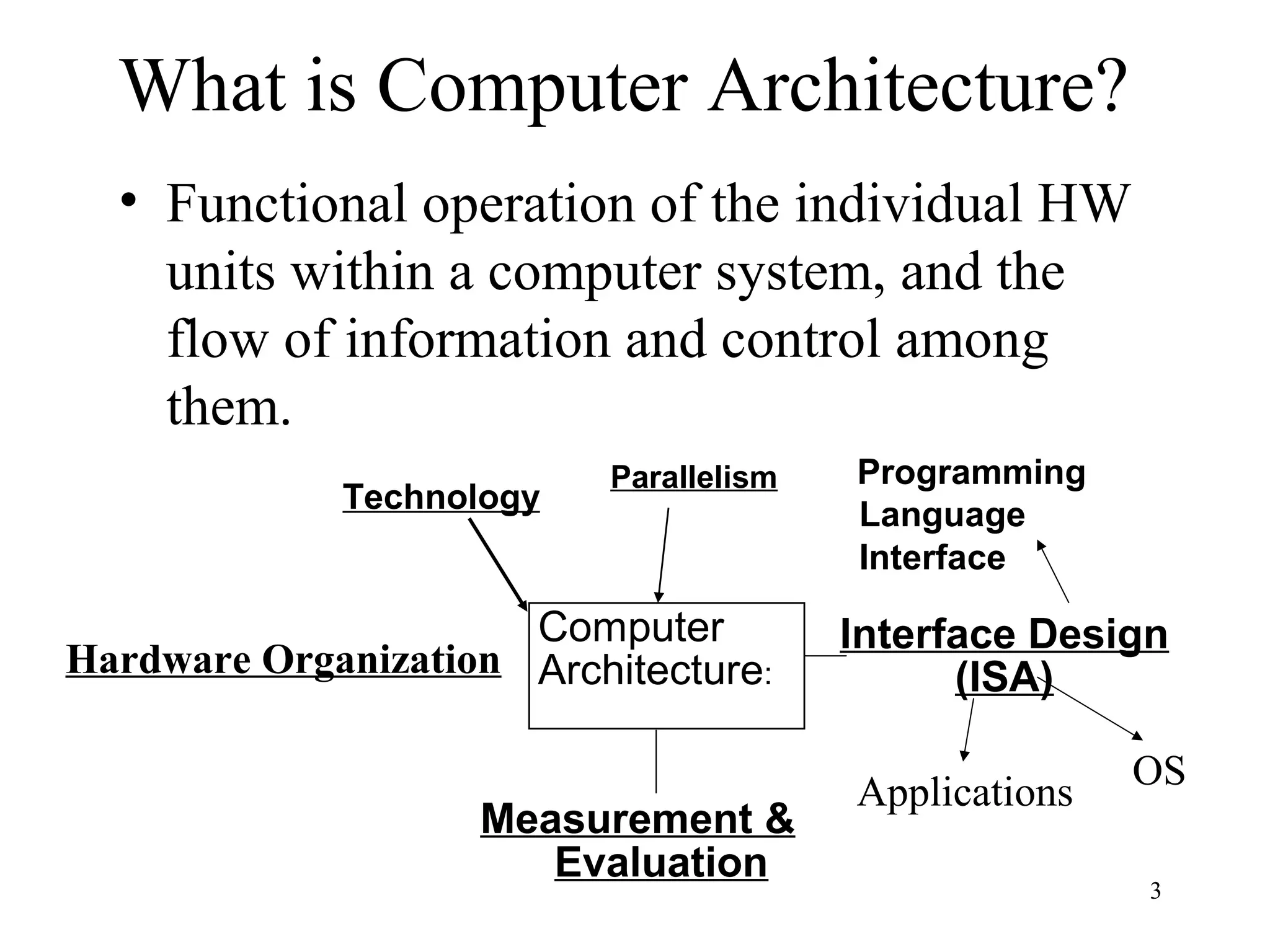
What is Computer Architecture?
• Functional operation of the individual HW
units within a computer system, and the
flow of information and control among
them.
Technology
Programming
Language
Interface
Interface Design
(ISA)
Measurement &
Evaluation
Parallelism
Computer
Architecture:
Applications
OS
Hardware Organization
4
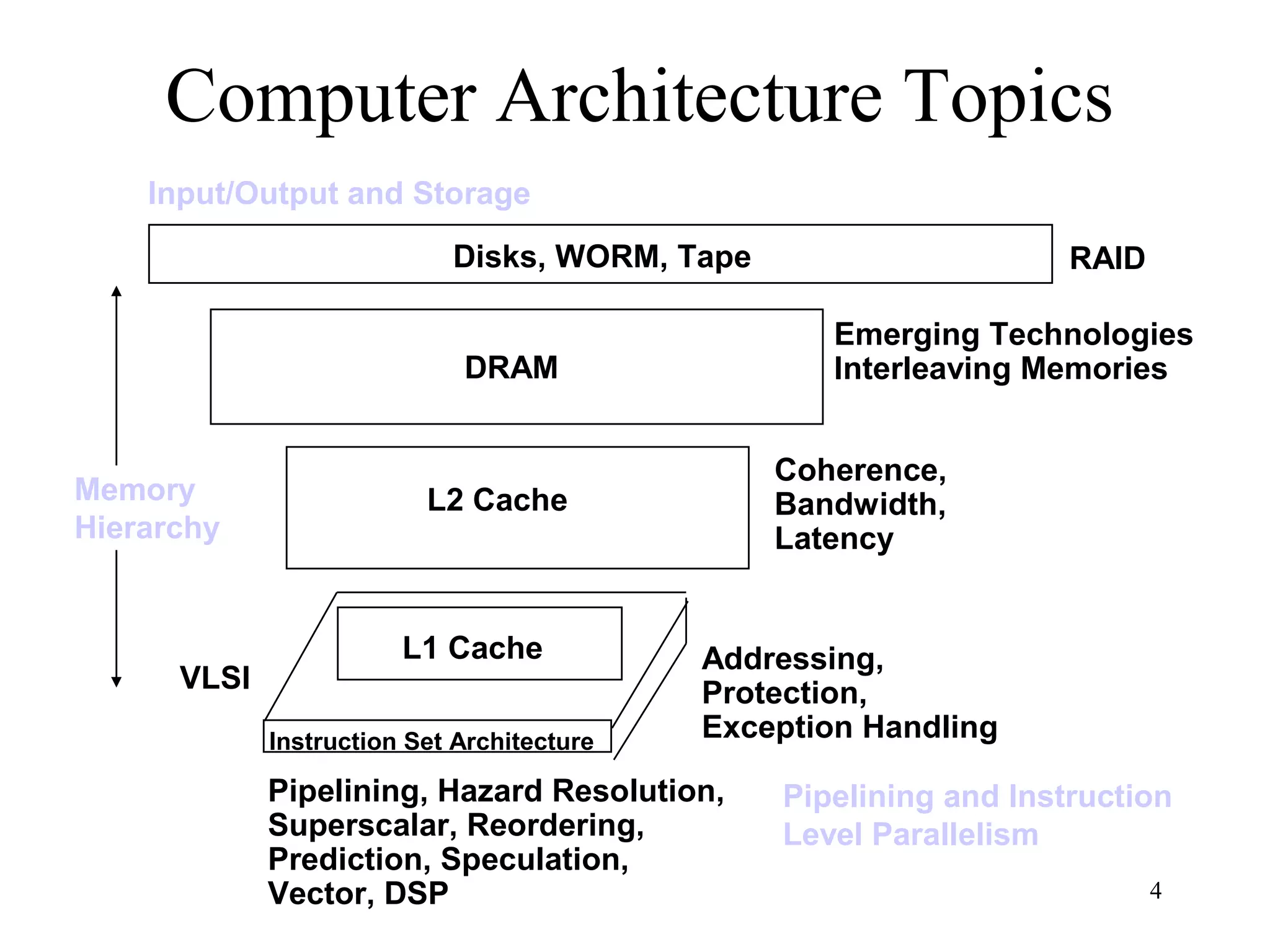
Computer Architecture Topics
Instruction Set Architecture
Pipelining, Hazard Resolution,
Superscalar, Reordering,
Prediction, Speculation,
Vector, DSP
Addressing,
Protection,
Exception Handling
L1 Cache
L2 Cache
DRAM
Disks, WORM, Tape
Coherence,
Bandwidth,
Latency
Emerging Technologies
Interleaving Memories
RAID
VLSI
Input/Output and Storage
Memory
Hierarchy
Pipelining and Instruction
Level Parallelism
5
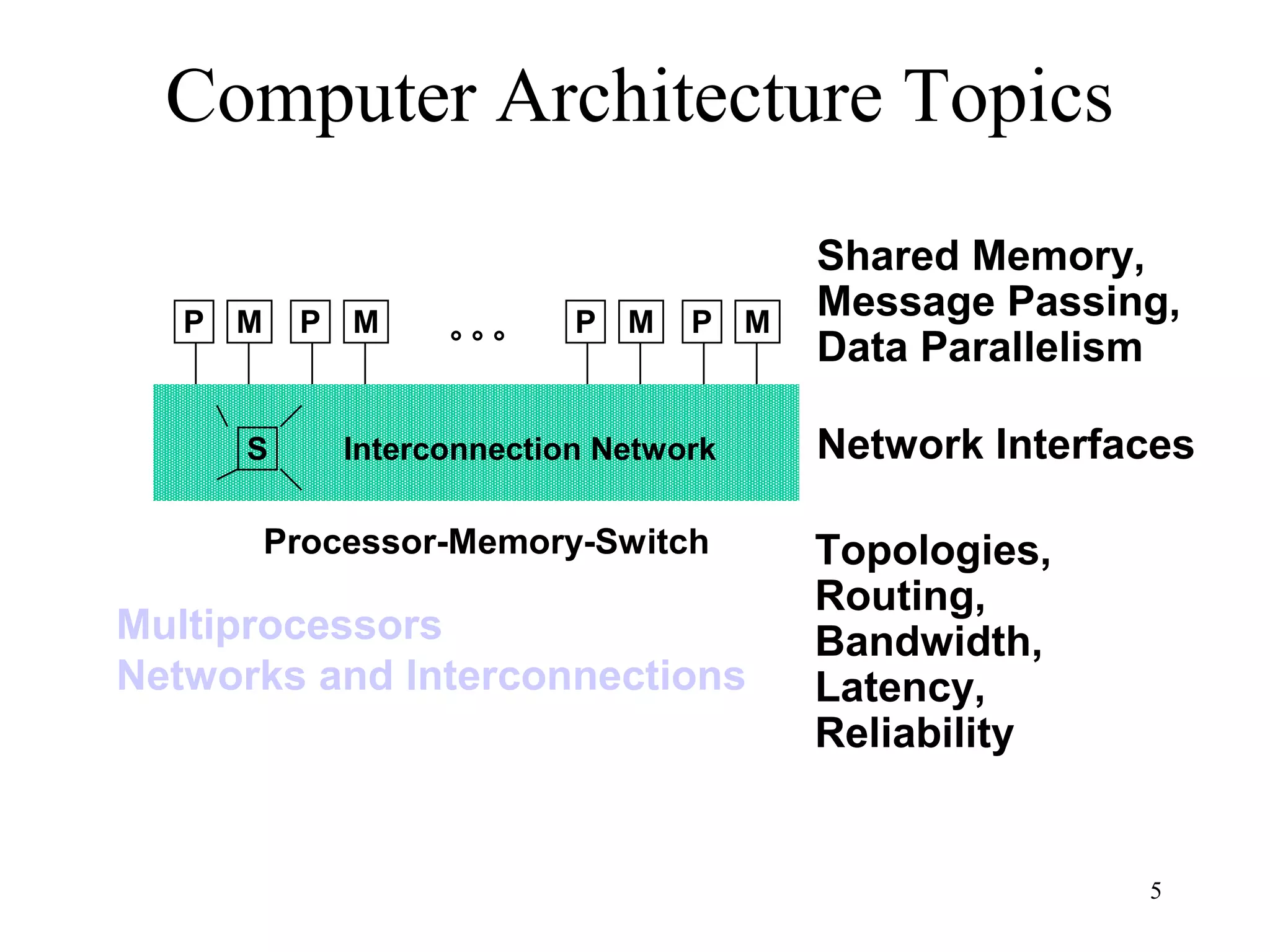
Computer Architecture Topics
M
Interconnection NetworkS
PMPMPMP
° ° °
Topologies,
Routing,
Bandwidth,
Latency,
Reliability
Network Interfaces
Shared Memory,
Message Passing,
Data Parallelism
Processor-Memory-Switch
Multiprocessors
Networks and Interconnections
6
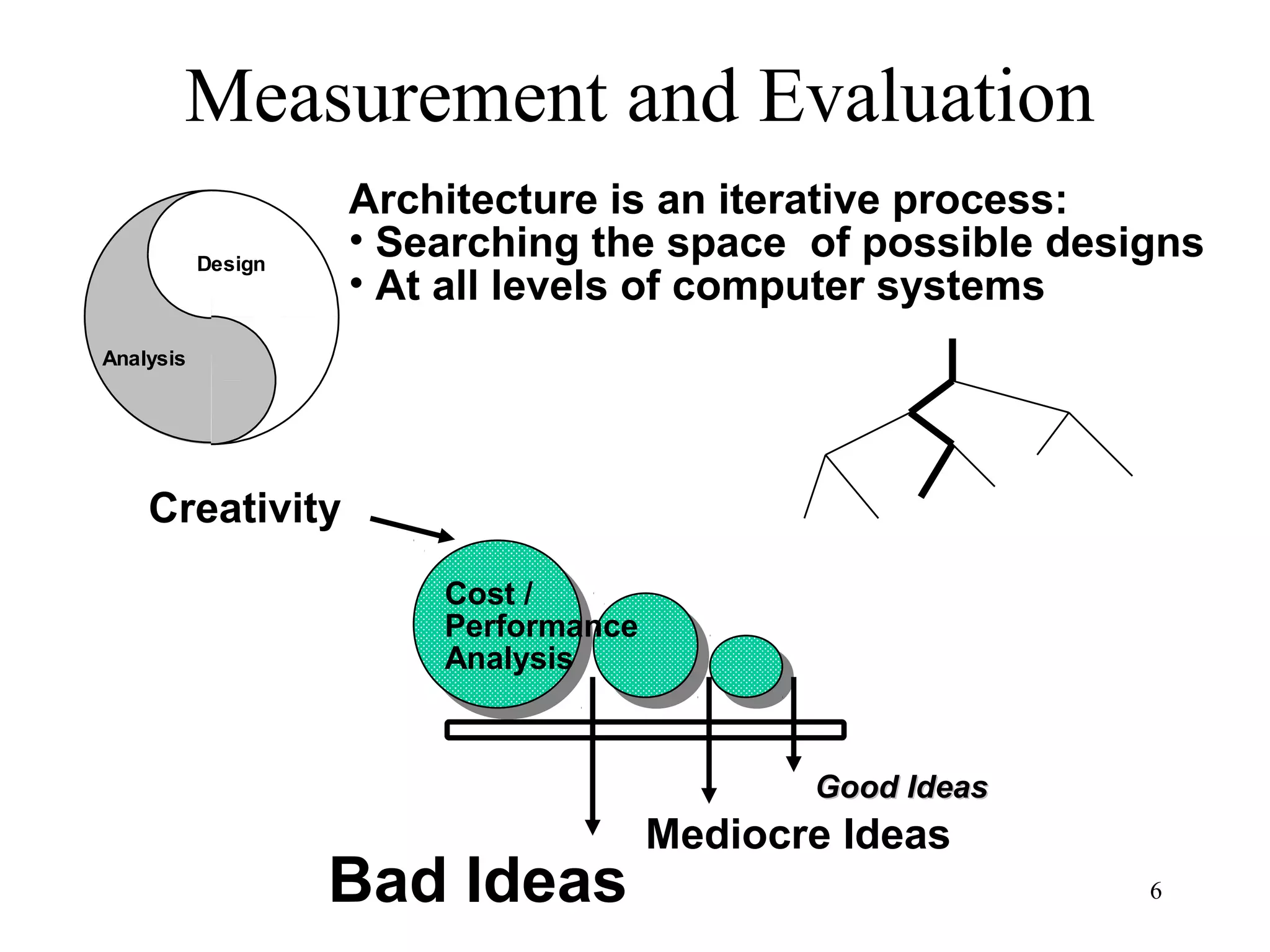
Measurement and Evaluation
Design
Analysis
Architecture is an iterative process:
• Searching the space of possible designs
• At all levels of computer systems
Creativity
Good IdeasGood Ideas
Mediocre Ideas
Bad Ideas
Cost /
Performance
Analysis
7
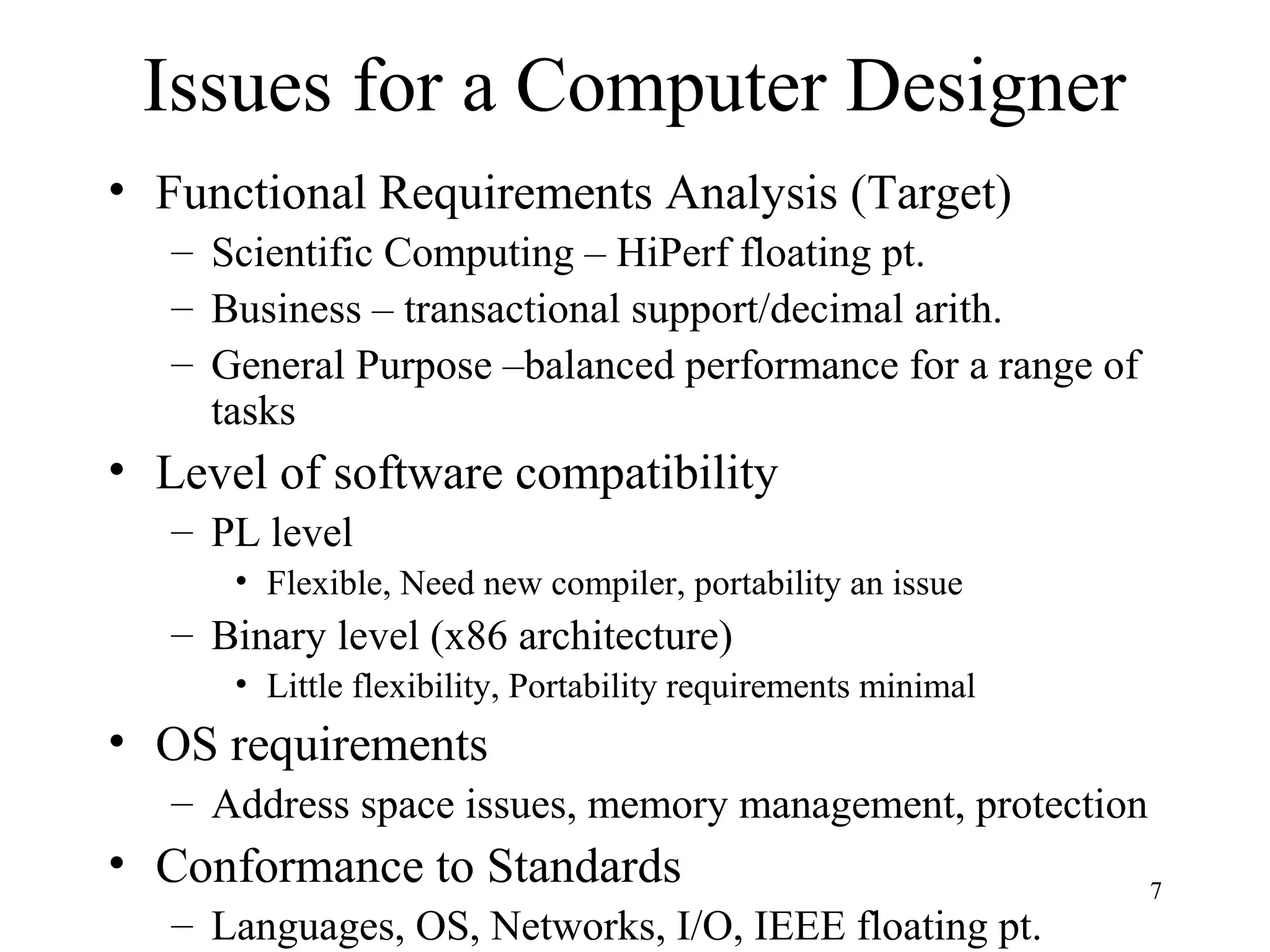
Issues for a Computer Designer
• Functional Requirements Analysis (Target)
– Scientific Computing – HiPerf floating pt.
– Business – transactional support/decimal arith.
– General Purpose –balanced performance for a range of
tasks
• Level of software compatibility
– PL level
• Flexible, Need new compiler, portability an issue
– Binary level (x86 architecture)
• Little flexibility, Portability requirements minimal
• OS requirements
– Address space issues, memory management, protection
• Conformance to Standards
– Languages, OS, Networks, I/O, IEEE floating pt.
8
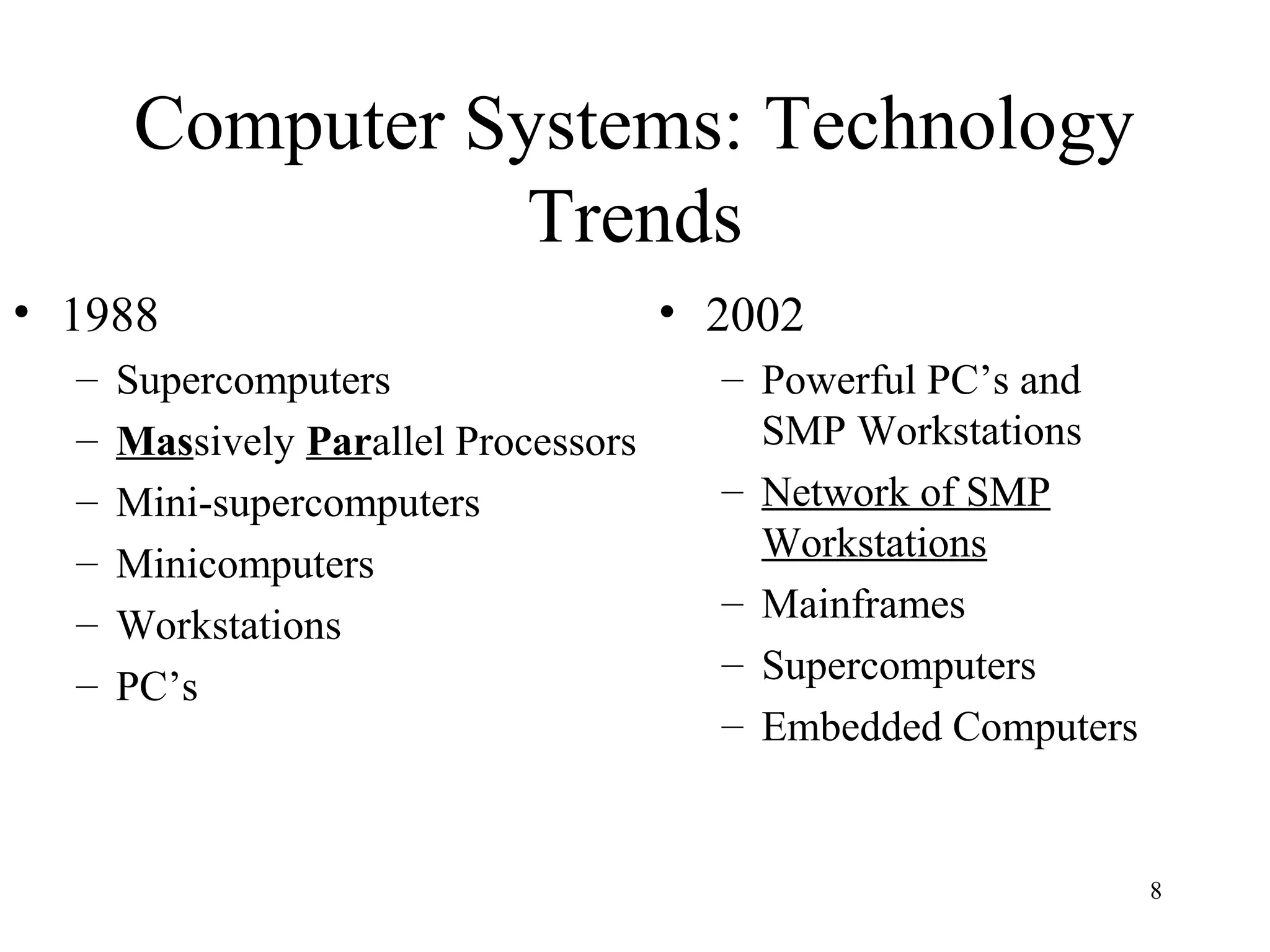
Computer Systems: Technology
Trends
• 1988
– Supercomputers
– Massively Parallel Processors
– Mini-supercomputers
– Minicomputers
– Workstations
– PC’s
• 2002
– Powerful PC’s and
SMP Workstations
– Network of SMP
Workstations
– Mainframes
– Supercomputers
– Embedded Computers
9
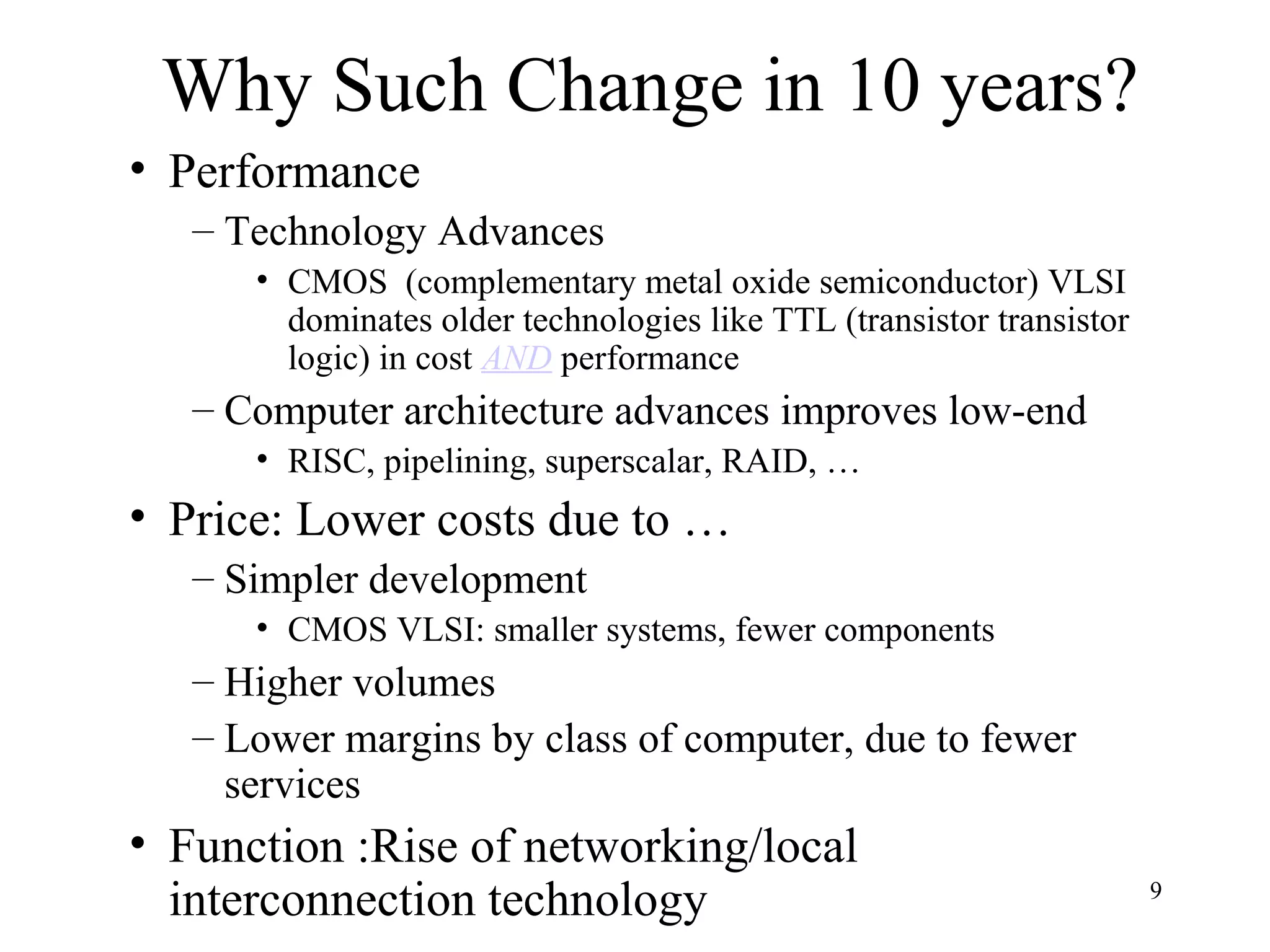
Why Such Change in 10 years?
• Performance
– Technology Advances
• CMOS (complementary metal oxide semiconductor) VLSI
dominates older technologies like TTL (transistor transistor
logic) in cost AND performance
– Computer architecture advances improves low-end
• RISC, pipelining, superscalar, RAID, …
• Price: Lower costs due to …
– Simpler development
• CMOS VLSI: smaller systems, fewer components
– Higher volumes
– Lower margins by class of computer, due to fewer
services
• Function :Rise of networking/local
interconnection technology
10
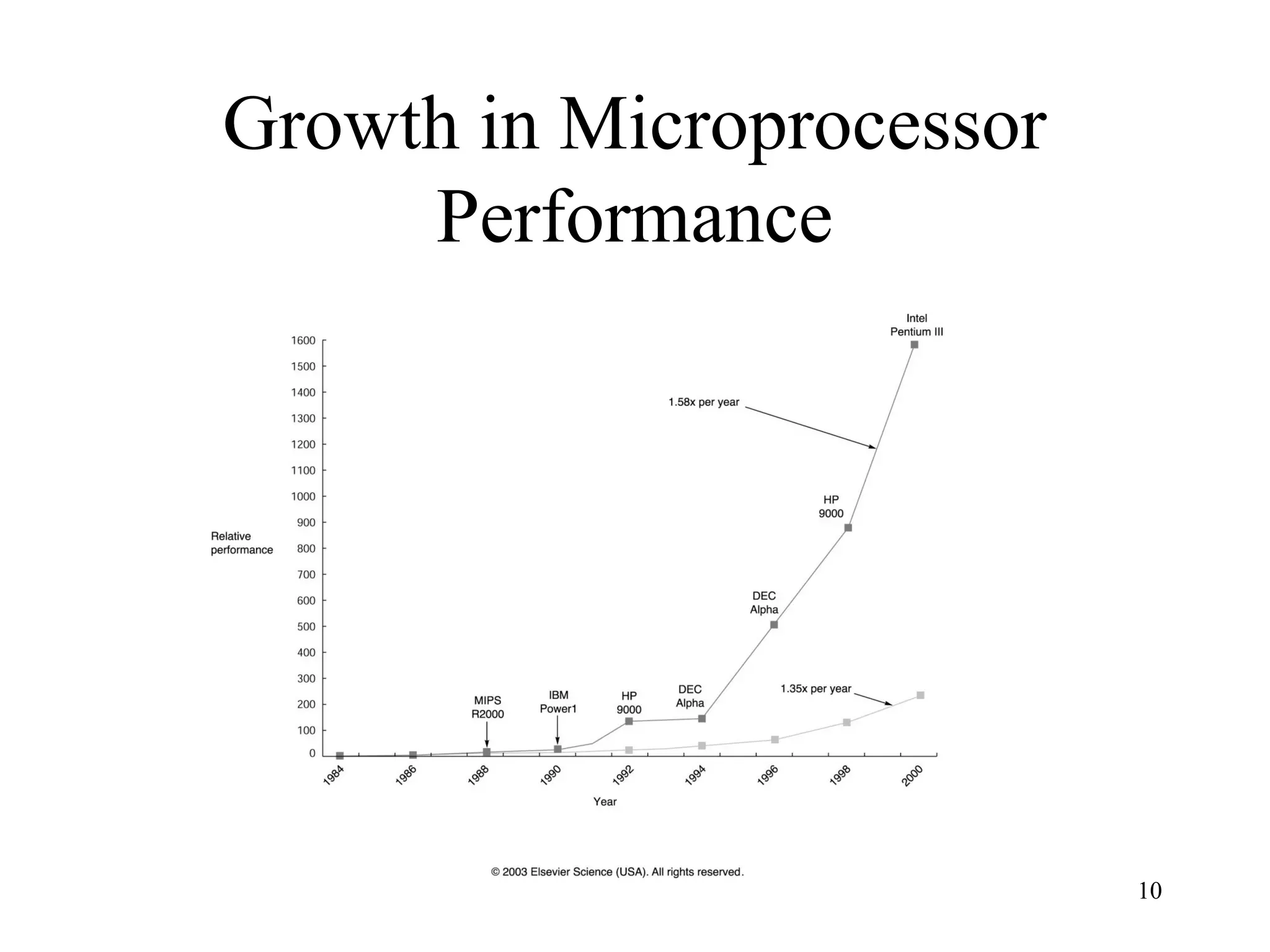
Growth in Microprocessor
Performance
11
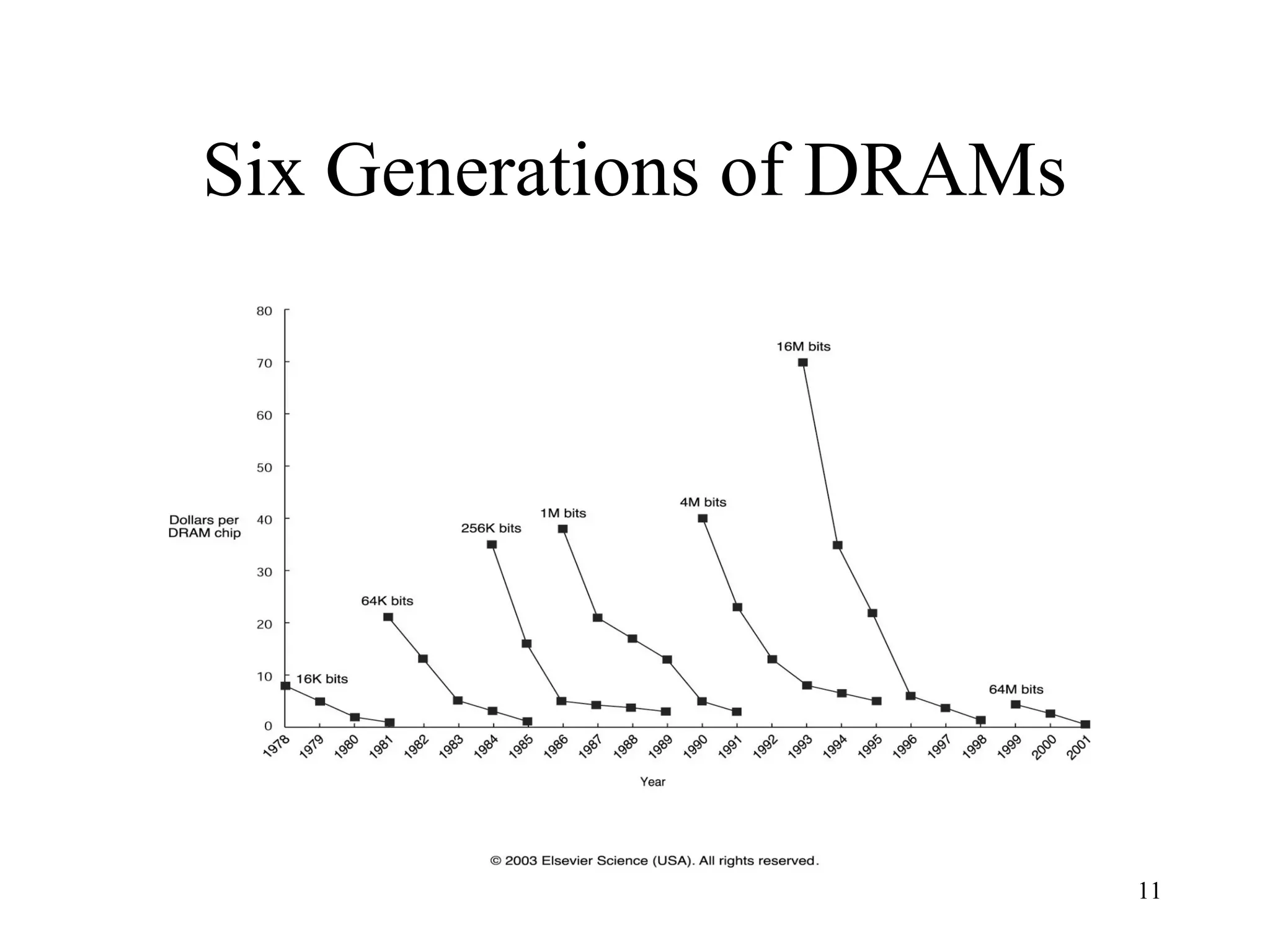
Six Generations of DRAMs
12
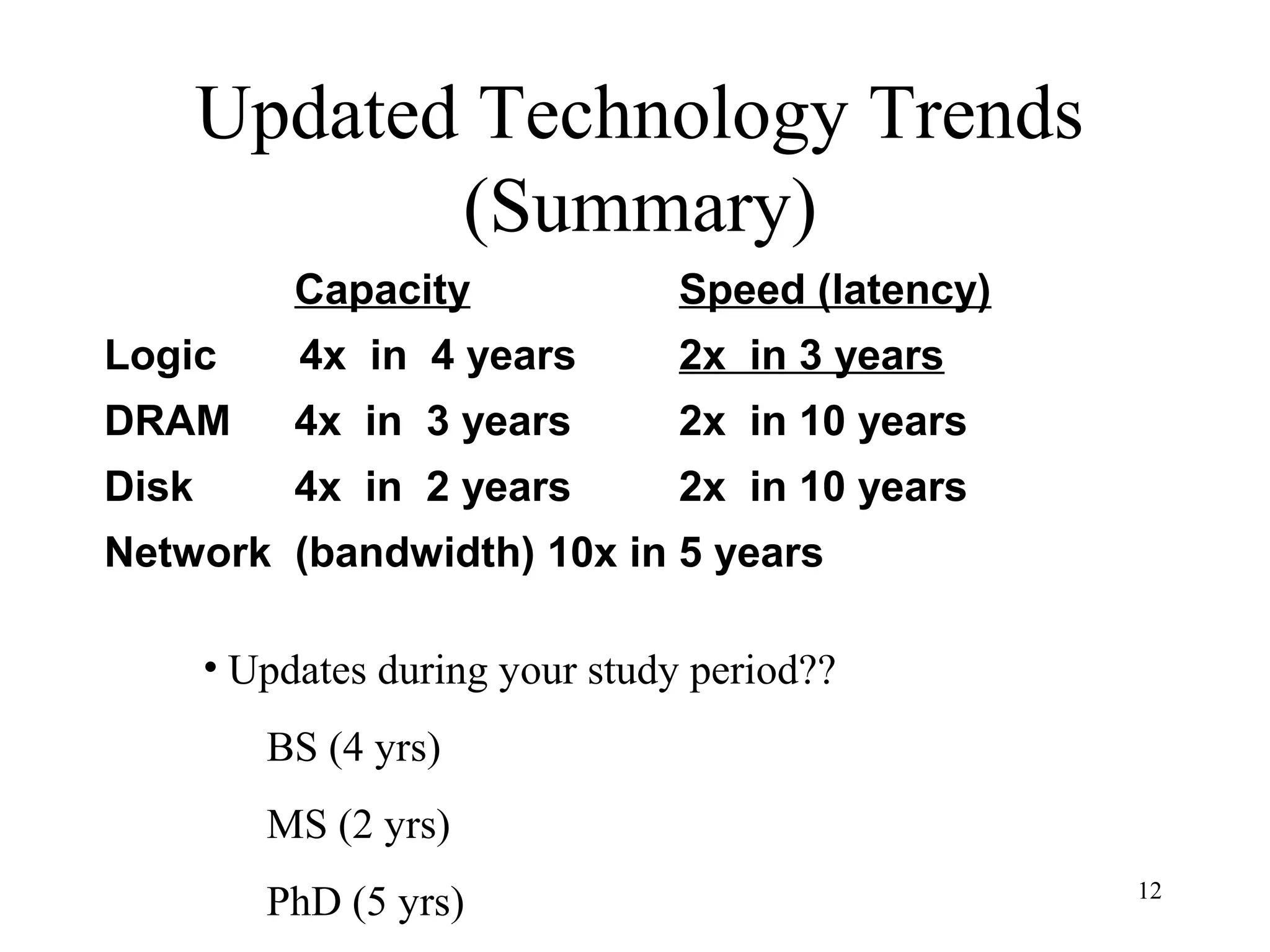
Updated Technology Trends
(Summary)
Capacity Speed (latency)
Logic 4x in 4 years 2x in 3 years
DRAM 4x in 3 years 2x in 10 years
Disk 4x in 2 years 2x in 10 years
Network (bandwidth) 10x in 5 years
• Updates during your study period??
BS (4 yrs)
MS (2 yrs)
PhD (5 yrs)
13
12
Cost of Microprocessors
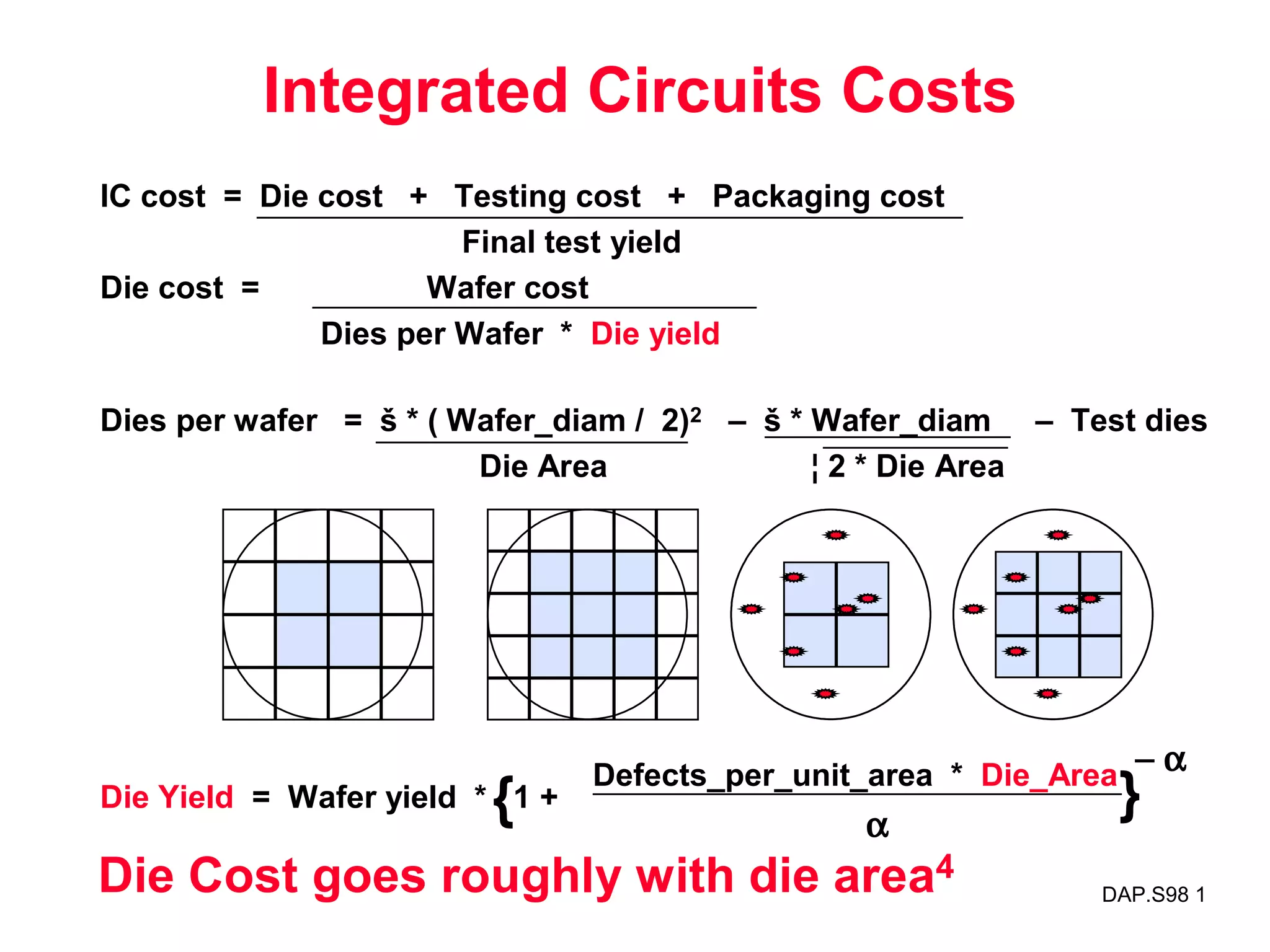
14DAP.S98 1
IC cost = Die cost + Testing cost + Packaging cost
Final test yield
Die cost = Wafer cost
Dies per Wafer * Die yield
Dies per wafer = š * ( Wafer_diam / 2)2 – š * Wafer_diam – Test dies
Die Area ¦ 2 * Die Area
Die Yield = Wafer yield * 1 +
Defects_per_unit_area * Die_Area
α
Integrated Circuits Costs
Die Cost goes roughly with die area4
{
− α
}
15
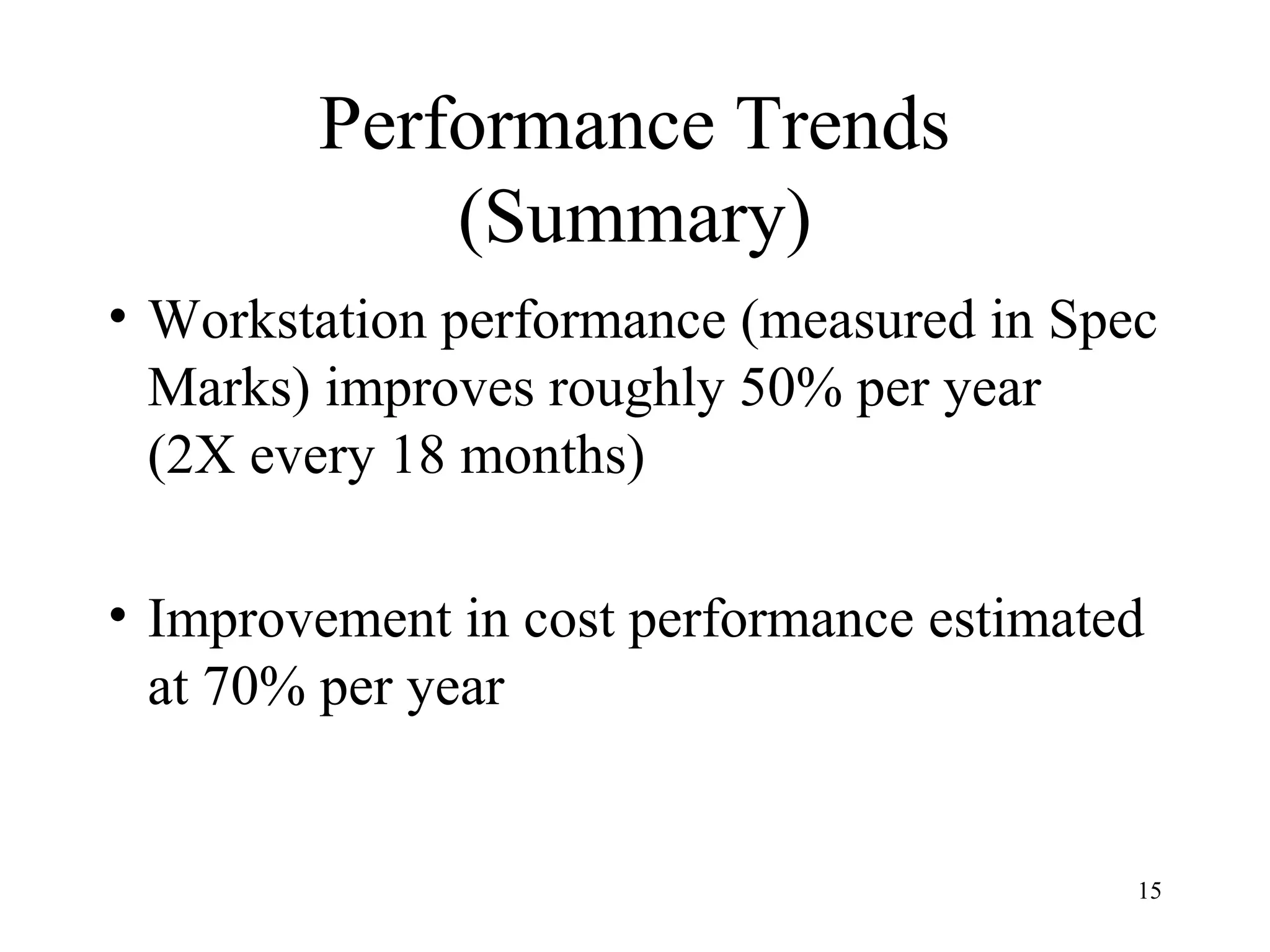
Performance Trends
(Summary)
• Workstation performance (measured in Spec
Marks) improves roughly 50% per year
(2X every 18 months)
• Improvement in cost performance estimated
at 70% per year
16
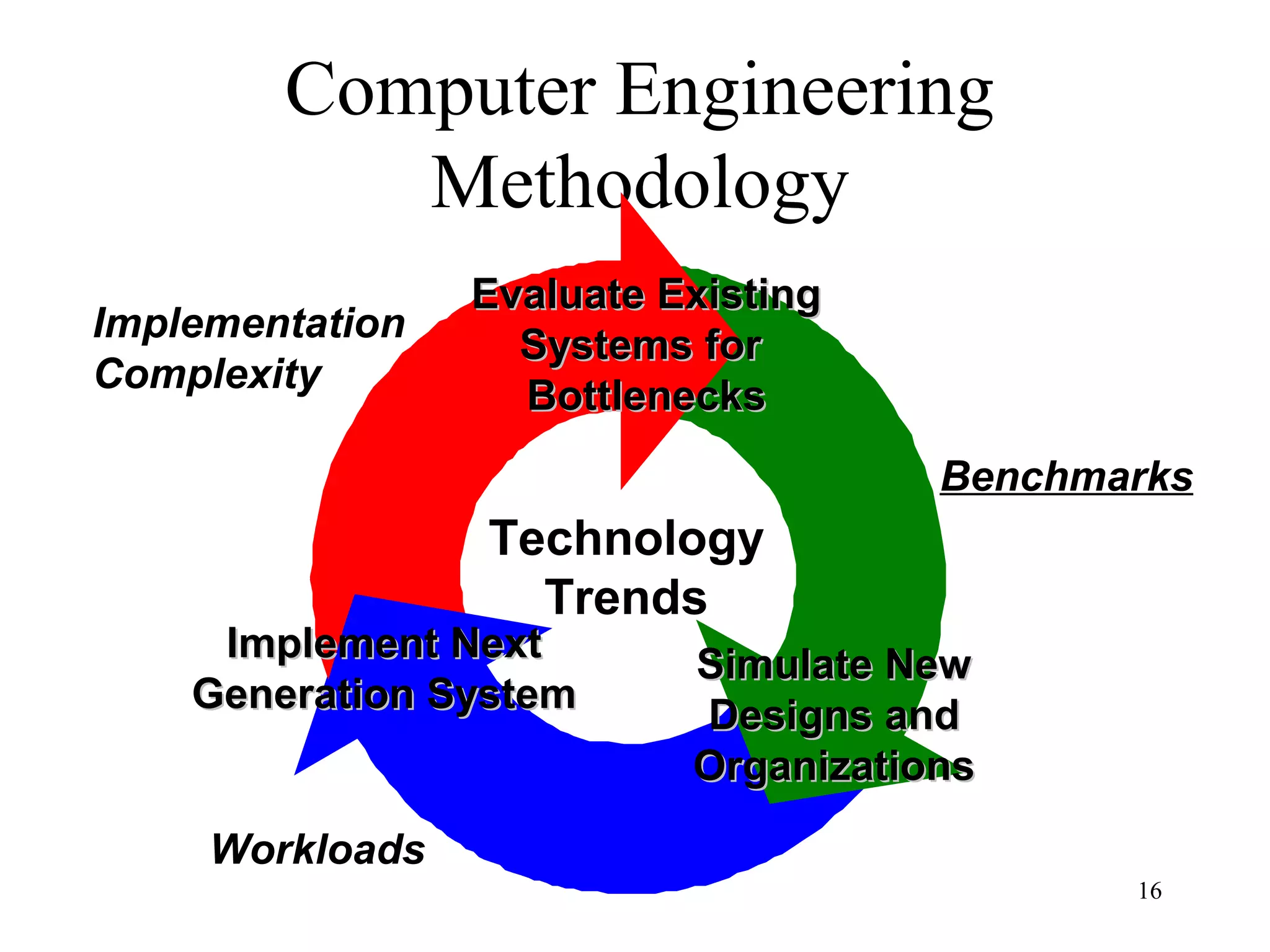
Computer Engineering
Methodology
Evaluate ExistingEvaluate Existing
Systems forSystems for
BottlenecksBottlenecks
Simulate NewSimulate New
Designs andDesigns and
OrganizationsOrganizations
Implement NextImplement Next
Generation SystemGeneration System
Technology
Trends
Benchmarks
Workloads
Implementation
Complexity
17
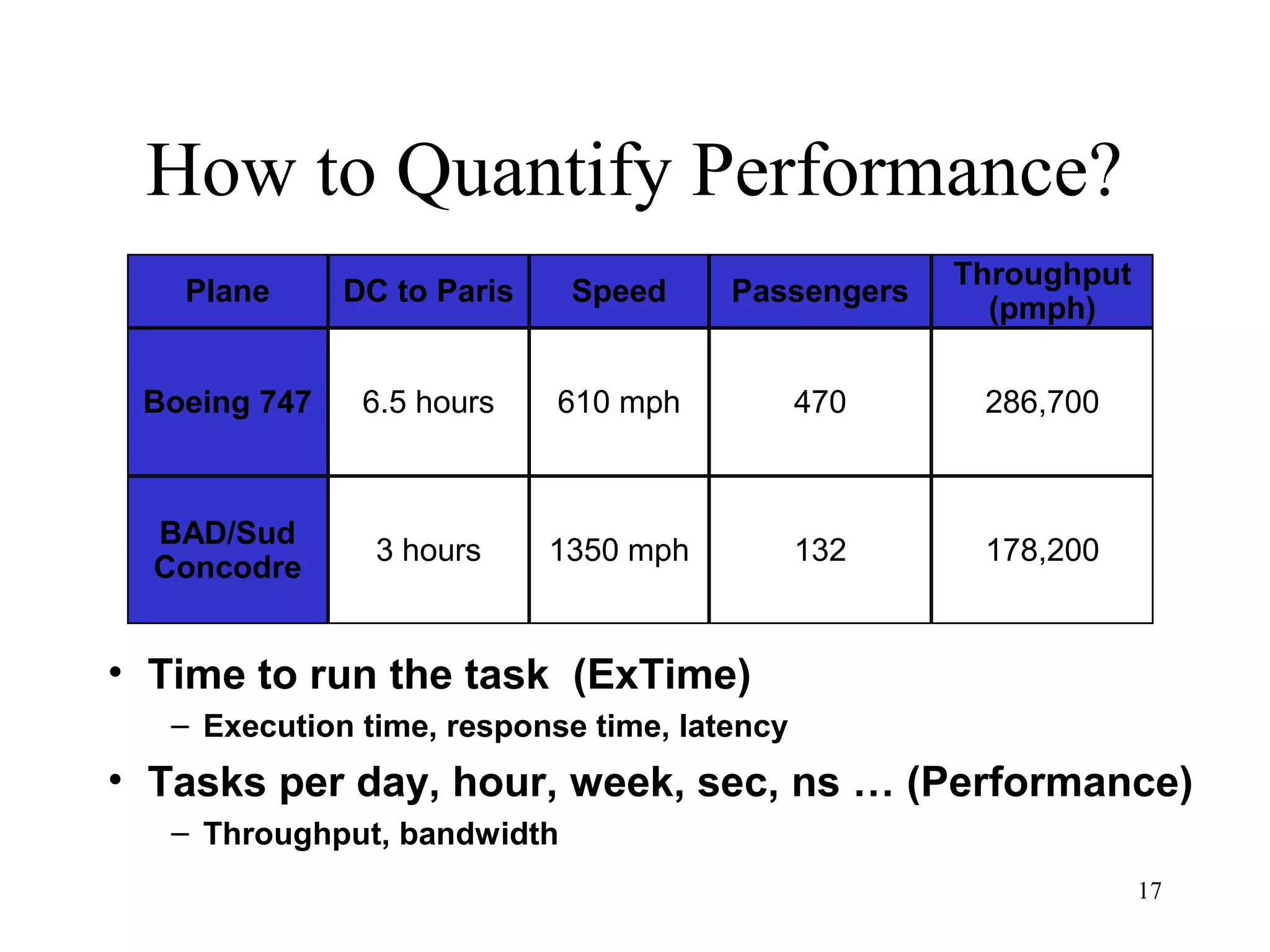
How to Quantify Performance?
• Time to run the task (ExTime)
– Execution time, response time, latency
• Tasks per day, hour, week, sec, ns … (Performance)
– Throughput, bandwidth
Plane
Boeing 747
BAD/Sud
Concodre
Speed
610 mph
1350 mph
DC to Paris
6.5 hours
3 hours
Passengers
470
132
Throughput
(pmph)
286,700
178,200
18
The Bottom Line:
Performance and Cost or Cost
and Performance?
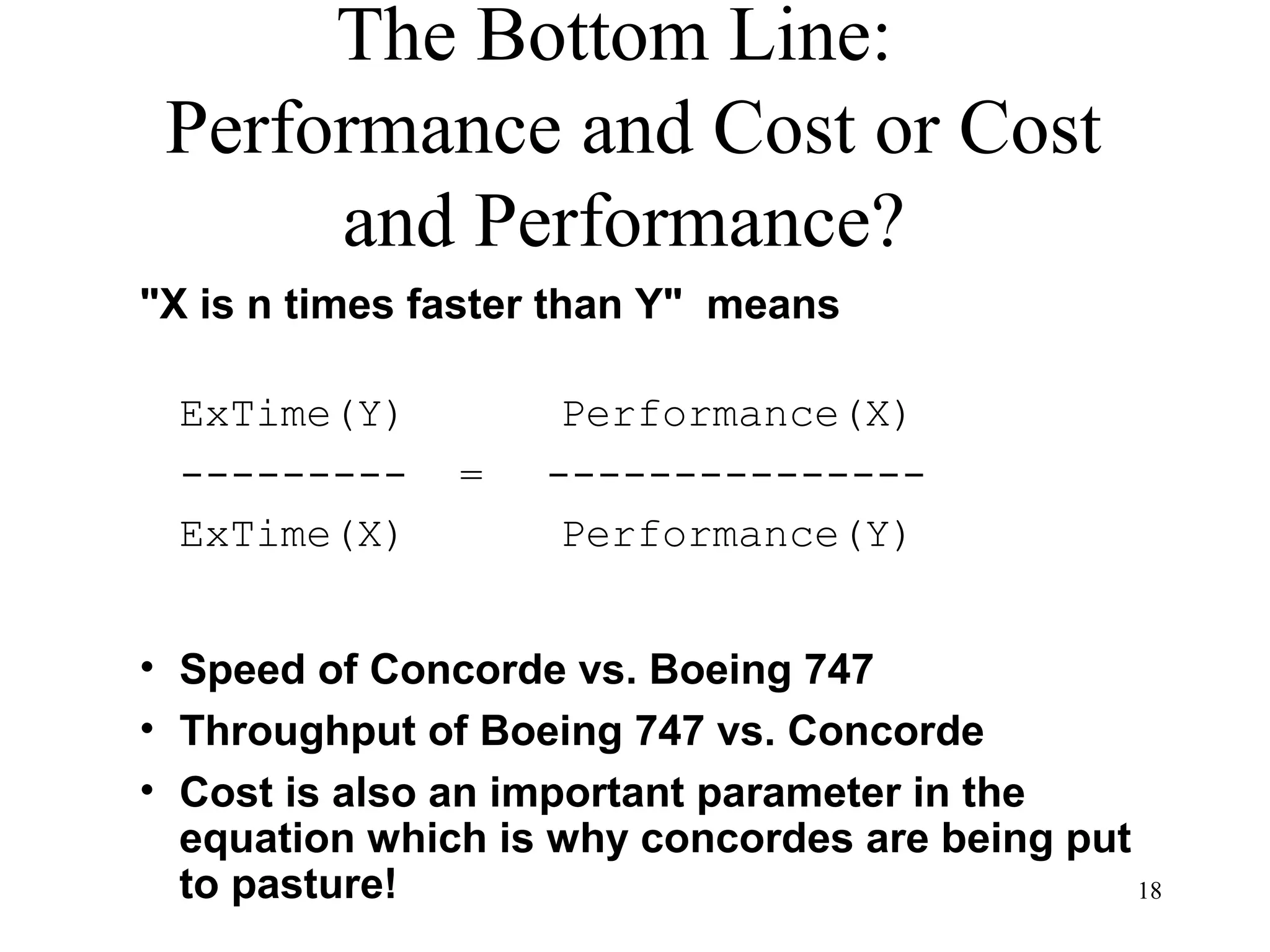
"X is n times faster than Y" means
ExTime(Y) Performance(X)
--------- = ---------------
ExTime(X) Performance(Y)
• Speed of Concorde vs. Boeing 747
• Throughput of Boeing 747 vs. Concorde
• Cost is also an important parameter in the
equation which is why concordes are being put
to pasture!
19
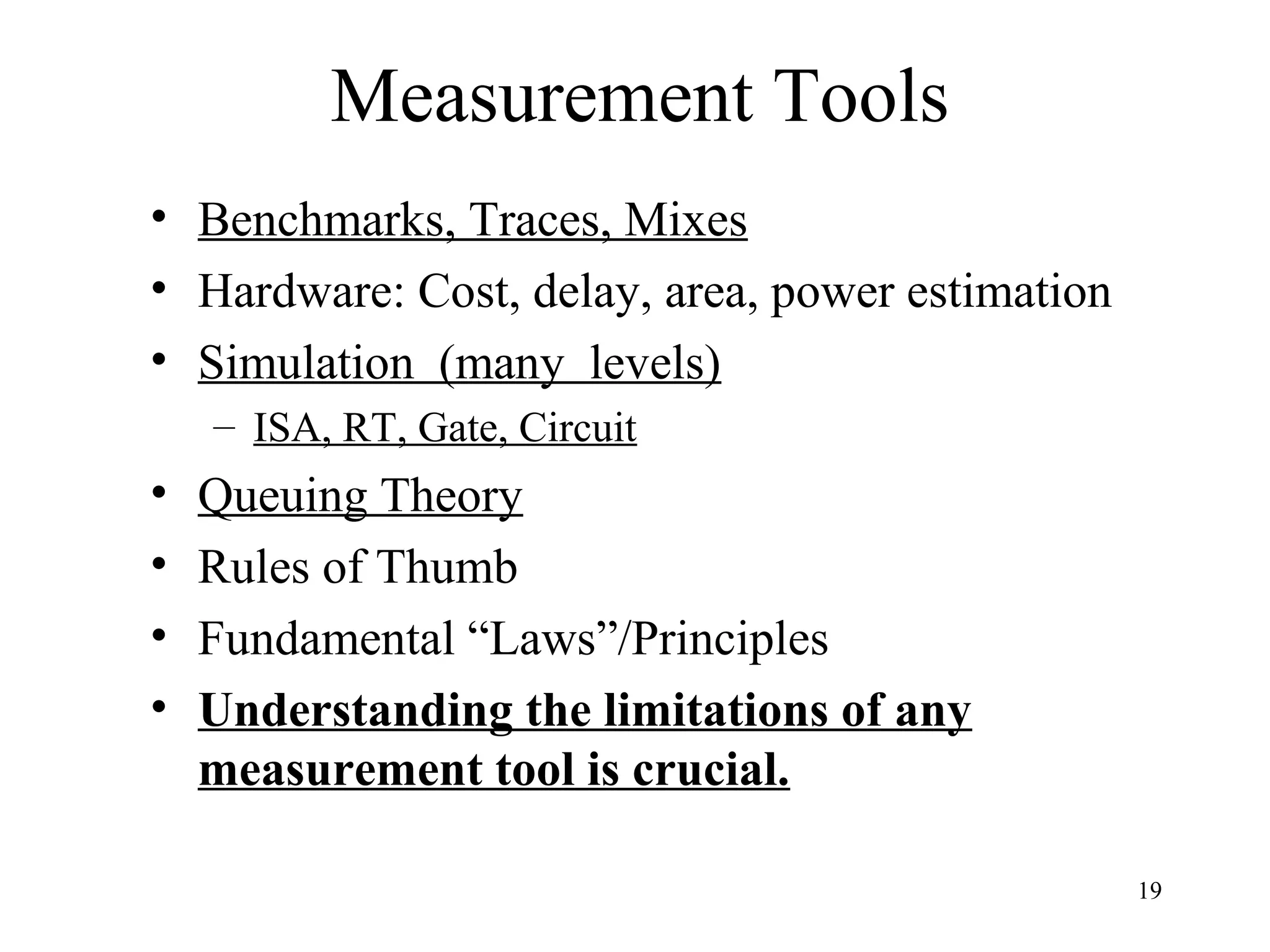
Measurement Tools
• Benchmarks, Traces, Mixes
• Hardware: Cost, delay, area, power estimation
• Simulation (many levels)
– ISA, RT, Gate, Circuit
• Queuing Theory
• Rules of Thumb
• Fundamental “Laws”/Principles
• Understanding the limitations of any
measurement tool is crucial.
20
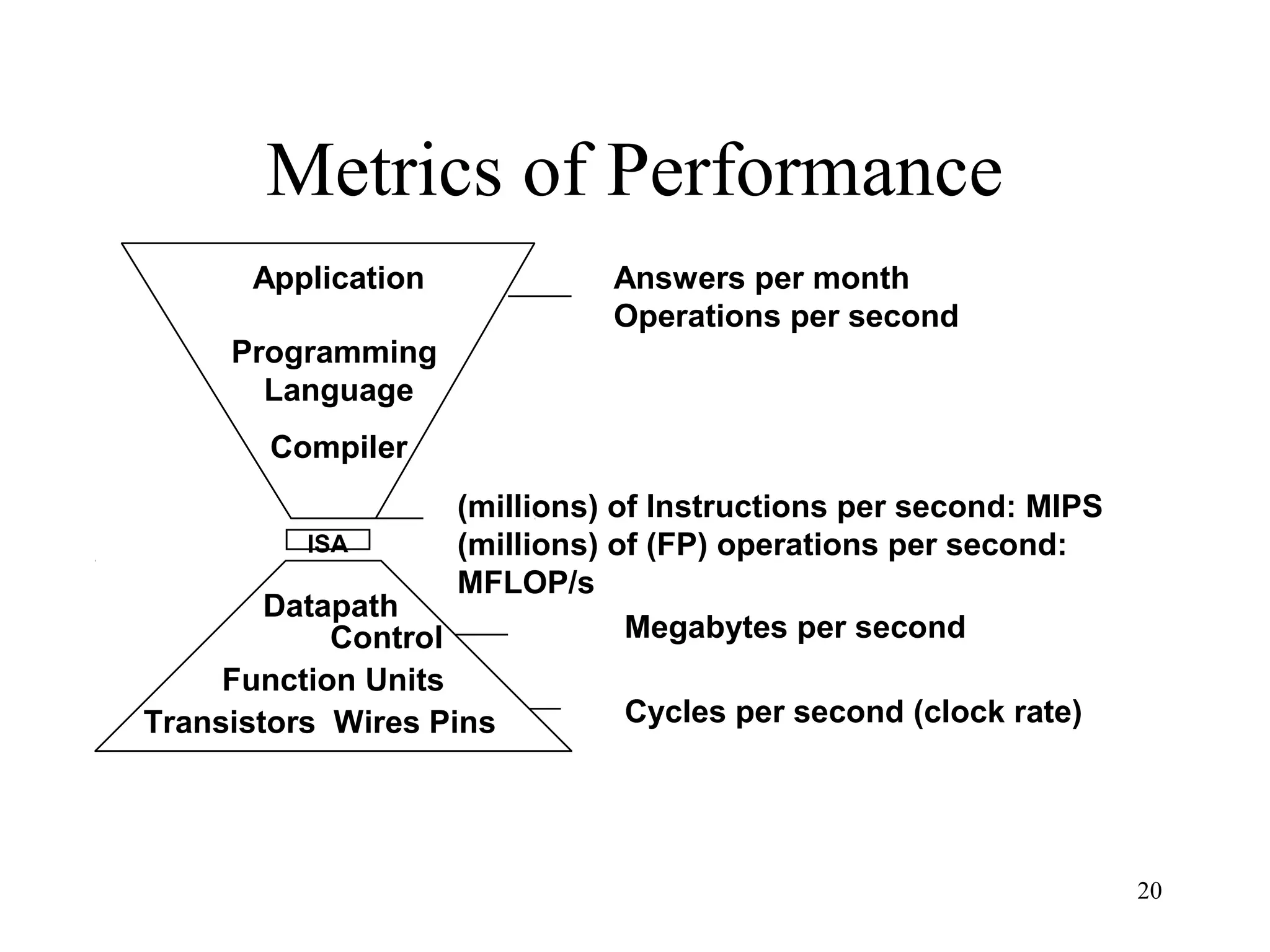
Metrics of Performance
Compiler
Programming
Language
Application
Datapath
Control
Transistors Wires Pins
ISA
Function Units
(millions) of Instructions per second: MIPS
(millions) of (FP) operations per second:
MFLOP/s
Cycles per second (clock rate)
Megabytes per second
Answers per month
Operations per second
21
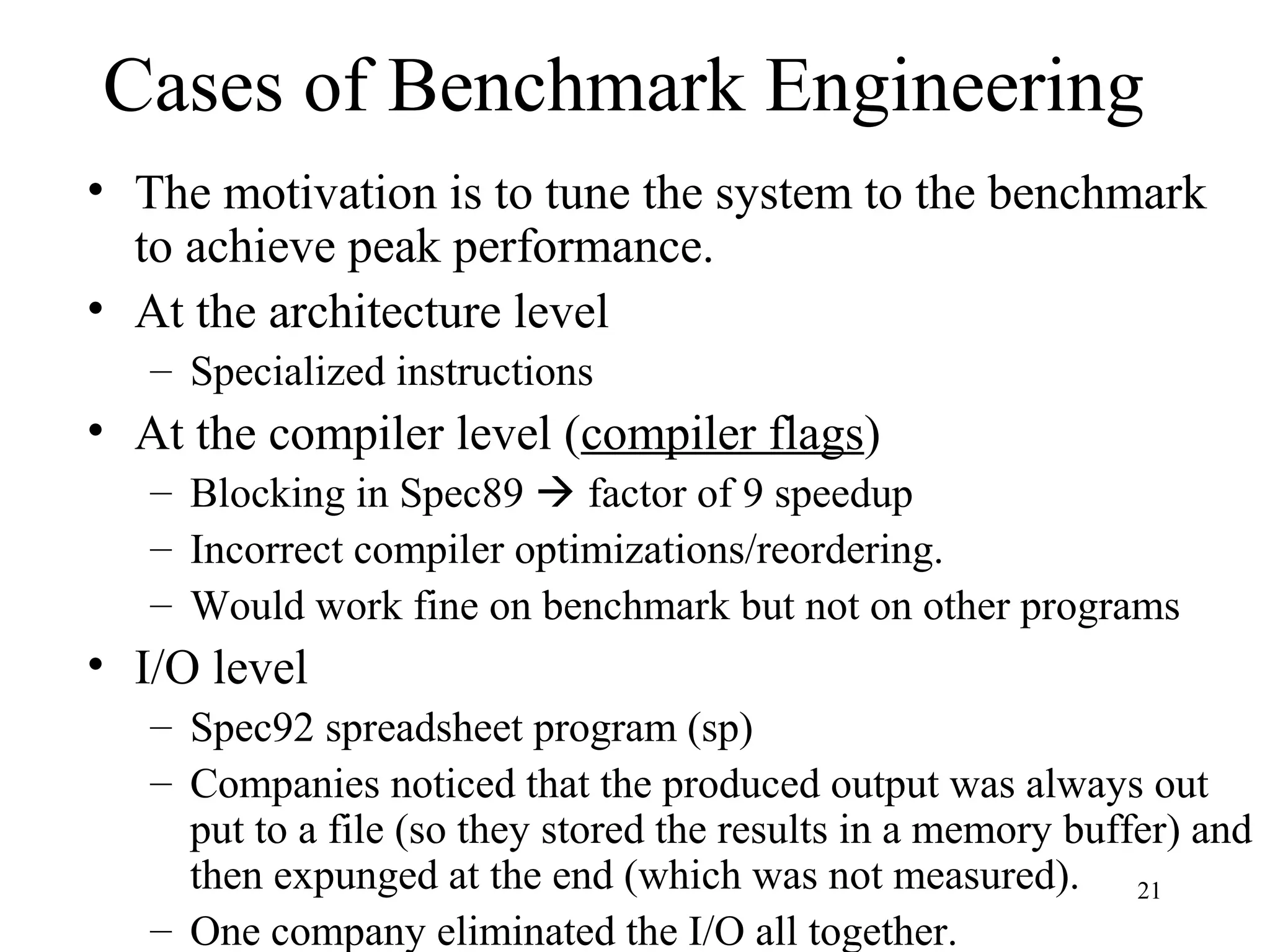
Cases of Benchmark Engineering
• The motivation is to tune the system to the benchmark
to achieve peak performance.
• At the architecture level
– Specialized instructions
• At the compiler level (compiler flags)
– Blocking in Spec89  factor of 9 speedup
– Incorrect compiler optimizations/reordering.
– Would work fine on benchmark but not on other programs
• I/O level
– Spec92 spreadsheet program (sp)
– Companies noticed that the produced output was always out
put to a file (so they stored the results in a memory buffer) and
then expunged at the end (which was not measured).
– One company eliminated the I/O all together.
22
After putting in a blazing performance on the benchmark test,
Sun issued a glowing press release claiming that it had
outperformed Windows NT systems on the test.
Pendragon president Ivan Phillips cried foul, saying the results
weren't representative of real-world Java performance and that
Sun had gone so far as to duplicate the test's code within Sun's
Just-In-Time compiler. That's cheating, says Phillips, who claims
that benchmark tests and real-world applications aren't
the same thing.
Did Sun issue a denial or a mea culpa? Initially, Sun neither
denied optimizing for the benchmark test nor apologized for
it. "If the test results are not representative of real-world Java
applications, then that's a problem with the benchmark,"
Sun's Brian Croll said.
After taking a beating in the press, though, Sun retreated and
issued an apology for the optimization.[Excerpted from PC Online 1997]
23
Issues with Benchmark
Engineering
• Motivated by the bottom dollar, good
performance on classic suites  more
customers, better sales.
• Benchmark Engineering  Limits the
longevity of benchmark suites
• Technology and Applications Limits the
longevity of benchmark suites.
24
SPEC: System Performance
Evaluation Cooperative
• First Round 1989
– 10 programs yielding a single number (“SPECmarks”)
• Second Round 1992
– SPECInt92 (6 integer programs) and SPECfp92 (14
floating point programs)
• Compiler Flags unlimited. March 93
• new set of programs: SPECint95 (8 integer programs) and
SPECfp95 (10 floating point)
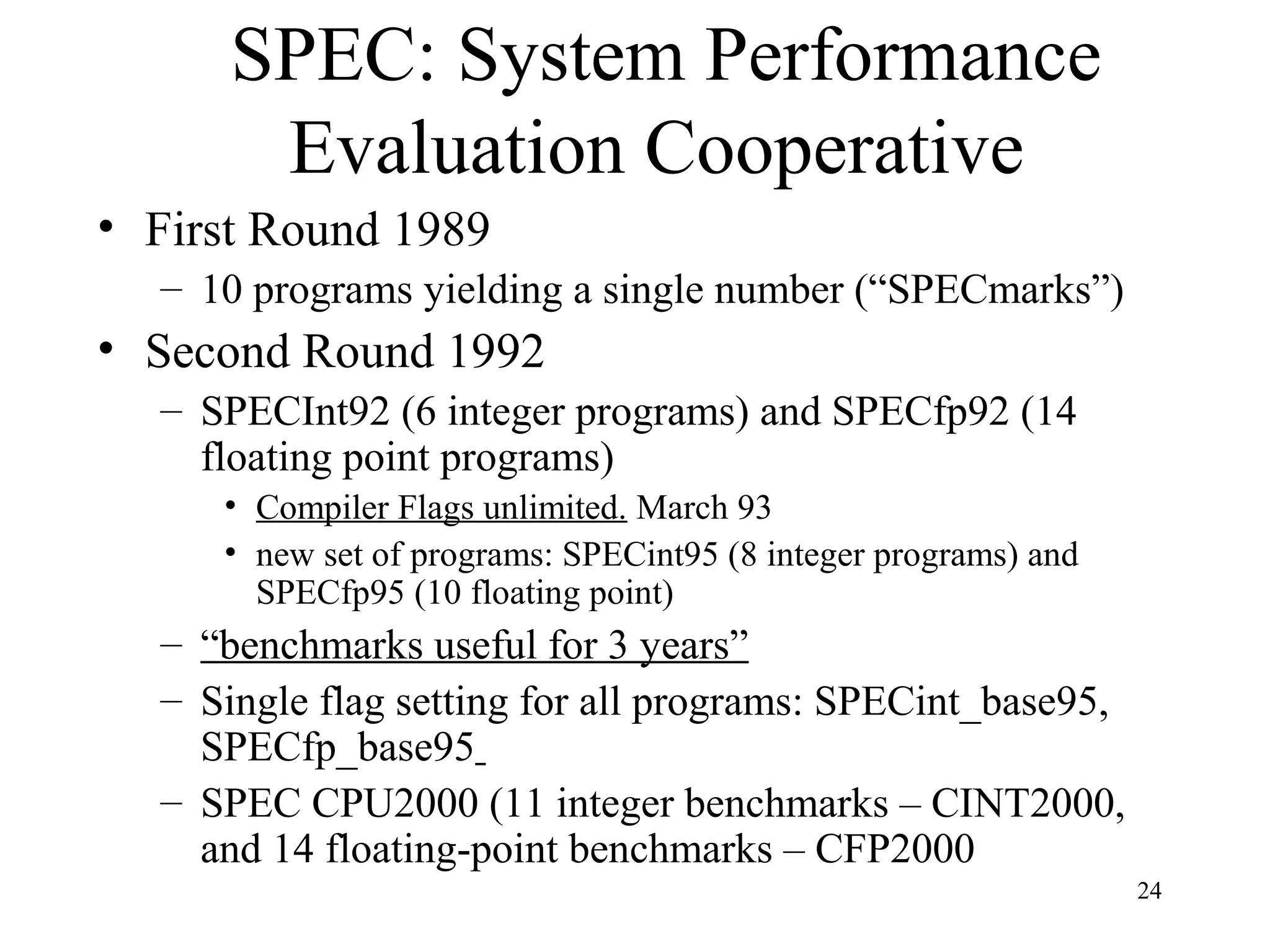
– “benchmarks useful for 3 years”
– Single flag setting for all programs: SPECint_base95,
SPECfp_base95
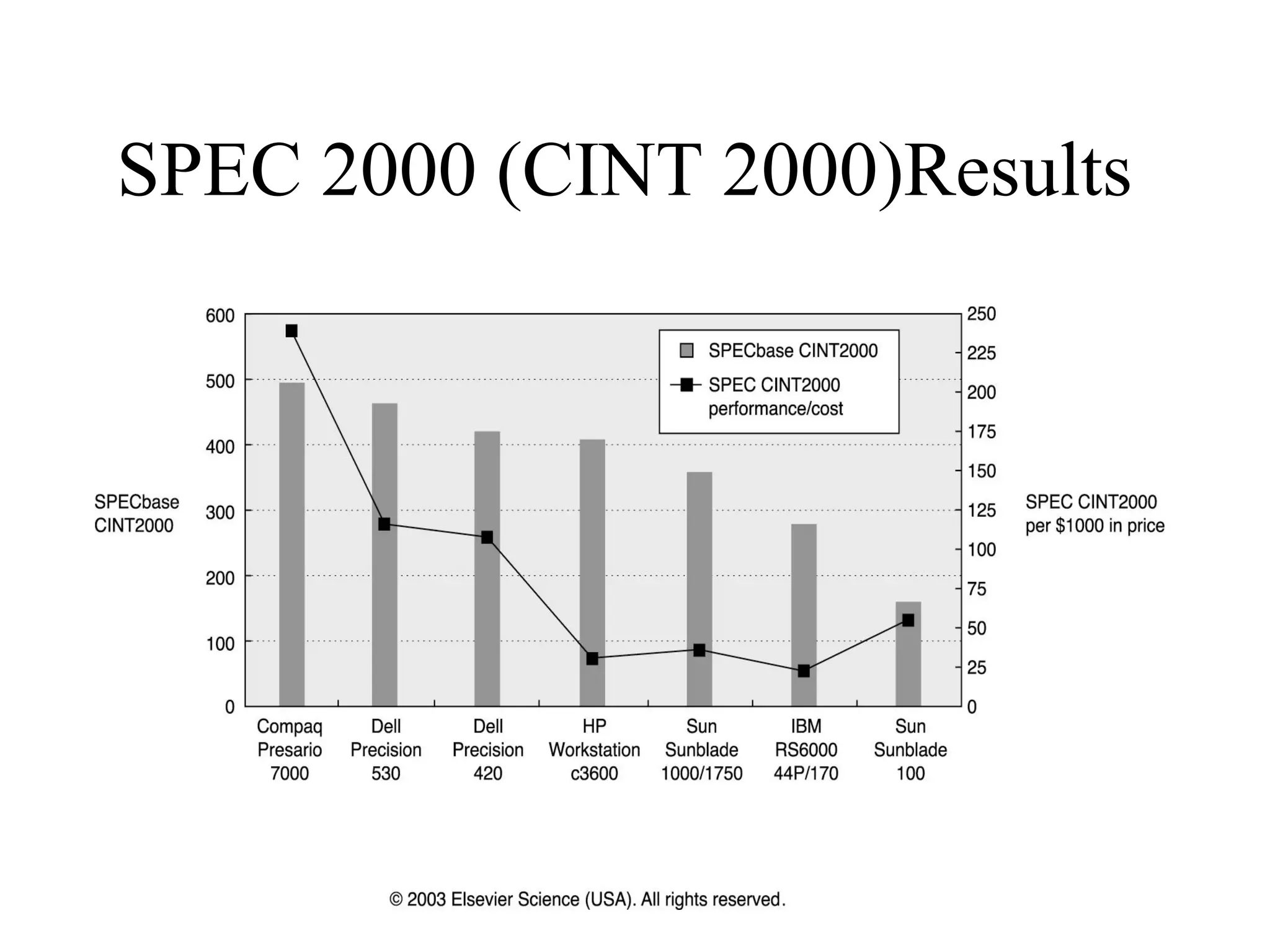
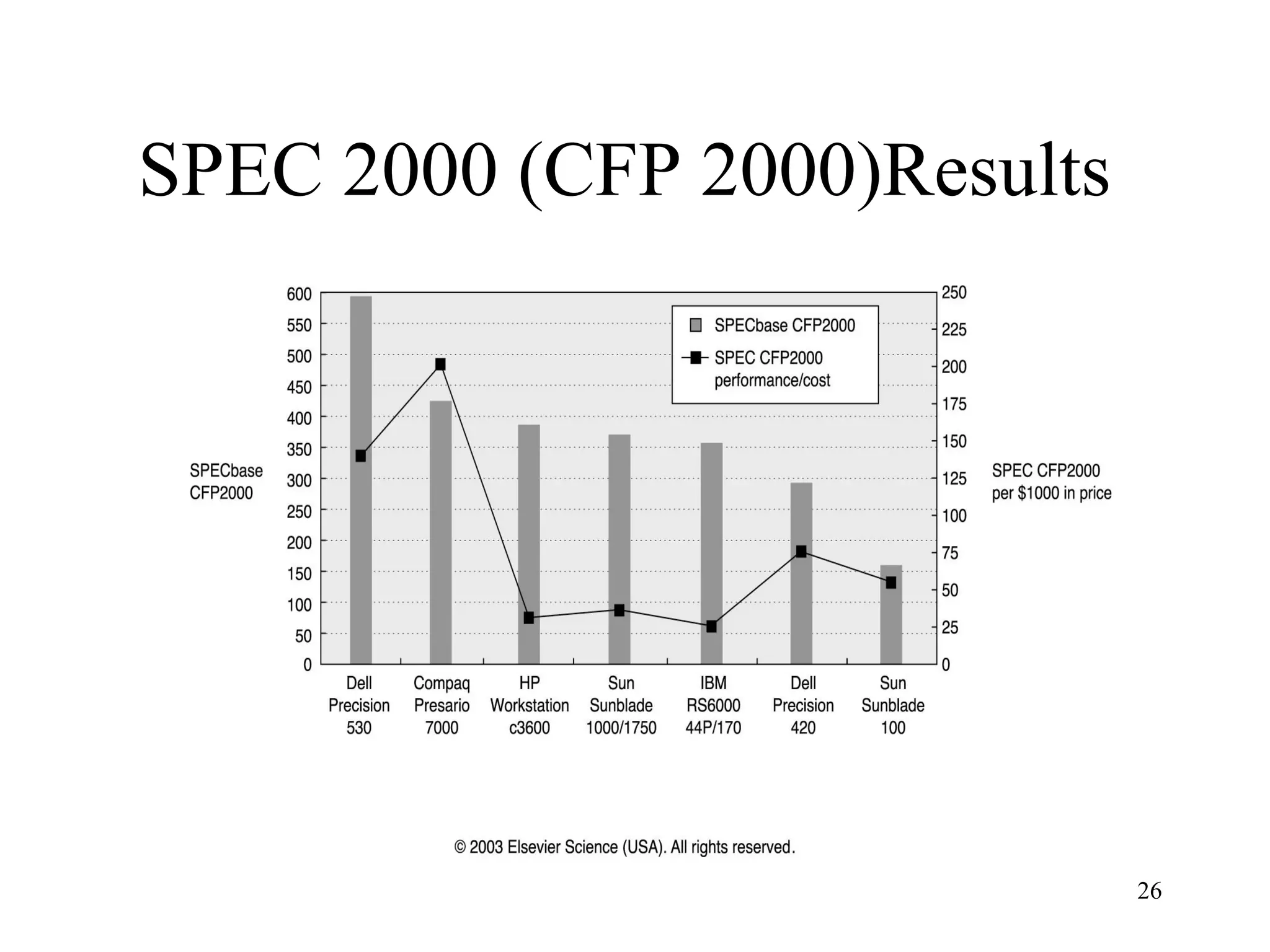
– SPEC CPU2000 (11 integer benchmarks – CINT2000,
and 14 floating-point benchmarks – CFP2000
25
SPEC 2000 (CINT 2000)Results
26
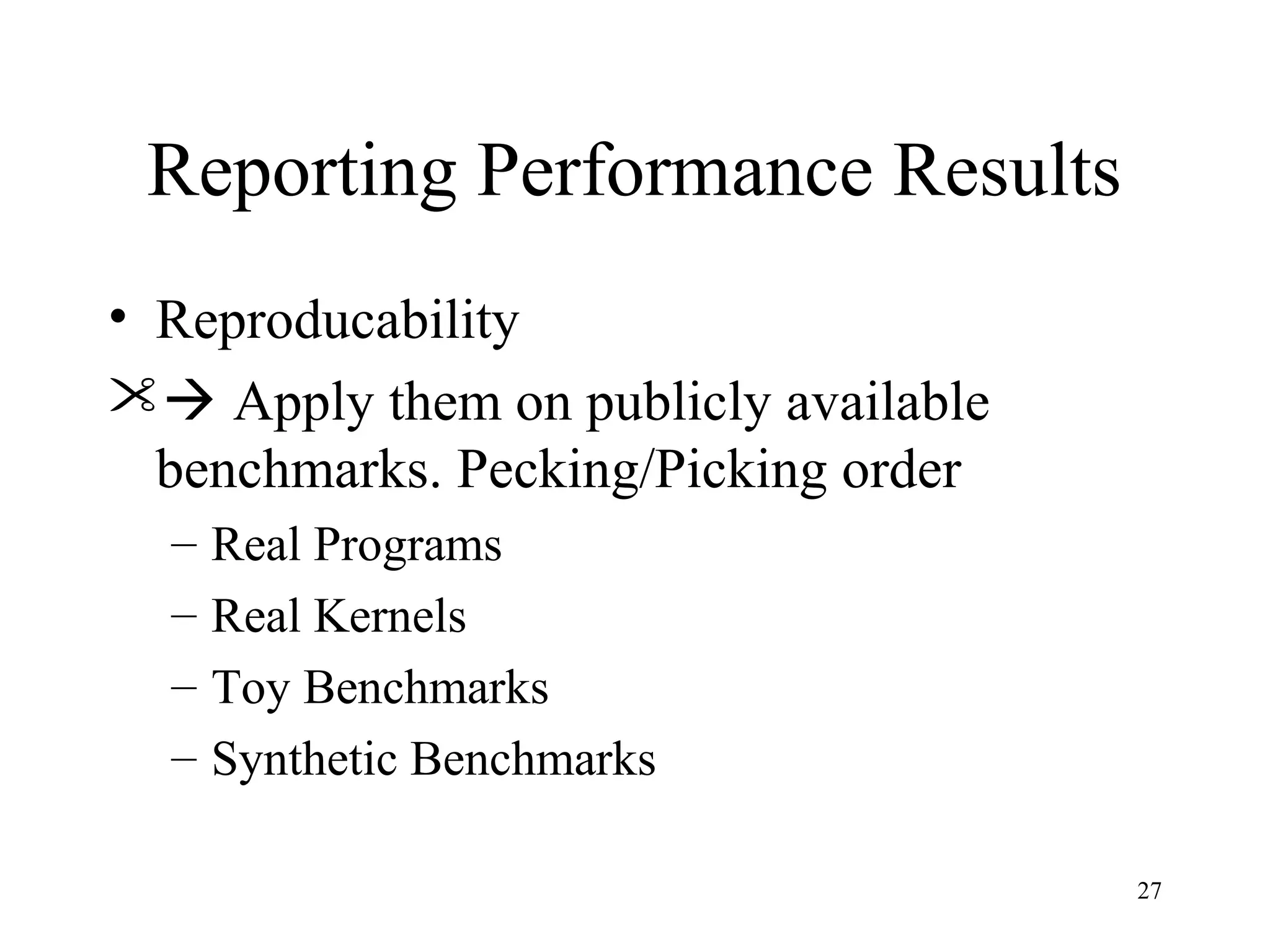
SPEC 2000 (CFP 2000)Results
27
Reporting Performance Results
• Reproducability
 Apply them on publicly available
benchmarks. Pecking/Picking order
– Real Programs
– Real Kernels
– Toy Benchmarks
– Synthetic Benchmarks
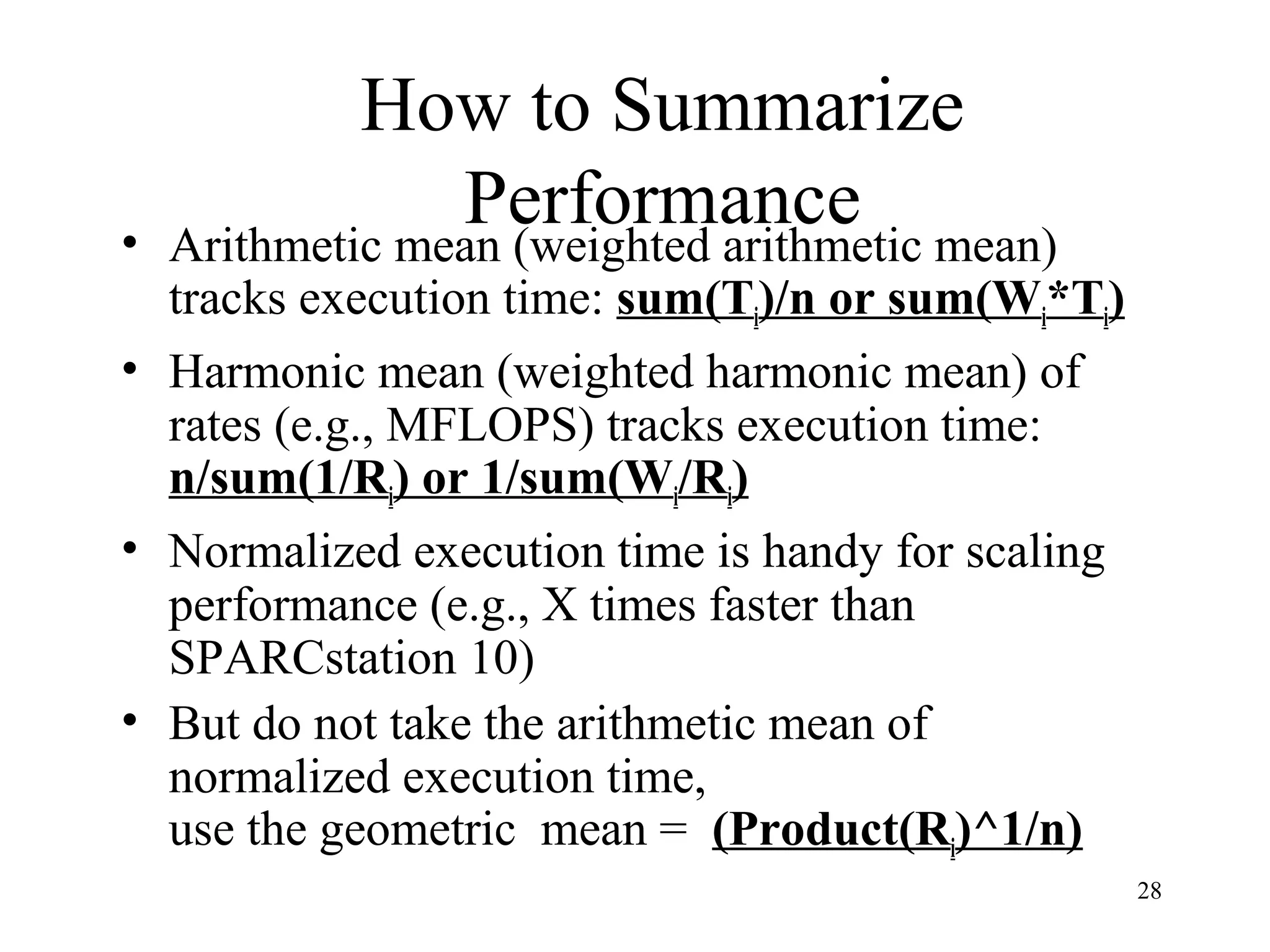
28
How to Summarize
Performance• Arithmetic mean (weighted arithmetic mean)
tracks execution time: sum(Ti)/n or sum(Wi*Ti)
• Harmonic mean (weighted harmonic mean) of
rates (e.g., MFLOPS) tracks execution time:
n/sum(1/Ri) or 1/sum(Wi/Ri)
• Normalized execution time is handy for scaling
performance (e.g., X times faster than
SPARCstation 10)
• But do not take the arithmetic mean of
normalized execution time,
use the geometric mean = (Product(Ri)^1/n)
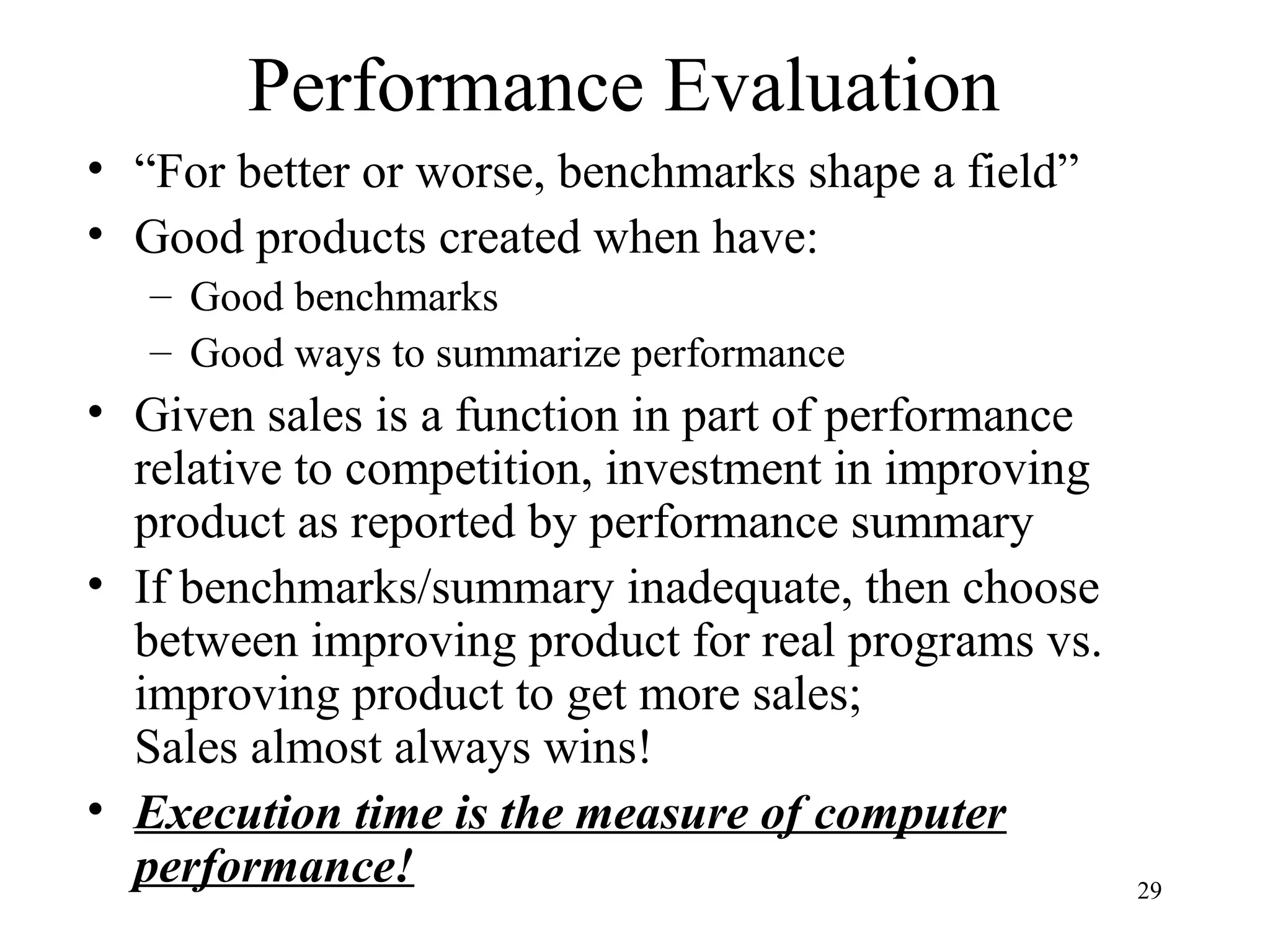
29
Performance Evaluation
• “For better or worse, benchmarks shape a field”
• Good products created when have:
– Good benchmarks
– Good ways to summarize performance
• Given sales is a function in part of performance
relative to competition, investment in improving
product as reported by performance summary
• If benchmarks/summary inadequate, then choose
between improving product for real programs vs.
improving product to get more sales;
Sales almost always wins!
• Execution time is the measure of computer
performance!
30
Simulations
• When are simulations useful?
• What are its limitations, I.e. what real world
phenomenon does it not account for?
• The larger the simulation trace, the less
tractable the post-processing analysis.
31
Queueing Theory
• What are the distributions of arrival rates
and values for other parameters?
• Are they realistic?
• What happens when the parameters or
distributions are changed?
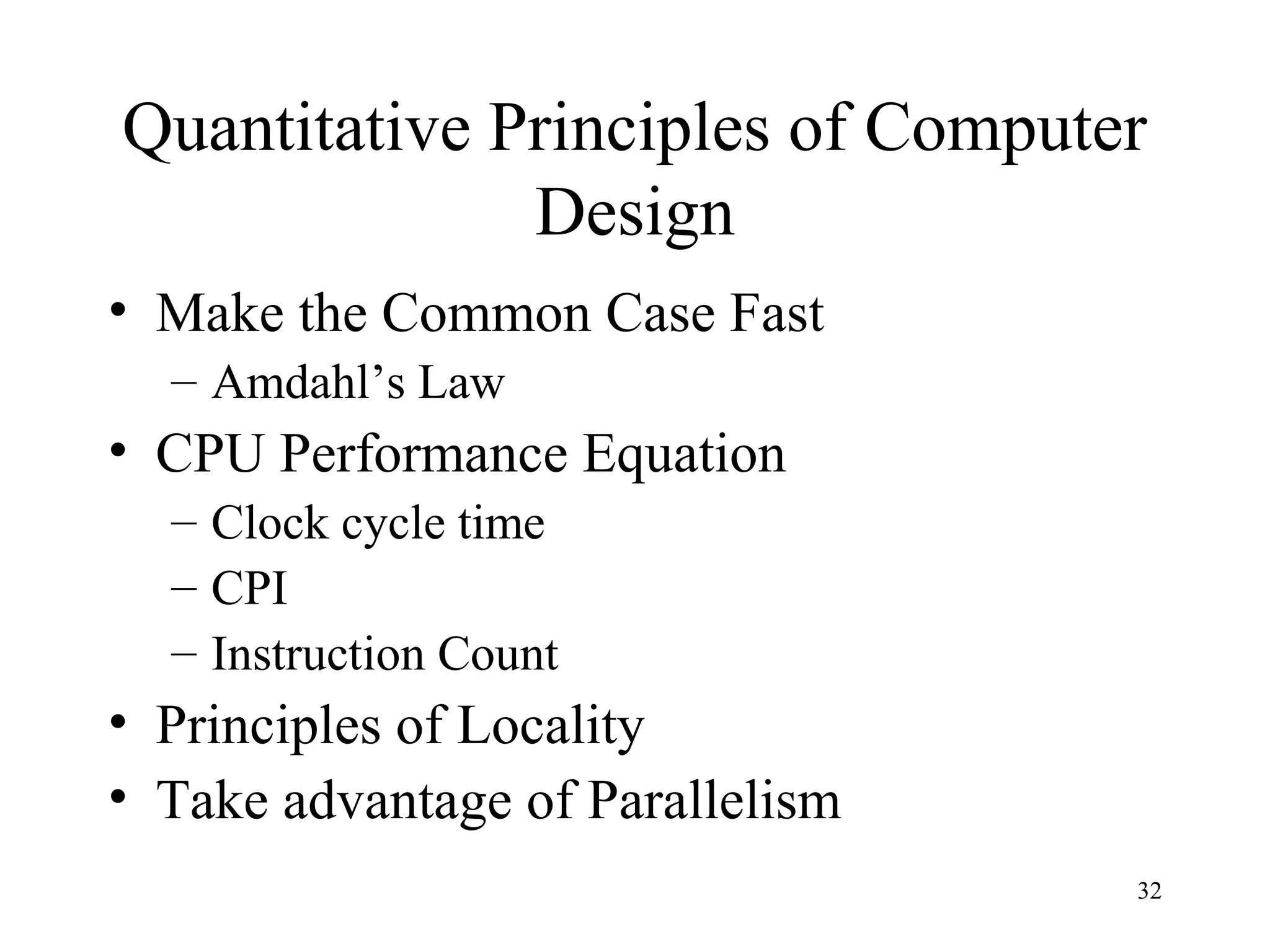
32
Quantitative Principles of Computer
Design
• Make the Common Case Fast
– Amdahl’s Law
• CPU Performance Equation
– Clock cycle time
– CPI
– Instruction Count
• Principles of Locality
• Take advantage of Parallelism
33
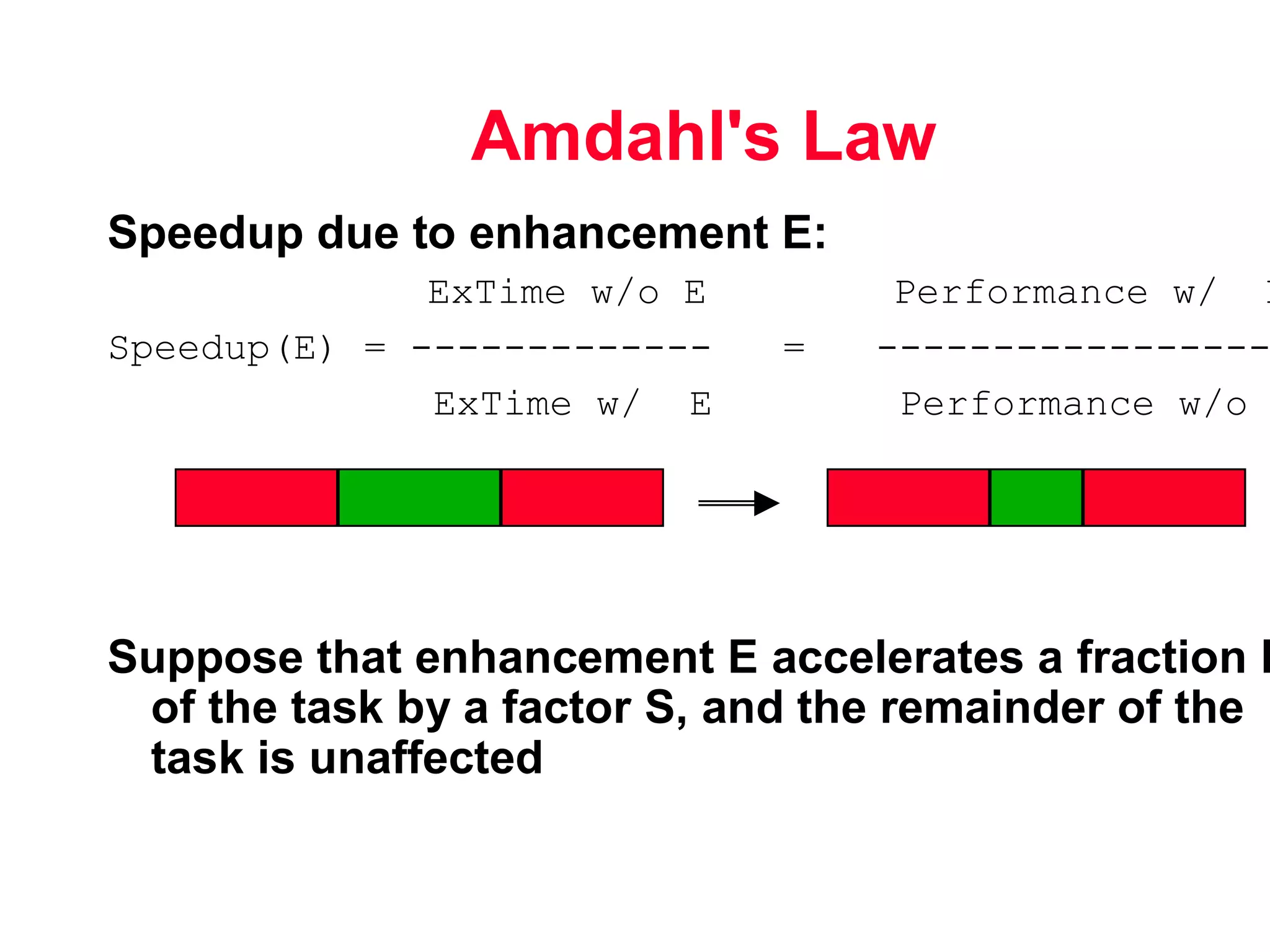
Amdahl's Law
Speedup due to enhancement E:
ExTime w/o E Performance w/ E
Speedup(E) = ------------- = -----------------
ExTime w/ E Performance w/o
Suppose that enhancement E accelerates a fraction F
of the task by a factor S, and the remainder of the
task is unaffected
34
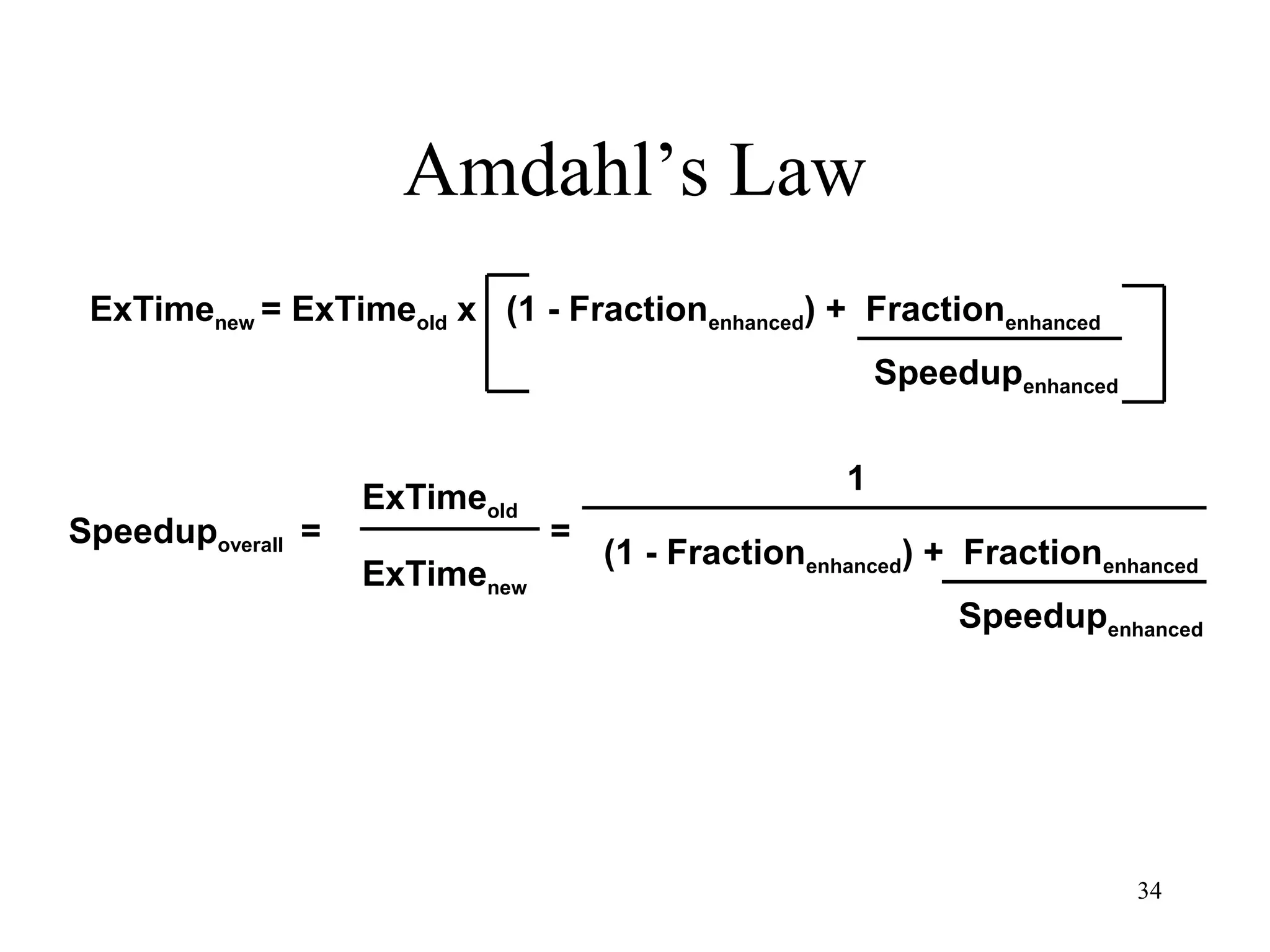
Amdahl’s Law
ExTimenew = ExTimeold x (1 - Fractionenhanced) + Fractionenhanced
Speedupoverall =
ExTimeold
ExTimenew
Speedupenhanced
=
1
(1 - Fractionenhanced) + Fractionenhanced
Speedupenhanced
35
Amdahl’s Law
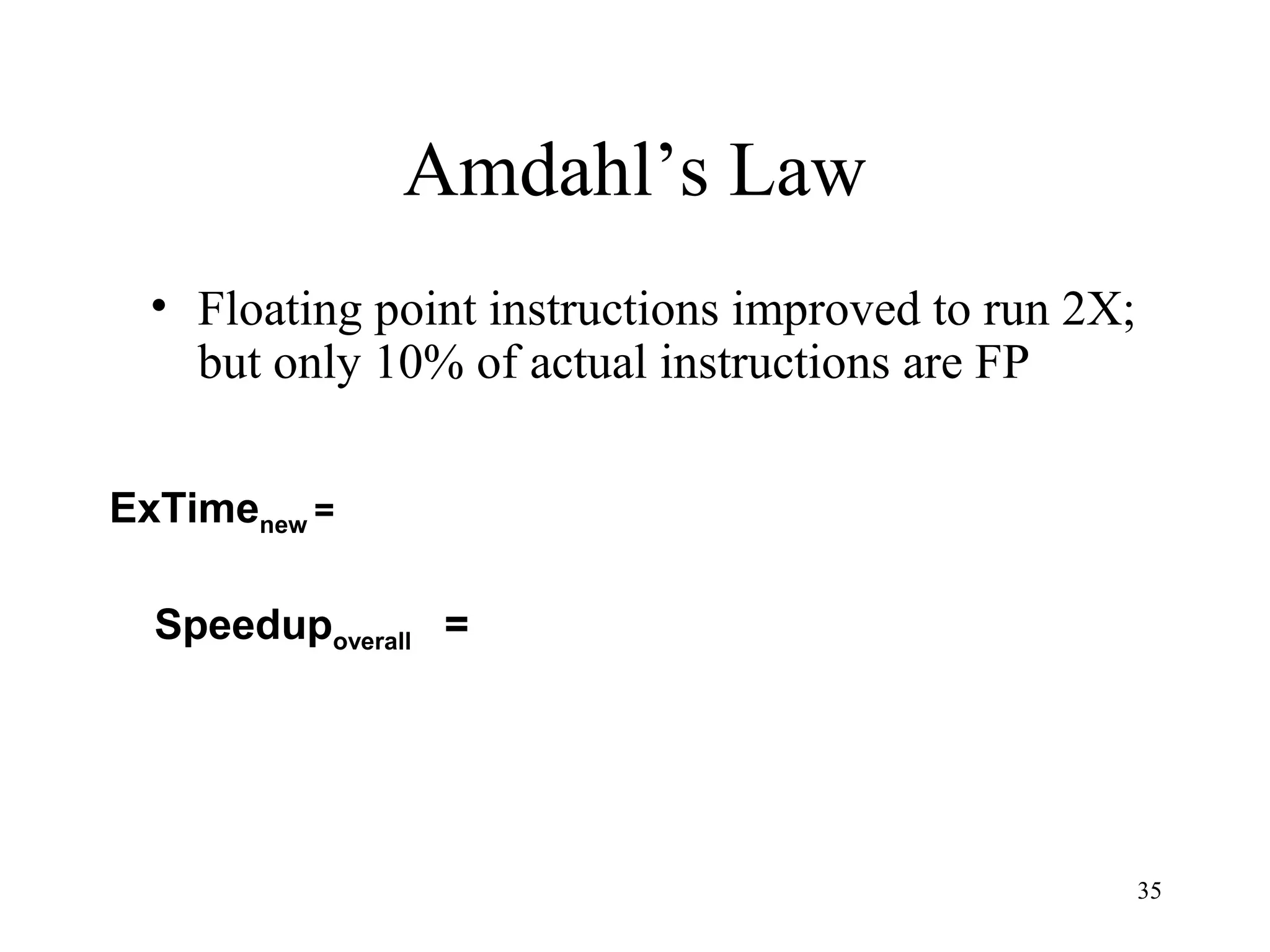
• Floating point instructions improved to run 2X;
but only 10% of actual instructions are FP
Speedupoverall =
ExTimenew =
36
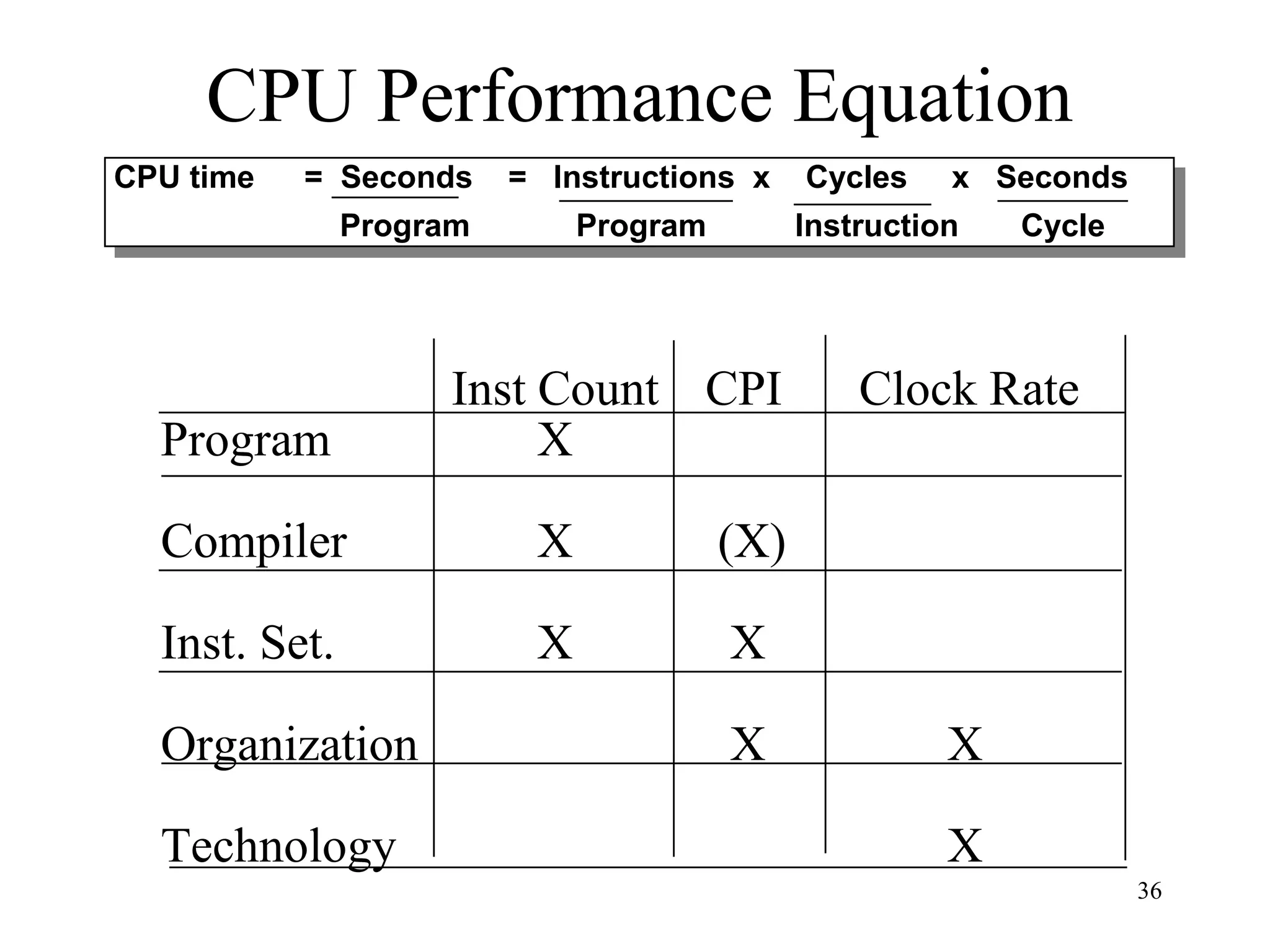
CPU Performance Equation
CPU time = Seconds = Instructions x Cycles x Seconds
Program Program Instruction Cycle
CPU time = Seconds = Instructions x Cycles x Seconds
Program Program Instruction Cycle
Inst Count CPI Clock Rate
Program X
Compiler X (X)
Inst. Set. X X
Organization X X
Technology X
37
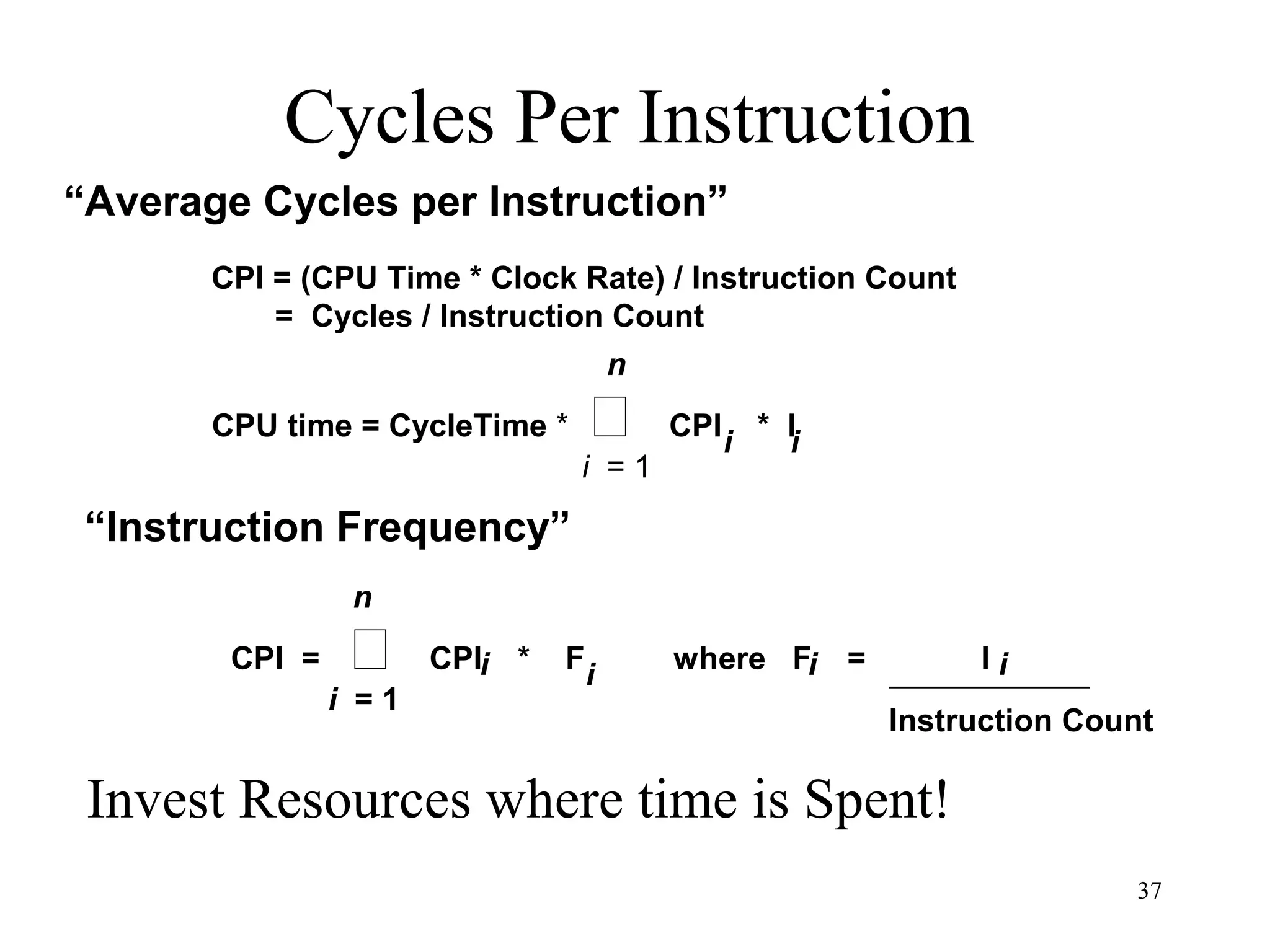
Cycles Per Instruction
CPU time = CycleTime *  CPI * I
i = 1
n
i i
CPI =  CPI * F where F = I
i = 1
n
i i i i
Instruction Count
“Instruction Frequency”
Invest Resources where time is Spent!
CPI = (CPU Time * Clock Rate) / Instruction Count
= Cycles / Instruction Count
“Average Cycles per Instruction”
38
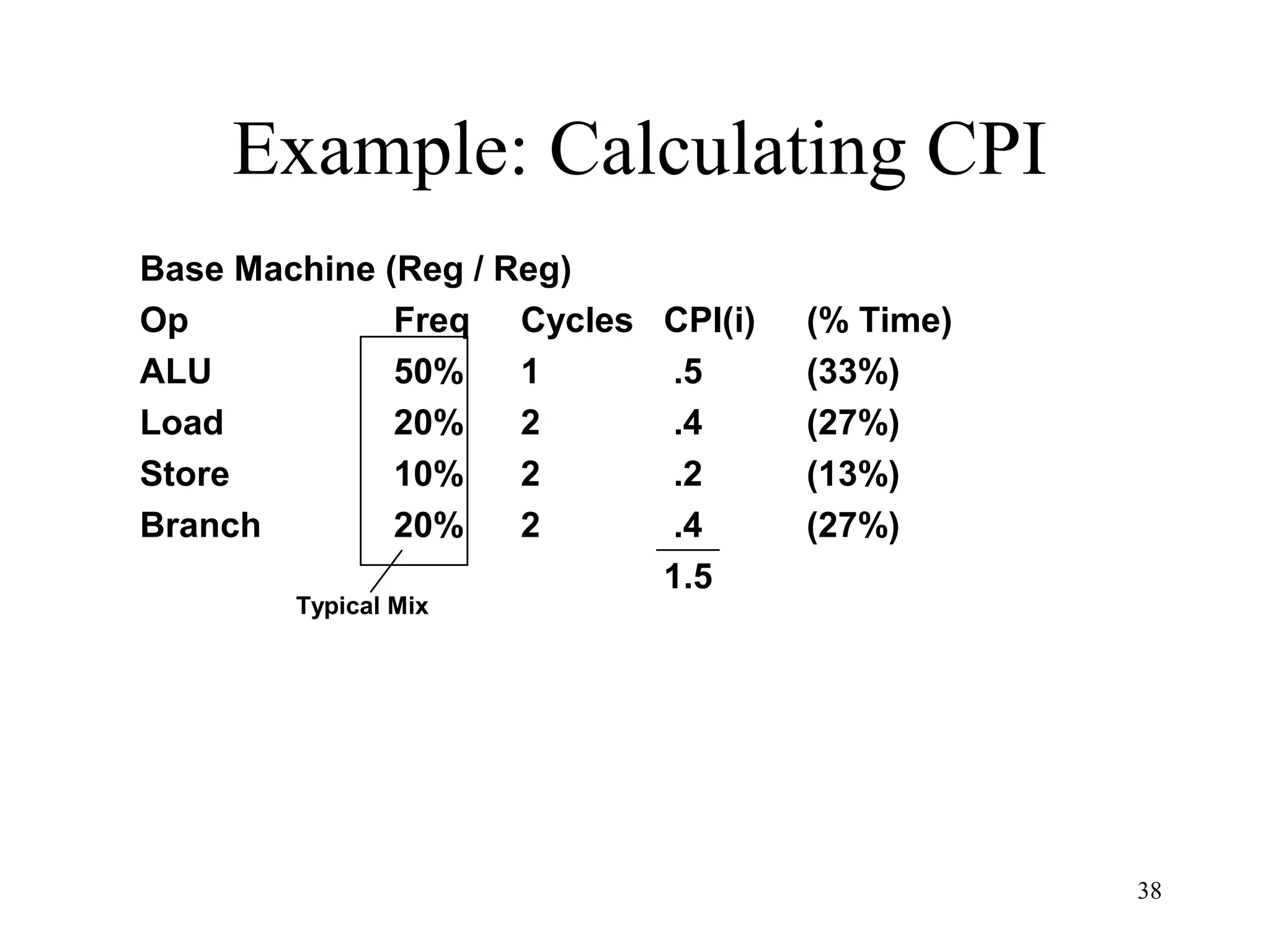
Example: Calculating CPI
Typical Mix
Base Machine (Reg / Reg)
Op Freq Cycles CPI(i) (% Time)
ALU 50% 1 .5 (33%)
Load 20% 2 .4 (27%)
Store 10% 2 .2 (13%)
Branch 20% 2 .4 (27%)
1.5
39
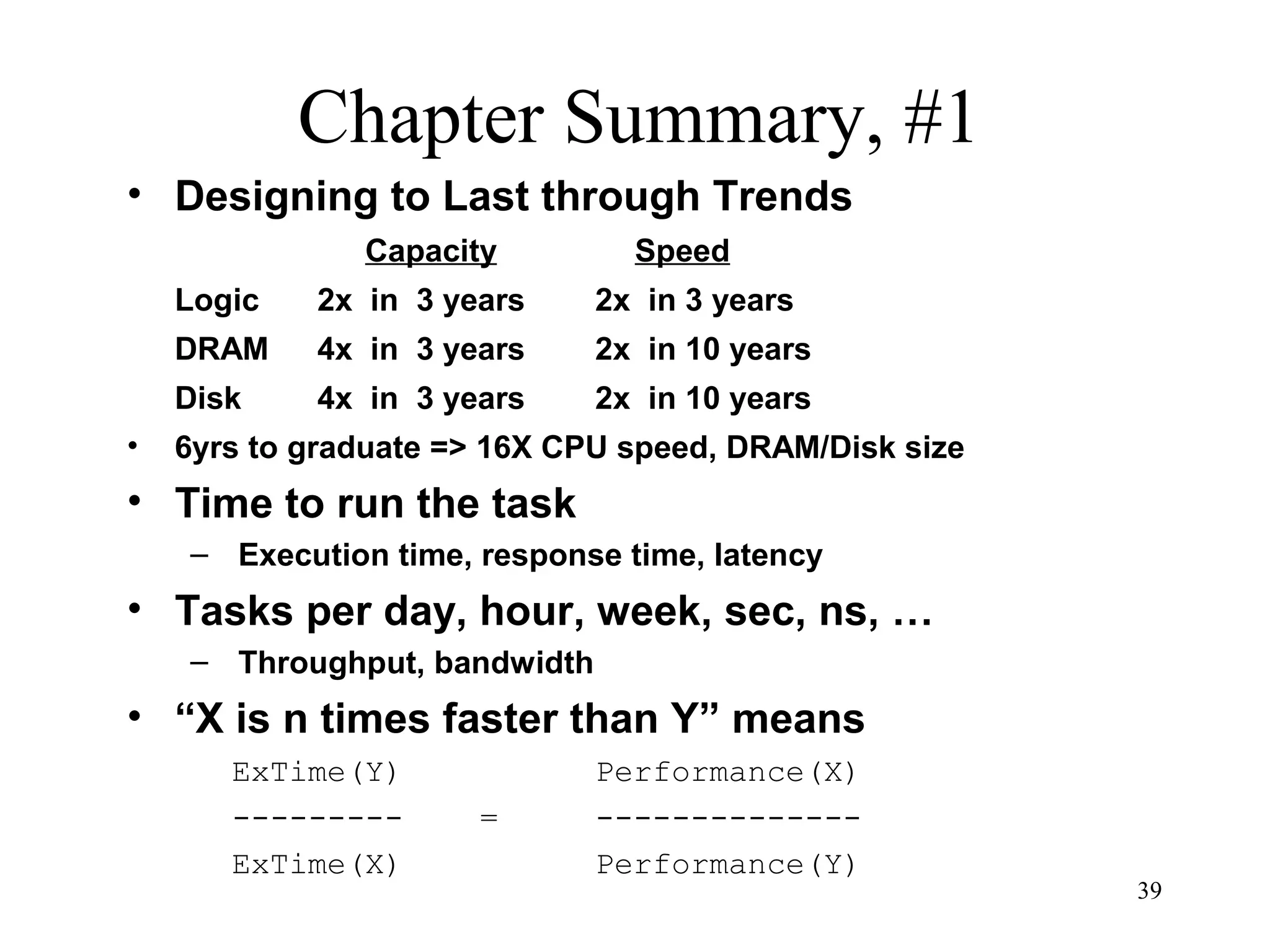
Chapter Summary, #1
• Designing to Last through Trends
Capacity Speed
Logic 2x in 3 years 2x in 3 years
DRAM 4x in 3 years 2x in 10 years
Disk 4x in 3 years 2x in 10 years
• 6yrs to graduate => 16X CPU speed, DRAM/Disk size
• Time to run the task
– Execution time, response time, latency
• Tasks per day, hour, week, sec, ns, …
– Throughput, bandwidth
• “X is n times faster than Y” means
ExTime(Y) Performance(X)
--------- = --------------
ExTime(X) Performance(Y)
40
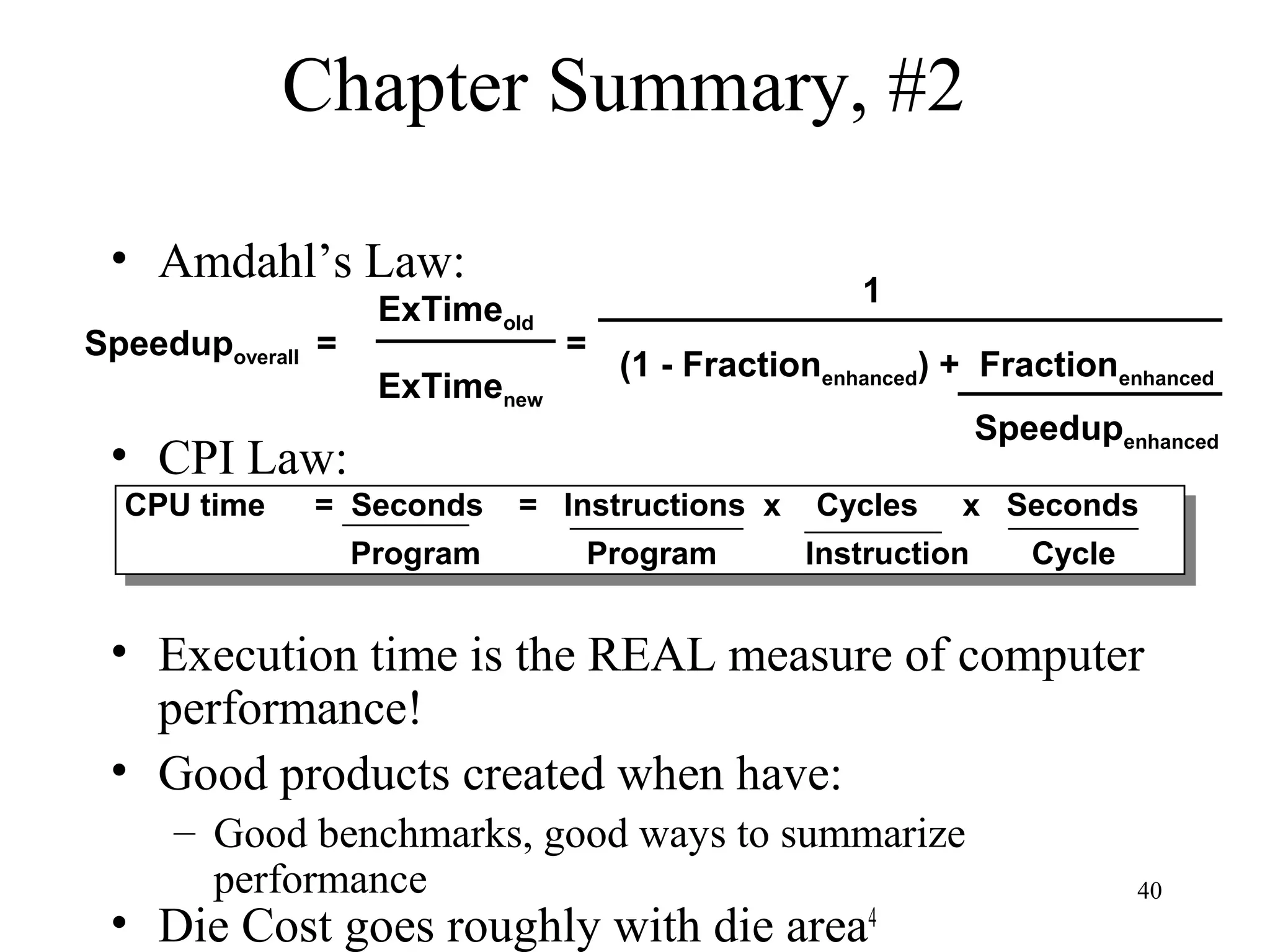
Chapter Summary, #2
• Amdahl’s Law:
• CPI Law:
• Execution time is the REAL measure of computer
performance!
• Good products created when have:
– Good benchmarks, good ways to summarize
performance
• Die Cost goes roughly with die area4
Speedupoverall =
ExTimeold
ExTimenew
=
1
(1 - Fractionenhanced) + Fractionenhanced
Speedupenhanced
CPU time = Seconds = Instructions x Cycles x Seconds
Program Program Instruction Cycle
CPU time = Seconds = Instructions x Cycles x Seconds
Program Program Instruction Cycle
41
Food for thought
• Two companies reports results on two benchmarks
one on a Fortran benchmark suite and the other on
a C++ benchmark suite.
• Company A’s product outperforms Company B’s
on the Fortran suite, the reverse holds true for the
C++ suite. Assume the performance differences
are similar in both cases.
• Do you have enough information to compare the
two products. What information will you need?
42
Food for Thought II
• In the CISC vs. RISC debate a key argument of the
RISC movement was that because of its simplicity,
RISC would always remain ahead.
• If there were enough transistors to implement a CISC
on chip, then those same transistors could implement
a pipelined RISC
• If there was enough to allow for a pipelined CISC
there would be enough to have an on-chip cache for
RISC. And so on.
• After 20 years of this debate what do you think?
• Hint: Think of commercial PC’s, Moore’s law and
some of the data in the first chapter of the book (and
on these slides)
43
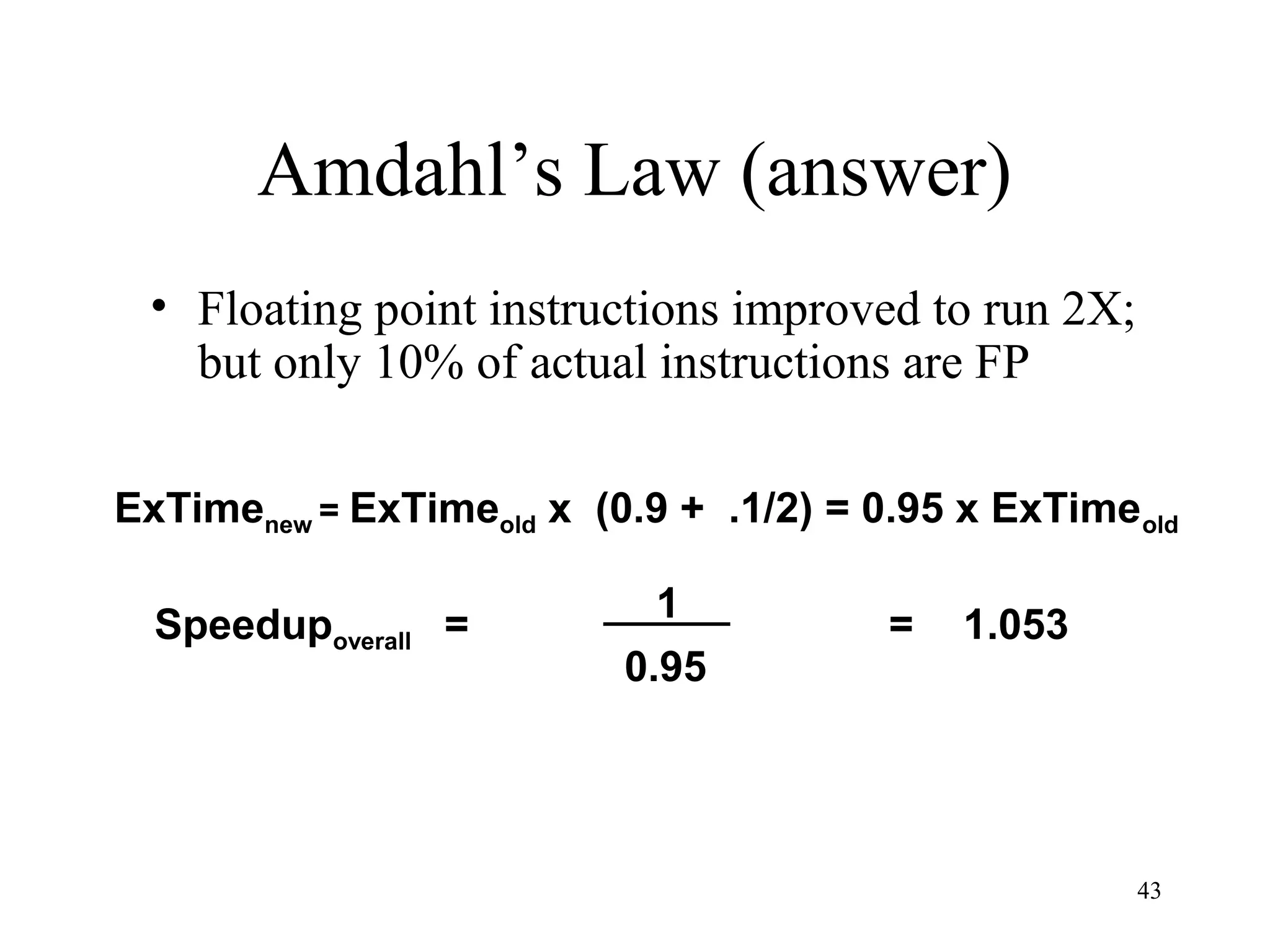
Amdahl’s Law (answer)
• Floating point instructions improved to run 2X;
but only 10% of actual instructions are FP
Speedupoverall =
1
0.95
= 1.053
ExTimenew = ExTimeold x (0.9 + .1/2) = 0.95 x ExTimeold

computer architecture.

  • 1.
    1 Computer Architecture Chapter 1:Fundamentals of Computer Design
  • 2.
    2 Course Objectives • Toevaluate the issues involved in choosing and designing instruction set. • To learn concepts behind advanced pipelining techniques. • To understand the “hitting the memory wall” problem and the current state-of-art in memory system design. • To understand the qualitative and quantitative tradeoffs in the design of modern computer systems
  • 3.
    3 What is ComputerArchitecture? • Functional operation of the individual HW units within a computer system, and the flow of information and control among them. Technology Programming Language Interface Interface Design (ISA) Measurement & Evaluation Parallelism Computer Architecture: Applications OS Hardware Organization
  • 4.
    4 Computer Architecture Topics InstructionSet Architecture Pipelining, Hazard Resolution, Superscalar, Reordering, Prediction, Speculation, Vector, DSP Addressing, Protection, Exception Handling L1 Cache L2 Cache DRAM Disks, WORM, Tape Coherence, Bandwidth, Latency Emerging Technologies Interleaving Memories RAID VLSI Input/Output and Storage Memory Hierarchy Pipelining and Instruction Level Parallelism
  • 5.
    5 Computer Architecture Topics M InterconnectionNetworkS PMPMPMP ° ° ° Topologies, Routing, Bandwidth, Latency, Reliability Network Interfaces Shared Memory, Message Passing, Data Parallelism Processor-Memory-Switch Multiprocessors Networks and Interconnections
  • 6.
    6 Measurement and Evaluation Design Analysis Architectureis an iterative process: • Searching the space of possible designs • At all levels of computer systems Creativity Good IdeasGood Ideas Mediocre Ideas Bad Ideas Cost / Performance Analysis
  • 7.
    7 Issues for aComputer Designer • Functional Requirements Analysis (Target) – Scientific Computing – HiPerf floating pt. – Business – transactional support/decimal arith. – General Purpose –balanced performance for a range of tasks • Level of software compatibility – PL level • Flexible, Need new compiler, portability an issue – Binary level (x86 architecture) • Little flexibility, Portability requirements minimal • OS requirements – Address space issues, memory management, protection • Conformance to Standards – Languages, OS, Networks, I/O, IEEE floating pt.
  • 8.
    8 Computer Systems: Technology Trends •1988 – Supercomputers – Massively Parallel Processors – Mini-supercomputers – Minicomputers – Workstations – PC’s • 2002 – Powerful PC’s and SMP Workstations – Network of SMP Workstations – Mainframes – Supercomputers – Embedded Computers
  • 9.
    9 Why Such Changein 10 years? • Performance – Technology Advances • CMOS (complementary metal oxide semiconductor) VLSI dominates older technologies like TTL (transistor transistor logic) in cost AND performance – Computer architecture advances improves low-end • RISC, pipelining, superscalar, RAID, … • Price: Lower costs due to … – Simpler development • CMOS VLSI: smaller systems, fewer components – Higher volumes – Lower margins by class of computer, due to fewer services • Function :Rise of networking/local interconnection technology
  • 10.
  • 11.
  • 12.
    12 Updated Technology Trends (Summary) CapacitySpeed (latency) Logic 4x in 4 years 2x in 3 years DRAM 4x in 3 years 2x in 10 years Disk 4x in 2 years 2x in 10 years Network (bandwidth) 10x in 5 years • Updates during your study period?? BS (4 yrs) MS (2 yrs) PhD (5 yrs)
  • 13.
  • 14.
    14DAP.S98 1 IC cost= Die cost + Testing cost + Packaging cost Final test yield Die cost = Wafer cost Dies per Wafer * Die yield Dies per wafer = š * ( Wafer_diam / 2)2 – š * Wafer_diam – Test dies Die Area ¦ 2 * Die Area Die Yield = Wafer yield * 1 + Defects_per_unit_area * Die_Area α Integrated Circuits Costs Die Cost goes roughly with die area4 { − α }
  • 15.
    15 Performance Trends (Summary) • Workstationperformance (measured in Spec Marks) improves roughly 50% per year (2X every 18 months) • Improvement in cost performance estimated at 70% per year
  • 16.
    16 Computer Engineering Methodology Evaluate ExistingEvaluateExisting Systems forSystems for BottlenecksBottlenecks Simulate NewSimulate New Designs andDesigns and OrganizationsOrganizations Implement NextImplement Next Generation SystemGeneration System Technology Trends Benchmarks Workloads Implementation Complexity
  • 17.
    17 How to QuantifyPerformance? • Time to run the task (ExTime) – Execution time, response time, latency • Tasks per day, hour, week, sec, ns … (Performance) – Throughput, bandwidth Plane Boeing 747 BAD/Sud Concodre Speed 610 mph 1350 mph DC to Paris 6.5 hours 3 hours Passengers 470 132 Throughput (pmph) 286,700 178,200
  • 18.
    18 The Bottom Line: Performanceand Cost or Cost and Performance? "X is n times faster than Y" means ExTime(Y) Performance(X) --------- = --------------- ExTime(X) Performance(Y) • Speed of Concorde vs. Boeing 747 • Throughput of Boeing 747 vs. Concorde • Cost is also an important parameter in the equation which is why concordes are being put to pasture!
  • 19.
    19 Measurement Tools • Benchmarks,Traces, Mixes • Hardware: Cost, delay, area, power estimation • Simulation (many levels) – ISA, RT, Gate, Circuit • Queuing Theory • Rules of Thumb • Fundamental “Laws”/Principles • Understanding the limitations of any measurement tool is crucial.
  • 20.
    20 Metrics of Performance Compiler Programming Language Application Datapath Control TransistorsWires Pins ISA Function Units (millions) of Instructions per second: MIPS (millions) of (FP) operations per second: MFLOP/s Cycles per second (clock rate) Megabytes per second Answers per month Operations per second
  • 21.
    21 Cases of BenchmarkEngineering • The motivation is to tune the system to the benchmark to achieve peak performance. • At the architecture level – Specialized instructions • At the compiler level (compiler flags) – Blocking in Spec89  factor of 9 speedup – Incorrect compiler optimizations/reordering. – Would work fine on benchmark but not on other programs • I/O level – Spec92 spreadsheet program (sp) – Companies noticed that the produced output was always out put to a file (so they stored the results in a memory buffer) and then expunged at the end (which was not measured). – One company eliminated the I/O all together.
  • 22.
    22 After putting ina blazing performance on the benchmark test, Sun issued a glowing press release claiming that it had outperformed Windows NT systems on the test. Pendragon president Ivan Phillips cried foul, saying the results weren't representative of real-world Java performance and that Sun had gone so far as to duplicate the test's code within Sun's Just-In-Time compiler. That's cheating, says Phillips, who claims that benchmark tests and real-world applications aren't the same thing. Did Sun issue a denial or a mea culpa? Initially, Sun neither denied optimizing for the benchmark test nor apologized for it. "If the test results are not representative of real-world Java applications, then that's a problem with the benchmark," Sun's Brian Croll said. After taking a beating in the press, though, Sun retreated and issued an apology for the optimization.[Excerpted from PC Online 1997]
  • 23.
    23 Issues with Benchmark Engineering •Motivated by the bottom dollar, good performance on classic suites  more customers, better sales. • Benchmark Engineering  Limits the longevity of benchmark suites • Technology and Applications Limits the longevity of benchmark suites.
  • 24.
    24 SPEC: System Performance EvaluationCooperative • First Round 1989 – 10 programs yielding a single number (“SPECmarks”) • Second Round 1992 – SPECInt92 (6 integer programs) and SPECfp92 (14 floating point programs) • Compiler Flags unlimited. March 93 • new set of programs: SPECint95 (8 integer programs) and SPECfp95 (10 floating point) – “benchmarks useful for 3 years” – Single flag setting for all programs: SPECint_base95, SPECfp_base95 – SPEC CPU2000 (11 integer benchmarks – CINT2000, and 14 floating-point benchmarks – CFP2000
  • 25.
    25 SPEC 2000 (CINT2000)Results
  • 26.
    26 SPEC 2000 (CFP2000)Results
  • 27.
    27 Reporting Performance Results •Reproducability  Apply them on publicly available benchmarks. Pecking/Picking order – Real Programs – Real Kernels – Toy Benchmarks – Synthetic Benchmarks
  • 28.
    28 How to Summarize Performance•Arithmetic mean (weighted arithmetic mean) tracks execution time: sum(Ti)/n or sum(Wi*Ti) • Harmonic mean (weighted harmonic mean) of rates (e.g., MFLOPS) tracks execution time: n/sum(1/Ri) or 1/sum(Wi/Ri) • Normalized execution time is handy for scaling performance (e.g., X times faster than SPARCstation 10) • But do not take the arithmetic mean of normalized execution time, use the geometric mean = (Product(Ri)^1/n)
  • 29.
    29 Performance Evaluation • “Forbetter or worse, benchmarks shape a field” • Good products created when have: – Good benchmarks – Good ways to summarize performance • Given sales is a function in part of performance relative to competition, investment in improving product as reported by performance summary • If benchmarks/summary inadequate, then choose between improving product for real programs vs. improving product to get more sales; Sales almost always wins! • Execution time is the measure of computer performance!
  • 30.
    30 Simulations • When aresimulations useful? • What are its limitations, I.e. what real world phenomenon does it not account for? • The larger the simulation trace, the less tractable the post-processing analysis.
  • 31.
    31 Queueing Theory • Whatare the distributions of arrival rates and values for other parameters? • Are they realistic? • What happens when the parameters or distributions are changed?
  • 32.
    32 Quantitative Principles ofComputer Design • Make the Common Case Fast – Amdahl’s Law • CPU Performance Equation – Clock cycle time – CPI – Instruction Count • Principles of Locality • Take advantage of Parallelism
  • 33.
    33 Amdahl's Law Speedup dueto enhancement E: ExTime w/o E Performance w/ E Speedup(E) = ------------- = ----------------- ExTime w/ E Performance w/o Suppose that enhancement E accelerates a fraction F of the task by a factor S, and the remainder of the task is unaffected
  • 34.
    34 Amdahl’s Law ExTimenew =ExTimeold x (1 - Fractionenhanced) + Fractionenhanced Speedupoverall = ExTimeold ExTimenew Speedupenhanced = 1 (1 - Fractionenhanced) + Fractionenhanced Speedupenhanced
  • 35.
    35 Amdahl’s Law • Floatingpoint instructions improved to run 2X; but only 10% of actual instructions are FP Speedupoverall = ExTimenew =
  • 36.
    36 CPU Performance Equation CPUtime = Seconds = Instructions x Cycles x Seconds Program Program Instruction Cycle CPU time = Seconds = Instructions x Cycles x Seconds Program Program Instruction Cycle Inst Count CPI Clock Rate Program X Compiler X (X) Inst. Set. X X Organization X X Technology X
  • 37.
    37 Cycles Per Instruction CPUtime = CycleTime *  CPI * I i = 1 n i i CPI =  CPI * F where F = I i = 1 n i i i i Instruction Count “Instruction Frequency” Invest Resources where time is Spent! CPI = (CPU Time * Clock Rate) / Instruction Count = Cycles / Instruction Count “Average Cycles per Instruction”
  • 38.
    38 Example: Calculating CPI TypicalMix Base Machine (Reg / Reg) Op Freq Cycles CPI(i) (% Time) ALU 50% 1 .5 (33%) Load 20% 2 .4 (27%) Store 10% 2 .2 (13%) Branch 20% 2 .4 (27%) 1.5
  • 39.
    39 Chapter Summary, #1 •Designing to Last through Trends Capacity Speed Logic 2x in 3 years 2x in 3 years DRAM 4x in 3 years 2x in 10 years Disk 4x in 3 years 2x in 10 years • 6yrs to graduate => 16X CPU speed, DRAM/Disk size • Time to run the task – Execution time, response time, latency • Tasks per day, hour, week, sec, ns, … – Throughput, bandwidth • “X is n times faster than Y” means ExTime(Y) Performance(X) --------- = -------------- ExTime(X) Performance(Y)
  • 40.
    40 Chapter Summary, #2 •Amdahl’s Law: • CPI Law: • Execution time is the REAL measure of computer performance! • Good products created when have: – Good benchmarks, good ways to summarize performance • Die Cost goes roughly with die area4 Speedupoverall = ExTimeold ExTimenew = 1 (1 - Fractionenhanced) + Fractionenhanced Speedupenhanced CPU time = Seconds = Instructions x Cycles x Seconds Program Program Instruction Cycle CPU time = Seconds = Instructions x Cycles x Seconds Program Program Instruction Cycle
  • 41.
    41 Food for thought •Two companies reports results on two benchmarks one on a Fortran benchmark suite and the other on a C++ benchmark suite. • Company A’s product outperforms Company B’s on the Fortran suite, the reverse holds true for the C++ suite. Assume the performance differences are similar in both cases. • Do you have enough information to compare the two products. What information will you need?
  • 42.
    42 Food for ThoughtII • In the CISC vs. RISC debate a key argument of the RISC movement was that because of its simplicity, RISC would always remain ahead. • If there were enough transistors to implement a CISC on chip, then those same transistors could implement a pipelined RISC • If there was enough to allow for a pipelined CISC there would be enough to have an on-chip cache for RISC. And so on. • After 20 years of this debate what do you think? • Hint: Think of commercial PC’s, Moore’s law and some of the data in the first chapter of the book (and on these slides)
  • 43.
    43 Amdahl’s Law (answer) •Floating point instructions improved to run 2X; but only 10% of actual instructions are FP Speedupoverall = 1 0.95 = 1.053 ExTimenew = ExTimeold x (0.9 + .1/2) = 0.95 x ExTimeold

Editor's Notes

  • #17 How hard to build Importance of simplicity (wearing a seat belt); avoiding a personal disaster Theory vs. practice
  • #18 Fastest for 1 person? Which takes less time to transport 470 passengers?
  • #19 1350 / 610 = 2.2X 286,700/ 178,200 1.6X