Computer Architecture
A Quantitative Approach, Fifth Edition

Chapter 1
Fundamentals of Quantitative
Design and Analysis

Copyright © 2012, Elsevier Inc. All rights reserved.

1


Performance improvements:


Improvements in semiconductor technology






Enabled by HLL compilers, UNIX
Lead to RISC architectures

Together have enabled:








Feature size, clock speed

Improvements in computer architectures




Introduction

Computer Technology

Lightweight computers
Productivity-based managed/interpreted programming
languages
SaaS, Virtualization, Cloud

Applications evolution:


Speech, sound, images, video, “augmented/extende
d reality”, “big data”
Copyright © 2012, Elsevier Inc. All rights reserved.

2
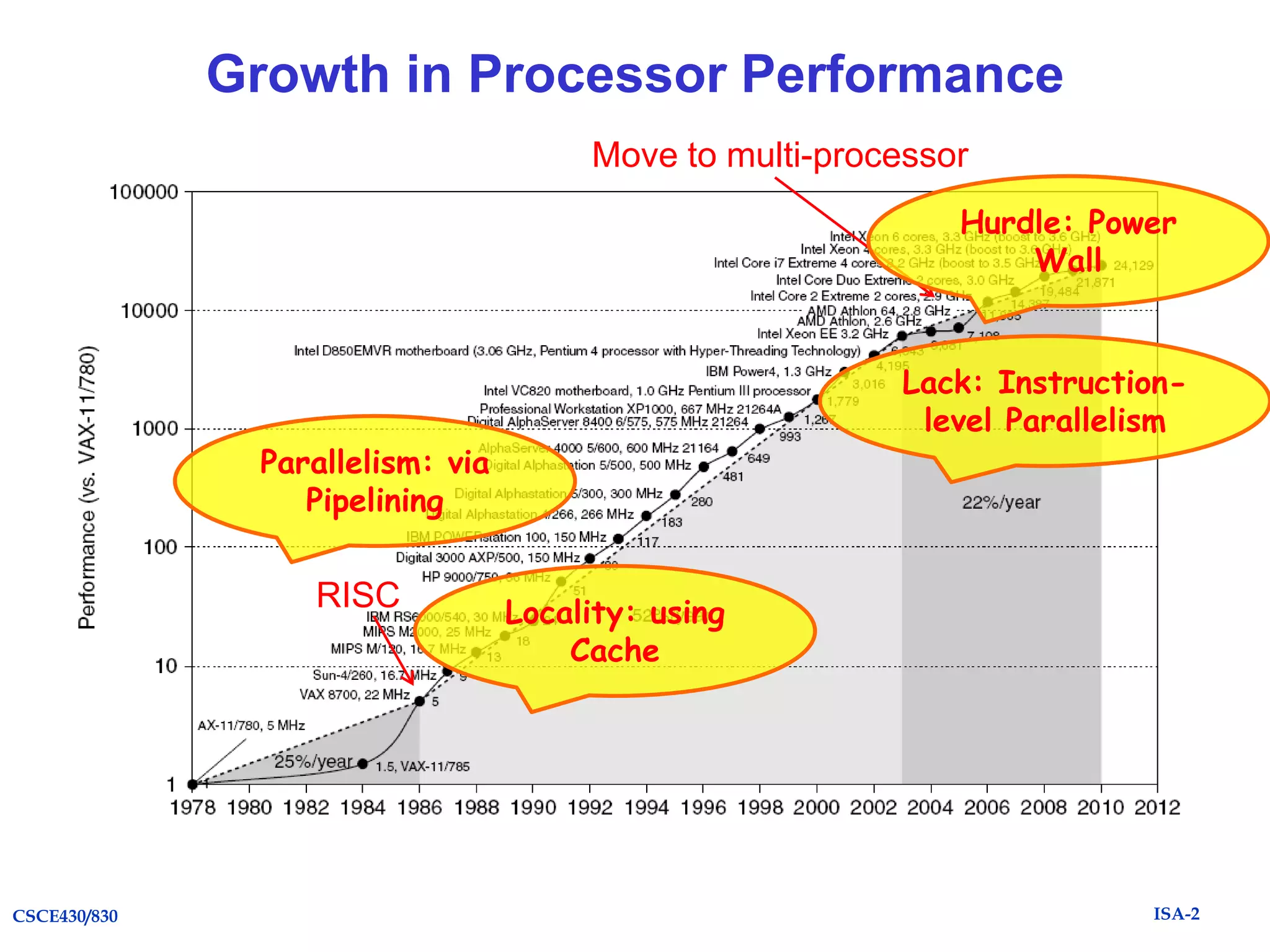
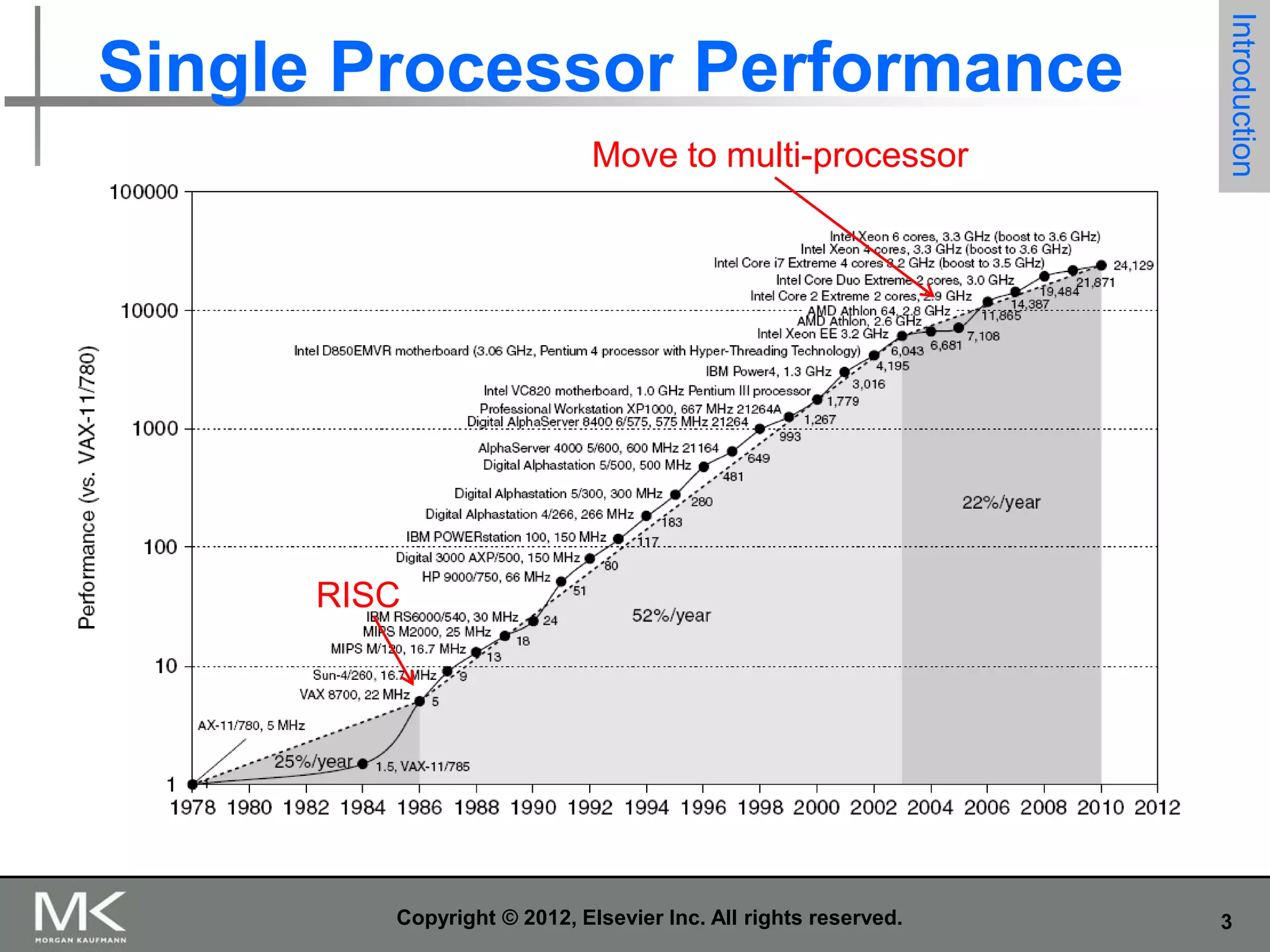
Move to multi-processor

Introduction

Single Processor Performance

RISC

Copyright © 2012, Elsevier Inc. All rights reserved.

3


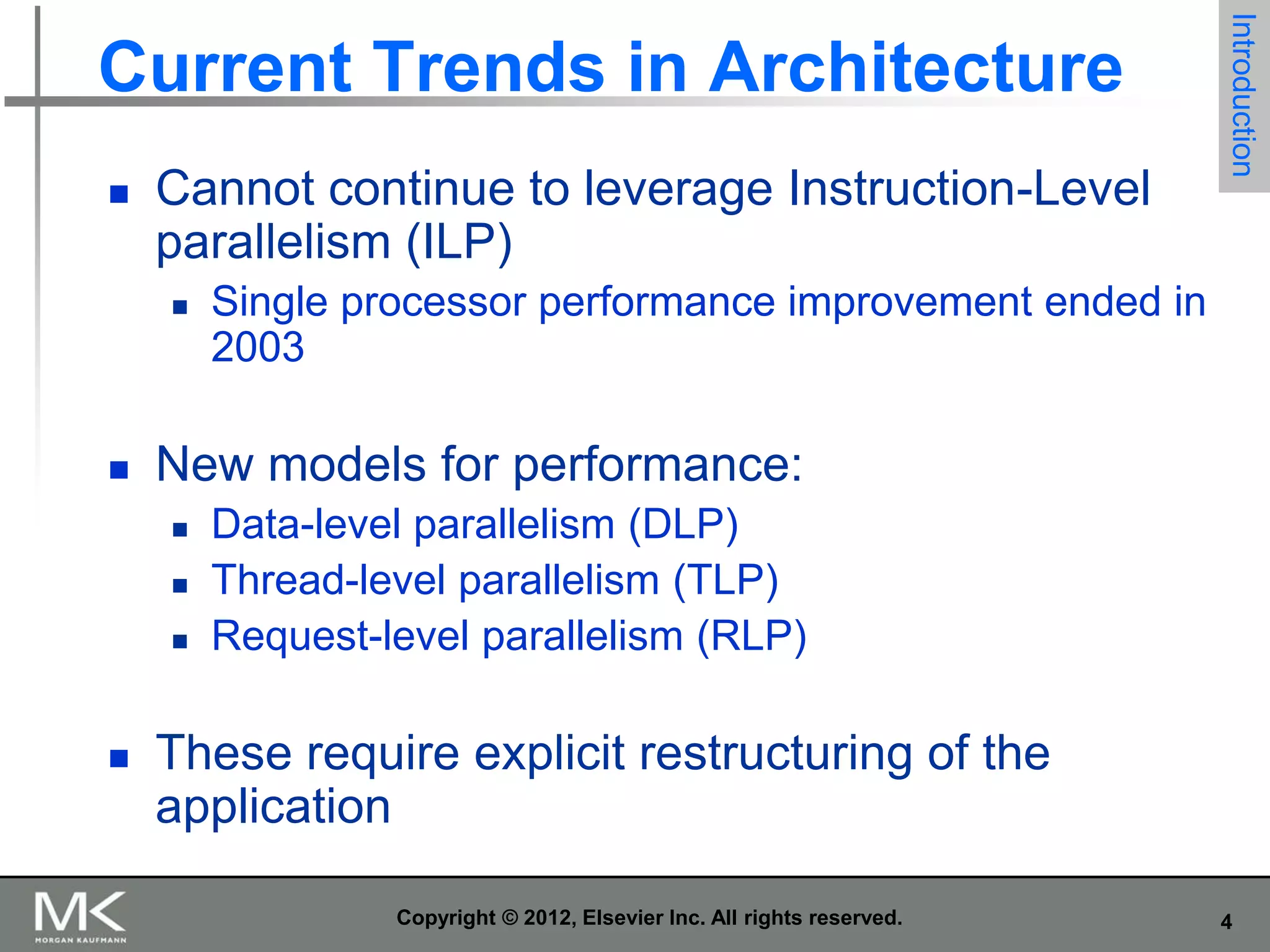
Cannot continue to leverage Instruction-Level
parallelism (ILP)




Single processor performance improvement ended in
2003

New models for performance:






Introduction

Current Trends in Architecture

Data-level parallelism (DLP)
Thread-level parallelism (TLP)
Request-level parallelism (RLP)

These require explicit restructuring of the
application
Copyright © 2012, Elsevier Inc. All rights reserved.

4


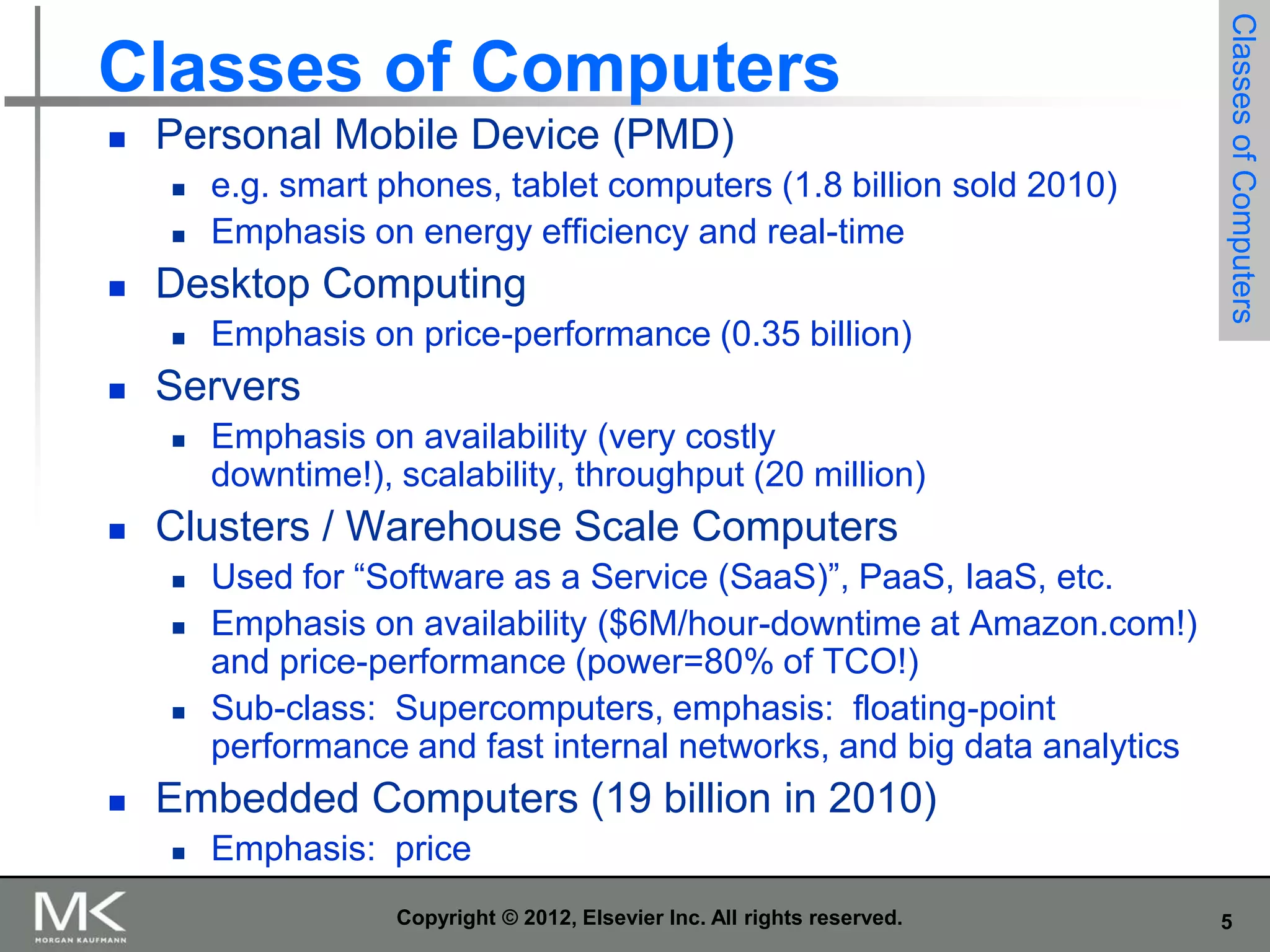
Personal Mobile Device (PMD)





Desktop Computing




Emphasis on availability (very costly
downtime!), scalability, throughput (20 million)

Clusters / Warehouse Scale Computers







Emphasis on price-performance (0.35 billion)

Servers




e.g. smart phones, tablet computers (1.8 billion sold 2010)
Emphasis on energy efficiency and real-time

Classes of Computers

Classes of Computers

Used for “Software as a Service (SaaS)”, PaaS, IaaS, etc.
Emphasis on availability ($6M/hour-downtime at Amazon.com!)
and price-performance (power=80% of TCO!)
Sub-class: Supercomputers, emphasis: floating-point
performance and fast internal networks, and big data analytics

Embedded Computers (19 billion in 2010)


Emphasis: price
Copyright © 2012, Elsevier Inc. All rights reserved.

5


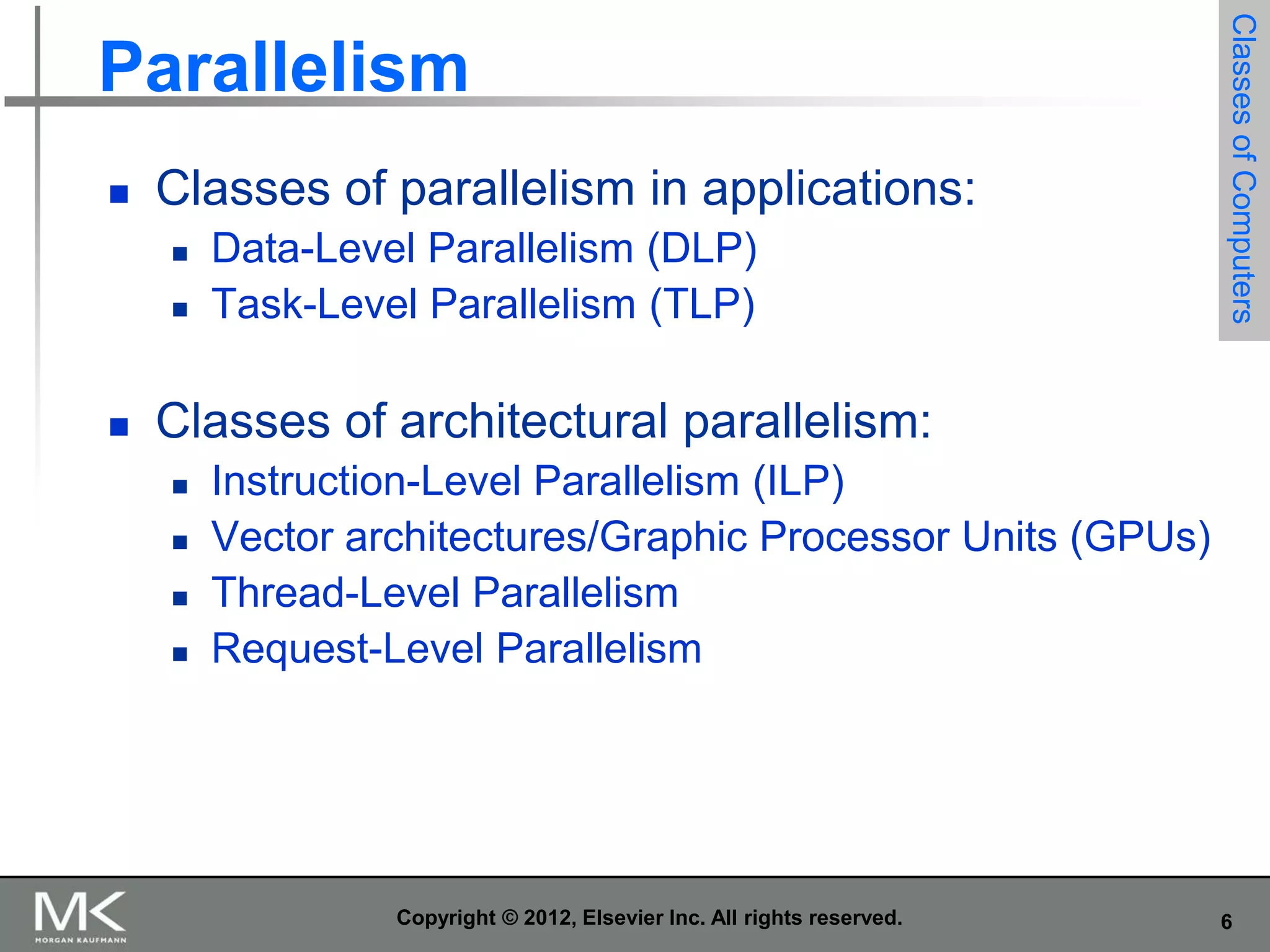
Classes of parallelism in applications:





Data-Level Parallelism (DLP)
Task-Level Parallelism (TLP)

Classes of Computers

Parallelism

Classes of architectural parallelism:





Instruction-Level Parallelism (ILP)
Vector architectures/Graphic Processor Units (GPUs)
Thread-Level Parallelism
Request-Level Parallelism

Copyright © 2012, Elsevier Inc. All rights reserved.

6


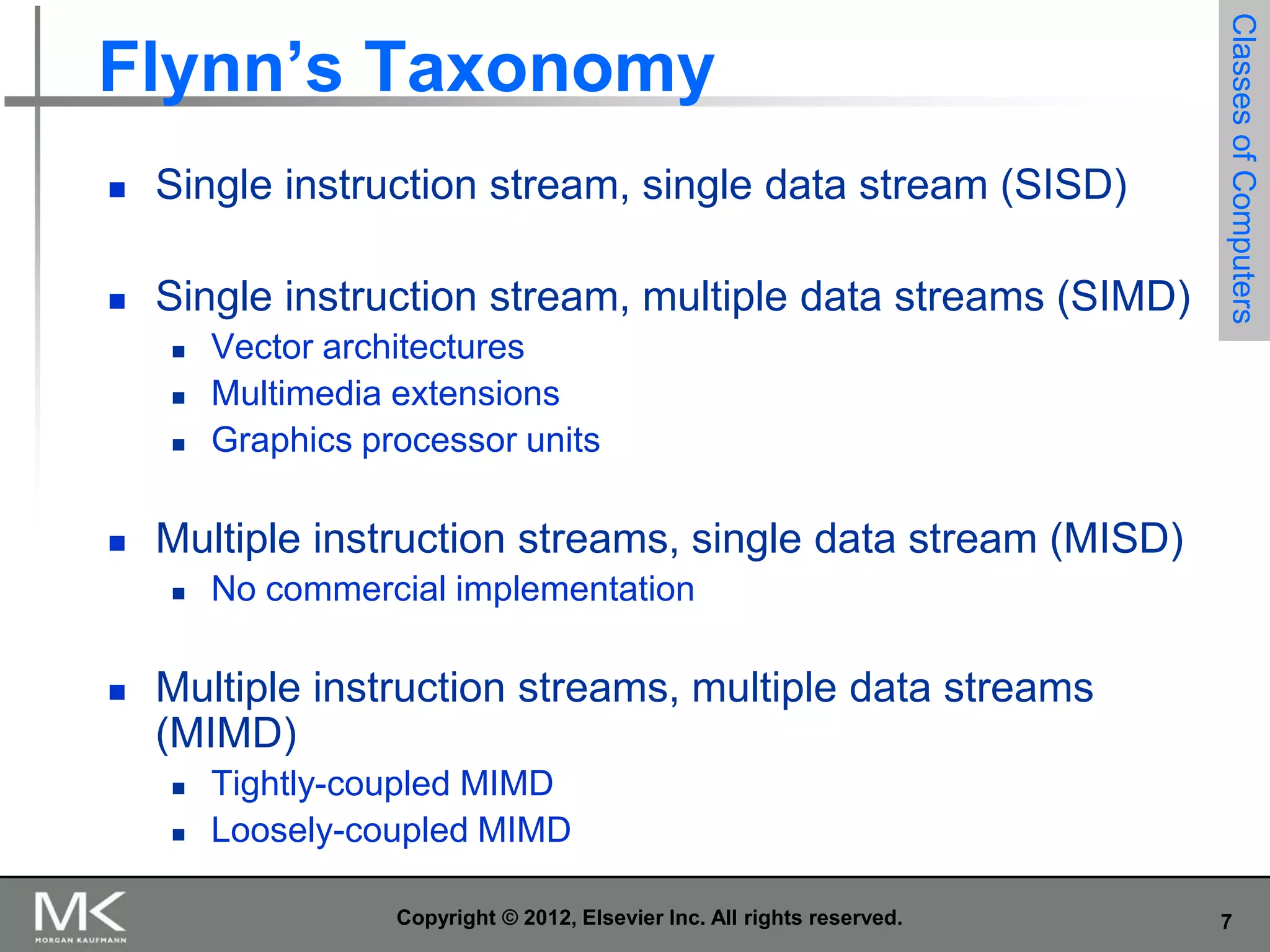
Single instruction stream, single data stream (SISD)



Single instruction stream, multiple data streams (SIMD)







Vector architectures
Multimedia extensions
Graphics processor units

Multiple instruction streams, single data stream (MISD)




Classes of Computers

Flynn’s Taxonomy

No commercial implementation

Multiple instruction streams, multiple data streams
(MIMD)




Tightly-coupled MIMD
Loosely-coupled MIMD
Copyright © 2012, Elsevier Inc. All rights reserved.

7


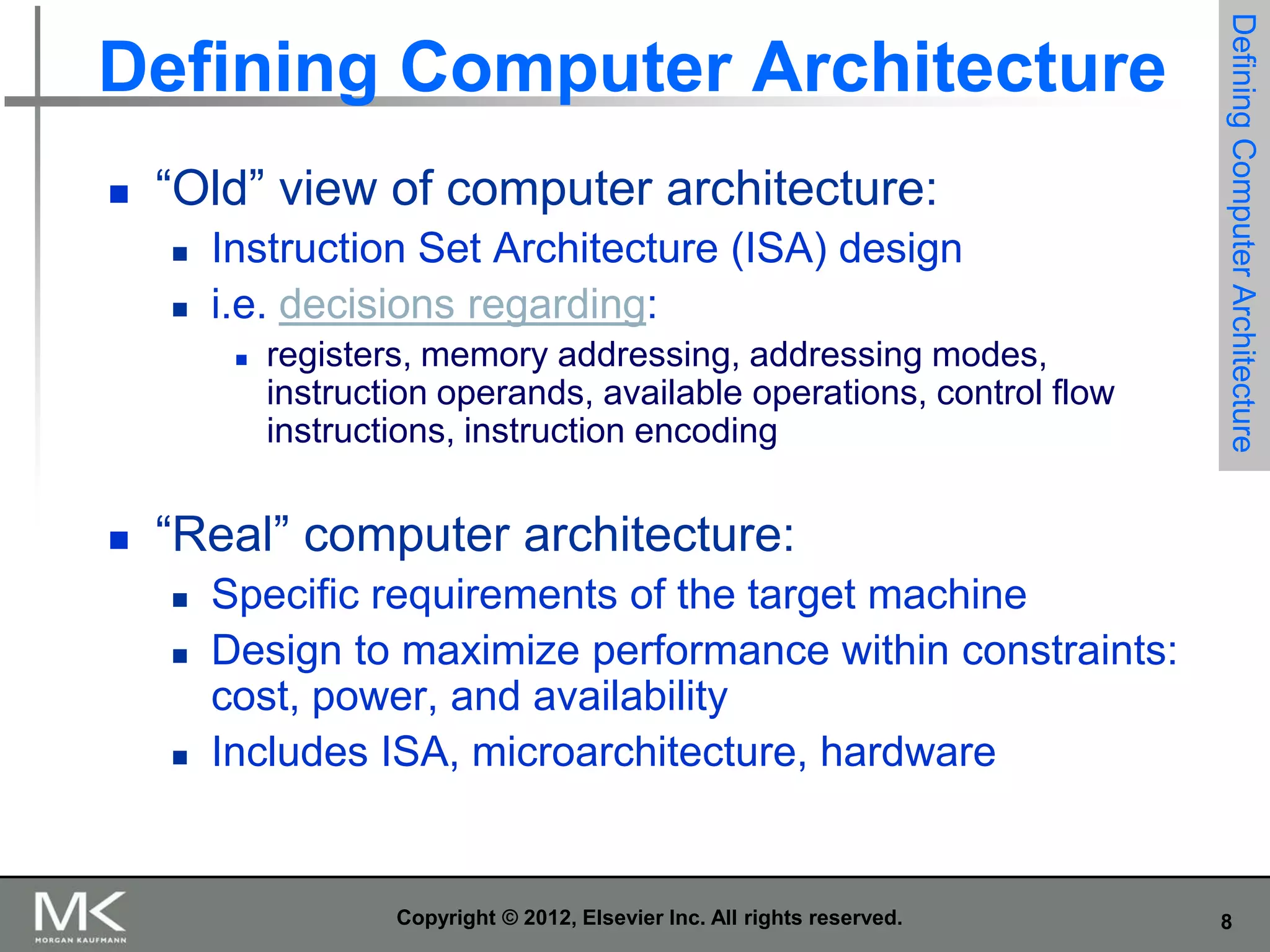
“Old” view of computer architecture:



Instruction Set Architecture (ISA) design
i.e. decisions regarding:




registers, memory addressing, addressing modes,
instruction operands, available operations, control flow
instructions, instruction encoding

Defining Computer Architecture

Defining Computer Architecture

“Real” computer architecture:





Specific requirements of the target machine
Design to maximize performance within constraints:
cost, power, and availability
Includes ISA, microarchitecture, hardware

Copyright © 2012, Elsevier Inc. All rights reserved.

8


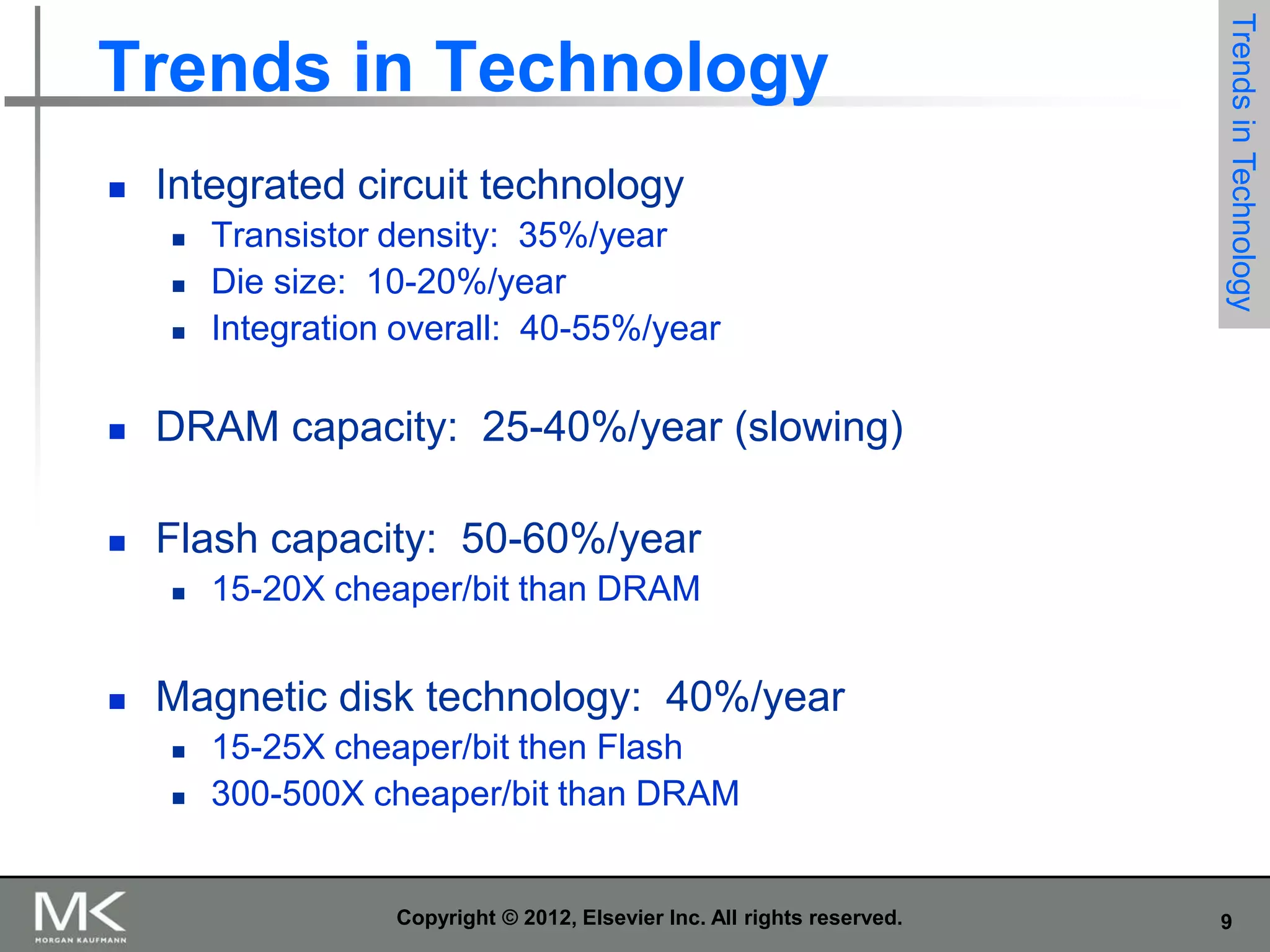
Integrated circuit technology




Transistor density: 35%/year
Die size: 10-20%/year
Integration overall: 40-55%/year



DRAM capacity: 25-40%/year (slowing)



Trends in Technology

Trends in Technology

Flash capacity: 50-60%/year




15-20X cheaper/bit than DRAM

Magnetic disk technology: 40%/year



15-25X cheaper/bit then Flash
300-500X cheaper/bit than DRAM

Copyright © 2012, Elsevier Inc. All rights reserved.

9


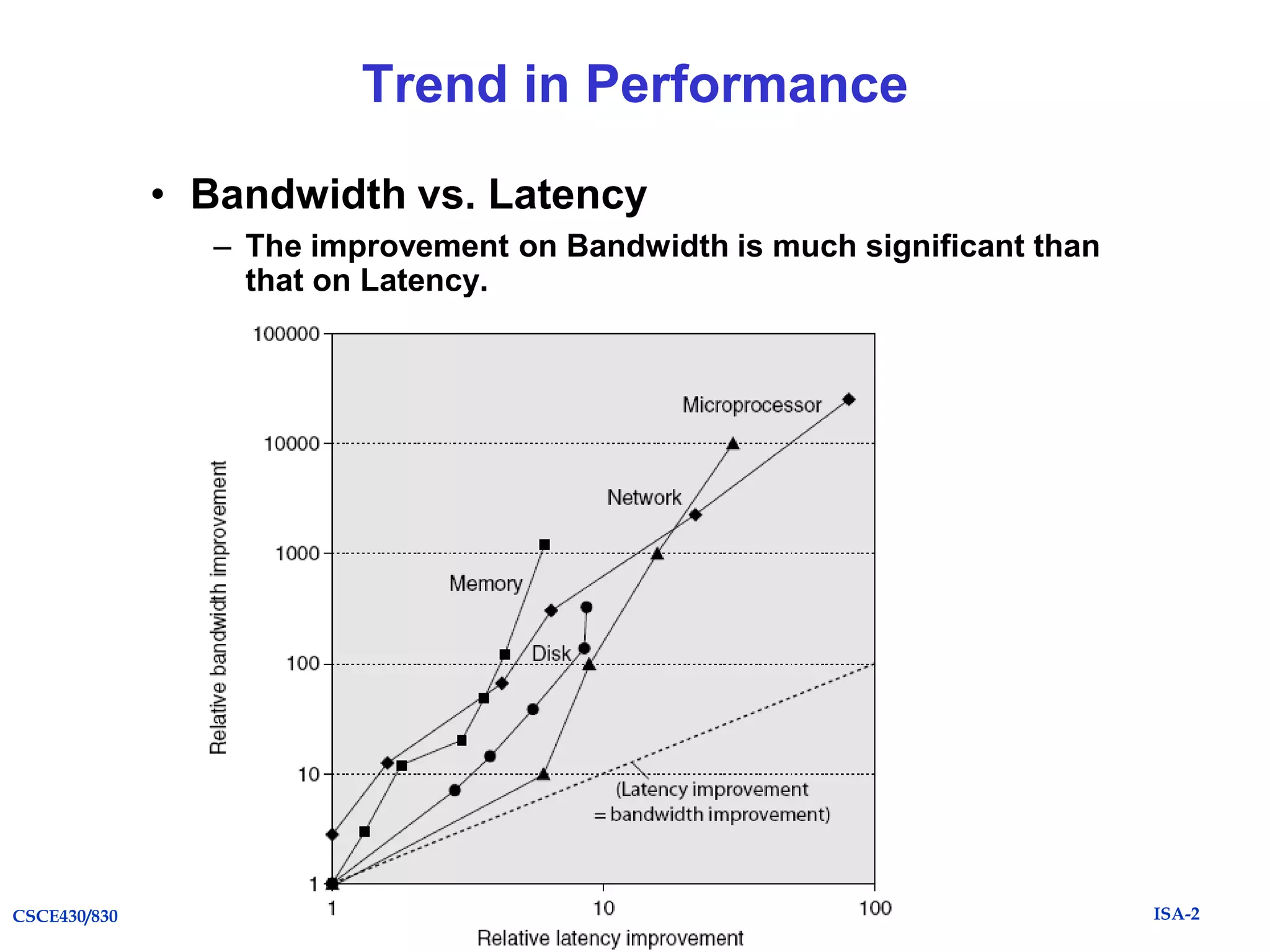
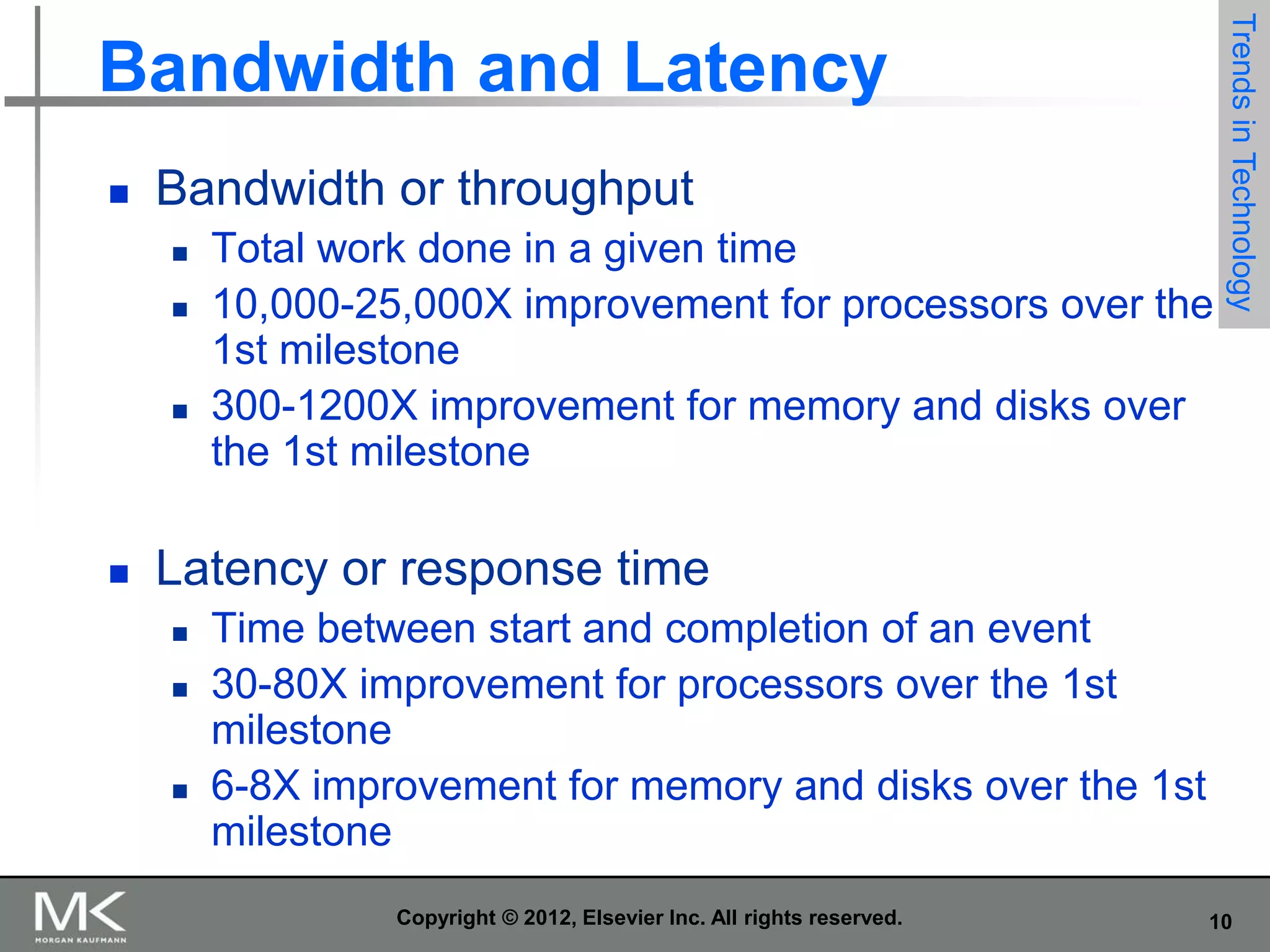
Bandwidth or throughput







Total work done in a given time
10,000-25,000X improvement for processors over the
1st milestone
300-1200X improvement for memory and disks over
the 1st milestone

Trends in Technology

Bandwidth and Latency

Latency or response time





Time between start and completion of an event
30-80X improvement for processors over the 1st
milestone
6-8X improvement for memory and disks over the 1st
milestone
Copyright © 2012, Elsevier Inc. All rights reserved.

10
Trends in Technology

Bandwidth and Latency

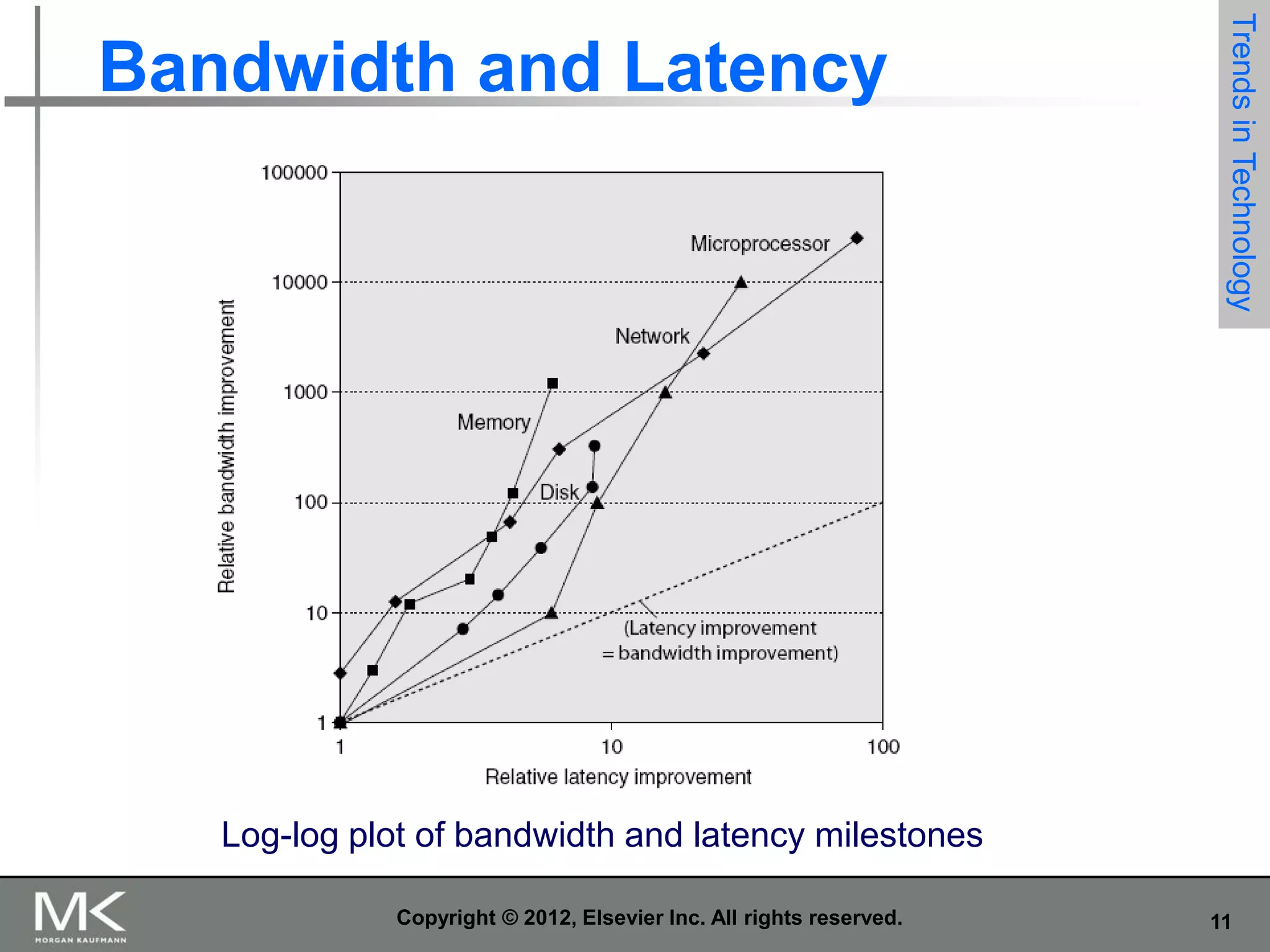
Log-log plot of bandwidth and latency milestones
Copyright © 2012, Elsevier Inc. All rights reserved.

11


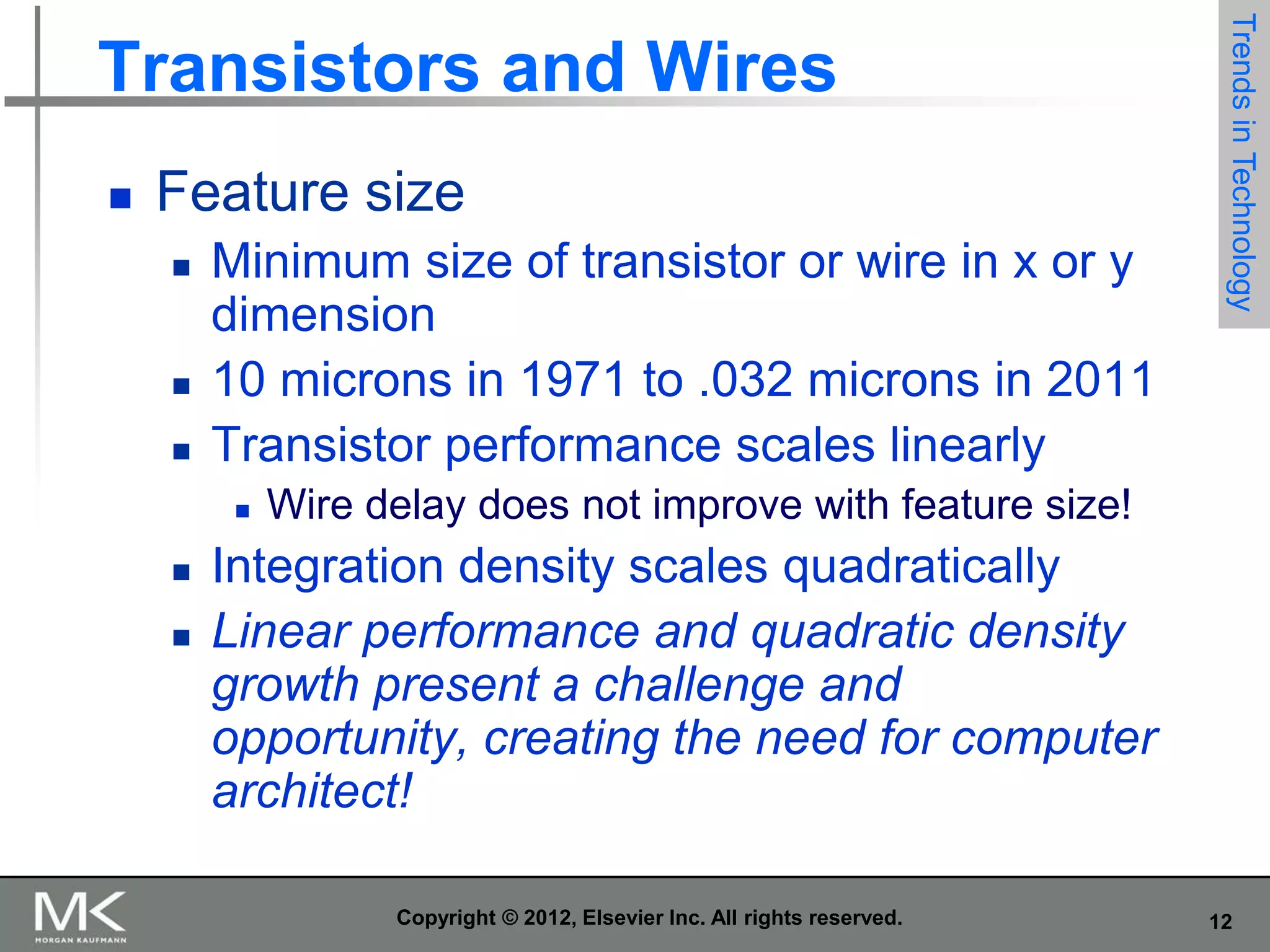
Feature size





Minimum size of transistor or wire in x or y
dimension
10 microns in 1971 to .032 microns in 2011
Transistor performance scales linearly






Trends in Technology

Transistors and Wires

Wire delay does not improve with feature size!

Integration density scales quadratically
Linear performance and quadratic density
growth present a challenge and
opportunity, creating the need for computer
architect!
Copyright © 2012, Elsevier Inc. All rights reserved.

12


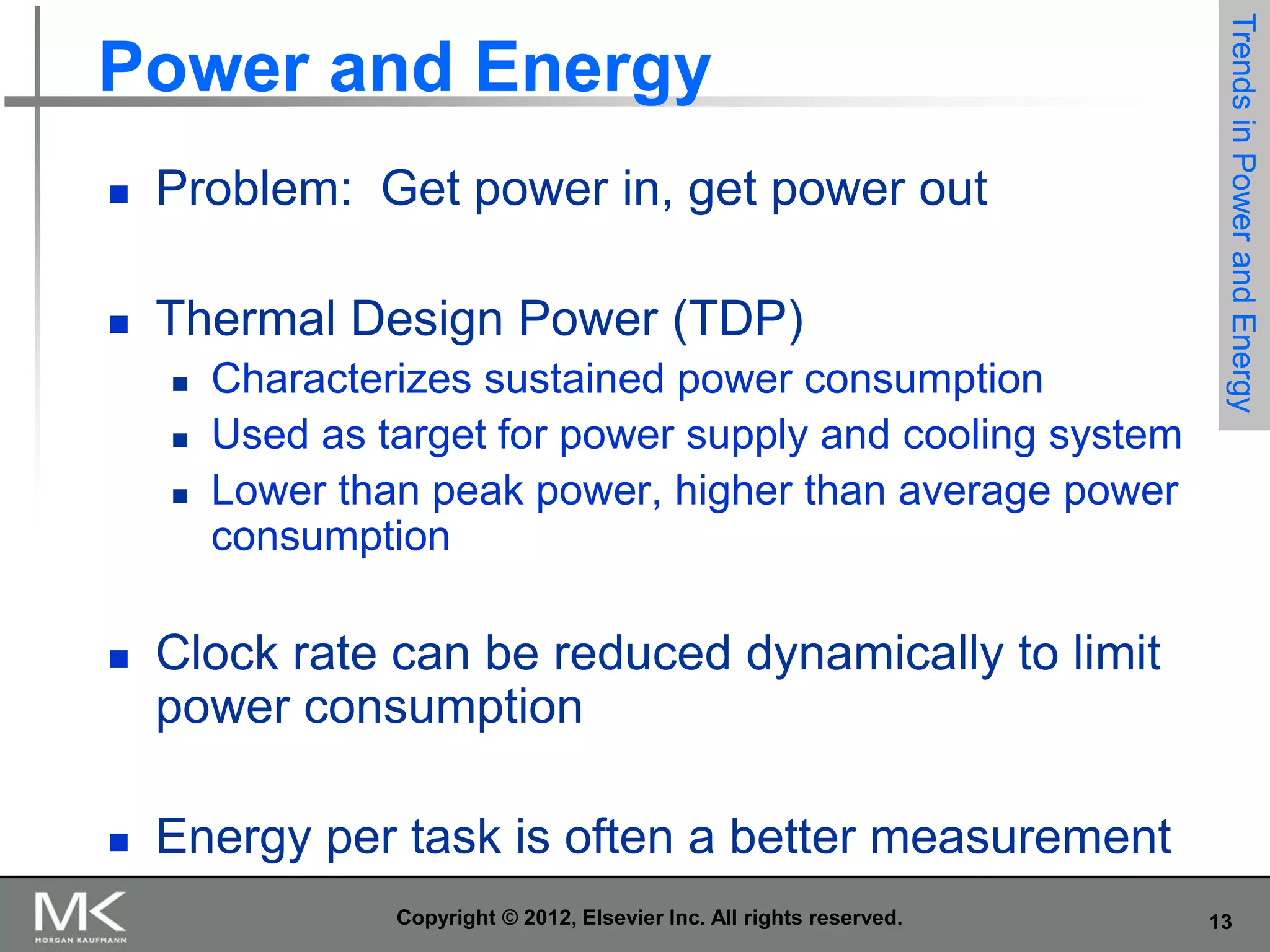
Problem: Get power in, get power out



Thermal Design Power (TDP)




Characterizes sustained power consumption
Used as target for power supply and cooling system
Lower than peak power, higher than average power
consumption



Clock rate can be reduced dynamically to limit
power consumption



Trends in Power and Energy

Power and Energy

Energy per task is often a better measurement
Copyright © 2012, Elsevier Inc. All rights reserved.

13


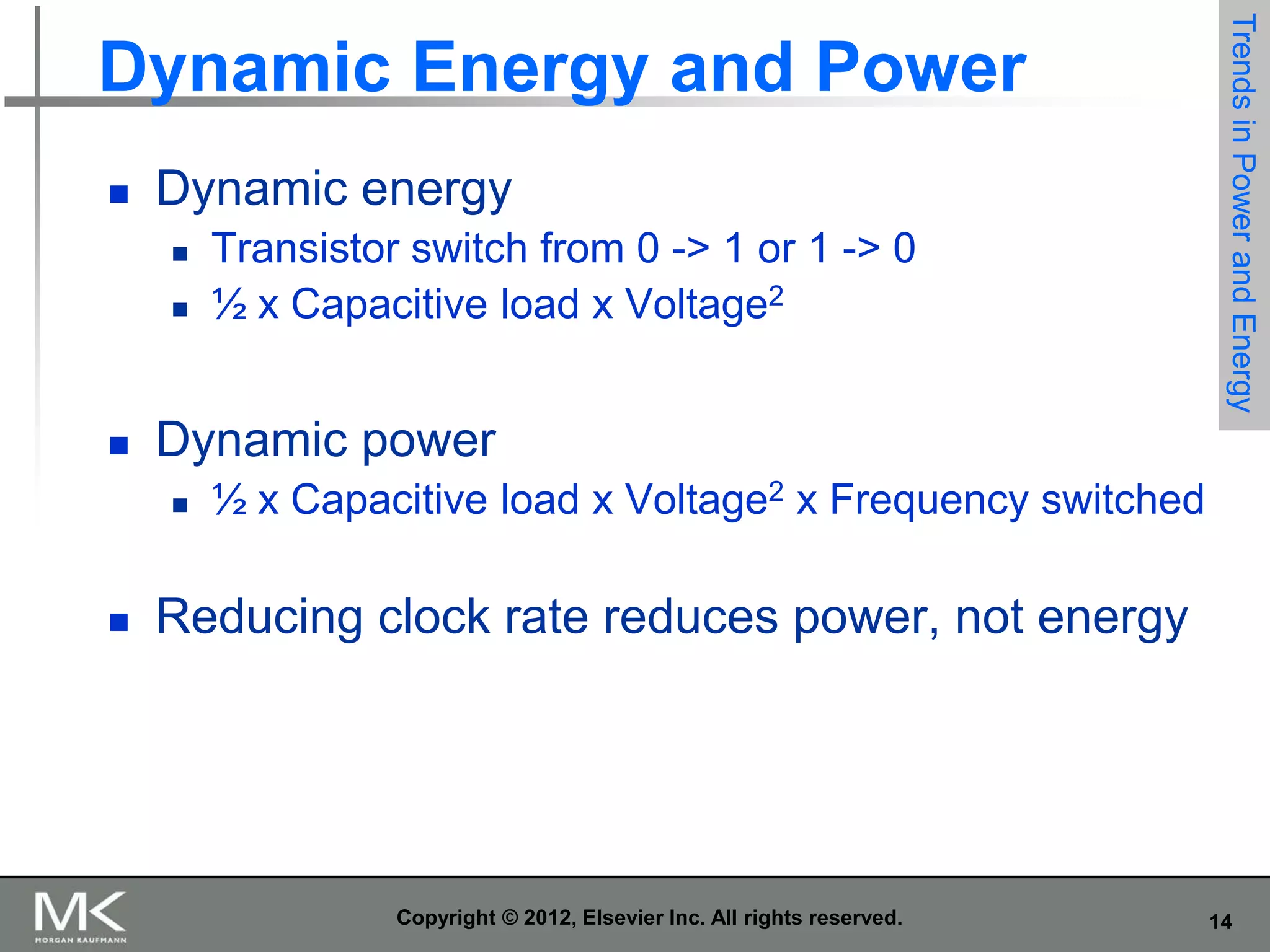
Dynamic energy





Dynamic power




Transistor switch from 0 -> 1 or 1 -> 0
½ x Capacitive load x Voltage2

Trends in Power and Energy

Dynamic Energy and Power

½ x Capacitive load x Voltage2 x Frequency switched

Reducing clock rate reduces power, not energy

Copyright © 2012, Elsevier Inc. All rights reserved.

14








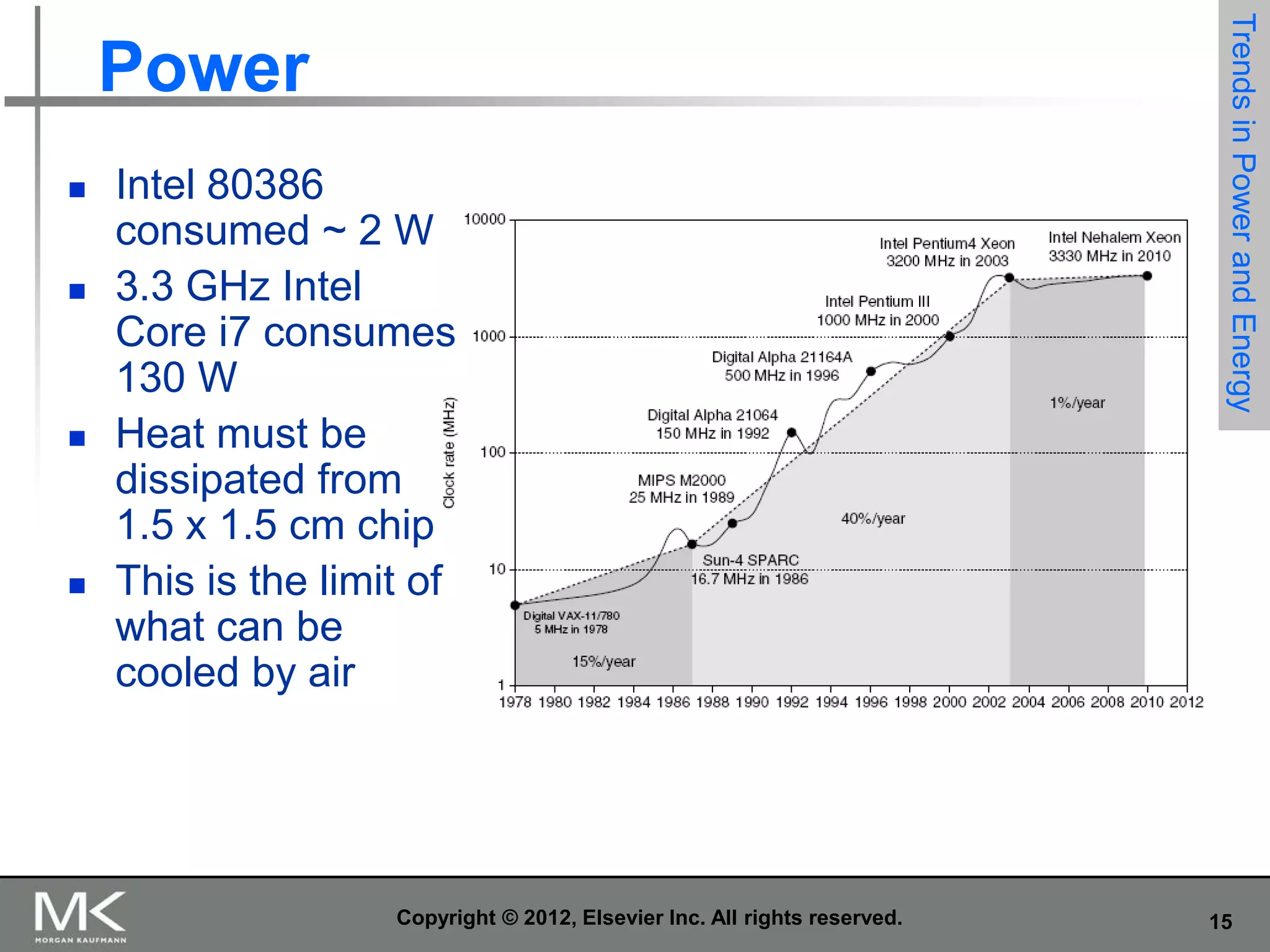
Intel 80386
consumed ~ 2 W
3.3 GHz Intel
Core i7 consumes
130 W
Heat must be
dissipated from
1.5 x 1.5 cm chip
This is the limit of
what can be
cooled by air

Copyright © 2012, Elsevier Inc. All rights reserved.

Trends in Power and Energy

Power

15


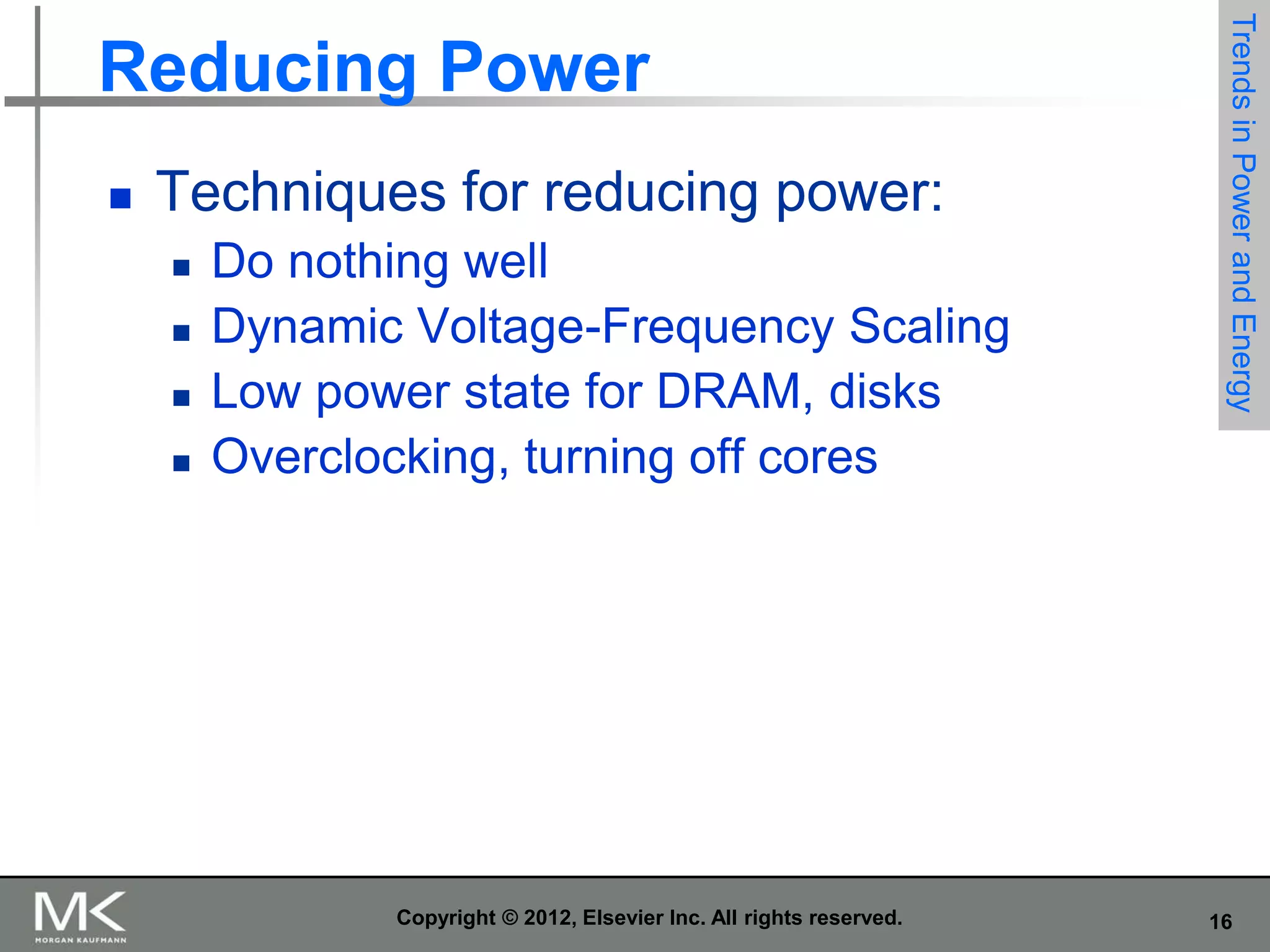
Techniques for reducing power:






Do nothing well
Dynamic Voltage-Frequency Scaling
Low power state for DRAM, disks
Overclocking, turning off cores

Copyright © 2012, Elsevier Inc. All rights reserved.

Trends in Power and Energy

Reducing Power

16


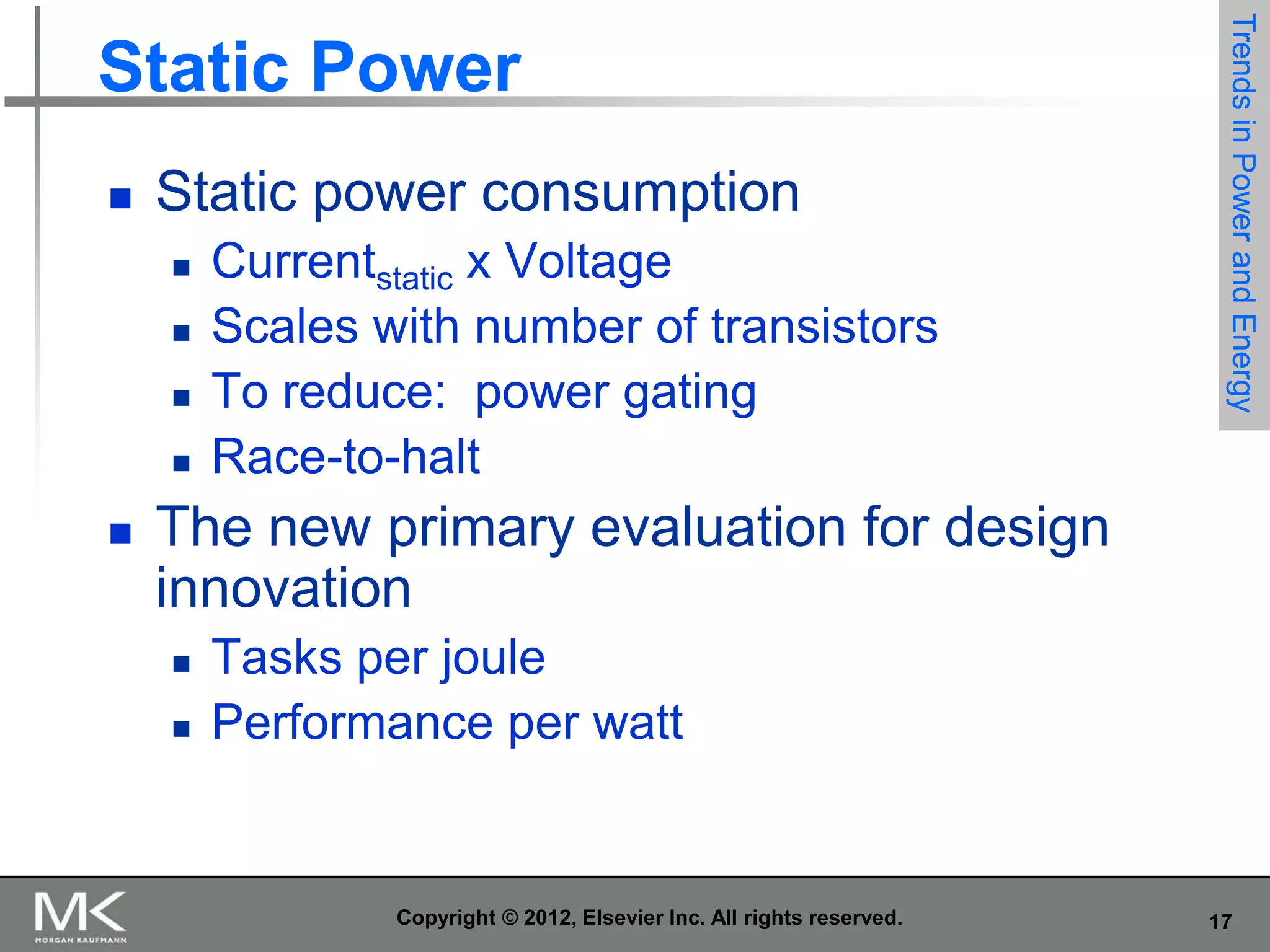
Static power consumption








Currentstatic x Voltage
Scales with number of transistors
To reduce: power gating
Race-to-halt

Trends in Power and Energy

Static Power

The new primary evaluation for design
innovation



Tasks per joule
Performance per watt

Copyright © 2012, Elsevier Inc. All rights reserved.

17


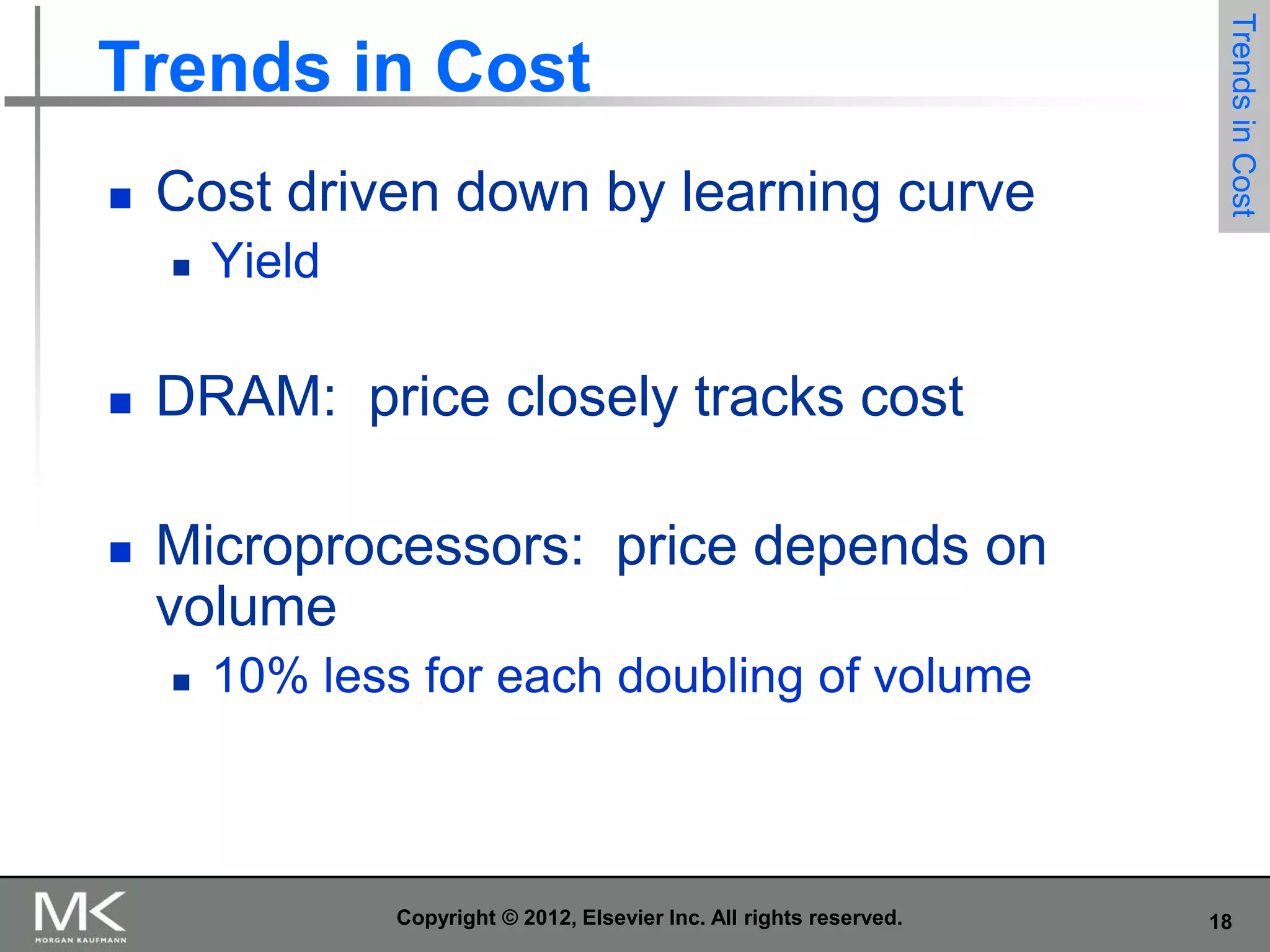
Cost driven down by learning curve


Trends in Cost

Trends in Cost
Yield



DRAM: price closely tracks cost



Microprocessors: price depends on
volume


10% less for each doubling of volume

Copyright © 2012, Elsevier Inc. All rights reserved.

18


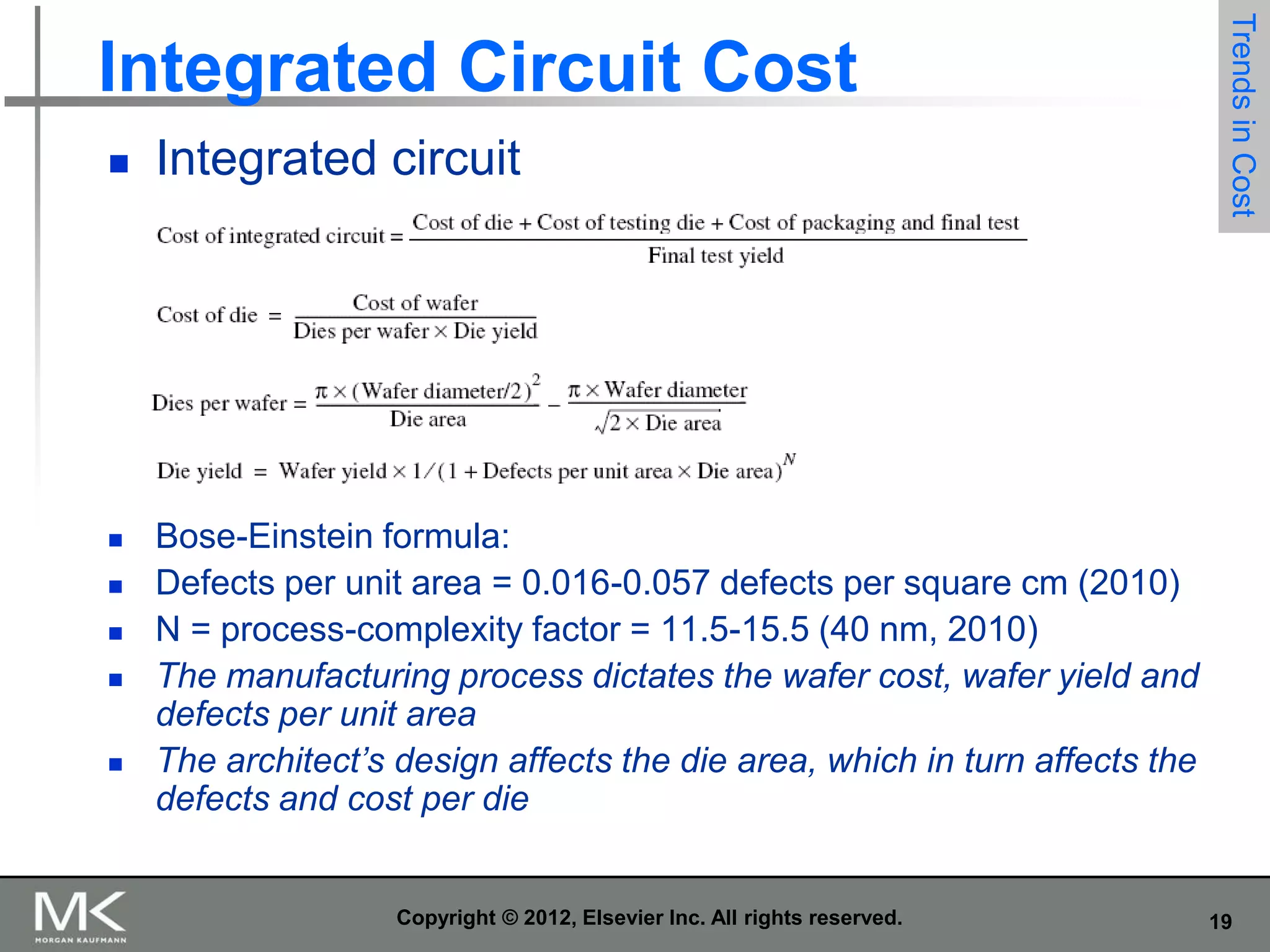
Integrated circuit



Trends in Cost

Integrated Circuit Cost

Bose-Einstein formula:
Defects per unit area = 0.016-0.057 defects per square cm (2010)
N = process-complexity factor = 11.5-15.5 (40 nm, 2010)
The manufacturing process dictates the wafer cost, wafer yield and
defects per unit area
The architect’s design affects the die area, which in turn affects the
defects and cost per die







Copyright © 2012, Elsevier Inc. All rights reserved.

19


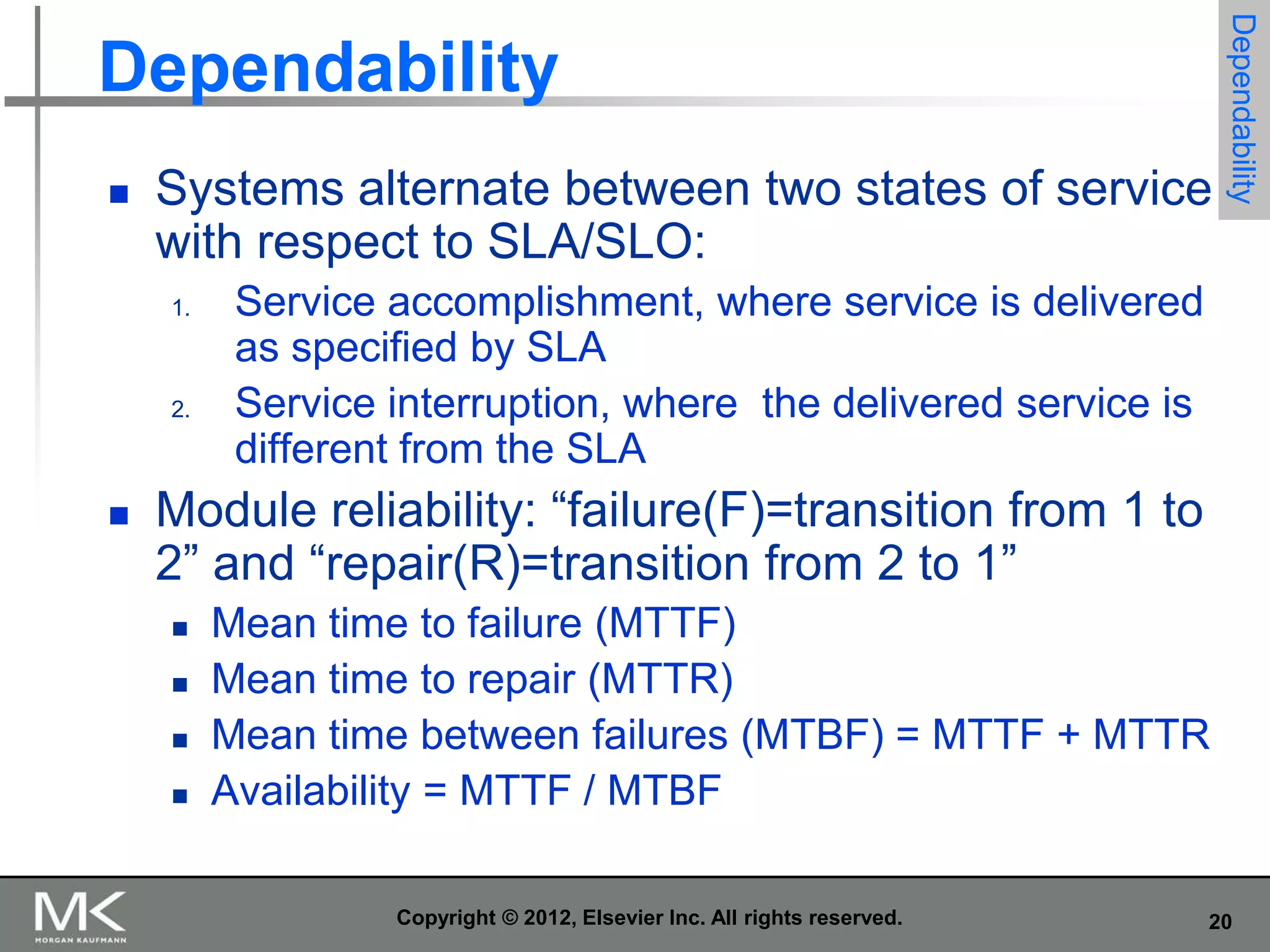
Systems alternate between two states of service
with respect to SLA/SLO:
1.

2.



Dependability

Dependability

Service accomplishment, where service is delivered
as specified by SLA
Service interruption, where the delivered service is
different from the SLA

Module reliability: “failure(F)=transition from 1 to
2” and “repair(R)=transition from 2 to 1”





Mean time to failure (MTTF)
Mean time to repair (MTTR)
Mean time between failures (MTBF) = MTTF + MTTR
Availability = MTTF / MTBF
Copyright © 2012, Elsevier Inc. All rights reserved.

20


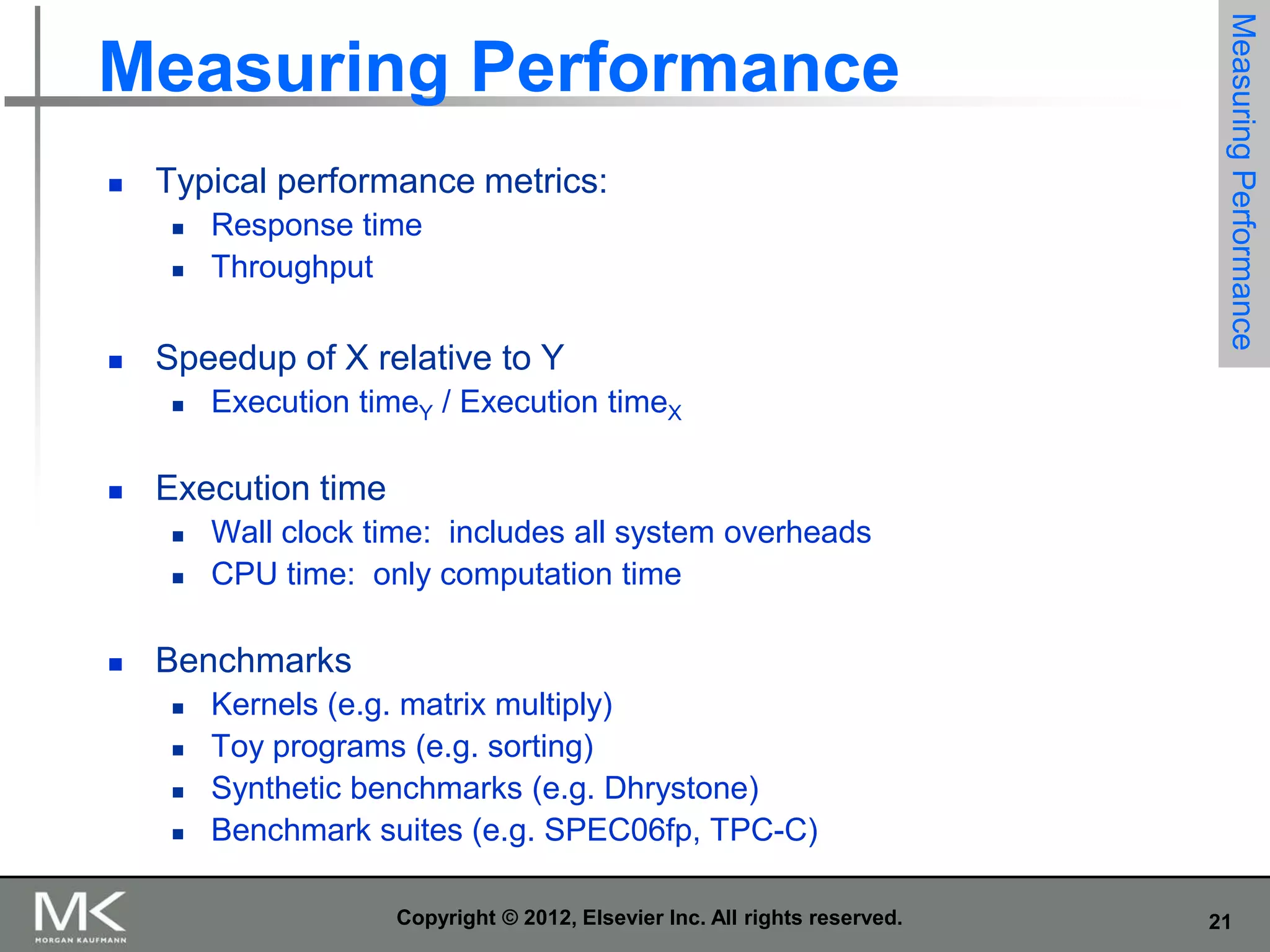
Typical performance metrics:





Speedup of X relative to Y




Execution timeY / Execution timeX

Execution time





Response time
Throughput

Measuring Performance

Measuring Performance

Wall clock time: includes all system overheads
CPU time: only computation time

Benchmarks






Kernels (e.g. matrix multiply)
Toy programs (e.g. sorting)
Synthetic benchmarks (e.g. Dhrystone)
Benchmark suites (e.g. SPEC06fp, TPC-C)
Copyright © 2012, Elsevier Inc. All rights reserved.

21


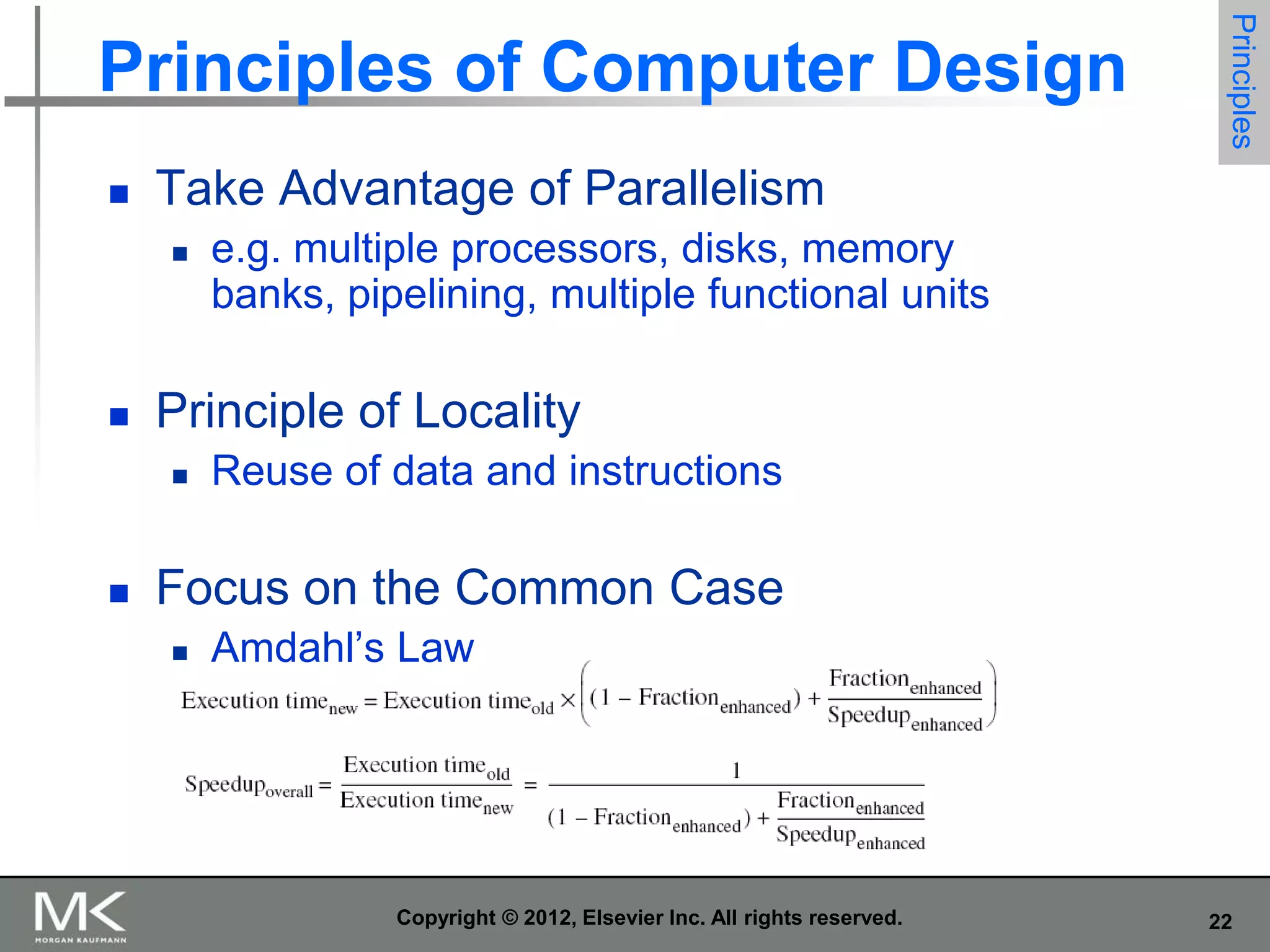
Take Advantage of Parallelism




e.g. multiple processors, disks, memory
banks, pipelining, multiple functional units

Principle of Locality




Principles

Principles of Computer Design

Reuse of data and instructions

Focus on the Common Case


Amdahl’s Law

Copyright © 2012, Elsevier Inc. All rights reserved.

22


Principles

Principles of Computer Design
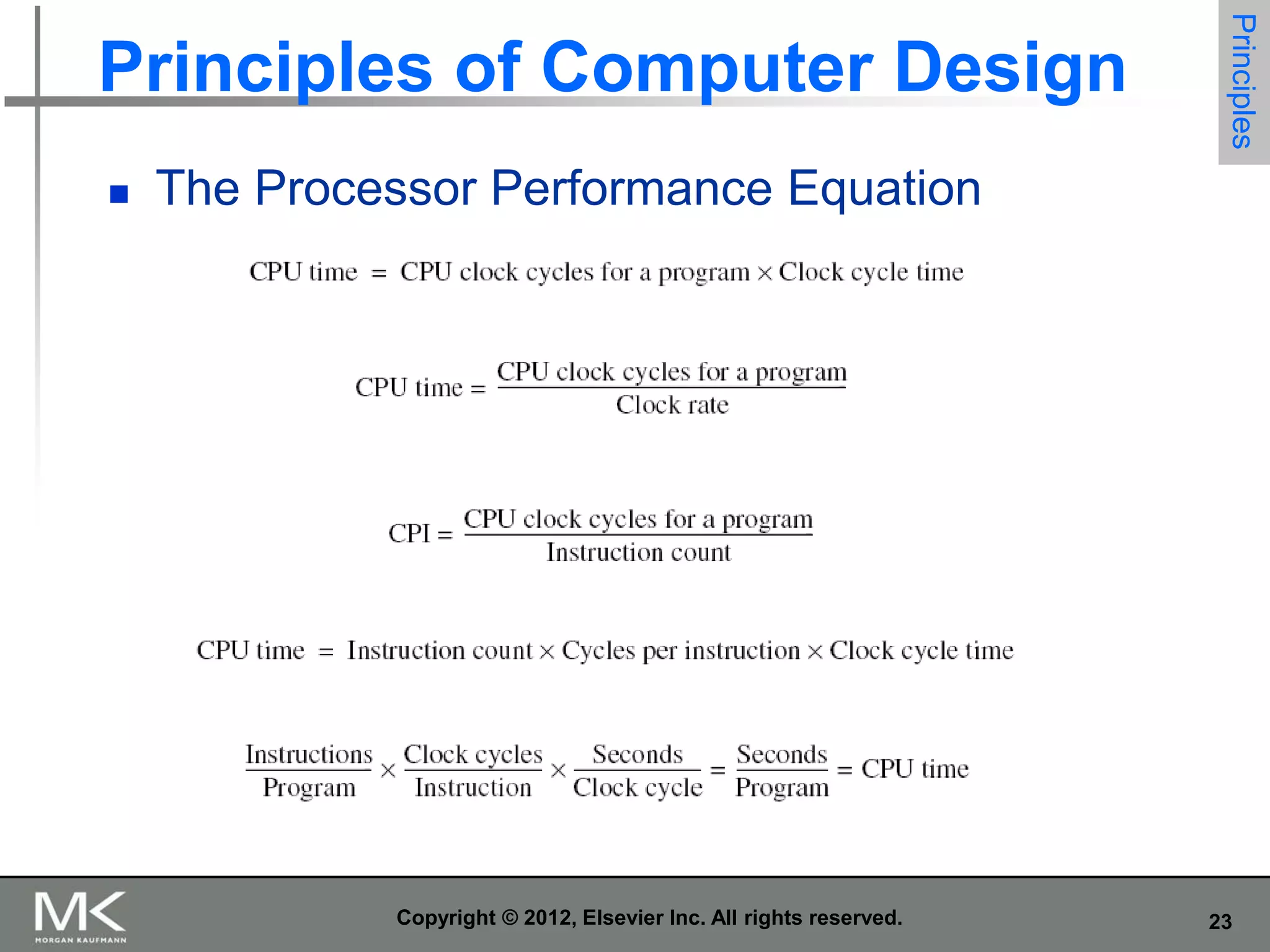
The Processor Performance Equation

Copyright © 2012, Elsevier Inc. All rights reserved.

23


Principles

Principles of Computer Design
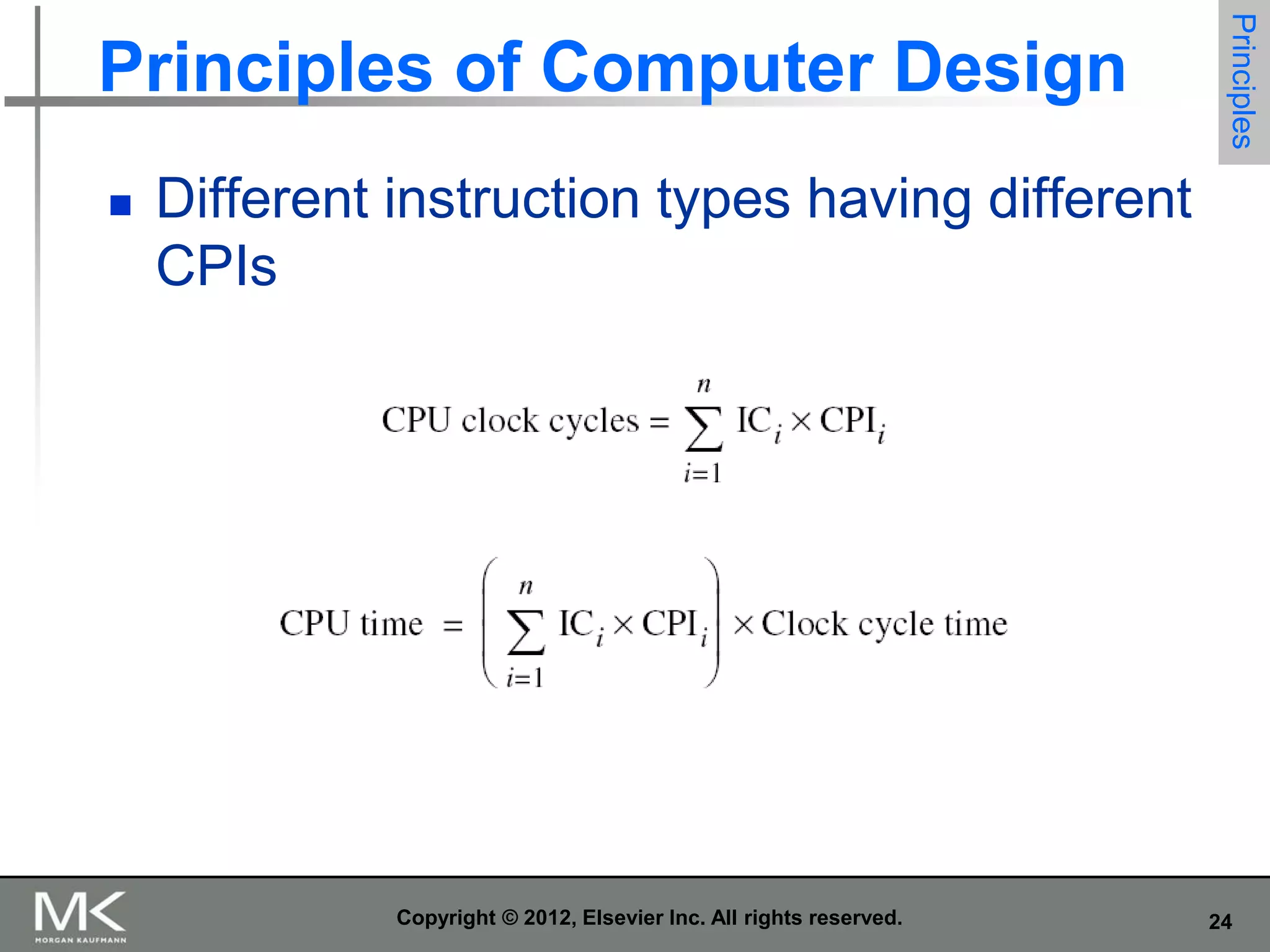
Different instruction types having different
CPIs

Copyright © 2012, Elsevier Inc. All rights reserved.

24
Chapter 1 Review & Examples

Copyright © 2012, Elsevier Inc. All rights reserved.

25
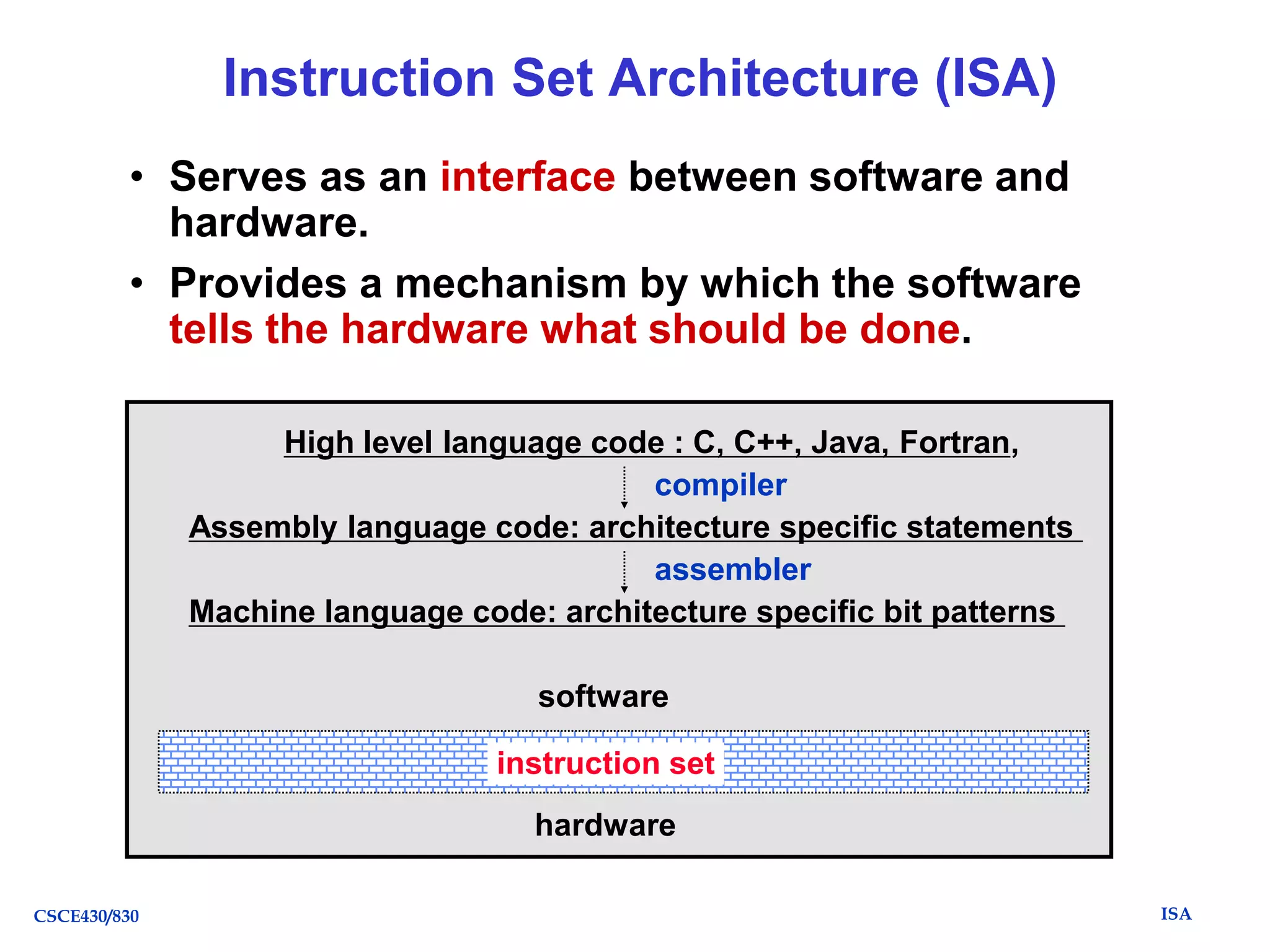
Instruction Set Architecture (ISA)
• Serves as an interface between software and
hardware.
• Provides a mechanism by which the software
tells the hardware what should be done.
High level language code : C, C++, Java, Fortran,
compiler
Assembly language code: architecture specific statements
assembler
Machine language code: architecture specific bit patterns
software
instruction set
hardware
CSCE430/830

ISA
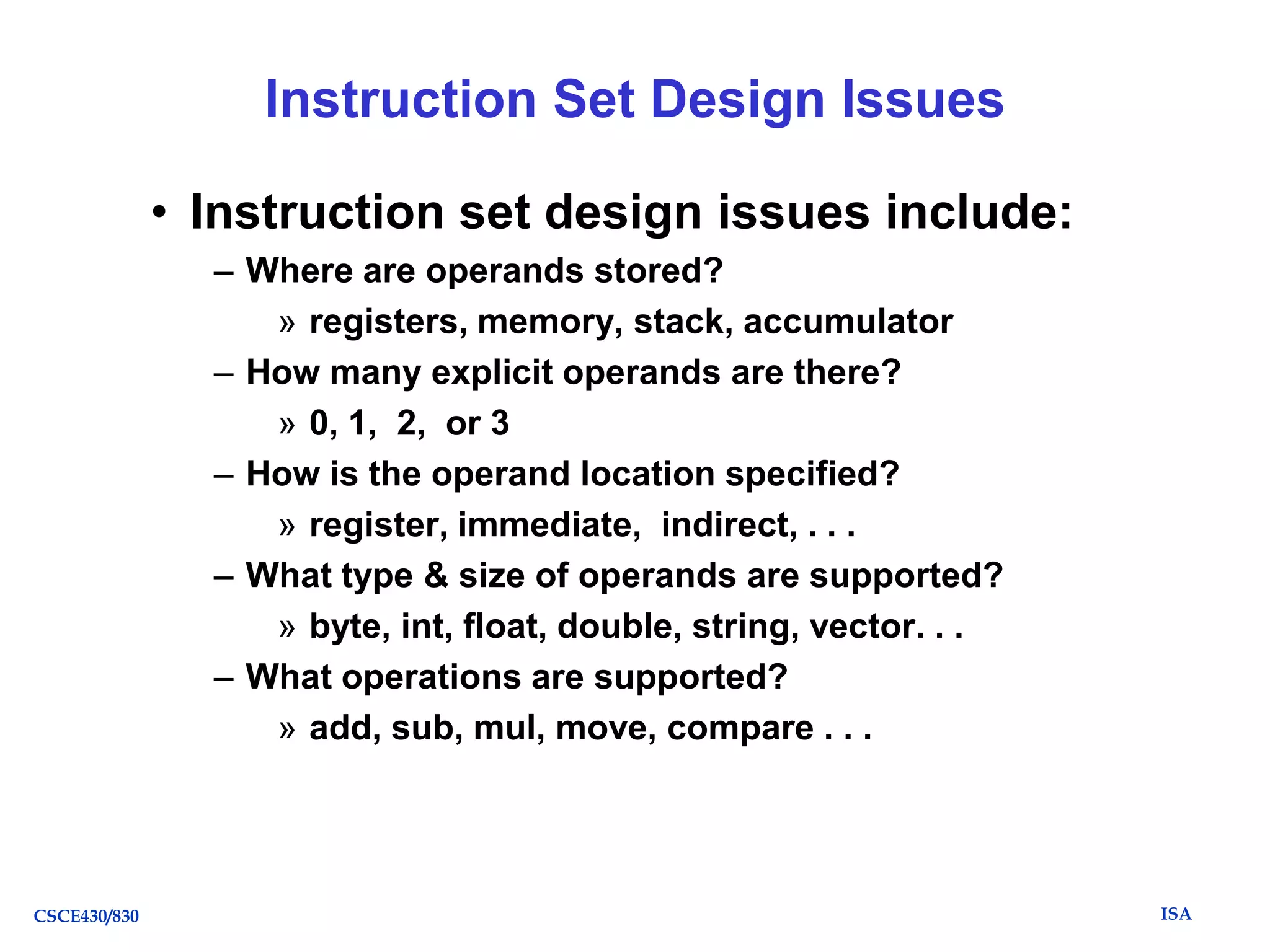
Instruction Set Design Issues
• Instruction set design issues include:
– Where are operands stored?
» registers, memory, stack, accumulator
– How many explicit operands are there?
» 0, 1, 2, or 3
– How is the operand location specified?
» register, immediate, indirect, . . .
– What type & size of operands are supported?
» byte, int, float, double, string, vector. . .
– What operations are supported?
» add, sub, mul, move, compare . . .

CSCE430/830

ISA
Classifying ISAs
Accumulator (before 1960, e.g. 68HC11):
1-address

add A

acc acc + mem[A]

Stack (1960s to 1970s):
0-address

add

tos tos + next

Memory-Memory (1970s to 1980s):
2-address
3-address

add A, B
add A, B, C

mem[A] mem[A] + mem[B]
mem[A] mem[B] + mem[C]

Register-Memory (1970s to present, e.g. 80x86):
2-address

add R1, A
load R1, A

R1 R1 + mem[A]
R1 mem[A]

Register-Register (Load/Store, RISC) (1960s to present, e.g.
MIPS):
3-address

CSCE430/830

add R1, R2, R3
load R1, R2
store R1, R2

R1 R2 + R3
R1 mem[R2]
mem[R1] R2
ISA
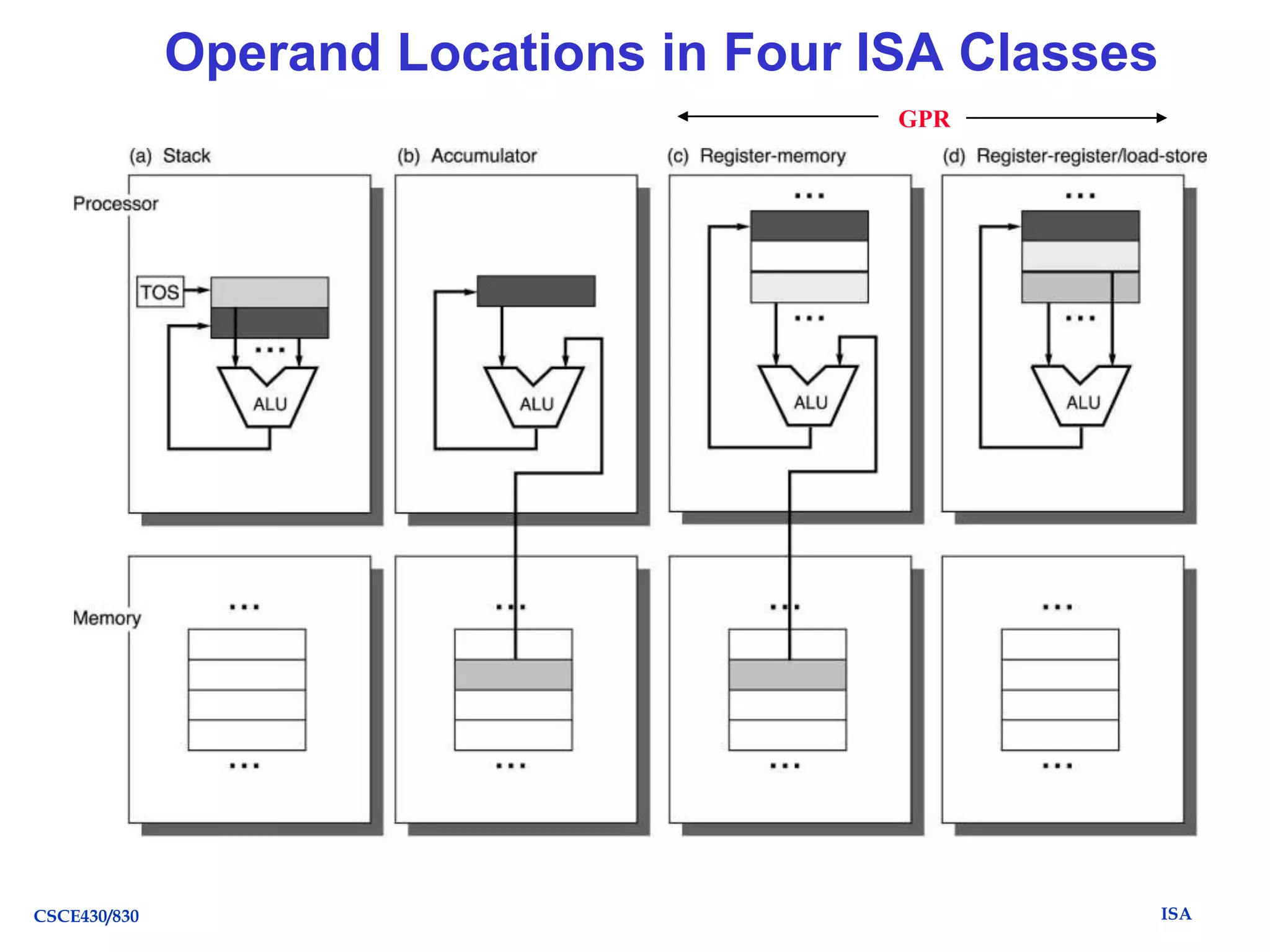
Operand Locations in Four ISA Classes
GPR

CSCE430/830

ISA
Code Sequence C = A + B
for Four Instruction Sets
Stack

Accumulator

Push A
Push B
Add
Pop C

Load A
Add B
Store C

memory
CSCE430/830

acc = acc + mem[C]

Register
(register-memory)
Load R1, A
Add R1, B
Store C, R1

memory
R1 = R1 + mem[C]

Register (loadstore)
Load R1,A
Load R2, B
Add R3, R1, R2
Store C, R3

R3 = R1 + R2

ISA
Types of Addressing Modes (VAX)
Addressing Mode
1. Register direct
2. Immediate
3. Displacement
4. Register indirect
5. Indexed
6. Direct
7. Memory Indirect
8. Autoincrement

Action
R4 <- R4 + R3
R4 <- R4 + 3
R4 <- R4 + M[100 + R1]
R4 <- R4 + M[R1]
R4 <- R4 + M[R1 + R2]
R4 <- R4 + M[1000]
R4 <- R4 + M[M[R3]]
R4 <- R4 + M[R2]
R2 <- R2 + d
9. Autodecrement
Add R4, (R2)R4 <- R4 + M[R2]
R2 <- R2 - d
10. Scaled
Add R4, 100(R2)[R3] R4 <- R4 +
M[100 + R2 + R3*d]
• Studies by [Clark and Emer] indicate that modes 1-4 account for
93% of all operands on the VAX.
CSCE430/830

Example
Add R4, R3
Add R4, #3
Add R4, 100(R1)
Add R4, (R1)
Add R4, (R1 + R2)
Add R4, (1000)
Add R4, @(R3)
Add R4, (R2)+

ISA
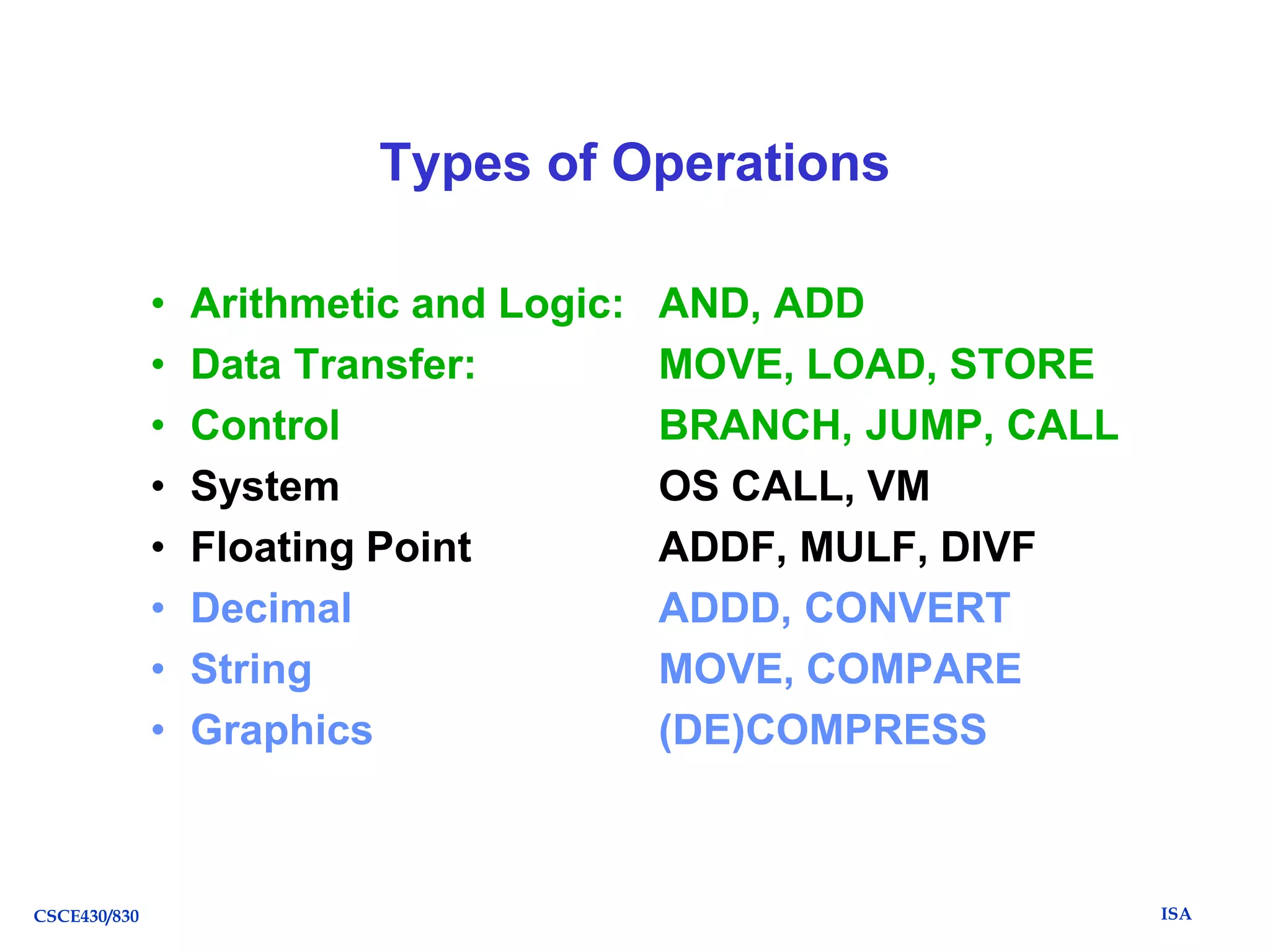
Types of Operations
•
•
•
•
•
•
•
•

CSCE430/830

Arithmetic and Logic:
Data Transfer:
Control
System
Floating Point
Decimal
String
Graphics

AND, ADD
MOVE, LOAD, STORE
BRANCH, JUMP, CALL
OS CALL, VM
ADDF, MULF, DIVF
ADDD, CONVERT
MOVE, COMPARE
(DE)COMPRESS

ISA
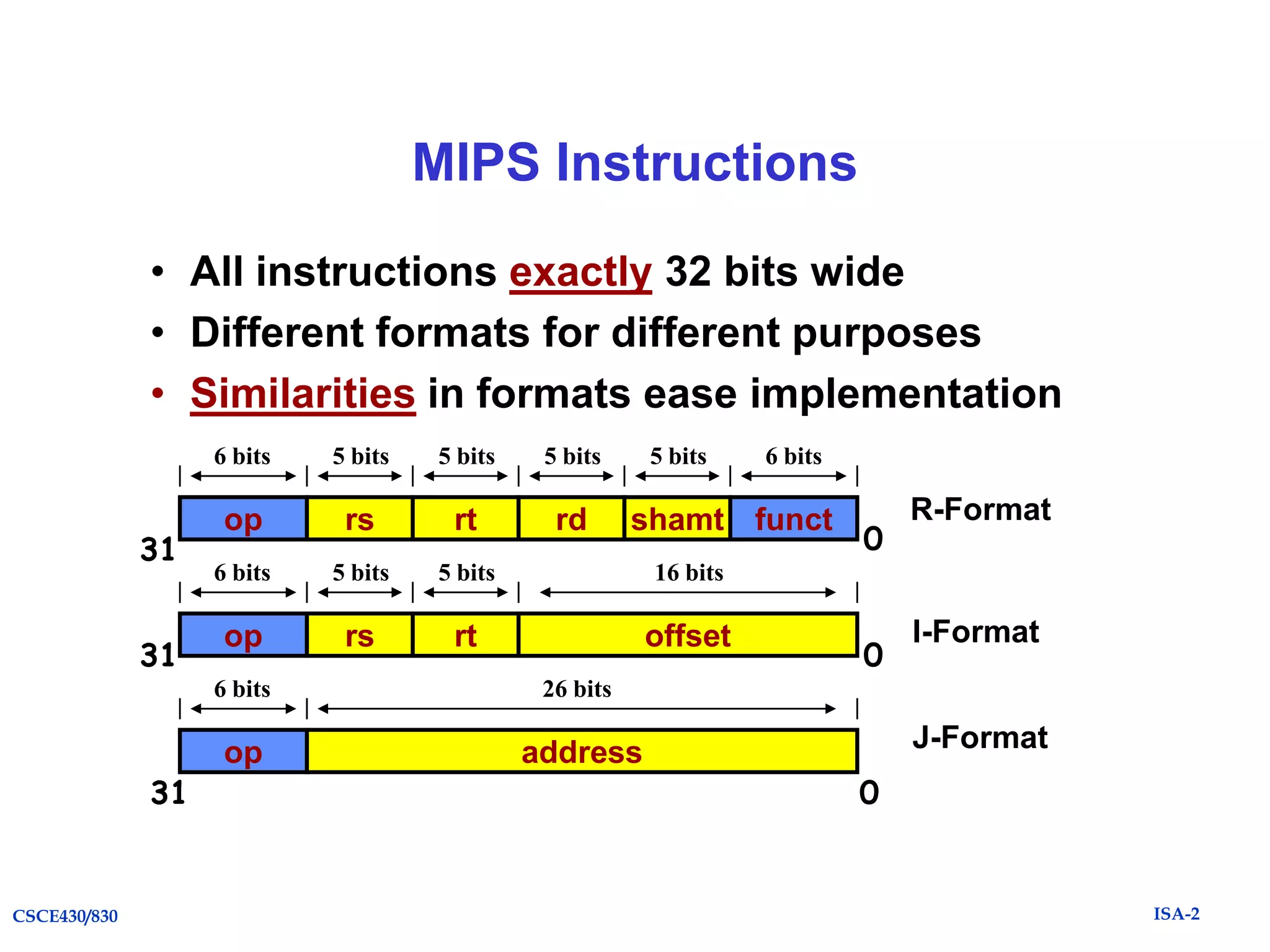
MIPS Instructions
• All instructions exactly 32 bits wide
• Different formats for different purposes
• Similarities in formats ease implementation
6 bits

31

31

5 bits

5 bits

5 bits

5 bits

op

rs

rt

rd

6 bits

5 bits

5 bits

16 bits

op

rs

rt

offset

shamt funct

6 bits

31

CSCE430/830

6 bits

address

0

I-Format

26 bits

op

0

R-Format

J-Format
0

ISA-2
MIPS Instruction Types
• Arithmetic & Logical - manipulate data in
registers
add $s1, $s2, $s3
or $s3, $s4, $s5

$s1 = $s2 + $s3
$s3 = $s4 OR $s5

• Data Transfer - move register data to/from
memory  load & store
lw $s1, 100($s2)
sw $s1, 100($s2)

$s1 = Memory[$s2 + 100]
Memory[$s2 + 100] = $s1

• Branch - alter program flow
beq $s1, $s2, 25

if ($s1==$s1) PC = PC + 4 + 4*25
else PC = PC + 4

CSCE430/830

ISA-2
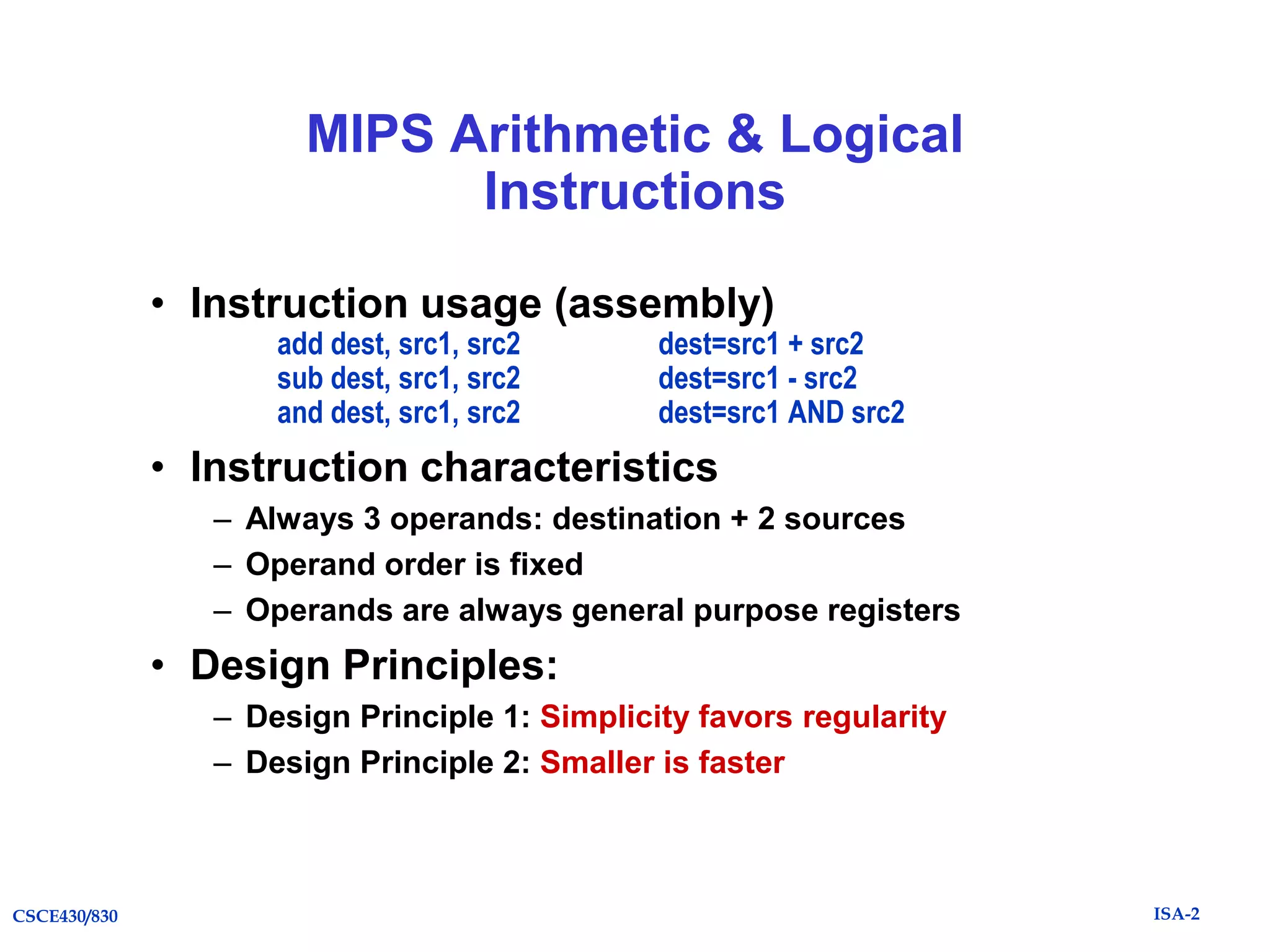
MIPS Arithmetic & Logical
Instructions
• Instruction usage (assembly)
add dest, src1, src2
sub dest, src1, src2
and dest, src1, src2

dest=src1 + src2
dest=src1 - src2
dest=src1 AND src2

• Instruction characteristics
– Always 3 operands: destination + 2 sources
– Operand order is fixed
– Operands are always general purpose registers

• Design Principles:
– Design Principle 1: Simplicity favors regularity
– Design Principle 2: Smaller is faster

CSCE430/830

ISA-2
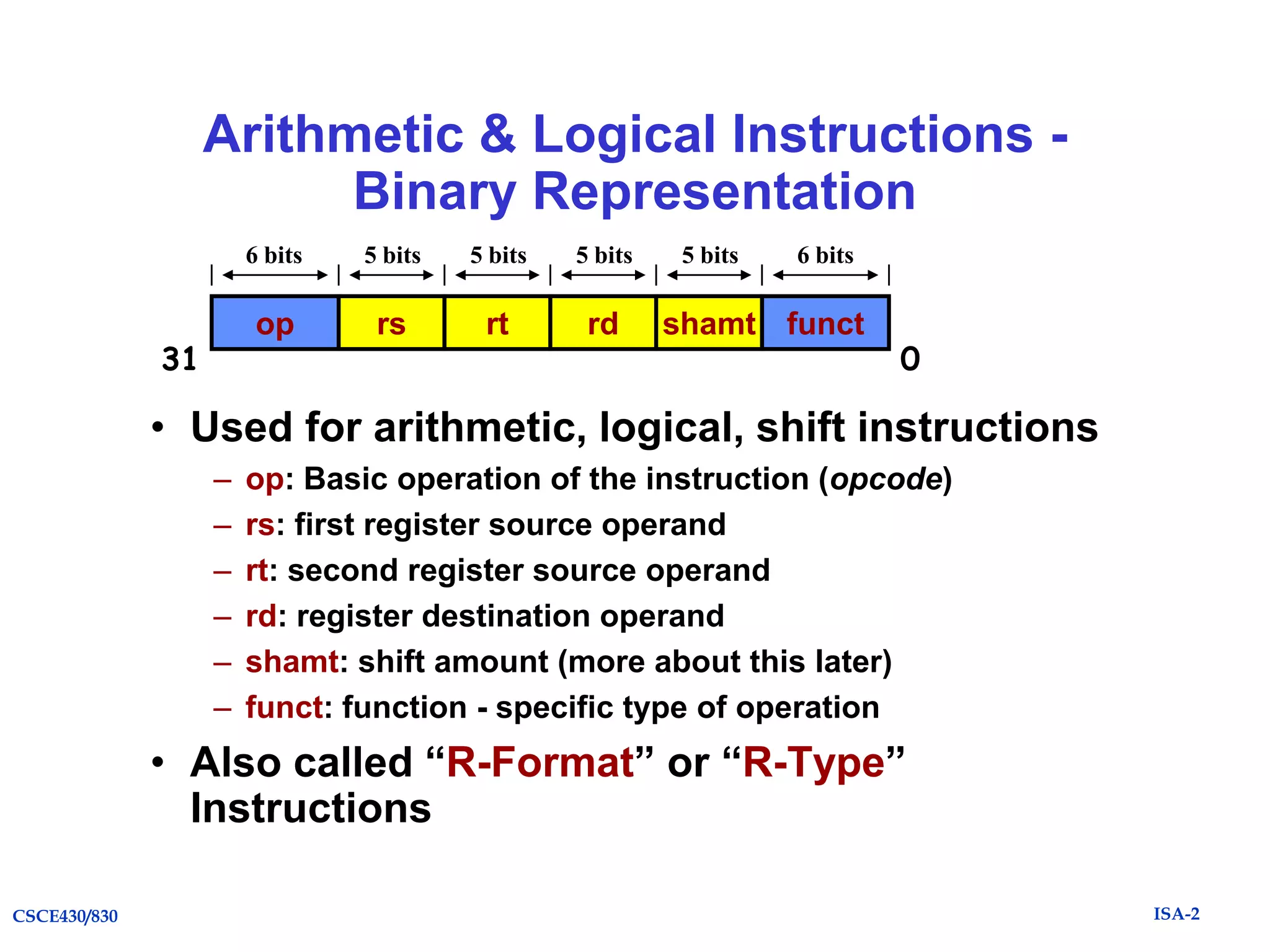
Arithmetic & Logical Instructions Binary Representation
6 bits

5 bits

5 bits

op

31

5 bits

rs

rt

rd

5 bits

6 bits

shamt funct

0

• Used for arithmetic, logical, shift instructions
–
–
–
–
–
–

op: Basic operation of the instruction (opcode)
rs: first register source operand
rt: second register source operand
rd: register destination operand
shamt: shift amount (more about this later)
funct: function - specific type of operation

• Also called “R-Format” or “R-Type”
Instructions
CSCE430/830

ISA-2
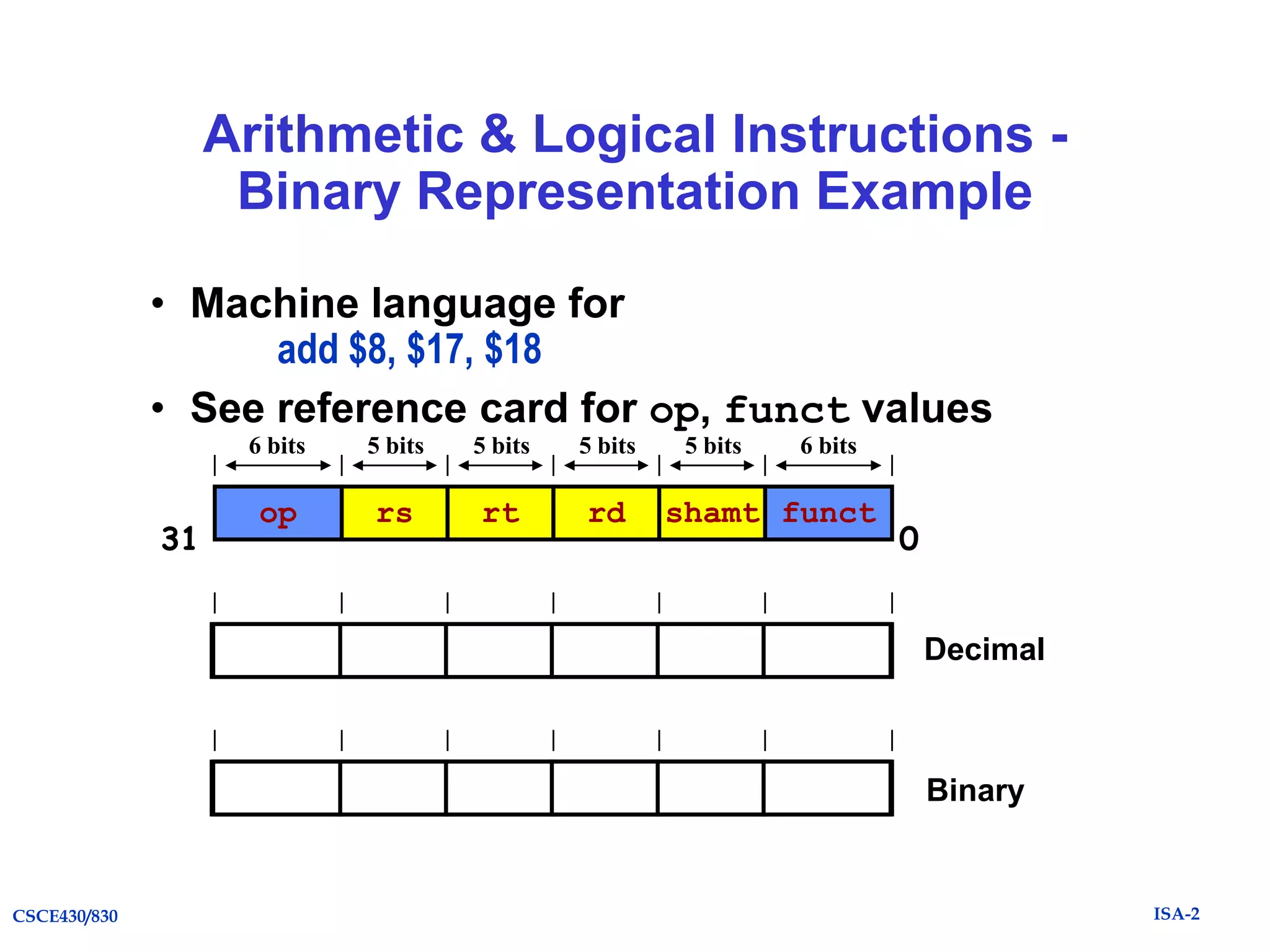
Arithmetic & Logical Instructions Binary Representation Example
• Machine language for
add $8, $17, $18
• See reference card for op, funct values
6 bits

5 bits

5 bits

op

rs

rt

rd

0

31

5 bits

17

18

8

5 bits

6 bits

shamt funct

0

32

000000 10001 10010 01000 00000 100000

CSCE430/830

0

Decimal

Binary

ISA-2
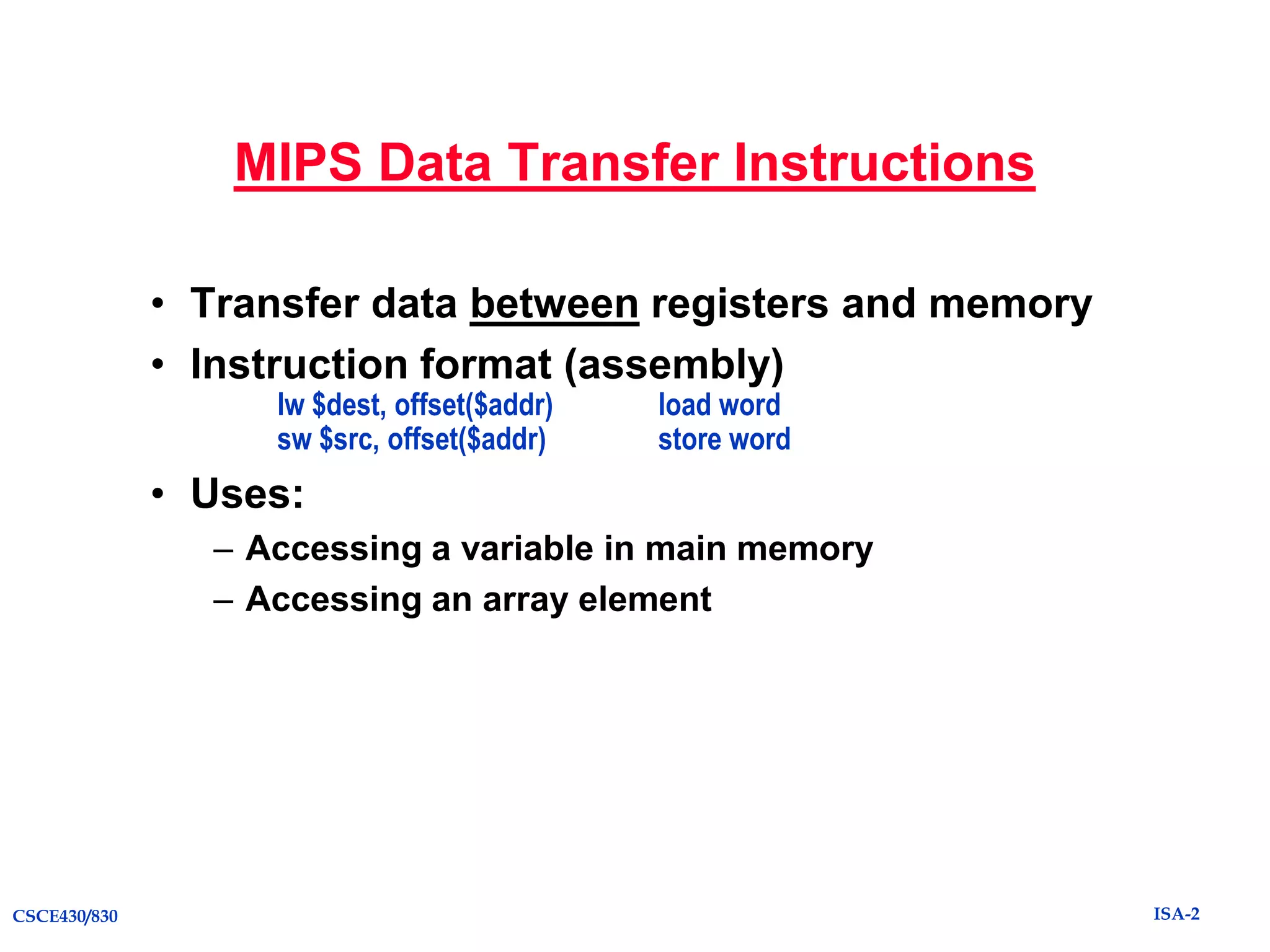
MIPS Data Transfer Instructions
• Transfer data between registers and memory
• Instruction format (assembly)
lw $dest, offset($addr)
sw $src, offset($addr)

load word
store word

• Uses:
– Accessing a variable in main memory
– Accessing an array element

CSCE430/830

ISA-2
Review: Chapter 1
• Classes of Computers and Classes of
Parallelism
• Technology Trend
• Dependability
• Performance Measurements and Benchmarks
• Principles

CSCE430/830

ISA-2
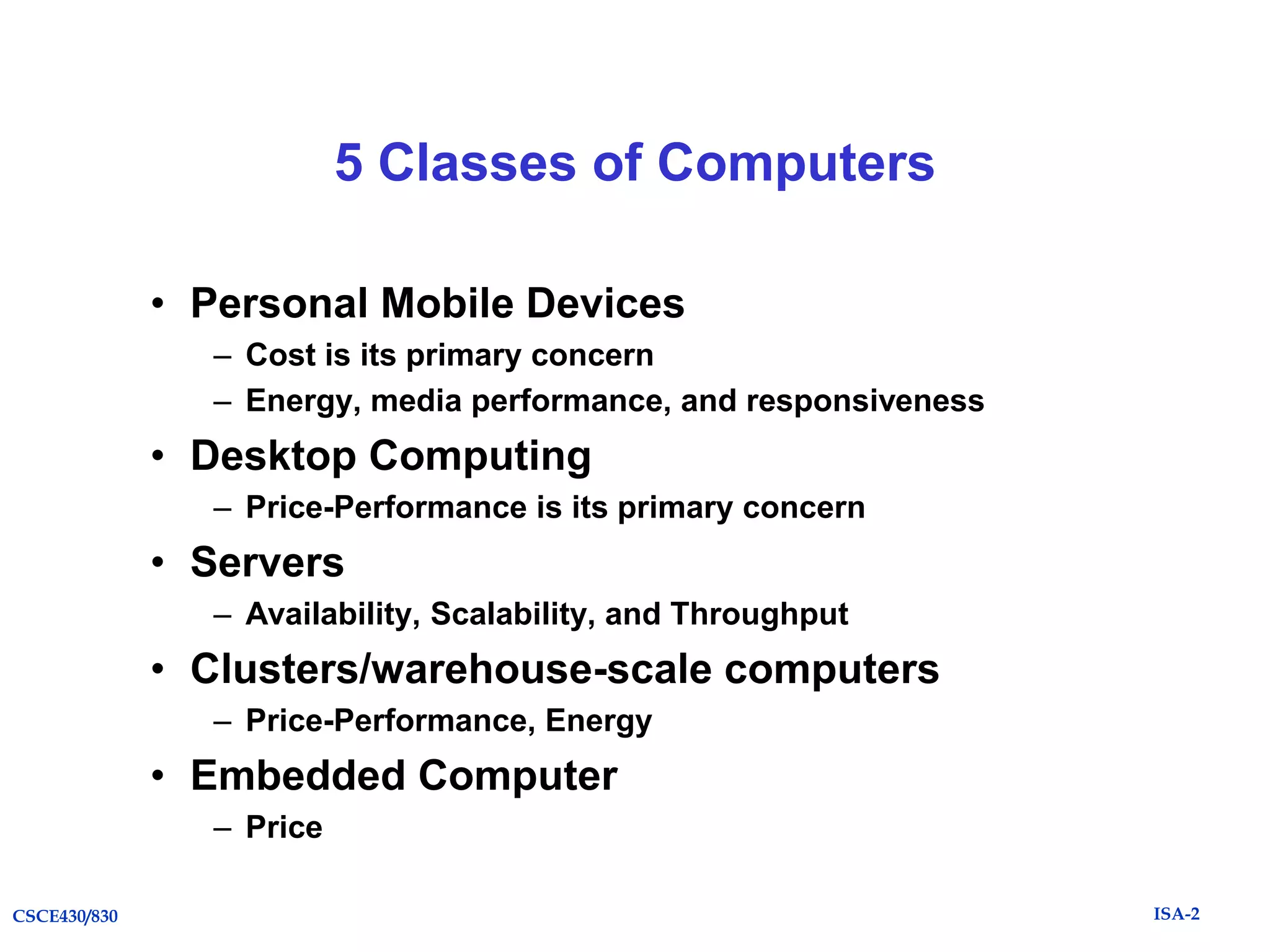
5 Classes of Computers
• Personal Mobile Devices
– Cost is its primary concern
– Energy, media performance, and responsiveness

• Desktop Computing
– Price-Performance is its primary concern

• Servers
– Availability, Scalability, and Throughput

• Clusters/warehouse-scale computers
– Price-Performance, Energy

• Embedded Computer
– Price
CSCE430/830

ISA-2
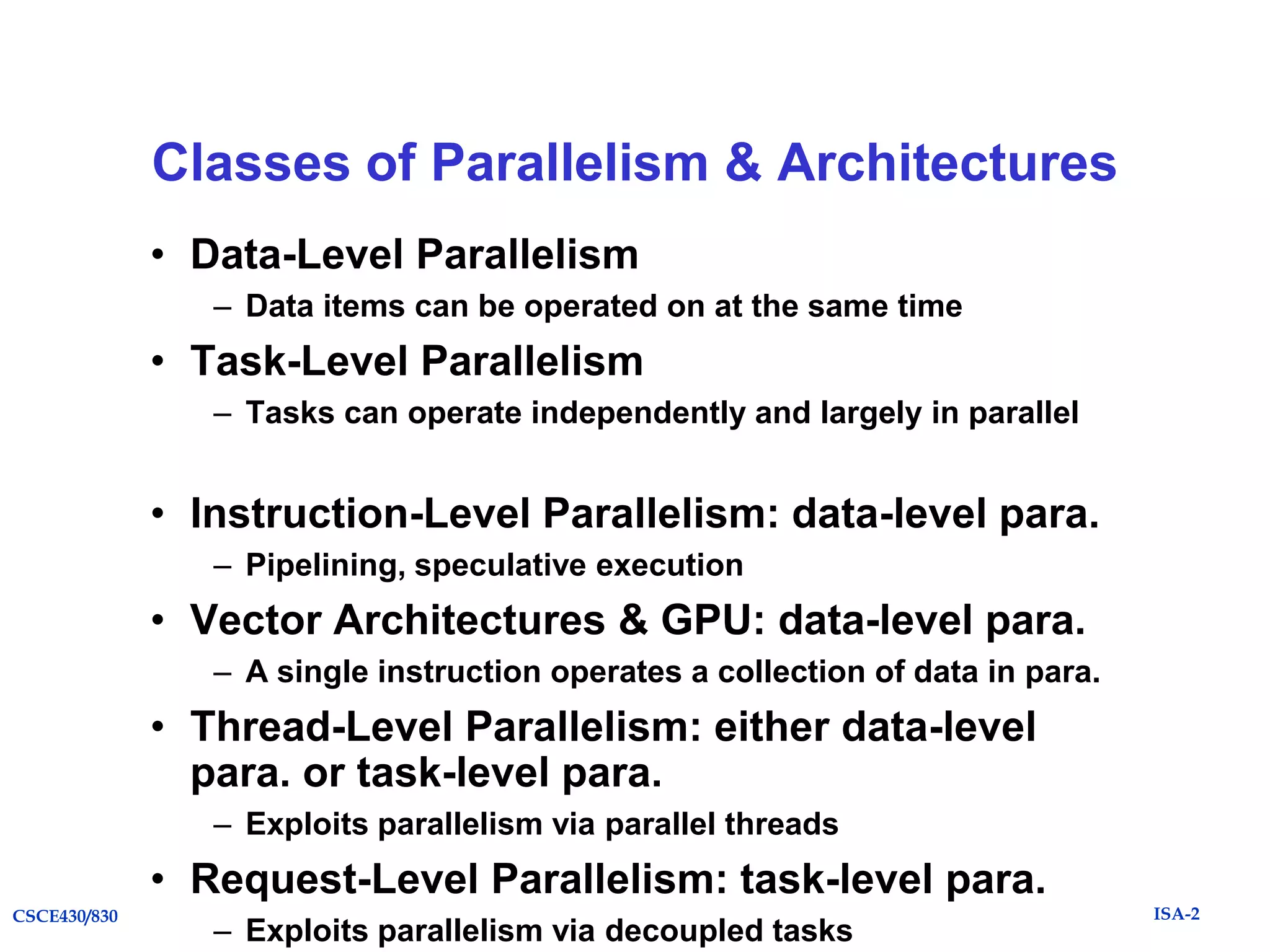
Classes of Parallelism & Architectures
• Data-Level Parallelism
– Data items can be operated on at the same time

• Task-Level Parallelism
– Tasks can operate independently and largely in parallel

• Instruction-Level Parallelism: data-level para.
– Pipelining, speculative execution

• Vector Architectures & GPU: data-level para.
– A single instruction operates a collection of data in para.

• Thread-Level Parallelism: either data-level
para. or task-level para.
– Exploits parallelism via parallel threads

• Request-Level Parallelism: task-level para.
CSCE430/830

– Exploits parallelism via decoupled tasks

ISA-2
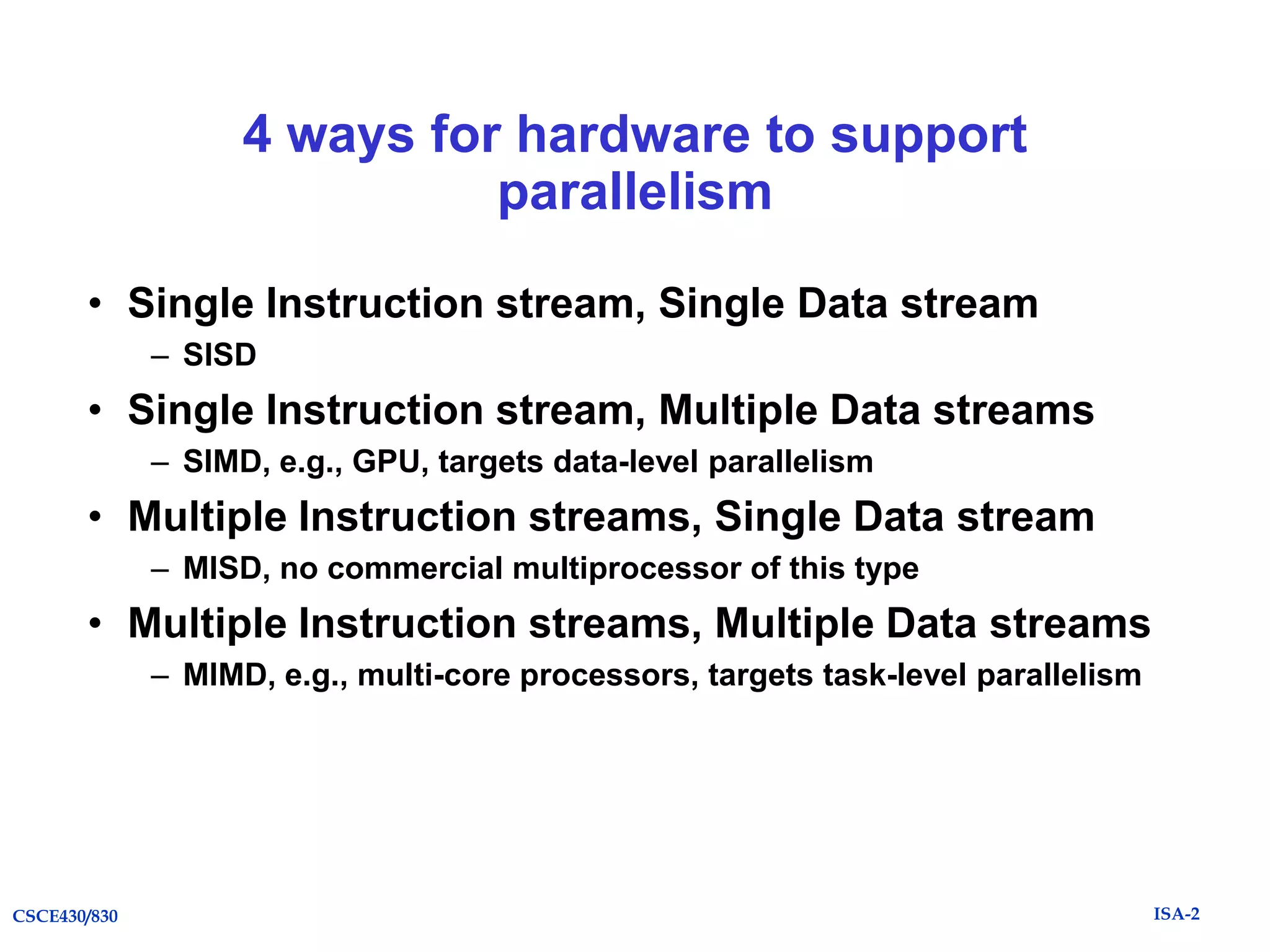
4 ways for hardware to support
parallelism
• Single Instruction stream, Single Data stream
– SISD

• Single Instruction stream, Multiple Data streams
– SIMD, e.g., GPU, targets data-level parallelism

• Multiple Instruction streams, Single Data stream
– MISD, no commercial multiprocessor of this type

• Multiple Instruction streams, Multiple Data streams
– MIMD, e.g., multi-core processors, targets task-level parallelism

CSCE430/830

ISA-2
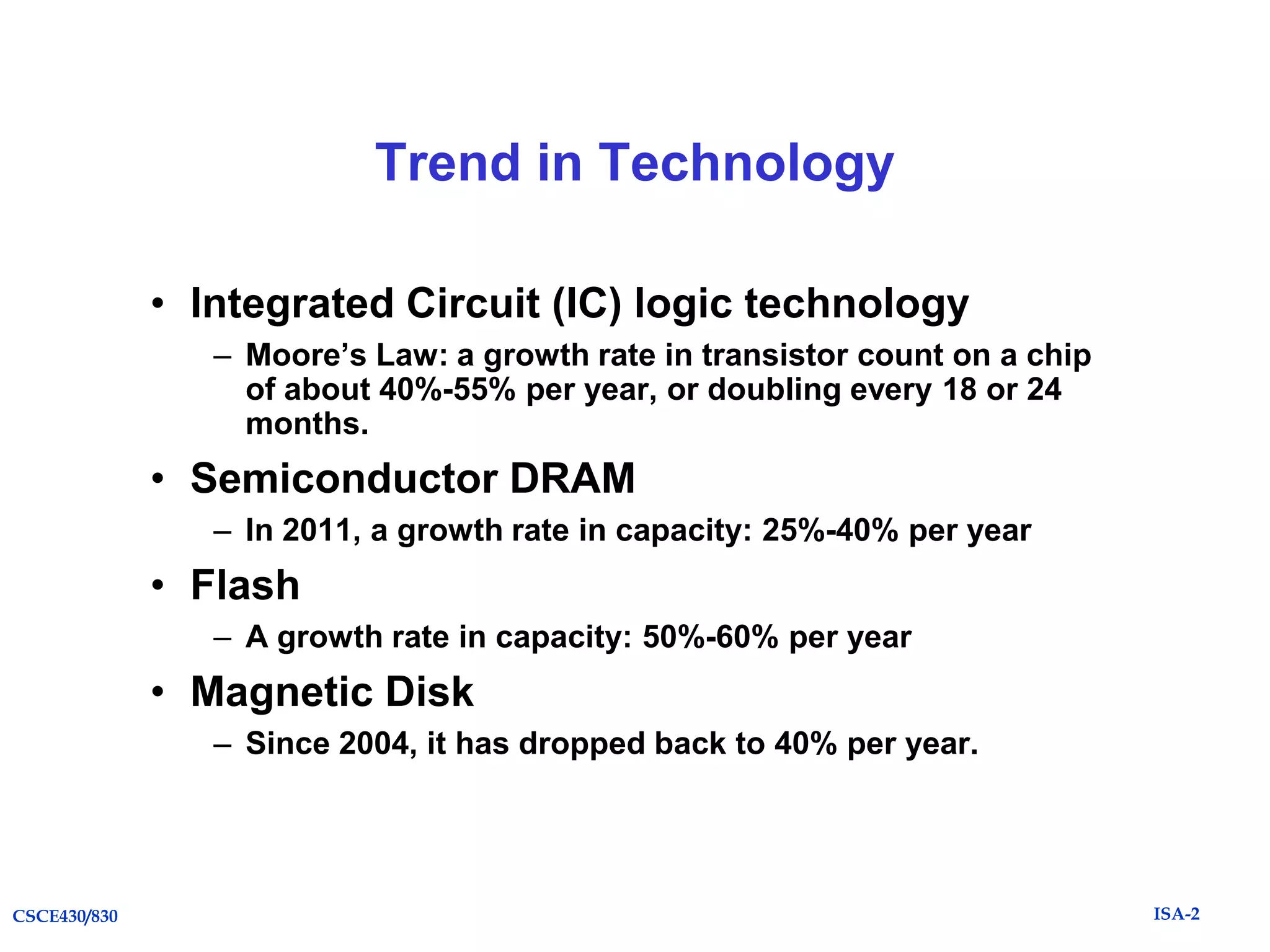
Trend in Technology
• Integrated Circuit (IC) logic technology
– Moore’s Law: a growth rate in transistor count on a chip
of about 40%-55% per year, or doubling every 18 or 24
months.

• Semiconductor DRAM
– In 2011, a growth rate in capacity: 25%-40% per year

• Flash
– A growth rate in capacity: 50%-60% per year

• Magnetic Disk
– Since 2004, it has dropped back to 40% per year.

CSCE430/830

ISA-2
Trend in Performance
• Bandwidth vs. Latency
– The improvement on Bandwidth is much significant than
that on Latency.

CSCE430/830

ISA-2
Growth in Processor Performance
Move to multi-processor
Hurdle: Power
Wall
Lack: Instructionlevel Parallelism

Parallelism: via
Pipelining

RISC

CSCE430/830

Locality: using
Cache

ISA-2
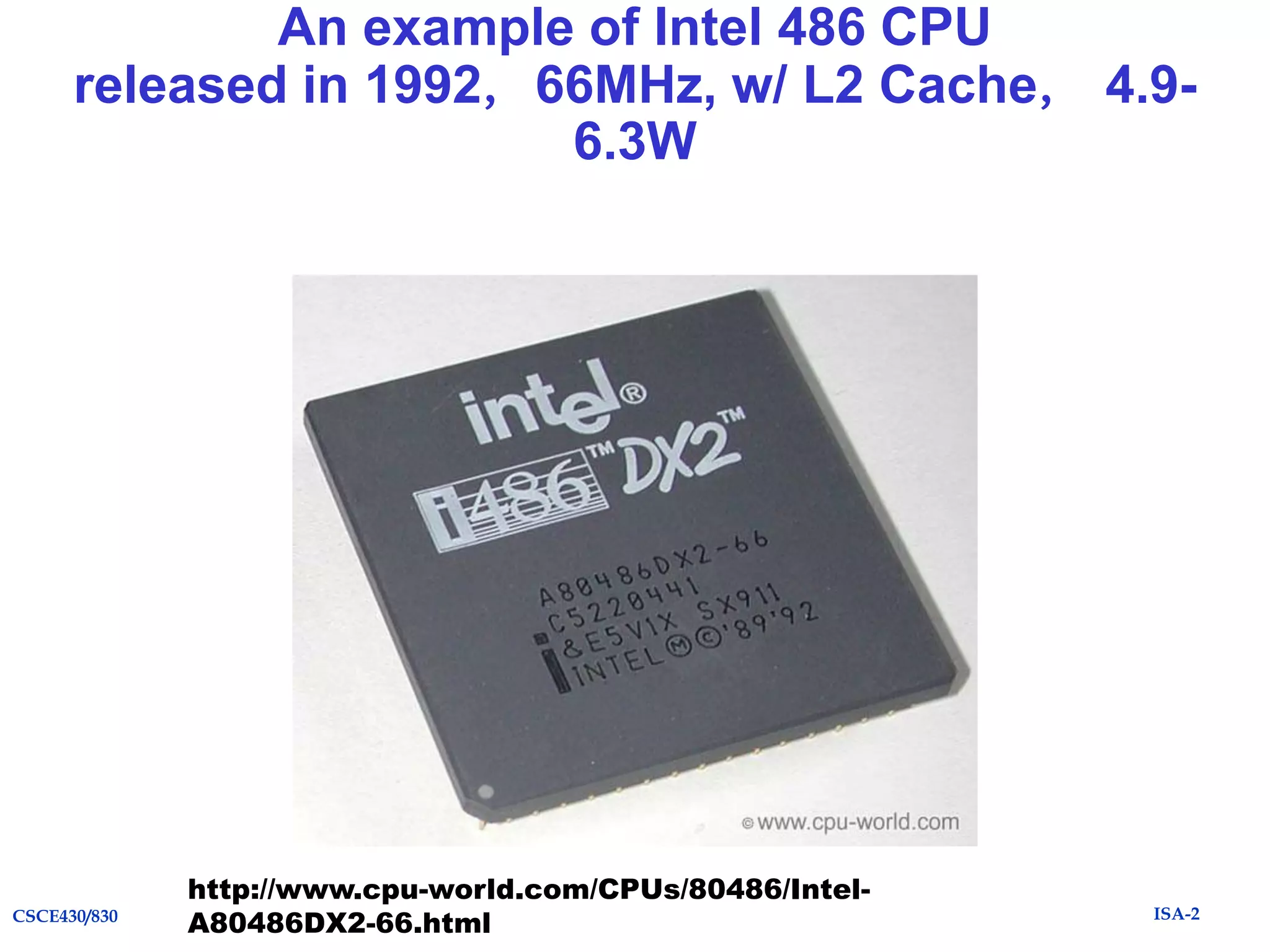
An example of Intel 486 CPU
released in 1992,66MHz, w/ L2 Cache, 4.96.3W

CSCE430/830

http://www.cpu-world.com/CPUs/80486/IntelA80486DX2-66.html

ISA-2
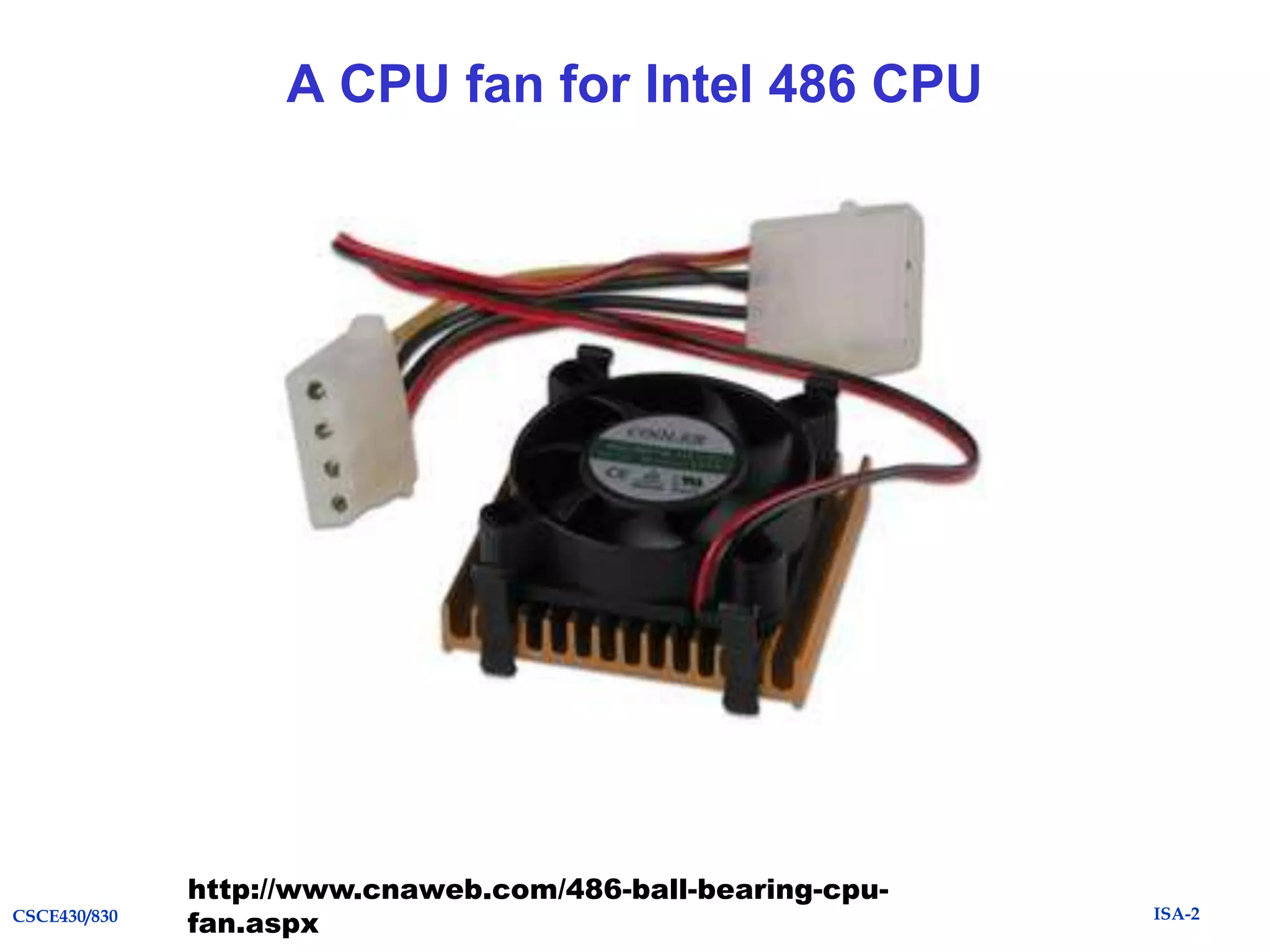
A CPU fan for Intel 486 CPU

CSCE430/830

http://www.cnaweb.com/486-ball-bearing-cpufan.aspx

ISA-2
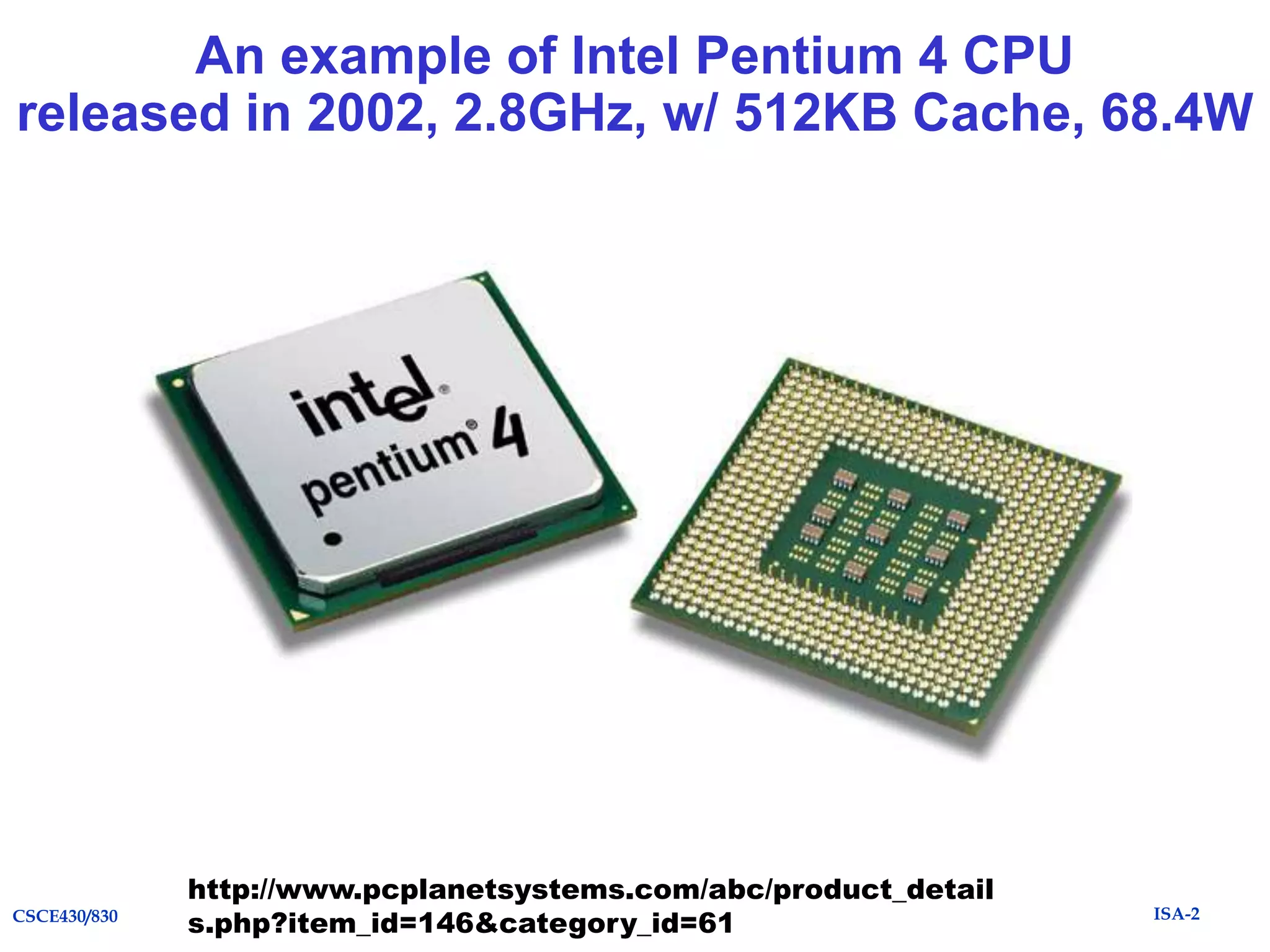
An example of Intel Pentium 4 CPU
released in 2002, 2.8GHz, w/ 512KB Cache, 68.4W

CSCE430/830

http://www.pcplanetsystems.com/abc/product_detail
s.php?item_id=146&category_id=61

ISA-2
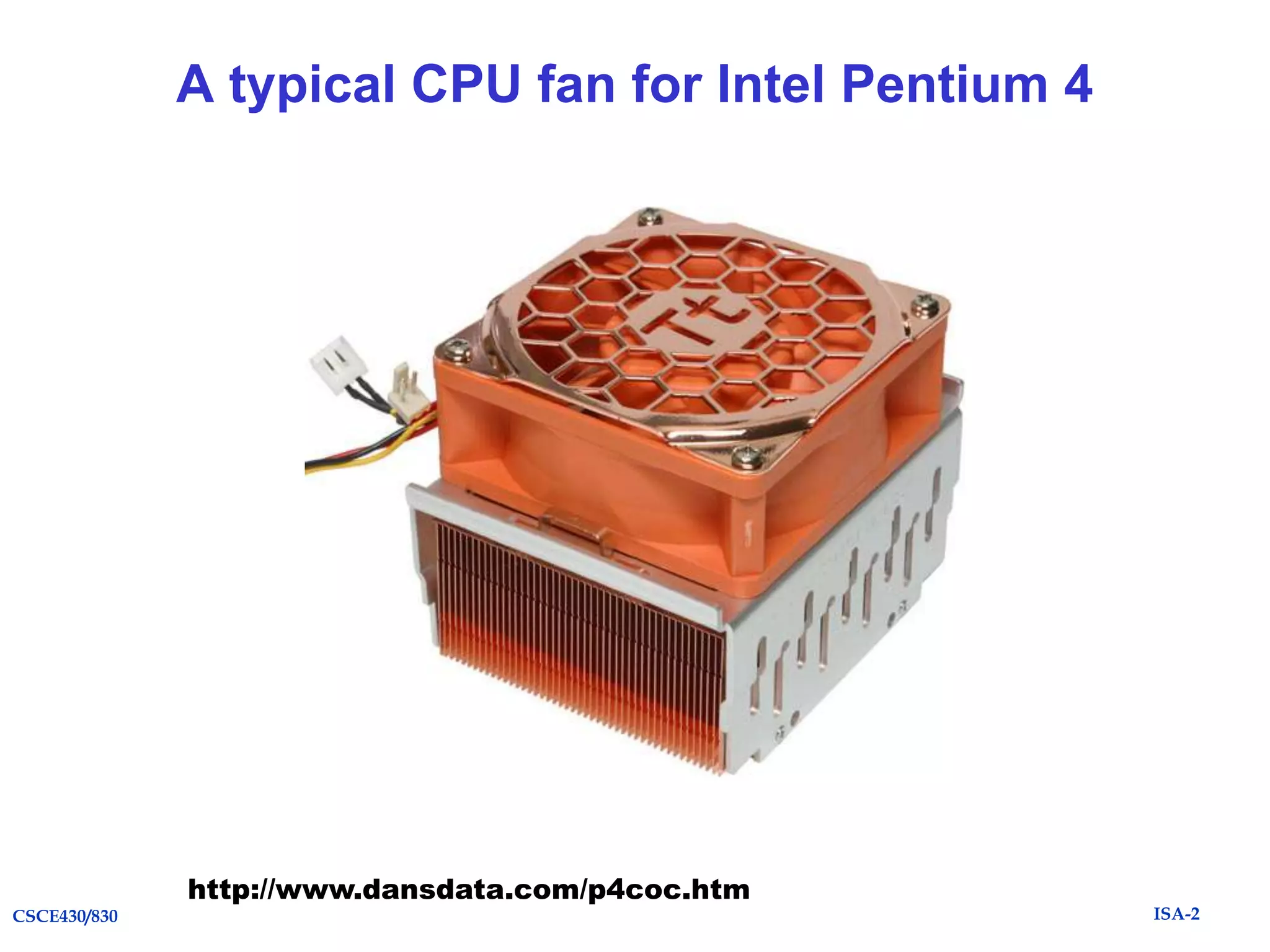
A typical CPU fan for Intel Pentium 4

http://www.dansdata.com/p4coc.htm
CSCE430/830

ISA-2
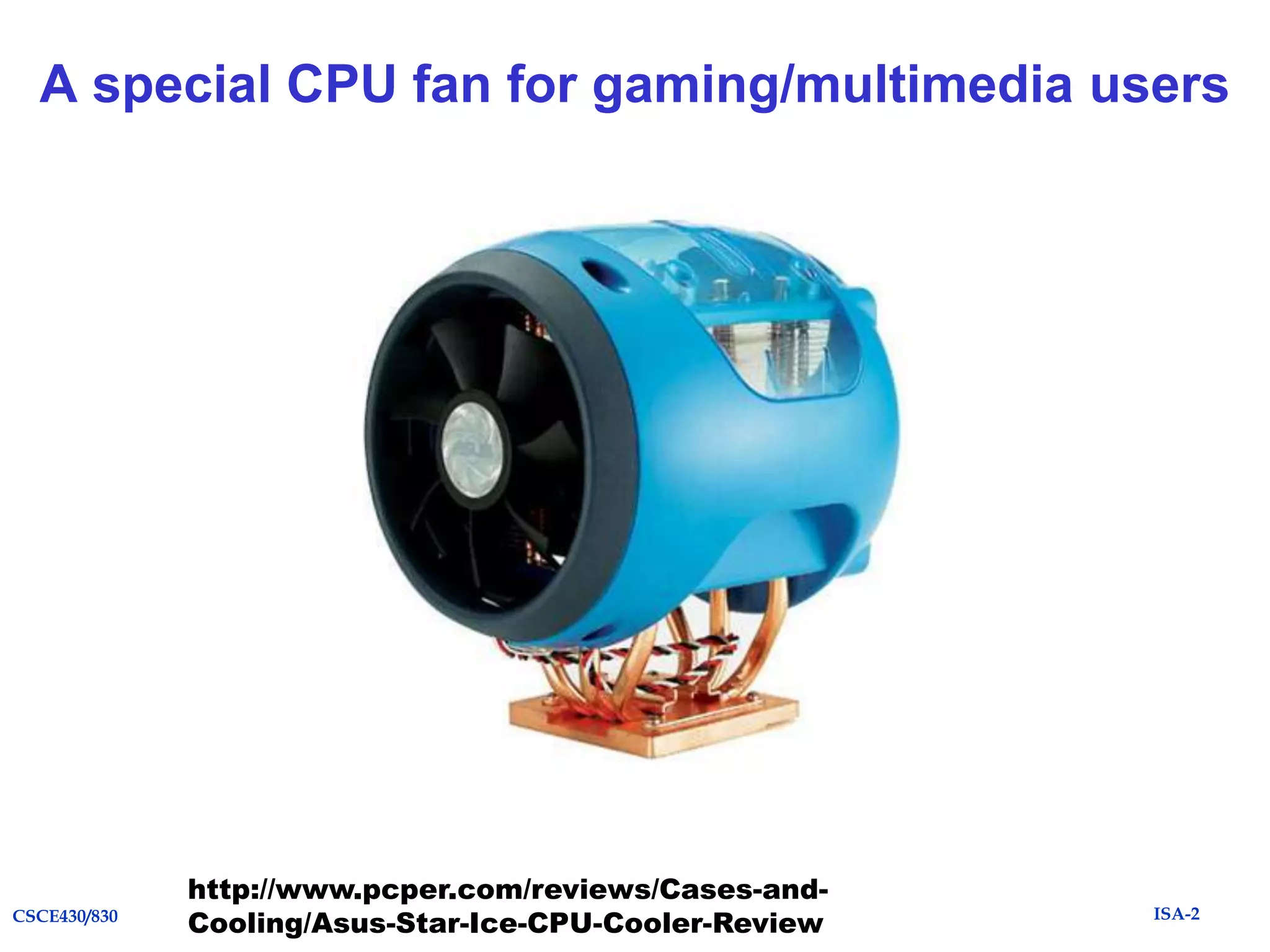
A special CPU fan for gaming/multimedia users

CSCE430/830

http://www.pcper.com/reviews/Cases-andCooling/Asus-Star-Ice-CPU-Cooler-Review

ISA-2
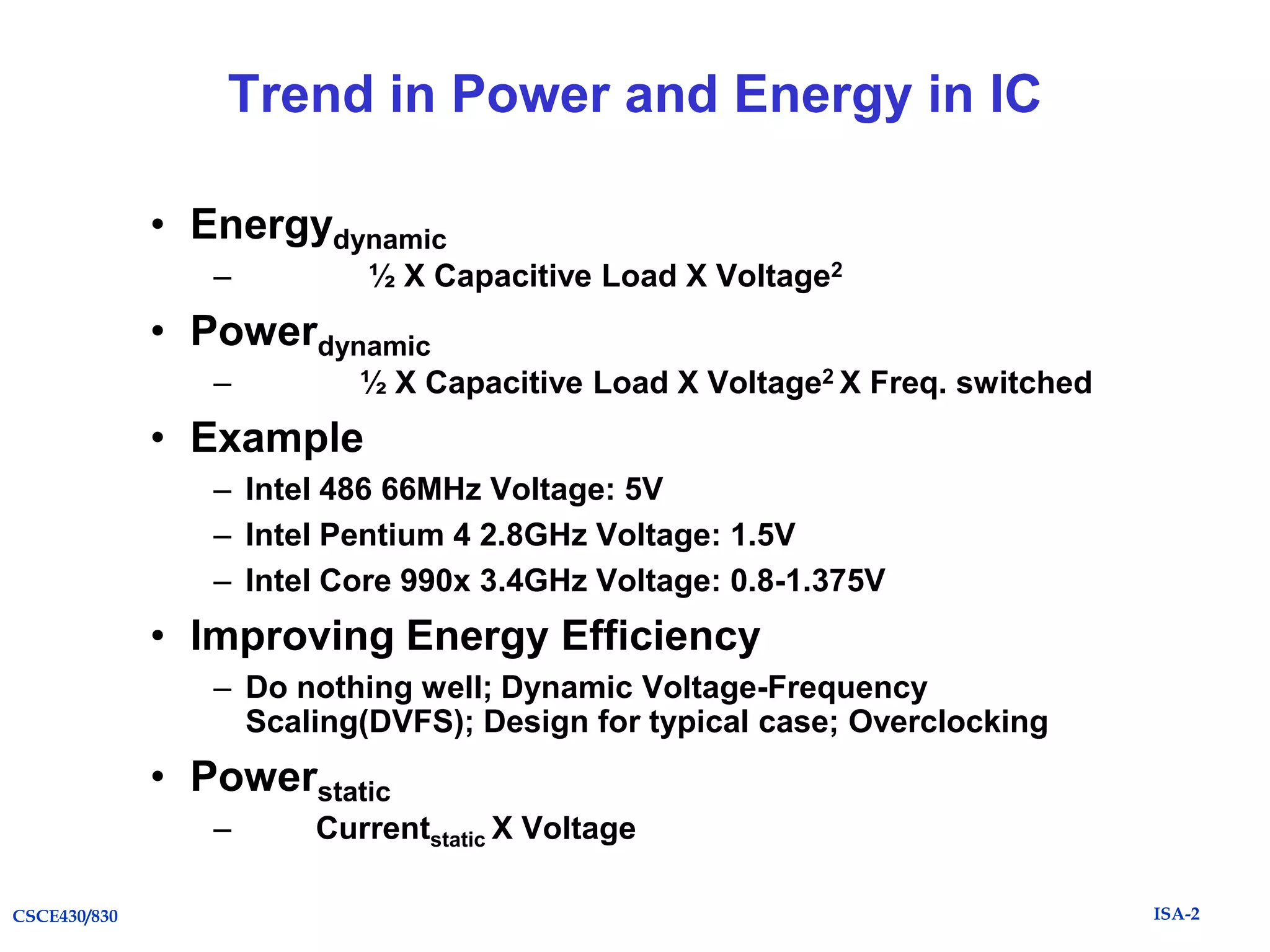
Trend in Power and Energy in IC
• Energydynamic
–

½ X Capacitive Load X Voltage2

• Powerdynamic
–

½ X Capacitive Load X Voltage2 X Freq. switched

• Example
– Intel 486 66MHz Voltage: 5V
– Intel Pentium 4 2.8GHz Voltage: 1.5V
– Intel Core 990x 3.4GHz Voltage: 0.8-1.375V

• Improving Energy Efficiency
– Do nothing well; Dynamic Voltage-Frequency
Scaling(DVFS); Design for typical case; Overclocking

• Powerstatic
–
CSCE430/830

Currentstatic X Voltage
ISA-2
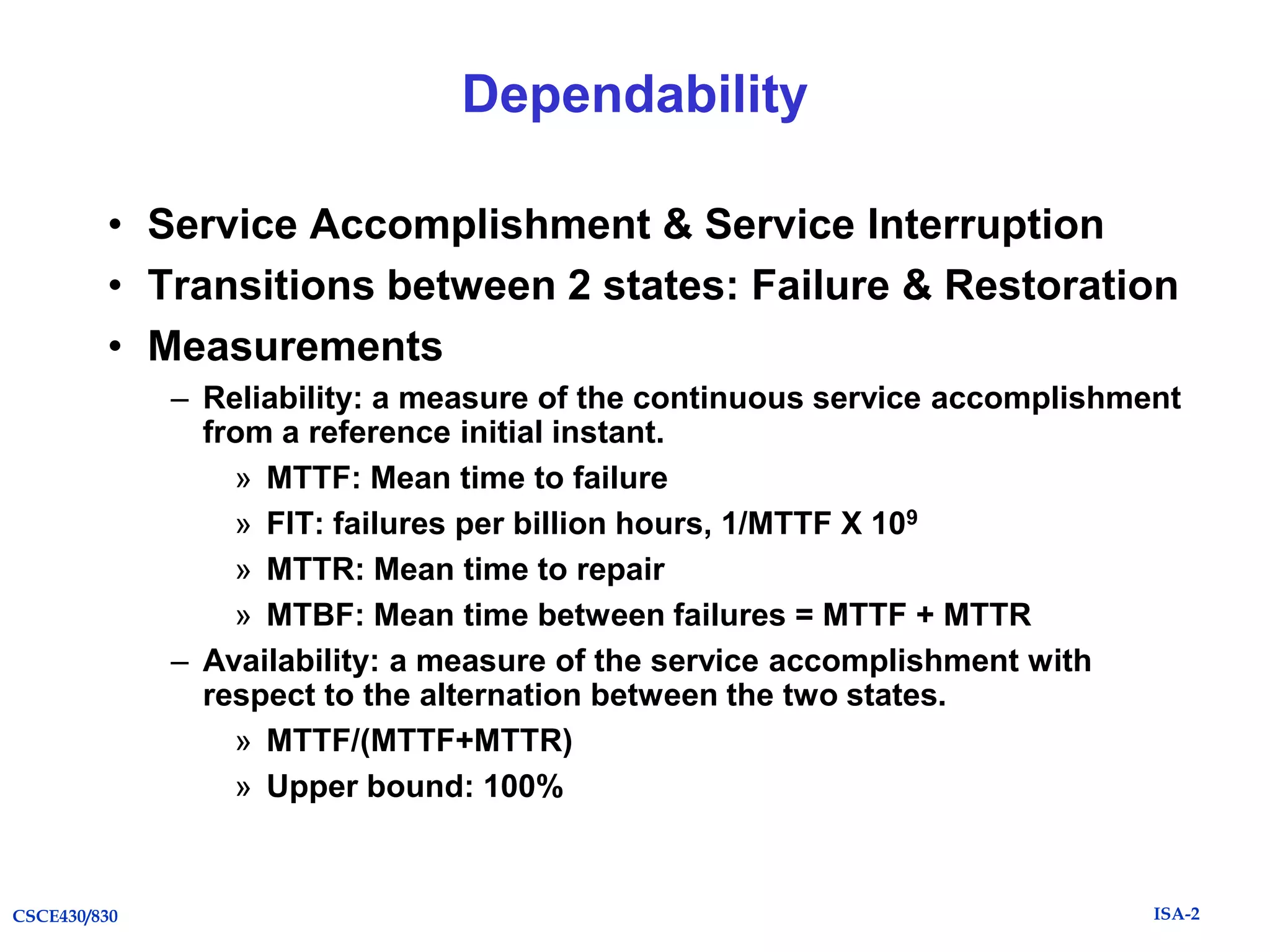
Dependability
• Service Accomplishment & Service Interruption
• Transitions between 2 states: Failure & Restoration
• Measurements
– Reliability: a measure of the continuous service accomplishment
from a reference initial instant.
» MTTF: Mean time to failure
» FIT: failures per billion hours, 1/MTTF X 109
» MTTR: Mean time to repair
» MTBF: Mean time between failures = MTTF + MTTR
– Availability: a measure of the service accomplishment with
respect to the alternation between the two states.
» MTTF/(MTTF+MTTR)
» Upper bound: 100%

CSCE430/830

ISA-2
Performance Measurements and
Benchmarks
• Metrics
– Throughput: a total amount of work done in a given time
– Response time (Execution time): the time between the start and
the completion of an event

• Speedup of X relative to Y
– Execution timeY / Execution timeX

• Execution time
– Wall clock time: a latency to complete a task
– CPU time: only computation time

• Benchmarks
– Kernels, Toy programs, Synthetic benchmarks
– Benchmark suites: SPEC [CPU] & TPC [Transaction Processing]
– SpecRatio = Execution Timereference / Execution Timetarget

CSCE430/830

ISA-2
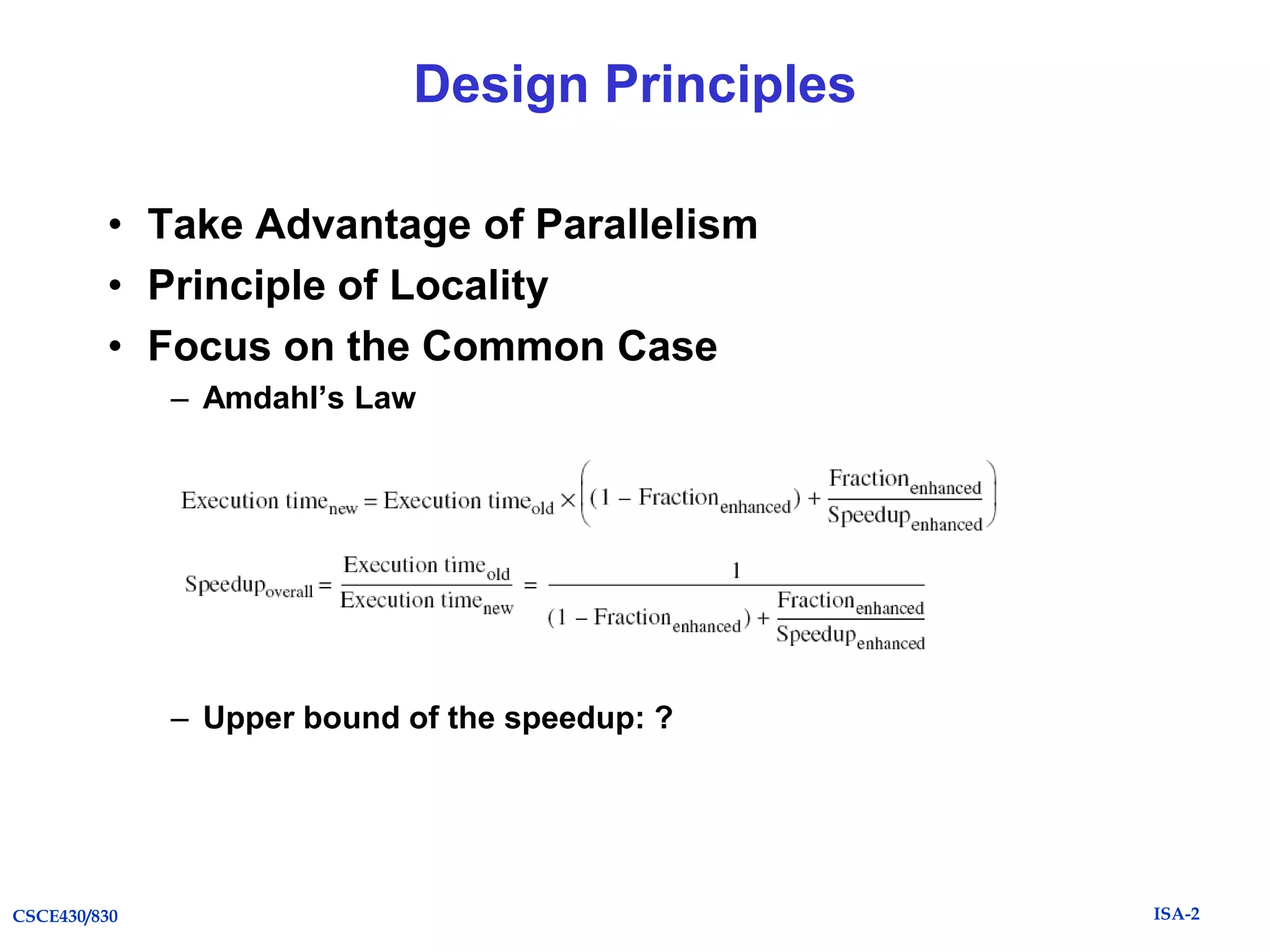
Design Principles
• Take Advantage of Parallelism
• Principle of Locality
• Focus on the Common Case
– Amdahl’s Law

– Upper bound of the speedup: ?

CSCE430/830

ISA-2
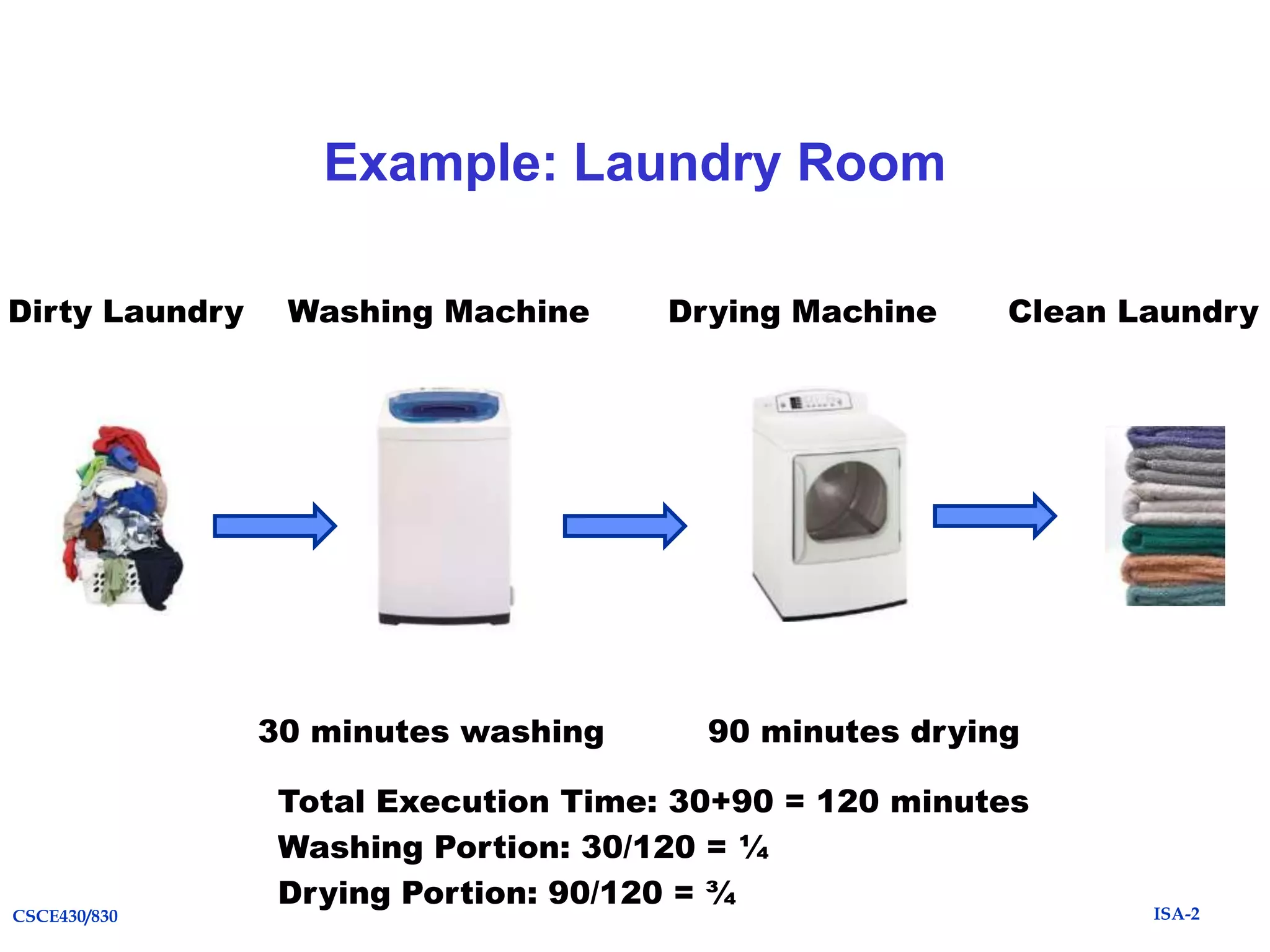
Example: Laundry Room
Dirty Laundry

Washing Machine

30 minutes washing

CSCE430/830

Drying Machine

Clean Laundry

90 minutes drying

Total Execution Time: 30+90 = 120 minutes
Washing Portion: 30/120 = ¼
Drying Portion: 90/120 = ¾

ISA-2
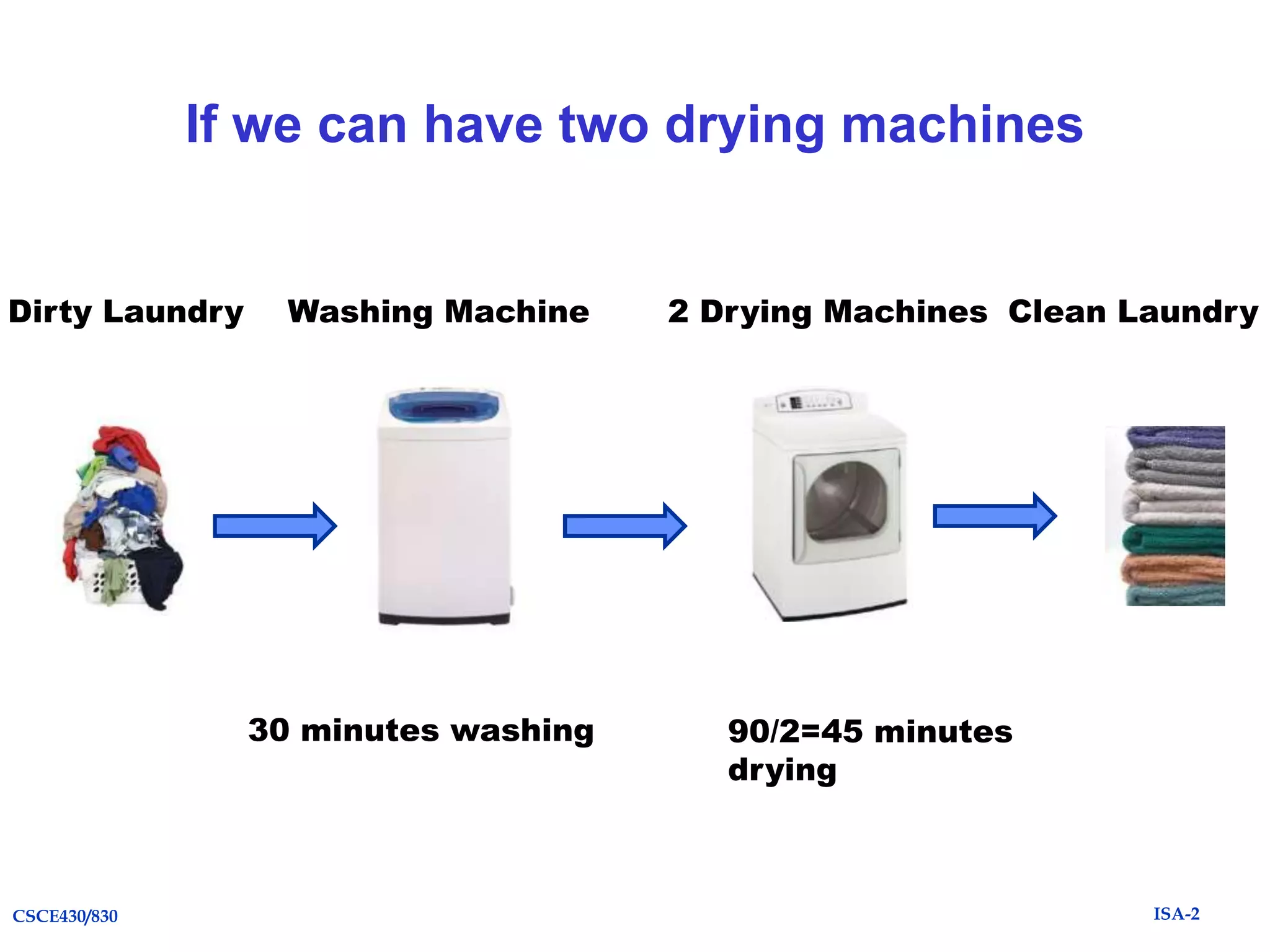
If we can have two drying machines

Dirty Laundry

Washing Machine

30 minutes washing

CSCE430/830

2 Drying Machines Clean Laundry

90/2=45 minutes
drying

ISA-2
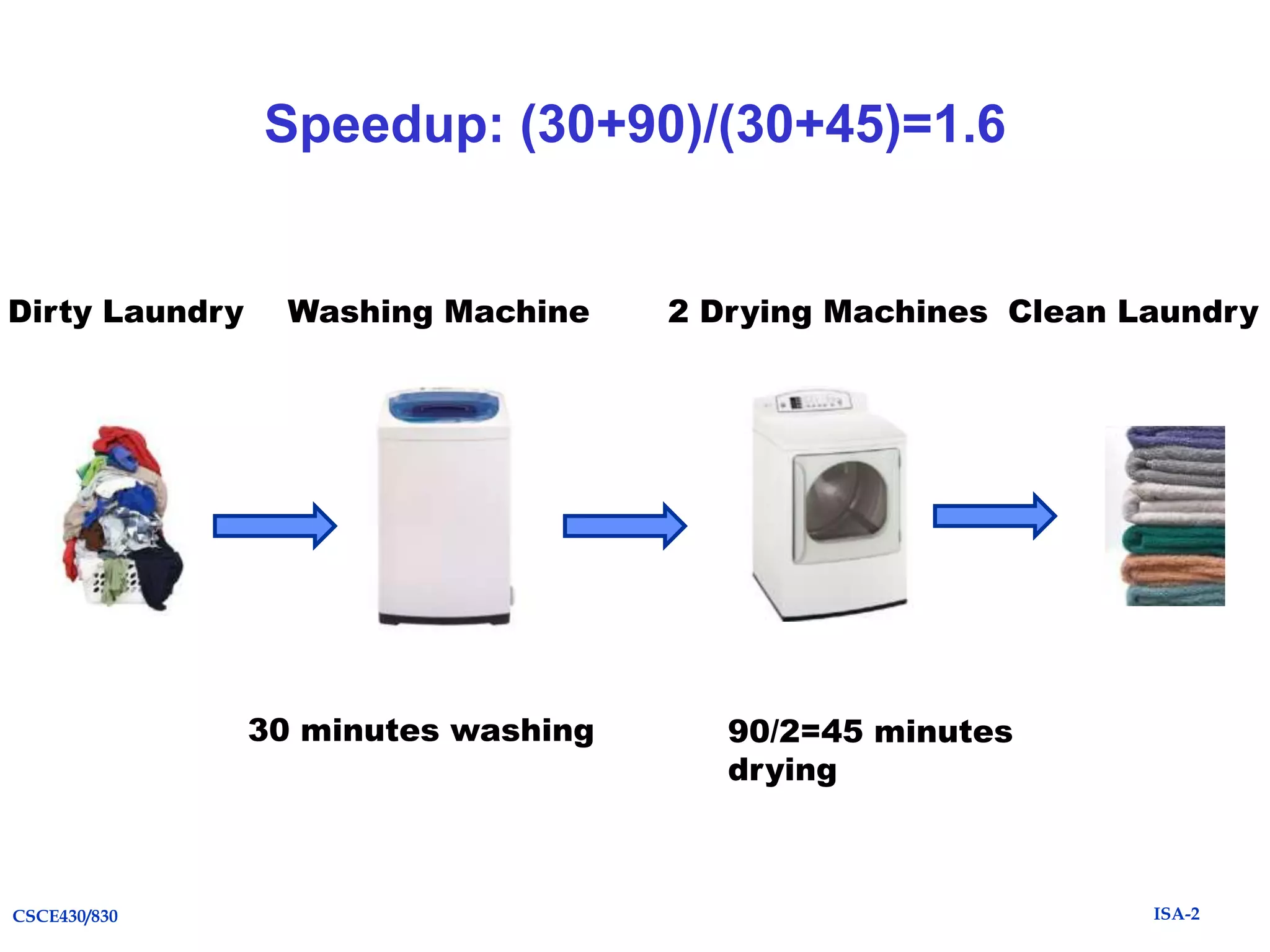
Speedup: (30+90)/(30+45)=1.6

Dirty Laundry

Washing Machine

30 minutes washing

CSCE430/830

2 Drying Machines Clean Laundry

90/2=45 minutes
drying

ISA-2
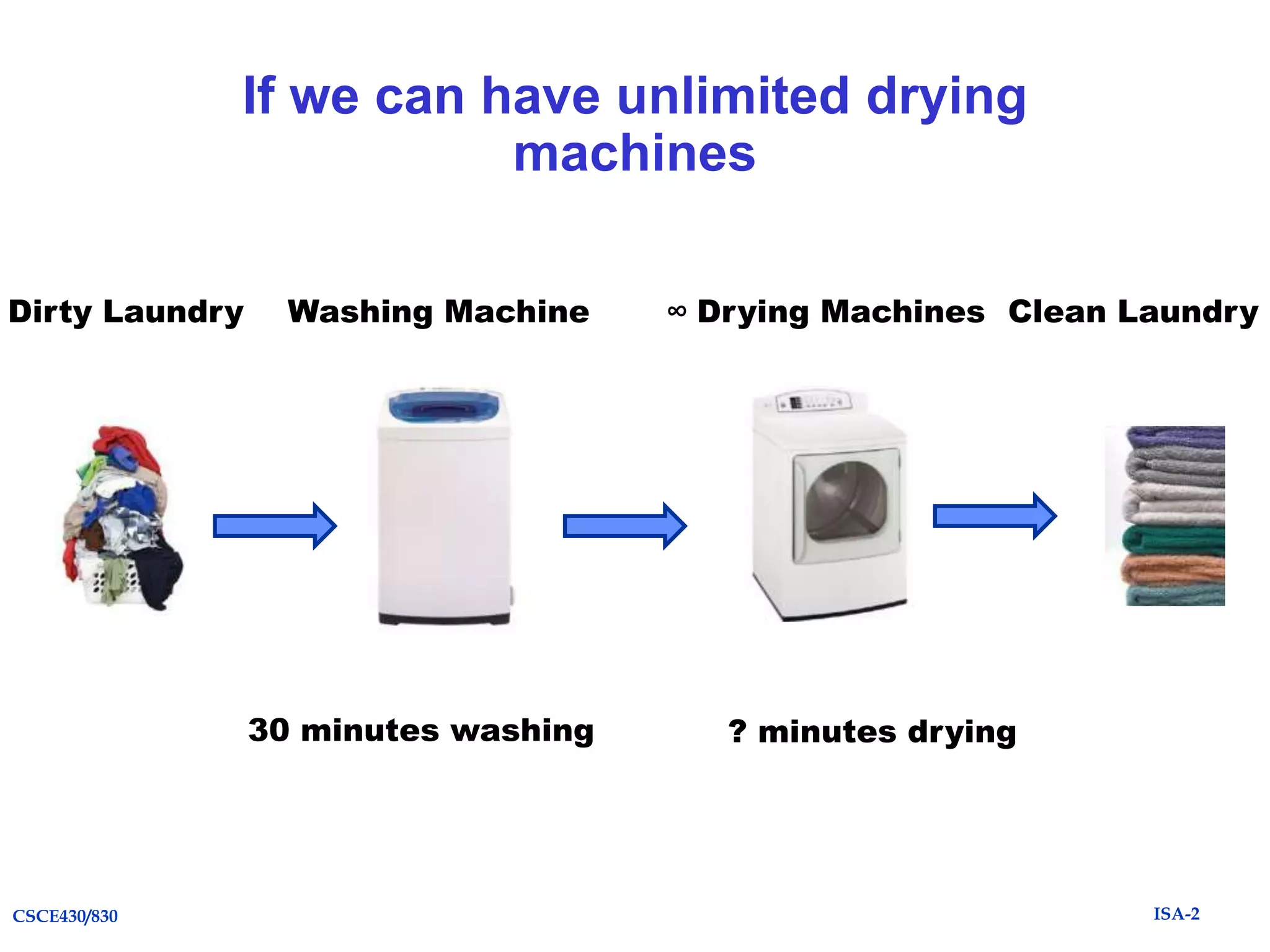
If we can have unlimited drying
machines
Dirty Laundry

Washing Machine

30 minutes washing

CSCE430/830

∞ Drying Machines Clean Laundry

? minutes drying

ISA-2
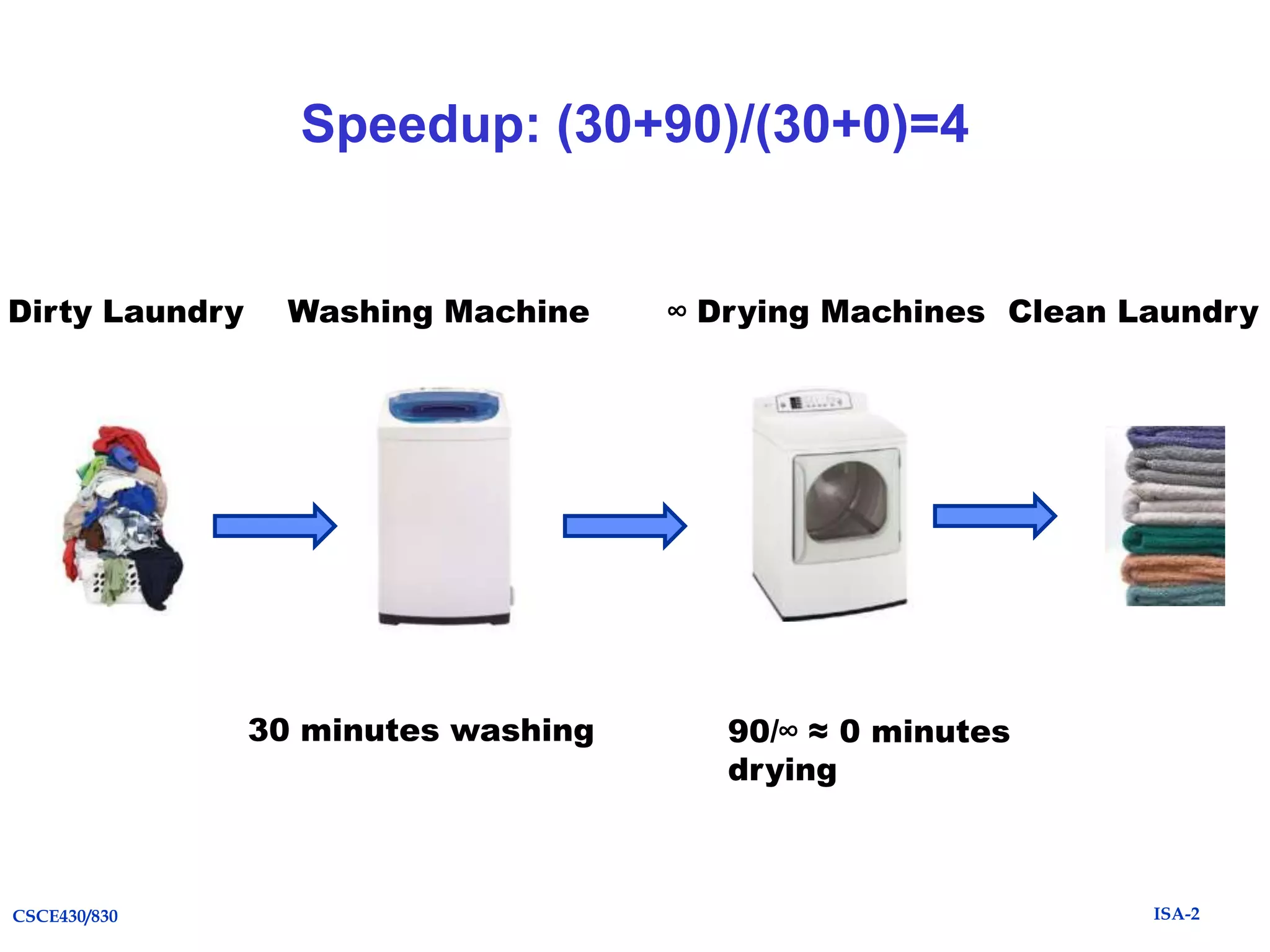
Speedup: (30+90)/(30+0)=4

Dirty Laundry

Washing Machine

30 minutes washing

CSCE430/830

∞ Drying Machines Clean Laundry

90/∞ ≈ 0 minutes
drying

ISA-2
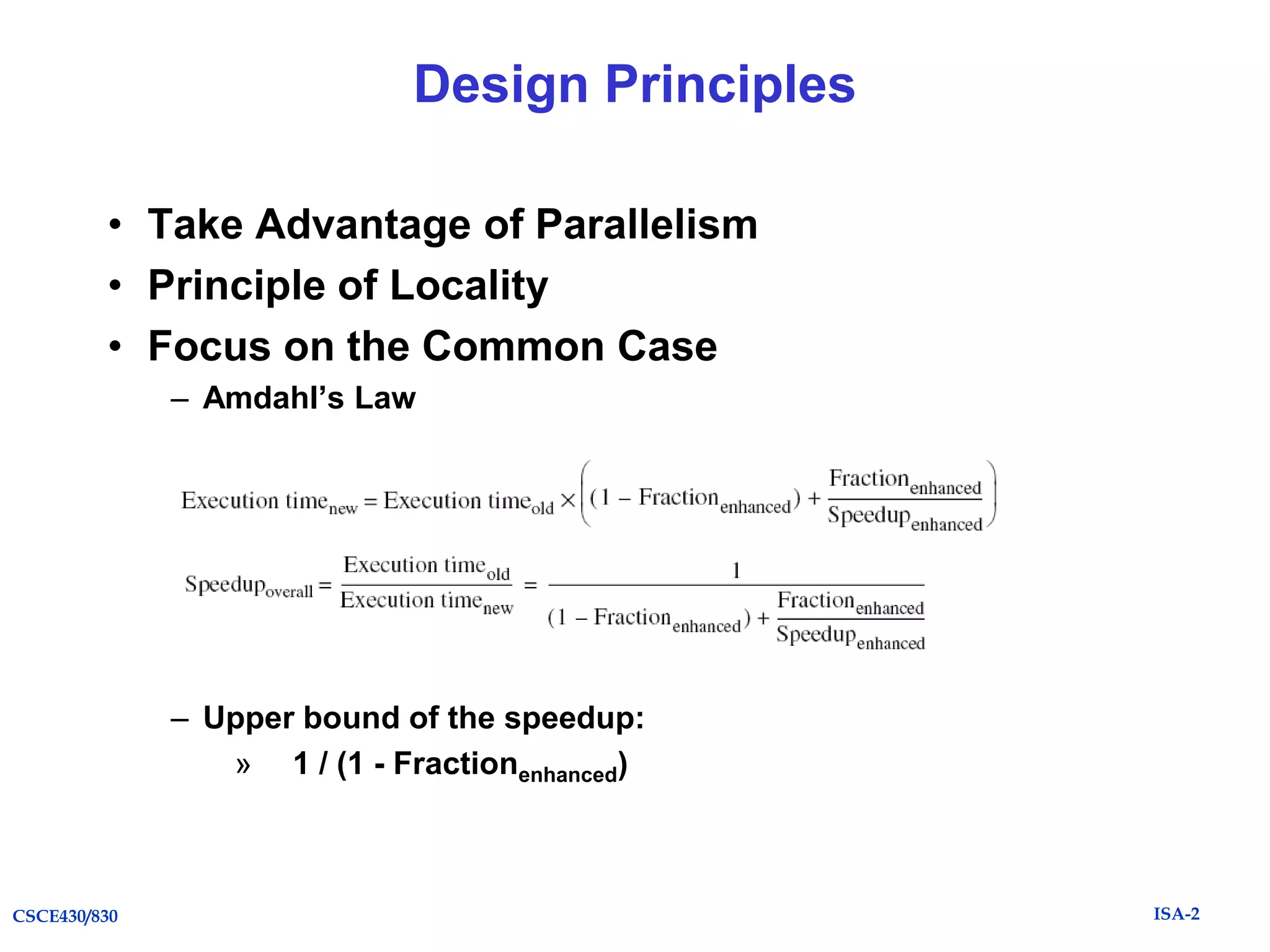
Design Principles
• Take Advantage of Parallelism
• Principle of Locality
• Focus on the Common Case
– Amdahl’s Law

– Upper bound of the speedup:
» 1 / (1 - Fractionenhanced)

CSCE430/830

ISA-2
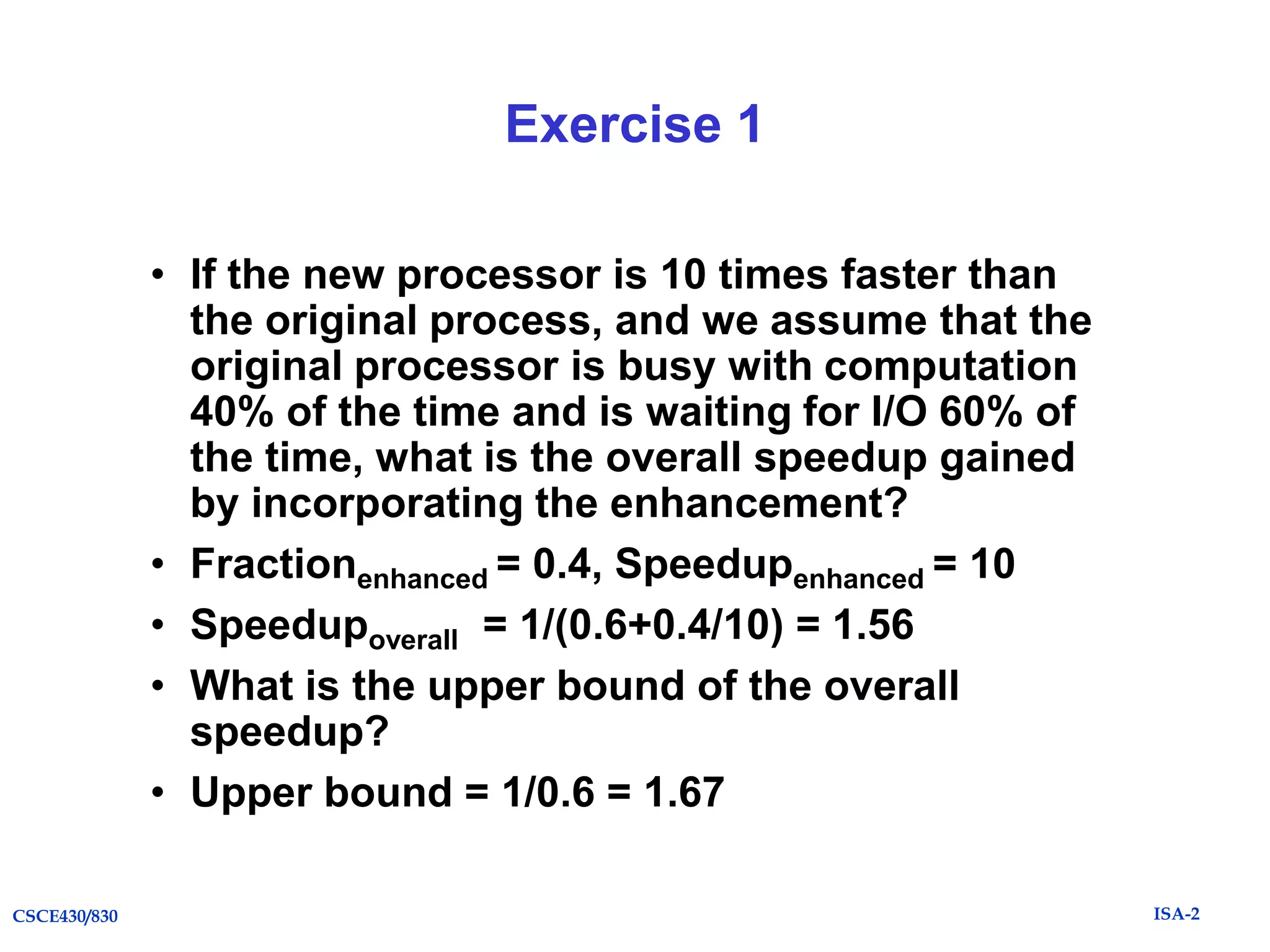
Exercise 1
• If the new processor is 10 times faster than
the original process, and we assume that the
original processor is busy with computation
40% of the time and is waiting for I/O 60% of
the time, what is the overall speedup gained
by incorporating the enhancement?
• Fractionenhanced = 0.4, Speedupenhanced = 10
• Speedupoverall = 1/(0.6+0.4/10) = 1.56
• What is the upper bound of the overall
speedup?
• Upper bound = 1/0.6 = 1.67
CSCE430/830

ISA-2
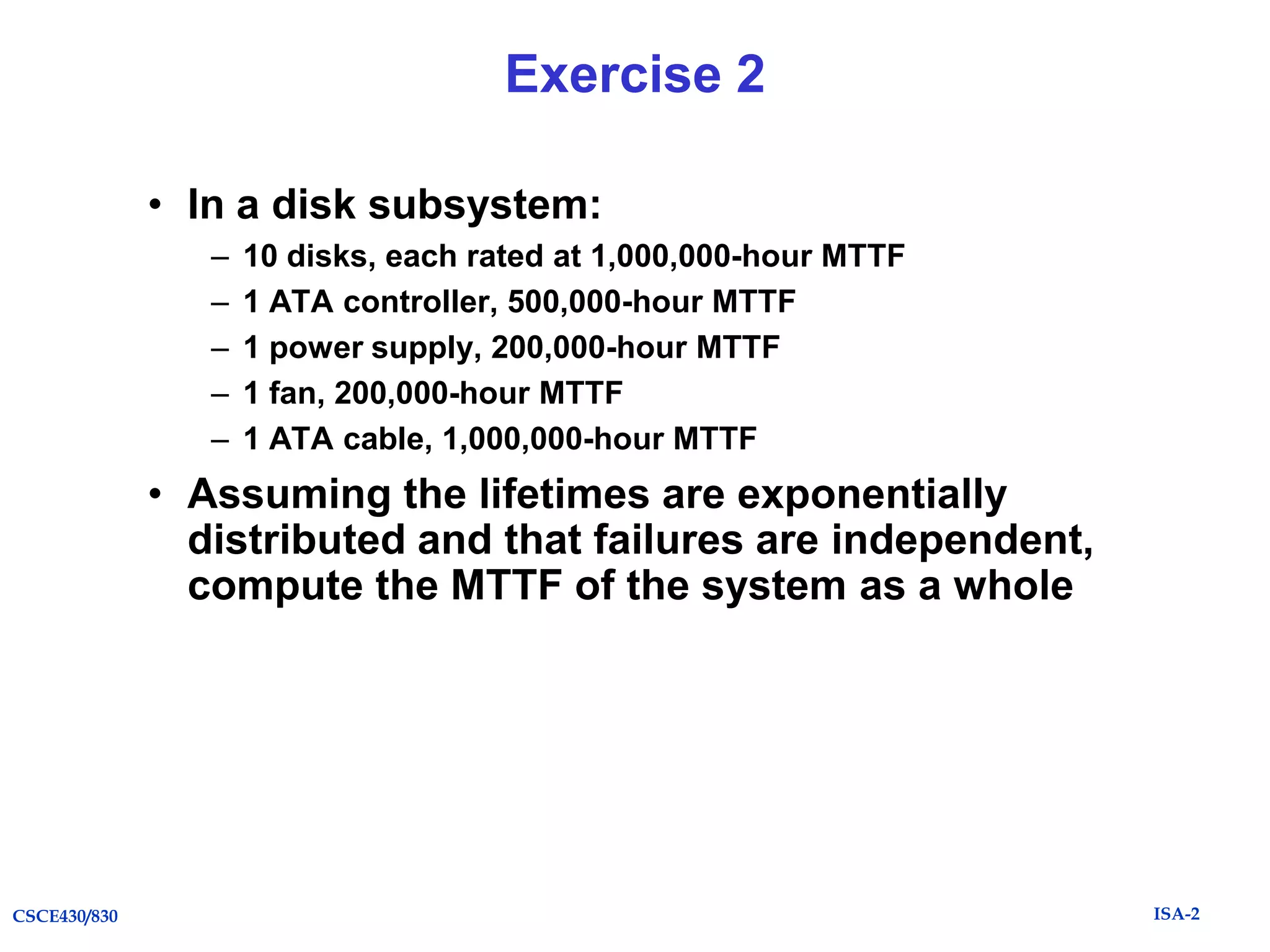
Exercise 2
• In a disk subsystem:
–
–
–
–
–

10 disks, each rated at 1,000,000-hour MTTF
1 ATA controller, 500,000-hour MTTF
1 power supply, 200,000-hour MTTF
1 fan, 200,000-hour MTTF
1 ATA cable, 1,000,000-hour MTTF

• Assuming the lifetimes are exponentially
distributed and that failures are independent,
compute the MTTF of the system as a whole

CSCE430/830

ISA-2
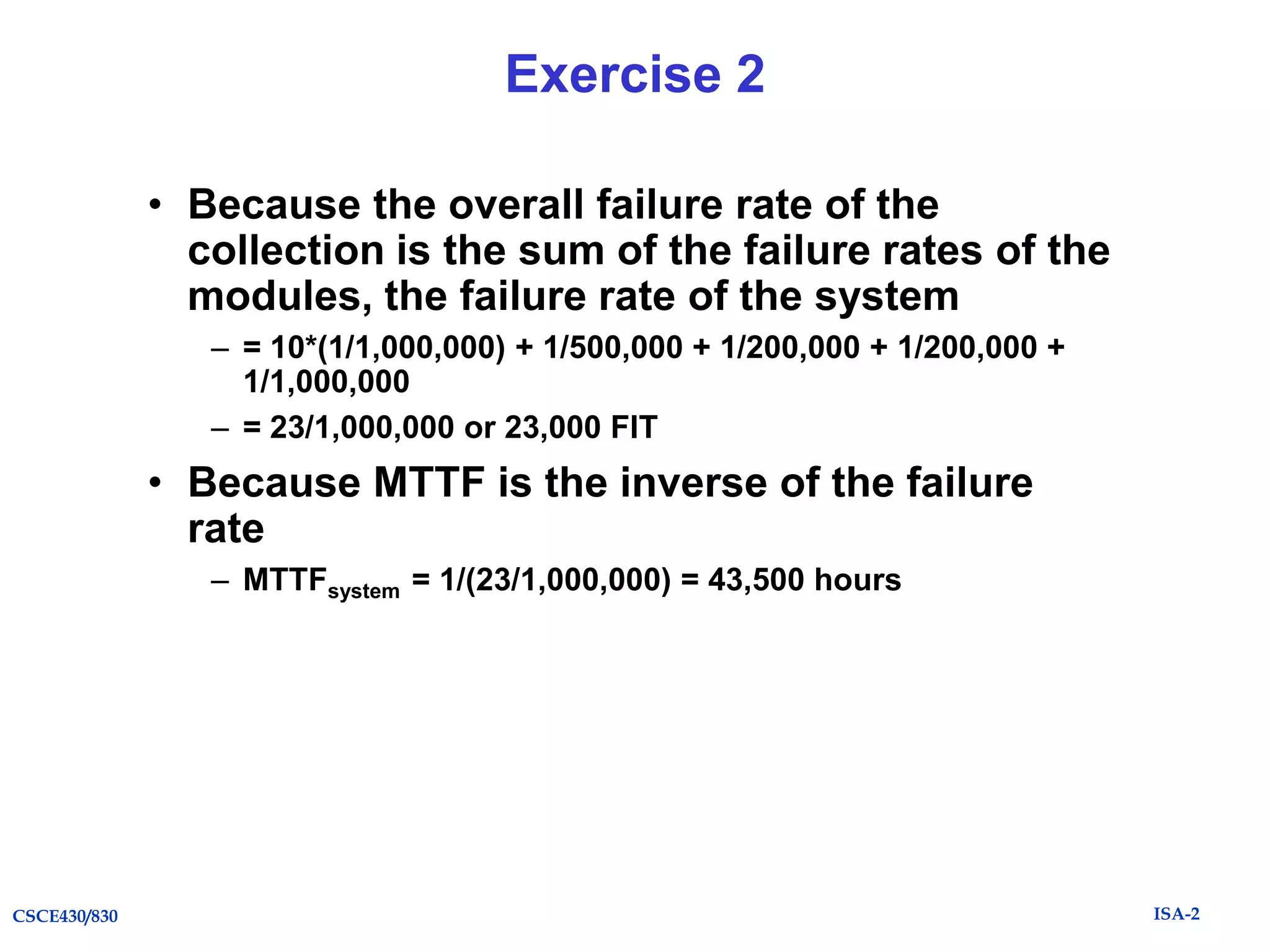
Exercise 2
• Because the overall failure rate of the
collection is the sum of the failure rates of the
modules, the failure rate of the system
– = 10*(1/1,000,000) + 1/500,000 + 1/200,000 + 1/200,000 +
1/1,000,000
– = 23/1,000,000 or 23,000 FIT

• Because MTTF is the inverse of the failure
rate
– MTTFsystem = 1/(23/1,000,000) = 43,500 hours

CSCE430/830

ISA-2

Caqa5e ch1 with_review_and_examples

  • 1.
    Computer Architecture A QuantitativeApproach, Fifth Edition Chapter 1 Fundamentals of Quantitative Design and Analysis Copyright © 2012, Elsevier Inc. All rights reserved. 1
  • 2.
     Performance improvements:  Improvements insemiconductor technology    Enabled by HLL compilers, UNIX Lead to RISC architectures Together have enabled:     Feature size, clock speed Improvements in computer architectures   Introduction Computer Technology Lightweight computers Productivity-based managed/interpreted programming languages SaaS, Virtualization, Cloud Applications evolution:  Speech, sound, images, video, “augmented/extende d reality”, “big data” Copyright © 2012, Elsevier Inc. All rights reserved. 2
  • 3.
    Move to multi-processor Introduction SingleProcessor Performance RISC Copyright © 2012, Elsevier Inc. All rights reserved. 3
  • 4.
     Cannot continue toleverage Instruction-Level parallelism (ILP)   Single processor performance improvement ended in 2003 New models for performance:     Introduction Current Trends in Architecture Data-level parallelism (DLP) Thread-level parallelism (TLP) Request-level parallelism (RLP) These require explicit restructuring of the application Copyright © 2012, Elsevier Inc. All rights reserved. 4
  • 5.
     Personal Mobile Device(PMD)    Desktop Computing   Emphasis on availability (very costly downtime!), scalability, throughput (20 million) Clusters / Warehouse Scale Computers     Emphasis on price-performance (0.35 billion) Servers   e.g. smart phones, tablet computers (1.8 billion sold 2010) Emphasis on energy efficiency and real-time Classes of Computers Classes of Computers Used for “Software as a Service (SaaS)”, PaaS, IaaS, etc. Emphasis on availability ($6M/hour-downtime at Amazon.com!) and price-performance (power=80% of TCO!) Sub-class: Supercomputers, emphasis: floating-point performance and fast internal networks, and big data analytics Embedded Computers (19 billion in 2010)  Emphasis: price Copyright © 2012, Elsevier Inc. All rights reserved. 5
  • 6.
     Classes of parallelismin applications:    Data-Level Parallelism (DLP) Task-Level Parallelism (TLP) Classes of Computers Parallelism Classes of architectural parallelism:     Instruction-Level Parallelism (ILP) Vector architectures/Graphic Processor Units (GPUs) Thread-Level Parallelism Request-Level Parallelism Copyright © 2012, Elsevier Inc. All rights reserved. 6
  • 7.
     Single instruction stream,single data stream (SISD)  Single instruction stream, multiple data streams (SIMD)     Vector architectures Multimedia extensions Graphics processor units Multiple instruction streams, single data stream (MISD)   Classes of Computers Flynn’s Taxonomy No commercial implementation Multiple instruction streams, multiple data streams (MIMD)   Tightly-coupled MIMD Loosely-coupled MIMD Copyright © 2012, Elsevier Inc. All rights reserved. 7
  • 8.
     “Old” view ofcomputer architecture:   Instruction Set Architecture (ISA) design i.e. decisions regarding:   registers, memory addressing, addressing modes, instruction operands, available operations, control flow instructions, instruction encoding Defining Computer Architecture Defining Computer Architecture “Real” computer architecture:    Specific requirements of the target machine Design to maximize performance within constraints: cost, power, and availability Includes ISA, microarchitecture, hardware Copyright © 2012, Elsevier Inc. All rights reserved. 8
  • 9.
     Integrated circuit technology    Transistordensity: 35%/year Die size: 10-20%/year Integration overall: 40-55%/year  DRAM capacity: 25-40%/year (slowing)  Trends in Technology Trends in Technology Flash capacity: 50-60%/year   15-20X cheaper/bit than DRAM Magnetic disk technology: 40%/year   15-25X cheaper/bit then Flash 300-500X cheaper/bit than DRAM Copyright © 2012, Elsevier Inc. All rights reserved. 9
  • 10.
     Bandwidth or throughput     Totalwork done in a given time 10,000-25,000X improvement for processors over the 1st milestone 300-1200X improvement for memory and disks over the 1st milestone Trends in Technology Bandwidth and Latency Latency or response time    Time between start and completion of an event 30-80X improvement for processors over the 1st milestone 6-8X improvement for memory and disks over the 1st milestone Copyright © 2012, Elsevier Inc. All rights reserved. 10
  • 11.
    Trends in Technology Bandwidthand Latency Log-log plot of bandwidth and latency milestones Copyright © 2012, Elsevier Inc. All rights reserved. 11
  • 12.
     Feature size    Minimum sizeof transistor or wire in x or y dimension 10 microns in 1971 to .032 microns in 2011 Transistor performance scales linearly    Trends in Technology Transistors and Wires Wire delay does not improve with feature size! Integration density scales quadratically Linear performance and quadratic density growth present a challenge and opportunity, creating the need for computer architect! Copyright © 2012, Elsevier Inc. All rights reserved. 12
  • 13.
     Problem: Get powerin, get power out  Thermal Design Power (TDP)    Characterizes sustained power consumption Used as target for power supply and cooling system Lower than peak power, higher than average power consumption  Clock rate can be reduced dynamically to limit power consumption  Trends in Power and Energy Power and Energy Energy per task is often a better measurement Copyright © 2012, Elsevier Inc. All rights reserved. 13
  • 14.
     Dynamic energy    Dynamic power   Transistorswitch from 0 -> 1 or 1 -> 0 ½ x Capacitive load x Voltage2 Trends in Power and Energy Dynamic Energy and Power ½ x Capacitive load x Voltage2 x Frequency switched Reducing clock rate reduces power, not energy Copyright © 2012, Elsevier Inc. All rights reserved. 14
  • 15.
        Intel 80386 consumed ~2 W 3.3 GHz Intel Core i7 consumes 130 W Heat must be dissipated from 1.5 x 1.5 cm chip This is the limit of what can be cooled by air Copyright © 2012, Elsevier Inc. All rights reserved. Trends in Power and Energy Power 15
  • 16.
     Techniques for reducingpower:     Do nothing well Dynamic Voltage-Frequency Scaling Low power state for DRAM, disks Overclocking, turning off cores Copyright © 2012, Elsevier Inc. All rights reserved. Trends in Power and Energy Reducing Power 16
  • 17.
     Static power consumption      Currentstaticx Voltage Scales with number of transistors To reduce: power gating Race-to-halt Trends in Power and Energy Static Power The new primary evaluation for design innovation   Tasks per joule Performance per watt Copyright © 2012, Elsevier Inc. All rights reserved. 17
  • 18.
     Cost driven downby learning curve  Trends in Cost Trends in Cost Yield  DRAM: price closely tracks cost  Microprocessors: price depends on volume  10% less for each doubling of volume Copyright © 2012, Elsevier Inc. All rights reserved. 18
  • 19.
     Integrated circuit  Trends inCost Integrated Circuit Cost Bose-Einstein formula: Defects per unit area = 0.016-0.057 defects per square cm (2010) N = process-complexity factor = 11.5-15.5 (40 nm, 2010) The manufacturing process dictates the wafer cost, wafer yield and defects per unit area The architect’s design affects the die area, which in turn affects the defects and cost per die     Copyright © 2012, Elsevier Inc. All rights reserved. 19
  • 20.
     Systems alternate betweentwo states of service with respect to SLA/SLO: 1. 2.  Dependability Dependability Service accomplishment, where service is delivered as specified by SLA Service interruption, where the delivered service is different from the SLA Module reliability: “failure(F)=transition from 1 to 2” and “repair(R)=transition from 2 to 1”     Mean time to failure (MTTF) Mean time to repair (MTTR) Mean time between failures (MTBF) = MTTF + MTTR Availability = MTTF / MTBF Copyright © 2012, Elsevier Inc. All rights reserved. 20
  • 21.
     Typical performance metrics:    Speedupof X relative to Y   Execution timeY / Execution timeX Execution time    Response time Throughput Measuring Performance Measuring Performance Wall clock time: includes all system overheads CPU time: only computation time Benchmarks     Kernels (e.g. matrix multiply) Toy programs (e.g. sorting) Synthetic benchmarks (e.g. Dhrystone) Benchmark suites (e.g. SPEC06fp, TPC-C) Copyright © 2012, Elsevier Inc. All rights reserved. 21
  • 22.
     Take Advantage ofParallelism   e.g. multiple processors, disks, memory banks, pipelining, multiple functional units Principle of Locality   Principles Principles of Computer Design Reuse of data and instructions Focus on the Common Case  Amdahl’s Law Copyright © 2012, Elsevier Inc. All rights reserved. 22
  • 23.
     Principles Principles of ComputerDesign The Processor Performance Equation Copyright © 2012, Elsevier Inc. All rights reserved. 23
  • 24.
     Principles Principles of ComputerDesign Different instruction types having different CPIs Copyright © 2012, Elsevier Inc. All rights reserved. 24
  • 25.
    Chapter 1 Review& Examples Copyright © 2012, Elsevier Inc. All rights reserved. 25
  • 26.
    Instruction Set Architecture(ISA) • Serves as an interface between software and hardware. • Provides a mechanism by which the software tells the hardware what should be done. High level language code : C, C++, Java, Fortran, compiler Assembly language code: architecture specific statements assembler Machine language code: architecture specific bit patterns software instruction set hardware CSCE430/830 ISA
  • 27.
    Instruction Set DesignIssues • Instruction set design issues include: – Where are operands stored? » registers, memory, stack, accumulator – How many explicit operands are there? » 0, 1, 2, or 3 – How is the operand location specified? » register, immediate, indirect, . . . – What type & size of operands are supported? » byte, int, float, double, string, vector. . . – What operations are supported? » add, sub, mul, move, compare . . . CSCE430/830 ISA
  • 28.
    Classifying ISAs Accumulator (before1960, e.g. 68HC11): 1-address add A acc acc + mem[A] Stack (1960s to 1970s): 0-address add tos tos + next Memory-Memory (1970s to 1980s): 2-address 3-address add A, B add A, B, C mem[A] mem[A] + mem[B] mem[A] mem[B] + mem[C] Register-Memory (1970s to present, e.g. 80x86): 2-address add R1, A load R1, A R1 R1 + mem[A] R1 mem[A] Register-Register (Load/Store, RISC) (1960s to present, e.g. MIPS): 3-address CSCE430/830 add R1, R2, R3 load R1, R2 store R1, R2 R1 R2 + R3 R1 mem[R2] mem[R1] R2 ISA
  • 29.
    Operand Locations inFour ISA Classes GPR CSCE430/830 ISA
  • 30.
    Code Sequence C= A + B for Four Instruction Sets Stack Accumulator Push A Push B Add Pop C Load A Add B Store C memory CSCE430/830 acc = acc + mem[C] Register (register-memory) Load R1, A Add R1, B Store C, R1 memory R1 = R1 + mem[C] Register (loadstore) Load R1,A Load R2, B Add R3, R1, R2 Store C, R3 R3 = R1 + R2 ISA
  • 31.
    Types of AddressingModes (VAX) Addressing Mode 1. Register direct 2. Immediate 3. Displacement 4. Register indirect 5. Indexed 6. Direct 7. Memory Indirect 8. Autoincrement Action R4 <- R4 + R3 R4 <- R4 + 3 R4 <- R4 + M[100 + R1] R4 <- R4 + M[R1] R4 <- R4 + M[R1 + R2] R4 <- R4 + M[1000] R4 <- R4 + M[M[R3]] R4 <- R4 + M[R2] R2 <- R2 + d 9. Autodecrement Add R4, (R2)R4 <- R4 + M[R2] R2 <- R2 - d 10. Scaled Add R4, 100(R2)[R3] R4 <- R4 + M[100 + R2 + R3*d] • Studies by [Clark and Emer] indicate that modes 1-4 account for 93% of all operands on the VAX. CSCE430/830 Example Add R4, R3 Add R4, #3 Add R4, 100(R1) Add R4, (R1) Add R4, (R1 + R2) Add R4, (1000) Add R4, @(R3) Add R4, (R2)+ ISA
  • 32.
    Types of Operations • • • • • • • • CSCE430/830 Arithmeticand Logic: Data Transfer: Control System Floating Point Decimal String Graphics AND, ADD MOVE, LOAD, STORE BRANCH, JUMP, CALL OS CALL, VM ADDF, MULF, DIVF ADDD, CONVERT MOVE, COMPARE (DE)COMPRESS ISA
  • 33.
    MIPS Instructions • Allinstructions exactly 32 bits wide • Different formats for different purposes • Similarities in formats ease implementation 6 bits 31 31 5 bits 5 bits 5 bits 5 bits op rs rt rd 6 bits 5 bits 5 bits 16 bits op rs rt offset shamt funct 6 bits 31 CSCE430/830 6 bits address 0 I-Format 26 bits op 0 R-Format J-Format 0 ISA-2
  • 34.
    MIPS Instruction Types •Arithmetic & Logical - manipulate data in registers add $s1, $s2, $s3 or $s3, $s4, $s5 $s1 = $s2 + $s3 $s3 = $s4 OR $s5 • Data Transfer - move register data to/from memory  load & store lw $s1, 100($s2) sw $s1, 100($s2) $s1 = Memory[$s2 + 100] Memory[$s2 + 100] = $s1 • Branch - alter program flow beq $s1, $s2, 25 if ($s1==$s1) PC = PC + 4 + 4*25 else PC = PC + 4 CSCE430/830 ISA-2
  • 35.
    MIPS Arithmetic &Logical Instructions • Instruction usage (assembly) add dest, src1, src2 sub dest, src1, src2 and dest, src1, src2 dest=src1 + src2 dest=src1 - src2 dest=src1 AND src2 • Instruction characteristics – Always 3 operands: destination + 2 sources – Operand order is fixed – Operands are always general purpose registers • Design Principles: – Design Principle 1: Simplicity favors regularity – Design Principle 2: Smaller is faster CSCE430/830 ISA-2
  • 36.
    Arithmetic & LogicalInstructions Binary Representation 6 bits 5 bits 5 bits op 31 5 bits rs rt rd 5 bits 6 bits shamt funct 0 • Used for arithmetic, logical, shift instructions – – – – – – op: Basic operation of the instruction (opcode) rs: first register source operand rt: second register source operand rd: register destination operand shamt: shift amount (more about this later) funct: function - specific type of operation • Also called “R-Format” or “R-Type” Instructions CSCE430/830 ISA-2
  • 37.
    Arithmetic & LogicalInstructions Binary Representation Example • Machine language for add $8, $17, $18 • See reference card for op, funct values 6 bits 5 bits 5 bits op rs rt rd 0 31 5 bits 17 18 8 5 bits 6 bits shamt funct 0 32 000000 10001 10010 01000 00000 100000 CSCE430/830 0 Decimal Binary ISA-2
  • 38.
    MIPS Data TransferInstructions • Transfer data between registers and memory • Instruction format (assembly) lw $dest, offset($addr) sw $src, offset($addr) load word store word • Uses: – Accessing a variable in main memory – Accessing an array element CSCE430/830 ISA-2
  • 39.
    Review: Chapter 1 •Classes of Computers and Classes of Parallelism • Technology Trend • Dependability • Performance Measurements and Benchmarks • Principles CSCE430/830 ISA-2
  • 40.
    5 Classes ofComputers • Personal Mobile Devices – Cost is its primary concern – Energy, media performance, and responsiveness • Desktop Computing – Price-Performance is its primary concern • Servers – Availability, Scalability, and Throughput • Clusters/warehouse-scale computers – Price-Performance, Energy • Embedded Computer – Price CSCE430/830 ISA-2
  • 41.
    Classes of Parallelism& Architectures • Data-Level Parallelism – Data items can be operated on at the same time • Task-Level Parallelism – Tasks can operate independently and largely in parallel • Instruction-Level Parallelism: data-level para. – Pipelining, speculative execution • Vector Architectures & GPU: data-level para. – A single instruction operates a collection of data in para. • Thread-Level Parallelism: either data-level para. or task-level para. – Exploits parallelism via parallel threads • Request-Level Parallelism: task-level para. CSCE430/830 – Exploits parallelism via decoupled tasks ISA-2
  • 42.
    4 ways forhardware to support parallelism • Single Instruction stream, Single Data stream – SISD • Single Instruction stream, Multiple Data streams – SIMD, e.g., GPU, targets data-level parallelism • Multiple Instruction streams, Single Data stream – MISD, no commercial multiprocessor of this type • Multiple Instruction streams, Multiple Data streams – MIMD, e.g., multi-core processors, targets task-level parallelism CSCE430/830 ISA-2
  • 43.
    Trend in Technology •Integrated Circuit (IC) logic technology – Moore’s Law: a growth rate in transistor count on a chip of about 40%-55% per year, or doubling every 18 or 24 months. • Semiconductor DRAM – In 2011, a growth rate in capacity: 25%-40% per year • Flash – A growth rate in capacity: 50%-60% per year • Magnetic Disk – Since 2004, it has dropped back to 40% per year. CSCE430/830 ISA-2
  • 44.
    Trend in Performance •Bandwidth vs. Latency – The improvement on Bandwidth is much significant than that on Latency. CSCE430/830 ISA-2
  • 45.
    Growth in ProcessorPerformance Move to multi-processor Hurdle: Power Wall Lack: Instructionlevel Parallelism Parallelism: via Pipelining RISC CSCE430/830 Locality: using Cache ISA-2
  • 46.
    An example ofIntel 486 CPU released in 1992,66MHz, w/ L2 Cache, 4.96.3W CSCE430/830 http://www.cpu-world.com/CPUs/80486/IntelA80486DX2-66.html ISA-2
  • 47.
    A CPU fanfor Intel 486 CPU CSCE430/830 http://www.cnaweb.com/486-ball-bearing-cpufan.aspx ISA-2
  • 48.
    An example ofIntel Pentium 4 CPU released in 2002, 2.8GHz, w/ 512KB Cache, 68.4W CSCE430/830 http://www.pcplanetsystems.com/abc/product_detail s.php?item_id=146&category_id=61 ISA-2
  • 49.
    A typical CPUfan for Intel Pentium 4 http://www.dansdata.com/p4coc.htm CSCE430/830 ISA-2
  • 50.
    A special CPUfan for gaming/multimedia users CSCE430/830 http://www.pcper.com/reviews/Cases-andCooling/Asus-Star-Ice-CPU-Cooler-Review ISA-2
  • 51.
    Trend in Powerand Energy in IC • Energydynamic – ½ X Capacitive Load X Voltage2 • Powerdynamic – ½ X Capacitive Load X Voltage2 X Freq. switched • Example – Intel 486 66MHz Voltage: 5V – Intel Pentium 4 2.8GHz Voltage: 1.5V – Intel Core 990x 3.4GHz Voltage: 0.8-1.375V • Improving Energy Efficiency – Do nothing well; Dynamic Voltage-Frequency Scaling(DVFS); Design for typical case; Overclocking • Powerstatic – CSCE430/830 Currentstatic X Voltage ISA-2
  • 52.
    Dependability • Service Accomplishment& Service Interruption • Transitions between 2 states: Failure & Restoration • Measurements – Reliability: a measure of the continuous service accomplishment from a reference initial instant. » MTTF: Mean time to failure » FIT: failures per billion hours, 1/MTTF X 109 » MTTR: Mean time to repair » MTBF: Mean time between failures = MTTF + MTTR – Availability: a measure of the service accomplishment with respect to the alternation between the two states. » MTTF/(MTTF+MTTR) » Upper bound: 100% CSCE430/830 ISA-2
  • 53.
    Performance Measurements and Benchmarks •Metrics – Throughput: a total amount of work done in a given time – Response time (Execution time): the time between the start and the completion of an event • Speedup of X relative to Y – Execution timeY / Execution timeX • Execution time – Wall clock time: a latency to complete a task – CPU time: only computation time • Benchmarks – Kernels, Toy programs, Synthetic benchmarks – Benchmark suites: SPEC [CPU] & TPC [Transaction Processing] – SpecRatio = Execution Timereference / Execution Timetarget CSCE430/830 ISA-2
  • 54.
    Design Principles • TakeAdvantage of Parallelism • Principle of Locality • Focus on the Common Case – Amdahl’s Law – Upper bound of the speedup: ? CSCE430/830 ISA-2
  • 55.
    Example: Laundry Room DirtyLaundry Washing Machine 30 minutes washing CSCE430/830 Drying Machine Clean Laundry 90 minutes drying Total Execution Time: 30+90 = 120 minutes Washing Portion: 30/120 = ¼ Drying Portion: 90/120 = ¾ ISA-2
  • 56.
    If we canhave two drying machines Dirty Laundry Washing Machine 30 minutes washing CSCE430/830 2 Drying Machines Clean Laundry 90/2=45 minutes drying ISA-2
  • 57.
    Speedup: (30+90)/(30+45)=1.6 Dirty Laundry WashingMachine 30 minutes washing CSCE430/830 2 Drying Machines Clean Laundry 90/2=45 minutes drying ISA-2
  • 58.
    If we canhave unlimited drying machines Dirty Laundry Washing Machine 30 minutes washing CSCE430/830 ∞ Drying Machines Clean Laundry ? minutes drying ISA-2
  • 59.
    Speedup: (30+90)/(30+0)=4 Dirty Laundry WashingMachine 30 minutes washing CSCE430/830 ∞ Drying Machines Clean Laundry 90/∞ ≈ 0 minutes drying ISA-2
  • 60.
    Design Principles • TakeAdvantage of Parallelism • Principle of Locality • Focus on the Common Case – Amdahl’s Law – Upper bound of the speedup: » 1 / (1 - Fractionenhanced) CSCE430/830 ISA-2
  • 61.
    Exercise 1 • Ifthe new processor is 10 times faster than the original process, and we assume that the original processor is busy with computation 40% of the time and is waiting for I/O 60% of the time, what is the overall speedup gained by incorporating the enhancement? • Fractionenhanced = 0.4, Speedupenhanced = 10 • Speedupoverall = 1/(0.6+0.4/10) = 1.56 • What is the upper bound of the overall speedup? • Upper bound = 1/0.6 = 1.67 CSCE430/830 ISA-2
  • 62.
    Exercise 2 • Ina disk subsystem: – – – – – 10 disks, each rated at 1,000,000-hour MTTF 1 ATA controller, 500,000-hour MTTF 1 power supply, 200,000-hour MTTF 1 fan, 200,000-hour MTTF 1 ATA cable, 1,000,000-hour MTTF • Assuming the lifetimes are exponentially distributed and that failures are independent, compute the MTTF of the system as a whole CSCE430/830 ISA-2
  • 63.
    Exercise 2 • Becausethe overall failure rate of the collection is the sum of the failure rates of the modules, the failure rate of the system – = 10*(1/1,000,000) + 1/500,000 + 1/200,000 + 1/200,000 + 1/1,000,000 – = 23/1,000,000 or 23,000 FIT • Because MTTF is the inverse of the failure rate – MTTFsystem = 1/(23/1,000,000) = 43,500 hours CSCE430/830 ISA-2