DIAGNOSTIC EVALUATION FOR STRABISMUS Ms. JayaRajini Vasanth Mphil, B.S (opt) Assistant Professor – Optometry Ophthalmology Department Sri Ramachandra University
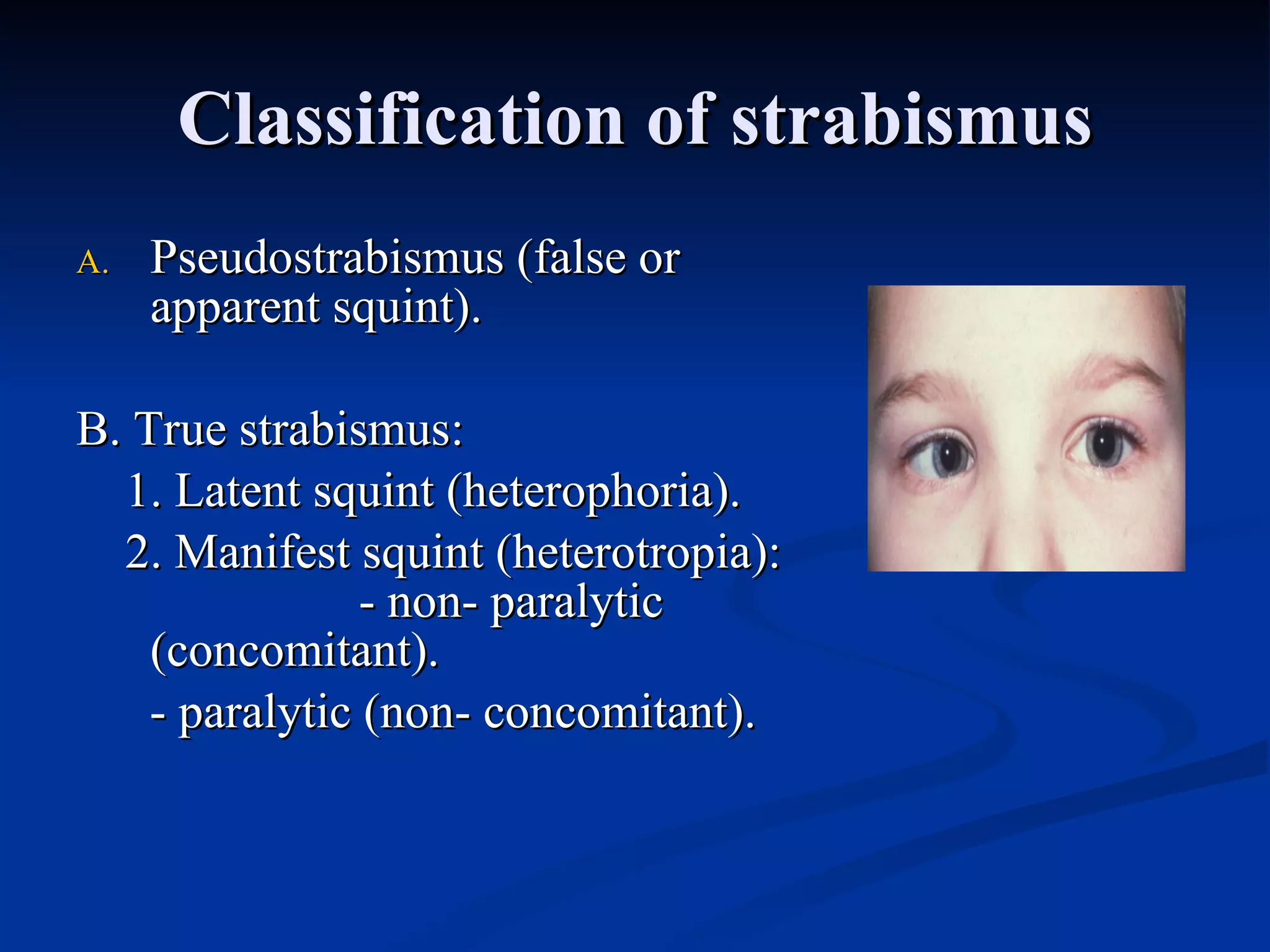
Classification of strabismus Pseudostrabismus (false or apparent squint). B. True strabismus: 1. Latent squint (heterophoria). 2. Manifest squint (heterotropia):  - non- paralytic (concomitant). - paralytic (non- concomitant).
Axes of the eye Visual axis:   Line passes from the fovea to the point of fixation (object of regard). The normal visual axes (from both eyes) intersects at the point of fixation. Optical axis: It is the line passing through the centre of the cornea and meets the retina on the nasal side of the fovea Fixation axis: It is the line joining the fixation point and the centre of rotation
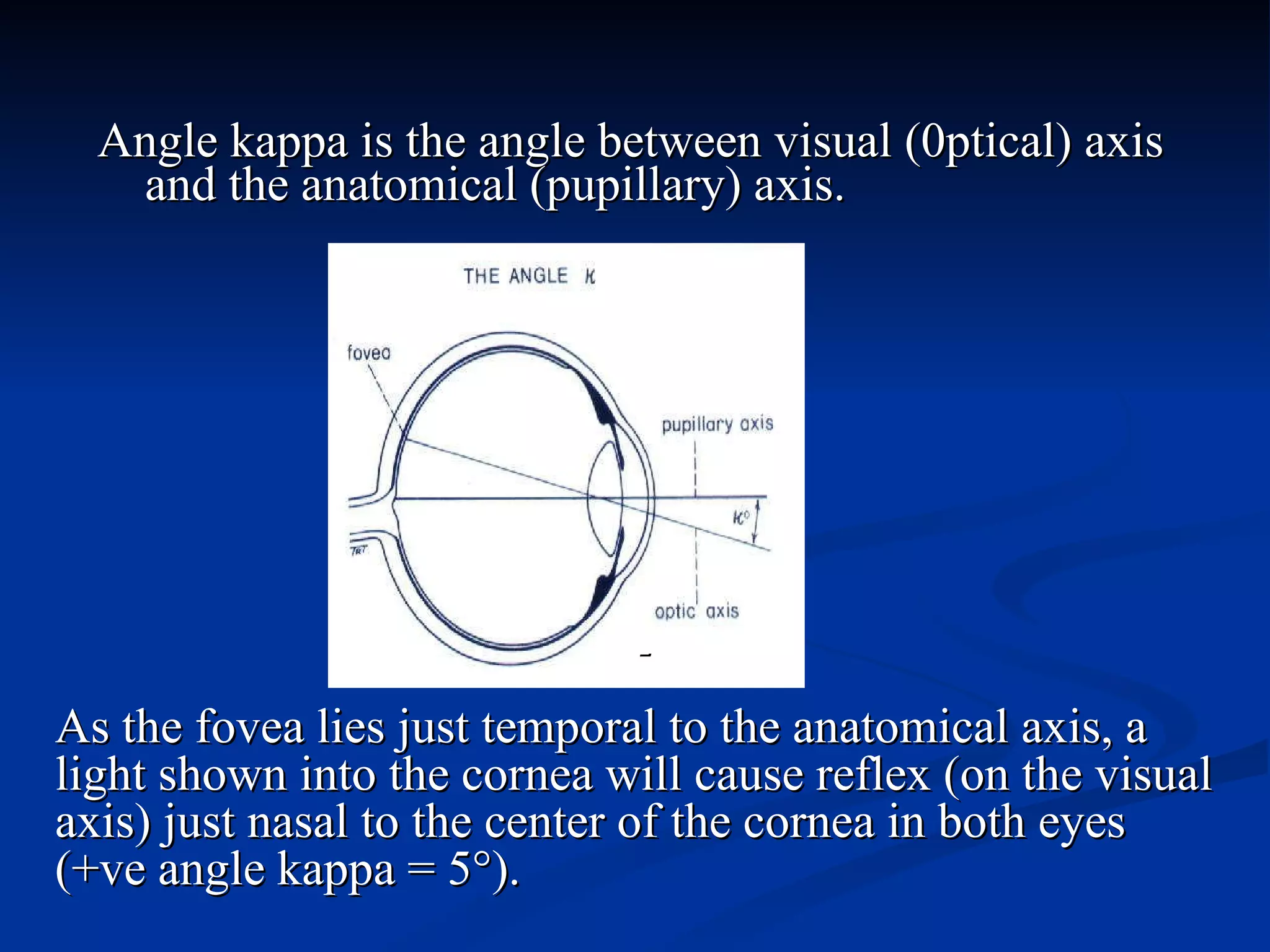
Angle kappa is the angle between visual (0ptical) axis and the anatomical (pupillary) axis.  - As the fovea lies just temporal to the anatomical axis, a light shown into the cornea will cause reflex (on the visual axis) just nasal to the center of the cornea in both eyes (+ve angle kappa = 5°).
In high myopia the, the fovea lies nasal to the optical axis. So, the corneal reflex lies temporal to the center of the cornea simulating esotropia. Negative angle kappa (myopia) leads to pseudo-esotropia. Large positive angle kappa (hypermetropia) leads to pseudo-exotropia.
Pseudostrabismus In young infants, strabismus must be differentiated from the more common pseudostrabismus Pseudoesotropia   as a result of a broad bridge of the nose. This is not a real eye crossing
Pseudo-deviations Pseudo-esotropia Pseudo-exotropia Epicanthic folds Short interpupillary distance Negative angle kappa Wide interpupillary distance Positive angle kappa
HISTORY Age of onset of deviation Is the deviation constant or intermittent? Is the deviation present for distance, near or both? Is it unilateral or alternating? Is it present only when the patient is inattentive or fatigued? Is it associated with trauma or physical stress? Old photographs Birth history Is there a family history of strabismus?. Are there any other medical problems?  Headaches Is there a history of toxin or medication exposure?
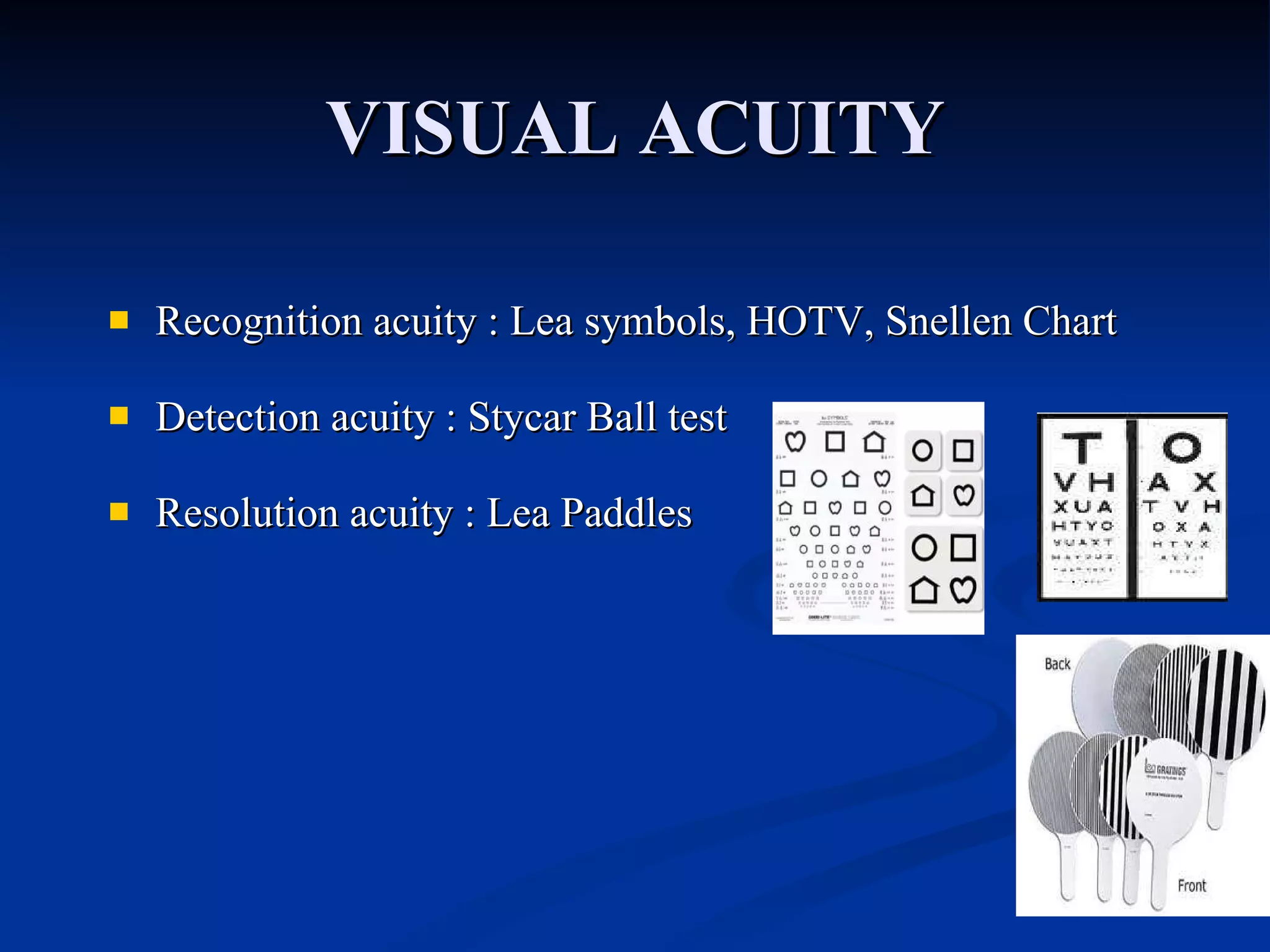
VISUAL ACUITY Recognition acuity : Lea symbols, HOTV, Snellen Chart Detection acuity : Stycar Ball test Resolution acuity : Lea Paddles
SENSORY EVALUATION Simultaneous macular perception Worth four dot test Stereopsis
Tests for sensory anomalies Worth four-dot test a - Prior to use of glasses b - Normal  c - Left suppression/ amblyopia Bagolini striated glasses a - Normal or ARC b- Diplopia c - Suppression d - Right suppression/ amblyopia e - Diplopia d - Small suppression scotoma
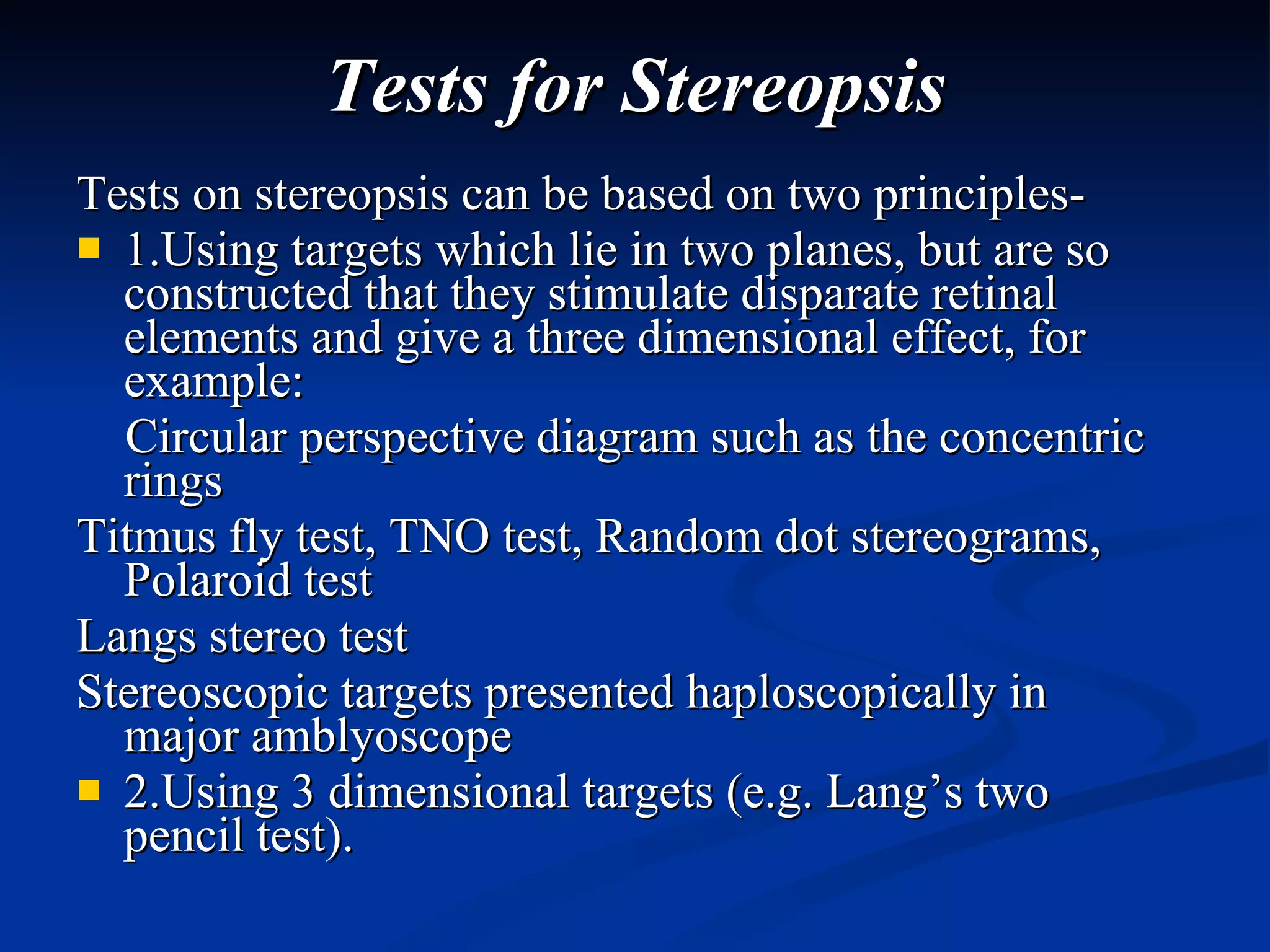
Tests for Stereopsis Tests on stereopsis can be based on two principles-  1.Using targets which lie in two planes, but are so constructed that they stimulate disparate retinal elements and give a three dimensional effect, for example:  Circular perspective diagram such as the concentric rings  Titmus fly test, TNO test, Random dot stereograms, Polaroid test  Langs stereo test  Stereoscopic targets presented haploscopically in major amblyoscope  2.Using 3 dimensional targets (e.g. Lang’s two pencil test).
Qualitative tests for Stereopsis :  Lang’s 2 pencil test  Synoptophore  Quantitative tests for Stereopsis:   Random dot test  TNO Test  Lang’s stereo test
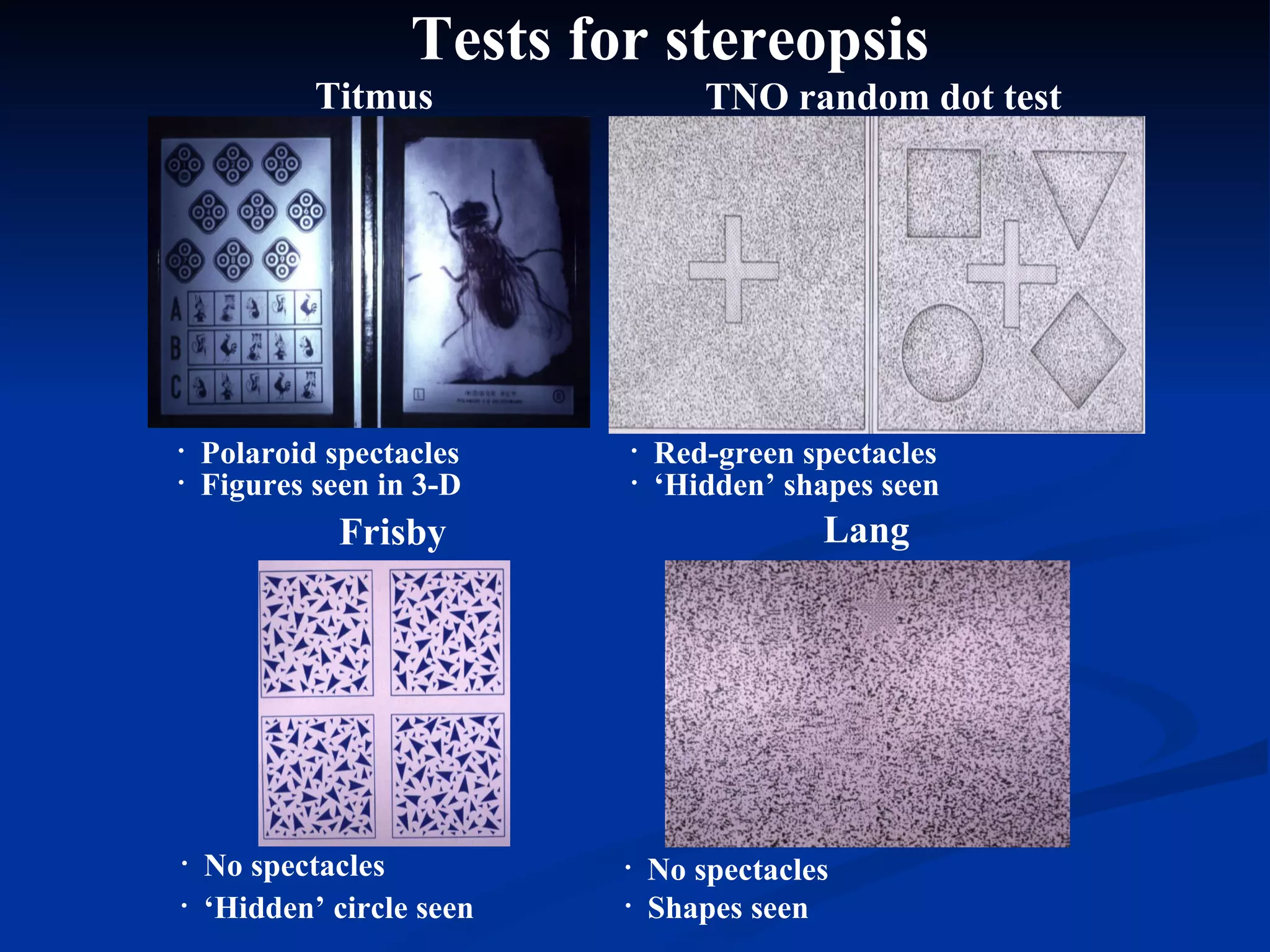
Tests for stereopsis Titmus Red-green spectacles TNO random dot test ‘ Hidden’ shapes seen  Polaroid spectacles Figures seen in 3-D Lang No spectacles Frisby ‘ Hidden’ circle seen No spectacles Shapes seen
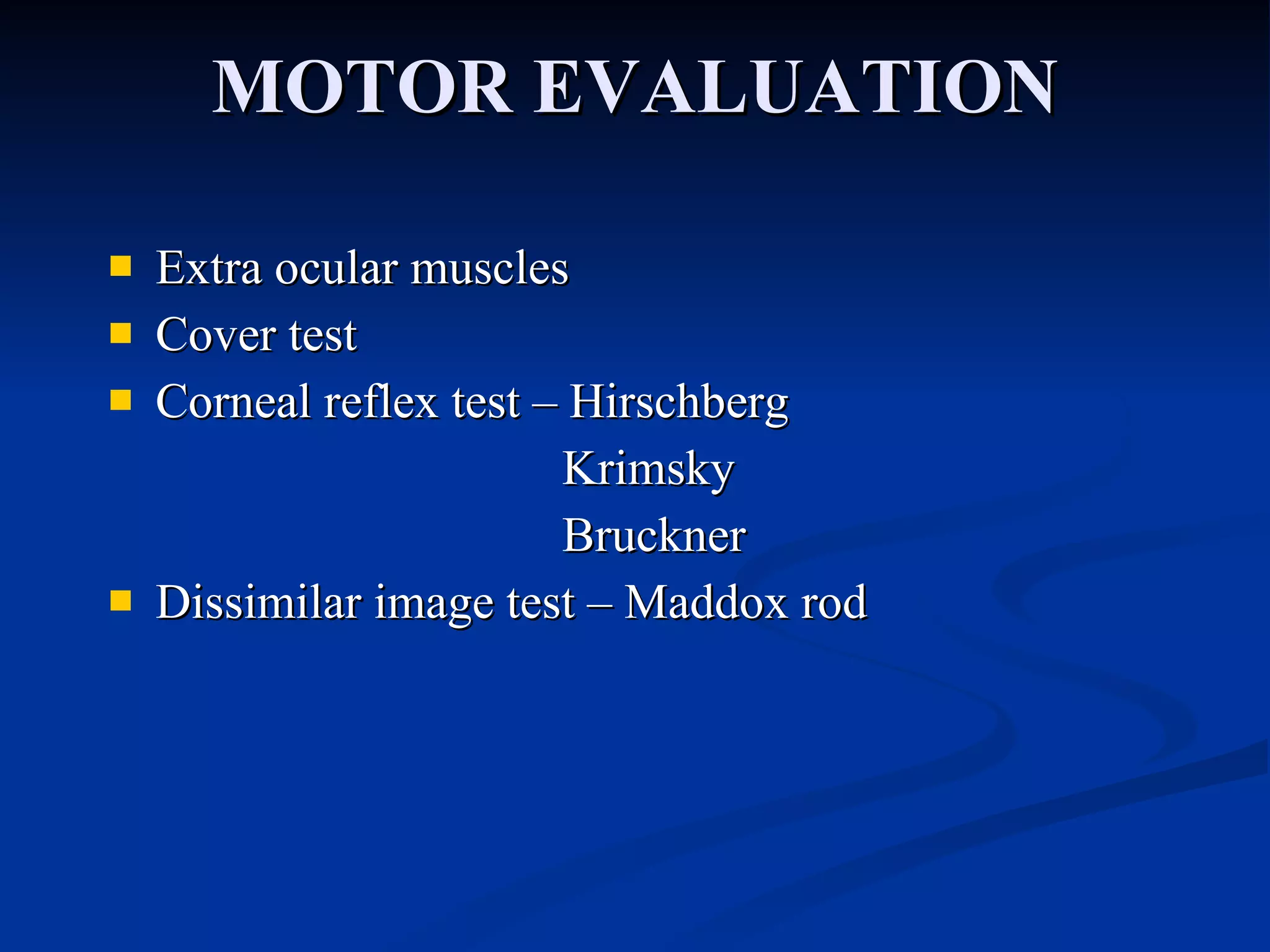
MOTOR EVALUATION Extra ocular muscles Cover test Corneal reflex test – Hirschberg Krimsky Bruckner Dissimilar image test – Maddox rod
Evaluation of Motility Two principle methods of evaluating ocular motility are:  1 .  Observation of ocular ductions, which are the actual monocular movements of the eye. 2 .  Observation of binocular ocular alignment, using cover/uncover and alternate cover testing.
Monocular eye movements A- elevation  B- depression  C- adbuction  d- adduction  E–extortion  F- intortion
Ocular movement examination
 
 
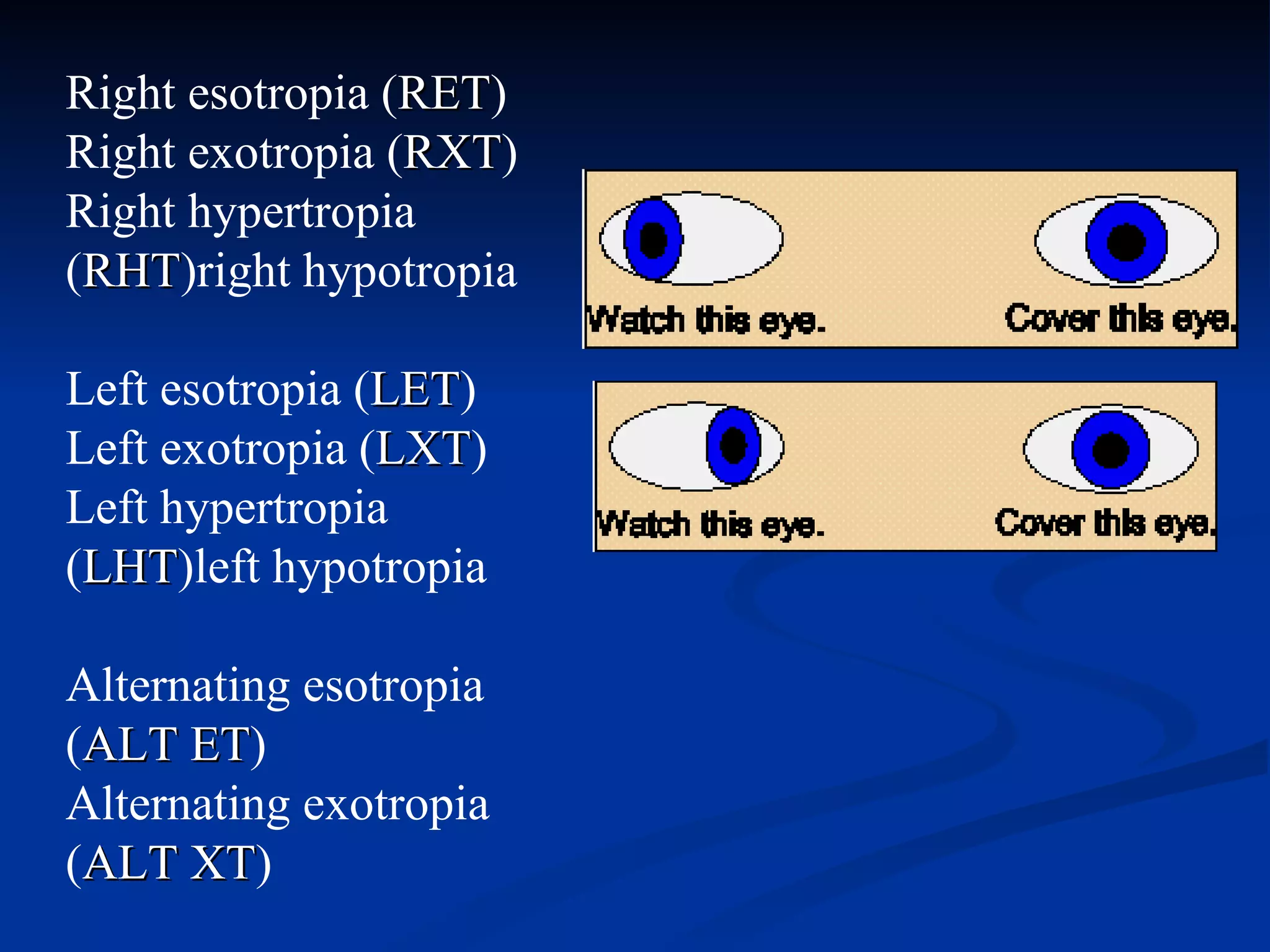
Right esotropia ( RET ) Right exotropia ( RXT ) Right hypertropia ( RHT )right hypotropia    Left esotropia ( LET ) Left exotropia ( LXT ) Left hypertropia ( LHT )left hypotropia   Alternating esotropia ( ALT ET ) Alternating exotropia ( ALT XT )
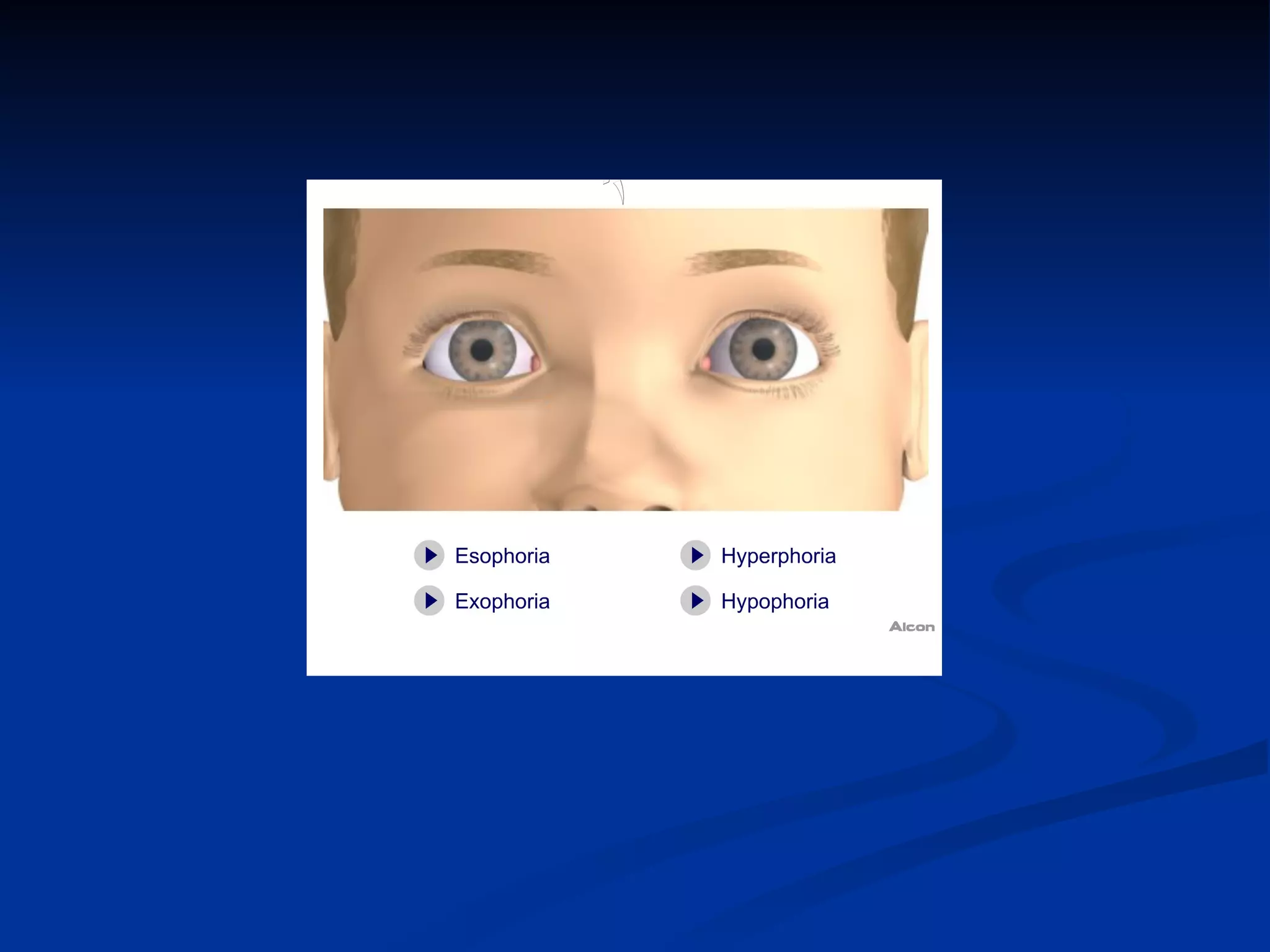
E   esophoria X   exophoria RH   right hyperphoria LH   left hyperphoria E(T)   intermittent esotropia X(T)  intermittent exotropia RH(T)   intermittent right hypertropia LH(T)   intermittent left hypertropia
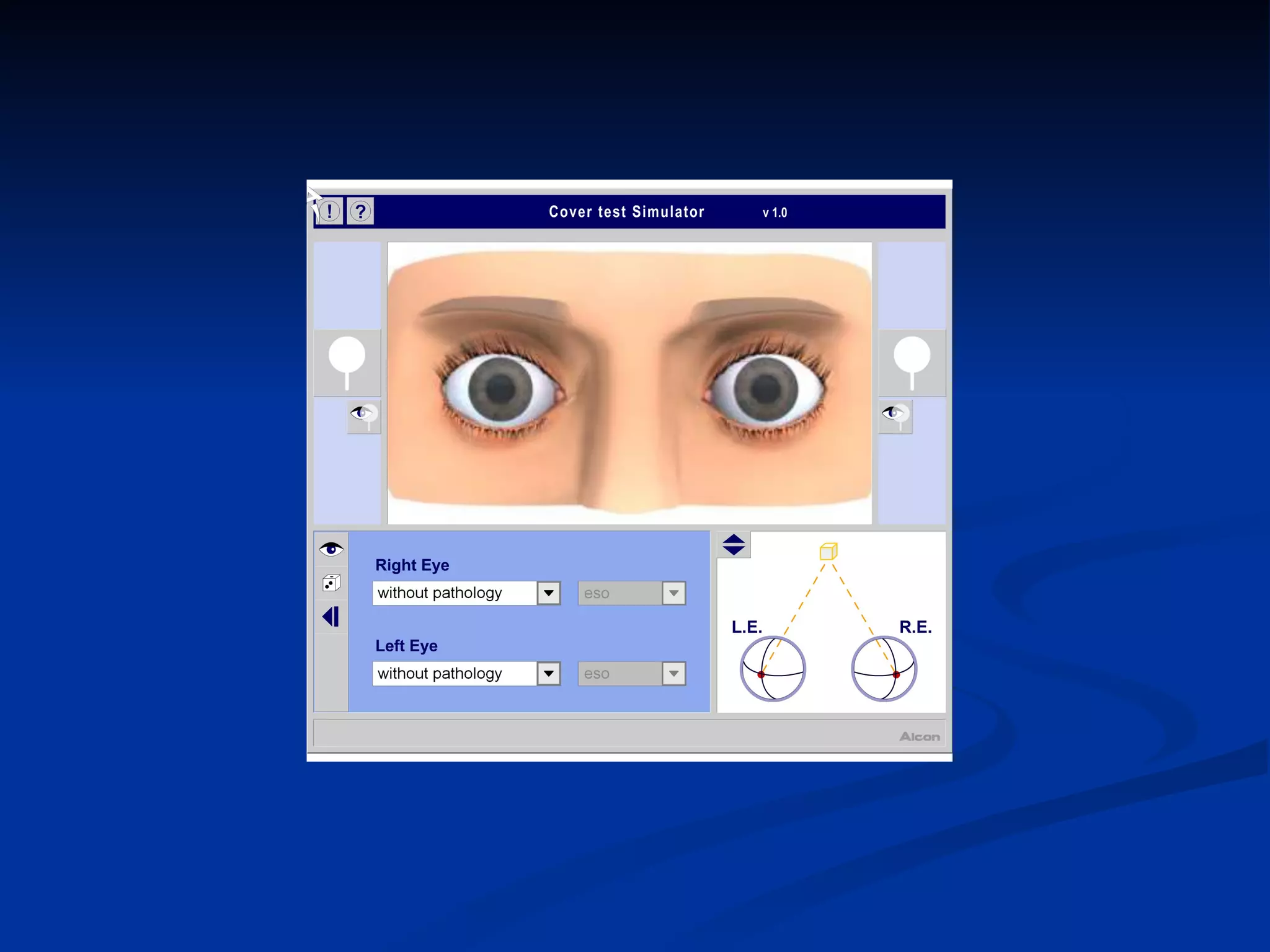
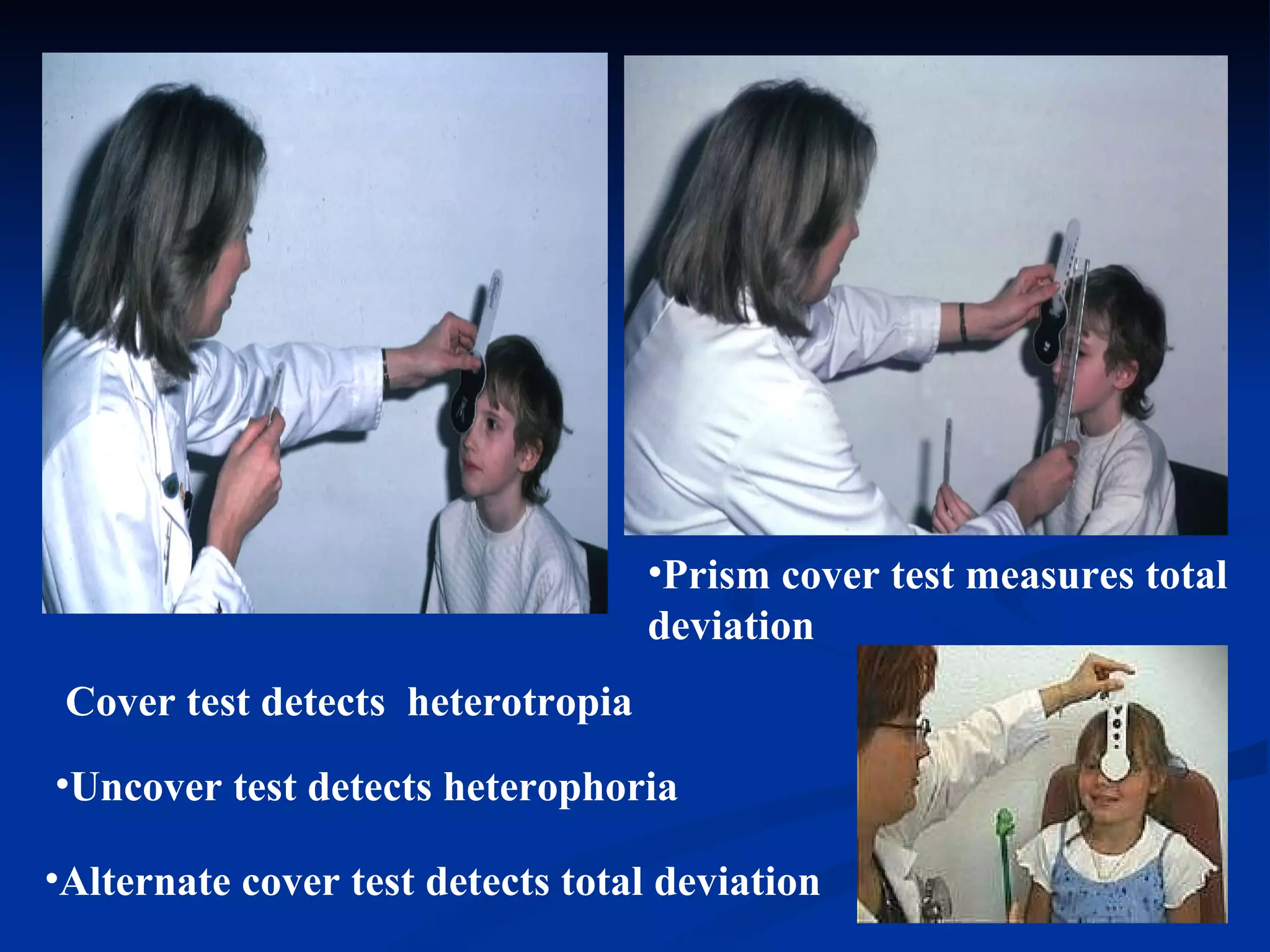
Cover test detects  heterotropia Uncover test detects heterophoria   Alternate cover test detects total deviation Prism cover test measures total deviation
Motility tests Tests versions and ductions Grades under/overaction   Left inferior oblique overaction Left lateral rectus underaction
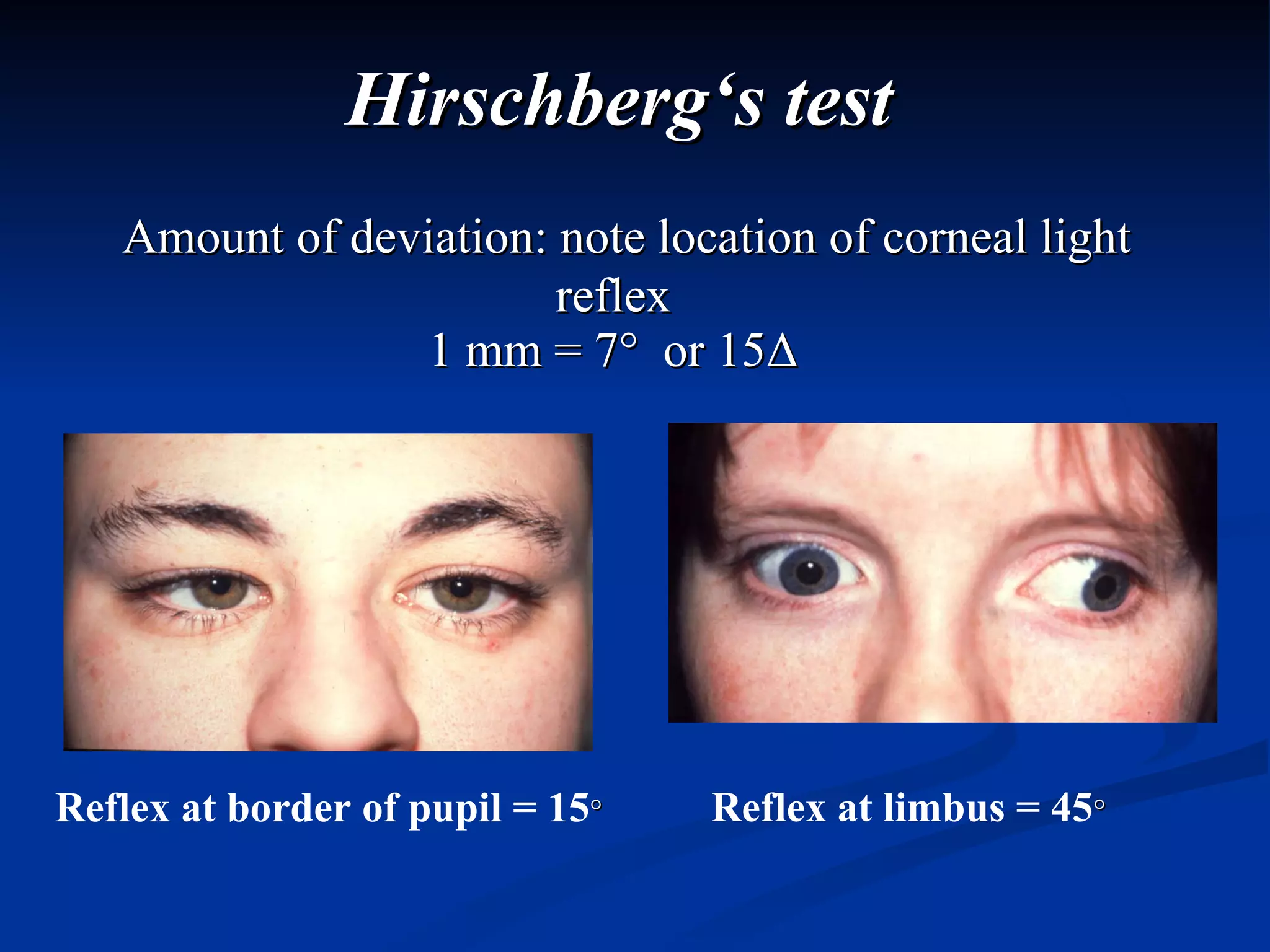
Hirschberg‘s test   Amount of deviation: note location of corneal light reflex  1 mm = 7 °   or 15 Δ   Reflex at border of pupil = 15 °   Reflex at limbus = 45 °
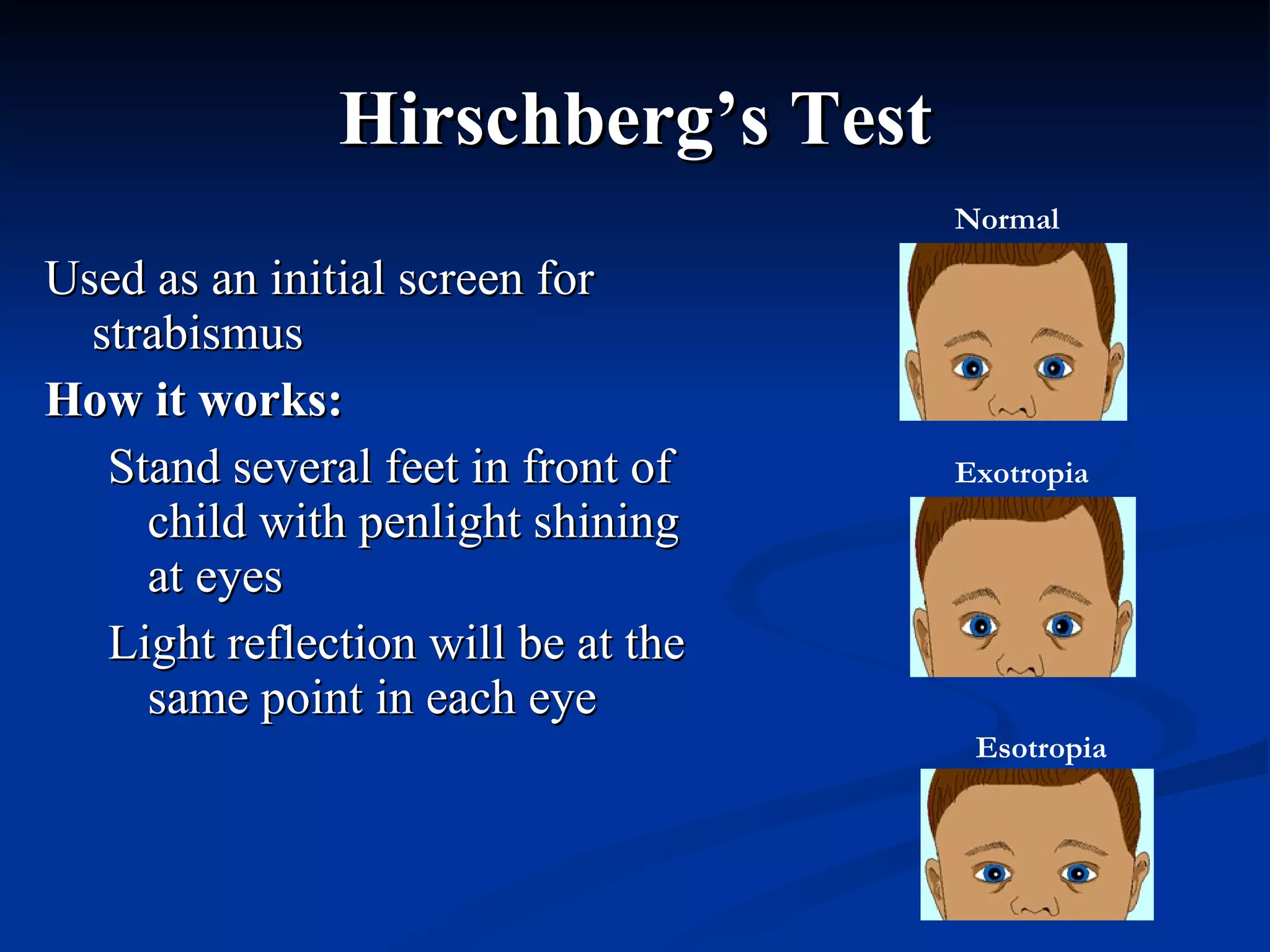
Hirschberg’s Test Used as an initial screen for strabismus How it works: Stand several feet in front of child with penlight shining at eyes Light reflection will be at the same point in each eye Normal Exotropia Esotropia
 
Krimsky Test
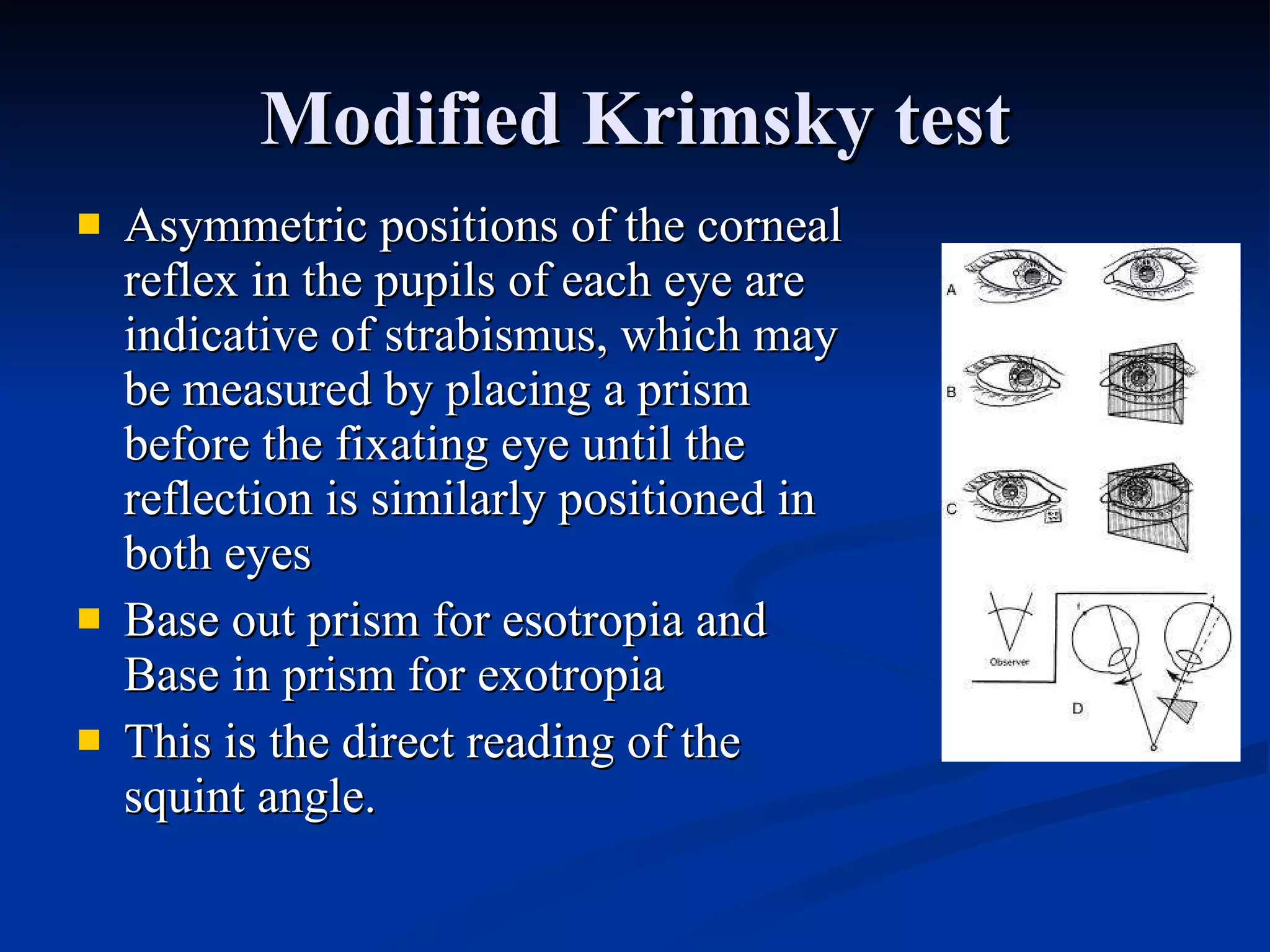
Modified Krimsky test Asymmetric positions of the corneal reflex in the pupils of each eye are indicative of strabismus, which may be measured by placing a prism before the fixating eye until the reflection is similarly positioned in both eyes Base out prism for esotropia and Base in prism for exotropia This is the direct reading of the squint angle.
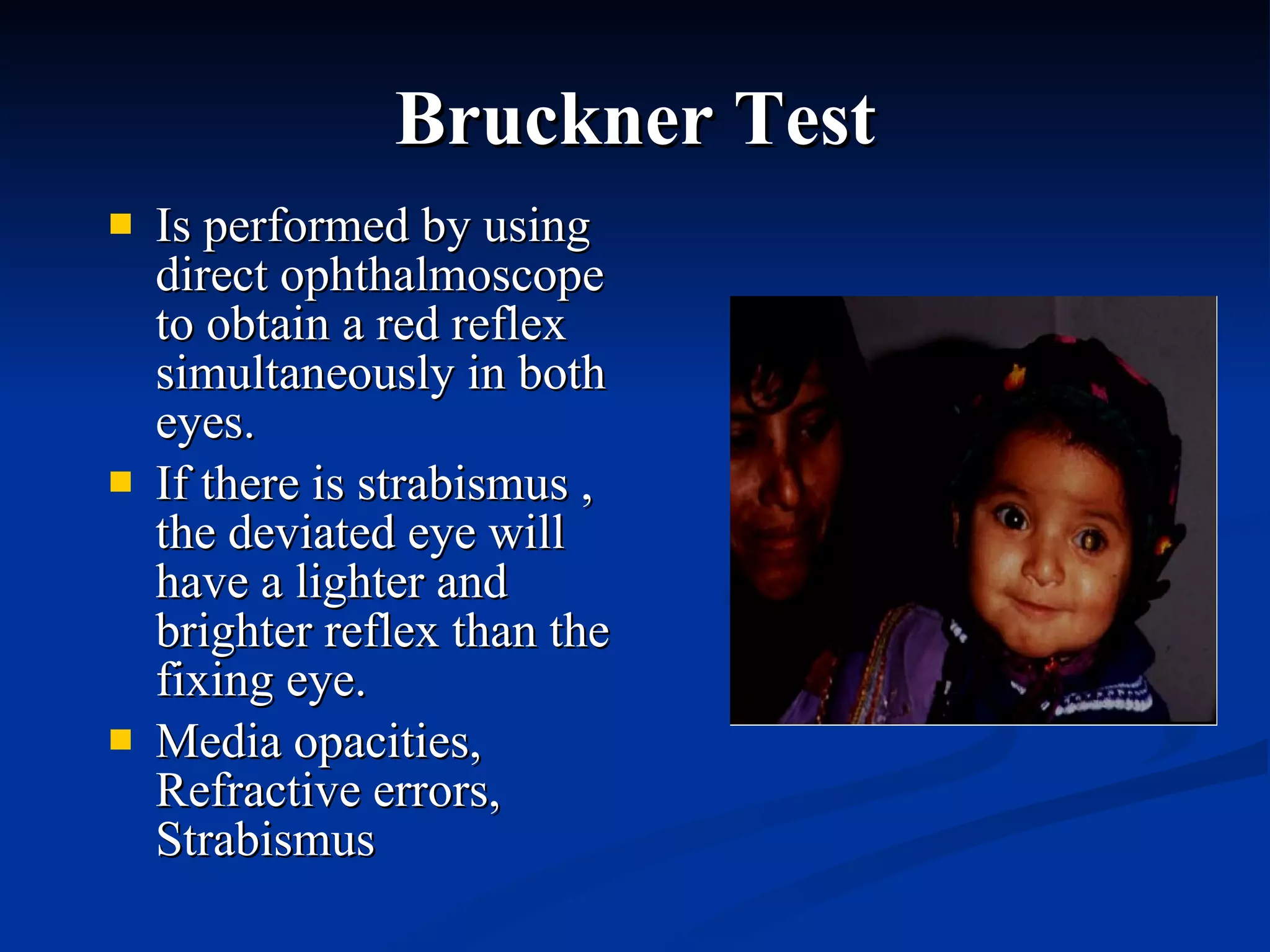
Bruckner Test Is performed by using direct ophthalmoscope to obtain a red reflex simultaneously in both eyes. If there is strabismus , the deviated eye will have a lighter and brighter reflex than the fixing eye. Media opacities, Refractive errors, Strabismus
Dissimilar image tests Maddox wing Maddox rod Dissociates eyes for near fixation (1/3 m) Measures heterophoria White spot converted into red streak Cannot differentiate tropia from phoria
Measurements of ocular misalignment Measurement of squints/misalignments  Synoptophore - picture test  Measure - misalignments, sensory and motor fusion and stereopsis  Predict BV post-surgery  Measure misalignments 9 positions of gaze
Prism Cover Test Measure squint/misalignment  Single prism/prism bar  Primary position or in all positions of gaze
Thank You

Diagnosis evaluation in strabismus

  • 1.
    DIAGNOSTIC EVALUATION FORSTRABISMUS Ms. JayaRajini Vasanth Mphil, B.S (opt) Assistant Professor – Optometry Ophthalmology Department Sri Ramachandra University
  • 2.
    Classification of strabismusPseudostrabismus (false or apparent squint). B. True strabismus: 1. Latent squint (heterophoria). 2. Manifest squint (heterotropia): - non- paralytic (concomitant). - paralytic (non- concomitant).
  • 3.
    Axes of theeye Visual axis: Line passes from the fovea to the point of fixation (object of regard). The normal visual axes (from both eyes) intersects at the point of fixation. Optical axis: It is the line passing through the centre of the cornea and meets the retina on the nasal side of the fovea Fixation axis: It is the line joining the fixation point and the centre of rotation
  • 4.
    Angle kappa isthe angle between visual (0ptical) axis and the anatomical (pupillary) axis. - As the fovea lies just temporal to the anatomical axis, a light shown into the cornea will cause reflex (on the visual axis) just nasal to the center of the cornea in both eyes (+ve angle kappa = 5°).
  • 5.
    In high myopiathe, the fovea lies nasal to the optical axis. So, the corneal reflex lies temporal to the center of the cornea simulating esotropia. Negative angle kappa (myopia) leads to pseudo-esotropia. Large positive angle kappa (hypermetropia) leads to pseudo-exotropia.
  • 6.
    Pseudostrabismus In younginfants, strabismus must be differentiated from the more common pseudostrabismus Pseudoesotropia as a result of a broad bridge of the nose. This is not a real eye crossing
  • 7.
    Pseudo-deviations Pseudo-esotropia Pseudo-exotropiaEpicanthic folds Short interpupillary distance Negative angle kappa Wide interpupillary distance Positive angle kappa
  • 8.
    HISTORY Age ofonset of deviation Is the deviation constant or intermittent? Is the deviation present for distance, near or both? Is it unilateral or alternating? Is it present only when the patient is inattentive or fatigued? Is it associated with trauma or physical stress? Old photographs Birth history Is there a family history of strabismus?. Are there any other medical problems? Headaches Is there a history of toxin or medication exposure?
  • 9.
    VISUAL ACUITY Recognitionacuity : Lea symbols, HOTV, Snellen Chart Detection acuity : Stycar Ball test Resolution acuity : Lea Paddles
  • 10.
    SENSORY EVALUATION Simultaneousmacular perception Worth four dot test Stereopsis
  • 11.
    Tests for sensoryanomalies Worth four-dot test a - Prior to use of glasses b - Normal c - Left suppression/ amblyopia Bagolini striated glasses a - Normal or ARC b- Diplopia c - Suppression d - Right suppression/ amblyopia e - Diplopia d - Small suppression scotoma
  • 12.
    Tests for StereopsisTests on stereopsis can be based on two principles- 1.Using targets which lie in two planes, but are so constructed that they stimulate disparate retinal elements and give a three dimensional effect, for example: Circular perspective diagram such as the concentric rings Titmus fly test, TNO test, Random dot stereograms, Polaroid test Langs stereo test Stereoscopic targets presented haploscopically in major amblyoscope 2.Using 3 dimensional targets (e.g. Lang’s two pencil test).
  • 13.
    Qualitative tests forStereopsis : Lang’s 2 pencil test Synoptophore Quantitative tests for Stereopsis: Random dot test TNO Test Lang’s stereo test
  • 14.
    Tests for stereopsisTitmus Red-green spectacles TNO random dot test ‘ Hidden’ shapes seen Polaroid spectacles Figures seen in 3-D Lang No spectacles Frisby ‘ Hidden’ circle seen No spectacles Shapes seen
  • 15.
    MOTOR EVALUATION Extraocular muscles Cover test Corneal reflex test – Hirschberg Krimsky Bruckner Dissimilar image test – Maddox rod
  • 16.
    Evaluation of MotilityTwo principle methods of evaluating ocular motility are: 1 . Observation of ocular ductions, which are the actual monocular movements of the eye. 2 . Observation of binocular ocular alignment, using cover/uncover and alternate cover testing.
  • 17.
    Monocular eye movementsA- elevation B- depression C- adbuction d- adduction E–extortion F- intortion
  • 18.
  • 19.
  • 20.
  • 21.
    Right esotropia (RET ) Right exotropia ( RXT ) Right hypertropia ( RHT )right hypotropia    Left esotropia ( LET ) Left exotropia ( LXT ) Left hypertropia ( LHT )left hypotropia   Alternating esotropia ( ALT ET ) Alternating exotropia ( ALT XT )
  • 22.
    E esophoria X exophoria RH right hyperphoria LH left hyperphoria E(T) intermittent esotropia X(T) intermittent exotropia RH(T) intermittent right hypertropia LH(T) intermittent left hypertropia
  • 23.
    Cover test detects heterotropia Uncover test detects heterophoria Alternate cover test detects total deviation Prism cover test measures total deviation
  • 24.
    Motility tests Testsversions and ductions Grades under/overaction Left inferior oblique overaction Left lateral rectus underaction
  • 25.
    Hirschberg‘s test Amount of deviation: note location of corneal light reflex 1 mm = 7 ° or 15 Δ Reflex at border of pupil = 15 ° Reflex at limbus = 45 °
  • 26.
    Hirschberg’s Test Usedas an initial screen for strabismus How it works: Stand several feet in front of child with penlight shining at eyes Light reflection will be at the same point in each eye Normal Exotropia Esotropia
  • 27.
  • 28.
  • 29.
    Modified Krimsky testAsymmetric positions of the corneal reflex in the pupils of each eye are indicative of strabismus, which may be measured by placing a prism before the fixating eye until the reflection is similarly positioned in both eyes Base out prism for esotropia and Base in prism for exotropia This is the direct reading of the squint angle.
  • 30.
    Bruckner Test Isperformed by using direct ophthalmoscope to obtain a red reflex simultaneously in both eyes. If there is strabismus , the deviated eye will have a lighter and brighter reflex than the fixing eye. Media opacities, Refractive errors, Strabismus
  • 31.
    Dissimilar image testsMaddox wing Maddox rod Dissociates eyes for near fixation (1/3 m) Measures heterophoria White spot converted into red streak Cannot differentiate tropia from phoria
  • 32.
    Measurements of ocularmisalignment Measurement of squints/misalignments Synoptophore - picture test Measure - misalignments, sensory and motor fusion and stereopsis Predict BV post-surgery Measure misalignments 9 positions of gaze
  • 33.
    Prism Cover TestMeasure squint/misalignment Single prism/prism bar Primary position or in all positions of gaze
  • 34.