CALL METHODOLOGY TSL 641
CALL METHODOLOGY Interplay between human and technology Human end is most important
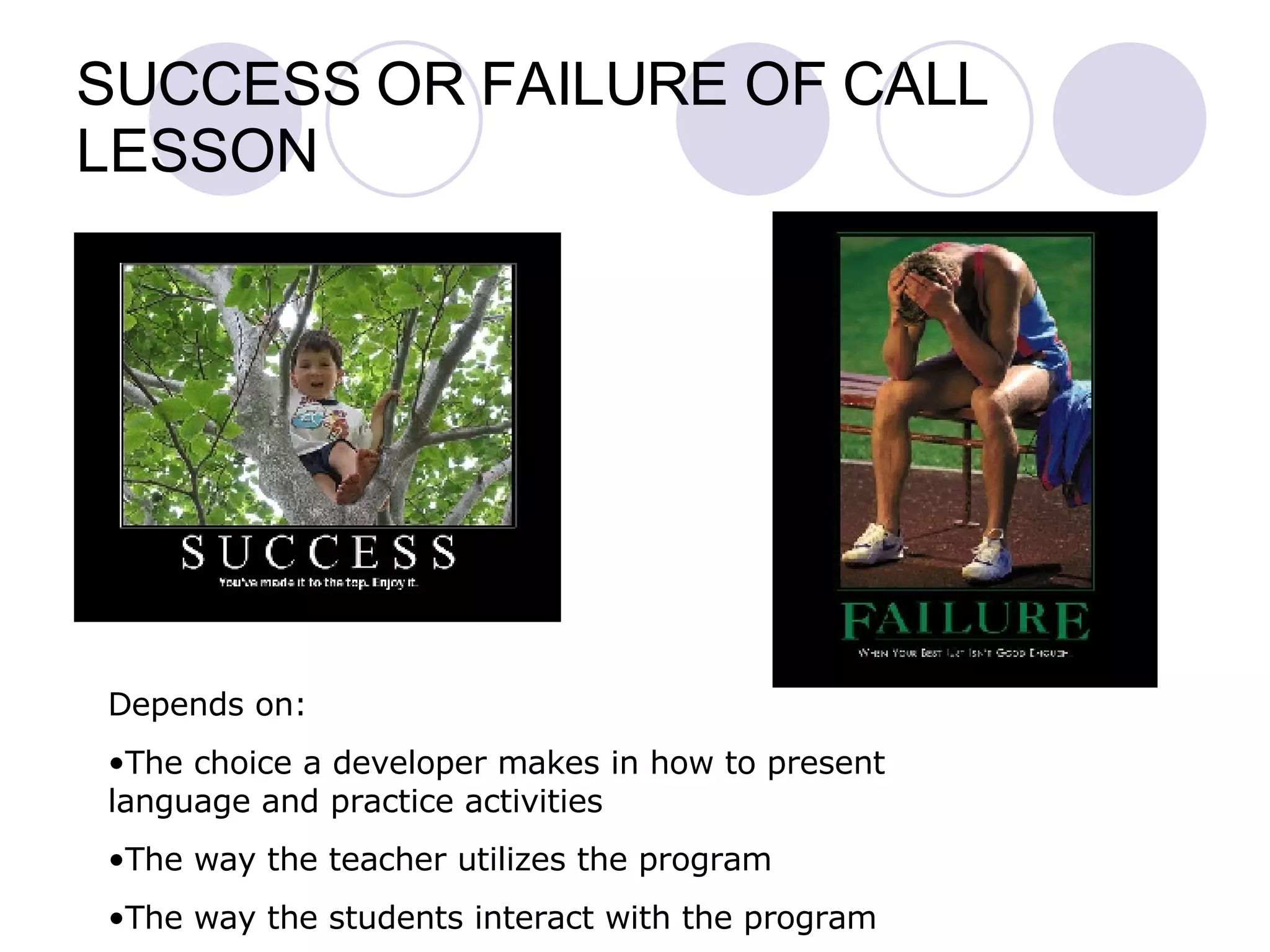
SUCCESS OR FAILURE OF CALL LESSON Depends on: The choice a developer makes in how to present language and practice activities The way the teacher utilizes the program The way the students interact with the program
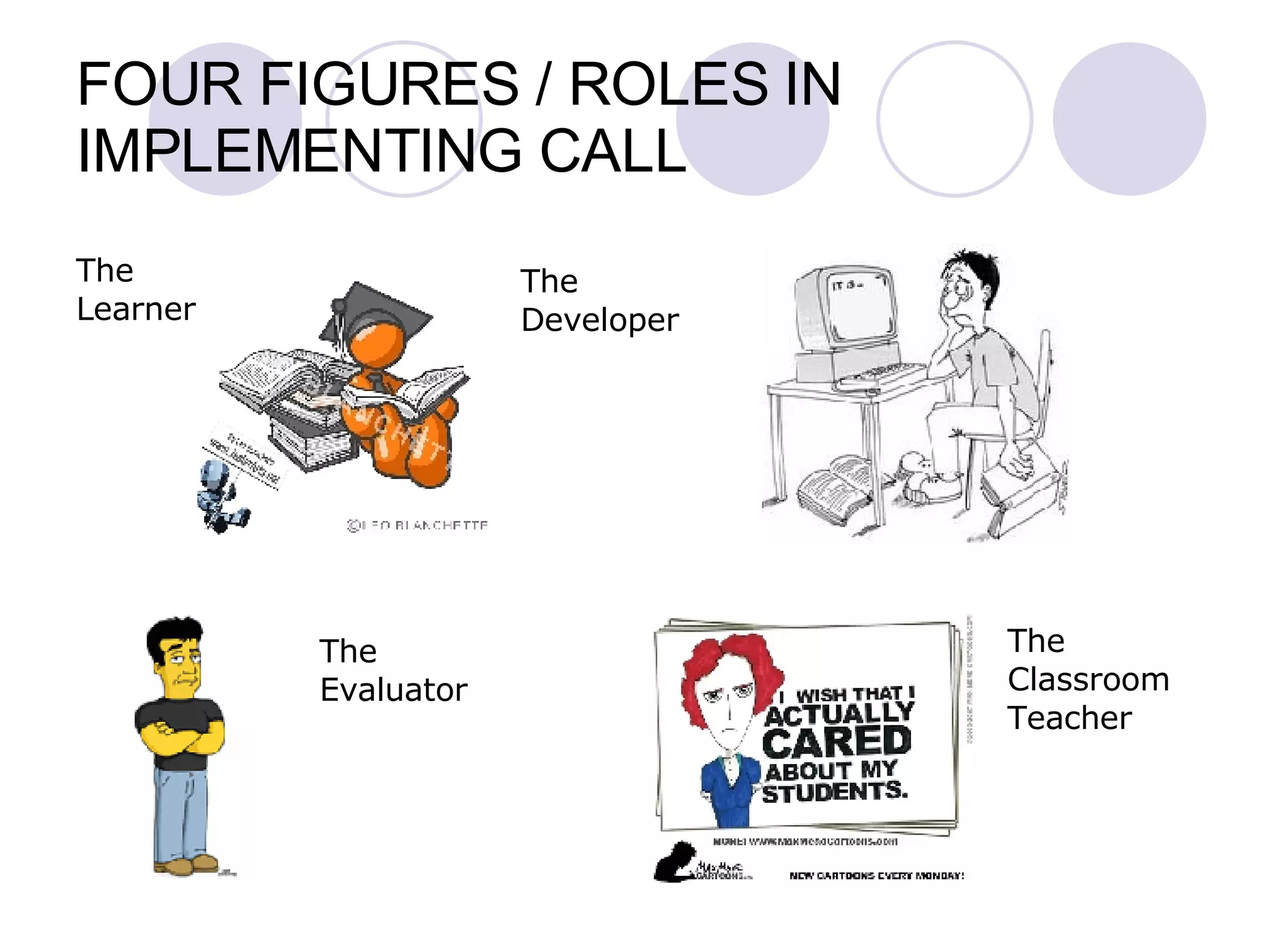
FOUR FIGURES / ROLES IN IMPLEMENTING CALL The Learner The Developer The Evaluator The Classroom Teacher
The Respective Roles - Learner The end user The person who is supposed to benefit from the product
The Respective Roles - Developer Will aid the teacher and learner in fulfilling broadly and narrowly defined learning objectives
The Respective Roles - Evaluator Analyzes software,  Describes its operation,  Passes professional judgment on the quality of the pedagogy and language materials,  Determines what types of learners and teachers the software might fit (evaluation is done through published software reviews, in-house evaluation, etc.)
The Respective Roles - Teacher Interprets the results of the evaluation for a particular teaching situation
Methodological Framework When developing a CALL courseware or website you need to have a methodological framework
Methodological Framework – 3 Components Development   Module Evaluation Module Implementation Module Development and evaluation precedes implementation • Evaluation can inform development and implementation can inform both development + evaluation
Development Module Three interacting components: Approach Design Procedure Approach Theories of language learning / structure Design The goals and objectives of the syllabus and the roles of the teacher, learner, and materials consistent with the approach Procedure Types of exercises, techniques or classroom activities consistent with the approach and design
Evaluation Module Incorporates Teacher fit Learner fit Operational description
Evaluation Module Leaner fit Does the presentational scheme fit the students' learning style? Are the program focus (language area) and learner focus (skill area) appropriate for the learners' needs as determined by the syllabus? Is the language difficulty at the right level given the learners' proficiency? Ss the feedback understandable and useful to the students?
Evaluation Module Teacher fit The considerations of the language teaching approach and computer delivery system can be used to judge the degree to which a piece of software fits within the teacher's conception of how languages are successfully learned .
Implementation Module The actual use of the software
Implementation Module The elements are: Accessibility Number of computers, availability, setting Preparatory activities training or tutorial module on how to use the program content preparation reviewing grammar rules, discussing the predicted content of a reading passage, etc. Learner use Follow-up activities (i.e. in-class quiz, discussing the content) Teacher control (control decisions are governed by the teacher's assumptions about the nature of language learning, the course requirements (syllabus), the teacher's perception of the students)

Call Methodology

  • 1.
  • 2.
    CALL METHODOLOGY Interplaybetween human and technology Human end is most important
  • 3.
    SUCCESS OR FAILUREOF CALL LESSON Depends on: The choice a developer makes in how to present language and practice activities The way the teacher utilizes the program The way the students interact with the program
  • 4.
    FOUR FIGURES /ROLES IN IMPLEMENTING CALL The Learner The Developer The Evaluator The Classroom Teacher
  • 5.
    The Respective Roles- Learner The end user The person who is supposed to benefit from the product
  • 6.
    The Respective Roles- Developer Will aid the teacher and learner in fulfilling broadly and narrowly defined learning objectives
  • 7.
    The Respective Roles- Evaluator Analyzes software, Describes its operation, Passes professional judgment on the quality of the pedagogy and language materials, Determines what types of learners and teachers the software might fit (evaluation is done through published software reviews, in-house evaluation, etc.)
  • 8.
    The Respective Roles- Teacher Interprets the results of the evaluation for a particular teaching situation
  • 9.
    Methodological Framework Whendeveloping a CALL courseware or website you need to have a methodological framework
  • 10.
    Methodological Framework –3 Components Development Module Evaluation Module Implementation Module Development and evaluation precedes implementation • Evaluation can inform development and implementation can inform both development + evaluation
  • 11.
    Development Module Threeinteracting components: Approach Design Procedure Approach Theories of language learning / structure Design The goals and objectives of the syllabus and the roles of the teacher, learner, and materials consistent with the approach Procedure Types of exercises, techniques or classroom activities consistent with the approach and design
  • 12.
    Evaluation Module IncorporatesTeacher fit Learner fit Operational description
  • 13.
    Evaluation Module Leanerfit Does the presentational scheme fit the students' learning style? Are the program focus (language area) and learner focus (skill area) appropriate for the learners' needs as determined by the syllabus? Is the language difficulty at the right level given the learners' proficiency? Ss the feedback understandable and useful to the students?
  • 14.
    Evaluation Module Teacherfit The considerations of the language teaching approach and computer delivery system can be used to judge the degree to which a piece of software fits within the teacher's conception of how languages are successfully learned .
  • 15.
    Implementation Module Theactual use of the software
  • 16.
    Implementation Module Theelements are: Accessibility Number of computers, availability, setting Preparatory activities training or tutorial module on how to use the program content preparation reviewing grammar rules, discussing the predicted content of a reading passage, etc. Learner use Follow-up activities (i.e. in-class quiz, discussing the content) Teacher control (control decisions are governed by the teacher's assumptions about the nature of language learning, the course requirements (syllabus), the teacher's perception of the students)