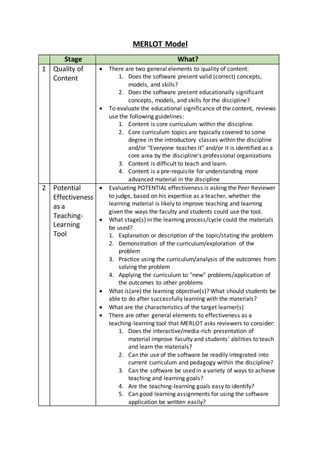
MERLOT Model
Stage What?
1 Quality of
Content
 There are two general elements to quality of content:
1. Does the software present valid (correct) concepts,
models, and skills?
2. Does the software present educationally significant
concepts, models, and skills for the discipline?
 To evaluate the educational significance of the content, reviews
use the following guidelines:
1. Content is core curriculum within the discipline.
2. Core curriculum topics are typically covered to some
degree in the introductory classes within the discipline
and/or "Everyone teaches it" and/or it is identified as a
core area by the discipline's professional organizations
3. Content is difficult to teach and learn.
4. Content is a pre-requisite for understanding more
advanced material in the discipline
2 Potential
Effectiveness
as a
Teaching-
Learning
Tool
 Evaluating POTENTIAL effectiveness is asking the Peer Reviewer
to judge, based on his expertise as a teacher, whether the
learning material is likely to improve teaching and learning
given the ways the faculty and students could use the tool.
 What stage(s) in the learning process/cycle could the materials
be used?
1. Explanation or description of the topic/stating the problem
2. Demonstration of the curriculum/exploration of the
problem
3. Practice using the curriculum/analysis of the outcomes from
solving the problem
4. Applying the curriculum to "new" problems/application of
the outcomes to other problems
 What is(are) the learning objective(s)? What should students be
able to do after successfully learning with the materials?
 What are the characteristics of the target learner(s)
 There are other general elements to effectiveness as a
teaching-learning tool that MERLOT asks reviewers to consider:
1. Does the interactive/media-rich presentation of
material improve faculty and students' abilities to teach
and learn the materials?
2. Can the use of the software be readily integrated into
current curriculum and pedagogy within the discipline?
3. Can the software be used in a variety of ways to achieve
teaching and learning goals?
4. Are the teaching-learning goals easy to identify?
5. Can good learning assignments for using the software
application be written easily?
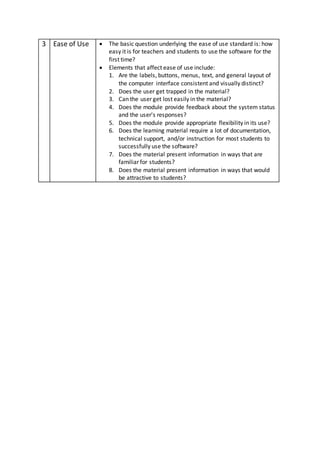
3 Ease of Use  The basic question underlying the ease of use standard is: how
easy it is for teachers and students to use the software for the
first time?
 Elements that affect ease of use include:
1. Are the labels, buttons, menus, text, and general layout of
the computer interface consistent and visually distinct?
2. Does the user get trapped in the material?
3. Can the user get lost easily in the material?
4. Does the module provide feedback about the system status
and the user's responses?
5. Does the module provide appropriate flexibility in its use?
6. Does the learning material require a lot of documentation,
technical support, and/or instruction for most students to
successfully use the software?
7. Does the material present information in ways that are
familiar for students?
8. Does the material present information in ways that would
be attractive to students?

Evaluating Teaching: MERLOT

  • 1.
    MERLOT Model Stage What? 1Quality of Content  There are two general elements to quality of content: 1. Does the software present valid (correct) concepts, models, and skills? 2. Does the software present educationally significant concepts, models, and skills for the discipline?  To evaluate the educational significance of the content, reviews use the following guidelines: 1. Content is core curriculum within the discipline. 2. Core curriculum topics are typically covered to some degree in the introductory classes within the discipline and/or "Everyone teaches it" and/or it is identified as a core area by the discipline's professional organizations 3. Content is difficult to teach and learn. 4. Content is a pre-requisite for understanding more advanced material in the discipline 2 Potential Effectiveness as a Teaching- Learning Tool  Evaluating POTENTIAL effectiveness is asking the Peer Reviewer to judge, based on his expertise as a teacher, whether the learning material is likely to improve teaching and learning given the ways the faculty and students could use the tool.  What stage(s) in the learning process/cycle could the materials be used? 1. Explanation or description of the topic/stating the problem 2. Demonstration of the curriculum/exploration of the problem 3. Practice using the curriculum/analysis of the outcomes from solving the problem 4. Applying the curriculum to "new" problems/application of the outcomes to other problems  What is(are) the learning objective(s)? What should students be able to do after successfully learning with the materials?  What are the characteristics of the target learner(s)  There are other general elements to effectiveness as a teaching-learning tool that MERLOT asks reviewers to consider: 1. Does the interactive/media-rich presentation of material improve faculty and students' abilities to teach and learn the materials? 2. Can the use of the software be readily integrated into current curriculum and pedagogy within the discipline? 3. Can the software be used in a variety of ways to achieve teaching and learning goals? 4. Are the teaching-learning goals easy to identify? 5. Can good learning assignments for using the software application be written easily?
  • 2.
    3 Ease ofUse  The basic question underlying the ease of use standard is: how easy it is for teachers and students to use the software for the first time?  Elements that affect ease of use include: 1. Are the labels, buttons, menus, text, and general layout of the computer interface consistent and visually distinct? 2. Does the user get trapped in the material? 3. Can the user get lost easily in the material? 4. Does the module provide feedback about the system status and the user's responses? 5. Does the module provide appropriate flexibility in its use? 6. Does the learning material require a lot of documentation, technical support, and/or instruction for most students to successfully use the software? 7. Does the material present information in ways that are familiar for students? 8. Does the material present information in ways that would be attractive to students?