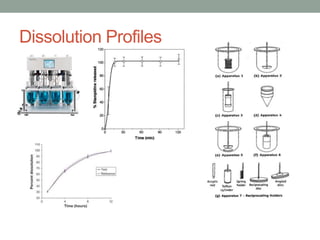
Dissolution Profiles
Agenda
• Types of Drug Release
• Drug Release Profiling
• Alcohol-Induced Dose Dumping
• Dissolution Release Specification
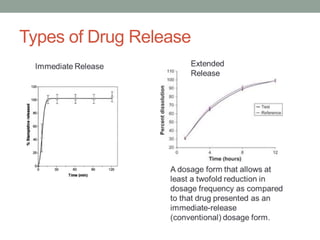
Types of Drug Release
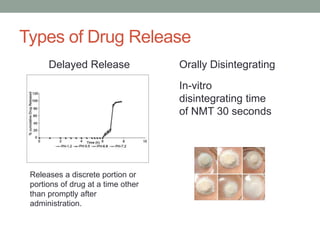
Delayed Release Orally Disintegrating
In-vitro
disintegrating time
of NMT 30 seconds
Releases a discrete portion or
portions of drug at a time other
than promptly after
administration.
Drug Release Profiling
• Places to check first
• USP
• FDA Dissolution Method
Database
http://www.accessdata.fda.gov/scripts
/cder/dissolution/
• Summary Basis of
Approval
• FDA Bioequivalence
Recommendations for
Specific Products
Drug Name
Dosage
Form
USP
Apparatus
Speed
(RPMs)
Medium Volume (mL)
Recommend
ed Sampling
Times
(minutes)
Date
Updated
Abacavir
Sulfate
Tablet II (Paddle) 75 0.1 N HCl 900 5, 10, 15,
and 30
03/22/2006
Abacavir
Sulfate/Lami
vudine
Tablet II (Paddle) 75 0.1 N HCl 900 10, 20, 30,
and 45
01/03/2007
Abacavir
Sulfate/Lami
vudine/Zidov
udine
Tablet II (Paddle) 75 0.1 N HCl 900 5, 10, 15, 30
and 45
01/03/2007
In addition to the method above, for modified release
products, dissolution profiles on 12 dosage units each
of test and reference products generated using USP
Apparatus I at 100 rpm and/or Apparatus II at 50 rpm in
at least three dissolution media (pH 1.2, 4.5, and 6.8
buffer) should be submitted in the application. Agitation
speeds may have to be increased if appropriate. It is
acceptable to add a small amount of surfactant, if
necessary. Include early sampling times of 1, 2, and 4
hours and continue every 2 hours until at least 80% of
the drug is released, to provide assurance against
premature release of drug (dose dumping) from the
formulation. Specifications will be determined upon
review of the data submitted in the application.
Drug Release Profiling (IR)
• Things to do first (Immediate Release)
• 0.1 N HCl, 900 mL, paddles, 50 RPM, 15 min.
If NLT 85% is dissolved, then product behaves like a
solution.
• Using release method, sample dissolution every 15
minutes until two points past the asymptote is
obtained.
For dissolution profiles, select NMT 4 time points with
NMT 2 points past the asymptote. Asymptote should
be NLT 85% amount released.
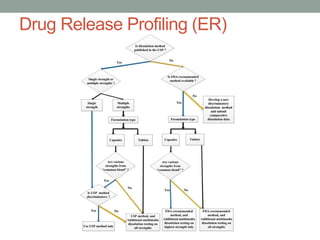
Drug Release Profiling (ER)
• Things to do first
• Generate RLD profile as per FDA Dissolution Data Base.
• Using same apparatus, volume, speed and time points as
FDA method, generate additional profiles* with
• Water
• 0.1N HCl
• Buffer pH 6.8
• Buffer pH 4.5
All together, there should be 4 dissolution profiles: FDA’s
plus three.
*Surfactants may be used to achieve sink conditions
Drug Release Profiling (DR)
• Demonstrate product is
stable at pH 1.2 for 2 hrs.
• Demonstrate drug is
released at pH 6.8.
• No multimedia dissolution
testing required.
Alcohol-Induced Dose Dumping
• Not required for all products.
• Verify FDA’s guidance – Individual Products
Bioequivalence Recommendations Guidance
http://www.fda.gov/Drugs/GuidanceComplianceRegulatoryInformation/Guidances/ucm075207.htm
• Check if it was requested by FDA on RLD SBoA.
• Media: 900 mL 0.1N HCl media on a V/V basis to
give the following percentages:
• 0% ethanol (no ethanol added)
• 5% ethanol (beer)
• 20% ethanol (mixed drinks)
• 40% ethanol (neat liquor)
Beware!
Ethanol ≠ Alcohol
Alcohol is about 94.5% Ethanol…
Alcohol-Induced Dose Dumping
• Sampling is done
every 15 minutes until
2 hrs are reached.
• Acceptance criteria:
Generic drug is not
worst than the RLD.
• It is only performed
once in the lifetime of
a drug product
formula. Prior to
approval.
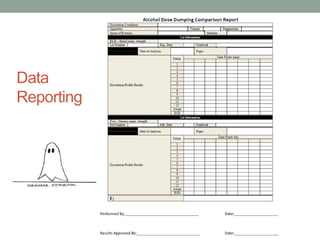
Data
• No decimal points
• Assays
• RLD should be 95 – 105% LC
• Test product should be within
5% of RLD
• RLD satisfactory Content
Uniformity
• The following may indicate
the need to investigate
results out of the lab
• RSD should be NMT 20% in
first time point.
• RSD should be NMT 10% for
all other points.
• Asymptote should be NLT
85%.
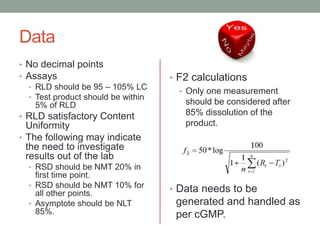
• F2 calculations
• Only one measurement
should be considered after
85% dissolution of the
product.
• Data needs to be
generated and handled as
per cGMP.
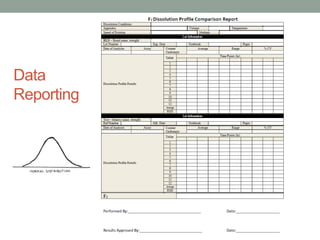
Data
Reporting
Data
Reporting
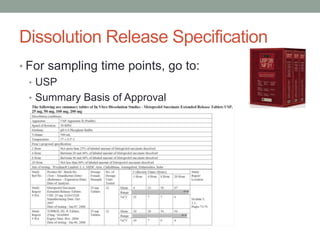
Dissolution Release Specification
• For sampling time points, go to:
• USP
• Summary Basis of Approval
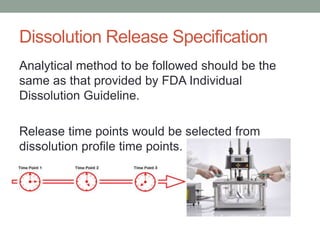
Dissolution Release Specification
Analytical method to be followed should be the
same as that provided by FDA Individual
Dissolution Guideline.
Release time points would be selected from
dissolution profile time points.
Dissolution Release Specification
• IR
• One point with release
of NLT 85%
• DR
• Two points
• 0% @ 2 hr in 0.1N HCl
• Either
• 85% in 6.8 buffer
• Multipoint Dissolution
• ER
• NMT 4 time points
• NMT 2 points past
asymptote
• Asymptote NLT 85%
• Ranges:
• 1st is NMT __%
• 2nd and 3rd with a range of
NMT 20%
• 4th time point NLT 85%
Questions

Dissolution Profiles

  • 1.
  • 2.
    Dissolution Profiles Agenda • Typesof Drug Release • Drug Release Profiling • Alcohol-Induced Dose Dumping • Dissolution Release Specification
  • 3.
  • 4.
    Types of DrugRelease Delayed Release Orally Disintegrating In-vitro disintegrating time of NMT 30 seconds Releases a discrete portion or portions of drug at a time other than promptly after administration.
  • 5.
    Drug Release Profiling •Places to check first • USP • FDA Dissolution Method Database http://www.accessdata.fda.gov/scripts /cder/dissolution/ • Summary Basis of Approval • FDA Bioequivalence Recommendations for Specific Products Drug Name Dosage Form USP Apparatus Speed (RPMs) Medium Volume (mL) Recommend ed Sampling Times (minutes) Date Updated Abacavir Sulfate Tablet II (Paddle) 75 0.1 N HCl 900 5, 10, 15, and 30 03/22/2006 Abacavir Sulfate/Lami vudine Tablet II (Paddle) 75 0.1 N HCl 900 10, 20, 30, and 45 01/03/2007 Abacavir Sulfate/Lami vudine/Zidov udine Tablet II (Paddle) 75 0.1 N HCl 900 5, 10, 15, 30 and 45 01/03/2007 In addition to the method above, for modified release products, dissolution profiles on 12 dosage units each of test and reference products generated using USP Apparatus I at 100 rpm and/or Apparatus II at 50 rpm in at least three dissolution media (pH 1.2, 4.5, and 6.8 buffer) should be submitted in the application. Agitation speeds may have to be increased if appropriate. It is acceptable to add a small amount of surfactant, if necessary. Include early sampling times of 1, 2, and 4 hours and continue every 2 hours until at least 80% of the drug is released, to provide assurance against premature release of drug (dose dumping) from the formulation. Specifications will be determined upon review of the data submitted in the application.
  • 6.
  • 7.
    Drug Release Profiling(IR) • Things to do first (Immediate Release) • 0.1 N HCl, 900 mL, paddles, 50 RPM, 15 min. If NLT 85% is dissolved, then product behaves like a solution. • Using release method, sample dissolution every 15 minutes until two points past the asymptote is obtained. For dissolution profiles, select NMT 4 time points with NMT 2 points past the asymptote. Asymptote should be NLT 85% amount released.
  • 8.
  • 9.
    Drug Release Profiling(ER) • Things to do first • Generate RLD profile as per FDA Dissolution Data Base. • Using same apparatus, volume, speed and time points as FDA method, generate additional profiles* with • Water • 0.1N HCl • Buffer pH 6.8 • Buffer pH 4.5 All together, there should be 4 dissolution profiles: FDA’s plus three. *Surfactants may be used to achieve sink conditions
  • 10.
    Drug Release Profiling(DR) • Demonstrate product is stable at pH 1.2 for 2 hrs. • Demonstrate drug is released at pH 6.8. • No multimedia dissolution testing required.
  • 11.
    Alcohol-Induced Dose Dumping •Not required for all products. • Verify FDA’s guidance – Individual Products Bioequivalence Recommendations Guidance http://www.fda.gov/Drugs/GuidanceComplianceRegulatoryInformation/Guidances/ucm075207.htm • Check if it was requested by FDA on RLD SBoA. • Media: 900 mL 0.1N HCl media on a V/V basis to give the following percentages: • 0% ethanol (no ethanol added) • 5% ethanol (beer) • 20% ethanol (mixed drinks) • 40% ethanol (neat liquor)
  • 12.
  • 13.
    Alcohol is about94.5% Ethanol…
  • 14.
    Alcohol-Induced Dose Dumping •Sampling is done every 15 minutes until 2 hrs are reached. • Acceptance criteria: Generic drug is not worst than the RLD. • It is only performed once in the lifetime of a drug product formula. Prior to approval.
  • 15.
    Data • No decimalpoints • Assays • RLD should be 95 – 105% LC • Test product should be within 5% of RLD • RLD satisfactory Content Uniformity • The following may indicate the need to investigate results out of the lab • RSD should be NMT 20% in first time point. • RSD should be NMT 10% for all other points. • Asymptote should be NLT 85%. • F2 calculations • Only one measurement should be considered after 85% dissolution of the product. • Data needs to be generated and handled as per cGMP.
  • 16.
  • 17.
  • 18.
    Dissolution Release Specification •For sampling time points, go to: • USP • Summary Basis of Approval
  • 19.
    Dissolution Release Specification Analyticalmethod to be followed should be the same as that provided by FDA Individual Dissolution Guideline. Release time points would be selected from dissolution profile time points.
  • 20.
    Dissolution Release Specification •IR • One point with release of NLT 85% • DR • Two points • 0% @ 2 hr in 0.1N HCl • Either • 85% in 6.8 buffer • Multipoint Dissolution • ER • NMT 4 time points • NMT 2 points past asymptote • Asymptote NLT 85% • Ranges: • 1st is NMT __% • 2nd and 3rd with a range of NMT 20% • 4th time point NLT 85%
  • 21.