NEXT GENERATION SEQUENCING
Introduction
Alagar S
2014419002
M.Tech/Computational Biology
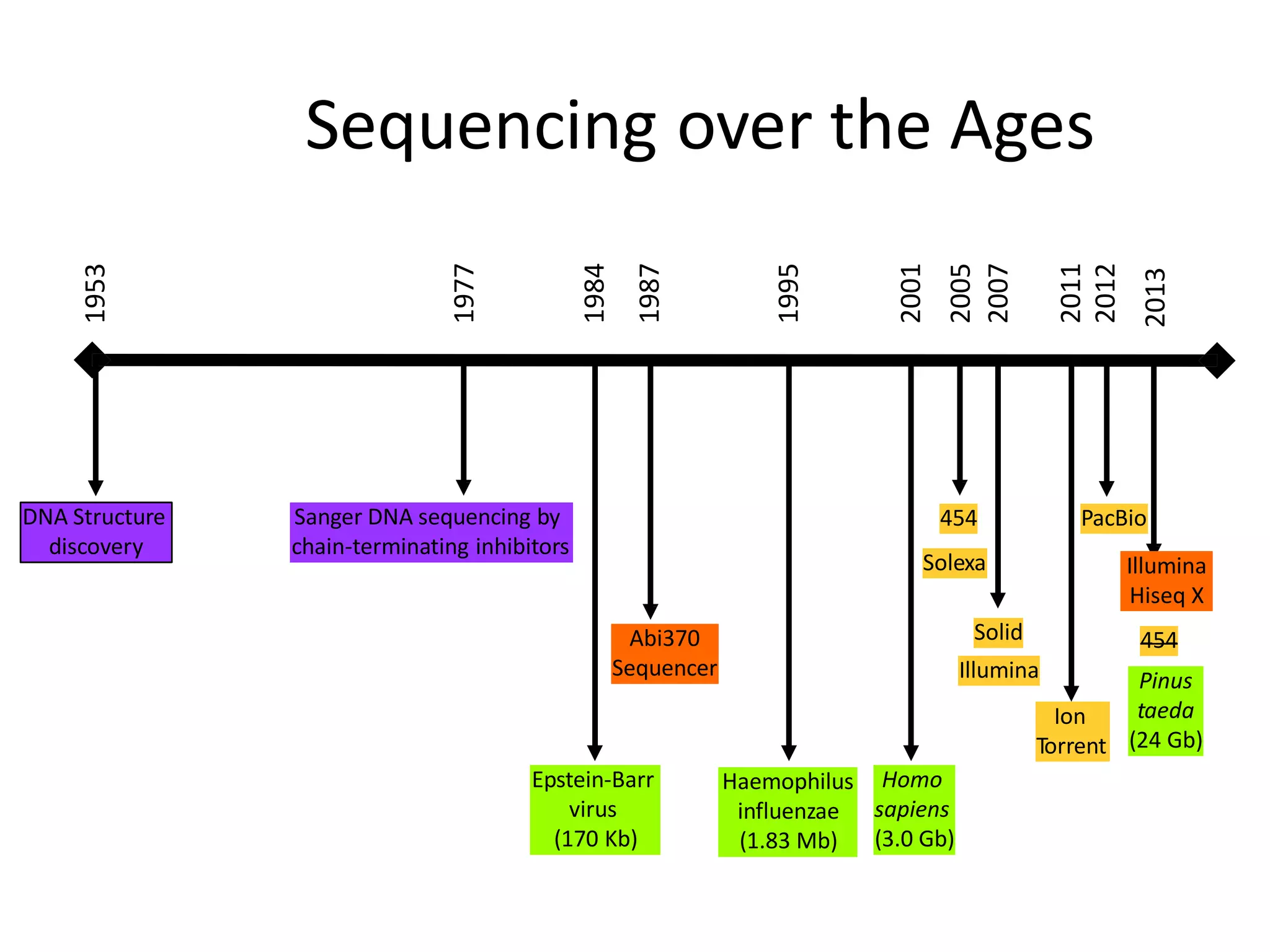
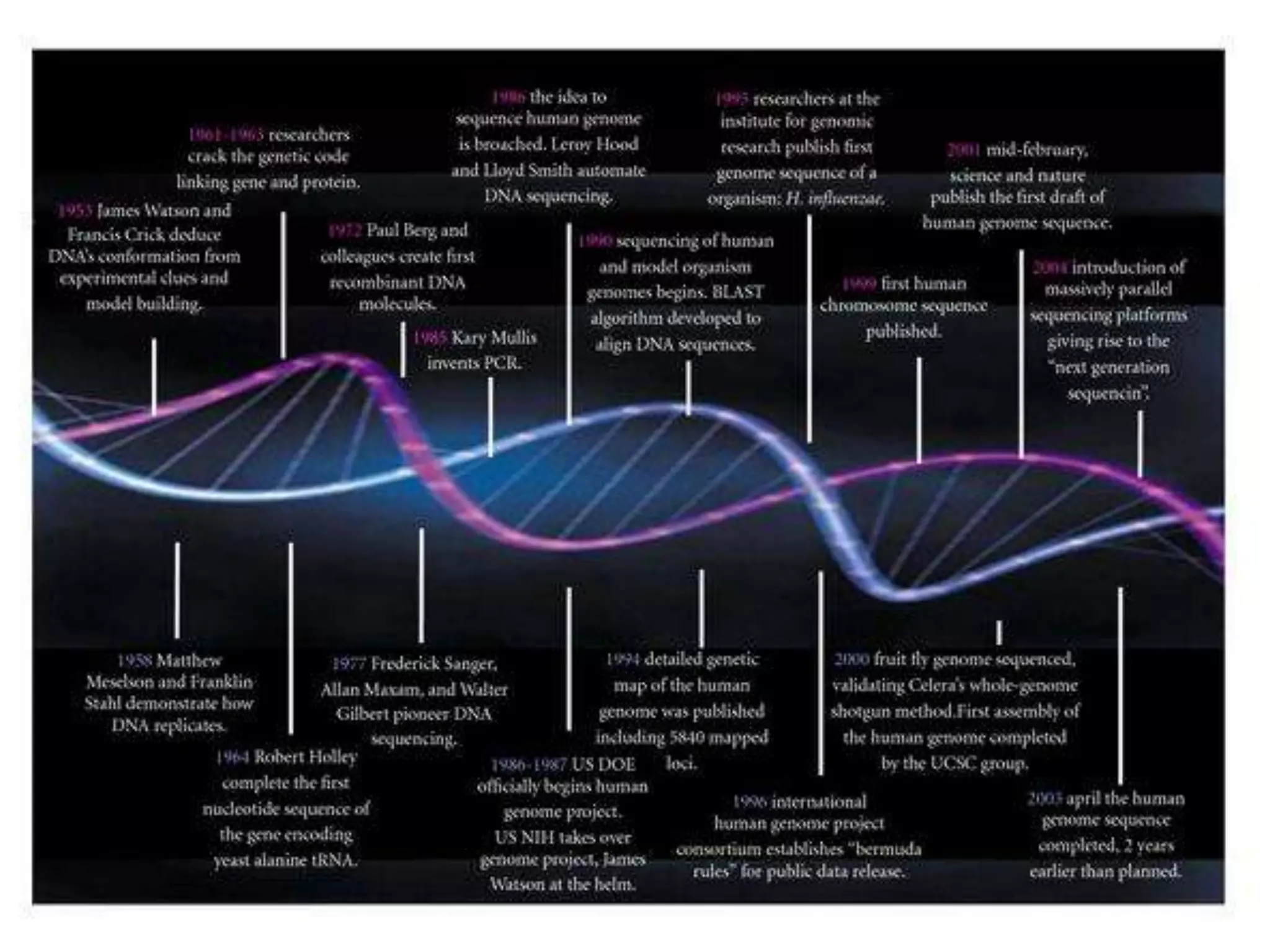
1953
DNA Structure
discovery
1977
Sanger DNA sequencing by
chain-terminating inhibitors
Epstein-Barr
virus
(170 Kb)
1984
1987Abi370
Sequencer
1995 Homo
sapiens
(3.0 Gb)
454
Solexa
Solid
2001
2005
2007
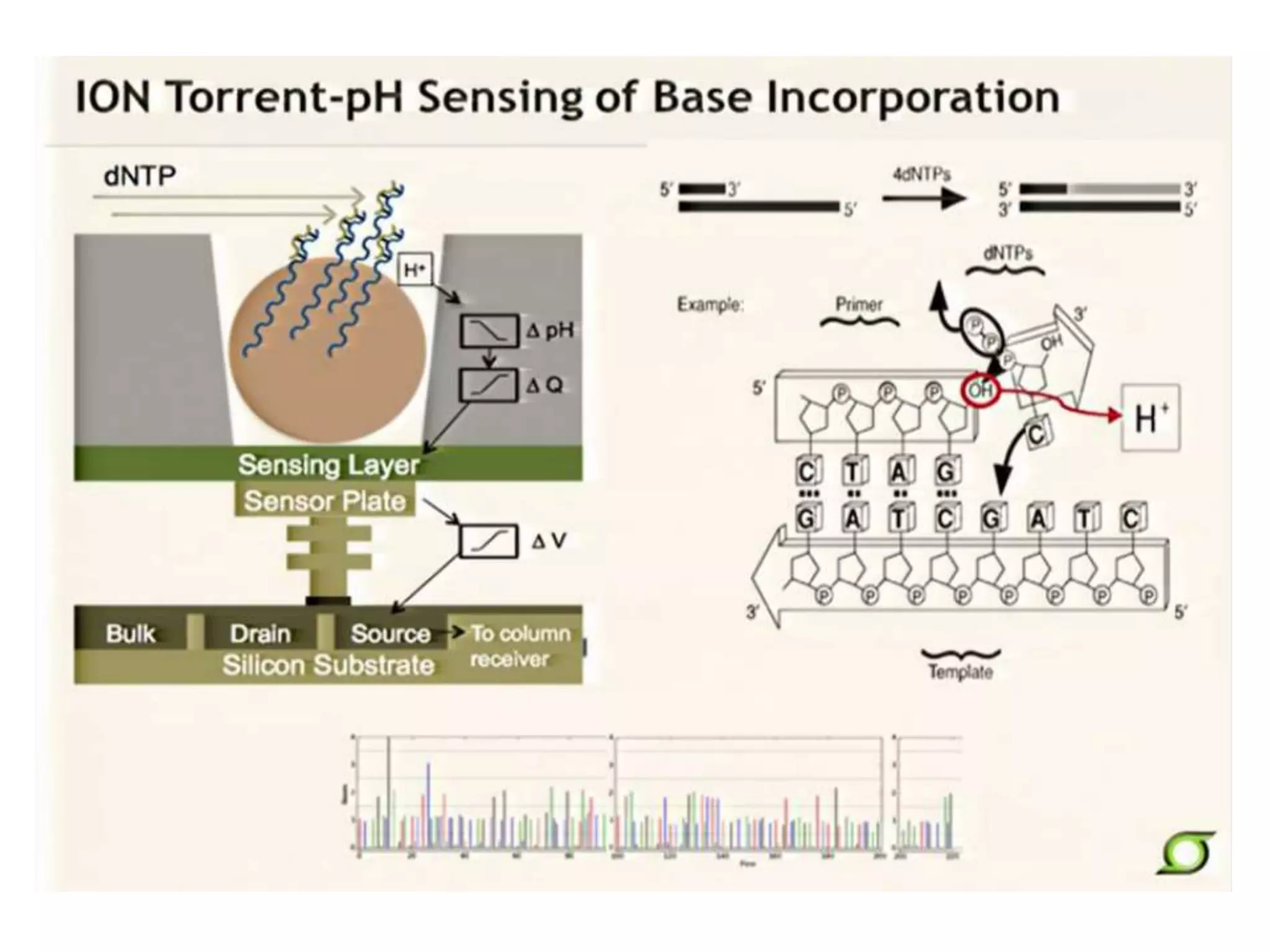
Ion
Torrent
PacBio
Haemophilus
influenzae
(1.83 Mb)
2011
2012
2013
Sequencing over the Ages
Illumina
Illumina
Hiseq X
454
Pinus
taeda
(24 Gb)
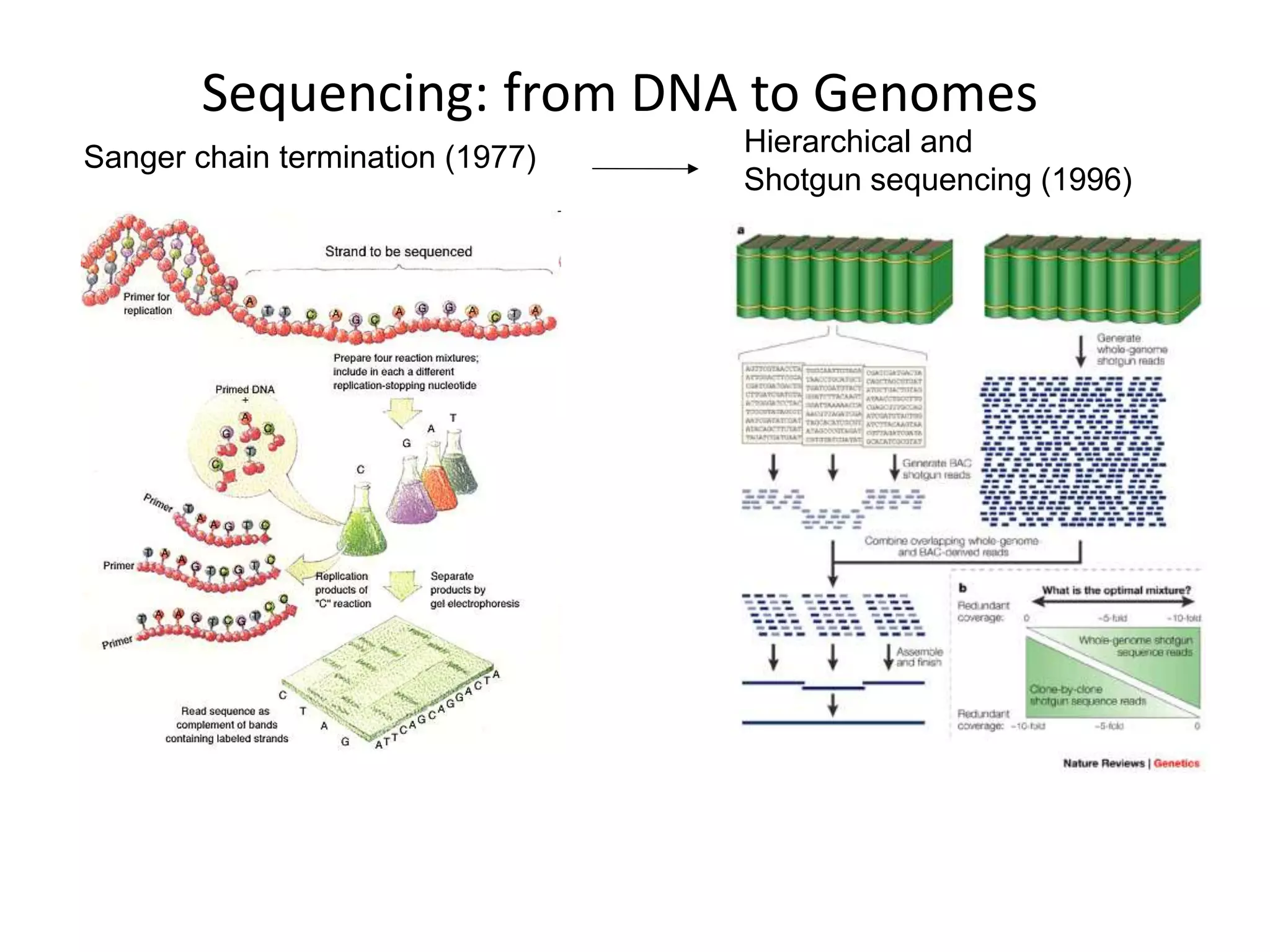
Sequencing: from DNA to Genomes
Sanger chain termination (1977) Hierarchical and
Shotgun sequencing (1996)
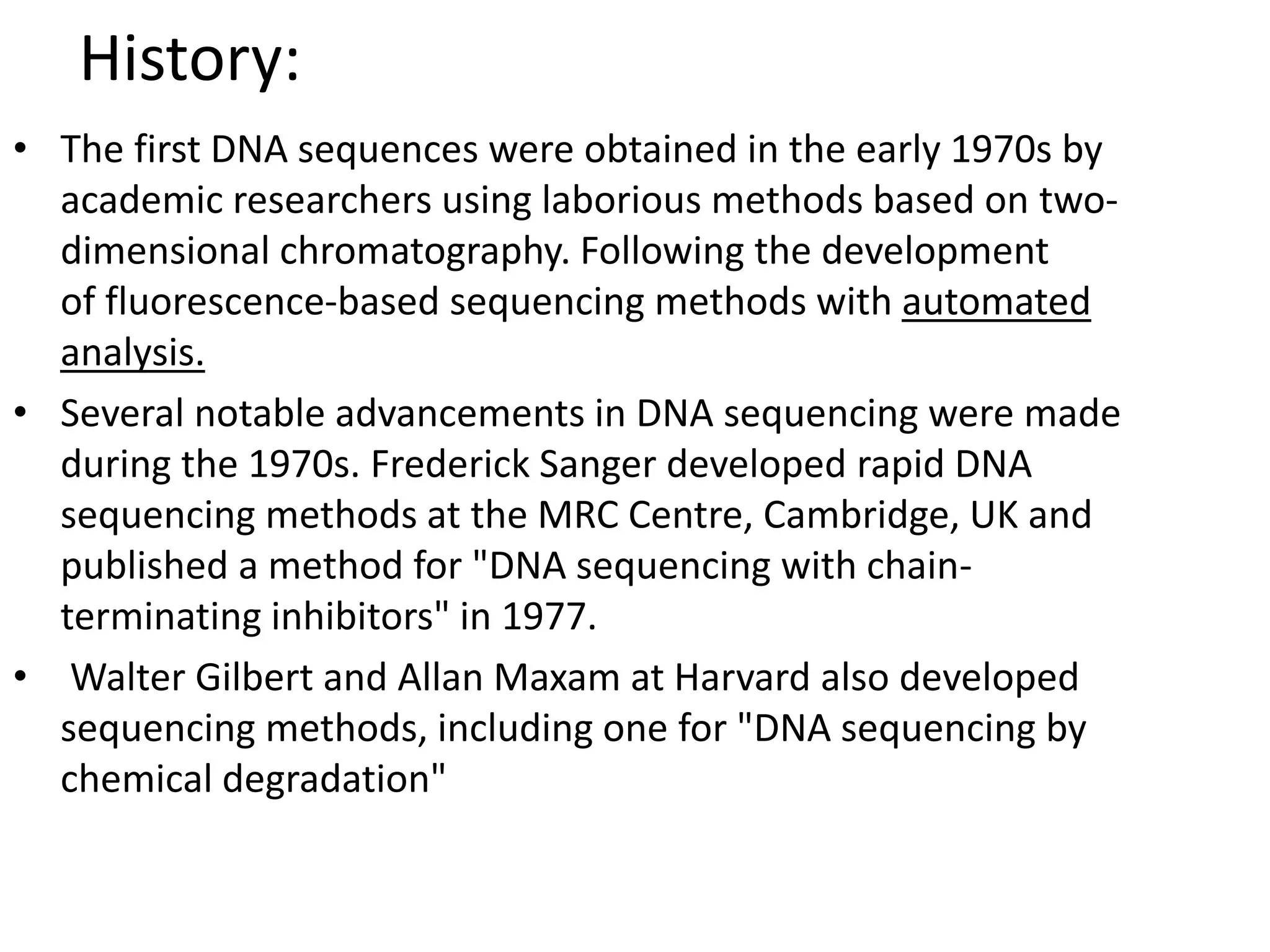
History:
• The first DNA sequences were obtained in the early 1970s by
academic researchers using laborious methods based on two-
dimensional chromatography. Following the development
of fluorescence-based sequencing methods with automated
analysis.
• Several notable advancements in DNA sequencing were made
during the 1970s. Frederick Sanger developed rapid DNA
sequencing methods at the MRC Centre, Cambridge, UK and
published a method for "DNA sequencing with chain-
terminating inhibitors" in 1977.
• Walter Gilbert and Allan Maxam at Harvard also developed
sequencing methods, including one for "DNA sequencing by
chemical degradation"
Contd.
• The first full DNA genome to be sequenced was that
of bacteriophage φX174 in 1977. Medical Research
Council scientists deciphered the complete DNA sequence of
the Epstein-Barr virus in 1984, finding it to be 170 thousand
base-pairs long.
• Leroy E. Hood's laboratory at the California Institute of
Technology and Smith announced the first semi-automated
DNA sequencing machine in 1986.
• Followed by Applied Biosystems' marketing of the first fully
automated sequencing machine, the ABI 370, in 1987.
• By 1990, the U.S. NIH had begun large-scale sequencing trials
on Mycoplasma capricolum ,Escherichia coli, Caenorhabditis
elegans, and Saccharomyces cerevisiae at a cost of US$0.75
per base.
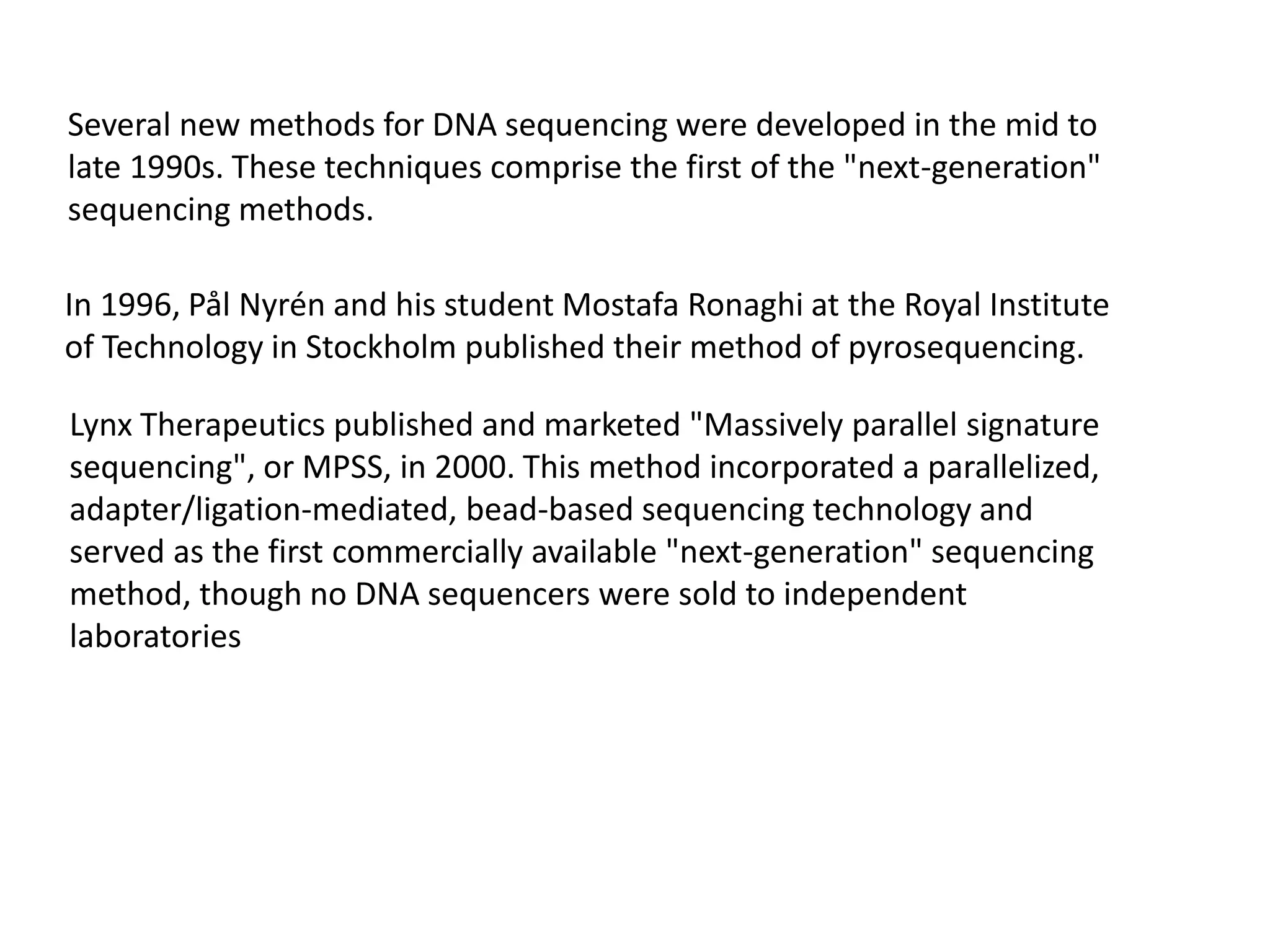
Several new methods for DNA sequencing were developed in the mid to
late 1990s. These techniques comprise the first of the "next-generation"
sequencing methods.
In 1996, Pål Nyrén and his student Mostafa Ronaghi at the Royal Institute
of Technology in Stockholm published their method of pyrosequencing.
Lynx Therapeutics published and marketed "Massively parallel signature
sequencing", or MPSS, in 2000. This method incorporated a parallelized,
adapter/ligation-mediated, bead-based sequencing technology and
served as the first commercially available "next-generation" sequencing
method, though no DNA sequencers were sold to independent
laboratories
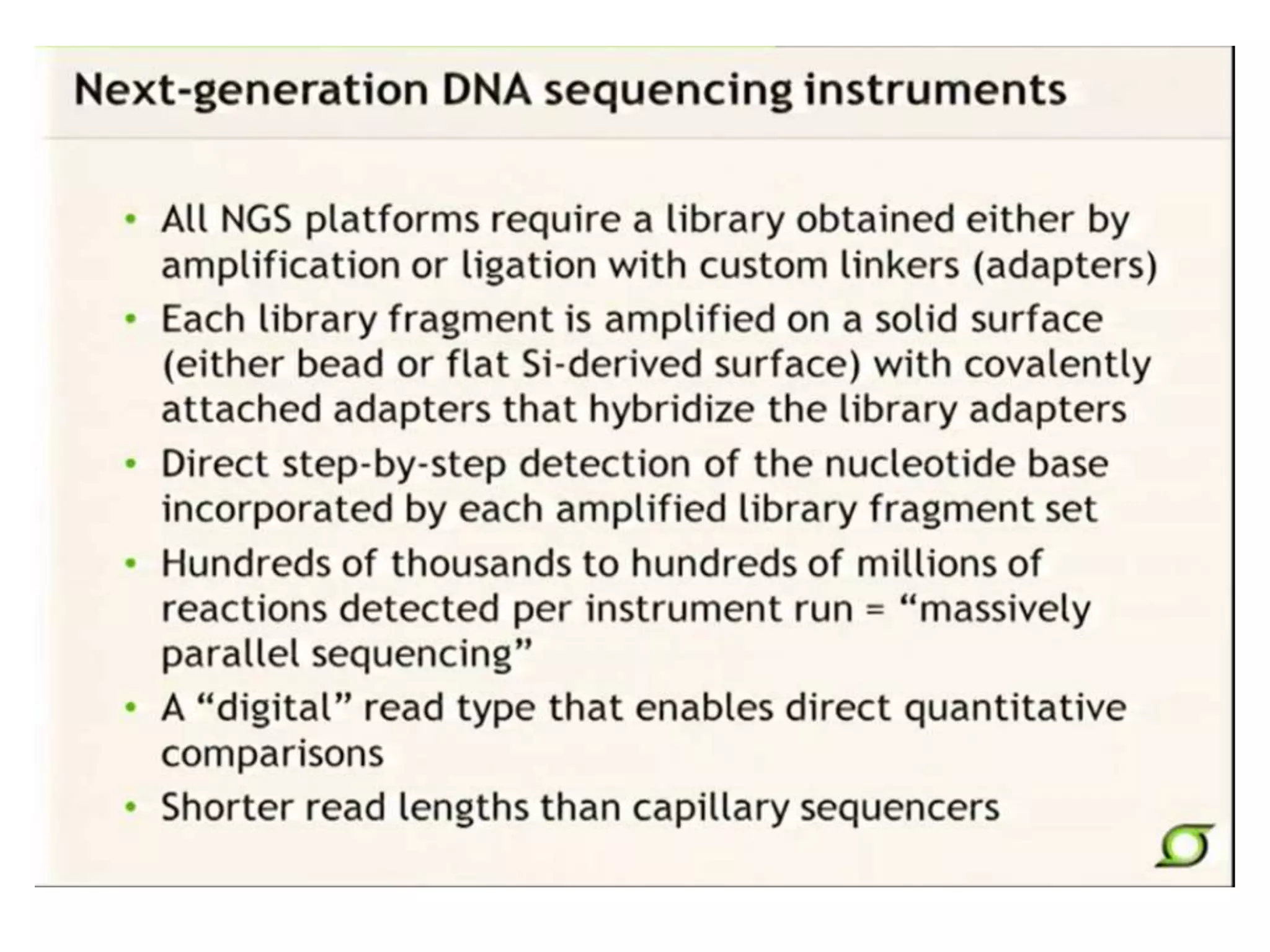
Next Generation Sequencing
• Employs micro and nanotechnologies to reduce the size of
sample components, reducing reagent costs and enabling
massively parallel sequencing reactions.
• Highly multiplexed, allowing simultaneous sequencing and
analysis of millions of samples.
• Became commercially available from 2005.
• The first using Solexa sequencing technologies.
• Several different sequencing methods have been developed,
all of which are continually being developed at astonishing
rates.
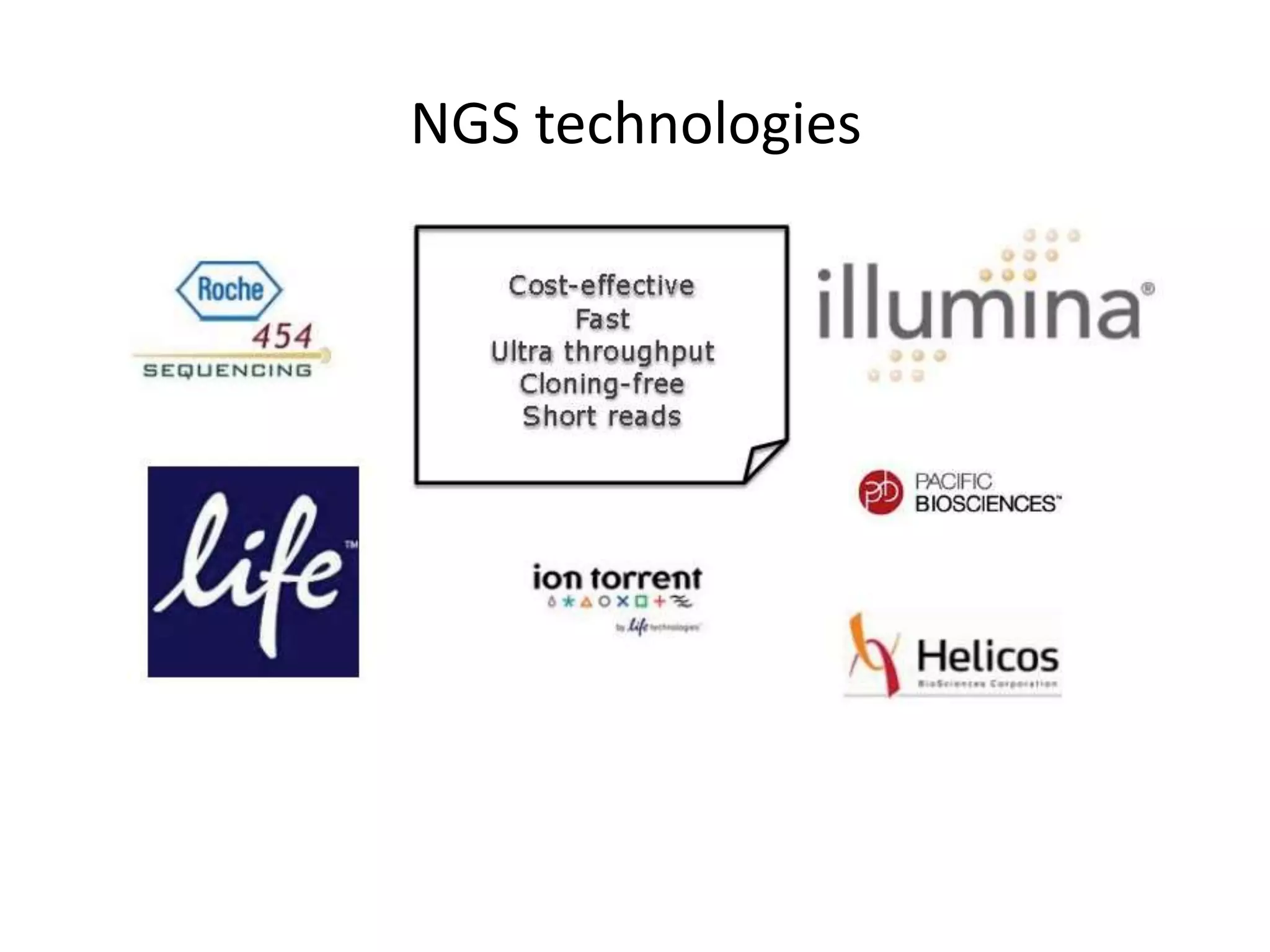
NGS technologies
Introduction to NGS http://ueb.ir.vhebron.net/NGS
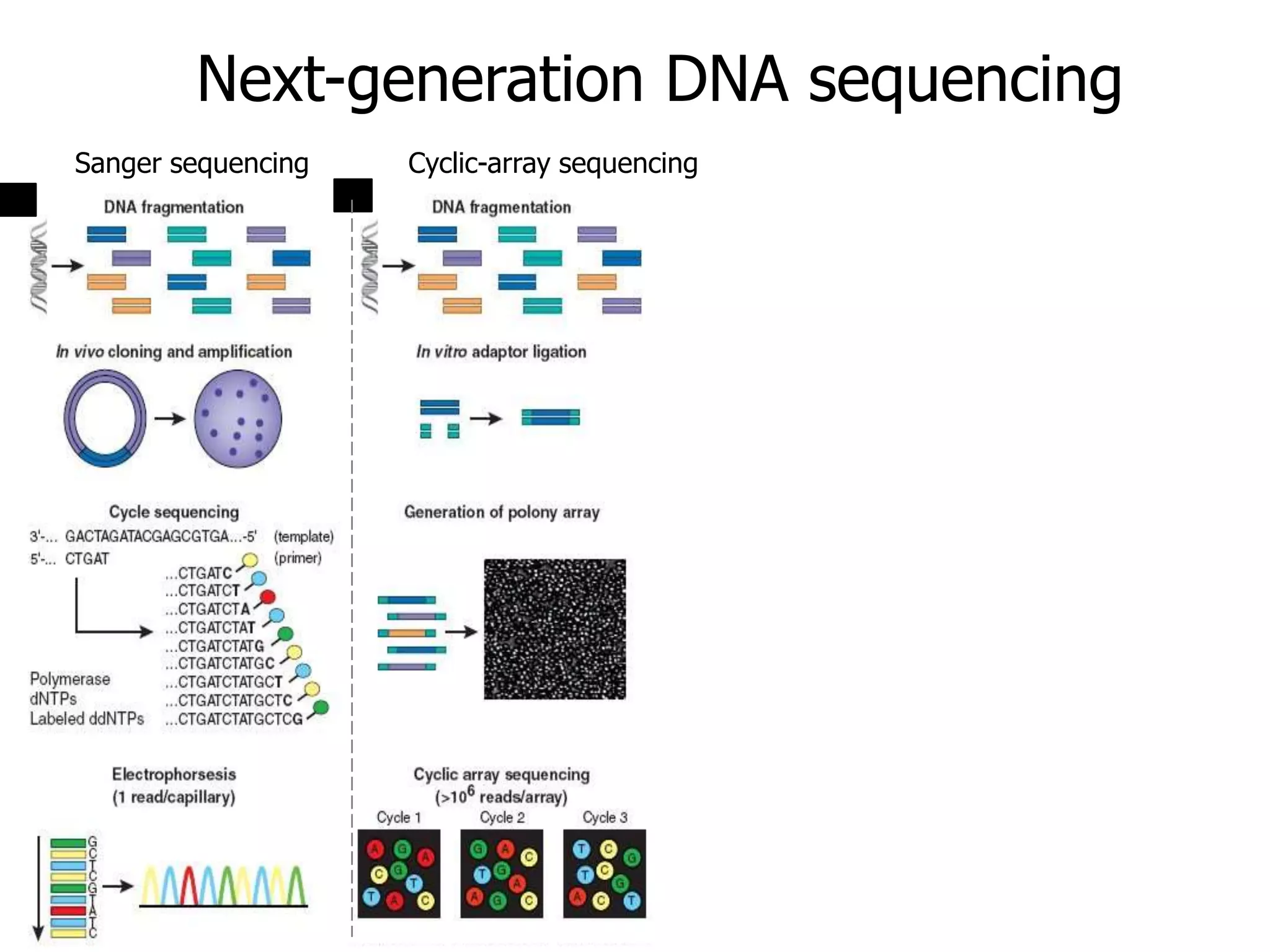
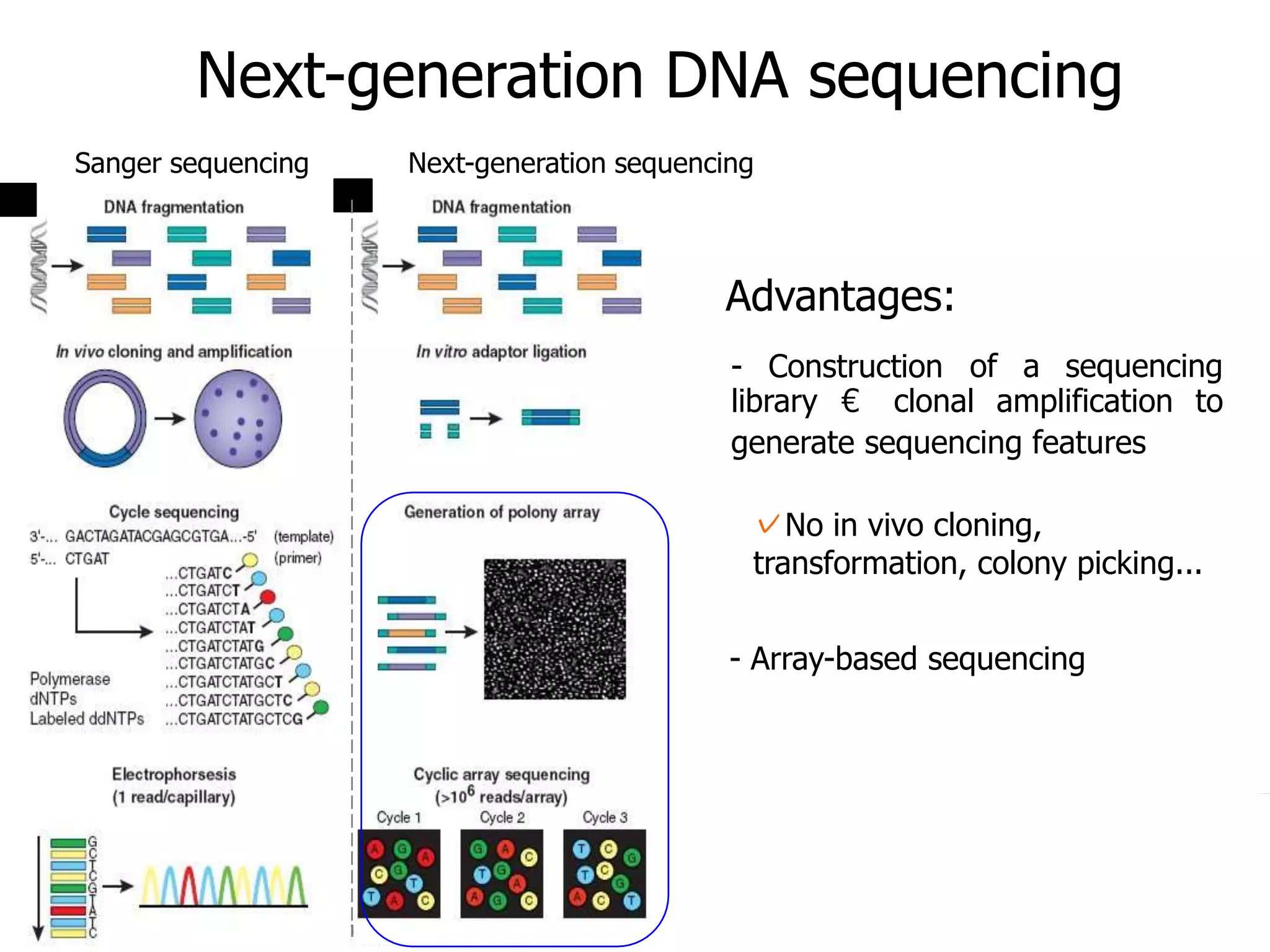
Next-generation DNA sequencing
Sanger sequencing Cyclic-array sequencing
Introduction to NGS http://ueb.ir.vhebron.net/NGS
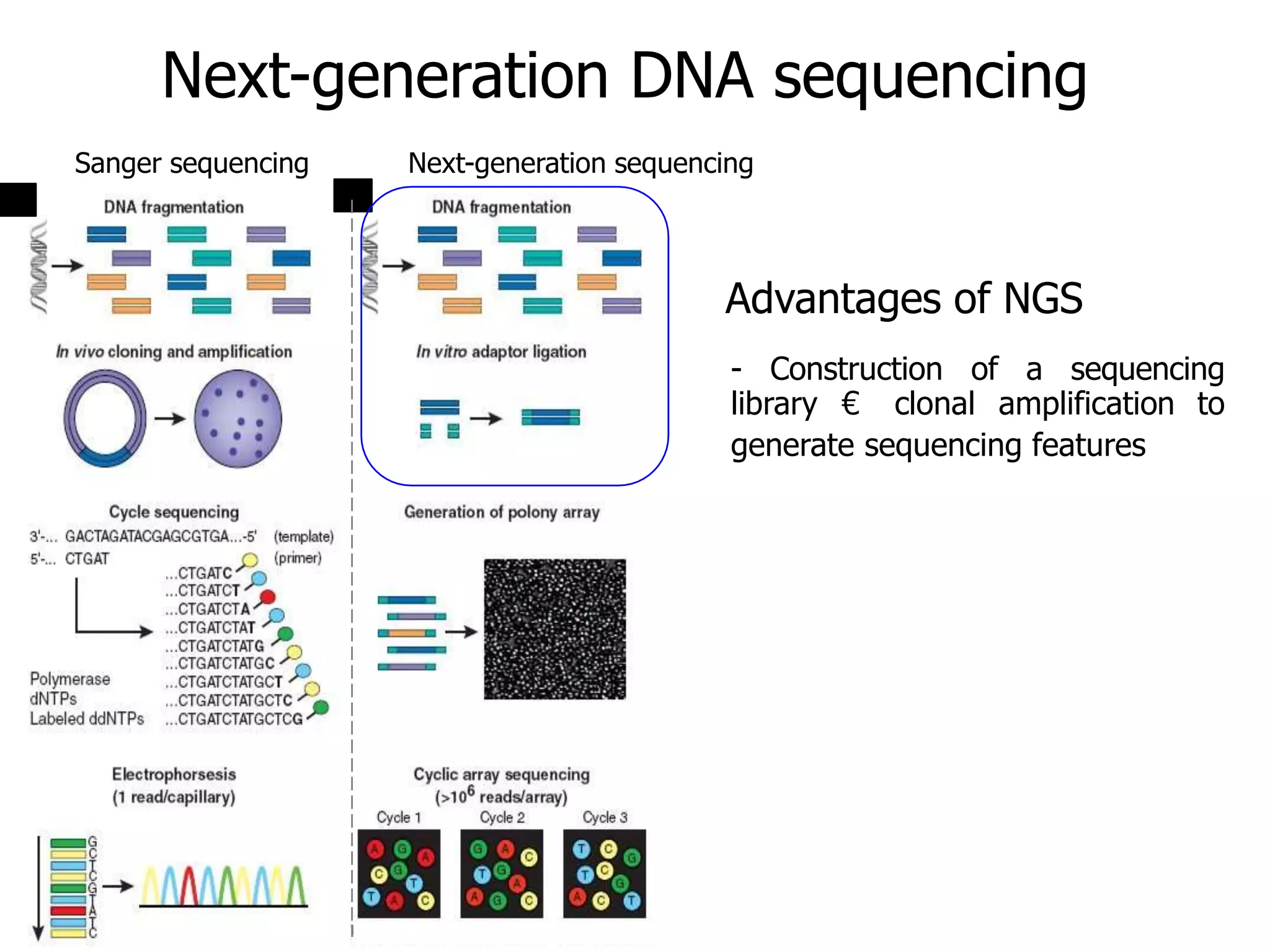
Next-generation DNA sequencing
Sanger sequencing Next-generation sequencing
Advantages of NGS
- Construction of a sequencing
library € clonal amplification to
generate sequencing features
Introduction to NGS http://ueb.ir.vhebron.net/NGS
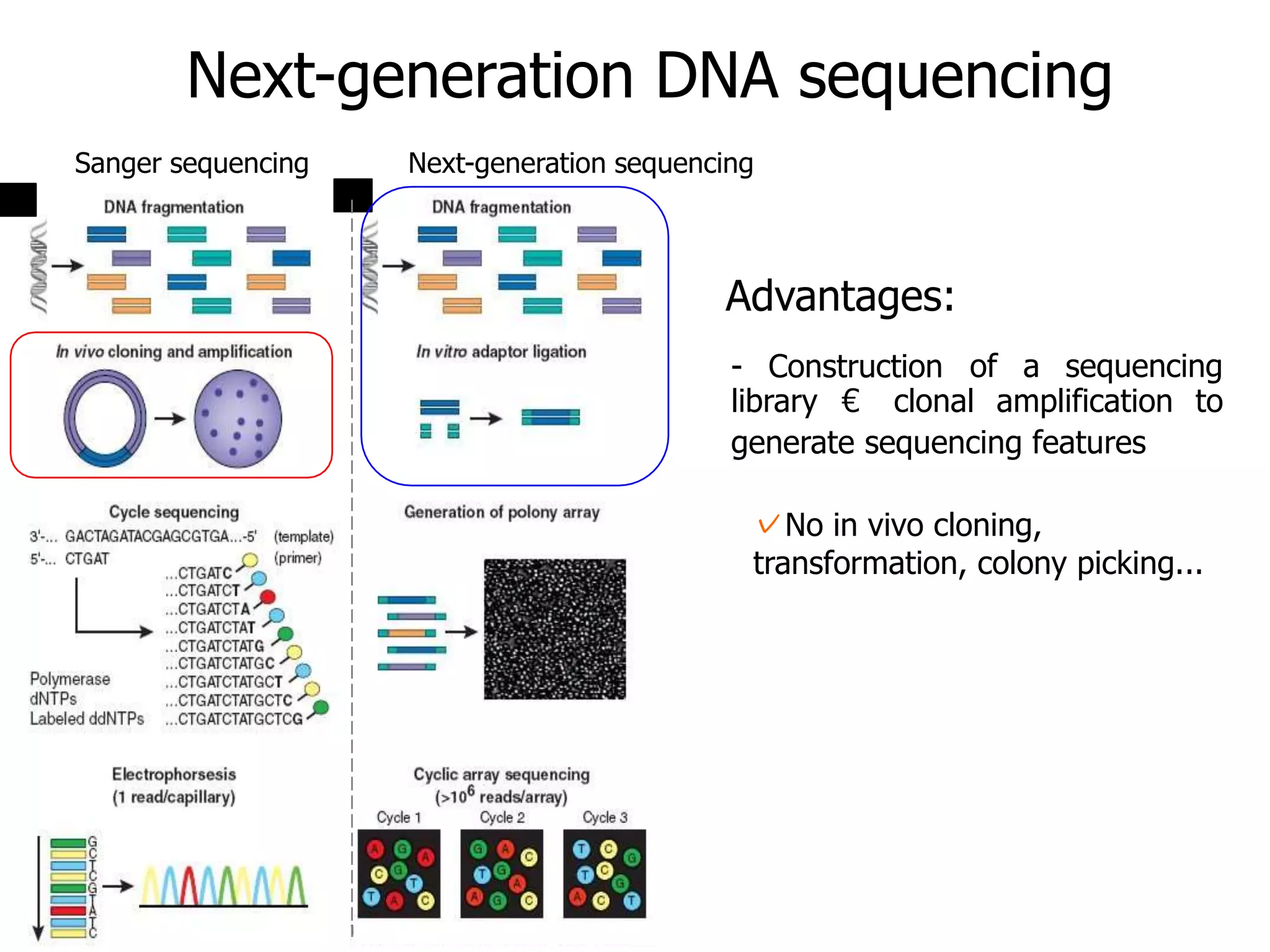
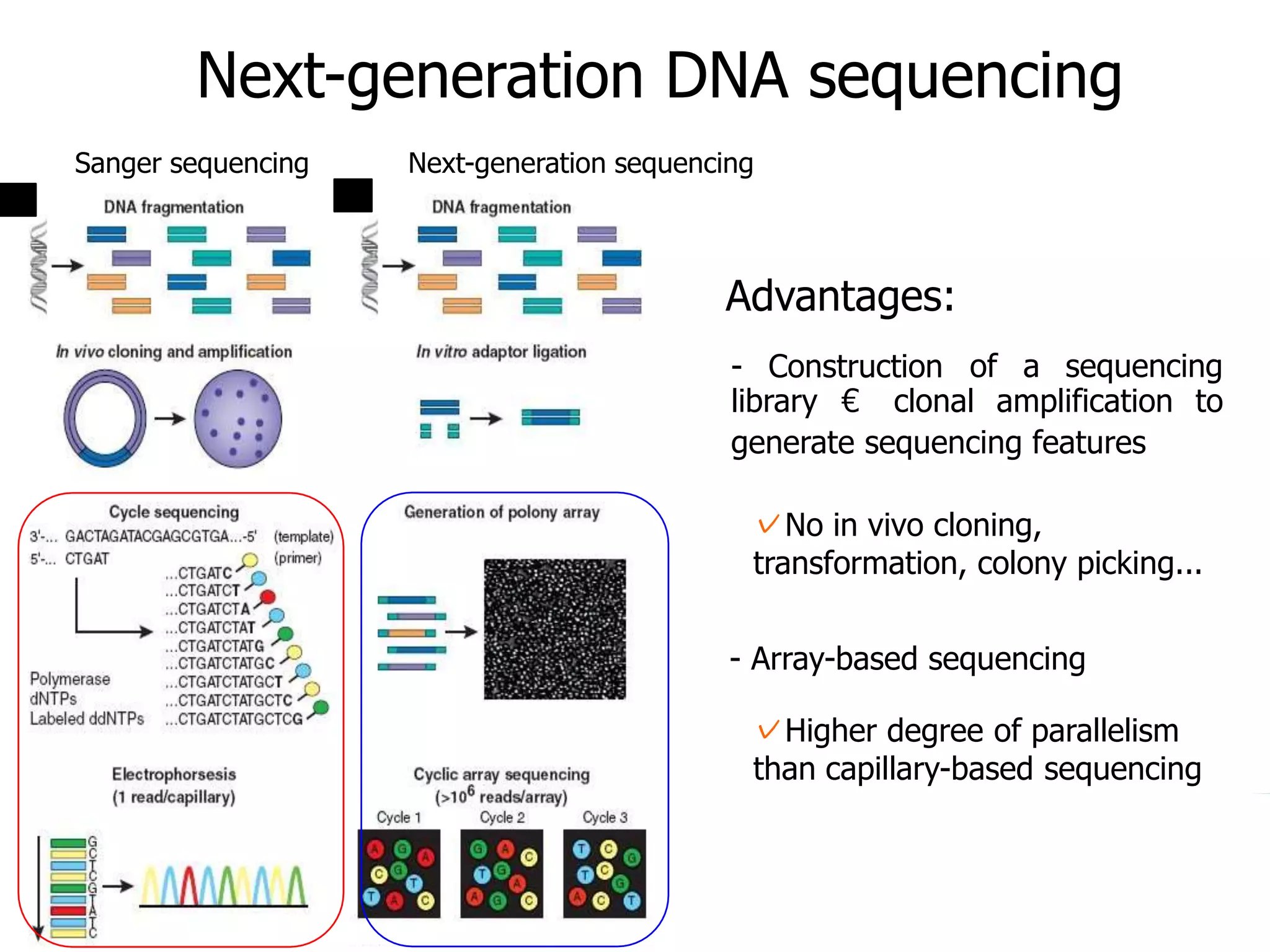
Next-generation DNA sequencing
Sanger sequencing Next-generation sequencing
Advantages:
- Construction of a sequencing
library € clonal amplification to
generate sequencing features
✓No in vivo cloning,
transformation, colony picking...
Introduction to NGS http://ueb.ir.vhebron.net/NGS
Next-generation DNA sequencing
Sanger sequencing Next-generation sequencing
Advantages:
- Construction of a sequencing
library € clonal amplification to
generate sequencing features
✓No in vivo cloning,
transformation, colony picking...
- Array-based sequencing
Introduction to NGS http://ueb.ir.vhebron.net/NGS
Next-generation DNA sequencing
Sanger sequencing Next-generation sequencing
Advantages:
- Construction of a sequencing
library € clonal amplification to
generate sequencing features
✓No in vivo cloning,
transformation, colony picking...
- Array-based sequencing
✓Higher degree of parallelism
than capillary-based sequencing
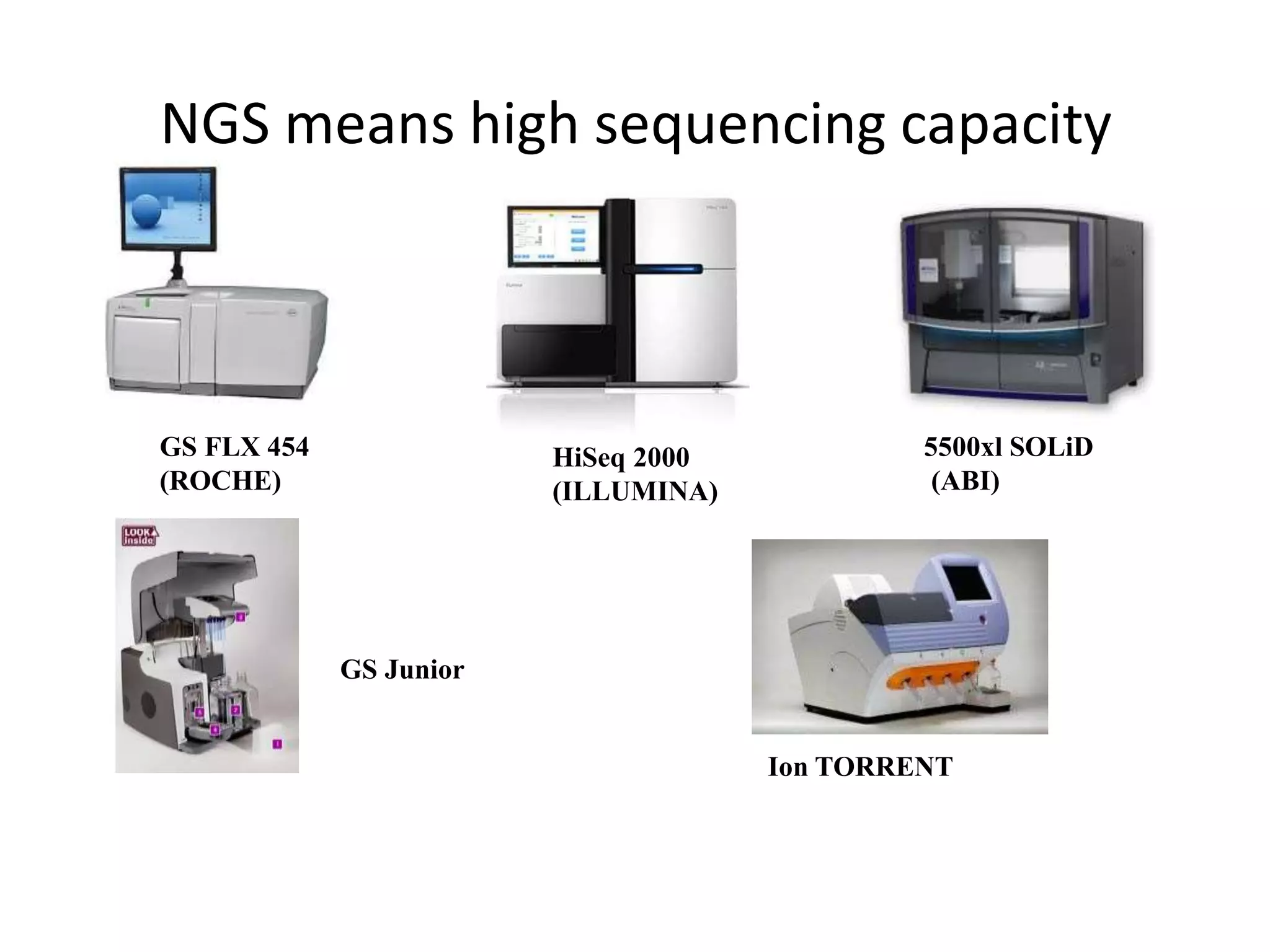
NGS means high sequencing capacity
GS FLX 454
(ROCHE)
HiSeq 2000
(ILLUMINA)
5500xl SOLiD
(ABI)
GS Junior
Ion TORRENT
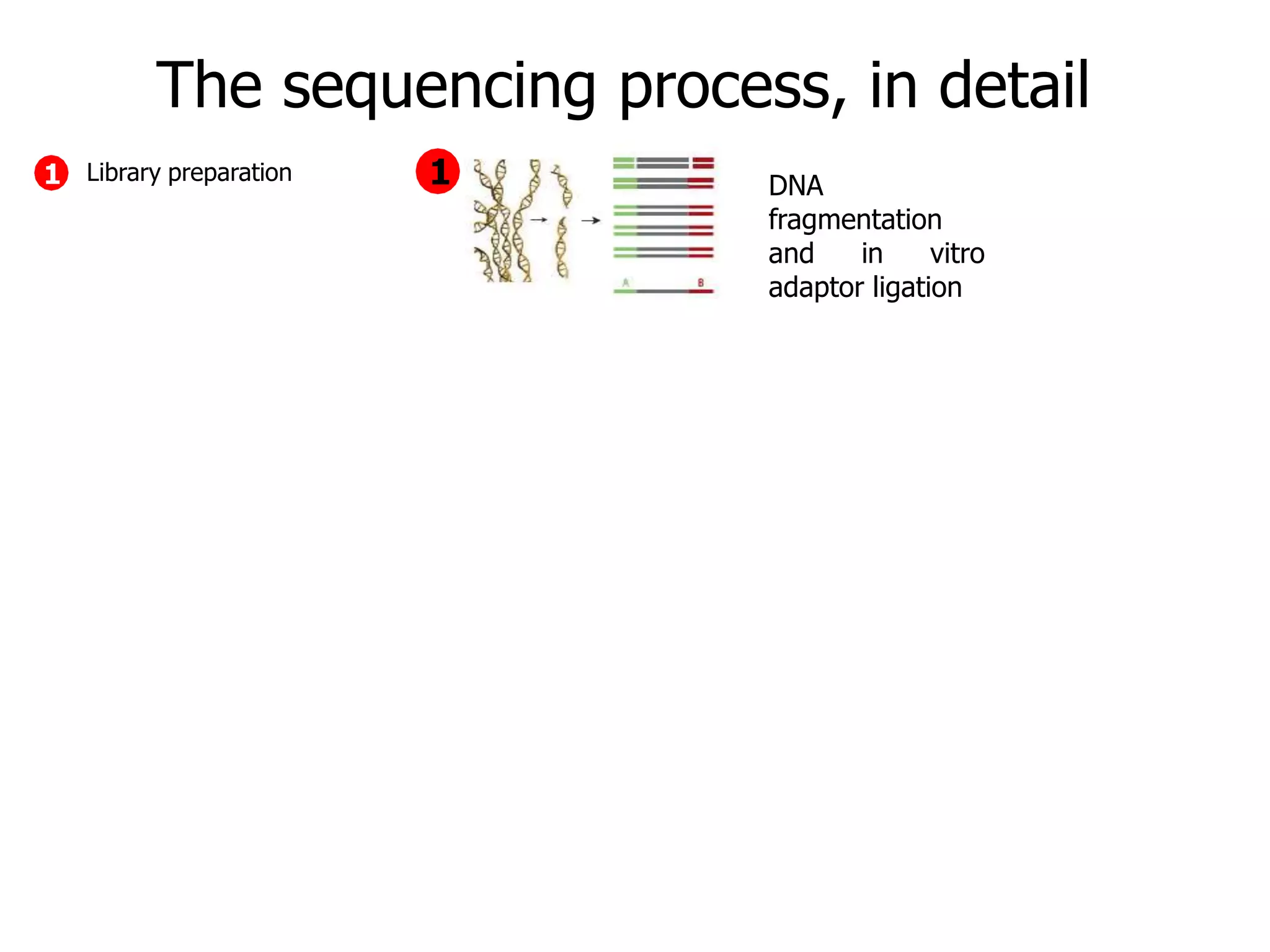
The sequencing process, in detail
DNA
fragmentation
and in vitro
adaptor ligation
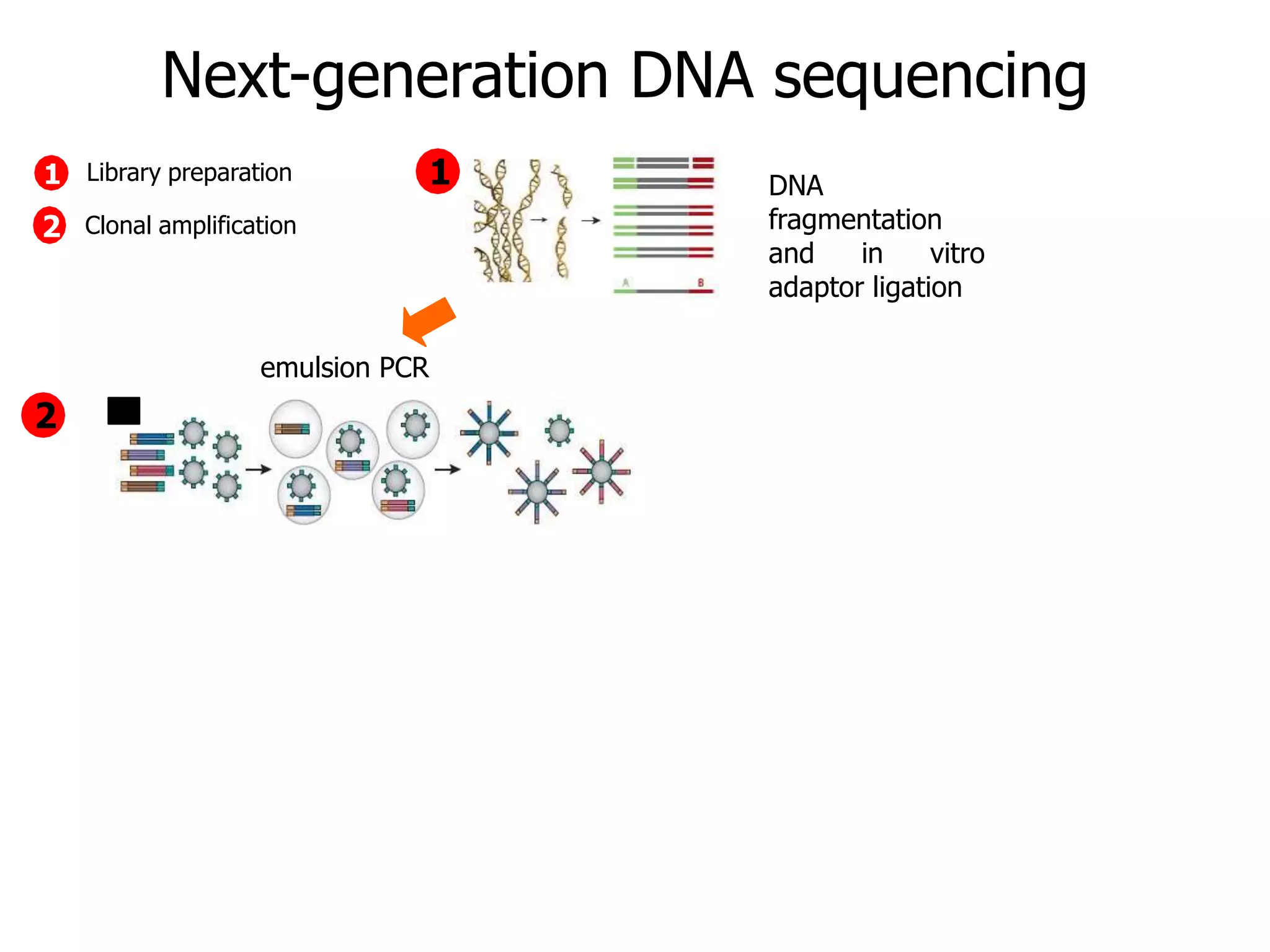
11 Library preparation
Next-generation DNA sequencing
DNA
fragmentation
and in vitro
adaptor ligation
emulsion PCR
1
2
1
2
Library preparation
Clonal amplification
Introduction to NGS http://ueb.ir.vhebron.net/NGS
Next-generation DNA sequencing
DNA
fragmentation
and in vitro
adaptor ligation
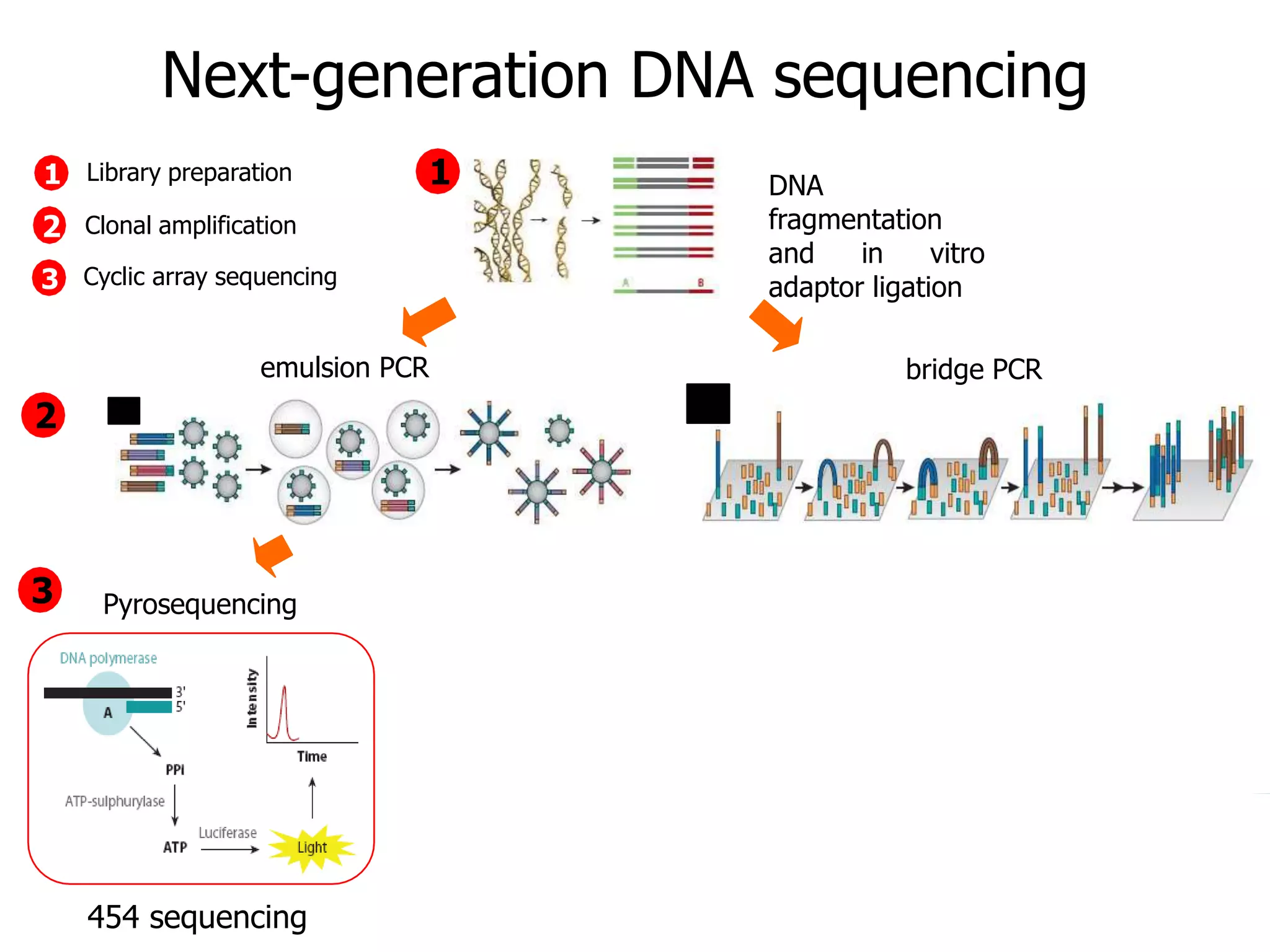
emulsion PCR bridge PCR
Pyrosequencing
1
2
3
1
2
3 Cyclic array sequencing
Library preparation
Clonal amplification
454 sequencing
Introduction to NGS http://ueb.ir.vhebron.net/NGS
Next-generation DNA sequencing
DNA
fragmentation
and in vitro
adaptor ligation
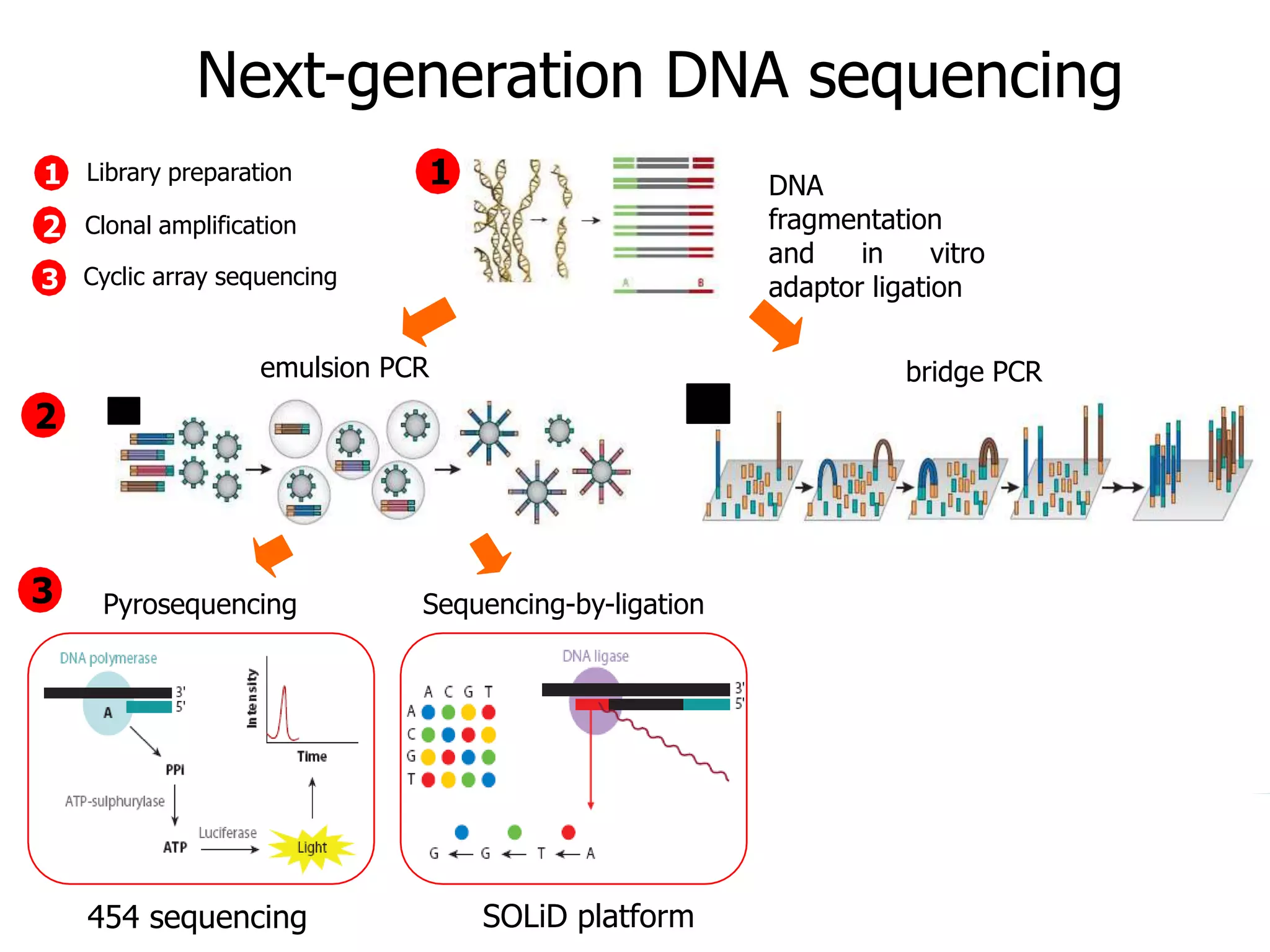
bridge PCR
Pyrosequencing Sequencing-by-ligation
1
emulsion PCR
2
3
1
2
3
454 sequencing SOLiD platform
Cyclic array sequencing
Library preparation
Clonal amplification
Introduction to NGS http://ueb.ir.vhebron.net/NGS
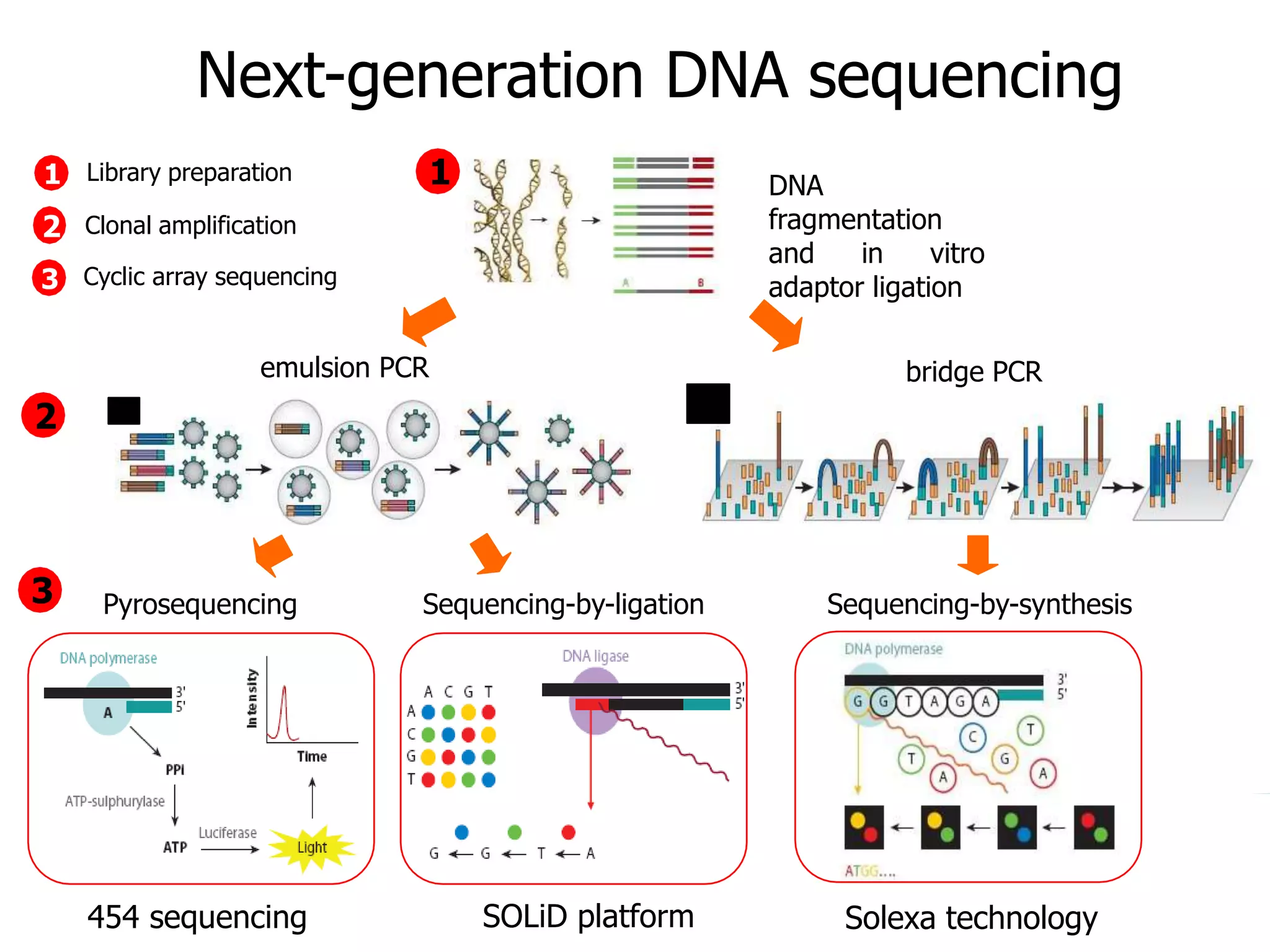
Next-generation DNA sequencing
DNA
fragmentation
and in vitro
adaptor ligation
bridge PCR
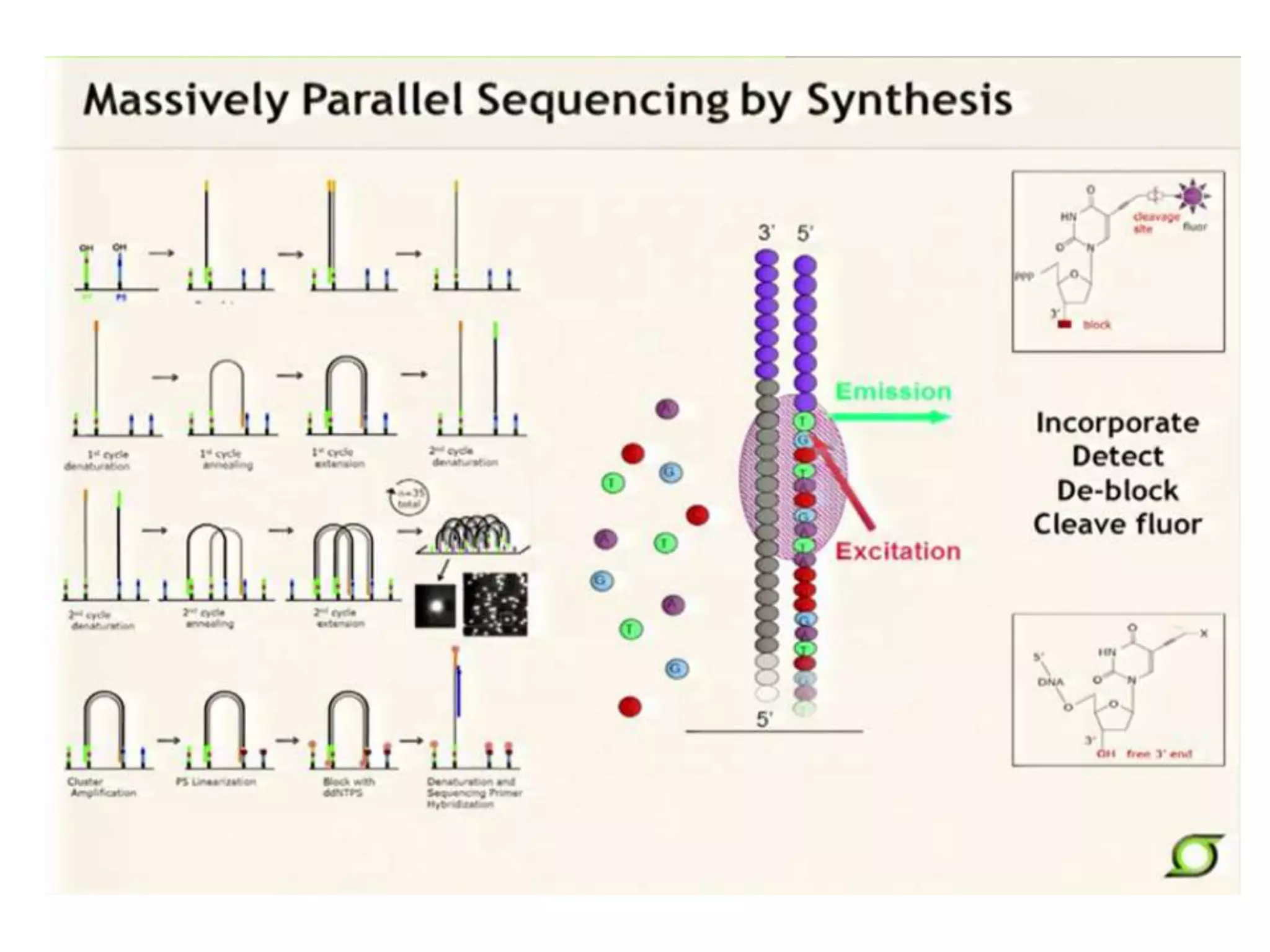
Pyrosequencing Sequencing-by-ligation Sequencing-by-synthesis
1
emulsion PCR
2
3
1
2
3
454 sequencing SOLiD platform Solexa technology
Cyclic array sequencing
Library preparation
Clonal amplification
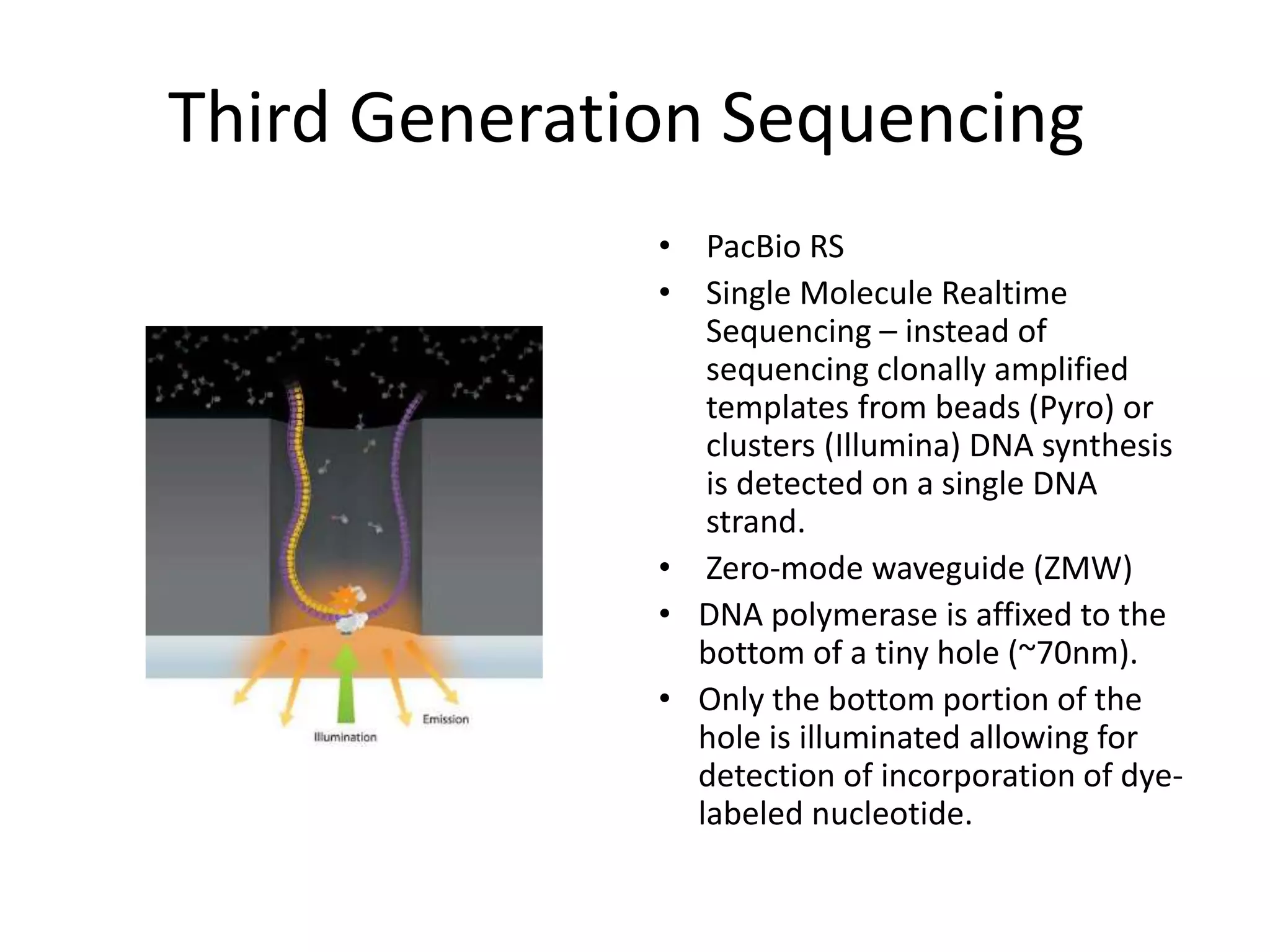
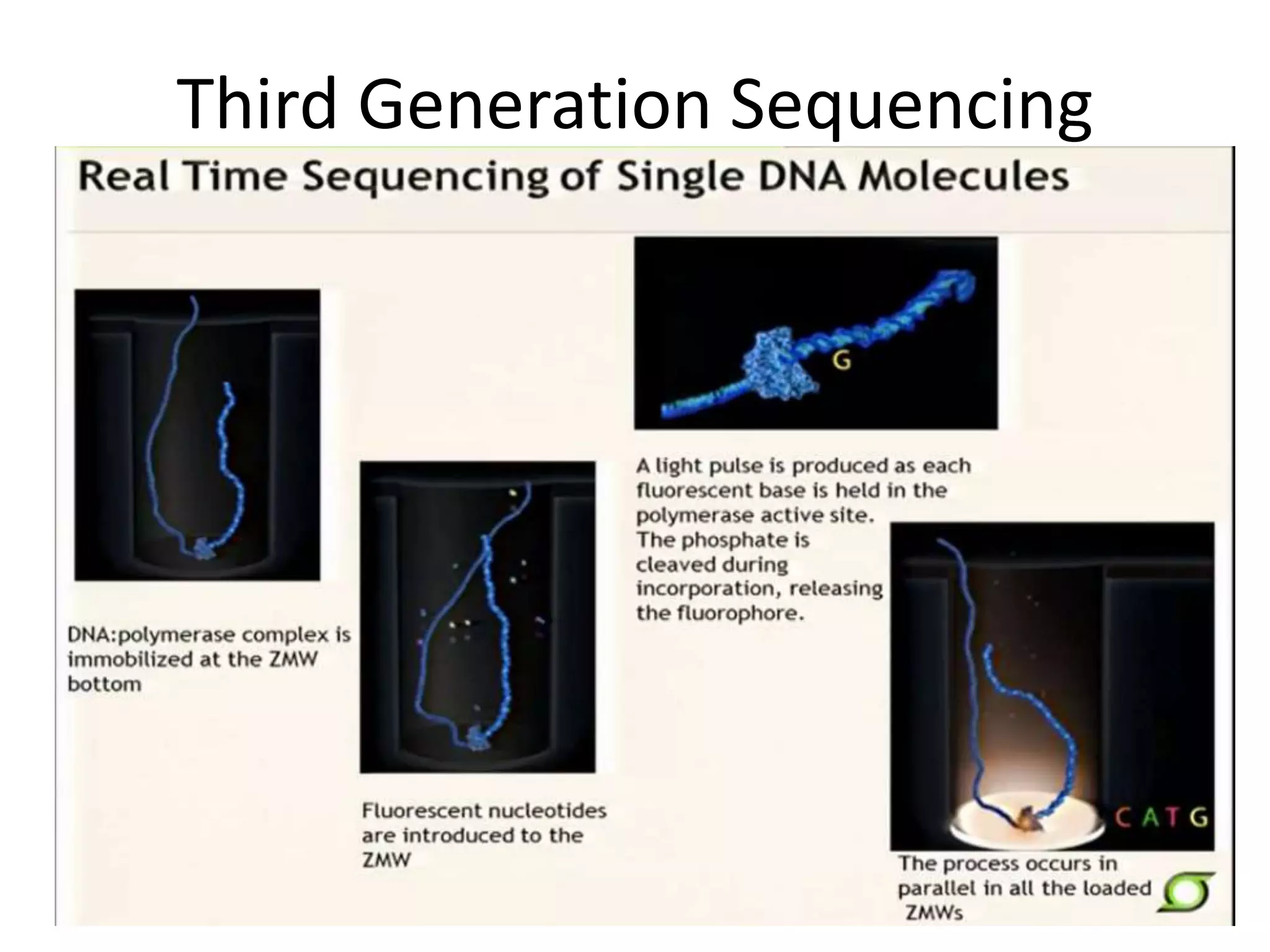
Third Generation Sequencing
• PacBio RS
• Single Molecule Realtime
Sequencing – instead of
sequencing clonally amplified
templates from beads (Pyro) or
clusters (Illumina) DNA synthesis
is detected on a single DNA
strand.
• Zero-mode waveguide (ZMW)
• DNA polymerase is affixed to the
bottom of a tiny hole (~70nm).
• Only the bottom portion of the
hole is illuminated allowing for
detection of incorporation of dye-
labeled nucleotide.
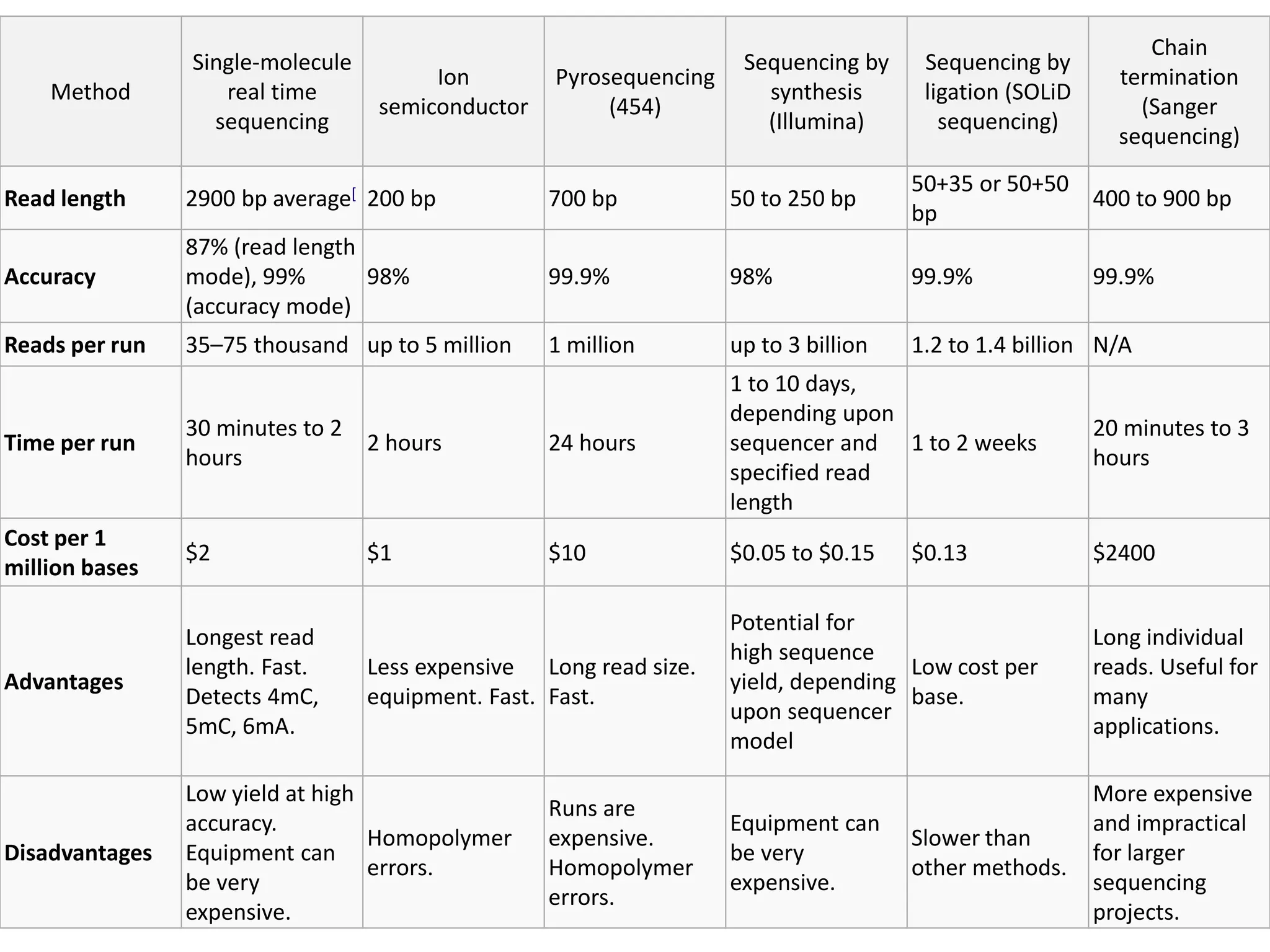
Third Generation Sequencing
Method
Single-molecule
real time
sequencing
Ion
semiconductor
Pyrosequencing
(454)
Sequencing by
synthesis
(Illumina)
Sequencing by
ligation (SOLiD
sequencing)
Chain
termination
(Sanger
sequencing)
Read length 2900 bp average[ 200 bp 700 bp 50 to 250 bp
50+35 or 50+50
bp
400 to 900 bp
Accuracy
87% (read length
mode), 99%
(accuracy mode)
98% 99.9% 98% 99.9% 99.9%
Reads per run 35–75 thousand up to 5 million 1 million up to 3 billion 1.2 to 1.4 billion N/A
Time per run
30 minutes to 2
hours
2 hours 24 hours
1 to 10 days,
depending upon
sequencer and
specified read
length
1 to 2 weeks
20 minutes to 3
hours
Cost per 1
million bases
$2 $1 $10 $0.05 to $0.15 $0.13 $2400
Advantages
Longest read
length. Fast.
Detects 4mC,
5mC, 6mA.
Less expensive
equipment. Fast.
Long read size.
Fast.
Potential for
high sequence
yield, depending
upon sequencer
model
Low cost per
base.
Long individual
reads. Useful for
many
applications.
Disadvantages
Low yield at high
accuracy.
Equipment can
be very
expensive.
Homopolymer
errors.
Runs are
expensive.
Homopolymer
errors.
Equipment can
be very
expensive.
Slower than
other methods.
More expensive
and impractical
for larger
sequencing
projects.
References
• Sequences, sequences, and sequences. Sanger, F. s.l. : Annu Rev Biochem, 1988,
Vol. 57, pp. 1-28.
• Nucleotide sequence of bacteriophage phi X174 DNA. Sanger, F, Air, GM and
Barrell, BG.1977, Nature, Vol. 265, pp. 687-695.
• DNA Sequencing with chain-terminating inhibitors. Snager, F, Nicklen, S and
Coulson, AR. s.l. : Proc NatI Acad Sci USA, Vol. 74, pp. 5463-5467.
• Overview of DNA sequencing strategies. Shendure, JA, Porreca, GJ and Church,
GM.Chapter 7, s.l. : John Wiley & Sons, 2011.
• Energy transfer primers: a new fluoresence labeling paradigm for DNA sequencing
and analysis. Ju, J, Glazer, AN and Mathies, RA. 2, s.l. : Nat Med, 1996, pp. 998-999.
• 454 Sequencing. [Online] 2015. [Cited: 6 2, 2015.] http://www.454.com/.
• illumina. [Online] 2015. [Cited: 6 2, 2015.] http://www.illumina.com/.
• SOLiD. Applied Biosystems. [Online] 2015. [Cited: 6 2, 2015.]
http://www.appliedbiosystems.com/absite/us/en/home/applications-
technologies/solid-next-generation-sequencing.html.
• Ion Torrent. Applied Biosystems. [Online] 2015. [Cited: 6 2, 2015.]
http://www.lifetechnologies.com/ca/en/home/brands/ion-torrent.html.
Ngs introduction

Ngs introduction

  • 1.
    NEXT GENERATION SEQUENCING Introduction AlagarS 2014419002 M.Tech/Computational Biology
  • 2.
    1953 DNA Structure discovery 1977 Sanger DNAsequencing by chain-terminating inhibitors Epstein-Barr virus (170 Kb) 1984 1987Abi370 Sequencer 1995 Homo sapiens (3.0 Gb) 454 Solexa Solid 2001 2005 2007 Ion Torrent PacBio Haemophilus influenzae (1.83 Mb) 2011 2012 2013 Sequencing over the Ages Illumina Illumina Hiseq X 454 Pinus taeda (24 Gb)
  • 3.
    Sequencing: from DNAto Genomes Sanger chain termination (1977) Hierarchical and Shotgun sequencing (1996)
  • 4.
    History: • The firstDNA sequences were obtained in the early 1970s by academic researchers using laborious methods based on two- dimensional chromatography. Following the development of fluorescence-based sequencing methods with automated analysis. • Several notable advancements in DNA sequencing were made during the 1970s. Frederick Sanger developed rapid DNA sequencing methods at the MRC Centre, Cambridge, UK and published a method for "DNA sequencing with chain- terminating inhibitors" in 1977. • Walter Gilbert and Allan Maxam at Harvard also developed sequencing methods, including one for "DNA sequencing by chemical degradation"
  • 5.
    Contd. • The firstfull DNA genome to be sequenced was that of bacteriophage φX174 in 1977. Medical Research Council scientists deciphered the complete DNA sequence of the Epstein-Barr virus in 1984, finding it to be 170 thousand base-pairs long. • Leroy E. Hood's laboratory at the California Institute of Technology and Smith announced the first semi-automated DNA sequencing machine in 1986. • Followed by Applied Biosystems' marketing of the first fully automated sequencing machine, the ABI 370, in 1987. • By 1990, the U.S. NIH had begun large-scale sequencing trials on Mycoplasma capricolum ,Escherichia coli, Caenorhabditis elegans, and Saccharomyces cerevisiae at a cost of US$0.75 per base.
  • 6.
    Several new methodsfor DNA sequencing were developed in the mid to late 1990s. These techniques comprise the first of the "next-generation" sequencing methods. In 1996, Pål Nyrén and his student Mostafa Ronaghi at the Royal Institute of Technology in Stockholm published their method of pyrosequencing. Lynx Therapeutics published and marketed "Massively parallel signature sequencing", or MPSS, in 2000. This method incorporated a parallelized, adapter/ligation-mediated, bead-based sequencing technology and served as the first commercially available "next-generation" sequencing method, though no DNA sequencers were sold to independent laboratories
  • 8.
    Next Generation Sequencing •Employs micro and nanotechnologies to reduce the size of sample components, reducing reagent costs and enabling massively parallel sequencing reactions. • Highly multiplexed, allowing simultaneous sequencing and analysis of millions of samples. • Became commercially available from 2005. • The first using Solexa sequencing technologies. • Several different sequencing methods have been developed, all of which are continually being developed at astonishing rates.
  • 9.
  • 10.
    Introduction to NGShttp://ueb.ir.vhebron.net/NGS Next-generation DNA sequencing Sanger sequencing Cyclic-array sequencing
  • 11.
    Introduction to NGShttp://ueb.ir.vhebron.net/NGS Next-generation DNA sequencing Sanger sequencing Next-generation sequencing Advantages of NGS - Construction of a sequencing library € clonal amplification to generate sequencing features
  • 12.
    Introduction to NGShttp://ueb.ir.vhebron.net/NGS Next-generation DNA sequencing Sanger sequencing Next-generation sequencing Advantages: - Construction of a sequencing library € clonal amplification to generate sequencing features ✓No in vivo cloning, transformation, colony picking...
  • 13.
    Introduction to NGShttp://ueb.ir.vhebron.net/NGS Next-generation DNA sequencing Sanger sequencing Next-generation sequencing Advantages: - Construction of a sequencing library € clonal amplification to generate sequencing features ✓No in vivo cloning, transformation, colony picking... - Array-based sequencing
  • 14.
    Introduction to NGShttp://ueb.ir.vhebron.net/NGS Next-generation DNA sequencing Sanger sequencing Next-generation sequencing Advantages: - Construction of a sequencing library € clonal amplification to generate sequencing features ✓No in vivo cloning, transformation, colony picking... - Array-based sequencing ✓Higher degree of parallelism than capillary-based sequencing
  • 15.
    NGS means highsequencing capacity GS FLX 454 (ROCHE) HiSeq 2000 (ILLUMINA) 5500xl SOLiD (ABI) GS Junior Ion TORRENT
  • 16.
    The sequencing process,in detail DNA fragmentation and in vitro adaptor ligation 11 Library preparation
  • 17.
    Next-generation DNA sequencing DNA fragmentation andin vitro adaptor ligation emulsion PCR 1 2 1 2 Library preparation Clonal amplification
  • 18.
    Introduction to NGShttp://ueb.ir.vhebron.net/NGS Next-generation DNA sequencing DNA fragmentation and in vitro adaptor ligation emulsion PCR bridge PCR Pyrosequencing 1 2 3 1 2 3 Cyclic array sequencing Library preparation Clonal amplification 454 sequencing
  • 19.
    Introduction to NGShttp://ueb.ir.vhebron.net/NGS Next-generation DNA sequencing DNA fragmentation and in vitro adaptor ligation bridge PCR Pyrosequencing Sequencing-by-ligation 1 emulsion PCR 2 3 1 2 3 454 sequencing SOLiD platform Cyclic array sequencing Library preparation Clonal amplification
  • 20.
    Introduction to NGShttp://ueb.ir.vhebron.net/NGS Next-generation DNA sequencing DNA fragmentation and in vitro adaptor ligation bridge PCR Pyrosequencing Sequencing-by-ligation Sequencing-by-synthesis 1 emulsion PCR 2 3 1 2 3 454 sequencing SOLiD platform Solexa technology Cyclic array sequencing Library preparation Clonal amplification
  • 26.
    Third Generation Sequencing •PacBio RS • Single Molecule Realtime Sequencing – instead of sequencing clonally amplified templates from beads (Pyro) or clusters (Illumina) DNA synthesis is detected on a single DNA strand. • Zero-mode waveguide (ZMW) • DNA polymerase is affixed to the bottom of a tiny hole (~70nm). • Only the bottom portion of the hole is illuminated allowing for detection of incorporation of dye- labeled nucleotide.
  • 27.
  • 28.
  • 29.
    Method Single-molecule real time sequencing Ion semiconductor Pyrosequencing (454) Sequencing by synthesis (Illumina) Sequencingby ligation (SOLiD sequencing) Chain termination (Sanger sequencing) Read length 2900 bp average[ 200 bp 700 bp 50 to 250 bp 50+35 or 50+50 bp 400 to 900 bp Accuracy 87% (read length mode), 99% (accuracy mode) 98% 99.9% 98% 99.9% 99.9% Reads per run 35–75 thousand up to 5 million 1 million up to 3 billion 1.2 to 1.4 billion N/A Time per run 30 minutes to 2 hours 2 hours 24 hours 1 to 10 days, depending upon sequencer and specified read length 1 to 2 weeks 20 minutes to 3 hours Cost per 1 million bases $2 $1 $10 $0.05 to $0.15 $0.13 $2400 Advantages Longest read length. Fast. Detects 4mC, 5mC, 6mA. Less expensive equipment. Fast. Long read size. Fast. Potential for high sequence yield, depending upon sequencer model Low cost per base. Long individual reads. Useful for many applications. Disadvantages Low yield at high accuracy. Equipment can be very expensive. Homopolymer errors. Runs are expensive. Homopolymer errors. Equipment can be very expensive. Slower than other methods. More expensive and impractical for larger sequencing projects.
  • 30.
    References • Sequences, sequences,and sequences. Sanger, F. s.l. : Annu Rev Biochem, 1988, Vol. 57, pp. 1-28. • Nucleotide sequence of bacteriophage phi X174 DNA. Sanger, F, Air, GM and Barrell, BG.1977, Nature, Vol. 265, pp. 687-695. • DNA Sequencing with chain-terminating inhibitors. Snager, F, Nicklen, S and Coulson, AR. s.l. : Proc NatI Acad Sci USA, Vol. 74, pp. 5463-5467. • Overview of DNA sequencing strategies. Shendure, JA, Porreca, GJ and Church, GM.Chapter 7, s.l. : John Wiley & Sons, 2011. • Energy transfer primers: a new fluoresence labeling paradigm for DNA sequencing and analysis. Ju, J, Glazer, AN and Mathies, RA. 2, s.l. : Nat Med, 1996, pp. 998-999. • 454 Sequencing. [Online] 2015. [Cited: 6 2, 2015.] http://www.454.com/. • illumina. [Online] 2015. [Cited: 6 2, 2015.] http://www.illumina.com/. • SOLiD. Applied Biosystems. [Online] 2015. [Cited: 6 2, 2015.] http://www.appliedbiosystems.com/absite/us/en/home/applications- technologies/solid-next-generation-sequencing.html. • Ion Torrent. Applied Biosystems. [Online] 2015. [Cited: 6 2, 2015.] http://www.lifetechnologies.com/ca/en/home/brands/ion-torrent.html.