INTERTEXTUALITY
B Y Z A C K C H R I S T O D O U L O U
INTERTEXTUALITY
• the shaping of a text's meaning by another
text.
• Intertextual figures include: allusion,
quotation, calque, plagiarism, translation,
pastiche and parody.
• An example of intertextuality is a writer’s
borrowing and transformation of a prior text,
and incorporating an aspect of it in a new
text.
DEFINITION
The shaping of texts' meanings by other texts.
• Notion introduced by Julia Kristeva.
• Kristeva argued against the concept of a text as a
isolated entity which operates in a self-contained
manner and states that:
"any text is the absorption and transformation of another"
DEFINITION
• Every text (and we can insert any cultural
object here: image, film, web content, music
etc.) is a mosaic of references to other texts,
genres, and discourses.
Where a text alludes to, or references,
another text
INTERTEXUALITY
• Some texts refer directly to each
other – such as in 'remakes' of films,
extra-diegetic references to the
media / society in the animated
cartoon The Simpsons, and many
amusing contemporary TV ads.
• The interpretation of these
references is influenced by the
audiences’ prior knowledge of other
texts.
AUDIENCE
PLEASURES
• This particularly self-conscious form of
intertextuality credits its audience with the
necessary experience to make sense of such
references and offers the pleasure of
recognition.
• By referring to other texts and other media
reminds us that we are in a mediated reality.
This runs counter to the dominant 'realist'
tradition which focuses on persuading the
audience to believe in the on-going reality of
the narrative.
INTERTEXTUALITY
AND GENRE
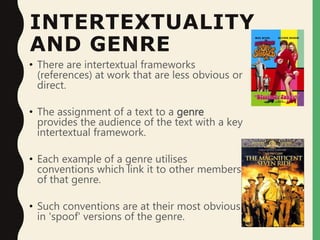
• There are intertextual frameworks
(references) at work that are less obvious or
direct.
• The assignment of a text to a genre
provides the audience of the text with a key
intertextual framework.
• Each example of a genre utilises
conventions which link it to other members
of that genre.
• Such conventions are at their most obvious
in 'spoof' versions of the genre.
INTERTEXTUALITY -
SIMPSONS
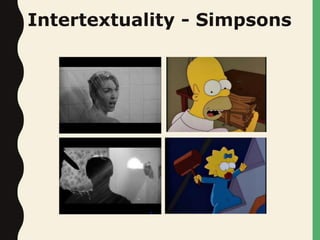
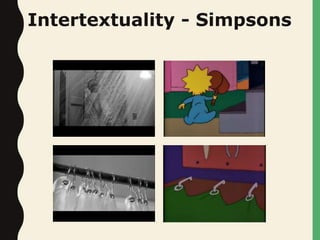
• Almost every episode of The Simpsons contains
at least one film reference to a famous film scene.
• The Simpsons also contains intertextual
references to politics, religion – nearly every
aspect of social, political and cultural life.
• The grabs on the following slides are from an
episode where the Simpsons referenced Psycho
Intertextuality - Simpsons
THEORY
• In 1968 Barthes announced 'the death of the author'
and 'the birth of the reader', declaring that 'a text's
unity lies not in its origin but in its destination' - in
other words there is no longer such a thing as an
original text – very postmodern.
• This highlights how interpretation lies with the
audience – that it is subjective - it is the audience
that creates meaning.

Intertextuality

  • 1.
    INTERTEXTUALITY B Y ZA C K C H R I S T O D O U L O U
  • 2.
    INTERTEXTUALITY • the shapingof a text's meaning by another text. • Intertextual figures include: allusion, quotation, calque, plagiarism, translation, pastiche and parody. • An example of intertextuality is a writer’s borrowing and transformation of a prior text, and incorporating an aspect of it in a new text.
  • 3.
    DEFINITION The shaping oftexts' meanings by other texts. • Notion introduced by Julia Kristeva. • Kristeva argued against the concept of a text as a isolated entity which operates in a self-contained manner and states that: "any text is the absorption and transformation of another"
  • 4.
    DEFINITION • Every text(and we can insert any cultural object here: image, film, web content, music etc.) is a mosaic of references to other texts, genres, and discourses. Where a text alludes to, or references, another text
  • 5.
    INTERTEXUALITY • Some textsrefer directly to each other – such as in 'remakes' of films, extra-diegetic references to the media / society in the animated cartoon The Simpsons, and many amusing contemporary TV ads. • The interpretation of these references is influenced by the audiences’ prior knowledge of other texts.
  • 6.
    AUDIENCE PLEASURES • This particularlyself-conscious form of intertextuality credits its audience with the necessary experience to make sense of such references and offers the pleasure of recognition. • By referring to other texts and other media reminds us that we are in a mediated reality. This runs counter to the dominant 'realist' tradition which focuses on persuading the audience to believe in the on-going reality of the narrative.
  • 7.
    INTERTEXTUALITY AND GENRE • Thereare intertextual frameworks (references) at work that are less obvious or direct. • The assignment of a text to a genre provides the audience of the text with a key intertextual framework. • Each example of a genre utilises conventions which link it to other members of that genre. • Such conventions are at their most obvious in 'spoof' versions of the genre.
  • 8.
    INTERTEXTUALITY - SIMPSONS • Almostevery episode of The Simpsons contains at least one film reference to a famous film scene. • The Simpsons also contains intertextual references to politics, religion – nearly every aspect of social, political and cultural life. • The grabs on the following slides are from an episode where the Simpsons referenced Psycho
  • 9.
  • 10.
  • 11.
  • 12.
  • 13.
    THEORY • In 1968Barthes announced 'the death of the author' and 'the birth of the reader', declaring that 'a text's unity lies not in its origin but in its destination' - in other words there is no longer such a thing as an original text – very postmodern. • This highlights how interpretation lies with the audience – that it is subjective - it is the audience that creates meaning.