ELEMENTS OF PROSE
PRINCESS M. CUISON
• Identify the elements of prose
• Compare and contrast the
genres of literature in the past
and in the 21st century
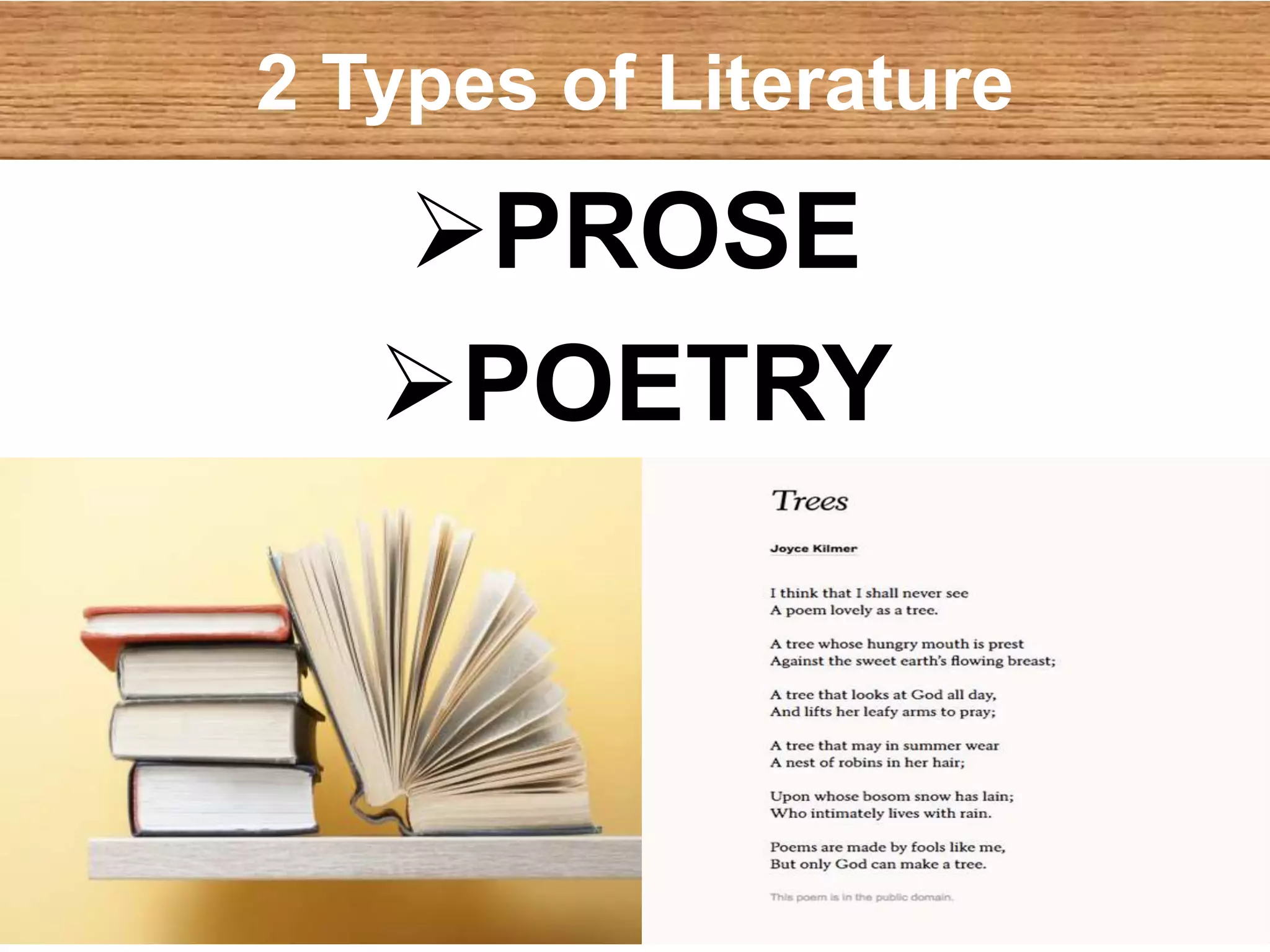
2 Types of Literature
PROSE
POETRY
PROSE (prowz)
• is the ordinary form of written and
spoken language whose unit is in the
sentence, rather than the individual
line as it is in poetry. The term applies
to all expressions in language that do
not have a regular rhythmic pattern.
• it consists of those written within the
common flow of conversation in
sentences and paragraphs.
Continuous piece of writing
Uses sentences and paragraphs
Sounds similar to ordinary speech
or writing
May or may not be creative
Literature in the past includes a
variety of works such as:
LEGENDS FABLES
MYTHS FOLK
TALES
FAIRY
TALES
Literature in the past includes a
variety of works such as:
NOVELS
SHORT
STORY PLAYS
ANECDOTES BIOGRAPHY ESSAY
Best 10 Books in the Philippines
1. Noli Me Tángere by Dr. José Rizal.
2. Florante at Laura by Francisco Balagtas.
3. Mga Ibong Mandaragit by Amado V. Hernandez.
4. The Woman Who Had Two Navels by Nick
Joaquin.
5. Po-on A Novel by F. Sionil Jose.
6. Banaag at Sikat by Lope K. Santos.
7. Ilustrado by Miguel Syjuco.
8. Dekada '70 by Lualhati Bautista.
9. Smaller and Smaller Circles by F.H. Batacan
10.ABNKKBSNPLAko?! by Bob Ong
https://theculturetrip.com/asia/philippines/articles/the-10-best-
books-in-philippine-literature/
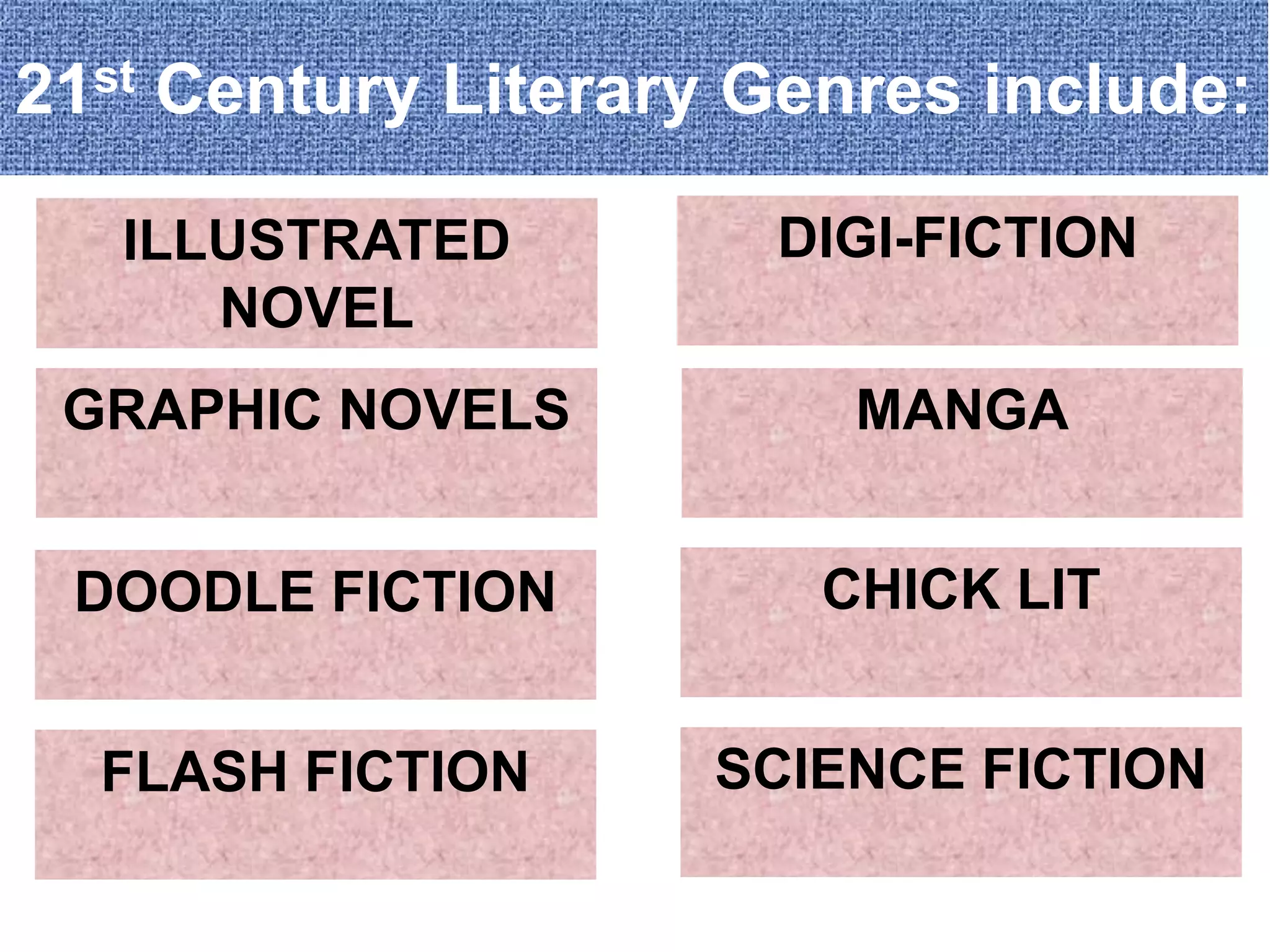
21st Century Literary Genres include:
ILLUSTRATED
NOVEL
DIGI-FICTION
GRAPHIC NOVELS MANGA
DOODLE FICTION CHICK LIT
FLASH FICTION SCIENCE FICTION
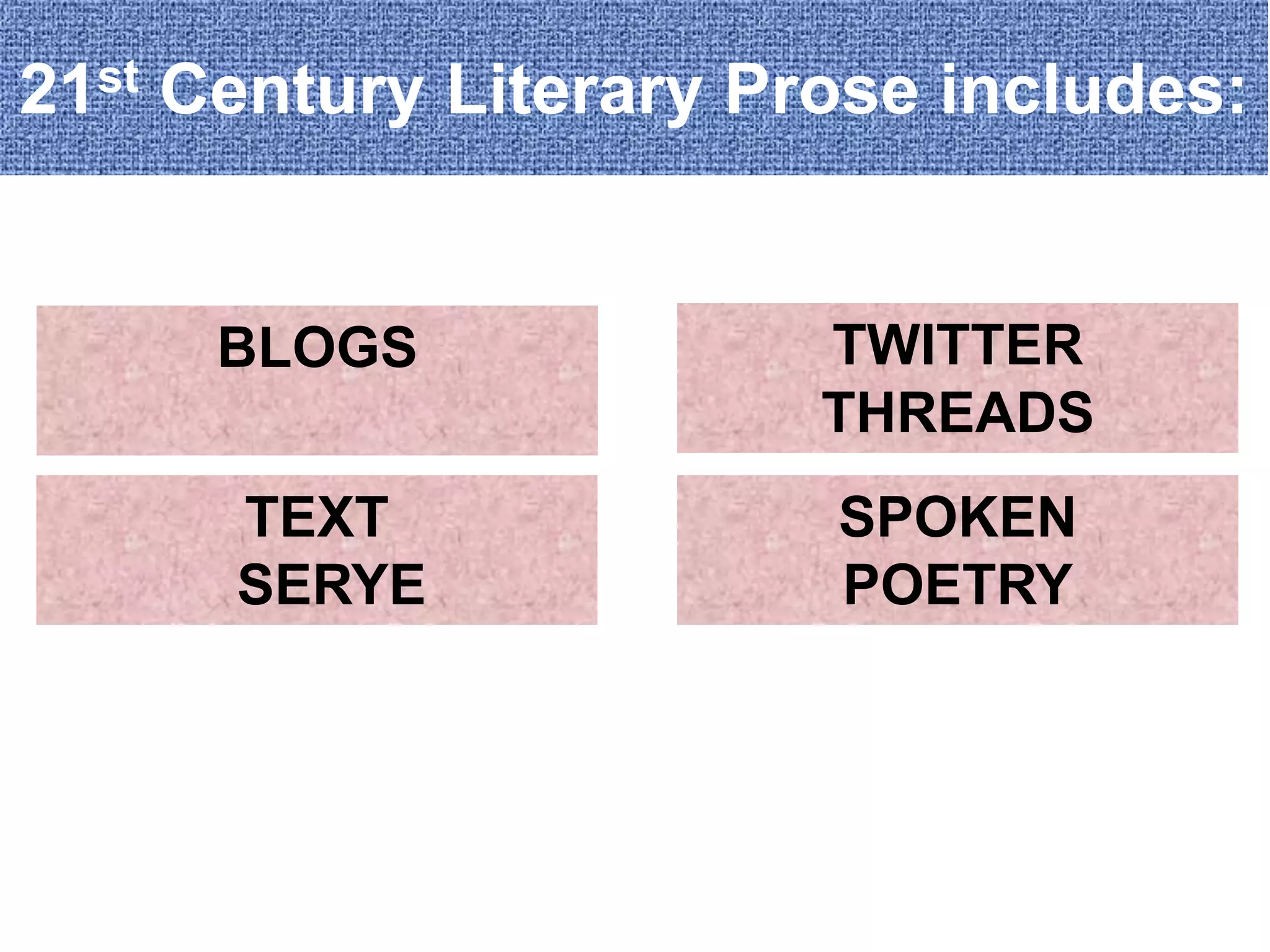
21st Century Literary Prose includes:
BLOGS TWITTER
THREADS
TEXT
SERYE
SPOKEN
POETRY
ELEMENTS OF PROSE
CHARACTER
SETTING
PLOT
POINT OF
VIEW
THEME
CONFLICT
CHARACTER
 A fictional personality created by
the author
1. PROTAGONIST- the central character in the
story
2. ANTAGONIST- forces acting against the
protagonist
3. DYNAMIC CHARACTER- the character
changes as a result of the action of the
story
4. STATIC CHARACTER- the character does
not change much in the course of the story
SETTINGS
• Because these stories are
passed along by word of mouth,
the plot elements are simple but
unchanging.
 Setting is the time and place
where a scene occurs.
 It can help set the mood
 Influences the way characters
behave
 Affects the dialog
 Reflects the society in which the
characters live, and sometimes
even plays a part in the story.
PLOT
• Is the organized
pattern or sequence
of events that make
up a story.
• Every plot is made
up of a series of
events that are
related to one
another.
POINT OF VIEW
The point of view of the story relates to
the person telling the story
TYPES:
A. First Person POV- the narrator is a
character in the story and tells the
story.
POINT OF VIEW
A. Second Person POV- the narrator
tells the story using the pronoun you.
B. Third Person POV- the narrator is not
a character in the story and refers to
the characters by name or he/she.
THEME
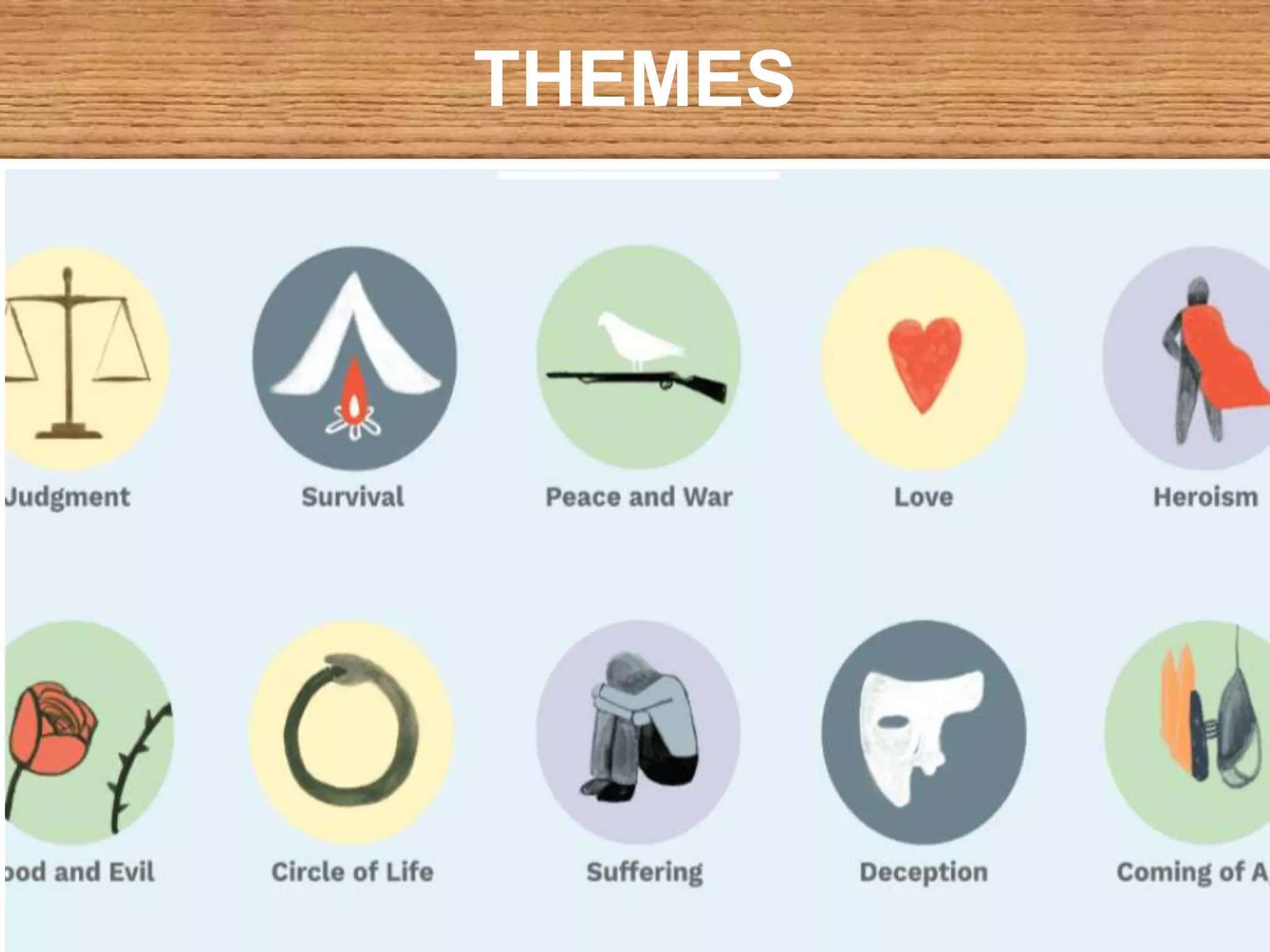
• Theme is what the story teaches readers the
life lesson, meaning, moral or message
about life or human nature that is
communicated by a literary work.
 Good vs. evil
 Weak vs. strong
 Beauty vs. ugliness
 Peace and war
 Love
 Heroism
 Suffering
 Deception
THEMES
CONFLICT
• A clash of actions, desires,
ideas or wills
• This element is what makes
the story exciting. It is the
opposition of forces that
makes the story move.
2 TYPES OF CONFLICT
1. EXTERNAL- a struggle with a
force outside one’s self.
a. Man Vs. Man – (physical)
- the main character
struggles with his physical
strength against other men, forces
of nature or animal.
2 TYPES OF CONFLICT
b. Man Vs. Circumstances
- (classical) the main
character struggles against fate, or
the circumstances of life facing him/
her.
c. Man Vs. Society
- (social) the main character
against ideas, practices, or customs
of other people.
2 TYPES OF CONFLICT
2. INTERNAL- the main character’s
struggle within one’s self wherein he/she
has to make some decision, overcome
pain, resist their urge etc.
 Man Vs. Himself- (psychological) the
main character struggles with
himself/herself; with his/ her own
choices, ideas of right and wrong,
physical limitations, etc.
THE CROSSROADS OF
LITERATURE
• The “death of print” has been notable over
the past decade, due to the rising
accessibility of devices like tablets and
smartphones that have made the electronic
medium cheaper and more universal. Book
sales, as well as magazine and newspaper
subscriptions, have diminished, but our
appetite for information has grown larger
and more impetuous.
21ST CENTURY LITERATURE
• In the 21st century, Philippines
have a lot of literary innovations
that are adapted and created by
Filipinos.
• Nowadays, even those who do not
have any significant literary
background make their own way
using their freedom to write and to
express.
• As we engage in technology
everyday we create and discover
more existing forms of expressive
culture as well. We have a wide
range of resources through the
internet and this gave
opportunities to people, especially
the youth, to begin writing and
expressing their thoughts, ideas,
and feelings.
21ST CENTURY LITERATURE
• There are a lot of new
forms from the basic
genres of literature; thus
proving how far the
literature in the Philippines
has gone and how far it will
go from here.
Elements of prose

Elements of prose

  • 1.
  • 2.
    • Identify theelements of prose • Compare and contrast the genres of literature in the past and in the 21st century
  • 3.
    2 Types ofLiterature PROSE POETRY
  • 4.
    PROSE (prowz) • isthe ordinary form of written and spoken language whose unit is in the sentence, rather than the individual line as it is in poetry. The term applies to all expressions in language that do not have a regular rhythmic pattern. • it consists of those written within the common flow of conversation in sentences and paragraphs.
  • 5.
    Continuous piece ofwriting Uses sentences and paragraphs Sounds similar to ordinary speech or writing May or may not be creative
  • 6.
    Literature in thepast includes a variety of works such as: LEGENDS FABLES MYTHS FOLK TALES FAIRY TALES
  • 7.
    Literature in thepast includes a variety of works such as: NOVELS SHORT STORY PLAYS ANECDOTES BIOGRAPHY ESSAY
  • 8.
    Best 10 Booksin the Philippines 1. Noli Me Tángere by Dr. José Rizal. 2. Florante at Laura by Francisco Balagtas. 3. Mga Ibong Mandaragit by Amado V. Hernandez. 4. The Woman Who Had Two Navels by Nick Joaquin. 5. Po-on A Novel by F. Sionil Jose. 6. Banaag at Sikat by Lope K. Santos. 7. Ilustrado by Miguel Syjuco. 8. Dekada '70 by Lualhati Bautista. 9. Smaller and Smaller Circles by F.H. Batacan 10.ABNKKBSNPLAko?! by Bob Ong https://theculturetrip.com/asia/philippines/articles/the-10-best- books-in-philippine-literature/
  • 9.
    21st Century LiteraryGenres include: ILLUSTRATED NOVEL DIGI-FICTION GRAPHIC NOVELS MANGA DOODLE FICTION CHICK LIT FLASH FICTION SCIENCE FICTION
  • 10.
    21st Century LiteraryProse includes: BLOGS TWITTER THREADS TEXT SERYE SPOKEN POETRY
  • 12.
  • 13.
    CHARACTER  A fictionalpersonality created by the author 1. PROTAGONIST- the central character in the story 2. ANTAGONIST- forces acting against the protagonist 3. DYNAMIC CHARACTER- the character changes as a result of the action of the story 4. STATIC CHARACTER- the character does not change much in the course of the story
  • 14.
    SETTINGS • Because thesestories are passed along by word of mouth, the plot elements are simple but unchanging.  Setting is the time and place where a scene occurs.  It can help set the mood  Influences the way characters behave  Affects the dialog  Reflects the society in which the characters live, and sometimes even plays a part in the story.
  • 15.
    PLOT • Is theorganized pattern or sequence of events that make up a story. • Every plot is made up of a series of events that are related to one another.
  • 17.
    POINT OF VIEW Thepoint of view of the story relates to the person telling the story TYPES: A. First Person POV- the narrator is a character in the story and tells the story.
  • 18.
    POINT OF VIEW A.Second Person POV- the narrator tells the story using the pronoun you. B. Third Person POV- the narrator is not a character in the story and refers to the characters by name or he/she.
  • 19.
    THEME • Theme iswhat the story teaches readers the life lesson, meaning, moral or message about life or human nature that is communicated by a literary work.  Good vs. evil  Weak vs. strong  Beauty vs. ugliness  Peace and war  Love  Heroism  Suffering  Deception
  • 20.
  • 21.
    CONFLICT • A clashof actions, desires, ideas or wills • This element is what makes the story exciting. It is the opposition of forces that makes the story move.
  • 22.
    2 TYPES OFCONFLICT 1. EXTERNAL- a struggle with a force outside one’s self. a. Man Vs. Man – (physical) - the main character struggles with his physical strength against other men, forces of nature or animal.
  • 23.
    2 TYPES OFCONFLICT b. Man Vs. Circumstances - (classical) the main character struggles against fate, or the circumstances of life facing him/ her. c. Man Vs. Society - (social) the main character against ideas, practices, or customs of other people.
  • 24.
    2 TYPES OFCONFLICT 2. INTERNAL- the main character’s struggle within one’s self wherein he/she has to make some decision, overcome pain, resist their urge etc.  Man Vs. Himself- (psychological) the main character struggles with himself/herself; with his/ her own choices, ideas of right and wrong, physical limitations, etc.
  • 25.
    THE CROSSROADS OF LITERATURE •The “death of print” has been notable over the past decade, due to the rising accessibility of devices like tablets and smartphones that have made the electronic medium cheaper and more universal. Book sales, as well as magazine and newspaper subscriptions, have diminished, but our appetite for information has grown larger and more impetuous.
  • 26.
    21ST CENTURY LITERATURE •In the 21st century, Philippines have a lot of literary innovations that are adapted and created by Filipinos. • Nowadays, even those who do not have any significant literary background make their own way using their freedom to write and to express.
  • 27.
    • As weengage in technology everyday we create and discover more existing forms of expressive culture as well. We have a wide range of resources through the internet and this gave opportunities to people, especially the youth, to begin writing and expressing their thoughts, ideas, and feelings.
  • 28.
    21ST CENTURY LITERATURE •There are a lot of new forms from the basic genres of literature; thus proving how far the literature in the Philippines has gone and how far it will go from here.