GAURAV GUPTA(22)
GUNISH GROVER(25)
LIST OF CONTENTS
 What is refraction
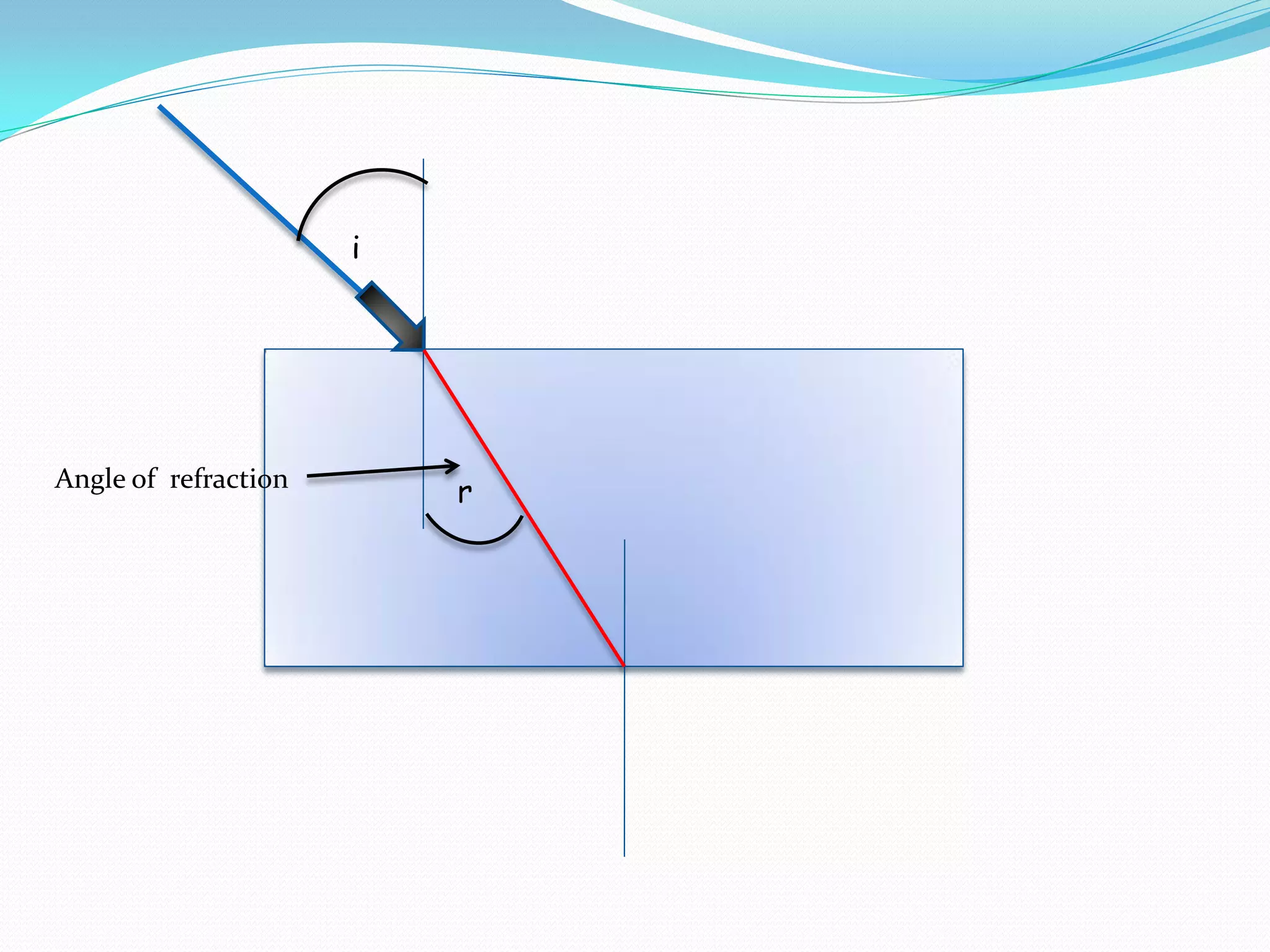
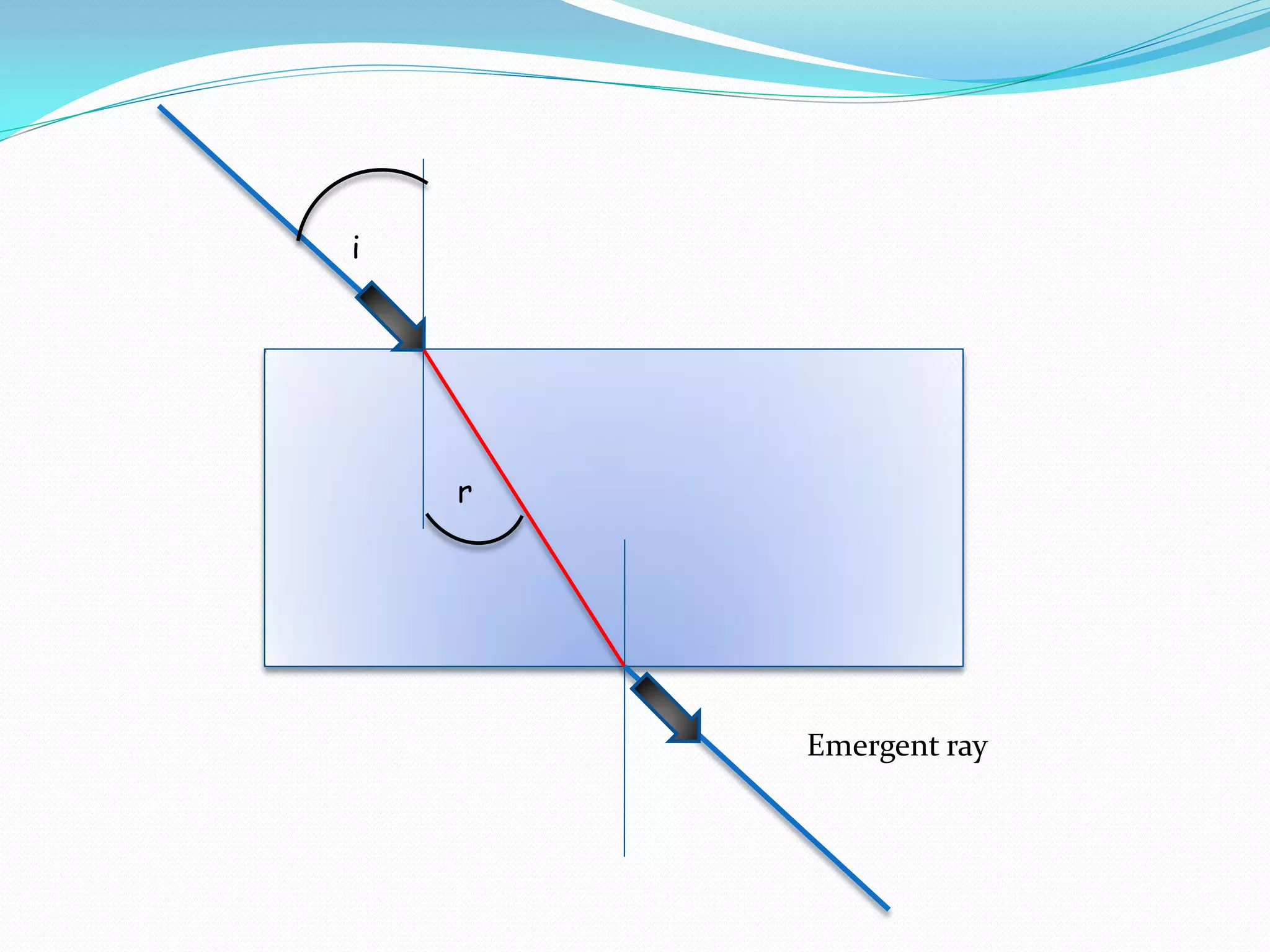
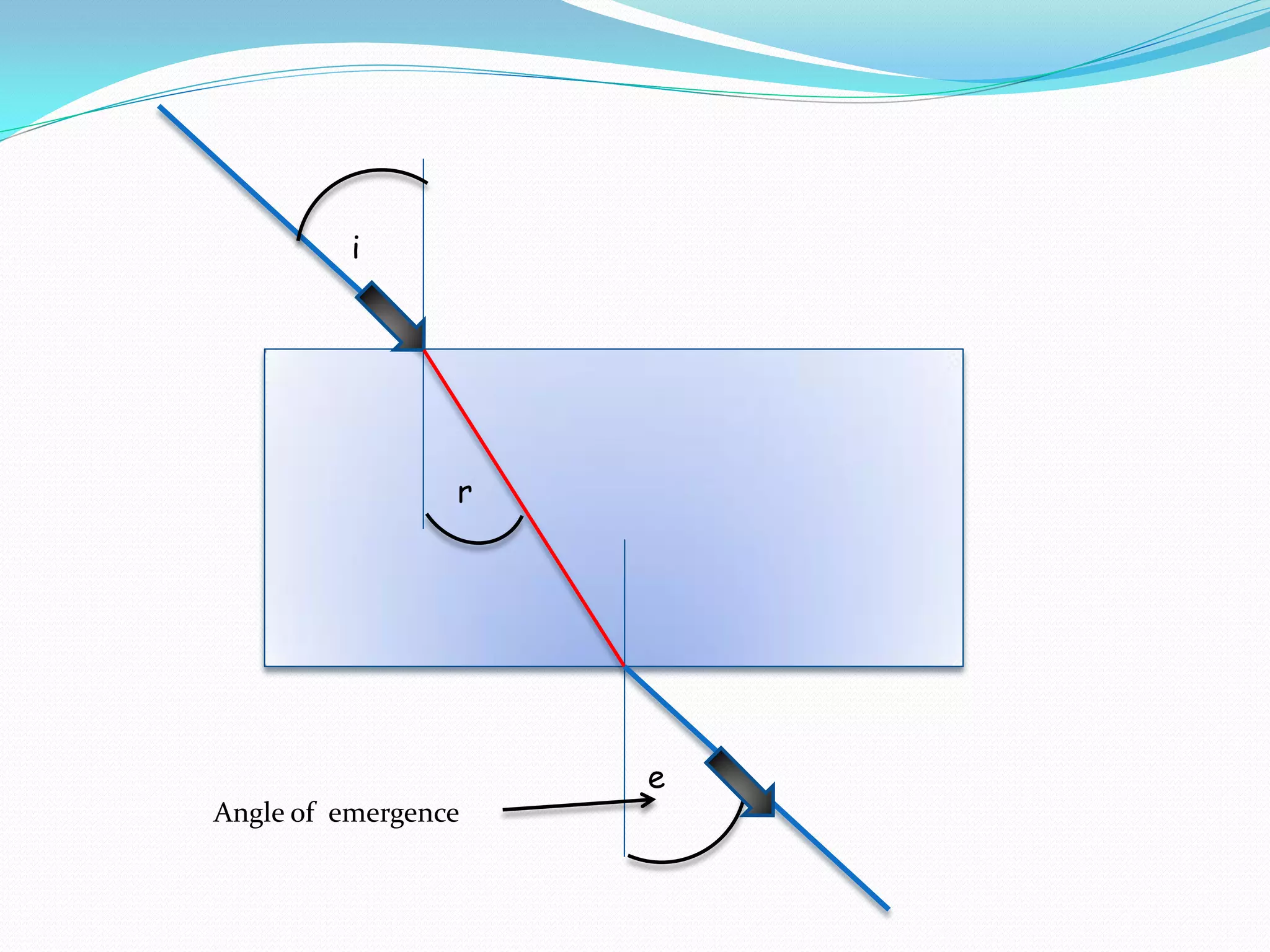
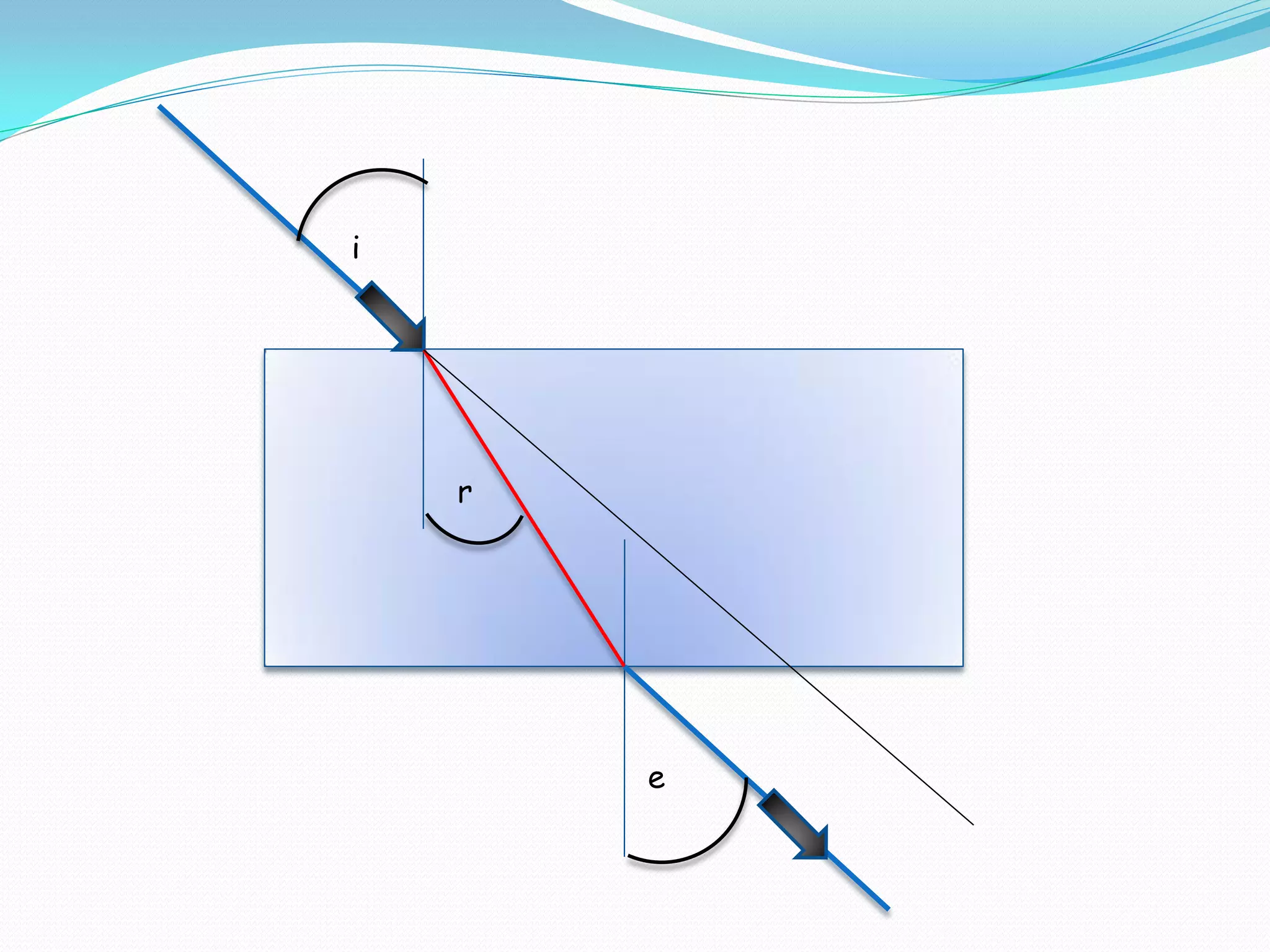
 Refraction through glass slab
 Laws of refraction
 Advanced sunrise and delayed sunset
 Twinkling of stars
 Why don’t planets twinkle..
 Apparent flattening of sun’s disc at sunrise and sunset
 Mirage
 References
WHAT is REFRACTION of light ?
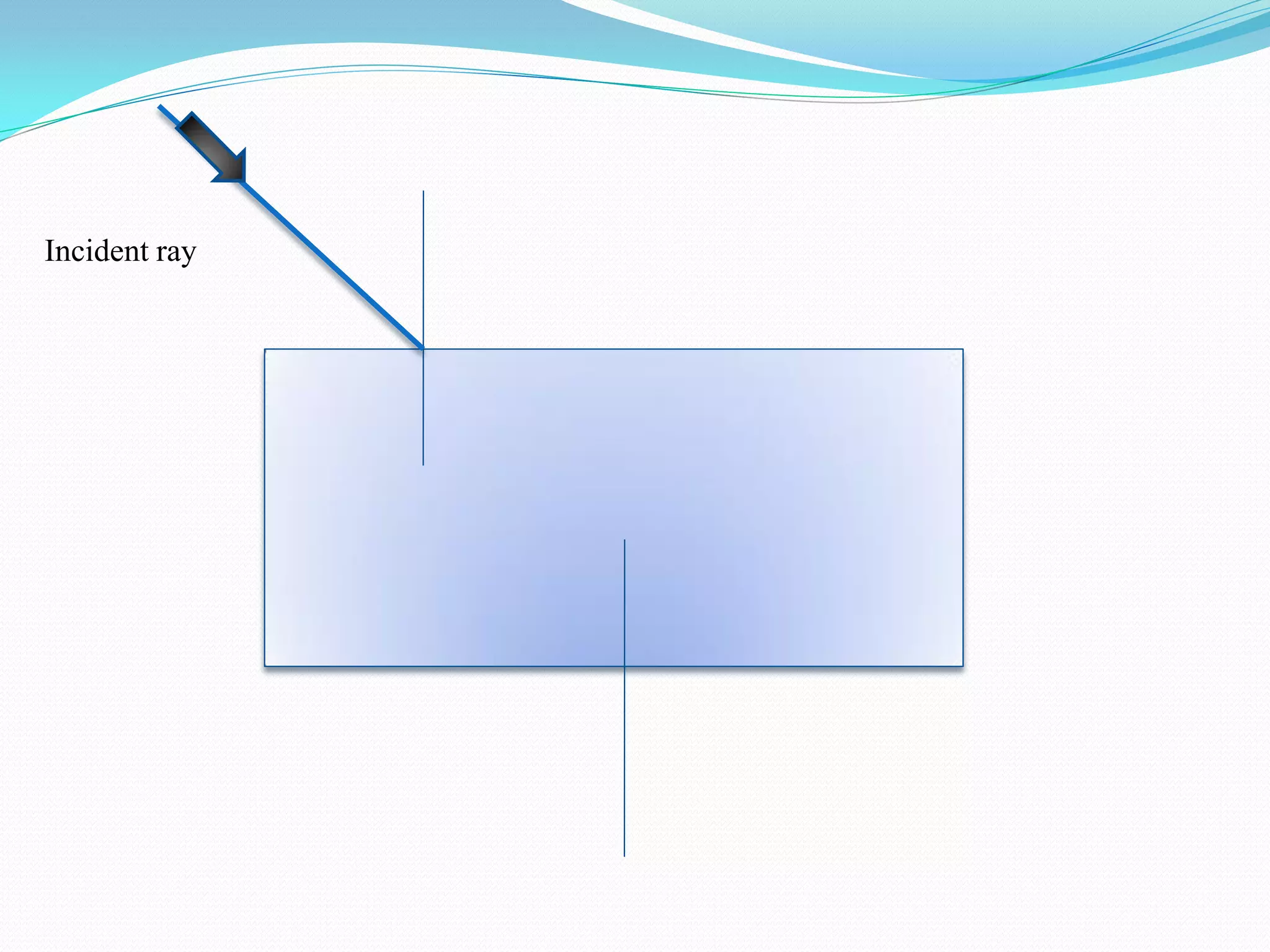
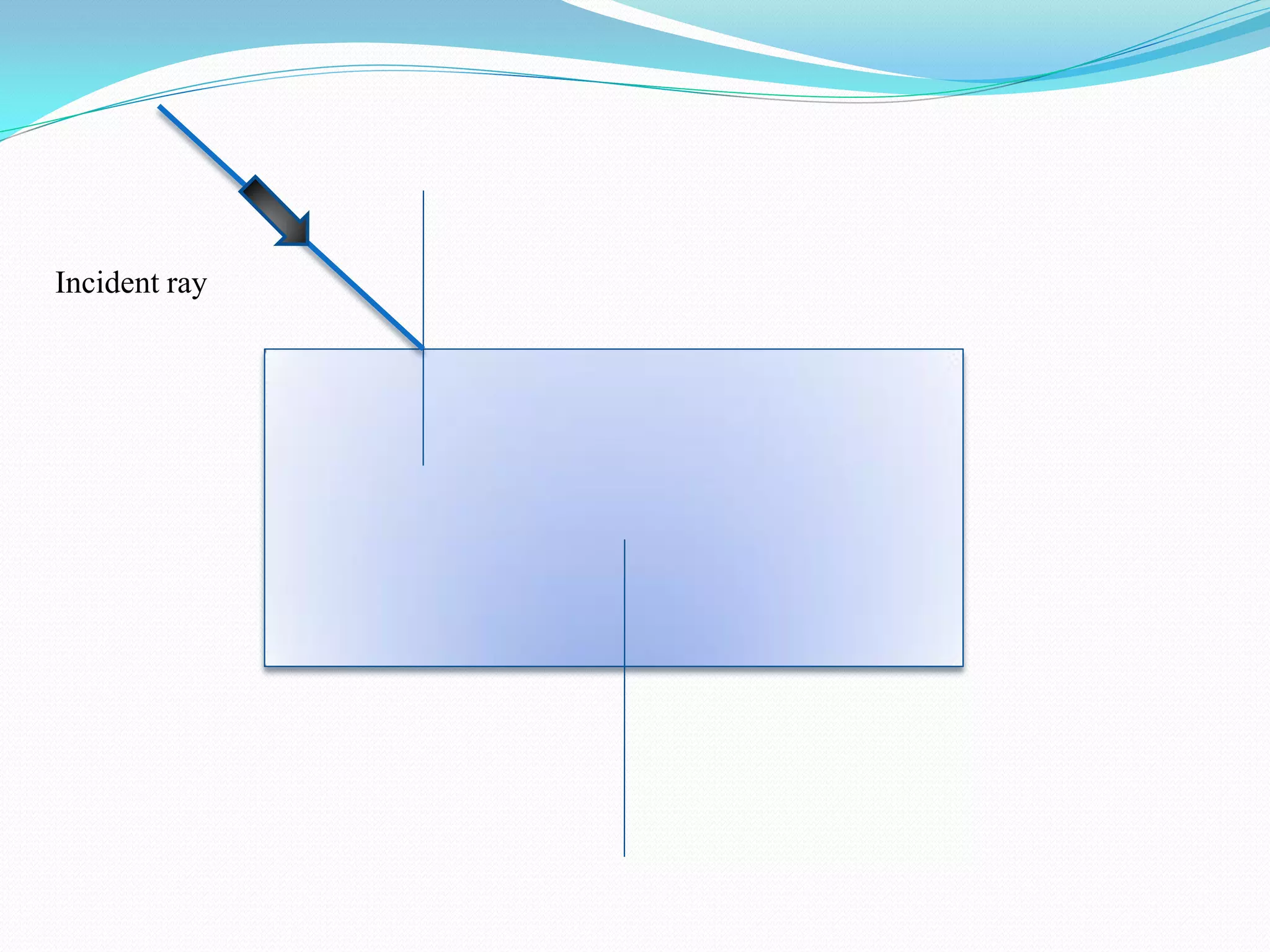
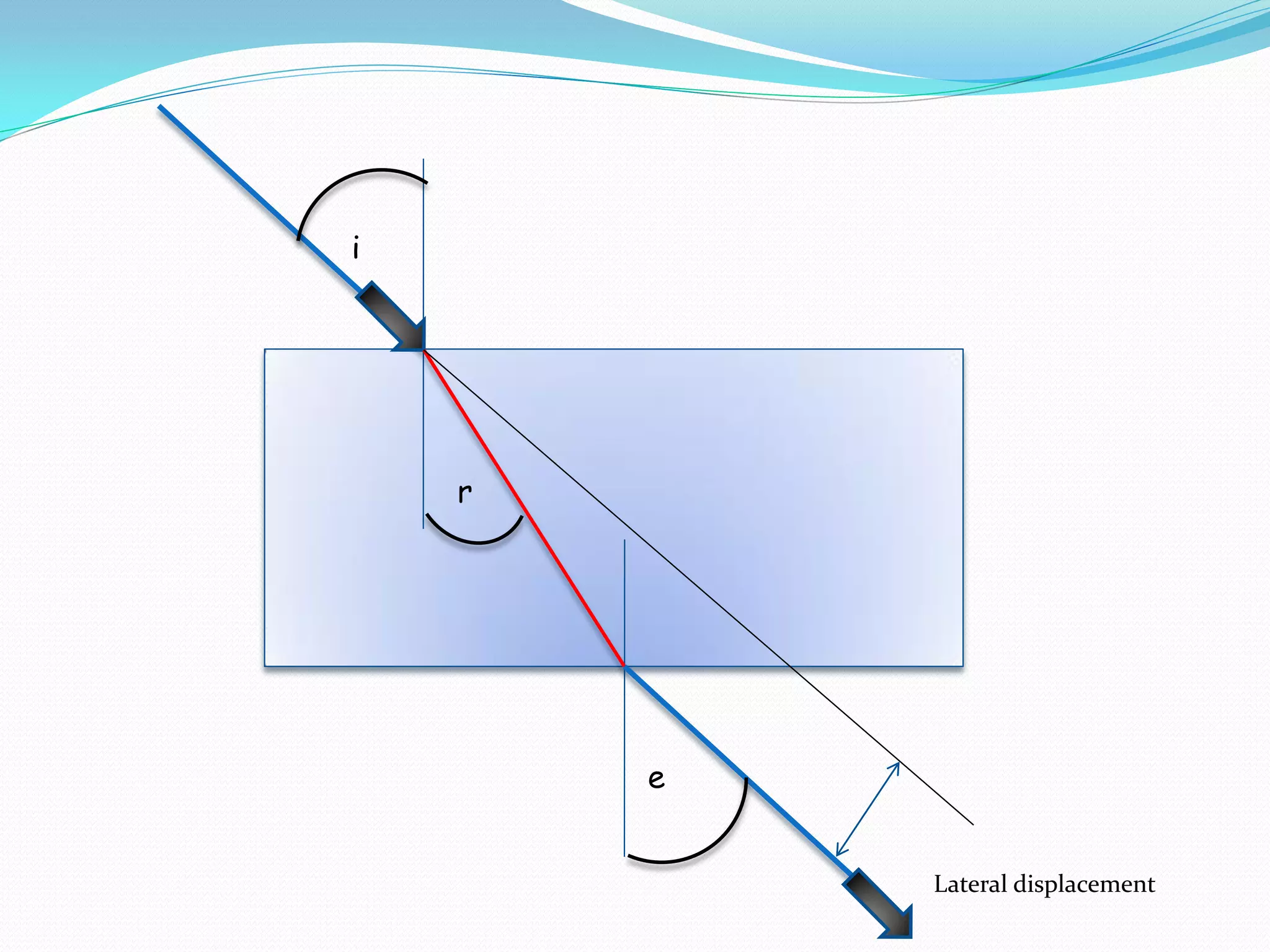
 REFRACTION of light is the phenomenon of change
 in the path of light, when it travels from one medium
 to another.

 The basic cause of refraction is change in velocity in
 going from one medium to the other.
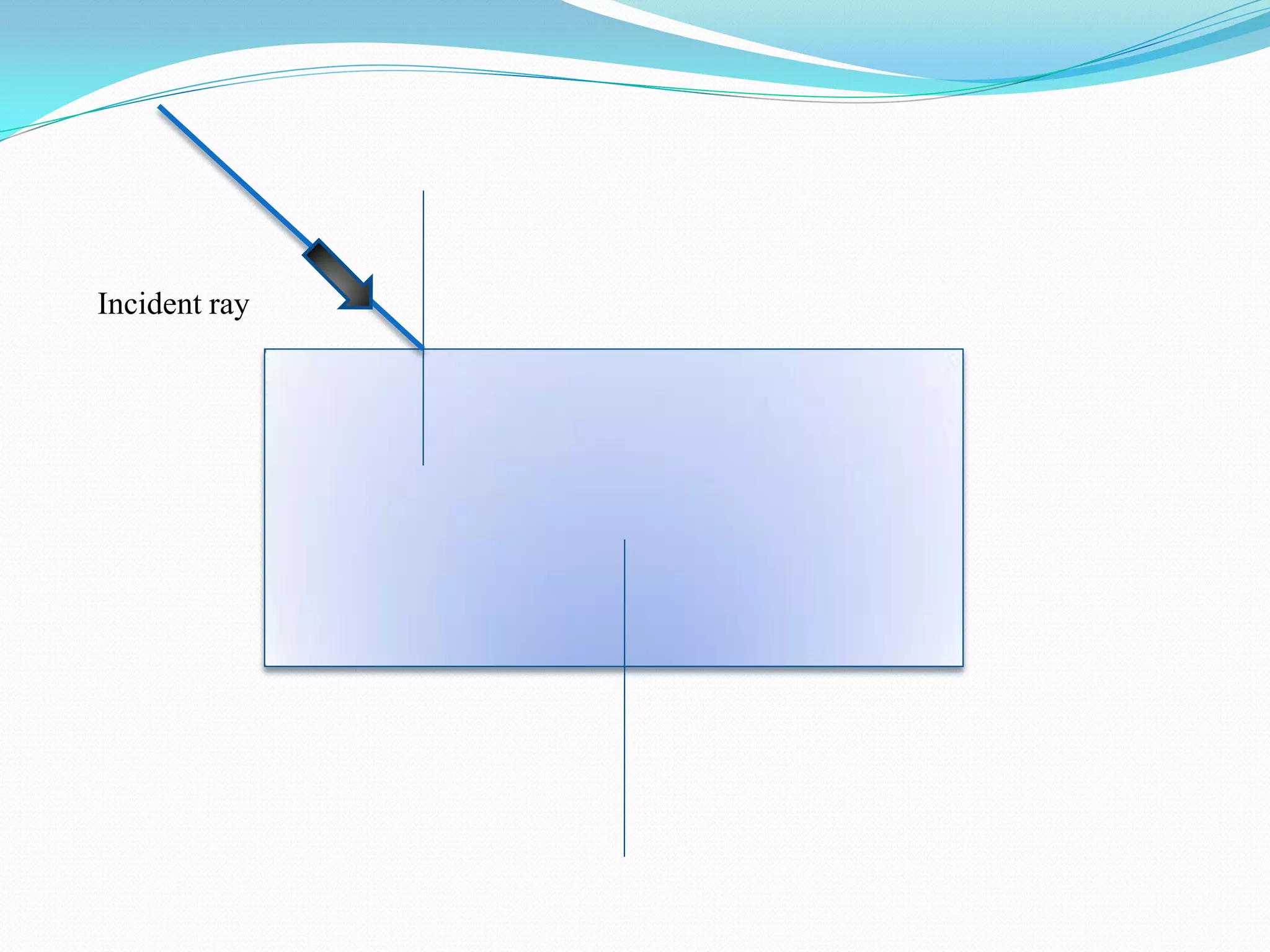
Incident ray
Incident ray
Incident ray
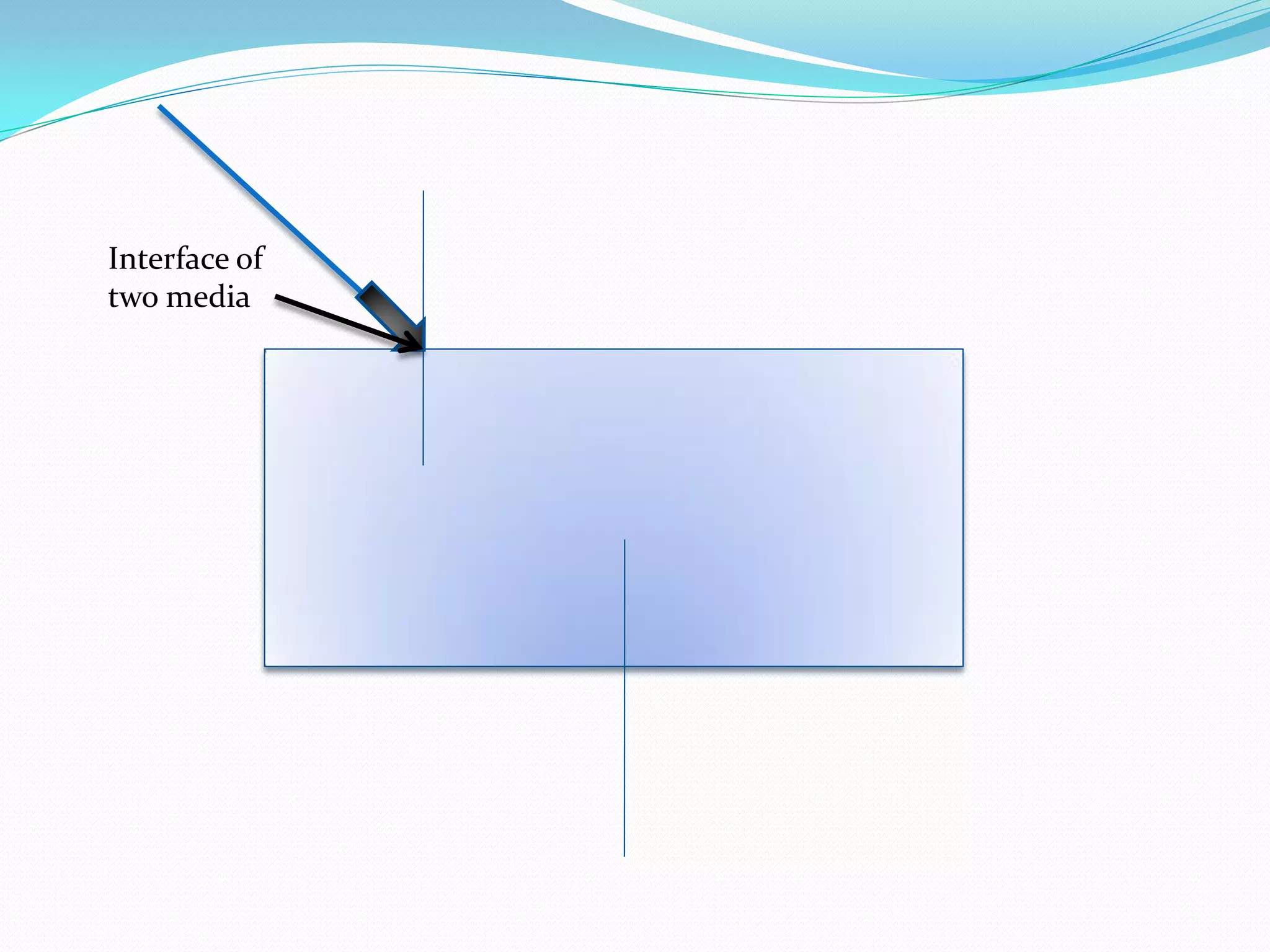
Interface of
two media
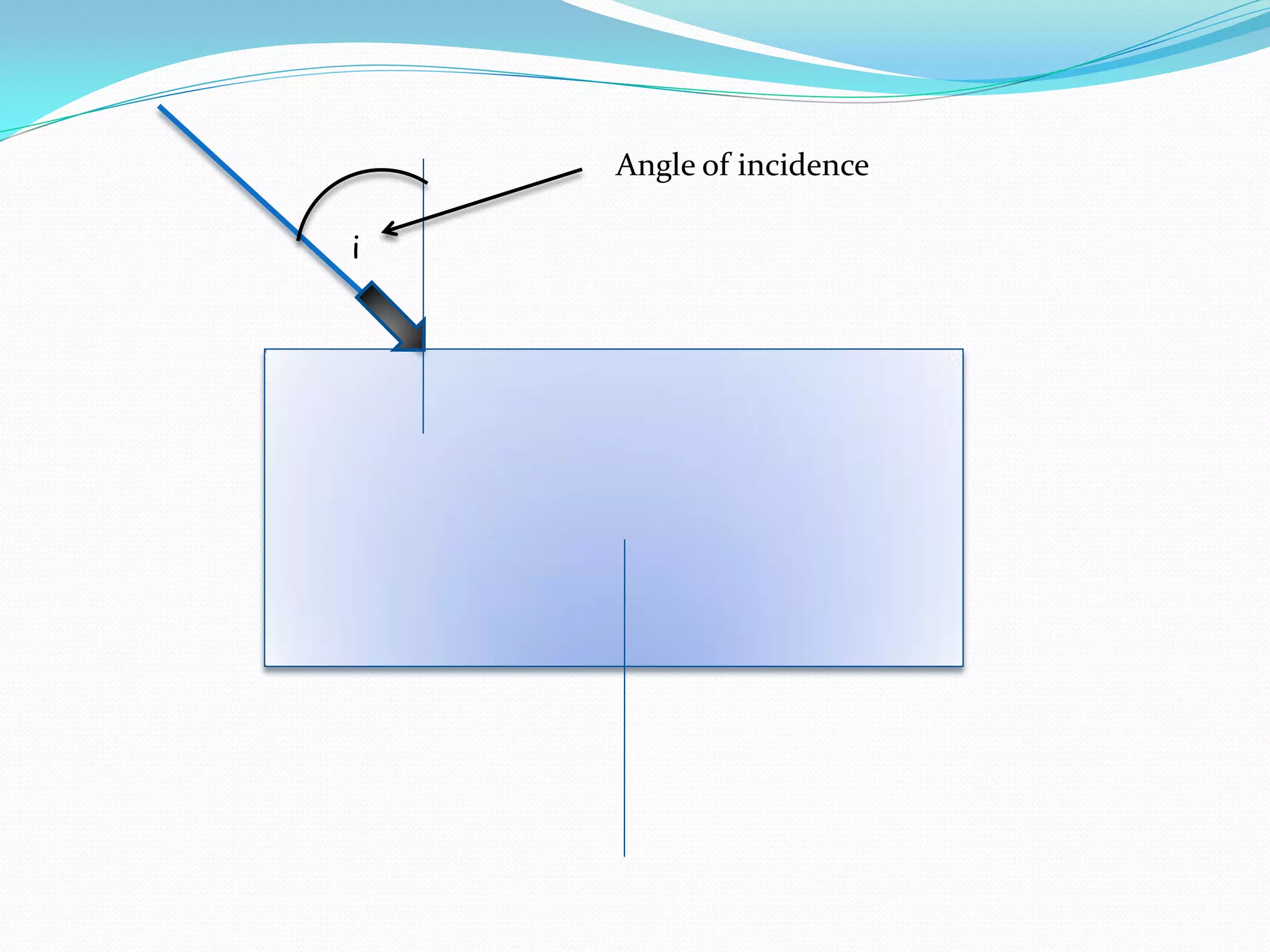
Angle of incidence

i
i


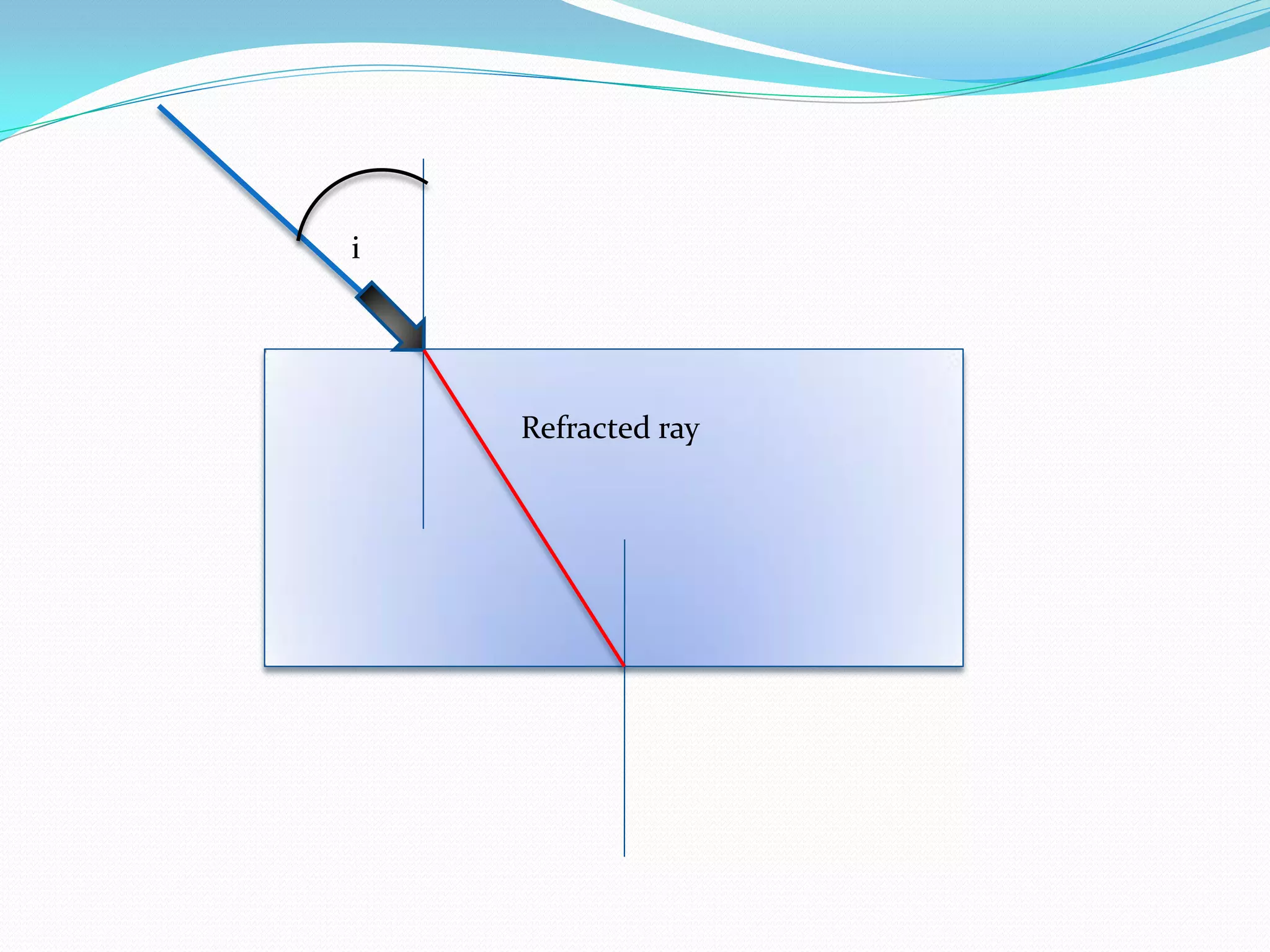
    Refracted ray
i


Angle of refraction
                          r
i


    r


        Emergent ray
i


                 r


                     e
Angle of emergence
i


    r


        e
i


    r


        e


            Lateral displacement
laws of REFRACTION
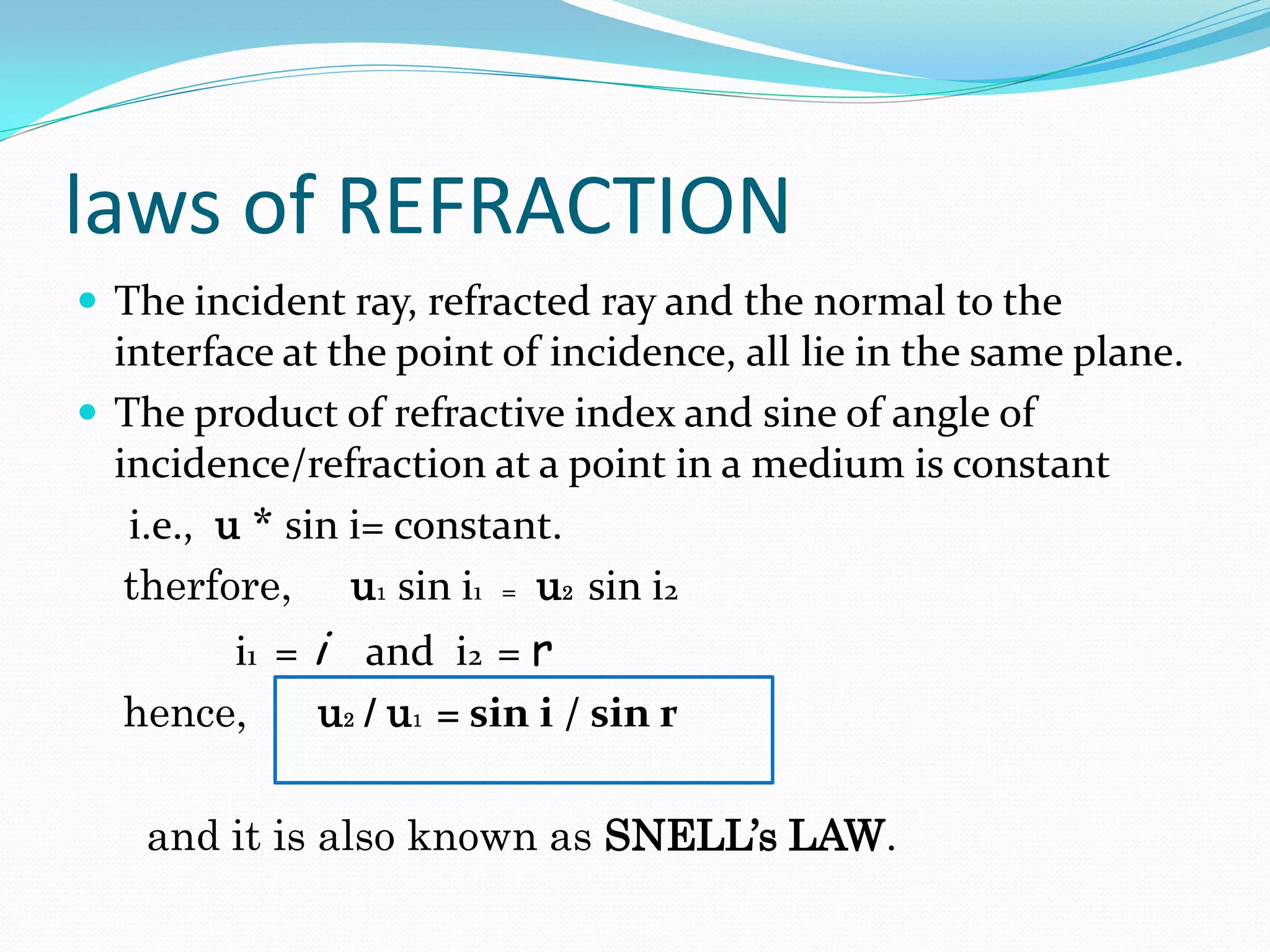
 The incident ray, refracted ray and the normal to the
  interface at the point of incidence, all lie in the same plane.
 The product of refractive index and sine of angle of
  incidence/refraction at a point in a medium is constant
   i.e., u * sin i= constant.
   therfore, u1 sin i1 = u2 sin i2
       i1 = i and i2 = r
  hence,    u2 / u1 = sin i / sin r

    and it is also known as SNELL’s LAW.
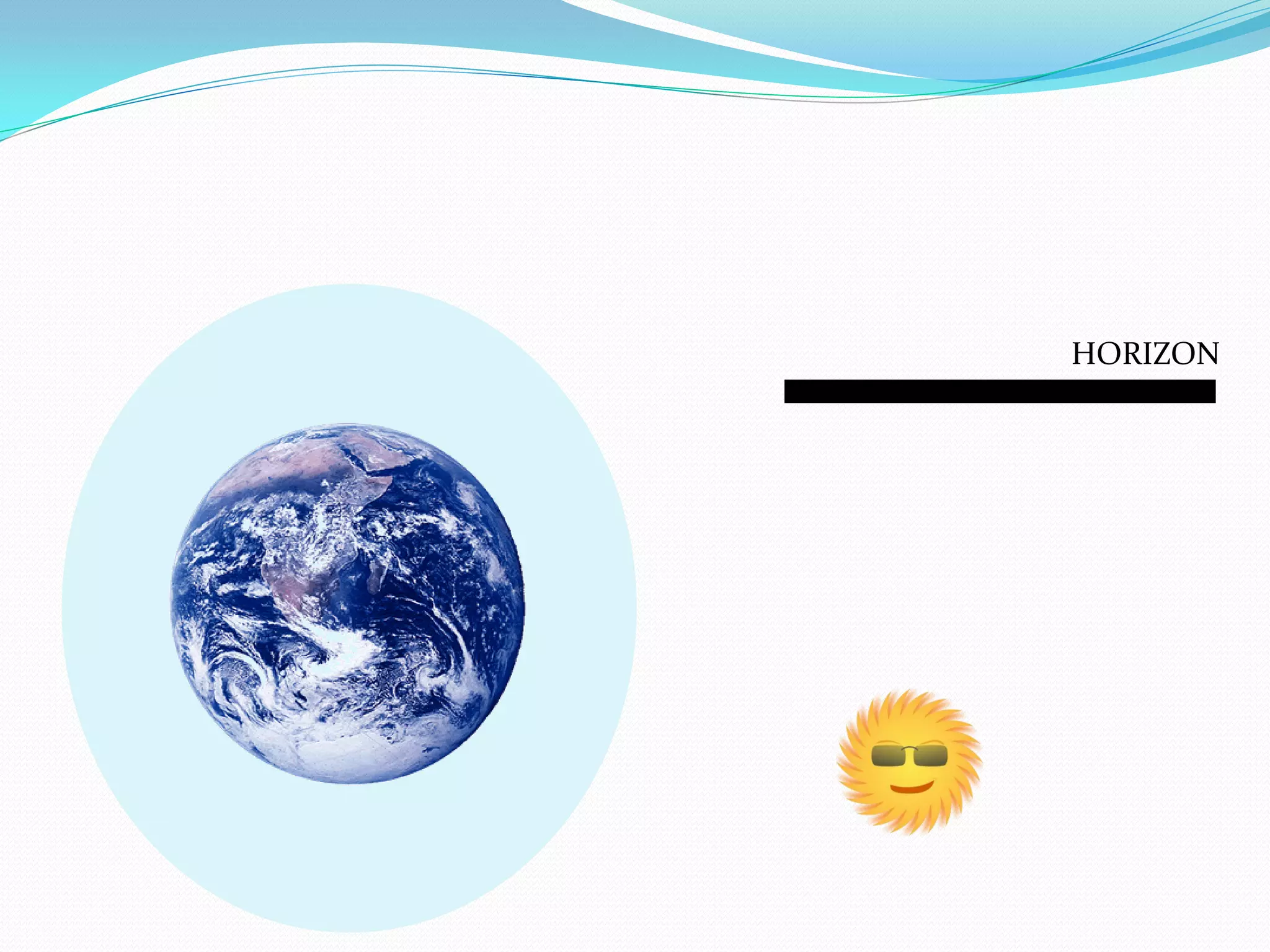
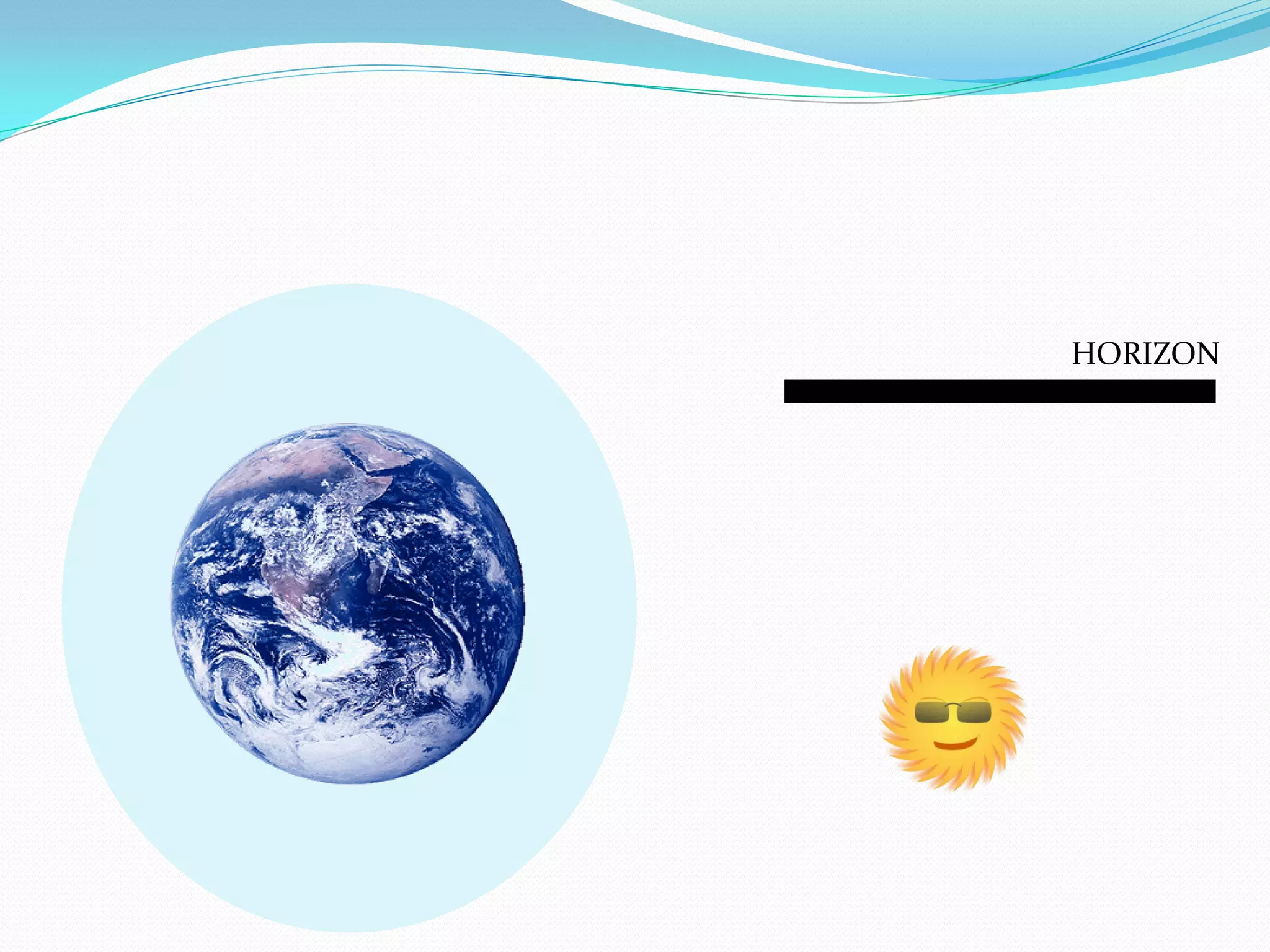
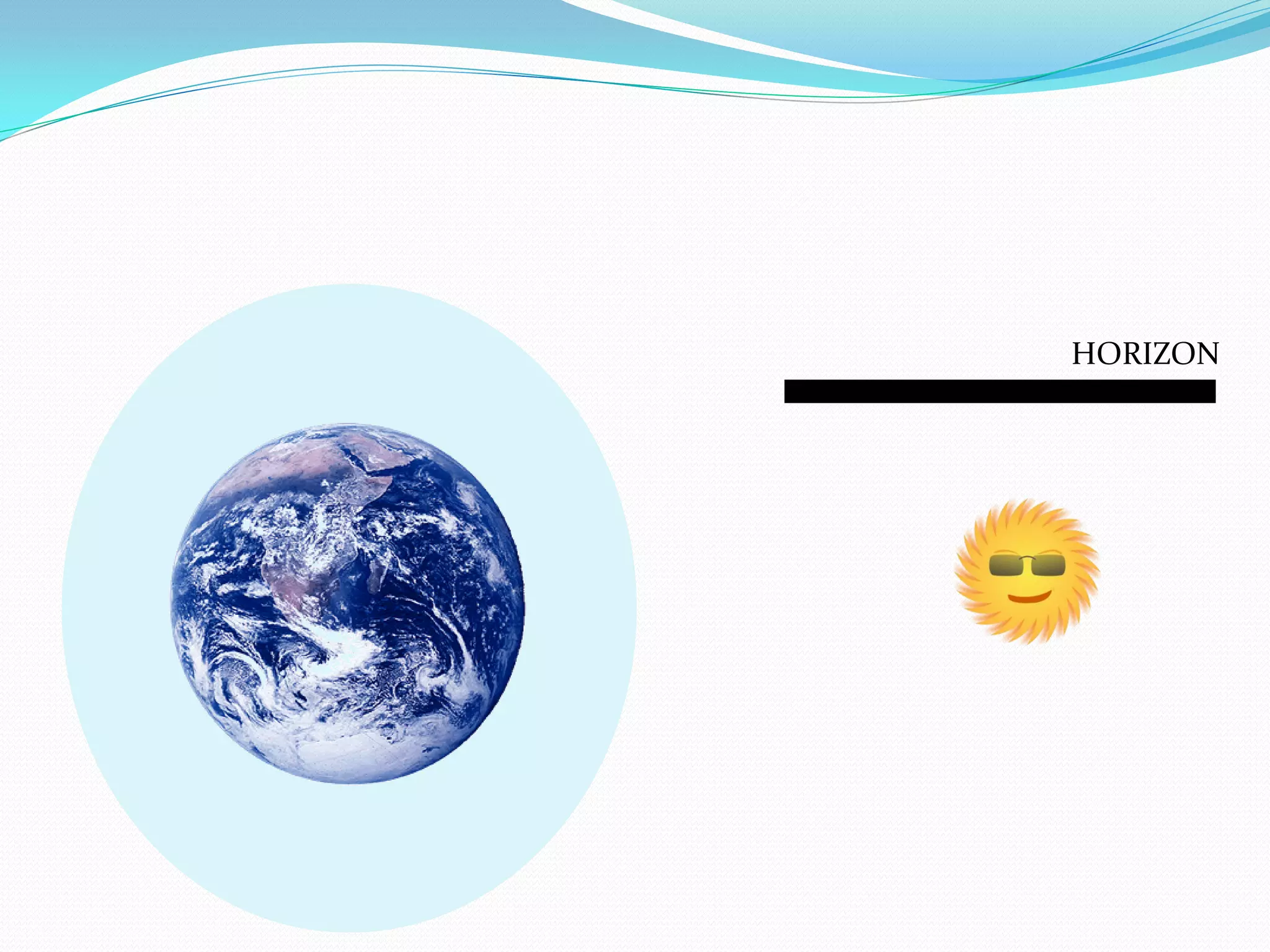
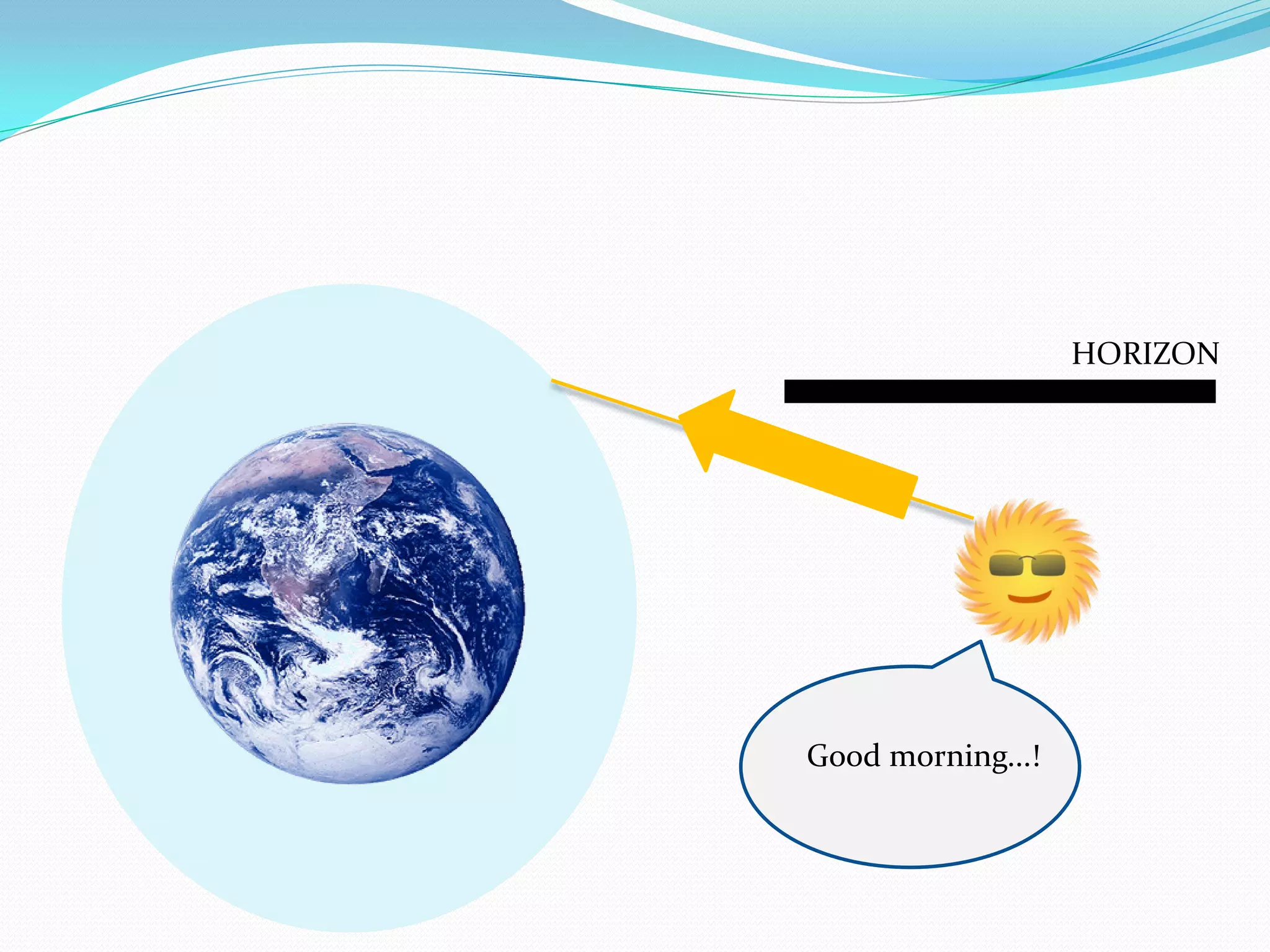
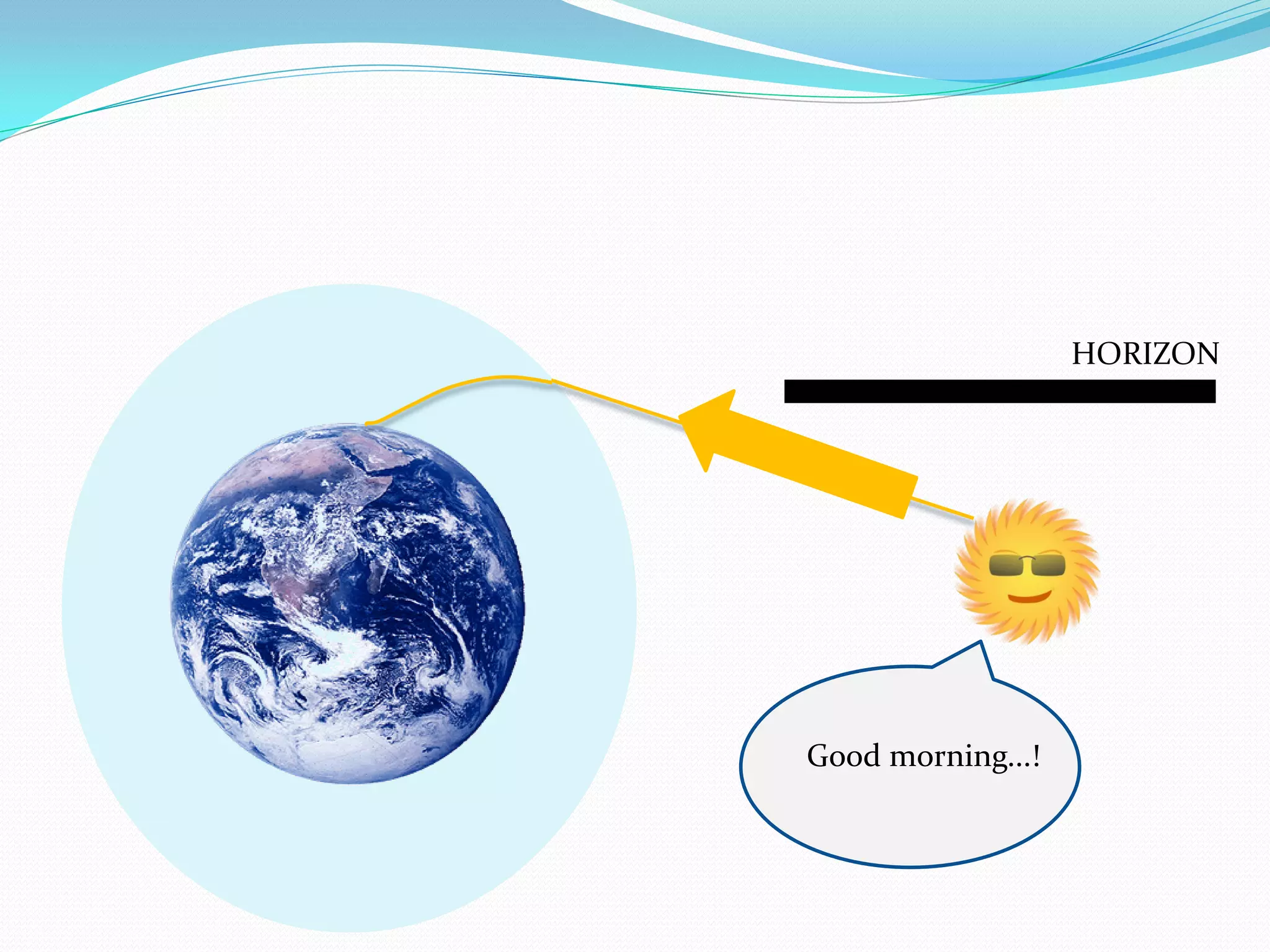
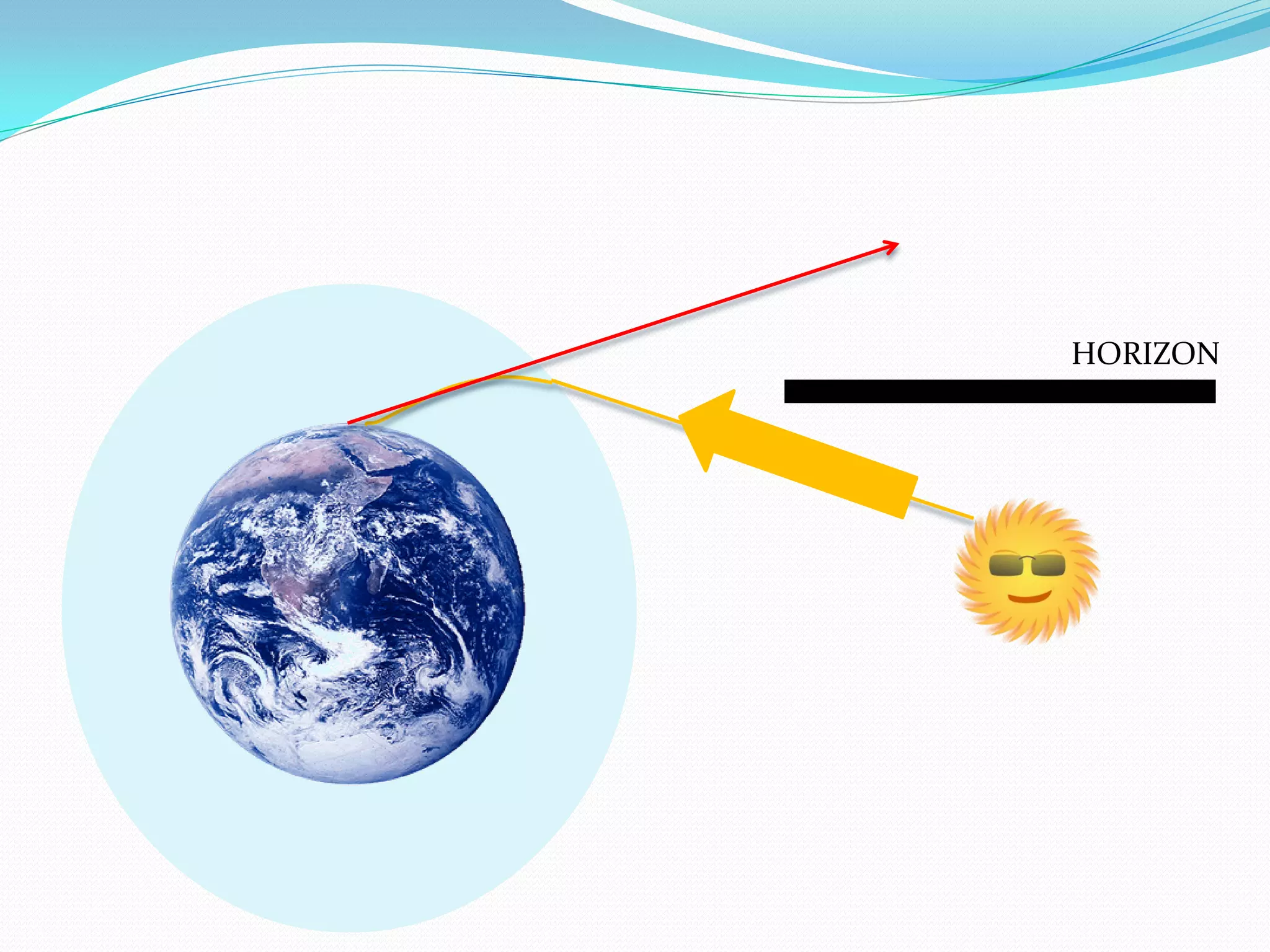
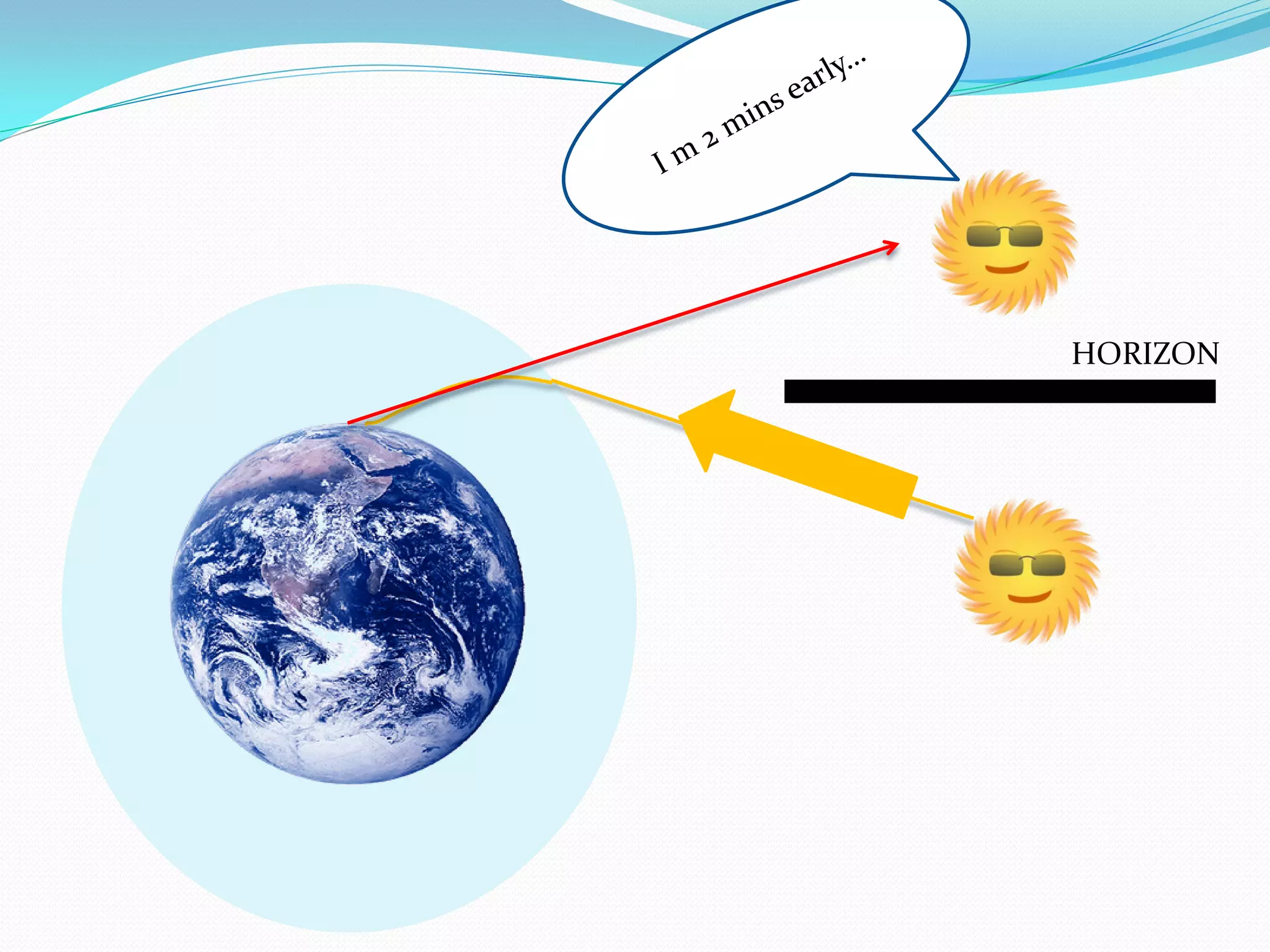
ADVANCED SUNRISE & DELAYED
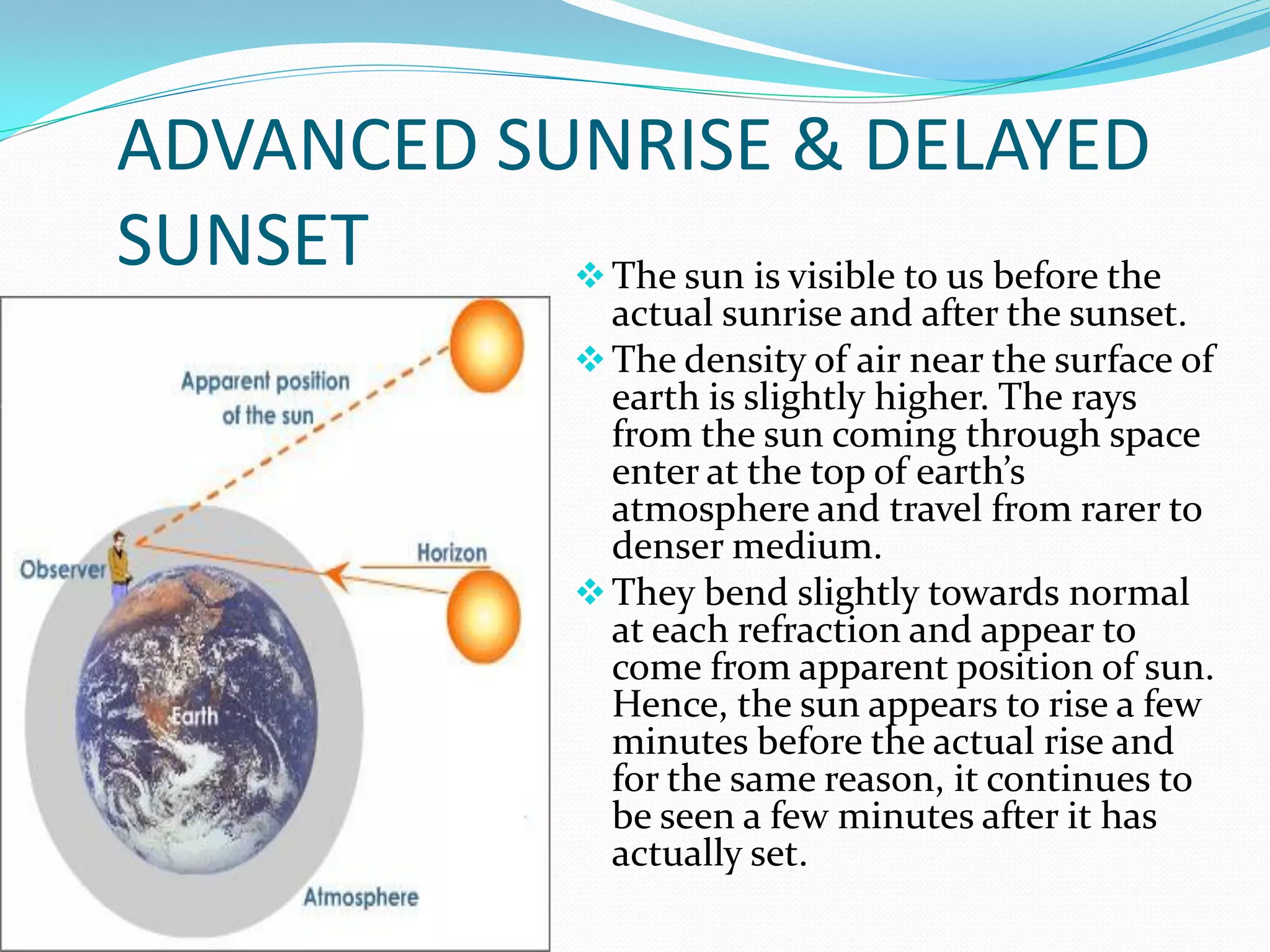
SUNSET      The sun is visible to us before the
                       actual sunrise and after the sunset.
                      The density of air near the surface of
                       earth is slightly higher. The rays
                       from the sun coming through space
                       enter at the top of earth’s
                       atmosphere and travel from rarer to
                       denser medium.
                      They bend slightly towards normal
                       at each refraction and appear to
                       come from apparent position of sun.
                       Hence, the sun appears to rise a few
                       minutes before the actual rise and
                       for the same reason, it continues to
                       be seen a few minutes after it has
                       actually set.
HORIZON
HORIZON
HORIZON
HORIZON


Good morning...!
HORIZON


Good morning...!
HORIZON
HORIZON
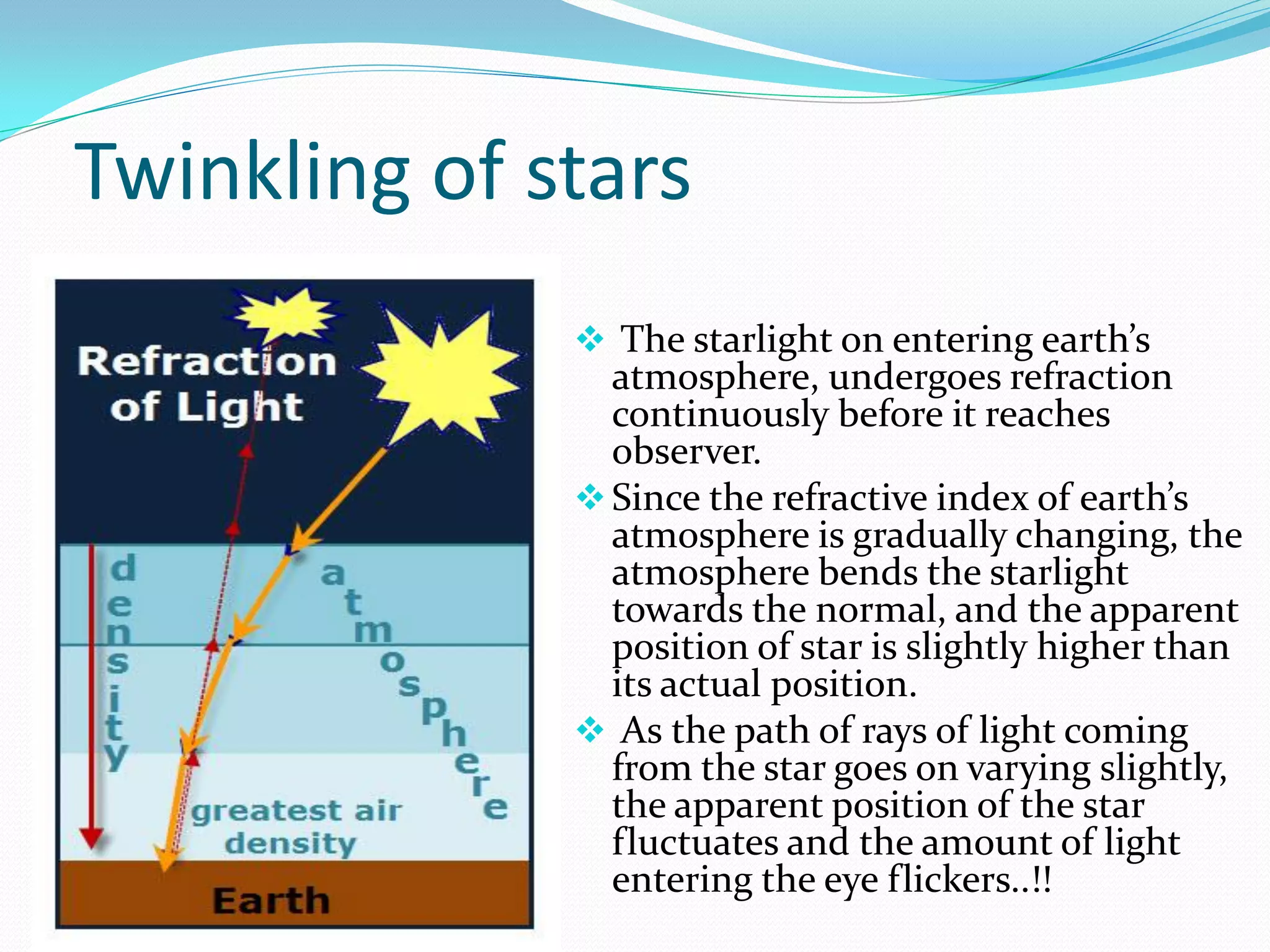
Twinkling of stars
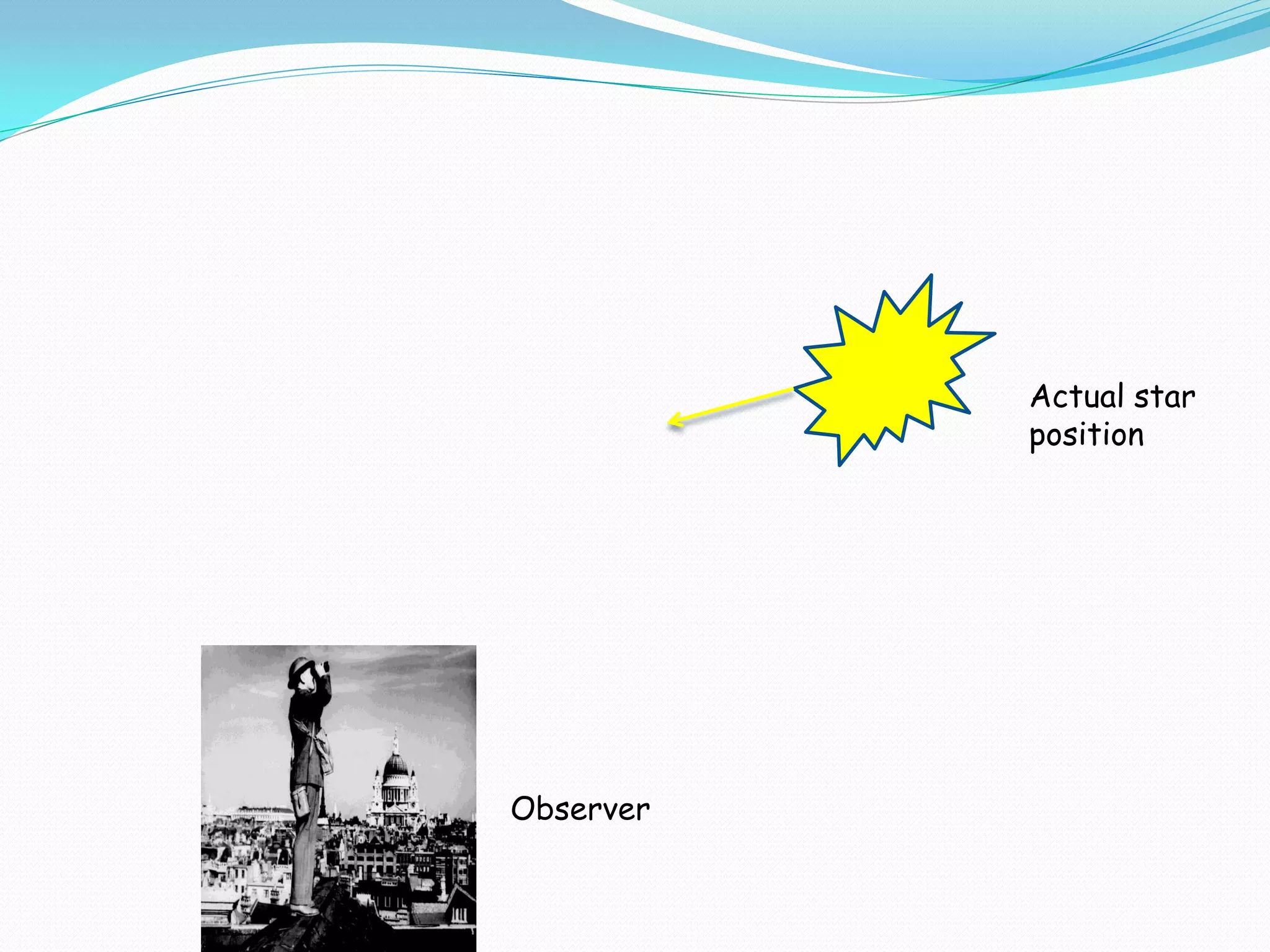
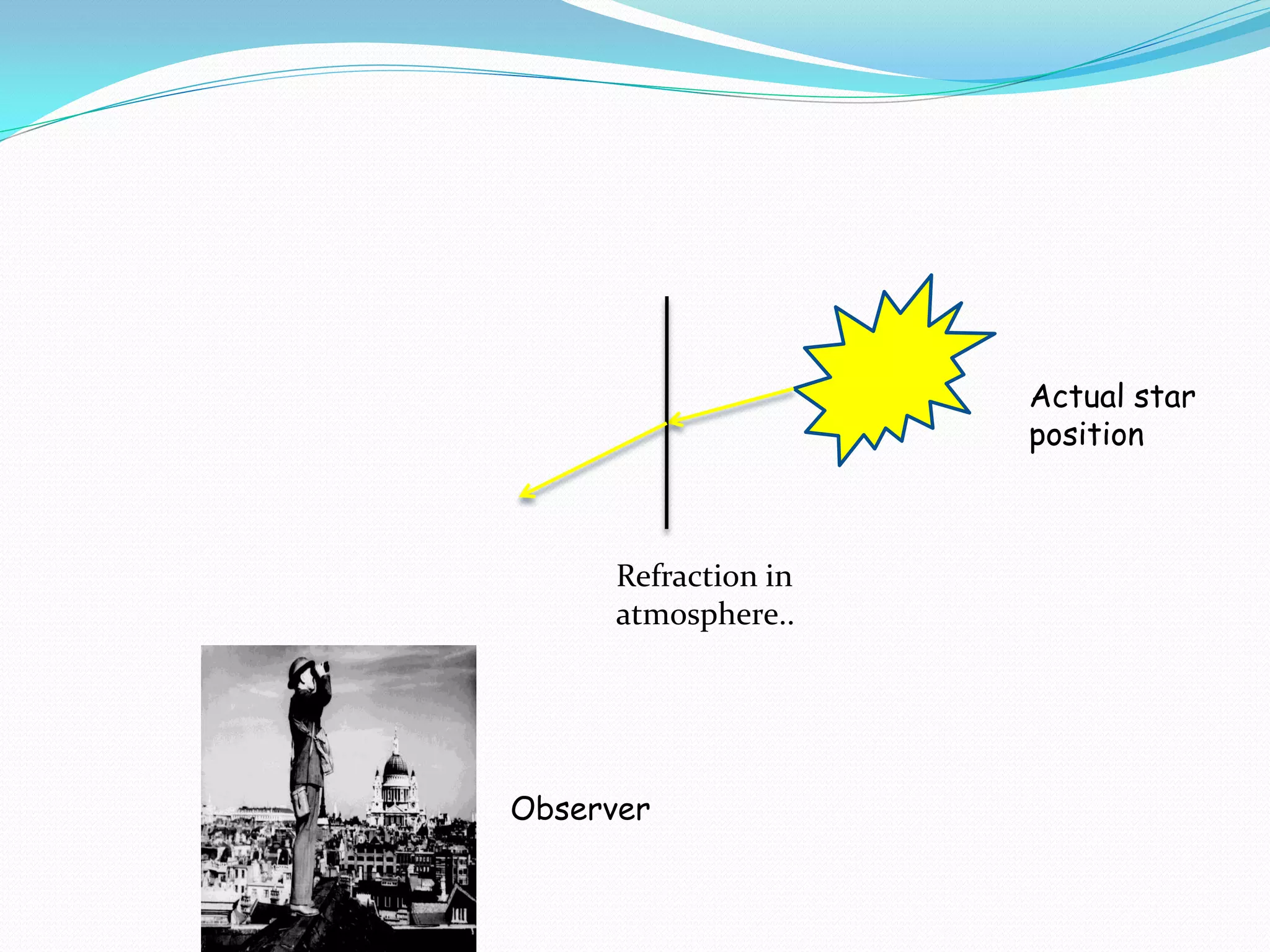
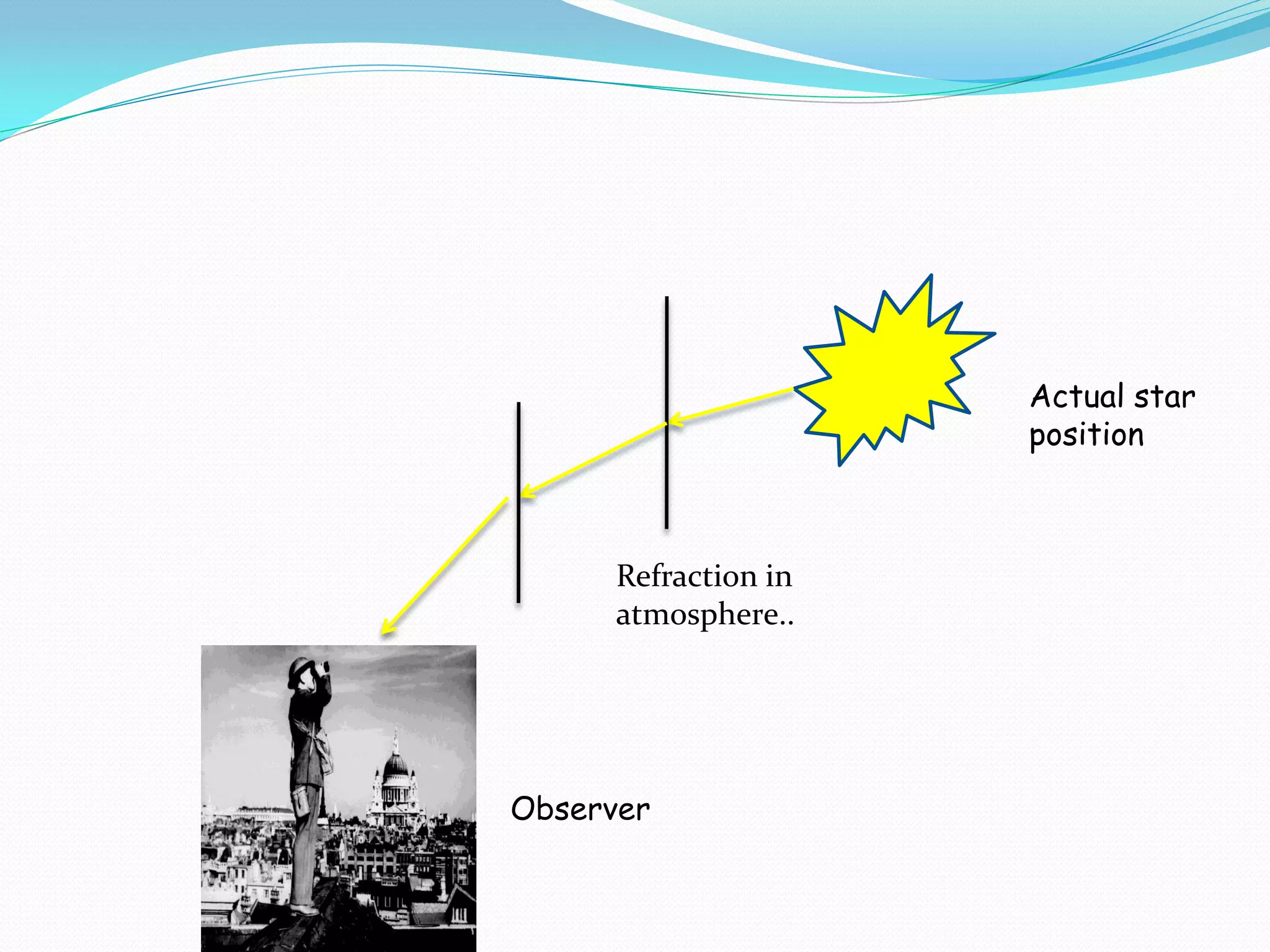
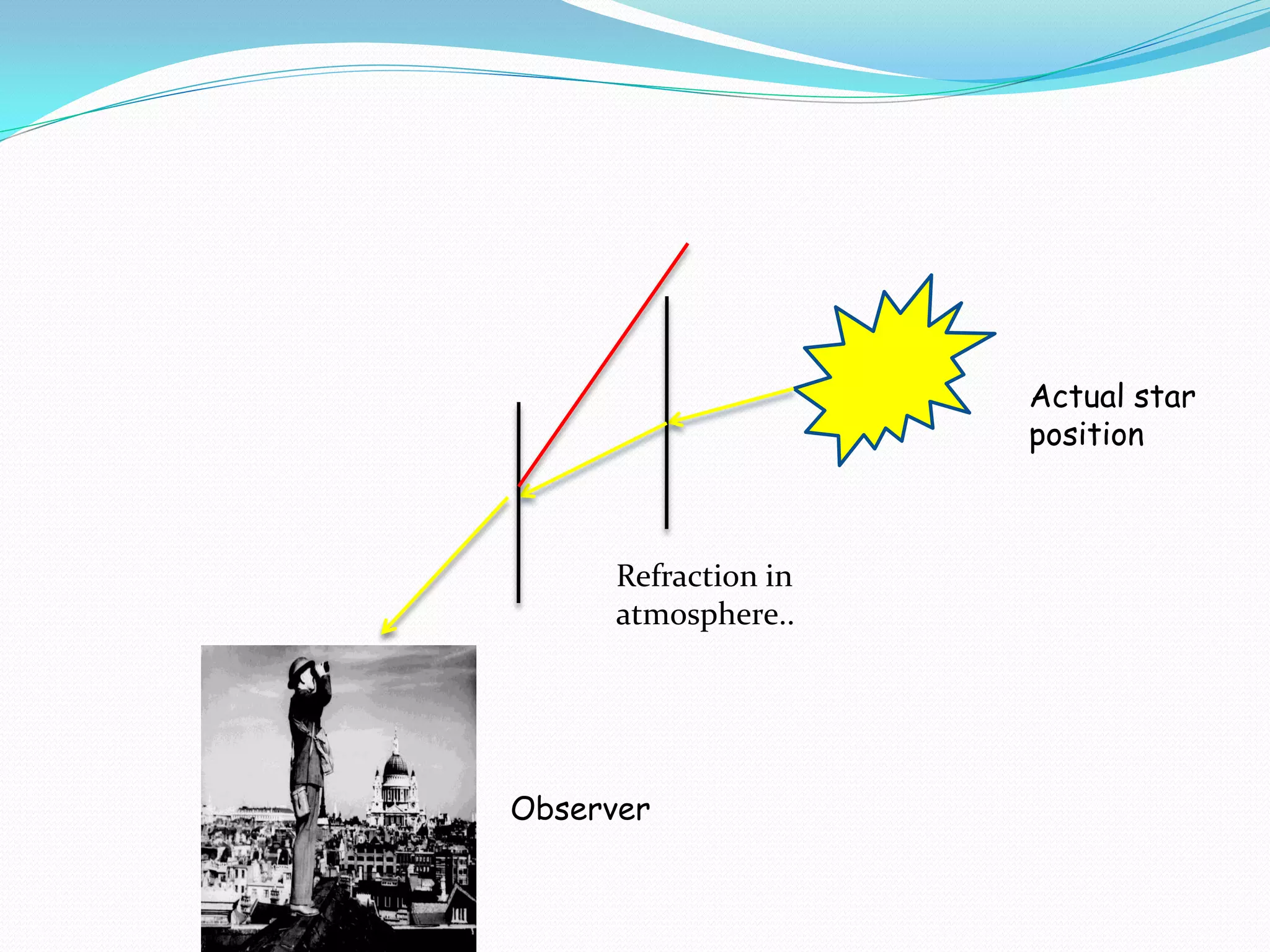
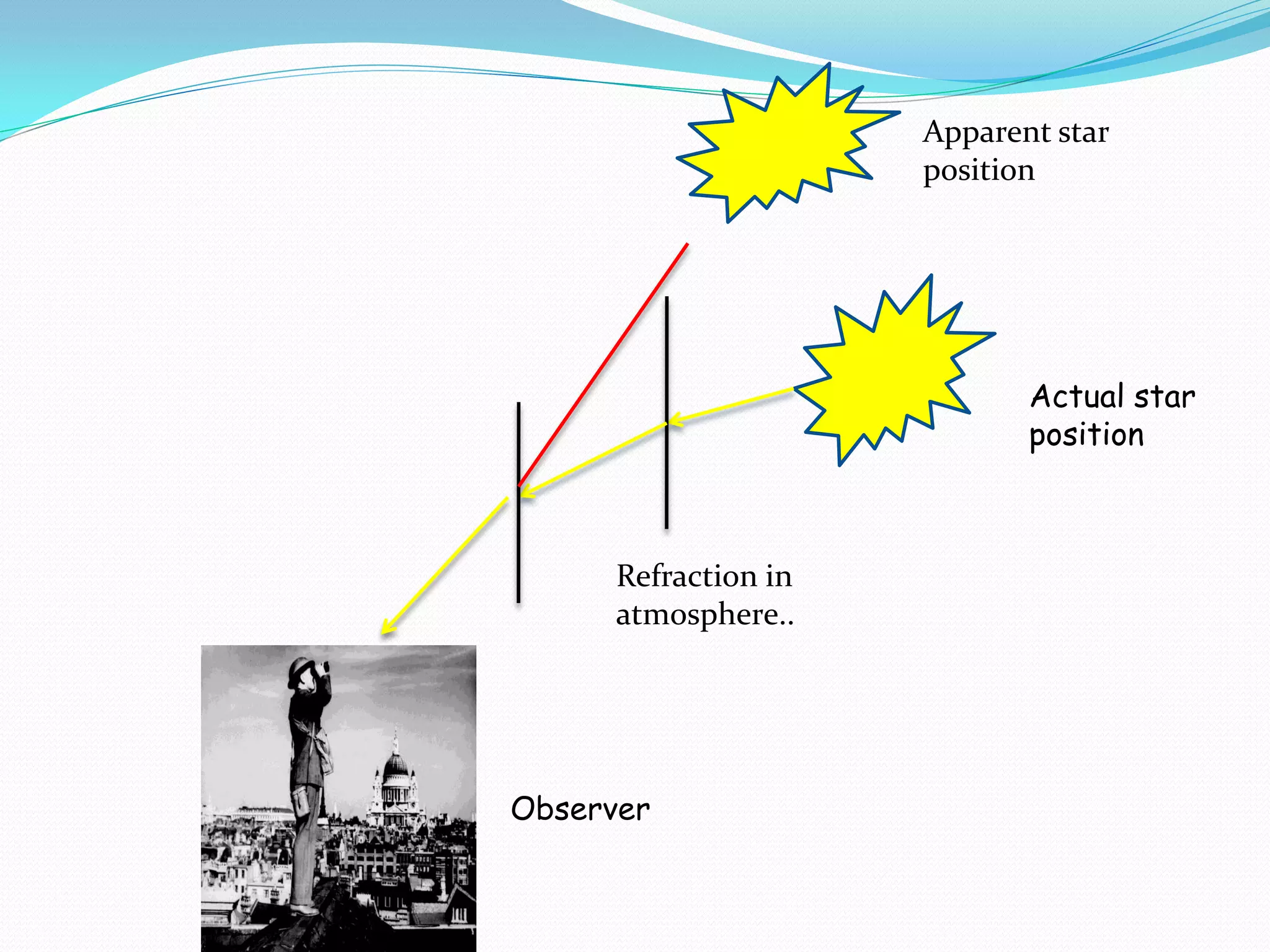
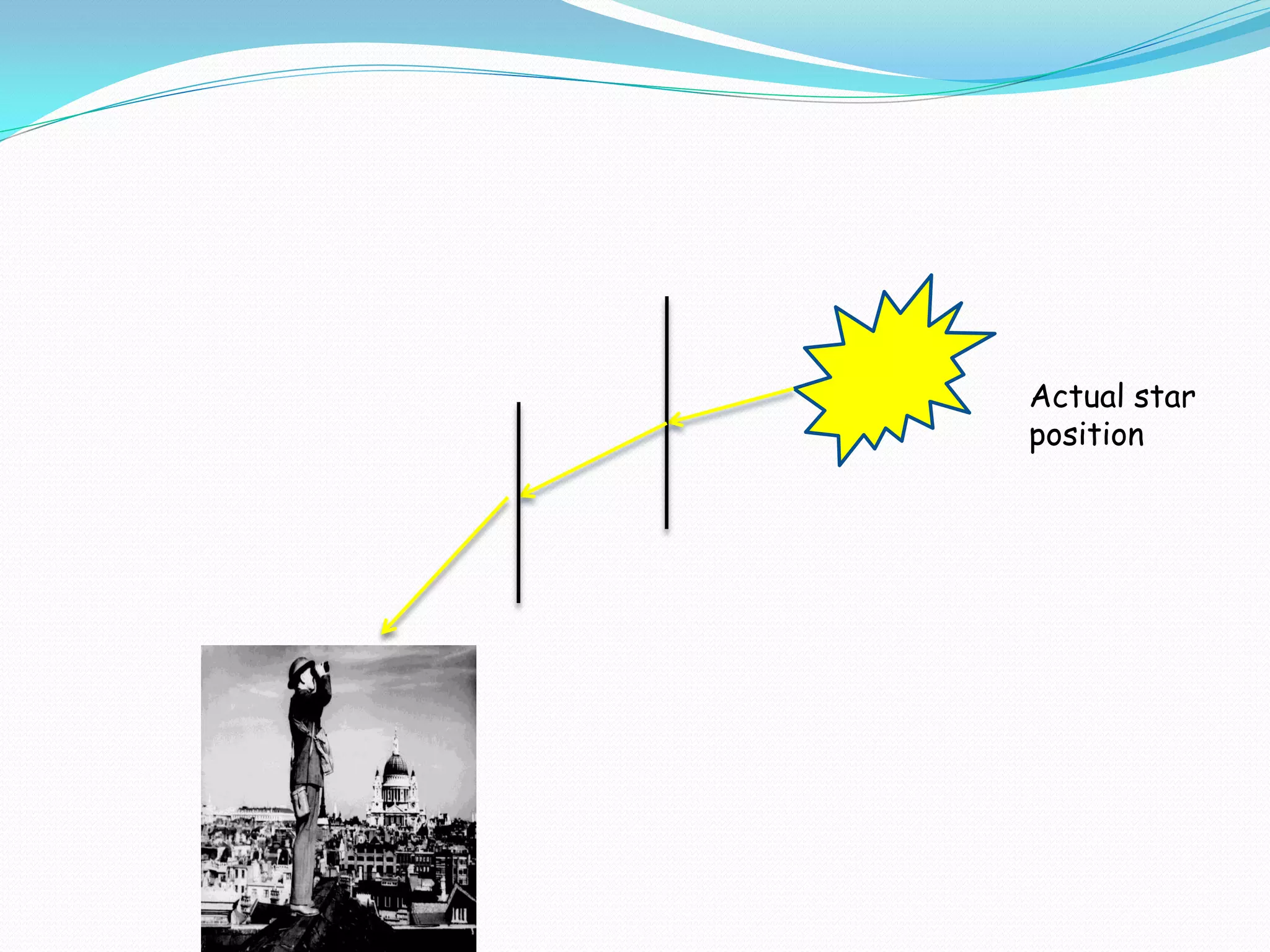
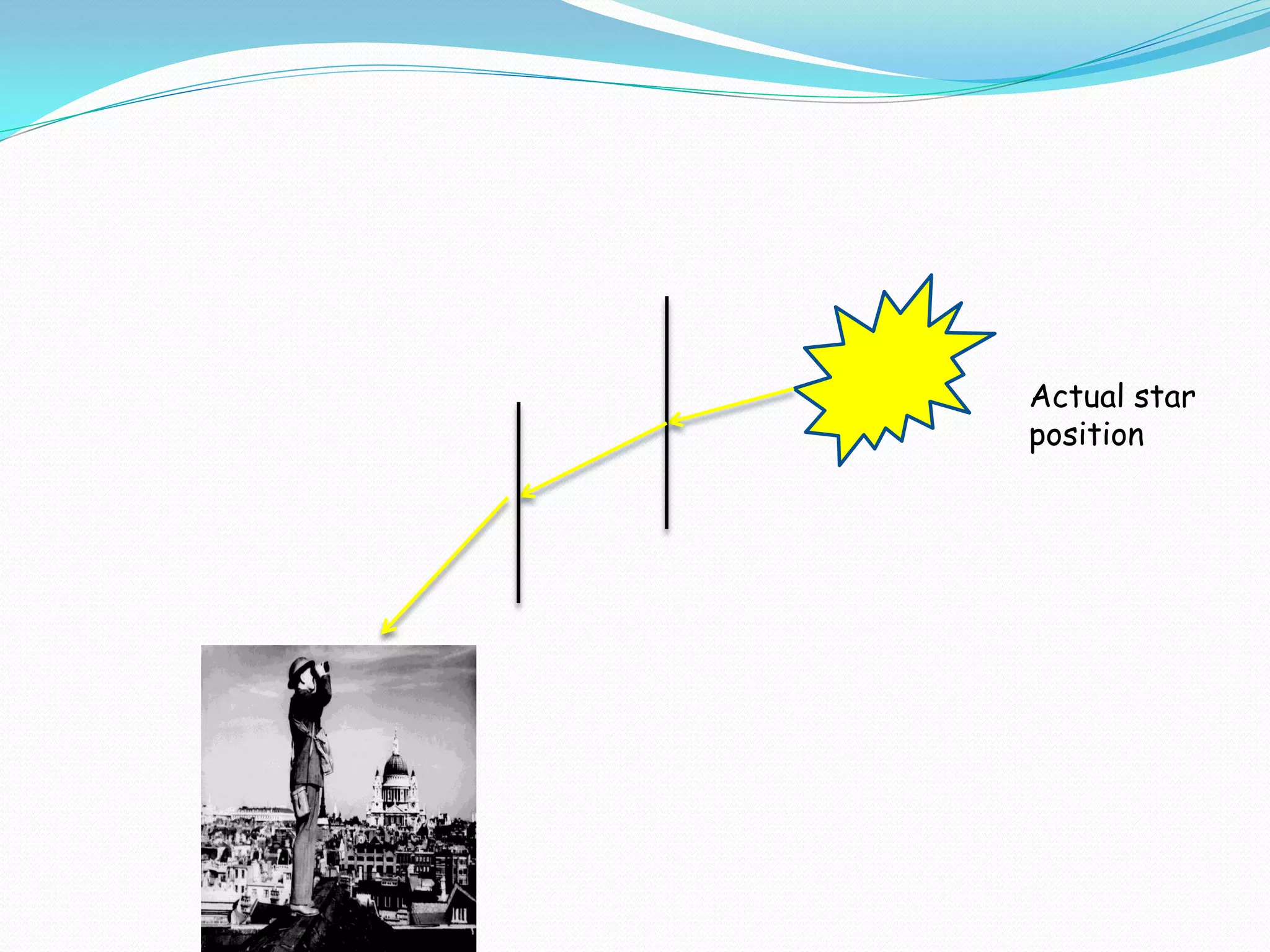
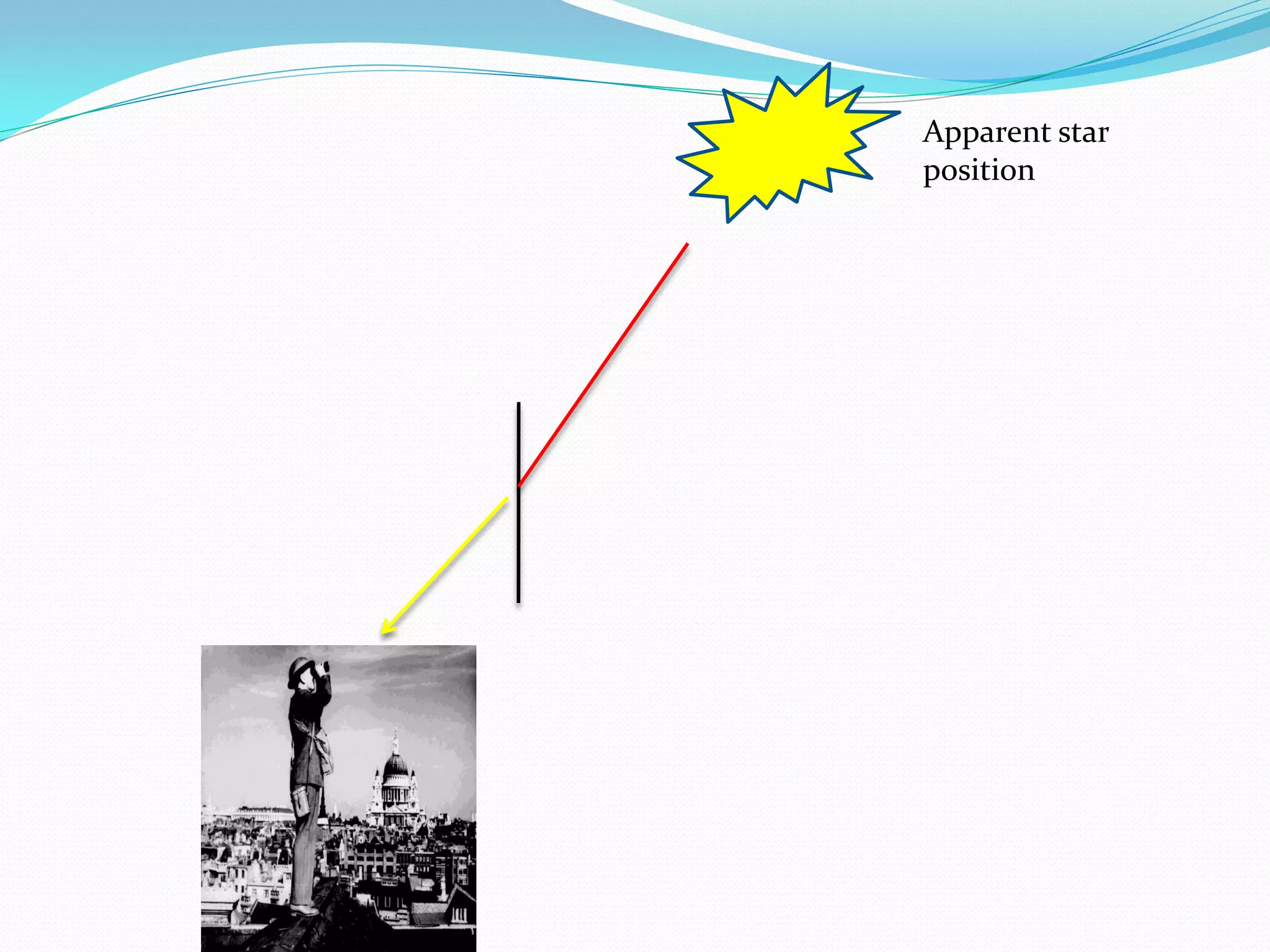
               The starlight on entering earth’s
                atmosphere, undergoes refraction
                continuously before it reaches
                observer.
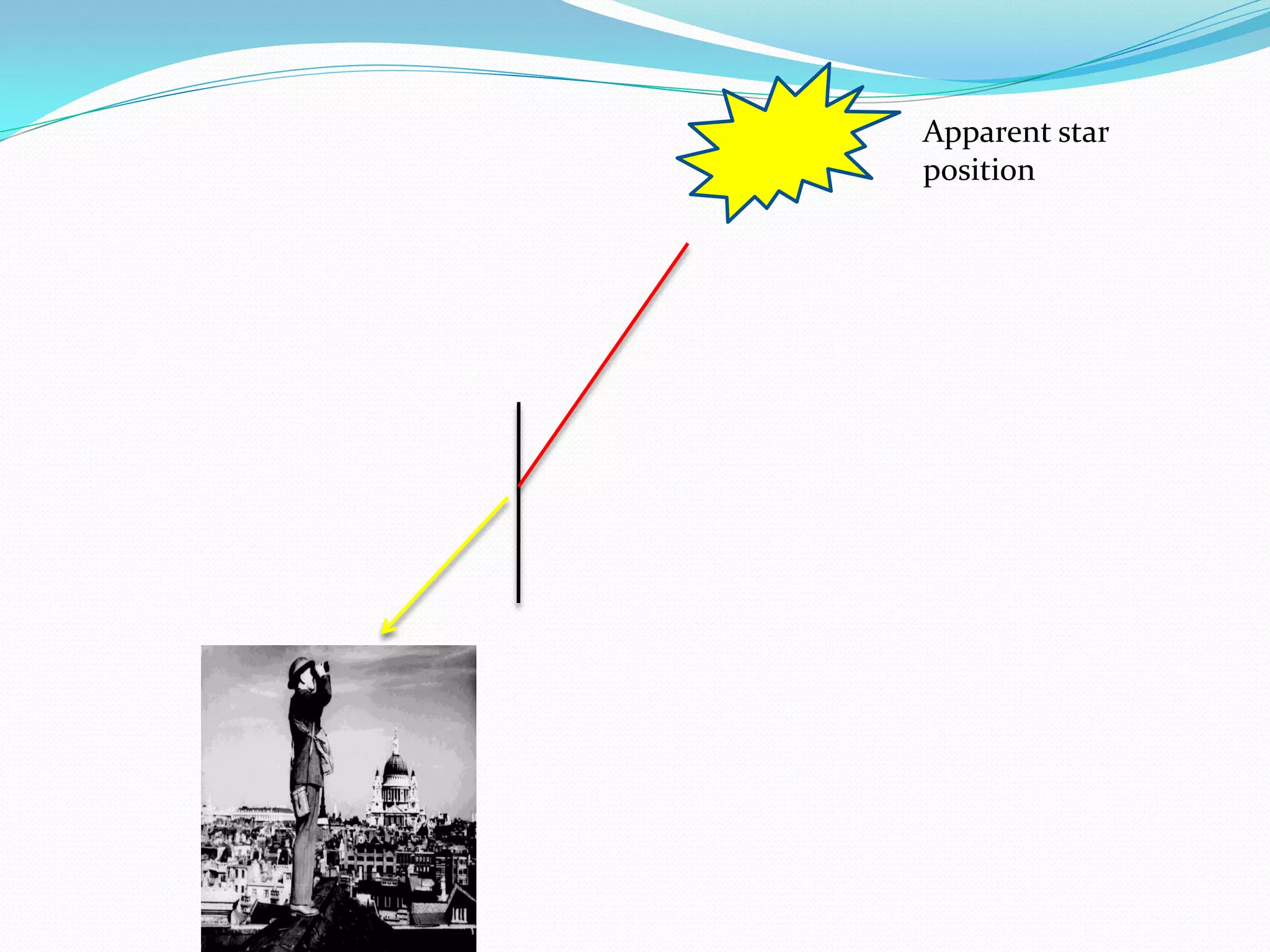
               Since the refractive index of earth’s
                atmosphere is gradually changing, the
                atmosphere bends the starlight
                towards the normal, and the apparent
                position of star is slightly higher than
                its actual position.
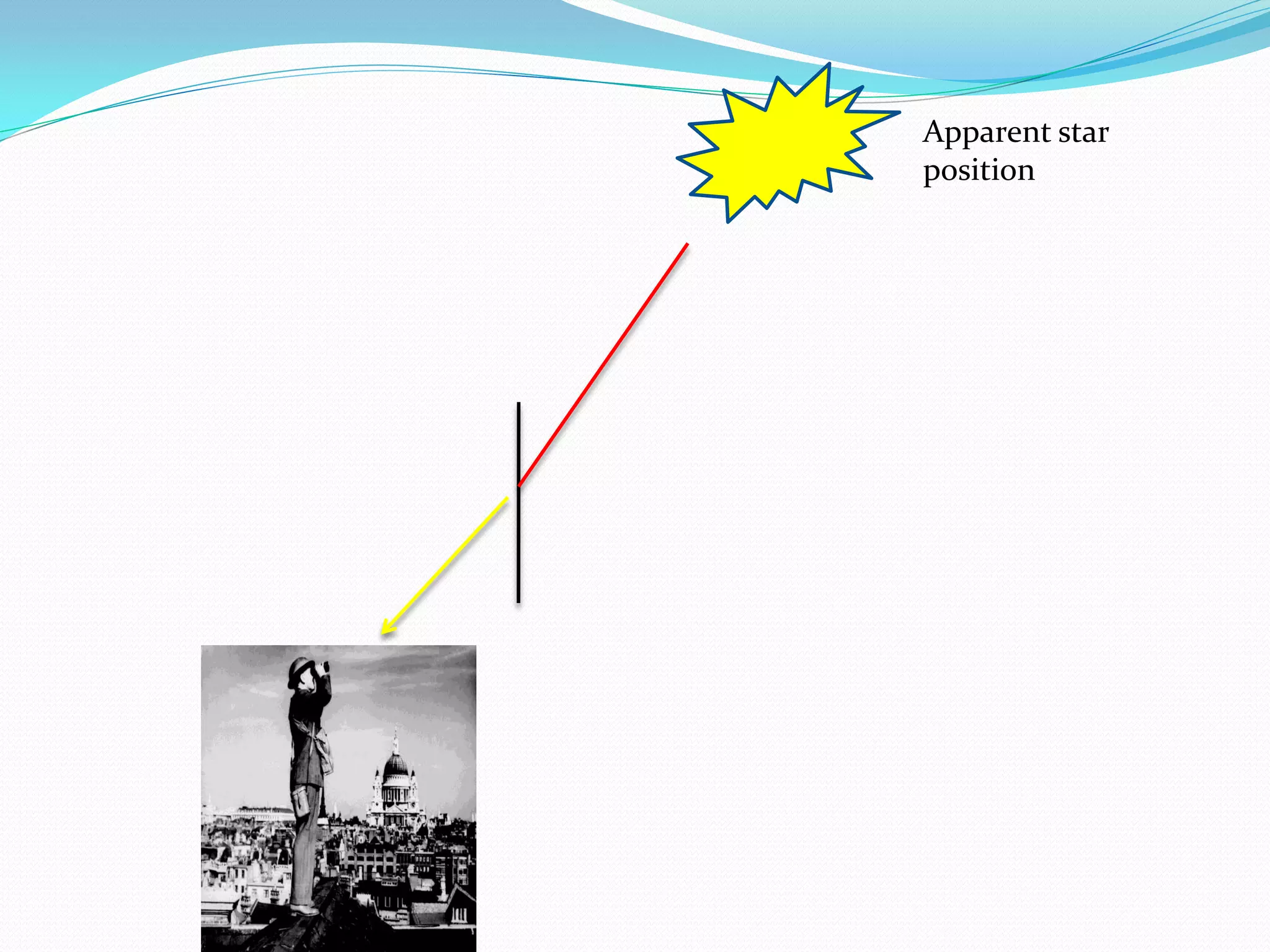
               As the path of rays of light coming
                from the star goes on varying slightly,
                the apparent position of the star
                fluctuates and the amount of light
                entering the eye flickers..!!
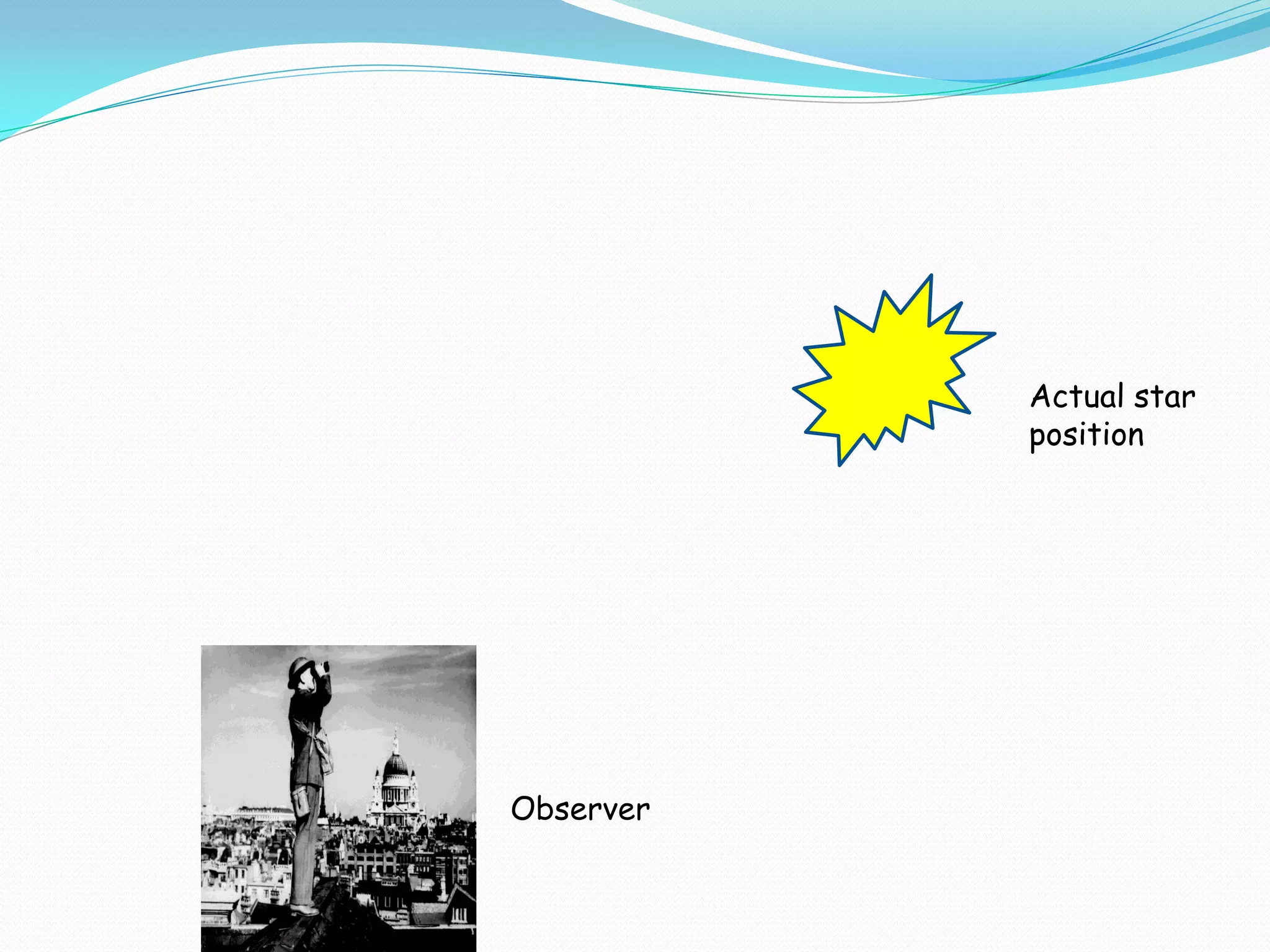
Actual star
           position


Observer
Actual star
           position


Observer
Actual star
                      position


      Refraction in
      atmosphere..


Observer
Actual star
                      position


      Refraction in
      atmosphere..


Observer
Actual star
                      position


      Refraction in
      atmosphere..


Observer
Apparent star
                      position


                             Actual star
                             position


      Refraction in
      atmosphere..


Observer
Apparent star
position
Actual star
position
Apparent star
position
Actual star
position
Apparent star
position
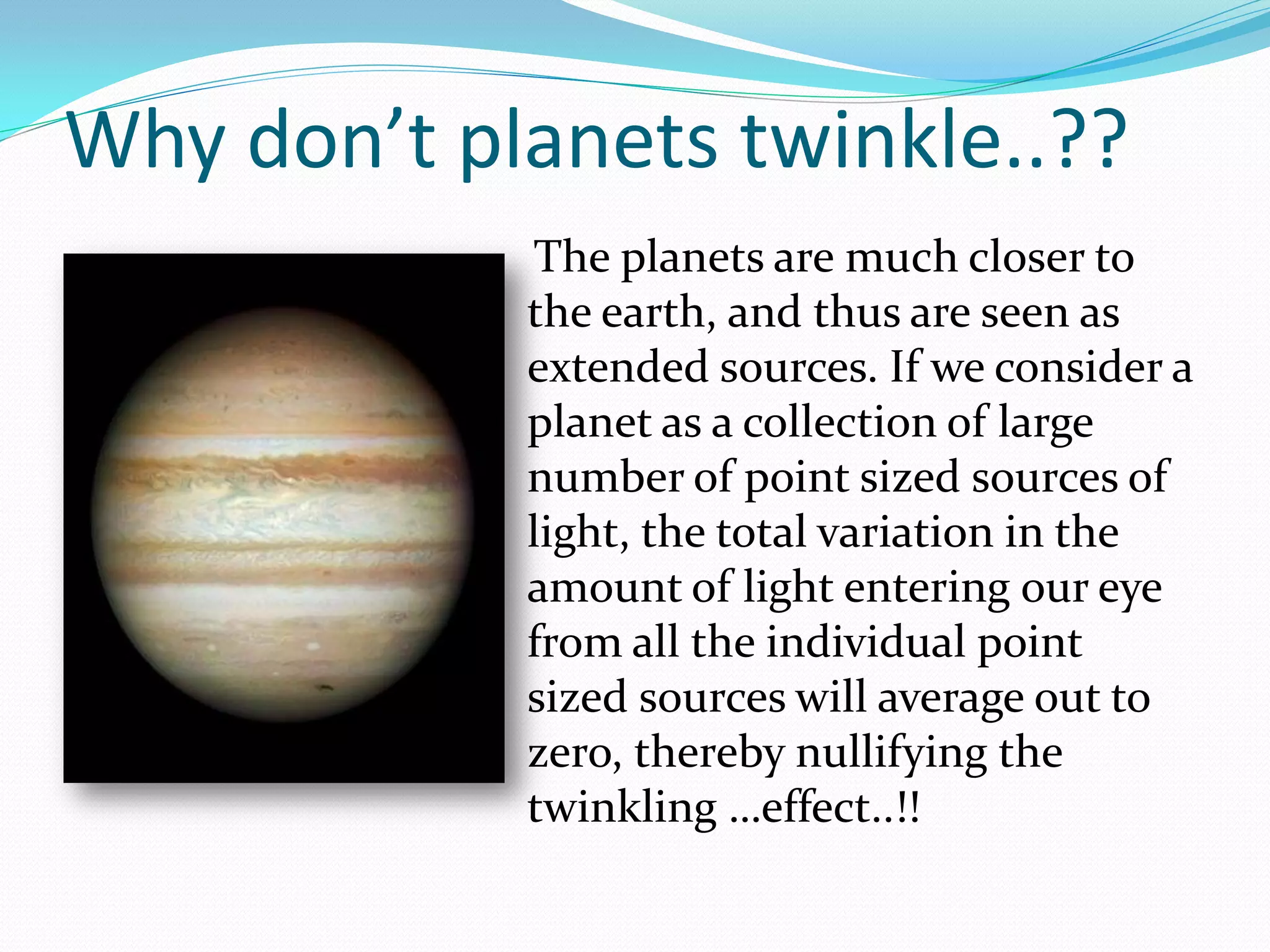
Why don’t planets twinkle..??
             The planets are much closer to
            the earth, and thus are seen as
            extended sources. If we consider a
            planet as a collection of large
            number of point sized sources of
            light, the total variation in the
            amount of light entering our eye
            from all the individual point
            sized sources will average out to
            zero, thereby nullifying the
            twinkling …effect..!!
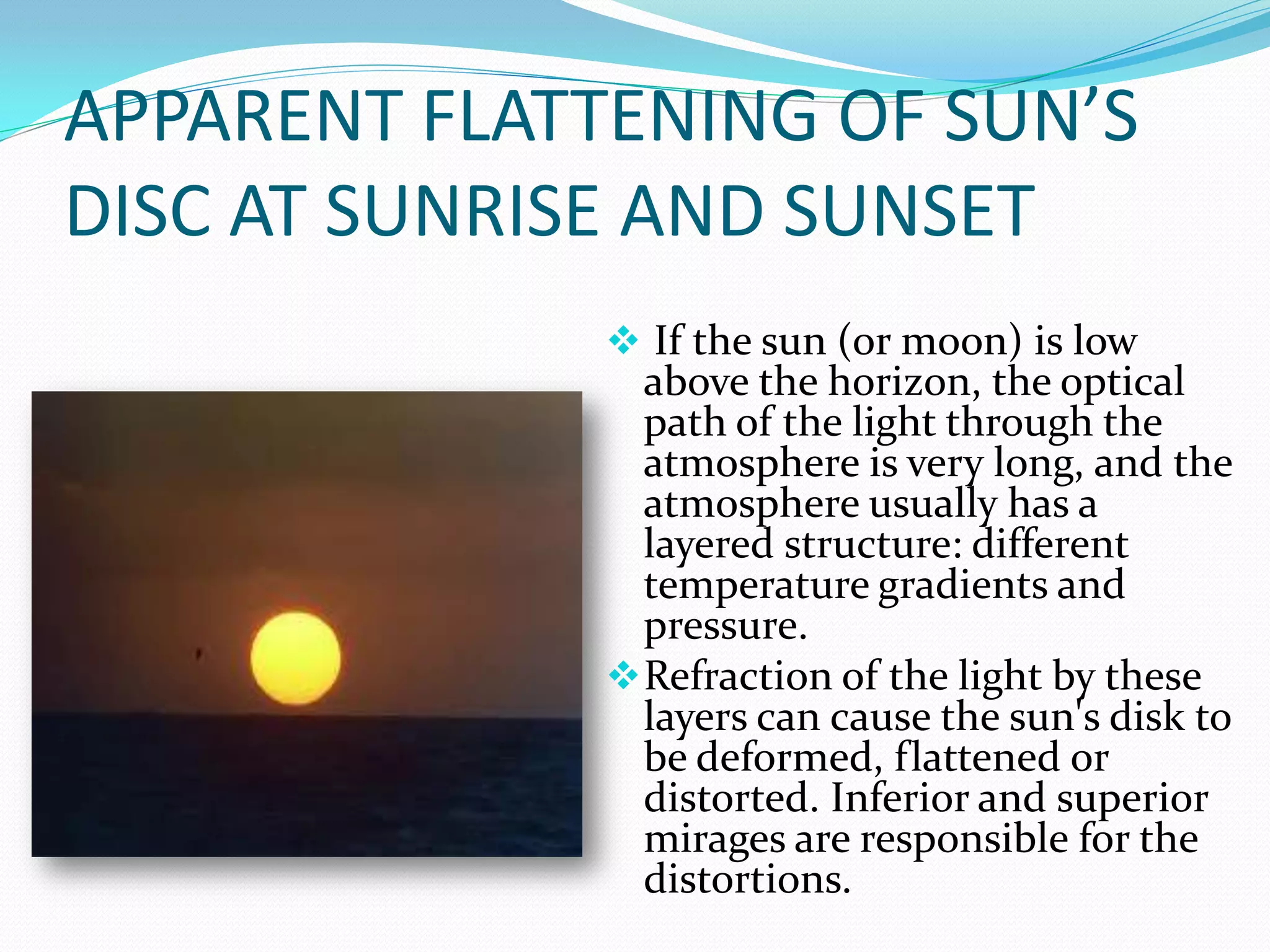
APPARENT FLATTENING OF SUN’S
DISC AT SUNRISE AND SUNSET
               If the sun (or moon) is low
                above the horizon, the optical
                path of the light through the
                atmosphere is very long, and the
                atmosphere usually has a
                layered structure: different
                temperature gradients and
                pressure.
               Refraction of the light by these
                layers can cause the sun's disk to
                be deformed, flattened or
                distorted. Inferior and superior
                mirages are responsible for the
                distortions.
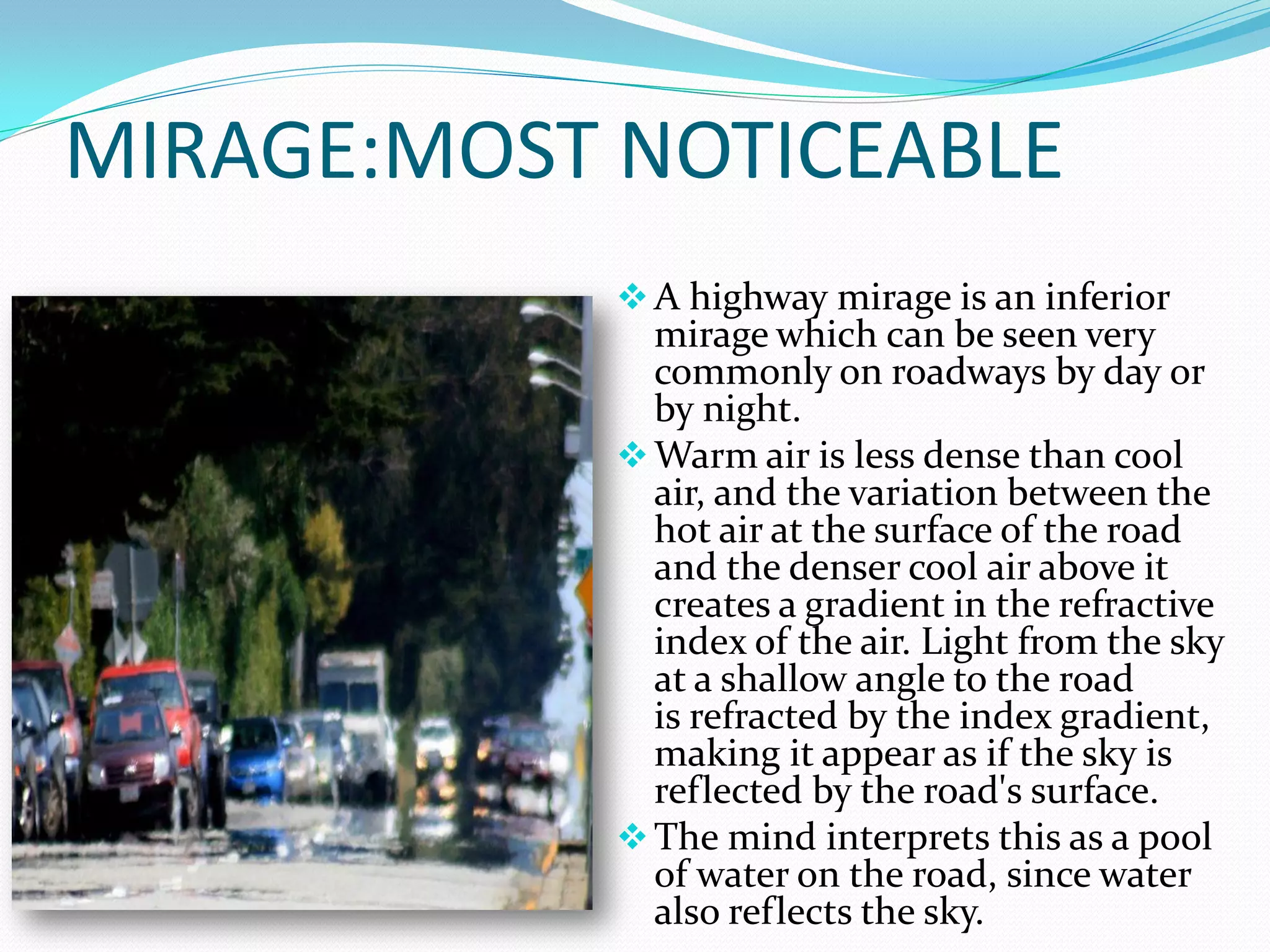
MIRAGE:MOST NOTICEABLE
             A highway mirage is an inferior
              mirage which can be seen very
              commonly on roadways by day or
              by night.
             Warm air is less dense than cool
              air, and the variation between the
              hot air at the surface of the road
              and the denser cool air above it
              creates a gradient in the refractive
              index of the air. Light from the sky
              at a shallow angle to the road
              is refracted by the index gradient,
              making it appear as if the sky is
              reflected by the road's surface.
             The mind interprets this as a pool
              of water on the road, since water
              also reflects the sky.
REFRENCES
 Pradeep vol.2 edition 2006


 http://en.wikipedia.org/wiki/Atmospheric_refraction


 PHYSICS textbook NCERT EDITION MARCH 2007.
THANK
YOU!!!

Atmospheric refraction

  • 1.
  • 2.
    LIST OF CONTENTS What is refraction  Refraction through glass slab  Laws of refraction  Advanced sunrise and delayed sunset  Twinkling of stars  Why don’t planets twinkle..  Apparent flattening of sun’s disc at sunrise and sunset  Mirage  References
  • 3.
    WHAT is REFRACTIONof light ?  REFRACTION of light is the phenomenon of change in the path of light, when it travels from one medium to another.  The basic cause of refraction is change in velocity in going from one medium to the other.
  • 7.
  • 8.
  • 9.
  • 10.
  • 11.
  • 12.
    i Refracted ray
  • 13.
  • 14.
    i r Emergent ray
  • 15.
    i r e Angle of emergence
  • 16.
    i r e
  • 17.
    i r e Lateral displacement
  • 18.
    laws of REFRACTION The incident ray, refracted ray and the normal to the interface at the point of incidence, all lie in the same plane.  The product of refractive index and sine of angle of incidence/refraction at a point in a medium is constant i.e., u * sin i= constant. therfore, u1 sin i1 = u2 sin i2 i1 = i and i2 = r hence, u2 / u1 = sin i / sin r and it is also known as SNELL’s LAW.
  • 20.
    ADVANCED SUNRISE &DELAYED SUNSET  The sun is visible to us before the actual sunrise and after the sunset.  The density of air near the surface of earth is slightly higher. The rays from the sun coming through space enter at the top of earth’s atmosphere and travel from rarer to denser medium.  They bend slightly towards normal at each refraction and appear to come from apparent position of sun. Hence, the sun appears to rise a few minutes before the actual rise and for the same reason, it continues to be seen a few minutes after it has actually set.
  • 21.
  • 22.
  • 23.
  • 24.
  • 25.
  • 26.
  • 27.
  • 28.
    Twinkling of stars  The starlight on entering earth’s atmosphere, undergoes refraction continuously before it reaches observer.  Since the refractive index of earth’s atmosphere is gradually changing, the atmosphere bends the starlight towards the normal, and the apparent position of star is slightly higher than its actual position.  As the path of rays of light coming from the star goes on varying slightly, the apparent position of the star fluctuates and the amount of light entering the eye flickers..!!
  • 29.
    Actual star position Observer
  • 30.
    Actual star position Observer
  • 31.
    Actual star position Refraction in atmosphere.. Observer
  • 32.
    Actual star position Refraction in atmosphere.. Observer
  • 33.
    Actual star position Refraction in atmosphere.. Observer
  • 34.
    Apparent star position Actual star position Refraction in atmosphere.. Observer
  • 35.
  • 36.
  • 37.
  • 38.
  • 39.
  • 40.
    Why don’t planetstwinkle..?? The planets are much closer to the earth, and thus are seen as extended sources. If we consider a planet as a collection of large number of point sized sources of light, the total variation in the amount of light entering our eye from all the individual point sized sources will average out to zero, thereby nullifying the twinkling …effect..!!
  • 41.
    APPARENT FLATTENING OFSUN’S DISC AT SUNRISE AND SUNSET  If the sun (or moon) is low above the horizon, the optical path of the light through the atmosphere is very long, and the atmosphere usually has a layered structure: different temperature gradients and pressure.  Refraction of the light by these layers can cause the sun's disk to be deformed, flattened or distorted. Inferior and superior mirages are responsible for the distortions.
  • 42.
    MIRAGE:MOST NOTICEABLE  A highway mirage is an inferior mirage which can be seen very commonly on roadways by day or by night.  Warm air is less dense than cool air, and the variation between the hot air at the surface of the road and the denser cool air above it creates a gradient in the refractive index of the air. Light from the sky at a shallow angle to the road is refracted by the index gradient, making it appear as if the sky is reflected by the road's surface.  The mind interprets this as a pool of water on the road, since water also reflects the sky.
  • 43.
    REFRENCES  Pradeep vol.2edition 2006  http://en.wikipedia.org/wiki/Atmospheric_refraction  PHYSICS textbook NCERT EDITION MARCH 2007.
  • 44.