
Learning To Draw Buildings

      Dr. Yasser Mahgoub
Learning To Draw Buildings
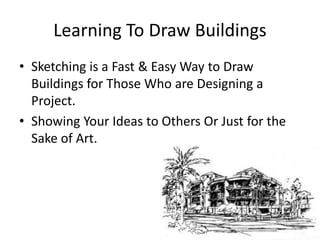
• Sketching is a Fast & Easy Way to Draw
  Buildings for Those Who are Designing a
  Project.
• Showing Your Ideas to Others Or Just for the
  Sake of Art.
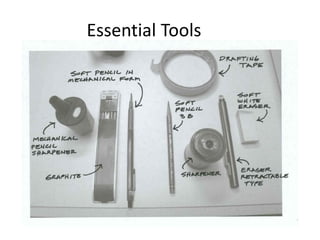
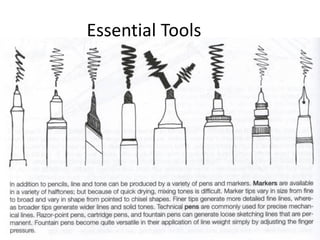
Essential Tools
Essential Tools
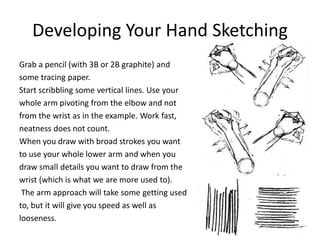
Developing Your Hand Sketching
Grab a pencil (with 3B or 2B graphite) and
some tracing paper.
Start scribbling some vertical lines. Use your
whole arm pivoting from the elbow and not
from the wrist as in the example. Work fast,
neatness does not count.
When you draw with broad strokes you want
to use your whole lower arm and when you
draw small details you want to draw from the
wrist (which is what we are more used to).
 The arm approach will take some getting used
to, but it will give you speed as well as
looseness.
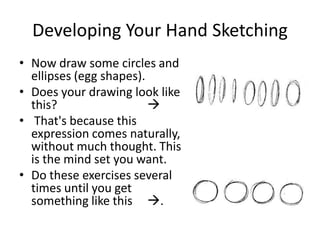
Developing Your Hand Sketching
• Now draw some circles and
  ellipses (egg shapes).
• Does your drawing look like
  this?                  
• That's because this
  expression comes naturally,
  without much thought. This
  is the mind set you want.
• Do these exercises several
  times until you get
  something like this .
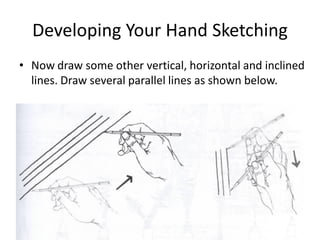
Developing Your Hand Sketching
• Now draw some other vertical, horizontal and inclined
  lines. Draw several parallel lines as shown below.
Developing Your Hand Sketching
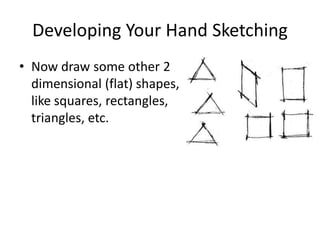
• Now draw some other 2
  dimensional (flat) shapes,
  like squares, rectangles,
  triangles, etc.
Developing Your Hand Sketching
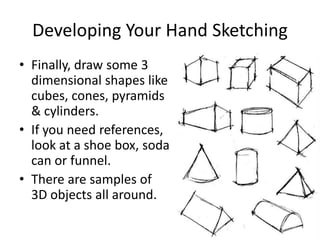
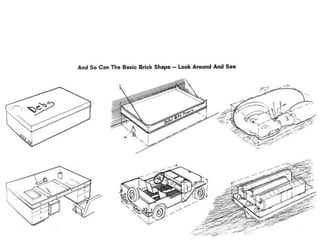
• Finally, draw some 3
  dimensional shapes like
  cubes, cones, pyramids
  & cylinders.
• If you need references,
  look at a shoe box, soda
  can or funnel.
• There are samples of
  3D objects all around.
Developing Your Hand Sketching
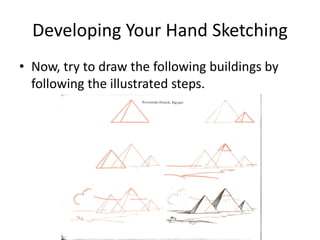
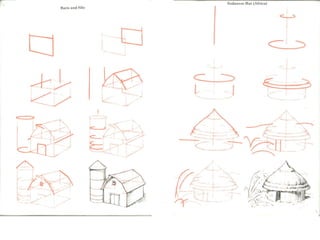
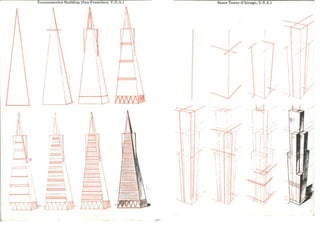
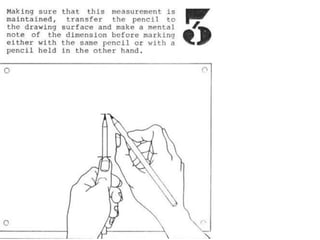
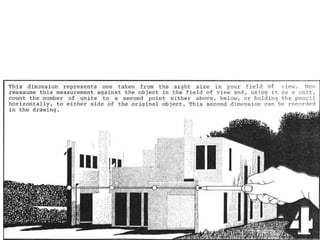
• Now, try to draw the following buildings by
  following the illustrated steps.
Developing Your Hand Sketching
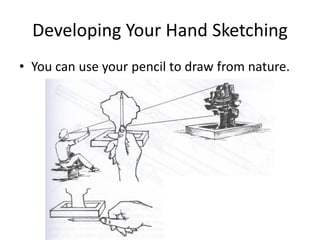
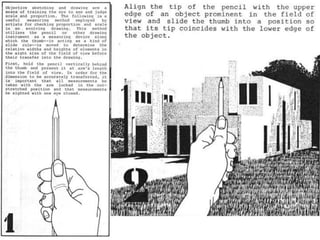
• You can use your pencil to draw from nature.
Developing Your Hand Sketching
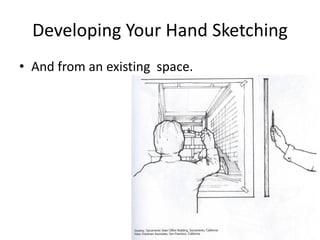
• And from an existing space.
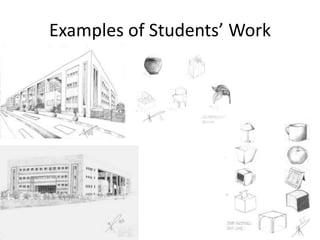
Examples of Students’ Work
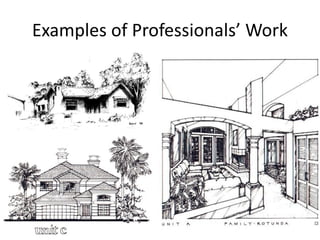
Examples of Professionals’ Work
Basics of Perspective
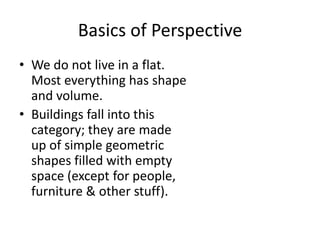
• We do not live in a flat.
  Most everything has shape
  and volume.
• Buildings fall into this
  category; they are made
  up of simple geometric
  shapes filled with empty
  space (except for people,
  furniture & other stuff).
Basics of Perspective
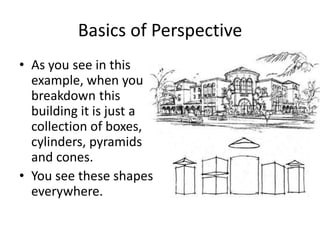
• As you see in this
  example, when you
  breakdown this
  building it is just a
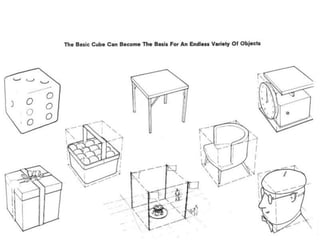
  collection of boxes,
  cylinders, pyramids
  and cones.
• You see these shapes
  everywhere.
Basics of Perspective
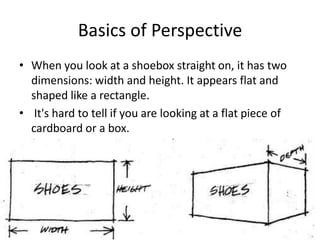
• When you look at a shoebox straight on, it has two
  dimensions: width and height. It appears flat and
  shaped like a rectangle.
• It's hard to tell if you are looking at a flat piece of
  cardboard or a box.
Basics of Perspective
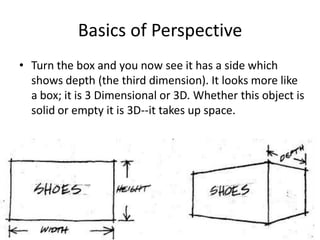
• Turn the box and you now see it has a side which
  shows depth (the third dimension). It looks more like
  a box; it is 3 Dimensional or 3D. Whether this object is
  solid or empty it is 3D--it takes up space.
Basics of Perspective
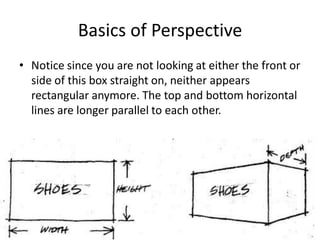
• Notice since you are not looking at either the front or
  side of this box straight on, neither appears
  rectangular anymore. The top and bottom horizontal
  lines are longer parallel to each other.
Basics of Perspective
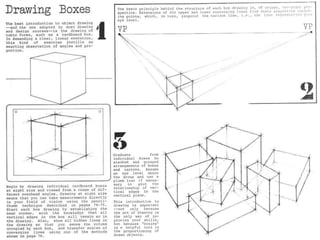
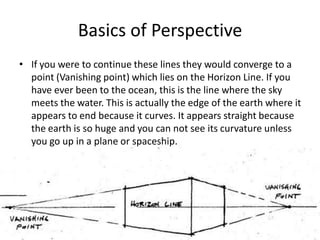
• If you were to continue these lines they would converge to a
  point (Vanishing point) which lies on the Horizon Line. If you
  have ever been to the ocean, this is the line where the sky
  meets the water. This is actually the edge of the earth where it
  appears to end because it curves. It appears straight because
  the earth is so huge and you can not see its curvature unless
  you go up in a plane or spaceship.
Basics of Perspective
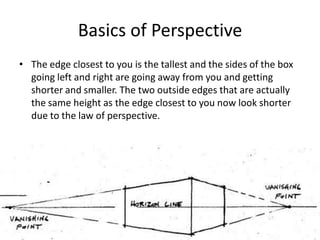
• The edge closest to you is the tallest and the sides of the box
  going left and right are going away from you and getting
  shorter and smaller. The two outside edges that are actually
  the same height as the edge closest to you now look shorter
  due to the law of perspective.
Basics of Perspective
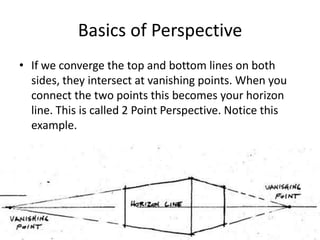
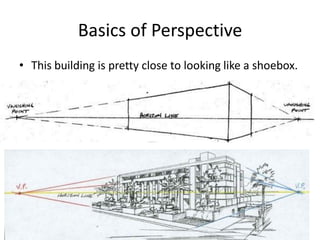
• If we converge the top and bottom lines on both
  sides, they intersect at vanishing points. When you
  connect the two points this becomes your horizon
  line. This is called 2 Point Perspective. Notice this
  example.
Basics of Perspective
• This building is pretty close to looking like a shoebox.
END

Learning to Draw Buildings - تعلم رسم المبانى

  • 1.
    Learning To DrawBuildings Dr. Yasser Mahgoub
  • 2.
    Learning To DrawBuildings • Sketching is a Fast & Easy Way to Draw Buildings for Those Who are Designing a Project. • Showing Your Ideas to Others Or Just for the Sake of Art.
  • 3.
  • 4.
  • 5.
    Developing Your HandSketching Grab a pencil (with 3B or 2B graphite) and some tracing paper. Start scribbling some vertical lines. Use your whole arm pivoting from the elbow and not from the wrist as in the example. Work fast, neatness does not count. When you draw with broad strokes you want to use your whole lower arm and when you draw small details you want to draw from the wrist (which is what we are more used to). The arm approach will take some getting used to, but it will give you speed as well as looseness.
  • 6.
    Developing Your HandSketching • Now draw some circles and ellipses (egg shapes). • Does your drawing look like this?  • That's because this expression comes naturally, without much thought. This is the mind set you want. • Do these exercises several times until you get something like this .
  • 7.
    Developing Your HandSketching • Now draw some other vertical, horizontal and inclined lines. Draw several parallel lines as shown below.
  • 8.
    Developing Your HandSketching • Now draw some other 2 dimensional (flat) shapes, like squares, rectangles, triangles, etc.
  • 9.
    Developing Your HandSketching • Finally, draw some 3 dimensional shapes like cubes, cones, pyramids & cylinders. • If you need references, look at a shoe box, soda can or funnel. • There are samples of 3D objects all around.
  • 14.
    Developing Your HandSketching • Now, try to draw the following buildings by following the illustrated steps.
  • 17.
    Developing Your HandSketching • You can use your pencil to draw from nature.
  • 18.
    Developing Your HandSketching • And from an existing space.
  • 22.
  • 23.
  • 24.
    Basics of Perspective •We do not live in a flat. Most everything has shape and volume. • Buildings fall into this category; they are made up of simple geometric shapes filled with empty space (except for people, furniture & other stuff).
  • 25.
    Basics of Perspective •As you see in this example, when you breakdown this building it is just a collection of boxes, cylinders, pyramids and cones. • You see these shapes everywhere.
  • 26.
    Basics of Perspective •When you look at a shoebox straight on, it has two dimensions: width and height. It appears flat and shaped like a rectangle. • It's hard to tell if you are looking at a flat piece of cardboard or a box.
  • 27.
    Basics of Perspective •Turn the box and you now see it has a side which shows depth (the third dimension). It looks more like a box; it is 3 Dimensional or 3D. Whether this object is solid or empty it is 3D--it takes up space.
  • 28.
    Basics of Perspective •Notice since you are not looking at either the front or side of this box straight on, neither appears rectangular anymore. The top and bottom horizontal lines are longer parallel to each other.
  • 29.
    Basics of Perspective •If you were to continue these lines they would converge to a point (Vanishing point) which lies on the Horizon Line. If you have ever been to the ocean, this is the line where the sky meets the water. This is actually the edge of the earth where it appears to end because it curves. It appears straight because the earth is so huge and you can not see its curvature unless you go up in a plane or spaceship.
  • 30.
    Basics of Perspective •The edge closest to you is the tallest and the sides of the box going left and right are going away from you and getting shorter and smaller. The two outside edges that are actually the same height as the edge closest to you now look shorter due to the law of perspective.
  • 31.
    Basics of Perspective •If we converge the top and bottom lines on both sides, they intersect at vanishing points. When you connect the two points this becomes your horizon line. This is called 2 Point Perspective. Notice this example.
  • 32.
    Basics of Perspective •This building is pretty close to looking like a shoebox.
  • 33.