88

Project four Fantasy art

Illustration workshop

Figure
drawing
techniques
Figuring it out: Ron
Lemen explains the
basics of figure drawing
and explores the Reilly
method of working
If you want to illustrate stories or book covers, draw
storyboards or design conceptually for games or movies, it’s vital
to grasp the foundations of representational art. And with most
stories you’ll come across that involve people, it’s important to
understand how to draw the human figure, both in a static pose
and in action.
There are several techniques for drawing the human
body, all leading to a similar goal – a three-dimensional, realistic
figure. While it’s not necessary to be an expert to produce
illustrations, the more knowledge you have, the easier it will be to
solve problems and reach clear-cut solutions for any drawing.
What you lack in your foundations will show up in your
work – that is, a lack of understanding of certain principles will be
all too apparent in your finished piece. In other words, an artist’s
style can be reflective of his lack of understanding just as much as
it can be a showcase for the total sum of his knowledge.

Ron Lemen
A designer/painter
and freelance
illustrator, Ron
Lemen has worked
in games, comics, TV
and film. He also
teaches art.
www.studio
2ndstreet.com.

Skill
Create realistic
human figures

01-02
Computer Arts Projects _August 2008

CAP113.tut_bodies 88

www.computerarts.co.uk

27/6/08 17:29:04
Figure drawing techniques

89

06

01
Drawing or illustrating the human form can be extremely
frustrating. Learning how to do it can be even more annoying, and
is a daunting prospect to any fledgling artist. Therefore, it’s
important to know what methods are available to you.
02
The two approaches to figure drawing that I feel to be distinctly
separate are the observational approach and the formulaic
approach. Observational drawing has its origins in the sight-size
methodology, which trains the eye to view a subject with accuracy,
placing the object and the drawing side by side for comparative
analysis. Plumb lines, levels, a fixed point and a measuring line
are used to help the artist in understanding dimensional and
spatial measuring.
03
Formulaic figure drawing uses abstract rhythms or interlocking
shapes – basically design concepts – to build from. Once these
formulas are memorised by drawing from life, you then have a set
of tools to recall, enabling you to design from your imagination.
04
I feel it’s important to have a solid understanding of both
approaches if you truly want to be free as an artist. Observational
drawing sharpens the eye and mind to capturing a likeness
without using abstract concepts; straightforward measuring.
Formulaic figure drawing gives you a set of tools to develop both
from life and, more importantly, from your mind’s eye.
05
This image demonstrates observational drawing in practice, using
a pencil to measure the body’s dimensions
06
Formulaic figure drawing involves using abstract rhythms or, as
shown top right, interlocking shapes, to construct the human
body. Those shapes can then be built upon and fleshed out for a
full human figure, as shown left.

03-04
www.computerarts.co.uk

CAP113.tut_bodies 89

05
August 2008_ Computer Arts Projects

27/6/08 17:29:13
90

Project four Fantasy art

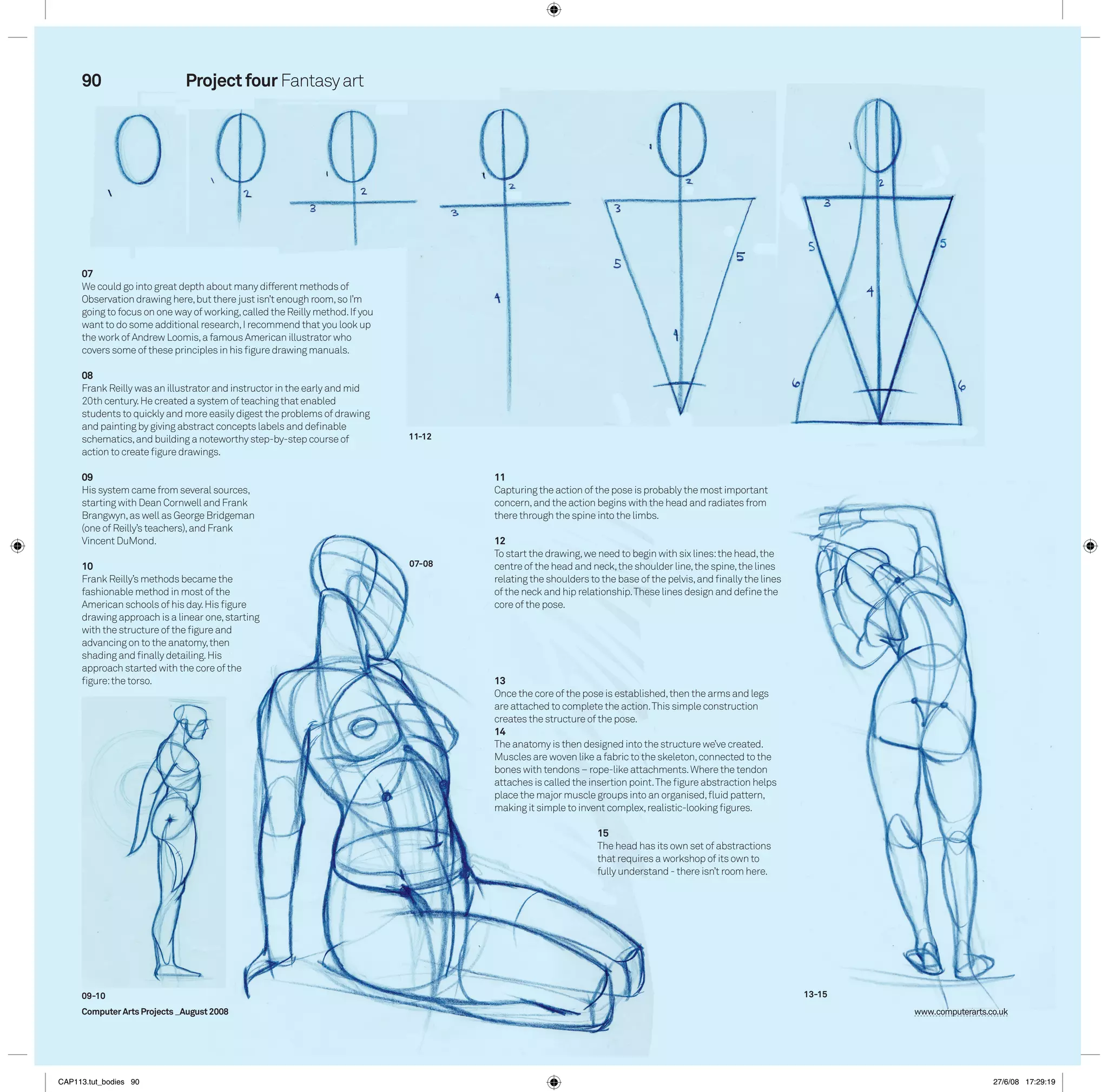
07
We could go into great depth about many different methods of
Observation drawing here, but there just isn’t enough room, so I’m
going to focus on one way of working, called the Reilly method. If you
want to do some additional research, I recommend that you look up
the work of Andrew Loomis, a famous American illustrator who
covers some of these principles in his figure drawing manuals.
08
Frank Reilly was an illustrator and instructor in the early and mid
20th century. He created a system of teaching that enabled
students to quickly and more easily digest the problems of drawing
and painting by giving abstract concepts labels and definable
schematics, and building a noteworthy step-by-step course of
action to create figure drawings.

11-12

11
Capturing the action of the pose is probably the most important
concern, and the action begins with the head and radiates from
there through the spine into the limbs.

09
His system came from several sources,
starting with Dean Cornwell and Frank
Brangwyn, as well as George Bridgeman
(one of Reilly’s teachers), and Frank
Vincent DuMond.
10
Frank Reilly’s methods became the
fashionable method in most of the
American schools of his day. His figure
drawing approach is a linear one, starting
with the structure of the figure and
advancing on to the anatomy, then
shading and finally detailing. His
approach started with the core of the
figure: the torso.

07-08

12
To start the drawing, we need to begin with six lines: the head, the
centre of the head and neck, the shoulder line, the spine, the lines
relating the shoulders to the base of the pelvis, and finally the lines
of the neck and hip relationship. These lines design and define the
core of the pose.

13
Once the core of the pose is established, then the arms and legs
are attached to complete the action. This simple construction
creates the structure of the pose.
14
The anatomy is then designed into the structure we’ve created.
Muscles are woven like a fabric to the skeleton, connected to the
bones with tendons – rope-like attachments. Where the tendon
attaches is called the insertion point. The figure abstraction helps
place the major muscle groups into an organised, fluid pattern,
making it simple to invent complex, realistic-looking figures.
15
The head has its own set of abstractions
that requires a workshop of its own to
fully understand - there isn’t room here.

09-10
Computer Arts Projects _August 2008

CAP113.tut_bodies 90

13-15
www.computerarts.co.uk

27/6/08 17:29:19
16

16
Once you have learned the Reilly method,
you can move on to creating flexible
figures and poses from different angles.

17-18

17
When the figure abstraction is well
understood, you’ll find that you’ll
constantly change and rearrange to suit
every pose and every situation. The
standard set of lines we start with are
charts for learning – they’re just one set
of possibilities, a stock vocabulary that
will constantly flex, grow and reinvent
itself with each new image we create.
18
I cannot stress enough that this is just a
system to learn from. All systems of
drawing are designed for teaching and
should be left behind as soon as they’re
mastered, like stabilisers on a bicycle. Too
many carefully followed rules can lead to
pictorial sterility. It’s very important that
we train and practice as much as possible
until the rules become background noise.
When we perform, we should be able to
do so with total clarity and focus on the
more important aspects of making a
picture – the story content and/or the
pictorial intent.

www.computerarts.co.uk

CAP113.tut_bodies 91

This feature is taken
from Ron Lemen’s Figure
Drawing masterclass, as
seen in ImagineFX – the
ultimate magazine for
digital artists.
Find it at WH Smith and
all good newsagents,
and for more details visit
www.imaginefx.com

August 2008_ Computer Arts Projects

27/6/08 17:29:27

Figure

  • 1.
    88 Project four Fantasyart Illustration workshop Figure drawing techniques Figuring it out: Ron Lemen explains the basics of figure drawing and explores the Reilly method of working If you want to illustrate stories or book covers, draw storyboards or design conceptually for games or movies, it’s vital to grasp the foundations of representational art. And with most stories you’ll come across that involve people, it’s important to understand how to draw the human figure, both in a static pose and in action. There are several techniques for drawing the human body, all leading to a similar goal – a three-dimensional, realistic figure. While it’s not necessary to be an expert to produce illustrations, the more knowledge you have, the easier it will be to solve problems and reach clear-cut solutions for any drawing. What you lack in your foundations will show up in your work – that is, a lack of understanding of certain principles will be all too apparent in your finished piece. In other words, an artist’s style can be reflective of his lack of understanding just as much as it can be a showcase for the total sum of his knowledge. Ron Lemen A designer/painter and freelance illustrator, Ron Lemen has worked in games, comics, TV and film. He also teaches art. www.studio 2ndstreet.com. Skill Create realistic human figures 01-02 Computer Arts Projects _August 2008 CAP113.tut_bodies 88 www.computerarts.co.uk 27/6/08 17:29:04
  • 2.
    Figure drawing techniques 89 06 01 Drawingor illustrating the human form can be extremely frustrating. Learning how to do it can be even more annoying, and is a daunting prospect to any fledgling artist. Therefore, it’s important to know what methods are available to you. 02 The two approaches to figure drawing that I feel to be distinctly separate are the observational approach and the formulaic approach. Observational drawing has its origins in the sight-size methodology, which trains the eye to view a subject with accuracy, placing the object and the drawing side by side for comparative analysis. Plumb lines, levels, a fixed point and a measuring line are used to help the artist in understanding dimensional and spatial measuring. 03 Formulaic figure drawing uses abstract rhythms or interlocking shapes – basically design concepts – to build from. Once these formulas are memorised by drawing from life, you then have a set of tools to recall, enabling you to design from your imagination. 04 I feel it’s important to have a solid understanding of both approaches if you truly want to be free as an artist. Observational drawing sharpens the eye and mind to capturing a likeness without using abstract concepts; straightforward measuring. Formulaic figure drawing gives you a set of tools to develop both from life and, more importantly, from your mind’s eye. 05 This image demonstrates observational drawing in practice, using a pencil to measure the body’s dimensions 06 Formulaic figure drawing involves using abstract rhythms or, as shown top right, interlocking shapes, to construct the human body. Those shapes can then be built upon and fleshed out for a full human figure, as shown left. 03-04 www.computerarts.co.uk CAP113.tut_bodies 89 05 August 2008_ Computer Arts Projects 27/6/08 17:29:13
  • 3.
    90 Project four Fantasyart 07 We could go into great depth about many different methods of Observation drawing here, but there just isn’t enough room, so I’m going to focus on one way of working, called the Reilly method. If you want to do some additional research, I recommend that you look up the work of Andrew Loomis, a famous American illustrator who covers some of these principles in his figure drawing manuals. 08 Frank Reilly was an illustrator and instructor in the early and mid 20th century. He created a system of teaching that enabled students to quickly and more easily digest the problems of drawing and painting by giving abstract concepts labels and definable schematics, and building a noteworthy step-by-step course of action to create figure drawings. 11-12 11 Capturing the action of the pose is probably the most important concern, and the action begins with the head and radiates from there through the spine into the limbs. 09 His system came from several sources, starting with Dean Cornwell and Frank Brangwyn, as well as George Bridgeman (one of Reilly’s teachers), and Frank Vincent DuMond. 10 Frank Reilly’s methods became the fashionable method in most of the American schools of his day. His figure drawing approach is a linear one, starting with the structure of the figure and advancing on to the anatomy, then shading and finally detailing. His approach started with the core of the figure: the torso. 07-08 12 To start the drawing, we need to begin with six lines: the head, the centre of the head and neck, the shoulder line, the spine, the lines relating the shoulders to the base of the pelvis, and finally the lines of the neck and hip relationship. These lines design and define the core of the pose. 13 Once the core of the pose is established, then the arms and legs are attached to complete the action. This simple construction creates the structure of the pose. 14 The anatomy is then designed into the structure we’ve created. Muscles are woven like a fabric to the skeleton, connected to the bones with tendons – rope-like attachments. Where the tendon attaches is called the insertion point. The figure abstraction helps place the major muscle groups into an organised, fluid pattern, making it simple to invent complex, realistic-looking figures. 15 The head has its own set of abstractions that requires a workshop of its own to fully understand - there isn’t room here. 09-10 Computer Arts Projects _August 2008 CAP113.tut_bodies 90 13-15 www.computerarts.co.uk 27/6/08 17:29:19
  • 4.
    16 16 Once you havelearned the Reilly method, you can move on to creating flexible figures and poses from different angles. 17-18 17 When the figure abstraction is well understood, you’ll find that you’ll constantly change and rearrange to suit every pose and every situation. The standard set of lines we start with are charts for learning – they’re just one set of possibilities, a stock vocabulary that will constantly flex, grow and reinvent itself with each new image we create. 18 I cannot stress enough that this is just a system to learn from. All systems of drawing are designed for teaching and should be left behind as soon as they’re mastered, like stabilisers on a bicycle. Too many carefully followed rules can lead to pictorial sterility. It’s very important that we train and practice as much as possible until the rules become background noise. When we perform, we should be able to do so with total clarity and focus on the more important aspects of making a picture – the story content and/or the pictorial intent. www.computerarts.co.uk CAP113.tut_bodies 91 This feature is taken from Ron Lemen’s Figure Drawing masterclass, as seen in ImagineFX – the ultimate magazine for digital artists. Find it at WH Smith and all good newsagents, and for more details visit www.imaginefx.com August 2008_ Computer Arts Projects 27/6/08 17:29:27