Topics
1. The Graphical Language and Design
2. Instrumental Drawing
3. Lettering
4. Geometric Construction
5. Sketching and Shape Description
6. Multiview Projection
7. Axonometric Projections
8. Perspective Drawing
8.0 Perspective
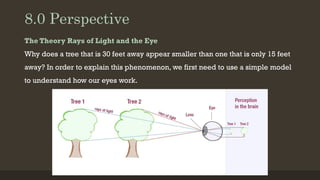
The Theory Rays of Light and the Eye
Why does a tree that is 30 feet away appear smaller than one that is only 15 feet
away? In order to explain this phenomenon, we first need to use a simple model
to understand how our eyes work.
8.0 Perspective
We perceive our surroundings through rays of light that enter our eyes. These
always meet the same point in our eye, where they are then refracted and
projected onto our retina. Because of this, the rays of light from a tree that is
further away reach our eyes at a sharper angle than a tree that is directly in front
of us. As a result, we get a mirror image on the retina: A small tree and a large
tree. After our brain processes this information, it turns the picture right side up
and knows that one of the trees is further away.
A painted picture, however, cannot transport light rays to our eyes at different
angles. That’s why it’s necessary for us to create our drawing how it is perceived
after it’s processed by our eyes. Perspective drawing helps us with this.
The Basic elements of Perspective
Drawing
In order to understand human perception, there are three important
tools for perspective drawing:
a. Horizon Line
b. Vanishing Points
c. Vanishing Lines
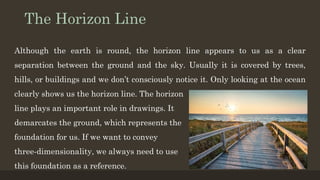
The Horizon Line
Although the earth is round, the horizon line appears to us as a clear
separation between the ground and the sky. Usually it is covered by trees,
hills, or buildings and we don’t consciously notice it. Only looking at the ocean
clearly shows us the horizon line. The horizon
line plays an important role in drawings. It
demarcates the ground, which represents the
foundation for us. If we want to convey
three-dimensionality, we always need to use
this foundation as a reference.
The Horizon Line
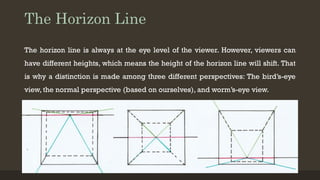
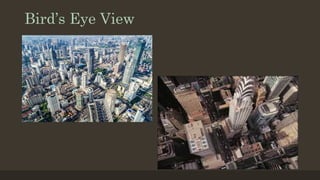
The horizon line is always at the eye level of the viewer. However, viewers can
have different heights, which means the height of the horizon line will shift. That
is why a distinction is made among three different perspectives: The bird’s-eye
view, the normal perspective (based on ourselves), and worm’s-eye view.
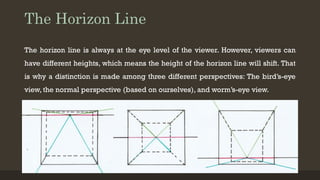
The Horizon Line
The horizon line is always at the eye level of the viewer. However, viewers can
have different heights, which means the height of the horizon line will shift. That
is why a distinction is made among three different perspectives: The bird’s-eye
view, the normal perspective (based on ourselves), and worm’s-eye view.
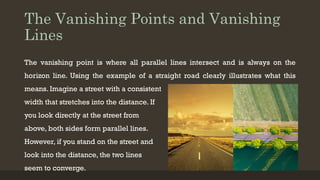
The Vanishing Points and Vanishing
Lines
The vanishing point is where all parallel lines intersect and is always on the
horizon line. Using the example of a straight road clearly illustrates what this
means. Imagine a street with a consistent
width that stretches into the distance. If
you look directly at the street from
above, both sides form parallel lines.
However, if you stand on the street and
look into the distance, the two lines
seem to converge.
Different Perspectives
Just as with the horizon line, there are different perspectives for the vanishing
points. However, it is important to know that both variants can be combined with
each other.
a. Single Point Perspective
b. Two-Point Perspective
c. Three-Point Perspective
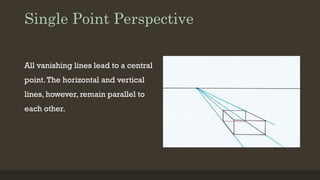
Single Point Perspective
All vanishing lines lead to a central
point.The horizontal and vertical
lines, however, remain parallel to
each other.
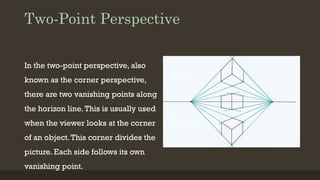
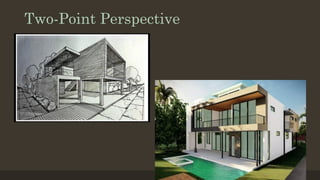
Two-Point Perspective
In the two-point perspective, also
known as the corner perspective,
there are two vanishing points along
the horizon line.This is usually used
when the viewer looks at the corner
of an object.This corner divides the
picture. Each side follows its own
vanishing point.
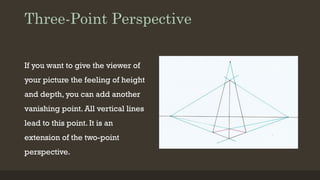
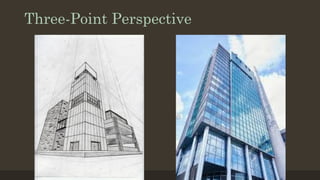
Three-Point Perspective
If you want to give the viewer of
your picture the feeling of height
and depth, you can add another
vanishing point. All vertical lines
lead to this point. It is an
extension of the two-point
perspective.
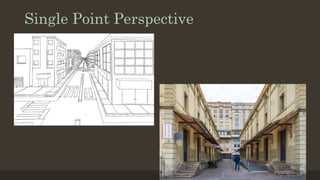
Single Point Perspective
Two-Point Perspective
Three-Point Perspective
Worm’s Eye View
Man’s of View
Bird’s Eye View
Plate
No.
11
Perspective Objective:
To produce a perspective drawing.
Instruction:
Complete the activity by drawing a two point perspective.
Thank you and God bless!

Topic 8 Perspective A Engineering Drafting

  • 1.
    Topics 1. The GraphicalLanguage and Design 2. Instrumental Drawing 3. Lettering 4. Geometric Construction 5. Sketching and Shape Description 6. Multiview Projection 7. Axonometric Projections 8. Perspective Drawing
  • 2.
    8.0 Perspective The TheoryRays of Light and the Eye Why does a tree that is 30 feet away appear smaller than one that is only 15 feet away? In order to explain this phenomenon, we first need to use a simple model to understand how our eyes work.
  • 3.
    8.0 Perspective We perceiveour surroundings through rays of light that enter our eyes. These always meet the same point in our eye, where they are then refracted and projected onto our retina. Because of this, the rays of light from a tree that is further away reach our eyes at a sharper angle than a tree that is directly in front of us. As a result, we get a mirror image on the retina: A small tree and a large tree. After our brain processes this information, it turns the picture right side up and knows that one of the trees is further away. A painted picture, however, cannot transport light rays to our eyes at different angles. That’s why it’s necessary for us to create our drawing how it is perceived after it’s processed by our eyes. Perspective drawing helps us with this.
  • 4.
    The Basic elementsof Perspective Drawing In order to understand human perception, there are three important tools for perspective drawing: a. Horizon Line b. Vanishing Points c. Vanishing Lines
  • 5.
    The Horizon Line Althoughthe earth is round, the horizon line appears to us as a clear separation between the ground and the sky. Usually it is covered by trees, hills, or buildings and we don’t consciously notice it. Only looking at the ocean clearly shows us the horizon line. The horizon line plays an important role in drawings. It demarcates the ground, which represents the foundation for us. If we want to convey three-dimensionality, we always need to use this foundation as a reference.
  • 6.
    The Horizon Line Thehorizon line is always at the eye level of the viewer. However, viewers can have different heights, which means the height of the horizon line will shift. That is why a distinction is made among three different perspectives: The bird’s-eye view, the normal perspective (based on ourselves), and worm’s-eye view.
  • 7.
    The Horizon Line Thehorizon line is always at the eye level of the viewer. However, viewers can have different heights, which means the height of the horizon line will shift. That is why a distinction is made among three different perspectives: The bird’s-eye view, the normal perspective (based on ourselves), and worm’s-eye view.
  • 8.
    The Vanishing Pointsand Vanishing Lines The vanishing point is where all parallel lines intersect and is always on the horizon line. Using the example of a straight road clearly illustrates what this means. Imagine a street with a consistent width that stretches into the distance. If you look directly at the street from above, both sides form parallel lines. However, if you stand on the street and look into the distance, the two lines seem to converge.
  • 9.
    Different Perspectives Just aswith the horizon line, there are different perspectives for the vanishing points. However, it is important to know that both variants can be combined with each other. a. Single Point Perspective b. Two-Point Perspective c. Three-Point Perspective
  • 10.
    Single Point Perspective Allvanishing lines lead to a central point.The horizontal and vertical lines, however, remain parallel to each other.
  • 11.
    Two-Point Perspective In thetwo-point perspective, also known as the corner perspective, there are two vanishing points along the horizon line.This is usually used when the viewer looks at the corner of an object.This corner divides the picture. Each side follows its own vanishing point.
  • 12.
    Three-Point Perspective If youwant to give the viewer of your picture the feeling of height and depth, you can add another vanishing point. All vertical lines lead to this point. It is an extension of the two-point perspective.
  • 13.
  • 14.
  • 15.
  • 16.
  • 17.
  • 18.
  • 19.
    Plate No. 11 Perspective Objective: To producea perspective drawing. Instruction: Complete the activity by drawing a two point perspective.
  • 20.
    Thank you andGod bless!