INTRODUCTION TO
AUTO-ENCODERS
YAN XU
HOUSTON MACHINE LEARNING
09-29-2018
Calling for abstracts
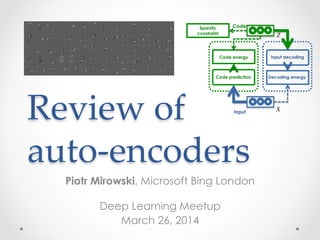
Review  of    
auto-­‐‑encoders	
Piotr Mirowski, Microsoft Bing London
Deep Learning Meetup
March 26, 2014
Code
Input
Code prediction
Code energy
Decoding energy
Input decoding
Sparsity
constraint
X
Z
Outline	
•  Deep learning concepts covered
o  Hierarchical representations
o  Sparse and/or distributed representations
o  Supervised vs. unsupervised learning
•  Auto-encoder
o  Architecture
o  Inference and learning
o  Sparse coding
o  Sparse auto-encoders
•  Illustration: handwritten digits
o  Stacking auto-encoders
o  Learning representations of digits
o  Impact on classification
•  Applications to text
o  Semantic hashing
o  Semi-supervised learning
o  Moving away from auto-encoders
•  Topics not covered in this talk
Walk through codes of "Building Autoencoders in Keras".
dddddddddddddddddddddddddddddddddddd
Outline	
•  Deep learning concepts covered
o  Hierarchical representations
o  Sparse and/or distributed representations
o  Supervised vs. unsupervised learning
•  Auto-encoder
o  Architecture
o  Inference and learning
o  Sparse coding
o  Sparse auto-encoders
•  Illustration: handwritten digits
o  Stacking auto-encoders
o  Learning representations of digits
o  Impact on classification
•  Applications to text
o  Semantic hashing
o  Semi-supervised learning
o  Moving away from auto-encoders
•  Topics not covered in this talk
Hierarchical  
representations	
“Deep learning methods aim at
learning feature hierarchies
with features from higher levels
of the hierarchy formed by the
composition of lower level
features.
Automatically learning features
at multiple levels of abstraction
allows a system
to learn complex functions
mapping the input to the output
directly from data,
without depending completely
on human-crafted features.”
— Yoshua Bengio
[Bengio,  “On  the  expressive  power  of  deep  architectures”,  Talk  at  ALT,  2011]	
[Bengio,  Learning  Deep  Architectures  for  AI,  2009]
Sparse  and/or  distributed  
representations	
Example on MNIST handwritten digits
An image of size 28x28 pixels can be represented
using a small combination of codes from a basis set.	
+ 1 + 1= 1 + 1 + 1 + 1 + 1 + 0.8 + 0.8
Figure 4: Top: A randomly selected subset of encoder filters learned by our energy-based model
when trained on the MNIST handwritten digit dataset. Bottom: An example of reconstruction of a
digit randomly extracted from the test data set. The reconstruction is made by adding “parts”: it is
the additive linear combination of few basis functions of the decoder with positive coefficients.
Examples of learned encoder and decoder filters are shown in figure 3. They are spatially localized,
and have different orientations, frequencies and scales. They are somewhat similar to, but more
localized than, Gabor wavelets and are reminiscent of the receptive fields of V1 neurons. Interest-
ingly, the encoder and decoder filter values are nearly identical up to a scale factor. After training,
inference is extremely fast, requiring only a simple matrix-vector multiplication.
[Ranzato,  Poultney,  Chopra  &  LeCun,  “Efficient  Learning  of  Sparse  Representations  with  an  Energy-­‐‑Based  Model  ”,  NIPS,  2006;  
Ranzato,  Boureau  &  LeCun,  “Sparse  Feature  Learning  for  Deep  Belief  Networks  ”,  NIPS,  2007]	
Biological motivation: V1 visual cortex
Sparse  and/or  distributed  
representations	
Example on MNIST handwritten digits
An image of size 28x28 pixels can be represented
using a small combination of codes from a basis set.	
+ 1 + 1= 1 + 1 + 1 + 1 + 1 + 0.8 + 0.8
Figure 4: Top: A randomly selected subset of encoder filters learned by our energy-based model
when trained on the MNIST handwritten digit dataset. Bottom: An example of reconstruction of a
digit randomly extracted from the test data set. The reconstruction is made by adding “parts”: it is
the additive linear combination of few basis functions of the decoder with positive coefficients.
Examples of learned encoder and decoder filters are shown in figure 3. They are spatially localized,
and have different orientations, frequencies and scales. They are somewhat similar to, but more
localized than, Gabor wavelets and are reminiscent of the receptive fields of V1 neurons. Interest-
ingly, the encoder and decoder filter values are nearly identical up to a scale factor. After training,
inference is extremely fast, requiring only a simple matrix-vector multiplication.
At the end of this talk, you should know how to learn that basis set
and how to infer the codes, in a 2-layer auto-encoder architecture.
Matlab/Octave code and the MNIST dataset will be provided. 	
[Ranzato,  Poultney,  Chopra  &  LeCun,  “Efficient  Learning  of  Sparse  Representations  with  an  Energy-­‐‑Based  Model  ”,  NIPS,  2006;  
Ranzato,  Boureau  &  LeCun,  “Sparse  Feature  Learning  for  Deep  Belief  Networks  ”,  NIPS,  2007]	
Biological motivation: V1 visual cortex (backup slides)
Supervised  learning	
X
Y
Ef Y, ˆY( )
Target
Input
Prediction
Error
ˆY = f X;W,b( )
Supervised  learning	
Y − ˆY
2
2
Target
Input
Prediction
Error
ˆY = WT
X + b
X
Y
Why  not  exploit  
unlabeled  data?
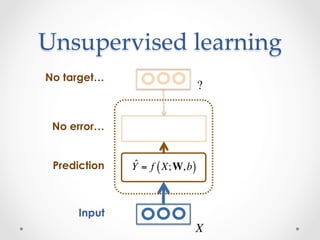
Unsupervised  learning	
No target…
Input
Prediction
No error…
ˆY = f X;W,b( )
X
?
Unsupervised  learning	
Code
“latent/hidden”
representation
Input
Prediction(s)
Error(s)
X
Z
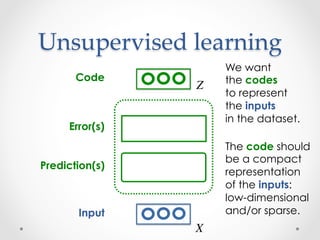
Unsupervised  learning	
Code
Input
Prediction(s)
Error(s)
We want
the codes
to represent
the inputs
in the dataset.
The code should
be a compact
representation
of the inputs:
low-dimensional
and/or sparse.
X
Z
Examples  of    
unsupervised  learning	
•  Linear decomposition of the inputs:
o  Principal Component Analysis and Singular Value Decomposition
o  Independent Component Analysis [Bell & Sejnowski, 1995]
o  Sparse coding [Olshausen & Field, 1997]
o  …
•  Fitting a distribution to the inputs:
o  Mixtures of Gaussians
o  Use of Expectation-Maximization algorithm [Dempster et al, 1977]
o  …
•  For text or discrete data:
o  Latent Semantic Indexing [Deerwester et al, 1990]
o  Probabilistic Latent Semantic Indexing [Hofmann et al, 1999]
o  Latent Dirichlet Allocation [Blei et al, 2003]
o  Semantic Hashing
o  …
Objective  of  this  tutorial	
Study a fundamental building block
for deep learning,
the auto-encoder
Outline	
•  Deep learning concepts covered
o  Hierarchical representations
o  Sparse and/or distributed representations
o  Supervised vs. unsupervised learning
•  Auto-encoder
o  Architecture
o  Inference and learning
o  Sparse coding
o  Sparse auto-encoders
•  Illustration: handwritten digits
o  Stacking auto-encoders
o  Learning representations of digits
o  Impact on classification
•  Applications to text
o  Semantic hashing
o  Semi-supervised learning
o  Moving away from auto-encoders
•  Topics not covered in this talk
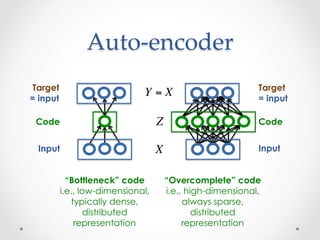
Auto-­‐‑encoder	
Code
Input X
Z
Target
= input
Y = X
Code
Input
“Bottleneck” code
i.e., low-dimensional,
typically dense,
distributed
representation
“Overcomplete” code
i.e., high-dimensional,
always sparse,
distributed
representation
Target
= input
Auto-­‐‑encoder	
Eg Z, ˆZ( )
Code
Input
Code
prediction
Encoding
“energy”
ˆZ = g X;C,bC( ) Eh X, ˆX( )
ˆX = h Z;D,bD( )
Decoding
“energy”
Input
decoding
X
Z
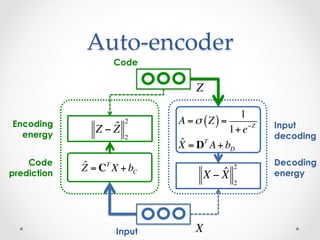
Auto-­‐‑encoder	
Z − ˆZ
2
2
Code
Input
Code
prediction
Encoding
energy
X − ˆX
2
2 Decoding
energy
Input
decoding
X
Z
ˆZ = g X;C,bC( )
ˆX = h Z;D,bD( )
Auto-­‐‑encoder  
loss  function	
L X(t), Z(t);W( )=α Z(t)− g X(t);C,bC( ) 2
2
+ X(t)− h Z(t);D,bD( ) 2
2
L X,Z;W( )= α Z(t)− g X(t);C,bC( ) 2
2
t=1
T
∑ + X(t)− h Z(t);D,bD( ) 2
2
t=1
T
∑
Encoding energy Decoding energy
For one sample t
For all T samples
How do we get the codes Z?
coefficient of
the encoder error	
We note W={C, bC, D, bD}
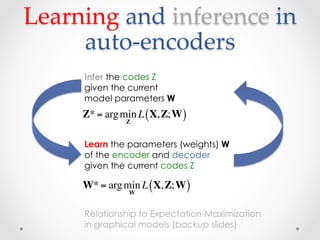
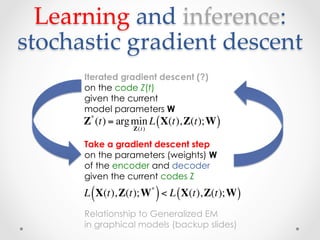
Learning  and  inference  in  
auto-­‐‑encoders	
Z* = argmin
Z
L X,Z;W( )
W* = argmin
W
L X,Z;W( )
Learn the parameters (weights) W
of the encoder and decoder
given the current codes Z
Infer the codes Z
given the current
model parameters W
Relationship to Expectation-Maximization
in graphical models (backup slides)
Learning  and  inference:  
stochastic  gradient  descent	
Z*
(t) = argmin
Z(t)
L X(t),Z(t);W( )
L X(t),Z(t);W*
( )< L X(t),Z(t);W( )
Take a gradient descent step
on the parameters (weights) W
of the encoder and decoder
given the current codes Z
Iterated gradient descent (?)
on the code Z(t)
given the current
model parameters W
Relationship to Generalized EM
in graphical models (backup slides)
Auto-­‐‑encoder	
Z − ˆZ
2
2
Code
Input
Code
prediction
Encoding
energy
ˆZ = CT
X + bC
X − ˆX
2
2
A =σ Z( )=
1
1+e−Z
ˆX = DT
A+ bD
Decoding
energy
Input
decoding
X
Z
Under-complete auto-encoders
Sparse auto-encoders
Denoising Auto-encoders
Stacking  auto-­‐‑encoders	
Code
Input
Code prediction
Code energy
Decoding energy
Input decoding
Sparsity
constraint
X
Z
Code
Input
Code prediction
Code energy
Decoding energy
Input decoding
Sparsity
constraint
X
Z
[Ranzato,  Boureau  &  LeCun,  “Sparse  Feature  Learning  for  Deep  Belief  Networks  ”,  NIPS,  2007]	
Video:
Autoencoder applications:
https://www.youtube.com/watch?
v=J4DsymeZe2g
MNIST  handwricen  digits	
•  Database of 70k
handwritten digits
o  Training set: 60k
o  Test set: 10k
•  28 x 28 pixels
•  Best performing
classifiers:
o  Linear classifier: 12% error
o  Gaussian SVM 1.4% error
o  ConvNets <1% error
[hcp://yann.lecun.com/exdb/mnist/]	
https://blog.keras.io/building-autoenc
oders-in-keras.html
Stacked  auto-­‐‑encoders	
Code
Input
Code prediction
Code energy
Decoding energy
Input decoding
Sparsity
constraint
X
Z
Code
Input
Code prediction
Code energy
Decoding energy
Input decoding
Sparsity
constraint
X
Z
(C)
0 0.5 1 1.5 2
0.05
0.1
0.15
Entropy (bits/pixel) (D)
(E) (F)
(G) (H)
Figure 1: (A)-(B) Error rate on MNIST training (with 10, 100 a
test set produced by a linear classifier trained on the codes produ
The entropy and RMSE refers to a quantization into 256 bins. The
also to the same classifier trained on raw pixel data (showing the a
The error bars refer to 1 std. dev. of the error rate for 10 rand
(same splits for all methods). The parameter αs in eq. 8 takes va
Comparison between SESM, RBM, and PCA when quantizing the
Random selection from the 200 linear filters that were learned by SE
of original and reconstructed digit from the code produced by the
propagation through encoder and decoder). (F) Random selection
Back-projection in image space of the filters learned in the second
extractor. The second stage was trained on the non linearly transfor
stage machine. The back-projection has been performed by using a
machine, and propagating this through the second stage decoder an
at the second stage discover the class-prototypes (manually order
though no class label was ever used during training. (H) Feature ex
patches: some filters that were learned.
(A)
0 1 2
0
5
10
15
20
25
30
35
40
45
ENTROPY (bits/pixel)
ERRORRATE%
10 samples
0 1 2
0
2
4
6
8
10
12
14
16
18
ENTROPY (bits/pixel)
ERRORRATE%
100 samples
0 1 2
3
4
5
6
7
8
9
10
ENTROPY (bits/pixel)
ERRORRATE%
1000 samples
RAW: train
RAW: test
PCA: train
PCA: test
RBM: train
RBM: test
SESM: train
SESM: test
(B)
0 0.2 0.4
0
5
10
15
20
25
30
35
40
45
RMSE
ERRORRATE%
10 samples
0 0.2 0.4
0
2
4
6
8
10
12
14
16
18
RMSE
ERRORRATE%
100 samples
0 0.2 0.4
3
4
5
6
7
8
9
10
RMSE
ERRORRATE%
1000 samples
(C)
0 0.5 1 1.5 2
0.05
0.1
0.15
0.2
0.25
0.3
0.35
0.4
0.45
RMSE
Entropy (bits/pixel)
Symmetric Sparse Coding − RBM − PCA
PCA: quantization in 5 bins
PCA: quantization in 256 bins
RBM: quantization in 5 bins
RBM: quantization in 256 bins
Sparse Coding: quantization in 5 bins
Sparse Coding: quantization in 256 bins
(D)
Layer 1: Matrix W1 of size 192 x 784
192 sparse bases of 28 x 28 pixels
Layer 2: Matrix W2 of size 10 x 192
10 sparse bases of 192 units
[Ranzato,  Boureau  &  LeCun,  “Sparse  Feature  Learning  for  Deep  Belief  Networks  ”,  NIPS,  2007]
Our  results:  
bases  learned  on  layer  1
Our  results:  
back-­‐‑projecting  layer  2
Sparse  representations	
Layer 1
Layer 2
Semantic  Hashing	
[Hinton  &  Salakhutdinov,  “Reducing  the  dimensionality  of  data  with  neural  networks,  Science,  2006;  
Salakhutdinov  &  Hinton,  “Semantic  Hashing”,  Int  J  Approx  Reason,  2007]	
2000
500
250
125
2
125
250
500
2000
Beyond  auto-­‐‑encoders  
for  web  search  (MSR)	
[Huang,  He,  Gao,  Deng  et  al,  “Learning  Deep  Structured  Semantic  Models  for  Web  Search  using  Clickthrough  Data”,  CIKM,  2013]	
s: “racing car”Input word/phrase
dim = 5MBag-of-words vector
dim = 50K
d=500Letter-tri-gram
embedding matrix
Letter-tri-gram coeff.
matrix (fixed)
d=500
Semantic
vector
d=300
t1: “formula one”
dim = 5M
dim = 50K
d=500
d=500
d=300
t2: “ford model t”
dim = 5M
dim = 50K
d=500
d=500
d=300
Compute Cosine similarity
between semantic vectors cos(s,t1) cos(s,t2)
W1
W2
W3
W4

Introduction to Autoencoders

  • 1.
  • 2.
  • 3.
    Review  of    auto-­‐‑encoders Piotr Mirowski, Microsoft Bing London Deep Learning Meetup March 26, 2014 Code Input Code prediction Code energy Decoding energy Input decoding Sparsity constraint X Z
  • 4.
    Outline •  Deep learningconcepts covered o  Hierarchical representations o  Sparse and/or distributed representations o  Supervised vs. unsupervised learning •  Auto-encoder o  Architecture o  Inference and learning o  Sparse coding o  Sparse auto-encoders •  Illustration: handwritten digits o  Stacking auto-encoders o  Learning representations of digits o  Impact on classification •  Applications to text o  Semantic hashing o  Semi-supervised learning o  Moving away from auto-encoders •  Topics not covered in this talk Walk through codes of "Building Autoencoders in Keras". dddddddddddddddddddddddddddddddddddd
  • 5.
    Outline •  Deep learningconcepts covered o  Hierarchical representations o  Sparse and/or distributed representations o  Supervised vs. unsupervised learning •  Auto-encoder o  Architecture o  Inference and learning o  Sparse coding o  Sparse auto-encoders •  Illustration: handwritten digits o  Stacking auto-encoders o  Learning representations of digits o  Impact on classification •  Applications to text o  Semantic hashing o  Semi-supervised learning o  Moving away from auto-encoders •  Topics not covered in this talk
  • 6.
    Hierarchical   representations “Deep learningmethods aim at learning feature hierarchies with features from higher levels of the hierarchy formed by the composition of lower level features. Automatically learning features at multiple levels of abstraction allows a system to learn complex functions mapping the input to the output directly from data, without depending completely on human-crafted features.” — Yoshua Bengio [Bengio,  “On  the  expressive  power  of  deep  architectures”,  Talk  at  ALT,  2011] [Bengio,  Learning  Deep  Architectures  for  AI,  2009]
  • 7.
    Sparse  and/or  distributed  representations Example on MNIST handwritten digits An image of size 28x28 pixels can be represented using a small combination of codes from a basis set. + 1 + 1= 1 + 1 + 1 + 1 + 1 + 0.8 + 0.8 Figure 4: Top: A randomly selected subset of encoder filters learned by our energy-based model when trained on the MNIST handwritten digit dataset. Bottom: An example of reconstruction of a digit randomly extracted from the test data set. The reconstruction is made by adding “parts”: it is the additive linear combination of few basis functions of the decoder with positive coefficients. Examples of learned encoder and decoder filters are shown in figure 3. They are spatially localized, and have different orientations, frequencies and scales. They are somewhat similar to, but more localized than, Gabor wavelets and are reminiscent of the receptive fields of V1 neurons. Interest- ingly, the encoder and decoder filter values are nearly identical up to a scale factor. After training, inference is extremely fast, requiring only a simple matrix-vector multiplication. [Ranzato,  Poultney,  Chopra  &  LeCun,  “Efficient  Learning  of  Sparse  Representations  with  an  Energy-­‐‑Based  Model  ”,  NIPS,  2006;   Ranzato,  Boureau  &  LeCun,  “Sparse  Feature  Learning  for  Deep  Belief  Networks  ”,  NIPS,  2007] Biological motivation: V1 visual cortex
  • 8.
    Sparse  and/or  distributed  representations Example on MNIST handwritten digits An image of size 28x28 pixels can be represented using a small combination of codes from a basis set. + 1 + 1= 1 + 1 + 1 + 1 + 1 + 0.8 + 0.8 Figure 4: Top: A randomly selected subset of encoder filters learned by our energy-based model when trained on the MNIST handwritten digit dataset. Bottom: An example of reconstruction of a digit randomly extracted from the test data set. The reconstruction is made by adding “parts”: it is the additive linear combination of few basis functions of the decoder with positive coefficients. Examples of learned encoder and decoder filters are shown in figure 3. They are spatially localized, and have different orientations, frequencies and scales. They are somewhat similar to, but more localized than, Gabor wavelets and are reminiscent of the receptive fields of V1 neurons. Interest- ingly, the encoder and decoder filter values are nearly identical up to a scale factor. After training, inference is extremely fast, requiring only a simple matrix-vector multiplication. At the end of this talk, you should know how to learn that basis set and how to infer the codes, in a 2-layer auto-encoder architecture. Matlab/Octave code and the MNIST dataset will be provided. [Ranzato,  Poultney,  Chopra  &  LeCun,  “Efficient  Learning  of  Sparse  Representations  with  an  Energy-­‐‑Based  Model  ”,  NIPS,  2006;   Ranzato,  Boureau  &  LeCun,  “Sparse  Feature  Learning  for  Deep  Belief  Networks  ”,  NIPS,  2007] Biological motivation: V1 visual cortex (backup slides)
  • 9.
    Supervised  learning X Y Ef Y,ˆY( ) Target Input Prediction Error ˆY = f X;W,b( )
  • 10.
    Supervised  learning Y −ˆY 2 2 Target Input Prediction Error ˆY = WT X + b X Y
  • 11.
    Why  not  exploit  unlabeled  data?
  • 12.
  • 13.
  • 14.
    Unsupervised  learning Code Input Prediction(s) Error(s) We want thecodes to represent the inputs in the dataset. The code should be a compact representation of the inputs: low-dimensional and/or sparse. X Z
  • 15.
    Examples  of    unsupervised  learning •  Linear decomposition of the inputs: o  Principal Component Analysis and Singular Value Decomposition o  Independent Component Analysis [Bell & Sejnowski, 1995] o  Sparse coding [Olshausen & Field, 1997] o  … •  Fitting a distribution to the inputs: o  Mixtures of Gaussians o  Use of Expectation-Maximization algorithm [Dempster et al, 1977] o  … •  For text or discrete data: o  Latent Semantic Indexing [Deerwester et al, 1990] o  Probabilistic Latent Semantic Indexing [Hofmann et al, 1999] o  Latent Dirichlet Allocation [Blei et al, 2003] o  Semantic Hashing o  …
  • 16.
    Objective  of  this tutorial Study a fundamental building block for deep learning, the auto-encoder
  • 17.
    Outline •  Deep learningconcepts covered o  Hierarchical representations o  Sparse and/or distributed representations o  Supervised vs. unsupervised learning •  Auto-encoder o  Architecture o  Inference and learning o  Sparse coding o  Sparse auto-encoders •  Illustration: handwritten digits o  Stacking auto-encoders o  Learning representations of digits o  Impact on classification •  Applications to text o  Semantic hashing o  Semi-supervised learning o  Moving away from auto-encoders •  Topics not covered in this talk
  • 18.
    Auto-­‐‑encoder Code Input X Z Target = input Y= X Code Input “Bottleneck” code i.e., low-dimensional, typically dense, distributed representation “Overcomplete” code i.e., high-dimensional, always sparse, distributed representation Target = input
  • 19.
    Auto-­‐‑encoder Eg Z, ˆZ() Code Input Code prediction Encoding “energy” ˆZ = g X;C,bC( ) Eh X, ˆX( ) ˆX = h Z;D,bD( ) Decoding “energy” Input decoding X Z
  • 20.
    Auto-­‐‑encoder Z − ˆZ 2 2 Code Input Code prediction Encoding energy X− ˆX 2 2 Decoding energy Input decoding X Z ˆZ = g X;C,bC( ) ˆX = h Z;D,bD( )
  • 21.
    Auto-­‐‑encoder   loss  function LX(t), Z(t);W( )=α Z(t)− g X(t);C,bC( ) 2 2 + X(t)− h Z(t);D,bD( ) 2 2 L X,Z;W( )= α Z(t)− g X(t);C,bC( ) 2 2 t=1 T ∑ + X(t)− h Z(t);D,bD( ) 2 2 t=1 T ∑ Encoding energy Decoding energy Encoding energy Decoding energy For one sample t For all T samples How do we get the codes Z? coefficient of the encoder error We note W={C, bC, D, bD}
  • 22.
    Learning  and  inference in   auto-­‐‑encoders Z* = argmin Z L X,Z;W( ) W* = argmin W L X,Z;W( ) Learn the parameters (weights) W of the encoder and decoder given the current codes Z Infer the codes Z given the current model parameters W Relationship to Expectation-Maximization in graphical models (backup slides)
  • 23.
    Learning  and  inference:  stochastic  gradient  descent Z* (t) = argmin Z(t) L X(t),Z(t);W( ) L X(t),Z(t);W* ( )< L X(t),Z(t);W( ) Take a gradient descent step on the parameters (weights) W of the encoder and decoder given the current codes Z Iterated gradient descent (?) on the code Z(t) given the current model parameters W Relationship to Generalized EM in graphical models (backup slides)
  • 24.
    Auto-­‐‑encoder Z − ˆZ 2 2 Code Input Code prediction Encoding energy ˆZ= CT X + bC X − ˆX 2 2 A =σ Z( )= 1 1+e−Z ˆX = DT A+ bD Decoding energy Input decoding X Z
  • 25.
  • 26.
  • 27.
  • 28.
  • 29.
    Stacking  auto-­‐‑encoders Code Input Code prediction Codeenergy Decoding energy Input decoding Sparsity constraint X Z Code Input Code prediction Code energy Decoding energy Input decoding Sparsity constraint X Z [Ranzato,  Boureau  &  LeCun,  “Sparse  Feature  Learning  for  Deep  Belief  Networks  ”,  NIPS,  2007] Video: Autoencoder applications: https://www.youtube.com/watch? v=J4DsymeZe2g
  • 30.
    MNIST  handwricen  digits • Database of 70k handwritten digits o  Training set: 60k o  Test set: 10k •  28 x 28 pixels •  Best performing classifiers: o  Linear classifier: 12% error o  Gaussian SVM 1.4% error o  ConvNets <1% error [hcp://yann.lecun.com/exdb/mnist/] https://blog.keras.io/building-autoenc oders-in-keras.html
  • 31.
    Stacked  auto-­‐‑encoders Code Input Code prediction Codeenergy Decoding energy Input decoding Sparsity constraint X Z Code Input Code prediction Code energy Decoding energy Input decoding Sparsity constraint X Z (C) 0 0.5 1 1.5 2 0.05 0.1 0.15 Entropy (bits/pixel) (D) (E) (F) (G) (H) Figure 1: (A)-(B) Error rate on MNIST training (with 10, 100 a test set produced by a linear classifier trained on the codes produ The entropy and RMSE refers to a quantization into 256 bins. The also to the same classifier trained on raw pixel data (showing the a The error bars refer to 1 std. dev. of the error rate for 10 rand (same splits for all methods). The parameter αs in eq. 8 takes va Comparison between SESM, RBM, and PCA when quantizing the Random selection from the 200 linear filters that were learned by SE of original and reconstructed digit from the code produced by the propagation through encoder and decoder). (F) Random selection Back-projection in image space of the filters learned in the second extractor. The second stage was trained on the non linearly transfor stage machine. The back-projection has been performed by using a machine, and propagating this through the second stage decoder an at the second stage discover the class-prototypes (manually order though no class label was ever used during training. (H) Feature ex patches: some filters that were learned. (A) 0 1 2 0 5 10 15 20 25 30 35 40 45 ENTROPY (bits/pixel) ERRORRATE% 10 samples 0 1 2 0 2 4 6 8 10 12 14 16 18 ENTROPY (bits/pixel) ERRORRATE% 100 samples 0 1 2 3 4 5 6 7 8 9 10 ENTROPY (bits/pixel) ERRORRATE% 1000 samples RAW: train RAW: test PCA: train PCA: test RBM: train RBM: test SESM: train SESM: test (B) 0 0.2 0.4 0 5 10 15 20 25 30 35 40 45 RMSE ERRORRATE% 10 samples 0 0.2 0.4 0 2 4 6 8 10 12 14 16 18 RMSE ERRORRATE% 100 samples 0 0.2 0.4 3 4 5 6 7 8 9 10 RMSE ERRORRATE% 1000 samples (C) 0 0.5 1 1.5 2 0.05 0.1 0.15 0.2 0.25 0.3 0.35 0.4 0.45 RMSE Entropy (bits/pixel) Symmetric Sparse Coding − RBM − PCA PCA: quantization in 5 bins PCA: quantization in 256 bins RBM: quantization in 5 bins RBM: quantization in 256 bins Sparse Coding: quantization in 5 bins Sparse Coding: quantization in 256 bins (D) Layer 1: Matrix W1 of size 192 x 784 192 sparse bases of 28 x 28 pixels Layer 2: Matrix W2 of size 10 x 192 10 sparse bases of 192 units [Ranzato,  Boureau  &  LeCun,  “Sparse  Feature  Learning  for  Deep  Belief  Networks  ”,  NIPS,  2007]
  • 32.
    Our  results:   bases learned  on  layer  1
  • 33.
  • 34.
  • 35.
    Semantic  Hashing [Hinton  & Salakhutdinov,  “Reducing  the  dimensionality  of  data  with  neural  networks,  Science,  2006;   Salakhutdinov  &  Hinton,  “Semantic  Hashing”,  Int  J  Approx  Reason,  2007] 2000 500 250 125 2 125 250 500 2000
  • 36.
    Beyond  auto-­‐‑encoders   for web  search  (MSR) [Huang,  He,  Gao,  Deng  et  al,  “Learning  Deep  Structured  Semantic  Models  for  Web  Search  using  Clickthrough  Data”,  CIKM,  2013] s: “racing car”Input word/phrase dim = 5MBag-of-words vector dim = 50K d=500Letter-tri-gram embedding matrix Letter-tri-gram coeff. matrix (fixed) d=500 Semantic vector d=300 t1: “formula one” dim = 5M dim = 50K d=500 d=500 d=300 t2: “ford model t” dim = 5M dim = 50K d=500 d=500 d=300 Compute Cosine similarity between semantic vectors cos(s,t1) cos(s,t2) W1 W2 W3 W4