



AI & DEEP LEARNING with TENSORFLOW www.edureka.co/ai-deep-learning-with-tensorflow
Agenda
❖ Why do we need Autoencoders?
❖ What are Autoencoders?
❖ Properties of Autoencoders
❖ Autoencoders Training & Architecture
❖ Types of Autoencoders
❖ Applications of Autoencoders
AI & DEEP LEARNING with TENSORFLOW www.edureka.co/ai-deep-learning-with-tensorflow
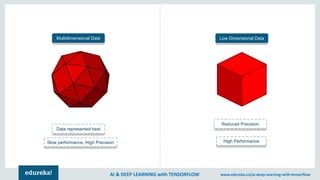
Multidimensional Data
Data represented best
Slow performance, High Precision
Low Dimensional Data
Reduced Precision
High Performance
AI & DEEP LEARNING with TENSORFLOW www.edureka.co/ai-deep-learning-with-tensorflow
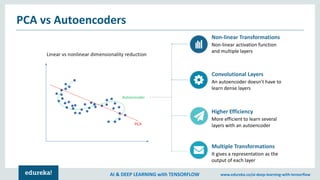
PCA vs Autoencoders
Non-linear Transformations
Non-linear activation function
and multiple layers
Convolutional Layers
An autoencoder doesn’t have to
learn dense layers
Higher Efficiency
More efficient to learn several
layers with an autoencoder
Multiple Transformations
It gives a representation as the
output of each layer
AI & DEEP LEARNING with TENSORFLOW www.edureka.co/ai-deep-learning-with-tensorflow
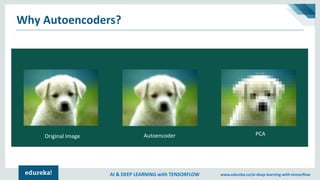
Why Autoencoders?
Original Image Autoencoder PCA
AI & DEEP LEARNING with TENSORFLOW www.edureka.co/ai-deep-learning-with-tensorflow
Introduction to Autoencoders
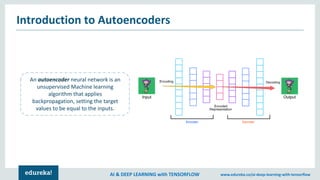
An autoencoder neural network is an
unsupervised Machine learning
algorithm that applies
backpropagation, setting the target
values to be equal to the inputs.
AI & DEEP LEARNING with TENSORFLOW www.edureka.co/ai-deep-learning-with-tensorflow
Autoencoders
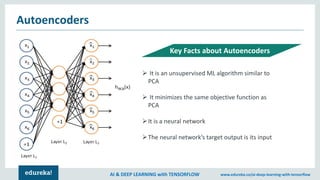
Key Facts about Autoencoders
➢ It is an unsupervised ML algorithm similar to
PCA
➢ It minimizes the same objective function as
PCA
➢It is a neural network
➢The neural network’s target output is its input
AI & DEEP LEARNING with TENSORFLOW www.edureka.co/ai-deep-learning-with-tensorflow
Autoencoders
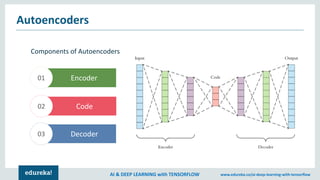
Code02
Encoderr01
Decoder03
Components of Autoencoders
AI & DEEP LEARNING with TENSORFLOW www.edureka.co/ai-deep-learning-with-tensorflow
Autoencoders
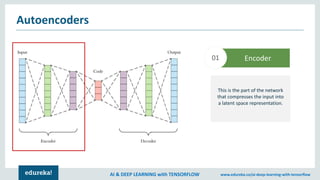
Encoderr01
This is the part of the network
that compresses the input into
a latent space representation.
AI & DEEP LEARNING with TENSORFLOW www.edureka.co/ai-deep-learning-with-tensorflow
Autoencoders
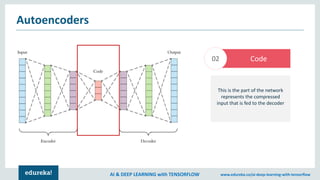
Code02
This is the part of the network
represents the compressed
input that is fed to the decoder
AI & DEEP LEARNING with TENSORFLOW www.edureka.co/ai-deep-learning-with-tensorflow
Autoencoders
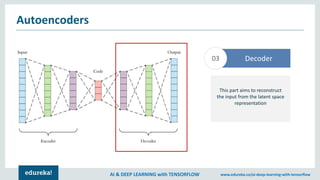
Decoder03
This part aims to reconstruct
the input from the latent space
representation
AI & DEEP LEARNING with TENSORFLOW www.edureka.co/ai-deep-learning-with-tensorflow
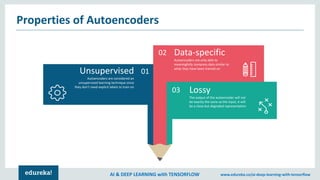
Properties of Autoencoders
Data-specific
Autoencoders are only able to
meaningfully compress data similar to
what they have been trained on
02
01
03 Lossy
The output of the autoencoder will not
be exactly the same as the input, it will
be a close but degraded representation
Unsupervised
Autoencoders are considered an
unsupervised learning technique since
they don’t need explicit labels to train on
AI & DEEP LEARNING with TENSORFLOW www.edureka.co/ai-deep-learning-with-tensorflow
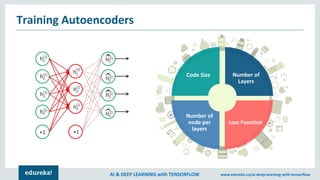
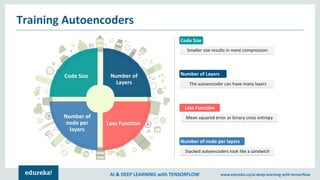
Training Autoencoders
Number of
Layers
Code Size
Loss Function
Number of
node per
layers
AI & DEEP LEARNING with TENSORFLOW www.edureka.co/ai-deep-learning-with-tensorflow
Training Autoencoders
Smaller size results in more compression
The autoencoder can have many layers
Mean squared error or binary cross entropy
Stacked autoencoders look like a sandwich
Code Size
Number of Layers
Loss Function
Number of node per layers
Number of
Layers
Code Size
Loss Function
Number of
node per
layers
AI & DEEP LEARNING with TENSORFLOW www.edureka.co/ai-deep-learning-with-tensorflow
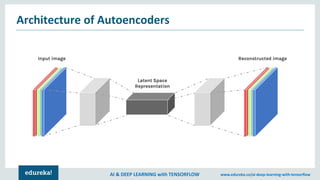
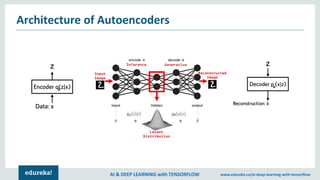
Architecture of Autoencoders
AI & DEEP LEARNING with TENSORFLOW www.edureka.co/ai-deep-learning-with-tensorflow
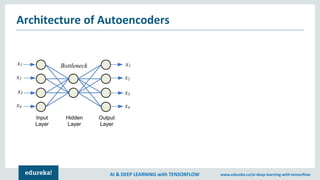
Architecture of Autoencoders
AI & DEEP LEARNING with TENSORFLOW www.edureka.co/ai-deep-learning-with-tensorflow
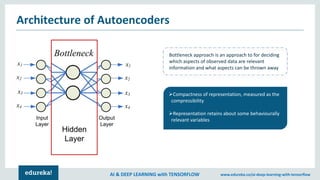
Architecture of Autoencoders
Bottleneck approach is an approach to for deciding
which aspects of observed data are relevant
information and what aspects can be thrown away
➢Compactness of representation, measured as the
compressibility
➢Representation retains about some behaviourally
relevant variables
AI & DEEP LEARNING with TENSORFLOW www.edureka.co/ai-deep-learning-with-tensorflow
Architecture of Autoencoders
AI & DEEP LEARNING with TENSORFLOW www.edureka.co/ai-deep-learning-with-tensorflow
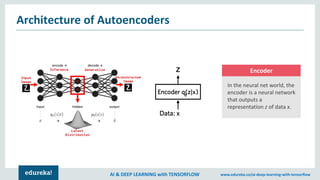
In the neural net world, the
encoder is a neural network
that outputs a
representation z of data x.
Encoder
Architecture of Autoencoders
AI & DEEP LEARNING with TENSORFLOW www.edureka.co/ai-deep-learning-with-tensorflow
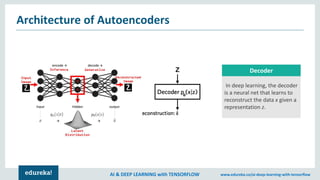
Decoder
In deep learning, the decoder
is a neural net that learns to
reconstruct the data x given a
representation z.
Architecture of Autoencoders
AI & DEEP LEARNING with TENSORFLOW www.edureka.co/ai-deep-learning-with-tensorflow
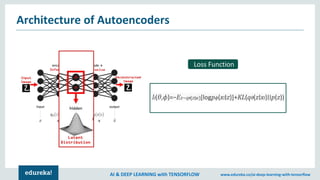
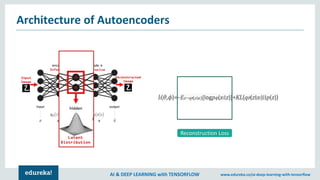
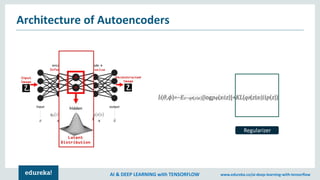
Loss Function
Architecture of Autoencoders
AI & DEEP LEARNING with TENSORFLOW www.edureka.co/ai-deep-learning-with-tensorflow
Reconstruction Loss
Architecture of Autoencoders
AI & DEEP LEARNING with TENSORFLOW www.edureka.co/ai-deep-learning-with-tensorflow
Regularizer
Architecture of Autoencoders
AI & DEEP LEARNING with TENSORFLOW www.edureka.co/ai-deep-learning-with-tensorflow .
Types of Autoencoders
AI & DEEP LEARNING with TENSORFLOW www.edureka.co/ai-deep-learning-with-tensorflow
Convolution Autoencoders
AI & DEEP LEARNING with TENSORFLOW www.edureka.co/ai-deep-learning-with-tensorflow
Convolution Autoencoders
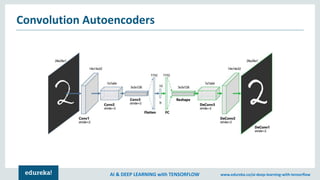
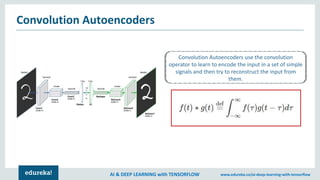
Convolution Autoencoders use the convolution
operator to learn to encode the input in a set of simple
signals and then try to reconstruct the input from
them.
AI & DEEP LEARNING with TENSORFLOW www.edureka.co/ai-deep-learning-with-tensorflow
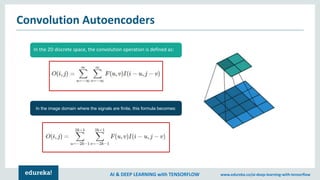
In the image domain where the signals are finite, this formula becomes:
Convolution Autoencoders
In the 2D discrete space, the convolution operation is defined as:
AI & DEEP LEARNING with TENSORFLOW www.edureka.co/ai-deep-learning-with-tensorflowCopyright © 2017, edureka and/or its affiliates. All rights reserved.
1
2
3
Use Case of CAE:
Image Reconstruction
Image Colorization
Advanced Applications
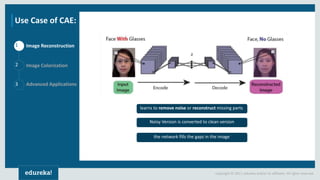
learns to remove noise or reconstruct missing parts.
Noisy Version is converted to clean version
the network fills the gaps in the image.
AI & DEEP LEARNING with TENSORFLOW www.edureka.co/ai-deep-learning-with-tensorflowCopyright © 2017, edureka and/or its affiliates. All rights reserved.
1
2
3
Use Case of CAE:
Image Reconstruction
Image Colorization
Advanced Applications
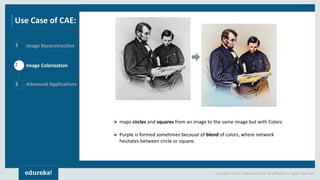
➢ maps circles and squares from an image to the same image but with Colors
➢ Purple is formed sometimes because of blend of colors, where network
hesitates between circle or square.
AI & DEEP LEARNING with TENSORFLOW www.edureka.co/ai-deep-learning-with-tensorflowCopyright © 2017, edureka and/or its affiliates. All rights reserved.
1
22
3
Use Case of CAE:
Image Reconstruction
Image Colorization
Advanced Applications
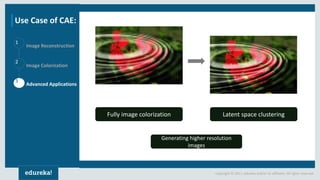
Latent space clusteringFully image colorization
Generating higher resolution
images
AI & DEEP LEARNING with TENSORFLOW www.edureka.co/ai-deep-learning-with-tensorflow
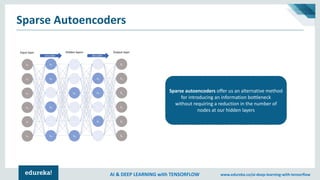
Sparse Autoencoders
Sparse autoencoders offer us an alternative method
for introducing an information bottleneck
without requiring a reduction in the number of
nodes at our hidden layers
AI & DEEP LEARNING with TENSORFLOW www.edureka.co/ai-deep-learning-with-tensorflow
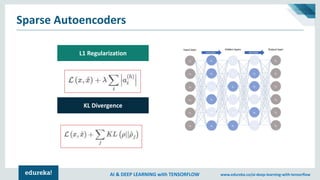
Sparse Autoencoders
L1 Regularization
KL Divergence
AI & DEEP LEARNING with TENSORFLOW www.edureka.co/ai-deep-learning-with-tensorflow
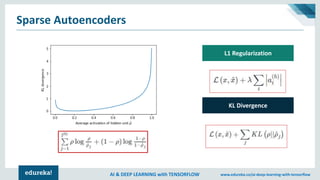
Sparse Autoencoders
L1 Regularization
KL Divergence
AI & DEEP LEARNING with TENSORFLOW www.edureka.co/ai-deep-learning-with-tensorflow
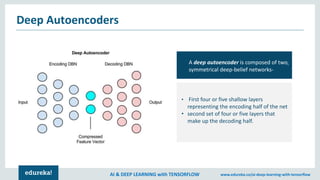
Deep Autoencoders
A deep autoencoder is composed of two,
symmetrical deep-belief networks-
• First four or five shallow layers
representing the encoding half of the net
• second set of four or five layers that
make up the decoding half.
AI & DEEP LEARNING with TENSORFLOW www.edureka.co/ai-deep-learning-with-tensorflow
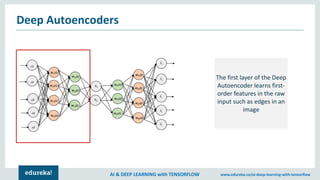
Deep Autoencoders
The first layer of the Deep
Autoencoder learns first-
order features in the raw
input such as edges in an
image
AI & DEEP LEARNING with TENSORFLOW www.edureka.co/ai-deep-learning-with-tensorflow
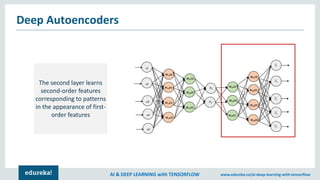
Deep Autoencoders
The second layer learns
second-order features
corresponding to patterns
in the appearance of first-
order features
AI & DEEP LEARNING with TENSORFLOW www.edureka.co/ai-deep-learning-with-tensorflowCopyright © 2017, edureka and/or its affiliates. All rights reserved.
1
2
3
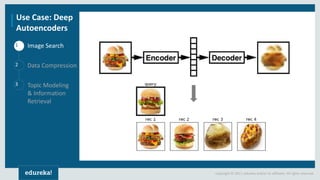
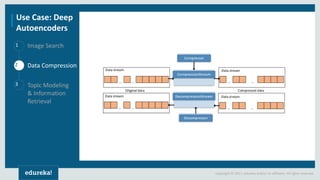
Use Case: Deep
Autoencoders
Image Search
Data Compression
Topic Modeling
& Information
Retrieval
AI & DEEP LEARNING with TENSORFLOW www.edureka.co/ai-deep-learning-with-tensorflowCopyright © 2017, edureka and/or its affiliates. All rights reserved.
1
2
3
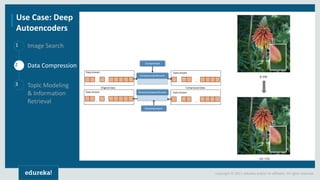
Use Case: Deep
Autoencoders
Image Search
Data Compression
Topic Modeling
& Information
Retrieval
AI & DEEP LEARNING with TENSORFLOW www.edureka.co/ai-deep-learning-with-tensorflowCopyright © 2017, edureka and/or its affiliates. All rights reserved.
1
2
3
Use Case: Deep
Autoencoders
Image Search
Data Compression
Topic Modeling
& Information
Retrieval
AI & DEEP LEARNING with TENSORFLOW www.edureka.co/ai-deep-learning-with-tensorflowCopyright © 2017, edureka and/or its affiliates. All rights reserved.
1
22
3
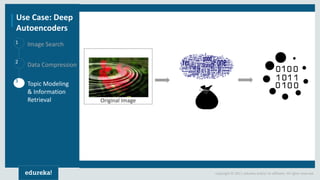
Use Case: Deep
Autoencoders
Image Search
Data Compression
Topic Modeling
& Information
Retrieval Original Image
AI & DEEP LEARNING with TENSORFLOW www.edureka.co/ai-deep-learning-with-tensorflow
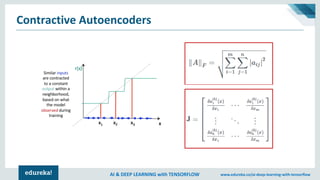
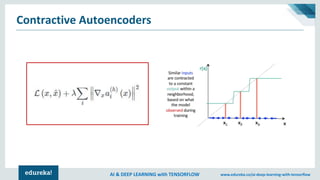
Contractive Autoencoders
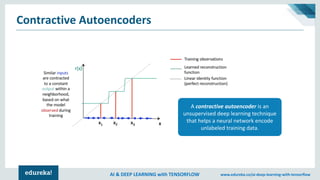
A contractive autoencoder is an
unsupervised deep learning technique
that helps a neural network encode
unlabeled training data.
AI & DEEP LEARNING with TENSORFLOW www.edureka.co/ai-deep-learning-with-tensorflow
Contractive Autoencoders
AI & DEEP LEARNING with TENSORFLOW www.edureka.co/ai-deep-learning-with-tensorflow
Contractive Autoencoders
AI & DEEP LEARNING with TENSORFLOW www.edureka.co/ai-deep-learning-with-tensorflow .
Applications of Autoencoder
AI & DEEP LEARNING with TENSORFLOW www.edureka.co/ai-deep-learning-with-tensorflow
DimensionalityReduction
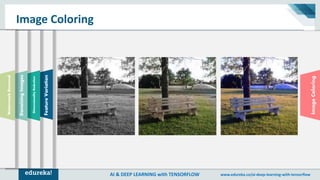
Image ColoringDenoisingImages
WatermarkRemoval
FeatureVariation
ImageColoring
AI & DEEP LEARNING with TENSORFLOW www.edureka.co/ai-deep-learning-with-tensorflow
DimensionalityReduction
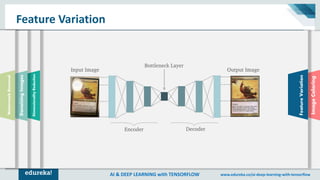
Feature VariationDenoisingImages
WatermarkRemoval
FeatureVariation
ImageColoring
AI & DEEP LEARNING with TENSORFLOW www.edureka.co/ai-deep-learning-with-tensorflow
DimensionalityReduction
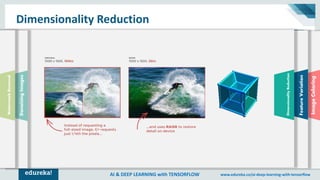
Dimensionality ReductionDenoisingImages
WatermarkRemoval
FeatureVariation
ImageColoring
AI & DEEP LEARNING with TENSORFLOW www.edureka.co/ai-deep-learning-with-tensorflow
DimensionalityReduction
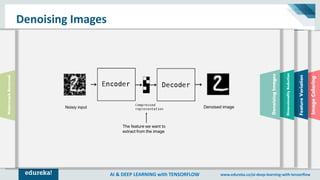
Denoising Images
DenoisingImages
WatermarkRemoval
FeatureVariation
ImageColoring
AI & DEEP LEARNING with TENSORFLOW www.edureka.co/ai-deep-learning-with-tensorflow
DimensionalityReduction
Watermark Removal
DenoisingImages
WatermarkRemoval
FeatureVariation
ImageColoring
AI & DEEP LEARNING with TENSORFLOW www.edureka.co/ai-deep-learning-with-tensorflow

Autoencoders Tutorial | Autoencoders In Deep Learning | Tensorflow Training | Edureka

  • 1.
    AI & DEEPLEARNING with TENSORFLOW www.edureka.co/ai-deep-learning-with-tensorflow
  • 2.
    AI & DEEPLEARNING with TENSORFLOW www.edureka.co/ai-deep-learning-with-tensorflow Agenda ❖ Why do we need Autoencoders? ❖ What are Autoencoders? ❖ Properties of Autoencoders ❖ Autoencoders Training & Architecture ❖ Types of Autoencoders ❖ Applications of Autoencoders
  • 3.
    AI & DEEPLEARNING with TENSORFLOW www.edureka.co/ai-deep-learning-with-tensorflow Multidimensional Data Data represented best Slow performance, High Precision Low Dimensional Data Reduced Precision High Performance
  • 4.
    AI & DEEPLEARNING with TENSORFLOW www.edureka.co/ai-deep-learning-with-tensorflow PCA vs Autoencoders Non-linear Transformations Non-linear activation function and multiple layers Convolutional Layers An autoencoder doesn’t have to learn dense layers Higher Efficiency More efficient to learn several layers with an autoencoder Multiple Transformations It gives a representation as the output of each layer
  • 5.
    AI & DEEPLEARNING with TENSORFLOW www.edureka.co/ai-deep-learning-with-tensorflow Why Autoencoders? Original Image Autoencoder PCA
  • 6.
    AI & DEEPLEARNING with TENSORFLOW www.edureka.co/ai-deep-learning-with-tensorflow Introduction to Autoencoders An autoencoder neural network is an unsupervised Machine learning algorithm that applies backpropagation, setting the target values to be equal to the inputs.
  • 7.
    AI & DEEPLEARNING with TENSORFLOW www.edureka.co/ai-deep-learning-with-tensorflow Autoencoders Key Facts about Autoencoders ➢ It is an unsupervised ML algorithm similar to PCA ➢ It minimizes the same objective function as PCA ➢It is a neural network ➢The neural network’s target output is its input
  • 8.
    AI & DEEPLEARNING with TENSORFLOW www.edureka.co/ai-deep-learning-with-tensorflow Autoencoders Code02 Encoderr01 Decoder03 Components of Autoencoders
  • 9.
    AI & DEEPLEARNING with TENSORFLOW www.edureka.co/ai-deep-learning-with-tensorflow Autoencoders Encoderr01 This is the part of the network that compresses the input into a latent space representation.
  • 10.
    AI & DEEPLEARNING with TENSORFLOW www.edureka.co/ai-deep-learning-with-tensorflow Autoencoders Code02 This is the part of the network represents the compressed input that is fed to the decoder
  • 11.
    AI & DEEPLEARNING with TENSORFLOW www.edureka.co/ai-deep-learning-with-tensorflow Autoencoders Decoder03 This part aims to reconstruct the input from the latent space representation
  • 12.
    AI & DEEPLEARNING with TENSORFLOW www.edureka.co/ai-deep-learning-with-tensorflow Properties of Autoencoders Data-specific Autoencoders are only able to meaningfully compress data similar to what they have been trained on 02 01 03 Lossy The output of the autoencoder will not be exactly the same as the input, it will be a close but degraded representation Unsupervised Autoencoders are considered an unsupervised learning technique since they don’t need explicit labels to train on
  • 13.
    AI & DEEPLEARNING with TENSORFLOW www.edureka.co/ai-deep-learning-with-tensorflow Training Autoencoders Number of Layers Code Size Loss Function Number of node per layers
  • 14.
    AI & DEEPLEARNING with TENSORFLOW www.edureka.co/ai-deep-learning-with-tensorflow Training Autoencoders Smaller size results in more compression The autoencoder can have many layers Mean squared error or binary cross entropy Stacked autoencoders look like a sandwich Code Size Number of Layers Loss Function Number of node per layers Number of Layers Code Size Loss Function Number of node per layers
  • 15.
    AI & DEEPLEARNING with TENSORFLOW www.edureka.co/ai-deep-learning-with-tensorflow Architecture of Autoencoders
  • 16.
    AI & DEEPLEARNING with TENSORFLOW www.edureka.co/ai-deep-learning-with-tensorflow Architecture of Autoencoders
  • 17.
    AI & DEEPLEARNING with TENSORFLOW www.edureka.co/ai-deep-learning-with-tensorflow Architecture of Autoencoders Bottleneck approach is an approach to for deciding which aspects of observed data are relevant information and what aspects can be thrown away ➢Compactness of representation, measured as the compressibility ➢Representation retains about some behaviourally relevant variables
  • 18.
    AI & DEEPLEARNING with TENSORFLOW www.edureka.co/ai-deep-learning-with-tensorflow Architecture of Autoencoders
  • 19.
    AI & DEEPLEARNING with TENSORFLOW www.edureka.co/ai-deep-learning-with-tensorflow In the neural net world, the encoder is a neural network that outputs a representation z of data x. Encoder Architecture of Autoencoders
  • 20.
    AI & DEEPLEARNING with TENSORFLOW www.edureka.co/ai-deep-learning-with-tensorflow Decoder In deep learning, the decoder is a neural net that learns to reconstruct the data x given a representation z. Architecture of Autoencoders
  • 21.
    AI & DEEPLEARNING with TENSORFLOW www.edureka.co/ai-deep-learning-with-tensorflow Loss Function Architecture of Autoencoders
  • 22.
    AI & DEEPLEARNING with TENSORFLOW www.edureka.co/ai-deep-learning-with-tensorflow Reconstruction Loss Architecture of Autoencoders
  • 23.
    AI & DEEPLEARNING with TENSORFLOW www.edureka.co/ai-deep-learning-with-tensorflow Regularizer Architecture of Autoencoders
  • 24.
    AI & DEEPLEARNING with TENSORFLOW www.edureka.co/ai-deep-learning-with-tensorflow . Types of Autoencoders
  • 25.
    AI & DEEPLEARNING with TENSORFLOW www.edureka.co/ai-deep-learning-with-tensorflow Convolution Autoencoders
  • 26.
    AI & DEEPLEARNING with TENSORFLOW www.edureka.co/ai-deep-learning-with-tensorflow Convolution Autoencoders Convolution Autoencoders use the convolution operator to learn to encode the input in a set of simple signals and then try to reconstruct the input from them.
  • 27.
    AI & DEEPLEARNING with TENSORFLOW www.edureka.co/ai-deep-learning-with-tensorflow In the image domain where the signals are finite, this formula becomes: Convolution Autoencoders In the 2D discrete space, the convolution operation is defined as:
  • 28.
    AI & DEEPLEARNING with TENSORFLOW www.edureka.co/ai-deep-learning-with-tensorflowCopyright © 2017, edureka and/or its affiliates. All rights reserved. 1 2 3 Use Case of CAE: Image Reconstruction Image Colorization Advanced Applications learns to remove noise or reconstruct missing parts. Noisy Version is converted to clean version the network fills the gaps in the image.
  • 29.
    AI & DEEPLEARNING with TENSORFLOW www.edureka.co/ai-deep-learning-with-tensorflowCopyright © 2017, edureka and/or its affiliates. All rights reserved. 1 2 3 Use Case of CAE: Image Reconstruction Image Colorization Advanced Applications ➢ maps circles and squares from an image to the same image but with Colors ➢ Purple is formed sometimes because of blend of colors, where network hesitates between circle or square.
  • 30.
    AI & DEEPLEARNING with TENSORFLOW www.edureka.co/ai-deep-learning-with-tensorflowCopyright © 2017, edureka and/or its affiliates. All rights reserved. 1 22 3 Use Case of CAE: Image Reconstruction Image Colorization Advanced Applications Latent space clusteringFully image colorization Generating higher resolution images
  • 31.
    AI & DEEPLEARNING with TENSORFLOW www.edureka.co/ai-deep-learning-with-tensorflow Sparse Autoencoders Sparse autoencoders offer us an alternative method for introducing an information bottleneck without requiring a reduction in the number of nodes at our hidden layers
  • 32.
    AI & DEEPLEARNING with TENSORFLOW www.edureka.co/ai-deep-learning-with-tensorflow Sparse Autoencoders L1 Regularization KL Divergence
  • 33.
    AI & DEEPLEARNING with TENSORFLOW www.edureka.co/ai-deep-learning-with-tensorflow Sparse Autoencoders L1 Regularization KL Divergence
  • 34.
    AI & DEEPLEARNING with TENSORFLOW www.edureka.co/ai-deep-learning-with-tensorflow Deep Autoencoders A deep autoencoder is composed of two, symmetrical deep-belief networks- • First four or five shallow layers representing the encoding half of the net • second set of four or five layers that make up the decoding half.
  • 35.
    AI & DEEPLEARNING with TENSORFLOW www.edureka.co/ai-deep-learning-with-tensorflow Deep Autoencoders The first layer of the Deep Autoencoder learns first- order features in the raw input such as edges in an image
  • 36.
    AI & DEEPLEARNING with TENSORFLOW www.edureka.co/ai-deep-learning-with-tensorflow Deep Autoencoders The second layer learns second-order features corresponding to patterns in the appearance of first- order features
  • 37.
    AI & DEEPLEARNING with TENSORFLOW www.edureka.co/ai-deep-learning-with-tensorflowCopyright © 2017, edureka and/or its affiliates. All rights reserved. 1 2 3 Use Case: Deep Autoencoders Image Search Data Compression Topic Modeling & Information Retrieval
  • 38.
    AI & DEEPLEARNING with TENSORFLOW www.edureka.co/ai-deep-learning-with-tensorflowCopyright © 2017, edureka and/or its affiliates. All rights reserved. 1 2 3 Use Case: Deep Autoencoders Image Search Data Compression Topic Modeling & Information Retrieval
  • 39.
    AI & DEEPLEARNING with TENSORFLOW www.edureka.co/ai-deep-learning-with-tensorflowCopyright © 2017, edureka and/or its affiliates. All rights reserved. 1 2 3 Use Case: Deep Autoencoders Image Search Data Compression Topic Modeling & Information Retrieval
  • 40.
    AI & DEEPLEARNING with TENSORFLOW www.edureka.co/ai-deep-learning-with-tensorflowCopyright © 2017, edureka and/or its affiliates. All rights reserved. 1 22 3 Use Case: Deep Autoencoders Image Search Data Compression Topic Modeling & Information Retrieval Original Image
  • 41.
    AI & DEEPLEARNING with TENSORFLOW www.edureka.co/ai-deep-learning-with-tensorflow Contractive Autoencoders A contractive autoencoder is an unsupervised deep learning technique that helps a neural network encode unlabeled training data.
  • 42.
    AI & DEEPLEARNING with TENSORFLOW www.edureka.co/ai-deep-learning-with-tensorflow Contractive Autoencoders
  • 43.
    AI & DEEPLEARNING with TENSORFLOW www.edureka.co/ai-deep-learning-with-tensorflow Contractive Autoencoders
  • 44.
    AI & DEEPLEARNING with TENSORFLOW www.edureka.co/ai-deep-learning-with-tensorflow . Applications of Autoencoder
  • 45.
    AI & DEEPLEARNING with TENSORFLOW www.edureka.co/ai-deep-learning-with-tensorflow DimensionalityReduction Image ColoringDenoisingImages WatermarkRemoval FeatureVariation ImageColoring
  • 46.
    AI & DEEPLEARNING with TENSORFLOW www.edureka.co/ai-deep-learning-with-tensorflow DimensionalityReduction Feature VariationDenoisingImages WatermarkRemoval FeatureVariation ImageColoring
  • 47.
    AI & DEEPLEARNING with TENSORFLOW www.edureka.co/ai-deep-learning-with-tensorflow DimensionalityReduction Dimensionality ReductionDenoisingImages WatermarkRemoval FeatureVariation ImageColoring
  • 48.
    AI & DEEPLEARNING with TENSORFLOW www.edureka.co/ai-deep-learning-with-tensorflow DimensionalityReduction Denoising Images DenoisingImages WatermarkRemoval FeatureVariation ImageColoring
  • 49.
    AI & DEEPLEARNING with TENSORFLOW www.edureka.co/ai-deep-learning-with-tensorflow DimensionalityReduction Watermark Removal DenoisingImages WatermarkRemoval FeatureVariation ImageColoring
  • 50.
    AI & DEEPLEARNING with TENSORFLOW www.edureka.co/ai-deep-learning-with-tensorflow