Conduction, Convection, and Radiation Heat Energy Transfer
Methods of Heat Energy Transfer Conduction  is the transfer of heat energy by Between particles of objects in direct contact Convection  is the transfer of heat energy by the movement of fluids(gas or liquid) convection currents due to hot fluid rising and cold fluid sinking Radiation  is the transfer of heat energy by electromagnetic waves does not involve the movement of matter
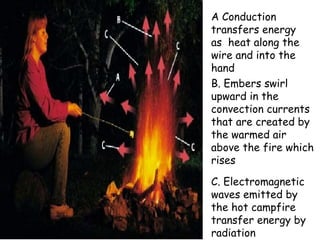
A Conduction transfers energy as  heat along the wire and into the hand B. Embers swirl upward in the convection currents that are created by the warmed air above the fire which rises C. Electromagnetic waves emitted by the hot campfire transfer energy by radiation
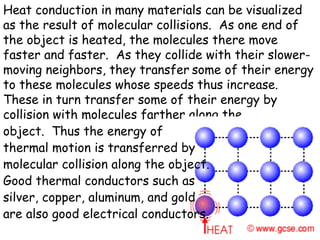
Heat Transfer by Conduction   Conduction is the transfer of thermal energy without any net movement of the material itself. When a metal poker is put in a hot fire, the exposed end of the poker soon becomes hot as well, even though it is not directly in contact with the source of heat.  We say that heat has been conducted from the hot end to the cold end.
object.  Thus the energy of thermal motion is transferred by molecular collision along the object. Good thermal conductors such as silver, copper, aluminum, and gold are also good electrical conductors.   Heat conduction in many materials can be visualized as the result of molecular collisions.  As one end of the object is heated, the molecules there move faster and faster.  As they collide with their slower-moving neighbors, they transfer   some of their energy to these molecules whose speeds thus increase. These in turn transfer some of their energy by collision with molecules farther along the
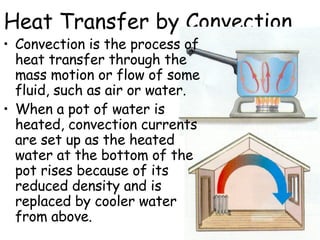
Heat Transfer by Convection Convection is the process of heat transfer through the mass motion or flow of some fluid, such as air or water.   When a pot of water is heated, convection currents are set up as the heated water at the bottom of the pot rises because of its reduced density and is replaced by cooler water from above.
Heat Transfer by Convection Although liquids and gases are generally not very good conductors of heat, they can transfer heat quite rapidly by convection.  Convection is the process whereby heat is transferred by the mass movement of molecules from one place to another.  Whereas conduction involves molecules (and/or electrons) moving only over small distances and colliding, convection involves the movement of molecules over large distances.
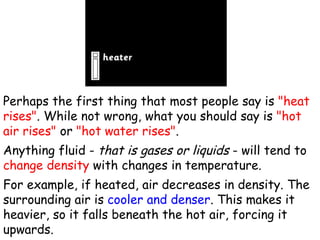
Perhaps the first thing that most people say is  "heat rises" . While not wrong, what you should say is  "hot air rises"  or  "hot water rises" .  Anything fluid -  that is gases or liquids  - will tend to  change density  with changes in temperature.  For example, if heated, air decreases in density. The surrounding air is  cooler and denser . This makes it heavier, so it falls beneath the hot air, forcing it upwards.
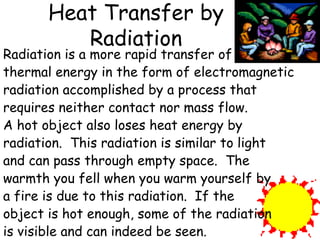
Heat Transfer by Radiation Radiation is a more rapid transfer of thermal energy in the form of electromagnetic radiation accomplished by a process that requires neither contact nor mass flow.  A hot object also loses heat energy by radiation.  This radiation is similar to light and can pass through empty space.  The warmth you fell when you warm yourself by a fire is due to this radiation.  If the object is hot enough, some of the radiation is visible and can indeed be seen.
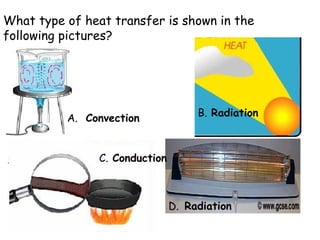
What type of heat transfer is shown in the following pictures? A. B. C. D. Convection Radiation Radiation Conduction
Conductors and Insulators Conductors readily transfer heat energy. Gases are the poorest conductors Solids are the best conductors Insulators are poor conductors of heat energy. Fiberglass batting is better than air alone because it traps air.

02-22-08 - Conduction, Convection & Radiation

  • 1.
    Conduction, Convection, andRadiation Heat Energy Transfer
  • 2.
    Methods of HeatEnergy Transfer Conduction is the transfer of heat energy by Between particles of objects in direct contact Convection is the transfer of heat energy by the movement of fluids(gas or liquid) convection currents due to hot fluid rising and cold fluid sinking Radiation is the transfer of heat energy by electromagnetic waves does not involve the movement of matter
  • 3.
    A Conduction transfersenergy as heat along the wire and into the hand B. Embers swirl upward in the convection currents that are created by the warmed air above the fire which rises C. Electromagnetic waves emitted by the hot campfire transfer energy by radiation
  • 4.
    Heat Transfer byConduction Conduction is the transfer of thermal energy without any net movement of the material itself. When a metal poker is put in a hot fire, the exposed end of the poker soon becomes hot as well, even though it is not directly in contact with the source of heat. We say that heat has been conducted from the hot end to the cold end.
  • 5.
    object. Thusthe energy of thermal motion is transferred by molecular collision along the object. Good thermal conductors such as silver, copper, aluminum, and gold are also good electrical conductors. Heat conduction in many materials can be visualized as the result of molecular collisions. As one end of the object is heated, the molecules there move faster and faster. As they collide with their slower-moving neighbors, they transfer some of their energy to these molecules whose speeds thus increase. These in turn transfer some of their energy by collision with molecules farther along the
  • 6.
    Heat Transfer byConvection Convection is the process of heat transfer through the mass motion or flow of some fluid, such as air or water. When a pot of water is heated, convection currents are set up as the heated water at the bottom of the pot rises because of its reduced density and is replaced by cooler water from above.
  • 7.
    Heat Transfer byConvection Although liquids and gases are generally not very good conductors of heat, they can transfer heat quite rapidly by convection. Convection is the process whereby heat is transferred by the mass movement of molecules from one place to another. Whereas conduction involves molecules (and/or electrons) moving only over small distances and colliding, convection involves the movement of molecules over large distances.
  • 8.
    Perhaps the firstthing that most people say is "heat rises" . While not wrong, what you should say is "hot air rises" or "hot water rises" . Anything fluid - that is gases or liquids - will tend to change density with changes in temperature. For example, if heated, air decreases in density. The surrounding air is cooler and denser . This makes it heavier, so it falls beneath the hot air, forcing it upwards.
  • 9.
    Heat Transfer byRadiation Radiation is a more rapid transfer of thermal energy in the form of electromagnetic radiation accomplished by a process that requires neither contact nor mass flow. A hot object also loses heat energy by radiation. This radiation is similar to light and can pass through empty space. The warmth you fell when you warm yourself by a fire is due to this radiation. If the object is hot enough, some of the radiation is visible and can indeed be seen.
  • 10.
    What type ofheat transfer is shown in the following pictures? A. B. C. D. Convection Radiation Radiation Conduction
  • 11.
    Conductors and InsulatorsConductors readily transfer heat energy. Gases are the poorest conductors Solids are the best conductors Insulators are poor conductors of heat energy. Fiberglass batting is better than air alone because it traps air.