MEEN 801
HEAT TRANSFER
• Engr. Dr. M. U. Kaisan
• mukaisan@abu.edu.ng
• Room 11, Shell Chair Office Complex, Department of Mechanical Engineering,
• Ahmadu Bello University, Zaria, Nigeria
2019/20 Session
RADIATION
- thermal energy that is transferred in the form of
(electromagnetic) rays or waves and can occur in solids,
liquids, or gases.
- All objects emit radiation, but hot objects emit more than
cool objects. The hotter the object, the more radiation it
emits.
There is NO TOUCHING of the object, you can feel the
thermal energy without touching it. (emit means gives off)
example: energy from the sun by rays or heat from a fire.
CONDUCTION
-the direct transfer of thermal energy that occurs when molecules
bump into one another when two substances are touching. When
fast moving molecules (warmer object) bump into slower moving
molecules (cooler object) it transfers some of it’s energy..
The closer together the molecules in a substance are, the more
effectively they can conduct heat.
Conduction (cont.)
It works well in solids such as metals where the molecules are closer
together (because they only have to move a short distance to bump
into each other), but not as well in gases or liquids. Thermal energy
ALWAYS travels from HOT to COLD!
example: hot sand/pavement transferring to your feet when you walk
on it, or ice melting in your hand
CONVECTION
• The transfer of thermal energy by the flow of gases or liquids. In
gas and liquids, molecules can move much more easily than they
can in a solid, as a result, the more energetic molecules can travel
from one place to another, and carry their energy along with them.
Convection (cont.)
• example: pot of water boiling (because the molecules are farther
apart in the warm water, this water is less dense than the cooler
water. As a result, the warm water rises and is replaced at the bottom
of the pot by cooler water.) or water in a bath tub, preheating an
oven.
Heat Transfer QUIZ
1. Microwaving method
2. Warmth from a fire
3. Accidentally touching a hot light bulb
4. Sunbathing on the beach
5. Noodles boiling in a pot
6. “Nuking” your hot chocolate
7. Burning your finger as you remove it from the microwave
8. Air popping method
9. A pot sitting on a HOT stovetop eye
10. Jiffy Pop method
Condensed Heat Transfer Notes
• RADIATION
- electromagnetic rays or waves
- solids, liquids or gases
- EMIT (to give off)
- NO TOUCHING
EX: sun’s rays, campfire, microwave, popcorn method
Condensed Notes (cont.)
• CONDUCTION
- direct transfer of heat
- TOUCHING or direct contact
- faster molecules = warmer temperatures
slower molecules = cooler temperatures
- TRANSFERS HOT TO COLD
- Solids = more molecules = best conductors
EX: walking across hot pavement / sand
touching a HOT stovetop eye
Jiffy Pop popcorn
Condensed Notes (cont.)
• CONVECTION
- gases & liquids
- MOVEMENT to transfer heat
- warm air rises, cool air is lower
EX: preheating an oven
cooking noodles in boiling water
Air Pop popcorn
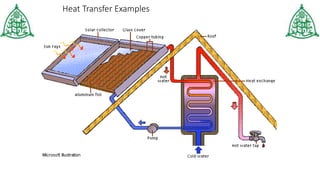
Heat Transfer Examples
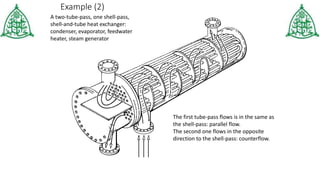
Example (2)
A two-tube-pass, one shell-pass,
shell-and-tube heat exchanger:
condenser, evaporator, feedwater
heater, steam generator
The first tube-pass flows is in the same as
the shell-pass: parallel flow.
The second one flows in the opposite
direction to the shell-pass: counterflow.
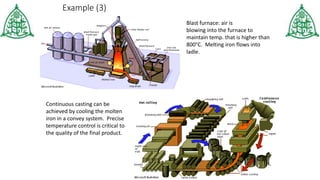
Example (3)
Blast furnace: air is
blowing into the furnace to
maintain temp. that is higher than
800°C. Melting iron flows into
ladle.
Continuous casting can be
achieved by cooling the molten
iron in a convey system. Precise
temperature control is critical to
the quality of the final product.
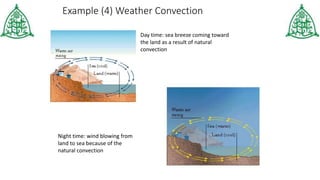
Example (4) Weather Convection
Day time: sea breeze coming toward
the land as a result of natural
convection
Night time: wind blowing from
land to sea because of the
natural convection
THANK YOU

Introduction to Heat_Transfer_ppt.ppt

  • 1.
    MEEN 801 HEAT TRANSFER •Engr. Dr. M. U. Kaisan • mukaisan@abu.edu.ng • Room 11, Shell Chair Office Complex, Department of Mechanical Engineering, • Ahmadu Bello University, Zaria, Nigeria 2019/20 Session
  • 2.
    RADIATION - thermal energythat is transferred in the form of (electromagnetic) rays or waves and can occur in solids, liquids, or gases. - All objects emit radiation, but hot objects emit more than cool objects. The hotter the object, the more radiation it emits. There is NO TOUCHING of the object, you can feel the thermal energy without touching it. (emit means gives off) example: energy from the sun by rays or heat from a fire.
  • 3.
    CONDUCTION -the direct transferof thermal energy that occurs when molecules bump into one another when two substances are touching. When fast moving molecules (warmer object) bump into slower moving molecules (cooler object) it transfers some of it’s energy.. The closer together the molecules in a substance are, the more effectively they can conduct heat.
  • 4.
    Conduction (cont.) It workswell in solids such as metals where the molecules are closer together (because they only have to move a short distance to bump into each other), but not as well in gases or liquids. Thermal energy ALWAYS travels from HOT to COLD! example: hot sand/pavement transferring to your feet when you walk on it, or ice melting in your hand
  • 5.
    CONVECTION • The transferof thermal energy by the flow of gases or liquids. In gas and liquids, molecules can move much more easily than they can in a solid, as a result, the more energetic molecules can travel from one place to another, and carry their energy along with them.
  • 6.
    Convection (cont.) • example:pot of water boiling (because the molecules are farther apart in the warm water, this water is less dense than the cooler water. As a result, the warm water rises and is replaced at the bottom of the pot by cooler water.) or water in a bath tub, preheating an oven.
  • 7.
    Heat Transfer QUIZ 1.Microwaving method 2. Warmth from a fire 3. Accidentally touching a hot light bulb 4. Sunbathing on the beach 5. Noodles boiling in a pot 6. “Nuking” your hot chocolate 7. Burning your finger as you remove it from the microwave 8. Air popping method 9. A pot sitting on a HOT stovetop eye 10. Jiffy Pop method
  • 8.
    Condensed Heat TransferNotes • RADIATION - electromagnetic rays or waves - solids, liquids or gases - EMIT (to give off) - NO TOUCHING EX: sun’s rays, campfire, microwave, popcorn method
  • 9.
    Condensed Notes (cont.) •CONDUCTION - direct transfer of heat - TOUCHING or direct contact - faster molecules = warmer temperatures slower molecules = cooler temperatures - TRANSFERS HOT TO COLD - Solids = more molecules = best conductors EX: walking across hot pavement / sand touching a HOT stovetop eye Jiffy Pop popcorn
  • 10.
    Condensed Notes (cont.) •CONVECTION - gases & liquids - MOVEMENT to transfer heat - warm air rises, cool air is lower EX: preheating an oven cooking noodles in boiling water Air Pop popcorn
  • 11.
  • 12.
    Example (2) A two-tube-pass,one shell-pass, shell-and-tube heat exchanger: condenser, evaporator, feedwater heater, steam generator The first tube-pass flows is in the same as the shell-pass: parallel flow. The second one flows in the opposite direction to the shell-pass: counterflow.
  • 13.
    Example (3) Blast furnace:air is blowing into the furnace to maintain temp. that is higher than 800°C. Melting iron flows into ladle. Continuous casting can be achieved by cooling the molten iron in a convey system. Precise temperature control is critical to the quality of the final product.
  • 14.
    Example (4) WeatherConvection Day time: sea breeze coming toward the land as a result of natural convection Night time: wind blowing from land to sea because of the natural convection
  • 15.