A component of partial denture that connects
parts of partial removable prosthesis at one side
of arch with those on opposite side.
It’s a unit to which all other parts are attached
directly or indirectly.
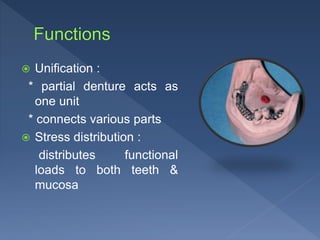
 Unification :
* partial denture acts as
one unit
* connects various parts
 Stress distribution :
distributes functional
loads to both teeth &
mucosa
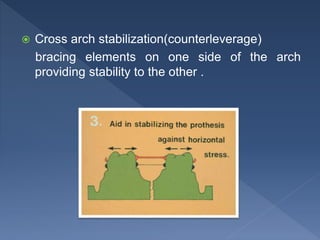
 Cross arch stabilization(counterleverage)
bracing elements on one side of the arch
providing stability to the other .
 Rigidity :
- chrome-cobalt > gold
alloys; cast > wrought
- 1/2 round > 1/2 pear
shaped > flat bars
* to increase rigidity :
- Increase the bulk as the
length increases
- corrugate linguoplate or
rugae areas
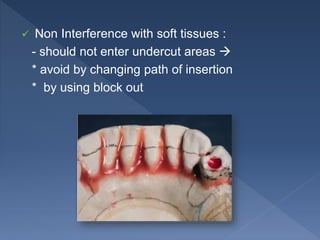
 Non Interference with soft tissues :
- should not enter undercut areas 
* avoid by changing path of insertion
* by using block out
- avoid terminating on free gingival margin
* borders of maxillary connector should be
placed a minimum of 6 mm away from and
parallel to the gingival margins.
* border of mandibular connector should be
located a minimum of 4 mm below the gingival
margin.
- avoid terminating on hard structures such as
the mid palatal suture or mandibular tori.
- avoid terminating on lingual frenum & the
movable soft palate.
 Minimize food impaction.
 Unobtrusive :
- line angles and edges should be smooth and
rounded
- borders should not interfere with speech
 Bar shaped :
It is long, narrow, and thick.
In cross section bars are ½ round, ½ oval or ½
pear in shape.
The thickness of a bar should be at least 6
gauge (4.11 mm) at its greatest dimension.
The minimum width of a bar is 4 mm, but they
must usually be wider than this for adequate
rigidity.
 Strap ( plate shaped ) :
It is long, wide and thin.
The width of a strap or plate varies from 6 -8
mm to the entire length of the
palate.
The thickest portion of straps or plates is 22 -24
gauge (0.64-0.51 mm).
 Lingual Bar
 Lingual Plate
 Sublingual bar
 Lingual bar with cingulum bar (continuous bar)
 Labial bar
 Swing lock design
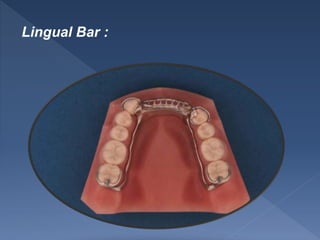
Lingual Bar :
Most common in mandible (use whenever
possible).
Shape:
flat on tissue side, convex or tear-drop on
tongue side (1/2 pear shape, with thin edge
toward teeth).
Size :
occluso-gingival width 4 to 6 mm, thickness l.5
to 2 mm.
Position:
located above moving tissue but as far below
the gingival tissue as possible (3-4 mm or more
below FGM).
* Patient lifts tongue  activates floor of mouth :
measure from tip of probe to free gingival
margin or make impression with lifted tongue &
measure on cast.
* Eliminates impingement  wax spacer (relief)
placed under major connector.
Indication :
the lingual bar should be used for mandibular
RPD where sufficient space exists between the
slightly elevated alveolar lingual sulcus and the
lingual gingival tissue (more than 8 mm).
Contraindications :
• remaining natural anterior teeth severely
tilted lingually
• interfering lingual tori
• high attachment of lingual frenum
• interference with elevation of the floor of the
mouth during functional movements (< 8 mm)
Lingual Plate :
 Lingual bar with extension over cingulum of
anterior teeth (used where a lingual bar cannot
be used).
 Inferior border at the ascertained height of the
alveolar lingual sulcus when the patient's
tongue is slightly elevated.
 Rest at each end of lingual plate.
 It prevents forces being directed facially.
 Easier denture tooth addition than bar.
Indications :
 high floor of the mouth(< 8 mm)
 prominent lingual frenum
 lingual tori
 the residual ridges in Class I arch have
undergone such vertical resorbtion that they will
offer only minimal resistance to horizontal
rotations of the denture through its bases.
 for using periodontally weakened teeth to
furnish support to prosthesis and to help
resist horizontal rotation of the distal extension
type of denture (act as periodontal splint).
Mandibular Lingual Bar with Continuous
Bar (Cingulum Bar)
(Kennedy Bar, Double Lingual Bar)
 Lingual bar with secondary bar on cingula of
anterior teeth.
 Secondary bar acts as indirect retainer.
Indications :
 When a linguoplates otherwise indicated but the
axial alignment of anterior teeth is such that
excessive block out of interproximal undercuts
would be required.
 When wide diastema exists between
mandibular anterior teeth and a linguoplate
would objectionably display metal in a frontal
view.
 Whenever it is necessary for the palatal
connector to make contact with the teeth for
support, definite tooth supported by definite rest
seats should be provided.
 Terminate 6.0 mm or more from free gingival
margin when possible.
 Anterior-Posterior Palatal Strap
 Palatal plate-type connector
 Single palatal strap
 U-shaped palatal connector (Anterior Palatal
Strap)
 Single palatal bar
 Anterior-posterior palatal bar
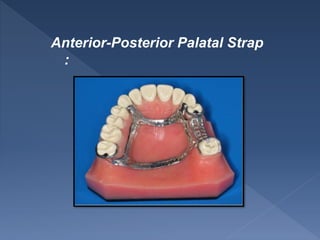
Anterior-Posterior Palatal Strap
:
 maximum rigidity - minimum bulk
 used in most cases - especially torus palatinus.
Indications :
 Class I and II arches in which excellent
abutment and residual ridge support exists,
and direct retention can be made adequate
without the need for indirect retention.
 Long edentulous spans in Class II, modification
1 arches.
 Class IV arches.
 Inoperable palatal tori that do not extend
posteriorly to the junction of the hard and soft
palates.
Contraindication :
when there is an inoperable maxillary torus that
extends posteriorly to the soft palate.
Anterior-Posterior Palatal Bar :
 A narrow (A-P) variation of anterior-posterior
palatal strap  double palatal bar connector,
requires greater bulk for rigidity.
 More objectionable to the patient.
 Strap connectors provide greater distribution of
stresses.
Palatal Plate Type Connector :
 Covers one half or more of the hard palate
 Maximum tissue support
 Connector of choice in long distal extension
cases
 Six or less anterior teeth remain
 Greater stability and stress distribution
 Not used with torus
 Increases retention
Connector should :
 be fabricated of uniformly thin metal
 have accurate anatomic reproduction of the
rugae
 improves strength and rigidity 
 cover same area as complete denture
posteriorly
 have large surface area of mucosal contact
 improves potential for retention 
Forms :
 A cast plate between two or more edentulous
areas.
 A complete or partial cast plate that extends
posteriorly to the junction of the hard and soft
palate.
 An anterior palatal connector with a provision
for extending an acrylic resin denture base
posteriorly.
Indications :
 Abutments are periodontally involved
 Maximum stress distribution is needed
 Flabby tissue
 Shallow palatal vault
Single Palatal Strap :
 usually use for Class III & IV cases.
 should be 8mm wide or approximately as wide
as the combined width of a maxillary premolar
and first molar.
 confined within an area bounded by the four
principal rests.
 never use in cases involving distal extensions
since it must be made bulky for rigidity.
 relief may be required over bony midline.
 not used with torus.
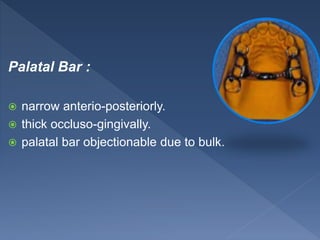
Palatal Bar :
 narrow anterio-posteriorly.
 thick occluso-gingivally.
 palatal bar objectionable due to bulk.
U-Shaped Palatal Connector
“ Horse Shoe”
 poor connector
 never use unless absolutely necessary
 requires bulk in the rugae area (where the
tongue requires freedom) for rigidity
 too flexible
 allows movement at the posterior
 traumatic to the residual ridge
 use only where torus prohibits other connector
& extends to the posterior limit of the hard
palate
Chapter 5 Major and Minor Connectors,
McCracken's Removable Partial
Prosthodontics, 11th edition.

Ola Qatu
We’am Faroun
Third year Dental
students at AQU

RPD Major Connectors

  • 2.
    A component ofpartial denture that connects parts of partial removable prosthesis at one side of arch with those on opposite side. It’s a unit to which all other parts are attached directly or indirectly.
  • 3.
     Unification : *partial denture acts as one unit * connects various parts  Stress distribution : distributes functional loads to both teeth & mucosa
  • 4.
     Cross archstabilization(counterleverage) bracing elements on one side of the arch providing stability to the other .
  • 5.
     Rigidity : -chrome-cobalt > gold alloys; cast > wrought - 1/2 round > 1/2 pear shaped > flat bars * to increase rigidity : - Increase the bulk as the length increases - corrugate linguoplate or rugae areas
  • 6.
     Non Interferencewith soft tissues : - should not enter undercut areas  * avoid by changing path of insertion * by using block out
  • 7.
    - avoid terminatingon free gingival margin * borders of maxillary connector should be placed a minimum of 6 mm away from and parallel to the gingival margins. * border of mandibular connector should be located a minimum of 4 mm below the gingival margin.
  • 8.
    - avoid terminatingon hard structures such as the mid palatal suture or mandibular tori. - avoid terminating on lingual frenum & the movable soft palate.
  • 9.
     Minimize foodimpaction.  Unobtrusive : - line angles and edges should be smooth and rounded - borders should not interfere with speech
  • 10.
     Bar shaped: It is long, narrow, and thick. In cross section bars are ½ round, ½ oval or ½ pear in shape. The thickness of a bar should be at least 6 gauge (4.11 mm) at its greatest dimension. The minimum width of a bar is 4 mm, but they must usually be wider than this for adequate rigidity.
  • 11.
     Strap (plate shaped ) : It is long, wide and thin. The width of a strap or plate varies from 6 -8 mm to the entire length of the palate. The thickest portion of straps or plates is 22 -24 gauge (0.64-0.51 mm).
  • 12.
     Lingual Bar Lingual Plate  Sublingual bar  Lingual bar with cingulum bar (continuous bar)  Labial bar  Swing lock design
  • 13.
  • 14.
    Most common inmandible (use whenever possible). Shape: flat on tissue side, convex or tear-drop on tongue side (1/2 pear shape, with thin edge toward teeth). Size : occluso-gingival width 4 to 6 mm, thickness l.5 to 2 mm.
  • 15.
    Position: located above movingtissue but as far below the gingival tissue as possible (3-4 mm or more below FGM). * Patient lifts tongue  activates floor of mouth : measure from tip of probe to free gingival margin or make impression with lifted tongue & measure on cast. * Eliminates impingement  wax spacer (relief) placed under major connector.
  • 16.
    Indication : the lingualbar should be used for mandibular RPD where sufficient space exists between the slightly elevated alveolar lingual sulcus and the lingual gingival tissue (more than 8 mm). Contraindications : • remaining natural anterior teeth severely tilted lingually • interfering lingual tori • high attachment of lingual frenum • interference with elevation of the floor of the mouth during functional movements (< 8 mm)
  • 17.
  • 18.
     Lingual barwith extension over cingulum of anterior teeth (used where a lingual bar cannot be used).  Inferior border at the ascertained height of the alveolar lingual sulcus when the patient's tongue is slightly elevated.  Rest at each end of lingual plate.  It prevents forces being directed facially.  Easier denture tooth addition than bar.
  • 19.
    Indications :  highfloor of the mouth(< 8 mm)  prominent lingual frenum  lingual tori  the residual ridges in Class I arch have undergone such vertical resorbtion that they will offer only minimal resistance to horizontal rotations of the denture through its bases.  for using periodontally weakened teeth to furnish support to prosthesis and to help resist horizontal rotation of the distal extension type of denture (act as periodontal splint).
  • 20.
    Mandibular Lingual Barwith Continuous Bar (Cingulum Bar) (Kennedy Bar, Double Lingual Bar)  Lingual bar with secondary bar on cingula of anterior teeth.  Secondary bar acts as indirect retainer.
  • 21.
    Indications :  Whena linguoplates otherwise indicated but the axial alignment of anterior teeth is such that excessive block out of interproximal undercuts would be required.  When wide diastema exists between mandibular anterior teeth and a linguoplate would objectionably display metal in a frontal view.
  • 22.
     Whenever itis necessary for the palatal connector to make contact with the teeth for support, definite tooth supported by definite rest seats should be provided.  Terminate 6.0 mm or more from free gingival margin when possible.
  • 23.
     Anterior-Posterior PalatalStrap  Palatal plate-type connector  Single palatal strap  U-shaped palatal connector (Anterior Palatal Strap)  Single palatal bar  Anterior-posterior palatal bar
  • 24.
  • 25.
     maximum rigidity- minimum bulk  used in most cases - especially torus palatinus. Indications :  Class I and II arches in which excellent abutment and residual ridge support exists, and direct retention can be made adequate without the need for indirect retention.
  • 26.
     Long edentulousspans in Class II, modification 1 arches.  Class IV arches.  Inoperable palatal tori that do not extend posteriorly to the junction of the hard and soft palates. Contraindication : when there is an inoperable maxillary torus that extends posteriorly to the soft palate.
  • 27.
  • 28.
     A narrow(A-P) variation of anterior-posterior palatal strap  double palatal bar connector, requires greater bulk for rigidity.  More objectionable to the patient.  Strap connectors provide greater distribution of stresses.
  • 29.
    Palatal Plate TypeConnector :
  • 30.
     Covers onehalf or more of the hard palate  Maximum tissue support  Connector of choice in long distal extension cases  Six or less anterior teeth remain  Greater stability and stress distribution  Not used with torus  Increases retention
  • 31.
    Connector should : be fabricated of uniformly thin metal  have accurate anatomic reproduction of the rugae  improves strength and rigidity   cover same area as complete denture posteriorly  have large surface area of mucosal contact  improves potential for retention 
  • 32.
    Forms :  Acast plate between two or more edentulous areas.  A complete or partial cast plate that extends posteriorly to the junction of the hard and soft palate.  An anterior palatal connector with a provision for extending an acrylic resin denture base posteriorly.
  • 33.
    Indications :  Abutmentsare periodontally involved  Maximum stress distribution is needed  Flabby tissue  Shallow palatal vault
  • 34.
  • 35.
     usually usefor Class III & IV cases.  should be 8mm wide or approximately as wide as the combined width of a maxillary premolar and first molar.  confined within an area bounded by the four principal rests.  never use in cases involving distal extensions since it must be made bulky for rigidity.  relief may be required over bony midline.  not used with torus.
  • 36.
    Palatal Bar : narrow anterio-posteriorly.  thick occluso-gingivally.  palatal bar objectionable due to bulk.
  • 37.
  • 38.
     poor connector never use unless absolutely necessary  requires bulk in the rugae area (where the tongue requires freedom) for rigidity  too flexible
  • 39.
     allows movementat the posterior  traumatic to the residual ridge  use only where torus prohibits other connector & extends to the posterior limit of the hard palate
  • 40.
    Chapter 5 Majorand Minor Connectors, McCracken's Removable Partial Prosthodontics, 11th edition. 
  • 41.
    Ola Qatu We’am Faroun Thirdyear Dental students at AQU