Stages, Theories, and Communication
Ahyana Presley | Olivia Criss |
Thuy Le | Dominic Interlicchia

November 18, 2013
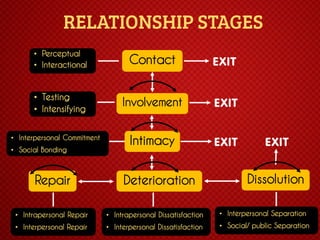
• Perceptual
• Interactional

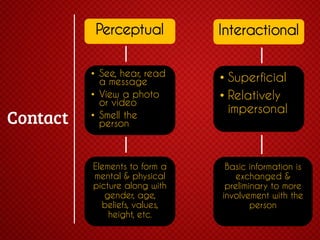
Contact

EXIT

• Testing
• Intensifying

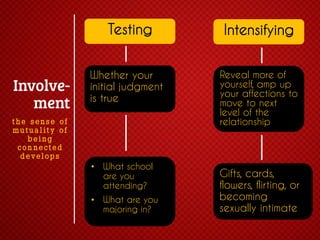
Involvement

EXIT

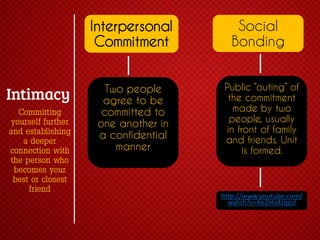
Intimacy

EXIT

• Interpersonal Commitment

• Social Bonding

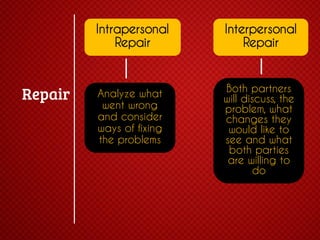
Repair

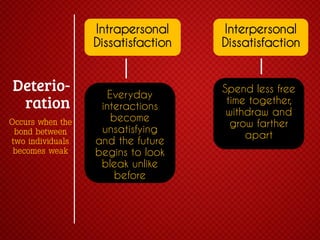
Deterioration

EXIT
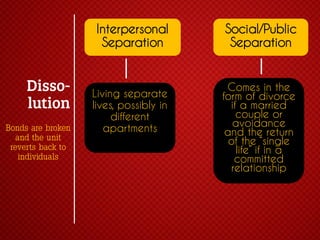
Dissolution

• Intrapersonal Repair

• Intrapersonal Dissatisfaction

• Interpersonal Separation

• Interpersonal Repair

• Interpersonal Dissatisfaction

• Social/ public Separation
Perceptual
• See, hear, read
a message
• View a photo
or video
• Smell the
person

Elements to form a
mental & physical
picture along with
gender, age,
beliefs, values,
height, etc.

Interactional
• Superficial
• Relatively
impersonal

Basic information is
exchanged &
preliminary to more
involvement with the
person
Testing
Whether your
initial judgment
is true
the sense of
mutua lity of
being
con nected
develops

• What school
are you
attending?
• What are you
majoring in?

Intensifying
Reveal more of
yourself, amp up
your affections to
move to next
level of the
relationship

Gifts, cards,
flowers, flirting, or
becoming
sexually intimate
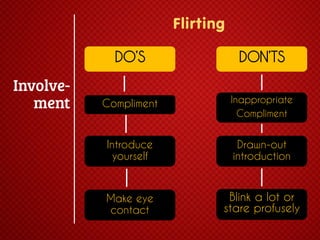
Flirting
DO’S

DON’TS

Compliment

Inappropriate
Compliment

Introduce
yourself

Drawn-out
introduction

Make eye
contact

Blink a lot or
stare profusely
Interpersonal
Commitment

Committing
yourself further
and establishing
a deeper
connection with
the person who
becomes your
best or closest
friend

Two people
agree to be
committed to
one another in
a confidential
manner

Social
Bonding
Public “outing” of
the commitment
made by two
people, usually
in front of family
and friends. Unit
is formed.

http://www.youtube.com/
watch?v=Ke2Ho4JqgsI
Intrapersonal
Dissatisfaction

Occurs when the
bond between
two individuals
becomes weak

Everyday
interactions
become
unsatisfying
and the future
begins to look
bleak unlike
before

Interpersonal
Dissatisfaction

Spend less free
time together,
withdraw and
grow farther
apart
Intrapersonal
Repair

Interpersonal
Repair

Analyze what
went wrong
and consider
ways of fixing
the problems

Both partners
will discuss, the
problem, what
changes they
would like to
see and what
both parties
are willing to
do
Interpersonal
Separation

Bonds are broken
and the unit
reverts back to
individuals

Living separate
lives, possibly in
different
apartments

Social/Public
Separation

Comes in the
form of divorce
if a married
couple or
avoidance
and the return
of the “single
life” if in a
committed
relationship
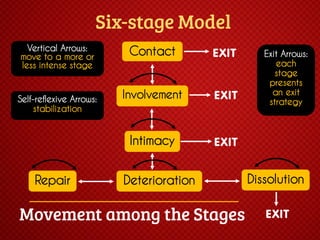
Vertical Arrows:
move to a more or
less intense stage

Repair

EXIT

Involvement

EXIT

Intimacy

Self-reflexive Arrows:
stabilization

Contact

EXIT

Deterioration

Exit Arrows:
each
stage
presents
an exit
strategy

Dissolution
EXIT
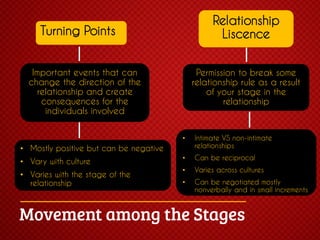
Relationship
Liscence

Turning Points
Important events that can
change the direction of the
relationship and create
consequences for the
individuals involved

Permission to break some
relationship rule as a result
of your stage in the
relationship

•

Intimate VS non-intimate
relationships

•

Can be reciprocal

•

Varies across cultures

•

Can be negotiated mostly
nonverbally and in small increments

• Mostly positive but can be negative
• Vary with culture
• Varies with the stage of the
relationship
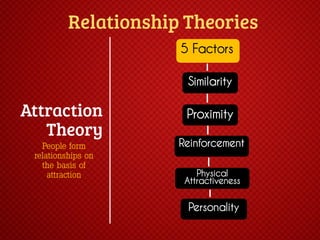
5 Factors
Similarity

Proximity
People form
relationships on
the basis of
attraction

Reinforcement
Physical
Attractiveness

Personality
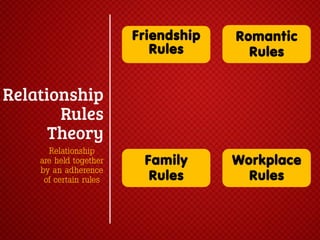
Friendship
Rules

Relationship
are held together
by an adherence
of certain rules

Romantic
Rules

Family
Rules

Workplace
Rules
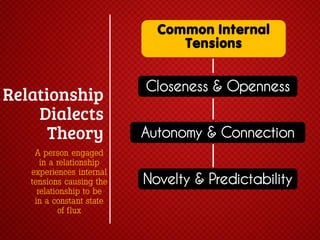
Common Internal
Tensions

Closeness & Openness
Autonomy & Connection
A person engaged
in a relationship
experiences internal
tensions causing the
relationship to be
in a constant state
of flux

Novelty & Predictability
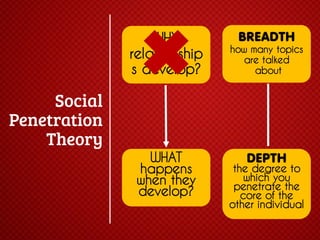
WHY
relationship
s develop?

WHAT
happens
when they
develop?

BREADTH

how many topics
are talked
about

DEPTH

the degree to
which you
penetrate the
core of the
other individual
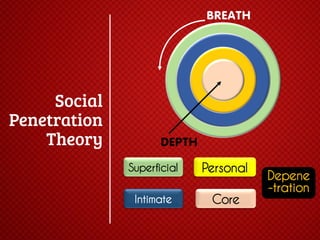
BREATH

DEPTH
Superficial

Personal

Intimate

Core

Depene
-tration
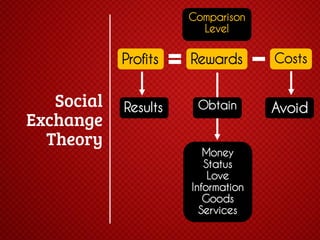
Comparison
Level

Profits

Rewards

Costs

Results

Obtain

Avoid

Money
Status
Love
Information
Goods
Services
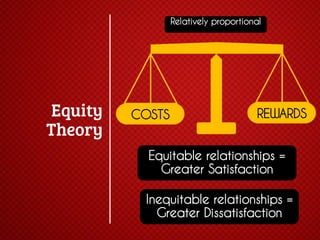
Relatively proportional

COSTS

REWARDS

Equitable relationships =
Greater Satisfaction
Inequitable relationships =
Greater Dissatisfaction
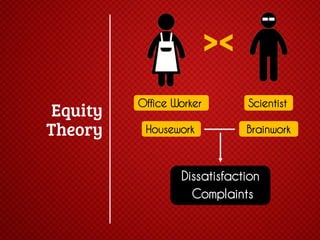
><
Office Worker

Scientist

Housework

Brainwork

Dissatisfaction
Complaints
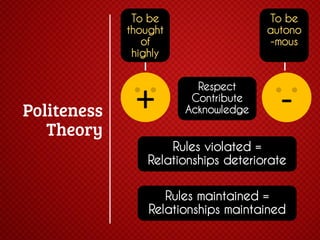
To be
autono
-mous

To be
thought
of
highly

+

Respect
Contribute
Acknowledge

-

Rules violated =
Relationships deteriorate
Rules maintained =
Relationships maintained
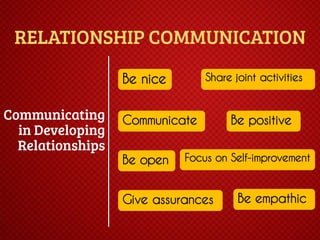
Be nice

Share joint activities

Communicate
Be open

Be positive

Focus on Self-improvement

Give assurances

Be empathic
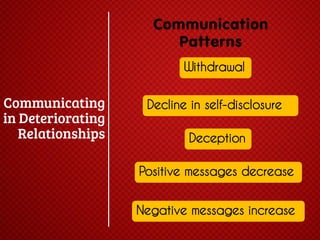
Communication
Patterns
Withdrawal

Decline in self-disclosure
Deception
Positive messages decrease

Negative messages increase
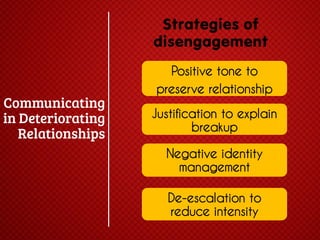
Strategies of
disengagement
Positive tone to
preserve relationship

Justification to explain
breakup
Negative identity
management
De-escalation to
reduce intensity
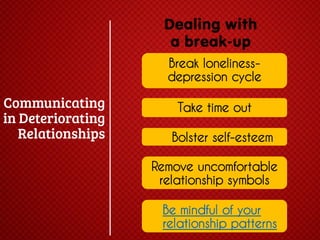
Dealing with
a break-up
Break lonelinessdepression cycle

Take time out
Bolster self-esteem

Remove uncomfortable
relationship symbols
Be mindful of your
relationship patterns
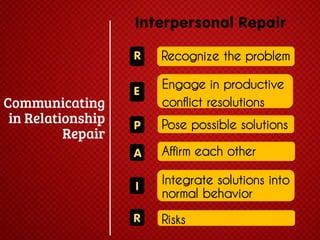
Interpersonal Repair
R

Recognize the problem

E

Engage in productive
conflict resolutions

P

Pose possible solutions

A

Affirm each other

I

Integrate solutions into
normal behavior

R

Risks
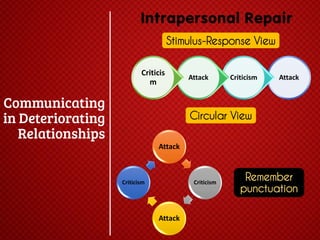
Intrapersonal Repair
Stimulus-Response View
Criticis
m

Attack

Criticism

Attack

Circular View
Attack

Criticism

Criticism

Attack

Remember
punctuation
Interpersonal Relationship

Interpersonal Relationship