INTERPERSONAL RELATIONSHIPS: STAGES OF RELATIONSHIP DEVELOPMENT  CHAPTER 5 LESSON 1
Relationship Stages  There are six different stages in a relationship and they are as follows: Contact Involvement  Intimacy Deterioration Repair  Dissolution
CONTACT   There are three stages of contact. Perceptual contact  This is where you either see, hear, or read something about that person forming a physical picture in your mind  Interactional Contact  Contact here is usually superficial and impersonal  Here you exchange basic information and engage in more of an in-depth communication This is the main stage for ‘first impressions’  We come into contact face to face and exchange in verbal and non verbal communication Flirting is a key in this stage if the partners are looking to develop their relationship into a romantic one.
THIS PICTURE EXPLAINS THE CONTACT STAGE.  THIS COUPLE IS ENJOYING A DRINK TOGETHER TRYING TO GET TO  KNOW EACH OTHER.  HENCE, THE FIRST IMPRESSION.
INVOLVEMNT  At the involvement stage a sense of mutuality develops.  It’s where you try to experiment and learn more about the person, whether it be romantically or just as a new friend  There are two types of levels of involvement:  Testing  This is when you and the significant other make initial judgments based on the contact and meetings to see if the relationship proves reasonable.  Intensifying  This usually happens when two people decide they want to try out a relationship. Both parties usually begin to reveal themselves and open up more to the other person. Some ways to do this are to increase contact, share tokens of affection and/or increase the level of personal attractiveness.  During the involvement stage there are many strategies that each partner uses to test and find out how the partner feels about a relationship.  Directness -  ask your partner exactly how they feel  Indirect-this may include joking about a shared future and how things might play out  Public presentation – go to public places such as resturants, bars, parties, or even around family and see how each other acts. Separation – separate yourself from each other and see how you feel about not having that person around  Third party – ask friends or family members how they would feel about your partner being a significant part of your life.
THIS PICTURE SHOWS HOW THE GIRL HAS BROUGHT HER NEW BOYFRIEND AROUND TO MEET HER PARENTS AND SEE IF THEY APPROVE.  THIS EXPLAINS THE THIRD PARTY STRAGTY AND INTISIFYING.
INITMACY   This is when you commit yourself further to a person and start to establish a serious relationship in which the person becomes more times than none your significant other.  The intimacy stage is divided into two phases: Interpersonal Commitment  Phase  This is when two people commit themselves to each other in a private way  Social Bonding Phase  In these phase the commitment is made public  This is when you and your partner become a unit or an identifiable pair  There are three main anxieties involved when it comes to intimacy  Security anxiety  - when one partner worries that the other may leave them for someone else  Fulfillment anxiety – this is when one partner or both are concerned that they may not be able to achieve a close or equal relationship.  Excitement anxiety – this is when the partners worry that boredom and routine may set in or that one or the other may loose freedom and feel trapped.
Deterioration This is characterized by the weakening of the bonds in a relationship.  There are two stages: Interpersonal Dissatisfaction  This is when the couple basically become dissatisfied with each other and little things start to bother them. These little annoyances begin to separate the couple.  Interpersonal Deterioration  This is when the two partners begin to withdraw from each other and grow further and further apart.
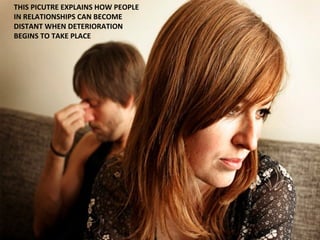
THIS PICUTRE EXPLAINS HOW PEOPLE IN RELATIONSHIPS CAN BECOME DISTANT WHEN DETERIORATION BEGINS TO TAKE PLACE
REPAIR  The relationship repair stage is not always pursued.  If it’s something that is pursued it usually occurs in the middle of the deterioration stage otherwise couples pass it right up and go straight into dissolution.  There are two repair phases: Intrapersonal repair At this stage you try to analyze what went wrong and start from square one.  This is the phase where you might consider changing behaviors and  expectations to compromise for the betterment of the relationship  Interpersonal repair This is when the partners will begin to talk things out, let the other know if you are happy or not with the changes that are taking place or are not taking place.  This is the stage where new agreements and new behaviors will be created.  Towards the end of this phase the couple will know whether it is worth it to seek outside help or if the relationship just wasn’t meant to be.
THIS PICTURE EXPLAINS HOW RELATIONSHIP REPAIR CAN BE PAINFUL AND HARD BUT IN SOME CASES WORTH THE TROUBLE.
DISSOLUTION   This is the final stage of the relationship.  Not everyone reaches this stage but some relationships do come to and end and the Dissolution stage explains that.  The couple involved must begin to look at themselves as individuals and no longer each other’s better halves  They must try to establish new and different lives.  The memory will always be there but time heals everything. There are two phases of dissolution: Interpersonal Separation This is when the couple may move into separate apartments and/or begin leading separate lives .  When and if this separation proves to be working better than the relationship itself the couple moves on the next phase.  Social/Public Separation  When just in a serious relationship this usually means a formal breakup and family and friends are told.  However when it comes to marriage, this phase usually means divorce.
THIS PICTURE SHOWS WHAT HAPPENS AT THE END OF THE DISSOLUTION STAGE.  WHETHER IT BE A PROMISE RING AT THE END OF A RELATIONSHIP OR A WEDDING BAND ENDING THE MARRIAGE.
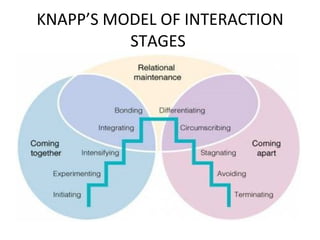
KNAPP’S MODEL OF INTERACTION STAGES  The model on the next page show the rise and fall of a relationship.  The first five stages are the coming together of the relationship.  Initiating – perceiving and interacting  Experimenting  - getting to know one another  Intensifying – starting to hang out more and see what each other likes and enjoys  Integrating  - share a lot more things, maybe show more significant tokens of affection Bonding  - in a relationship usually ends in marriage The next five stages are the falling apart or deterioration of a relationship Differentiating -  starting to think that the other person is changing and becoming different  Circumscribing  -  stop communicating so much in fear of what they will result in such as fights  Stagnating – communication usually ceases to exist  Avoiding – you begin to avoid each other as much as possible, this is where most breakups occur  Terminating – the relationship completely end and marriages usually end in divorce
KNAPP’S MODEL OF INTERACTION STAGES
 

MEGAN LEDET 215 YOUTEACH ASSIGNMENT

  • 1.
    INTERPERSONAL RELATIONSHIPS: STAGESOF RELATIONSHIP DEVELOPMENT CHAPTER 5 LESSON 1
  • 2.
    Relationship Stages There are six different stages in a relationship and they are as follows: Contact Involvement Intimacy Deterioration Repair Dissolution
  • 3.
    CONTACT There are three stages of contact. Perceptual contact This is where you either see, hear, or read something about that person forming a physical picture in your mind Interactional Contact Contact here is usually superficial and impersonal Here you exchange basic information and engage in more of an in-depth communication This is the main stage for ‘first impressions’ We come into contact face to face and exchange in verbal and non verbal communication Flirting is a key in this stage if the partners are looking to develop their relationship into a romantic one.
  • 4.
    THIS PICTURE EXPLAINSTHE CONTACT STAGE. THIS COUPLE IS ENJOYING A DRINK TOGETHER TRYING TO GET TO KNOW EACH OTHER. HENCE, THE FIRST IMPRESSION.
  • 5.
    INVOLVEMNT Atthe involvement stage a sense of mutuality develops. It’s where you try to experiment and learn more about the person, whether it be romantically or just as a new friend There are two types of levels of involvement: Testing This is when you and the significant other make initial judgments based on the contact and meetings to see if the relationship proves reasonable. Intensifying This usually happens when two people decide they want to try out a relationship. Both parties usually begin to reveal themselves and open up more to the other person. Some ways to do this are to increase contact, share tokens of affection and/or increase the level of personal attractiveness. During the involvement stage there are many strategies that each partner uses to test and find out how the partner feels about a relationship. Directness - ask your partner exactly how they feel Indirect-this may include joking about a shared future and how things might play out Public presentation – go to public places such as resturants, bars, parties, or even around family and see how each other acts. Separation – separate yourself from each other and see how you feel about not having that person around Third party – ask friends or family members how they would feel about your partner being a significant part of your life.
  • 6.
    THIS PICTURE SHOWSHOW THE GIRL HAS BROUGHT HER NEW BOYFRIEND AROUND TO MEET HER PARENTS AND SEE IF THEY APPROVE. THIS EXPLAINS THE THIRD PARTY STRAGTY AND INTISIFYING.
  • 7.
    INITMACY This is when you commit yourself further to a person and start to establish a serious relationship in which the person becomes more times than none your significant other. The intimacy stage is divided into two phases: Interpersonal Commitment Phase This is when two people commit themselves to each other in a private way Social Bonding Phase In these phase the commitment is made public This is when you and your partner become a unit or an identifiable pair There are three main anxieties involved when it comes to intimacy Security anxiety - when one partner worries that the other may leave them for someone else Fulfillment anxiety – this is when one partner or both are concerned that they may not be able to achieve a close or equal relationship. Excitement anxiety – this is when the partners worry that boredom and routine may set in or that one or the other may loose freedom and feel trapped.
  • 8.
    Deterioration This ischaracterized by the weakening of the bonds in a relationship. There are two stages: Interpersonal Dissatisfaction This is when the couple basically become dissatisfied with each other and little things start to bother them. These little annoyances begin to separate the couple. Interpersonal Deterioration This is when the two partners begin to withdraw from each other and grow further and further apart.
  • 9.
    THIS PICUTRE EXPLAINSHOW PEOPLE IN RELATIONSHIPS CAN BECOME DISTANT WHEN DETERIORATION BEGINS TO TAKE PLACE
  • 10.
    REPAIR Therelationship repair stage is not always pursued. If it’s something that is pursued it usually occurs in the middle of the deterioration stage otherwise couples pass it right up and go straight into dissolution. There are two repair phases: Intrapersonal repair At this stage you try to analyze what went wrong and start from square one. This is the phase where you might consider changing behaviors and expectations to compromise for the betterment of the relationship Interpersonal repair This is when the partners will begin to talk things out, let the other know if you are happy or not with the changes that are taking place or are not taking place. This is the stage where new agreements and new behaviors will be created. Towards the end of this phase the couple will know whether it is worth it to seek outside help or if the relationship just wasn’t meant to be.
  • 11.
    THIS PICTURE EXPLAINSHOW RELATIONSHIP REPAIR CAN BE PAINFUL AND HARD BUT IN SOME CASES WORTH THE TROUBLE.
  • 12.
    DISSOLUTION This is the final stage of the relationship. Not everyone reaches this stage but some relationships do come to and end and the Dissolution stage explains that. The couple involved must begin to look at themselves as individuals and no longer each other’s better halves They must try to establish new and different lives. The memory will always be there but time heals everything. There are two phases of dissolution: Interpersonal Separation This is when the couple may move into separate apartments and/or begin leading separate lives . When and if this separation proves to be working better than the relationship itself the couple moves on the next phase. Social/Public Separation When just in a serious relationship this usually means a formal breakup and family and friends are told. However when it comes to marriage, this phase usually means divorce.
  • 13.
    THIS PICTURE SHOWSWHAT HAPPENS AT THE END OF THE DISSOLUTION STAGE. WHETHER IT BE A PROMISE RING AT THE END OF A RELATIONSHIP OR A WEDDING BAND ENDING THE MARRIAGE.
  • 14.
    KNAPP’S MODEL OFINTERACTION STAGES The model on the next page show the rise and fall of a relationship. The first five stages are the coming together of the relationship. Initiating – perceiving and interacting Experimenting - getting to know one another Intensifying – starting to hang out more and see what each other likes and enjoys Integrating - share a lot more things, maybe show more significant tokens of affection Bonding - in a relationship usually ends in marriage The next five stages are the falling apart or deterioration of a relationship Differentiating - starting to think that the other person is changing and becoming different Circumscribing - stop communicating so much in fear of what they will result in such as fights Stagnating – communication usually ceases to exist Avoiding – you begin to avoid each other as much as possible, this is where most breakups occur Terminating – the relationship completely end and marriages usually end in divorce
  • 15.
    KNAPP’S MODEL OFINTERACTION STAGES
  • 16.