Interpersonal relations
.
Topic- Interpersonal relation
Contributor- Ms.Darshana Kumari Wankhede
DEPT OF CHILD HEALTH NURSING
SRMMCOLLEGE OF NURSING
Purpose of statement
At the end of the class the
students will be able to; Define IPR , Enlist the
purposes IPR , Describe the types of IPR ,
Explain the advantages , Describe the
disadvantages
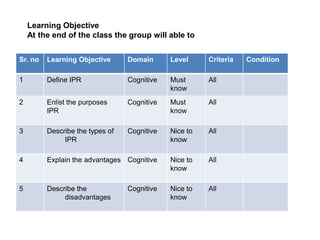
Sr. no Learning Objective Domain Level Criteria Condition
1 Define IPR Cognitive Must
know
All
2 Enlist the purposes
IPR
Cognitive Must
know
All
3 Describe the types of
IPR
Cognitive Nice to
know
All
4 Explain the advantages Cognitive Nice to
know
All
5 Describe the
disadvantages
Cognitive Nice to
know
All
Learning Objective
At the end of the class the group will able to
• No matter how hard you work or how many
brilliant ideas you may have, if you can’t connect
with the people who work around you, your
professional life will suffer.
.
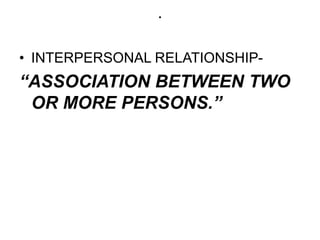
• INTERPERSONAL RELATIONSHIP-
“ASSOCIATION BETWEEN TWO
OR MORE PERSONS.”
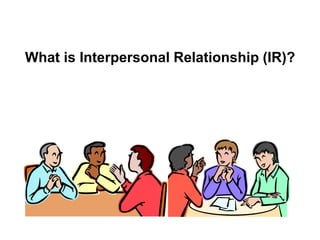
What is Interpersonal Relationship (IR)?
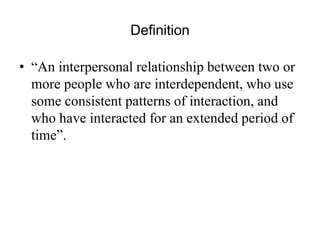
Definition
• “An interpersonal relationship between two or
more people who are interdependent, who use
some consistent patterns of interaction, and
who have interacted for an extended period of
time”.
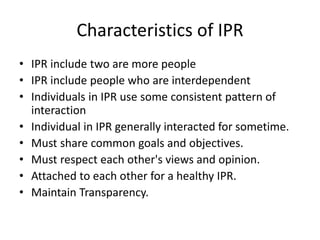
Characteristics of IPR
• IPR include two are more people
• IPR include people who are interdependent
• Individuals in IPR use some consistent pattern of
interaction
• Individual in IPR generally interacted for sometime.
• Must share common goals and objectives.
• Must respect each other's views and opinion.
• Attached to each other for a healthy IPR.
• Maintain Transparency.
Importance of IPR
• Need for inclusion
• Help in Decision
• Need for appreciation
• Need for caring person around
• Need for control
Purposes
• It serves as an intellectual and emotional bond
between the nurse and the client and is focused
on the client.
• To maintain the dignity of the profession.
• To respect and obey the law.
• To demonstrate personal integrity.
• To cooperate with parent and other to improve
the public schools of the community.
Types of Interpersonal Relationships
• Friendship
• Love
• Family
• Romantic
• Professional Relationship
Phases of Interpersonal Relationships
• Pre interaction phases.
• Introductory phases.
• Working Phases.
• Termination Phases.
Barriers………
• Mistrust
• Fear of rejection.
• Need for approval.
• Insecurity.
• Inflexibility.
• Lack of autonomy.(tendency to function
independently)
• Lack of communication.
Cont……….
• Avoidance of conflict.
• Fear of intimacy. Closeness attachment
• Need for control.
• Need for power.
• Irresponsible
• Low self-esteem
• Lack of healthy role models
Cont……..
• Chronic hostility
• Lack of positive reinforcement.
• Over dependence
• Chronic depression
• Avoidance of risk taking.
Method of overcoming barrier
• Step 1-admit you have a problem in your
relationship.
• Step 2-after step 1+ decide which of the barrier
• Step3-listed the problem and symptom in
1+2+share with your partner.
• Step 4-with your partners response + compare
+anlysis+agree and disagree point.
• Step 5-develop a plan
• Step 6- develop a plan and action on each plan.
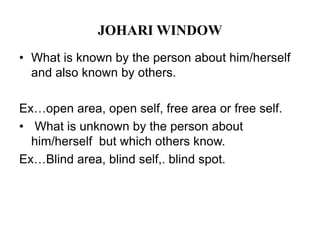
JOHARI WINDOW
• What is known by the person about him/herself
and also known by others.
Ex…open area, open self, free area or free self.
• What is unknown by the person about
him/herself but which others know.
Ex…Blind area, blind self,. blind spot.
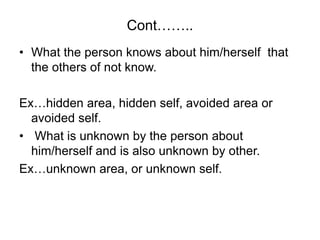
Cont……..
• What the person knows about him/herself that
the others of not know.
Ex…hidden area, hidden self, avoided area or
avoided self.
• What is unknown by the person about
him/herself and is also unknown by other.
Ex…unknown area, or unknown self.
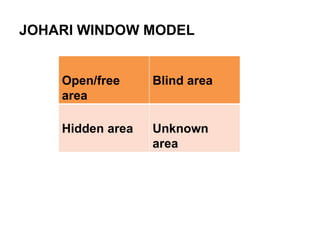
JOHARI WINDOW MODEL
Open/free
area
Blind area
Hidden area Unknown
area
Summary
We have discussed on
 Definition
 Purposes .
 Advantages
 Disadvantages
BIBLIOGRAPHY:--
1. B.T Basavanthappa,Nursing Education,2nd
edition.
2. KP.Neeraja,Textbook of nursing education,
1st Edition .
3. K.L.kumar educational technology, 2nd
Edition .
4. S.kanaka lakshimi communication and
educational technology, 1st Edition.
5. www.google.co.in
Interpersonal relation

Interpersonal relation

  • 1.
  • 2.
    Topic- Interpersonal relation Contributor-Ms.Darshana Kumari Wankhede DEPT OF CHILD HEALTH NURSING SRMMCOLLEGE OF NURSING
  • 3.
    Purpose of statement Atthe end of the class the students will be able to; Define IPR , Enlist the purposes IPR , Describe the types of IPR , Explain the advantages , Describe the disadvantages
  • 4.
    Sr. no LearningObjective Domain Level Criteria Condition 1 Define IPR Cognitive Must know All 2 Enlist the purposes IPR Cognitive Must know All 3 Describe the types of IPR Cognitive Nice to know All 4 Explain the advantages Cognitive Nice to know All 5 Describe the disadvantages Cognitive Nice to know All Learning Objective At the end of the class the group will able to
  • 5.
    • No matterhow hard you work or how many brilliant ideas you may have, if you can’t connect with the people who work around you, your professional life will suffer.
  • 6.
    . • INTERPERSONAL RELATIONSHIP- “ASSOCIATIONBETWEEN TWO OR MORE PERSONS.”
  • 7.
    What is InterpersonalRelationship (IR)?
  • 8.
    Definition • “An interpersonalrelationship between two or more people who are interdependent, who use some consistent patterns of interaction, and who have interacted for an extended period of time”.
  • 9.
    Characteristics of IPR •IPR include two are more people • IPR include people who are interdependent • Individuals in IPR use some consistent pattern of interaction • Individual in IPR generally interacted for sometime. • Must share common goals and objectives. • Must respect each other's views and opinion. • Attached to each other for a healthy IPR. • Maintain Transparency.
  • 10.
    Importance of IPR •Need for inclusion • Help in Decision • Need for appreciation • Need for caring person around • Need for control
  • 11.
    Purposes • It servesas an intellectual and emotional bond between the nurse and the client and is focused on the client. • To maintain the dignity of the profession. • To respect and obey the law. • To demonstrate personal integrity. • To cooperate with parent and other to improve the public schools of the community.
  • 12.
    Types of InterpersonalRelationships • Friendship • Love • Family • Romantic • Professional Relationship
  • 13.
    Phases of InterpersonalRelationships • Pre interaction phases. • Introductory phases. • Working Phases. • Termination Phases.
  • 14.
    Barriers……… • Mistrust • Fearof rejection. • Need for approval. • Insecurity. • Inflexibility. • Lack of autonomy.(tendency to function independently) • Lack of communication.
  • 15.
    Cont………. • Avoidance ofconflict. • Fear of intimacy. Closeness attachment • Need for control. • Need for power. • Irresponsible • Low self-esteem • Lack of healthy role models
  • 16.
    Cont…….. • Chronic hostility •Lack of positive reinforcement. • Over dependence • Chronic depression • Avoidance of risk taking.
  • 17.
    Method of overcomingbarrier • Step 1-admit you have a problem in your relationship. • Step 2-after step 1+ decide which of the barrier • Step3-listed the problem and symptom in 1+2+share with your partner. • Step 4-with your partners response + compare +anlysis+agree and disagree point. • Step 5-develop a plan • Step 6- develop a plan and action on each plan.
  • 18.
    JOHARI WINDOW • Whatis known by the person about him/herself and also known by others. Ex…open area, open self, free area or free self. • What is unknown by the person about him/herself but which others know. Ex…Blind area, blind self,. blind spot.
  • 19.
    Cont…….. • What theperson knows about him/herself that the others of not know. Ex…hidden area, hidden self, avoided area or avoided self. • What is unknown by the person about him/herself and is also unknown by other. Ex…unknown area, or unknown self.
  • 20.
    JOHARI WINDOW MODEL Open/free area Blindarea Hidden area Unknown area
  • 21.
    Summary We have discussedon  Definition  Purposes .  Advantages  Disadvantages
  • 22.
    BIBLIOGRAPHY:-- 1. B.T Basavanthappa,NursingEducation,2nd edition. 2. KP.Neeraja,Textbook of nursing education, 1st Edition . 3. K.L.kumar educational technology, 2nd Edition . 4. S.kanaka lakshimi communication and educational technology, 1st Edition. 5. www.google.co.in